
A complete issue · 37 pages · 1926
Judge — June 26, 1926
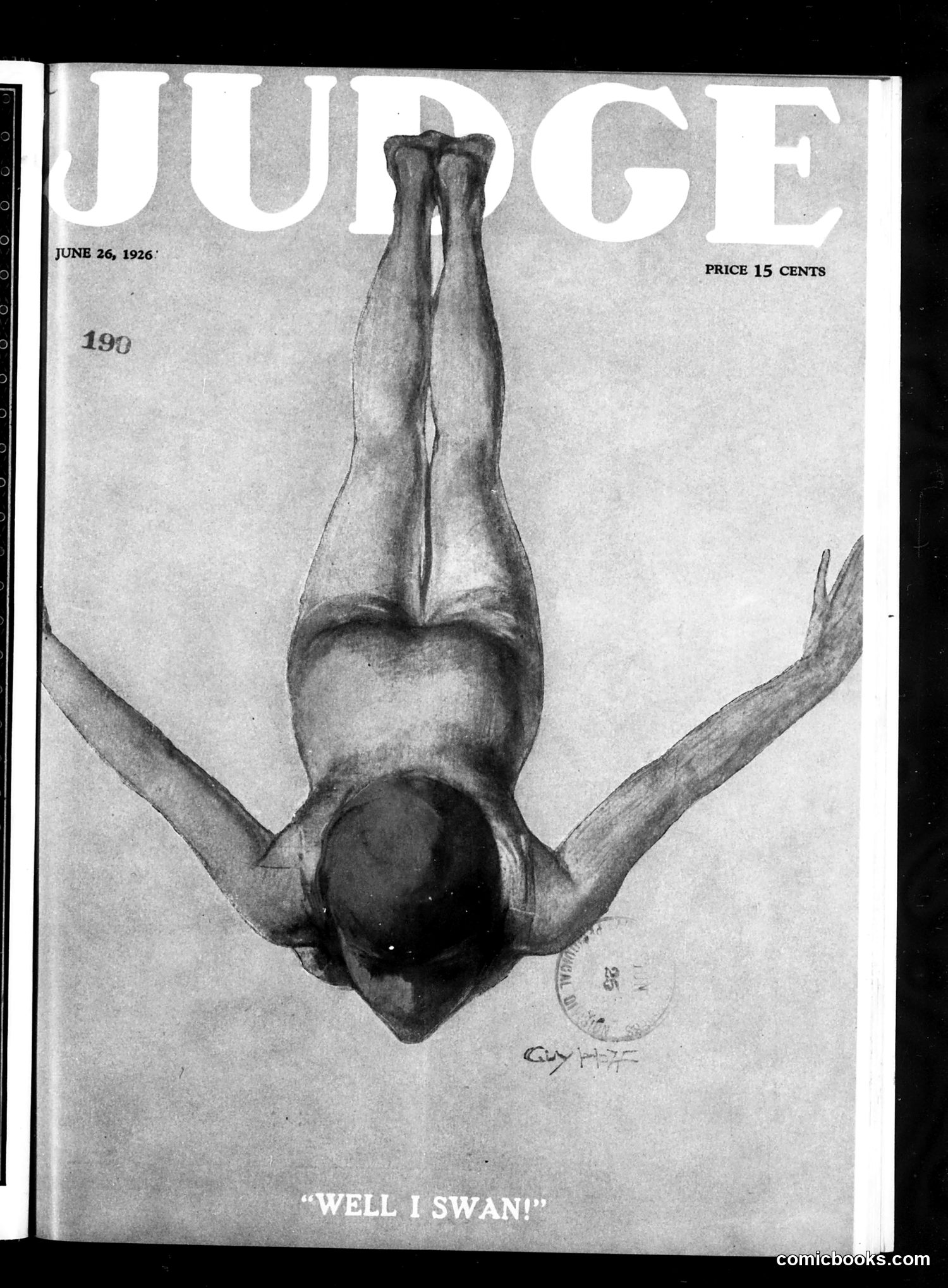
**June 26, 1926 | Issue 190** This cover depicts a figure performing a swan dive, viewed from above. The caption reads "Well I Swan!" — a play on words combining the diving posture with the exclamation "Well, I swear!" The image appears to be a straightforward visual pun rather than political satire. The humor derives from the homophone: a person executing a "swan dive" (a diving technique with arms spread) while the phrase mimics colloquial speech. This was typical Judge magazine content—clever visual wordplay aimed at middle-class readers. Without additional context, the figure's specific identity remains unclear, though the artistic rendering suggests this may reference a popular swimmer or diving athlete of 1926.
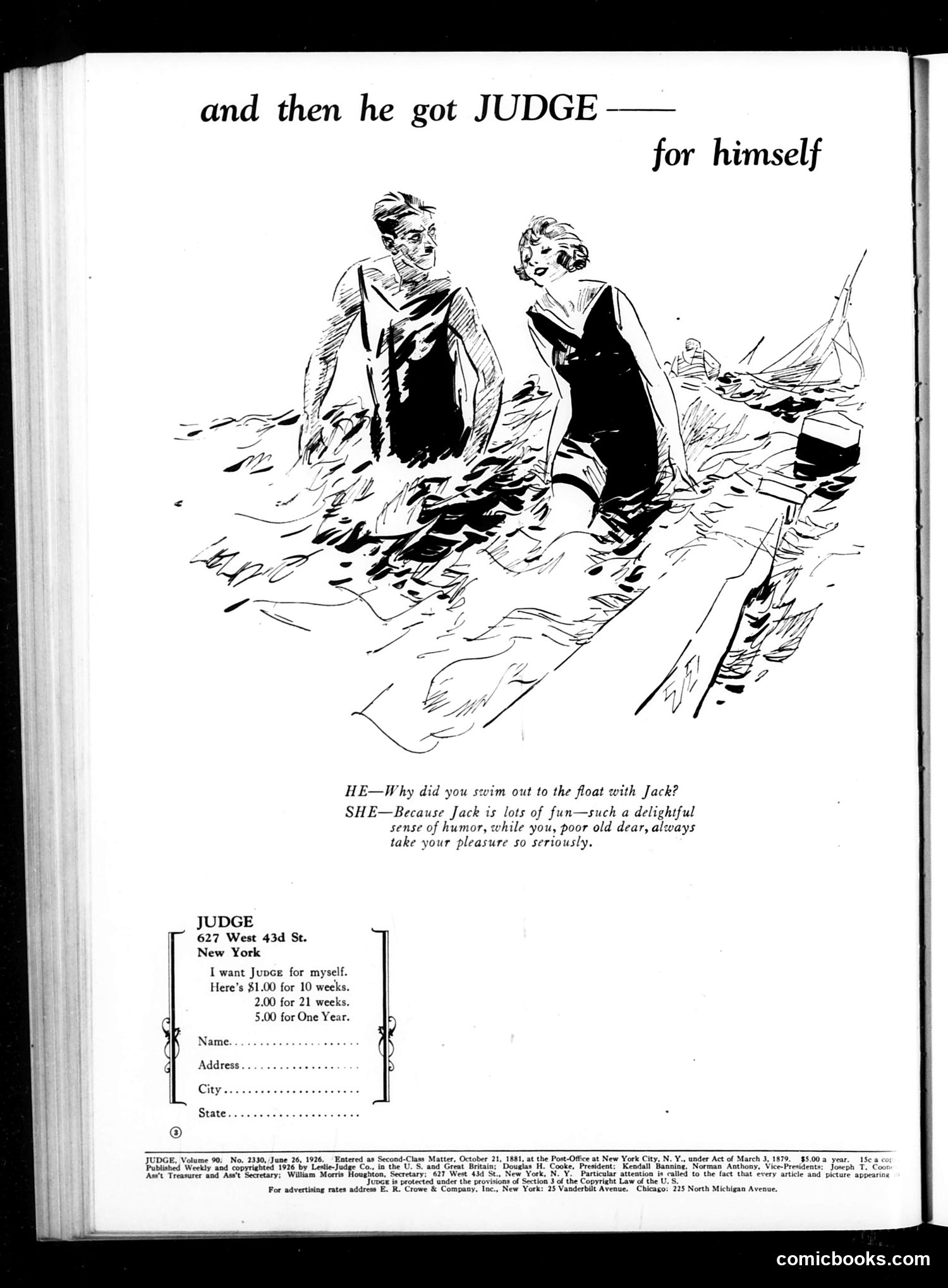
This page from *Judge* magazine (June 28, 1928) contains a single-panel cartoon satirizing marital dynamics. The caption "and then he got JUDGE—for himself" suggests the husband has obtained a subscription to the magazine. The accompanying dialogue depicts a wife criticizing her husband's serious temperament, praising another man ("Jack") for his sense of humor and fun. The husband's response—getting a *Judge* subscription—appears to be his attempt to acquire the humor and levity his wife desires. The satire targets both husbands seeking self-improvement through consumer goods and wives' complaints about spouses lacking playfulness. Below is a subscription advertisement for *Judge*, capitalizing on the cartoon's premise that the magazine offers humor and entertainment value.
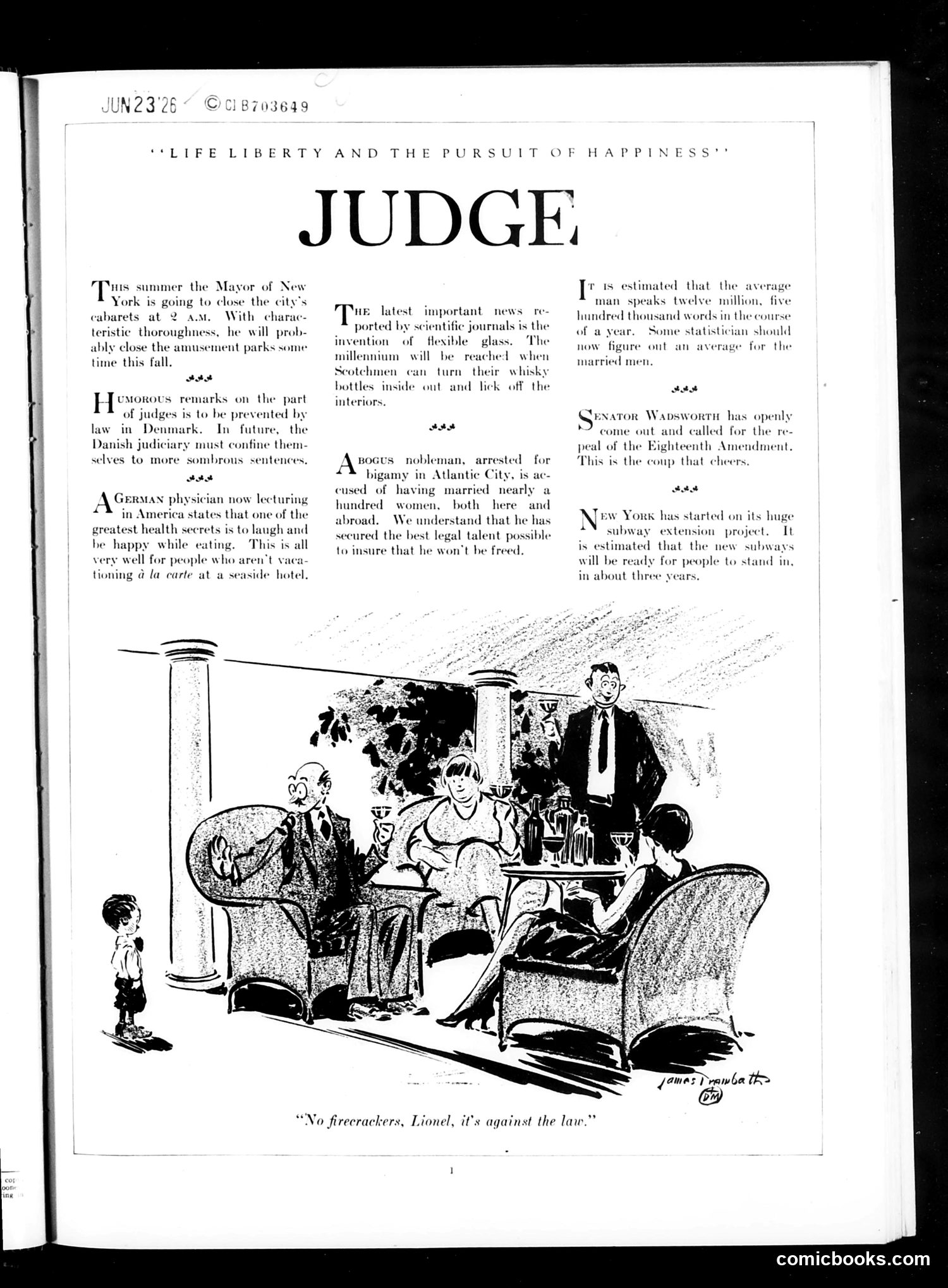
This page features social and political commentary typical of Judge magazine's satirical style. The main cartoon depicts an adult telling a young boy "No firecrackers, Lionel, it's against the law"—likely satirizing overly restrictive regulations or the tension between childhood freedom and governmental control. The text snippets address various contemporary issues: the Mayor of New York closing cabarets (Prohibition-era enforcement), flexible glass invention, humorous observations about judicial sentencing in Denmark, a German physician's health advice, Senator Wadsworth's call to repeal the Eighteenth Amendment, and New York's subway expansion project. The overall tone mixes humor with social criticism, targeting government overreach, legal absurdities, and public policy debates of the period.
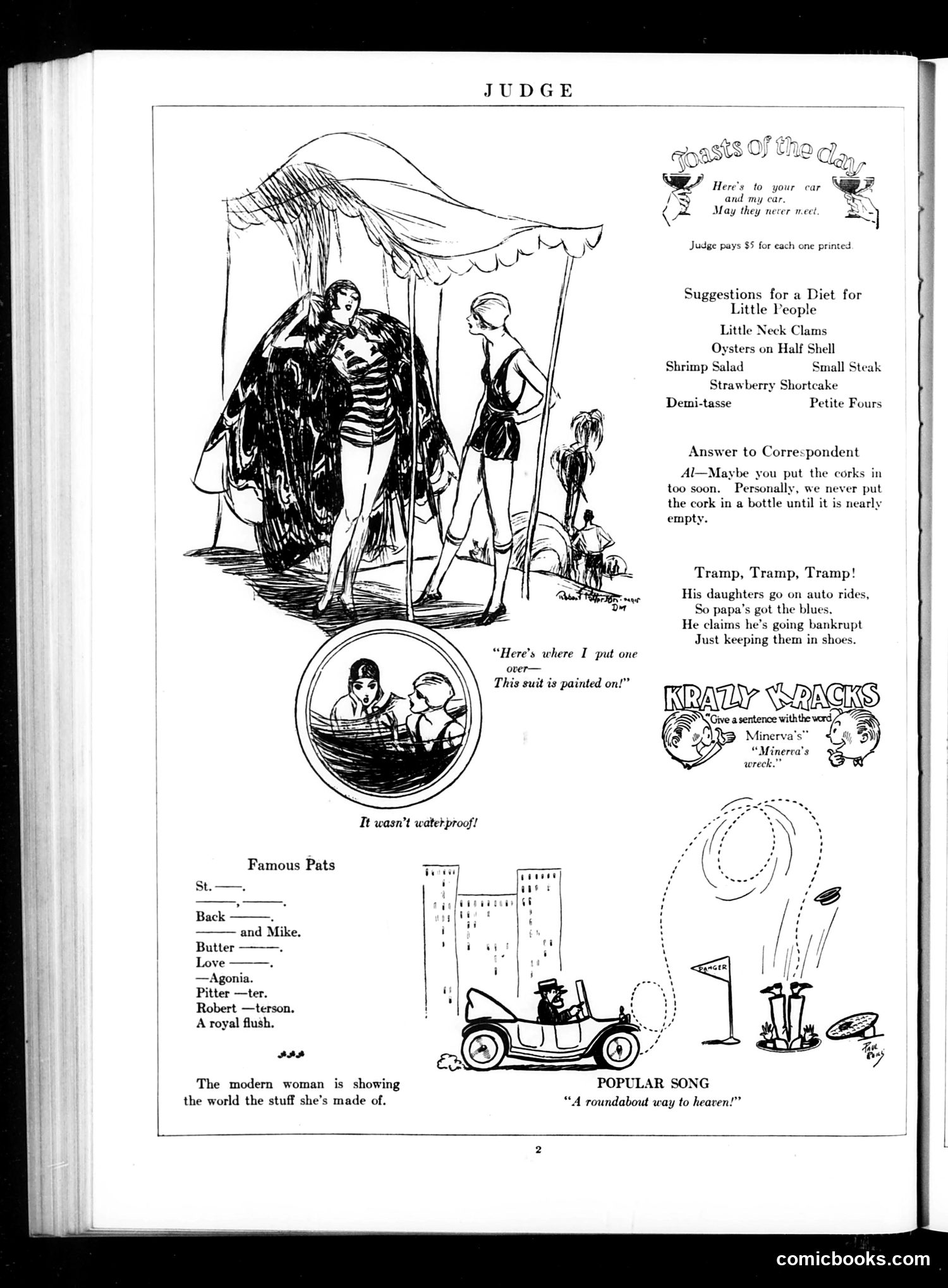
This page contains humor and advertisements typical of Judge's satirical content. The main cartoon depicts a woman at a beach or resort tent, with the caption "Here's where I put one over on him—This suit is painted on!" The joke satirizes modern fashion—specifically women's increasingly revealing bathing suits of what appears to be the 1920s era—and the deception involved in their appearance. The "Famous Fats" section mocks prominent figures through unflattering nicknames, though specific identities are unclear without additional context. The "Popular Song" cartoon about a car taking "a roundabout way to heaven" likely satirizes dangerous driving habits. Overall, the page reflects anxieties about changing women's fashion, behavior, and modernity characteristic of post-WWI American humor.
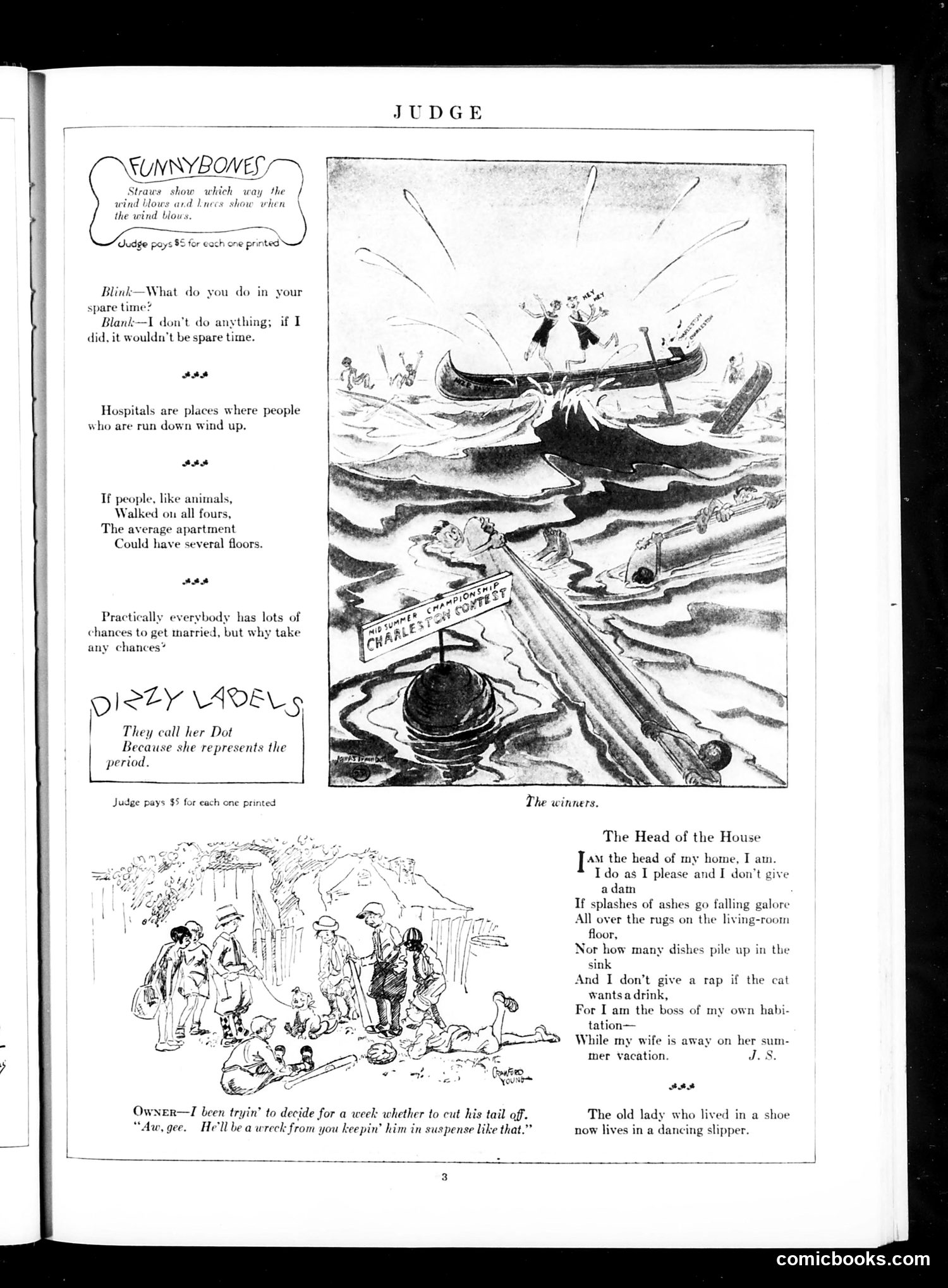
This page contains humor columns and illustrations typical of early 20th-century Judge magazine. The content includes: **"Funny Bones"** - Brief jokes about spare time, hospitals, and apartment living—standard domestic humor with no specific political reference. **"Dizzy Labels"** - A pun on women's menstruation ("Dot" as slang for the period). **"The Head of the House"** - A poem about a husband's domestic authority while his wife vacations, humorously cataloging his indifference to household disorder. **Illustrations** - Include a beach/seaside scene labeled "The winters" and a hobo camp scene. The hobo cartoon appears to reference Depression-era unemployment or vagrancy. **"The old lady who lived in a shoe"** - A nursery rhyme reference, updated to a "dancing slipper." The page represents general-audience humor rather than pointed political satire, focusing on domestic situations and wordplay.
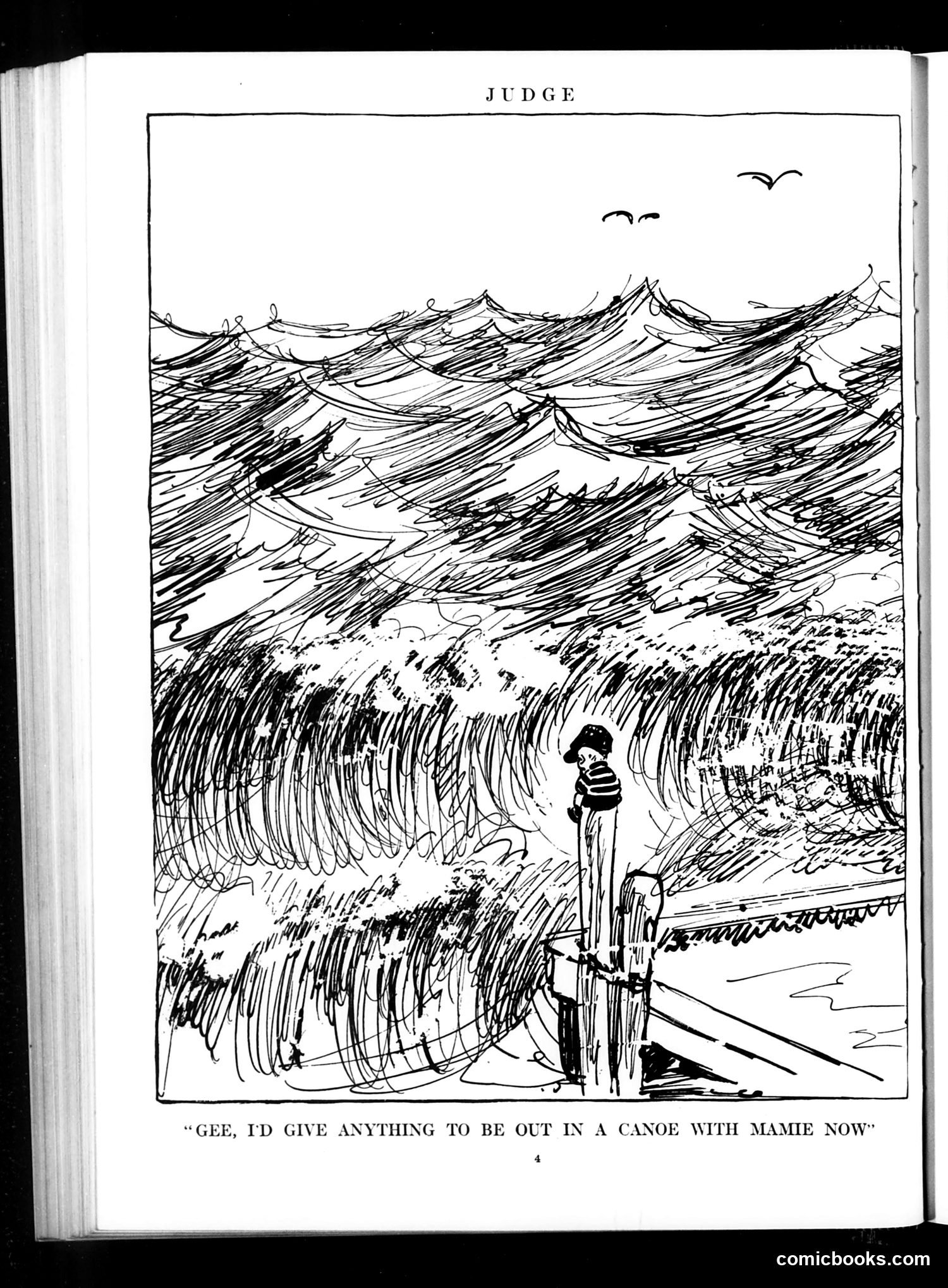
This cartoon depicts a man standing on a wooden post, gazing longingly at rough ocean waves. The caption reads: "GEE, I'D GIVE ANYTHING TO BE OUT IN A CANOE WITH MAMIE NOW." The humor appears to center on romantic longing—the speaker desperately wishes to be with someone named "Mamie" in a canoe, despite the dangerous, turbulent seas shown. The satire likely mocks idealized romantic notions: a canoe in such violent waters would be impractical and perilous, yet love makes the speaker oblivious to reality. Without additional context, it's unclear if "Mamie" references a specific public figure. The cartoon simply expresses how romantic infatuation can cloud judgment about actual circumstances and safety.
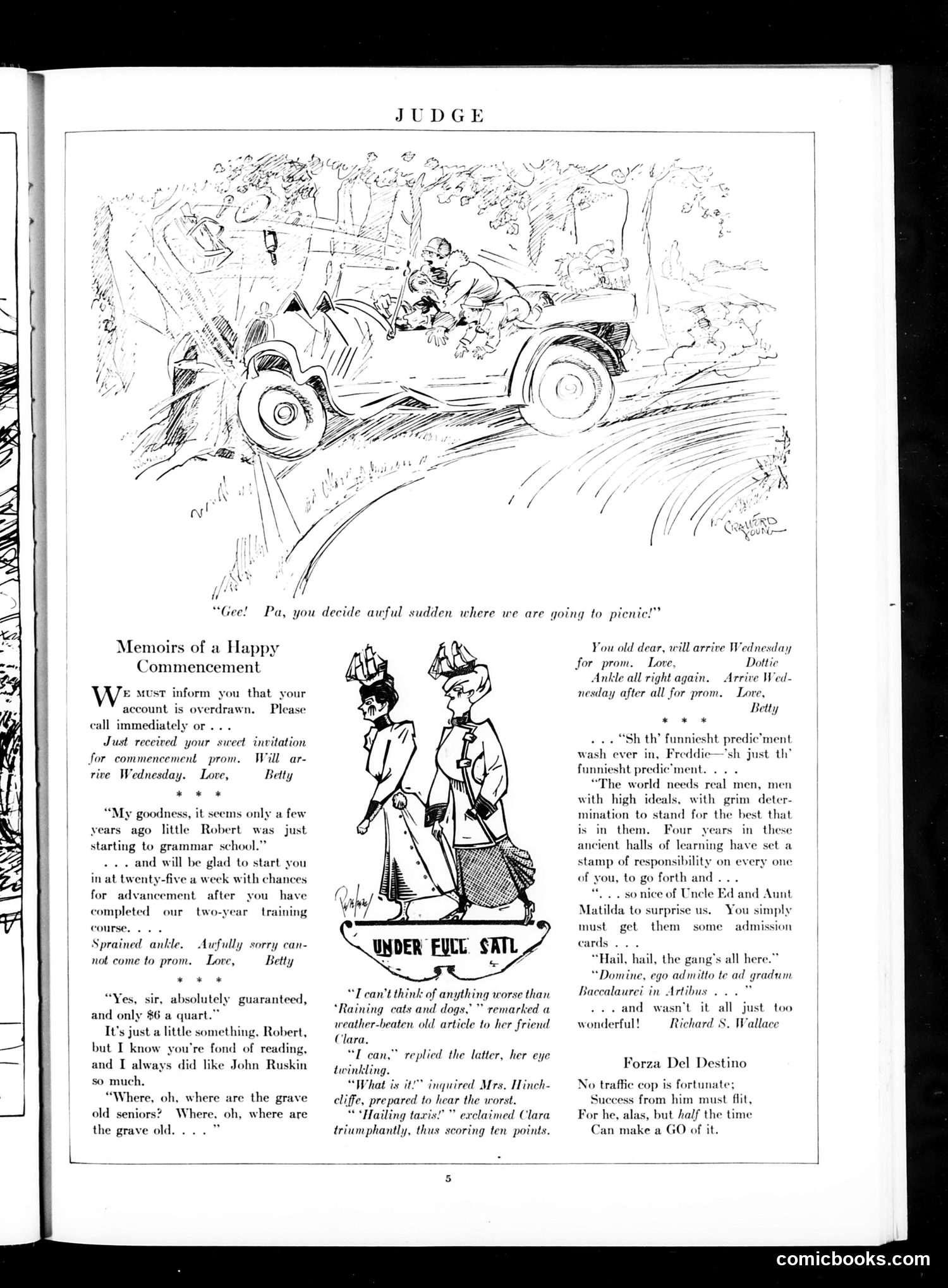
The main cartoon depicts a car on a winding road with passengers, captioned "Gee! Pa, you decide awful sudden where we are going to picnic!" This appears to be satirizing sudden, impulsive decision-making, likely reflecting early 20th-century automobile culture and family outings. The page contains several miscellaneous items: "Memoirs of a Happy Commencement" features brief comedic letters about graduation and prom mishaps. The "Under Full Sail" section shows two women and includes humorous exchanges about dating and social etiquette. The remaining content comprises short jokes and observations about everyday life—overdrawn bank accounts, grammar school, reading habits, and social embarrassments. This represents typical Judge magazine fare: light domestic humor targeting middle-class American readers of the era.
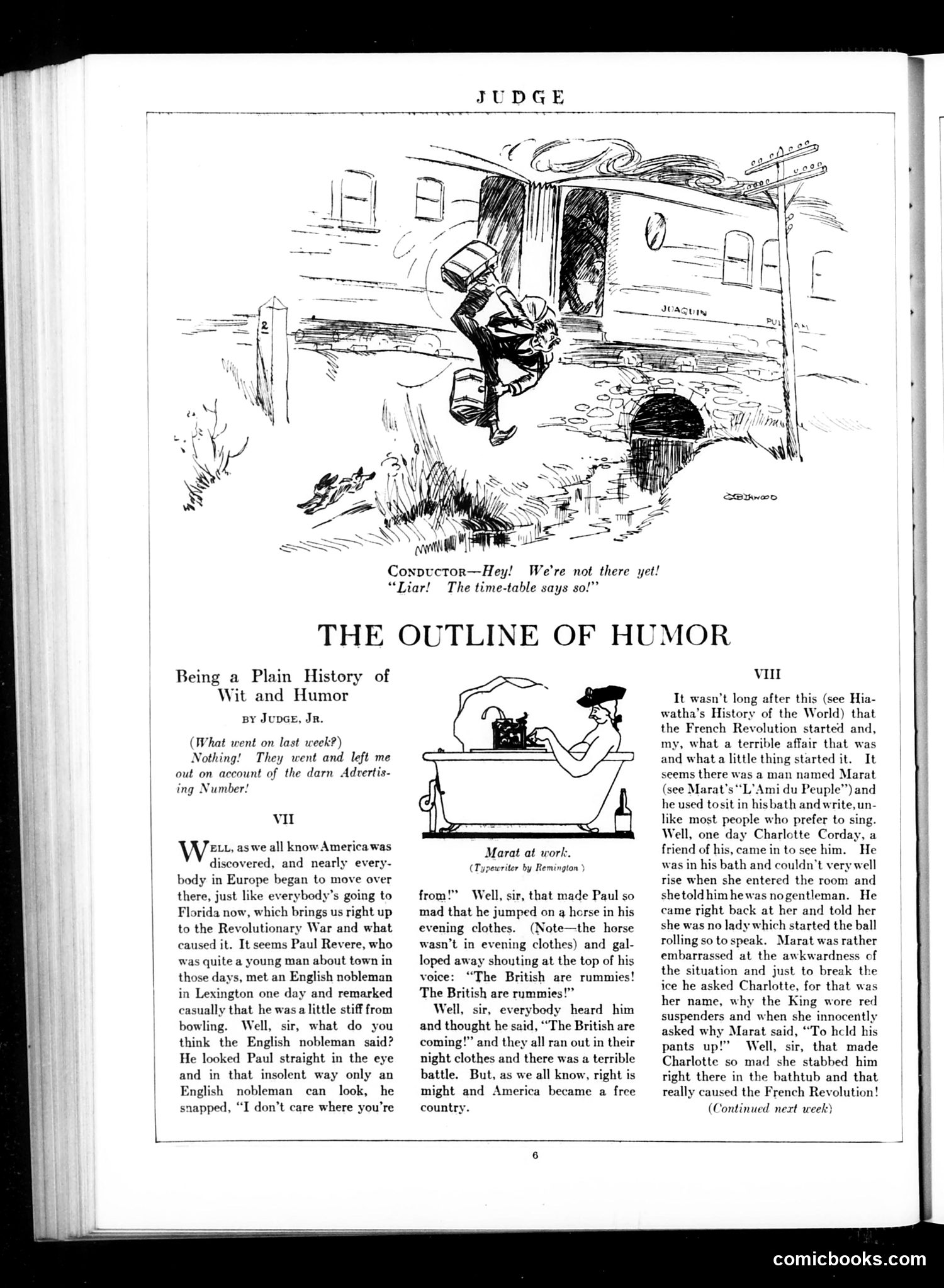
This page satirizes historical narratives by deliberately inverting causality with absurd humor. The top cartoon shows a conductor ejecting a passenger, claiming the timetable says they're "not there yet" — a visual gag about schedules and expectations. The main text mockingly "explains" major historical events through trivial incidents. Paul Revere's famous midnight ride supposedly resulted from an English nobleman's rudeness about bowling stiffness, not genuine revolutionary alarm. More pointedly, the French Revolution is attributed entirely to Marat and Charlotte Corday's bathroom quarrel over red suspenders — a crude joke reducing serious historical upheaval to domestic embarrassment and crude innuendo. Judge Jr. is lampooning how simplified popular histories reduce complex events to anecdotes and personalities, while also poking fun at contemporary fascination with sensationalized historical narratives. The irreverent tone mocks both grand historical pretension and readers' appetite for reductive explanations.
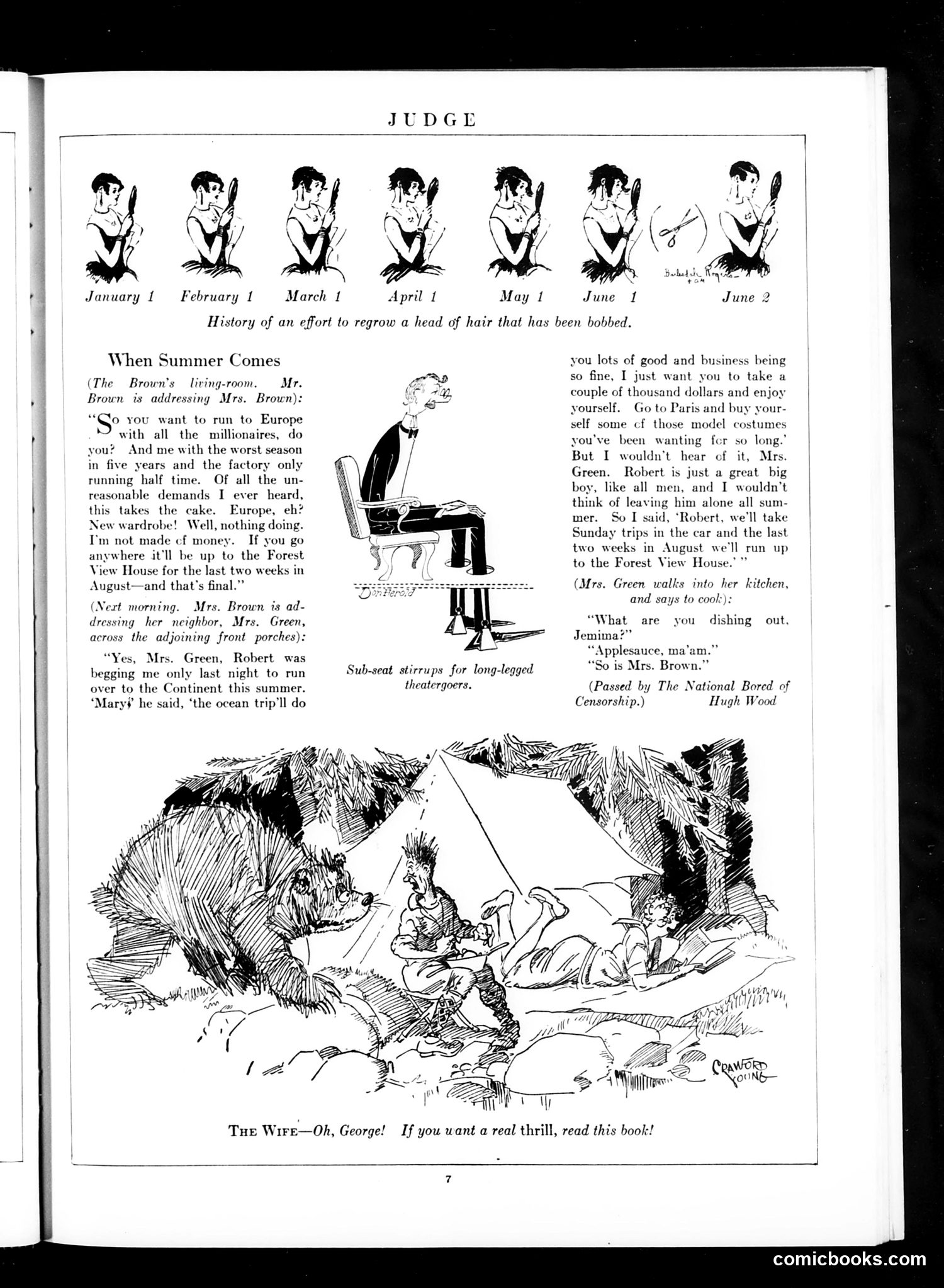
This page contains three separate satirical pieces: 1. **Top strip**: "History of an effort to regrow a head of hair that has been bobbed" — A visual joke tracking hair regrowth from January to June. "Bobbed" hair (short, fashionable cuts) was controversial in the 1920s, so this mocks women attempting to grow it back, likely due to social pressure. 2. **"When Summer Comes"**: Mr. Brown refuses his wife's request for a European vacation, citing financial hardship (poor factory season). Mrs. Brown then brags to her neighbor that *her* husband Robert begged *her* to go to Paris, claiming she virtuously refused. The satire exposes her transparent lie—she's simply repeating her husband's rejection while pretending the opposite occurred to save face socially. 3. **"Sub-seat stirrups" cartoon**: A humorous design suggestion for tall theater-goers' leg room. The overall tone mocks middle-class pretension and marital dynamics of the era.
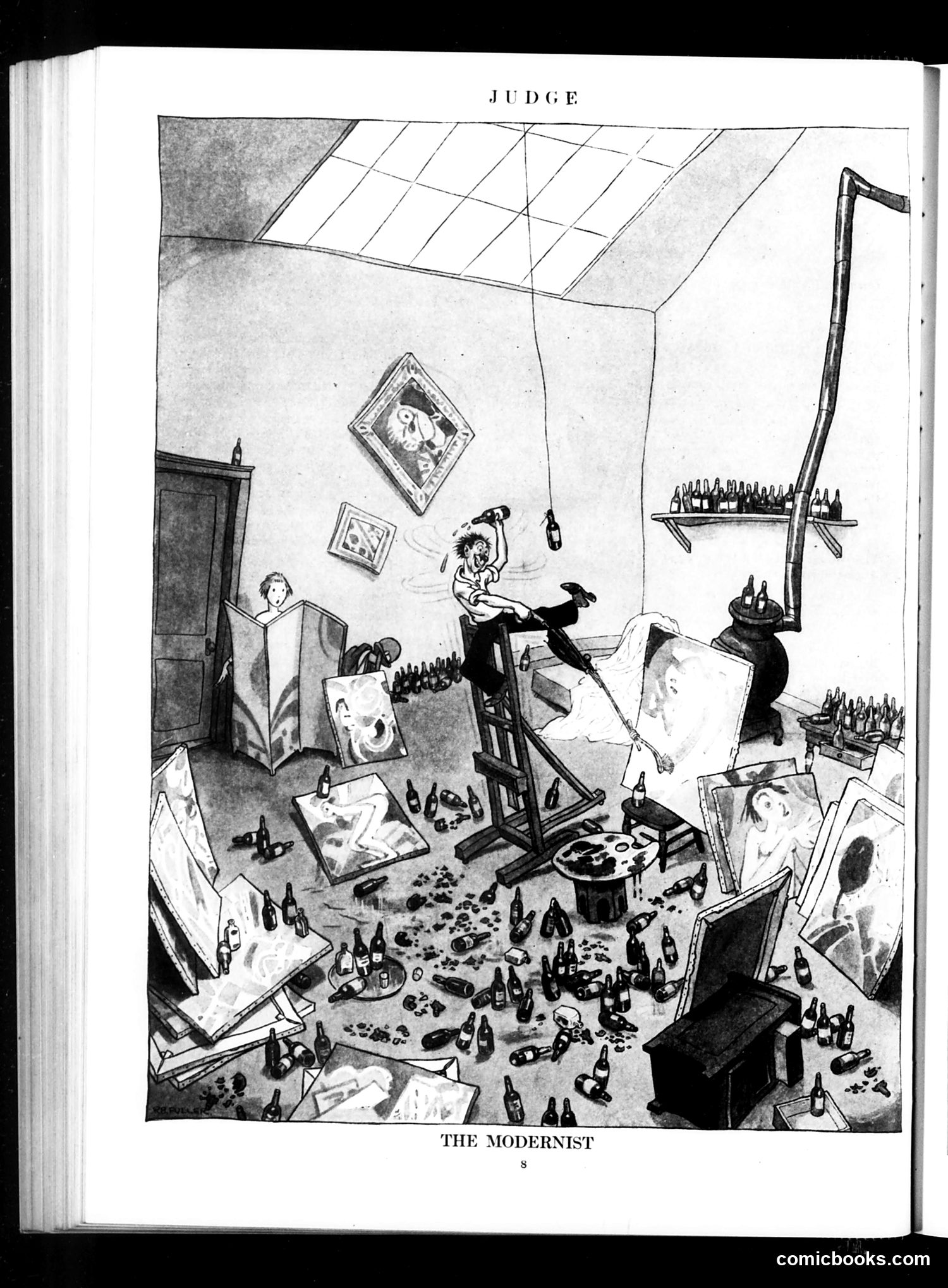
This satirical cartoon titled "The Modernist" depicts an artist's chaotic studio overflowing with empty bottles, scattered sketches, and art supplies in disarray. The central figure appears to be a bohemian artist suspended mid-swing or dramatic pose, surrounded by paintings and portraits leaning against walls. The satire targets early modernist artists and their work methods—suggesting they were reckless, intoxicated, or working in anarchic conditions. The abundance of bottles implies alcoholism or dissolute living, while the scattered, unfinished canvases mock modernist aesthetics as incomprehensible or chaotic rather than skillfully composed. Judge magazine's conservative stance shines through, ridiculing avant-garde artistic movements popular in early 20th-century America as the work of eccentric, disorganized individuals rather than serious craftspeople.
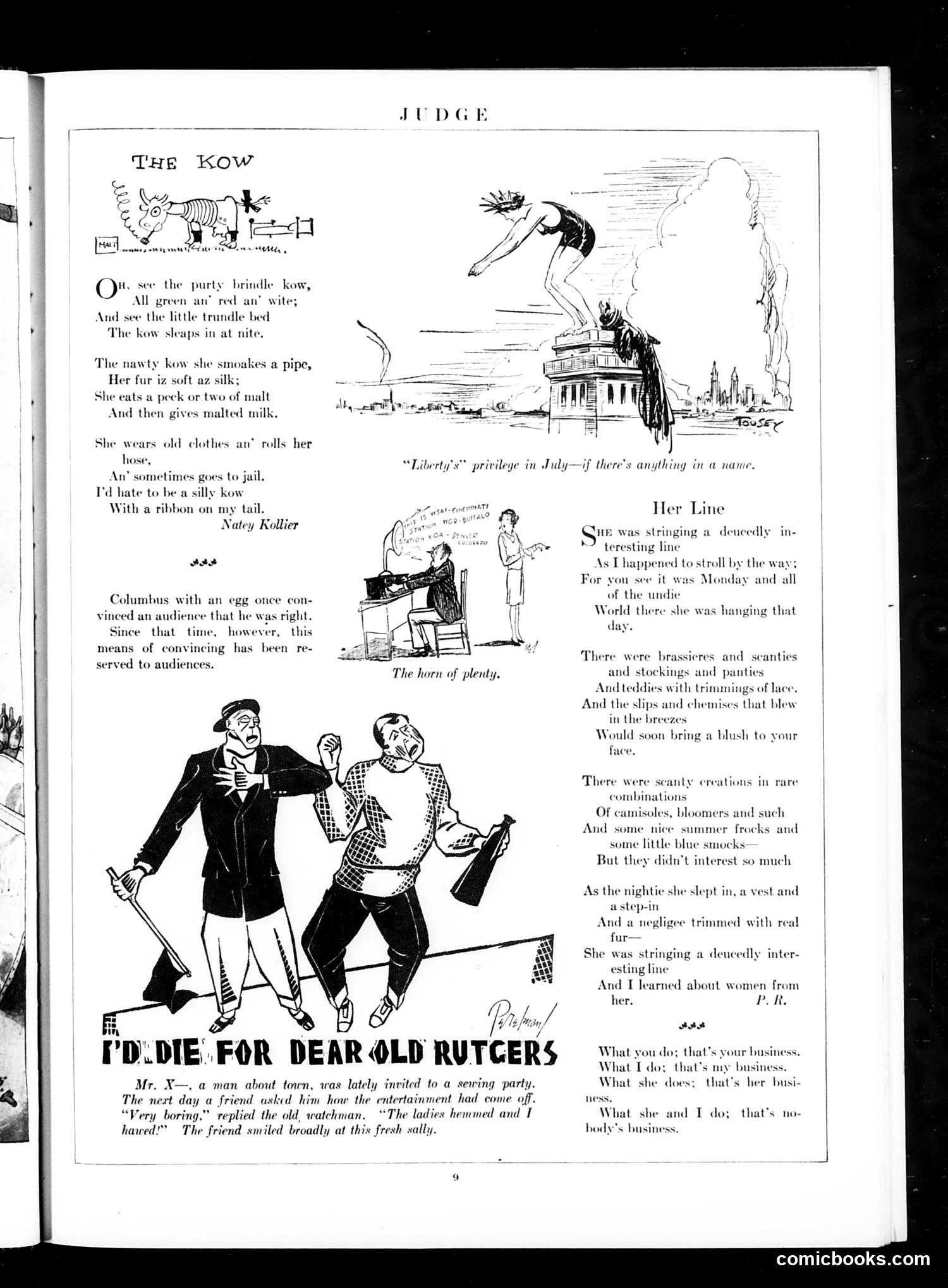
**"The Kow"** is a humorous dialect poem mocking rural or working-class speech patterns ("purty brindle kow," "nawty kow she smoakes a pipe"). The joke satirizes unsophisticated diction and grammar while describing an absurdly anthropomorphized cow who smokes, drinks malted milk, wears clothes, and goes to jail—a nonsensical creature presented deadpan. **"Her Line"** uses a double entendre: a man observing a woman hanging laundry (undergarments, slips, negligees) outdoors, framed as her "stringing an interesting line." The humor plays on the suggestiveness of intimate apparel while maintaining plausible deniability about what makes the "line" interesting—whether the laundry itself or the woman. Both pieces exemplify Judge's characteristic style: irreverent wordplay, mild social commentary through exaggeration, and humor targeting working-class subjects and gender relations. The satire is gentle rather than pointed.
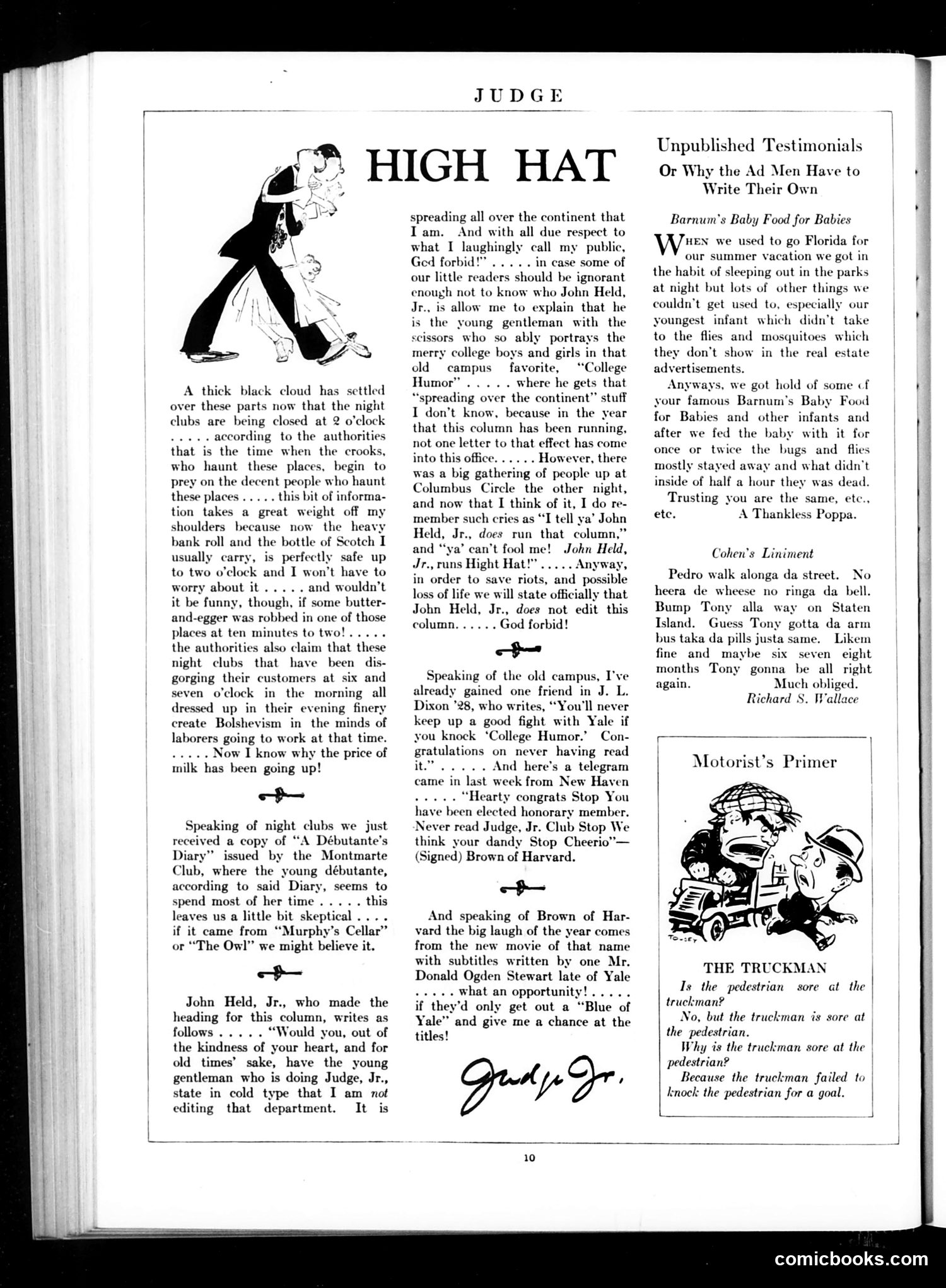
This page from **Judge** (a satirical weekly) contains a column called "High Hat" mocking 1920s nightlife and social pretensions. ## Main Content The lead essay satirizes recent **2 a.m. nightclub closures**, claiming they protect patrons from robbery—yet absurdly suggesting crooks only operate after 2 a.m. The author mocks authorities' claim that late-night club culture creates "Bolshevism" among working laborers, sarcastically linking it to rising milk prices. ## John Held Jr. Note A clarification states that **John Held Jr.** (famous cartoonist of college-themed humor and "flapper" culture) is *not* editing "Judge Jr." department, despite rumors "spreading over the continent." This appears self-promotional—establishing Held's prominence while disclaiming involvement. ## Campus Humor References The column references **"College Humor"** magazine and includes congratulatory telegrams from Yale and Harvard students, satirizing collegiate rivalry and the publication's appeal to Ivy League readers. ## Bottom Sections Additional small advertisements include testimonials for Barnum's Baby Food and "Motorist's Primer" (a joke about hitting pedestrians). The page reflects 1920s Prohibition-era nightclub culture and collegiate magazine circulation.
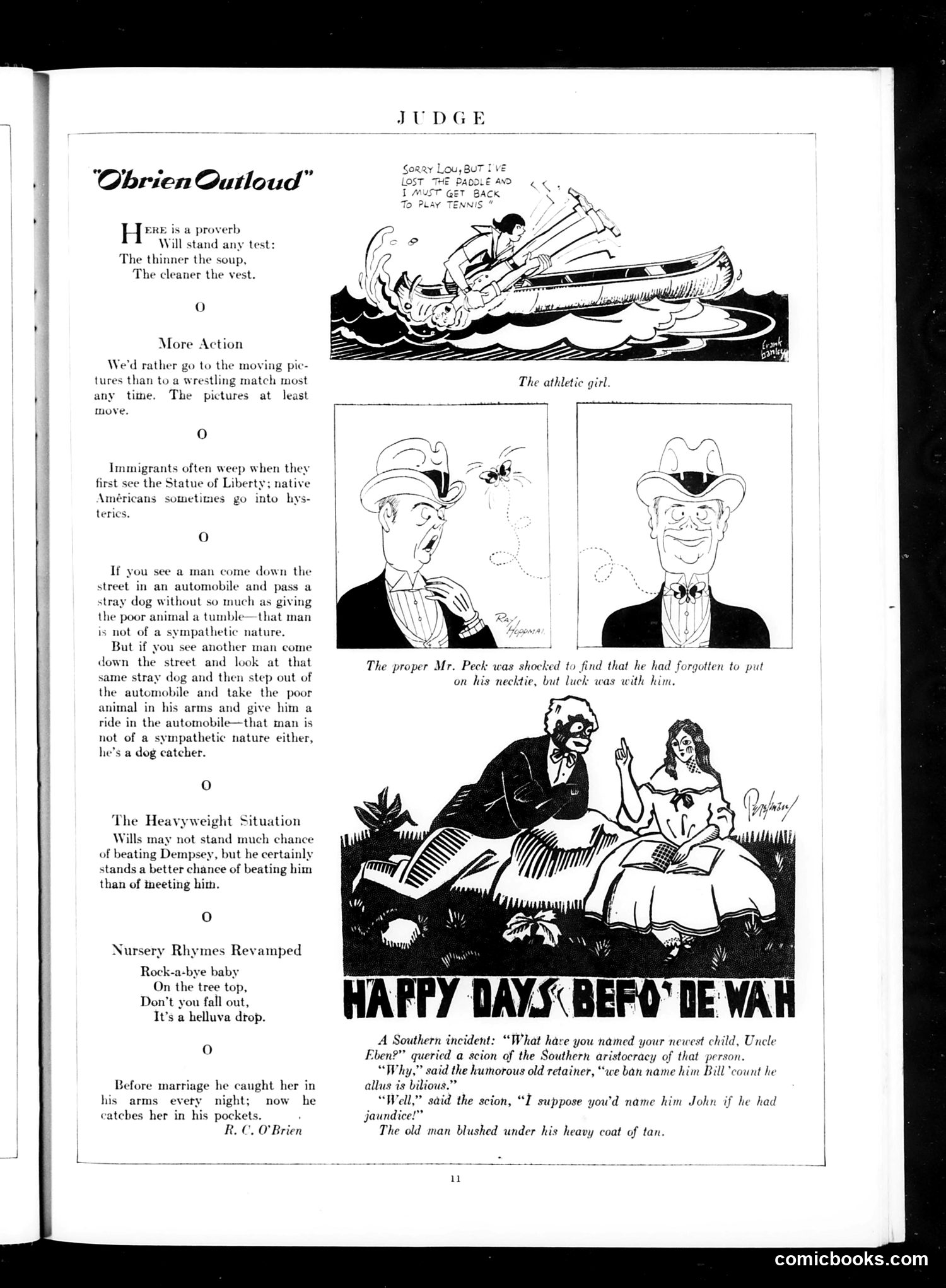
This page collects brief satirical observations and cartoons typical of Judge's social commentary. Key items: **"The Athletic Girl"**: Cartoons mocking a woman attempting tennis—she loses her paddle and appears disheveled, playing on early-1900s anxieties about women's athletics challenging gender norms. **"Happy Days Be Fo' De Wah"**: A racist caricature depicting enslaved or post-slavery Black Americans. The "Southern incident" joke relies on dialect humor and stereotypes—suggesting a formerly enslaved man would name his child "Bill" because he's "bilious" (ill), playing on racist pseudoscience about Black health. **General commentary**: Brief quips about immigration, automobiles, boxing (likely referencing the Dempsey-Wills heavyweight fight), marriage, and contemporary life. The page reflects Judge's editorial stance: mocking immigrants, women's changing roles, and relying heavily on racist caricature as "humor." The satire targets social change while perpetuating period stereotypes without irony.
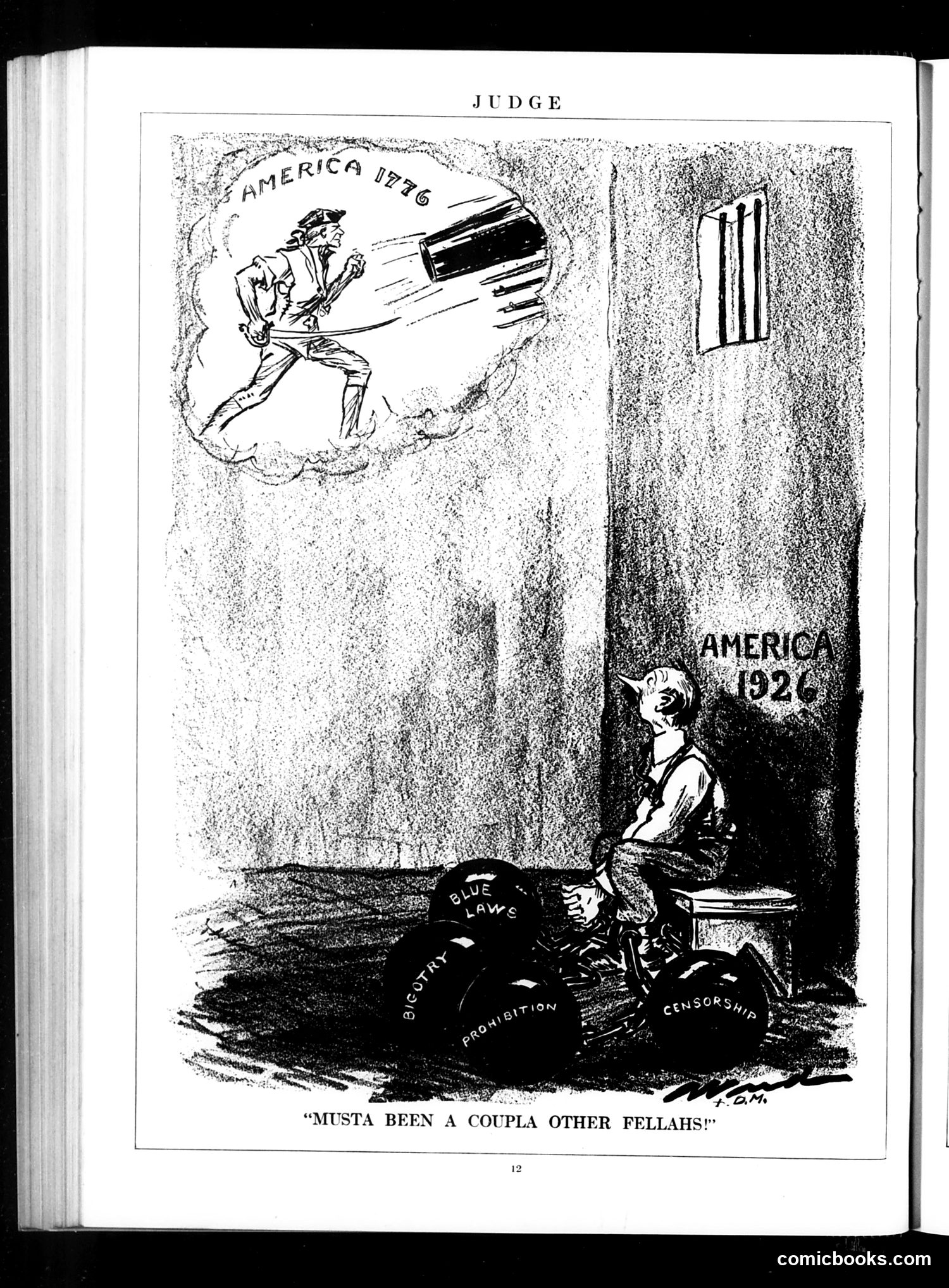
This Judge magazine cartoon compares America in 1976 (bicentennial year, shown in upper circle) with America in 1926. The upper figure depicts a revolutionary patriot wielding a torch—representing American independence and progress. The lower 1926 figure sits dejected in a prison cell, surrounded by chains labeled "Prohibition," "Censorship," and "Blue Laws." The caption "Musta Been a Coupla Other Fellahs" suggests bitter irony: the freedoms fought for in 1776 have been lost fifty years later through restrictive legislation. This satirizes 1920s social restrictions, particularly Prohibition (1920-1933), censorship efforts, and "Blue Laws" restricting behavior. The cartoon critiques how America has abandoned its founding principles of liberty through government overreach and moral legislation.
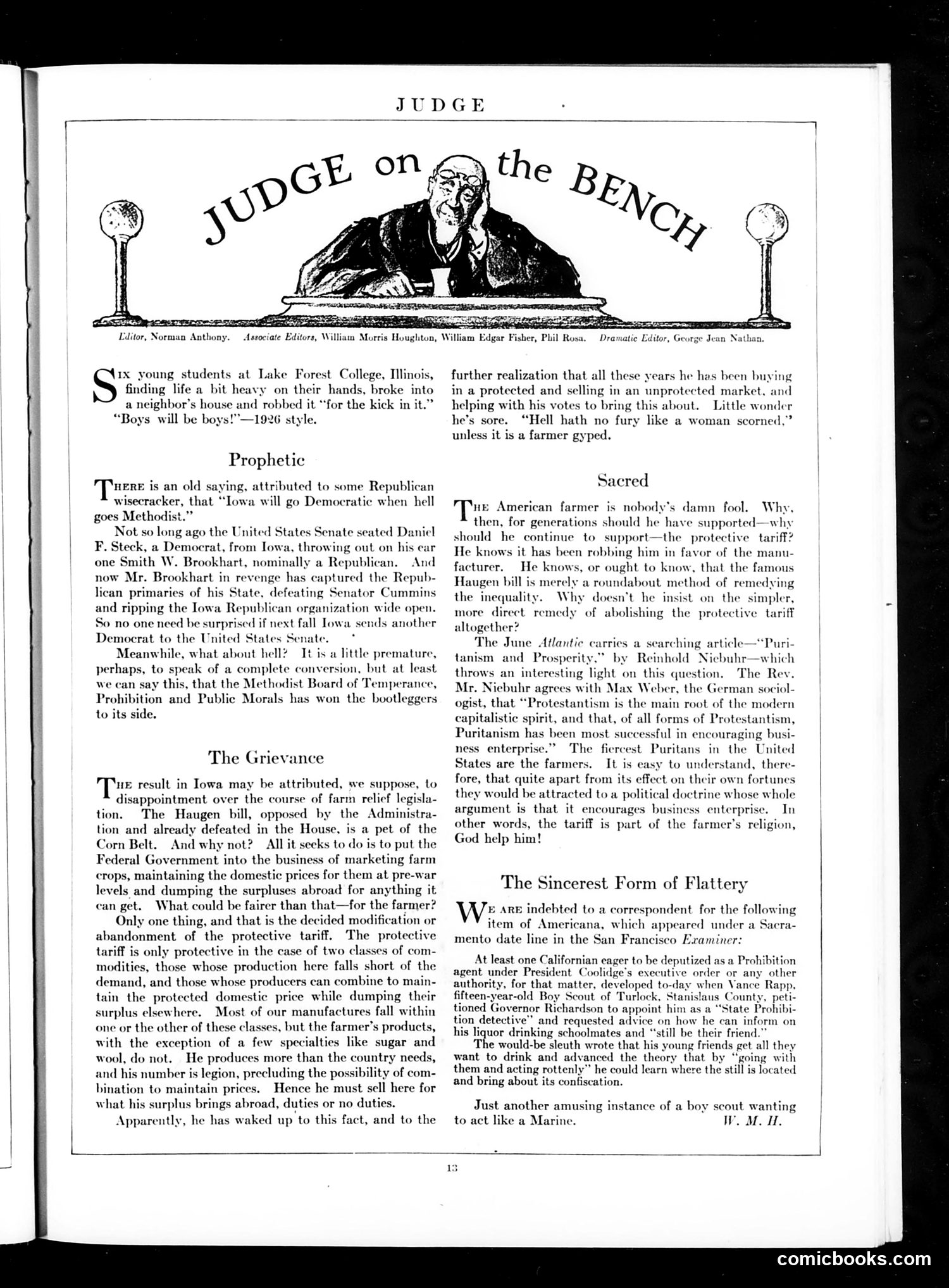
This page from *Judge* magazine satirizes American political and social issues of the 1920s through four editorial pieces: **"Prophetic"** mocks Iowa politics, noting that Democrat Daniel F. Steck's Senate victory contradicts the old saying "Iowa will go Democratic when hell goes Methodist"—yet Methodist Prohibition advocates have supposedly won over bootleggers. **"The Grievance"** critiques the failed Haugen Bill, farm relief legislation favored by the agricultural Corn Belt. The piece argues farmers are foolish to support protective tariffs that benefit manufacturers while harming agricultural producers who must sell surplus crops on unprotected markets. **"Sacred"** continues this argument, questioning why farmers support tariffs that exploit them, citing a *Atlantic Monthly* article linking Protestantism to capitalism. **"The Sincerest Form of Flattery"** reports humorous Americana anecdotes about Prohibition enforcement and Boy Scout misbehavior. The magazine's tone is sardonic, targeting political hypocrisy, economic policy failures, and social contradictions of 1920s America.
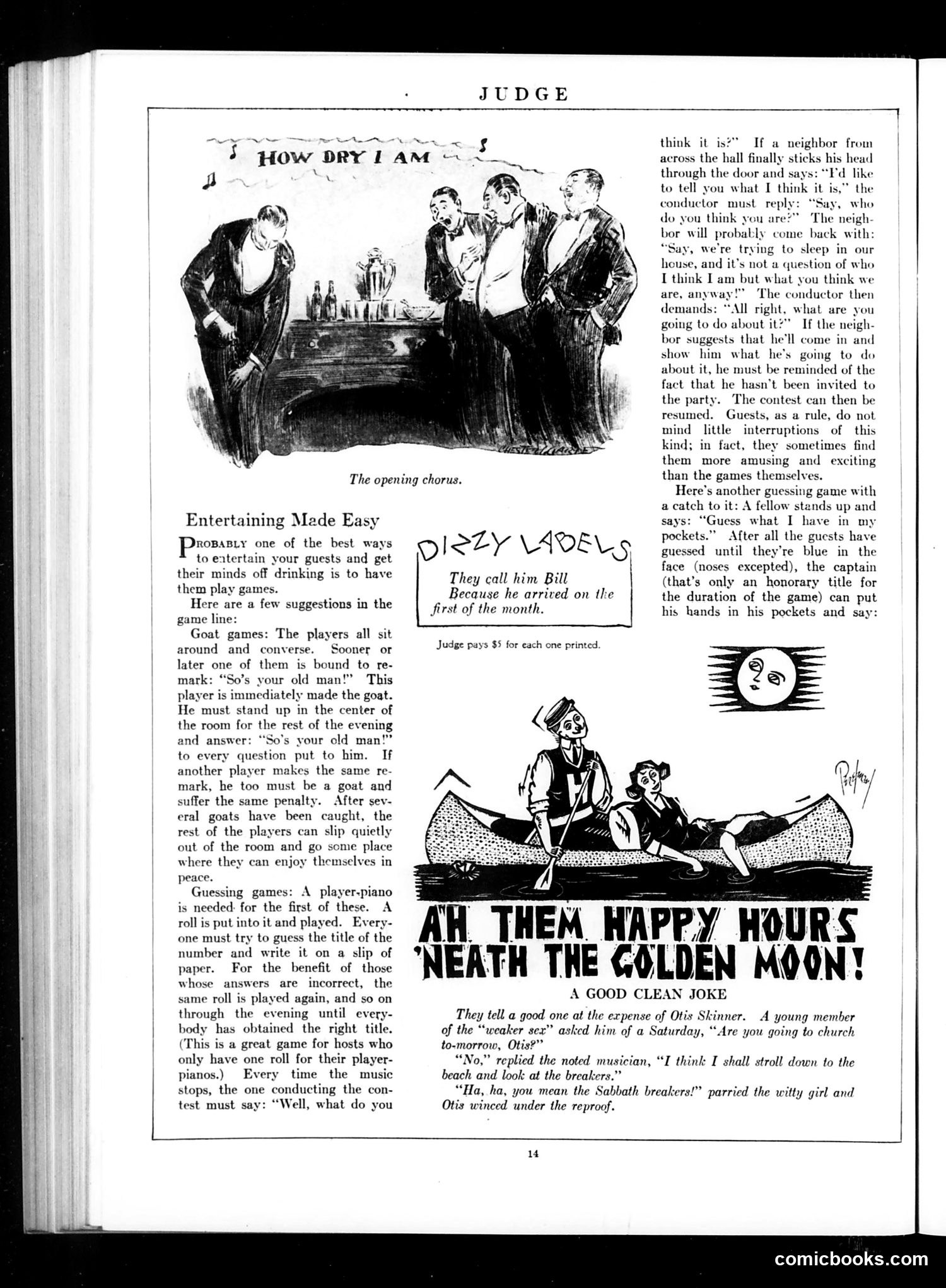
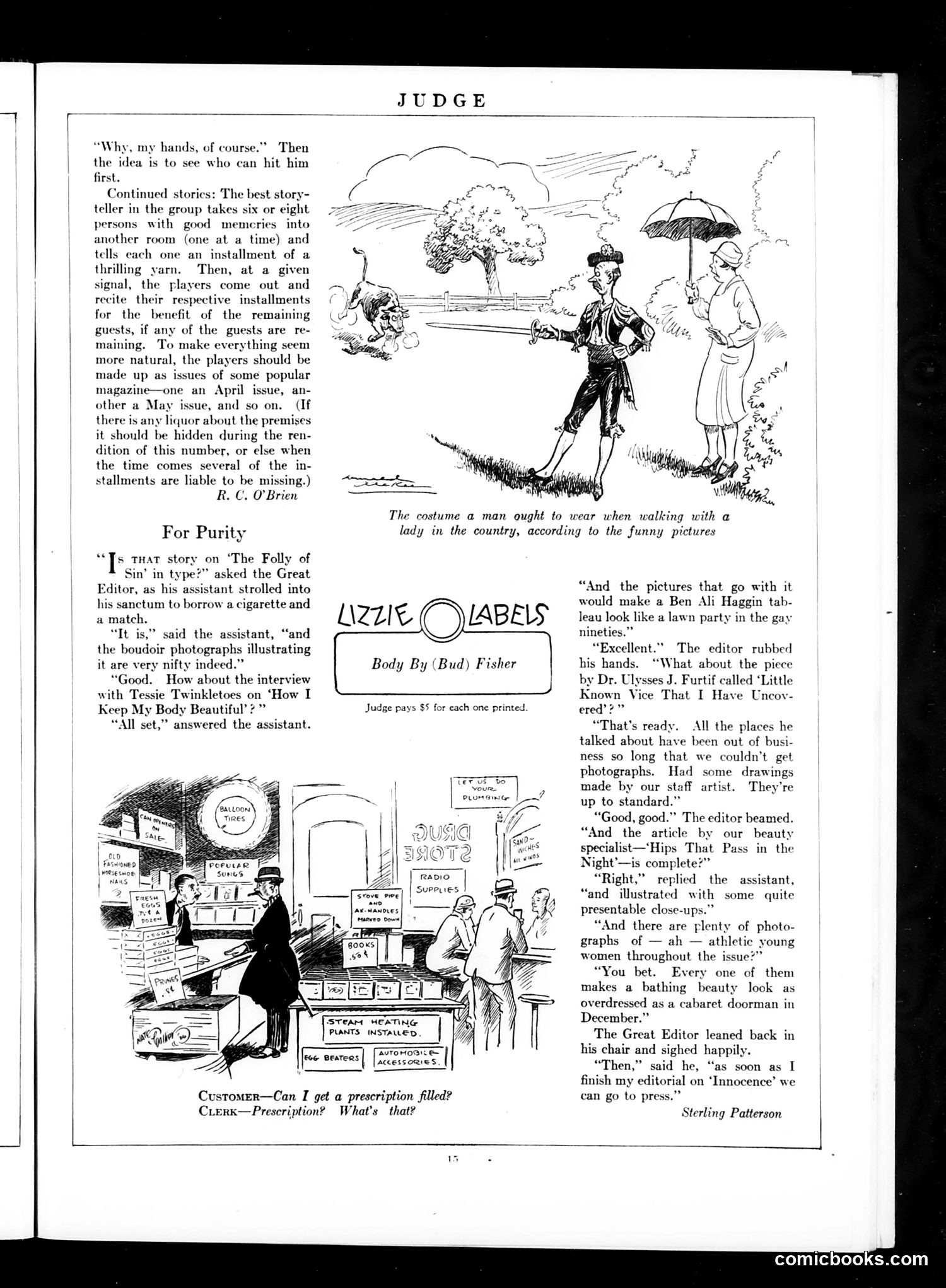
This page from *Judge* (a prominent American satirical magazine) contains party entertainment suggestions and humor pieces typical of early-to-mid 20th century social satire. **"Entertaining Made Easy"** describes parlor games for hosting guests, including "goat games" where someone becomes the butt of jokes by being forced to answer "So's your old man!" to all questions. The satire targets both tedious party hosts and guests seeking excuses to escape dull gatherings. **"Ah Them Happy Hours 'Neath the Golden Moon"** presents "A Good Clean Joke" mocking feminine wit. A young woman asks musician Otis Skinner if he's attending church, and when he says he'll visit the beach to "look at the breakers," she responds with "Sabbath breakers"—a religious pun. The setup satirizes women's attempts at clever humor as groan-worthy puns, reflecting period attitudes dismissing female wit. The magazine's tone is lighthearted mockery of social conventions and gender stereotypes common to genteel entertainment of the era.
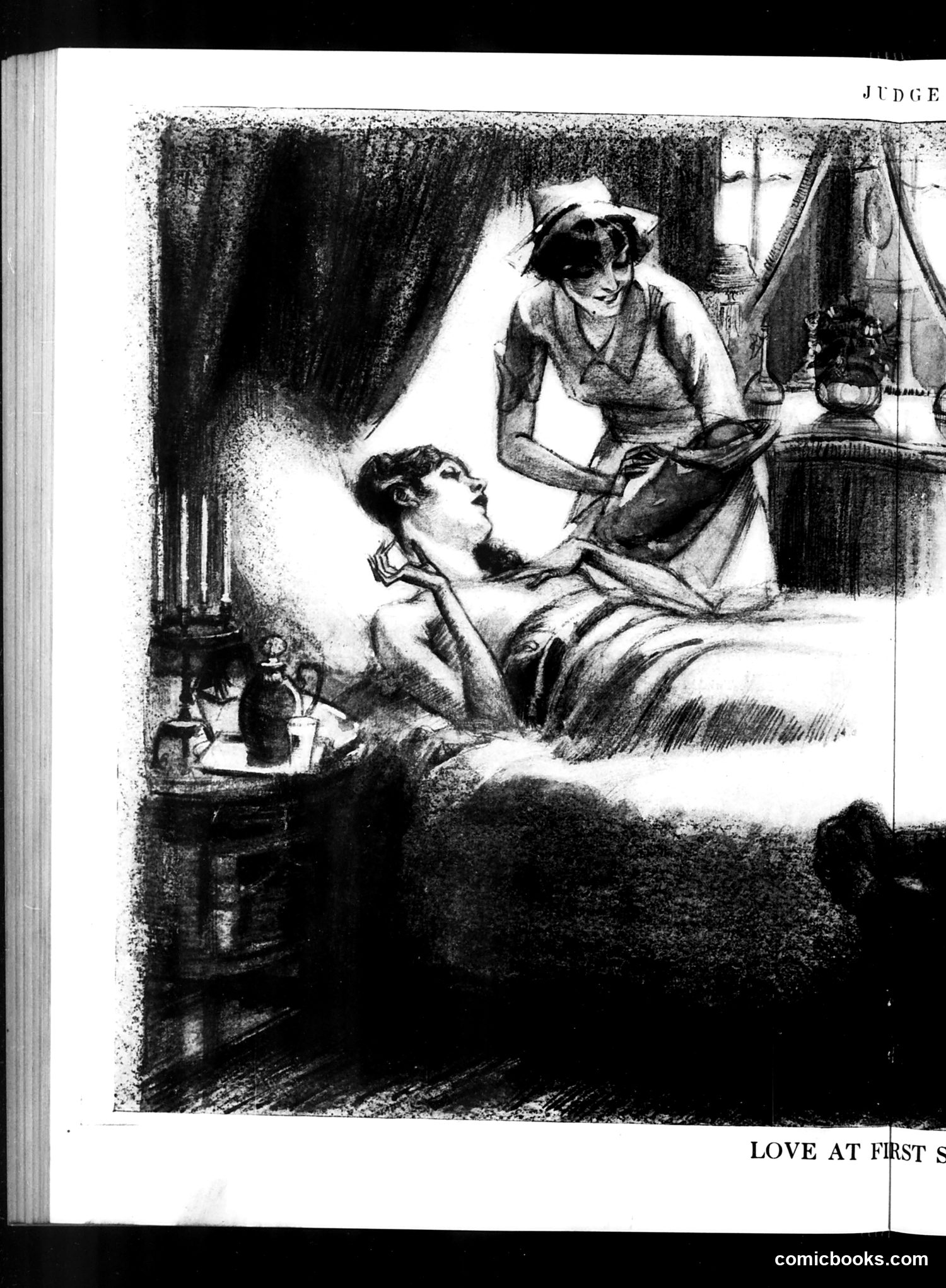
This appears to be a romantic illustration rather than political satire, despite coming from *Judge* magazine. The image shows a nurse or caregiver (identifiable by her cap and uniform) tending to a bedridden male patient. The caption "LOVE AT FIRST [SIGHT]" (the final character is unclear in OCR) suggests a humorous take on romantic attraction in an unlikely setting—a sickroom. The joke likely plays on the contrast between the patient's vulnerable, ill condition and the sudden romantic connection forming between caregiver and patient. This reflects early 20th-century attitudes about healthcare encounters and courtship. The illustration style is typical of *Judge*'s humorous domestic content, representing mainstream American humor of that era focused on everyday romantic scenarios rather than political commentary.
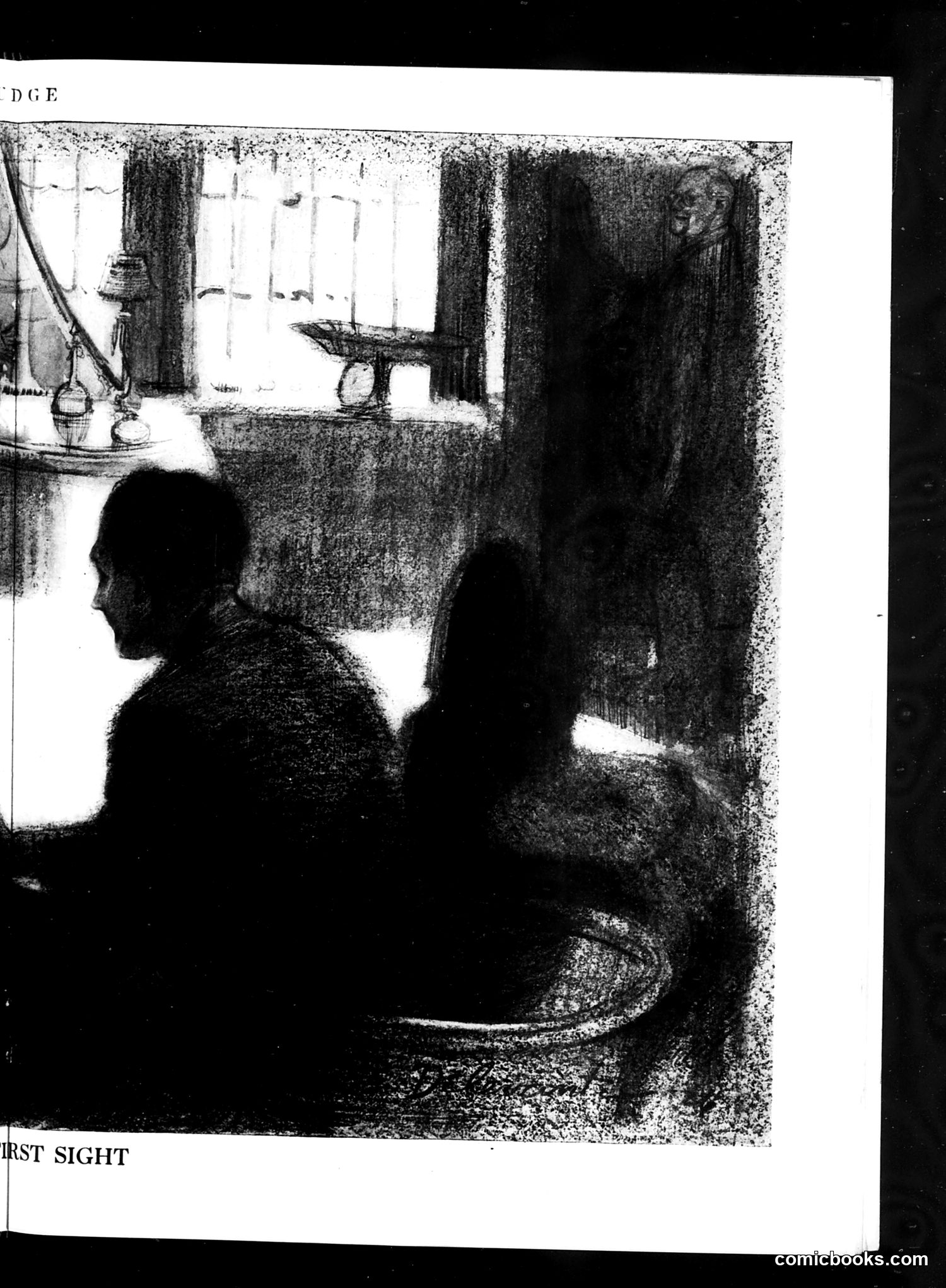
This appears to be a satirical illustration titled "First Sight," showing a silhouetted man viewing what looks like a portrait or figure of a woman on a wall. The composition suggests a commentary on first impressions or romantic attraction. The grainy, sketchy quality is typical of Judge's satirical style. Without additional context from the magazine's date or accompanying text, the specific political or social reference is unclear. However, the juxtaposition of the observer and observed likely comments on perception, aesthetics, or social conventions of courtship and judgment based on appearance—common themes in turn-of-the-century American satire. The page header suggests this is part of a larger feature, though only this one cartoon is visible.
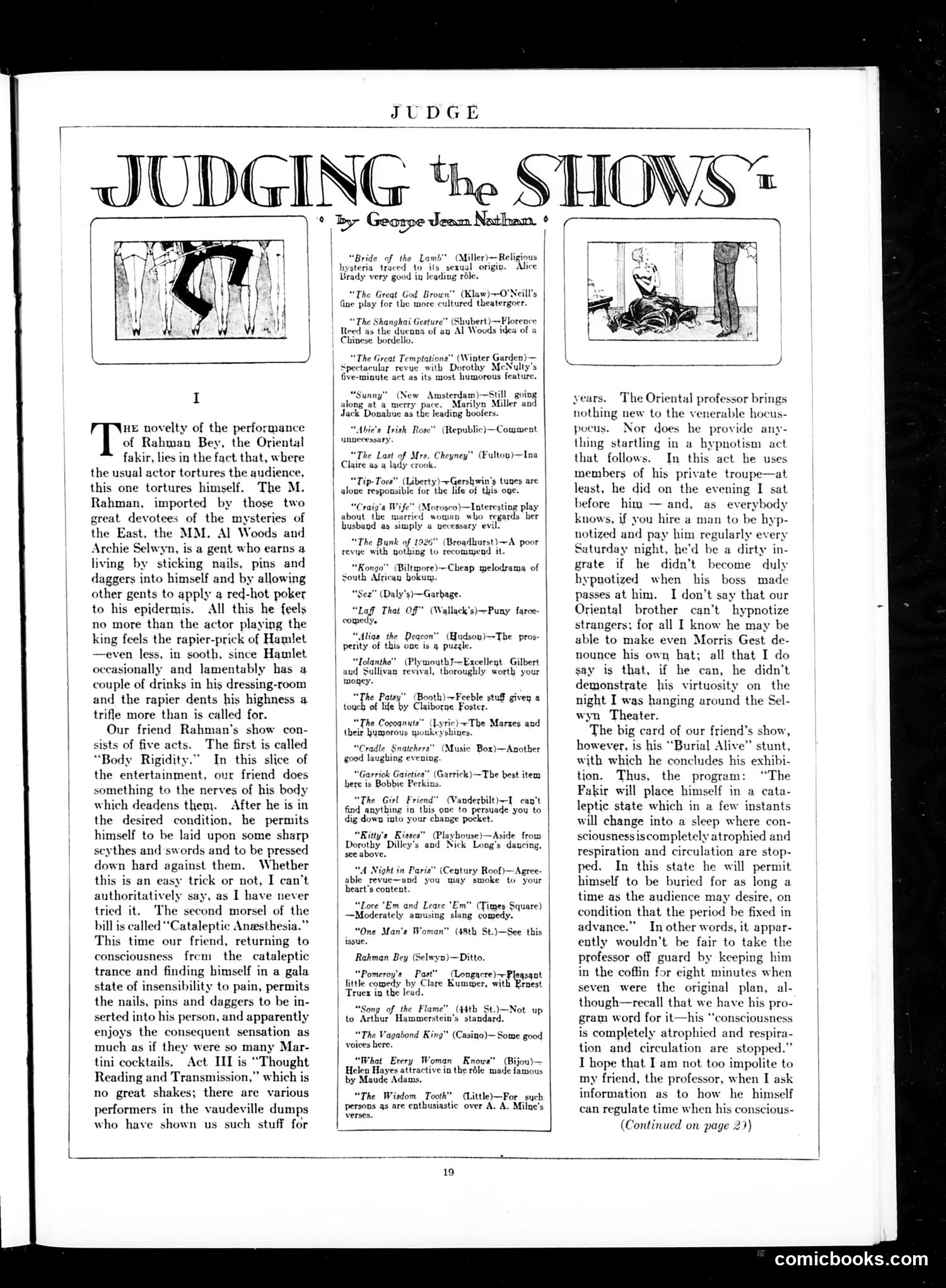
This page reviews theatrical performances, primarily focusing on "Rahman Bey," an Oriental fakir performing in New York. The satire lies in Nathan's deadpan comparison of Rahman's self-torture acts (lying on swords, inserting nails into his body while in induced states of numbness) to the overwrought emotional performances of conventional actors. Nathan ironically suggests Rahman's pain-free mutilation is actually *less* impressive than watching a drunk Hamlet get genuinely nicked by a rapier. The second section lists current Broadway shows with Nathan's witty, dismissive reviews—calling productions "garbage," "feeble stuff," and "poor revue[s]." The satire targets both the fakir's manufactured mystique and Broadway's manufactured entertainment, suggesting both are ultimately shallow spectacles designed to distract audiences.
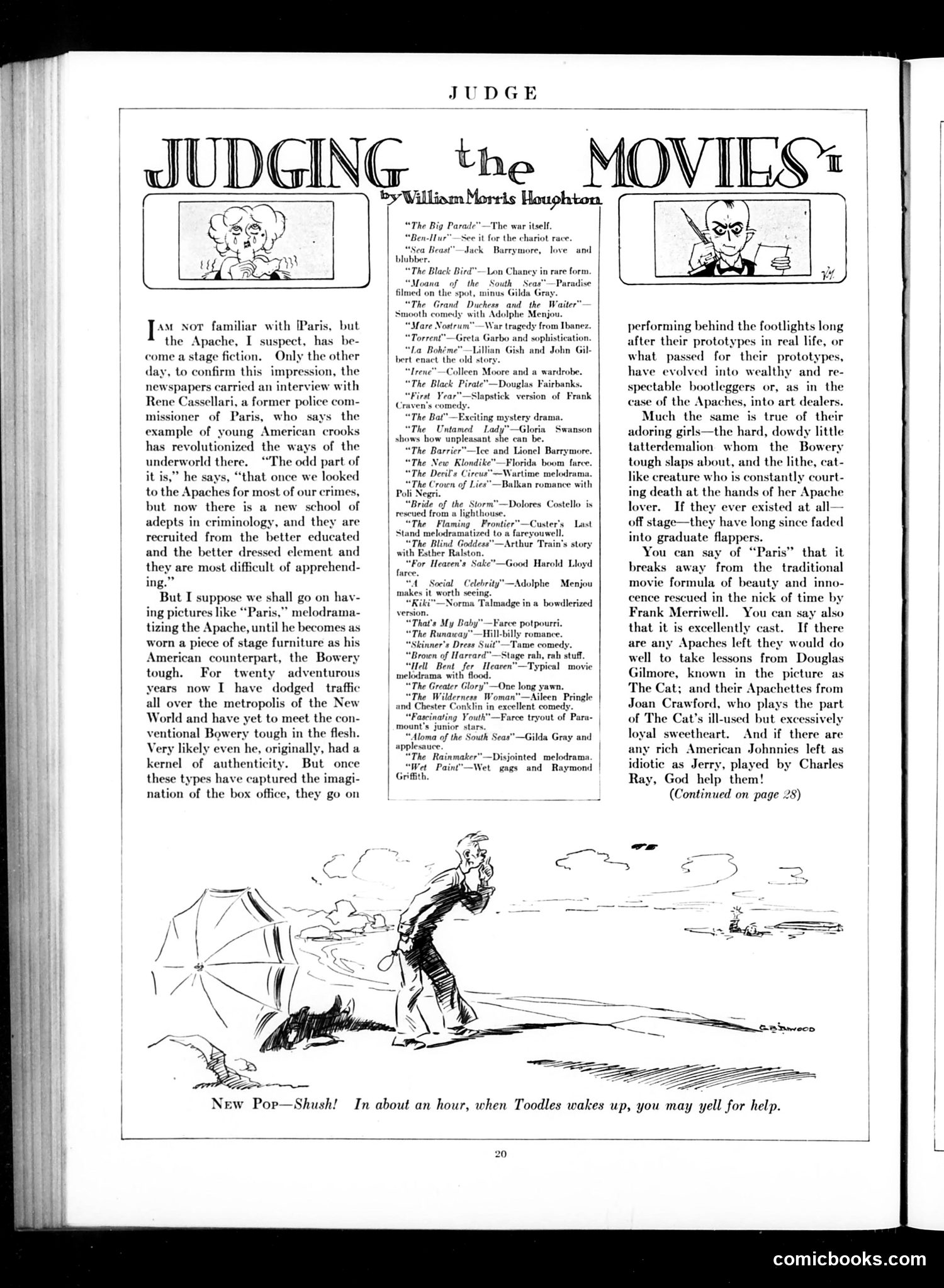
This 1920s film criticism piece by William Morris Houghton critiques how cinema perpetuates outdated criminal stereotypes. The author notes that the "Apache"—a Parisian street criminal type—has become theatrical fiction divorced from reality. He references an interview with a former Paris police commissioner claiming young American crooks have actually *replaced* the traditional Apache model, yet Hollywood keeps recycling the romantic "dangerous underworld thug" archetype for box-office appeal. The essay argues that once such types capture public imagination, they become "worn stage furniture" (like the American "Bowery tough"), persisting long after real criminals have evolved into respectable bootleggers or art dealers. Regarding the film "Paris," Houghton notes it refreshingly avoids the standard "beauty rescued by virtue" formula, though it still trades in Apache mythology. The accompanying cartoon depicts a man struggling with an umbrella in wind, captioned "New Pop—Shush!" with a threat: "In about an hour, when Toodles wakes up, you may yell for help"—suggesting domestic domestic comedy.
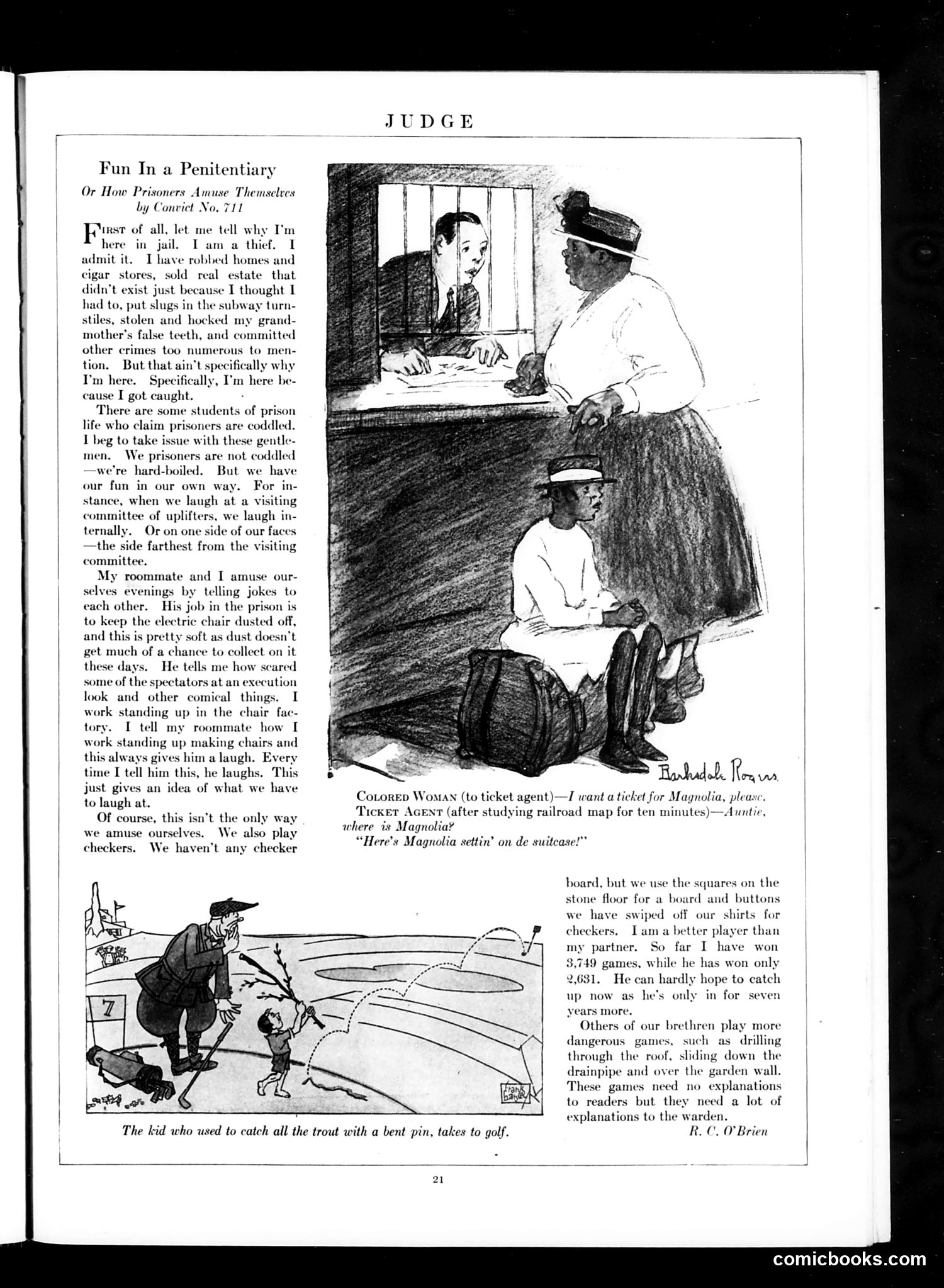
This *Judge* magazine page satirizes prison life through a convict's first-person account. The narrator—identified only as "Convict No. 711"—uses dark humor to undermine sentimentalist claims that prisoners are "coddled." The satire works by deadpan juxtaposition: he describes his cellmate's job dusting the electric chair and his own work making chairs as sources of workplace humor, playing checkers with shirt buttons on stone floors, and inmates' "dangerous games" like drilling through roofs—implying these constitute their entertainment and rebellion. The upper cartoon depicts a Black woman asking a ticket agent for passage to "Magnolia," which the agent cannot locate on a map. When she points to her suitcase, the joke suggests either geographical ignorance or a racial jab at Black dialect/spatial confusion. The bottom cartoon contrasts a boy who caught trout with a bent pin now attempting golf—satirizing social mobility or the absurdity of childhood skill transferring to adult activities. The overall tone mocks both prison conditions and naïve reformers' assumptions about prisoner welfare.
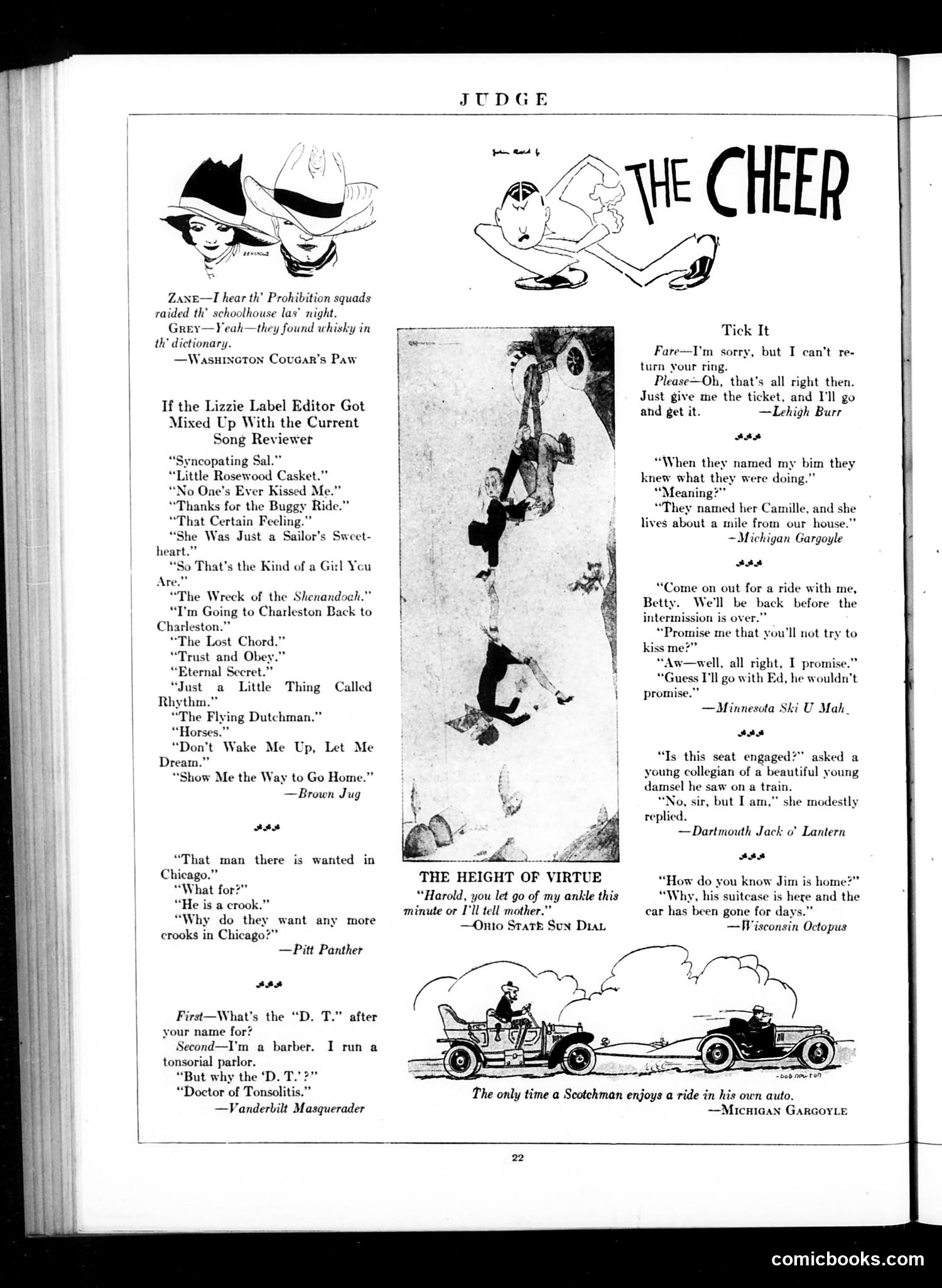
This page collects humorous short jokes and cartoons typical of 1920s American humor. Key themes include: **Prohibition satire**: A joke about whisky found in a dictionary during a Prohibition raid mocks both the drinking ban and officials' incompetence. **Song titles**: A list mixing actual 1920s song titles (like "Charleston," "Shenandoah") with fake titles creates absurdist humor—if a music reviewer confused song titles with object labels, chaos would result. **Dating/courtship jokes**: Multiple gags about young people on dates, broken engagements, and romantic promises reflect 1920s social anxieties about modern dating customs. **Ethnic/regional humor**: Jokes attributed to "Michigan Gargoyle," "Wisconsin Octopus," etc. use stereotypes (a Scotsman's stinginess; a barber's pretension with "Doctor" titles). **The auto cartoon**: Shows a Scotsman enjoying a car ride—implying he only appreciates it when he's not paying for gas. These represent typical Judge content: lighthearted social commentary on Prohibition, modern youth culture, and regional/ethnic stereotypes.
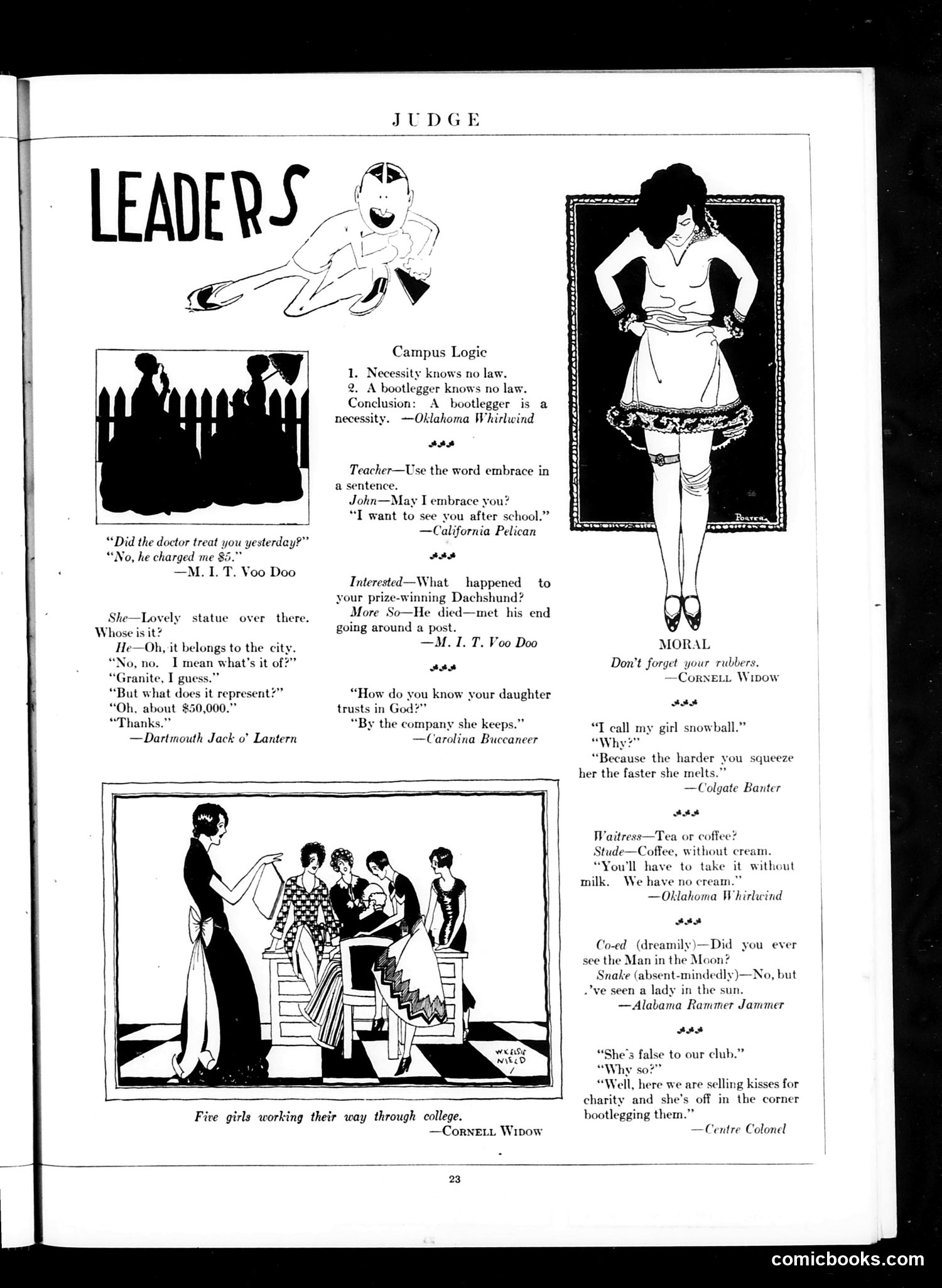
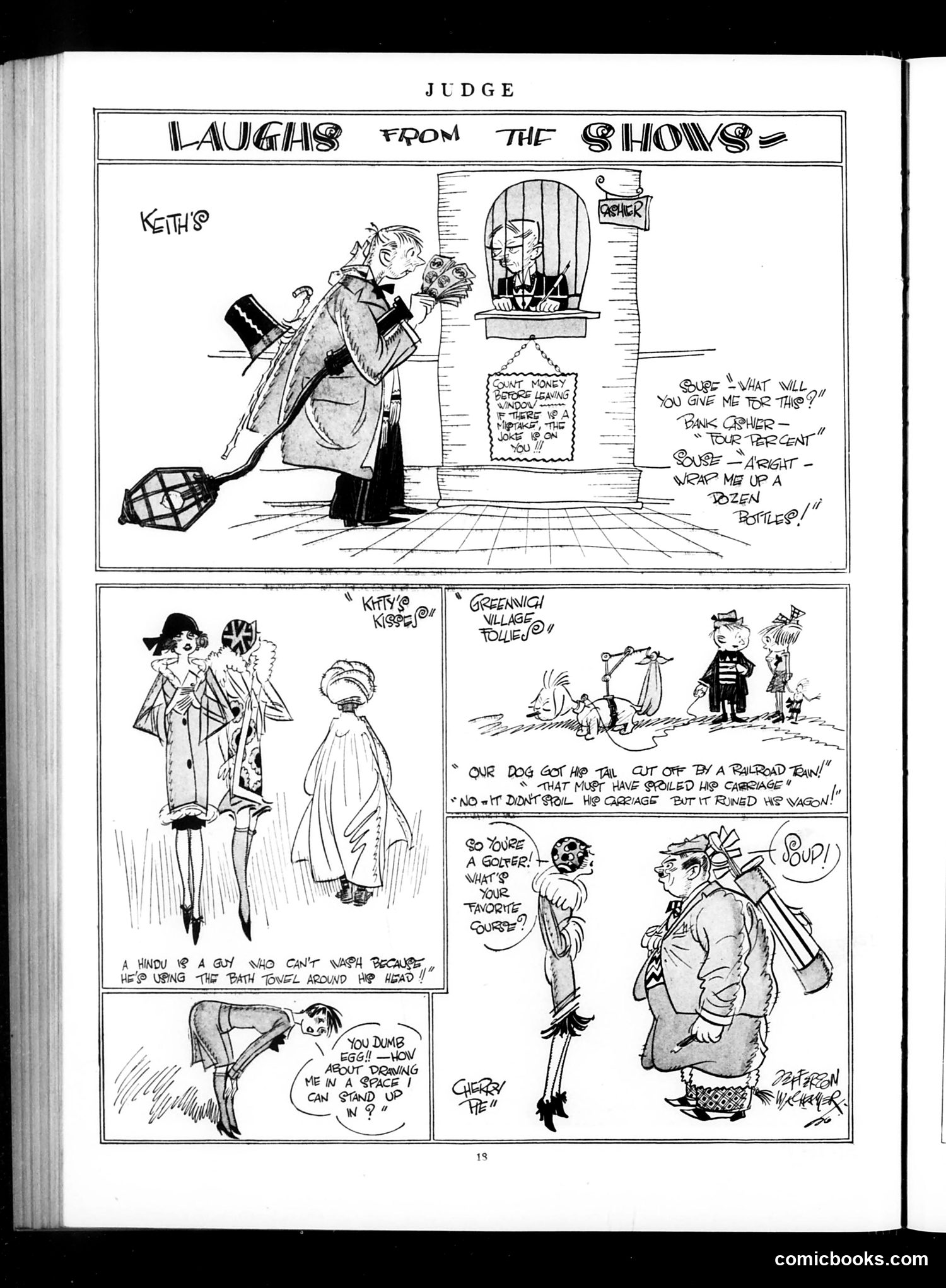
This is a **humor compilation page** from Judge, likely 1920s-era, featuring jokes from college humor magazines. The satire reflects Prohibition-era America: **Key references:** - The **bootlegger logic joke** mocks Prohibition's absurdity—bootleggers operating illegally are compared to necessities, suggesting lawlessness is now "necessary" - The **dachshund joke** appears to reference anti-German sentiment (dachshunds were German dogs), though the punchline is simply dark humor - The **"selling kisses/bootlegging them"** final joke juxtaposes charity fundraising with illegal alcohol sales, both viewed as underground activities **Visual elements:** - The "MORAL" section featuring a woman in revealing dress represents typical Judge flapper imagery—modern women as objects of both fascination and criticism - The "Five girls working their way through college" illustration likely depicts Depression-era economic struggle The overall page reflects collegiate irreverence toward Prohibition laws and emerging social changes. Most humor relies on wordplay rather than identifying specific political figures—it's anti-establishment rather than partisan satire.
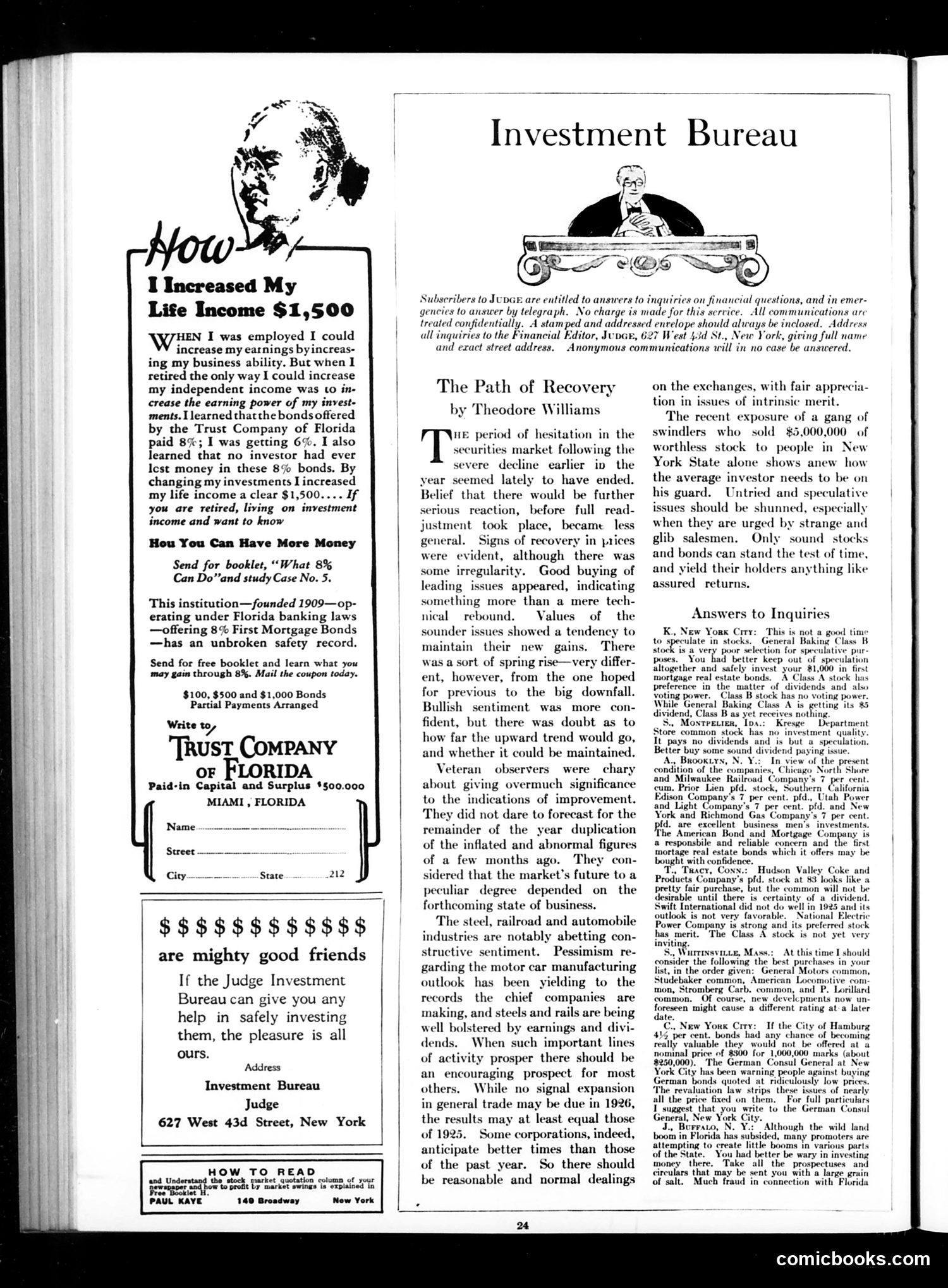
This page mixes advertising with financial commentary from Judge magazine (circa 1926, based on references to 1925 market activity). **The Advertisement (Left):** A testimonial claiming a retiree increased annual income by $1,500 by switching to Florida Trust Company bonds paying 8% interest—presented as risk-free ("no investor had ever lost money"). This is satire-adjacent advertising; Judge's skeptical readers would recognize the pitch as too-good-to-be-true. **The Article (Right):** Theodore Williams analyzes stock market "recovery" following a 1925 decline. He notes cautious optimism in steel, railroad, and automobile sectors, but warns investors against overconfidence—the market's future depends on actual business conditions, not speculation. **The Context:** This reflects post-1925 market uncertainty before the 1929 crash. The juxtaposition of guaranteed-return advertising claims against sober financial analysis suggests Judge's editorial irony: readers should trust reasoned analysis over promotional hype. The "$$$" decoration emphasizes money's importance while the Investment Bureau box offers Judge's own "safe" advisory service.
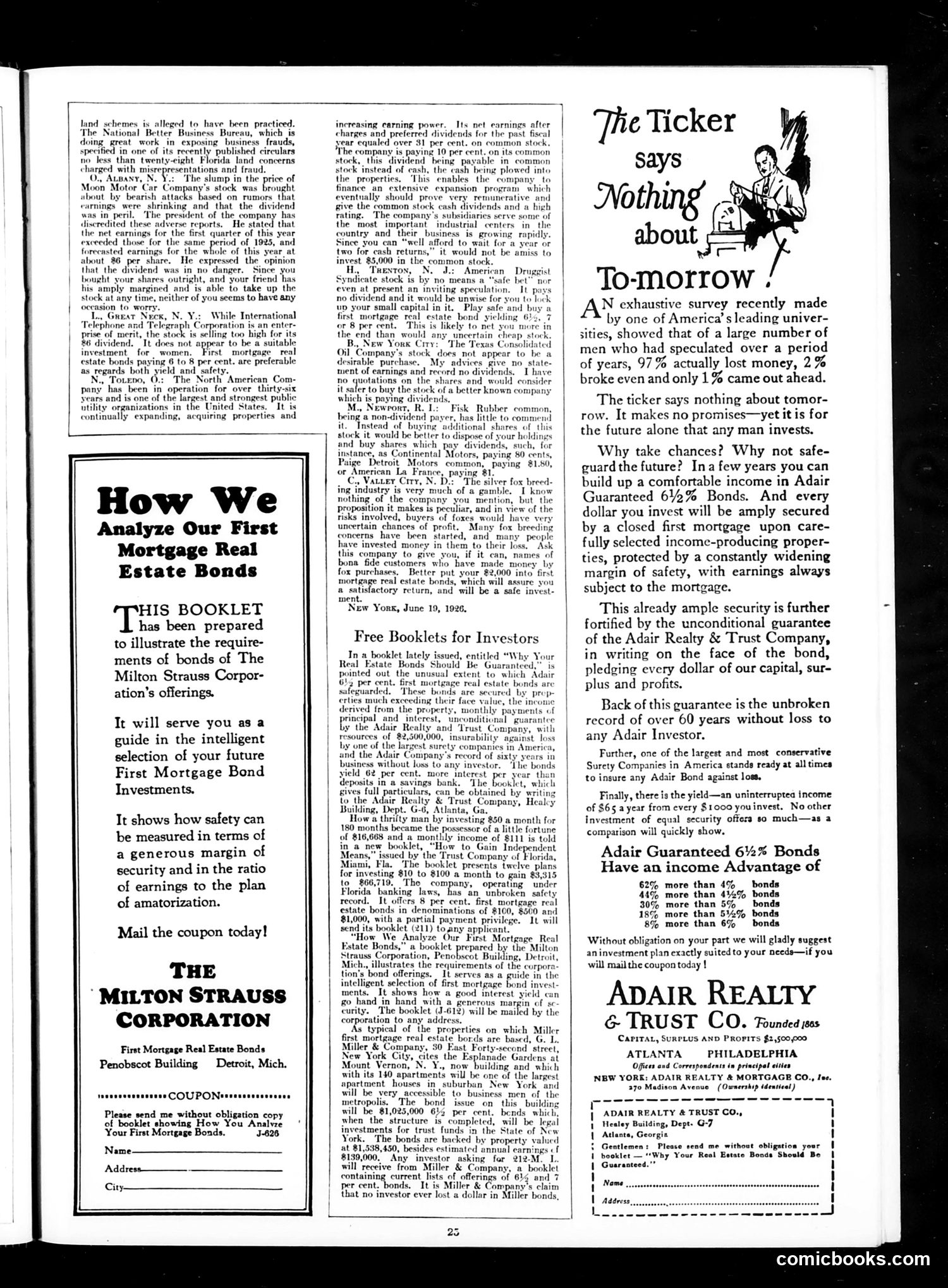
This page is primarily **financial advertising**, not political satire. The main content promotes Adair Realty & Trust Company's guaranteed bonds as safe investments compared to uncertain stock market speculation. The cartoon shows a figure labeled "The Ticker" (representing stock market price quotes) with a caption asserting it provides no information about future performance. The advertisement argues that unlike stocks—which fluctuate unpredictably—first mortgage real estate bonds offer reliable, guaranteed income. The left column contains stock advice columns addressing reader questions about various companies (Moon Motor, International Telephone, Texas Consolidated Oil, etc.), consistently recommending conservative bond investments over speculative stocks. **Context for modern readers:** This appears from the 1930s Depression era, when stock market volatility made bonds seem comparatively safe. The "ticker" reference suggests the rapid, unreliable nature of stock price information versus tangible real estate backing of bonds.
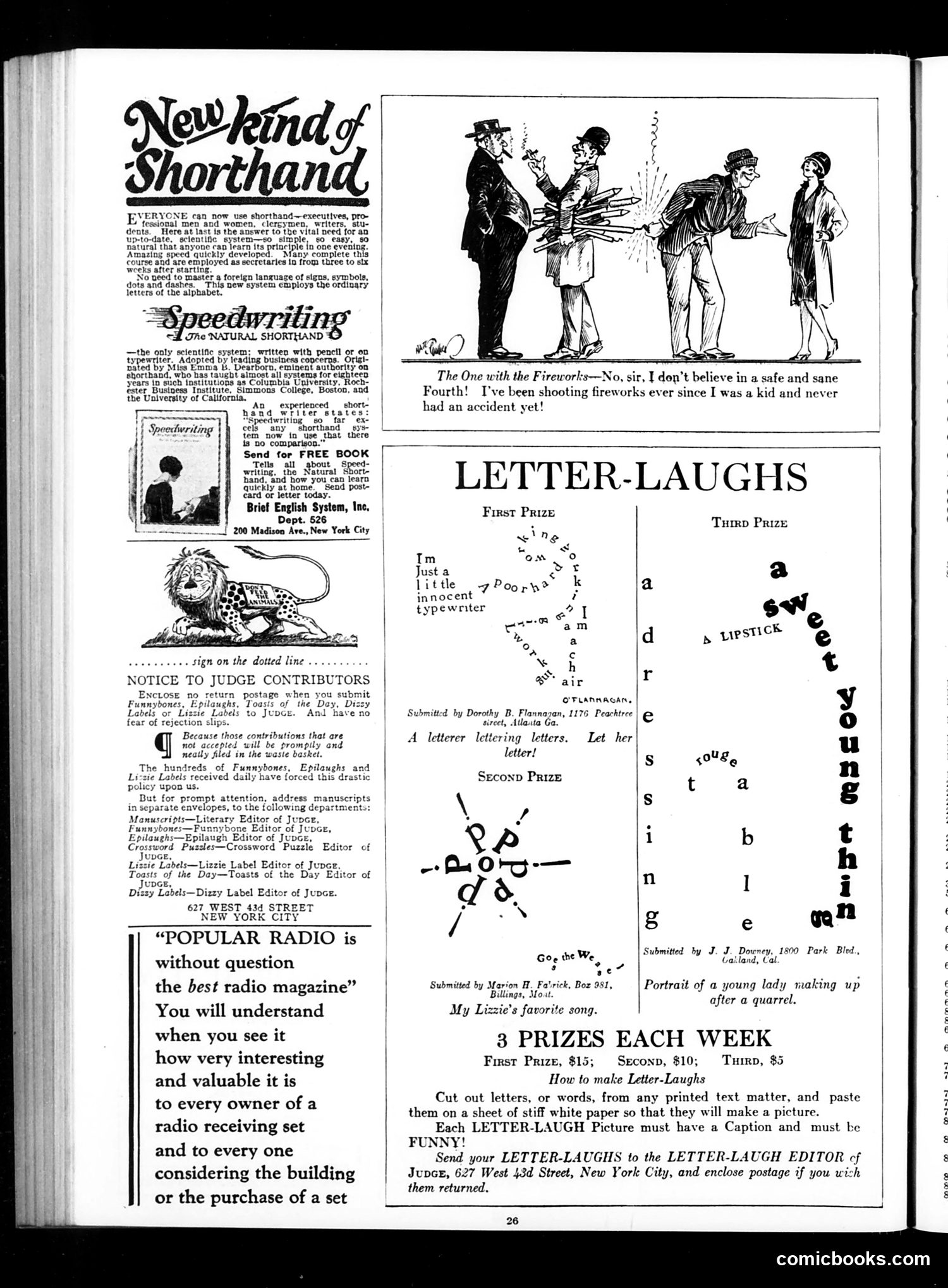
This is primarily a **features and advertising page** from Judge magazine rather than political satire. The main cartoon depicts a safety debate about Fourth of July fireworks. A man claims he's shot fireworks since childhood without accident—a common stance in early-20th-century America when consumer fireworks were largely unregulated. The "safe and sane Fourth" movement, which emerged in the 1900s to reduce holiday injuries and deaths, is implicitly mocked by this character's dangerous confidence. The joke reflects genuine tension between traditional Independence Day practices and emerging public safety concerns. The page also advertises shorthand training systems and contains "Letter-Laughs"—a visual word puzzle competition where readers cut and arrange letters from printed matter to form pictures. This was a typical Judge reader-participation feature of the era. The overall content emphasizes Judge's role as entertainment and commercial vehicle rather than serious political commentary.
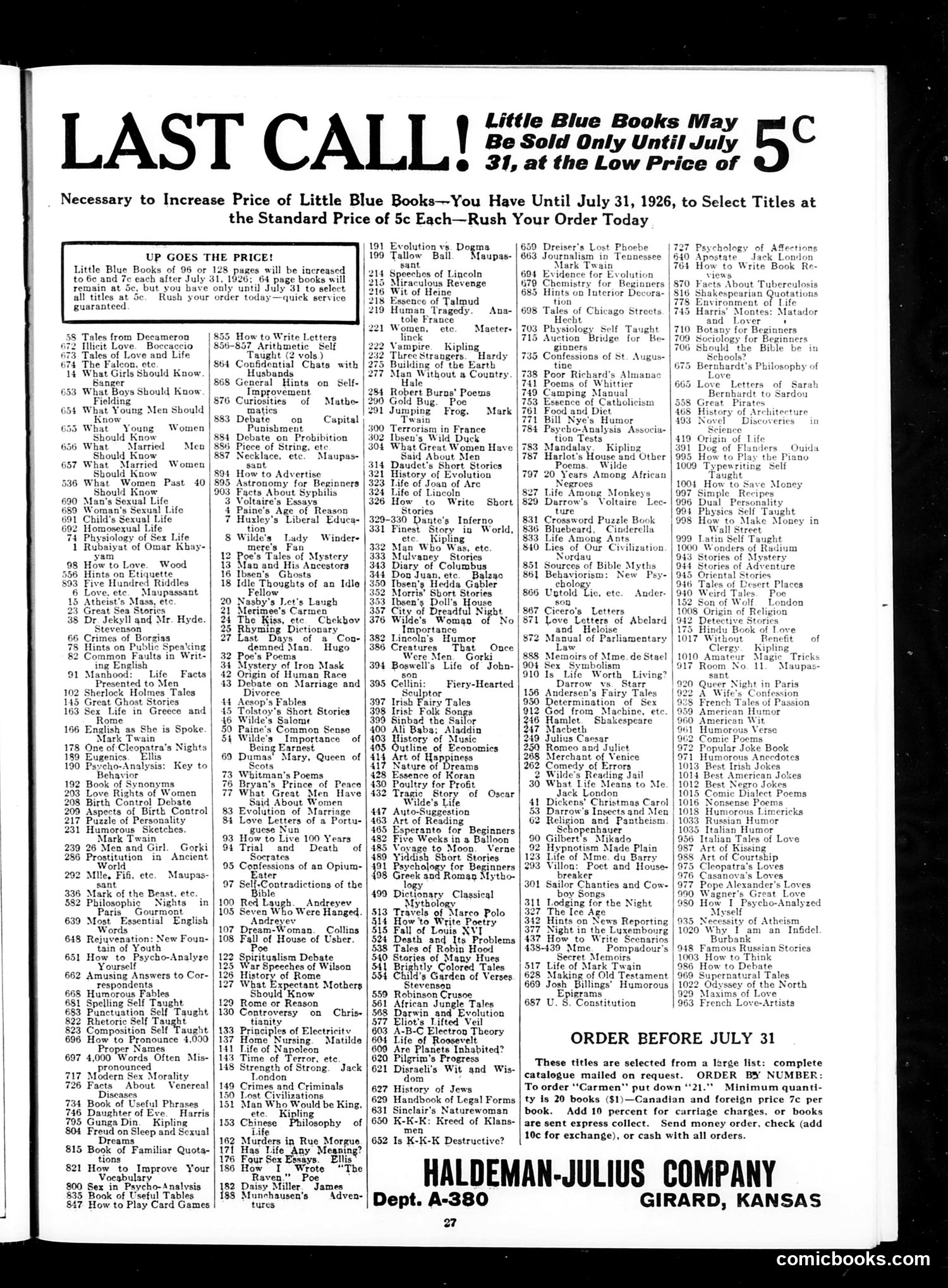
This is **not a cartoon page** but rather a **full-page advertisement** for the Haldeman-Julius Company's "Little Blue Books" series—inexpensive educational paperbacks popular in the 1920s. The advertisement announces a price increase effective August 1, 1926. Readers have until July 31 to order titles at the current 5¢ price before costs rise to 6¢-7¢. The catalog lists hundreds of titles reflecting 1920s progressive interests: sex education, birth control, atheist philosophy (Paine, Voltaire), psychology (Freud, psychoanalysis), and literary classics. Many titles address sexuality frankly—unusual for mainstream publishing then—indicating the series served intellectually curious, socially liberal readers. The "LAST CALL!" urgency and "rush your order" language are standard advertising tactics designed to prompt immediate purchases before the deadline. This reflects how Judge magazine's pages alternated between satirical content and commercial advertisements catering to educated, middle-class readers.
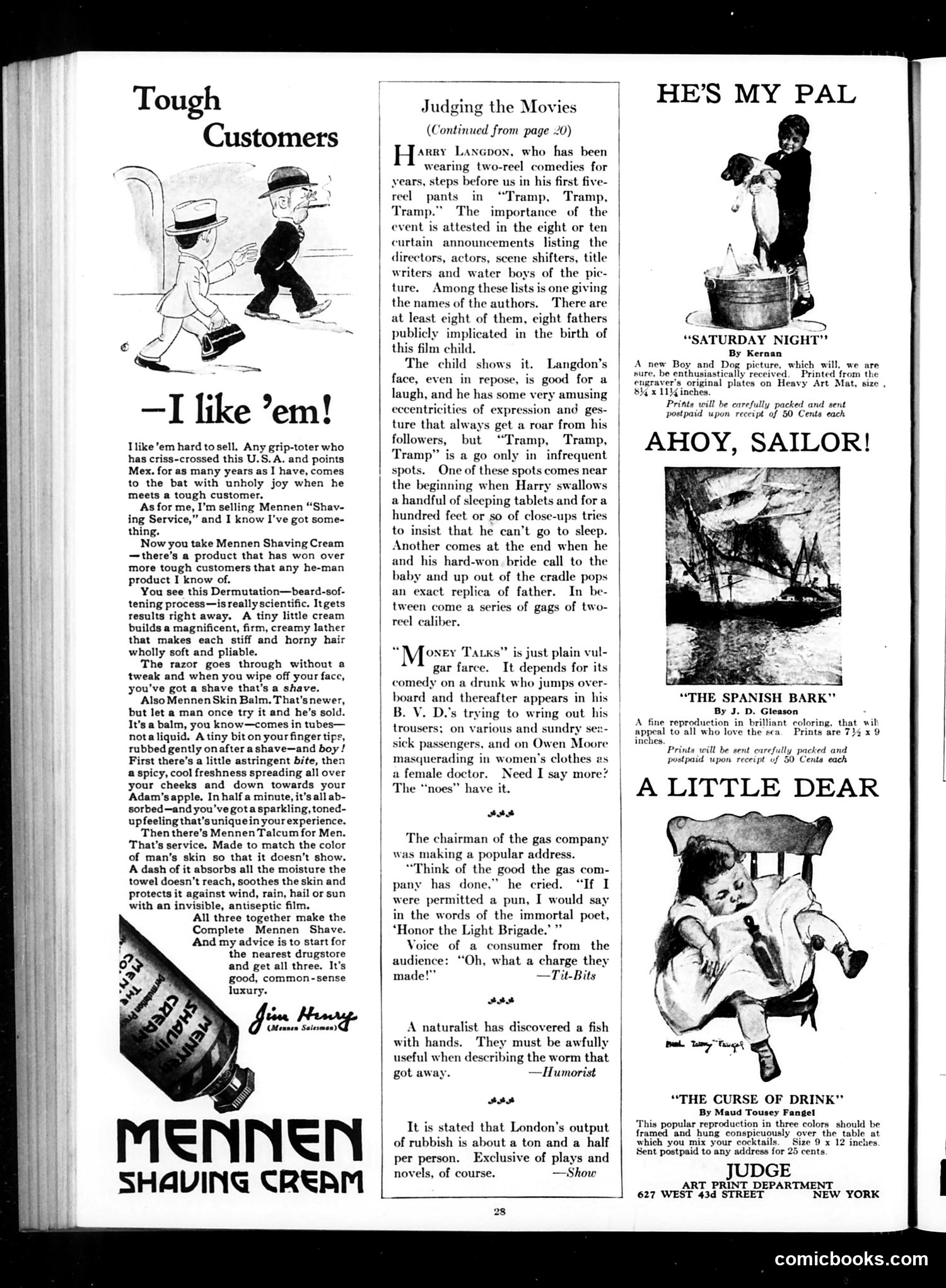
The left side is an advertisement for Mennen Shaving products, featuring a salesman's testimonial. The "tough customer" cartoon depicts a hard-to-sell client, illustrating the ad's claim that Mennen products succeed even with demanding consumers. The pitch emphasizes the cream's "Dermutation" (beard-softening) process and the balm's refreshing properties—marketed as "common-sense luxury" for men. The center column reviews Harry Langdon's first five-reel film "Tramp, Tramp, Tramp," criticizing its uneven quality despite Langdon's comedic talent. The reviewer notes too many credited writers produced inconsistent results. "Money Talks" is dismissed as vulgar farce relying on crude humor (drunk in underwear, seasickness jokes). The page includes humor snippets: a gas company chairman's pun about the "Light Brigade," and a joke about a fish with hands.
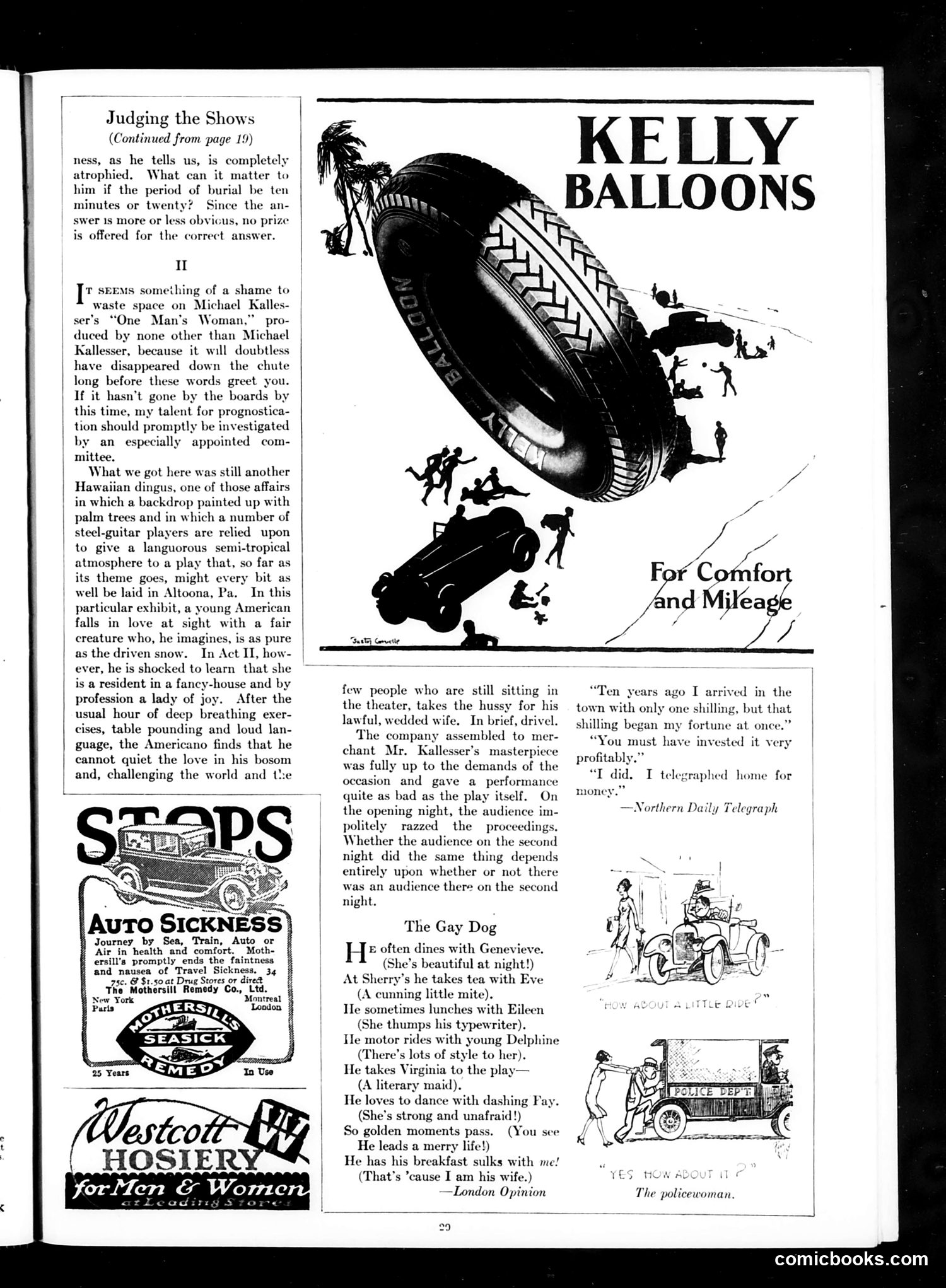
This page contains theater criticism and advertising from Judge magazine. The main content critiques two theatrical productions: **"One Man's Woman"** — A play produced by Michael Kallesser that the critic dismisses as derivative "Hawaiian" melodrama (a popular but tired genre). The plot follows a predictable formula: American man falls for a woman he believes innocent, discovers she's a prostitute, and marries her anyway after emotional turmoil. The reviewer predicts the show will close quickly and notes the opening-night audience "razzed" (booed) the performance. **"The Gay Dog"** — A humorous poem about a serial philanderer who dines and entertains multiple women (Genevieve, Eve, Eileen, Delphine, Virginia, Fay) across fashionable venues, leading a "merry life"—until breakfast with his wife, when his cheerful demeanor collapses into sulks. The joke satirizes male infidelity and domestic discord. The page also includes period advertisements (travel remedies, hosiery) and Kelly Balloons advertising featuring vintage automobile imagery.
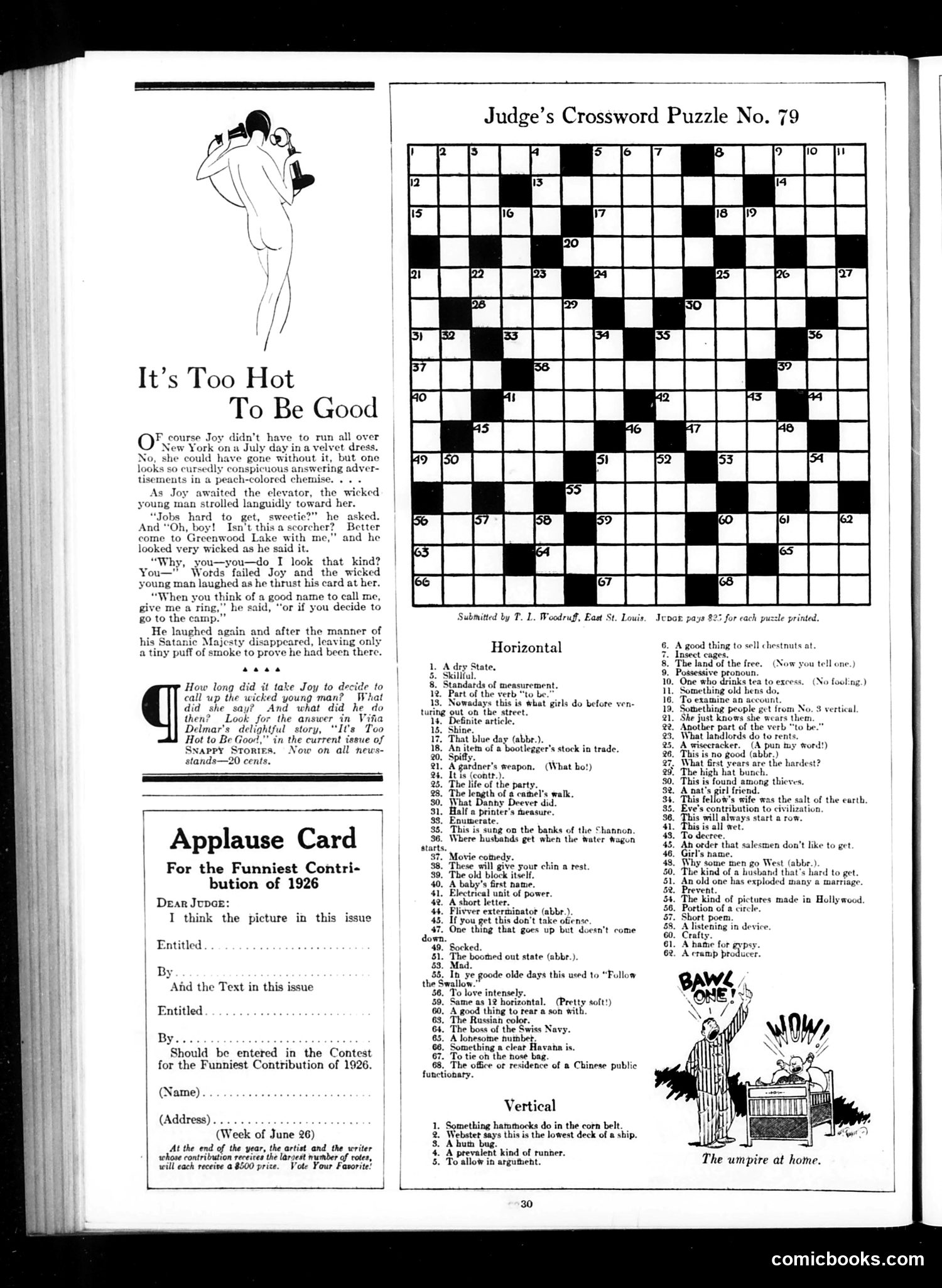
This page from Judge (a major American satirical magazine) contains several elements: **Main Story Illustration**: "It's Too Hot to Be Good" depicts a flirtation scenario—a young woman in summer clothing encounters a "wicked young man" offering an invitation to Greenwood Lake during hot weather. The satire targets 1920s dating customs and the loosening of social propriety during the Jazz Age; the woman's dilemma (job-hunting in impractical dress vs. accepting a man's suggestive invitation) mocks both gender dynamics and summer heat desperation. **The Crossword Puzzle**: A standard puzzle with clues referencing contemporary 1926 culture—bootleggers ("item of a bootlegger's stock"), automobiles ("Flivver exterminator"), and prohibition-era humor ("The boomed out state"). **Contest Element**: The "Applause Card" invites readers to vote for the funniest contribution to Judge that year, offering cash prizes ($500 each to artist and writer). The overall tone reflects Jazz Age irreverence toward social conventions, particularly regarding courtship and women's independence.
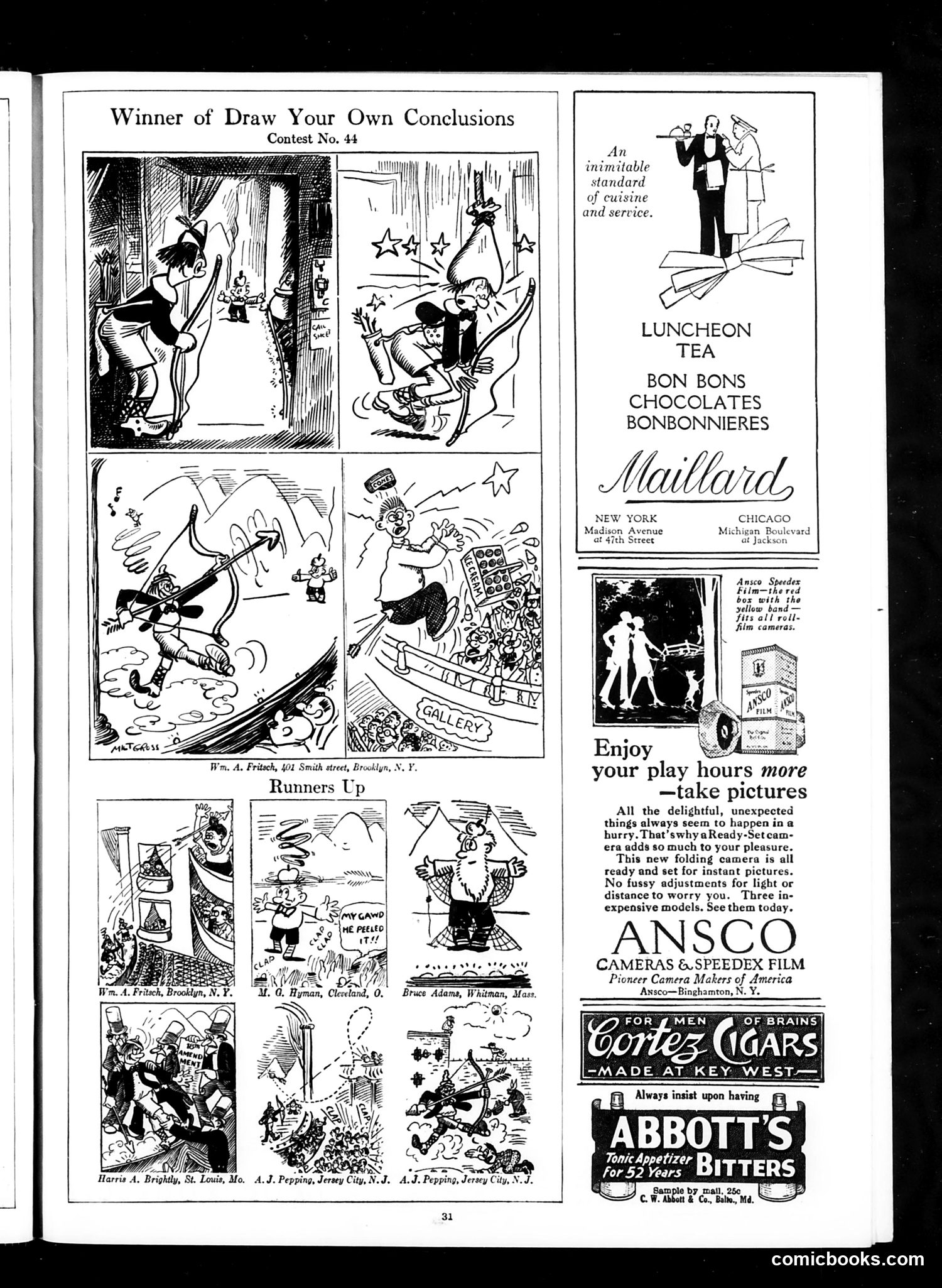
This page shows the winning entry and runners-up from a Judge magazine drawing contest. The winning cartoon (top, by Wm. A. Fritsch) depicts abstract, energetic scenes of people in various states of chaos or celebration—dancing, falling, juggling, and generally creating mayhem, particularly in what appears to be an indoor gallery or social space. The contest's title, "Draw Your Own Conclusions," suggests readers were meant to interpret these wordless, surreal images themselves. The humor likely derives from the absurdist nature of the scenes and the contest's appeal to readers' subjective interpretations. The page is primarily advertising, featuring luxury goods (Mallard restaurant, Ansco cameras, Cortez cigars, Abbott's Bitters), typical of Judge's upscale readership during this era (appears to be 1920s-1930s). The cartoons reflect the magazine's sophisticated, urban audience and preference for abstract, imaginative humor over explicit social commentary.
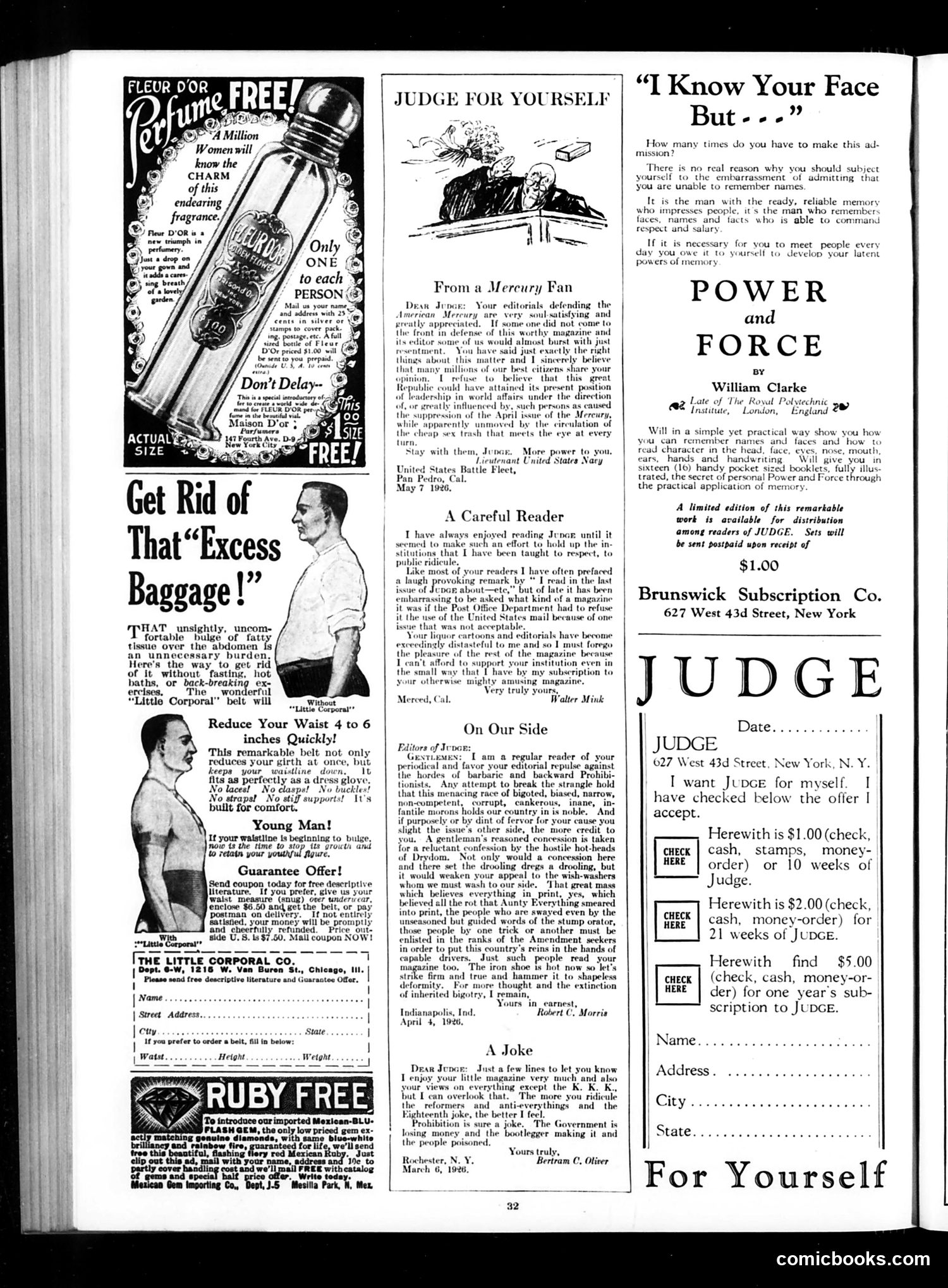
This page from *Judge* magazine contains primarily **advertisements and reader letters**, not political cartoons requiring historical interpretation. The **ads** promote dated bodycare products: a "Little Corporal" belt claiming to reduce waist size 4-6 inches without exercise, a "Ruby" gem, and a perfume bottle. These reflect early 20th-century consumer culture and unrealistic beauty/wellness claims. The **letters section** shows readers debating *Judge*'s editorial positions. One praises the magazine's defense of American leadership and criticism of Prohibition. Another criticizes *Judge* for attacking Prohibition advocates, calling them "bigoted" and "narrow." A third playfully notes the magazine covers everything except the KKK. These letters reveal *Judge* was a politically engaged satirical magazine where readers actively debated the era's major issues—particularly Prohibition, which was apparently a divisive topic the magazine championed opposing.
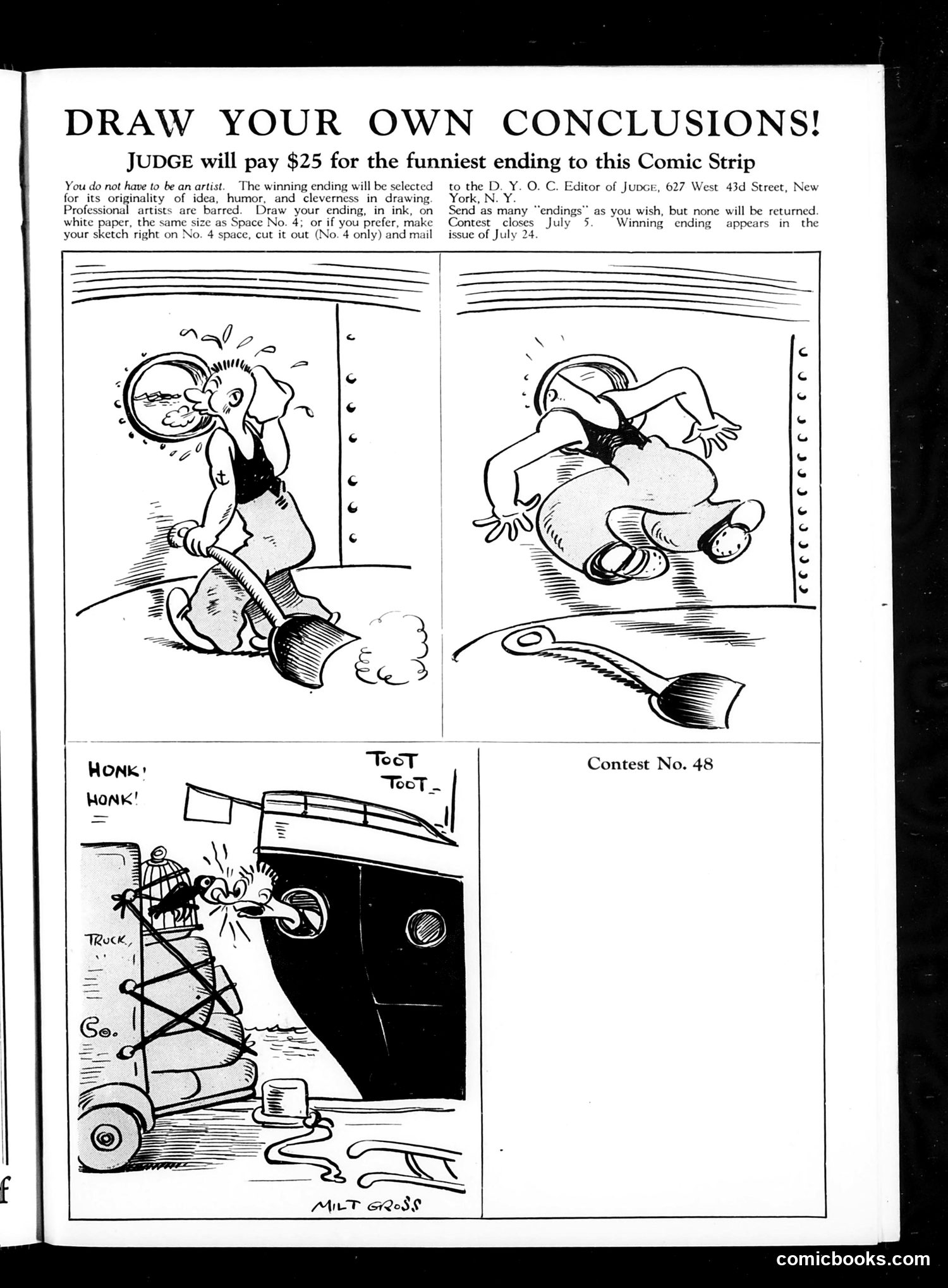
This page presents a reader-participation contest from *Judge* magazine. The top panels show an unfinished comic strip: a woman cleaning a mirror in the first panel, then appearing to fall or slip in the second. The third panel (by cartoonist Milt Gross) shows a truck hitting a house, with sound effects "HONK! HONK!" and "TOOT TOOT!" The contest invites readers to submit humorous endings to this incomplete narrative. Judge offered $25 to the winner selected for originality, humor, and cleverness—notably barring professional artists to encourage amateur participation. Submissions closed July 5, with the winning ending to appear July 24. The joke appears to involve slapstick comedy and the absurdist collision between domestic mishap and vehicular chaos. The crude, energetic drawing style was typical of 1920s-30s comic humor magazines.
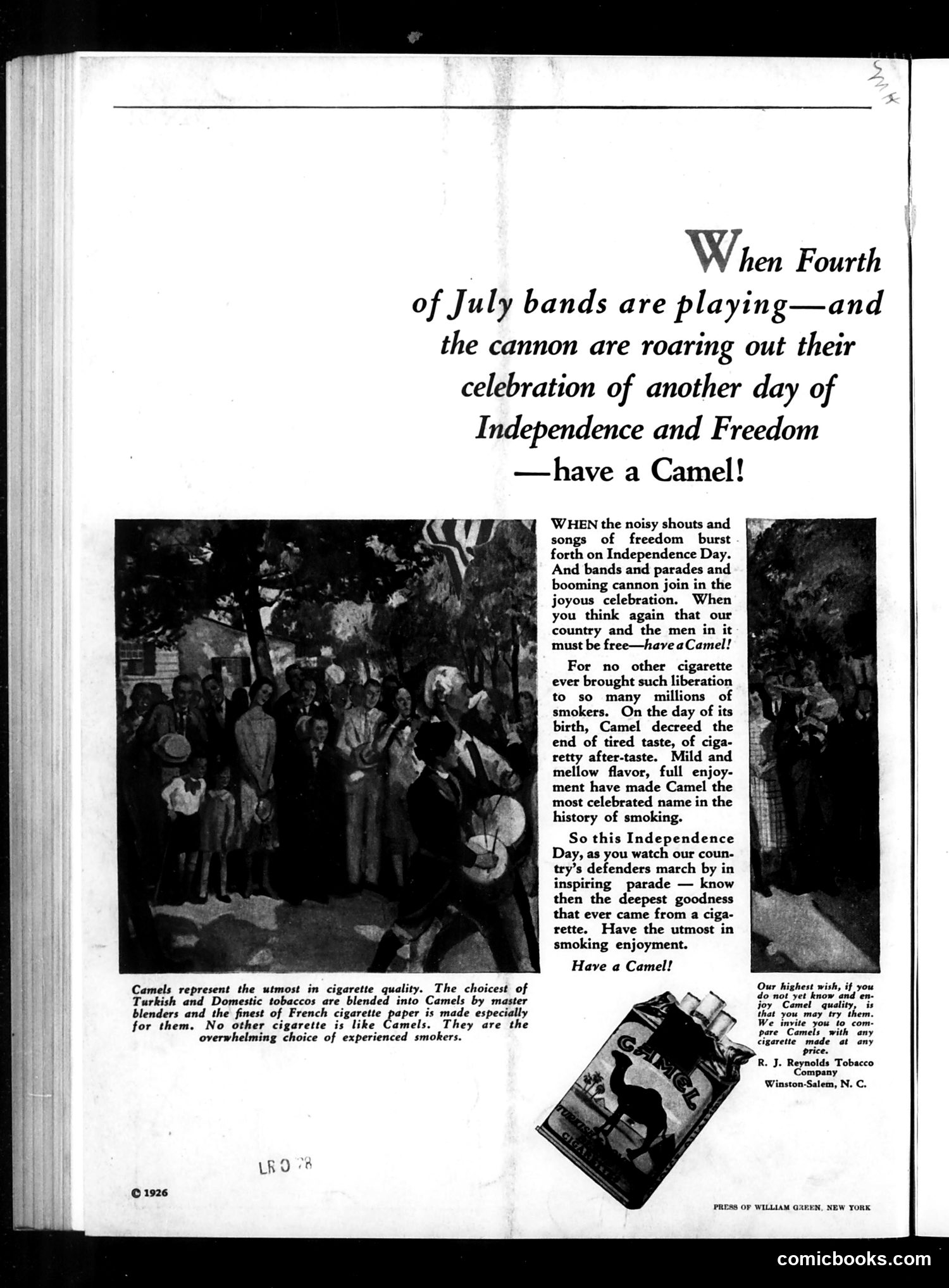
This is a **cigarette advertisement**, not political satire. The R.J. Reynolds Tobacco Company exploits American patriotism by connecting Camel cigarettes to Fourth of July celebrations and national freedom. The ad uses nationalist rhetoric—Independence Day parades, military defenders, bands and cannon—to frame smoking as an act of patriotic enjoyment. It claims Camel's introduction "decreed the end of tired taste," presenting the cigarette brand as itself a symbol of American liberation and progress. The photograph shows a crowd celebrating Independence Day. The accompanying text argues that enjoying Camels represents "the deepest goodness that ever came from a cigarette," conflating commercial consumption with civic virtue. By modern standards, this represents **aggressive marketing of an addictive, carcinogenic product** using nationalist symbolism—practices now illegal in most democracies. The copywriting's earnest tone obscures that it's fundamentally a commercial appeal disguised as patriotic messaging.

I appreciate your request, but I'm unable to provide the analysis you've asked for. The image you've shared appears to be a blank or nearly blank page with only a watermark visible at the bottom. There are no visible cartoons, illustrations, text content, or other satirical material that I can see to analyze. To provide the historical context and explanation you're looking for, I would need an image where the actual cartoon(s) and text are clearly legible. If you have a clearer version of this Judge magazine page, please share that, and I'd be happy to explain the political and social satire for a modern reader.