
Judge, 1926-06-26 · page 15 of 37
Judge — June 26, 1926 — page 15: what you’re looking at
What you’re looking at
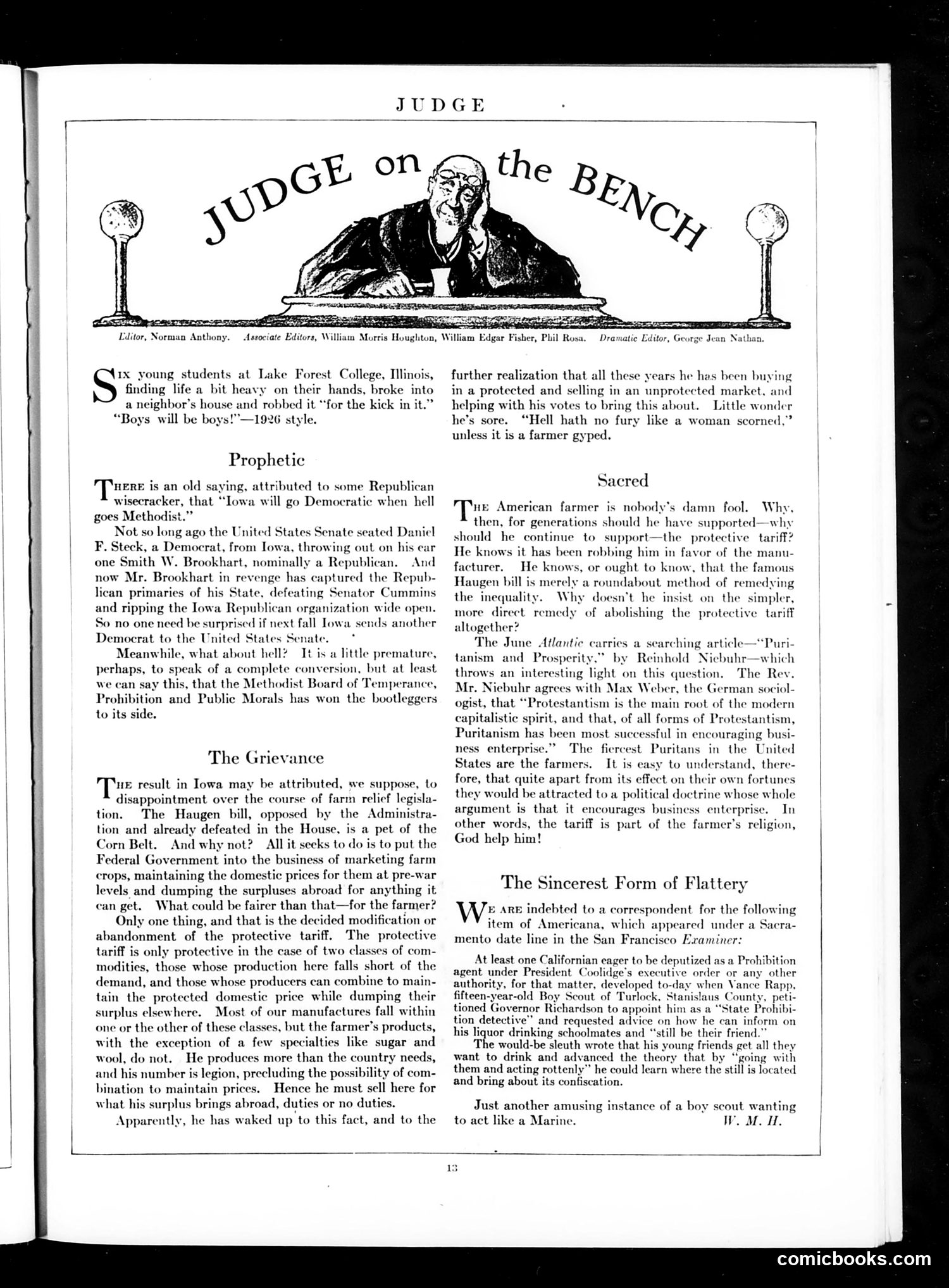
This page from *Judge* magazine satirizes American political and social issues of the 1920s through four editorial pieces: **"Prophetic"** mocks Iowa politics, noting that Democrat Daniel F. Steck's Senate victory contradicts the old saying "Iowa will go Democratic when hell goes Methodist"—yet Methodist Prohibition advocates have supposedly won over bootleggers. **"The Grievance"** critiques the failed Haugen Bill, farm relief legislation favored by the agricultural Corn Belt. The piece argues farmers are foolish to support protective tariffs that benefit manufacturers while harming agricultural producers who must sell surplus crops on unprotected markets. **"Sacred"** continues this argument, questioning why farmers support tariffs that exploit them, citing a *Atlantic Monthly* article linking Protestantism to capitalism. **"The Sincerest Form of Flattery"** reports humorous Americana anecdotes about Prohibition enforcement and Boy Scout misbehavior. The magazine's tone is sardonic, targeting political hypocrisy, economic policy failures, and social contradictions of 1920s America.
📄 Transcribed text from this page (OCR, searchable)
Machine-transcribed from the original scan — historical spelling and the odd misread are preserved.
Luitor, Norman Anthony. 1x young students at Lake Forest College, Ilinois, finding life a bit heavy on their hands, broke into a neighbor's house and robbed it “for the kick in it.” “Boys. will be boys!"—1926 style. Prophetic HERE is an old saying, attributed to some Republican wisecracker, that “Iowa will go Democratic when hell goes Methodist.” Not so long ago the United States Senate seated Daniel F. Steck, a Democrat, from Iowa, throwing out on his ear one Smith W. Brookhart, nominally a Republican. And now Mr. Brookhart in revenge has captured the Repub- lican primaries of his State, defeating Senator Cummins and ripping the Iowa Republican organization wide open. So no one need be surprised if next fall Jowa sends another Democrat to the United States Senate. Meanwhile, what about hell? It is a little premature, perhaps, to speak of a complete conversion, but at least we can say this, that the Methodist Board of Temperance, Prohibition and Public Morals has won the bootleggers to its side. The Grievance we suppose, to Te result in Iowa may be attributed, disappointment over the course of farm relief legisla- tion. The Haugen bill, opposed by the Administra- tion and already defeated in the House, is a pet of the Corn Belt. And why not? All it seeks to do is to put the Federal Government into the business of marketing farm crops, maintaining the domestic prices for them at pre-war levels and dumping the surpluses abroad for anything it can get. What could be fairer than that—for the farmer? Only one thing, and that is the decided modification or abandonment of the protective tariff. The protective tariff is only protective in the case of two classes of com- modities, those whose production here falls short of the demand, and those whose producers can combine to main- tain the protected domestic price while dumping their surplus elsewhere. Most of our manufactures fall within one or the other of these classes, but the farmer’s products, with the exception of a few specialties like sugar and wool, do not. He produces more than the country needs, and his number is legion, precluding the possibility of com- bination to maintain prices. Hence he must sell here for what his surplus brings abroad, duties or no duties. Apparently, he has waked up to this fact, and to the Associate Editors, William Morris Houghton, William Edgar Fisher, Phil Rosa Dramatie Editor, Ge« further realization that all these years he has been buying in a protected and selling in an unprotected market, and helping with his votes to bring this about. Little wonder he’s sore. “Hell hath no fury like a woman scorned,” unless it is a farmer gyped. Sacred T American farmer is nobody's damn fool. Why, then, for generations should he have supported—why should he continue to support—the protective tariff? He knows it has been robbing him in favor of the manu- facturer. He knows, or ought to know, that the Haugen bill is merely a roundabout method of remedying the inequality. Why doesn’t he insist on the simpler, more direct remedy of abolishing the protective tariff altogether? The June Atlantic ries a searching article tanism and Prosperity.” by Reinhold Niebuhr—which throws an interesting light on this question. The Rev. agrees with Max Weber, the German sociol- ogist, that ‘Protestantism is the main root of the modern istic spirit, and that, of all forms of Protestantism, Puritanism has been most successful in encouraging busi- ness enterprise.” The fiercest Puritans in the United States are the farmers. It is easy to understand, there- fore, that quite apart from its effect on their own fortunes they would be attracted to a political doctrine whose whole argument is that it encourages business enterprise. In other words, the tariff is part of the farmer’s religion, God help him! ‘amous uri- The Sincerest Form of Flattery W ARE indebted to a correspondent for the following item of Americana, which appeared under a mento date line in the San Francisco Examiner: At least one Californian eager to be deputized as a Prohibition agent under President Coolidge’s executive order or any other for that matter, developed to-day when Vance Rapp, ar-old Boy Scout of Turlock, Stanislaus County, peti- vernor Richardson to appoint him as a “State Prohibi- tion detective” and requested advice on how he can inform on his liquor drinking schoolmates and Il be their friend.” The would-be sleuth wrote that his young friends get all they want to drink and advanced the theory that by “going with them and acting rottenly” he could learn where the still is located and bring about its confiscation. Just another amusing instance of a boy scout wanting to act like a Marine. W. M. H. comicbooks.com