
Judge, 1926-06-26 · page 21 of 37
Judge — June 26, 1926 — page 21: what you’re looking at
What you’re looking at
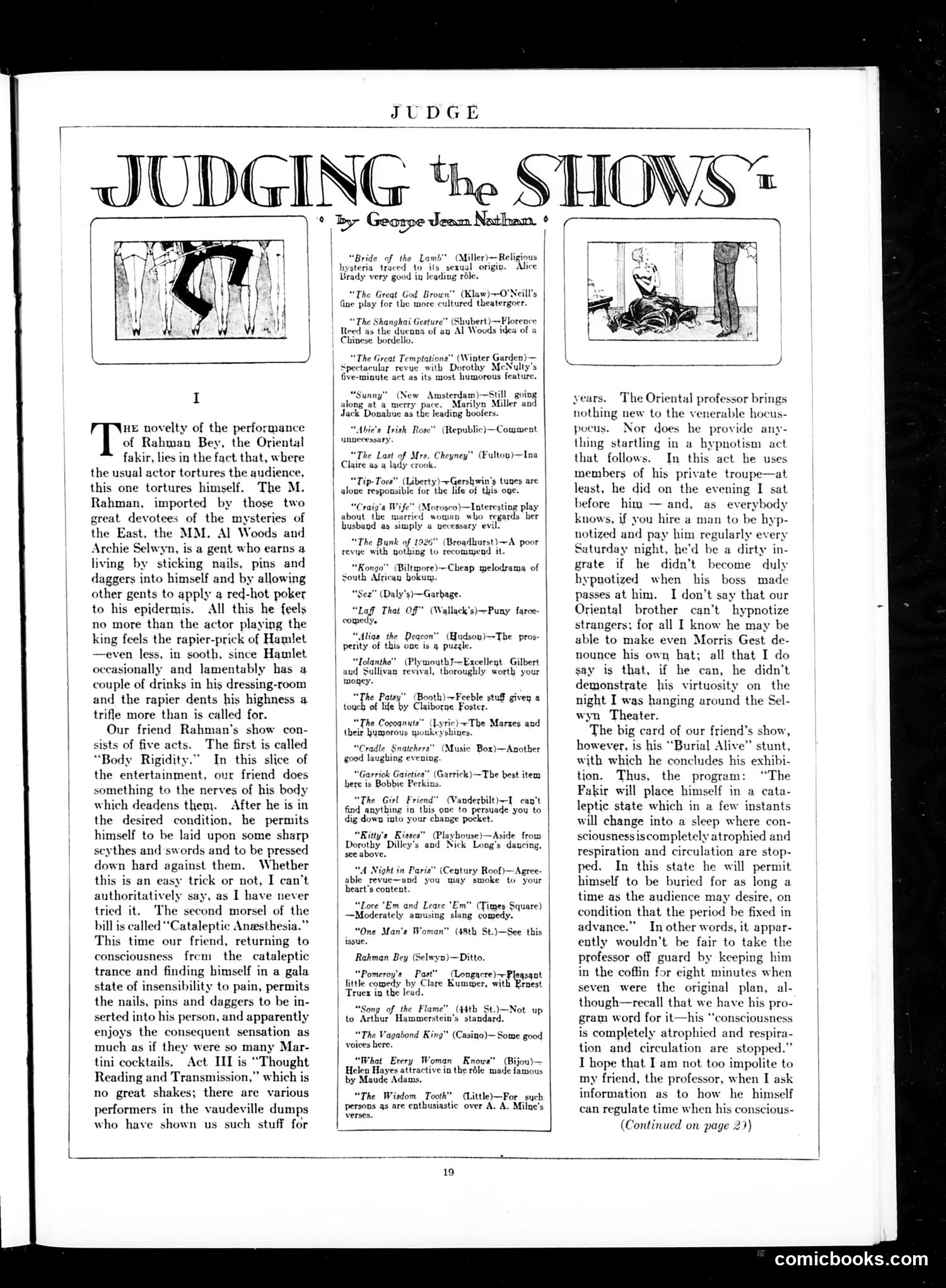
This page reviews theatrical performances, primarily focusing on "Rahman Bey," an Oriental fakir performing in New York. The satire lies in Nathan's deadpan comparison of Rahman's self-torture acts (lying on swords, inserting nails into his body while in induced states of numbness) to the overwrought emotional performances of conventional actors. Nathan ironically suggests Rahman's pain-free mutilation is actually *less* impressive than watching a drunk Hamlet get genuinely nicked by a rapier. The second section lists current Broadway shows with Nathan's witty, dismissive reviews—calling productions "garbage," "feeble stuff," and "poor revue[s]." The satire targets both the fakir's manufactured mystique and Broadway's manufactured entertainment, suggesting both are ultimately shallow spectacles designed to distract audiences.
📄 Transcribed text from this page (OCR, searchable)
Machine-transcribed from the original scan — historical spelling and the odd misread are preserved.
JUDGE I r ie novelty of the performance of Rahman Bey, the Oriental fakir, lies in the fact that, where the usual actor tortures the audience, this one tortures himself. The M. Rahman, imported by those two great devotees of the mysteries of the East, the MM. Al Woods and Archie Selwyn, is a gent who earns a living by sticking nails, pins and daggers into himself and by allowing other gents to apply a red-hot poker to his epidermis. All this he feels no more than the actor playing the king feels the rapier-prick of Hamlet —even less, in sooth, since Hamlet occasionally and lamentably has a couple of drinks in his dressing-room and the rapier dents his highness a trifle more than is called for. Our friend Rahman's show con- sists of five acts. The first is called “Body Rigidity.” In this slice of the entertainment, our friend does something to the nerves of his body which deadens them. After he is in the desired condition, he permits himself to be laid upon some sharp scythes and swords and to be pressed down hard against them. Whetber this is an easy trick or not, I can’t authoritativ , as I have never tried it. The second morsel of the bill is called “*Cataleptic Anesthesia.” This time our friend, returning to consciousness frem the cataleptic trance and finding himself in a gala state of insensibility to pain, permits the nails, pins and daggers to be in- serted into his person, and apparently enjoys the consequent sensation as much as if they were so many Mar- tini cocktails. Act III is “Thought Reading and Transmission,” which is no great shakes; there are various performers in the vaudeville dumps who have shown us such stuff for G the SHOW! @ thas “Bride of tho Lamb" hysteria traced to its. se3 ‘he Great God Brown" (Klaw)—-O" jay for the more cultured theaterg: “The Shanghai Gesture” (Shubert)—Flore Iced as the ducona of au Al Wouds idea of 3 | Chinese bordello. “The Great Temptations" (Winter Garden) ~ | Spectacular revue with Dorothy McNult Gve-minute act as its most humorous feature. “Sunny” (New Amsterdam)—Still going along at a merry pace. Marilyn Miller and Jack Donahue as the leading hooters. “Abie's Irish Rose’ unnecessary. “The Last of Mrs. Cheyney” (Fultov)—Ina Claire as 4 lady crook. (Republic)—Cowment “Tip-Toca” (Liberty)+Gershwin's tunes are alone responsible for the life of this ope. “Craig's Wife” (Moroyco)—Lnteresting play about the married soman who regards ber | busband as simply a necessary evil. “The Bunk of 1926" ( adurst)—-A poor revue with nothing to r mmmend it. | “Kongo” (Biltmore)~Cheap melodrama of South African boku. “Sez” (Daly's)—Garbage. | “Lag That Of" (Wallack’s)~Puny farce- comedy. | “lias the Degcon' (Hudsou)—The pros- perity of this one is q puzgle. “Tolanthe” (Plymouth}—Excellent Gilbert and Sullivan revival, thoroughly worth your money. “The Patsy (Booth)-~Feeble stuf given touch of life by Claiborne Foster. “The Cocoanuts" (Lyric) The Marses and their humorous monkeyshines. “Cradle Snatchers” (Music Box)—Another good laughing evening. “Garrick Gaictics"” (Garrick) —The best item bere is Bobbie Perkins. “The Girl Friend” (Vanderbilt)—I can’t find anything in this one to persuade you to dig down into your change pocket. “Kitty's Kisses (Playbouse)—Aside frow Dorothy Dilley's and Nick Long's dancing, see above “A Night in Paris” (Century Roof)—Agree- able revue—and you may smoke to your heart's content. “Lore ‘Em and Leare Em” (Tienes Square) | Moderately amusing slang comedy. “One Man's Woman" (48th St.)—See this issue. Rahman Bey (Selwyn)—Ditto. “Pomeroy's Past” (Longacre) Pleqsqnt little comedy by Clare Kummer, with Ernest Truex in the lead. “Song of the Flame” (44th St.)—Not up | to Arthur Hammerstein's standard. “The Vagabond King" (Casino)—Some good voices bere. “What Every Woman Knows" (Bijou)— | Helen Hayes attractive in the réle made famous by Maude Adams, “The Wisdom Tooth” (Little)—For such persons qs are enthusiastic over A. A. Milne’s verses. years. The Oriental professor brings nothing new to the venerable hocus- pocus. Nor does he provide any- thing startling in a hypnotism act that follows. In this act he uses members of his private troupe—at least, he did on the evening I sat before him — and, as everybody knows, if you hire a man to be hyp- notized and pay him regularly every Saturday night, he'd be a dirty in- grate if he didn’t become duly hypnotized when his boss made passes at him. I don’t say that our Oriental brother can’t hypnotize strangers; for all I know he may be able to make even Morris Gest de- nounce his own hat; all that I do say is that, if he can, he didn’t demonstrate his virtuosity on the night I was hanging around the Sel- wyn Theater. The big card of our friend’s show, however, is his “Burial Alive” stunt, with which he concludes his exhibi- tion. Thus, the program: “The Fakir will place himself in a cata- leptic state which in a few instants will change into a sleep where con- sciousness iscompletely atrophied and respiration and circulation are stop- ped. In this state he will permit himself to be buried for as long a time as the audience may desire, on condition that the period be fixed in advance.” In other words, it appar- ently wouldn't be fair to take the professor off guard by keeping him in the coffin for eight minutes when seven were the original plan, al- though—recall that we have his pro- gram word for it—his “consciousness is completely atrophied and respira- tion and circulation are stopped.” I hope that I am not too impolite to my friend, the professor, when I ask information as to how he himself can regulate time when his conscious- (Continued on page 29) comicbooks.com