
A complete issue · 36 pages · 1926
Judge — May 15, 1926
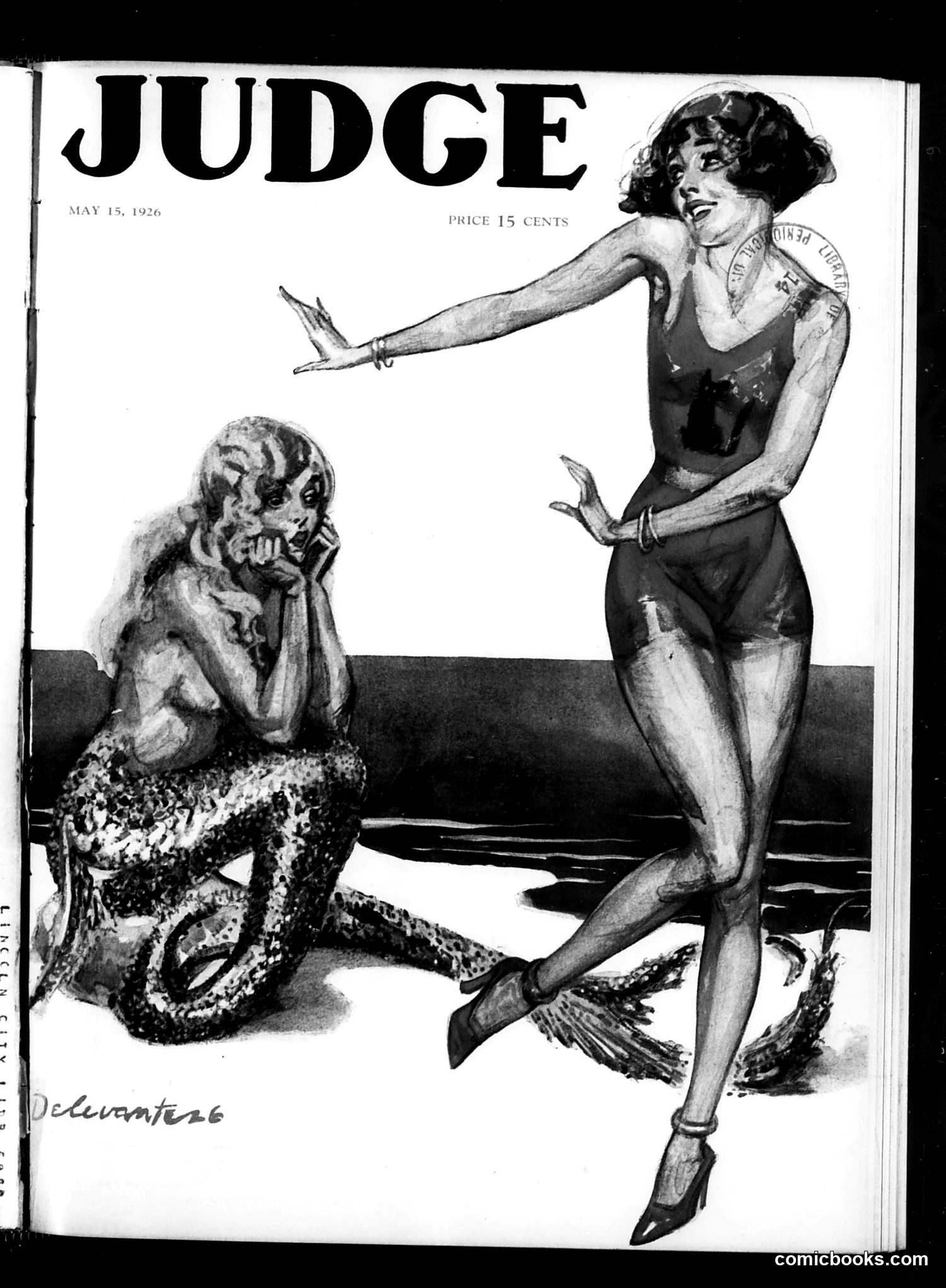
This cover depicts a woman in a bathing suit posing playfully with a sea creature (appears to be a stylized mermaid or sea monster). The satire likely comments on 1920s beach culture and the "modern woman" — a common Judge target during this era. The contrast between the glamorous, confident flapper-style woman and the grotesque creature suggests commentary on either: 1. The perceived absurdity of contemporary bathing fashions or beach behavior 2. Anxieties about changing gender roles and women's increasing public visibility The grotesque creature's distressed expression emphasizes the joke. Without visible OCR text explaining the specific reference, the exact satirical target remains unclear, though it reflects typical 1920s Judge humor mocking modern social trends and entertainment culture.
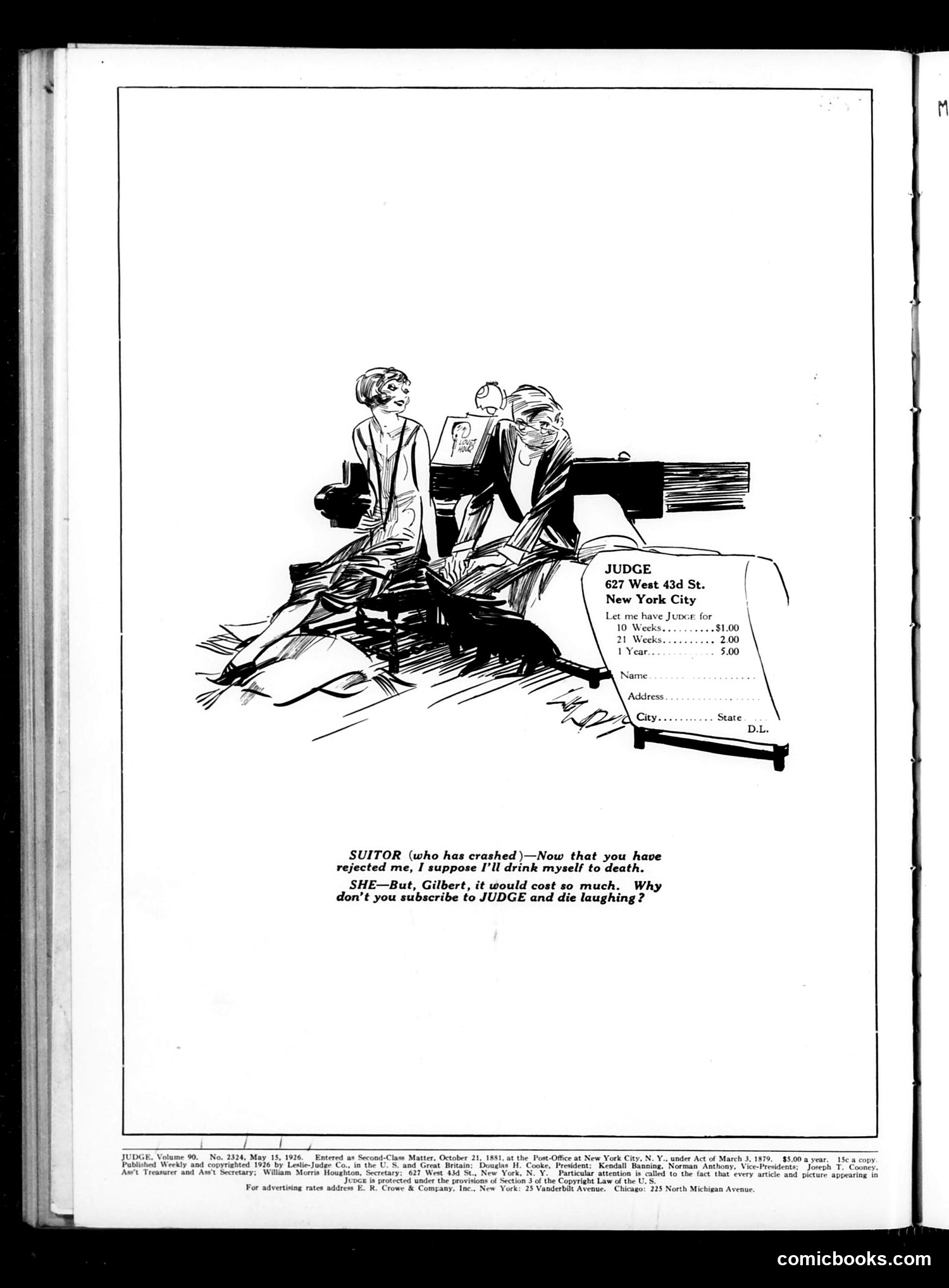
This is a **subscription advertisement** for *Judge* magazine, disguised as a satirical cartoon. The image shows two well-dressed women sitting on a bench beside a large telescope or surveying instrument, with a subscription card displayed prominently. The humor targets romantic rejection: a suitor (who has "crashed") tells his ex-lover he'd rather drink himself to death than accept her rejection. The woman responds by suggesting he subscribe to *Judge* instead and "die laughing"—implying the magazine's humor is so good it's a worthy alternative to either romance or suicide. This is typical early-20th-century advertising strategy: wrapping a product pitch in clever, dark humor to make it memorable and shareable. The actual magazine content or political commentary is secondary to the sales pitch.
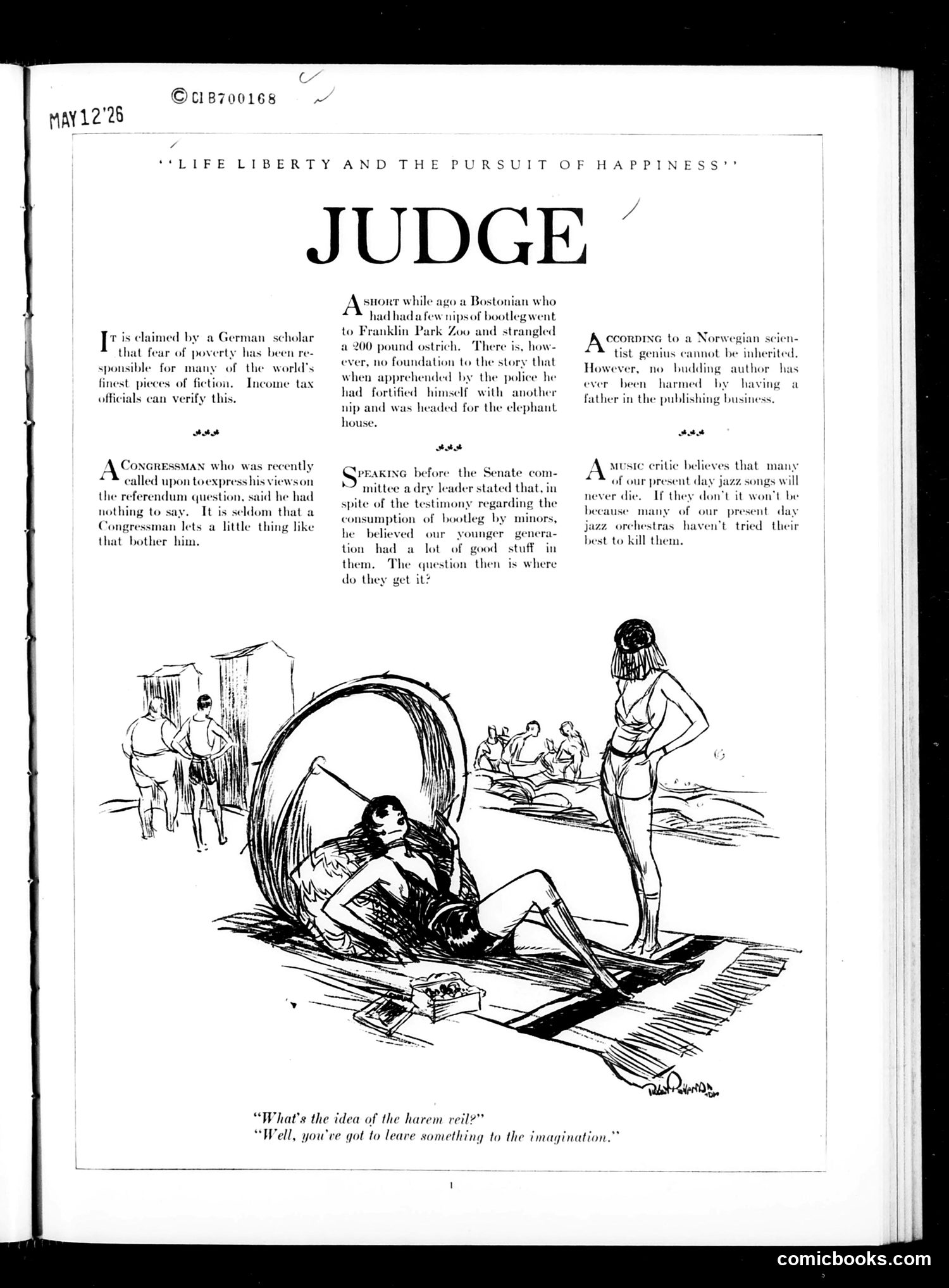
This page contains satirical commentary on various topics rather than a unified political cartoon. The main illustration depicts a beach scene with a woman in a harem outfit emerging from a barrel, with the caption "What's the idea of the harem veil?" / "Well, you've got to leave something to the imagination." This appears to satirize 1920s beach fashion debates—likely referencing ongoing controversies over women's swimwear becoming increasingly revealing during this era. The "harem" reference suggests exotic or supposedly scandalous clothing choices. The surrounding text includes commentary on income taxation, congressional conduct, inheritance of genius, and jazz music appreciation. These represent typical Judge editorial content critiquing contemporary social issues and public figures of the Jazz Age.
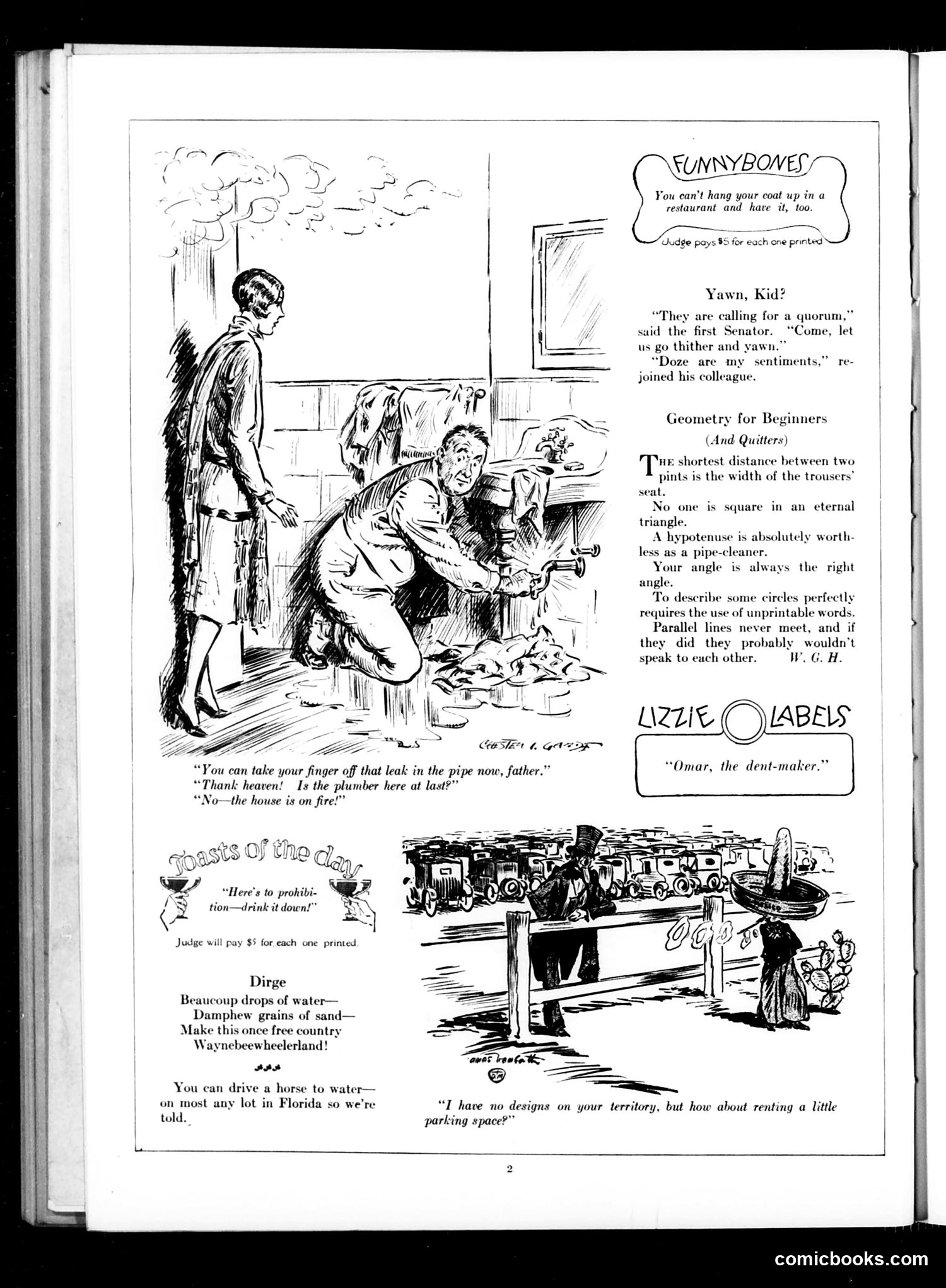
This page from *Judge* contains several humorous items rather than focused political satire: **Main cartoon** (top): Shows a plumber arriving at a house with a burst pipe. The joke plays on class anxiety—a wealthy homeowner assumes this emergency means disaster ("Is the plumber here at last?" / "No—the house is on fire!"), suggesting the plumber's arrival is the greater catastrophe due to expensive service calls. This satirizes the perceived greed of tradespeople. **"Funny Bones"**: A visual gag about coat etiquette in restaurants. **"Geometry for Beginners"**: Absurdist humor mocking dry mathematical concepts. **Lower sections**: Include wordplay ("Dirge"), a Florida anecdote, and a cartoon about parking lot disputes—all light social commentary on everyday American life rather than political critique.
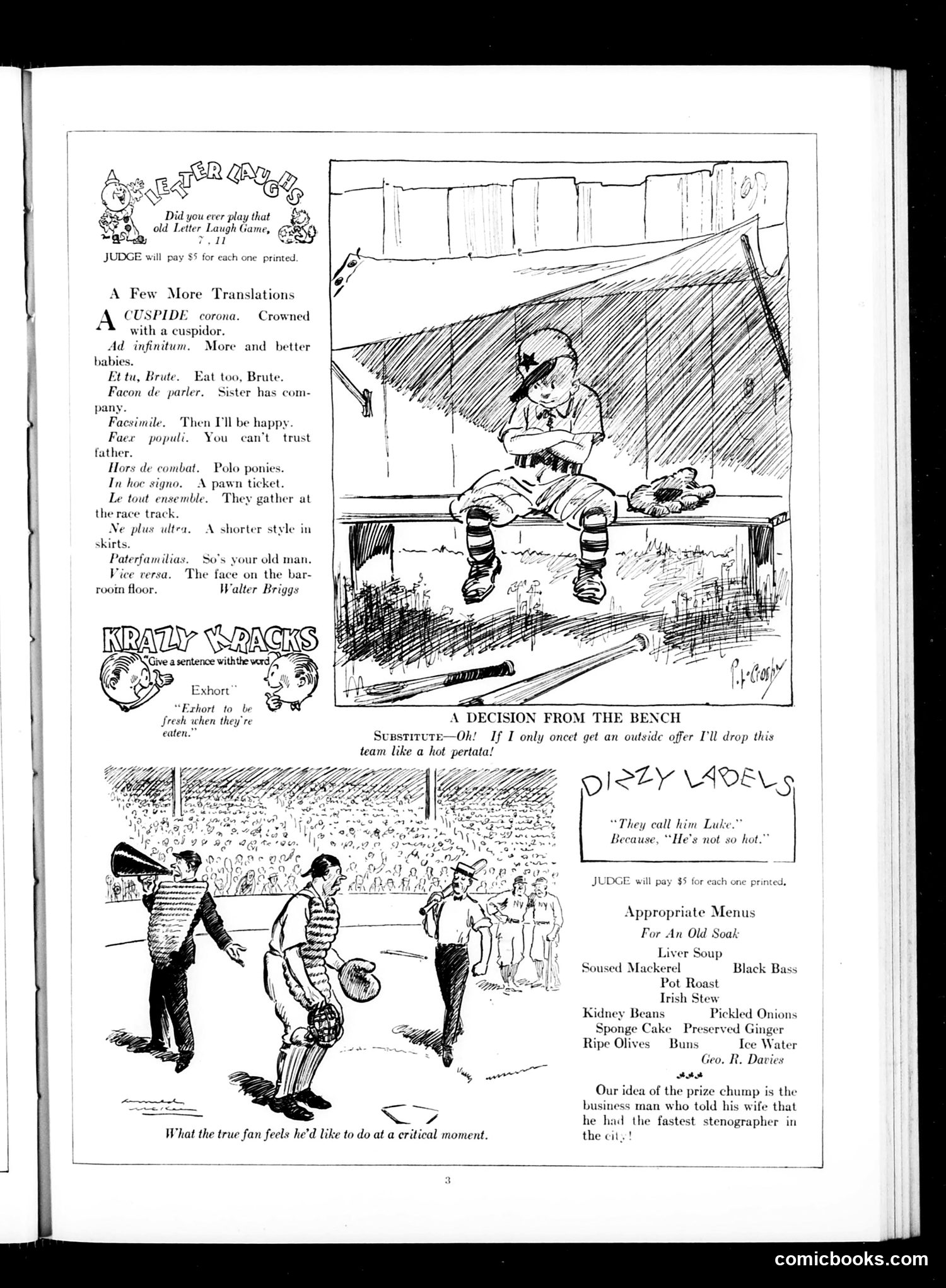
This Judge magazine page contains **sports humor and wordplay**, not political satire. The main cartoon, "A Decision from the Bench," depicts a baseball substitute warming up on the sidelines. The joke relies on a pun: the substitute threatens to "drop this team like a hot tortilla" if he doesn't get playing time—mixing sports terminology with ethnic food imagery for comedic effect. The lower cartoon shows a baseball catcher at a critical moment during a game. The page also includes a "Krazy Whacks" wordplay section and "Dizzy Labels" jokes, plus an "Appropriate Menus for an Old Soak" listing foods with double meanings (liver, kidney beans, etc.). The content reflects early 20th-century Judge magazine's focus on general humor and sports comedy rather than political commentary.
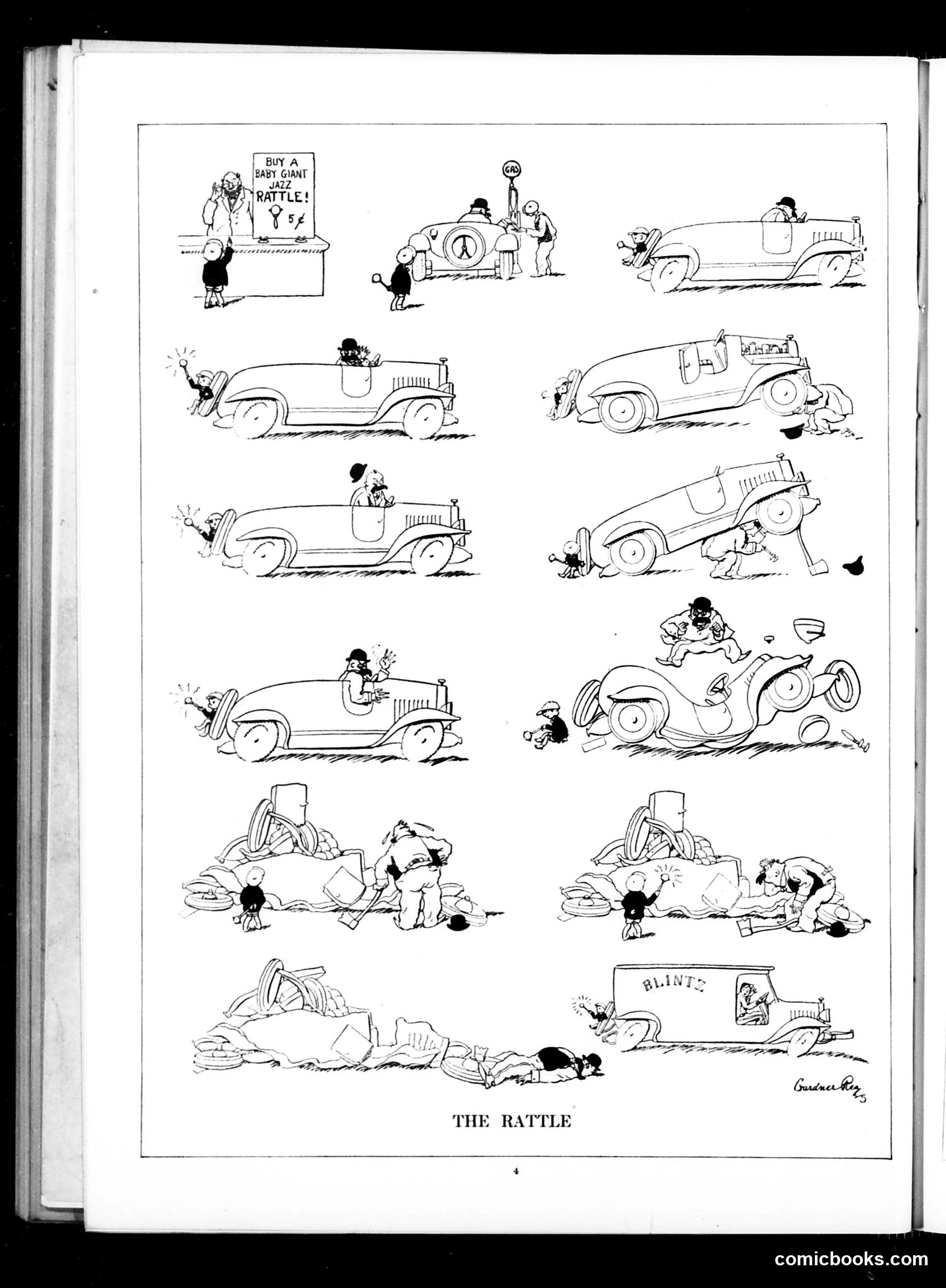
This is a sequential comic strip satirizing a dangerous toy—a "jazz rattle" marketed to babies. The narrative shows a mother purchasing the noisy toy, then depicts escalating chaos: the baby's rattle causes increasingly severe accidents to a motorist, including the car being shaken apart, tires exploding, and ultimately complete destruction of the vehicle. The satire targets both reckless product marketing and the "Jazz Age" phenomenon of the 1920s. By literalizing the rattle's disruptive power, the cartoonist mocks the era's obsession with jazz music as chaotic and destructive. The final panel shows the wrecked car being towed by a "Blintz" company truck, suggesting the baby's toy has obliterated modern conveniences—a critique of frivolous consumerism and cultural excess.
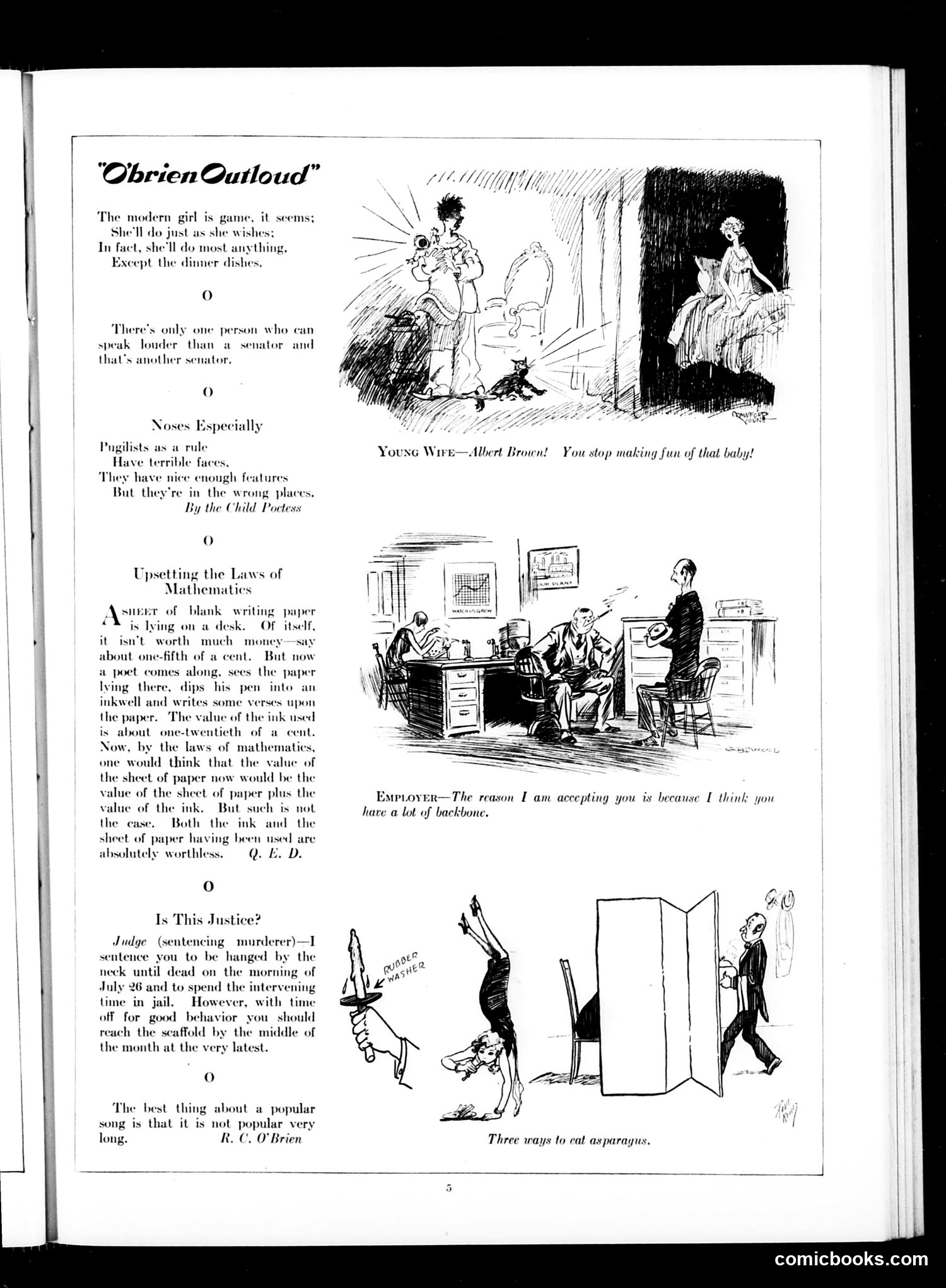
This page contains satirical poems and cartoons mocking early 20th-century social observations. **Top cartoon**: "Young Wife" complains to "Albert Brown" about making fun of their baby—a joke about modern domestic life and parental sensitivity. **Middle cartoon**: An employer tells a job applicant he's hired because of "backbone"—satirizing business-speak about character while likely suggesting the applicant is expendable labor. **Bottom cartoons**: "Three ways to eat asparagus" shows absurd dining methods, including someone doing a handstand. This mocks pretentious or overly-complicated upper-class dining etiquette, a common Judge theme. The poems address modern girls' independence, mathematical absurdity regarding paper value, and judicial leniency—typical early-1900s satirical targets of privilege, social change, and institutional hypocrisy.
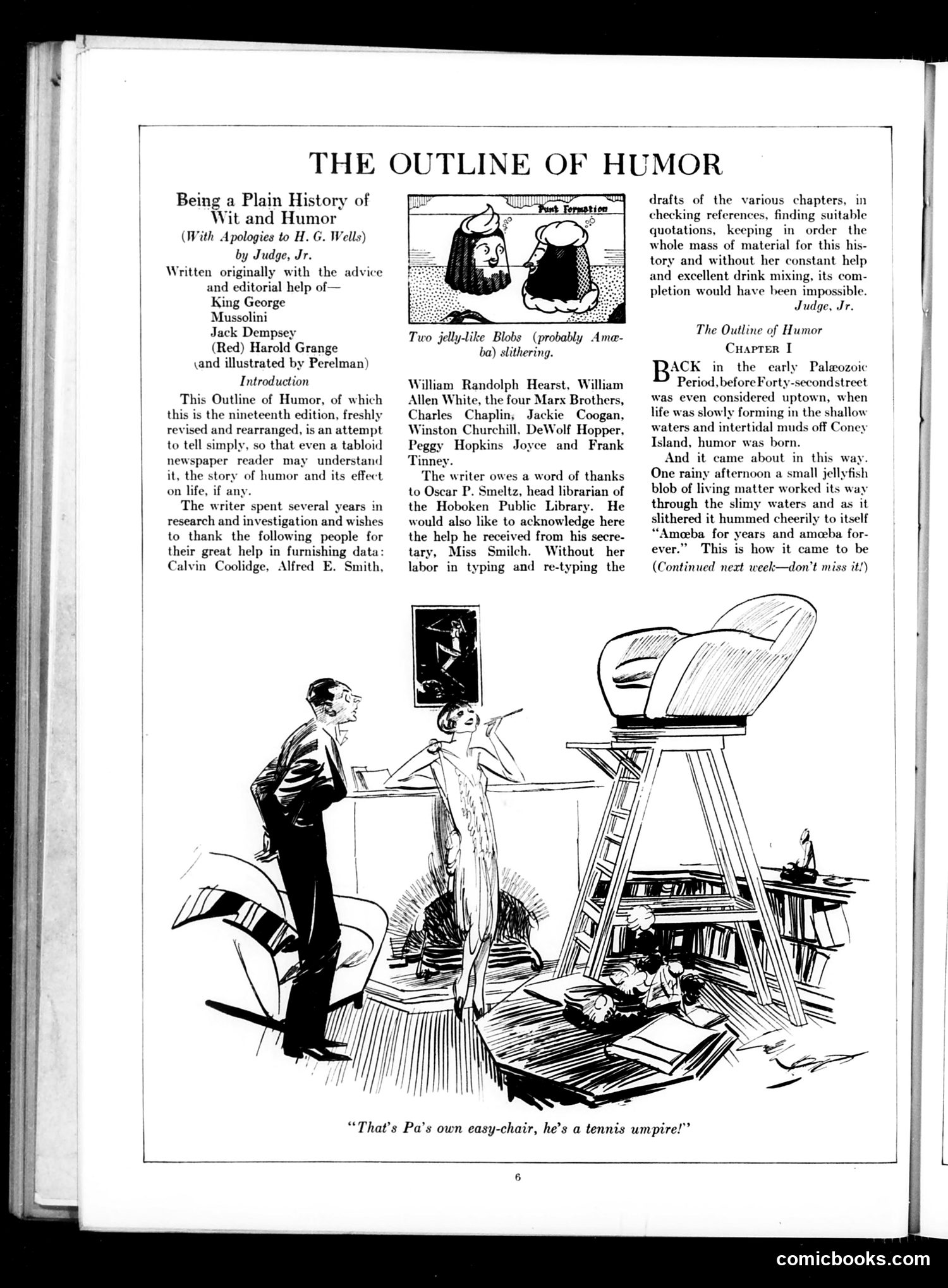
This is the introduction to a satirical history of wit and humor, presented as parody of H.G. Wells' educational works. The main cartoon depicts a woman standing on a high chair while a man examines it, with the caption "'That's Pa's own easy-chair, he's a tennis umpire!'"—the joke being that the chair's high elevation makes it resemble an umpire's elevated position. The text credits famous figures of the 1920s-30s (King George, Mussolini, Jack Dempsey, Harold Grange, Chaplin, Marx Brothers) in mock-serious fashion, satirizing how such "authorities" might be consulted for a humor history. The opening chapter humorously traces humor's origins to prehistoric jellyfish, mocking grandiose historical narratives. This is lighthearted satire on pretentious scholarship rather than political commentary.
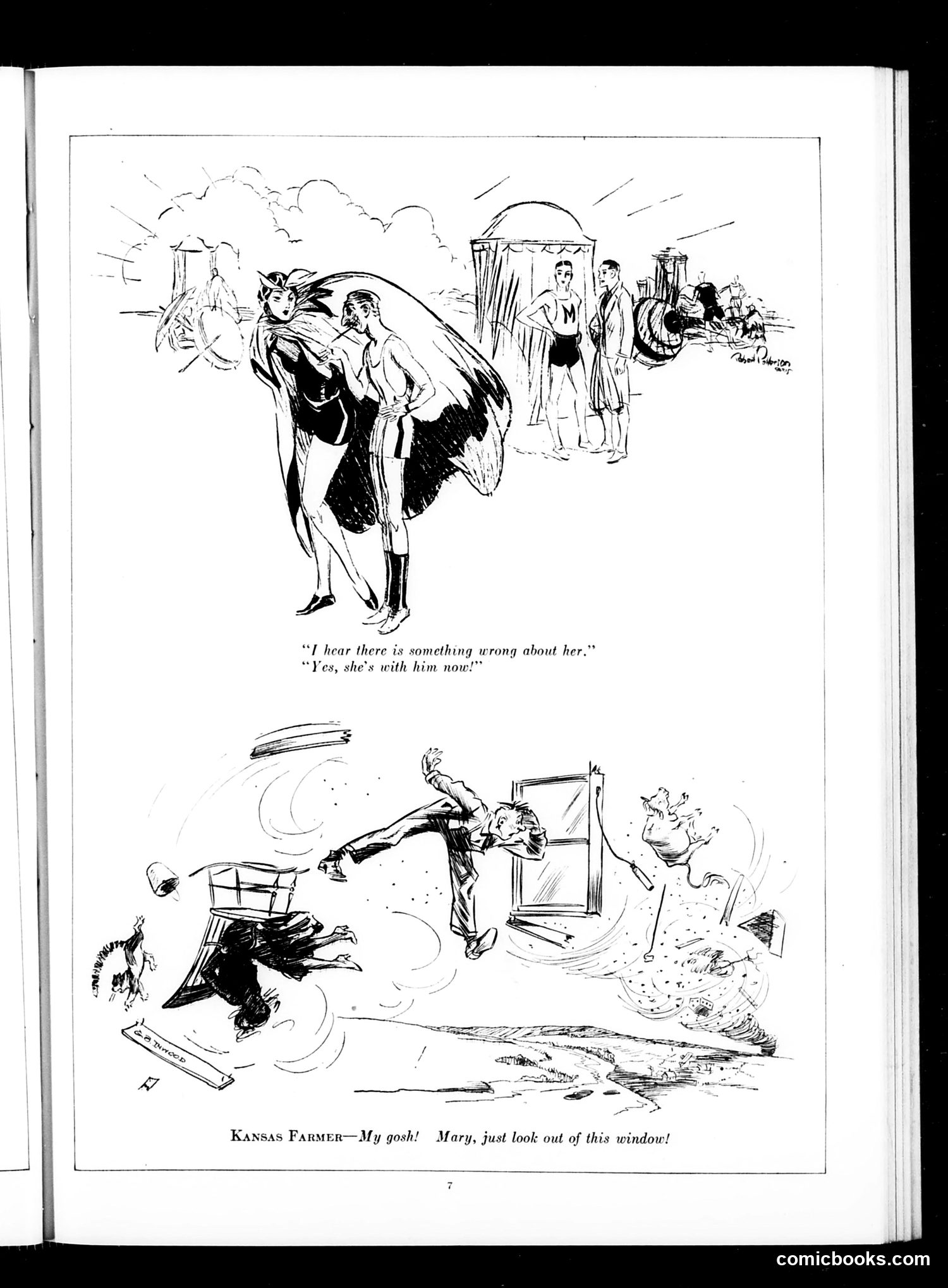
This page contains two distinct cartoons satirizing rural/farming life and morality. The **upper cartoon** depicts a woman in a coat at what appears to be a social gathering, with onlookers gossiping ("I hear there is something wrong about her"). The punchline—"Yes, she's with him now!"—suggests scandal about the woman's reputation or associations, playing on small-town gossip about improper female behavior. The **lower cartoon** shows a Kansas farmer urgently summoning his wife Mary to witness something shocking outside their window. The chaotic scene depicts what appears to be a violent accident or disaster—figures flying through the air, debris scattering. The humor derives from rural naiveté—the farmer's exclamation "My gosh!" suggests surprise at witnessing urban chaos or modern calamity, contrasting innocent country life with sensational city events. Both cartoons trade on period stereotypes about rural Americans as unsophisticated observers of moral or social disruption.
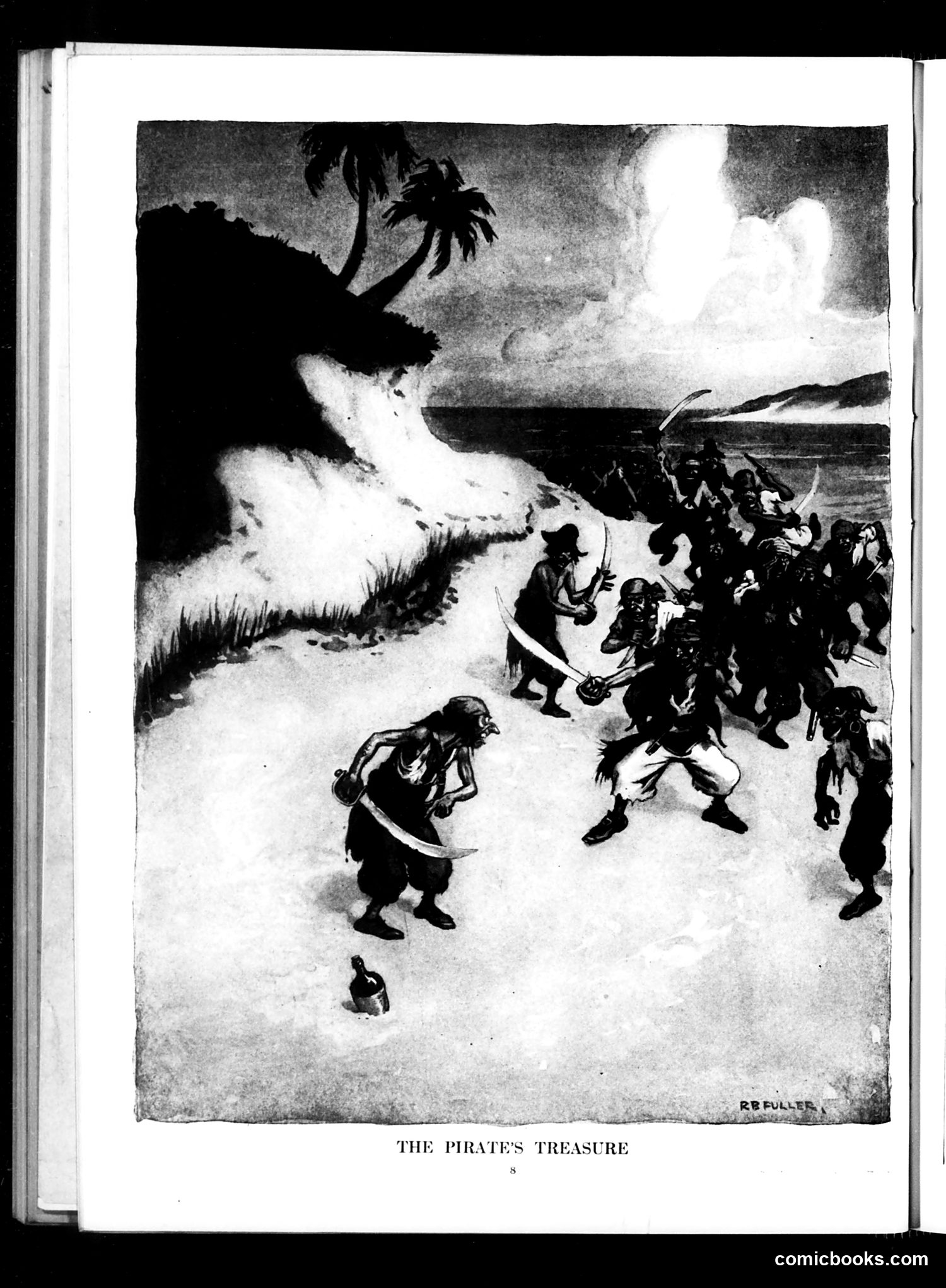
This illustration depicts a dramatic beach scene where armed figures in period costume appear to be engaged in conflict or pursuit. A large sea creature or whale dominates the left side, while a palm tree and ocean are visible in the background. Multiple figures wielding weapons (appearing to be cutlasses or similar blades) are scattered across the sandy beach. The title "The Pirate's Treasure" suggests this is a narrative illustration, likely from a serialized adventure story rather than political satire. Without additional context from surrounding pages or the magazine's publication date, the specific satirical meaning remains unclear. It may reference contemporary events using pirate/adventure metaphors, but the image alone appears to be illustrative fiction rather than pointed social commentary.
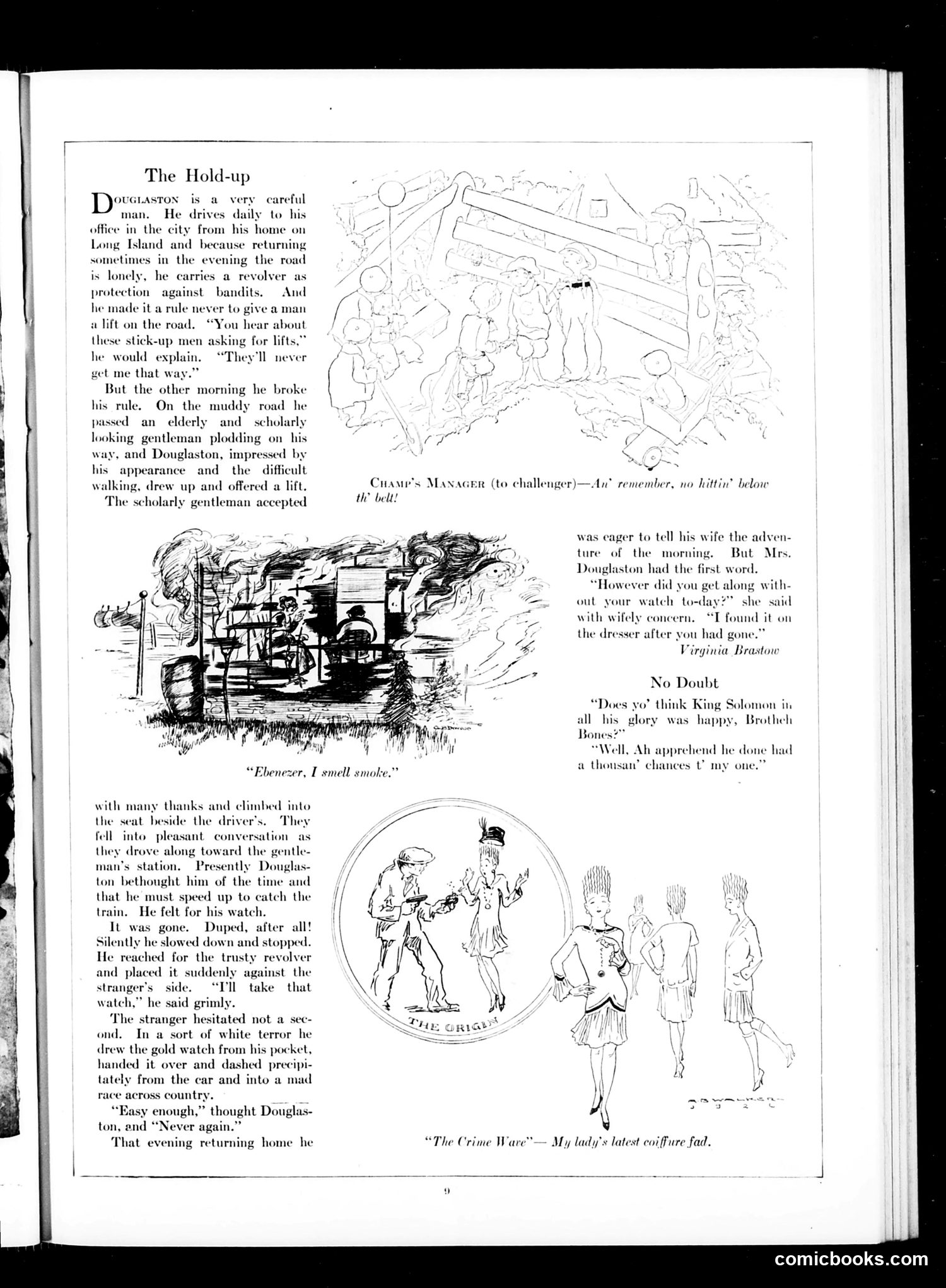
**Main Story**: Douglaston, a cautious businessman who refuses to give strangers rides to protect against highway bandits, breaks his own rule. He picks up an elderly, scholarly-looking man who robs him at gunpoint of his watch. The irony: Douglaston must reverse roles, drawing his own revolver to retrieve it. The joke plays on his violated principle—his careful precautions failed precisely when he ignored them. **Secondary Cartoons**: - "Crane's Manager" appears to reference boxing/prizefighting - "The Crime Wave" satirizes women's fashion trends by equating a new hairstyle with criminal behavior—mocking how dramatically society reacted to minor social changes **Historical Context**: This reflects early 20th-century anxiety about crime and highway robbery, particularly affecting commuters traveling between cities and suburbs on Long Island.
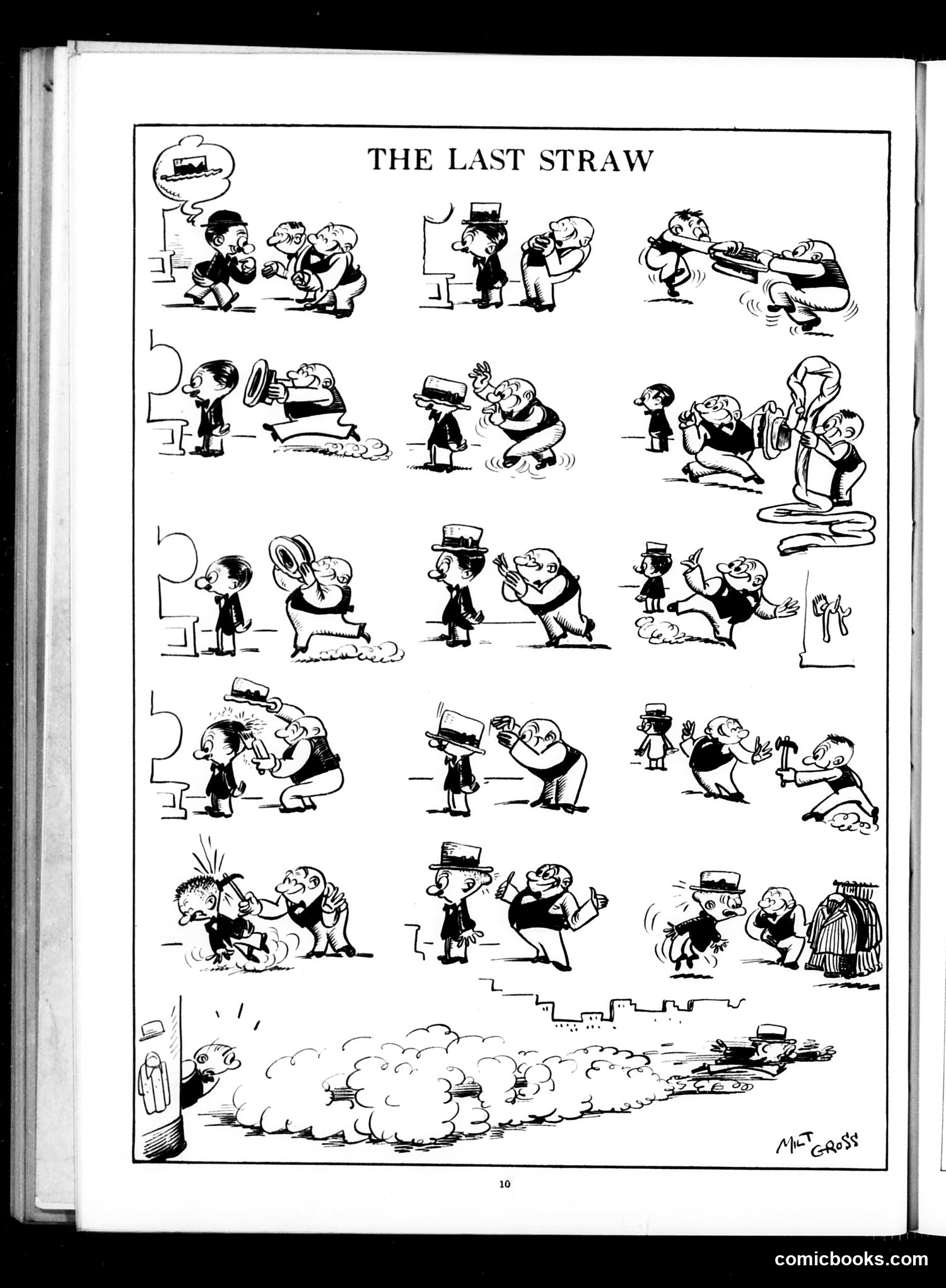
This wordless sequential comic by Milt Gross depicts a conflict escalating between two men in bowler hats. The first man repeatedly attempts to pass something to the second (appearing to offer or thrust items at him), who consistently refuses or rejects each advance. Their interaction intensifies through multiple panels—moving from verbal disagreement to physical struggle to outright combat. The final panel reveals the consequence: a massive explosion or destruction affecting multiple figures and buildings. The title "The Last Straw" suggests the cartoon illustrates how repeated provocations or rejections, though individually minor, can accumulate until they trigger catastrophic conflict or retaliation. The specific political context—which figures or nations are represented—remains unclear without additional historical documentation.
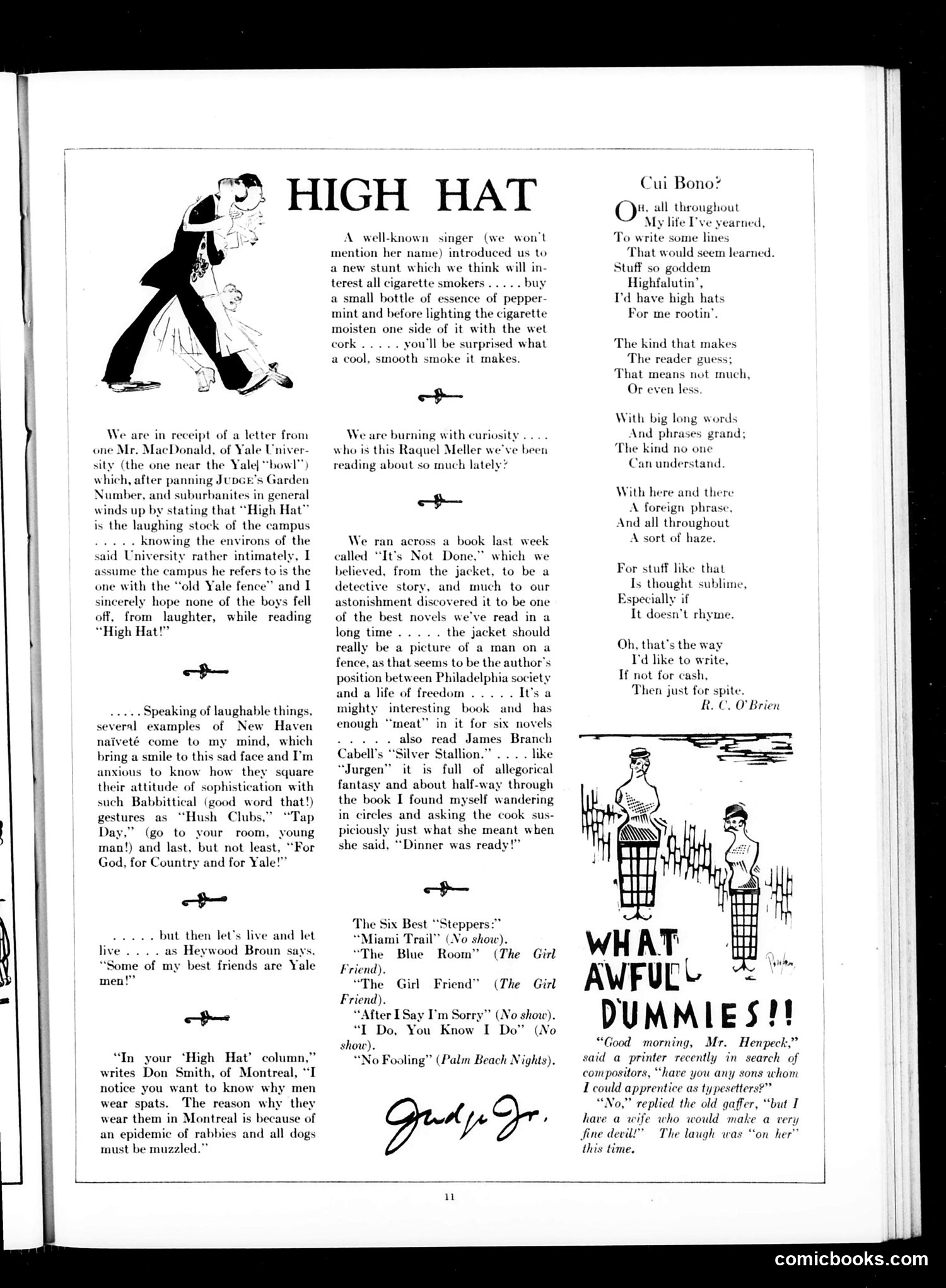
This page features satirical commentary on Yale University and literary/entertainment topics typical of 1920s Judge magazine. **Main Content:** The "High Hat" column mocks Yale students' pretentiousness. A Yale reader complained the column was the "laughing stock of the campus," prompting the editor to ridicule Yale's own affectations—"Hush Clubs," "Tap Day" (fraternity initiation), and their motto "For God, for Country and for Yale"—suggesting Yale men lack the sophistication they affect. **Satire Targets:** - Yale's social hierarchy and exclusionary clubs - New Haven's provincial attitudes masquerading as sophistication - Literary snobbery (the poem "Cui Bono?" mocks pretentious, obscure writing) - Contemporary entertainment (Raquel Meller, theatrical shows) **Minor Features:** A reader's joke about Montreal spats explains they're required due to a rabies epidemic. Book reviews discuss recent novels. The "Awful Dummies" cartoon makes a tired joke about printers' terminology ("devil"). The page reflects Judge's recurring theme: mocking American upper-class pretension and social climbing.
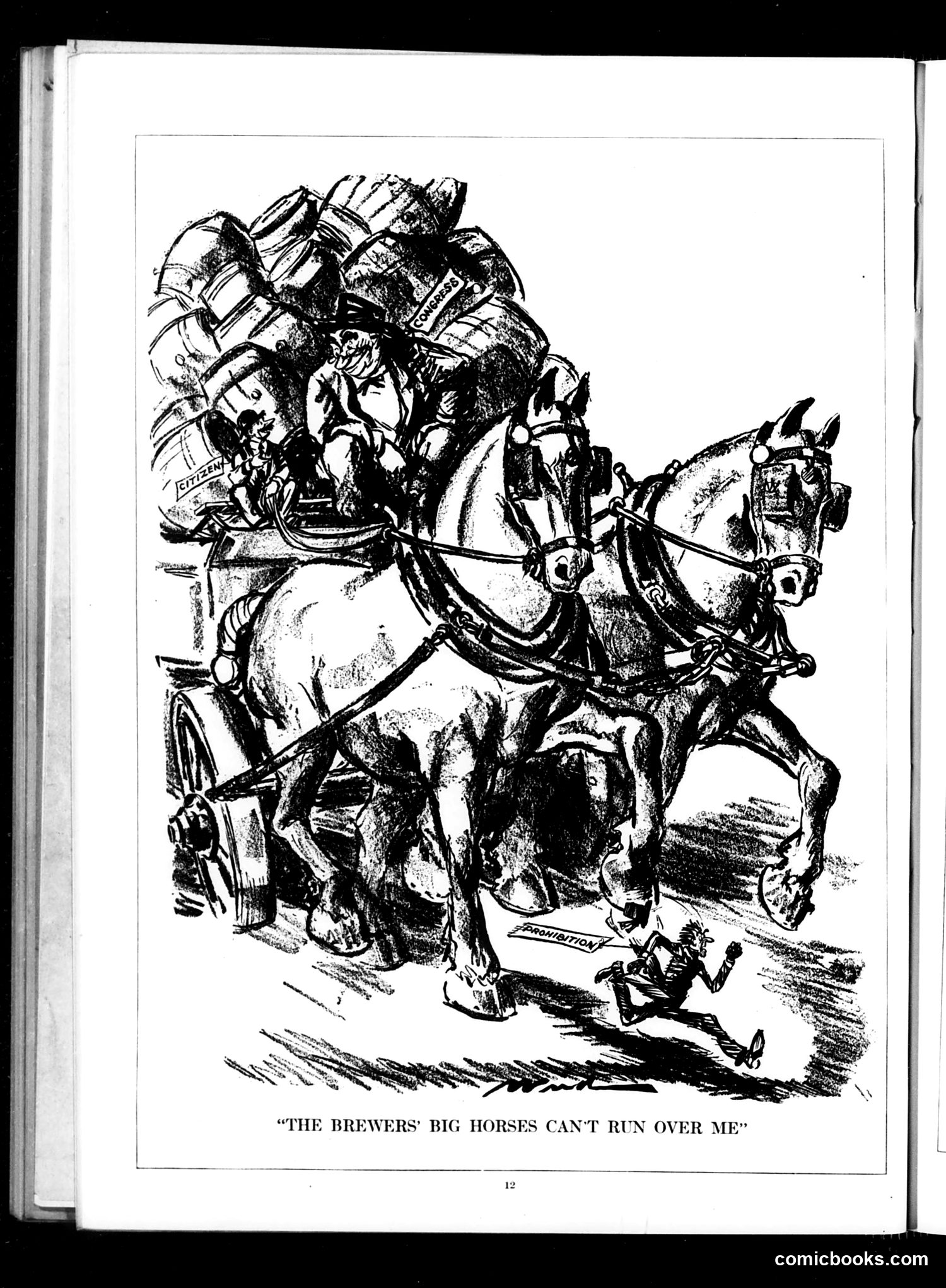
This political cartoon, titled "The Brewers' Big Horses Can't Run Over Me," depicts a figure (likely representing a labor organizer or reformer) standing defiant beneath two large brewery horses pulling a heavily-laden cart. The image uses the metaphor of horses as the brewing industry's power. The cartoon appears to satirize conflicts between breweries and labor/reform movements in early 20th-century America. The resolute stance of the small figure suggests resistance to industrial intimidation—"they can't run over me" despite overwhelming economic pressure from the brewing industry. The context likely involves labor disputes, prohibition advocacy, or broader conflicts between workers' rights and corporate interests during this era, though the specific historical moment remains unclear without additional dating or caption information.
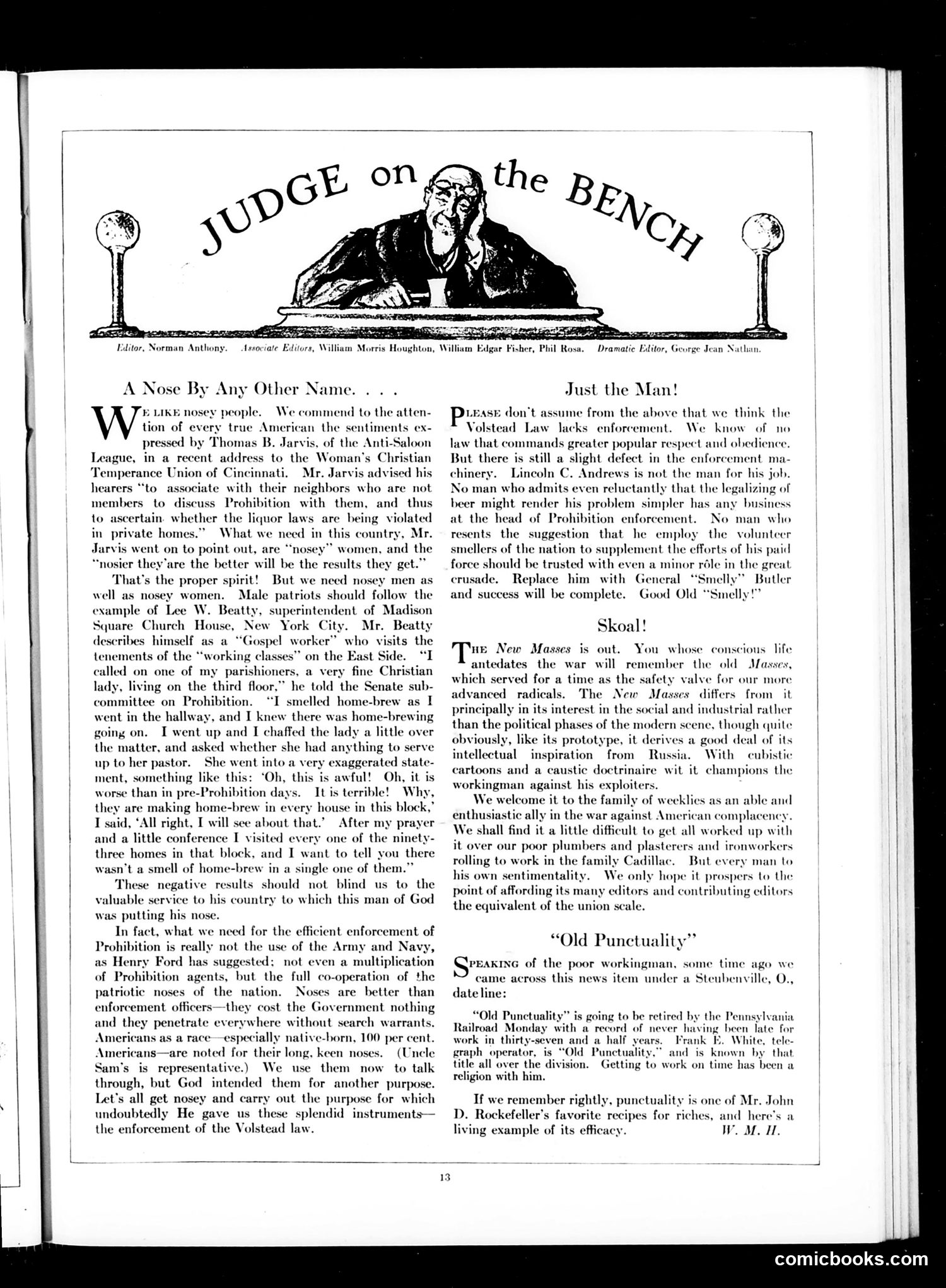
This page satirizes **Prohibition enforcement** during the 1920s. The masthead features a contemplative judge, establishing a judicial tone. **"A Nose By Any Other Name"** mocks overzealous Prohibition advocates who encourage citizens—particularly women—to spy on neighbors for illegal home-brewing. The article ridicules Thomas B. Jarvis (Anti-Saloon League) and Lee W. Beatty (a "Gospel worker") who boasted of visiting 93 homes to smell out violations. Judge's satire is subtle but cutting: while nominally supporting enforcement, it highlights the absurdity of enlisting amateur "nosey" informants and the invasive, hypocrisy-laden nature of Prohibition policing. **"Just the Man!"** criticizes Lincoln C. Andrews, the Prohibition enforcement chief, for lacking sufficient zealotry. The piece sarcastically suggests replacing him with General "Smelly" Butler—a joke name mocking the reliance on nose-sniffing informants. **"Skoal!"** briefly reviews *The New Masses*, a leftist publication, praising its anti-Prohibition stance. The overall message: Judge simultaneously mocks both aggressive Prohibition enforcement *and* those insufficiently devoted to it—satirizing the entire contradictory enterprise.
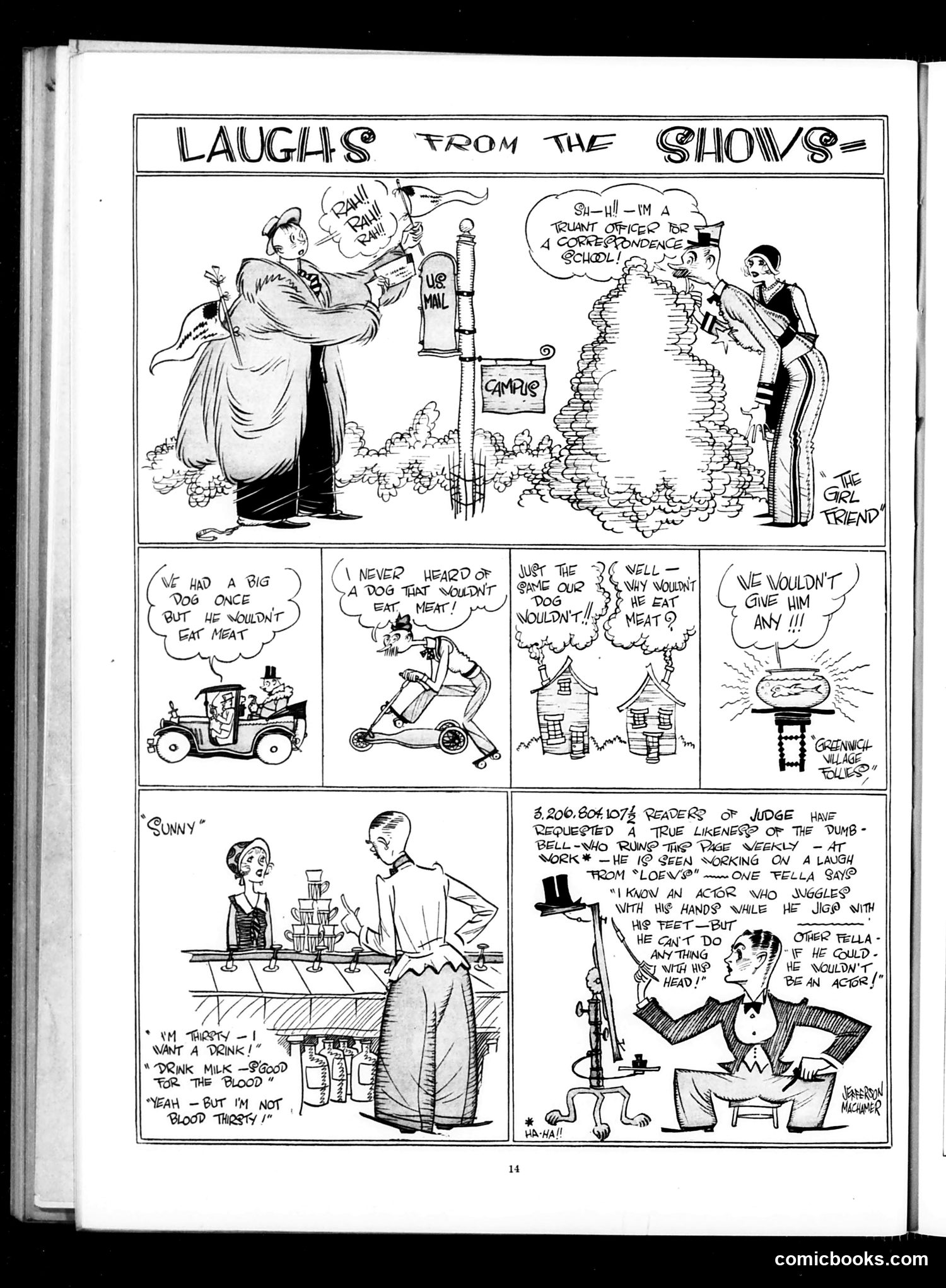
This page contains satirical cartoons mocking show business and vaudeville performers. The top panel appears to reference a correspondence school scandal or fraud, with a character posing as a "truant officer." The middle comics joke about dogs refusing meat and absurd dietary restrictions—likely mocking peculiar performer behaviors or affectations. The bottom section includes a anecdote (marked with an asterisk) about Judge magazine receiving 3,200+ reader requests for a caricature of an unnamed "dumb-bell" performer who rang a bell weekly on stage. The text describes an "actor who juggled with his hands while he jigged with his feet" but "couldn't do anything with his head"—satirizing the low intellectual capacity of certain vaudeville entertainers. The "Sunny" panel depicts a character claiming to drink milk for health, not "blood thirst"—likely a vampire or horror-themed joke. Overall, the page ridicules minor vaudeville acts and theatrical pretension popular in early-to-mid 20th century entertainment.
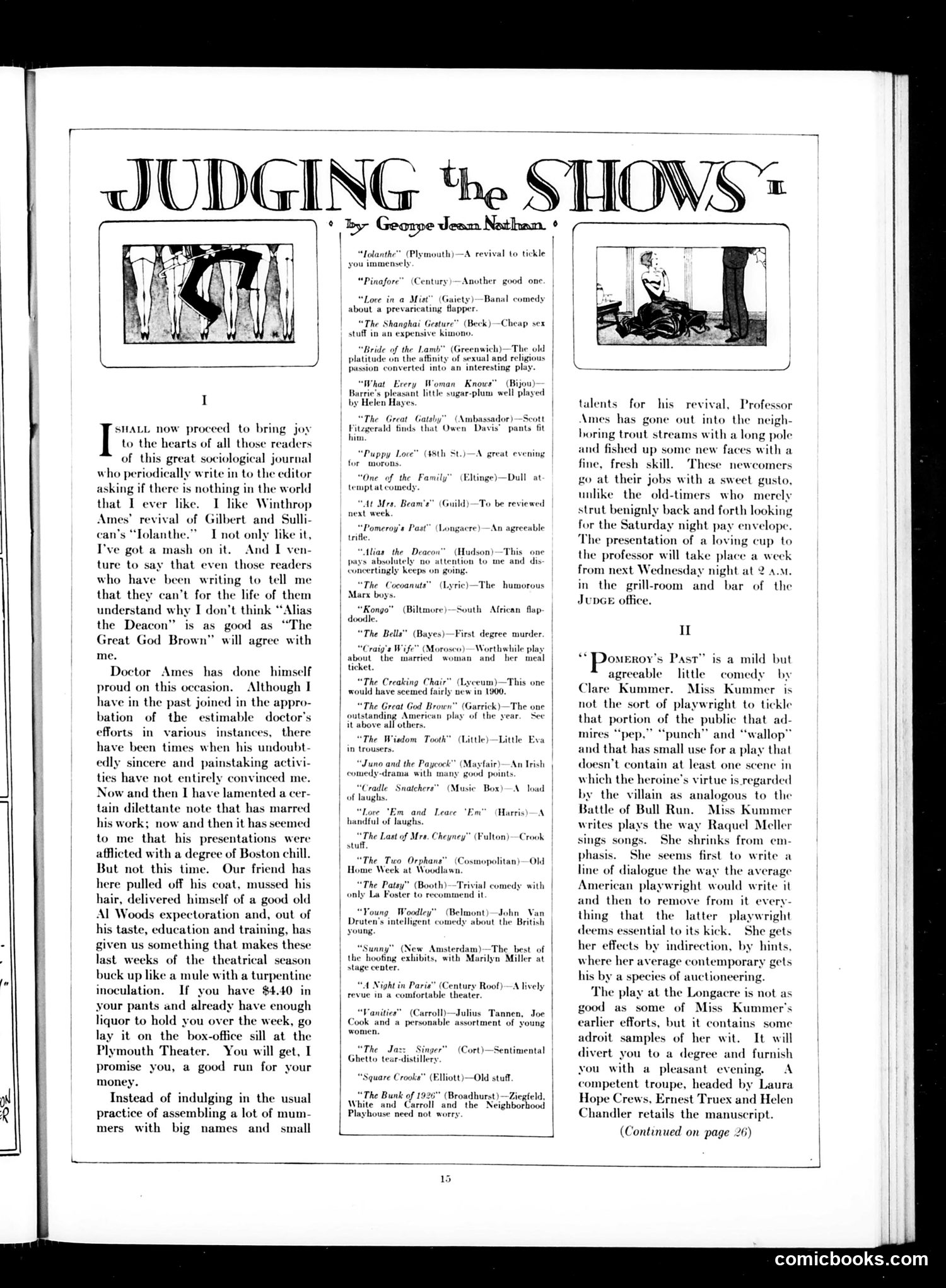
This is a theater review column by George Jean Nathan critiquing Broadway productions of the mid-1920s. The two illustrations appear to show scenes from plays—likely "Iolanthe" (Gilbert & Sullivan revival) and "Pomeroy's Past." Nathan praises producer Winthrop Ames' "Iolanthe" revival enthusiastically, contrasting it favorably with Ames' previous work, which Nathan felt had been overly refined and "Boston chill." He characterizes Ames as having "pulled off his coat" and delivered genuine entertainment rather than dilettante theater. Nathan encourages readers to spend $4.40 (a significant sum then) on Plymouth Theater tickets. The column lists other current Broadway offerings with brief, dismissive critiques—calling "Puppy Love" suitable only for "morons," describing "Alias the Deacon" as persistently mediocre, and praising "The Great God Brown" as "the one outstanding American play of the year." The satire targets pretentious theater and rewards accessible entertainment delivered with sincerity and energy.
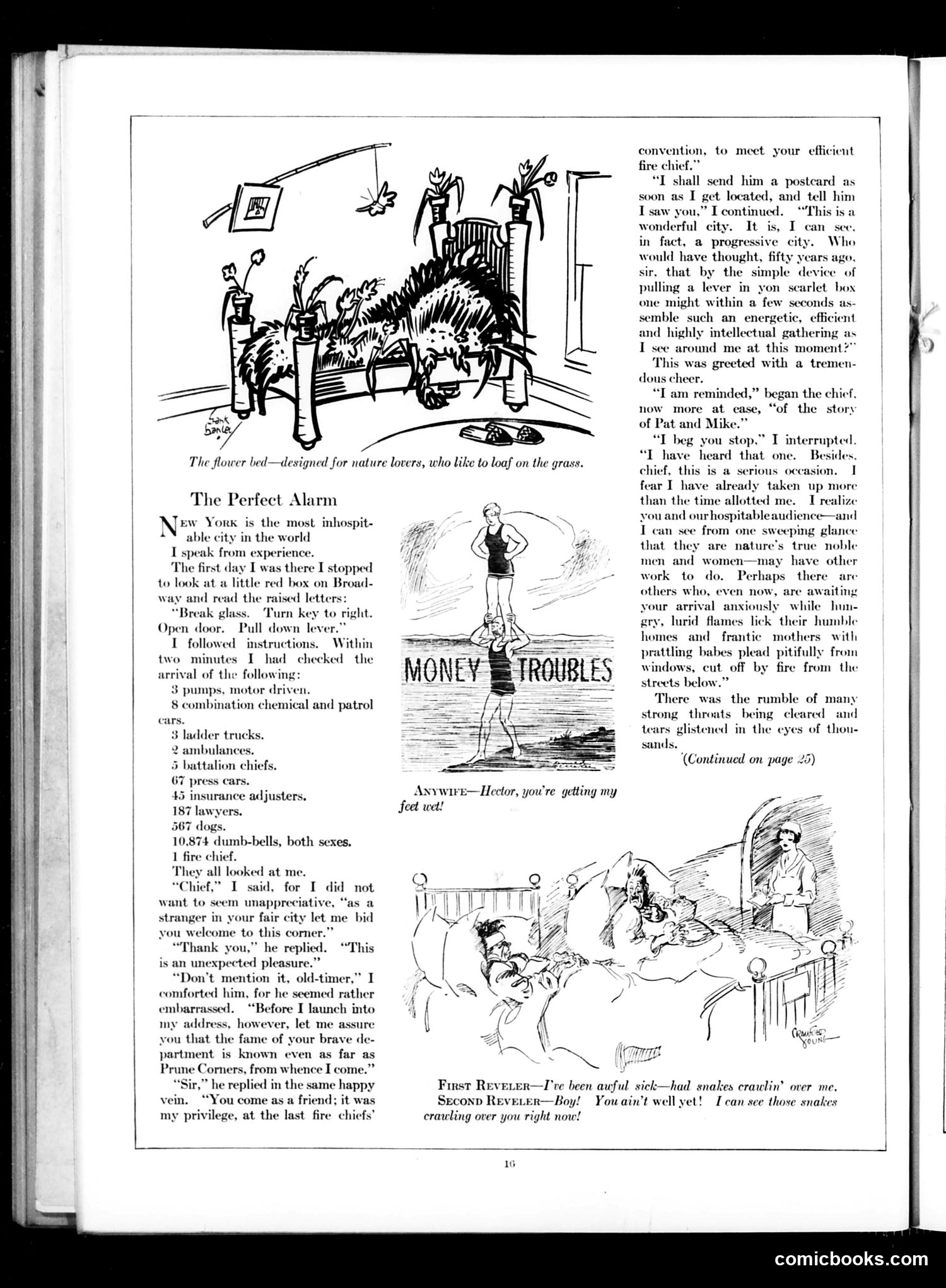
This page contains two satirical pieces mocking American urban life and social pretension. **"The Perfect Alarm"** ridicules New York City's emergency response system and the narrator's self-important behavior. A visitor pulls a fire alarm box as a tourist attraction, triggering an absurdly massive response (567 dogs, 10,874 "dumb-bells," 187 lawyers). The joke satirizes: (1) New York's inefficiency and chaos despite its "progress," (2) the visitor's pompous, flattering speech to the fire chief, and (3) the excessive, comical nature of urban bureaucracy. The phrase about "pulling a lever in yon scarlet box" mocking the ease of causing this chaos suggests critique of systems that respond disproportionately to minor triggers. **"The Flower Bed"** cartoon (top) depicts people lounging in grass—likely criticizing those who treat public spaces irresponsibly. **The lower comic strip** appears to show people in water, with crude dialect humor about snakes—typical period humor relying on racial/ethnic stereotypes. The overall tone mocks modern city life as chaotic, pretentious, and absurdly bureaucratic.
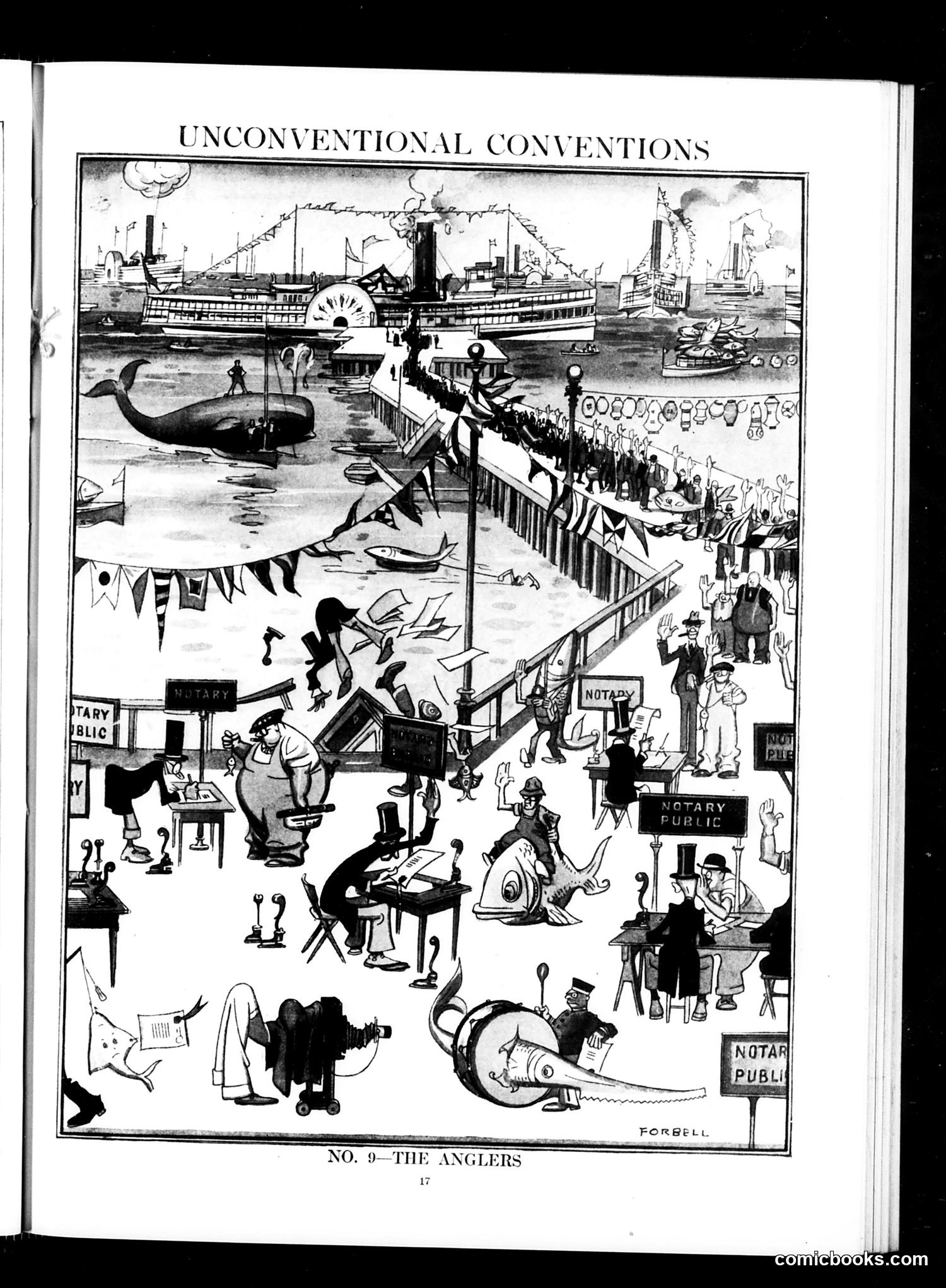
This satirical cartoon depicts a crowded waterfront scene where "Notary Public" signs are prominently displayed. The title "The Anglers" uses fishing as metaphor for the practice of notaries public soliciting business at harbors and piers. The joke targets notaries who aggressively pursued clients—particularly immigrants and sailors—to conduct business like document notarization and legal witnessing. The cartoon shows these notaries as opportunistic "anglers" literally fishing for customers among the crowds near ships and docks. The scene satirizes how notaries would congregate at transportation hubs where vulnerable populations (arriving immigrants, departing sailors) could be easily targeted for their services. This was apparently viewed as an unseemly, predatory commercial practice worthy of ridicule in Judge magazine's satirical commentary on American business conventions.
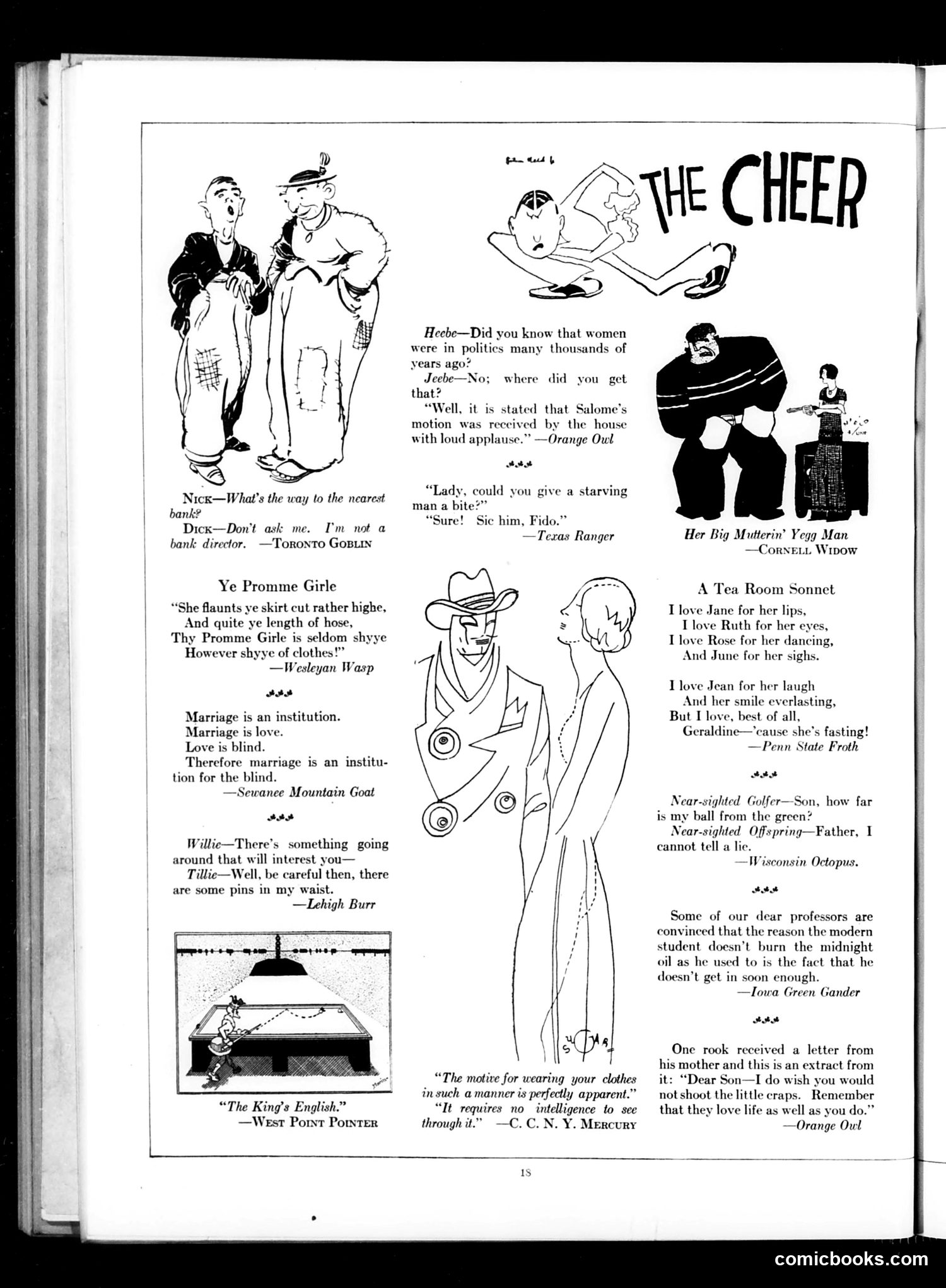
This page collects brief humorous jokes and cartoons typical of early 20th-century college humor magazines. The satire targets: **Social/Gender Issues**: "Ye Promme Girle" mocks young women's fashion—shorter skirts and visible stockings were scandalous, the joke being they're immodest while claiming modesty. The "motive for wearing your clothes" cartoon similarly attacks women's revealing clothing as requiring no intelligence to see "through." **Gender in Politics**: A joke references Salome receiving "loud applause" from "the house," sarcastically suggesting women were always in politics—referencing the Biblical Salome's power over men, mocking contemporary women's suffrage arguments. **Marriage/Romance**: Multiple jokes cynically treat marriage as "an institution for the blind" and mock college boys' romantic fickleness ("best of all, Geraldine—'cause she's fasting!"). **Student Life**: Jokes about professors, golf, and rooks (freshmen) reflect campus culture humor. The cartoons use exaggeration and wordplay typical of 1920s-era collegiate satire, mixing social commentary with crude contemporary attitudes toward women and fashion.
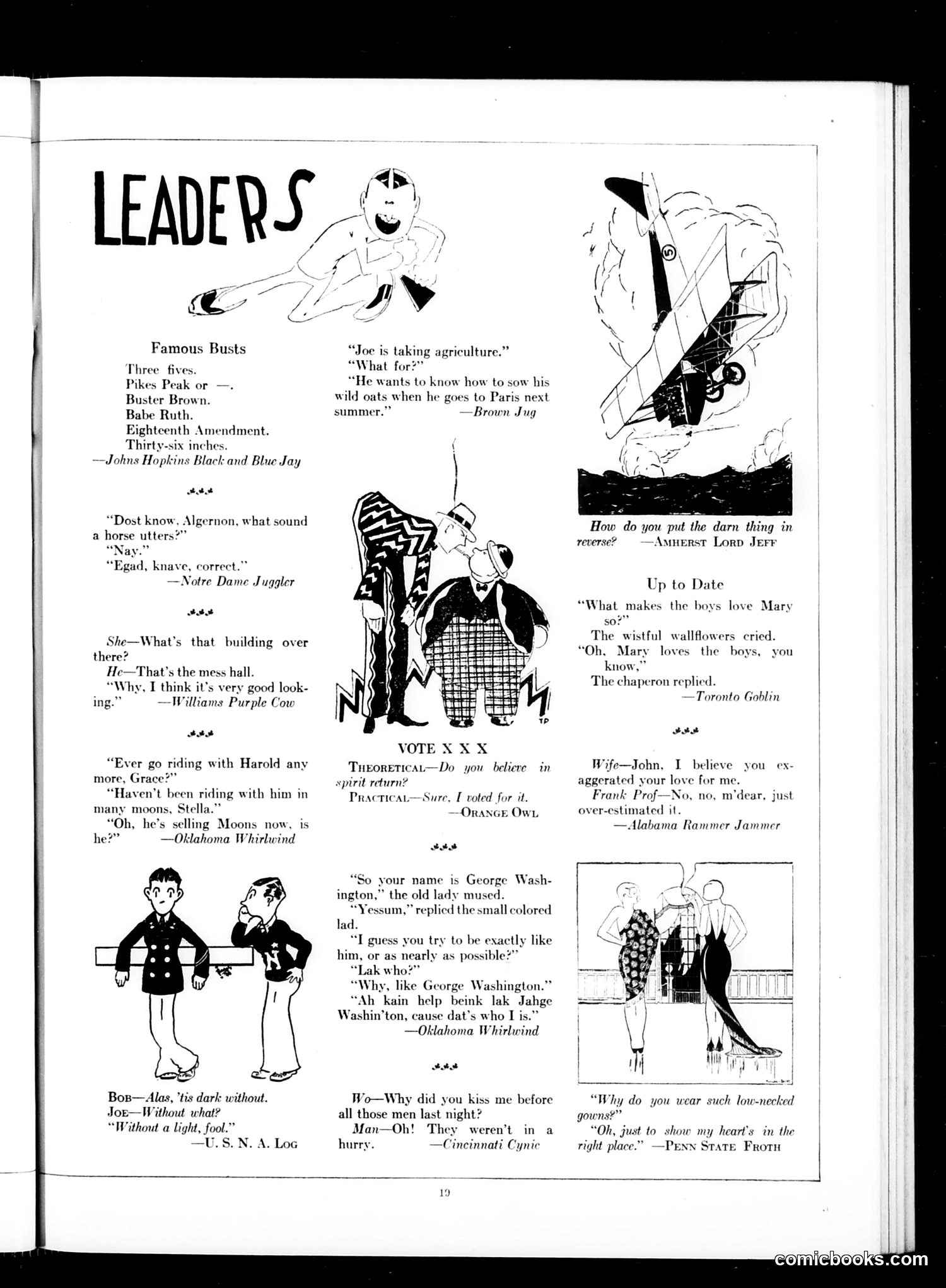
This page from *Judge* collects humorous one-liners and short jokes organized under "LEADERS"—likely meaning popular or trending jokes of the moment. **Key themes:** The jokes reference contemporary concerns: Prohibition (Eighteenth Amendment), automobiles ("selling Moons"—a car brand), and social conventions around courtship and women's fashion. One joke plays on a Black child named George Washington—a common comedy trope of the era stereotyping African Americans with dialect humor. **The satire:** Most humor targets social pretension and courtship rituals. A "VOTE XXX" section jokes about spiritualism and voting. The flapper-era joke about "low-necked gowns" reflects anxiety about changing women's fashion and morality. **Visual elements:** Cartoon illustrations show period clothing and scenarios (a couple in a car, a woman in fashionable dress). The style is typical 1920s-era light satirical cartooning. The page represents mainstream American humor of its era—mostly innocent social observation, though including dated racial stereotyping acceptable then but offensive now.
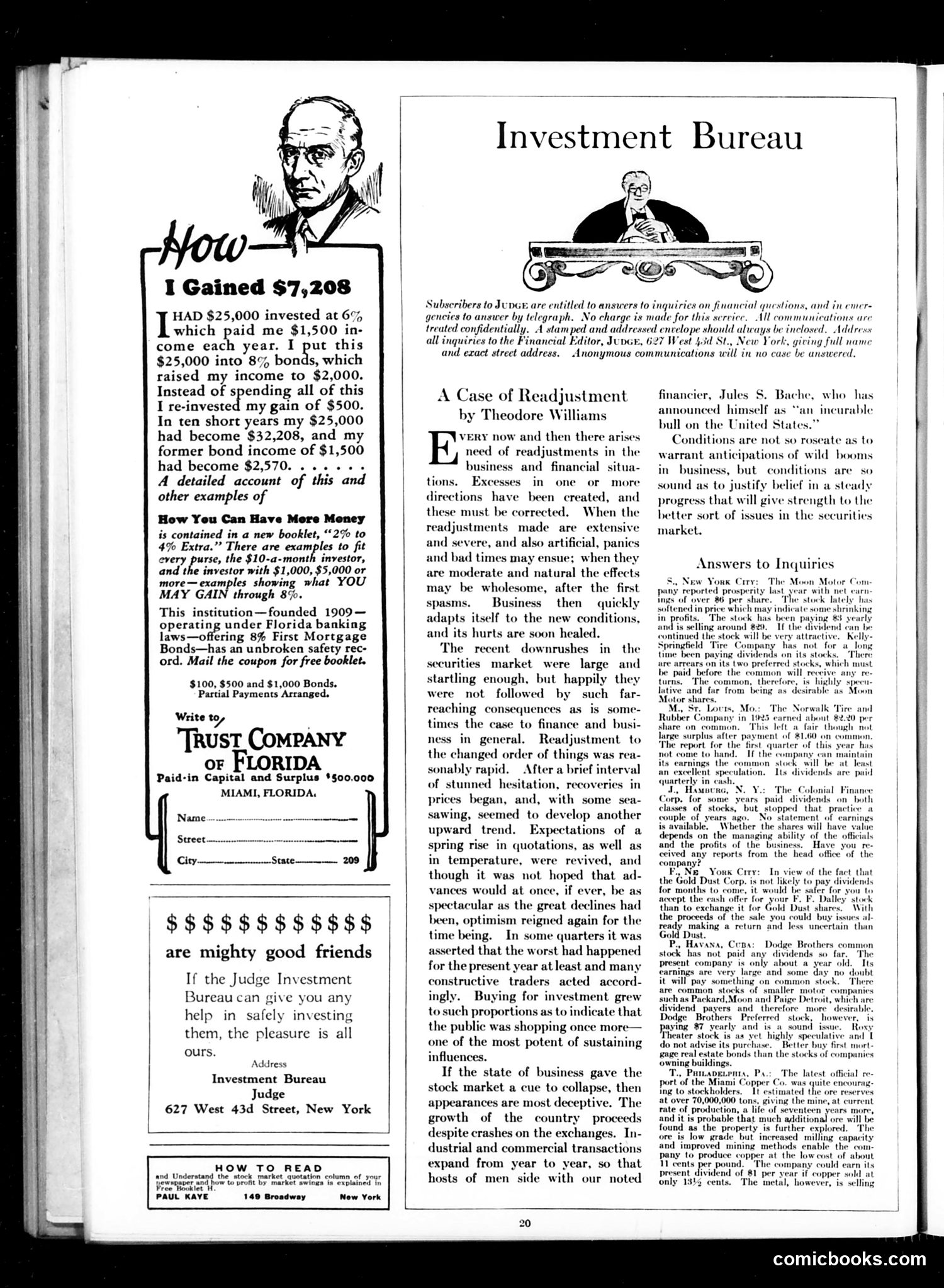
This page combines financial advertising with investment advice. The left side features a Trust Company of Florida advertisement promoting 8% bond returns through a testimonial claiming $7,208 gains from reinvested income—a pitch targeting small investors seeking wealth-building strategies. The right side contains Judge's "Investment Bureau," a reader-advice column addressing financial anxieties during what appears to be post-market-crash recovery (likely early 1900s, given the reference to "recent downrushes"). Theodore Williams's article titled "A Case of Readjustment" reassures readers that market volatility, while startling, needn't cause panic—business fundamentals remain sound and recovery is underway. The satire is subtle: Judge positions itself as a trusted financial counselor while simultaneously running speculative investment pitches, embodying the era's loose financial regulation and the magazine's opportunistic monetization of reader anxiety about money.
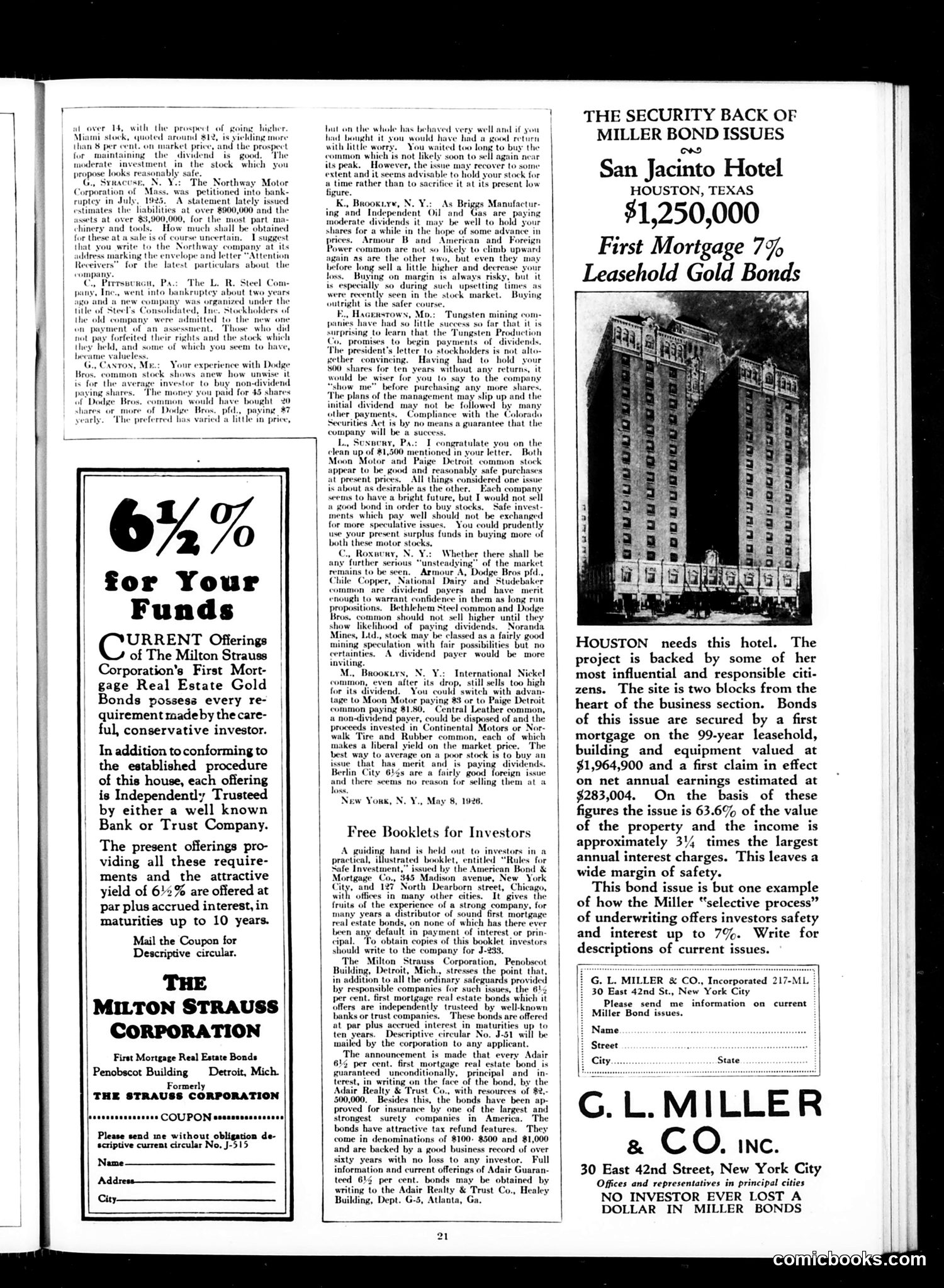
This page is primarily **financial advertising** rather than satirical content. It features investment solicitations from the mid-1920s (dated May 8, 1926). The main advertisements promote: 1. **Milton Strauss Corporation** - selling first mortgage real estate bonds at 6½% yield, marketed as safe, conservative investments with independent trust oversight 2. **G.L. Miller & Co.** - advertising the San Jacinto Hotel in Houston ($1,250,000 bond issue), emphasizing property value and investment safety The page also contains **reader Q&A advice columns** discussing stock investments—recommending caution with speculative stocks (Moon Motor, Dodge Bros), discussing dividend yields, and suggesting bonds as safer alternatives to equities. **Context for modern readers:** This reflects the speculative 1920s "bull market" before the 1929 crash. The repeated emphasis on "safety" and "conservative" investing suggests growing anxiety despite surface prosperity. Real estate bonds were considered blue-chip investments before that market also collapsed.
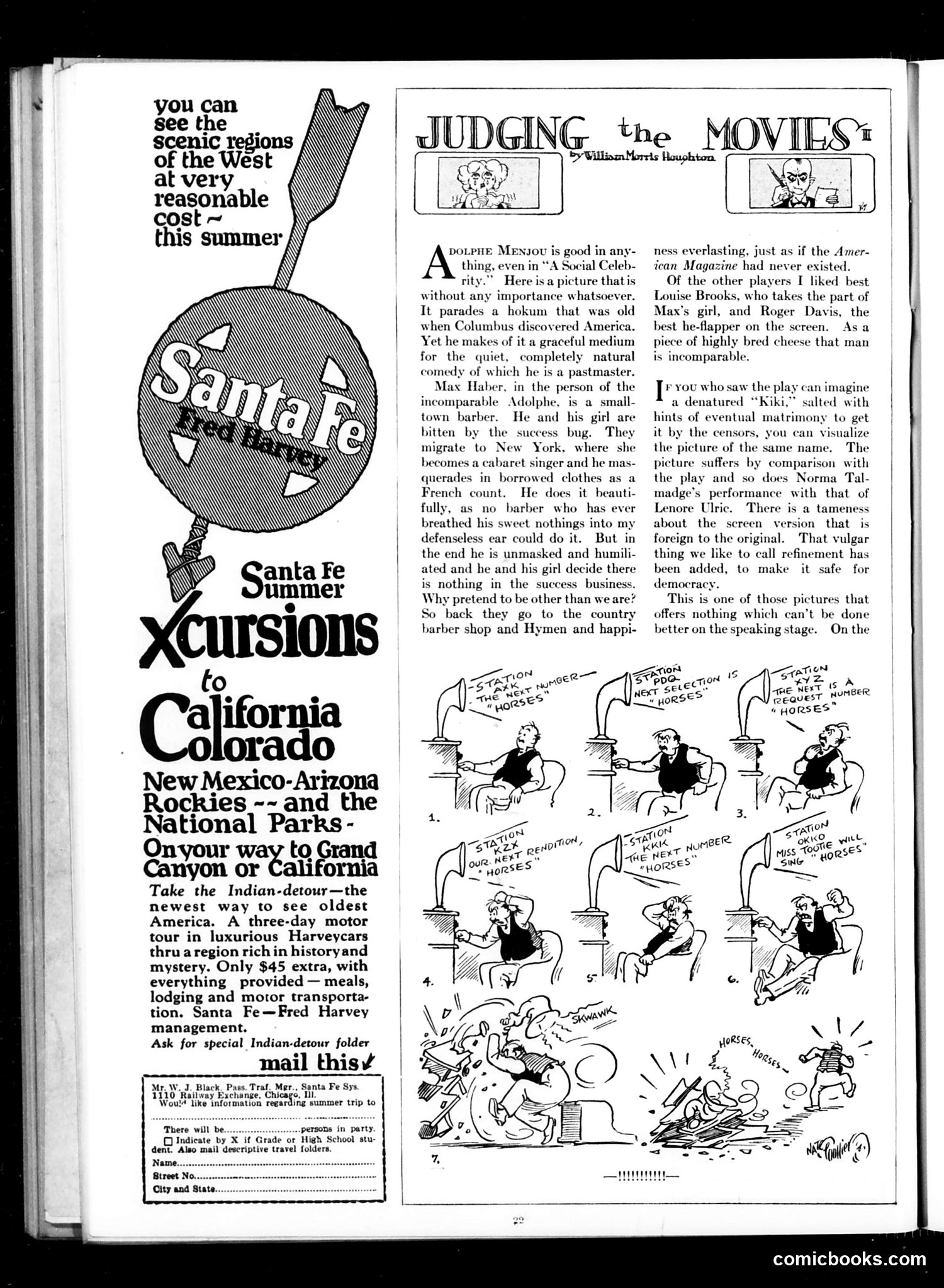
This page contains two main elements: **Left side:** A travel advertisement for Santa Fe Railway's "Indian-detour" tours through the American Southwest—a luxury motor tour package costing $45 extra, marketed as the "newest way to see oldest America." **Right side:** Film reviews by William Morris Houghton critiquing recent movies. He discusses "A Social Celebrity" starring Adolphe Menjou, praising Menjou's comedic skill in playing a small-town barber who pretends to be a French count in New York, ultimately learning that authenticity is better than social pretense. Houghton also reviews "Kiki" starring Norma Talmadge, criticizing it as a sanitized, inferior adaptation of the original play—arguing the censored film version lacks the edginess and sophistication of the stage production. His complaint reflects 1920s tensions between theatrical freedom and film censorship standards.
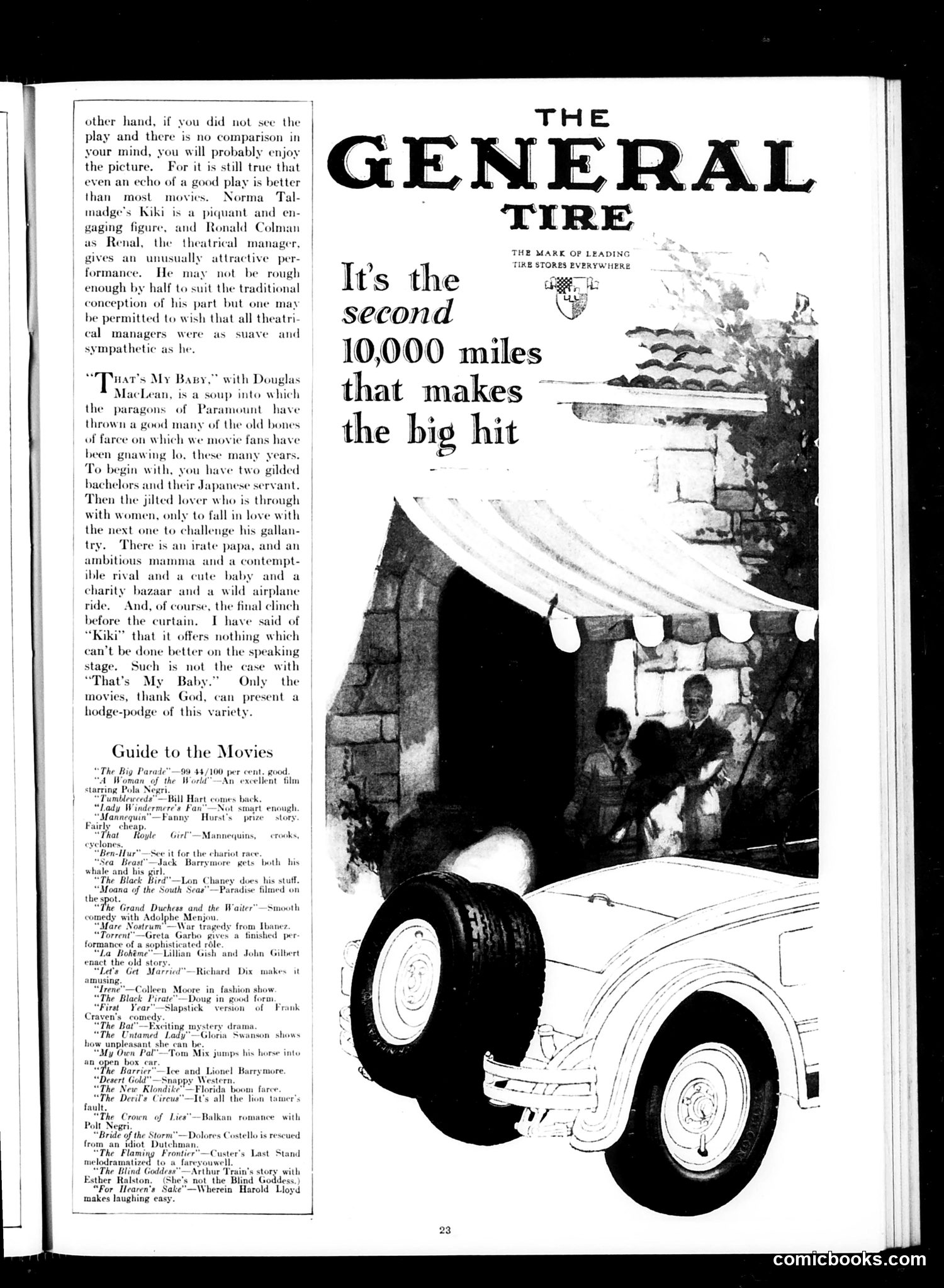
This page is primarily a **tire advertisement** masquerading as editorial content in Judge magazine. The large illustration shows a close-up of a tire on an automobile, emphasizing its quality. The headline's claim—"It's the second 10,000 miles that makes the big hit"—is a sales pitch suggesting that General Tires' durability impresses consumers *after* initial wear, when inferior competitors fail. This appeals to practical motorists concerned about tire longevity and value. The accompanying "Guide to the Movies" section is filler content typical of 1920s magazines, reviewing current silent films (featuring stars like Douglas Fairbanks, Greta Garbo, and Lionel Barrymore). This editorial material provides context and legitimacy to the advertising page. The juxtaposition reflects advertising strategies of the era: embed commercial messages within entertainment coverage to reach readers interested in automobiles and modern leisure.
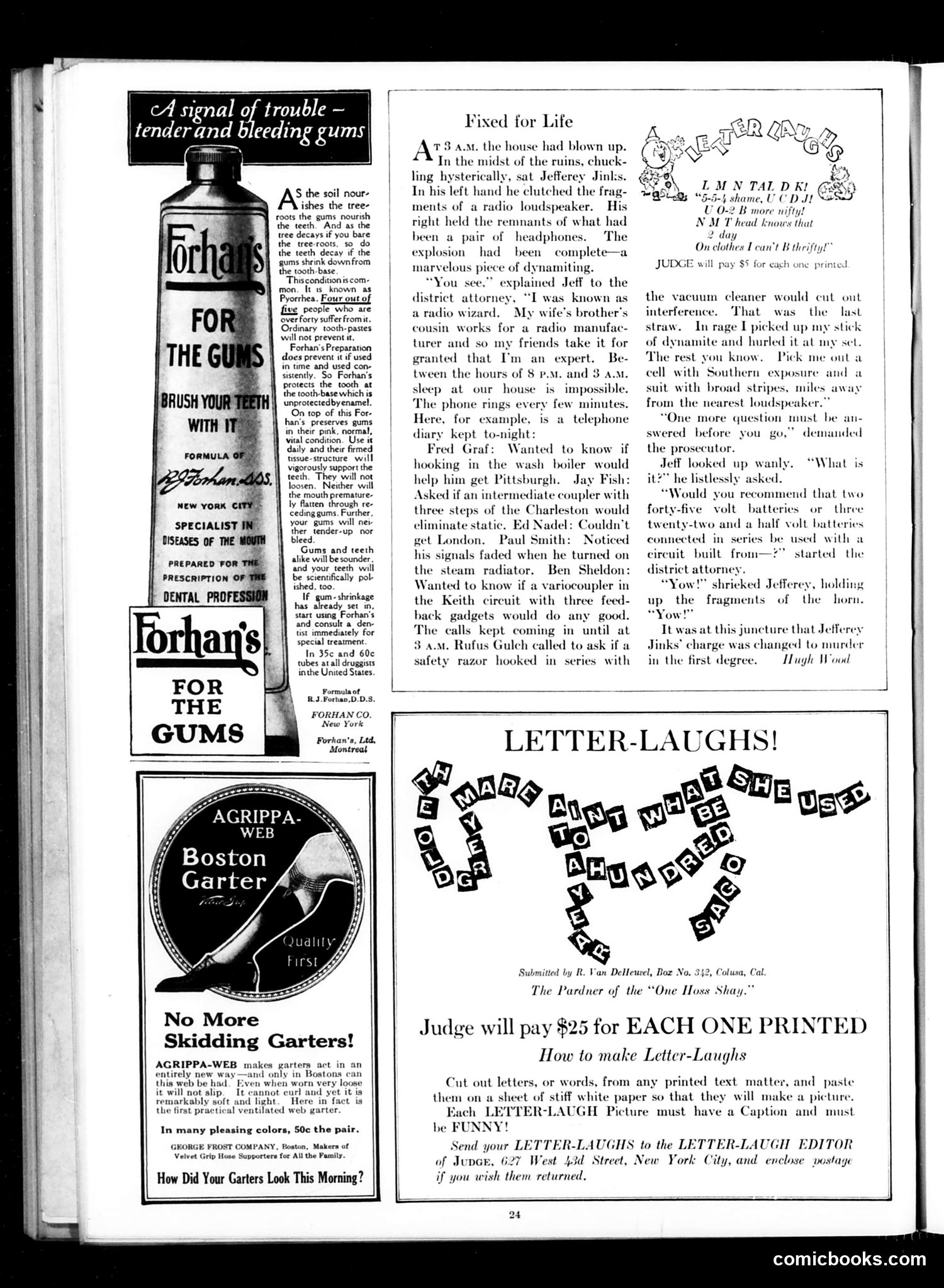
This page is primarily **advertisements and a humorous short story**, not political satire. The main content is "Fixed for Life," a comedic tale about Jeffrey Jinks, a man falsely reputed as a "radio wizard" because his wife's brother works in radio manufacturing. Desperate people call him constantly (8 p.m. to 3 a.m.) with absurd radio problems—asking if washing machines or safety razors can improve reception, if steam radiators cause signal fade, etc. Driven mad by the incessant calls, Jinks dynamites his entire radio setup, then faces murder charges. The joke satirizes **1920s radio mania**: the era's obsession with this new technology and widespread public ignorance about how it actually works. Early radio adoption created comedic scenarios where amateurs sought miraculous technical solutions from anyone loosely connected to the industry. The advertisements (Forhan's toothpaste, Agrippa-Web garters) and "Letter-Laughs" reader submissions are typical Judge magazine filler content. The page lacks political commentary.
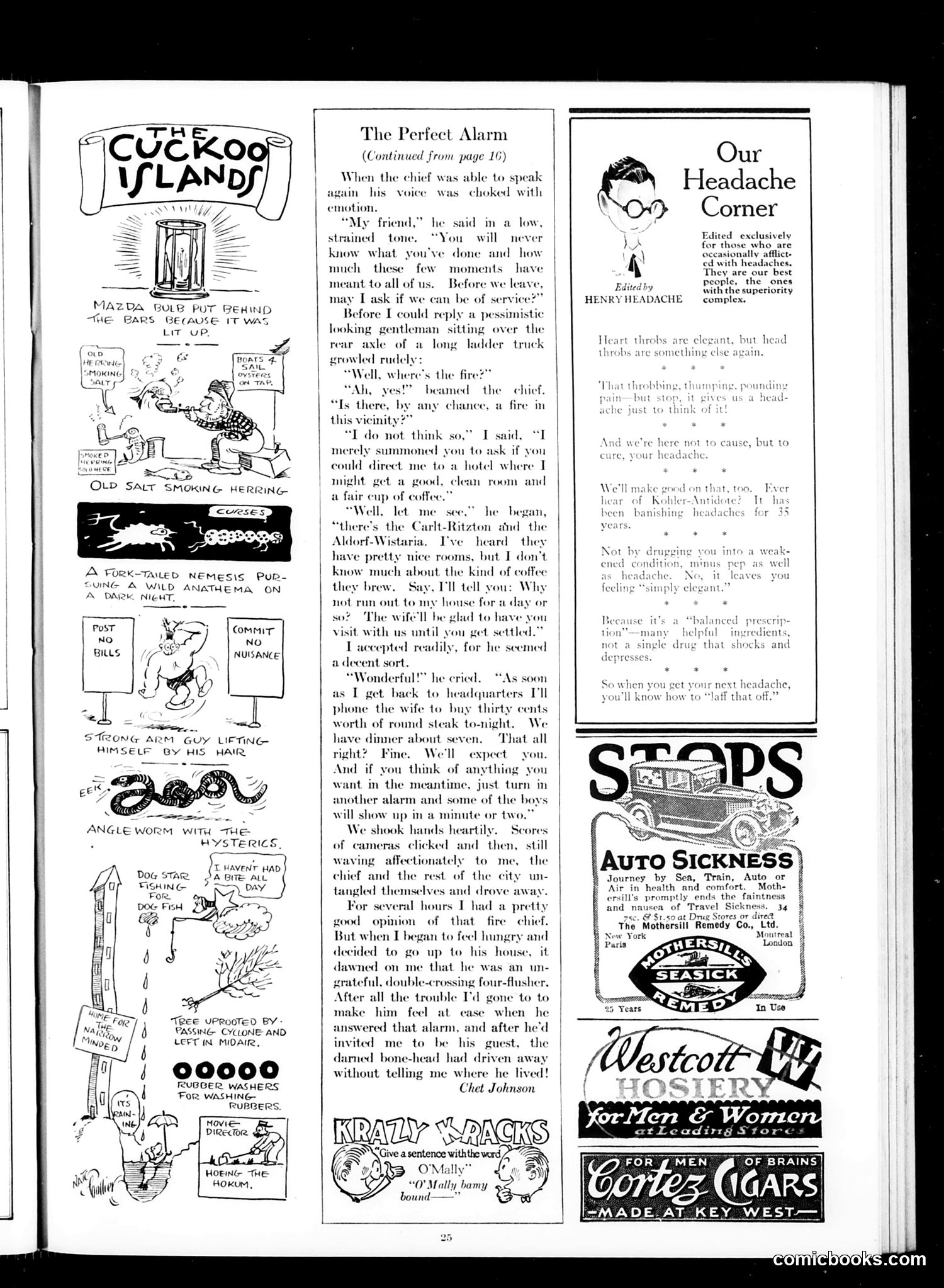
**Main Content: "The Perfect Alarm"** This humorous story by Chet Johnson describes a man who summons the fire department to ask for hotel directions. The fire chief, touched by this "service," generously invites the man to dinner at his house. The joke's punchline: after all this kindness, the chief drives away without giving his address, leaving the guest stranded and unable to find the house. **Satire:** The piece gently mocks civic pride and the eager-to-please attitude of public servants, while also satirizing the narrator's obliviousness in accepting a dinner invitation from someone who never specified where he lived. **"The Cuckoo Islands" Section:** Left side contains absurdist comic strips with surreal imagery (fork-tailed creatures, strong men lifting themselves by hair, etc.)—typical of early 20th-century nonsense humor. **Advertisements:** Right side features period products—headache remedies, auto sickness pills, cigars—typical Judge magazine content mixing editorial and commercial matter. The page reflects 1920s American humor: situational comedy, slight social observation, and absurdist visual gags.
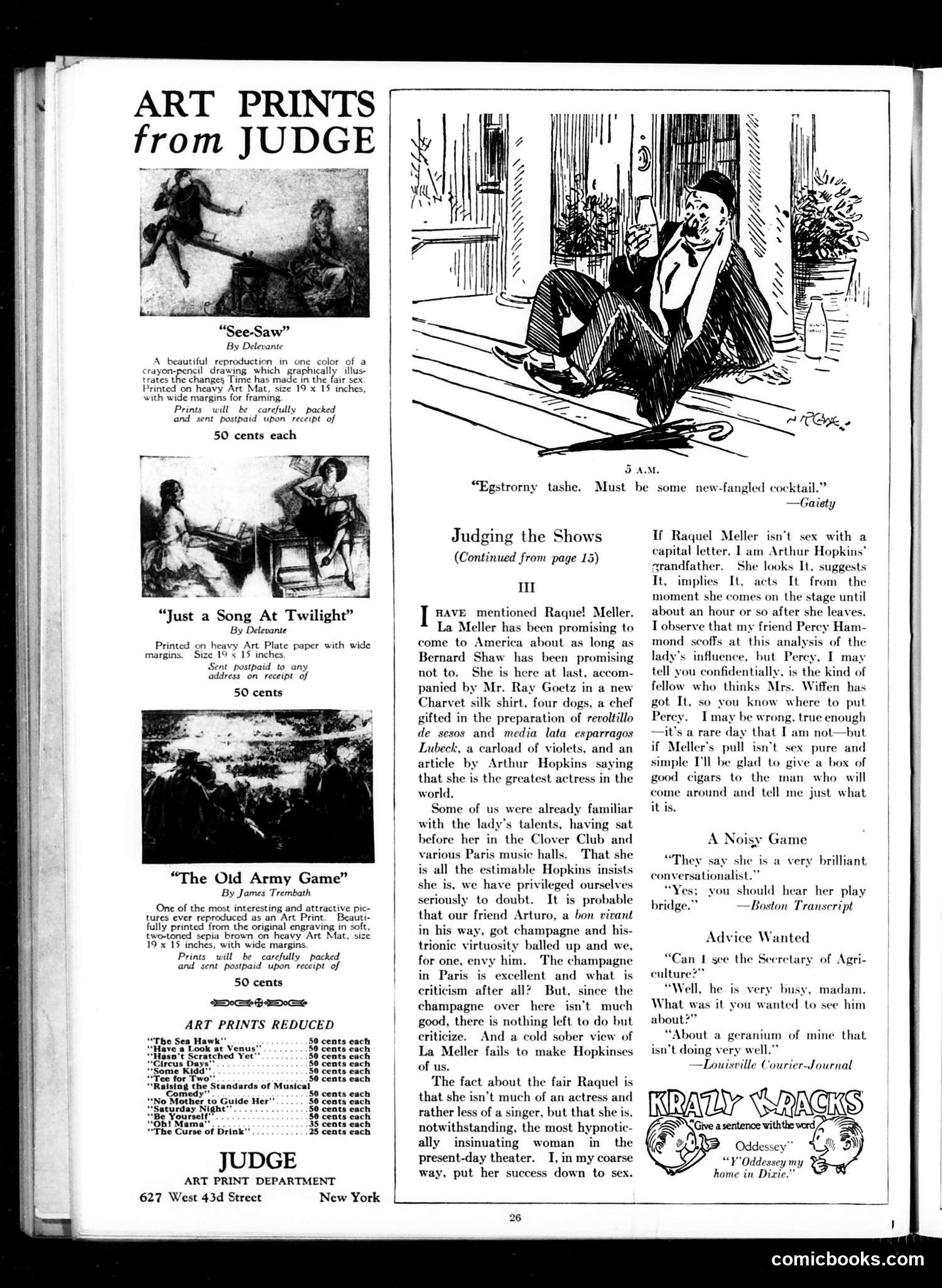
This is primarily an **advertising section** for Judge magazine's art print department, selling reproductions of drawings by artists like Delevante and James Trembath—romantic or genre scenes priced at 25-50 cents each. The only substantive editorial content is a theater review titled "Judging the Shows," discussing **Raquel Meller**, a Spanish entertainer who has recently arrived in America. The reviewer (likely drama critic) acknowledges she's talented but dismisses Arthur Hopkins's hyperbolic praise that she's "the greatest actress in the world." The key point: the critic reduces her success to sex appeal rather than acting ability—a somewhat dismissive take typical of the era's male-centered criticism. A small cartoon above shows two men discussing a cocktail, making a joke about modern "new-fangled" drinks, reflecting 1920s-era anxiety about changing social customs. The page captures Judge's mix of advertising, gossip-column theater coverage, and light satirical commentary on contemporary celebrity and social life.
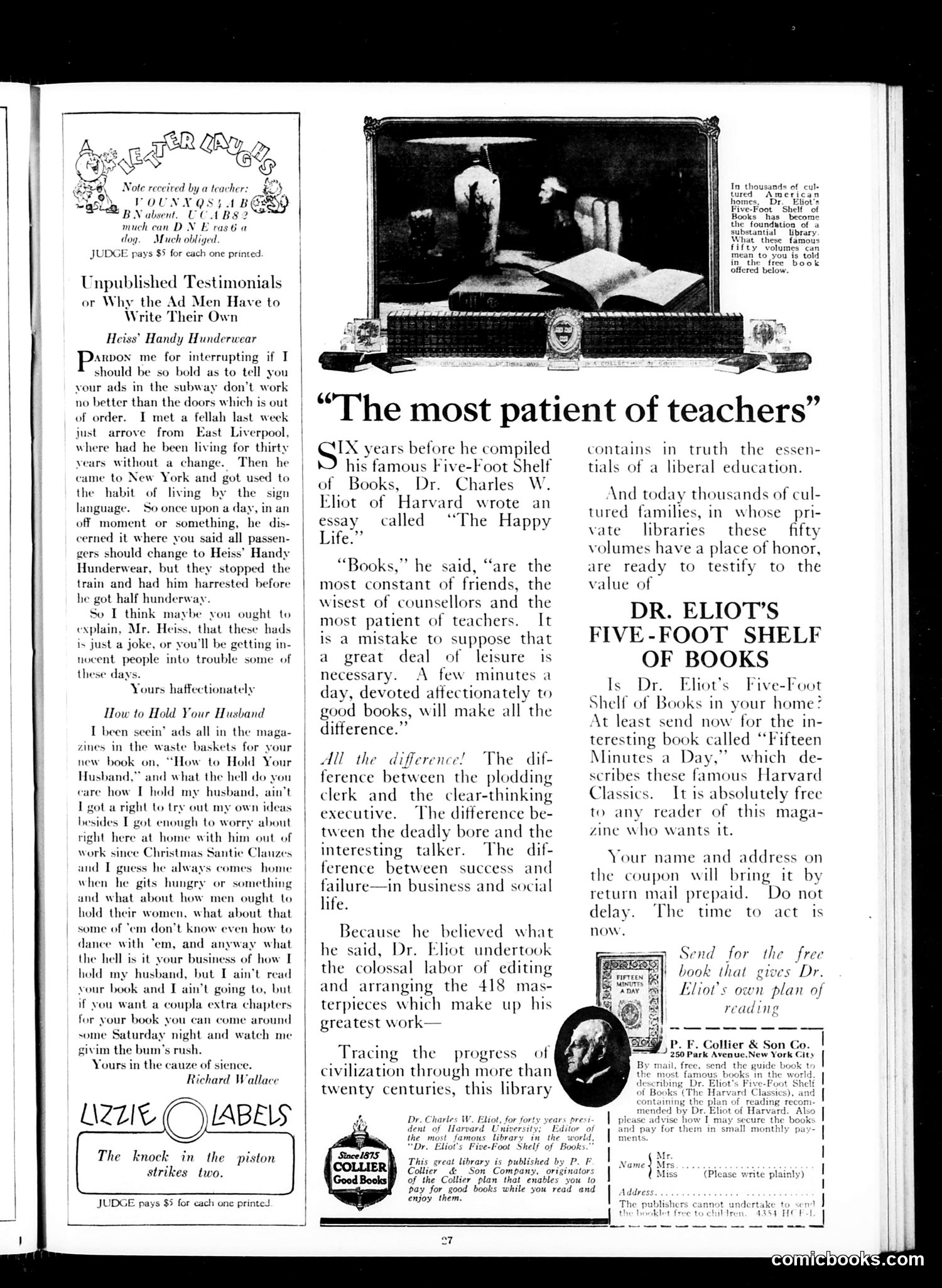
This page mixes satirical humor with advertising. The top section contains **"Unpublished Testimonials"**—fake endorsements written in deliberately broken English and poor grammar, satirizing how advertisers fabricate customer praise. Two examples mock products: "Heiss' Handy Hunderwear" (underwear) and "How to Hold Your Husband" (a how-to book). The jokes target both the absurdity of advertising claims and working-class confusion about urban life and gender roles. The dominant content is a substantial advertisement for **Dr. Charles W. Eliot's "Five-Foot Shelf of Books"**—a famous Harvard Classics collection. The ad quotes Eliot calling books "the most patient of teachers" and markets the 418-volume set as essential for cultivated families seeking self-improvement and liberal education through brief daily reading. A small section titled "Lizzie Labels" offers another Judge-branded joke ("The knock in the piston strikes two"). The page primarily serves as paid advertising space disguised within editorial content—typical of early 20th-century magazine publishing.
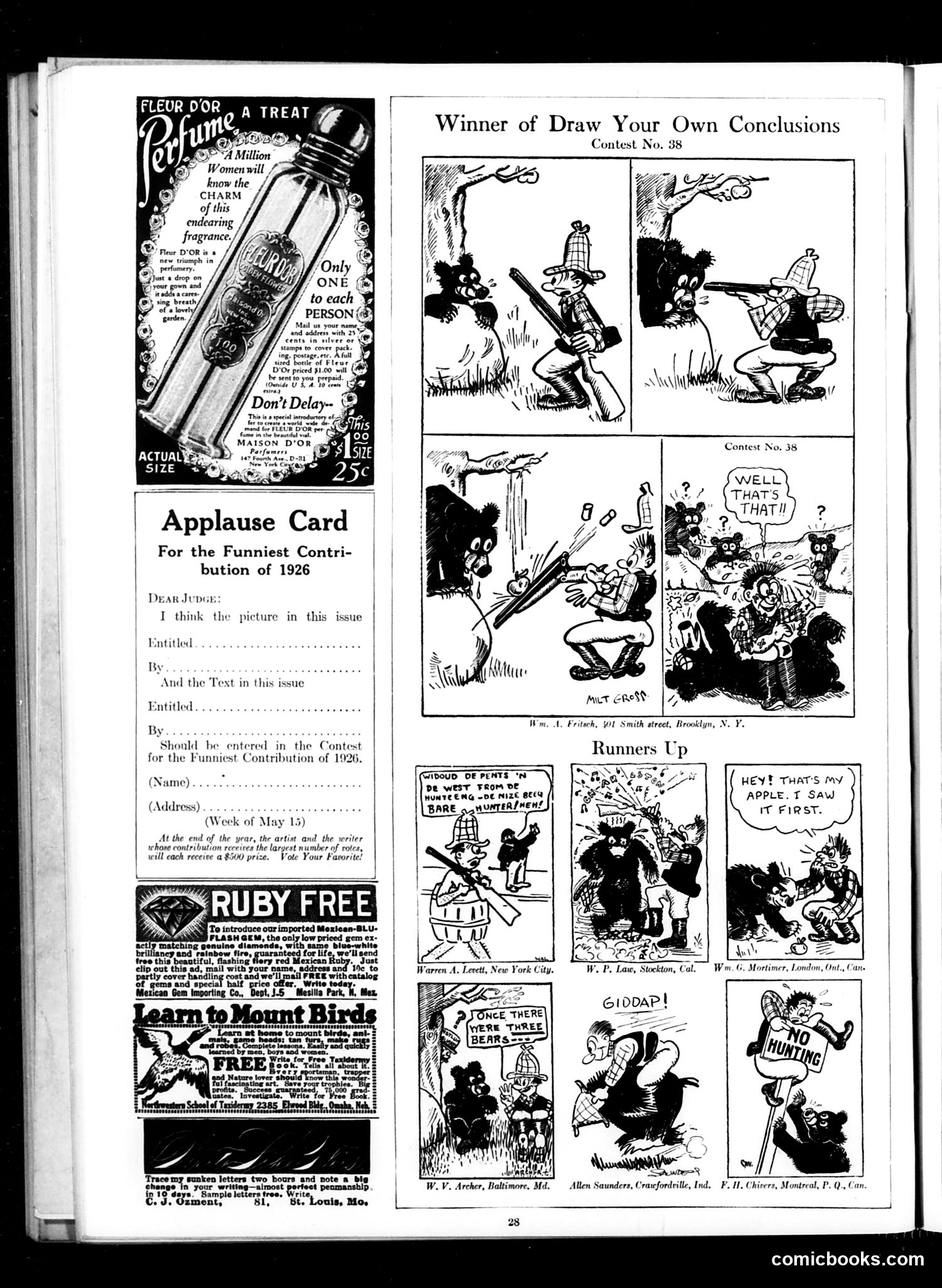
This page showcases **Judge's 1926 humor contests**, specifically the "Draw Your Own Conclusions" competition—a feature where readers submitted captions or conclusions to incomplete comic panels. The **winning entry** (top right) shows a figure shooting at another with a gun, apparently concluding a scene involving hunting or conflict. The **runners-up** below present various humorous scenarios: characters disputing over an apple, bears appearing unexpectedly, and a "no hunting" sign gag. These were participatory contests where readers completed visual jokes, and winners received cash prizes ($500 annually). The cartoons themselves are generic enough to accommodate multiple interpretations—the humor derives from readers' creative captions rather than the artwork. The page also includes advertisement space (Fleur d'Or perfume, Ruby Free shoes, bird-watching guides), typical of Judge's revenue model. This reflects early-20th-century magazine culture where reader participation and advertising subsidized publication costs.
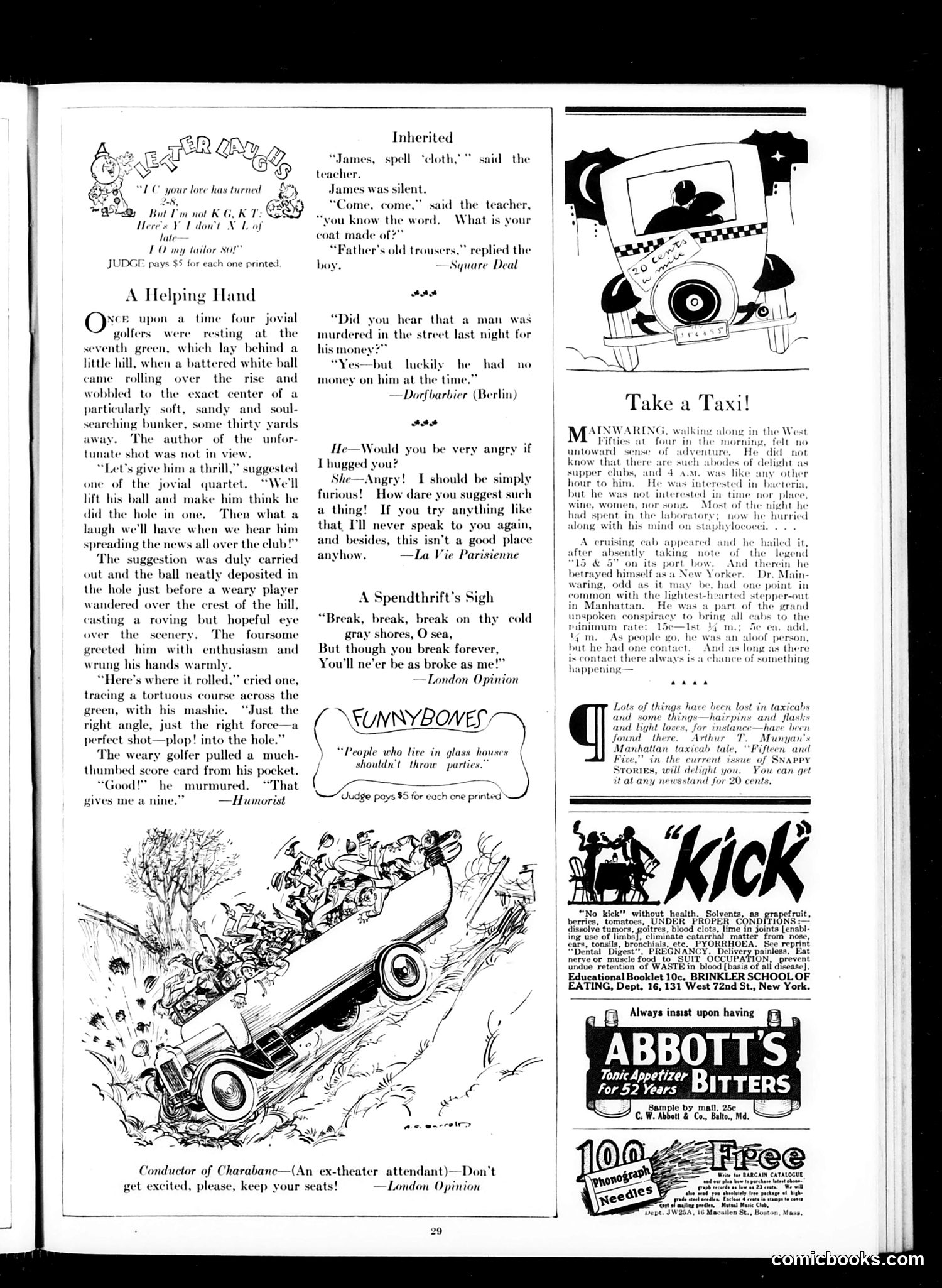
This Judge magazine page contains several humorous short pieces and advertisements typical of early 20th-century American humor: **"A Helping Hand"** is a golf anecdote about pranksters who place a ball in a hole to fool a fellow golfer into thinking he's made an impressive shot. The joke relies on the victim's later embarrassment when he discovers the trick—humor based on social humiliation. **"Inherited"** is a brief classroom joke where a poor boy, asked what his coat is made of, replies "father's old trousers"—satirizing poverty and class differences. **"Take a Taxi!"** advertises Arthur T. Munyan's story in *Snappy Stories*, emphasizing the taxi cab as a setting for romantic and comedic encounters—reflecting 1920s urban life. The page is primarily **advertising-driven**, featuring products like Abbott's Bitters (a patent medicine) and a "Brinkler School of Eating" promoting dubious health claims. The humor throughout reflects period anxieties about class, propriety, and urban modernization rather than specific political satire.
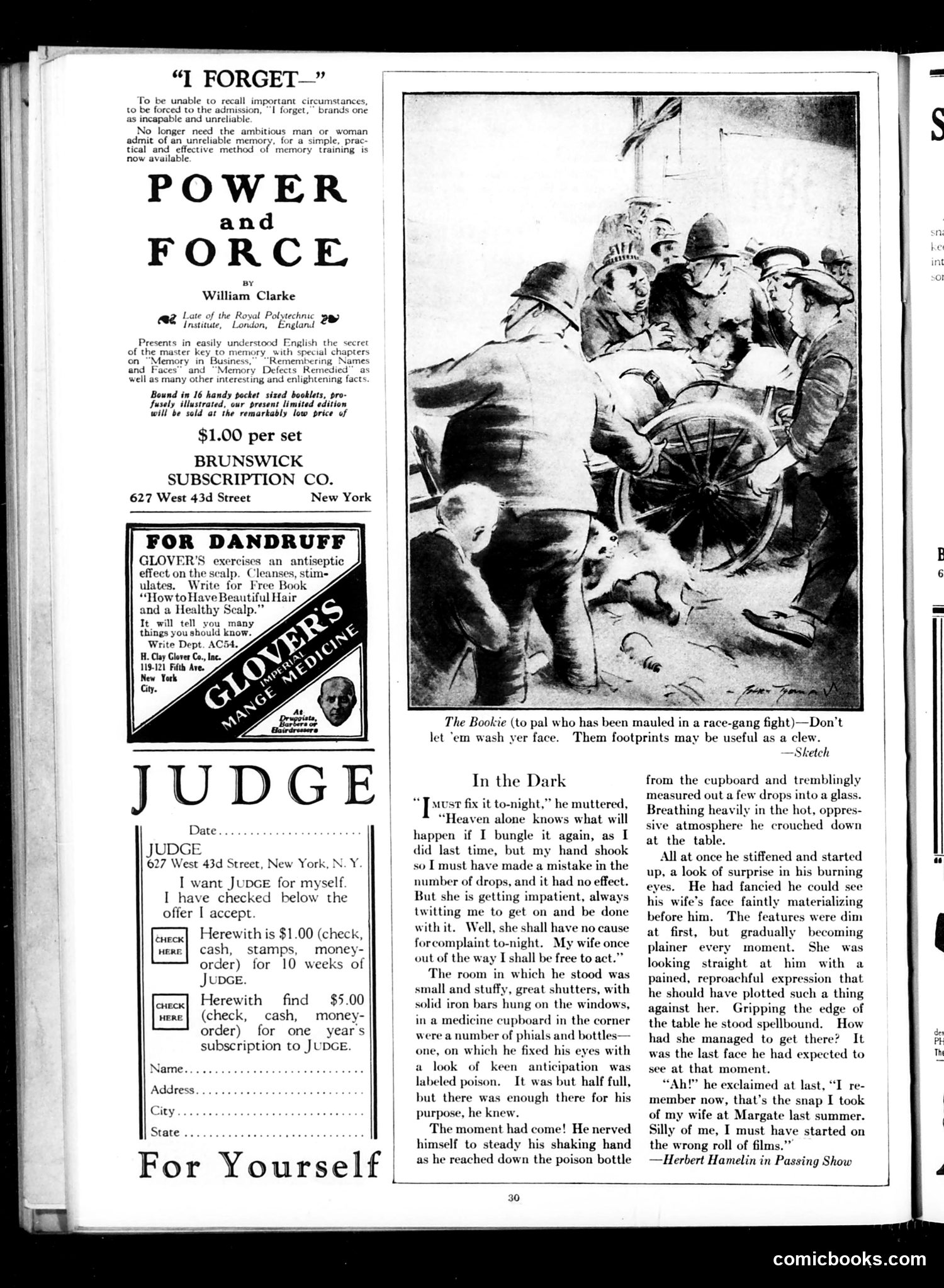
This page mixes advertisements with serialized fiction rather than political cartoons. The main content is a melodramatic short story titled "In the Dark" by Herbert Hamelin, depicting a man plotting to poison his wife with drops from a bottle. His guilt manifests as a hallucination of her reproachful face—which he eventually realizes is merely a photograph he accidentally developed. The accompanying illustration shows the dramatic moment of his supernatural-seeming vision. The story represents the kind of sensational, morality-tinged crime fiction common in early 20th-century periodicals. The page also advertises "Power and Force," a memory-training book, Glover's dandruff remedy, and Judge magazine subscriptions. A brief cartoon captioned "The Bookie" appears as well, referencing street violence ("race-gang fight"), though its specific satirical point remains unclear without additional context.
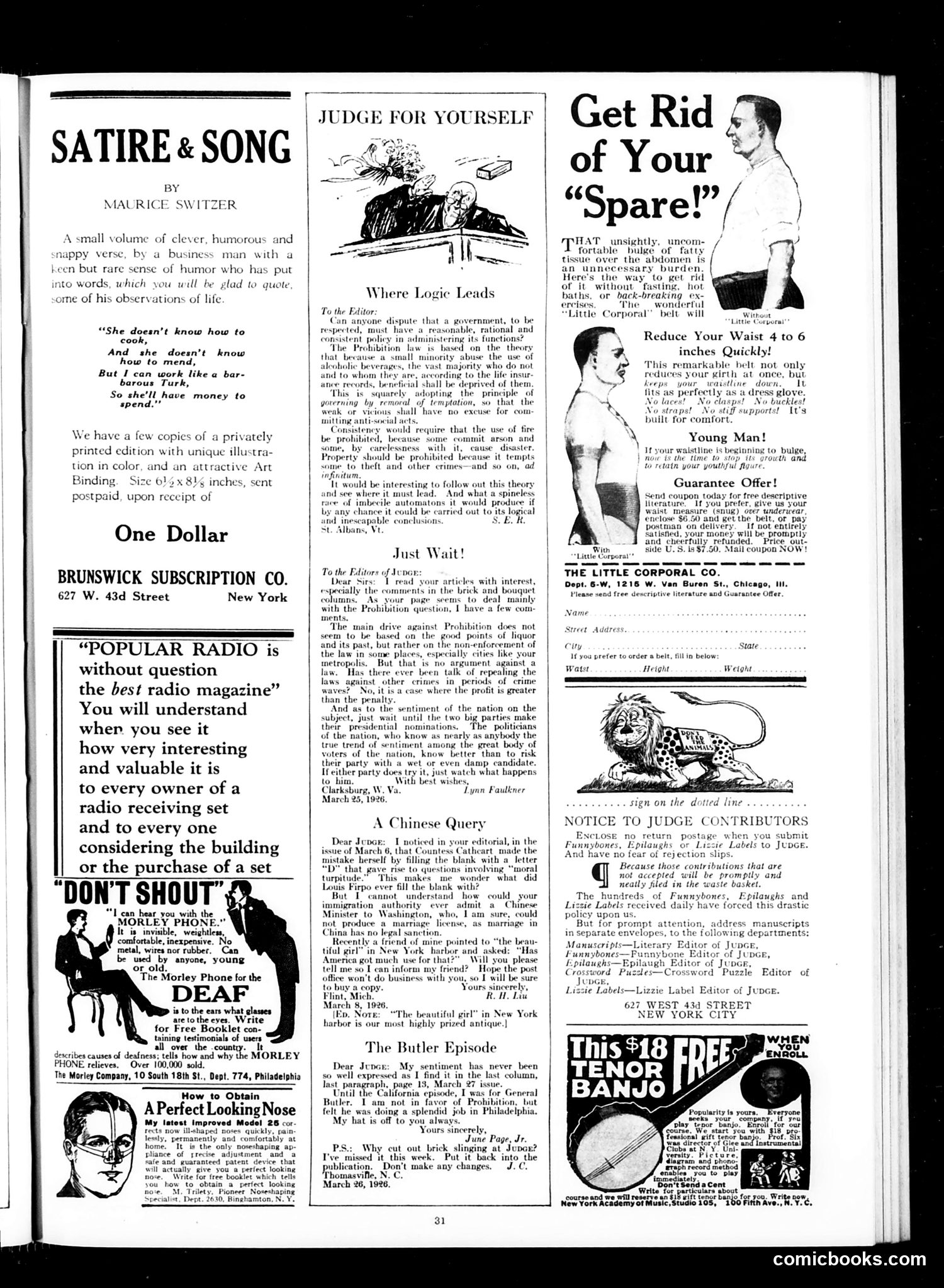
This page from *Judge* magazine (appears to be circa 1920s) mixes satire with advertising. The main satirical content includes: **"Where Logic Leads"**: A letter-to-editor format satirizing Prohibition policy. The writer argues that if government prohibits alcohol to prevent abuse by a minority, consistency would require banning fire, property, and other things because some misuse them. It's mockery of Prohibition's paternalistic logic—a common anti-Prohibition argument of the era. **"Just Wait!"**: Another letter sardonically predicting Prohibition will fail because politicians won't nominate "wet" candidates, suggesting the policy contradicts popular sentiment. The page is otherwise dominated by advertisements for body-shaping belts and self-improvement products typical of the period. The "Little Corporal" belt ad promises to reduce waist measurement—marketing to insecure readers with dubious claims. The *Judge* satirical contributions oppose Prohibition while surrounding advertisements exploit consumer anxiety—illustrating how 1920s magazines blended political commentary with commercial messaging.
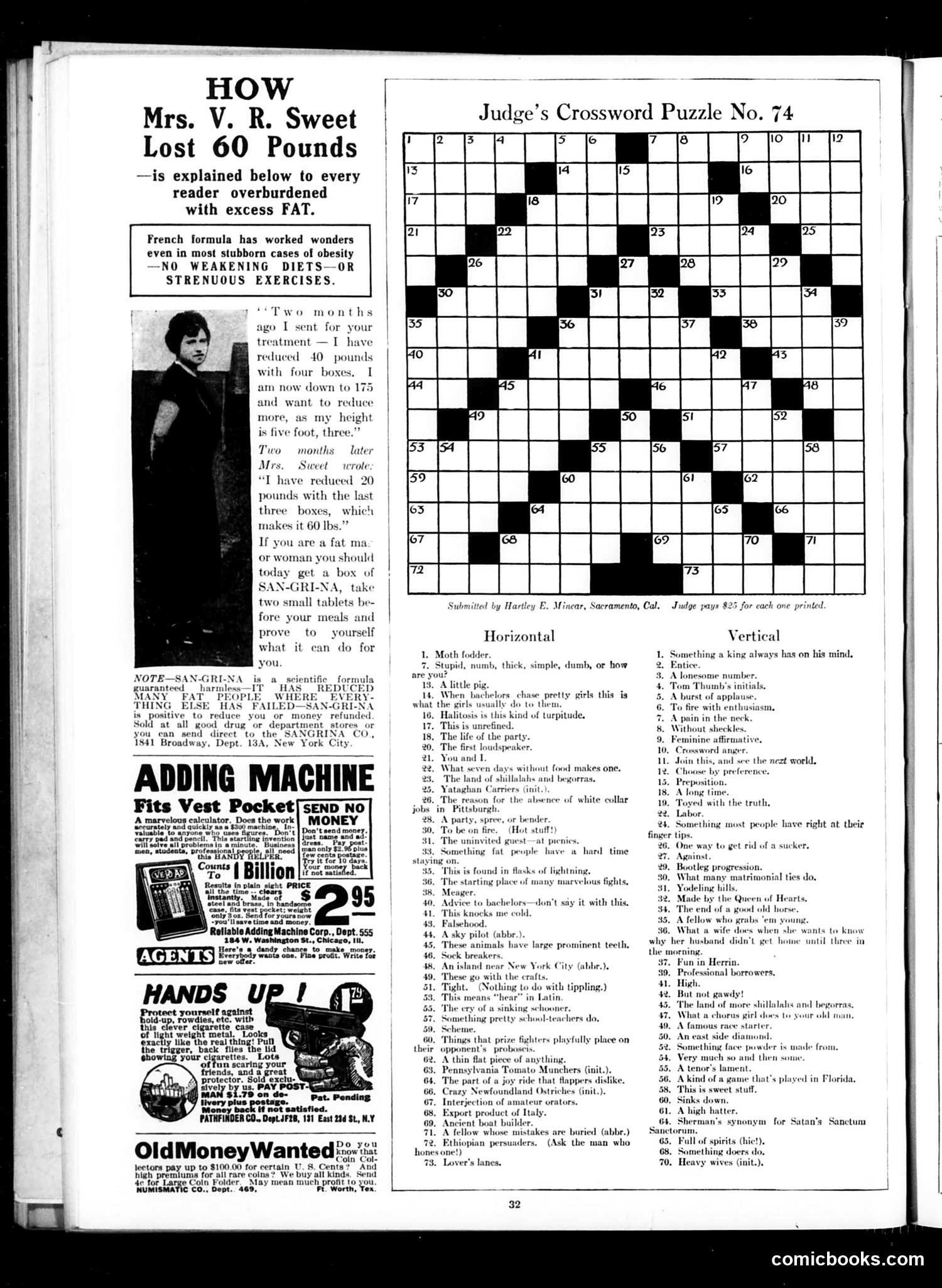
This page is primarily **advertising and a crossword puzzle**, not political satire. The main content includes: **Feature Story (top left):** An advertisement disguised as testimonial journalism about "San-Grina," a weight-loss product. Mrs. V. R. Sweet claims to have lost 60 pounds using this "French formula" requiring "no weakening diets or strenuous exercises"—a dubious promise typical of early 20th-century patent medicine marketing. The text encourages readers to purchase the product directly. **Advertisements (bottom half):** Multiple commercial ads for an adding machine, a novelty cigarette lighter disguised as a pistol, and old coin buyers—typical Judge magazine revenue sources. **Crossword Puzzle (right):** Judge's crossword puzzle #74, a standard feature. This page demonstrates how magazines like Judge blended editorial content with advertising. The "San-Grina" feature represents the era's widespread promotion of dubious health products, before modern FDA regulations. The novelty items reflect period consumer culture and humor tastes.
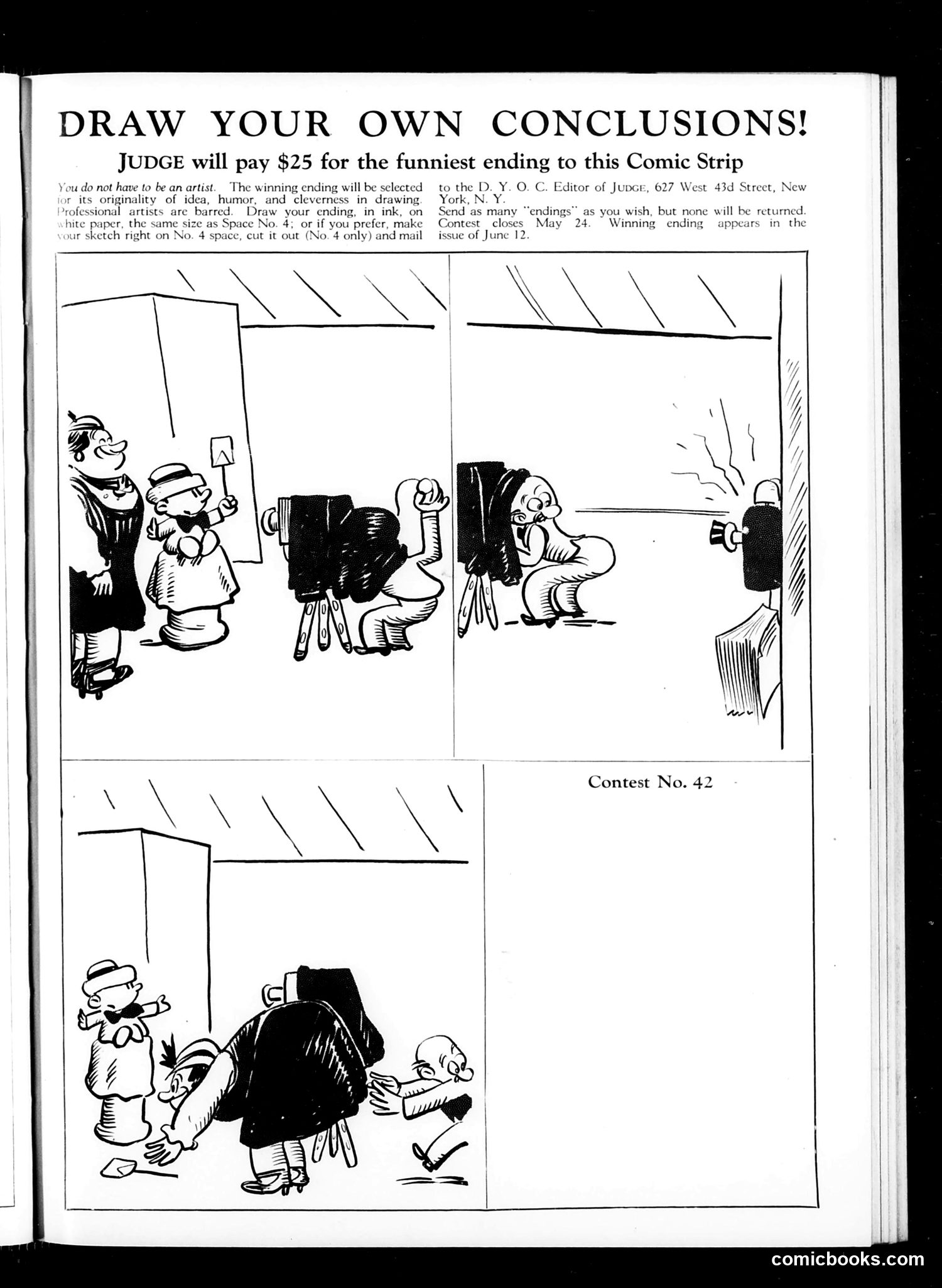
This is a reader-participation contest where Judge magazine invites submissions to complete an unfinished comic strip (Contest No. 42). The existing panels show what appears to be a film or photography production scene: characters operating a movie camera, positioning subjects, and adjusting lighting equipment in what looks like a studio setting. The joke setup involves the behind-the-scenes chaos of early film production—the characters seem to be struggling with equipment or positioning. Readers were challenged to draw their own humorous final panel, with the $25 prize going to the funniest conclusion. This reflects early 20th-century Judge magazine's interactive, participatory approach to humor, and the cultural fascination with cinema as a still-novel medium worthy of satire.
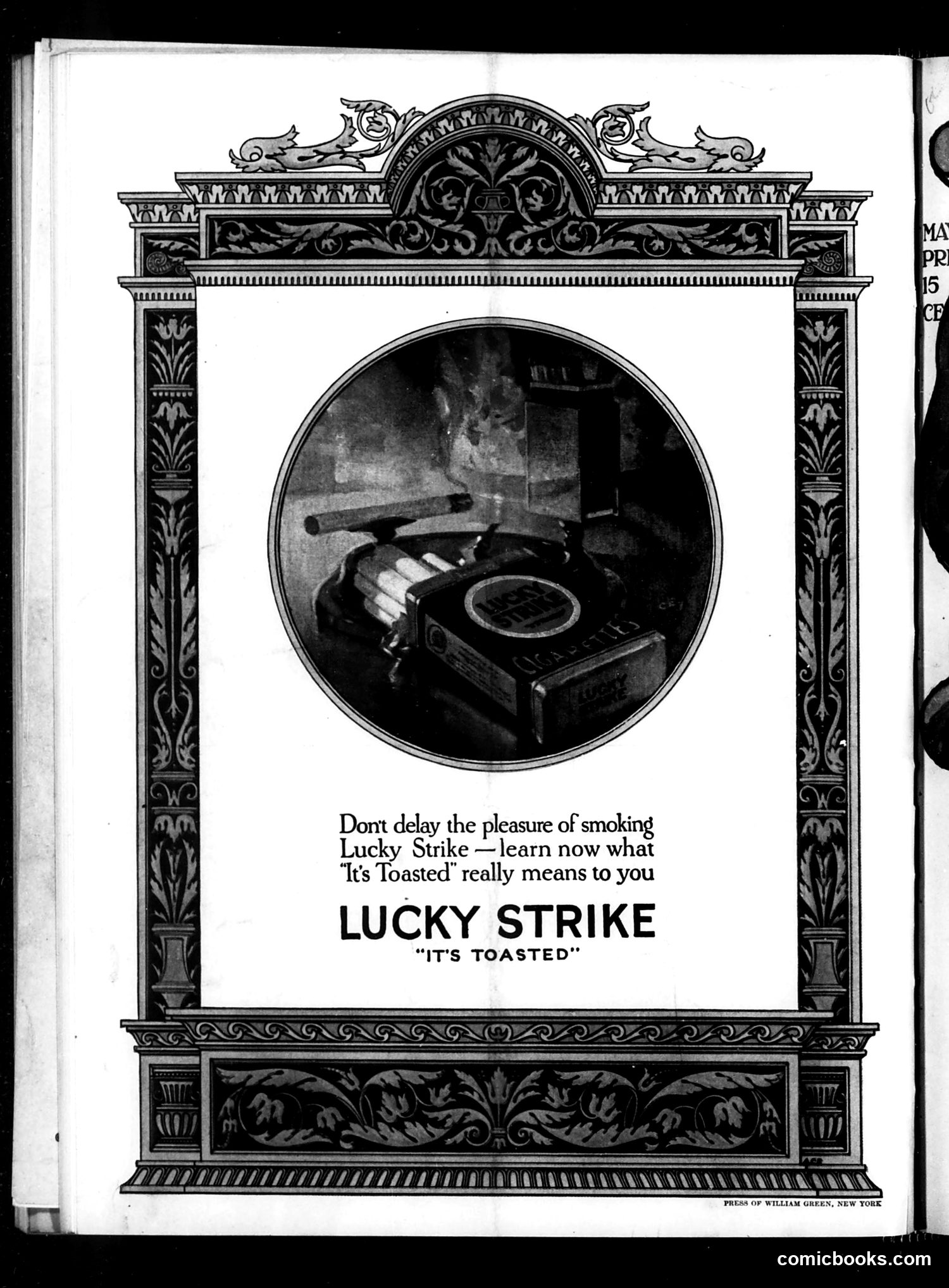
This is a **Lucky Strike cigarette advertisement**, not political satire. The ornate framing mimics fine art presentation to elevate the product. The circular photograph shows what appears to be a toasting process or manufacturing equipment, meant to demonstrate the cigarette's "It's Toasted" claim—a marketing slogan suggesting superior quality through a special toasting method. The ad urges readers not to delay experiencing smoking and to understand what the toasting process means. This represents early 20th-century tobacco advertising before health warnings, when cigarettes were openly promoted in mainstream publications like *Judge* magazine. The elaborate decorative border was typical of period advertising design, lending prestige and legitimacy to the product.