
Judge, 1926-05-15 · page 17 of 36
Judge — May 15, 1926 — page 17: what you’re looking at
What you’re looking at
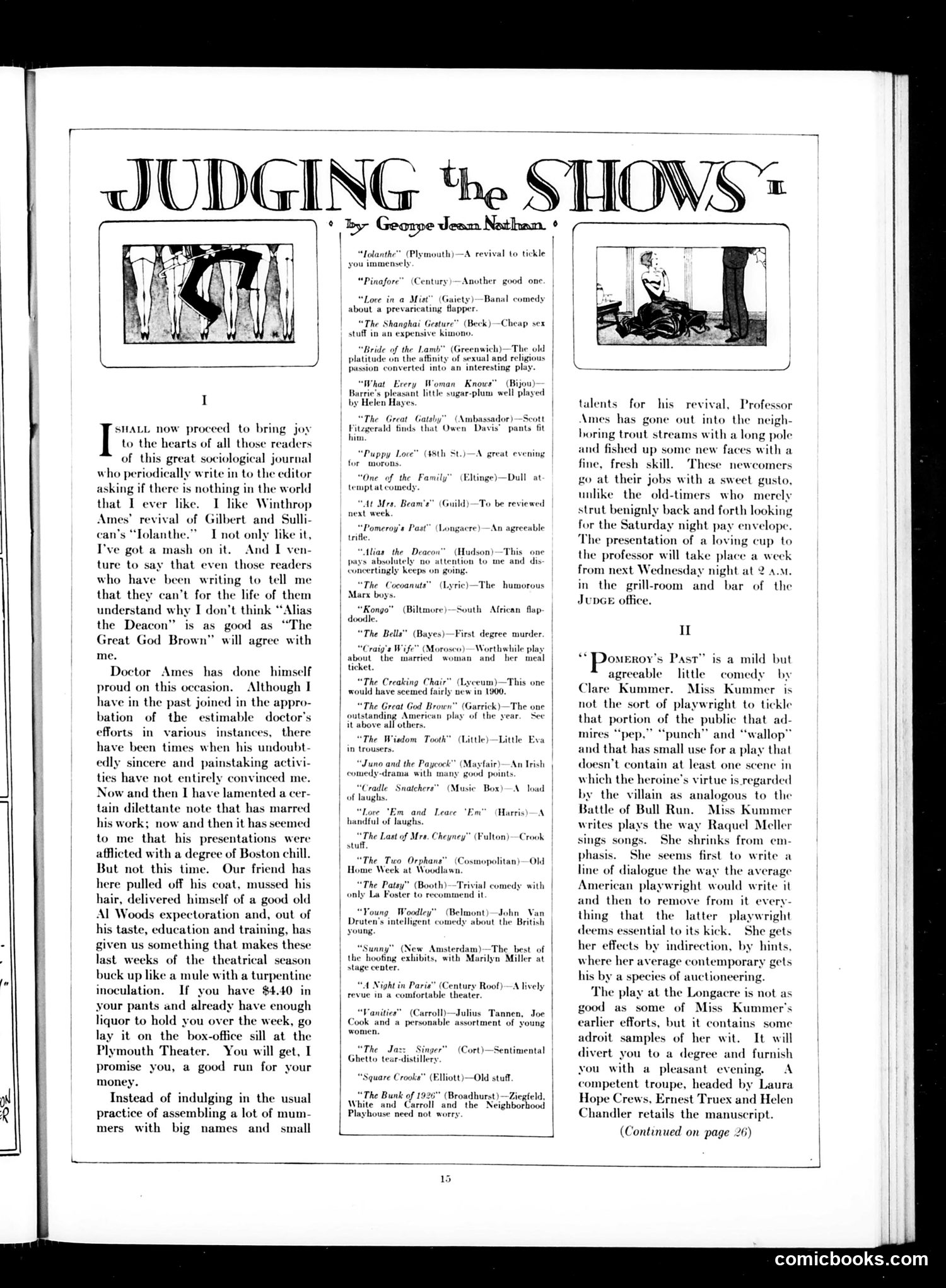
This is a theater review column by George Jean Nathan critiquing Broadway productions of the mid-1920s. The two illustrations appear to show scenes from plays—likely "Iolanthe" (Gilbert & Sullivan revival) and "Pomeroy's Past." Nathan praises producer Winthrop Ames' "Iolanthe" revival enthusiastically, contrasting it favorably with Ames' previous work, which Nathan felt had been overly refined and "Boston chill." He characterizes Ames as having "pulled off his coat" and delivered genuine entertainment rather than dilettante theater. Nathan encourages readers to spend $4.40 (a significant sum then) on Plymouth Theater tickets. The column lists other current Broadway offerings with brief, dismissive critiques—calling "Puppy Love" suitable only for "morons," describing "Alias the Deacon" as persistently mediocre, and praising "The Great God Brown" as "the one outstanding American play of the year." The satire targets pretentious theater and rewards accessible entertainment delivered with sincerity and energy.
📄 Transcribed text from this page (OCR, searchable)
Machine-transcribed from the original scan — historical spelling and the odd misread are preserved.
SHALL now proceed to bring joy to the hearts of all those readers of this great sociological journal who periodically write in to the editor asking if there is nothing in the world that I ever like. I like Winthrop Ames’ revival of Gilbert and Sulli- can’s “Tolanthe.” I not only like it, I've got a mash on it. And I ven- ture to say that even those readers who have been writing to tell me that they can’t for the life of them understand why I don’t think “Alias the Deacon” is as good as ‘The Great God Brown” will agree with me. Doctor Ames has done himself proud on this occasion. Although I have in the past joined in the appro- bation of the estimable doctor's efforts in various there have been times when his undoubt- edly sincere and painstaking activi- ties have not entirely convinced me Now and then I have lamented a cer- tain dilettante note that has marred his work; now and then it has seemed to me that his presentations were afflicted with a degree of Boston chill. But not this time. Our friend has here pulled off his coat, mussed his hair, delivered himself of a good old Al Woods expectoration and, out of his taste, education and training, has given us something that makes these last we of the theatrical season buck up like a mule with a turpentine inoculation. If you have $4.40 in your pants and already have enough liquor to hold you over the week, go lay it on the box-office sill at the Plymouth Theater. You will get, I promise you, a good run for your money. Instead of indulging in the usual practice of assembling a lot of mum- mers with big names and small instances, G the SHOWS nthe” (Plymouth)—A revival to tickle you immensely Century) —Another good one. “Pinafore” “Lore in a Mist” (Gaiety) —Banal comedy out a prevaricating flapper thai Gesture” (Beck) pensive kimono, Cheap sex “Bride of the Lamb” (Greenwich)—The old | titude on the affinity of sexual and religious jon converted into an interesting play. hat Every Woman Knows (Bijou) 's pleasant little sugar-plum well played by Helen Hayes “The Great Gatshy’ Fitzgerald finds that Owen Davis’ him, (Ambassador)—Scott pants fit “Puppy Love” (48th St.)—A great evening for morons. ne of the t teomedy Family” (Eltinge)—Dull at “At Mra, Bea's” (Guild) —To be reviewed neat week. “Pomeroy's Past” (Longacre) —An agreenble trifle, “Alias the Deacon’ son) —T pays absolutely no at to me a concertingly keeps on going. (Lyric) —The dds “The Cocoanuts” humorous (Biltmore)—South African flap. (Bayes) —First degree murder. Morosco)—Worthwhile play woman and her meal the Creaking Chair” (Lyceum)—This one would have scemed fairly new in 1900. “The Great God Brown" (Garrick)—The one outstanding American play of the year. See it above all othe “The Wisdom Tooth’ in trousers, (Little) Little Eva ‘Juno and the Paycock” (Mayfair) —An Irish comedy-drama with many good points Snatchers” (Music Box)—A- load m and Leave "Em Harris)—A of laughs. “The Last of Mra. Cheyney” (Fulton) Crook ull, st “The Two Orphans” (Ci Home Week at Woodlawn, “The Patsy” (Booth) —Trivial comedy with only La Foster to recommend it “Young Woodley” (Belmont)—John Van Druten’s intelligent comedy about the British young, mopolitan)—Old The best of Miller at | New Amsterdam) exhibits, with M: we center. “4 Night in Paris” revue in a comfortat | Alively | Joe | assortment of young Singer” (Cort) ar-distillery Sentimental Old stuff “Square Crooks” (Elliott) “The Bunk of 1926" (Broadhurst) —Ziegfeld, White Carroll and the Neighborhood Playhouse need not worry = revival, Professor Ames has gone out into the neigh- boring trout streams with a long pole and fished up some new faces with a fine, fresh skill. go at their jobs with a sweet gusto, unlike the who merely strut benignly back and forth looking for the Saturday night pay envelope. The presentation of a loving cup to the professor will take place a week from next Wednesday night at 2 a.m. in the grill-room and bar of the JuDGE office. talents for his These newcomers old-timers II * Pournoy’s Past” is a mild but agreeable little comedy by Clare Kummer. Miss Kummer is not the sort of playwright to tickle that portion of the public that ad- mires “pep,” “punch” and “wallop” and that has small use for a play that doesn’t contain at least one scene in which the heroine's virtue is.regarded by the villain as analogous to the Battle of Bull Run. Miss Kummer writes plays the way Raquel Meller sings songs. She shrinks from em- phasis. She seems first to write a line of dialogue the way the average American playwright would write it and then to remove from it every- thing that the latter playwright deems essential to its kick. She gets her effects by indirection, by hints. where her average contemporary gets his by a species of auctioneering. The play at the Longacre is not as good as some of Miss Kummer's earlier efforts, but it contains some adroit samples of her wit. It will divert you to a degree and furnish you with a pleasant evening. A competent troupe, headed by Laura Hope Crews, Ernest Truex and Helen Chandler retails the manuscript. (Continued on page 26) comicbooks.com