
Judge, 1926-05-15 · page 15 of 36
Judge — May 15, 1926 — page 15: what you’re looking at
What you’re looking at
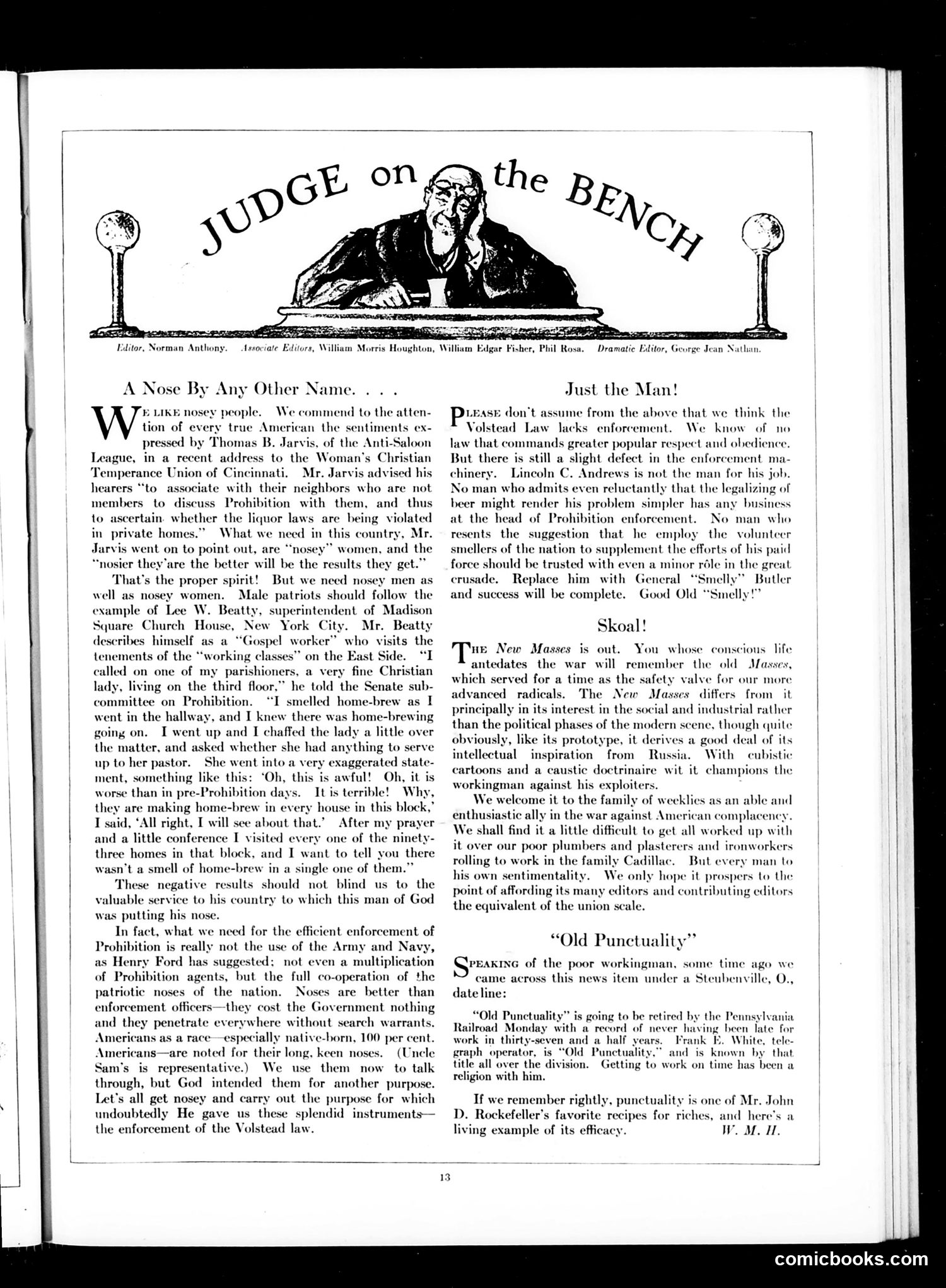
This page satirizes **Prohibition enforcement** during the 1920s. The masthead features a contemplative judge, establishing a judicial tone. **"A Nose By Any Other Name"** mocks overzealous Prohibition advocates who encourage citizens—particularly women—to spy on neighbors for illegal home-brewing. The article ridicules Thomas B. Jarvis (Anti-Saloon League) and Lee W. Beatty (a "Gospel worker") who boasted of visiting 93 homes to smell out violations. Judge's satire is subtle but cutting: while nominally supporting enforcement, it highlights the absurdity of enlisting amateur "nosey" informants and the invasive, hypocrisy-laden nature of Prohibition policing. **"Just the Man!"** criticizes Lincoln C. Andrews, the Prohibition enforcement chief, for lacking sufficient zealotry. The piece sarcastically suggests replacing him with General "Smelly" Butler—a joke name mocking the reliance on nose-sniffing informants. **"Skoal!"** briefly reviews *The New Masses*, a leftist publication, praising its anti-Prohibition stance. The overall message: Judge simultaneously mocks both aggressive Prohibition enforcement *and* those insufficiently devoted to it—satirizing the entire contradictory enterprise.
📄 Transcribed text from this page (OCR, searchable)
Machine-transcribed from the original scan — historical spelling and the odd misread are preserved.
{esoviate Editors, William Morris Houghton A Nose By Any Other Name. LIKE nosey people. We commend to the atten- ion of every true American the sentiments ex- pressed by Thomas B. Jarvis, of the Anti-Saloon League, in a recent address to the Woman's Christian ‘Temperance Union of Cincinnati. Mr. Jarvis advised his hearers “to associate with their neighbors who are not members to discu Prohibition with them, and thus to ertain. whether the liquor laws are being violated in private homes.” What we need in this country, Mr. Jarvis went on to point out, are “nosey” women, and the “nosier they’are the better will be the results they get.” ‘That's the proper spirit! But we need nosey men as well as nosey women. Male patriots should follow the example of Lee W. Beatty, superintendent of Madison Square Church House, New York City. Mr. Beatty describes himself a “Gospel worker” who visits the tenements of the “working classes” on the East Side. “I called on one of my parishioners, a very fine Christian lady, living on the third floor,” he told the Senate sub- committee on Prohibition. “I smelled home-brew as I went in the hallway, and I knew there was home-brewing going on. I went up and I chaffed the lady a little over the matter, and asked whether she had anything to serve up to her pastor. She went into a very exaggerated state- ment, something like this: ‘Oh, this is awful! Oh, it is worse than in pre-Prohibition days. It is terrible! Why, they are making home-brew in every house in this block,’ I said, ‘All right, I will see about that.’ After my prayer and a little conference I visited every one of the ninet three homes in that block, and I want to tell you there wasn’t a smell of home-brew in a single one of them.” These negative results should not blind us to the valuable service to his country to which this man of God was putting his nose. In fact, what we need for the efficient enforcement of Prohibition is really not the use of the Army and Nav. as Henry Ford has suggested: not even a multiplication of Prohibition agents, but the full co-operation of the patriotic noses of the nation. Noses are better than enforcement officers—they cost the Government nothing and they penetrate everywhere without search warrants. American: a race—especially native-horn, 100 per cent. are noted for their long, keen nos (Uncle Sam's is representative.) We use them now to talk through, but God intended them for another purpose. Let’s all get nosey and carry out the purpose for which undoubtedly He gave us these splendid. instruments— the enforcement of the Volstead law. Rosa, Dramatic Editor, George Jean Nathan, Just the Man! ¥ don’t assume from the above that we think the ‘olstead Law We know of no law that commands greater popular respect and obedience. But there is still a slight defect in the enforcement ma- chinery. Lincoln C. Andrews is not the man for his job. No man who admits even reluctantly that the legalizing of beer might render his problem simpler has any business at the head of Prohibition enforcement. No man who resents the suggestion that he employ the volunteer smellers of the nation to supplement the efforts of his paid force should be trusted with even a minor réle in the great crusade. Replace him with General “Smelly” Butler and success will be complete. Good Old “Smelly!” Jacks enforcement. Skoal! HE New Masses is out. You whose conscious life tedates the war will remember the old Masses, which served for a time as the safety valve for our more advanced radicals. The New Ma differs from it principally in its interest in the social and industrial rather than the political phases of the modern scene, though quite obviously, like its prototype, it derives a good deal of its intellectual inspiration from Russia. With cubistic cartoons and a caustic doctrinaire wit it champions the workingman against his exploiters. We welcome enthusiastic ally in the war a, We shall find it a little difficult to get all worked up with it over our poor plumbers and plasterers and ironworkers rolling to work in the family Cadil But every man to his own sentimentality. We only hope it prospers to the point of affording its many editors and contributing editors the equivalent of the union scale. mily of weeklies a: able and -an complacency. “Old Punctuality” Greaxixc of the poor workingman, some time ago we ‘ame across this news item under a Steubenville, O., date line: “Old Punctuality” is going to be retired by the Pennsylvania Railroad Monday with a record of never having been late for work in thirty-seven and a half years. Frank E. White, tele- graph operator, is “Old Punctuality,” and is known by that title all over the division. Getting to work on time has been a religion with him. If we remember rightly, punctuality is one of Mr. John D. Rockefeller's favorite recipes for riches, and here's a living example of its efficacy. WMH. comicbooks.com