
A complete issue · 36 pages · 1926
Judge — April 17, 1926
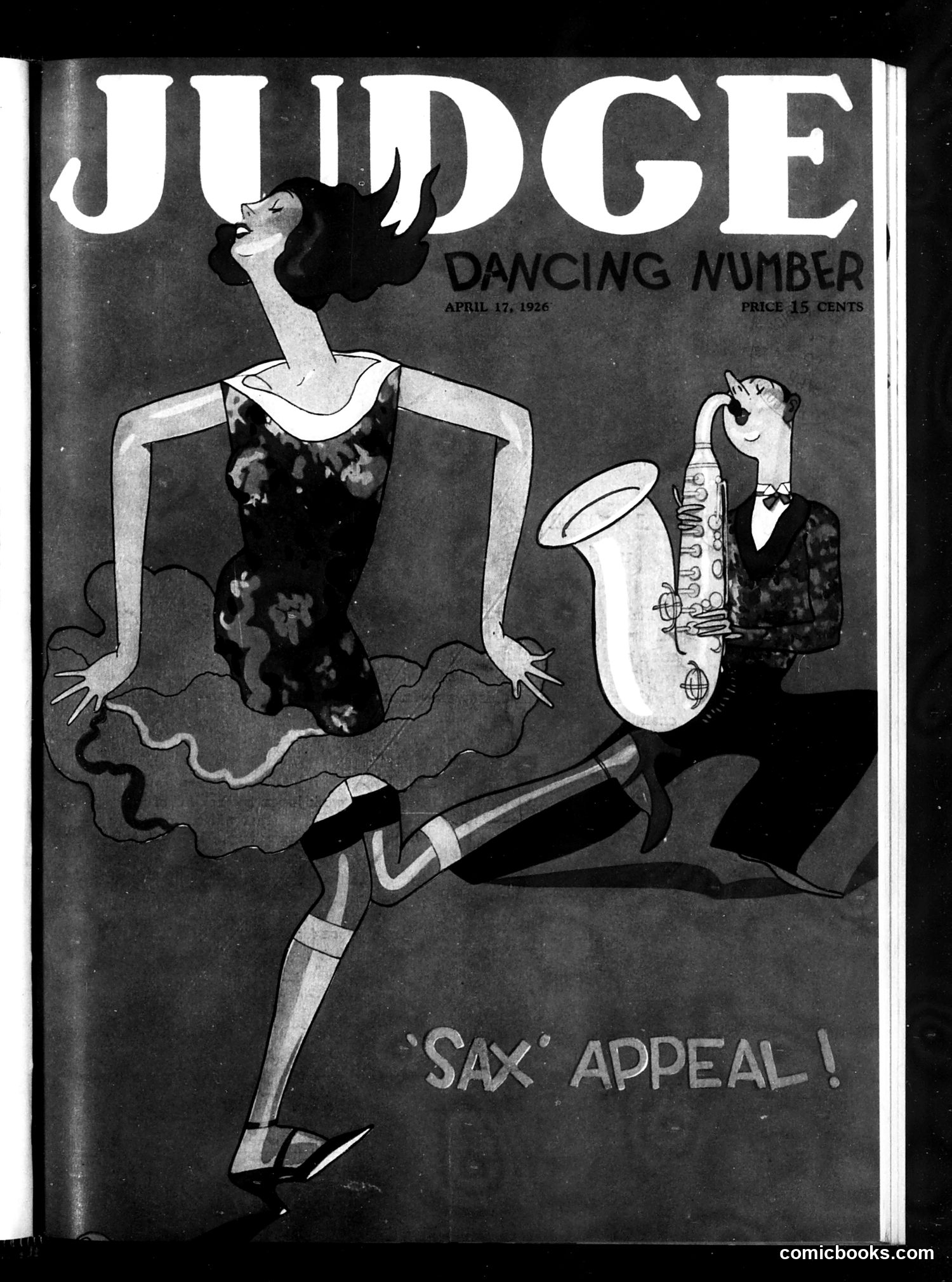
This is a "Dancing Number" cover satirizing the Jazz Age craze for saxophone music. The illustration depicts a stylized flapper woman in a short, beaded dress dancing energetically with elongated limbs, while a formally-dressed male musician plays an enormous saxophone beside her. The caption "'SAX' APPEAL!" is a pun on "sex appeal," mocking the saxophone's popularity in 1920s jazz culture and its association with modern, sexually liberated dancing. The exaggerated proportions and caricature style emphasize how contemporaries viewed jazz and saxophones as outrageous, transgressive entertainment. This reflects Jazz Age anxieties: older generations' alarm at young women's newfound freedom, shorter hemlines, and enthusiastic participation in "modern" music and dance considered morally questionable by conservative standards.
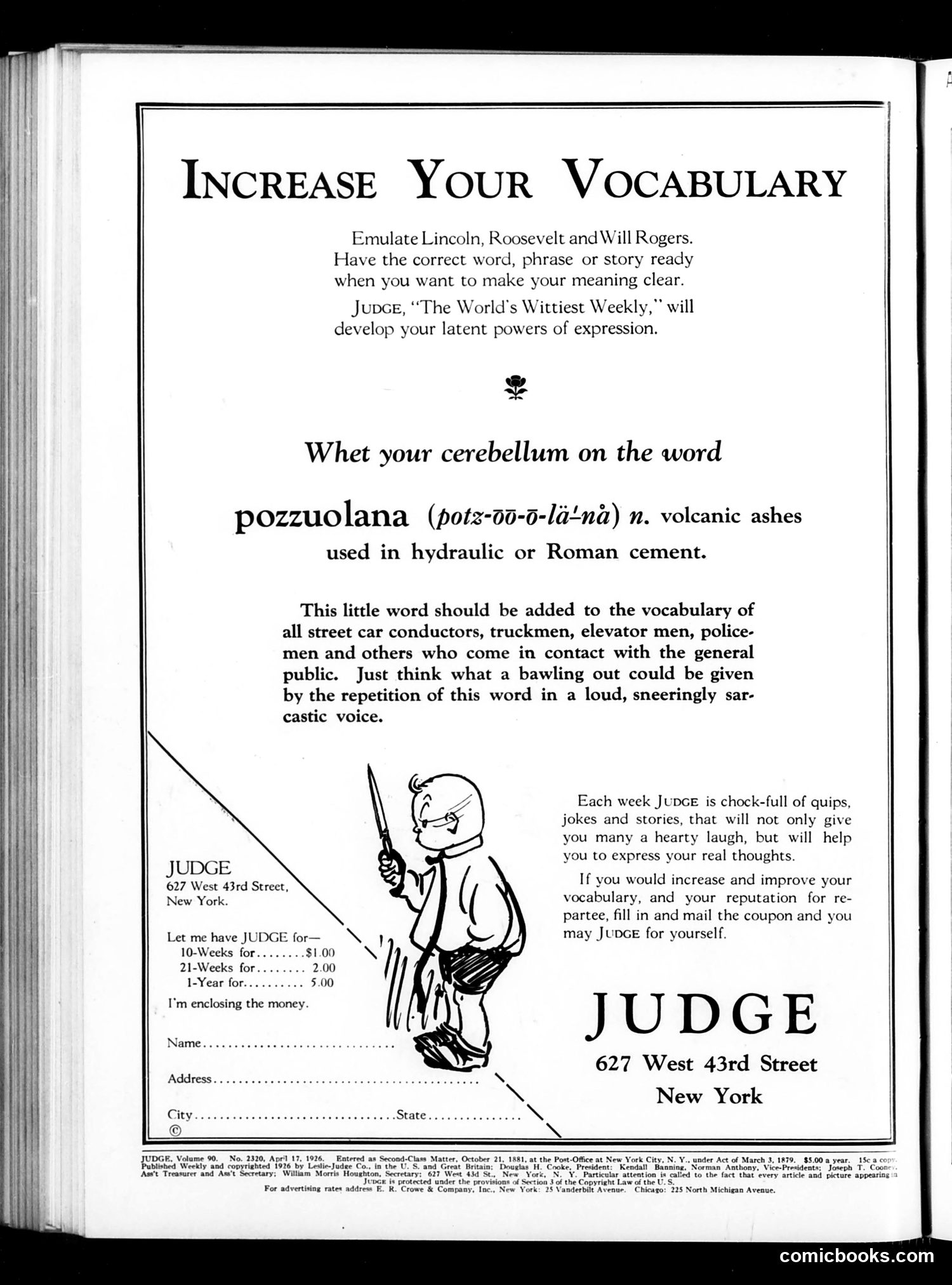
This page is primarily a **vocabulary-building advertisement** for *Judge* magazine, not a political cartoon. The main content promotes the word "pozzuolana" (volcanic ash used in Roman cement) as useful slang for working-class men like streetcar conductors and police officers who interact with the public. The cartoon shows a small figure wielding a sword or club, illustrating the humorous suggestion that repeatedly shouting this obscure word "in a loud, sneeringly sarcastic voice" could deliver an effective insult. The page is essentially a tongue-in-cheek subscription pitch, encouraging readers to buy *Judge* for vocabulary and humor. References to Lincoln, Roosevelt, and Will Rogers establish *Judge*'s brand as witty and culturally sophisticated. This reflects early 20th-century magazine marketing emphasizing self-improvement alongside entertainment.
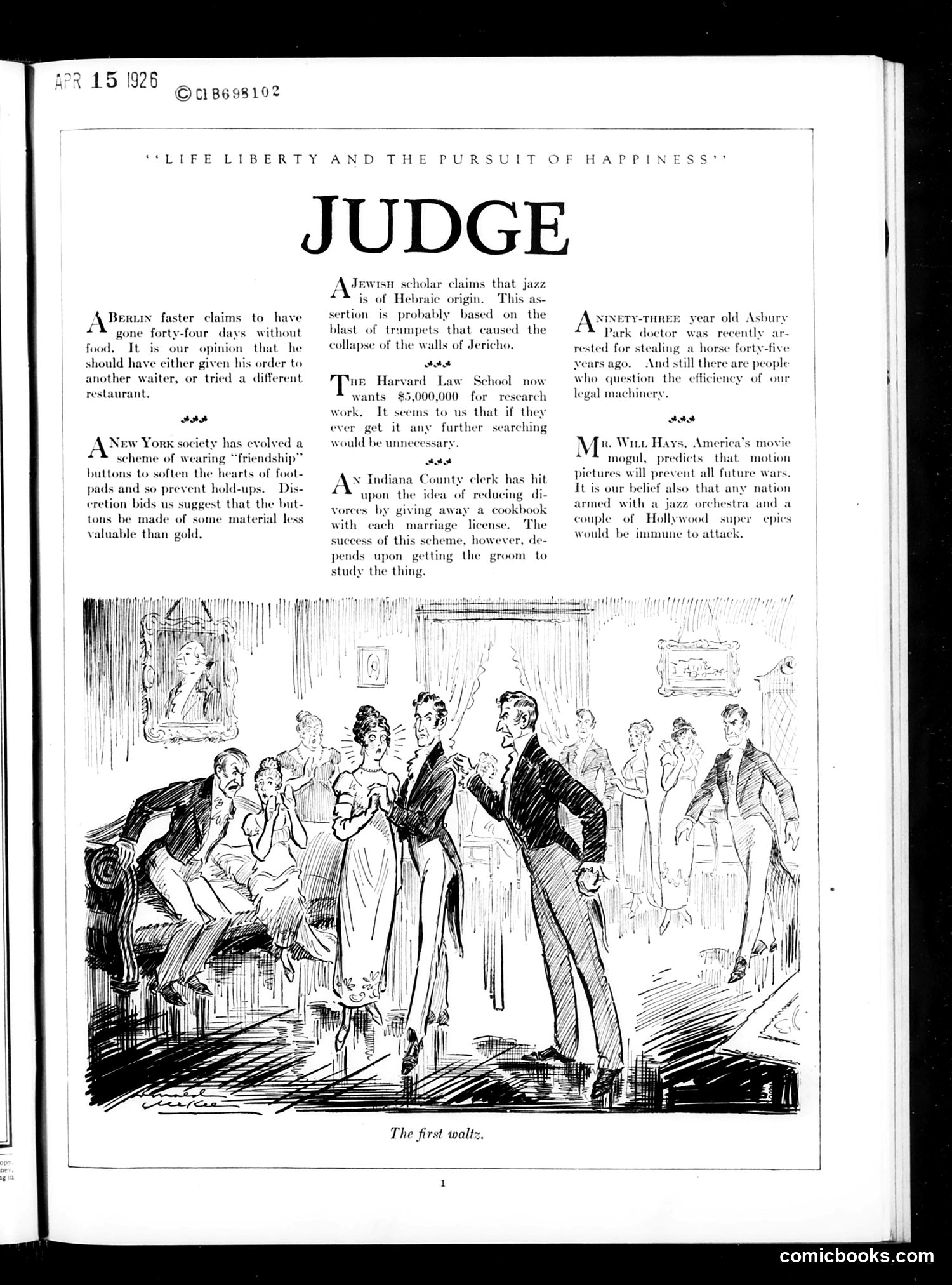
This page contains satirical commentary on contemporary issues rather than a unified political cartoon. The topics include: 1. **Jazz origins debate**: Mocking a Jewish scholar's claim that jazz derives from Hebrew tradition, likely referencing 1920s anxieties about jazz's "foreign" or non-Anglo origins. 2. **Harvard Law School funding**: Ridiculing the institution's $5 million research request as excessive. 3. **"Friendship buttons"**: Satirizing a New York society fad of wearing pins to soften social rejection. 4. **Indiana marriage licenses with cookbooks**: Poking fun at a scheme to encourage newlyweds to cook. 5. **Motion picture predictions**: Will Hays predicting jazz orchestras would prevent future wars—clearly satirical. The illustration ("The first waltz") shows an upper-class dance scene, likely commenting on social pretension or generational attitudes toward modern entertainment.
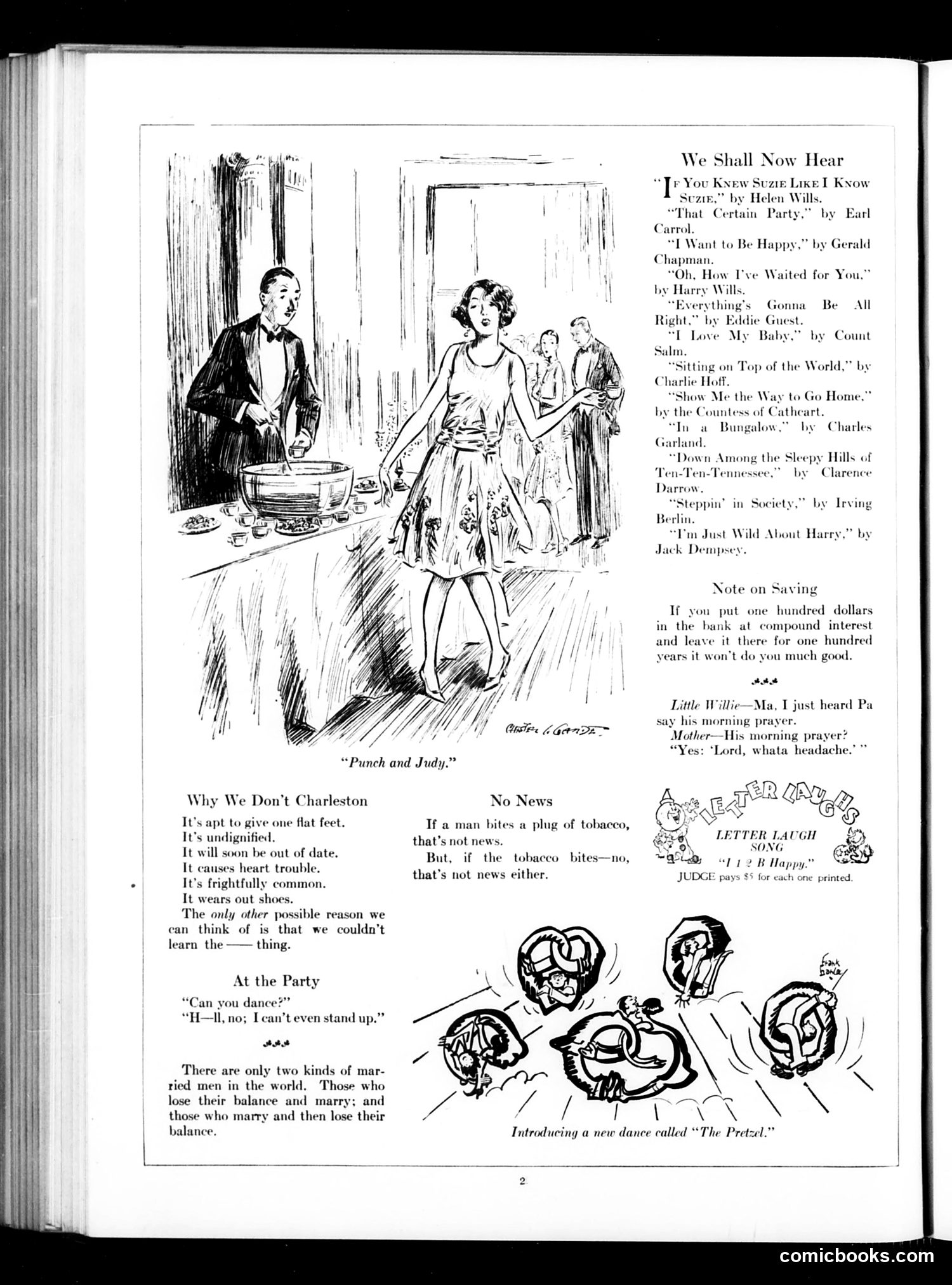
This page from Judge magazine contains entertainment content rather than political satire. The main illustration titled "Punch and Judy" depicts a domestic scene where a man appears frustrated while a woman dances—likely satirizing the era's dance crazes (the Charleston is explicitly mocked in the adjacent text section "Why We Don't Charleston"). The humor targets 1920s social trends: the piece critiques the Charleston as undignified, dangerous to shoes, and outdated. A section called "Introducing a new dance called 'The Pretzel'" shows abstracted figures in contorted positions, satirizing the absurdity of constantly evolving dance fads. The page also includes song recommendations and humorous anecdotes about contemporary life, with no identifiable political figures. It's primarily light social commentary on jazz-age dance culture and modern manners rather than serious political critique.
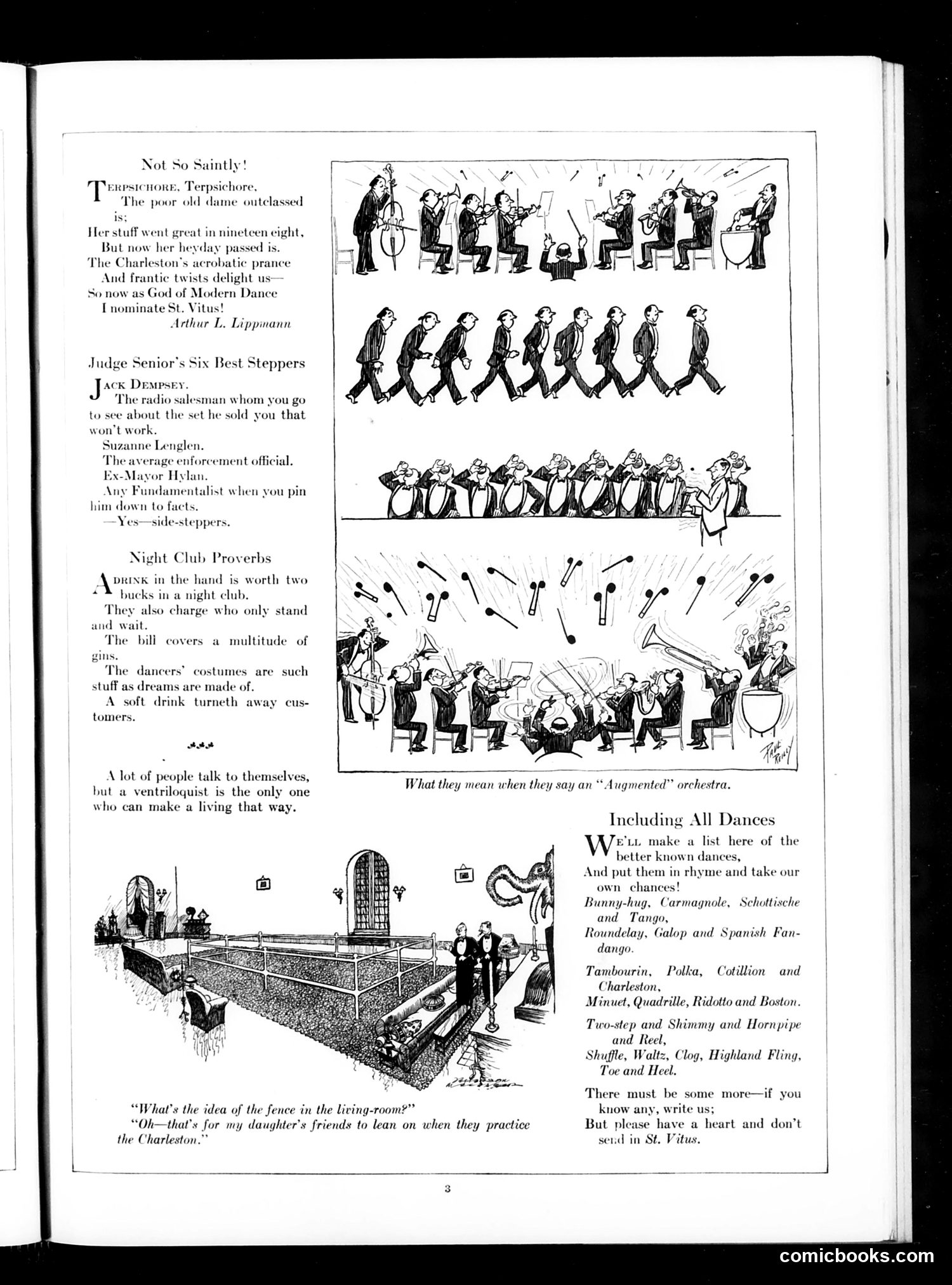
This page satirizes 1920s Jazz Age culture. The main cartoon titled "What they mean when they say an 'Augmented' orchestra" mocks the practice of hiring extra musicians for dance bands. The illustration shows an orchestra growing increasingly chaotic—starting orderly, then progressively more frantic with musicians playing unconventional instruments (bottles, household items) and literally collapsing in disarray. The surrounding text pokes fun at dance crazes (Charleston, Tango, etc.) and nightclub culture. References to "St. Vitus" (invoking the saint associated with uncontrollable dancing) and "Modern Dance" suggest disapproval of contemporary dance fads as excessive or undignified. The fence illustration below humorously depicts a generation gap regarding modern entertainment. Overall, the page reflects conservative anxiety about 1920s youth culture and commercial entertainment excess.
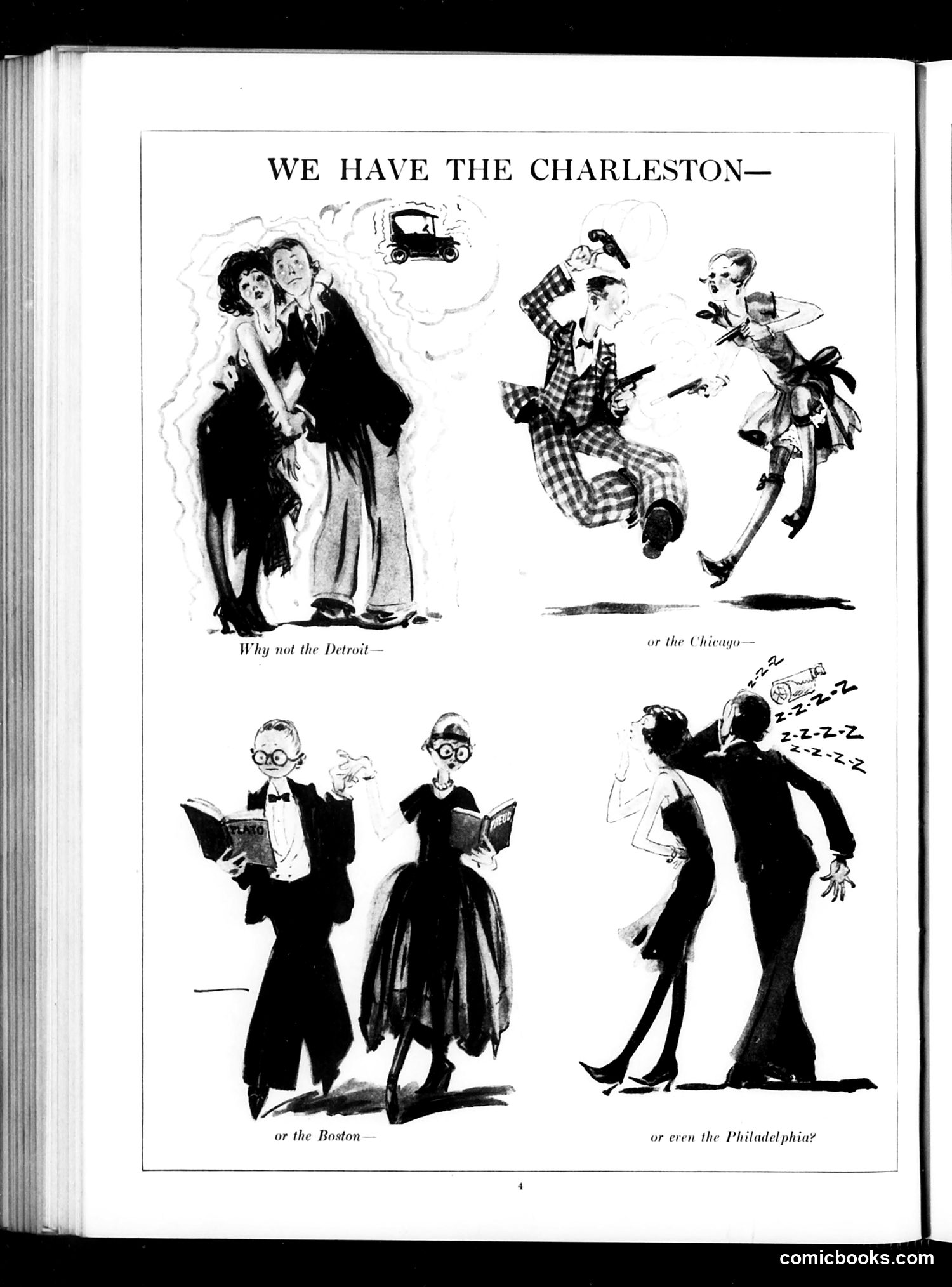
This page satirizes the Charleston dance craze of the 1920s. The headline presents the Charleston as a commodity or possession—"we have" it—suggesting American cities are competing to claim the trendy dance. Each panel mocks a different city's relationship to the Charleston: - **Detroit**: A couple hesitantly embracing, captioned "Why not the Detroit" - **Chicago**: Energetic dancers performing wildly - **Boston**: Intellectuals reading about it rather than dancing - **Philadelphia**: A couple sleeping through it all The satire targets how different American cities adopted (or failed to adopt) the Charleston, reflecting regional stereotypes—Chicago's boisterous energy, Boston's cerebral distance, Philadelphia's perceived stuffiness. The joke assumes readers recognize these regional character tropes and the Charleston's status as a defining cultural phenomenon of the Jazz Age.
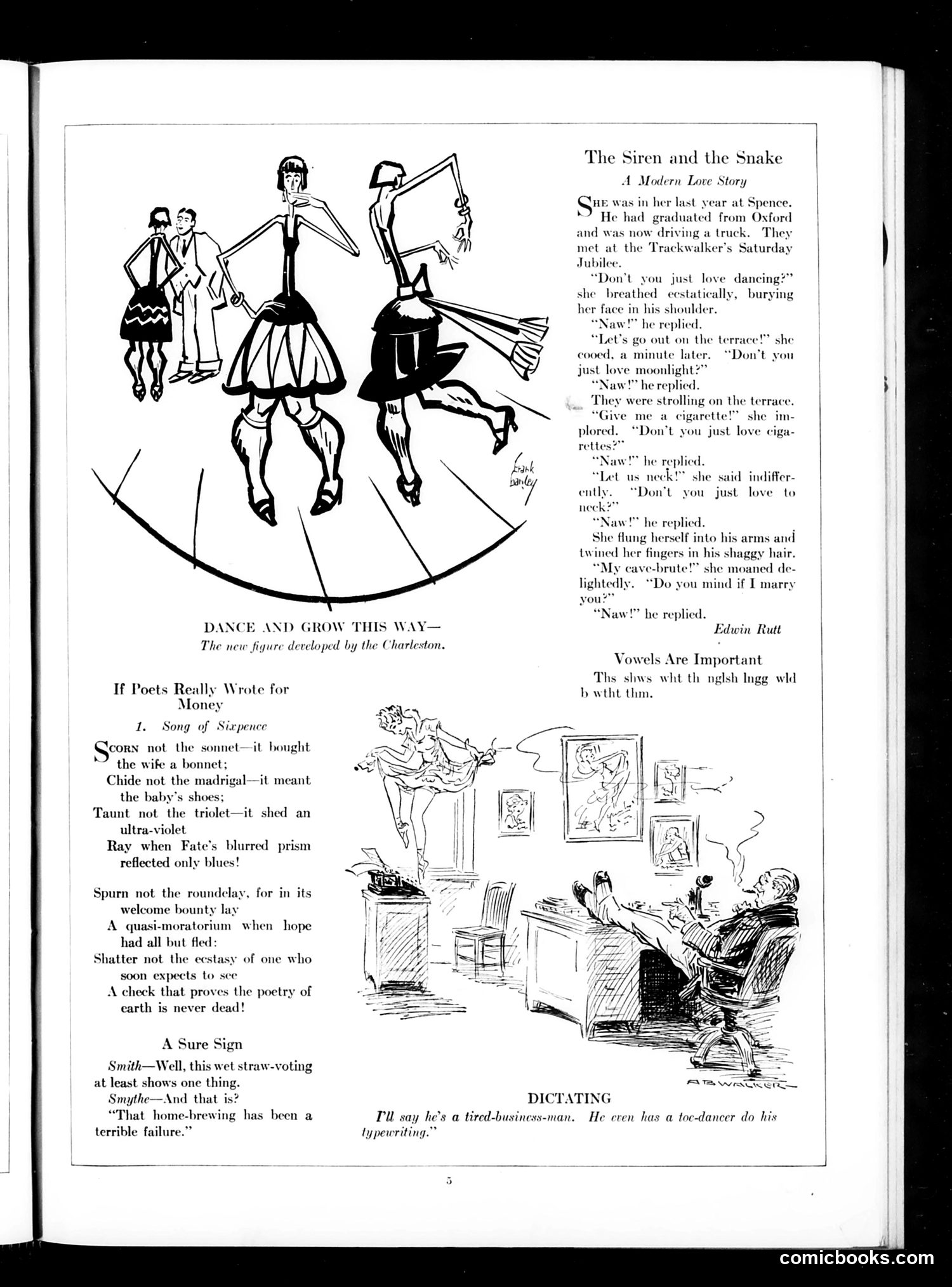
This page contains three distinct satirical pieces: 1. **"Dance and Grow This Way"** illustrates the Charleston, a 1920s dance craze, with figures performing exaggerated movements. The satire mocks the new dance's wild, undignified nature compared to traditional dancing. 2. **"If Poets Really Wrote for Money"** parodies romantic poetry by rewriting famous verses with commercialized, mundane alternatives—suggesting poets compromise artistic integrity for payment. This satirizes both commercialism and literary pretension. 3. **"Dictating"** shows a businessman dictating to a stenographer while a dancer performs. The caption mocks the absurdity of hiring entertainers during business work, likely satirizing wasteful corporate practices or the era's frivolous spending habits. The overall tone criticizes modern social trends, commercialization, and questionable workplace practices of the Jazz Age.
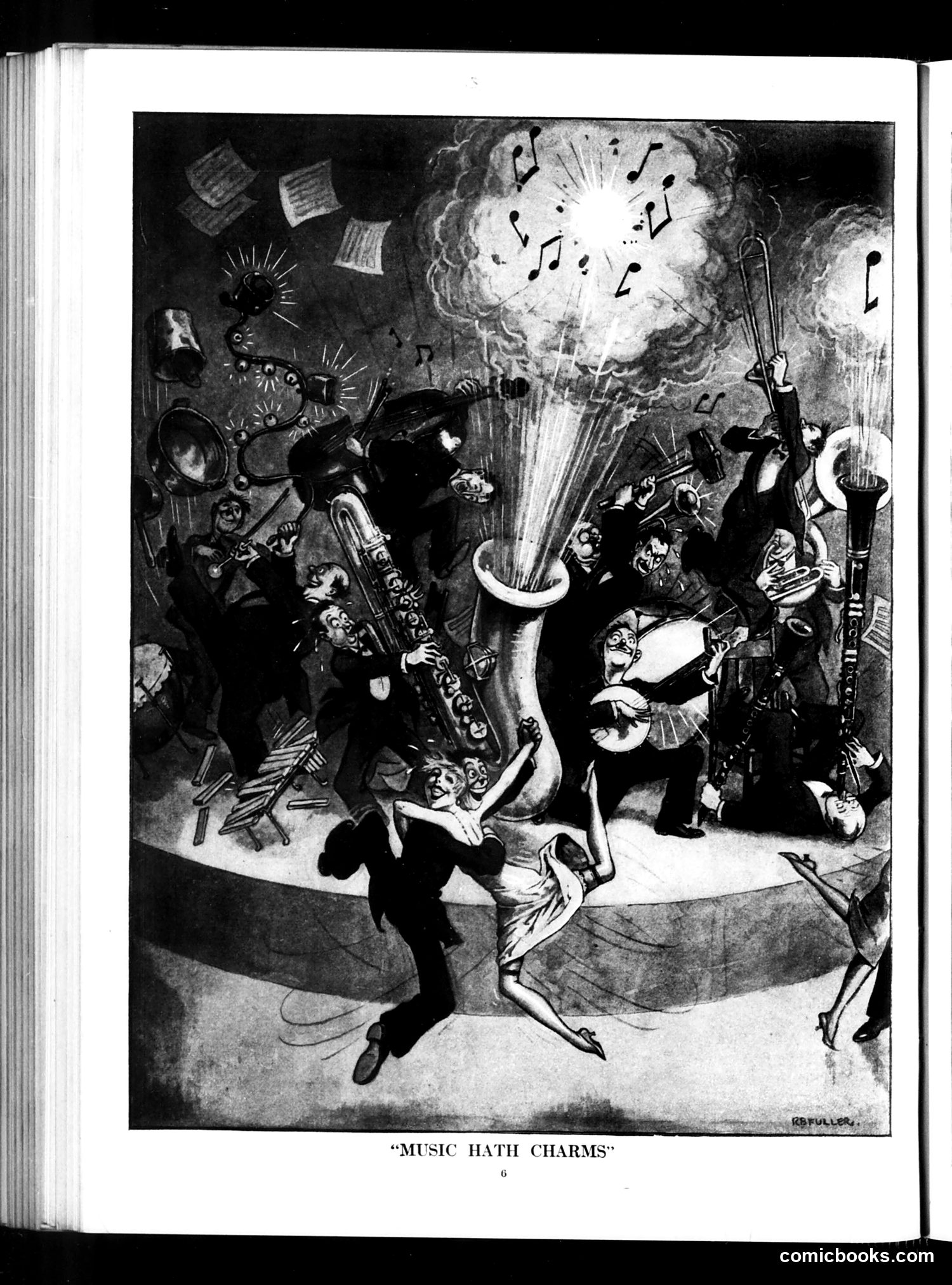
This Judge magazine cartoon depicts a surreal musical performance enchanting an audience of well-dressed figures. The title references the famous saying "music hath charms to soothe the savage breast," suggesting music's magical power to captivate people. The image shows musicians (appearing to play various instruments including what looks like a large horn or tuba) with musical notes radiating outward, while audience members appear mesmerized or dancing. The exaggerated, caricatured style typical of early 20th-century Judge satire emphasizes the almost supernatural spell music casts over listeners. Without clearer identification of specific figures or a visible date, the exact satirical target remains unclear—it may mock contemporary musicians, fashionable music trends, or simply play on music's universal appeal to different social classes. The whimsical, fantastical treatment suggests lighthearted social commentary rather than sharp political critique.
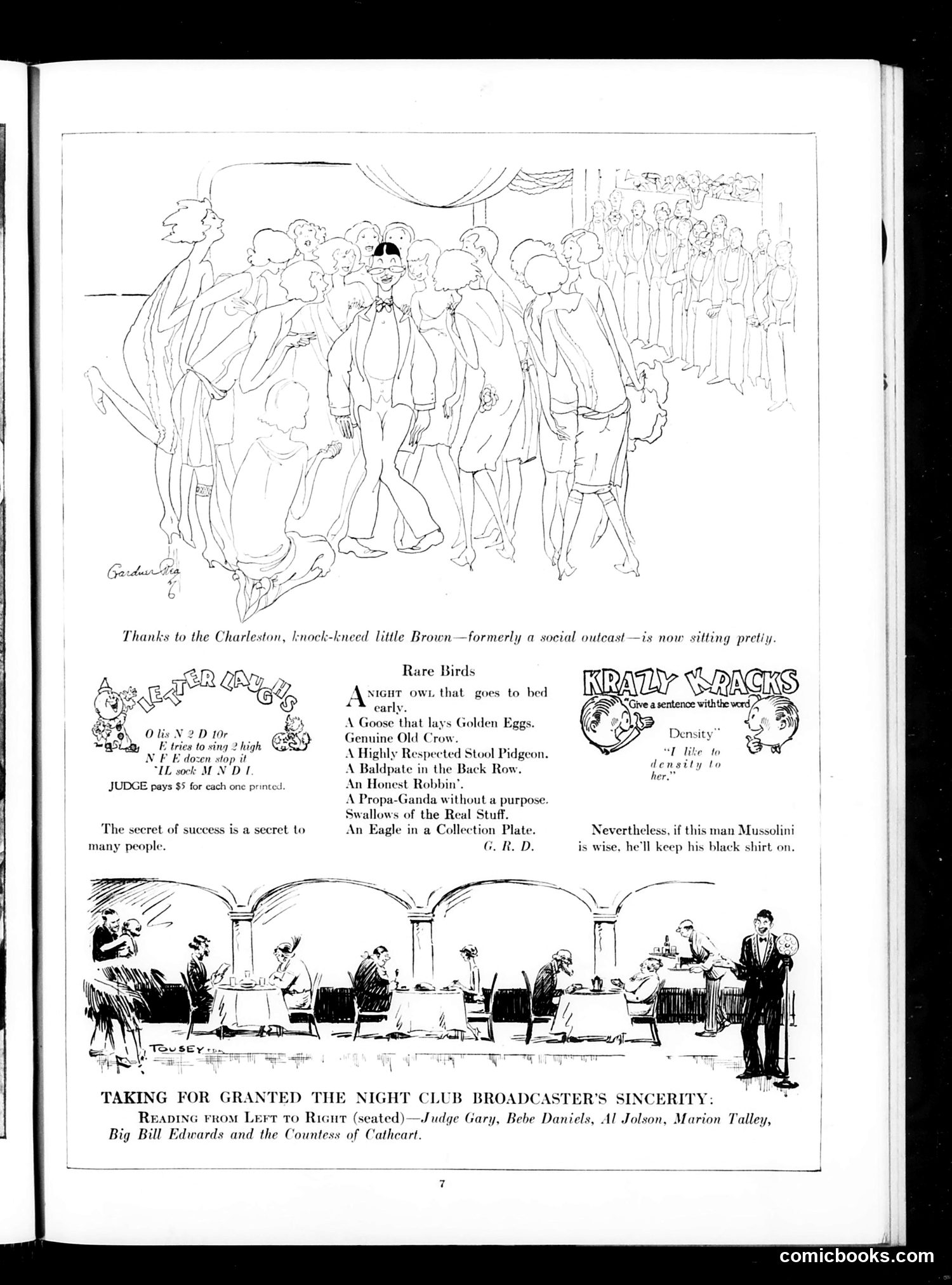
This page satirizes 1920s social climbing and nightlife culture. The top cartoon mocks how the Charleston dance craze has rehabilitated "little Brown," formerly a social outcast, into respectable society—suggesting the dance's popularity has made even disreputable people acceptable. The "Rare Birds" list is satirical wordplay identifying hypocritical figures in nightclubs: "Stool Pigeon" (informant), "Honest Robbin'" (robber), and "Propa-Ganda without a purpose" mock both actual criminals and those who merely pretend to be daring or radical while frequenting fashionable clubs. The bottom cartoon depicts a radio broadcast from a night club with real celebrities (Judge Gary, Bebe Daniels, Al Jolson, Marion Talley, Bill Edwards). The caption's irony—"Taking for Granted the Night Club Broadcaster's Sincerity"—suggests these broadcasts present a false image of nightclub culture as wholesome entertainment, when it actually involved Prohibition-era speakeasies and morally questionable socializing. The Mussolini reference appears tangential political commentary.
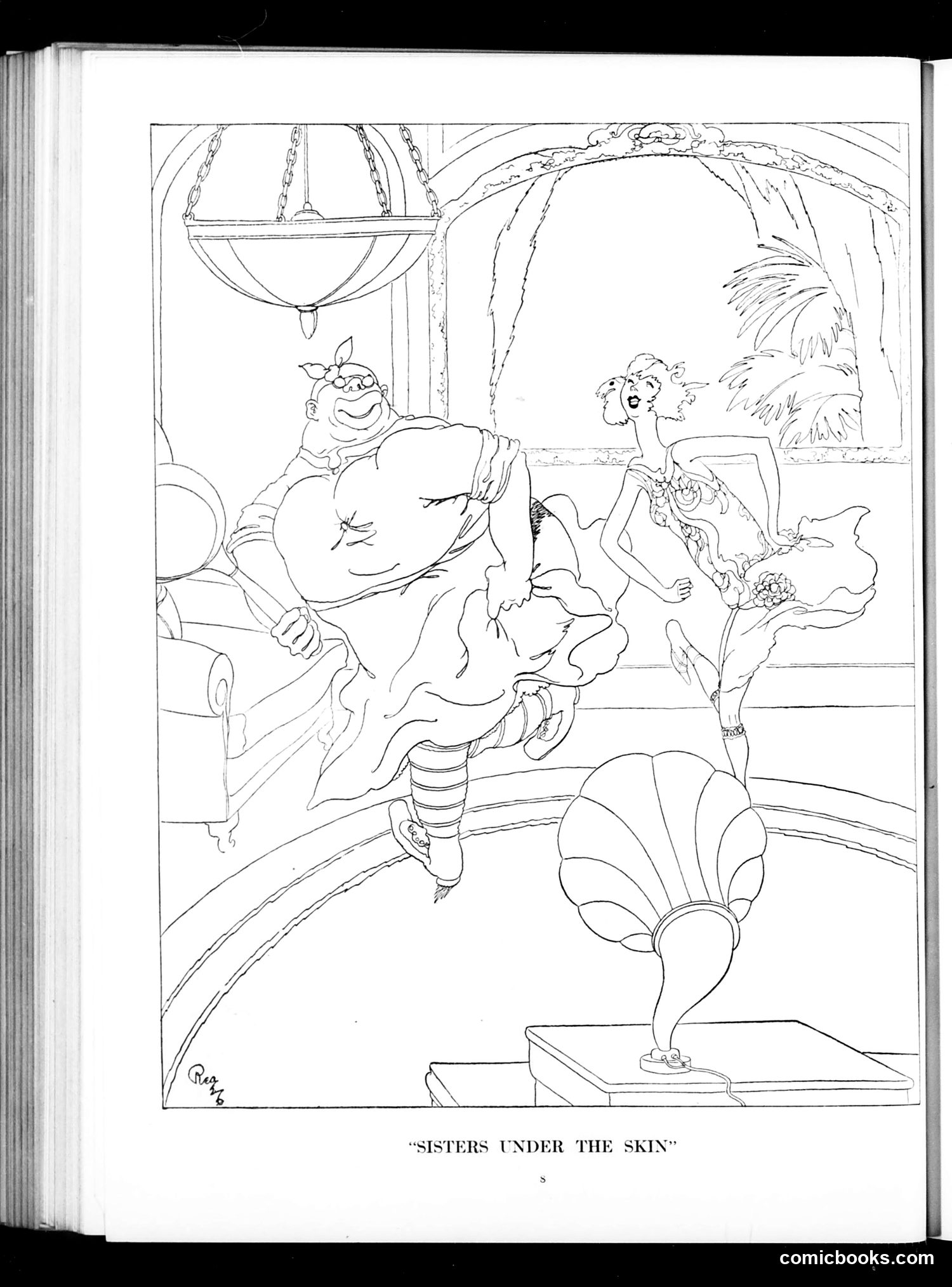
This Judge cartoon satirizes women's fashion and body standards. The title suggests hidden similarities despite surface differences. The central figure—a large woman in fashionable dress with exaggerated proportions—appears to represent how corsets and restrictive undergarments artificially reshape the body. The other figures observing her likely represent society's beauty standards or fashion industry gatekeepers. The satire critiques how women are transformed by clothing and undergarments into unnatural shapes to meet social expectations. "Under the skin" implies that beneath the fashionable exterior lies a very different body—the cartoon mocks both the extremes of fashion silhouettes and the absurdity of women conforming to them for social acceptance. This reflects early-20th-century debates about women's fashion, body autonomy, and the physical toll of restrictive garments like corsets.
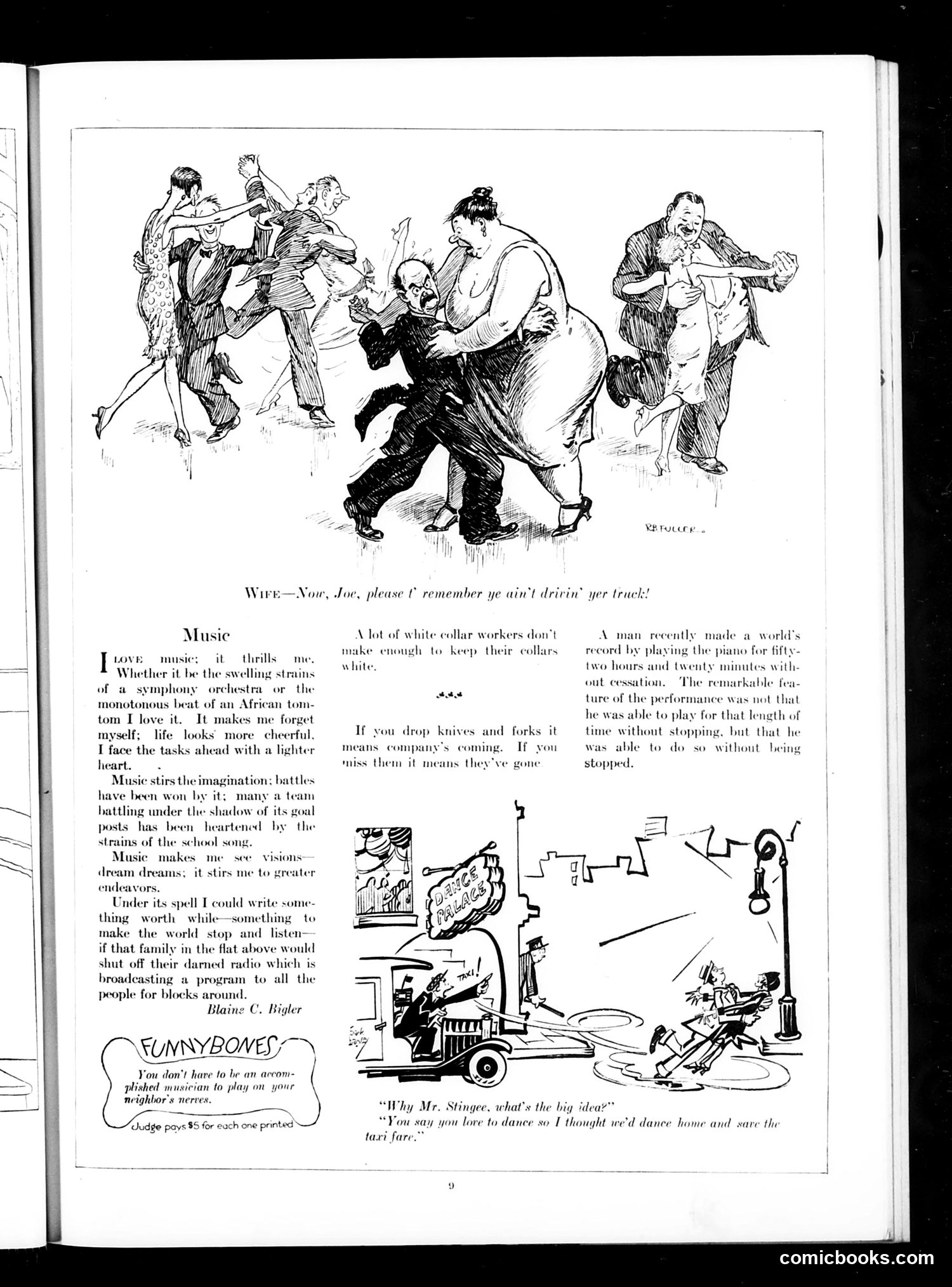
**Main Cartoon (Top):** Depicts a domestic dispute where a wife stops her husband from driving drunk ("remember ye ain't drivin' yer truck!"). The man appears intoxicated while other figures gesture wildly in the background—likely representing the chaos of Prohibition-era drinking culture. The satire targets both drunk driving and the absurdity of Prohibition enforcement. **"Music" Essay & Cartoons (Center/Bottom):** The author celebrates music's inspirational power, then undercuts themselves: they can't compose because neighbors won't stop playing their radio—satirizing how modern technology (radio broadcasting) disrupts traditional values. **Secondary Jokes:** Include observations about servant/working-class superstitions (dropped silverware means company coming) and miserliness (dancing home to avoid taxi fare). **Historical Context:** This appears to be 1920s-1930s era, reflecting Prohibition tensions, early radio's social impact, and economic struggles. The "white collar workers" reference and servant dynamics suggest Depression-era class anxieties.
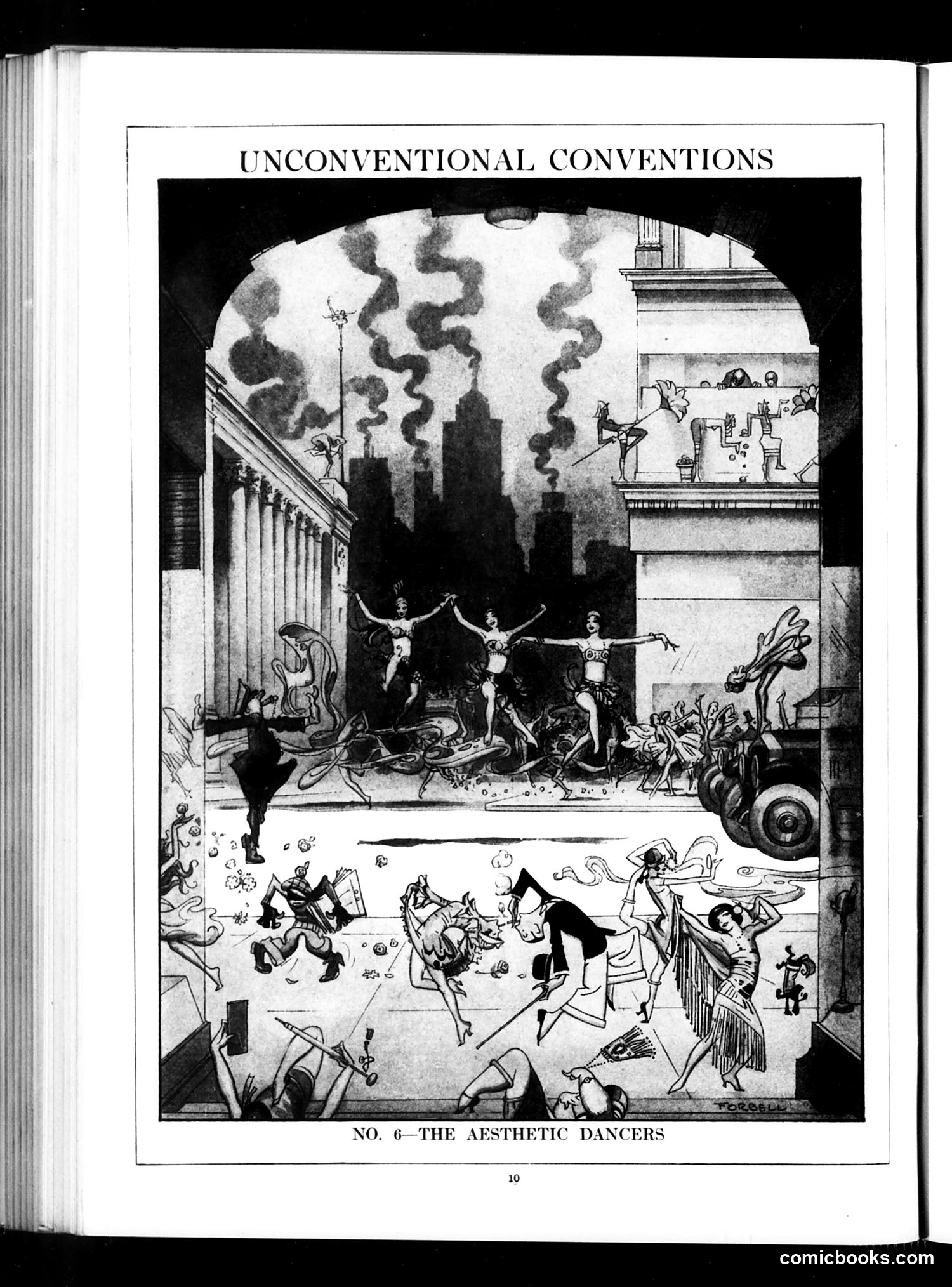
This cartoon satirizes the "Aesthetic Movement" of late 19th-century artistic culture. The title "Unconventional Conventions" and subtitle "No. 6—The Aesthetic Dancers" mock pretentious modern artists and dancers who rejected traditional artistic rules. The image depicts chaos: dancers in exaggerated, ungainly poses performing on stage while audience members react with confusion and disapproval from boxes above. The chaotic lower foreground shows spectators in disarray—some fleeing, others gesturing in dismay. The satire targets the gap between aesthetic movement claims of refined, avant-garde artistry and the actual bewilderment such "unconventional" performances provoked in mainstream society. Judge magazine, a conservative satirical publication, frequently mocked progressive artistic movements as pretentious affectation masquerading as innovation.
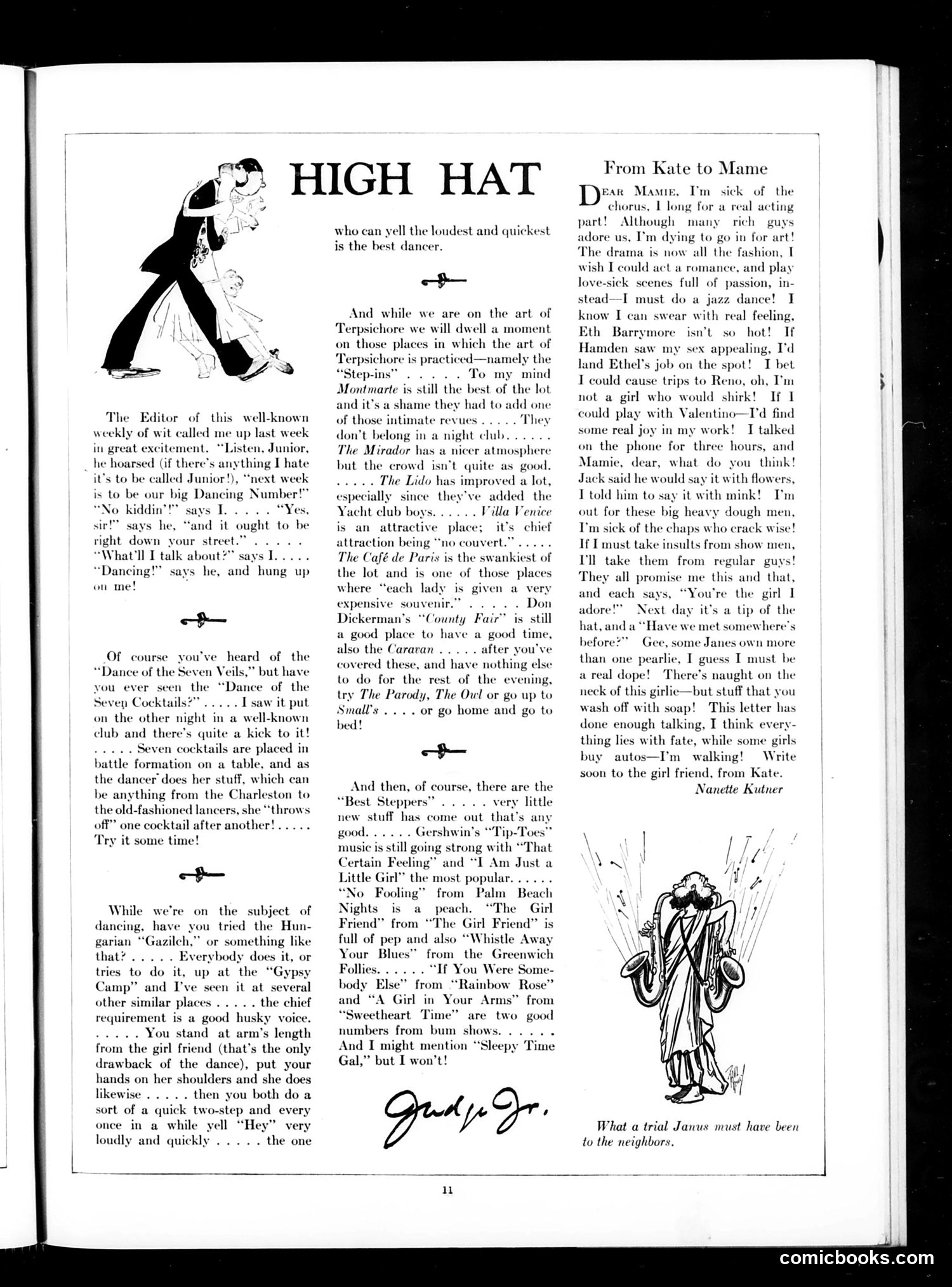
This page from *Judge* magazine features a humorous column about 1920s Manhattan nightlife and dancing culture. The main article discusses trendy "step-ins" (nightclubs) like Montmartre, the Lido, and Villa Venice, evaluating their atmospheres and crowds. It catalogs popular jazz-age dances—the Charleston, Hungarian "Gazilch," and the novelty "Dance of Seven Cocktails"—with comedic descriptions of how to perform them. The sidebar letter "From Kate to Maine" is satirical advice to an aspiring actress. "Nanette Kutner" complains she must perform jazz dances instead of serious dramatic roles, despite her talents. The satire mocks wealthy, status-conscious young women of the era who pursue entertainment careers for glamour and wealthy suitors rather than artistic merit—mentioning Rudolph Valentino and stage star Ethel Barrymore as ideals. The cartoon (top left) depicts a dancing couple in evening wear, illustrating the nightclub culture discussed. The overall tone is affectionate mockery of Jazz Age social climbing and the flapper generation's entertainment-obsessed lifestyle.
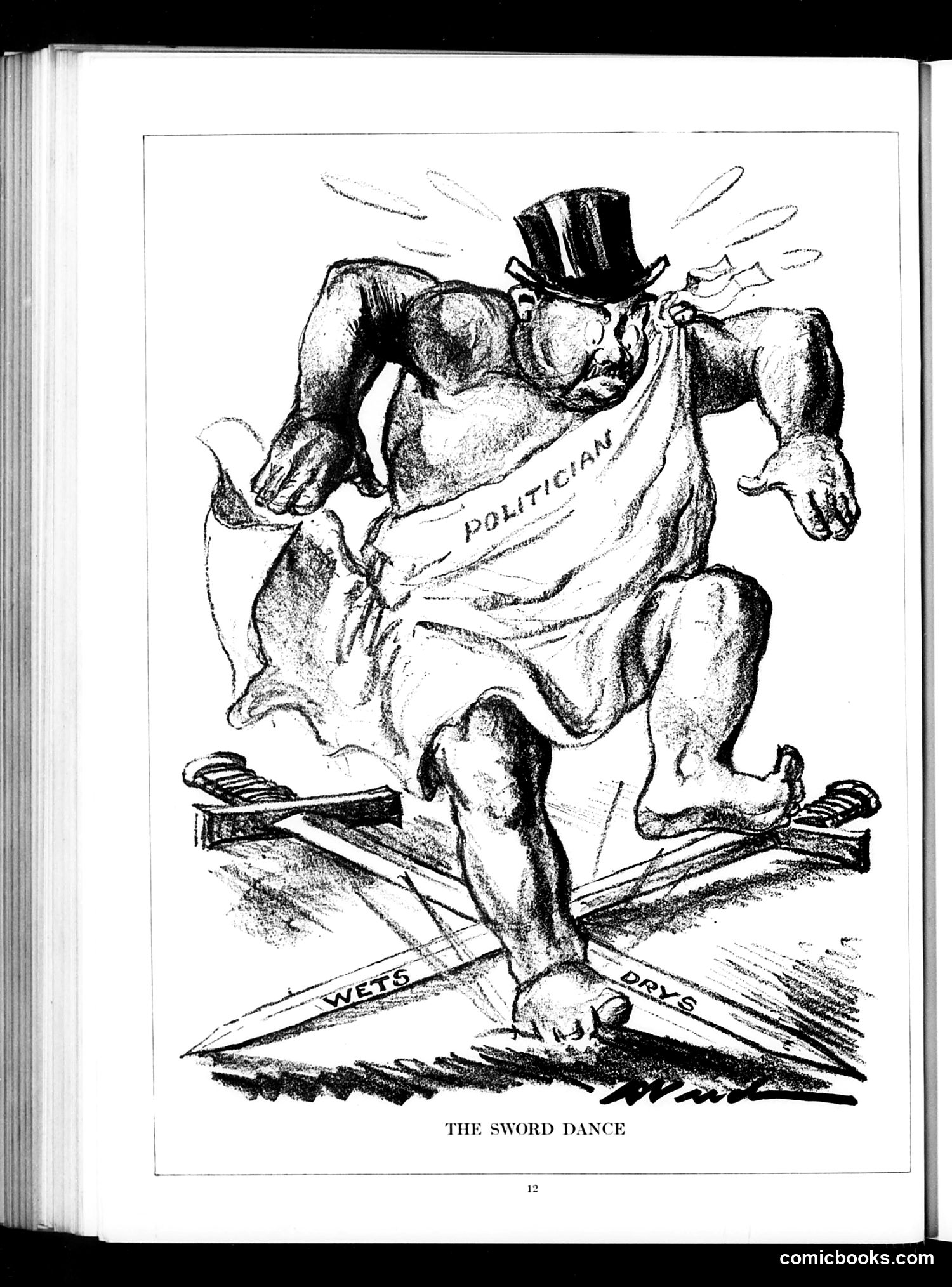
This political cartoon depicts a figure labeled "POLITICIAN" performing a precarious balancing act, standing on crossed swords labeled "WETS" and "DRYS." The character wears a top hat and formal attire, gesturing wildly while attempting to maintain equilibrium. The cartoon satirizes politicians navigating the Prohibition debate—a major American political issue of the early 20th century. "Wets" supported alcohol consumption and opposed Prohibition; "Drys" supported banning alcohol. The "sword dance" metaphor suggests that politicians were caught between these two powerful opposing forces, forced into an unstable, dangerous juggling act to please both constituencies. The exaggerated, comedic pose emphasizes the difficulty and absurdity of taking a middle position on this divisive issue.
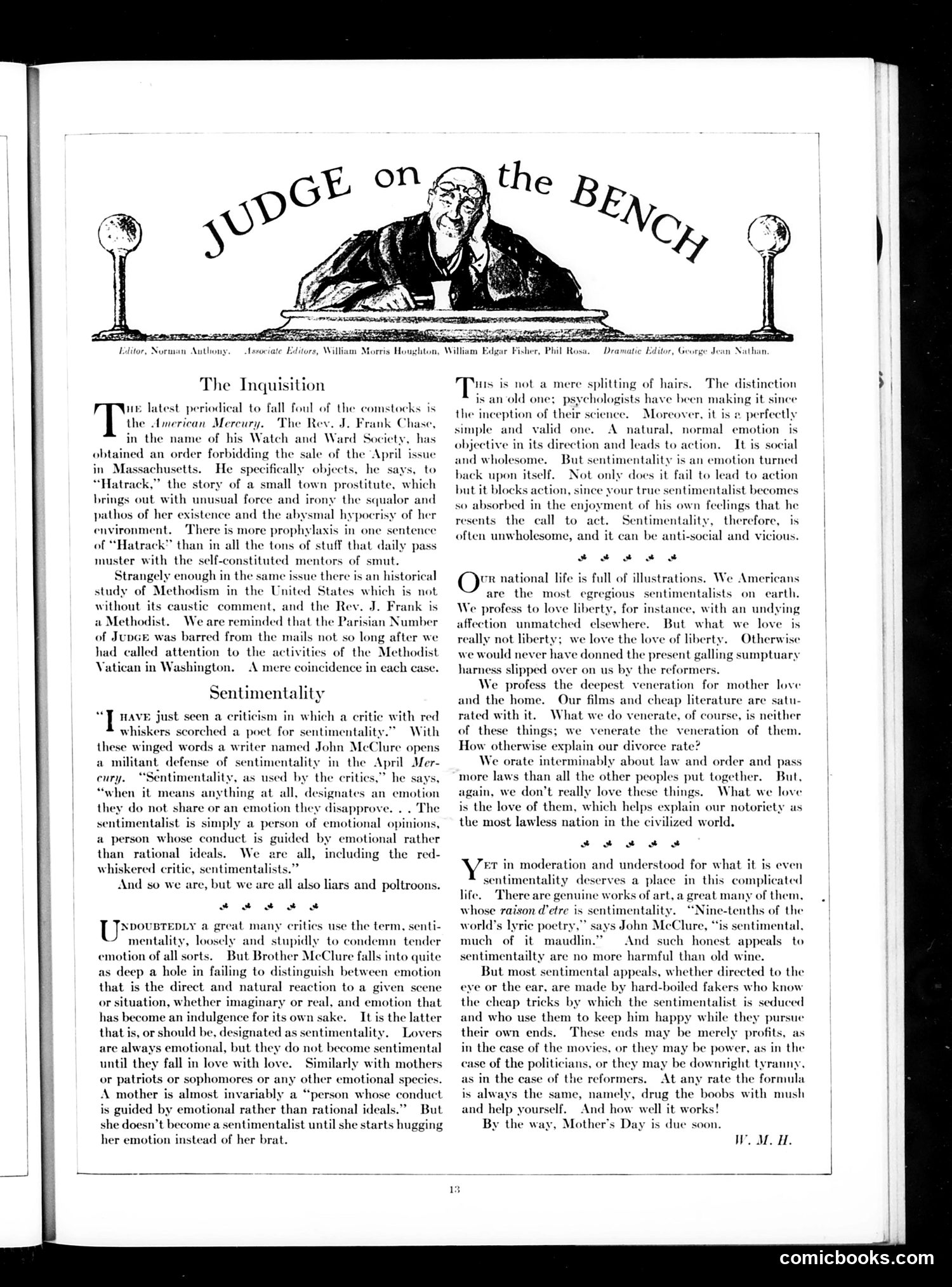
This page satirizes censorship efforts and defends emotional authenticity. The header "Judge on the Bench" features a stern judge presiding over the content below. **"The Inquisition" section** criticizes the Watch and Ward Society (led by Rev. J. Frank Chase) for banning the April 1926 *American Mercury* issue containing "Hatrack"—a story about a small-town prostitute. Judge mocks this as hypocritical censorship, noting Chase banned the magazine while being Methodist, yet the same issue contained a critical Methodist history study he didn't object to. **"Sentimentality" section** defends emotional responses against critics who dismiss them. The author distinguishes between genuine emotion (which prompts action) and false sentimentality (self-indulgent emotion that paralyzes action). Judge argues Americans are sentimental hypocrites: claiming to love liberty while accepting restrictive laws from "reformers"—likely referencing Prohibition and other Progressive Era regulations. The satire targets both censorious moralists and citizens' emotional complacency about losing freedoms.
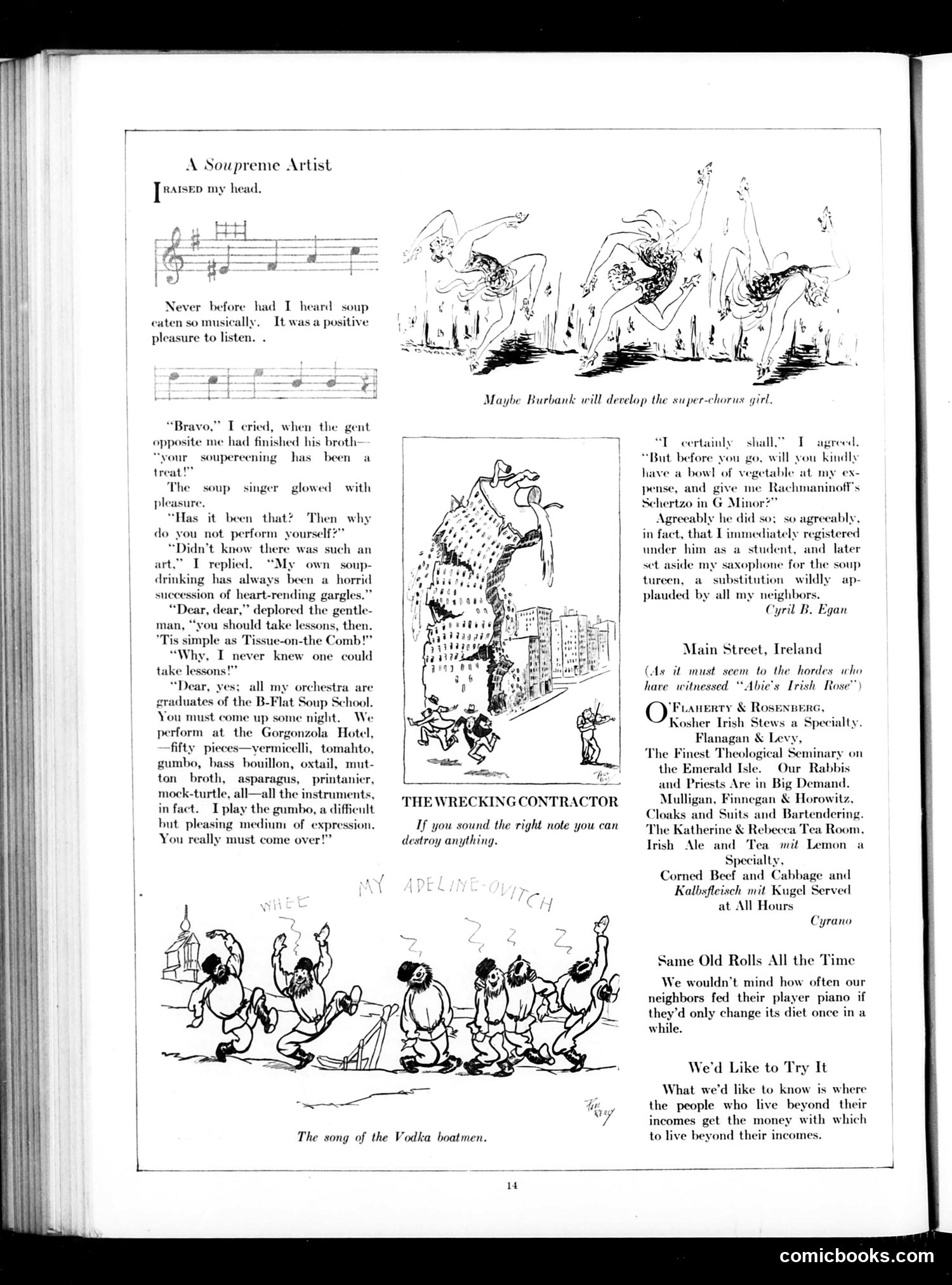
This humorous story satirizes pretentious affectation in the arts. The narrator encounters a man who treats soup-eating as a refined musical performance, complete with dramatic sound effects ("heart-rending gargles"). The joke mocks both the soup-eater's absurd snobbery and the narrator's gullible admiration—he immediately enrolls as a student and trades his saxophone for a soup tureen. The satire targets turn-of-the-century cultural pretension: the invention of fake "schools" (the "B-Flat Soup School"), the name-dropping of high art (Rachmaninoff), and the absurd notion that mundane activities can be elevated through affected sophistication. The accompanying cartoons—particularly "The Wrecking Contractor" (suggesting the right technique destroys anything)—reinforce the theme of empty performative art. The "Main Street, Ireland" section parodies ethnic business advertising, likely referencing the popular play "Abie's Irish Rose" and Jewish-Irish cultural mixing in urban America.
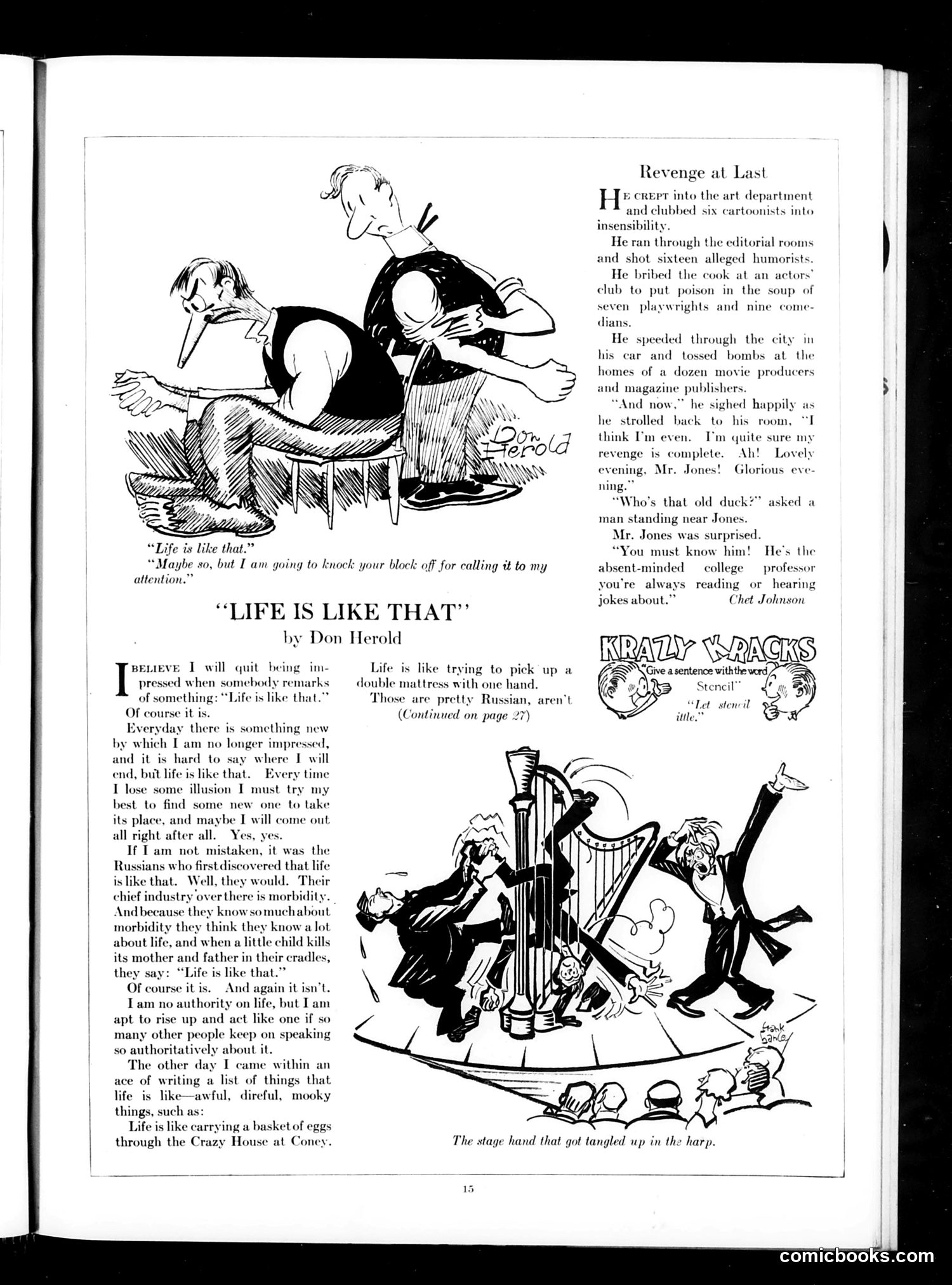
This satirical piece mocks the cliché phrase "Life is like that" by imagining an absurd revenge scenario. A character—described as an absentminded college professor—systematically attacks various creative professionals: cartoonists, humorists, playwrights, comedians, movie producers, and magazine publishers. His rationale appears to be retaliation for their constant use of the tired expression. The joke targets both the overuse of this vapid platitude in 1920s popular discourse and the entertainment industry's reliance on hackneyed observations. The accompanying text by Don Herold expands on this frustration, arguing that "life is like that" is meaningless—used authoritatively by people who aren't authorities. The illustration's chaotic violence humorously exaggerates what many readers likely felt: irritation at this ubiquitous, empty phrase repeated endlessly by writers and speakers.
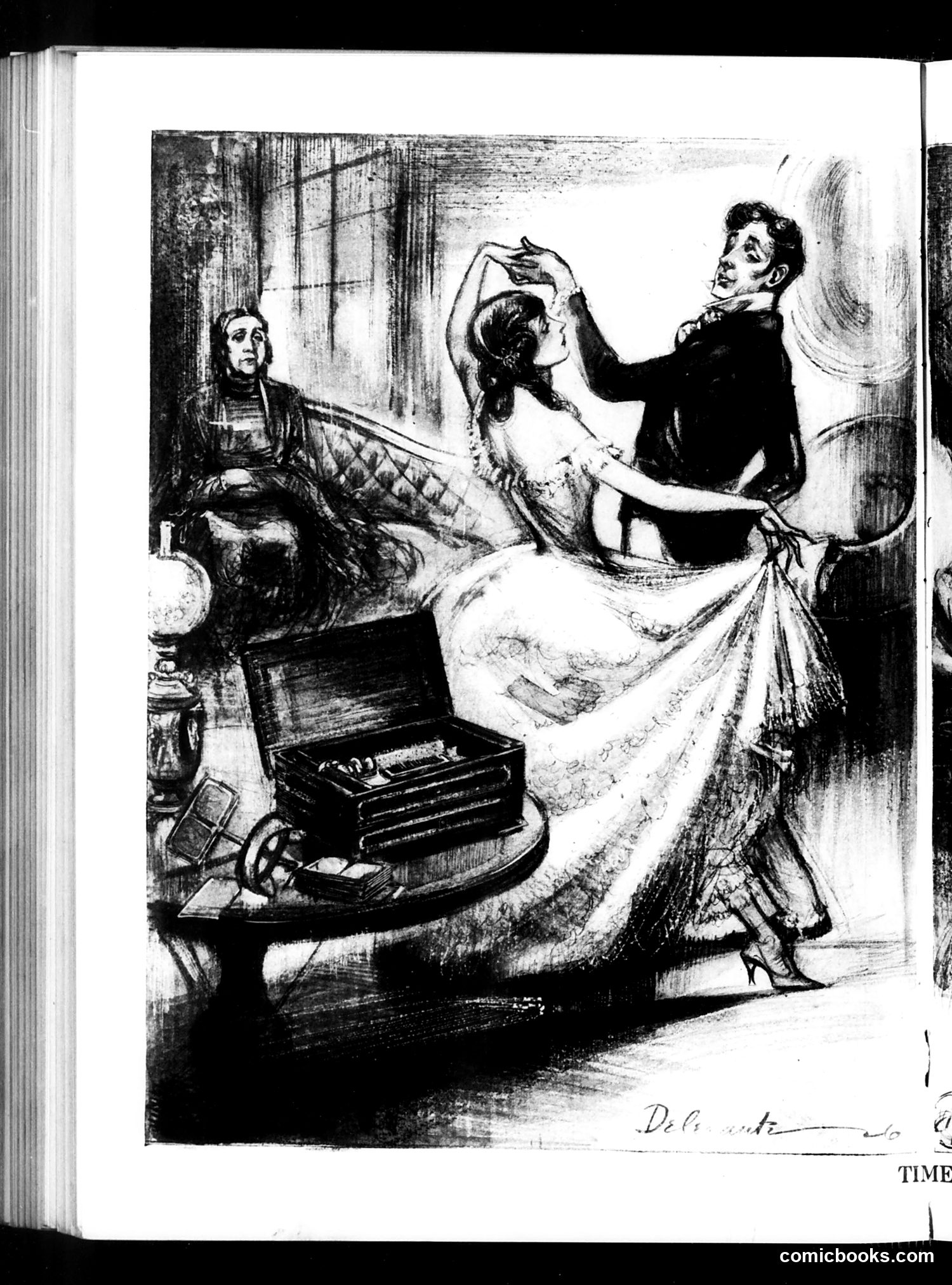
This appears to be a satirical cartoon from *Judge* magazine depicting a domestic scene with social commentary. A woman in an elegant gown is being admired or presented by a man in formal attire, while a seated figure (possibly representing a husband or suitor) observes. The presence of what appears to be a trunk or storage box suggests themes of travel, deception, or hidden circumstances. The satire likely comments on courtship, marriage arrangements, or social pretense common to the era when *Judge* was published. The woman's fashionable dress and the theatrical presentation suggest mockery of superficial social rituals or perhaps critiques female vanity and male gullibility in romantic contexts. However, without clearer text or caption visible, the specific political or social reference remains unclear. The artist's signature appears present but is not fully legible.
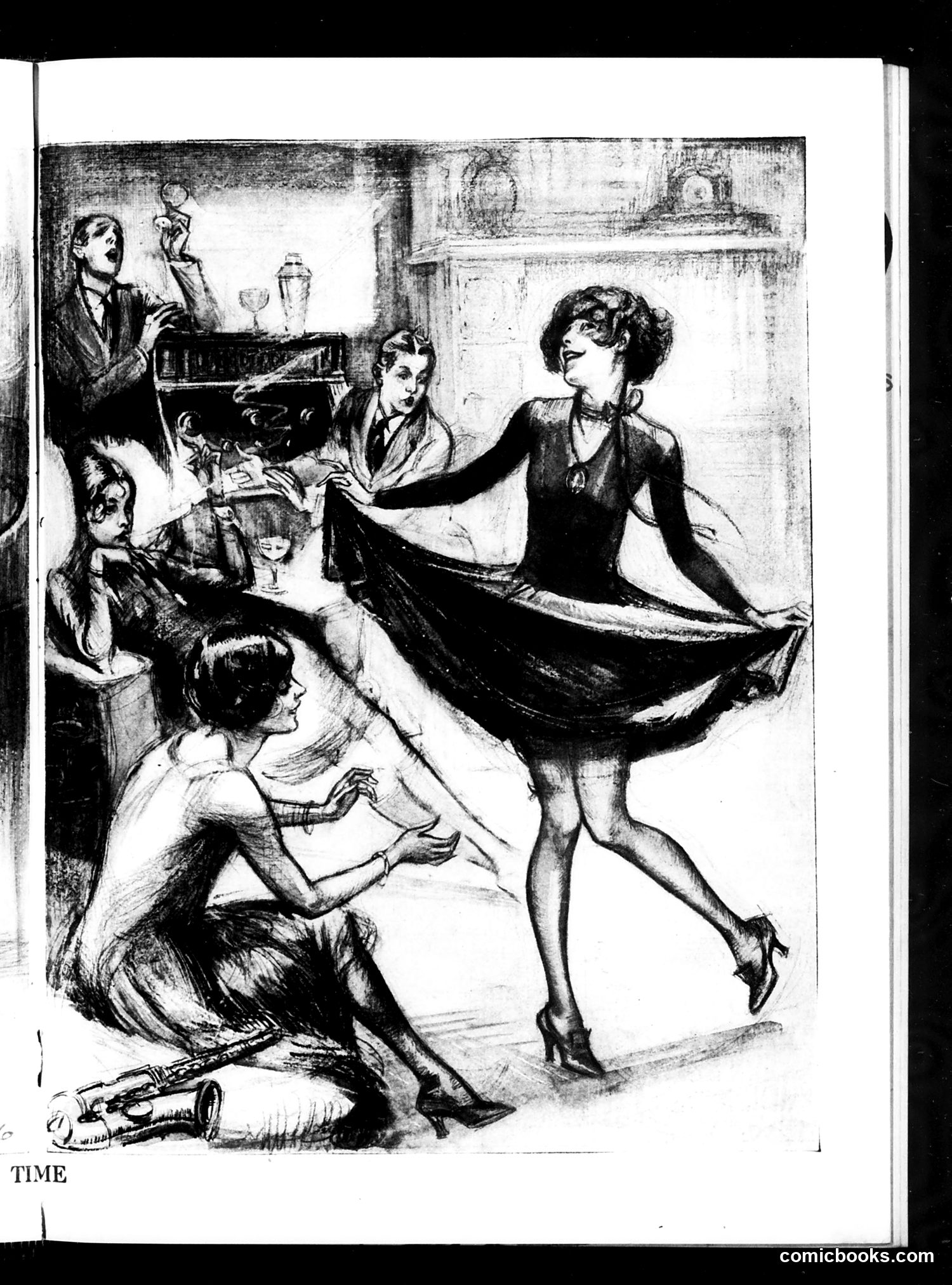
This appears to be a satirical illustration from *Judge* magazine depicting a social scene, likely from the early 20th century. The cartoon shows what appears to be a party or gathering where a woman in a dark dress is dancing or performing, while others observe. A man in the background (upper left) appears to be admiring or reacting to the scene. The satire likely concerns social behavior and propriety of the era—possibly mocking either the dancer's bold display, the onlookers' reactions, or broader anxieties about changing social norms regarding women's public behavior and dress. The detailed rendering and composition suggest this comments on class, morality, or shifting gender dynamics in contemporary society, but without additional text or context, the specific target remains unclear.
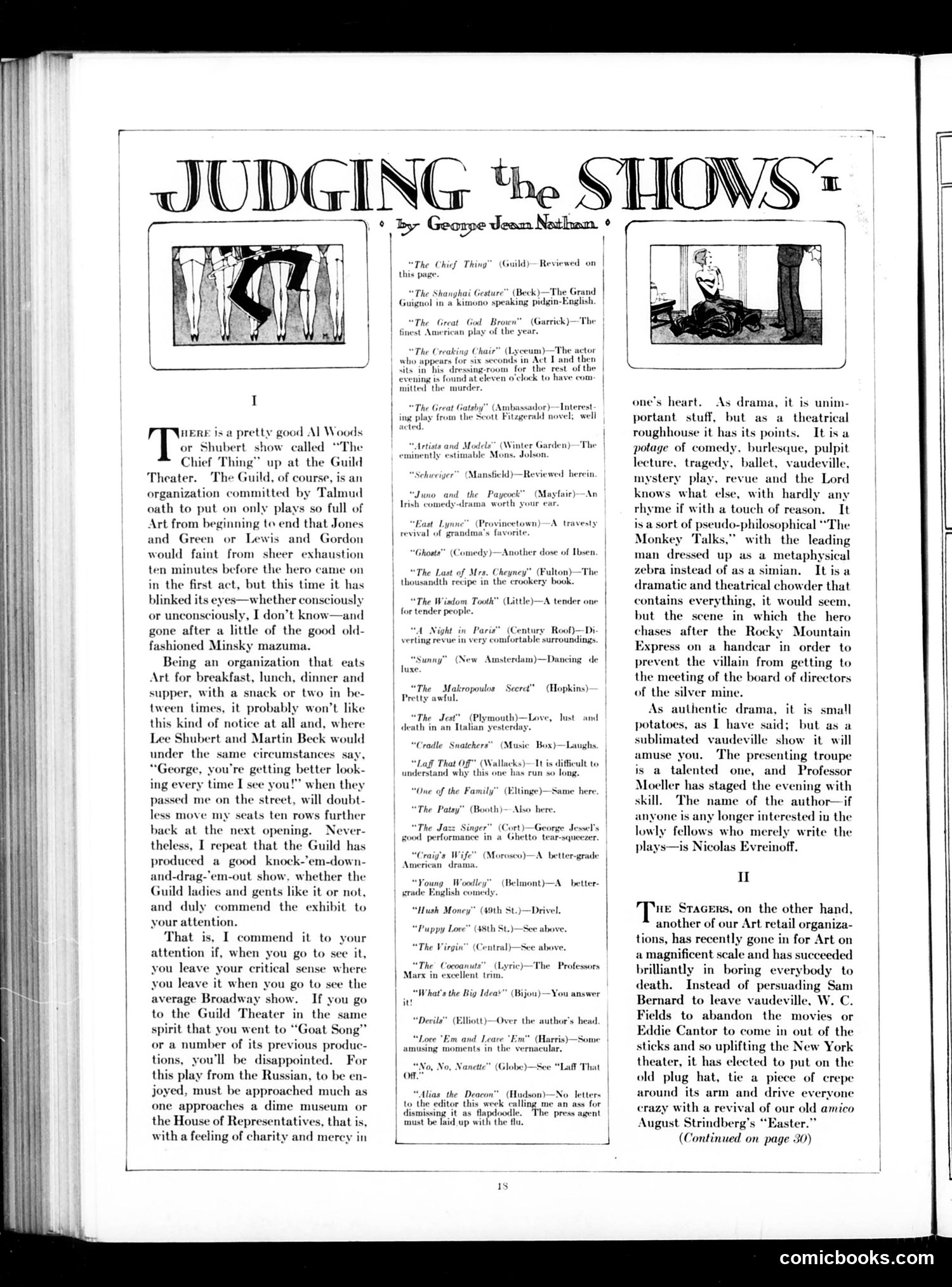
This page from Judge magazine contains theater reviews by George Jean Nathan, a prominent drama critic of the 1920s. The two small illustrations show theatrical scenes, likely from productions under review. Nathan's column critiques Broadway shows with characteristic acerbity. He commends the Guild Theater's production of "The Chief Thing" (a Russian play) as entertaining popular theater, while gently mocking the Guild's pretentious artistic mission. He notes the organization typically prioritizes "Art" over commercial appeal, so this knock-about comedy represents a departure. The extensive list of reviewed productions reflects the vibrant 1920s Broadway scene, including plays like "The Great God Brown," "The Shanghai Gesture," and the revue "Sunny." Nathan's reviews are characteristically brief and sardonic, rating works from respectable drama to outright "drivel." The page exemplifies Judge's role as a sophisticated commentary on contemporary American culture and entertainment for educated urban readers.
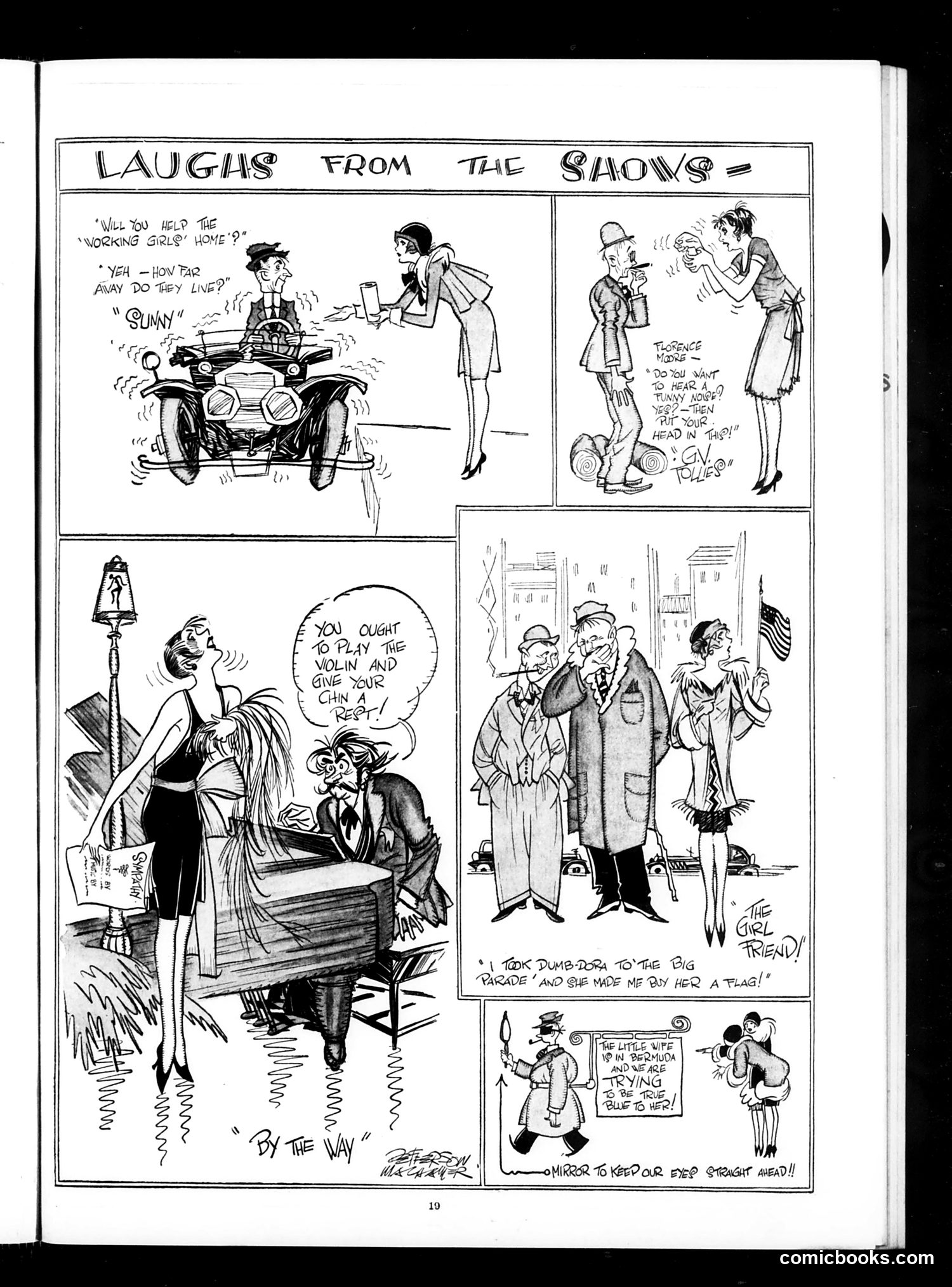
This page collects jokes and humorous vignettes apparently drawn from theatrical performances of the era. The cartoons mock social conventions and gender dynamics: **Top panels**: A woman asks a man where working girls live—he answers "sunny," implying they're kept in poor conditions. Another scene shows a woman instructing a man to "play the violin and give your chin a rest," suggesting nagging wives. **Middle panels**: A woman tells a small man "you ought to play the violin and give your chin a rest"—domestic comedy about henpecked husbands. Another shows a woman taken to a big parade, suggesting working-class outings. **Bottom**: A man tells his wife "the little wife's in Bermuda and we are trying to be true"—humor about marital separation or infidelity. The overall tone satirizes working-class romance, nagging wives, henpecked husbands, and domestic discord—common vaudeville and theatrical comedy themes of this era.
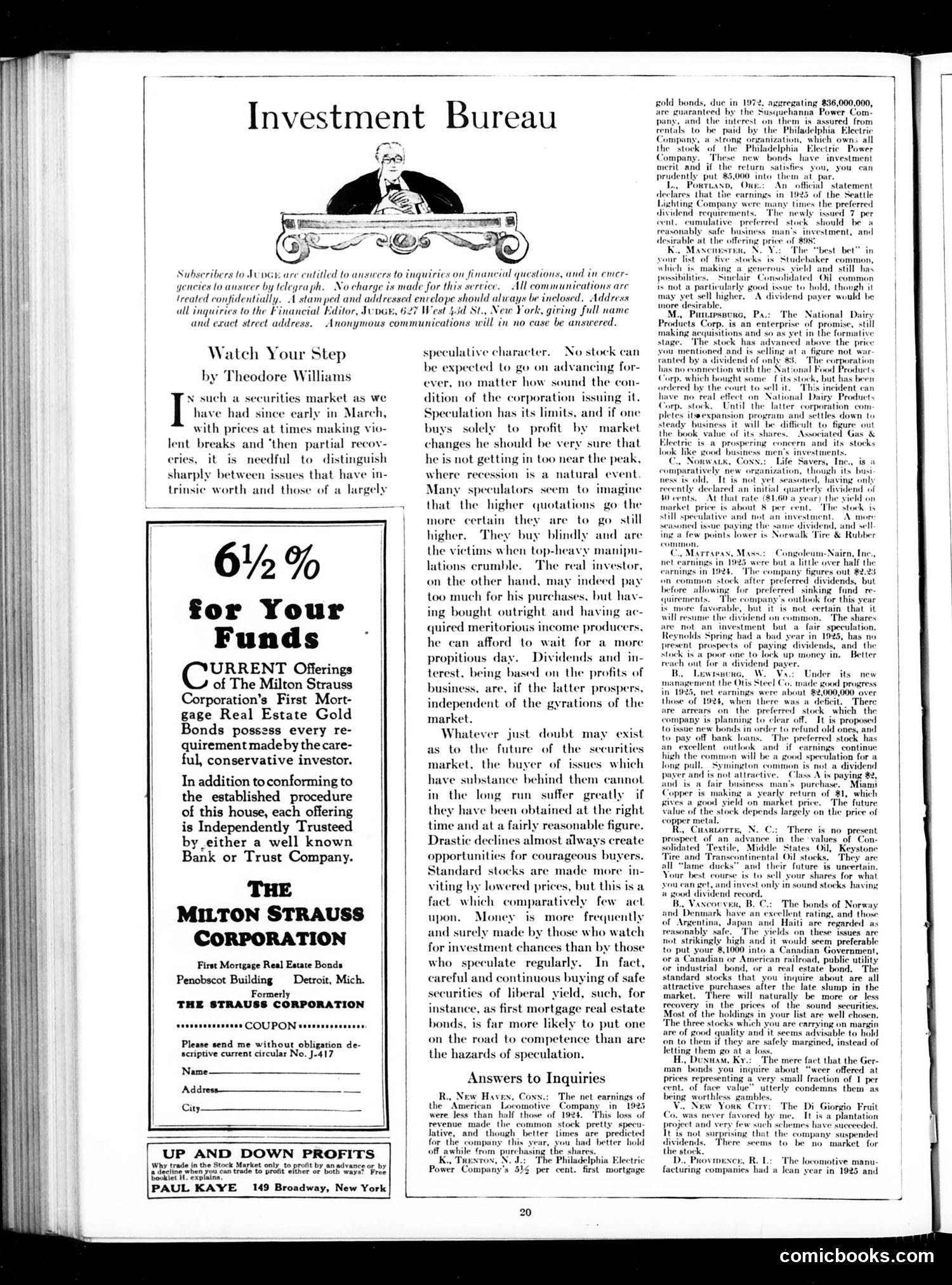
This page is primarily **financial advertising and investment advice**, not political satire. It contains: **Main Content:** - An "Investment Bureau" advice column by Theodore Williams warning against stock market speculation - His central message: distinguish between stocks with real value versus speculative bubbles; buy quality securities at reasonable prices and hold them, rather than chase price movements **The Satire (if any):** The title "Watch Your Step" appears ironic given the 1920s context—this advice warns readers away from the rampant stock speculation that characterized the era. Williams advocates boring but safe investments (like first-mortgage bonds) over the get-rich-quick mentality that dominated the market before the 1929 crash. **Advertisements:** Multiple investment firms promote their bonds as "safe" alternatives to stock market gambling, offering 6.5% returns. **Historical context:** This appears published during a volatile market period in 1924-1926, when ordinary Americans were increasingly buying stocks on margin. The sober warning against speculation proved prescient.
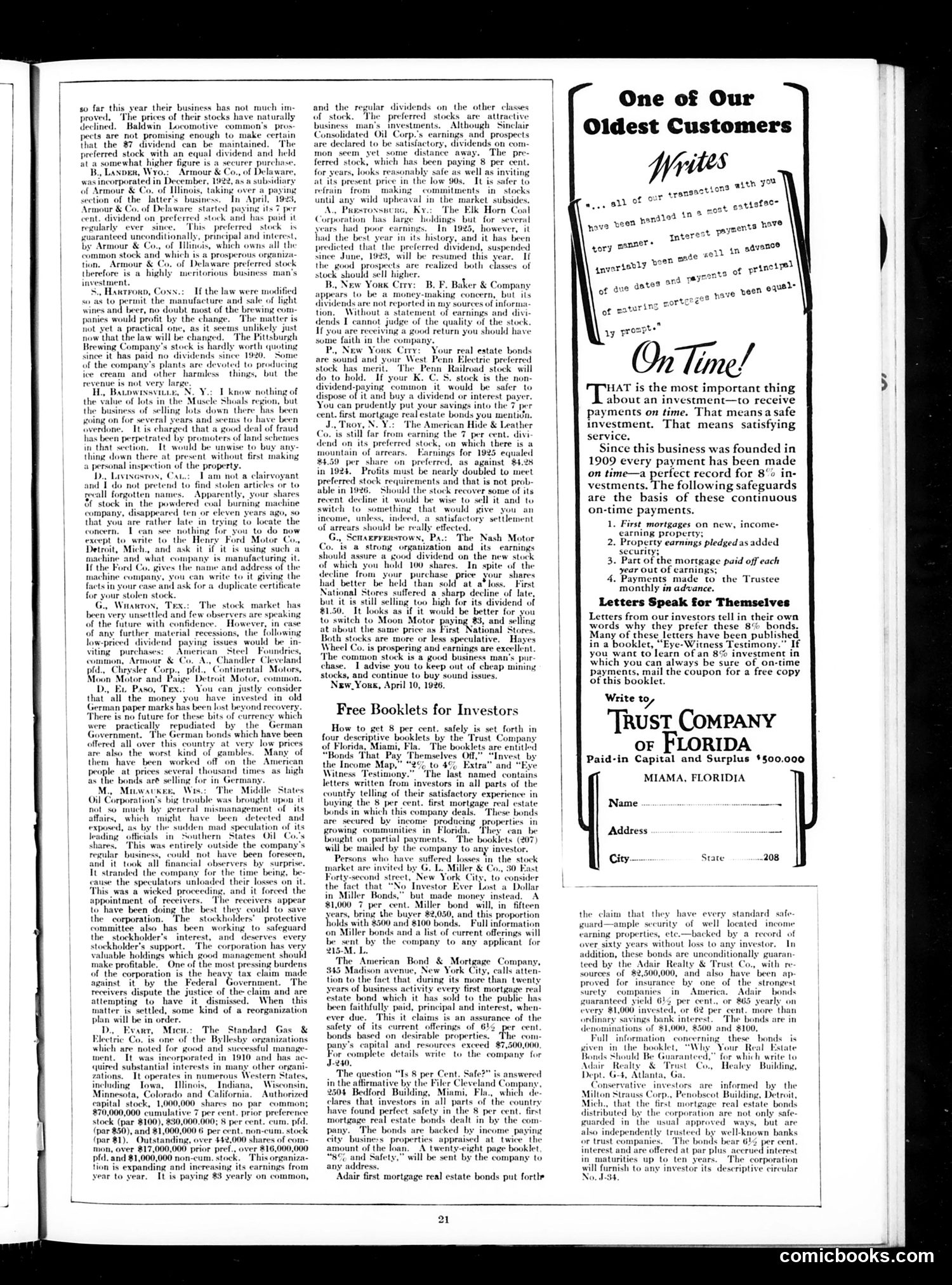
This page is primarily **financial advice and investment commentary**, not political satire. It contains a column answering reader questions about stock investments during the early 1920s. The content addresses concerns about specific companies' dividends and stock values—including Baldwin Locomotive, Armour & Co., brewing companies post-Prohibition, and Moon Motor. The advice-giver responds skeptically to various investment proposals, warning against speculation in German currency and bonds, and cautioning readers about fraud in land schemes in unspecified southern regions. The sidebar advertisement, "One of Our Oldest Customers Writes," promotes the **Trust Company of Florida**, emphasizing reliable dividend payments and "on-time" service since 1909. This is standard period advertising promising financial safety. The page reflects **1920s investment culture**: cautious optimism mixed with wariness of speculation, post-WWI financial instability (German marks), and the volatile stock market preceding 1929's crash. No specific political figures or satire appear visible—this is financial journalism for affluent readers.
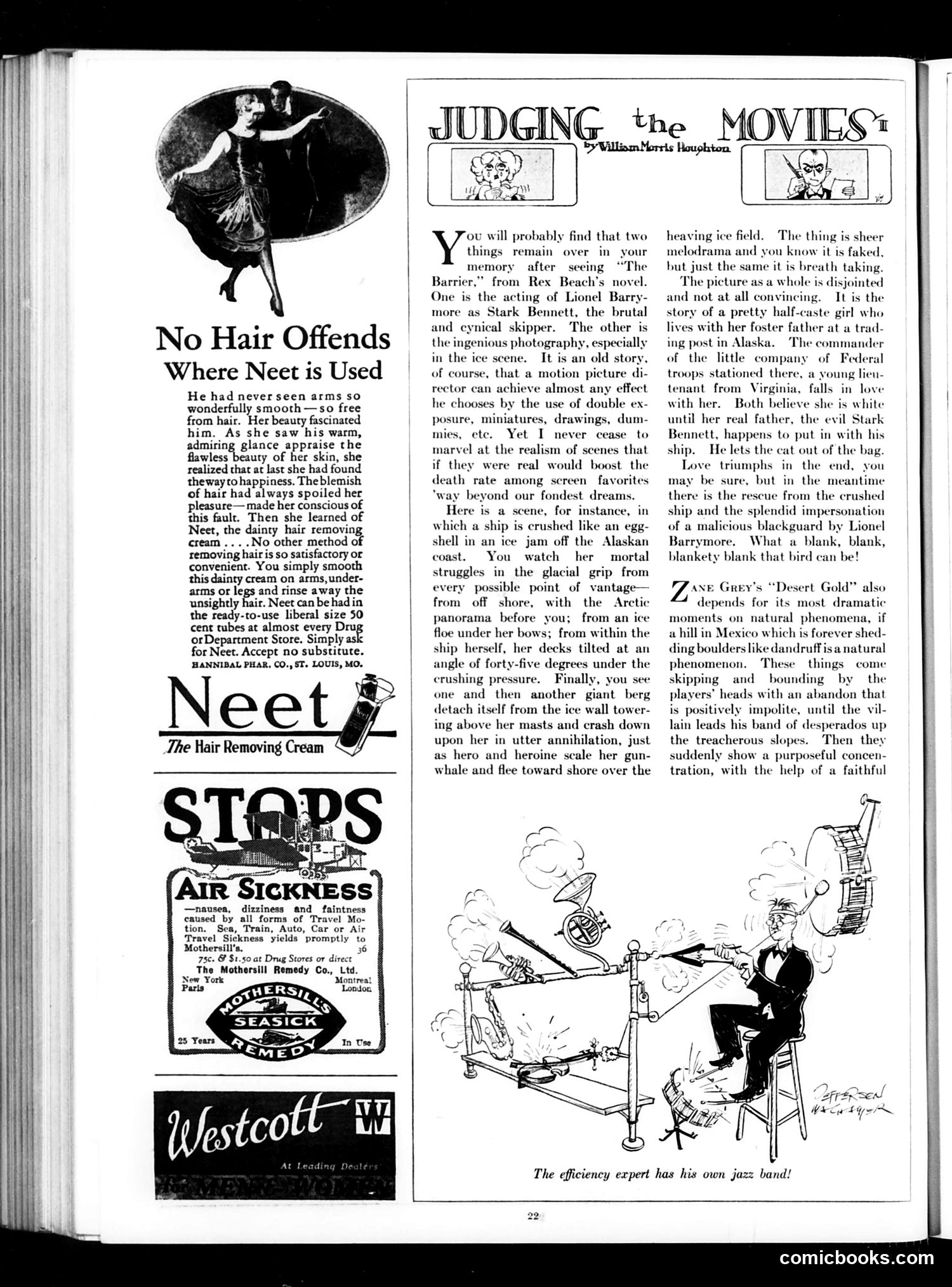
This page contains a film review column titled "Judging the Movies" by William Morris Haughton, alongside vintage advertisements. **The Main Content:** The review discusses two films: "The Barrier" (featuring actor Lionel Barrymore) and "Desert Gold." Haughton praises the cinematography and special effects—particularly impressive ice-crushing scenes and avalanche sequences—while acknowledging audiences know these are faked yet remain captivated. He criticizes "The Barrier" as disjointed overall, though praising Barrymore's performance as the villain Stark Bennett. The plot involves a mixed-race Alaskan girl, her foster father, a military officer, and dramatic revelations about her parentage. **The Advertisements:** The left side features ads for Neet (hair removal cream), emphasizing that smooth, hairless skin increases female attractiveness and "happiness," and remedies for travel sickness. The bottom shows a Westcott product ad. **Historical Context:** This reflects 1920s attitudes about beauty standards (female hair removal), cinema's technical innovations, and melodramatic storytelling conventions of silent film era.
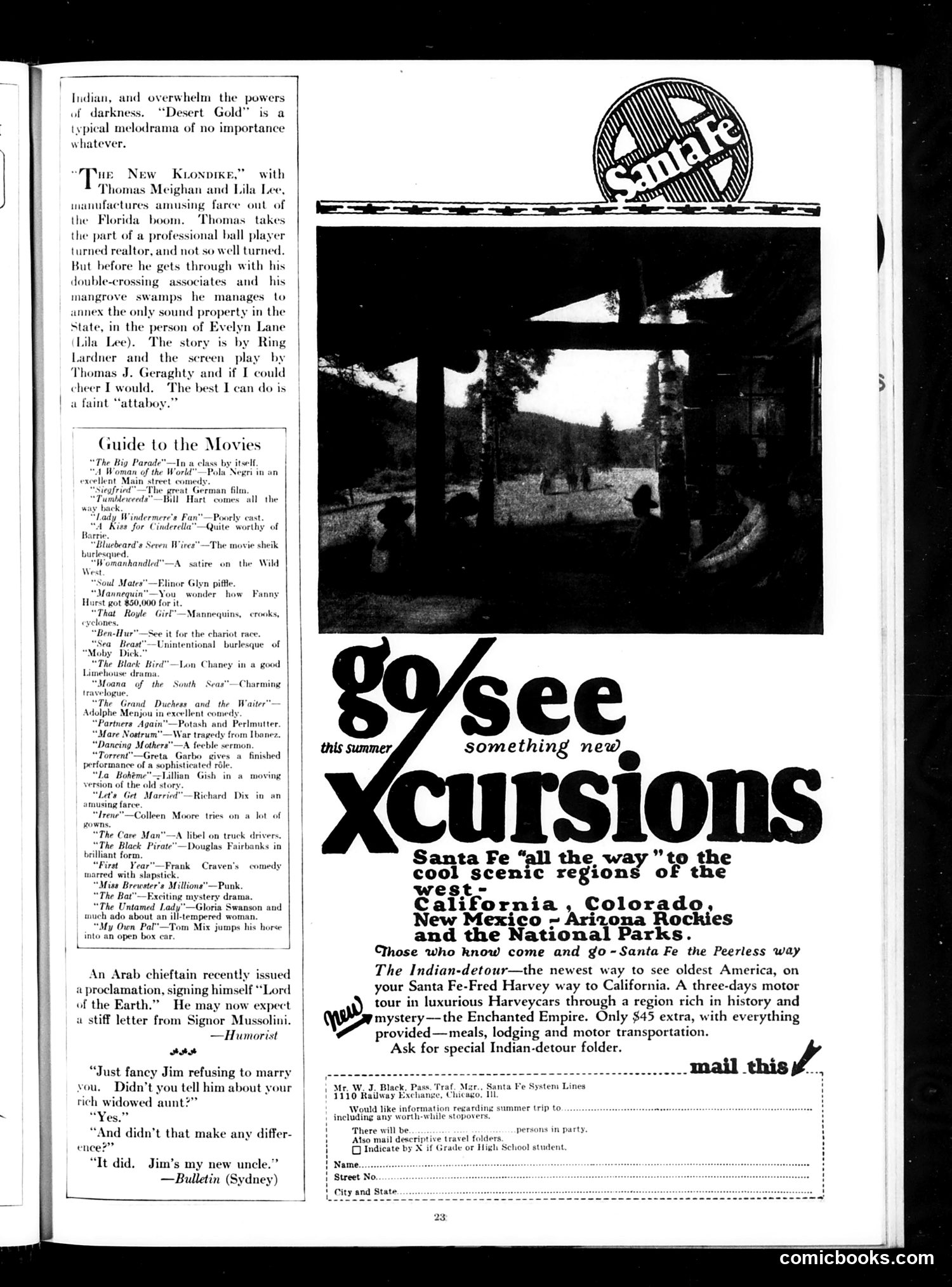
This page is primarily **advertising and entertainment guides**, not political satire. The main content includes: 1. **Movie Reviews**: A "Guide to the Movies" listing 1920s films with brief critiques (e.g., "The Big Parade," Douglas Fairbanks films). These reflect contemporary silent-film entertainment. 2. **Santa Fe Railway Advertisement**: The large illustration advertises "Indian-detour" excursions—tourist trips through the American Southwest (California, Colorado, New Mexico, Arizona) visiting Native American regions and national parks. This reflects 1920s tourism marketing, which used "Indian" imagery as exotic appeal. 3. **Humor Section**: Brief jokes, including one about an Arab chieftain proclaiming himself "Lord of the Earth" (mocking grandiose declarations; Mussolini reference suggests contemporary political awareness). The page represents early-20th-century entertainment culture and tourism advertising rather than sharp political commentary. The "Indian-detour" language reflects period attitudes toward Native Americans as tourist attractions rather than modern sensitivity.
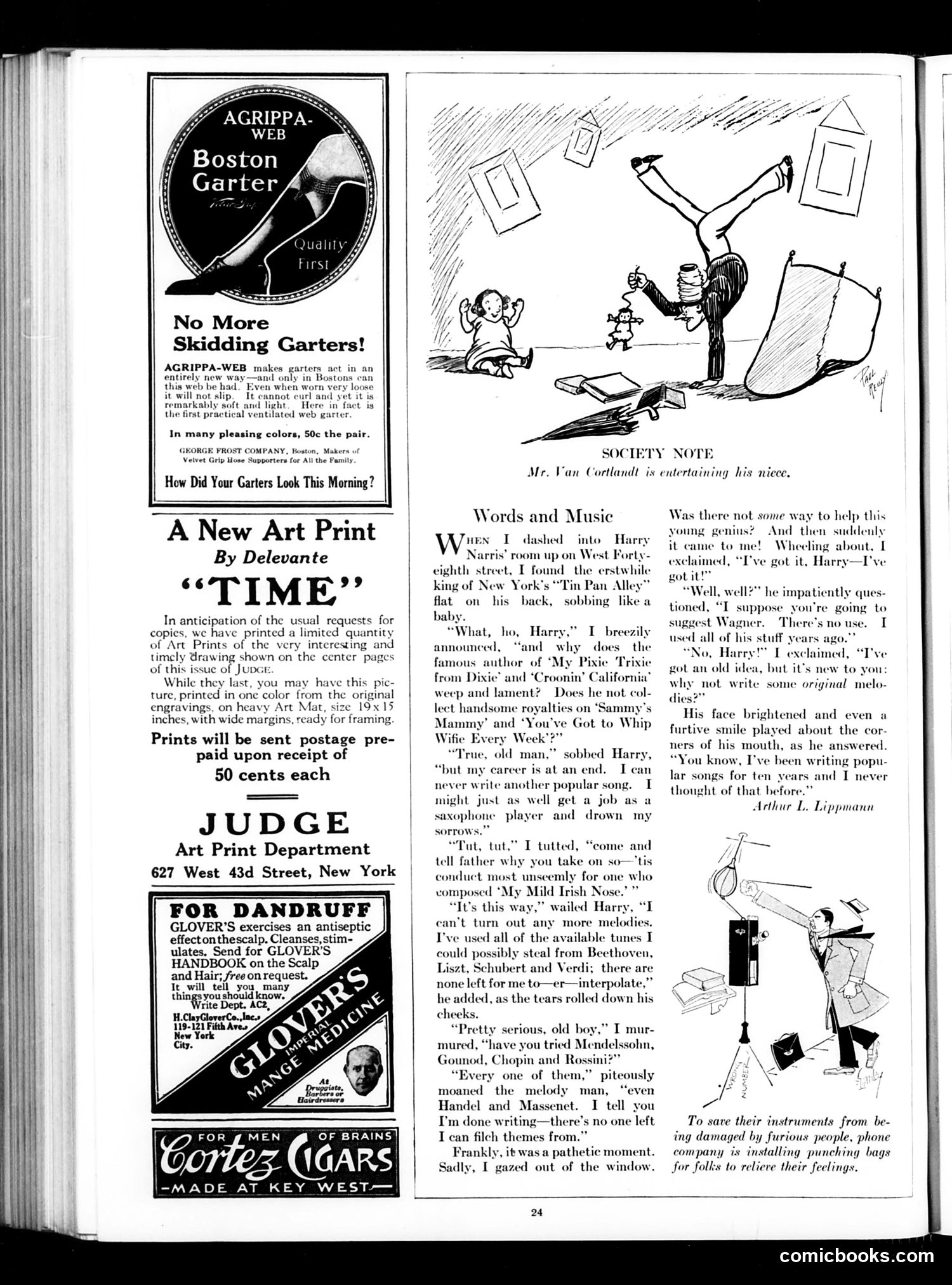
This page is primarily **advertising and light satirical content** rather than political commentary. The main cartoon (center-right) depicts a music composer in crisis, illustrated by Arthur L. Lippmann. The satire targets **Tin Pan Alley songwriters**—the commercial music industry of the era—who habitually plagiarized classical composers (Beethoven, Liszt, Schubert, Verdi, Mendelssohn, etc.). The joke: a desperate songwriter claims he's "used up" all available melodies to steal, until a friend suggests the radical solution: **write original music**. The humor mocks how prevalent musical theft was in popular songwriting, treating it as normal practice rather than dishonest. By the punchline, the composer is shocked he never considered originality. The remaining content consists of period advertisements (garters, art prints, dandruff treatment, cigars) and a brief "Society Note" about entertainment, typical of Judge's format.
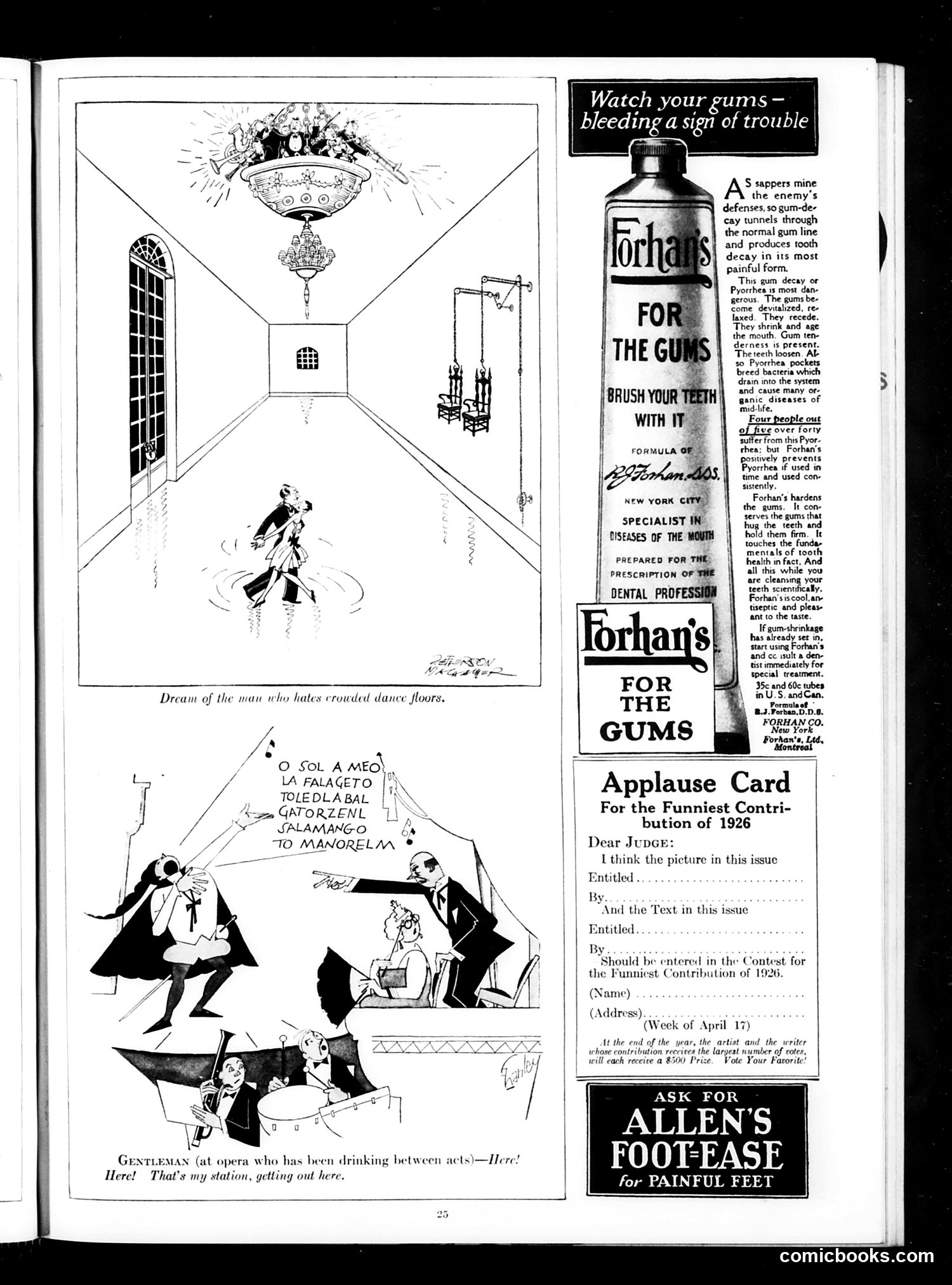
This page primarily contains **advertisements and a reader contest**, not political satire. The top cartoon depicts a man's nightmare of being trapped in a crowded dance hall—reflecting 1920s anxieties about modern social spaces. The lower cartoon shows an intoxicated opera-goer leaving during intermission, a light social jab at excess drinking during Prohibition. The dominant content comprises vintage advertisements: **Forhan's for the Gums** (a pyorrhea treatment presented as medically urgent) and **Allen's Foot-Ease** (for painful feet). These ads exemplify 1920s marketing that emphasized disease prevention through proprietary products—common fear-based advertising of the era. The "**Applause Card**" solicits reader submissions for Judge's 1926 funniest contribution contest, with $500 prize money. This was typical magazine engagement strategy of the period. The page reflects 1920s consumer culture, Prohibition-era social commentary, and the magazine's reliance on advertising revenue and reader participation rather than hard-hitting political cartoons.
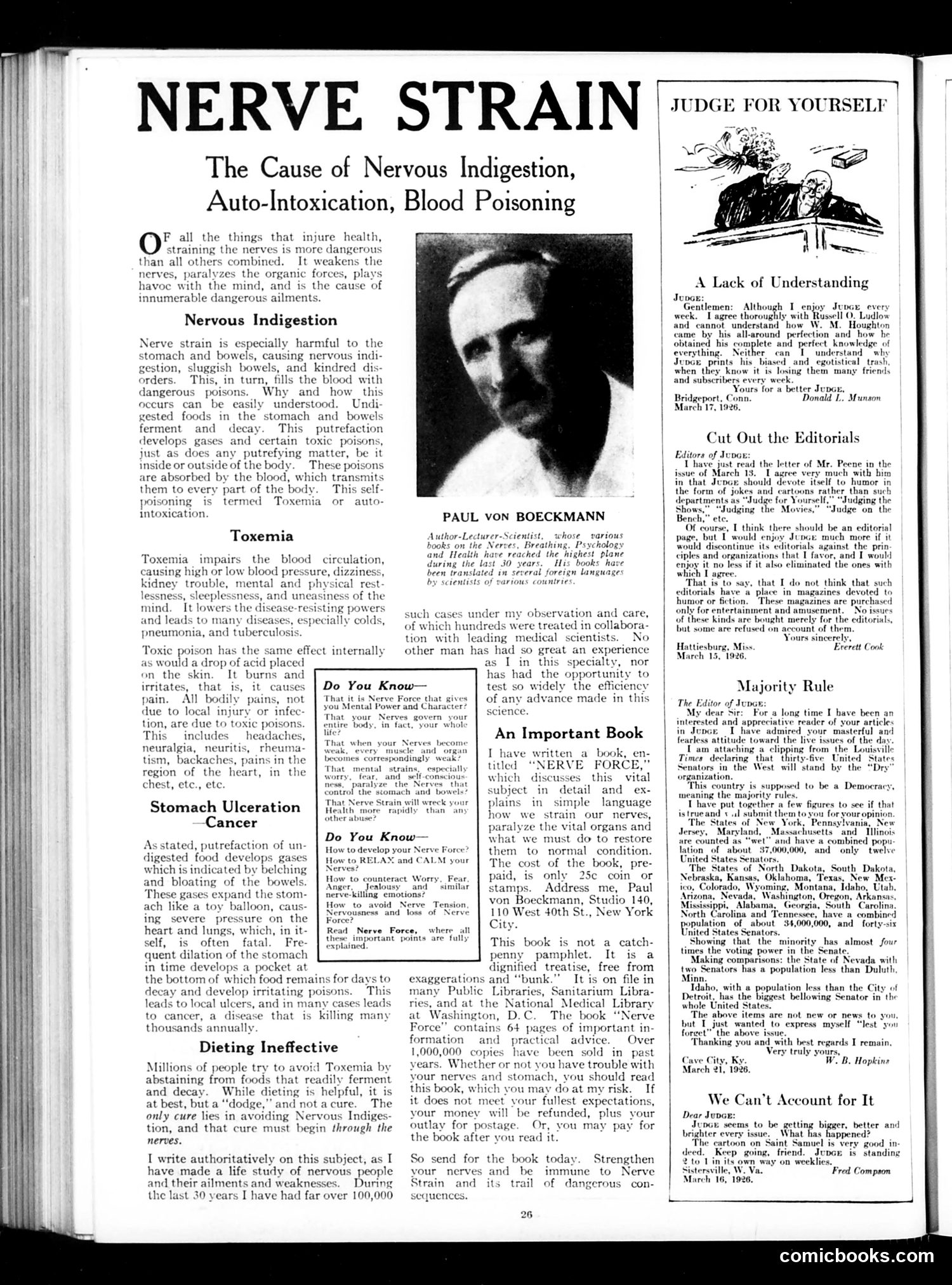
This page combines **medical advertising with editorial content** typical of early 1900s Judge magazine. The main feature is an advertorial by Paul von Boeckmann, a self-described "Author-Lecturer-Scientist" promoting his book "Nerve Force." **The Content:** Boeckmann claims "nerve strain" causes numerous ailments—indigestion, toxemia (self-poisoning), stomach ulcers, and cancer. He describes a pseudo-scientific mechanism: undigested food ferments, releases toxic gases, which poison the blood and damage nerves throughout the body. **The Satire:** The sidebar "Judge for Yourself" mocks this content through reader letters expressing skepticism about such universal health claims and competing "expert" advice. One letter notes the absurdity of different authorities claiming complete knowledge while disagreeing with each other. **Historical Context:** This reflects the era's widespread medical quackery and patent medicine advertising. Judge's editorial stance appears skeptical of such grandiose health claims, using reader letters to humorously undermine Boeckmann's authority while still accepting his paid advertisement.
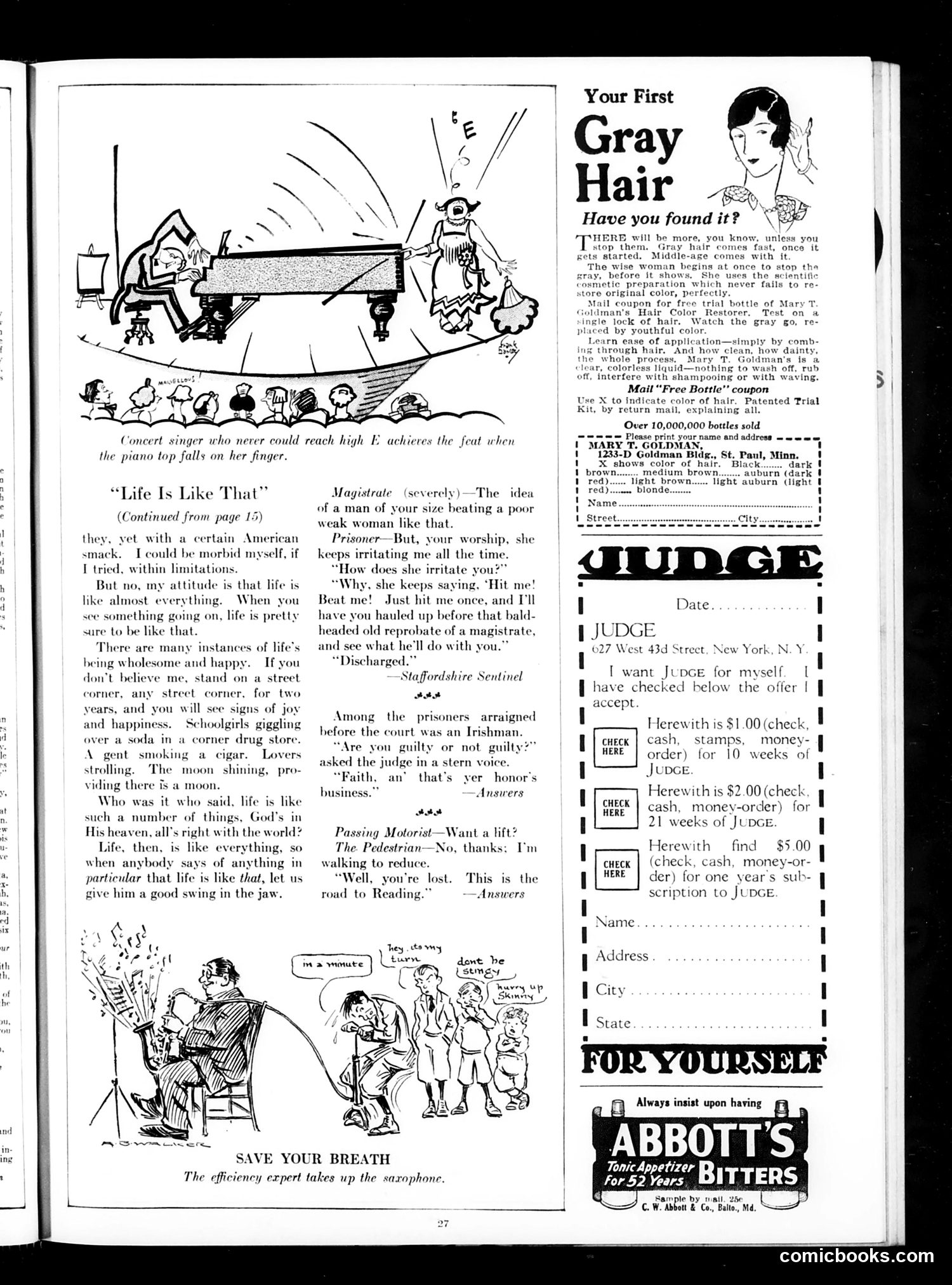
This page from *Judge* magazine contains several satirical items and advertisements typical of early-20th-century American humor. The cartoons and jokes mock everyday situations: a concert singer injured at the piano, domestic disputes (a magistrate dismissing assault charges when the woman supposedly provokes her abuser), Irish stereotypes (an Irishman's supposedly illogical courtroom response), and motoring mishaps (a pedestrian lost while "walking to reduce"). There's also satirical commentary on efficiency experts playing saxophone—implying they're incompetent even at self-improvement activities. The advertisements reveal period anxieties: women's fears about aging (Mary Goldman's Hair Color Restorer), and the prominence of patent medicines like Abbott's Bitters—products making dubious health claims that would later be regulated. The *Judge* magazine subscription offers suggest the publication competed for readers by bundling subscription deals. Overall, the page reflects turn-of-the-century middle-class anxieties about appearance, propriety, and social standing, presented through genteel humor targeting immigrants, women, and the aspiring classes.
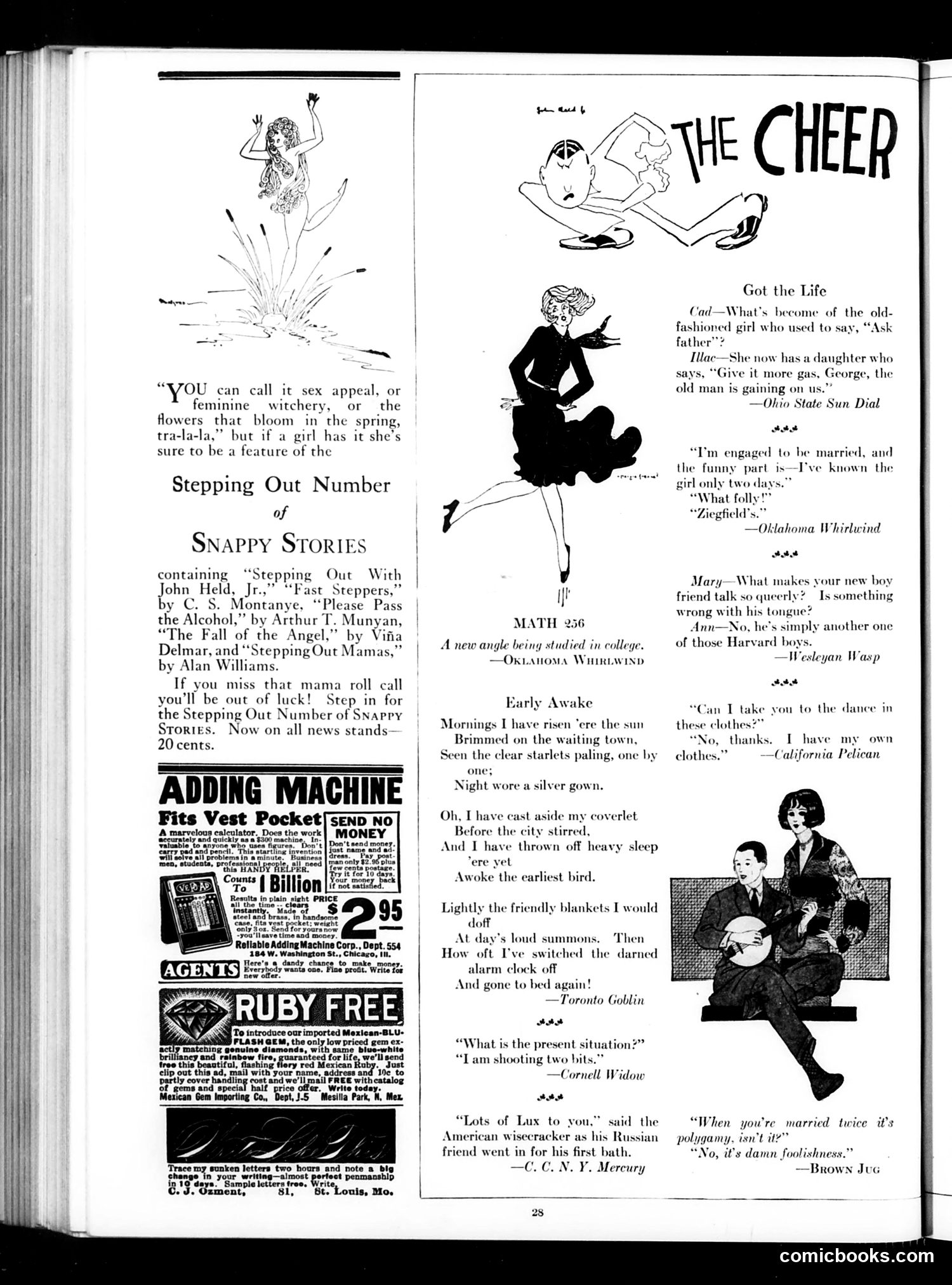
This page from Judge magazine (appears to be 1920s era) contains mostly advertisements and humor columns rather than political cartoons. **The main content** is "The Cheer" section—a collection of short jokes and witticisms on modern social topics. The humor targets: - **Changing gender roles**: A joke about modern daughters telling fathers "Give it more gas, George"—mocking how young women had become more independent and assertive post-WWI. - **Dating and courtship**: Jokes about quick engagements, Harvard boys, and young men's social awkwardness. - **Marriage satire**: A final quip equates remarriage with "polygamy" and "foolishness." **The advertisements** push products like adding machines, gem importing, and a calculator—typical commercial content for the era. The overall tone is lighthearted mockery of contemporary youth culture, changing social mores, and romantic mishaps—standard fare for Judge's satirical humor magazine aimed at adults.
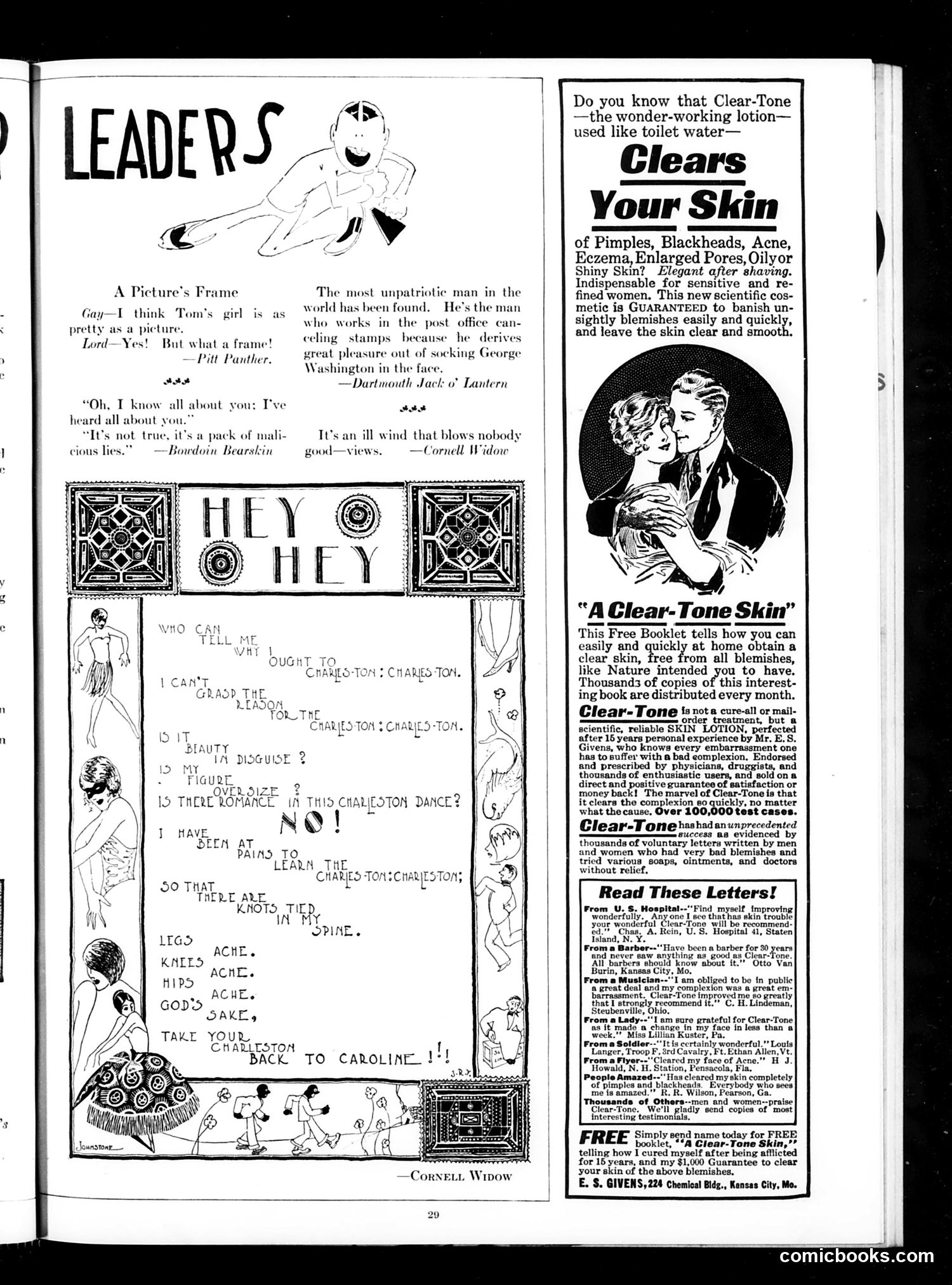
This page contains college humor and a full-page advertisement. **Left side ("Leaders"):** A collection of brief jokes from college publications, mostly about romance and campus life. The central cartoon depicts the Charleston dance craze of the 1920s—a man complains his partner's dancing causes various body aches ("knees ache, hips ache"). The satire mocks both the Charleston's vigorous movements and perhaps young women's liberation through modern dancing, which conservative readers found shocking. **Right side:** A full-page advertisement for "Clear-Tone" skin lotion, claiming to cure acne, blackheads, and eczema. The ad includes testimonials from doctors, soldiers, and ordinary citizens. This reflects 1920s advertising practices: unverified medical claims, personal endorsements, and a "free booklet" offer typical of mail-order beauty products of the era. The juxtaposition of college humor mocking modern youth culture with mass-market beauty advertising shows Judge's dual appeal to educated readers while generating revenue from period patent medicines.
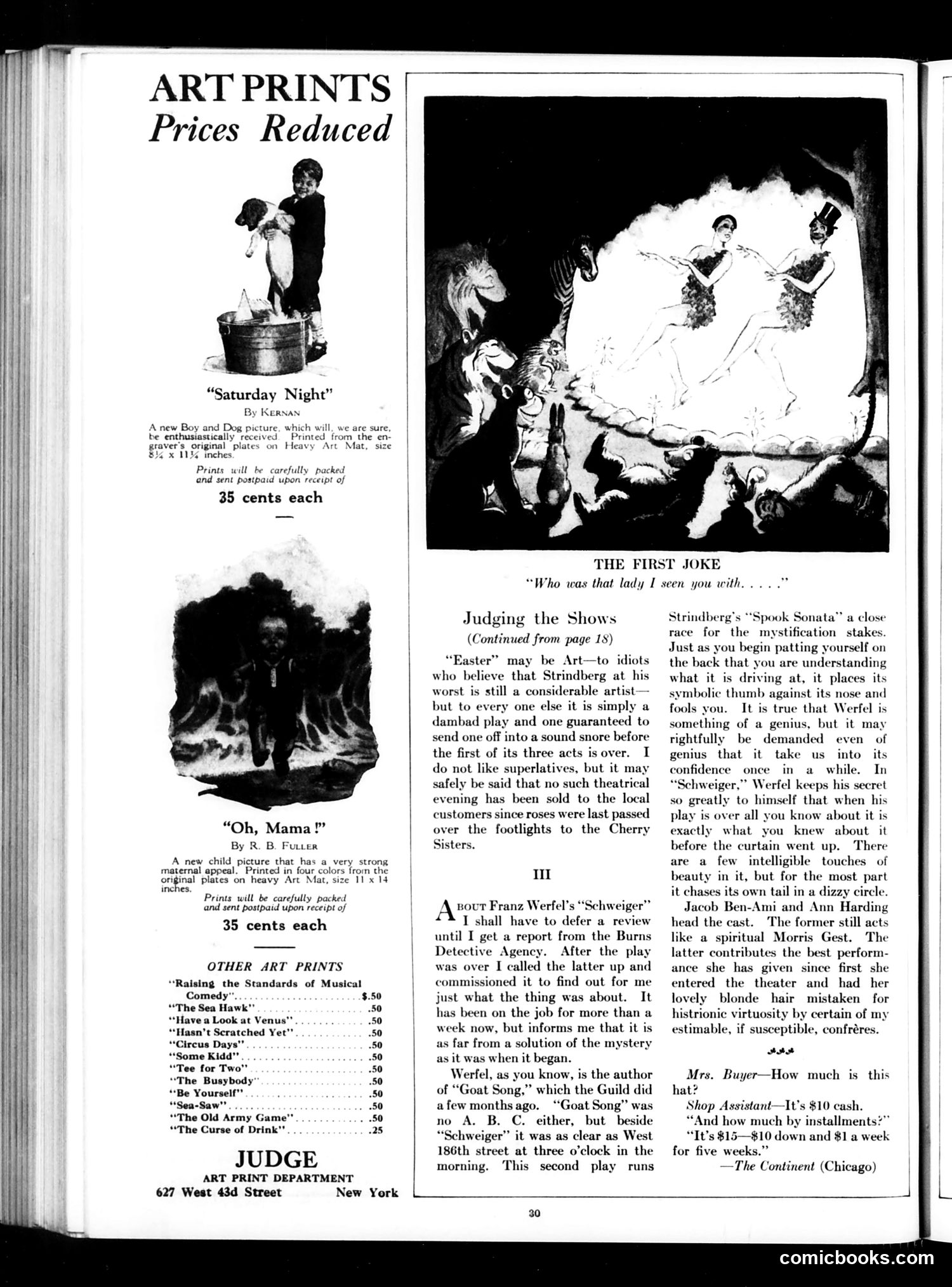
This page combines art print advertising with theater reviews. The top section advertises affordable reproductions of popular illustrations, including sentimental scenes like "Saturday Night" (a boy and dog in a bathtub) and "Oh, Mama!" (a child scene)—typical mass-market art of the era, selling for 35 cents each. The main content is a theater critic's review column titled "Judging the Shows." The reviewer dismisses Strindberg's "Easter" as unbearably boring, calls Franz Werfel's "Schweiger" incomprehensibly mystifying (jokingly suggesting he hired a detective agency to understand it), and praises the lead actors Jacob Ben-Ami and Ann Harding, particularly Harding's performance. "The First Joke" cartoon depicts a domestic scene with the caption "Who was that lady I seen you with...?"—a classic setup for marital suspicion or infidelity humor, common to early 20th-century comedy. The small advertisement at bottom is a domestic joke about installment purchasing: a hat costs $10 cash or $15 paid over five weeks.
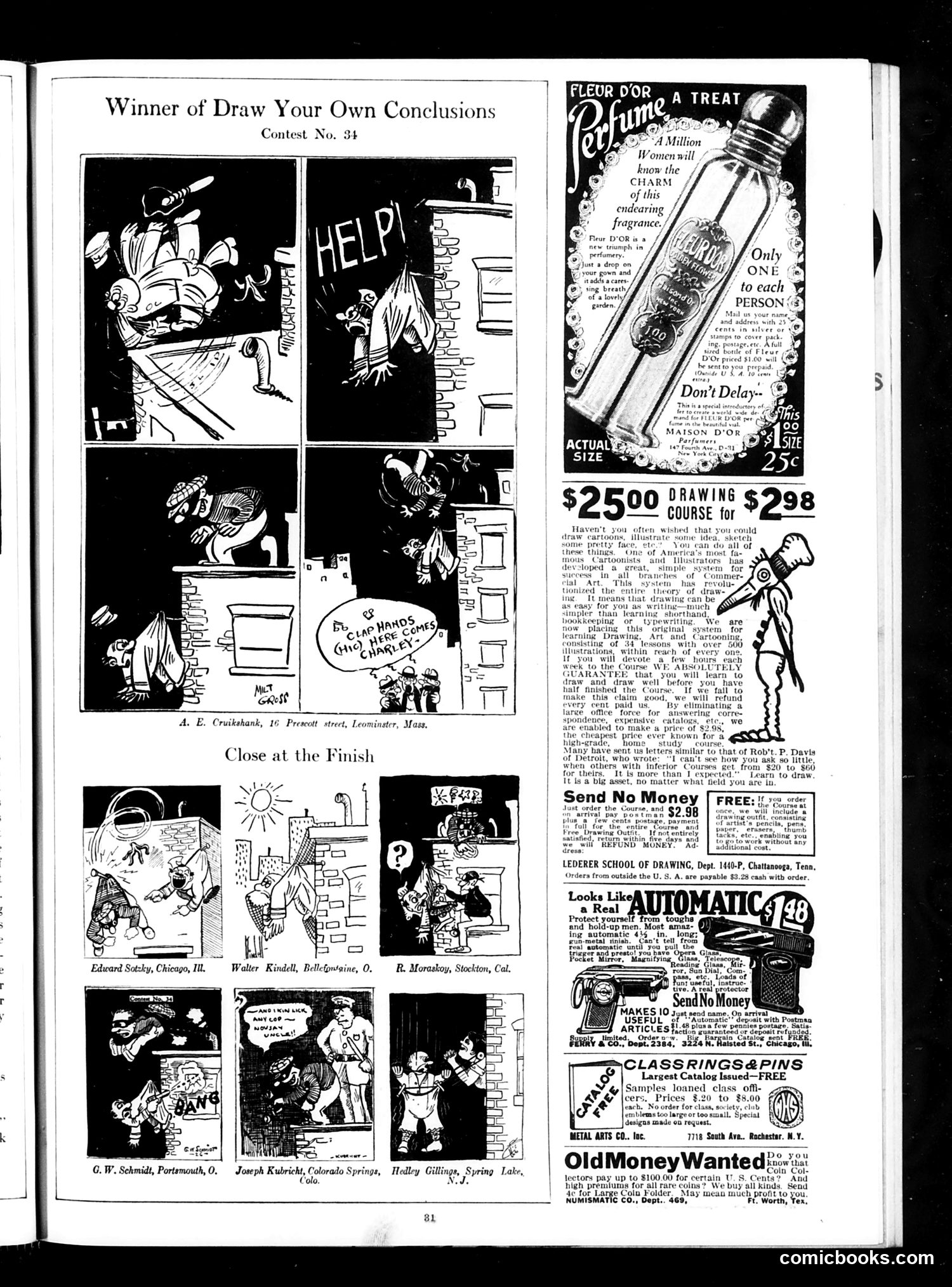
This page showcases the winning entry in Judge magazine's "Draw Your Own Conclusions" contest—a recurring feature inviting readers to complete or interpret unfinished cartoon panels. The winning cartoon by A.E. Cruikshank depicts a slapstick domestic scene: a woman appears to be in distress or chaos (likely falling or struggling), calling "HELP!" while a man below reacts with alarm. The humor derives from visual ambiguity—viewers must infer what's actually happening from incomplete visual information, the contest's central premise. Below are additional contest entries showing similar comedic scenarios involving household mishaps and confusion. The page also contains period advertisements (drawing courses, perfume, automatic pencils, coin collecting) typical of 1920s-30s Judge magazine content, indicating this was an entertainment/humor publication for general audiences rather than strictly political satire.
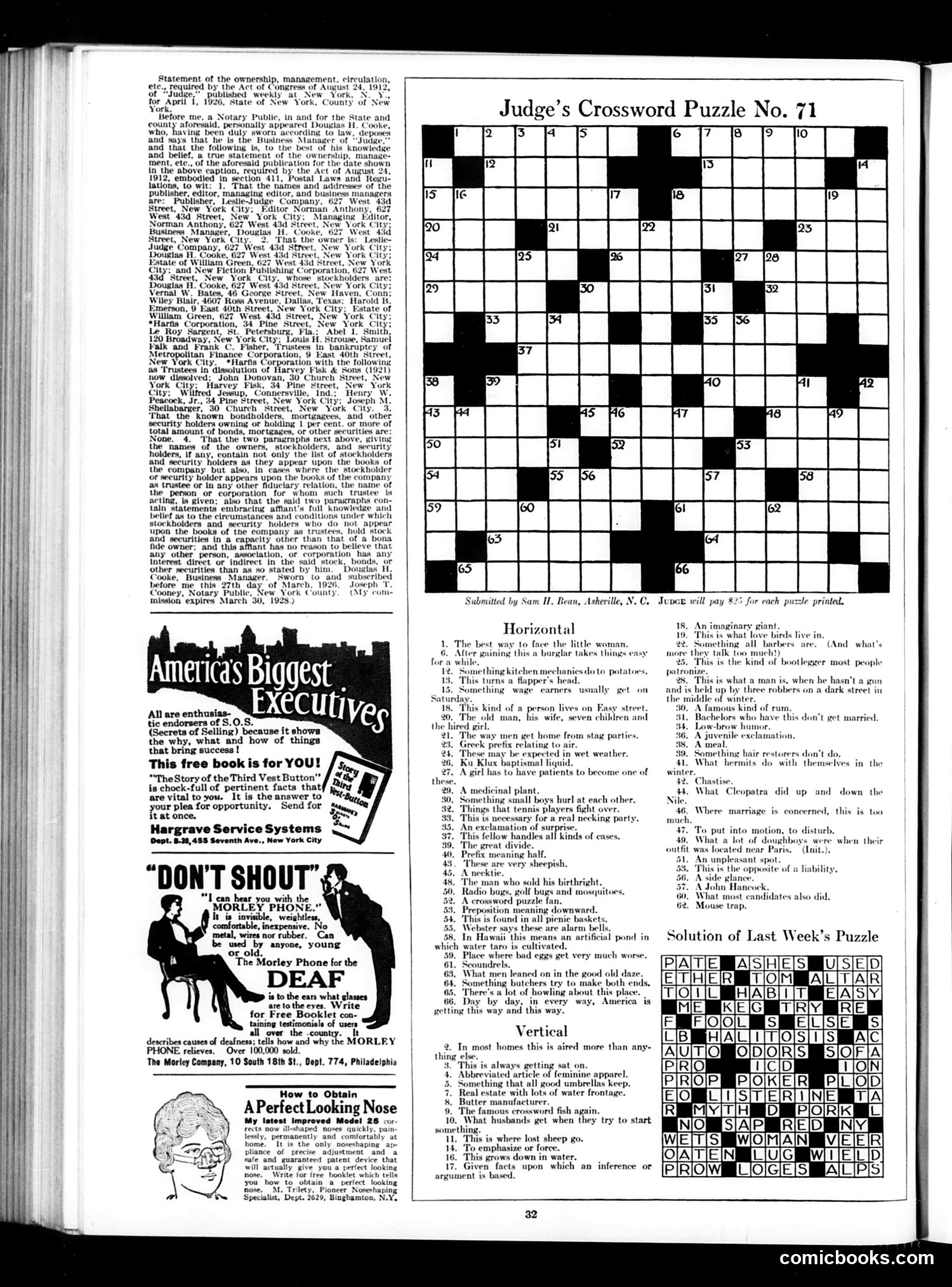
This page is primarily administrative and advertising rather than satirical content. The top half contains the required legal "Statement of Ownership, Management, and Circulation" for *Judge* magazine, dated April 1, 1926—a mandatory filing under postal regulations listing the magazine's publisher (Leslie-Judge Company), editors, and stockholders. The bottom half features period advertisements, including one for "Hargrave Service Systems" promoting a business book called "Secrets of Selling," and another for the "Morley Phone," an early hearing aid device marketed as "invisible" and "weightless." The crossword puzzle ("Judge's Crossword Puzzle No. 71") appears to be standard entertainment content rather than satire. This page represents the practical, regulatory, and commercial aspects of running a 1920s magazine rather than its editorial satirical mission.
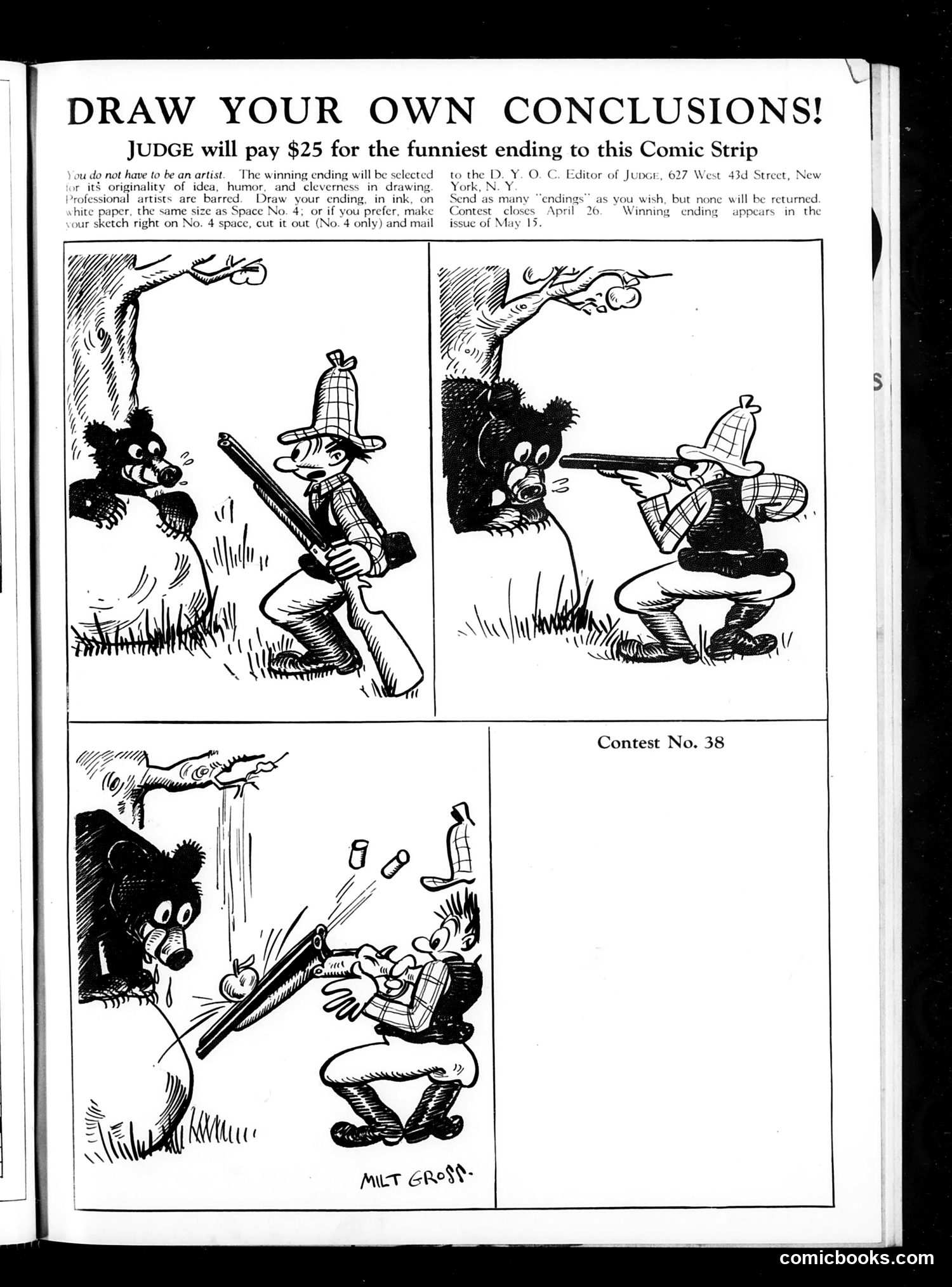
This is a reader-participation contest page from *Judge* magazine. The comic strip shows a hunter with a rifle confronting an angry bear near a tree. The three panels depict escalating conflict: the hunter aims at the bear, the bear appears to charge or retaliate, and in the final panel, the bear has apparently turned the tables—the hunter is knocked down with his rifle and supplies flying, while the bear looms nearby. Readers were invited to submit funny endings to complete the story, with the winner receiving $25. This reflects early 20th-century magazine culture where audience participation generated engagement and content. The humor derives from the reversal of expected power dynamics—the would-be hunter becoming the hunted. The strip's artist is signed "Milt Gross," a noted cartoonist of the era.
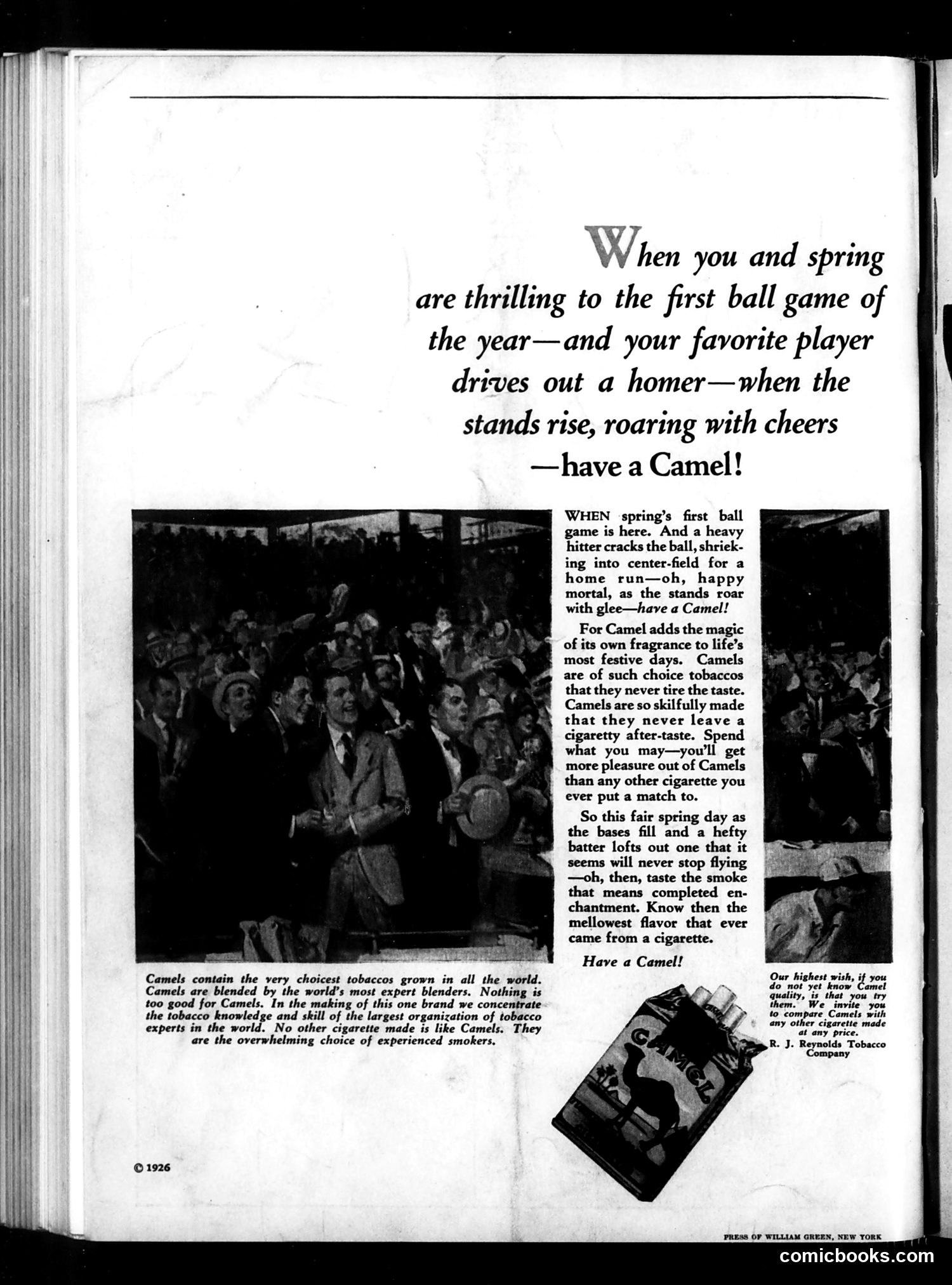
This is a **Camel cigarette advertisement**, not satire or political commentary. Dating to 1926, it uses spring baseball—America's national pastime—as an emotional hook to sell cigarettes. The ad exploits the excitement of opening day: a home run, cheering crowds, the sensory thrill of the moment. The copy then pivots: enhance this joy with a Camel cigarette. The product claims superior tobaccos, expert blending, and a "mellowest flavor" without aftertaste. For modern readers, the striking aspect is the **open, unapologetic cigarette marketing**—particularly linking smoking to wholesome American leisure and athletic celebration. The R.J. Reynolds company emphasizes quality and challenges readers to compare Camels with competitors, reflecting pre-regulation advertising practices. There is no hidden joke or satire here; this straightforward product promotion represents an era before tobacco's health dangers were widely acknowledged or legally restricted in advertising.