
Judge, 1926-04-17 · page 20 of 36
Judge — April 17, 1926 — page 20: what you’re looking at
What you’re looking at
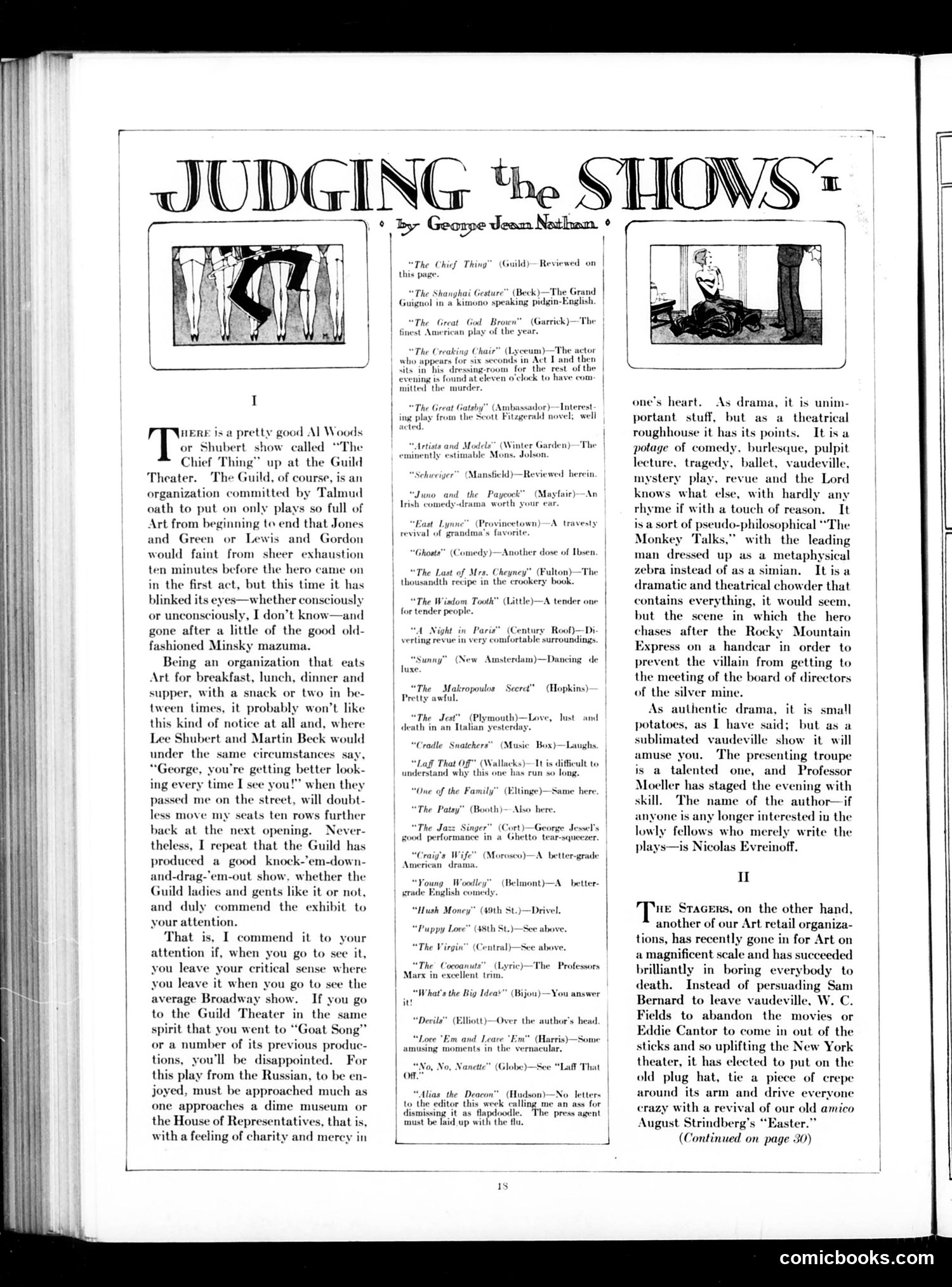
This page from Judge magazine contains theater reviews by George Jean Nathan, a prominent drama critic of the 1920s. The two small illustrations show theatrical scenes, likely from productions under review. Nathan's column critiques Broadway shows with characteristic acerbity. He commends the Guild Theater's production of "The Chief Thing" (a Russian play) as entertaining popular theater, while gently mocking the Guild's pretentious artistic mission. He notes the organization typically prioritizes "Art" over commercial appeal, so this knock-about comedy represents a departure. The extensive list of reviewed productions reflects the vibrant 1920s Broadway scene, including plays like "The Great God Brown," "The Shanghai Gesture," and the revue "Sunny." Nathan's reviews are characteristically brief and sardonic, rating works from respectable drama to outright "drivel." The page exemplifies Judge's role as a sophisticated commentary on contemporary American culture and entertainment for educated urban readers.
📄 Transcribed text from this page (OCR, searchable)
Machine-transcribed from the original scan — historical spelling and the odd misread are preserved.
JUDGI HERE is a pretty good Al Woods TS Shubert show called “The Chief Thing” up at the Guild Theater. The Guild, of course, is an organization committed by Talmud oath to put on only plays so full of Art from beginning to end that Jones and Green or Lewis and Gordon would faint from sheer exhaustion ten minutes before the hero came on in the first act, but this time it has blinked s—whether consciously or unconsciously, I don’t know—and gone after a little of the good old- fashioned Minsky mazuma. Being an organization that Art for breakfast, lunch, dinner and supper, with a snack or two in be- tween times, it probably won't like this kind of notice at all Lee Shubert and under the s “George, y nd, where tin Beck would me circumstanc u're getting better look- ing every time I see you!” when they passed me on the street, will doubt- less move my seats ten rows further back at the next opening. Never- theless, I repeat that the Guild has produced a good knock-’em-down- and-drag-"em-out show, whether the ild ladies and gents like it or not, and duly commend the exhibit to your attention. That is, I commend it to your attention if, when you leave nu go to see it, your critical sense where you leave it when you go to see the average Broadway show. If you go to the Guild Theater in the same spirit that you went to “Goat Song” or a number of its previous produc- tions, you'll be disappointed. For this play from the Russian, to be en- joyed, must be approached much as one approaches a dime museum or the House of Repre with a feel ntatives, that is, ing of charity and mer NG tbe SHOWS * “The Chief Thing’ d)— Reviewed on. | this page | | “The Shanghai Gesture” (Beck Guignol in a kimono speaking | “The Great God Brown’ finest American play of the “The Creaking Chair” ppeurs for six seconds his dressing-room w is found at ele rd lor) —Interest Id novel; well “The Great Gatsby” (Amb ing play from the Scott Fit “Artists and Models” (Winter Garden)—The eminently estimable Mons. Jolson. “Schweiger” (Mansfield) —Reviewed herein “Juno and the Paycoe Irish comedy-drama worth y Provin a's favorite “East Lyn | revival of gr: “Ghosts” (Comedy )—Another dose of Ibsen Mrs. Cheyney” (Fulton)—The ipe in the crookery book. 1¢ Last of ith thou | | | “The Wisdom Tooth” (Little)—A tender one | for tender people. | “A Night in Paris” (Century Roof)—Di- | verting revue in very comfortable surroundings. | “Sunny” (New Aumsterdam)—Dancing de | luxe. “The Makropoulos Secret” (Hopkins) Pretty awful. “The Jest” ( death in an Tal th)—Love, lust and yesterday. “Cradle Snatchers’ (Music Box)—L “Laff That Of" (Wa understand why this 0 acks) “One of the Family” (Eltinge)- | “The Patsy” (Booth) Also here. “The Jazz Singer” (Cort)—George good performance in a Ghetto squeezer. Craig's Wife” (Morosco)—A_better-grade American drai oung Woodley” nglish comedy Belmont)—A _ better- grade “Hush Money” (49th St.)—Drivel. “Puppy Lore” (48th St.)—See above. “The Virgin” (Central)—See above. )—The Professors -You answer “Devils” (Elliott)—Over t “Love ‘Em and amusing moments in the (Harris) —So cular, ‘0, No, Nanette” (Globe)—See “Laff That on. {lias the Deacon (Hudson)—No letters to the editor this week calling me an ass for dismissing it as flapdoodl press agent | must be laid up with the flu, one’s heart. As drama, it is unim- portant stuff, but as a theatrical roughhouse it has its points. It is a potage of comed lecture, traged . burlesque, pulpit ballet, vaudeville, mystery play. revue and the Lord knows what else, with hardly any rhyme if with a touch of reason. It is a sort of pseudo-philosophical “The Monkey Talks,” with the lea man dressed up as a metaph zebra instead of as a simian. It is a dramatic and theatrical chowder that contains everything, it would seem, but the scene in which the hero chases after the Rocky Mountain Express on a handcar in order to prevent the villain from getting to the meeting of the board of directors of the silver mine. As authentic drama, it is small potatoes, I have said; but as a sublimated vaudeville show it will muse you. The presenting troupe is a talented one, and Professor Moeller staged the evening with skill. The name of the author—if anyone is any longer interested in the lowly fellow who merely write the vreinoff, II HE StaGers, on the other hand, another of our Art retail organi: tions, has recently gone in for Art on a magnificent scale and has succeeded brilliantly in boring everybody to death. Instead of persuading Sam Bernard to leave vaudeville, W. C. Fields to abandon the movies or Eddie Cantor to come in out of the sticks and so uplifting the New York theater, it has elected to put on the old plug hat, tie a piece of crepe around its arm and drive everyone crazy with a revival of our old amico August Strindberg’s “Easte: (Continued on page 30) 1S comicbooks.com 1