
Judge, 1926-04-17 · page 7 of 36
Judge — April 17, 1926 — page 7: what you’re looking at
What you’re looking at
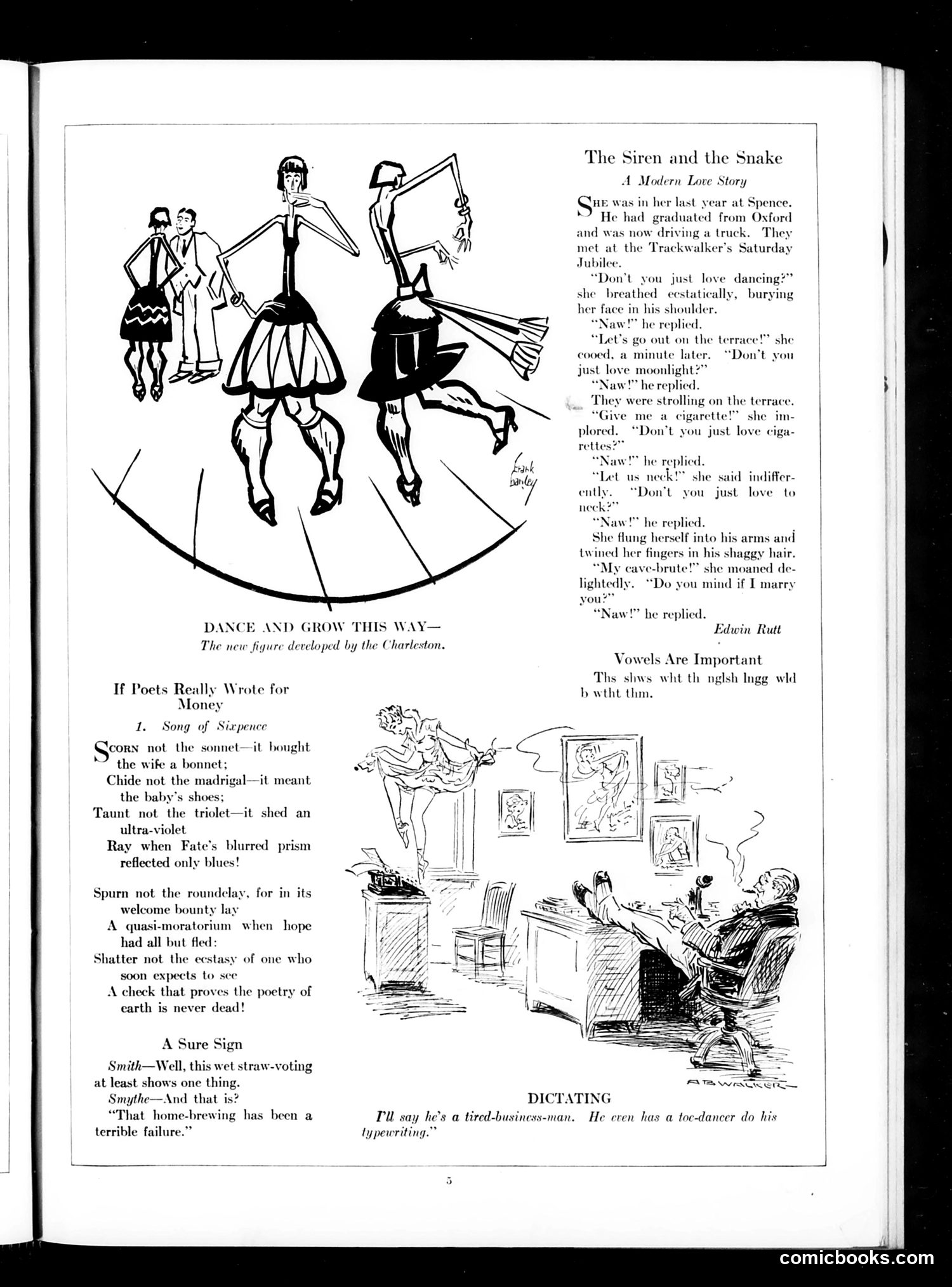
This page contains three distinct satirical pieces: 1. **"Dance and Grow This Way"** illustrates the Charleston, a 1920s dance craze, with figures performing exaggerated movements. The satire mocks the new dance's wild, undignified nature compared to traditional dancing. 2. **"If Poets Really Wrote for Money"** parodies romantic poetry by rewriting famous verses with commercialized, mundane alternatives—suggesting poets compromise artistic integrity for payment. This satirizes both commercialism and literary pretension. 3. **"Dictating"** shows a businessman dictating to a stenographer while a dancer performs. The caption mocks the absurdity of hiring entertainers during business work, likely satirizing wasteful corporate practices or the era's frivolous spending habits. The overall tone criticizes modern social trends, commercialization, and questionable workplace practices of the Jazz Age.
📄 Transcribed text from this page (OCR, searchable)
Machine-transcribed from the original scan — historical spelling and the odd misread are preserved.
The Siren and the Snake A Modern Love Story HE Was in her last year at Spence. "He had graduated from Oxford and was now driving a truck. They met at the Trackwalker’s Saturday Jubilee. “Don't you just love dancing?” » breathed ecstatically, burying face in his shoulder. w!” he replied. “Let’s go out on the terrace!” she cooed, a minute later. “Don't you just love moonligt “Naw!” he replied. They were strolling on the terrace. “Give me a cigarette! she im- “Don’t you just love ciga- w!” he replied. “Let us neck!” she said indiffer- ently. “Don't you just love to neck?” w!” he replied. ; She flung herself into his arms and twined her fingers in his shaggy hair “My cave-brute!” she moaned de- lightedly. “Do you mind if I marry Naw!” he replied. DANCE AND GROW THIS WAY— Edwin Rutt The new figure developed by the Charleston. Vowels Are Important Ths shws wht th nglsh Ingg wld If Poets Really Wrote for b wtht thm. Money 1. Song of Sixpence CORN not the sonnet—it bought the wife a bonnet; Chide not the madrigal—it meant the baby’s shoes; Taunt not the triolet—it shed an ultra-violet Ray when Fate's blurred prism reflected only blues! n Spurn not the roundelay, for in its welcome bounty lay A quasi-moratorium when hope had all but fled: Shatter not the ecstasy of one who soon expects to see A check that proves the poetry of earth is never dead! A Sure Sign Smith—Well, this wet straw-voting at least shows one thing. Smythe—And that is? DICTATING “That home-brewing has been a °s a tired-business-man. He even has a toe-dancer do his terrible failure.” ° comicbooks.com