
Judge, 1926-04-17 · page 15 of 36
Judge — April 17, 1926 — page 15: what you’re looking at
What you’re looking at
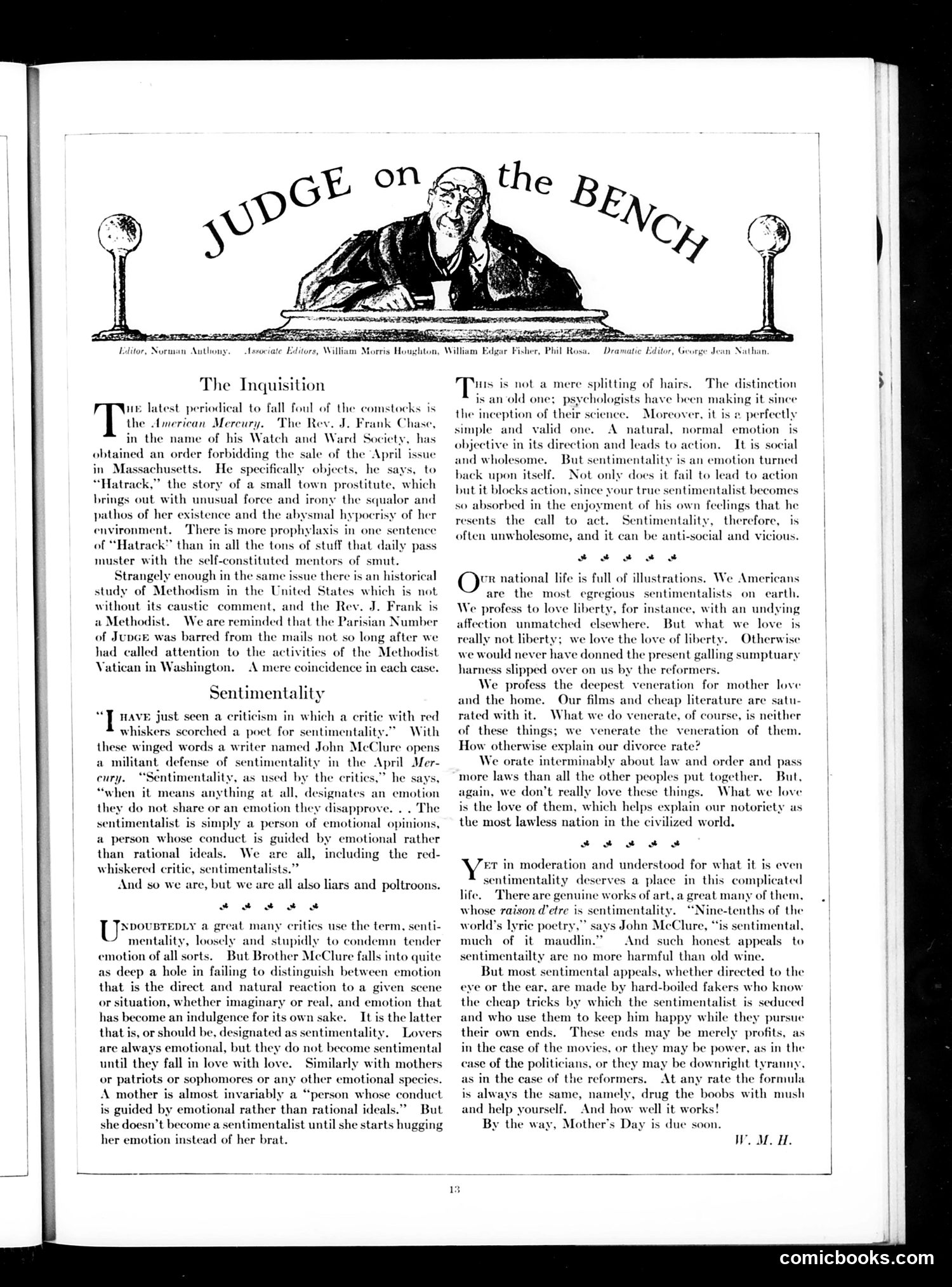
This page satirizes censorship efforts and defends emotional authenticity. The header "Judge on the Bench" features a stern judge presiding over the content below. **"The Inquisition" section** criticizes the Watch and Ward Society (led by Rev. J. Frank Chase) for banning the April 1926 *American Mercury* issue containing "Hatrack"—a story about a small-town prostitute. Judge mocks this as hypocritical censorship, noting Chase banned the magazine while being Methodist, yet the same issue contained a critical Methodist history study he didn't object to. **"Sentimentality" section** defends emotional responses against critics who dismiss them. The author distinguishes between genuine emotion (which prompts action) and false sentimentality (self-indulgent emotion that paralyzes action). Judge argues Americans are sentimental hypocrites: claiming to love liberty while accepting restrictive laws from "reformers"—likely referencing Prohibition and other Progressive Era regulations. The satire targets both censorious moralists and citizens' emotional complacency about losing freedoms.
📄 Transcribed text from this page (OCR, searchable)
Machine-transcribed from the original scan — historical spelling and the odd misread are preserved.
The Inquisition HE latest periodical to fall foul of the comstocks is the American Mercury. The Rey. J. Frank Chase, in the name of his Watch and Ward Society, has obtained an order forbidding the sale of the “April issue in Massachusetts. He specifically objects, he says, to “Hatrack,” the story of a small town prostitute, which brings out with unusual foree and irony the squalor and pathos of her existence and the abysmal hypocrisy of her environment. There is more prophylaxis in one sentence of “Hatrack” than in all the tons of stuff that daily pass muster with the self-constituted mentors of smut. Strangely enough in the same issue there is an historical study of Methodism in the United States which is not. without its caustic comment, and the Rev. J. Frank is a Methodist. We are reminded that the Parisian Number of JupGe was barred from the mail had called attention to the activi Vatican in Washington. not so long after we ies of the Methodi: A mere coincidence in each case Sentimentality just seen a criticism in which a critic with red rs scorched a poet for sentimentality.” With these winged words a writer named John McClure opens a militant defense of sentimentality in the April Mer- cury. “Sentimentality, as used by the critics,” he says, “when it means anything at all, designates an emotion they do not share or an emotion they disapprove. . . The sentimentalist is simply a person of emotional opinions, a person whose conduct is guided by emotional rather than rational ideals. We are all, including the red- whiskered critic, sentimentalists.” And so we are, but we are all also liars and poltroons. | Oe a great many critics use the term, senti- mentality, loosely and stupidly to condemn tender But Brother McClure falls into quite as deep a hole in failing to distinguish between emotion that is the direct and natural reaction to a given scene emotion of all sorts. or situation, whether imaginary or real, and emotion that has become an indulgence for its own sake. It is the latter that is, or should be, designated as sentimentality. are always emotional, but they do not become s until they fall in love with love. or patriol Lovers. ntimental Similarly with mothers or sophomores or any other emotional species. A mother is almost invariably a “person whose conduct is guided by emotional rather than rational ideals.” But she doesn’t become a sentimentalist until she starts hugging her emotion instead of her brat. iis is not a mere splitting of hairs. The distinction anold one; psychologists have been making it since the inception of their science. Moreover, it is # perfectly simple and valid one. A natural, objective in its direction and le: and wholesome. normal emotion is 1s to action. It is social But sentimentality is an emotion turned back upon itself. Not only does it fail to lead to action but it blocks action, since your true sentimentalist becomes so absorbed in the enjoyment of his own feelings that he resents the call to act. Sentimentality, therefore, is often unwholesome, and it can be anti-social and vicious. O R national life is full of illustrations. We Americans are the most egregious sentimentalists on earth. We profess to love liberty, for instance, with an undying affection unmatched elsewhere. But what we love is really not liberty; we love the love of liberty. Otherwise we would never have donned the present galling sumptuary slipped over on us by the reformers. profess the deepest veneration for mother love and the home. Our films and cheap literature are satu- rated with it. What we do venerate, of course, is neither of these things; we venerate the veneration of them. How otherwise explain our divorce rate? We orate interminably about law and order and pass more laws than all the other peoples put together. But, again, we don’t really love these things. What we love is the love of them, which helps explain our notoriety as the most lawless nation in the civilized world. a eo ee? yy" in moderation and understood for what it is even sentimentality deserves a place in this complicated life. ‘There are genuine works of art, a great many of them, whose raison d'etre is sentimentality, p-tenths of the world’s lyric poetr; s John McClure, “is sentimental, much of it maudlin.” And such honest appeals to sentimentailty are no more harmful than old wine. But most sentimental appeals, whether directed to the eye or the ear, are made by hard-boiled fakers who know the cheap tricks by which the sentimentalist is seduced and who use them to keep him happy while they pursue their own ends. These ends may be merely profits, as in the case of the movies, or they may be power, as in the case of the politicians, or they may be downright tyranny, as in the case of the reformers. At any rate the formula is always the same, namely, drug the boobs with mush and help yourself, And how well it works! By the way, Mother's Day is due soon. W.M. HH. comicbooks.com