
A complete issue · 36 pages · 1925
Judge — October 3, 1925
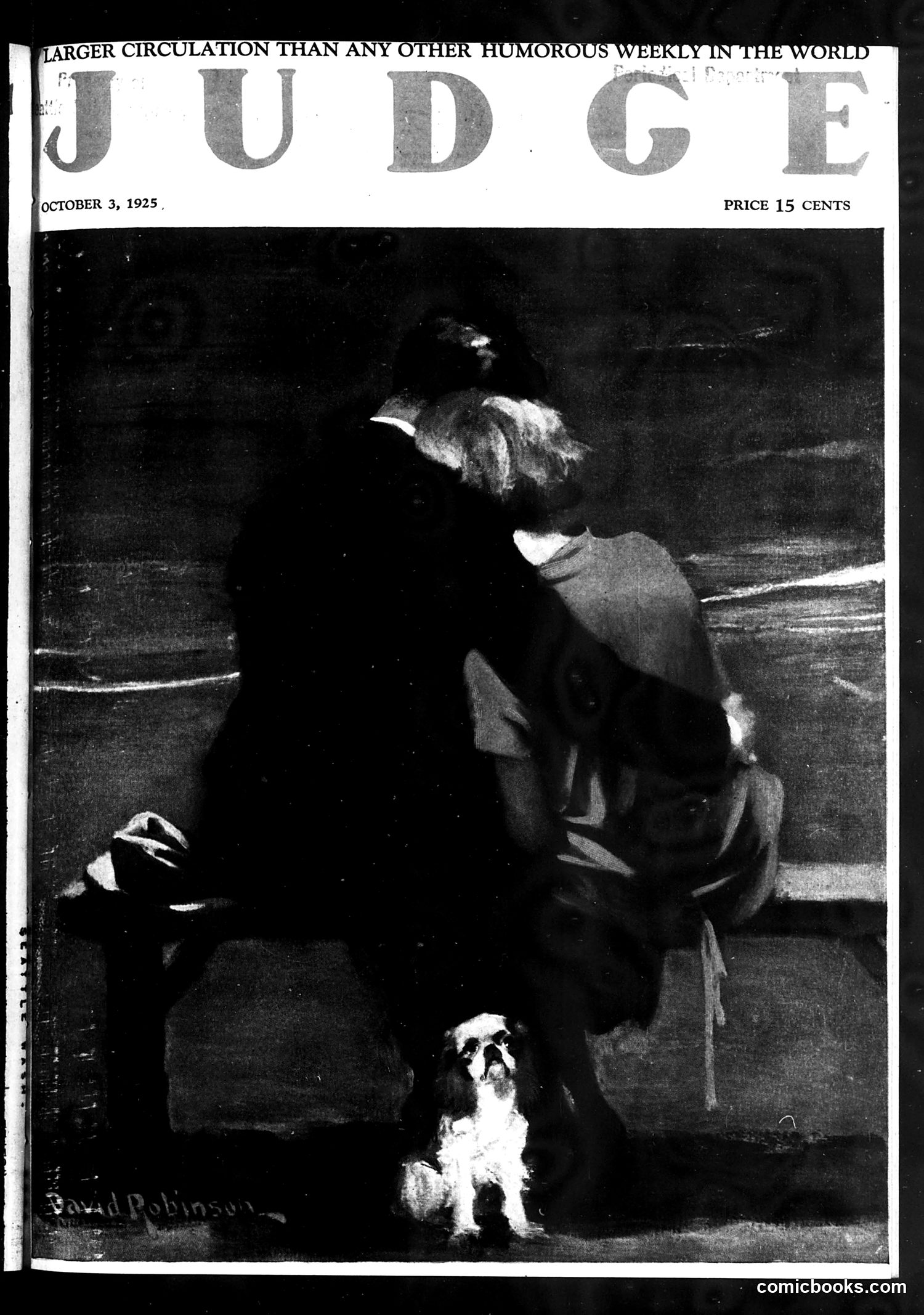
This appears to be a **cover image from Judge magazine** (October 3, 1925), a humorous weekly publication. The cover shows a **woman in fashionable 1920s attire with a small dog**, photographed in what appears to be a candid or staged moment. The woman wears a cloche hat and dark coat typical of the Jazz Age era. Without visible text on the cover itself, the specific satirical point is unclear from the image alone. However, given Judge's focus on social commentary, this likely satirizes **1920s fashion trends, wealth display, or social behavior** common to the era—possibly mocking upper-class affectations or the "modern woman" of the Roaring Twenties. The small dog may be a status symbol being mocked. The OCR text provided contains no additional context to determine the precise target of satire.
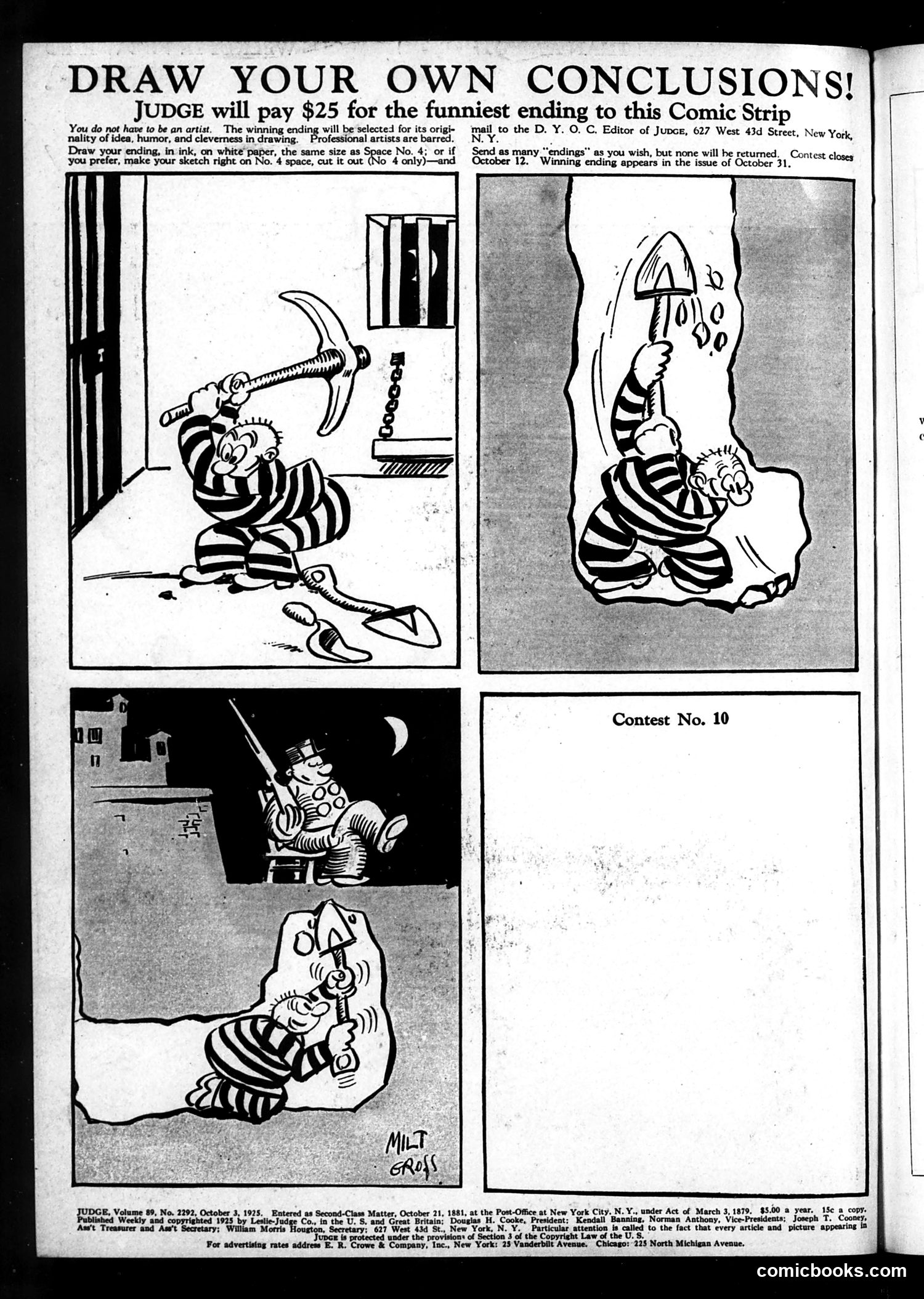
This page from *Judge* magazine features a reader contest ("Draw Your Own Conclusions!") offering $25 for the funniest ending to an incomplete comic strip. The three visible panels show a convict in striped prison clothing wielding a pickaxe in what appears to be an escape scenario—first breaking through a prison wall, then breaking through a cave wall, and finally approaching a castle tower at night where a guard stands watch. The incomplete fourth panel (Contest No. 10) invites readers to submit humorous conclusions to this prison-escape narrative. The contest mechanism exemplifies early 20th-century interactive magazine content, where reader participation was entertainment itself. The convict character and escape premise suggest this plays on familiar criminal-narrative tropes popular in period humor and illustration.
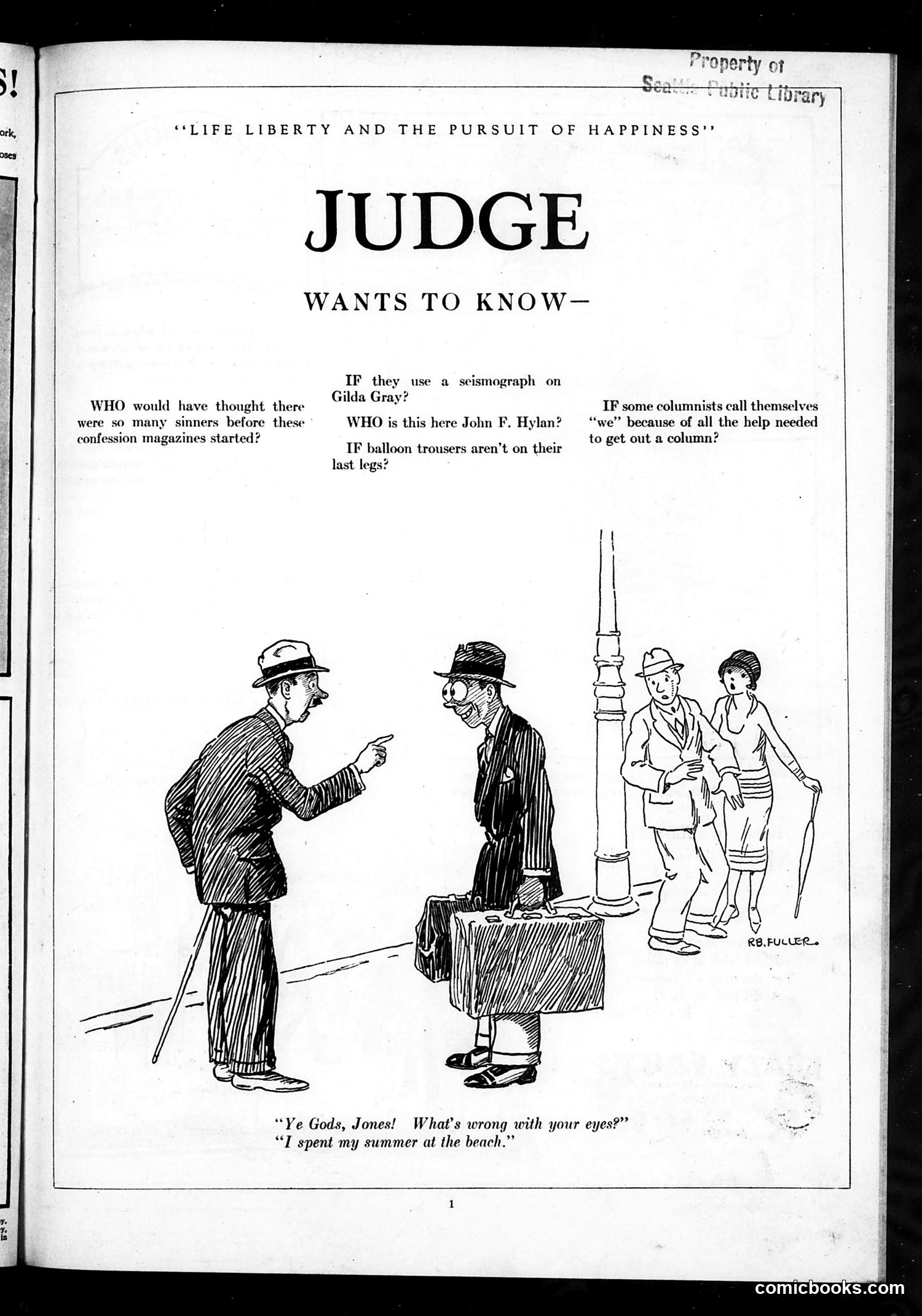
This satirical page from Judge magazine presents rhetorical questions mocking various contemporary figures and trends: - **The confession magazine phenomenon**: Satirizes the popularity of confession-style publications, questioning why so many people suddenly claimed to be "sinners" - **Gilda Gray and seismographs**: Appears to reference the dancer Gilda Gray, with a joke about measuring her movements - **John F. Hylan**: References this NYC mayor (likely from the 1920s), though the specific criticism is unclear from context - **"Balloon trousers"**: Mocks the fashion trend of loose, baggy pants - **The cartoon illustration**: Shows a judge confronting a witness about a beach visit, playing on courtroom authority and the era's social sensibilities The humor relies on readers' familiarity with contemporary celebrities, fashions, and social debates of the 1920s.
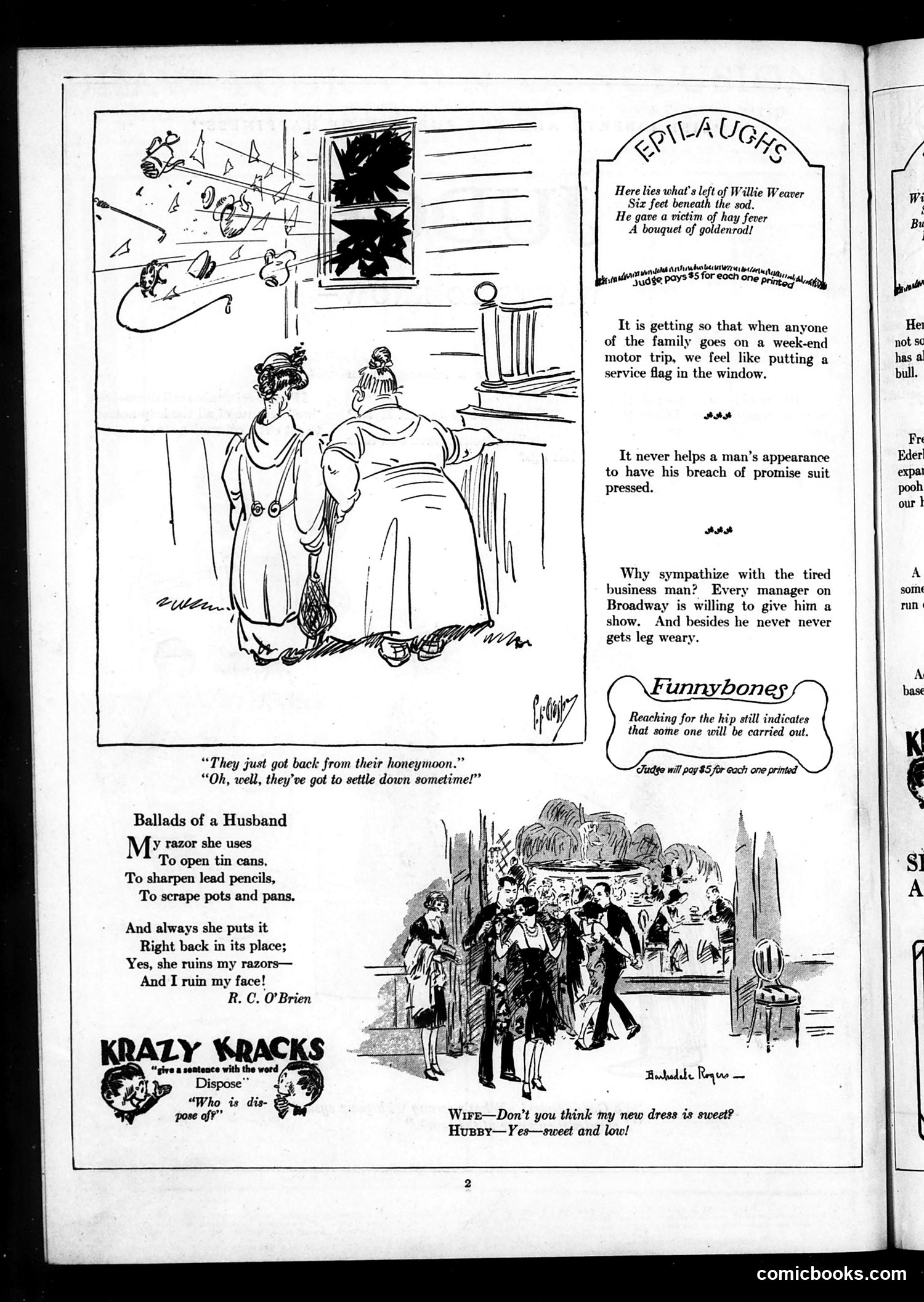
This page contains several domestic humor pieces typical of early 20th-century satirical magazines: **Top cartoon**: Shows a couple returning from their honeymoon. The wife says they "must settle down something," implying newlyweds must establish household routines and responsibilities after the romantic honeymoon phase ends. **"Ballads of a Husband"**: A poem mocking husbands whose wives use their razors for household tasks (sharpening pencils, scraping pans), ruining them—a common domestic complaint of the era. **Bottom cartoon**: A wife compliments her new dress as "sweet," and the husband agrees it's "sweet and loud"—satire on women's fashion choices and marital disagreement over taste. **"Krazy Kracks"**: A light wordplay joke section. The page reflects traditional gender roles and domestic conflict humor popular in 1920s American magazines.
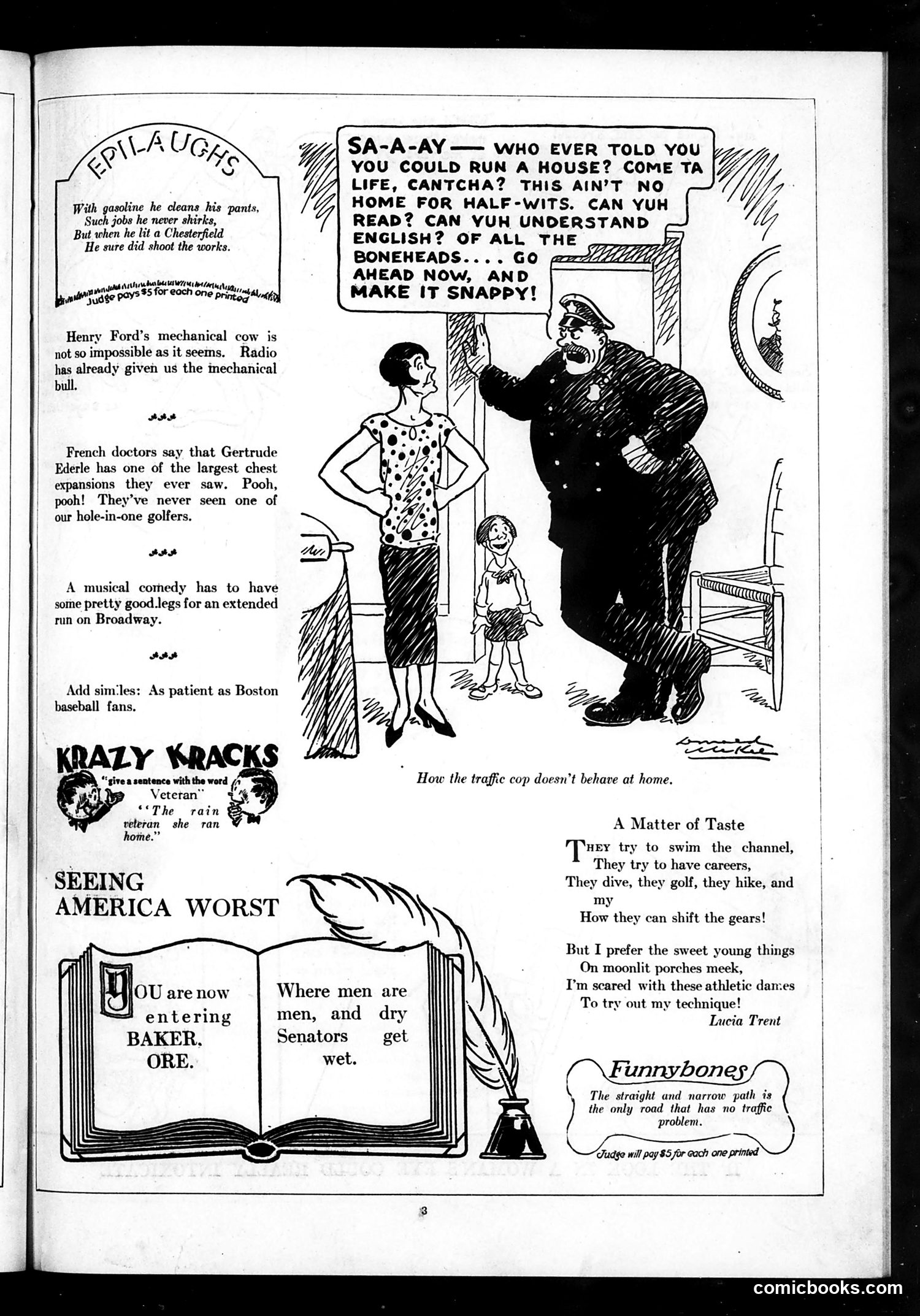
The main cartoon "How the traffic cop doesn't behave at home" depicts a police officer loudly berating a woman and child indoors—the opposite of his professional demeanor. It's a domestic humor joke about how authority figures abandon their public personas in private. The "Epilaughs" section contains brief satirical commentary on contemporary figures: Henry Ford's assembly line production, Gertrude Edith's chest expansion, and Broadway productions requiring "pretty good legs." "Seeing America Worst" mocks the phrase "Baker-ore" (unclear reference, possibly political). "A Matter of Taste" is poetry about recreational pursuits. "Funnybones" offers a one-liner about traffic. Overall, the page mixes domestic humor with light political/cultural satire typical of early 20th-century Judge magazine.
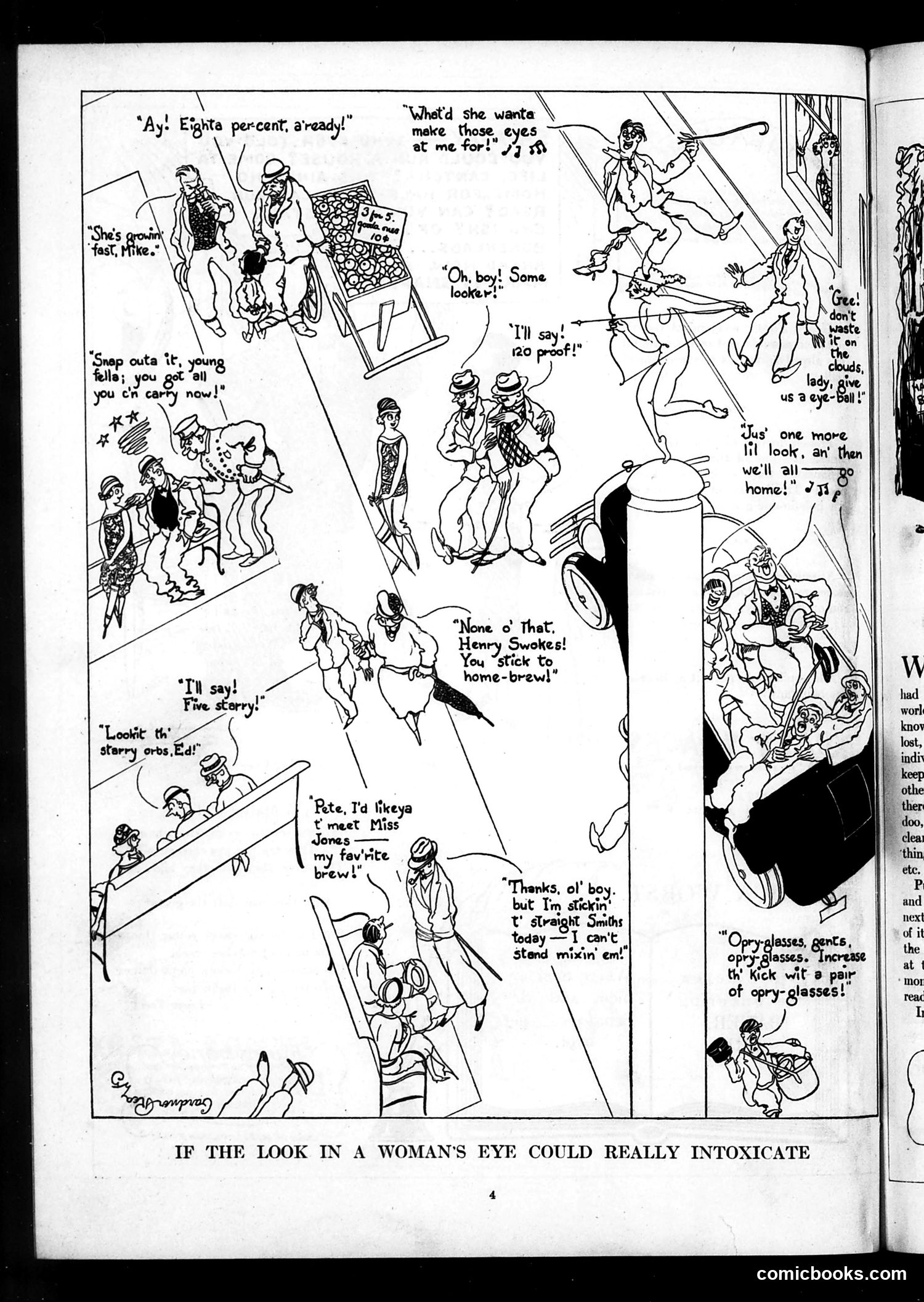
This cartoon satirizes the era's common trope that women's beauty or seductive glances could dangerously influence men—particularly regarding alcohol consumption. The caption title plays on the period's anxieties about female attraction as a corrupting force. The scenes depict men resisting various temptations (home-brew, fancy drinks) while women attempt to persuade them, often through flirtation. Characters reference "Henry Swokes" sticking to "home-brew" and avoiding mixed drinks, suggesting Prohibition-era concerns about adulterating beverages. The final panel jokes that "opry-glasses" (opera glasses) would be needed in pairs—a humorous visual pun suggesting women's looks are so intoxicating they require optical enhancement to withstand. The satire mocks both period alcohol anxieties and stereotypes about female manipulation.
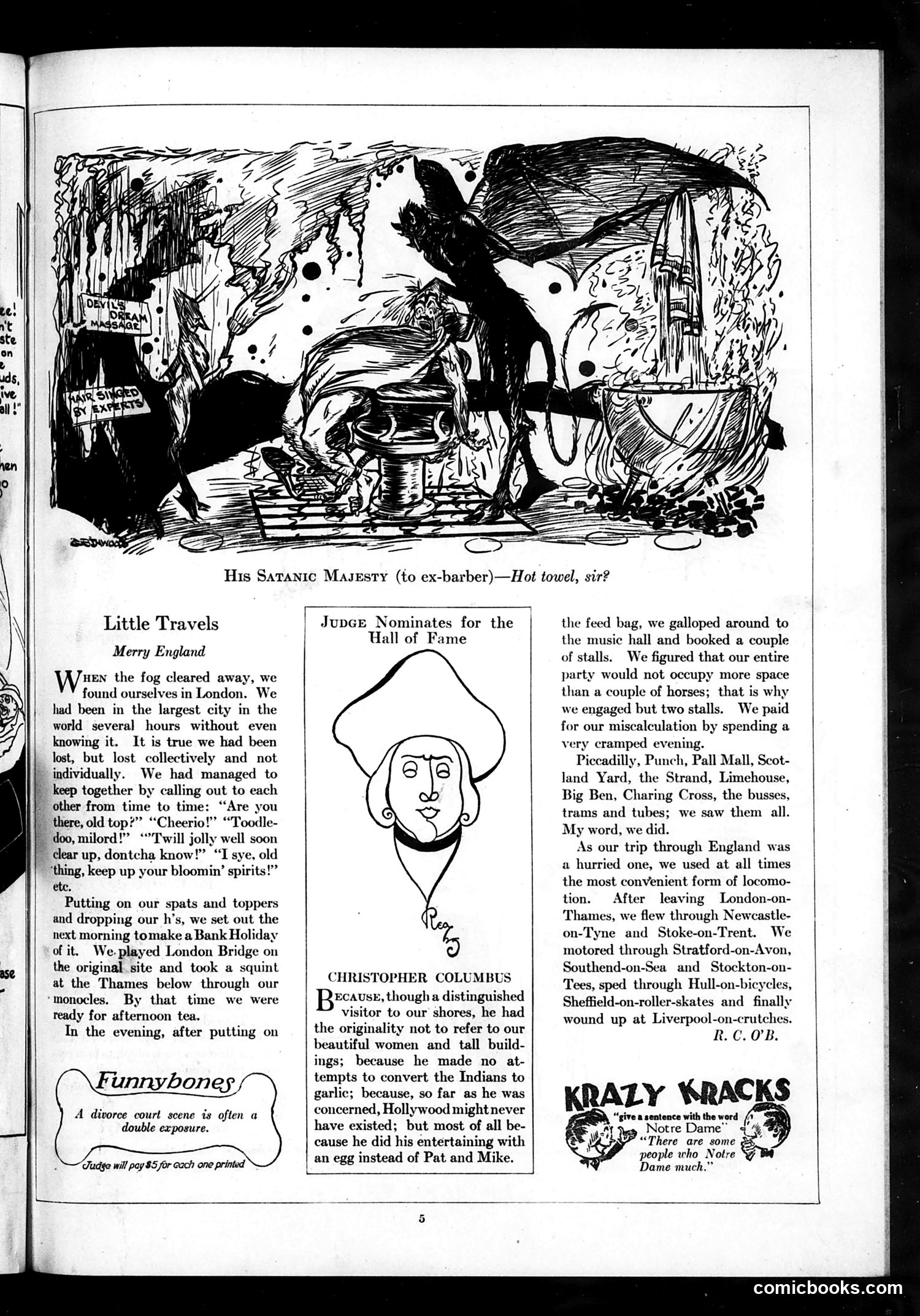
The top cartoon, "His Satanic Majesty (to ex-barber)—Hot towel, sir?" depicts a demonic figure addressing someone identified as an "ex-barber." The satire likely mocks a specific individual who transitioned from barbering to another profession, possibly in entertainment or politics, suggesting pretensions or absurd elevation in status. The page's main content is "Little Travels: Merry England," a travelogue describing a London visit and subsequent English sightseeing. The accompanying text discusses Christopher Columbus as a "distinguished visitor," praising his entertainment value while critiquing his historical claims about discovering America and converting indigenous peoples. Below are lighter humor sections including "Funnybones" and "Krazy Kracks," typical Judge filler content from this era.
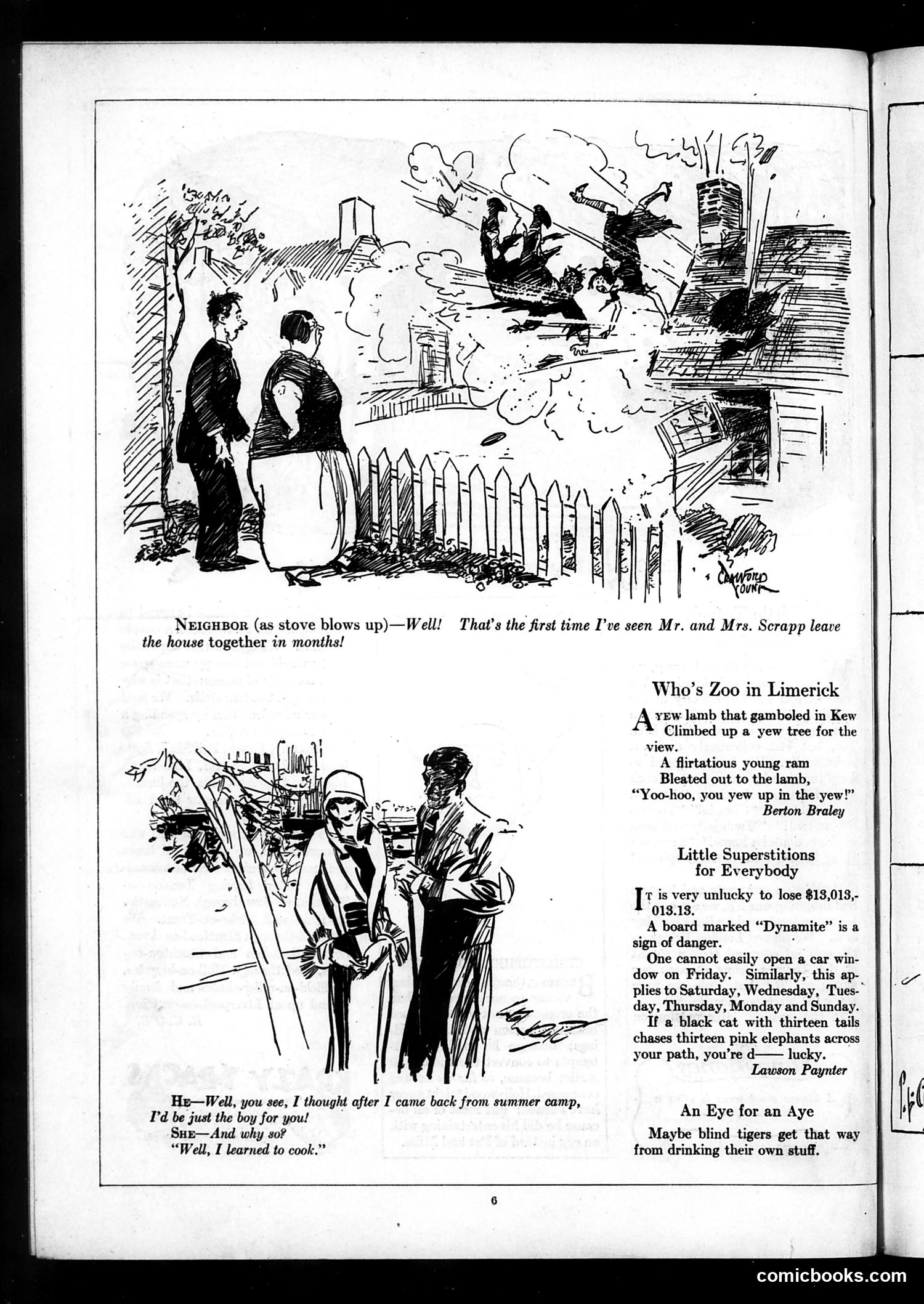
This page contains three separate humorous pieces: 1. **Top cartoon**: A domestic humor joke about the Scrapp couple. The stove explosion causes them to rush outside together—apparently so rare an occurrence that their neighbor comments they haven't left the house together in months, implying marital discord or estrangement. The humor relies on the domestic tension being so severe that only disaster forces togetherness. 2. **"Who's Zoo in Limerick"**: A playful limerick about animals at the London Zoo, with intentional wordplay around "yew tree" and "yew" sounds. Light, whimsical content. 3. **"Little Superstitions"**: Mock superstitions satirizing absurd folk beliefs. The humor lies in exaggeration—the unlucky number is ridiculously specific, the "can't open car windows" joke implies superstitions apply to literally every day, and the "pink elephants" reference suggests drunken hallucinations. 4. **Bottom**: A romantic exchange where a man learns to cook at summer camp, thinking it'll impress a woman—she questions why cooking would matter. The final "Eye for an Aye" quip about blind tigers likely references Prohibition-era illegal liquor ("blind tigers" = speakeasies).
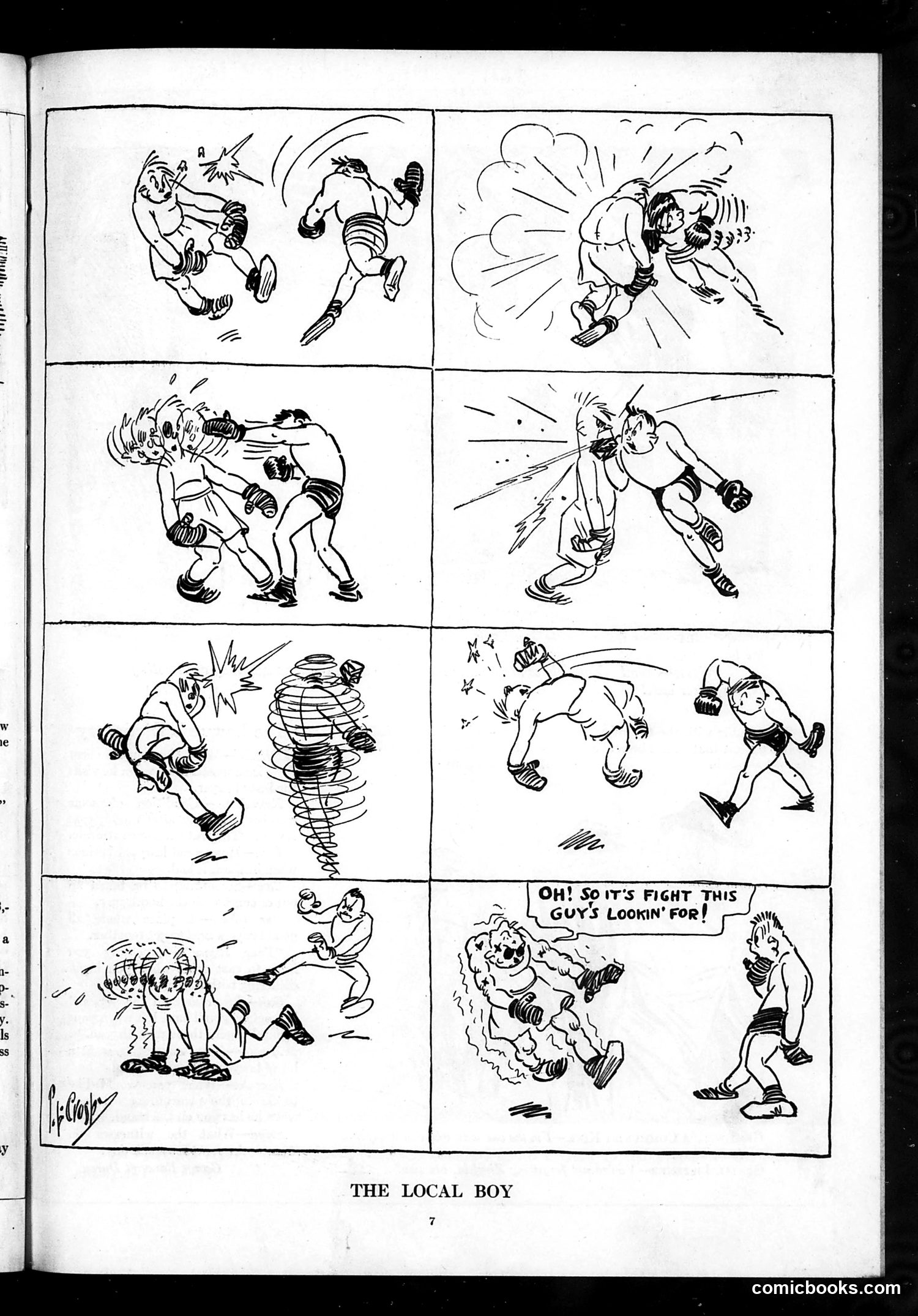
This is a wordless boxing comic strip titled "The Local Boy," showing a young fighter's increasingly brutal match. The sequence depicts escalating violence: the fighters exchange punches, then one opponent is knocked down repeatedly with more force each panel. By the final panel, the battered fighter is spinning from impact as the "local boy" (the protagonist) stands ready, with someone shouting "OH! SO IT'S FIGHT THIS GUY'S LOOKIN' FOR!" The comic appears to satirize small-town boxing culture and the brutal spectacle of amateur fights, likely mocking either the eagerness of local fighters or the enthusiasm of spectators who wanted to see violent knockouts. The exaggerated art style emphasizes the comedic absurdity of the escalating punishment.
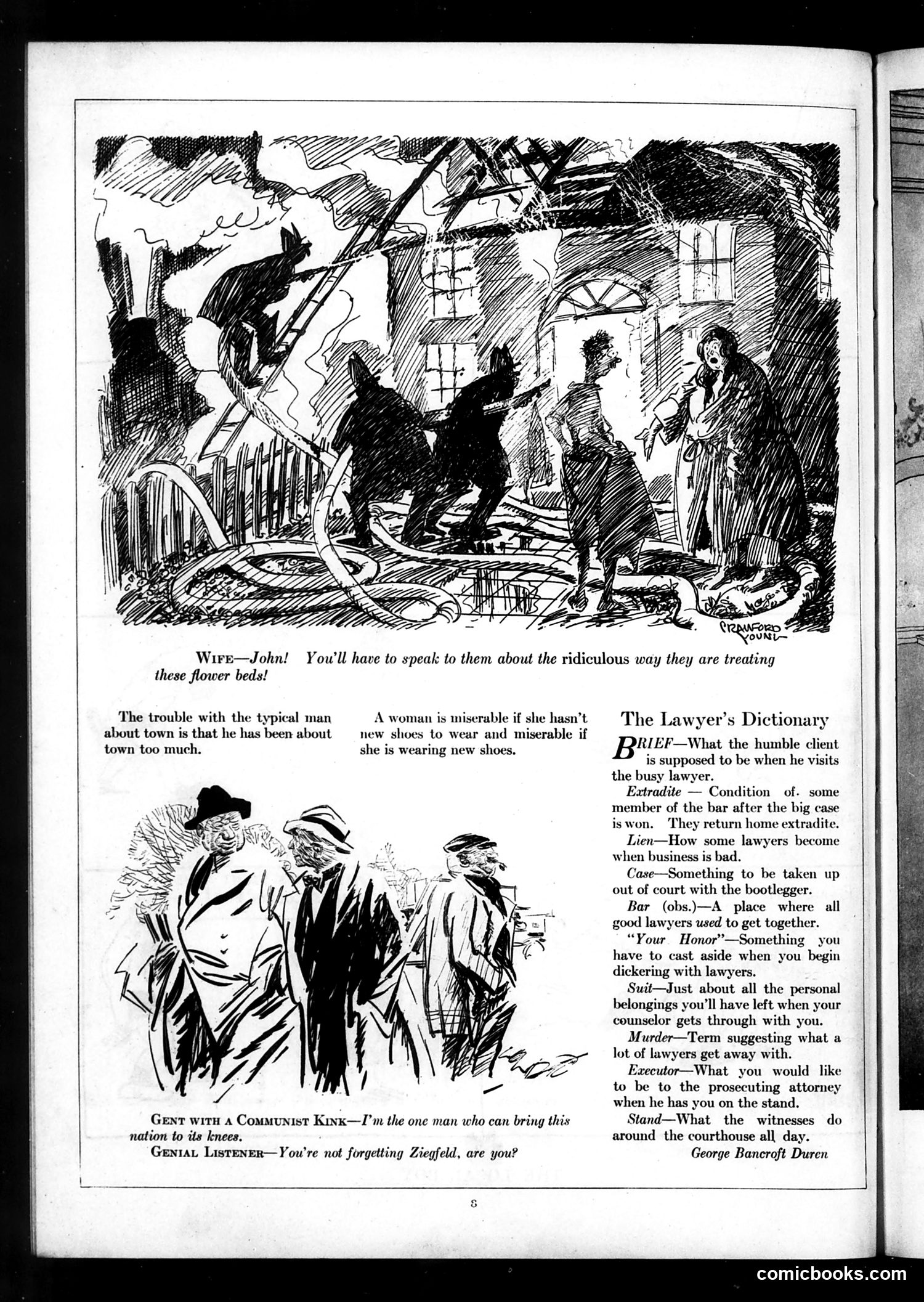
This page contains three satirical pieces targeting early 20th-century American society: **Top cartoon**: A domestic scene where a wife complains to her husband "John" about how servants are mistreating the flower beds—satirizing the trivial concerns of wealthy households. **Middle cartoon**: Features a man claiming to be "the one man who can bring this nation to its knees," likely referencing Communist threats of the era (the Red Scare period). A listener responds by invoking Florenz Ziegfeld, the famous Broadway impresario, suggesting that entertainment/spectacle poses a greater threat to national stability than political ideology—a humorous deflation of communist fears. **Right column**: "The Lawyer's Dictionary" by George Bancroft Duren offers cynical mock-definitions satirizing the legal profession: lawyers are portrayed as incompetent, financially predatory ("Suit—all the personal belongings you'll have left"), and morally dubious ("Murder—term suggesting what a lot of lawyers get away with"). This reflects contemporary distrust of lawyers and the legal system.
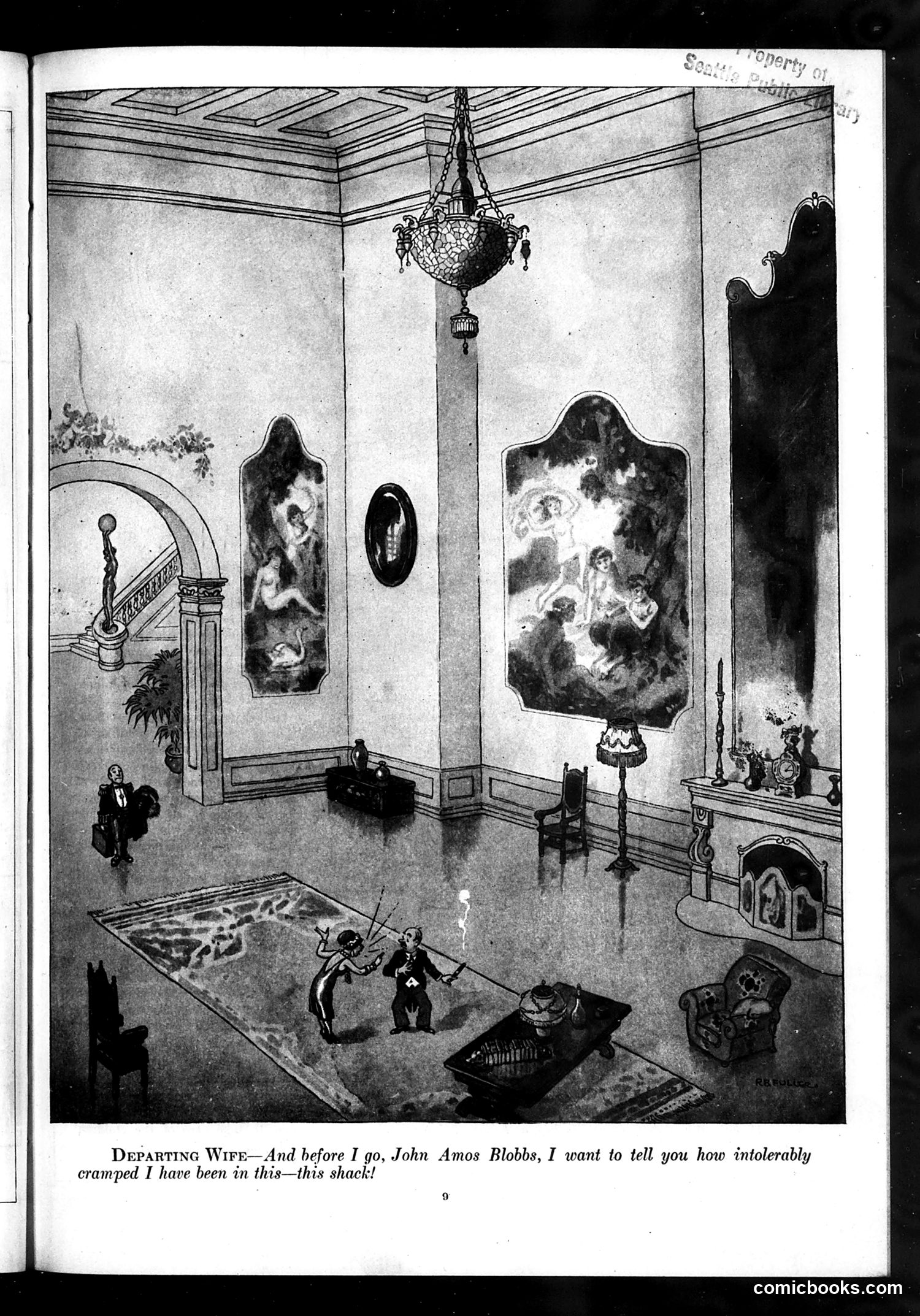
This is a single-panel cartoon depicting a domestic dispute. A woman is departing and addressing a man named "John Amos Blobbs," complaining about their cramped living quarters. The satire targets working-class housing conditions of the era—the ornate room depicted ironically contrasts with her complaints. The lavish furnishings (chandelier, paintings, decorative elements) suggest the couple considers themselves genteel, yet she still finds their home intolerably small. This mocks middle-class pretensions: people aspiring to refinement despite modest means, or the gap between their self-image and actual circumstances. The cartoon uses the marital conflict setup common to Judge magazine humor, making light of domestic dissatisfaction over housing—a relatable concern for contemporary readers navigating urban living spaces during America's rapid industrialization and urbanization.
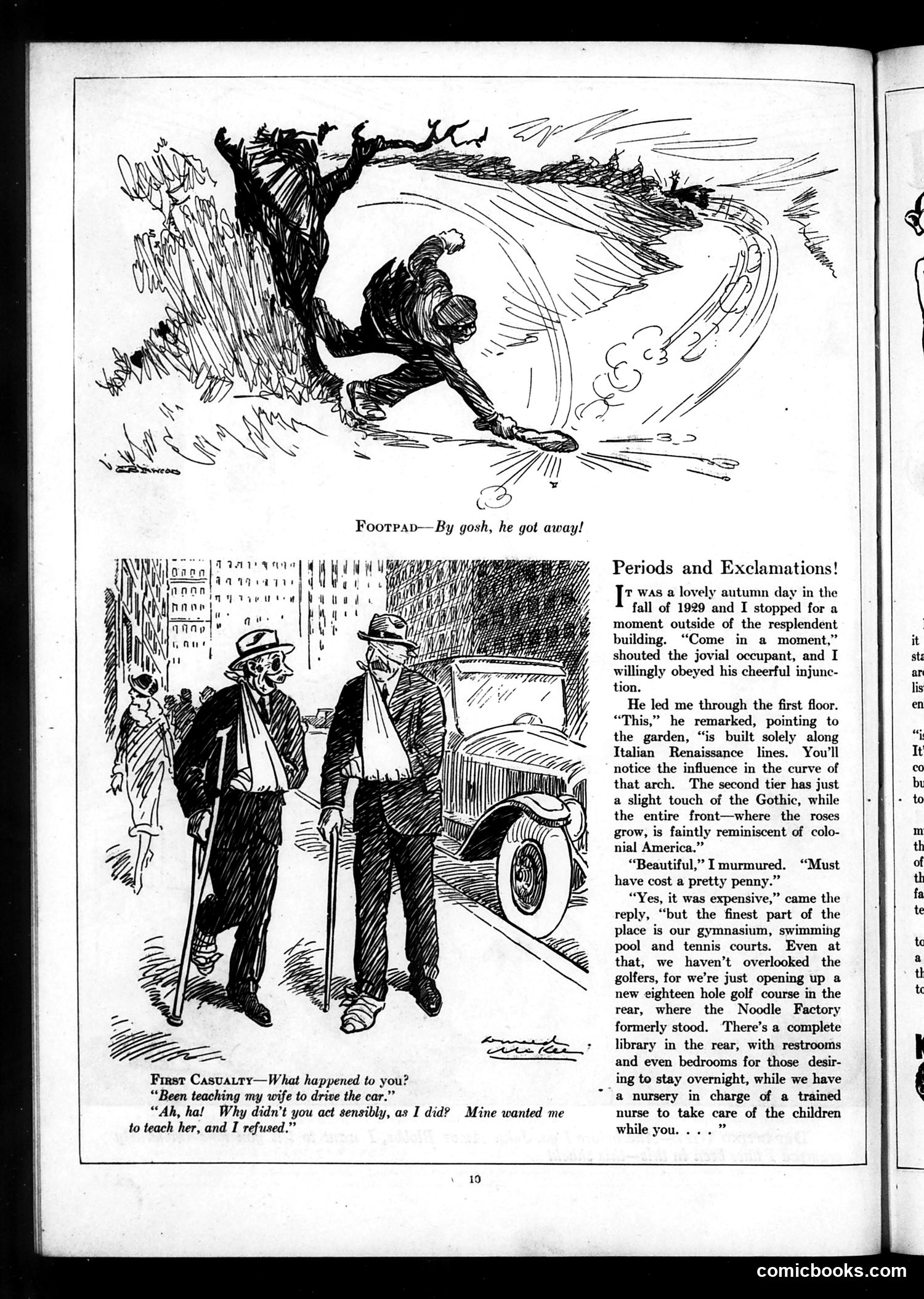
**Top Cartoon ("Footpad"):** A man chases away a burglar or thief ("footpad" is period slang for robber). The joke is visual slapstick humor about crime. **Bottom Cartoon ("First Casualty"):** Two men discuss automobile accidents. One explains his injuries came from teaching his wife to drive—implying wives are dangerous drivers. His companion refused such a task. This reflects 1920s anxieties about women entering the workforce and gaining independence (women's suffrage was recent—1920). The "joke" relies on sexist stereotypes about female incompetence at driving, presented as common wisdom of the era. **Right Column ("Periods and Exclamations!"):** A descriptive piece about an elaborate new building with luxury amenities: Italian Renaissance gardens, Gothic touches, gymnasium, swimming pool, tennis courts, golf course, library, and nursery services. The text emphasizes expensive architectural sophistication and modern recreational facilities available to members or residents. This appears promotional rather than satirical. The page reflects 1929 attitudes: casual sexism, car-culture anxieties, and celebration of leisure amenities for the wealthy.
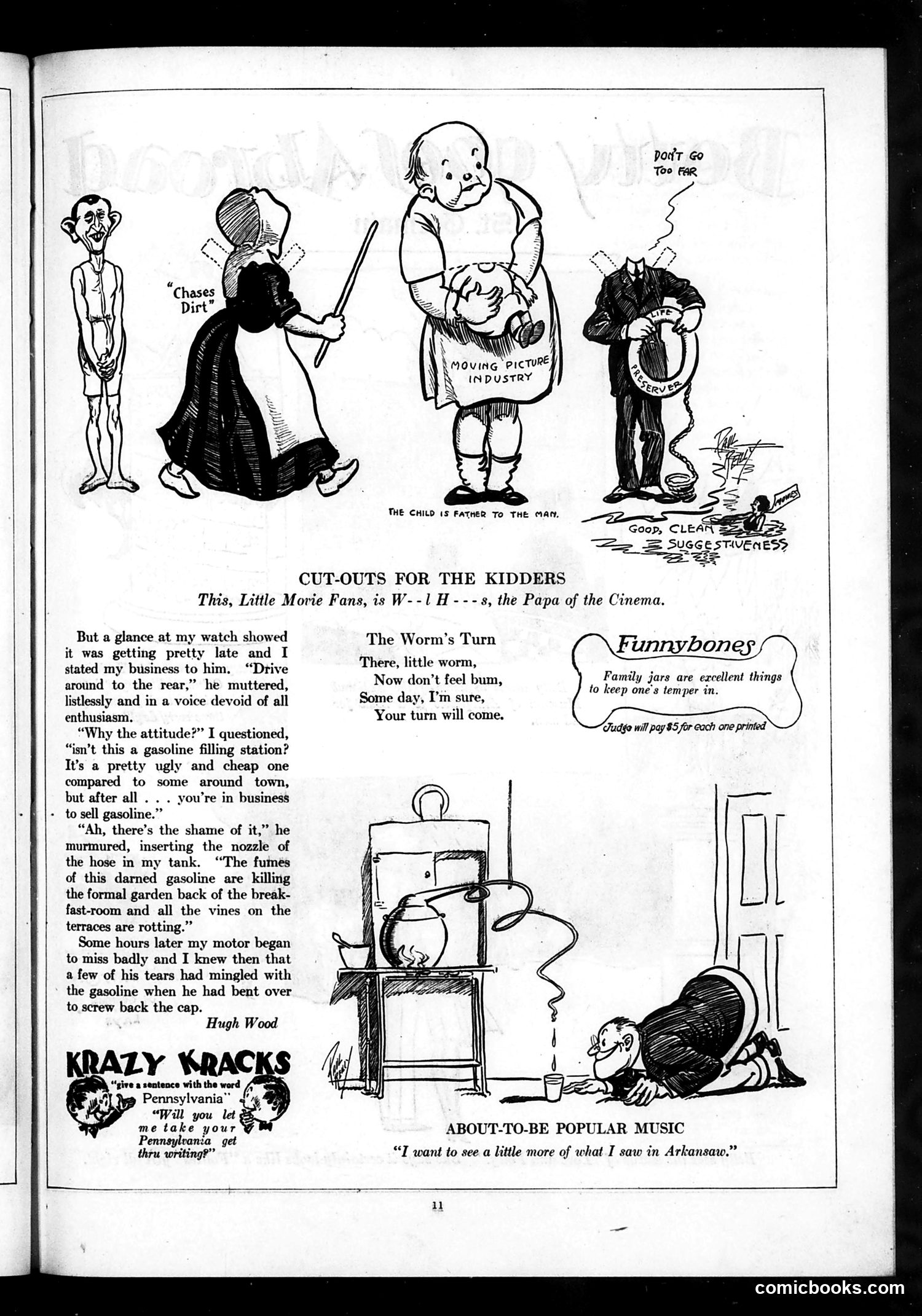
This page contains satirical content mocking early 20th-century American social anxieties: **Top Section ("Cut-outs for the Kidders"):** References "W.C. Fields" (the "Papa of the Cinema"), a famous comedian, in a story about a gasoline station attendant complaining that fuel fumes are destroying his formal garden and terraces. The satire mocks the pretension of working-class service workers affecting aristocratic sensibilities—claiming refined tastes while holding menial jobs. **"The Worm's Turn":** A morality verse suggesting patience; the downtrodden will eventually have their day. **Bottom Illustration:** Depicts someone cramped in a cabinet labeled with "IT" (likely referring to the Elinor Glyn film of that era), satirizing popular culture obsessions. **"About-to-be Popular Music":** A joke about American regional dialects, poking fun at rural "Arkansaw" speech patterns. The overall tone reflects early 1920s urban sophistication mocking both working-class pretension and rural American culture.
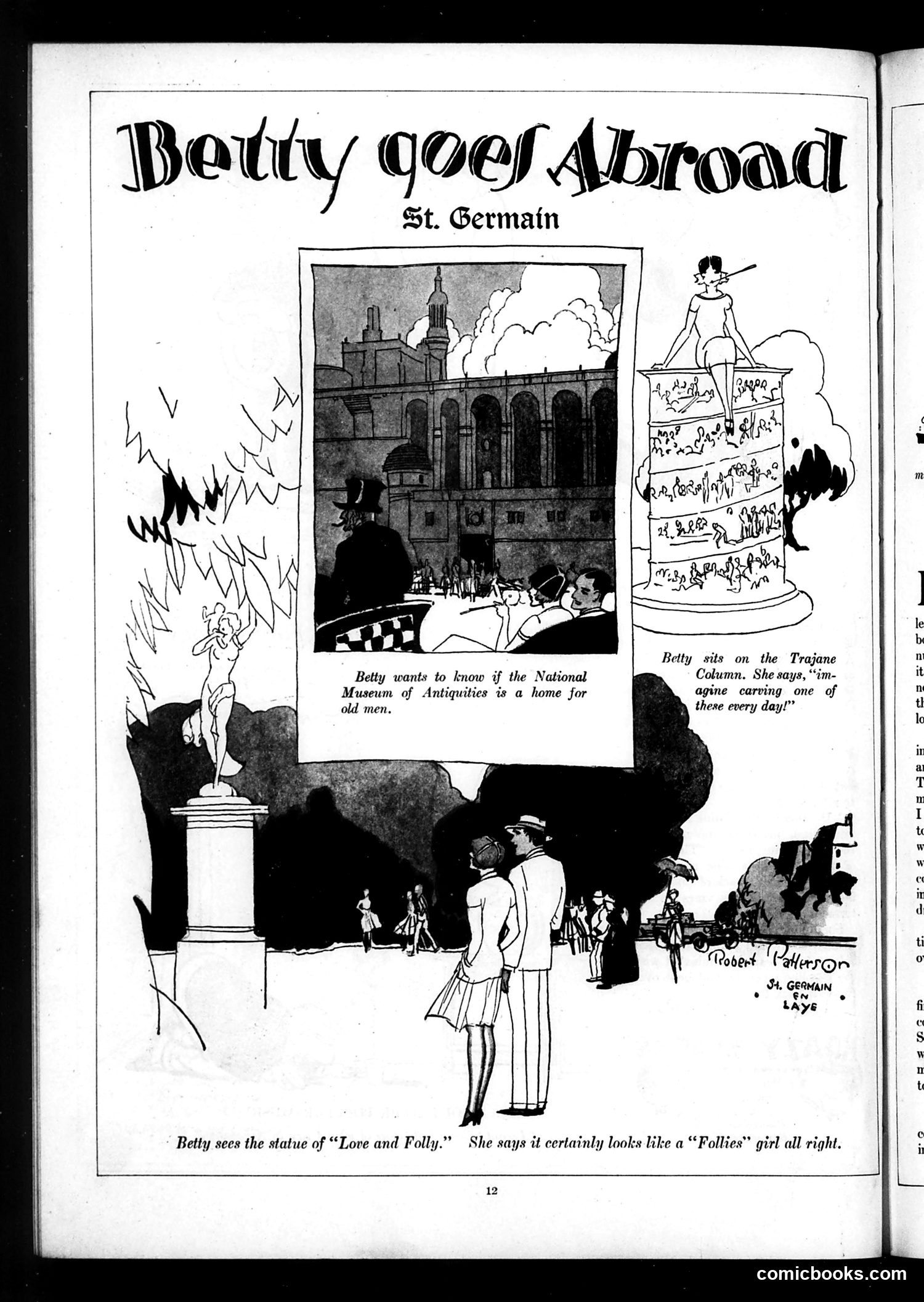
This page from Judge magazine presents "Betty Goes Abroad to St. Germain"—a humor series following a young American woman touring Paris landmarks. The satire works through Betty's irreverent American perspective on European culture. She makes jokes treating serious antiquities casually: questioning whether the National Museum houses elderly men, commenting that carving statues daily seems tedious, and comparing a classical "Love and Folly" sculpture to a Follies chorus girl (referencing the Ziegfeld Follies theatrical revue). The humor relies on the contrast between dignified European heritage sites and Betty's brash, unsentimental American tourist observations. This reflects 1920s-era American attitudes—confident, somewhat philistine, and dismissive of old-world pretension. The cartoons gently mock both Betty's vulgarity and, implicitly, European reverence for antiquity. The artist appears to be Robert Patterton.
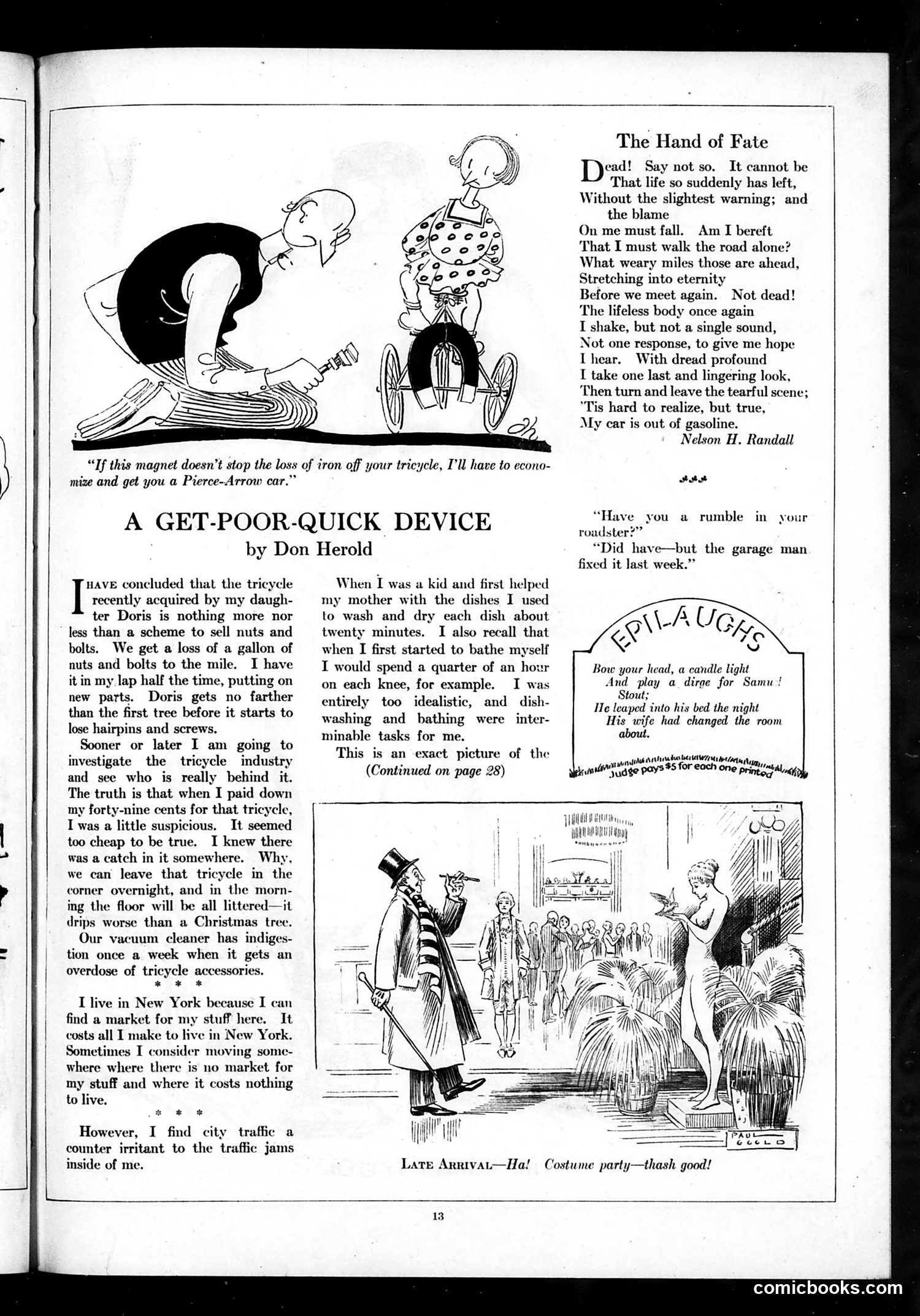
**Main Article/Cartoon**: Don Herold satirizes inexpensive children's tricycles as deliberately defective products designed to generate repeat purchases of replacement parts. The joke: a cheap tricycle ($0.49) loses nuts, bolts, and screws constantly, requiring endless repairs—essentially a "get-poor-quick" scheme disguised as economy. The opening cartoon shows a father using a magnet to retrieve iron parts, threatening to buy his daughter an expensive Pierce-Arrow car instead if the losses continue. **Social Context**: This targets early 20th-century consumer culture and planned obsolescence concerns. The piece contrasts New York City living costs with the tricycle's false economy. **Additional Content**: - "The Hand of Fate" (poem): darkly humorous—a man discovers his car is out of gasoline after finding someone dead - "Reptil-aughs" (jokes): brief humor about car troubles and a wife rearranging bedroom furniture The page reflects period anxieties about shoddy manufacturing and misleading product value.
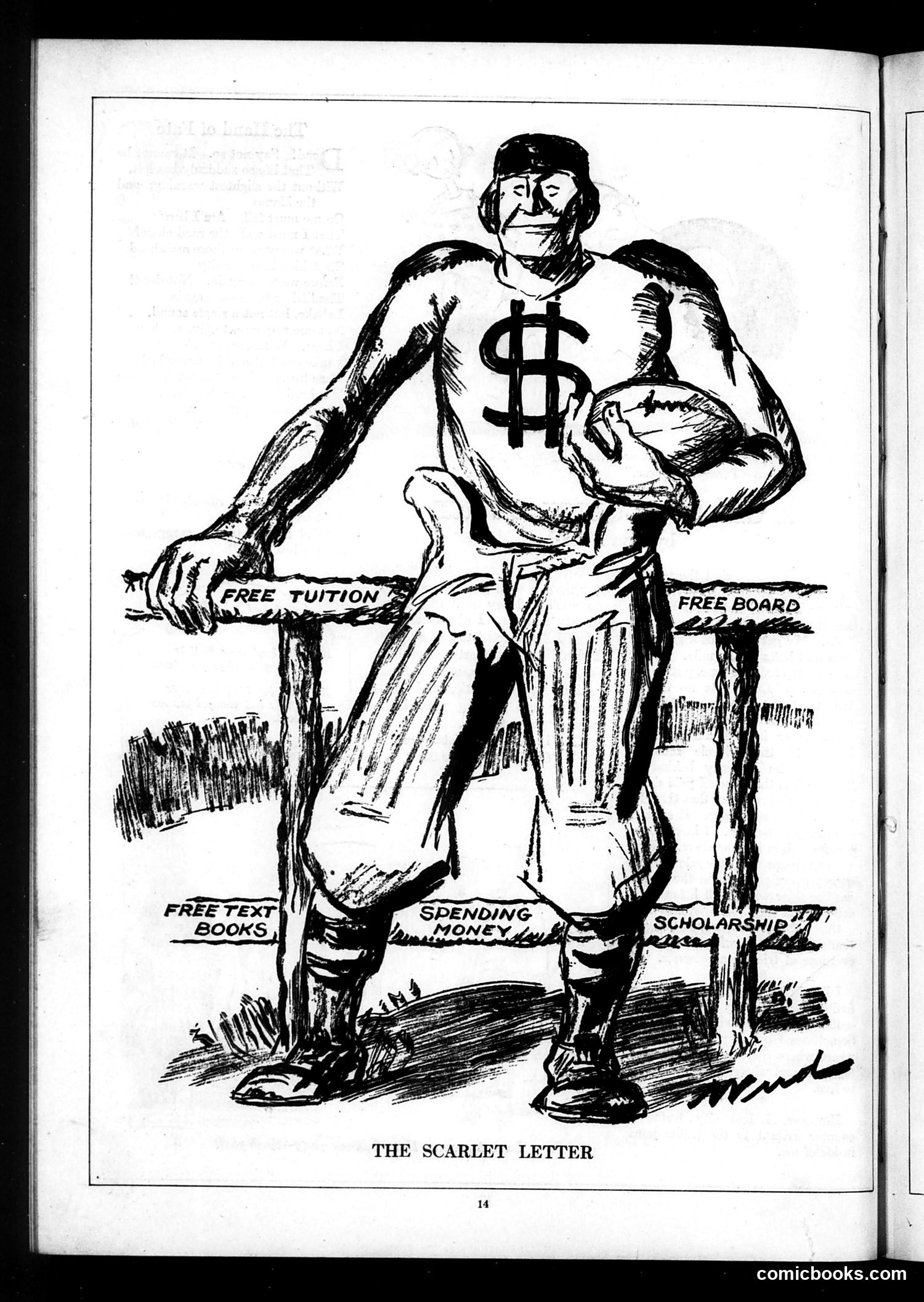
This political cartoon repurposes Nathaniel Hawthorne's famous novel title to satirize education funding and student support. The figure—resembling a large, muscular man wearing a dollar sign ($) on his chest—represents either an educational institution or perhaps wealth/capitalism itself. The labels on his body parts indicate what he's "supporting": "FREE TUITION," "FREE BOARD," "FREE TEXT BOOKS," "SPENDING MONEY," and "SCHOLARSHIP." The cartoon suggests these educational benefits are being stretched impossibly thin or that a single entity cannot realistically provide all these services simultaneously. The "Scarlet Letter" reference implies this burden or contradiction is shameful or stigmatizing—likely criticizing either inadequate education funding, the burden placed on institutions to provide comprehensive student support, or the false promises made about free education.
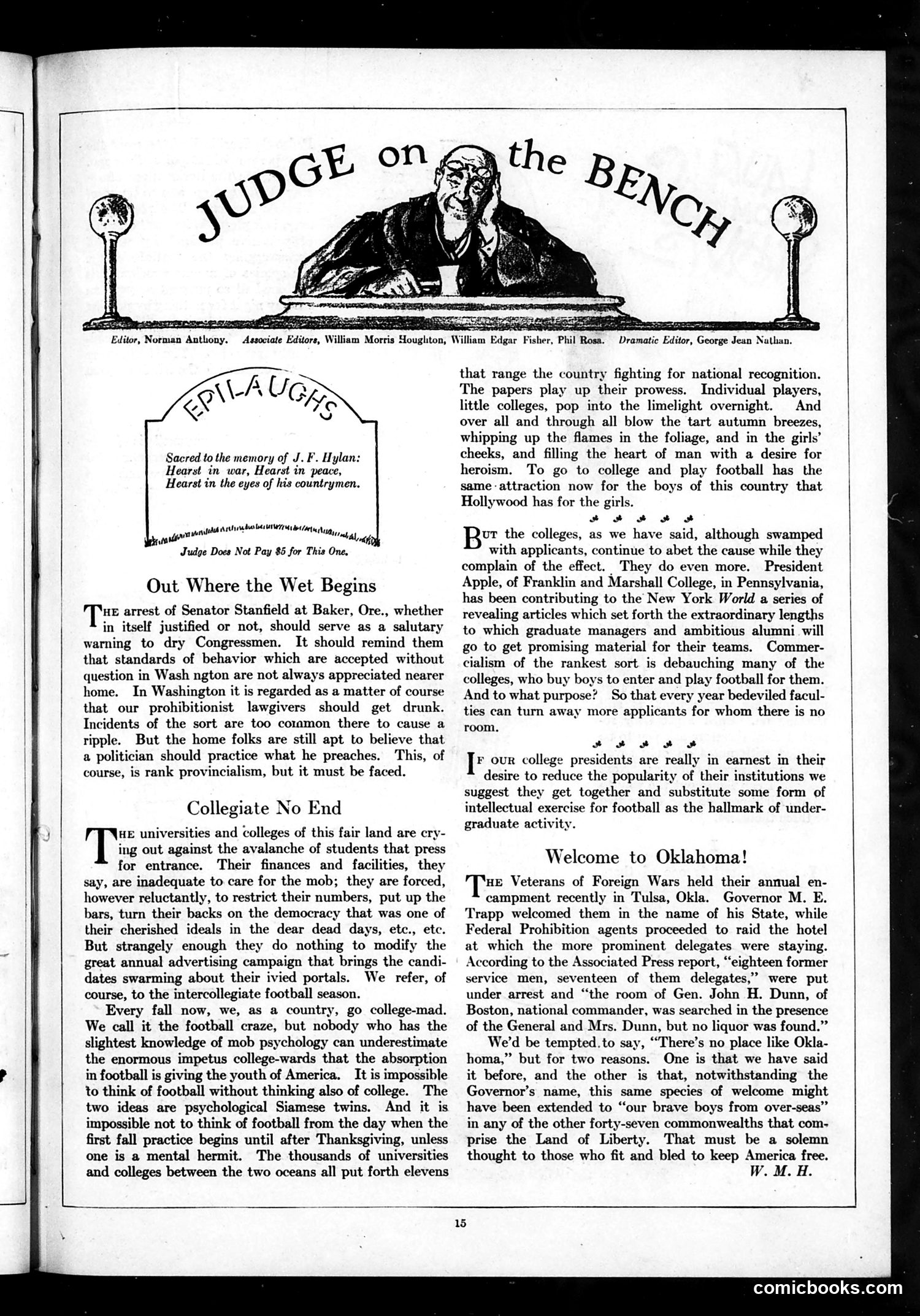
This page contains three distinct satirical pieces: **1. "Epilogue" (top):** A mocking epitaph for Mayor J.F. Hylan, crediting newspaper magnate William Randolph Hearst as the true power behind him ("Hearst in war, Hearst in peace"). This references Hearst's outsized political influence in New York City politics. **2. "Out Where the Wet Begins":** Satirizes Senator Stanfield's arrest in Oregon during Prohibition. The piece mocks Washington's hypocrisy: prohibitionist lawmakers regularly get drunk there without consequence, but face scandal when caught doing so elsewhere. Judge ridicules this double standard as "rank provincialism." **3. "Collegiate No End":** Criticizes American colleges for simultaneously complaining about overcrowding while aggressively promoting football as recruitment propaganda. The satire argues colleges commercialize athletics and even buy players, contradicting their claimed academic mission. Football's glamor drives enrollment more than educational values. The overarching theme: American institutions (politics, higher education) practice what they don't preach.
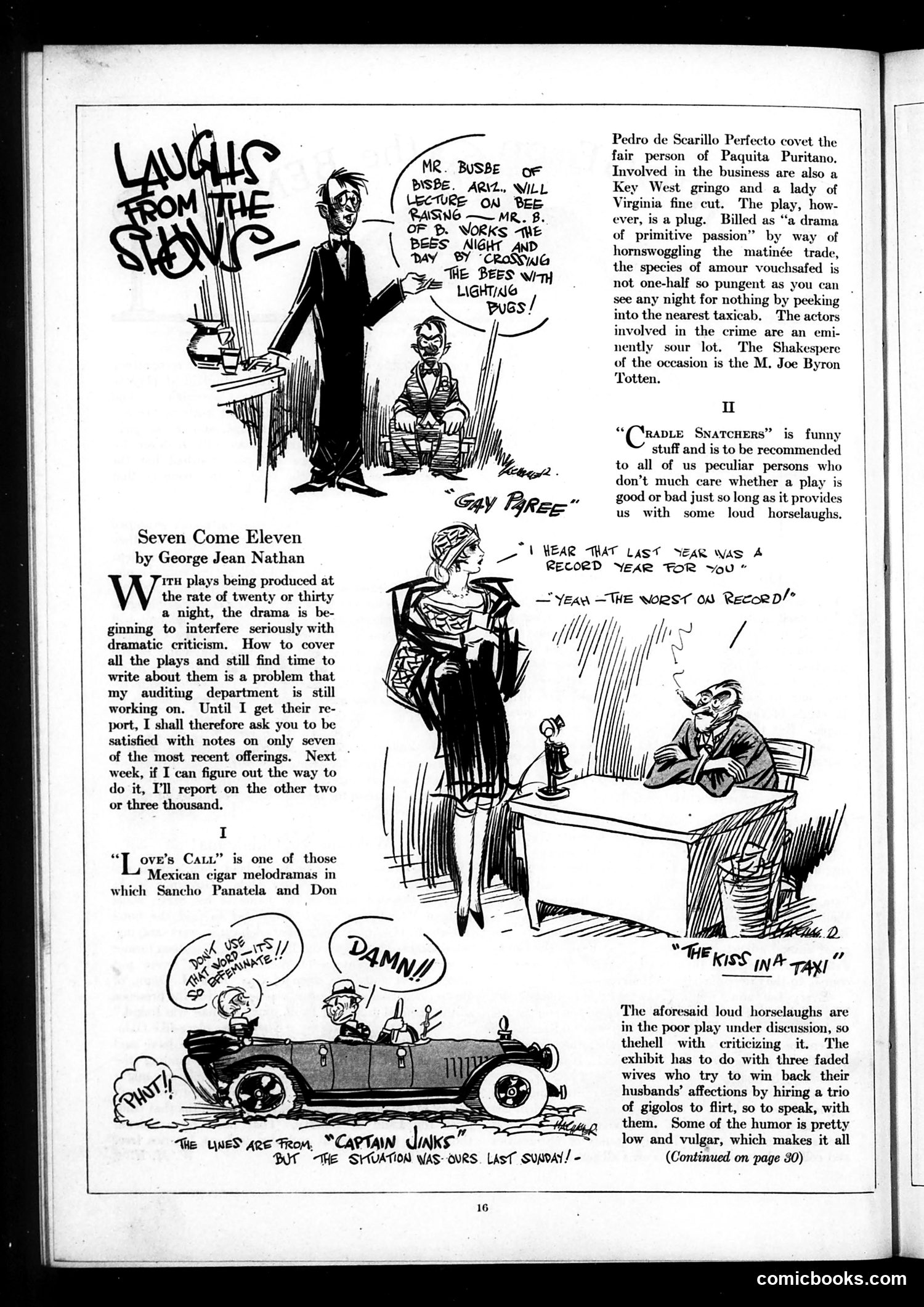
This is a theater review column by drama critic George Jean Nathan covering seven recent Broadway plays. The page mocks several productions as low-quality entertainments: **"Love's Call"** is criticized as a melodramatic Mexican cigar-opera featuring stock characters (Sancho Panatela, Don Pedro de Scarillo) in a predictable plot about a woman's romantic rivalry. Nathan dismisses it as cynical "matinée trade" material—shallow drama designed to exploit unsophisticated audiences. **"Cradle Snatchers"** earns mild praise not for quality but simply for providing "loud horselaughs"—it's entertaining trash for viewers unconcerned with artistic merit. **"Seven Come Eleven"** involves three wives hiring gigolos to recapture their husbands' affections, which Nathan finds crude and vulgar humor. The cartoons illustrate these reviews with exaggerated visual gags. Nathan's tone is caustic: he's drowning in theatrical output (20-30 plays nightly) and can barely keep up with criticism. The fundamental point is that Broadway is flooded with low-brow drivel competing for audience dollars, not serious dramatic art.
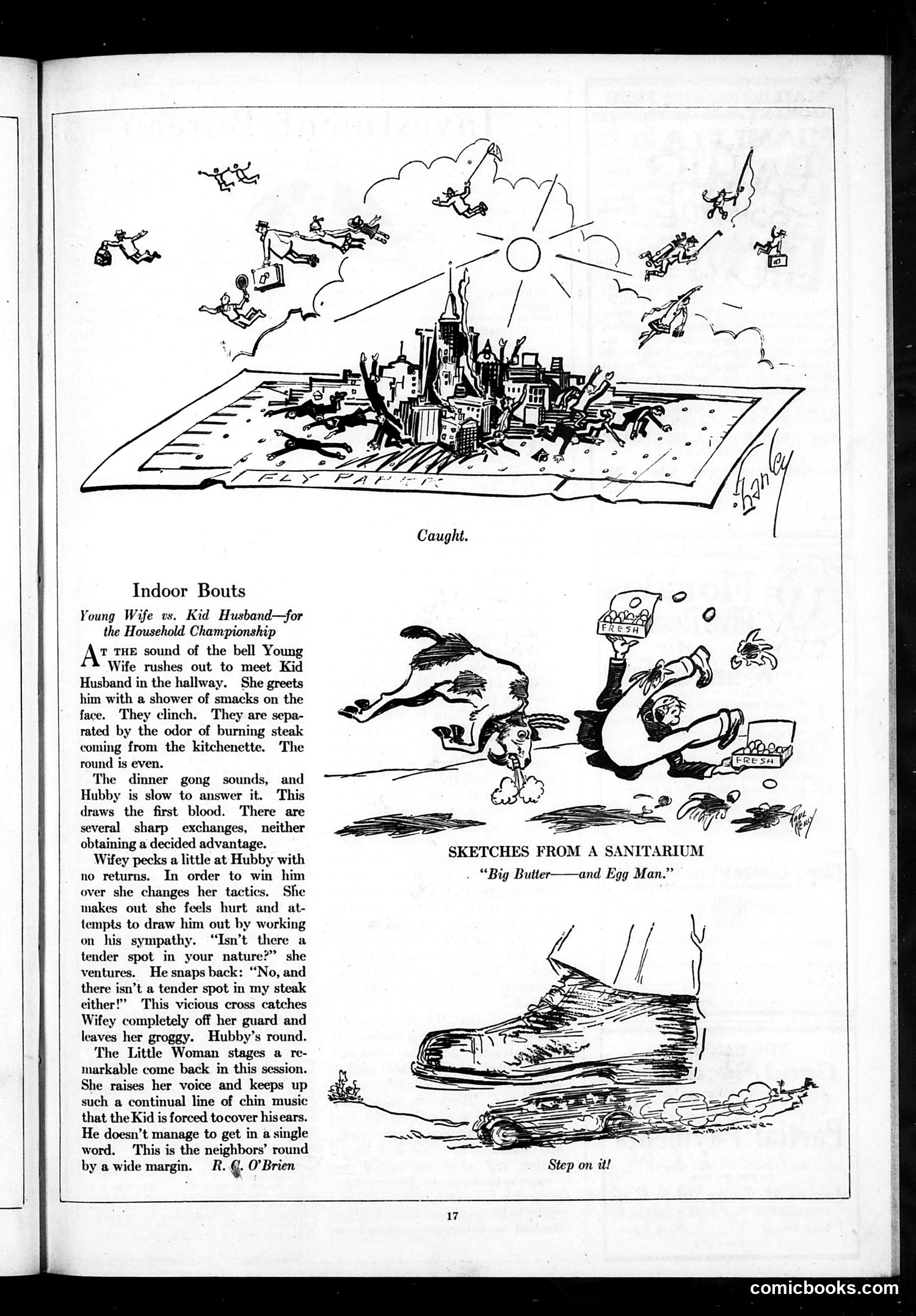
This satirical piece depicts a domestic argument between a young married couple as if it were a boxing match. The "Young Wife" attacks her "Kid Husband" upon his arrival home, initially gaining advantage. However, when he makes a cutting remark about her burnt steak ("there isn't a tender spot in my steak either!"), he wins the round by temporarily silencing her. The satire mocks contemporary marriage dynamics and gender roles. The "Kid Husband" appears to be a young, immature man, while the "Young Wife" is portrayed as emotionally manipulative and talkative. The joke's punchline—that the wife's endless talking bothers the neighbors most—reflects early 20th-century stereotypes about nagging wives and henpecked husbands. The boxing metaphor treats marital conflict as entertainment, typical of Judge magazine's irreverent humor.
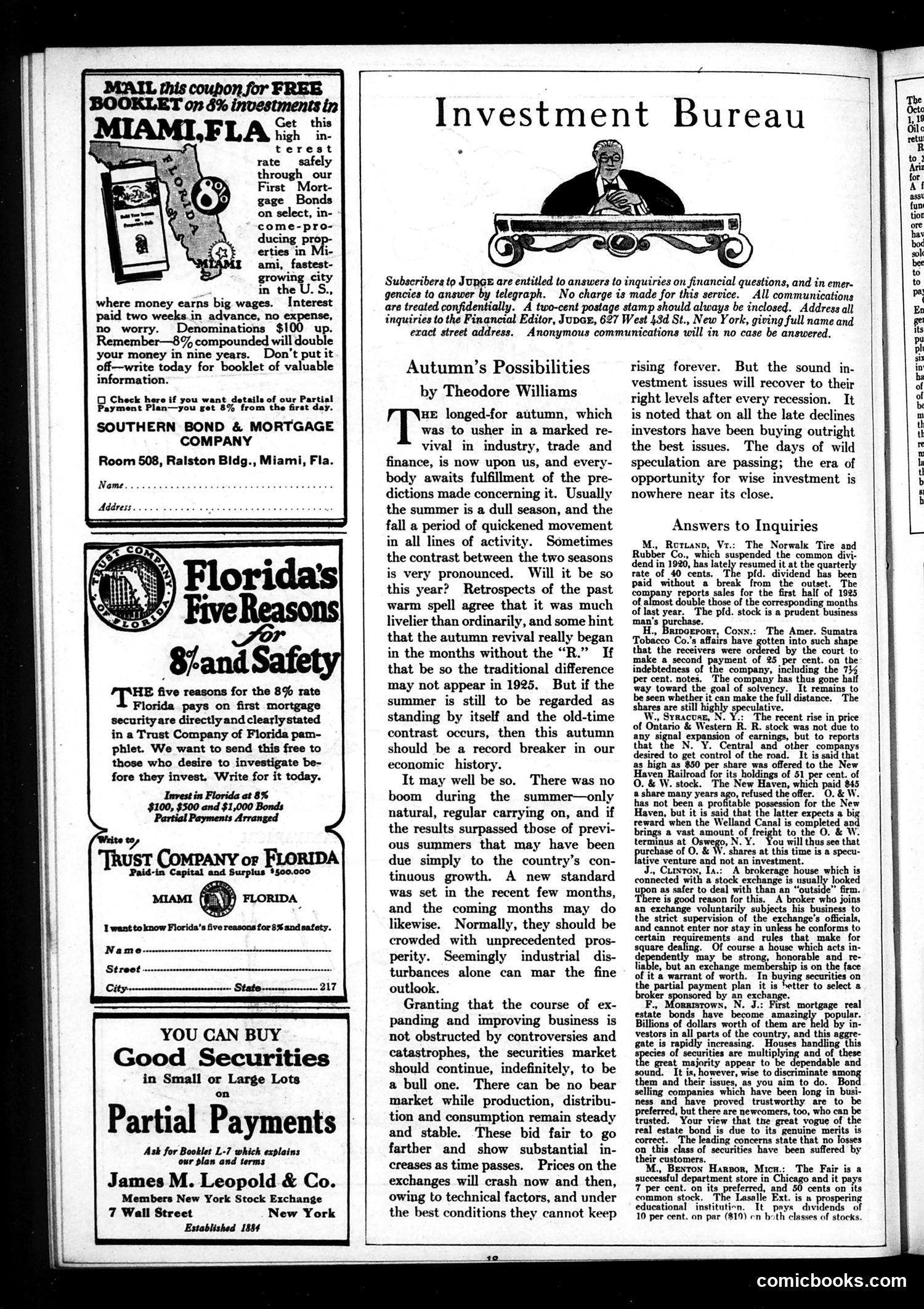
This page is primarily **financial advertising** rather than political satire. The dominant content consists of investment solicitations targeting middle-class readers during the 1920s Florida real estate boom. The advertisements promote mortgage bonds and securities with guaranteed high returns (8% interest), emphasizing safety and steady income—appealing to conservative investors. The language reflects post-WWI optimism about economic expansion. The article "Autumn's Possibilities" by Theodore Williams discusses stock market conditions, predicting continued prosperity if industrial disputes don't disrupt business. It reflects the bullish sentiment of the mid-1920s before the 1929 crash. The "Investment Bureau" masthead indicates Judge provided financial advice to subscribers. **No clear political cartoon or satire is visible**—this appears to be a business-focused issue rather than one emphasizing Judge's typical humorous commentary. The page represents how mainstream publications profited from promoting speculative investments during the Jazz Age economic bubble.
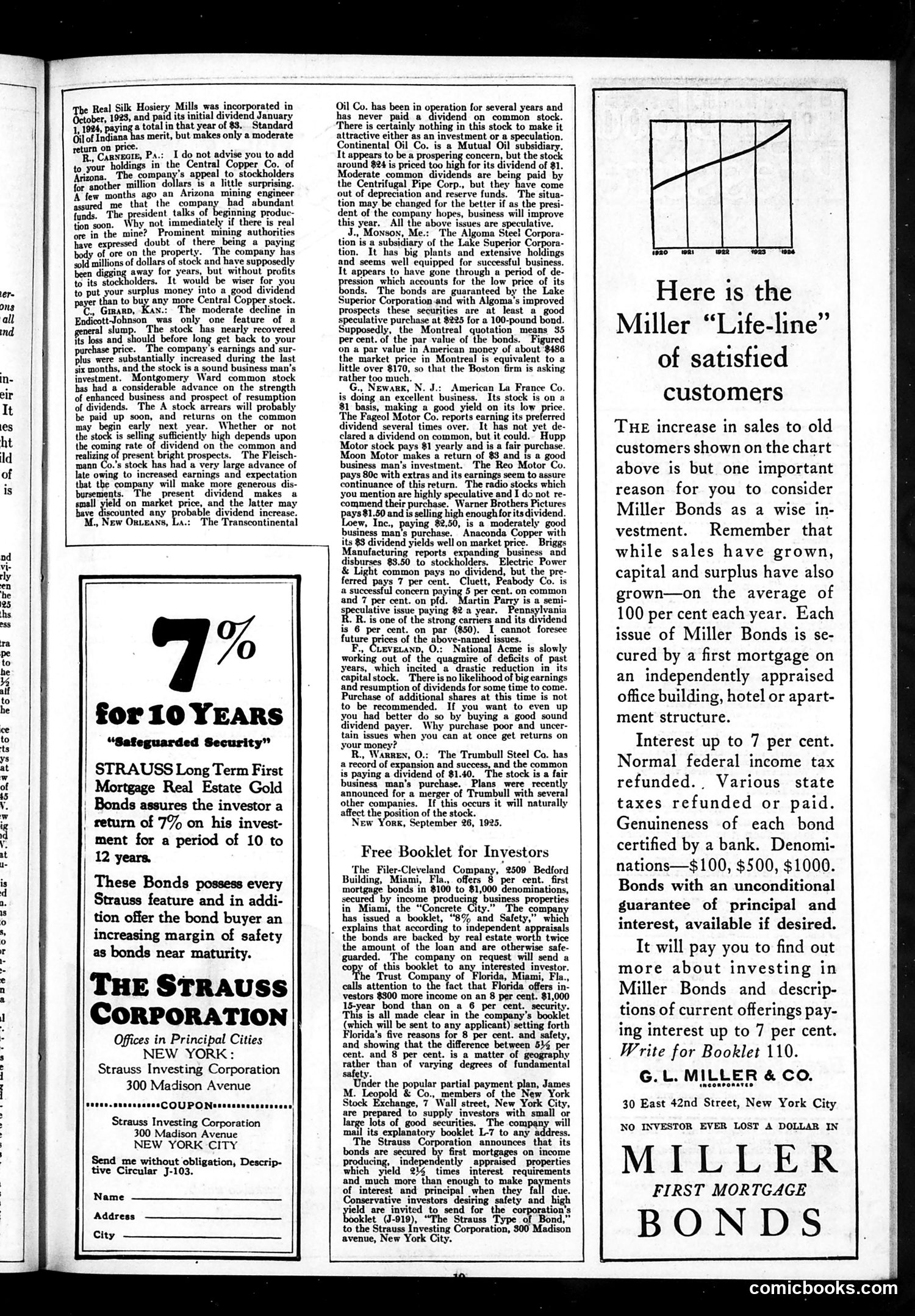
This page contains **investment advice columns and financial advertising** rather than political satire or cartoons. The primary content includes: 1. **Reader Q&A Section**: Financial columnist answers investor questions about various stocks and bonds (Central Copper Co., Continental Oil, Algoma Steel, etc.), offering conservative guidance against speculative purchases. 2. **"7% for 10 Years" Advertisement**: Strauss Corporation promotes long-term mortgage bonds as "safeguarded security" with guaranteed returns. 3. **Miller Bonds Advertisement**: G.L. Miller & Co. advertises "First Mortgage Bonds" emphasizing safety, claiming "NO INVESTOR EVER LOST A DOLLAR IN MILLER." **Historical Context for Modern Readers**: This reflects pre-1929 stock market optimism and investment marketing. The repeated emphasis on safety and guaranteed returns is darkly ironic given the 1929 crash would devastate investors who trusted such promises. The advertisements showcase how financial institutions marketed securities as risk-free before the Depression proved otherwise.
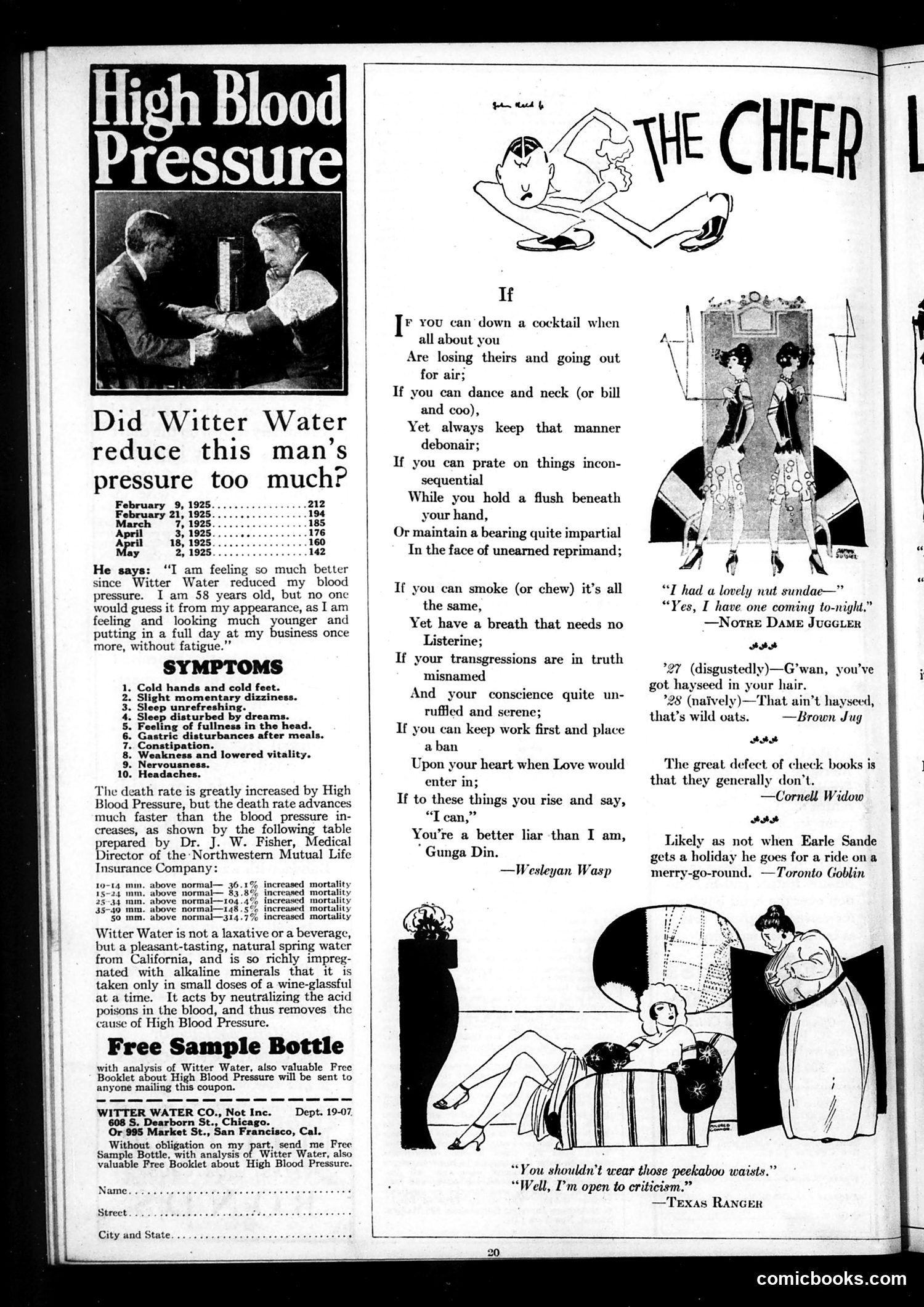
This page contains two distinct elements: **Left side:** An advertisement for Witter Water, a patent medicine claiming to reduce high blood pressure. It includes testimonial from a 58-year-old man, lists symptoms of hypertension, mortality statistics, and promotes the product as a natural spring water with alkaline minerals that allegedly neutralizes "acid poisons in the blood." A coupon offers a free sample bottle—typical of 1920s medical advertising before FDA regulation. **Right side:** "The Cheer," a poem mimicking Kipling's "If—" that satirizes 1920s social hypocrisy—the ability to appear carefree while engaging in questionable behavior (drinking cocktails during Prohibition, "necking," gambling, infidelity). It concludes the person performing such duplicity is "a better liar than I am." Below are humorous college jokes about sundaes, hairstyles, and social behavior—typical filler content in Judge magazine. **Context:** This reflects the Jazz Age's moral tensions and the contemporary obsession with dubious patent medicines before modern pharmaceutical regulation.
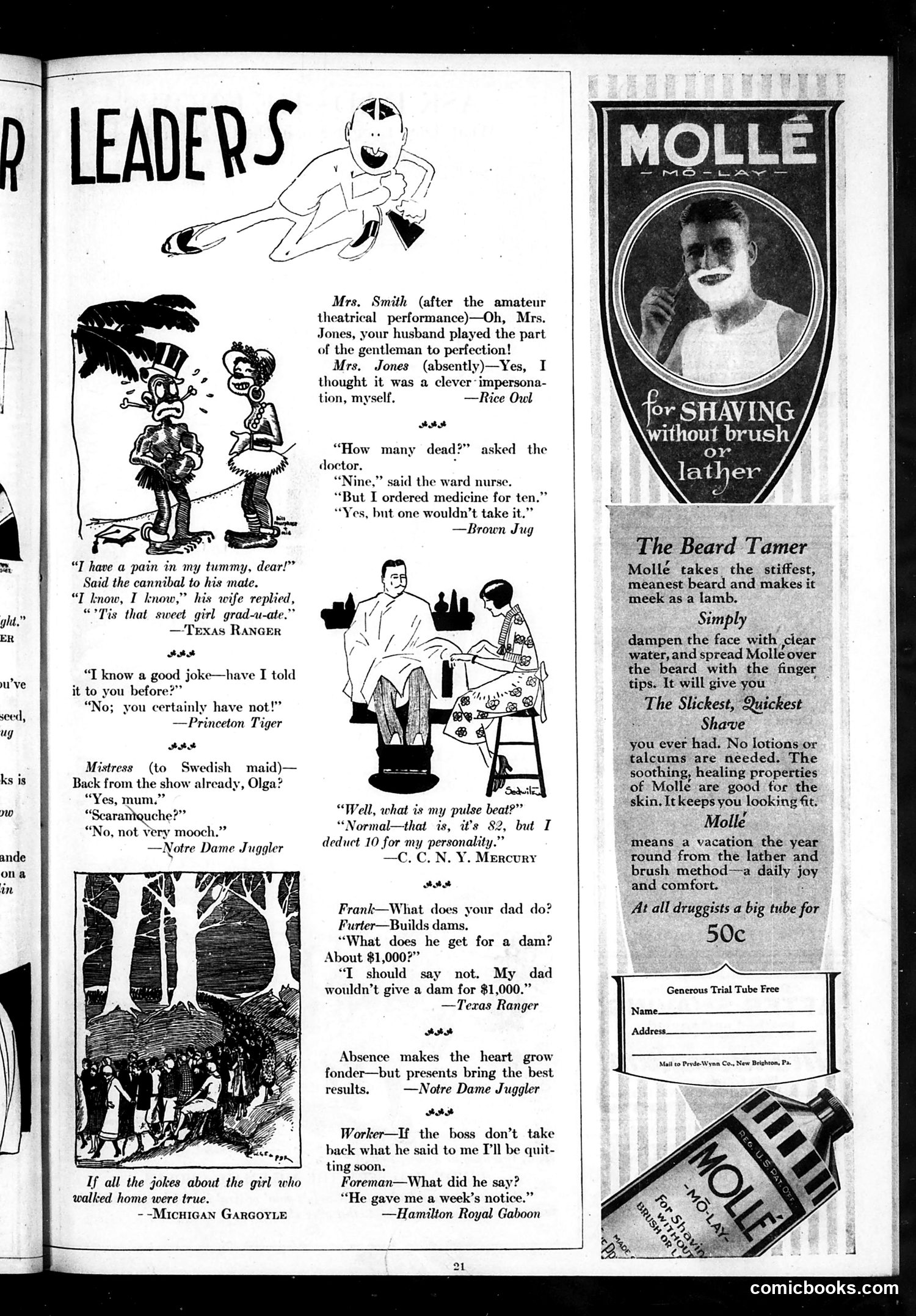
This page from *Judge* magazine contains primarily **humor columns** rather than political cartoons. The content consists of short jokes and witticisms sourced from college publications (Princeton Tiger, Rice Owl, Notre Dame Juggler) and regional humor sources (Texas Ranger, Hamilton Royal Baboon). The jokes reflect early 20th-century American humor conventions: marital quips, workplace comedy, and absurdist wordplay. Notable examples include a cannibal joke about a "sweet girl graduate" (poking fun at educated women), a doctor's dark humor about patient mortality, and a pun about a father unwilling to "give a dam" for money. The page also contains a **Mollé shaving cream advertisement**, which uses the phrase "The Beard Tamer"—a period-appropriate product endorsement unrelated to the editorial content. The cartoons shown are simple line drawings illustrating specific jokes rather than standalone political commentary. Overall, this represents *Judge*'s lighter entertainment content rather than its satirical editorial voice.
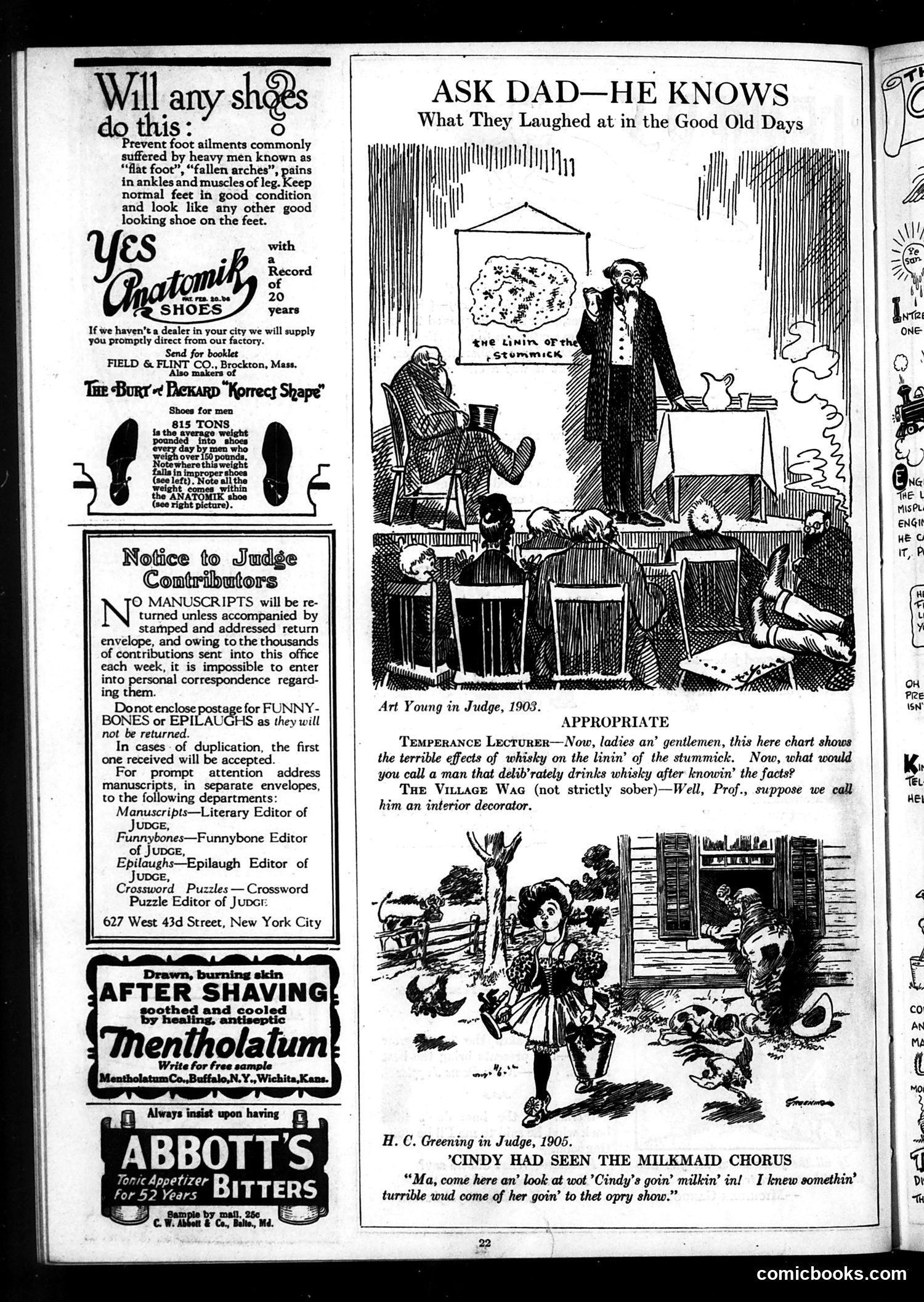
This page showcases Judge's satirical humor from the early 1900s. The two main cartoons ridicule social hypocrisy: **First cartoon (1903):** A temperance lecturer uses charts to warn about whisky's effects on the stomach lining while addressing an audience. The Village Wag—depicted as a drunk—quips that such a man would be an "interior decorator," suggesting the lecturer is decorating his own stomach's interior with whisky. The satire targets temperance reformers' self-righteousness. **Second cartoon (1905):** A mother scolds her daughter for wearing scandalous theatrical costume while "milking"—implying the girl's outfit is inappropriately revealing. The joke mocks working-class anxieties about theater's corrupting influence on morality. Both cartoons use dialect and class markers (rural/lower-class speech patterns) typical of early 20th-century American humor. The page also contains period advertisements and submission guidelines for the magazine's humor sections.
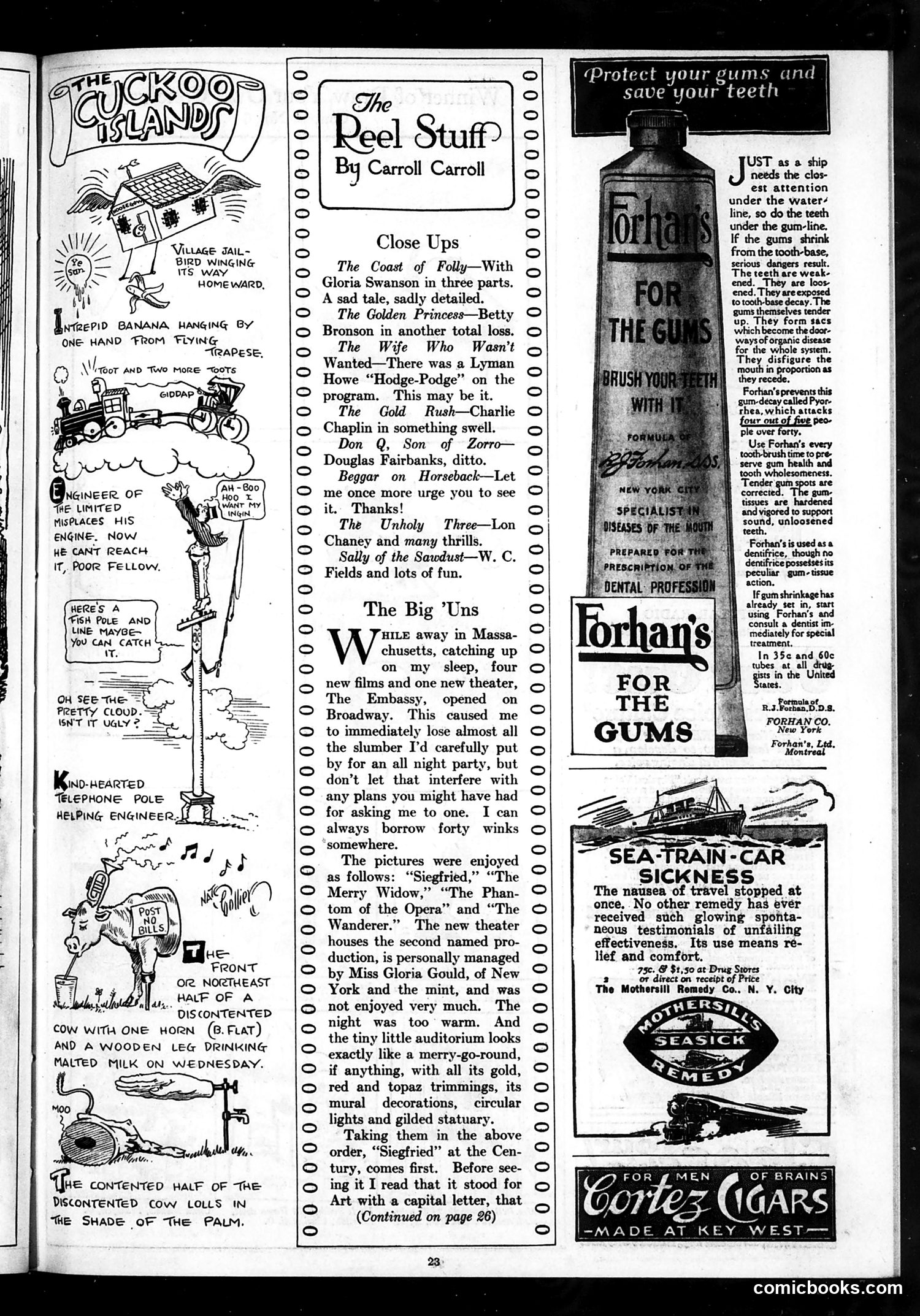
**Left side:** A whimsical cartoon by an artist (signature unclear) depicting absurdist, nonsensical scenarios—a banana hanging from a flying trapeze, a discontented cow with one horn and wooden leg drinking malted milk. This appears to be purely comedic surrealism with no political message; it's simply meant to be silly and entertain readers with illogical imagery. **Center:** Carroll Carroll's film review column critiquing recent movies (Gloria Swanson, Charlie Chaplin, Douglas Fairbanks, Lon Chaney). The reviewer describes attending a new Broadway theater, The Embassy, managed by "Miss Gloria Gould," finding it uncomfortable and architectural oddities. This is straightforward entertainment criticism—gossipy and sarcastic about contemporary cinema and theater. **Right side:** Period advertisements for Forhan's gum treatment product and Mothersill's seasickness remedy—standard commercial pitches common to 1920s magazines. No clear political satire or social commentary appears on this page; it's primarily entertainment and advertising content.
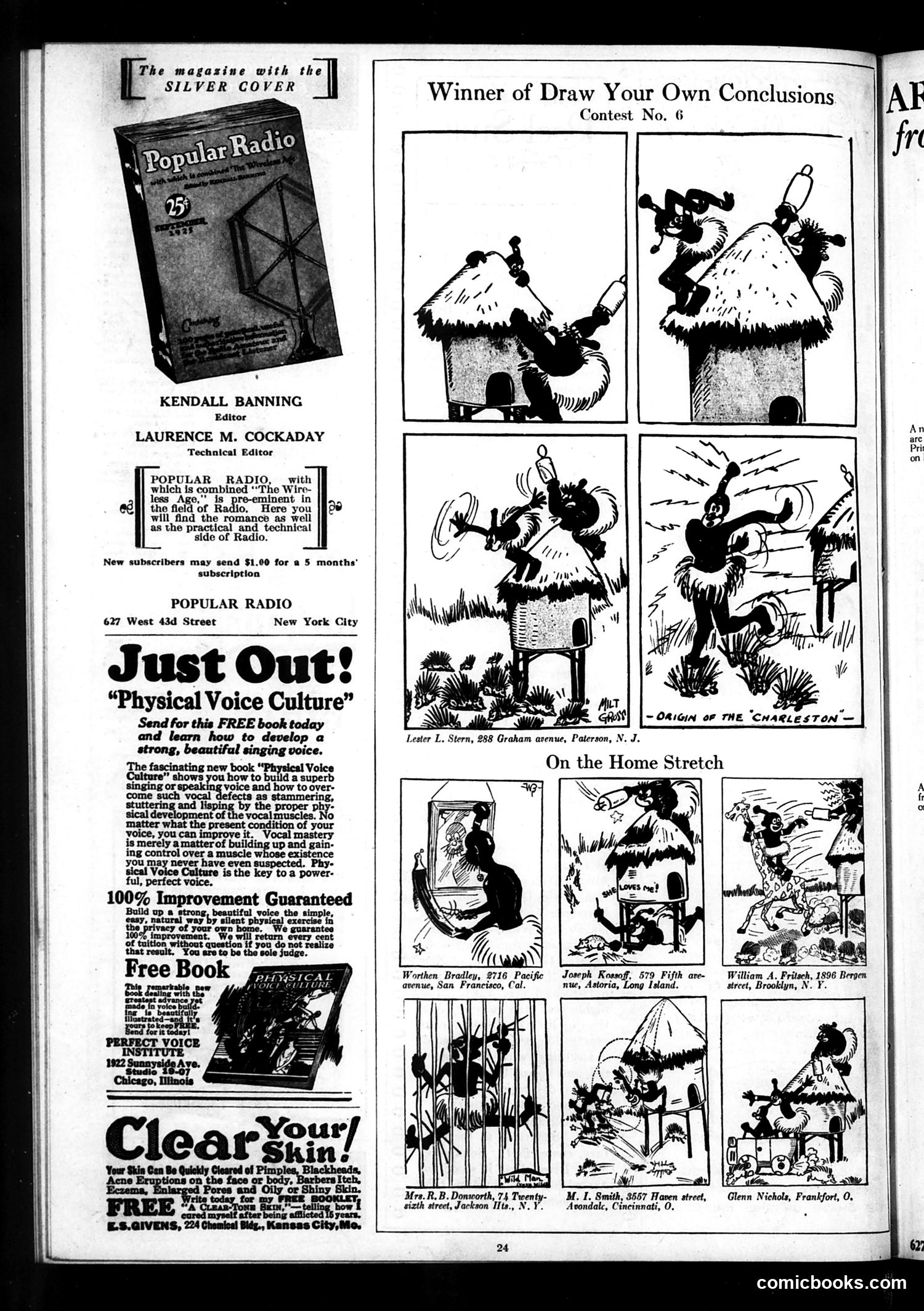
This page combines advertising with a "Draw Your Own Conclusions" cartoon contest (Contest No. 6). The four-panel cartoon at top shows a character—appears to be an anthropomorphic animal or creature—interacting with a mushroom-shaped hut, culminating in a panel labeled "Origin of the Charleston," referencing the popular 1920s dance craze. Below, "On the Home Stretch" displays six submitted reader drawings with captions showing where contestants lived (various U.S. cities). The contest appears to be about visual interpretation or completion of a narrative. The surrounding ads promote "Physical Voice Culture" self-help and skin-clearing products—typical period advertising. Without clearer OCR or visible bylines, the specific satirical point of the Charleston cartoon remains unclear, though it likely pokes fun at the dance's wild popularity or origins among younger generations during the Jazz Age.
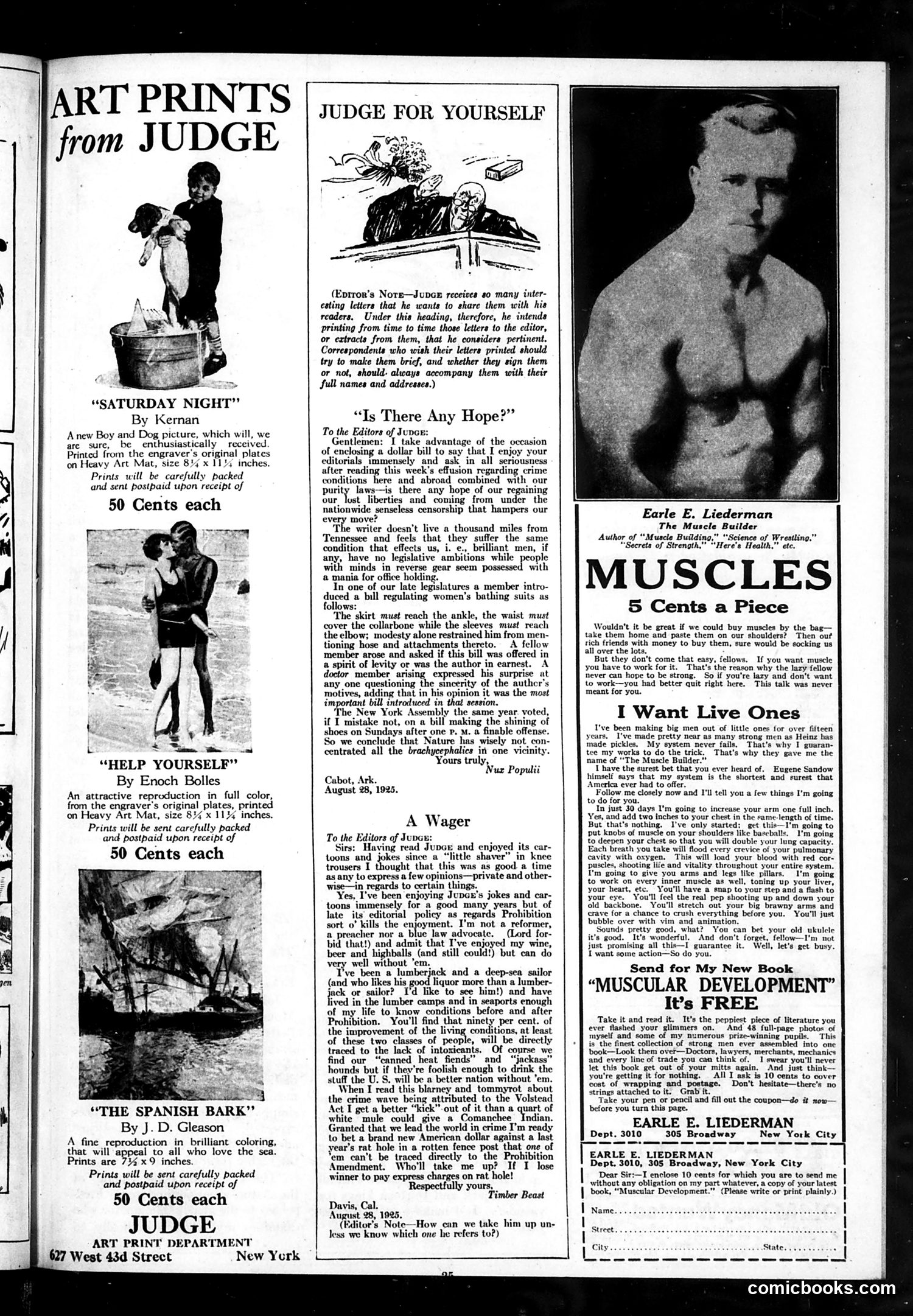
This page is primarily **advertising for art prints** rather than political satire. Judge's art department offers three reproductions for 50 cents each: "Saturday Night" (boy and dog), "Help Yourself" (by Enoch Bolles), and "The Spanish Bark" (seascape). The satirical content appears in the "Judge For Yourself" reader letters section, where Judge publishes correspondence. Two letters critique American governance and Prohibition: 1. A writer from Arkansas questions whether there's "any hope" of regaining "lost liberties" under "senseless censorship," citing absurd legislative attempts (like regulating women's bathing suits to ankle-length and banning shoe-shining on Sundays). The satire targets government overreach and what the writer sees as foolish lawmakers. 2. A second letter from someone who's enjoyed Judge for years expresses frustration with the magazine's anti-Prohibition editorial stance, though he admits enjoying alcohol himself. The page reflects 1920s debates over Prohibition, censorship, and government morality legislation—issues Judge apparently opposed editorially.
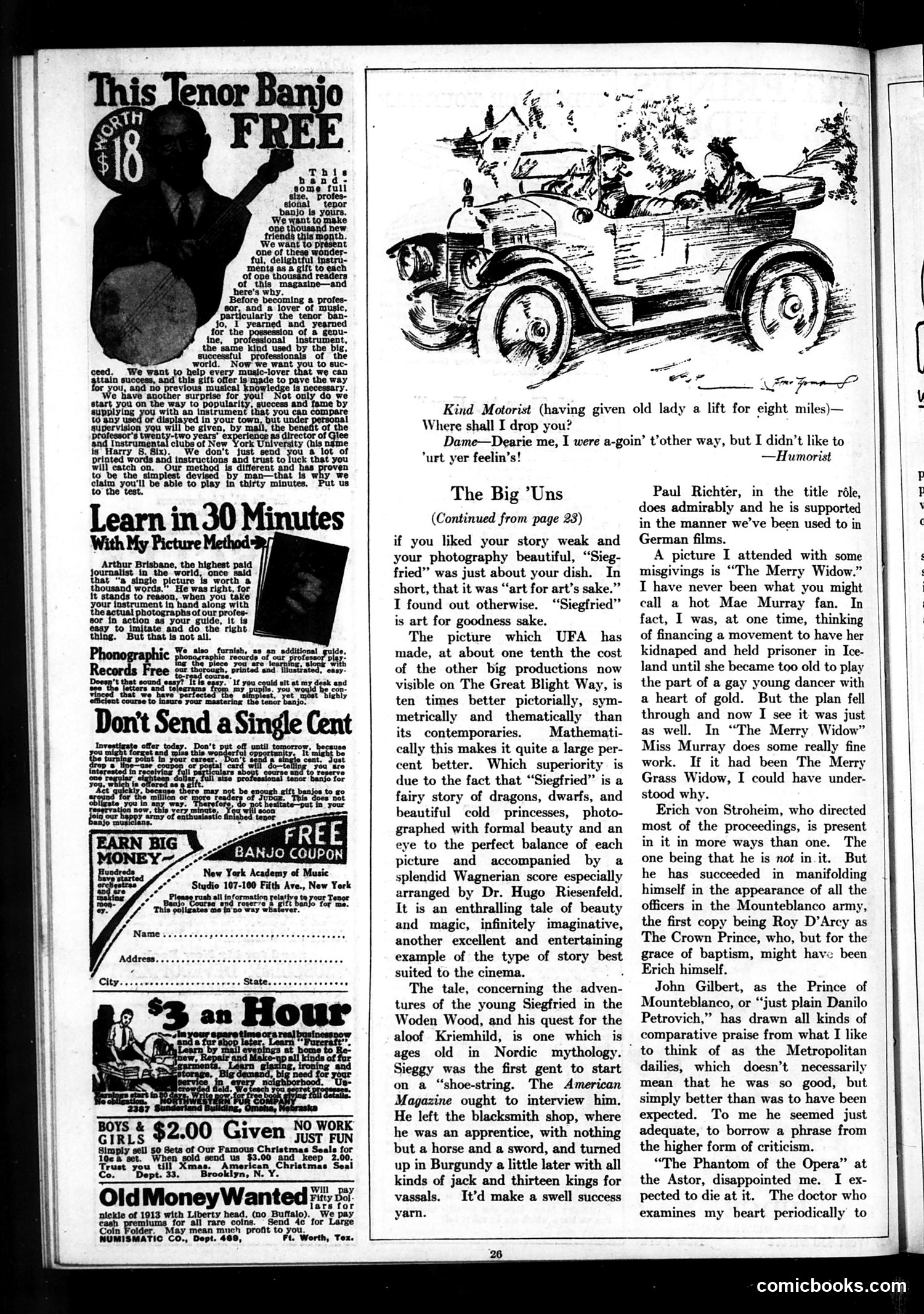
This page contains primarily **advertising and entertainment reviews** rather than political satire. The main cartoon depicts a humorous driving scenario: a kind motorist who gave an elderly woman a ride asks where to drop her off. She responds that she was going the other way but didn't want to hurt his feelings—a gentle joke about politeness and awkward social situations. The bulk of the page consists of **movie reviews** by what appears to be a film critic, discussing German films like "Siegfried" (a UFA production) and "The Merry Widow" starring Mae Murray. The critic praises "Siegfried" for its visual composition and Wagnerian score, while defending Mae Murray's performance in "The Merry Widow" against his previous skepticism. The page also features numerous **advertisements** for correspondence courses (banjo lessons, photography, music instruction) and money-making schemes—typical of 1920s-era magazines—rather than satirical political content.
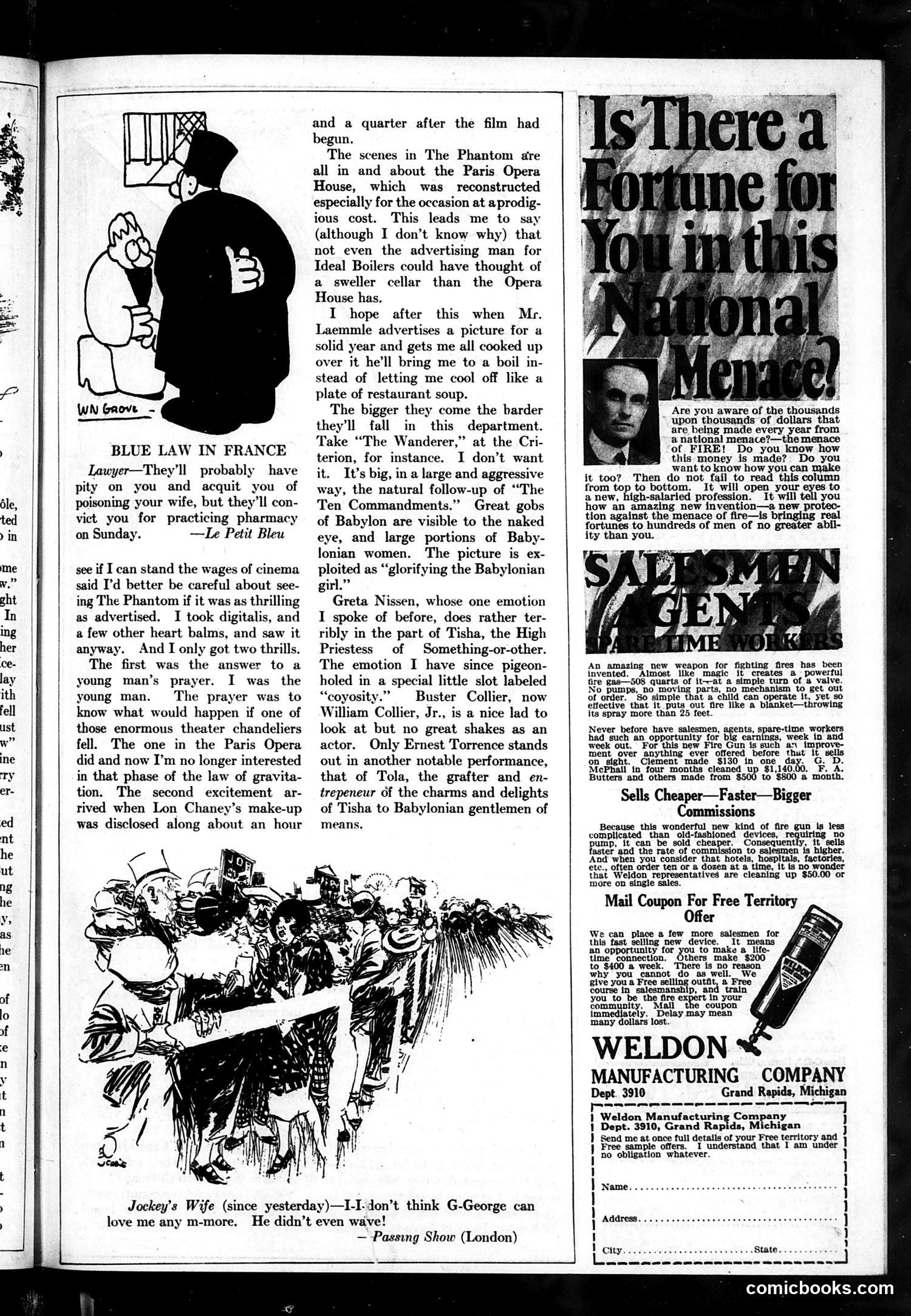
This page contains film reviews and advertisements from an earlier era of American journalism. **The "Blue Law in France" cartoon** satirizes French legal absurdity: a lawyer jokes that courts will acquit a man of poisoning his wife but convict him of practicing pharmacy on Sunday—mocking strict religious laws ("blue laws") that prohibit work on Sundays. **The film reviews** critique contemporary movies. The author attended *The Phantom of the Opera* (the famous Lon Chaney horror film) and found it disappointing despite hype and expensive sets. He also dismisses *The Wanderer*, a Biblical epic "glorifying the Babylonian girl," criticizing actress Greta Nissen's limited emotional range and praising only Ernest Torrence's performance. **The "Jockey's Wife" caption** is a humorous British item about a newlywed who cries because her husband didn't wave—trivial romantic disappointment. **The advertisements** (Weldon Manufacturing Company's fire suppression device, Salesman's Gen magazine) are standard period sales pitches promising easy wealth to salesmen.
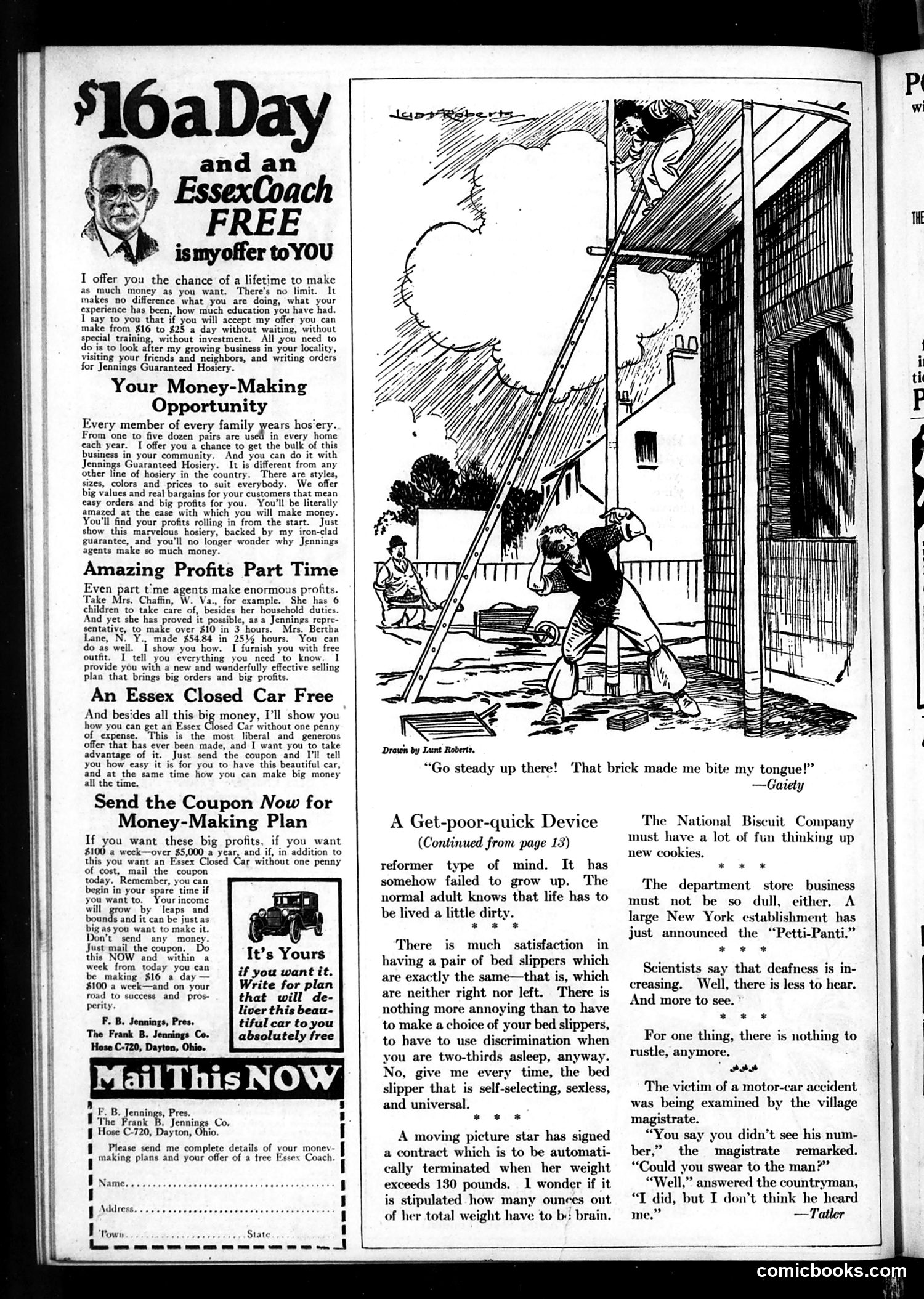
This page contains primarily **commercial advertising**, not political satire. The main content is a "get-rich-quick" scheme by the Frank B. Jennings Company offering $16-$25 daily income selling hosiery, with a free Essex automobile as incentive. The **cartoon** (credited to Lord Roberts) depicts a construction worker ascending scaffolding, complaining "That brick made me bite my tongue!" It's a simple workplace humor joke, unrelated to the advertisements. The brief text column below includes a humorous commentary titled "A Get-poor-quick Device," which appears to be *satirizing* such schemes—contrasting the advertiser's promises with reality. The hosiery ad itself represents the type of dubious "opportunity" that *Judge* magazine (as satire publication) likely meant to mock through juxtaposition. The references to specific women's earnings ($10 in 3 hours, $54.84 in 25½ hours) are typical period sales-pitch tactics, making exaggerated income claims seem credible through anecdotes.
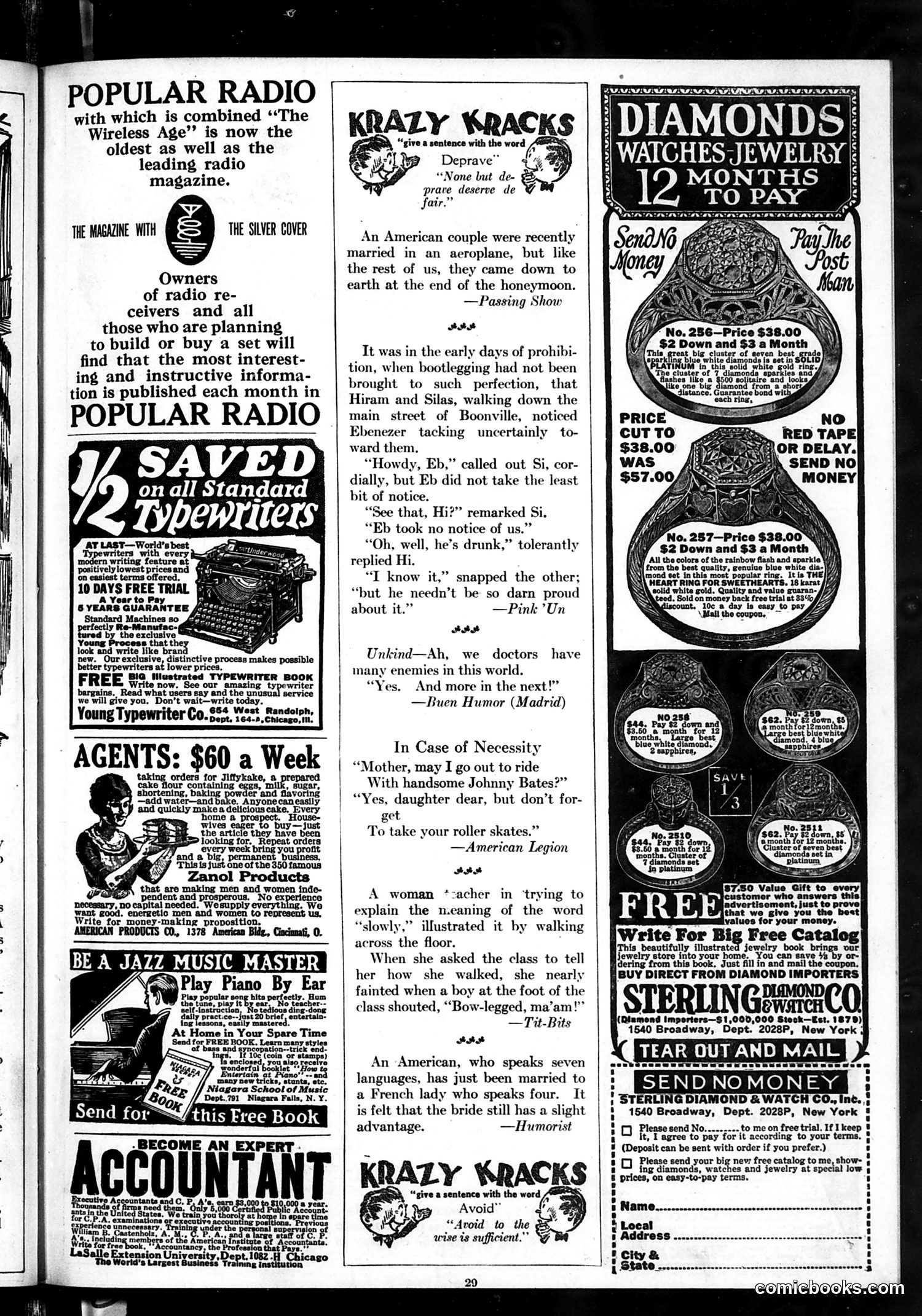
This page is primarily **advertising and humor content** rather than political satire. The main features include: **"Krazy Kracks"** sections: Brief jokes playing on words or situations—a humor column standard for magazines of this era. Examples include jokes about Prohibition-era bootlegging, a woman teacher demonstrating "slowly" by walking bow-legged, and linguistic humor about a multilingual couple. **Advertisements dominate**: Including typewriters, jewelry, accounting courses, and piano lessons—typical 1920s-30s product pitches offering payment plans and free catalogs. The humor reflects period concerns: Prohibition enforcement, courtship customs, and language barriers. The jokes are genteel, family-friendly wordplay rather than sharp political commentary. This appears to be a general-interest satirical magazine mixing light social humor with commercial advertisements.
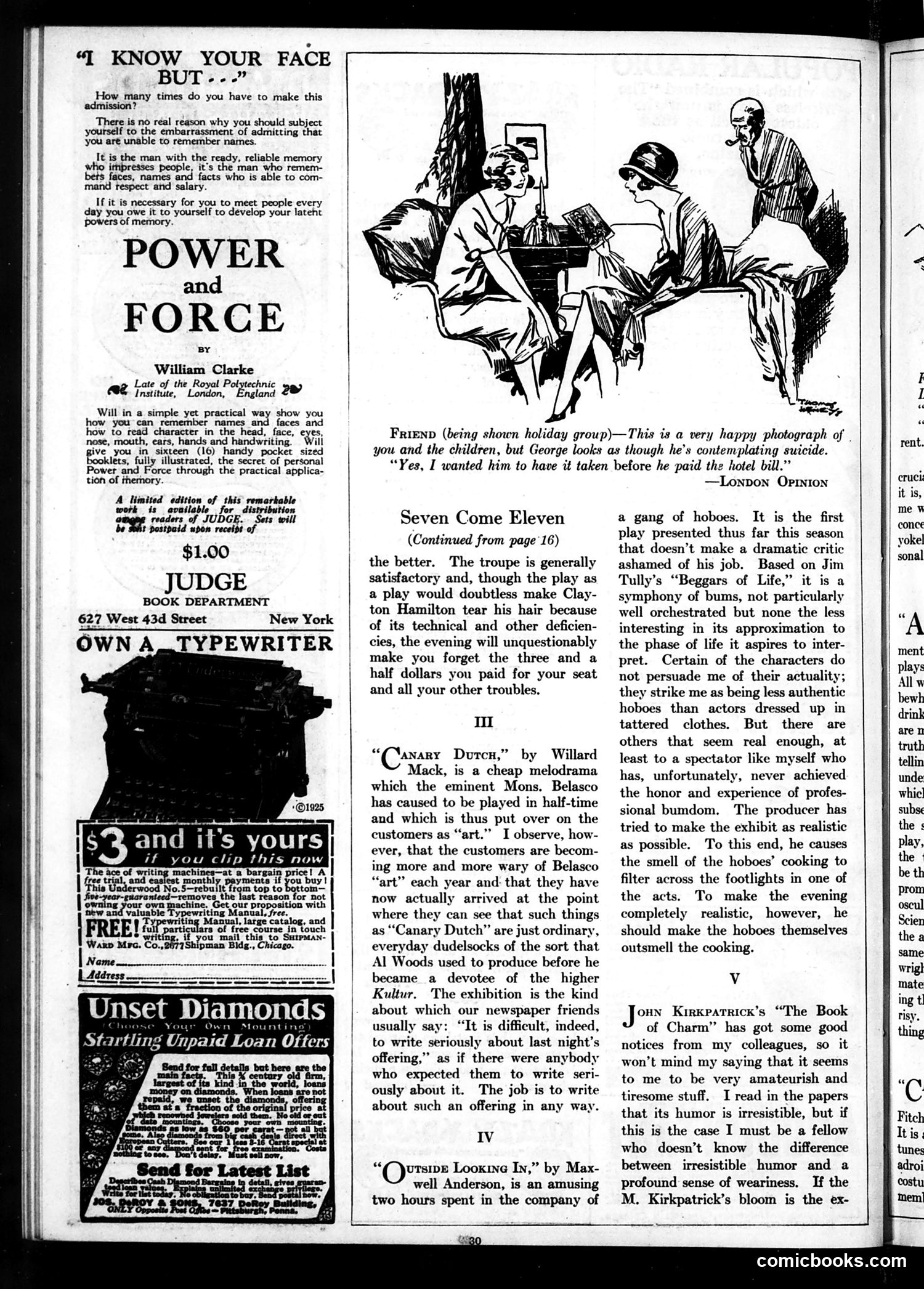
**Main Cartoon (Top Right):** Shows a woman displaying a holiday photograph to a friend. The friend compliments the picture but notes that "George looks as though he's contemplating suicide." The woman replies she wanted the photo taken before George "paid the hotel bill"—a joke about the financial burden of vacation costs causing marital despair. This satirizes the expense and stress of holidays. **Page Content:** Primarily consists of theatrical reviews and advertisements. The reviews critique several plays: "Seven Come Eleven" (a troupe play), "Canary Dutch" (a Belasco melodrama dismissed as cheap), and "Outside Looking In" (based on Jim Tully's "Beggars of Life," praised as genuinely interesting). **Advertisements:** Include memory-training courses, typewriter sales, and diamond offers—typical 1920s magazine advertising targeting middle-class readers. The page reflects Judge's satirical approach to contemporary American life and entertainment, mixing humor with consumer advertising.
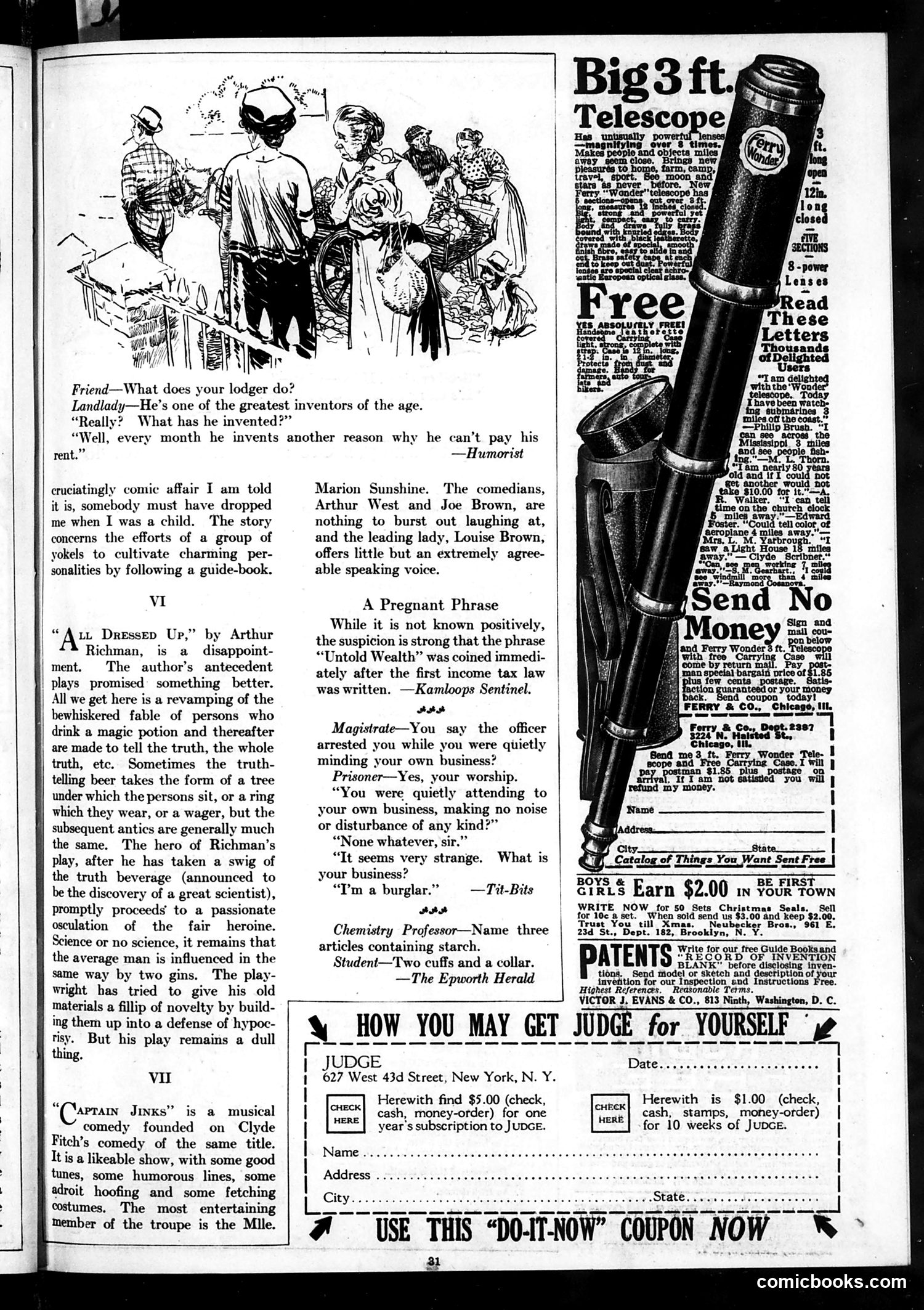
This page contains theatrical reviews and satirical humor typical of Judge magazine's content. **The Main Cartoon** (top left) shows a group of people gathered around what appears to be a guide-book, illustrating the joke below: a landlord complains that his tenant is "one of the greatest inventors of the age"—inventing monthly excuses for not paying rent. The satire targets both chronic debtors and their creative excuses. **Theater Reviews** critique three plays, including "All Dressed Up" by Arthur Richman, which recycled the tired plot device of a truth-telling potion forcing honest behavior. The reviewer dismisses it as derivative hack work. **Shorter Humor Pieces** include jokes about income tax (suggesting "Untold Wealth" was coined after tax laws), a burglar caught by police while conducting his "business," and a student listing cuffs and collars as starch-containing items. The page is primarily **advertising and subscription offers** for Judge itself, plus products like Christmas seals and patent services—standard magazine filler of the era.
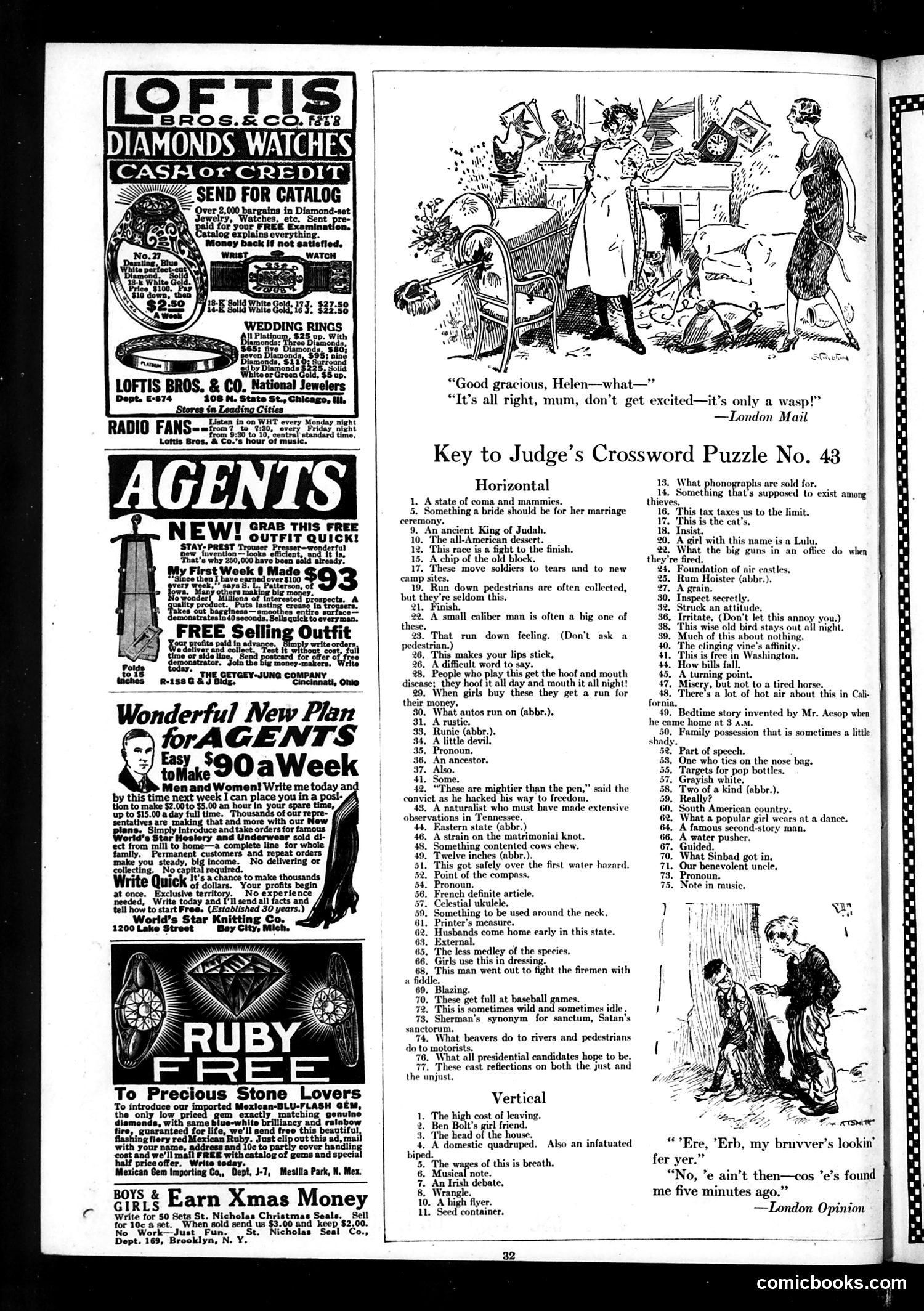
This page consists primarily of **advertisements and a crossword puzzle**, not satirical editorial content. The only cartoon visible shows a domestic scene: a woman is alarmed by what appears to be a wasp indoors, while another figure (likely a maid or servant) reassures her not to panic. The caption attributes this to the *London Mail*, suggesting it's reprinted humor about class dynamics—the working-class character calmly handling a situation that panics the upper-class woman. The rest of the page features period advertisements (jewelry, radio equipment, knitting kits, Christmas cards) and the answers/clues to Judge's crossword puzzle #43. The ads reveal the magazine's audience: middle-class Americans interested in mail-order opportunities, jewelry, and holiday merchandise. The cartoon's only satirical point is gentle mockery of women's supposed nervousness and reliance on servants.
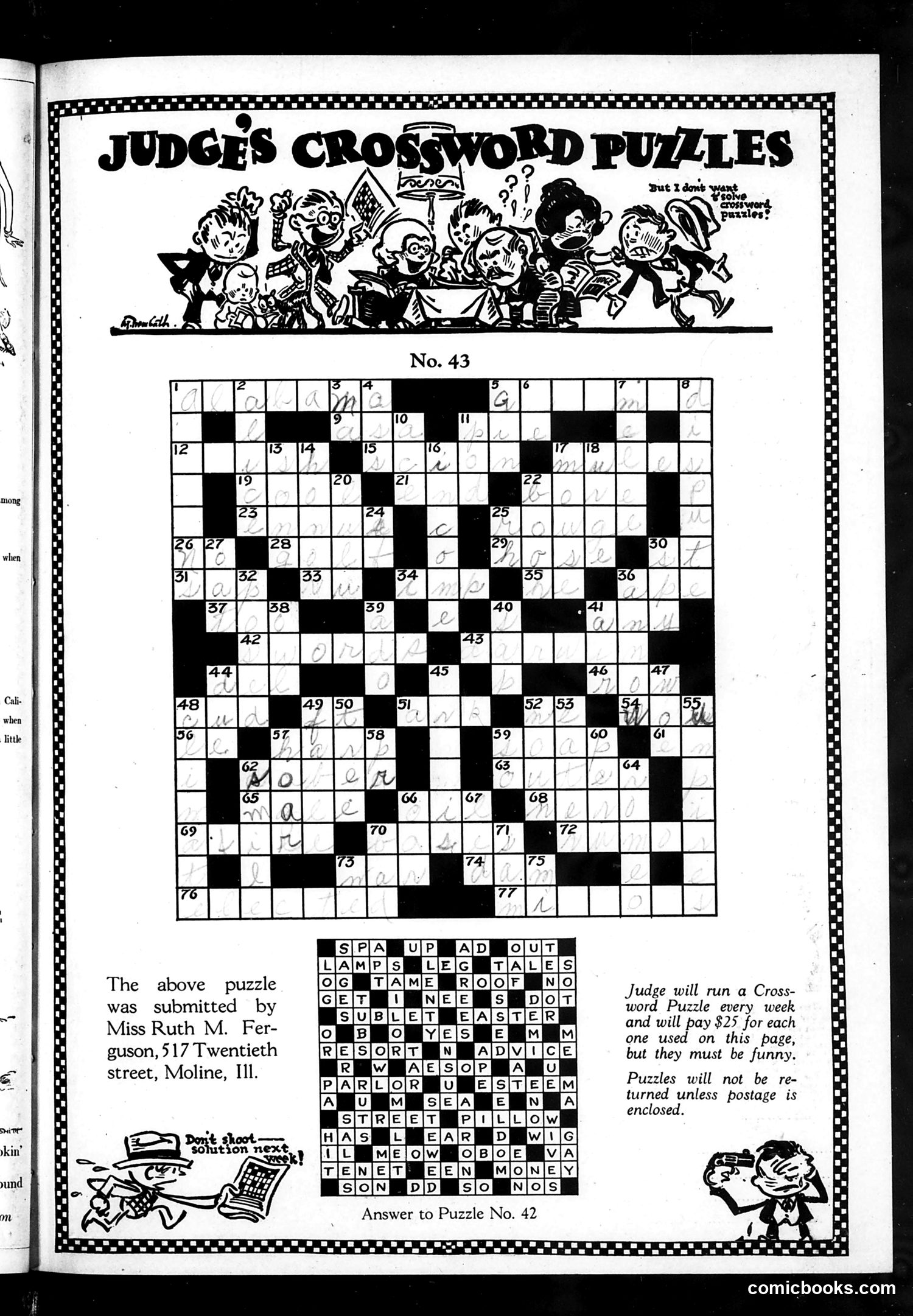
This page features a crossword puzzle submission from a reader (Miss Ruth M. Ferguson of Moline, Illinois). The masthead cartoon shows children enthusiastically engaged with puzzles—reflecting the 1920s-30s crossword craze that had swept America. The page includes: - The numbered crossword grid itself - The answer key to the previous week's puzzle (No. 42) - Small cartoons at bottom corners (one labeled "Don't shoot next time!") - A notice that Judge pays $25 for submitted puzzles that are "funny" The content is straightforward puzzle entertainment rather than political satire. It represents Judge magazine's pivot toward lighter, reader-interactive content. The emphasis on humor ("but they must be funny") suggests the magazine sought puzzles with witty or clever themes beyond standard crossword fare, appealing to readers during the Depression era when such affordable home entertainment was popular.
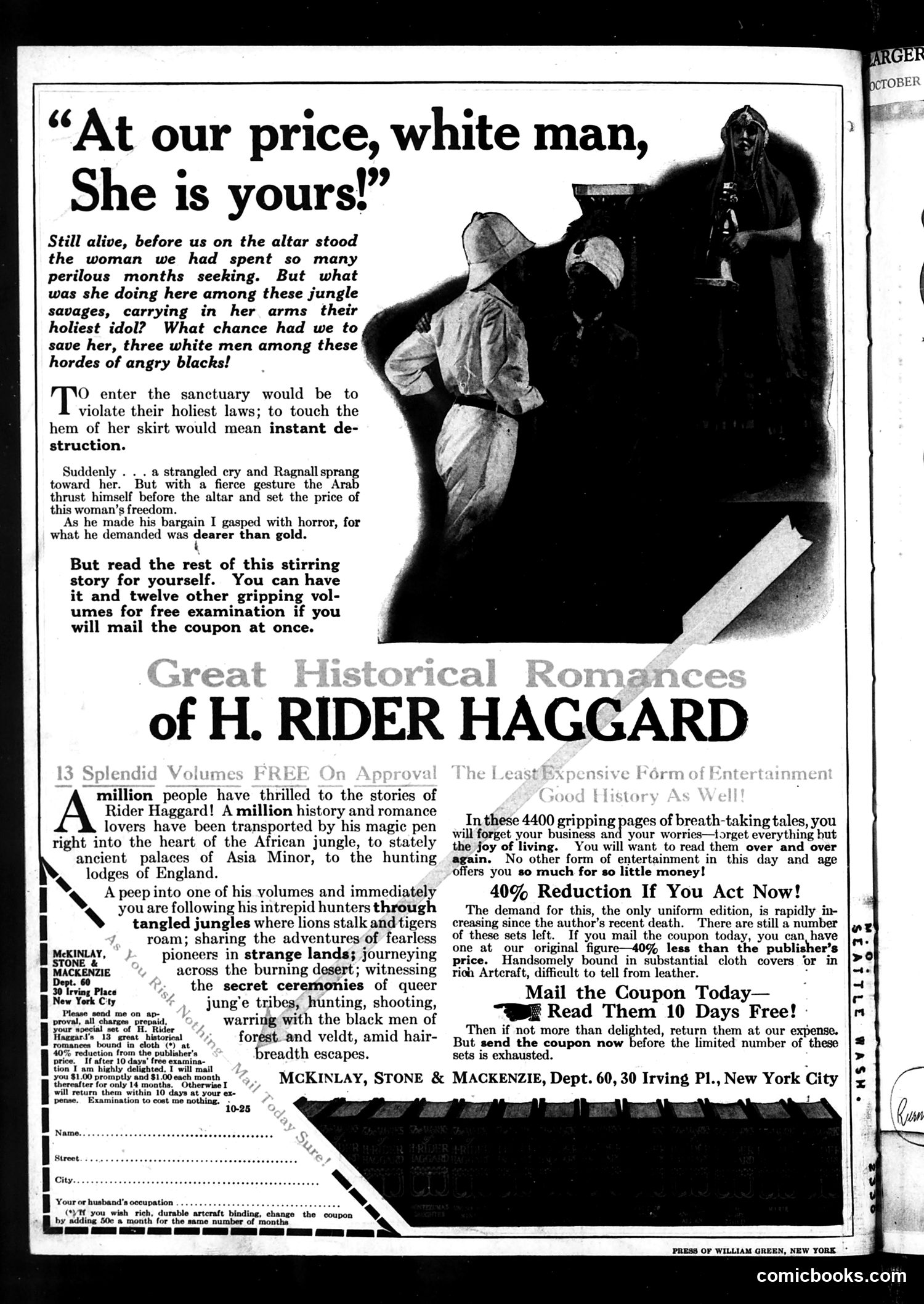
This page is primarily **advertising**, not political satire. It promotes H. Rider Haggard's collected adventure novels through a book club offer. The advertisement uses a dramatic scene depicting colonial-era adventure fiction: white explorers attempting to "rescue" a white woman from an African setting, with an Arab figure negotiating her "price." This imagery reflects the racist tropes common in late 19th/early 20th-century adventure literature—narratives centered on white protagonists saving European women from non-white peoples. The satire, if present, appears subtle or implicit: the ad may be gently mocking the overwrought melodrama and racial stereotypes inherent in Haggard's work itself. However, the advertisement primarily aims to *sell* these books by emphasizing their thrilling adventure and exotic settings, suggesting the publisher wasn't critiquing but rather capitalizing on these popular racial and gender dynamics. The "40% reduction" offer and coupon structure indicate this is straightforward commercial promotion rather than editorial commentary.