
Judge, 1925-10-03 · page 32 of 36
Judge — October 3, 1925 — page 32: what you’re looking at
What you’re looking at
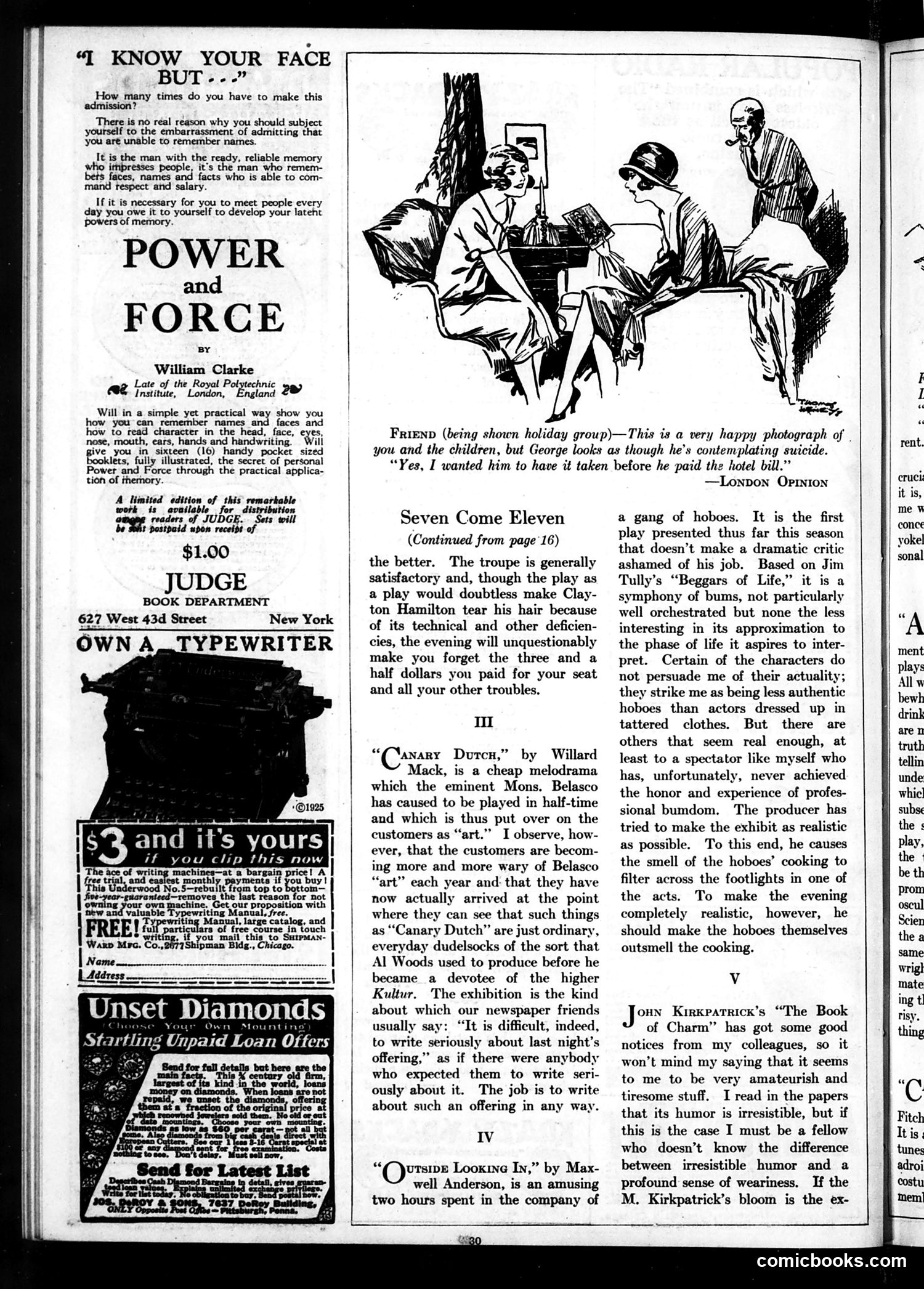
**Main Cartoon (Top Right):** Shows a woman displaying a holiday photograph to a friend. The friend compliments the picture but notes that "George looks as though he's contemplating suicide." The woman replies she wanted the photo taken before George "paid the hotel bill"—a joke about the financial burden of vacation costs causing marital despair. This satirizes the expense and stress of holidays. **Page Content:** Primarily consists of theatrical reviews and advertisements. The reviews critique several plays: "Seven Come Eleven" (a troupe play), "Canary Dutch" (a Belasco melodrama dismissed as cheap), and "Outside Looking In" (based on Jim Tully's "Beggars of Life," praised as genuinely interesting). **Advertisements:** Include memory-training courses, typewriter sales, and diamond offers—typical 1920s magazine advertising targeting middle-class readers. The page reflects Judge's satirical approach to contemporary American life and entertainment, mixing humor with consumer advertising.
📄 Transcribed text from this page (OCR, searchable)
Machine-transcribed from the original scan — historical spelling and the odd misread are preserved.
“| KNOW YOUR FACE BUT...” How many times do you have to make this There is no réal reason why you should subject yourself to the embarrassment of admitting that you aré unable to remember names. It is the man with the ready, reliable memory who ithipresses people, it's the man who remem- bets faces, names and facts who is able to com- mand respect and salary. If it is necessary for you to meet people every day you owe it to yourself to dévelop your lateht powers of memory. POWER FORCE William Clarke Late of the Royal Polytechnic 8B Institute, London, England 2 Will in a simple yet practical sey: show you how you can remember names and faces and how to read character in the head, face, eyes, nose, mouth, ears, hands and handwriting.” Wili ive’ you in sixteen (16) handy pocket sized Bookie, es illustrated, the secret of personal Power and Force through the practical applica- tion of thernory. A limited edition of this remarkable work is available for distribution Fee readers of JUDGE. Sets will be St postpaid upon receipt of $1.00 JUDGE BOOK DEPARTMENT 627 West 43d Street New York OWN A, TYPEWRITER i ; I and it’s yours| if you clip this now A a mont y le oa Ge own ine. Get, sition with and valuable Typewriting Mantal, free. new FREE! ges ay ieee ett Wako Mra. Car sei enloa eee ema | | et Diamonds Own Mounting teey, Frienp (being shown holiday group)—This is a very happy photograph of you and the children, but George looks as though he’s contemplating suicide. “Yes, I wanted him to have it taken before he paid the hotel bill.” Seven Come Eleven (Continued from page 16) the better. The troupe is generally satisfactory and, though the play as a play would doubtless make Clay- ton Hamilton tear his hair because of its technical and other deficien- cies, the evening will unquestionably make you forget the three and a half dollars you paid for your seat and all your other troubles. Il “(NXanany Dotcn,” by Willard Mack, is a cheap melodrama which the eminent Mons. Belasco has caused to be played in half-time and which is thus put over on the customers as “art.”” I observe, how- ever, that the customers are becom- ing more and more wary of Belasco “art” each year and: that they have now actually arrived at the point where they can see that such things as “Canary Dutch” are just ordinary, everyday dudelsocks of the sort that Al Woods used to produce before he became a devotee of the higher Kultur. The exhibition is the kind about which our newspaper friends usually say: “It is difficult, indeed, to write seriously about last night’s offering,” as if there were anybody who expected them to write seri- ously about it. The job is to write about such an offering in any way. IV “(C yortswe Looking In,” by Max- well Anderson, is an amusing two hours spent in the company of —Lonpon Opinion a gang of hoboes. It is the first play presented thus far this season that doesn’t make a dramatic critic ashamed of his job. Based on Jim Tully’s “Beggars of Life,” it is a symphony of bums, not particularly well orchestrated but none the less interesting in its approximation to the phase of life it aspires to inter- pret. Certain of the characters do not persuade me of their actuality; they strike me as being less authentic hoboes than actors dressed up in tattered clothes. But there are others that seem real enough, at least to a spectator like myself who has, unfortunately, never achieved the honor and experience of profes- sional bumdom. The producer has tried to make the exhibit as realistic as possible. To this end, he causes the smell of the hoboes’ cooking to filter across the footlights in one of the acts. To make the evening completely realistic, however, he should make the hoboes themselves outsmell the cooking. Vv oun Kirxparricx’s “The Book of Charm” has got some good notices from my colleagues, so it won’t mind my saying that it seems to me to be very amateurish and tiresome stuff. I read in the papers that its humor is irresistible, but if this is the case I must be a fellow who doesn’t know the difference between irresistible humor and a profound sense of weariness. If the M. Kirkpatrick’s bloom is the ex- comicbooks.com