
Judge, 1925-10-03 · page 15 of 36
Judge — October 3, 1925 — page 15: what you’re looking at
What you’re looking at
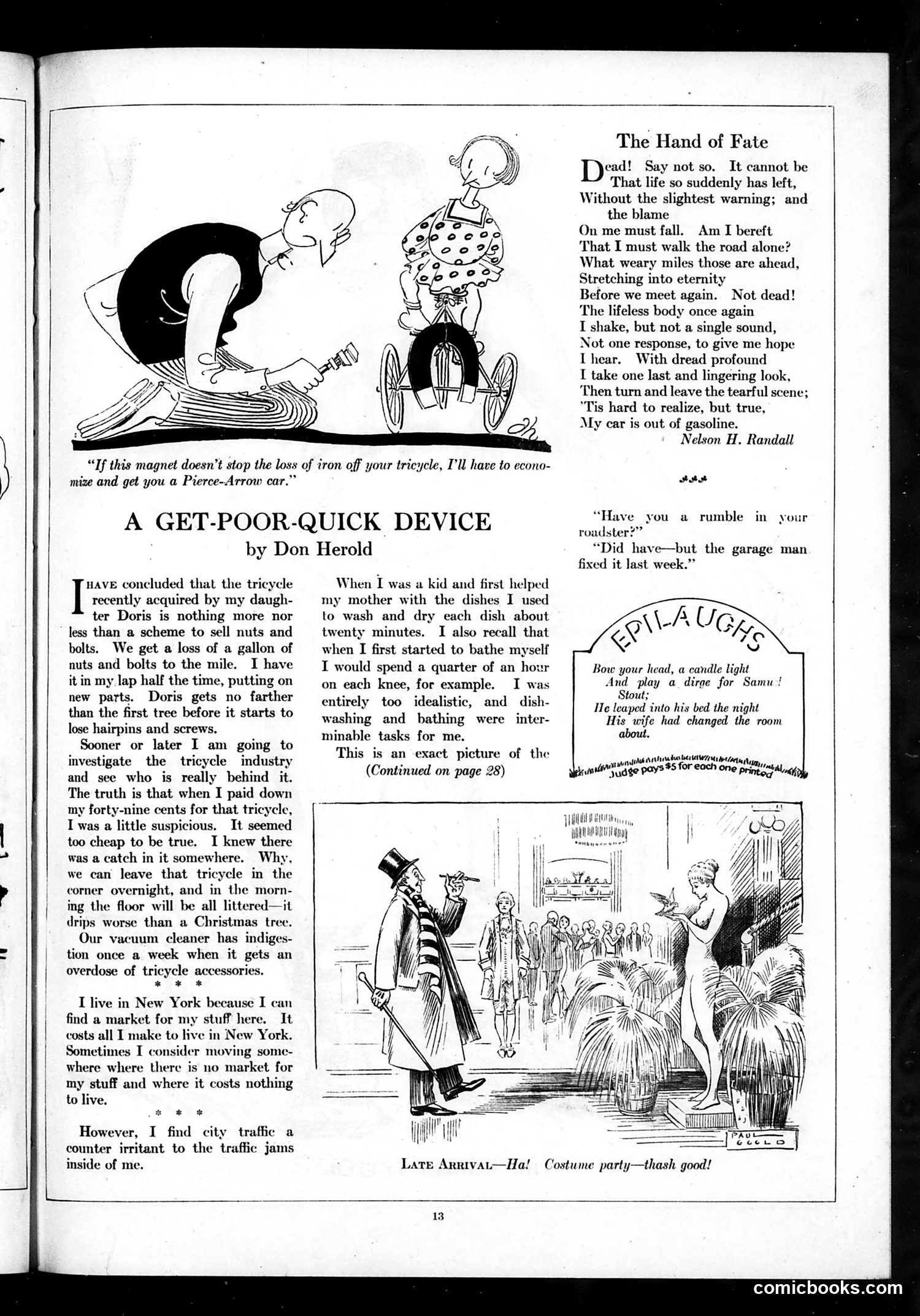
**Main Article/Cartoon**: Don Herold satirizes inexpensive children's tricycles as deliberately defective products designed to generate repeat purchases of replacement parts. The joke: a cheap tricycle ($0.49) loses nuts, bolts, and screws constantly, requiring endless repairs—essentially a "get-poor-quick" scheme disguised as economy. The opening cartoon shows a father using a magnet to retrieve iron parts, threatening to buy his daughter an expensive Pierce-Arrow car instead if the losses continue. **Social Context**: This targets early 20th-century consumer culture and planned obsolescence concerns. The piece contrasts New York City living costs with the tricycle's false economy. **Additional Content**: - "The Hand of Fate" (poem): darkly humorous—a man discovers his car is out of gasoline after finding someone dead - "Reptil-aughs" (jokes): brief humor about car troubles and a wife rearranging bedroom furniture The page reflects period anxieties about shoddy manufacturing and misleading product value.
📄 Transcribed text from this page (OCR, searchable)
Machine-transcribed from the original scan — historical spelling and the odd misread are preserved.
“If this magnet doesn’t stop the loss of iron off your tricycle, I'll have to econo- mize and get you a Pierce-Arrow car.” A GET-POOR-QUICK DEVICE by Don Herold recently acquired by my daugh- ter Doris is nothing more nor less than a scheme to sell nuts and bolts. We get a loss of a gallon of nuts and bolts to the mile. I have it in my lap half the time, putting on new parts. Doris gets no farther than the first tree before it starts to lose hairpins and screws. Sooner or later I am going to investigate the tricycle industry and see who is really behind it. The truth is that when I paid down my forty-nine cents for that tricycle, I was a little suspicious. It seemed too cheap to be true. I knew there was a catch in it somewhere. Why, we can leave that tricycle in the corner overnight, and in the morn- ing the floor will be all littered—it drips worse than a Christmas tree. Our vacuum cleaner has indiges- tion once a week when it gets an overdose of tricycle accessories. *- * * |e concluded that the tricycle L live in New York because I can find a market for my stuff here. It costs all I make to live in New York. Sometimes I consider moving some- where where there is no market for my stuff and where it costs nothing to live. * * * However, I find city traffic a counter irritant to the traffic jams inside of me. When I was a kid and first helped my mother with the dishes I used to wash and dry each dish about twenty minutes. I also recall that when I first started to bathe myself I would spend a quarter of an hour on each knee, for example. I was entirely too idealistic, and dish- washing and bathing were inter- minable tasks for me. This is an exact picture of the (Continued on page 28) The Hand of Fate Dt! Say not so. It cannot be That life so suddenly has left, Without the slightest warning; and the blame On me must fall. Am I bereft ‘That I must walk the road alone? What weary miles those are ahead, Stretching into eternity Before we meet again. Not dead! The lifeless body once again I shake, but not a single sound, Not one response, to give me hope Thear. With dread profound I take one last and lingering look, ‘Then turn and leave the tearful scene; ‘Tis hard to realize, but true, My car is out of gasoline. Nelson H. Randall Ft “Have you a rumble in’ your roadster?” “Did have—but the garage man fixed it last week.” Bow your head, a candle light And play a dirge for Samu! Stout; He leaped into his bed the night His wife had changed the room about. hats be aU dete Nat ein 5 anit se ‘pays $5 for each one pris! hig Late Arrivat—Ha! Costume party—thash good! comicbooks.com