
Judge, 1925-10-03 · page 28 of 36
Judge — October 3, 1925 — page 28: what you’re looking at
What you’re looking at
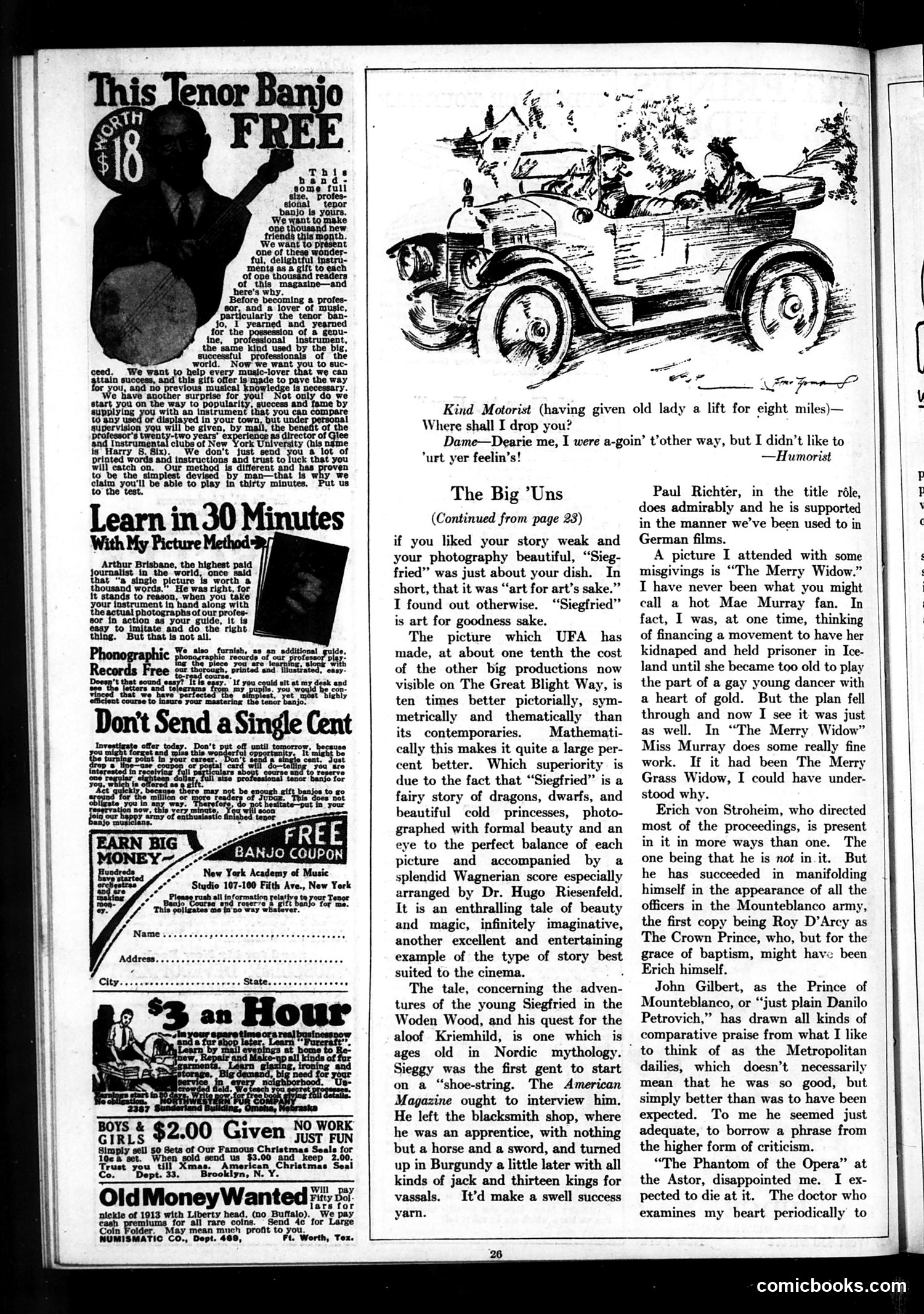
This page contains primarily **advertising and entertainment reviews** rather than political satire. The main cartoon depicts a humorous driving scenario: a kind motorist who gave an elderly woman a ride asks where to drop her off. She responds that she was going the other way but didn't want to hurt his feelings—a gentle joke about politeness and awkward social situations. The bulk of the page consists of **movie reviews** by what appears to be a film critic, discussing German films like "Siegfried" (a UFA production) and "The Merry Widow" starring Mae Murray. The critic praises "Siegfried" for its visual composition and Wagnerian score, while defending Mae Murray's performance in "The Merry Widow" against his previous skepticism. The page also features numerous **advertisements** for correspondence courses (banjo lessons, photography, music instruction) and money-making schemes—typical of 1920s-era magazines—rather than satirical political content.
📄 Transcribed text from this page (OCR, searchable)
Machine-transcribed from the original scan — historical spelling and the odd misread are preserved.
¢ to be the simplest devised is why we on od be able to play in hry a puimtes. Put us Learn in 30 Minutes With My Picture Met artes rl acne a Ez unis ae a a ene fe era ees ‘that Palbpao i > pes 2049 ree ae ree Sc ea Dont: tSend as a Single Cent ef ati New York Academy of Music Stydio 107-100 Fifth Ave., New York eee Sen eR ee ee wet § F550 Given 133 BO ORE Christ: bia bmp th hg hy tie Ae eran sl American Christmas Seal lyn, N.Y. os renee Bit Bol Fit Bel Trust you tll, Xmas. Co. Dept. ‘older. NUMISMATIC CO., Dept. 4 Where shall I drop you? Dame—Dearie me, I were a-goin’ t’other way, but I didn’t like to ’urt yer feelin’s! The Big ’Uns (Continued from page 23) if you liked your story weak and your photography beautiful, “Sieg- fried” was just about your dish. In short, that it was “art for art’s sake.” I found out otherwise. “Siegfried” is art for goodness sake. The picture which UFA has made, at about one tenth the cost of the other big productions now visible on The Great Blight Way, is ten times better pictorially, sym- metrically and thematically than its contemporaries. | Mathemati- cally this makes it quite a large per- cent better. Which superiority is due to the fact that “Siegfried” is a fairy story of dragons, dwarfs, and beautiful cold princesses, photo- graphed with formal beauty and an eye to the perfect balance of each picture and accompanied by a splendid Wagnerian score especially arranged by Dr. Hugo Riesenfeld. It is an enthralling tale of beauty and magic, infinitely imaginative, another excellent and entertaining example of the type of story best suited to the cinema. The tale, concerning the Maven! tures of the young Siegfried in the Woden Wood, and his quest for the aloof Kriemhild, is one which is ages old in Nordic mythology. Sieggy was the first gent to start on a “shoe-string. The American Magazine ought to interview him. He left the blacksmith shop, where he was an apprentice, with nothing but a horse and a sword, and turned up in Burgundy a little later with all kinds of jack and thirteen kings for vassals. It’d make a swell success yarn. Kind Motorist (having given old lady a lift for eight miles)— * to think of as the Metropolitan —Humorist Paul Richter, in the title réle, does admirably and he is supported in the manner we've been used to in German films. A picture I attended with some misgivings is ““The Merry Widow.” I have never been what you might call a hot Mae Murray fan. In fact, I was, at one time, thinking of financing a movement to have her kidnaped and held prisoner in Ice- land until she became too old to play the part of a gay young dancer with a heart of gold. But the plan fell through and now I see it was just as well. In “The Merry Widow” Miss Murray does some really fine work. If it had been The Merry Grass Widow, I could have under- stood why. Erich von Stroheim, who directed most of the proceedings, is present in it in more ways than one. The one being that he is not in.it. But he has succeeded in manifolding himself in the appearance of all the officers in the Mounteblanco army, the first copy being Roy D’Arcy as The Crown Prince, who, but for the grace of baptism, might have been Erich himself. John Gilbert, as the Prince of Mounteblanco, or “just plain Danilo Petrovich,” has drawn all kinds of comparative praise from what I like dailies, which doesn’t necessarily mean that he was so good, but simply better than was to have been expected. To me he seemed just adequate, to borrow a phrase from the higher form of criticism. “The Phantom of the Opera” at the Astor, disappointed me. I ex- PR | pected to die at it. The doctor who examines my heart periodically to comicbooks.com