
A complete issue · 36 pages · 1925
Judge — August 29, 1925
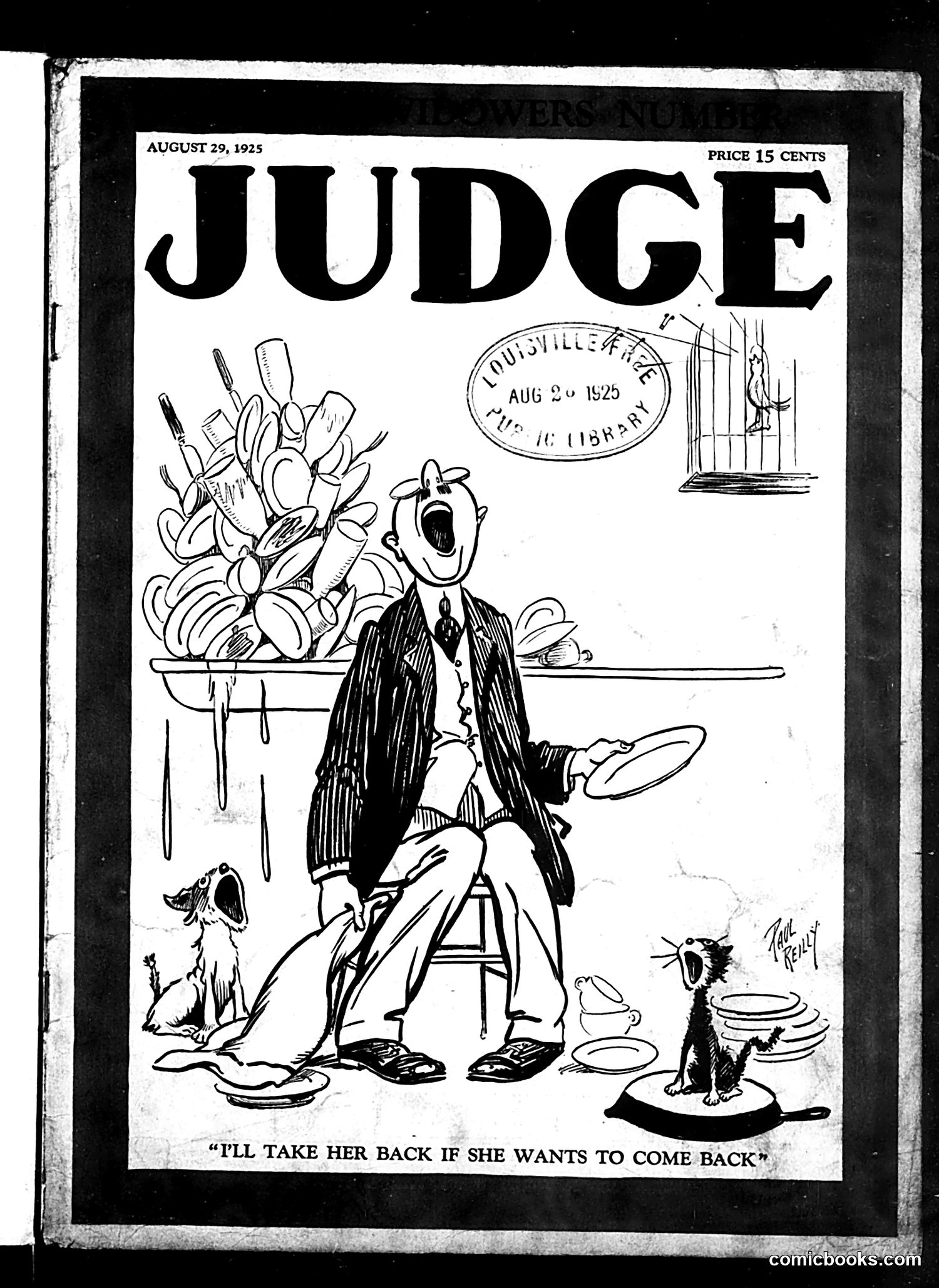
This cover cartoon depicts a man seated amid domestic chaos—dirty dishes, two small dogs, and an overflowing flower arrangement—juggling plates. The caption reads: "I'll Take Her Back If She Wants to Come Back." The satire mocks a husband left to manage household duties after his wife has apparently left him. The cartoon plays on 1920s gender roles: a man demonstrably incompetent at domestic work, surrounded by evidence of his failure (broken dishes, neglected pets). His exasperated expression and the precarious plate-juggling suggest he's overwhelmed. The joke inverts traditional power dynamics—rather than commanding his wife's return, he's desperately offering to accept her back, implying she's better off without him. This reflects period anxieties about changing women's independence during the Jazz Age.
This is a subscription advertisement for *Judge*, a satirical weekly magazine. The image shows a cartoon child being struck in the face ("Biff, bing, right in the eye"), illustrating the magazine's promised "knock-out for ennui"—meaning it offers vigorous entertainment to cure boredom. The ad emphasizes *Judge*'s comedic content: "sparkling, vivacious good humor," satirical commentary on current events, theater reviews, and fearless social criticism targeting "hypocrisy, dullness, provincialism and boredom." The solicitation invites readers to send a dollar for a ten-week subscription. The phrase "Incidentally do it now" in the corner adds urgency. This appears to be early 20th-century promotional material, positioning *Judge* as essential reading for those seeking witty, irreverent entertainment.
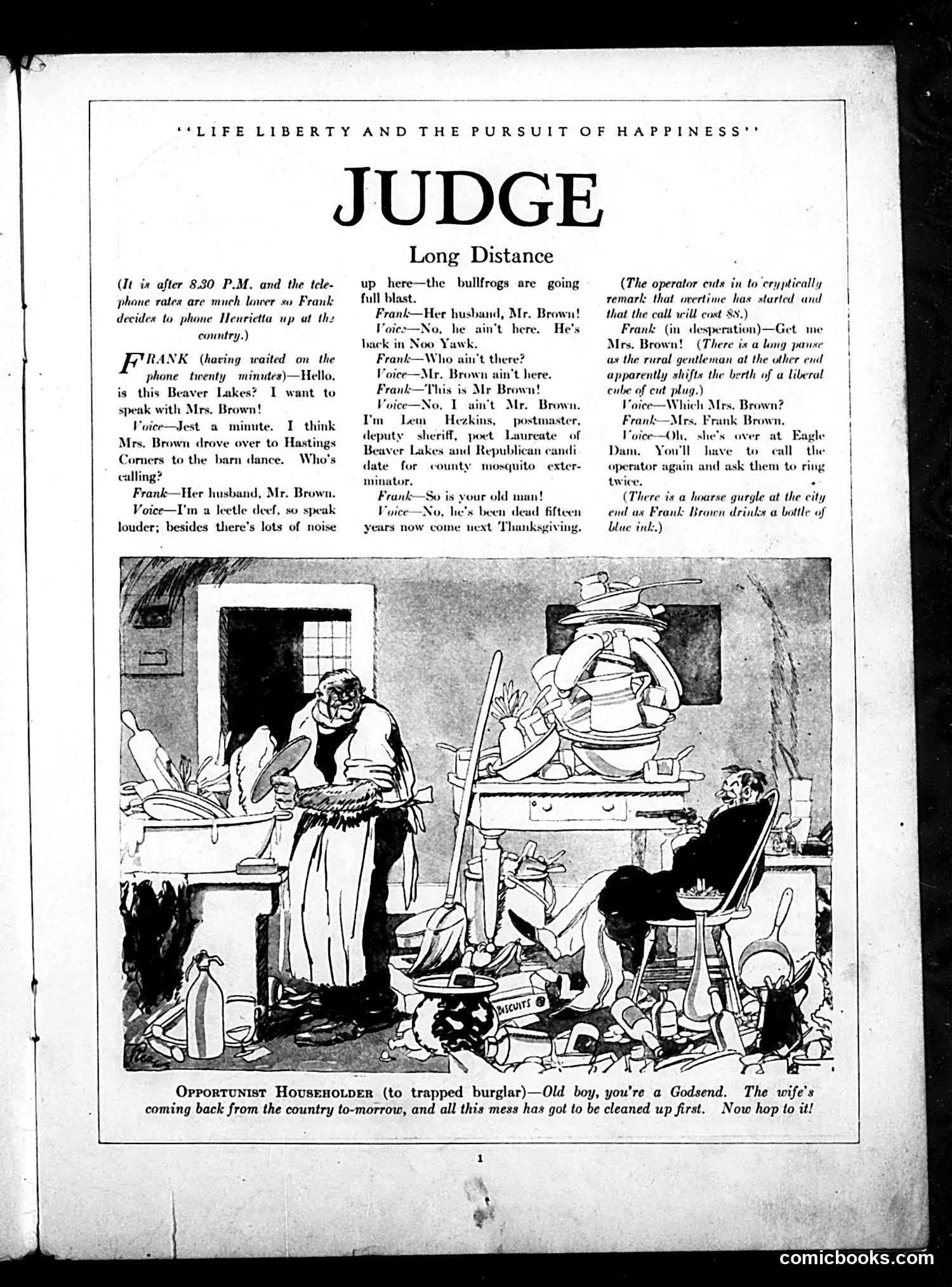
This page contains two distinct pieces: **"Long Distance" (top):** A satirical phone conversation between Frank (calling from the country) and Mrs. Brown. Frank struggles to reach Mr. Brown, eventually learning he's dead—killed fifteen years prior. The humor derives from the absurdity of the phone operator and Frank's persistence in trying to reach a deceased person, satirizing early telephone technology's unreliability and the confusion it could create. **Bottom cartoon:** Shows a burglar trapped in a messy kitchen while an opportunistic homeowner addresses him. The joke: rather than calling police, the homeowner sees the burglar as a solution to household chaos—he can clean up the mess before the wife returns from the country. It satirizes domestic disorder and marital dynamics through dark humor.
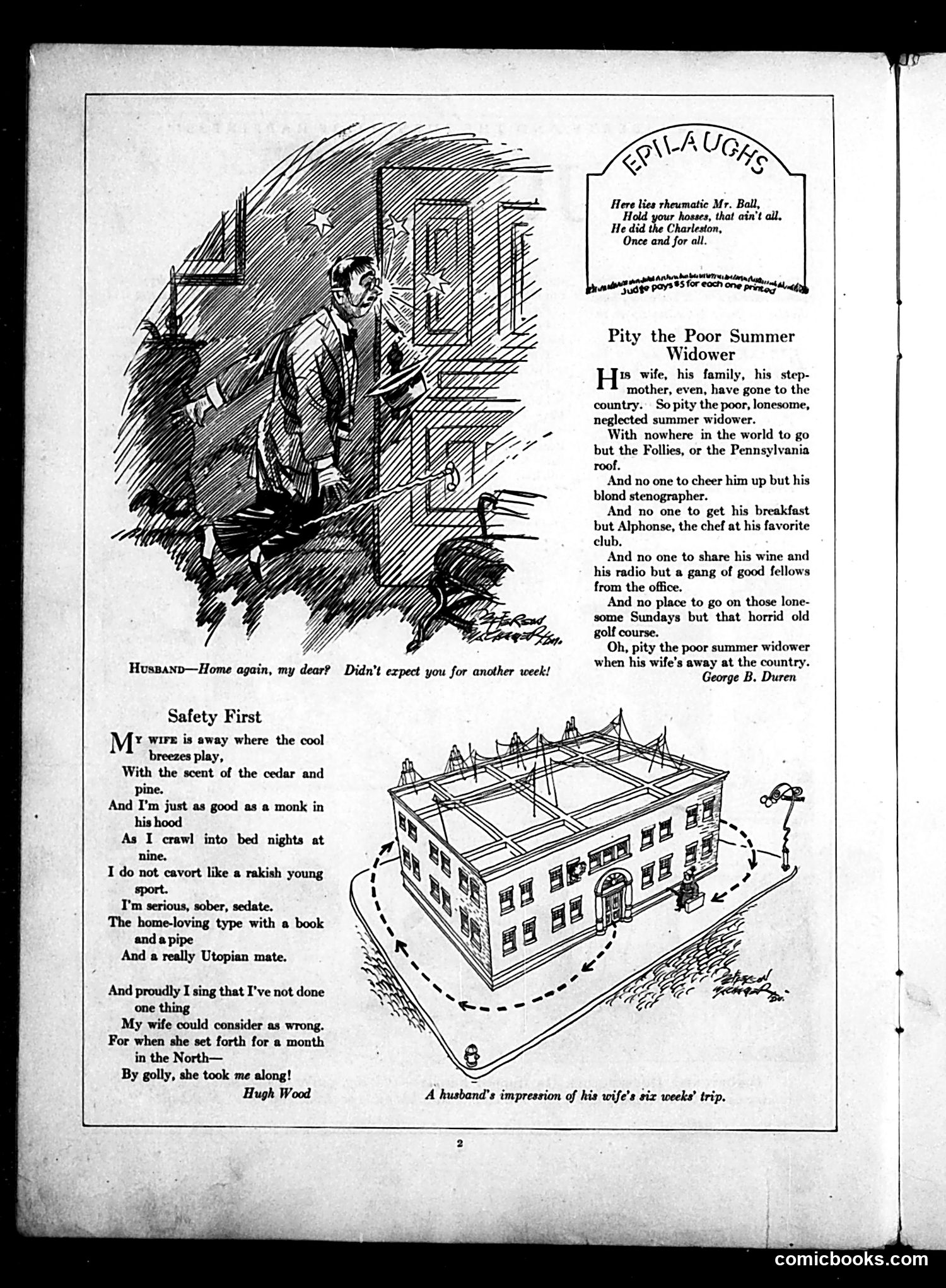
This page contains three separate pieces of social satire from early 20th-century America: 1. **"Pity the Poor Summer Widower"** (top right): A poem mocking husbands left behind when wives take extended country vacations, leaving them dependent on blood banks, restaurant chefs, and golf clubs for entertainment. 2. **"Safety First"** (bottom left): A humorous poem by Hugh Wood about a self-described serious, virtuous husband who boasts of never doing anything wrong—until admitting his wife took him along on a month-long trip north, suggesting domestic obedience rather than virtue. 3. **"A husband's impression of his wife's six weeks' trip"** (bottom right): An architectural drawing showing an enormous building, sarcastically depicting how vastly a man's home seems to expand during his wife's absence. All three pieces humorously explore gender dynamics and domestic separation.
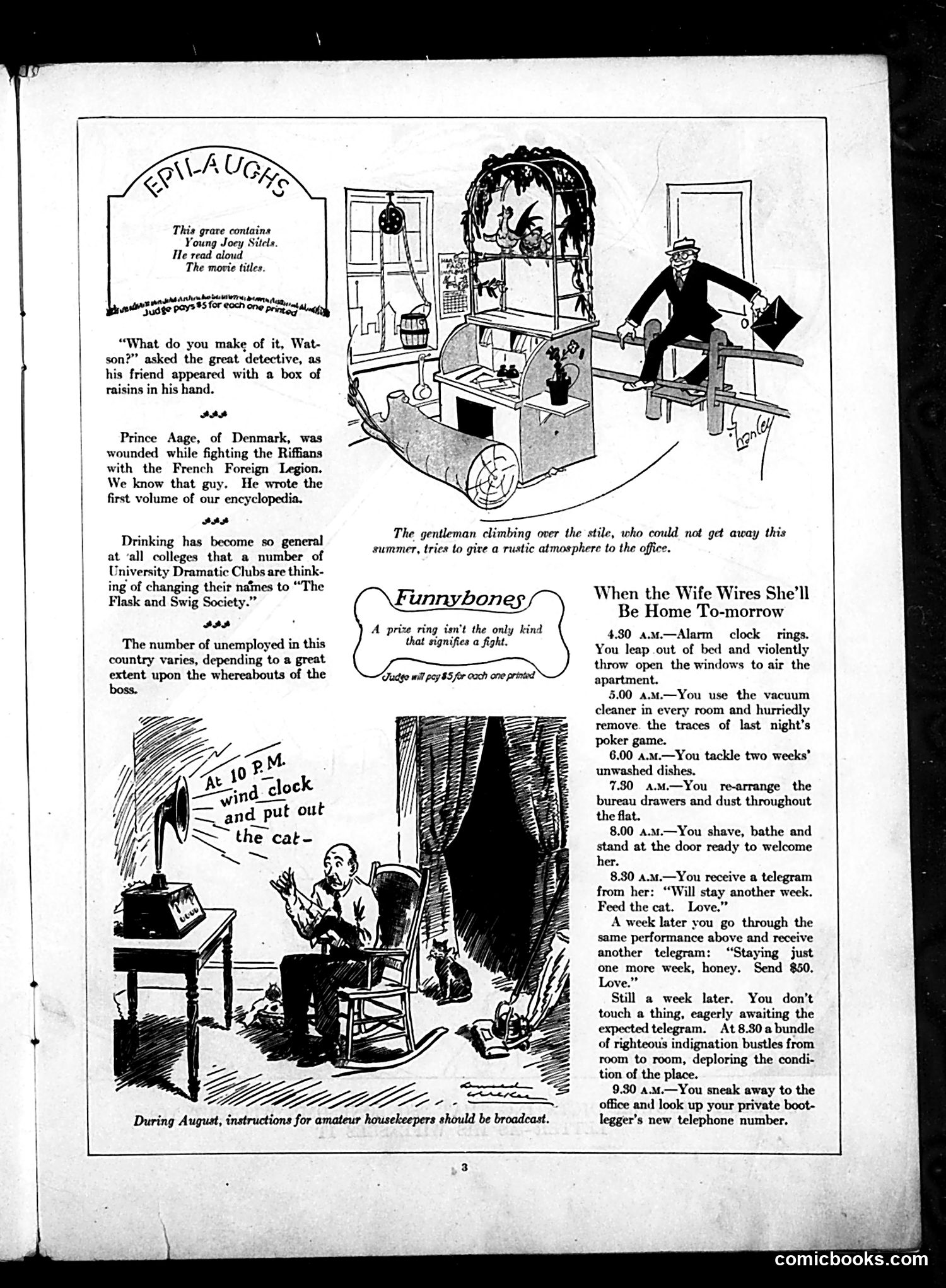
This page contains several satirical pieces typical of Judge's social commentary: **"Epitaphs"** mockingly presents brief epitaphs, including one for "Young Sleep Stida" who "read aloud / The mortar loud"—likely ridiculing tedious public speakers. **The office illustration** satirizes summer workplace conditions, showing a man struggling with excessive heat and an open stile door, captioning the difficulty of maintaining professional decorum during August. **"Funnybones"** offers a quip about prize rings and fights. **"When the Wife Wires She'll Be Home To-morrow"** is the main satirical piece, humorously chronicling a bachelor's frantic domestic scramble—vacuuming, washing dishes, cleaning—upon learning his wife returns. It mocks both bachelor slovenliness and the performative housekeeping husbands undertake to hide neglect. The humor relies on early 20th-century gender stereotypes about domestic labor and marital dynamics.
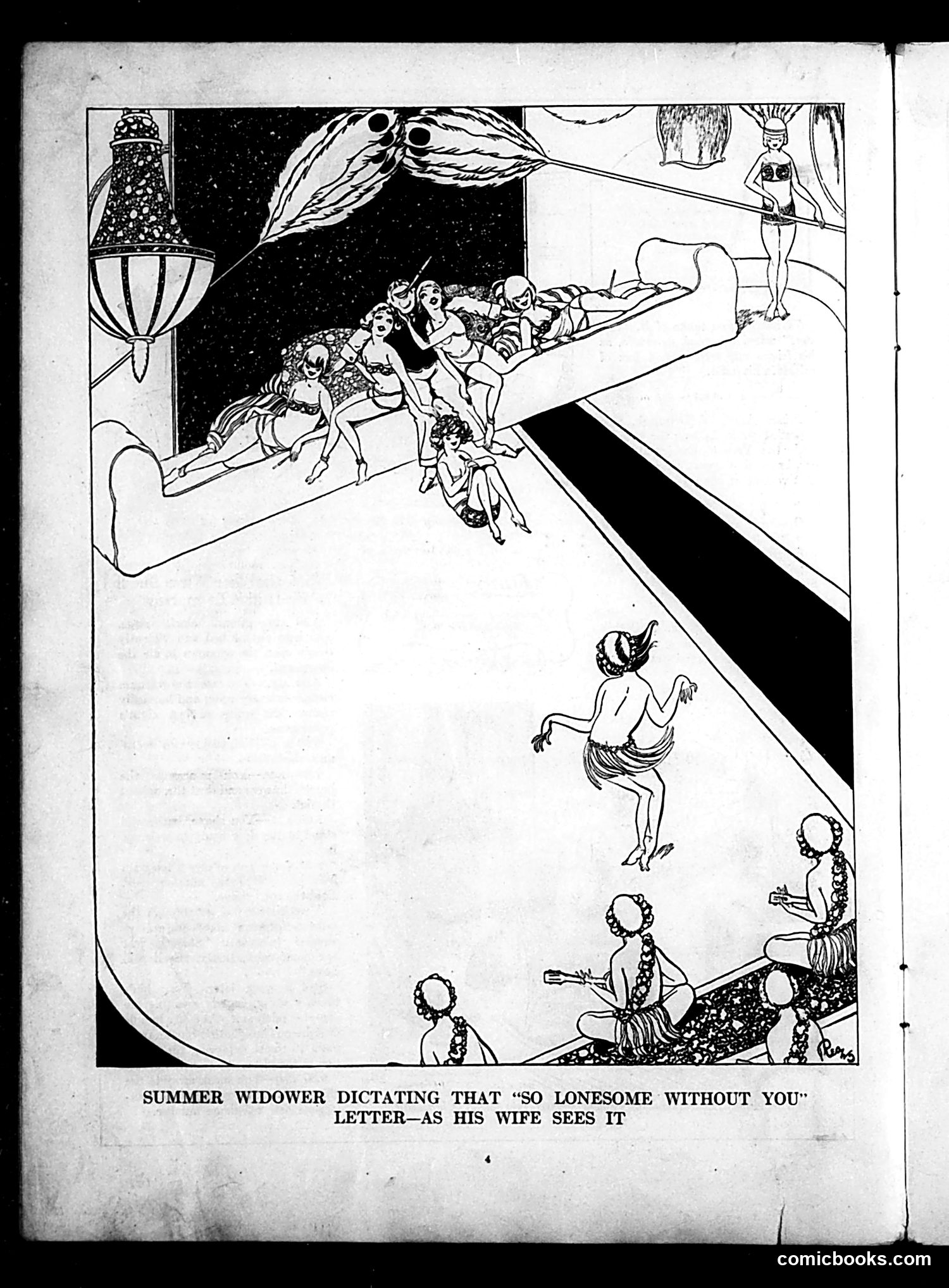
This is a satirical illustration from *Judge* magazine depicting a "Summer Widower"—a married man whose wife has left for vacation—dictating a romantic letter claiming to be "so lonesome without you." The humor works on multiple levels: The upper panel shows the man surrounded by attractive young women in a luxurious setting (appearing to be a resort or leisure venue), while the lower panel reveals his wife observing the scene. The satire mocks the husband's hypocrisy—his professions of loneliness and devotion are exposed as false given his apparent entertaining of female company during her absence. This reflects early 20th-century anxieties about marital fidelity and the leisure class, while the "summer widower" was a recognized social phenomenon of wealthy couples who separated seasonally.
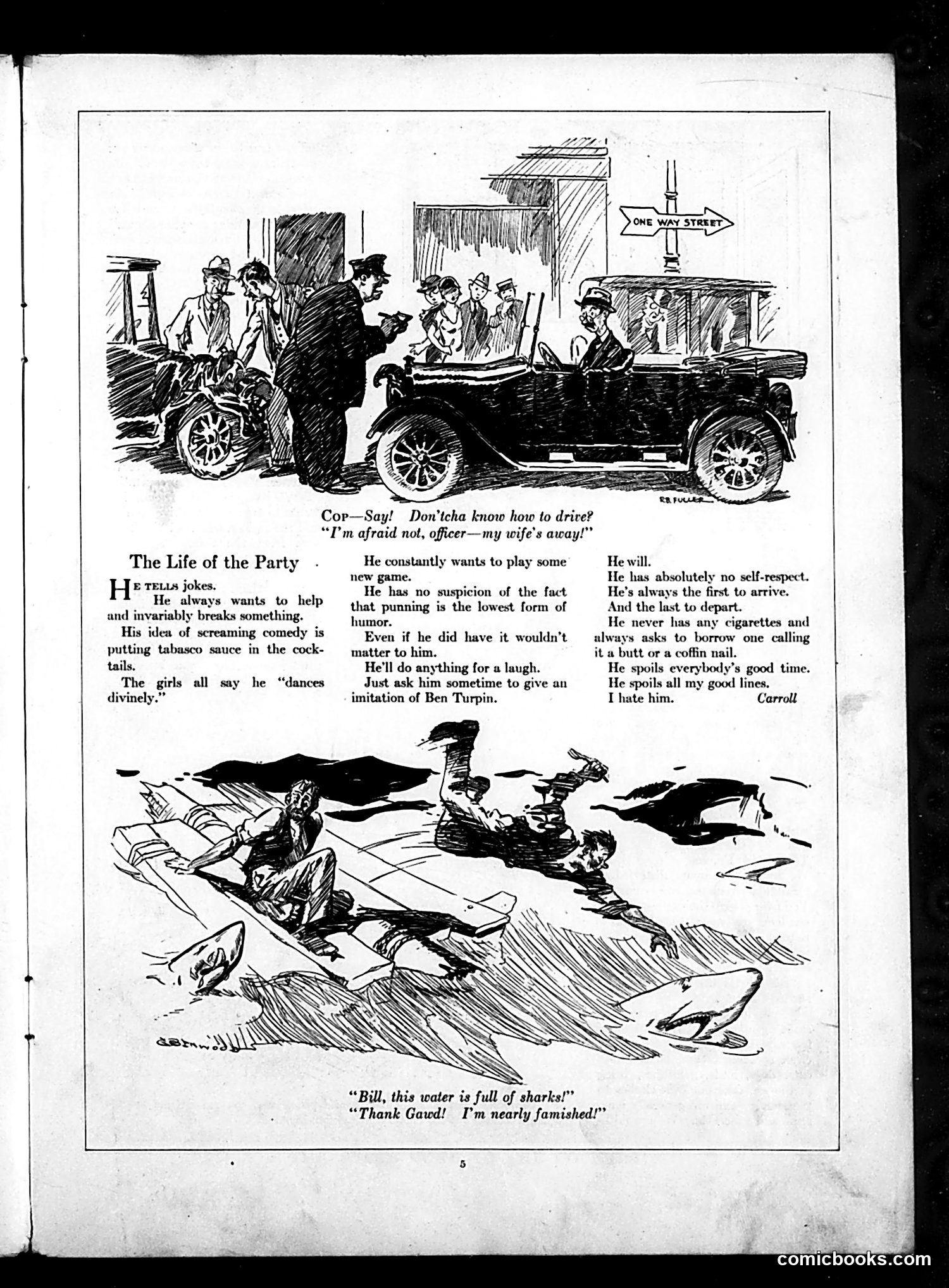
This page from *Judge* satirizes a particular social type: the man who tries too hard to be entertaining at social gatherings. The top cartoon shows a nervous driver claiming confidence he doesn't possess—he'll wreck the car but blame his absent wife. The accompanying text catalogs his annoying traits: telling stale jokes, attempting slapstick humor (putting tabasco in cocktails), imitating entertainer Ben Turpin, constantly arriving first and leaving last, and spoiling everyone's evening despite his obliviousness. The lower cartoon depicts him in water surrounded by sharks, desperate and calling for help—a visual punchline emphasizing his complete lack of awareness or self-respect. The satire targets middle-class social anxiety and the performing self, mocking men who mistake disruptive behavior for charm.
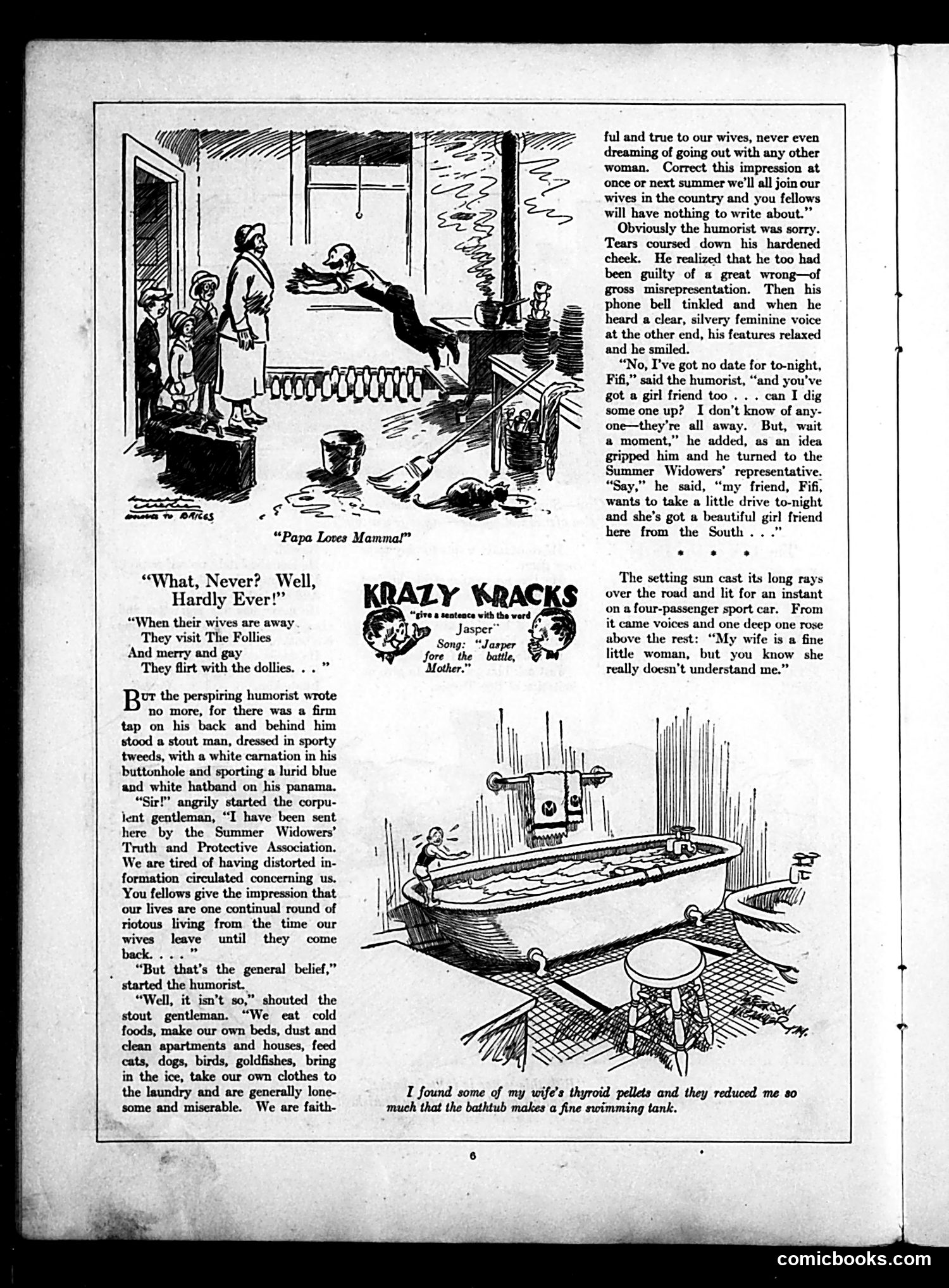
This page satirizes the "Summer Widowers"—married men whose wives leave for the countryside during summer. A humorist is interrupted by an angry representative of the "Summer Widowers' Truth and Protective Association," who protests that writers portray these men as carefree philanderers visiting follies and flirting with chorus girls. The association member insists they're actually faithful, doing domestic chores and feeling lonely. The satire's joke: the humorist immediately receives a phone call from "Fifi," and within moments is arranging a drive with her and another woman—proving the original stereotype correct. The final illustration jokes that one widower has become so thin (from wife's thyroid pills) that the bathtub serves as a swimming pool. The satire targets both the hypocrisy of married men and contemporary domestic anxiety about wives' absences.
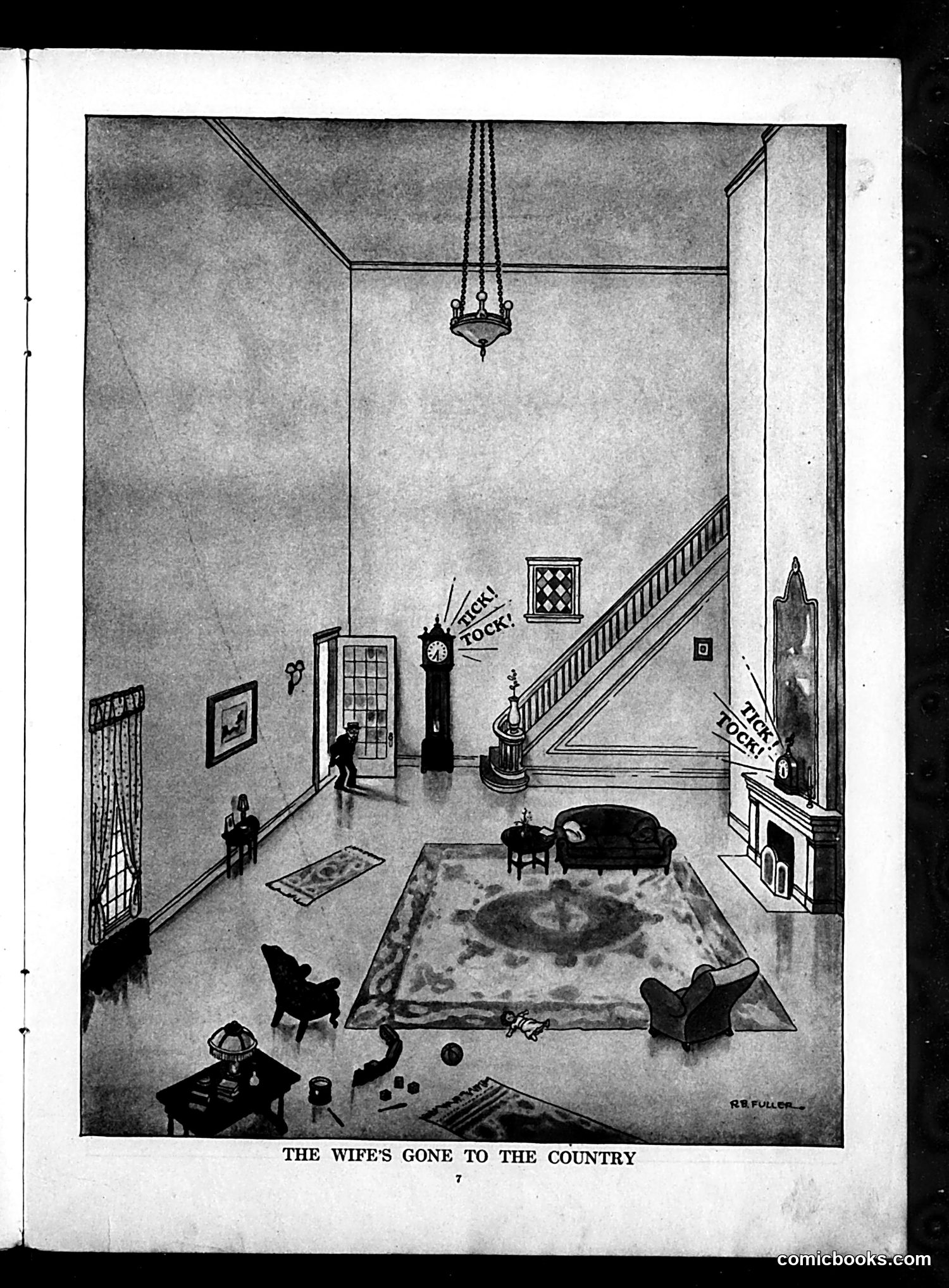
This cartoon satirizes domestic life and male behavior during the wife's absence. The illustration shows a man's home descending into chaos: furniture is overturned, a grandfather clock strikes loudly ("TICK! TOCK!"), toys and objects litter the floor, and the general disorder suggests negligence and disorder. The joke targets the common stereotype that husbands cannot manage household responsibilities without their wives. The titled phrase—a popular phrase from the era—implies freedom and abandonment of domestic standards. The cartoon mocks both the husband's incompetence at maintaining order and, inversely, women's essential role in keeping households functional. The signature reads "R.B. Fuller," identifying the cartoonist. This reflects early 20th-century gender assumptions about domesticity and male capability.
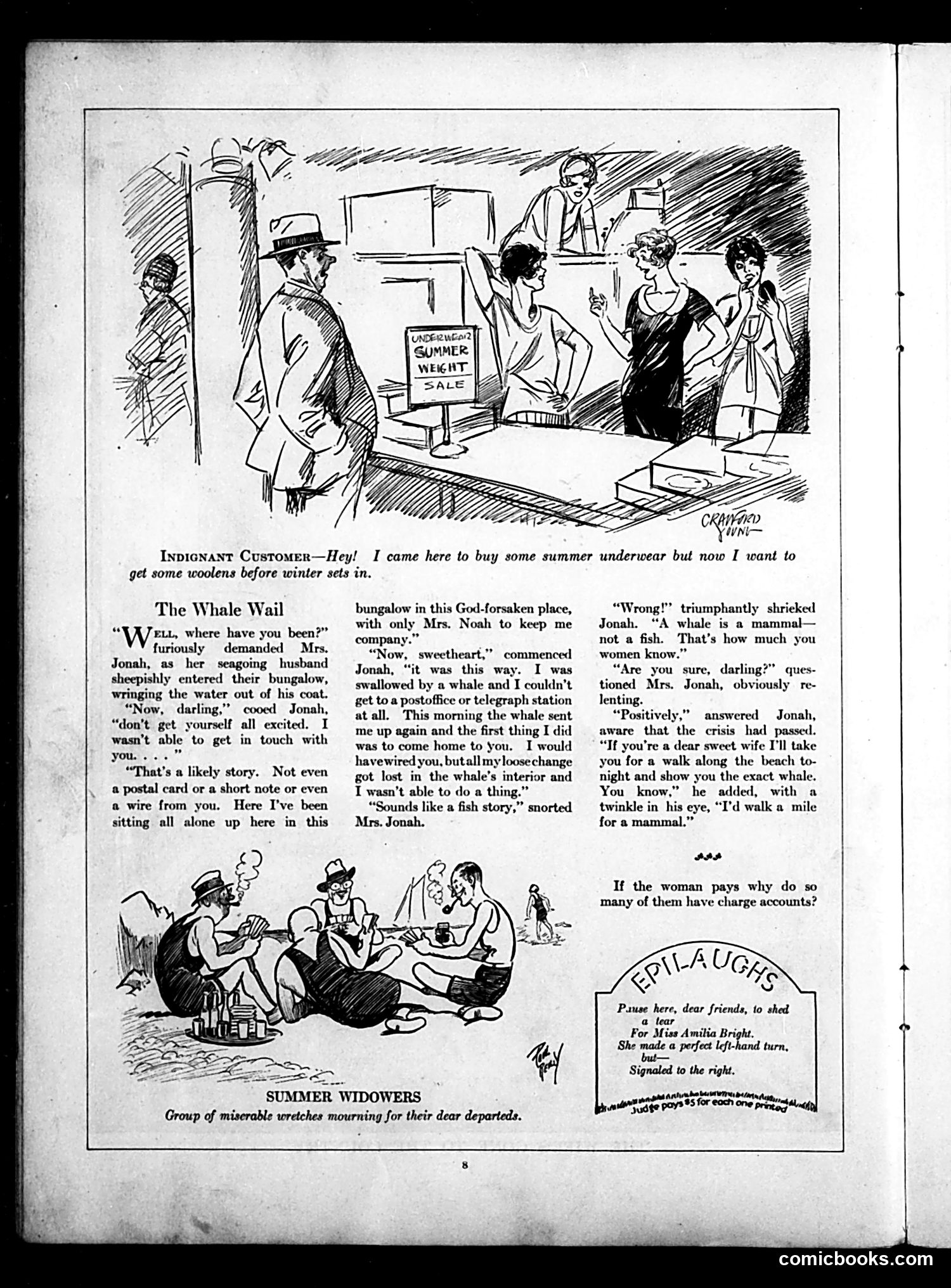
This page contains two satirical pieces about gender and marital dynamics in early 20th-century America. **"The Whale Wail"** is a humorous domestic dispute where a husband claims he was swallowed by a whale and couldn't contact his wife. The joke hinges on the wife's skepticism—she treats his excuse as an obvious lie ("fish story"), yet accepts it when he corrects her that whales are mammals, not fish. The satire mocks how easily men manipulate women through trivial "facts" and appeals to vanity. **"Summer Widowers"** depicts women left behind while husbands travel, framed as tragic figures ("miserable wretches"). The top cartoon shows a store customer complaining about inventory timing—wanting summer underwear but facing winter stock. **The "Epi-Laughs" section** jokes about women drivers, specifically a woman signaling a left turn while turning right—a period stereotype about female incompetence at driving. Overall, the page reflects 1920s-era attitudes treating women as gullible, dependent on men, and poor drivers—common satirical targets of the era.
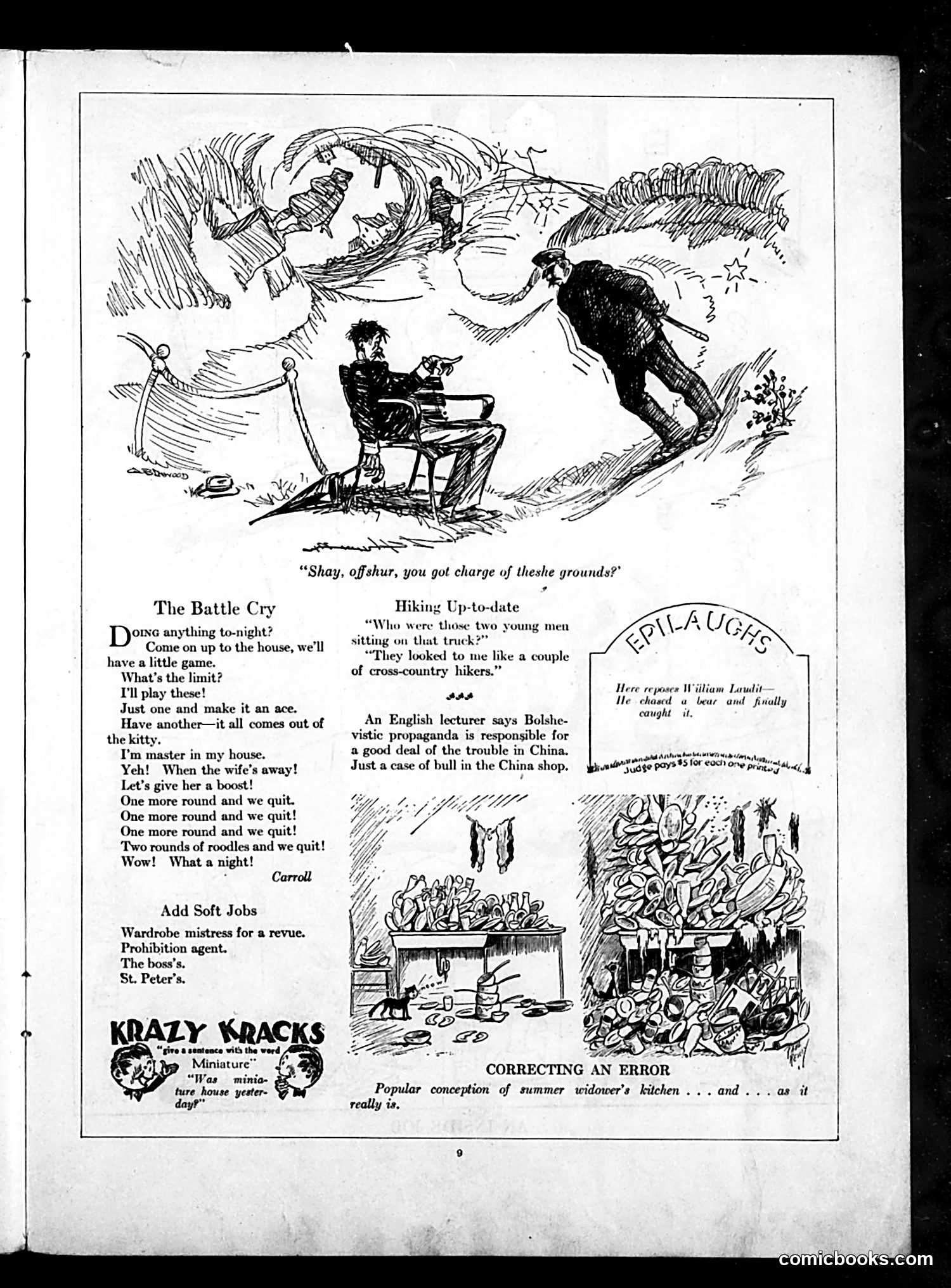
This page contains several satirical pieces typical of 1920s American humor: **"The Battle Cry"** mocks husbands who gamble and drink heavily when their wives are away, pretending to be "master" of the house while repeatedly promising to quit after "one more round." The satire critiques domestic hypocrisy and male behavior during Prohibition. **"Hiking Up-to-date"** makes a pun about "cross-country hikers" and Bolshevik propaganda in China—referencing contemporary anxiety about communist influence. **"Krazy Kracks"** advertises a miniature doll house product. **"Correcting an Error"** shows two contrasting kitchen scenes—likely satirizing the "summer widower" (husband left home alone) and his actual messy reality versus popular assumptions about domestic life. The page reflects 1920s concerns: Prohibition enforcement, communist fears, gender roles, and domestic comedy centered on male incompetence without female supervision.
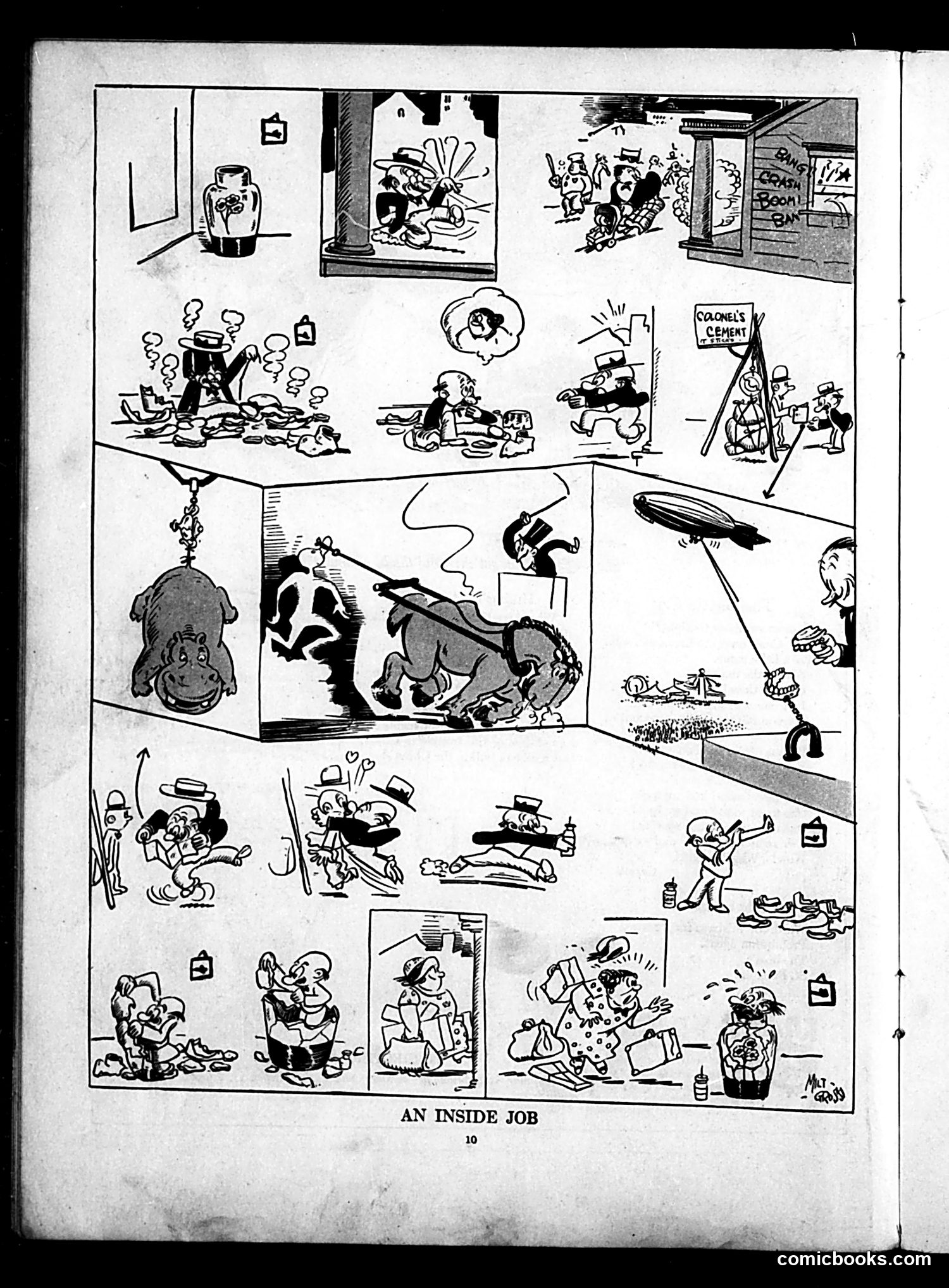
This appears to be a satirical comic strip about corruption or criminal conspiracy, titled "An Inside Job." The narrative follows characters (likely representing corrupt officials or criminals) engaged in various schemes—stealing, hiding contraband, and evading detection through multiple panels. The comic uses slapstick and visual gags to mock what seems to be organized crime or bureaucratic malfeasance. Characters in formal dress (hats, suits) suggest they're meant to represent authority figures or wealthy criminals. The repeated imagery of hiding, running, and chaos suggests the satire targets either actual criminal conspiracies or perceived corruption among the powerful. Without more context about Judge magazine's publication date or specific historical events referenced, the exact political target remains unclear, though the strip clearly ridicules organized wrongdoing among the elite.
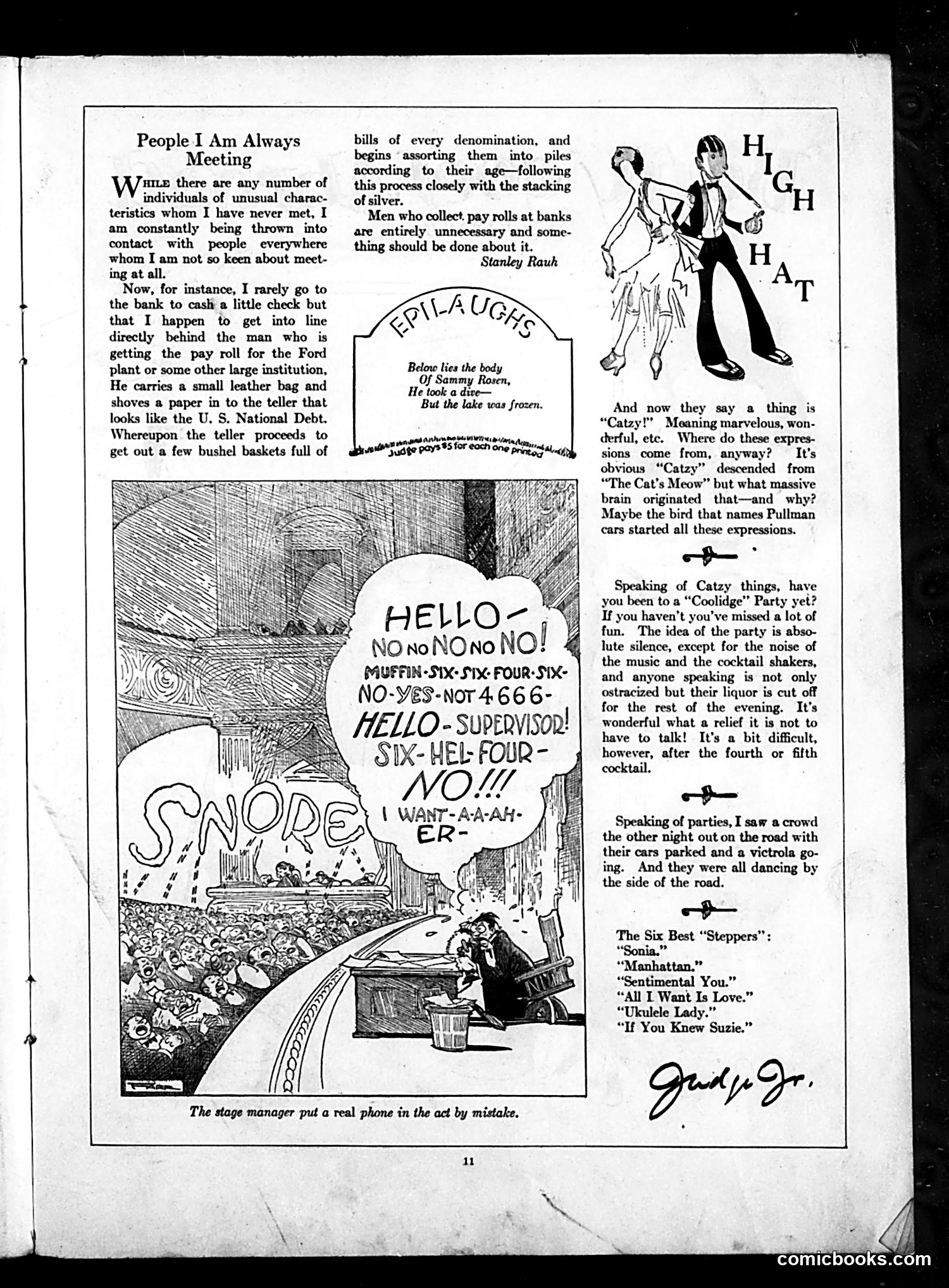
This page contains humorous social commentary from the 1920s era. The main cartoon depicts a theatrical mishap: a stage manager accidentally placed a real telephone on stage, resulting in an actor receiving actual phone calls mid-performance—the crowded speech bubble shows him frantically answering multiple connection attempts. The written column by Stanley Rauh mocks the inconvenience of waiting behind men collecting large corporate payroll cash at banks, complaining the practice is unnecessary. A secondary cartoon shows an epitaph for "Sammy Rosen," a dark joke about someone who "took a dive" into a frozen lake. The right column discusses contemporary 1920s slang ("Catzy" meaning marvelous, derived from "Cat's Meow") and describes "Coolidge" parties—silent social gatherings where conversation is forbidden and alcohol is served. The page concludes listing popular dance songs of the era. The humor targets modern urban inconveniences, workplace inefficiency, and fashionable youth culture of the Jazz Age.
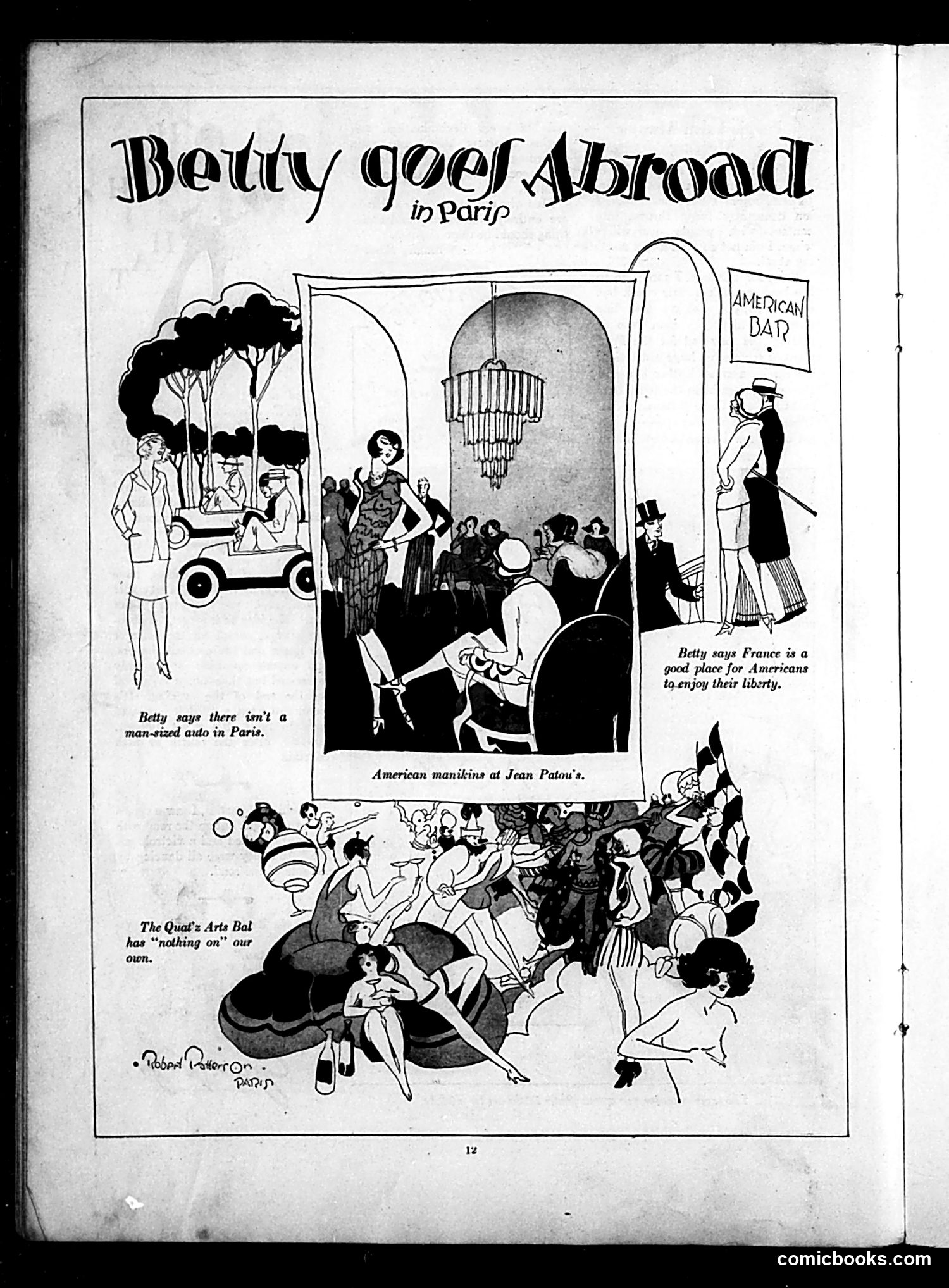
This is a humorous piece about an American woman named Betty experiencing Paris. The satire contrasts American and French culture: **Left panel:** Betty observes tiny Parisian automobiles, joking there aren't "man-sized autos in Paris"—mocking European cars as undersized compared to American vehicles. **Center:** An elegant French nightclub (Jean Patou's) showcases "American manikins," suggesting Paris attracts Americans seeking liberty and sophisticated entertainment. **Right:** Betty praises France as ideal for American freedom. **Bottom:** The Quai's Arts Bal (a famous bohemian ball) has "nothing on" American celebrations—implying American culture rivals or exceeds French sophistication, despite France's legendary artistic reputation. The overall joke reflects 1920s American confidence and consumerism, gently mocking both French pretension and American tourists' desire to appear cultured abroad.
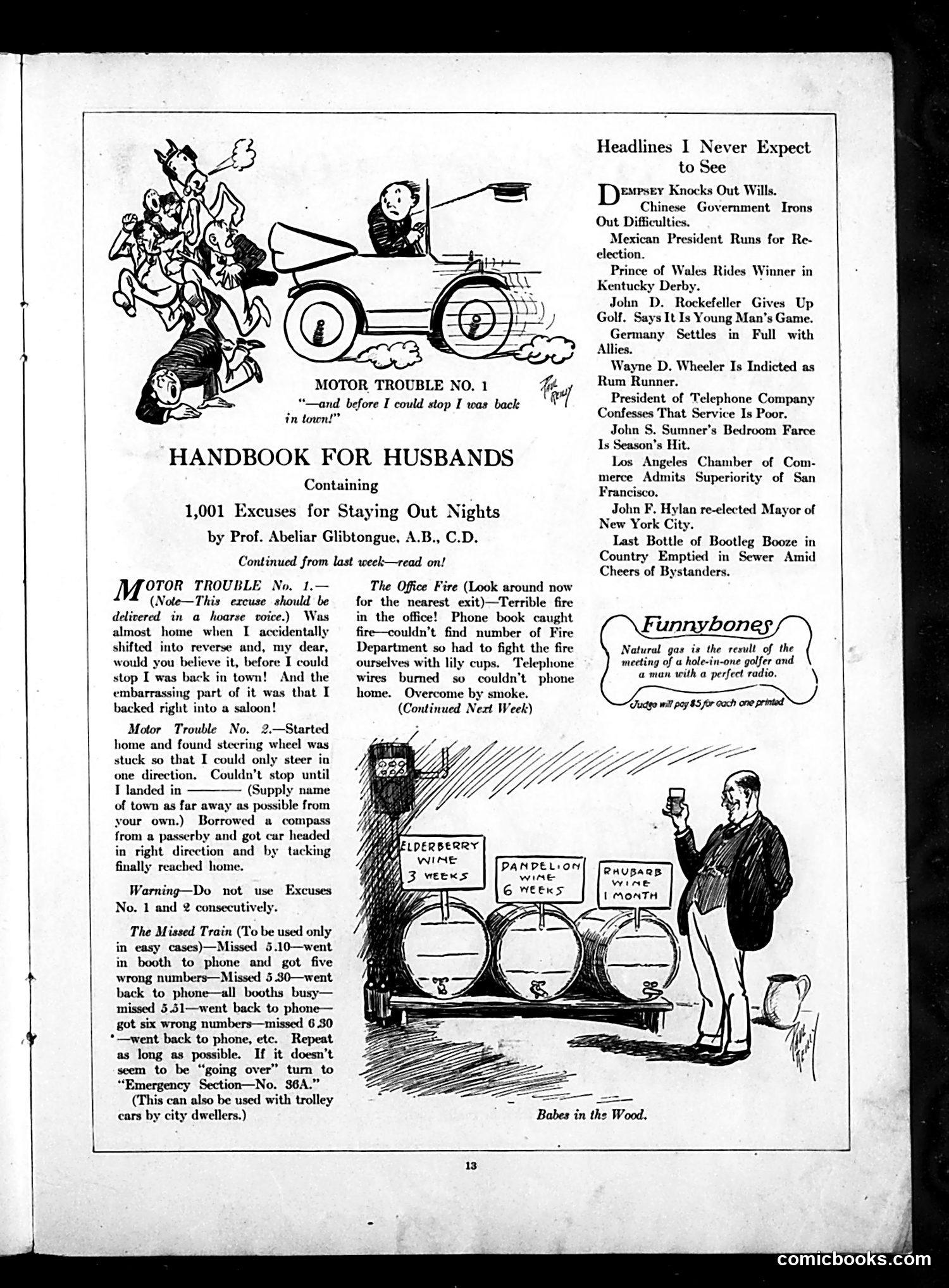
This page satirizes husbands' excuses for staying out late. The "Handbook for Husbands" mock-seriously catalogs fabricated explanations—motor troubles (reversing back to town, stuck steering wheels), missed trains with endless wrong phone numbers, and office fires with burned phone books preventing calls home. The humor targets marital deception and early 20th-century domestic tension over automobiles and nightlife. The "Motor Trouble No. 1" cartoon shows a man returning to a saloon despite claiming to head home. The right column lists absurd "Headlines I Never Expect to See"—satirizing current events. References include boxer Dempsey, Prohibition enforcer Wayne Wheeler (ironically indicted as a rum runner), Mayor Hylan of New York, and Germany's WWI reparations. These mock public figures and contemporary issues as inherently contradictory or unlikely. The small "Babes in the Wood" cartoon about bootleg liquor reflects Prohibition-era concerns. Overall, the page reflects 1920s anxieties about automobiles, infidelity, and Prohibition enforcement.
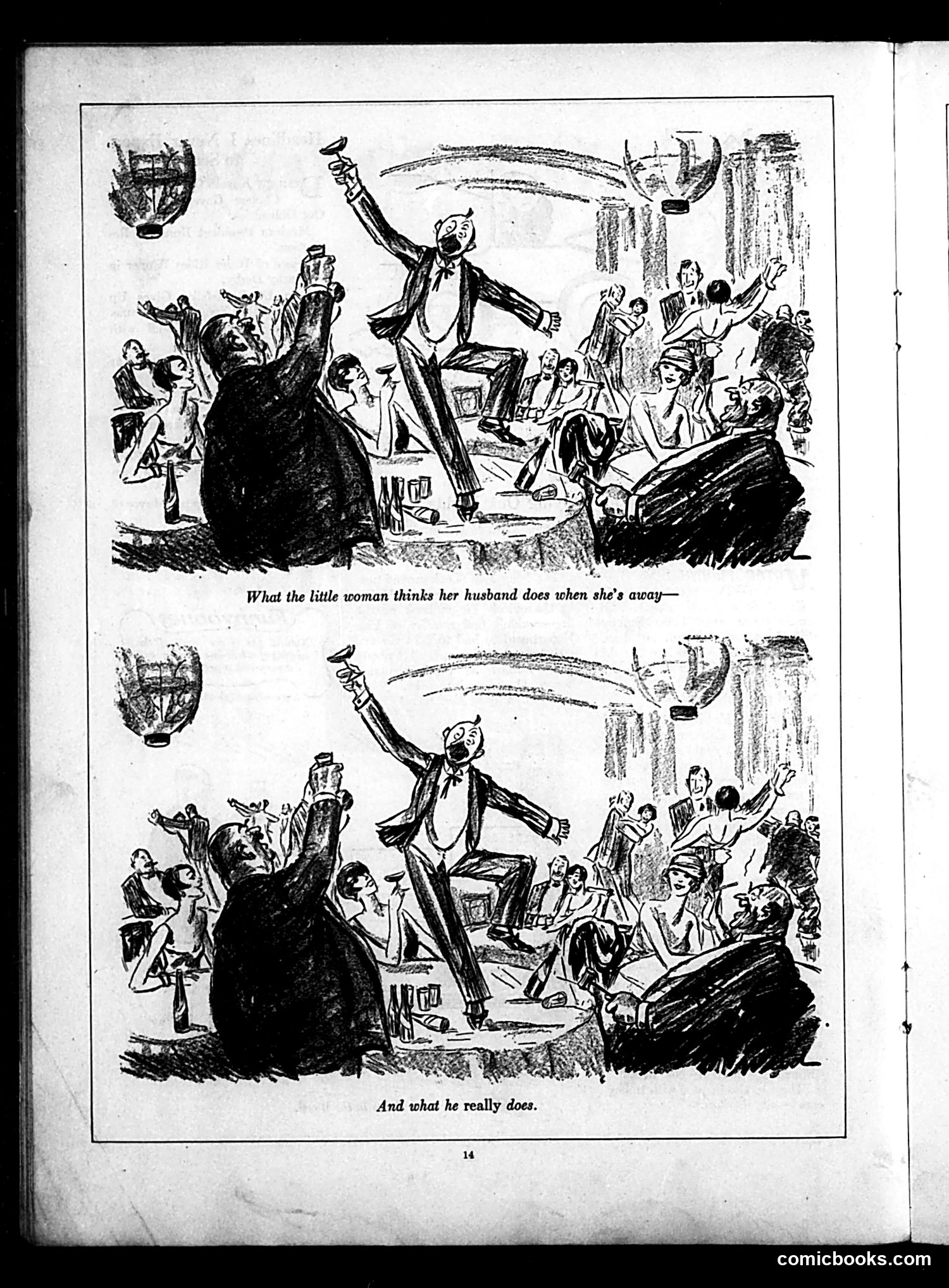
This is a two-panel comparative cartoon satirizing marital expectations versus reality. The top panel's caption states: "What the little woman thinks her husband does when she's away—" depicting a man in formal attire appearing to conduct an elegant, refined gathering with well-dressed guests in what looks like a sophisticated social event. The bottom panel's caption reads: "And what he really does"—showing the identical scene, implying the husband is actually engaged in wild, hedonistic revelry (suggested by his exaggerated posture and the chaotic atmosphere) rather than respectable activity. The humor targets the gap between wives' idealized assumptions about their husbands' behavior away from home versus their actual conduct—a common early-20th-century domestic comedy trope reflecting anxieties about male independence and fidelity.
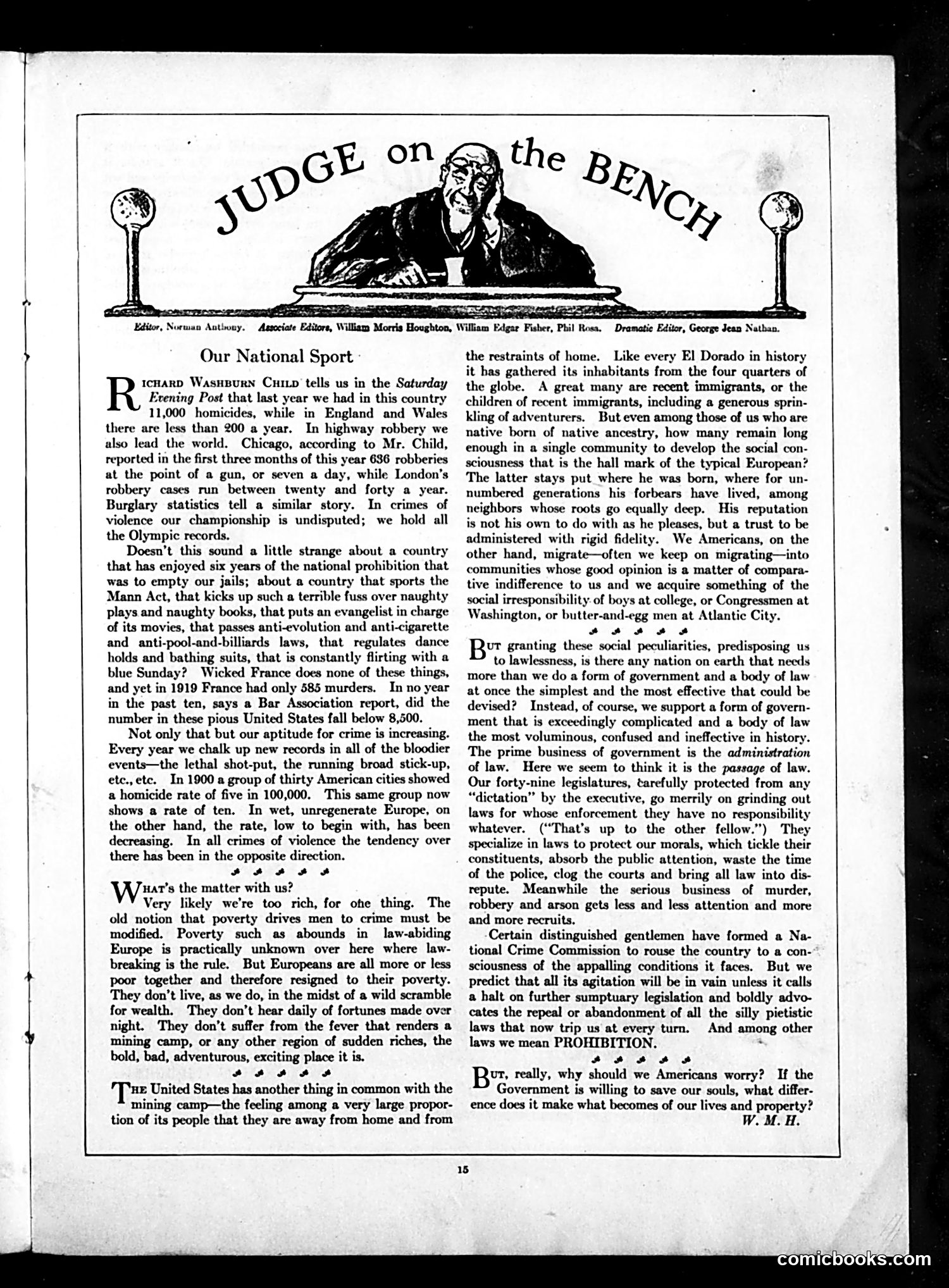
This editorial column by Richard Washburn Child contrasts America's soaring violent crime rates with those of Europe, presenting a satirical critique of Prohibition's failure. **The Central Irony**: The U.S. had implemented six years of national Prohibition specifically to "empty our jails," yet simultaneously leads the world in homicides (11,000 annually vs. fewer than 200 in England/Wales), highway robbery, and burglary. Child notes the hypocrisy: America aggressively regulates morality through anti-evolution laws, movie censorship, and blue laws—yet remains lawless. **The Explanation**: Child attributes American lawlessness not to poverty (as traditionally believed) but to *wealth and mobility*. Unlike stable, rooted European communities bound by reputation and ancestral ties, Americans are transient migrants—particularly immigrants and adventurers—lacking community accountability. This "mining camp mentality" encourages criminality. **The Satire**: The piece mockingly asks why Americans should worry if government can "save our souls," implying Prohibition's moral legislation is ineffective window-dressing masking deeper social disorder.
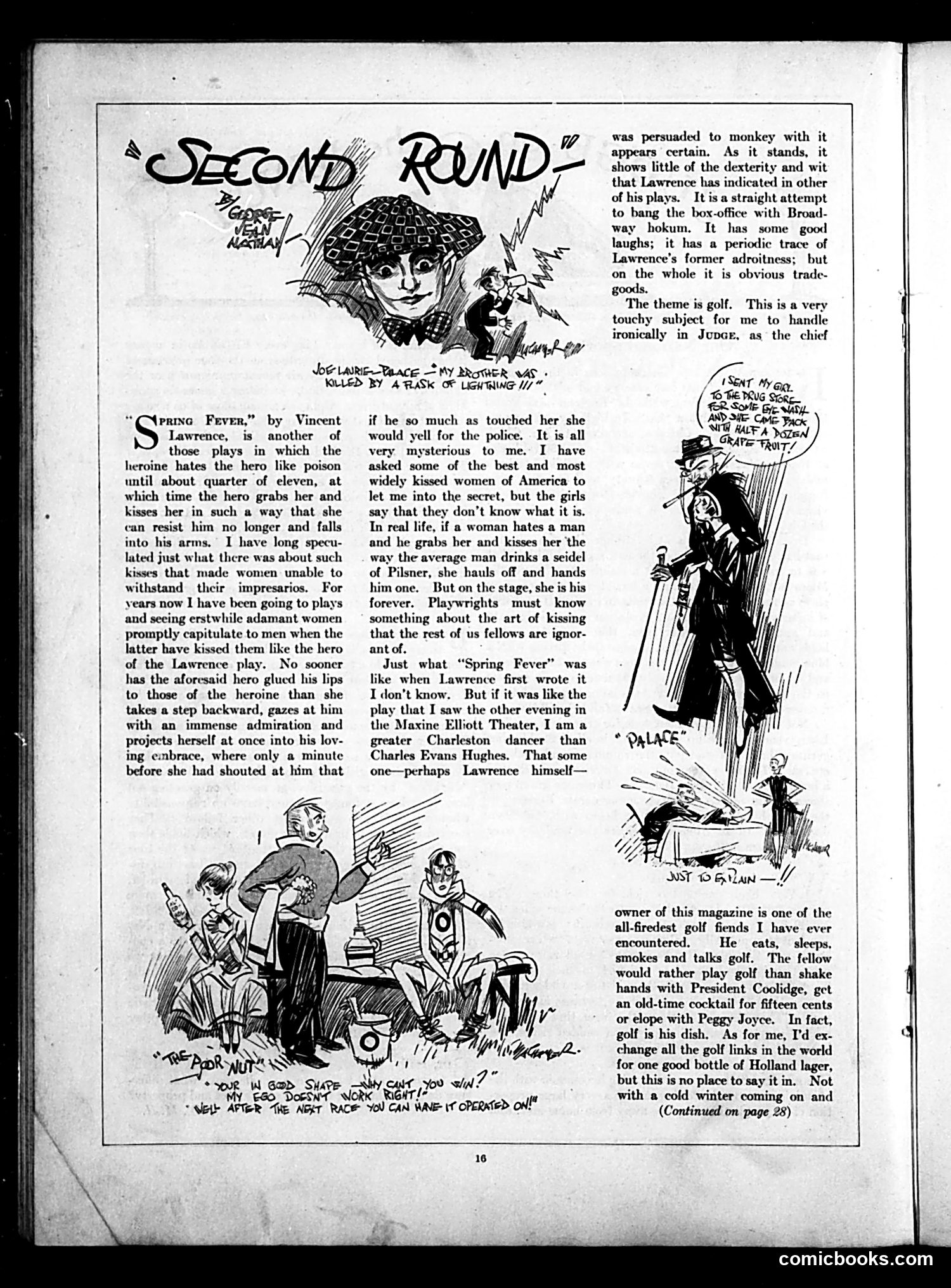
This is a theater review column titled "A Second Round" discussing Vincent Lawrence's play *Spring Fever*. The reviewer critiques the show as derivative "trade-goods"—commercially calculated hokum lacking Lawrence's usual wit. The central satire concerns an implausible theatrical convention: heroines who violently reject male advances suddenly capitulate after a kiss. The reviewer mocks this as absurd, noting that real women would "haul off and hand him one" rather than swoon. The cartoons illustrate this absurdity through exaggerated scenes of forced romantic encounters. One sketch shows a man at "Joe Laire's Palace" struck by lightning; another depicts a couple at the theater with the man making unwanted advances. The reviewer's final joke targets Judge magazine's unnamed owner (clearly a golf enthusiast), admitting he dare not criticize the play's golf-centric plot without risking editorial retaliation. This self-aware humor about magazine politics adds contemporary workplace satire.
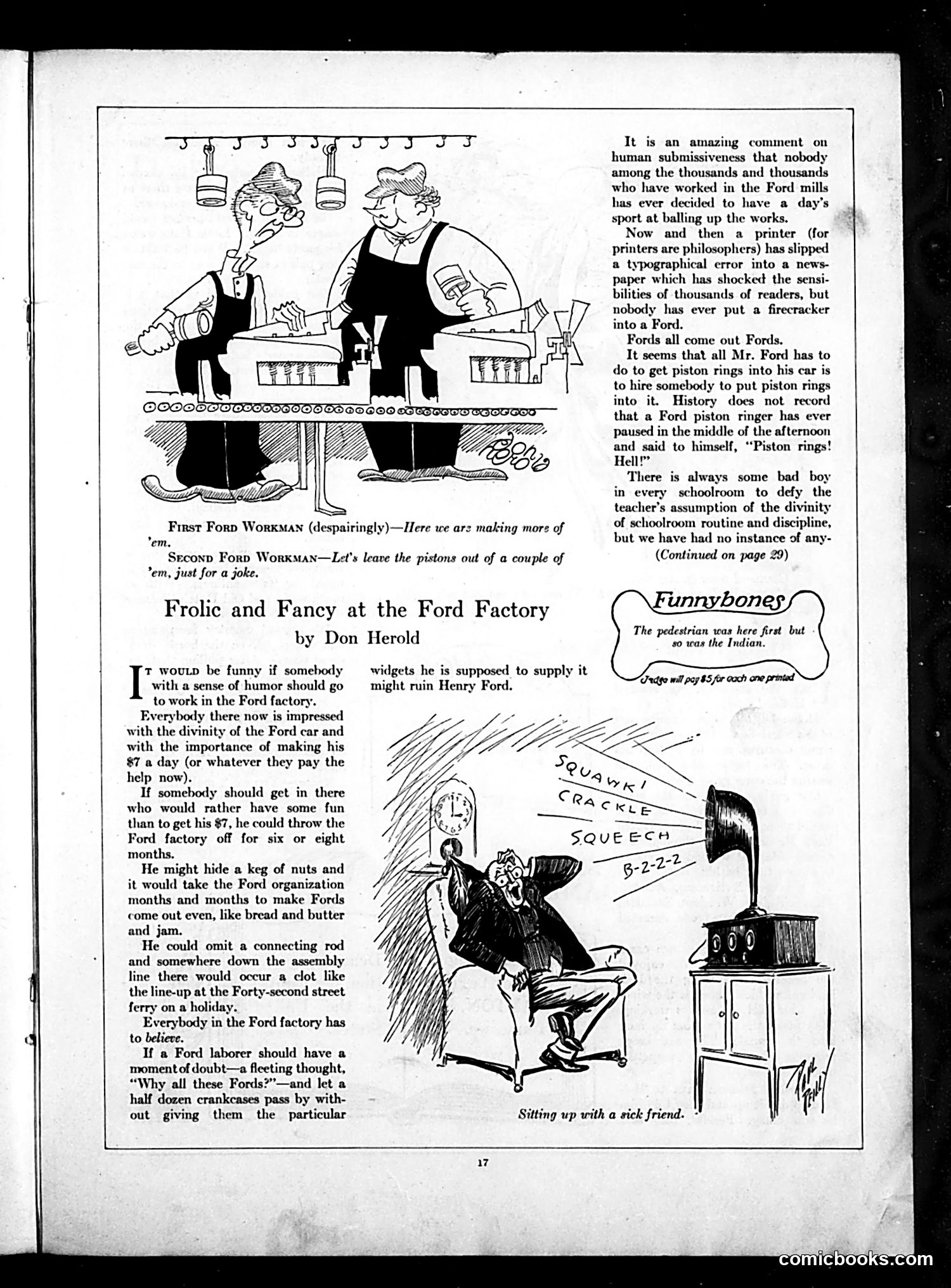
**Main Content**: Don Herold's satirical essay "Frolic and Fancy at the Ford Factory" with accompanying cartoons mocking assembly-line work discipline. **The Satire**: Herold humorously argues that Henry Ford's factory operates through total worker obedience—so rigidly organized that a single saboteur could halt production for months. He satirizes the mechanical conformity demanded: workers must mindlessly install parts without questioning the system. The essay suggests this blind compliance is remarkable—no worker has ever deliberately disrupted the line, unlike a "bad boy" in school who challenges authority. **The Joke**: The two Ford workers' dialogue jokes that omitting pistons "just for a joke" would cause chaos, underscoring how dependent the system is on unthinking compliance. **The "Funnybones" Cartoon**: A separate joke about a man calling his doctor phonograph with sound effects ("squeak," "crackle," "squeech"), likely mocking new technology or hypochondria. **Historical Context**: This reflects 1920s anxieties about Fordism—mass production's dehumanizing effect on workers through repetitive, regimented labor.
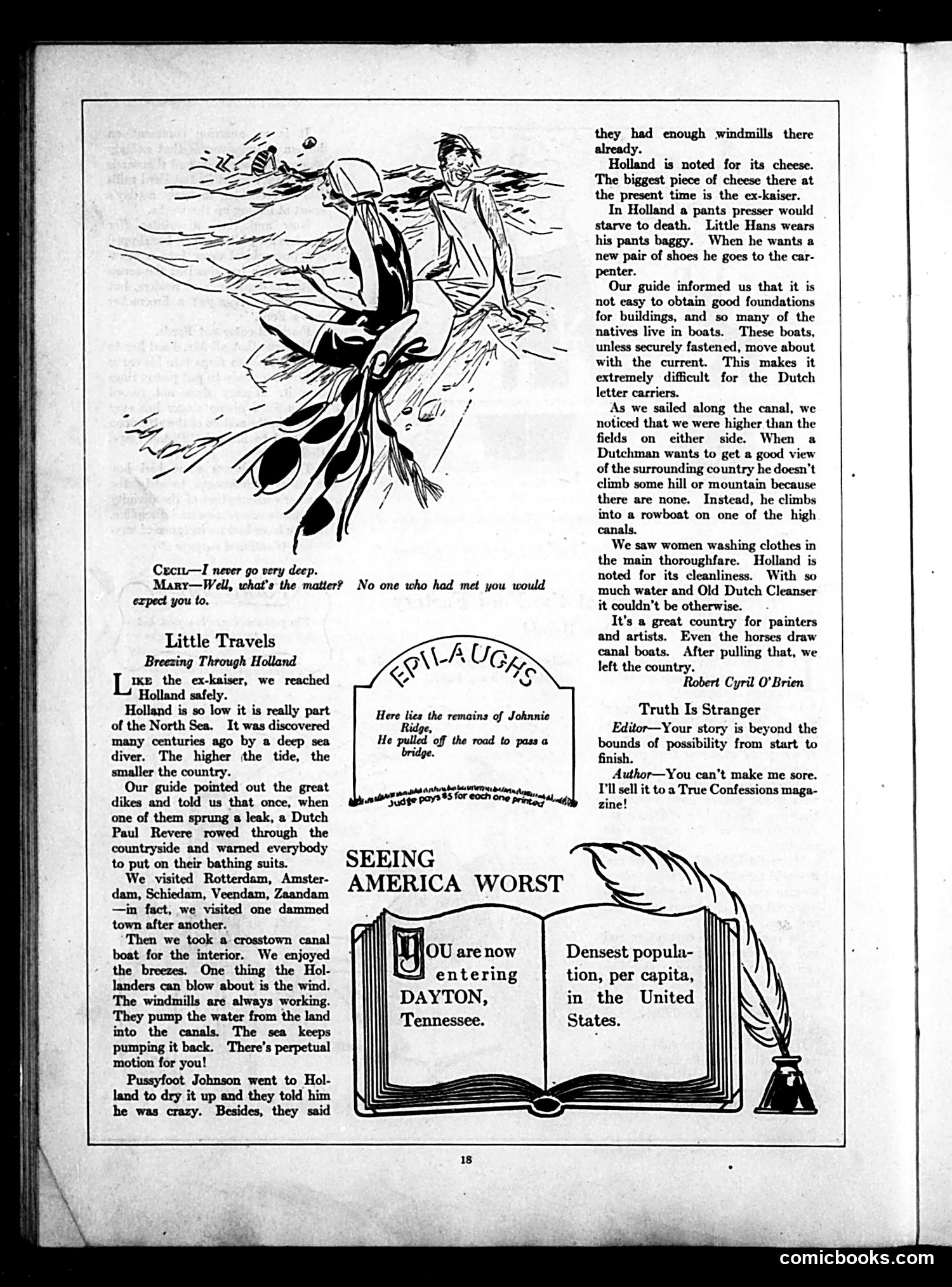
This page contains humor pieces mocking Holland and American provincialism circa post-WWI era. **"Little Travels: Breezing Through Holland"** is absurdist travel satire. It jokes about Holland's low elevation (comparing the country to the North Sea itself), windmills, canals, and Dutch culture. A key reference: "the ex-kaiser" appears twice—comparing the Kaiser (German WWI leader Wilhelm II, who actually fled to Holland after the war) to both the country itself and its cheese, mocking his exile. The "Pussyfoot Johnson" reference alludes to Billy Sunday's temperance crusade (Johnson was a prohibition activist), satirizing American moral crusading abroad. **"Seeing America Worst"** is a brief joke contrasting exotic travel with American reality: Dayton, Tennessee is presented as America's worst—likely referencing the 1925 Scopes Monkey Trial held there, which became a national embarrassment over evolution teaching. The dialogue cartoon above depicts two figures (likely representing different perspectives) debating whether travel stories are plausible, poking fun at tall tales and sensationalism in magazines.
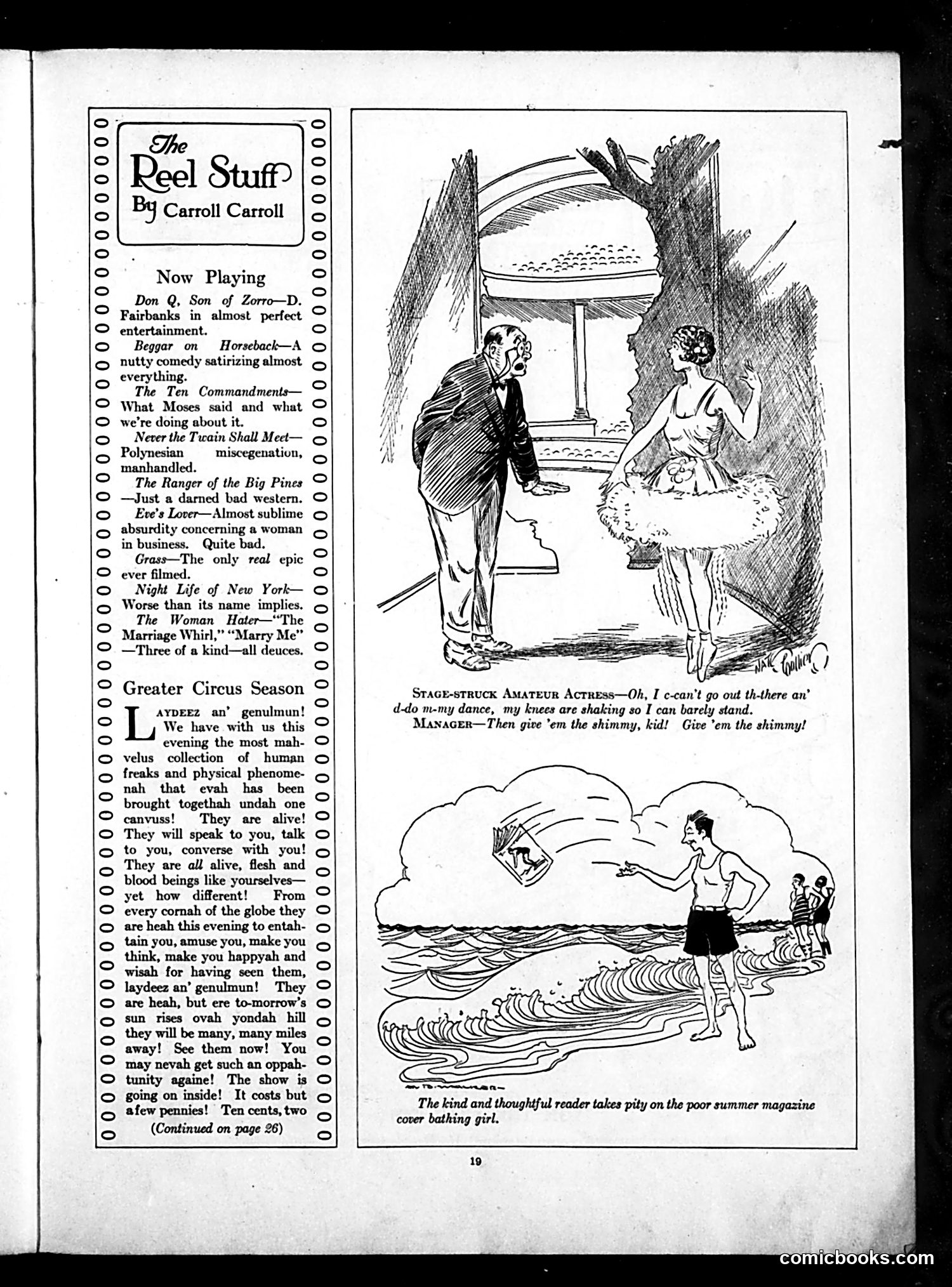
This page from *Judge* magazine contains two separate satirical pieces: **"The Reel Stuff"** (left) reviews current films with snark—mocking *Don Q*, praising *Beggar on Horseback* for satirizing society, and dismissing others as poorly executed. **The two cartoons** mock different aspects of 1920s entertainment: 1. **Top cartoon**: A stage-struck amateur actress is too nervous to perform her dance number. The manager tells her to do "the shimmy"—a scandalous dance craze of the era involving hip gyrations—implying even poor execution would succeed if she relies on this risqué move rather than actual talent. 2. **Bottom cartoon**: Satirizes the "bathing girl" aesthetic of summer magazine covers (a common marketing device), showing a staged beach photo shoot. The caption mocks readers' false sympathy for cover models, suggesting they're not actually suffering. Both pieces target early 1920s entertainment culture: the shimmy dance craze, amateur theatrical ambitions, and the manufactured imagery of popular magazines.
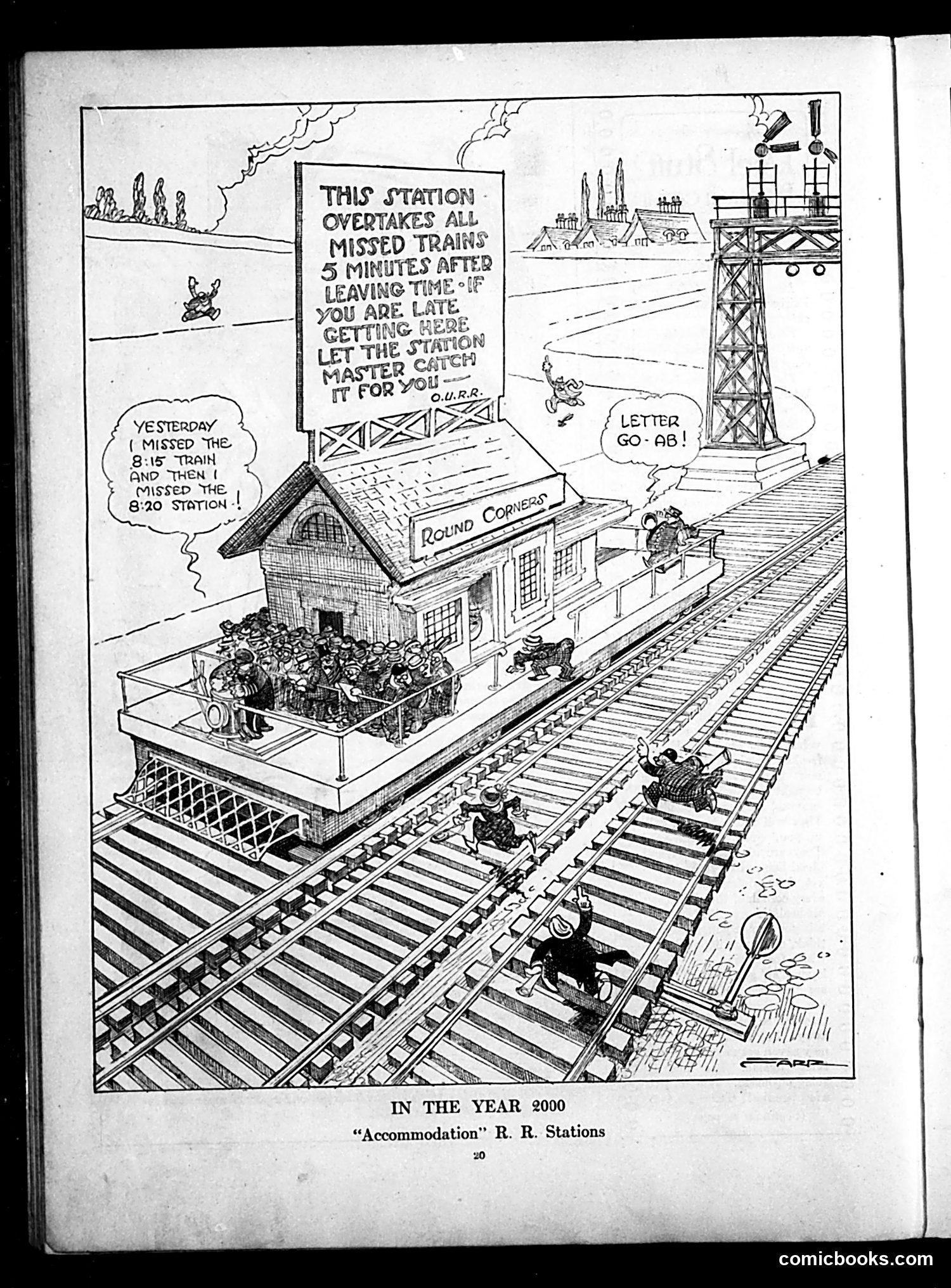
This is a satirical cartoon titled "In the Year 2000" imagining futuristic railroad stations. The joke depicts a person who missed their 8:15 train, then missed the 8:20 station itself—suggesting that by 2000, stations will move so fast they'll overtake late passengers. The humor lies in the absurdist premise: a sign promises the station will "catch" missed trains for you by moving faster than the trains themselves. This satirizes both technological optimism and the frustration of missing transportation. The cartoon mocks the common experience of being late while extrapolating it to an ridiculous future where even the infrastructure becomes mobile and unreliable. The O.U.P.R. (likely a fictional railroad) represents exaggerated solutions to modern commuting problems through increasingly absurd means rather than practical solutions.
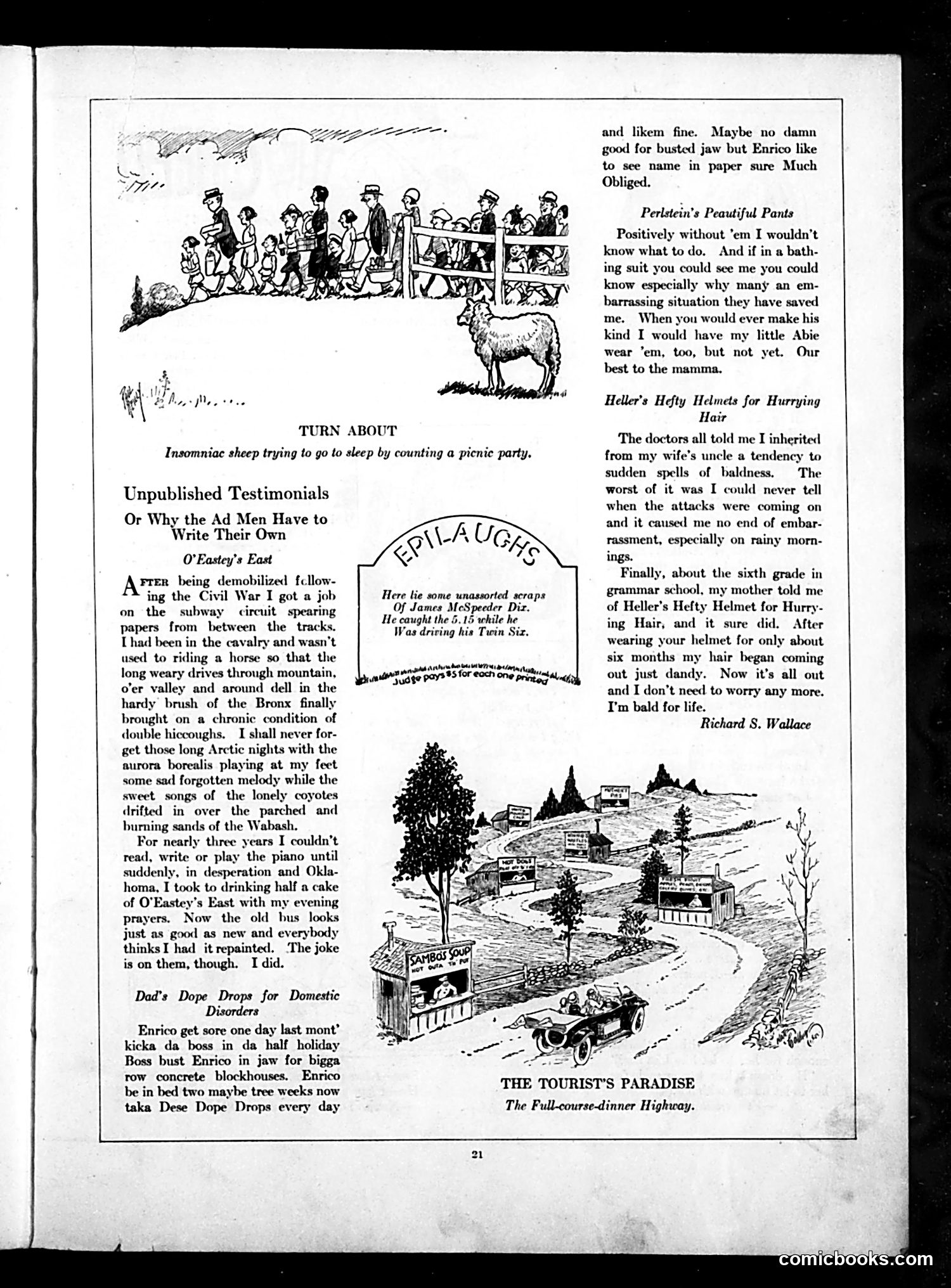
This page satirizes fake testimonials and advertising culture. The "Unpublished Testimonials" section mocks the convention of published customer endorsements by presenting absurd, badly-written letters praising fictional products. **Key satirical elements:** - **O'Eastey's East**: A fake remedy, with the testimonial using dialect humor (misspellings, rambling) to mock working-class credibility claims - **Perlstein's Pants, Heller's Helmets**: Humorous product testimonials using broken English and awkward phrasing to seem "authentic" - **Dad's Dope**: Features "Enrico" using heavy Italian-American dialect stereotypes—"kicka da boss," "bigga row"—to advertise a dubious remedy The cartoon at top shows sheep counting a picnic party to sleep, a visual pun on "counting sheep." The page ridicules how advertisers manufactured credibility through fabricated customer testimonials and ethnic stereotyping. The broken English and ridiculous claims expose the absurdity of the testimonial genre itself—the more "real" the testimonial sounds (via stereotypical dialect), the less believable it becomes.
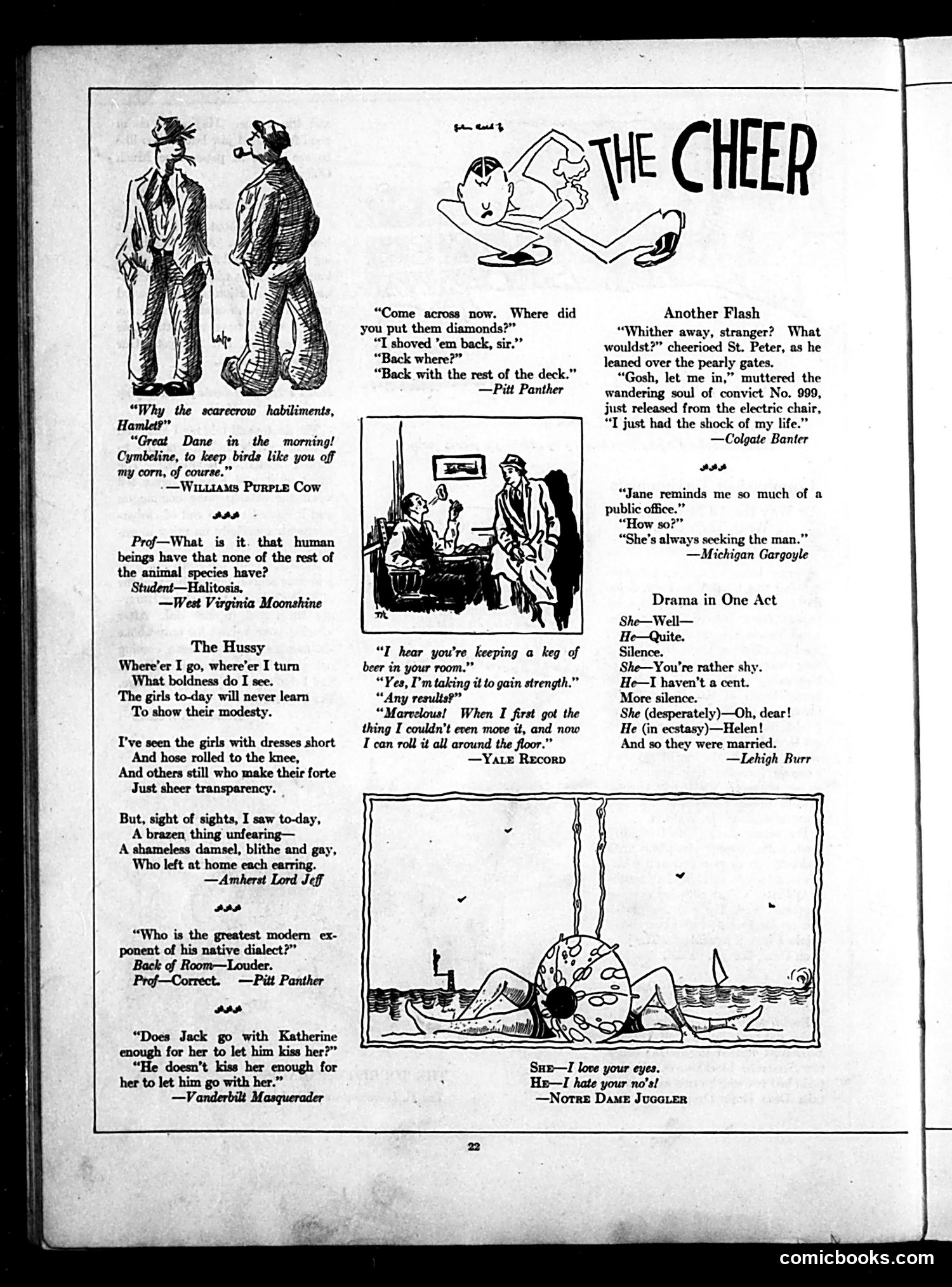
This is a **humor/joke compilation page** from Judge magazine featuring college-themed comedic quips and cartoons, likely from the 1920s based on style and references. **Key content:** - **"The Hussy"** satirizes changing women's fashion—short dresses, rolled stockings, and "sheer transparency"—portraying modern women as scandalously immodest. The punchline targets a woman who left home *without earrings*, mocking exaggerated moral panic about female liberation. - **Multiple one-liners** play on college life: a scarecrow defending corn (Shakespeare reference), student wisecracks about halitosis and beer strength, and romantic misadventures. - **"Drama in One Act"** depicts a couple where the man's poverty triggers silence until he reveals his name is "Helen"—implying she accepts him only because she mistook him for a wealthy woman. The humor reflects **1920s anxieties** about women's independence, Prohibition-era drinking, and class concerns, presented through collegiate wit typical of Judge's educated readership.
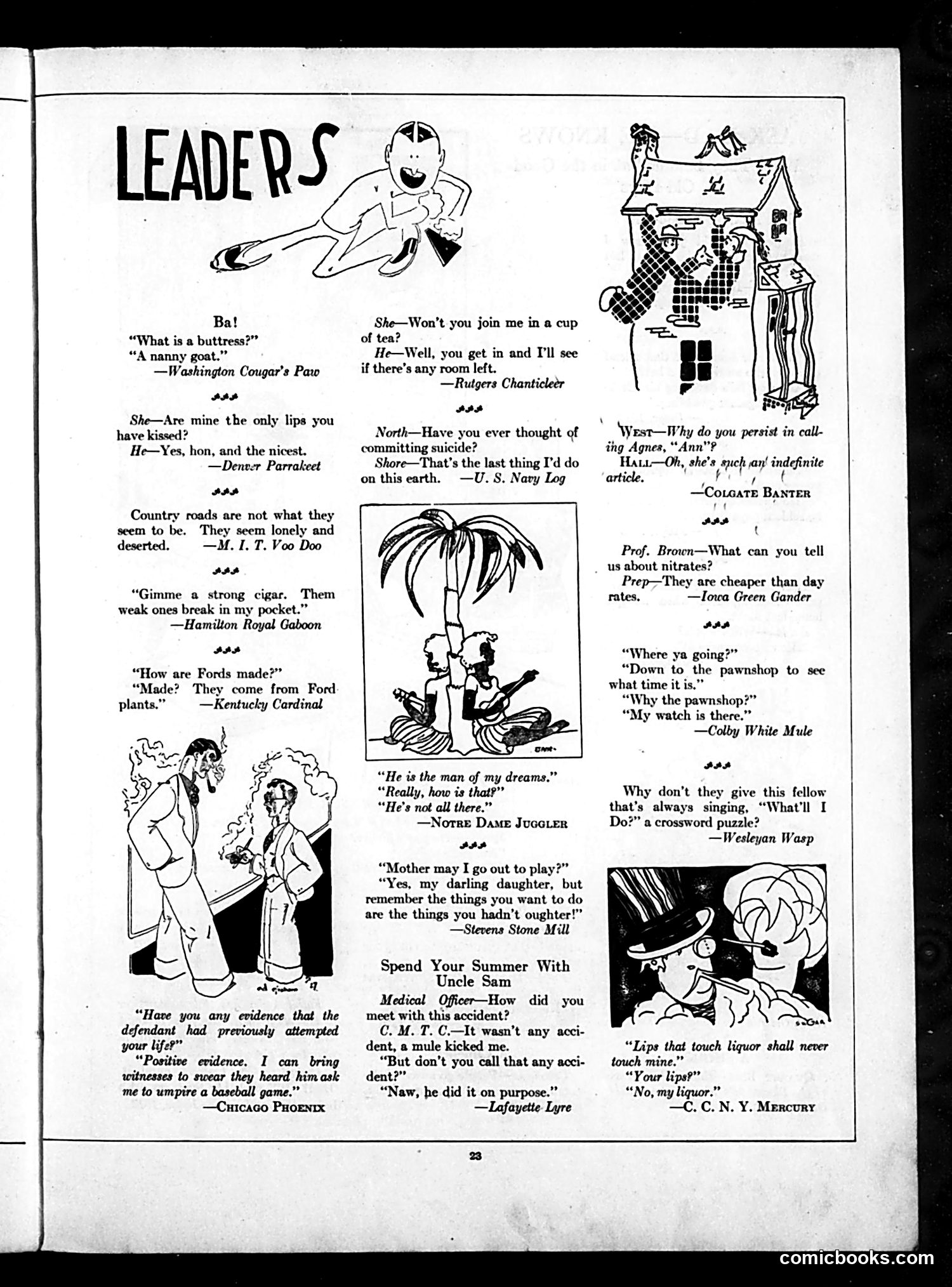
This page collects humorous one-liners and jokes from various college and military publications, arranged around cartoon illustrations. The humor relies on wordplay and gentle social satire typical of early-20th-century college humor. Key themes include: romantic misunderstandings (a woman claiming exclusive kiss rights while really protecting her liquor); absurd logic (calling a mule's kick "on purpose" so it's not an accident); puns ("nitrates are cheaper than day rates"); and mild critiques of modern life (Ford factory assembly, country roads, radio crooning). The "Uncle Sam" section references the Citizens' Military Training Camp (C.M.T.C.), a real government program. The cartoons show period dress and domestic scenes. Most jokes target educated audiences—college students and military personnel—with references to their publications like *Rutgers Chanticleer* and *U.S. Navy Log*. The satire is lighthearted rather than biting; the "leaders" title likely refers to these quips as conversation-starters or amusing observations for social settings.
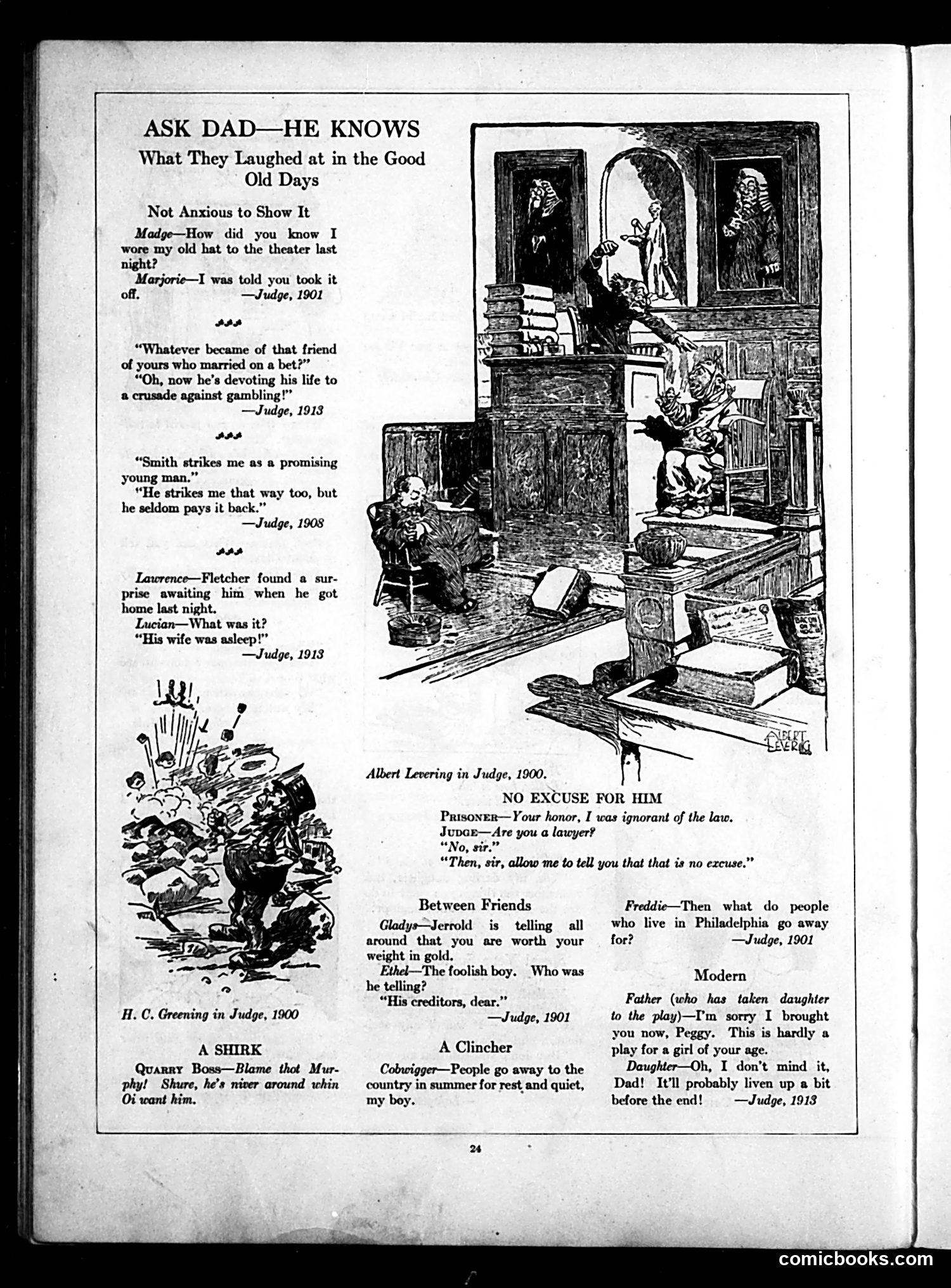
This page collects brief humorous anecdotes from Judge magazine (1900-1913), presented as "Ask Dad" wisdom from an earlier era. The jokes target common social hypocrisies and character flaws: **Key satirical themes:** - **Marital discord**: A wife's deception about wearing an old hat; a husband's "surprise" of finding his wife asleep - **Male irresponsibility**: A young man who borrows money without repaying; a worker shirking labor - **Social pretense**: A gambler-turned-crusader; a man praised for wealth who's actually in debt to creditors - **Generational humor**: A daughter finding a supposedly "unsuitable" play entertaining, suggesting modern girls are less innocent than fathers expect The cartoons mock Victorian-era pretensions and reveal unflattering truths about human nature—infidelity, dishonesty, hypocrisy. Philadelphia is joked as an especially dull city. The overall tone is cynical about marriage, work ethics, and social propriety, characteristic of Judge's satirical approach to American life.
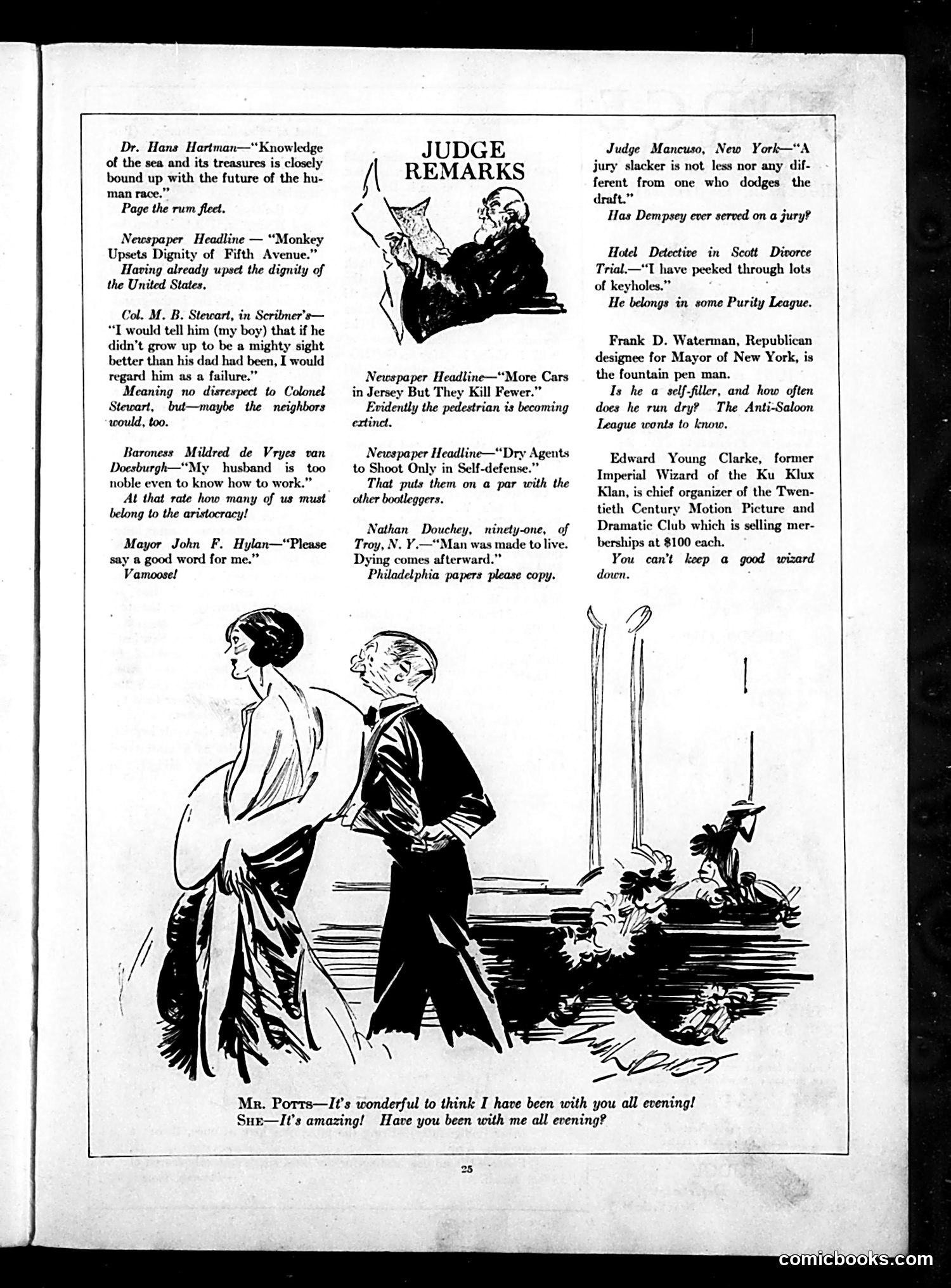
This page collects brief satirical quips mocking contemporary figures and headlines. Key targets include: **Political figures**: Mayor Hylan (NYC) seeking favorable press; Frank Waterman (Republican mayoral candidate), mocked for his fountain pen business with a pun about him being a "self-filler." **Social commentary**: A headline about pedestrians being "killed" by cars is twisted to suggest pedestrians are "becoming extinct"—dark humor about automobile fatalities. Prohibition-era dry agents shooting bootleggers puts them "on a par" morally. A hotel detective's admission of voyeurism in divorce proceedings is sarcastically praised as fitting for a "Purity League." **Ku Klux Klan**: Edward Young Clarke, former KKK leader, now runs a motion picture club—the joke being "you can't keep a good wizard down," sarcastically suggesting his continued influence despite leaving the Klan. The cartoon below shows a couple's mutual bewilderment about how long they've been together, likely satirizing shallow social interactions.
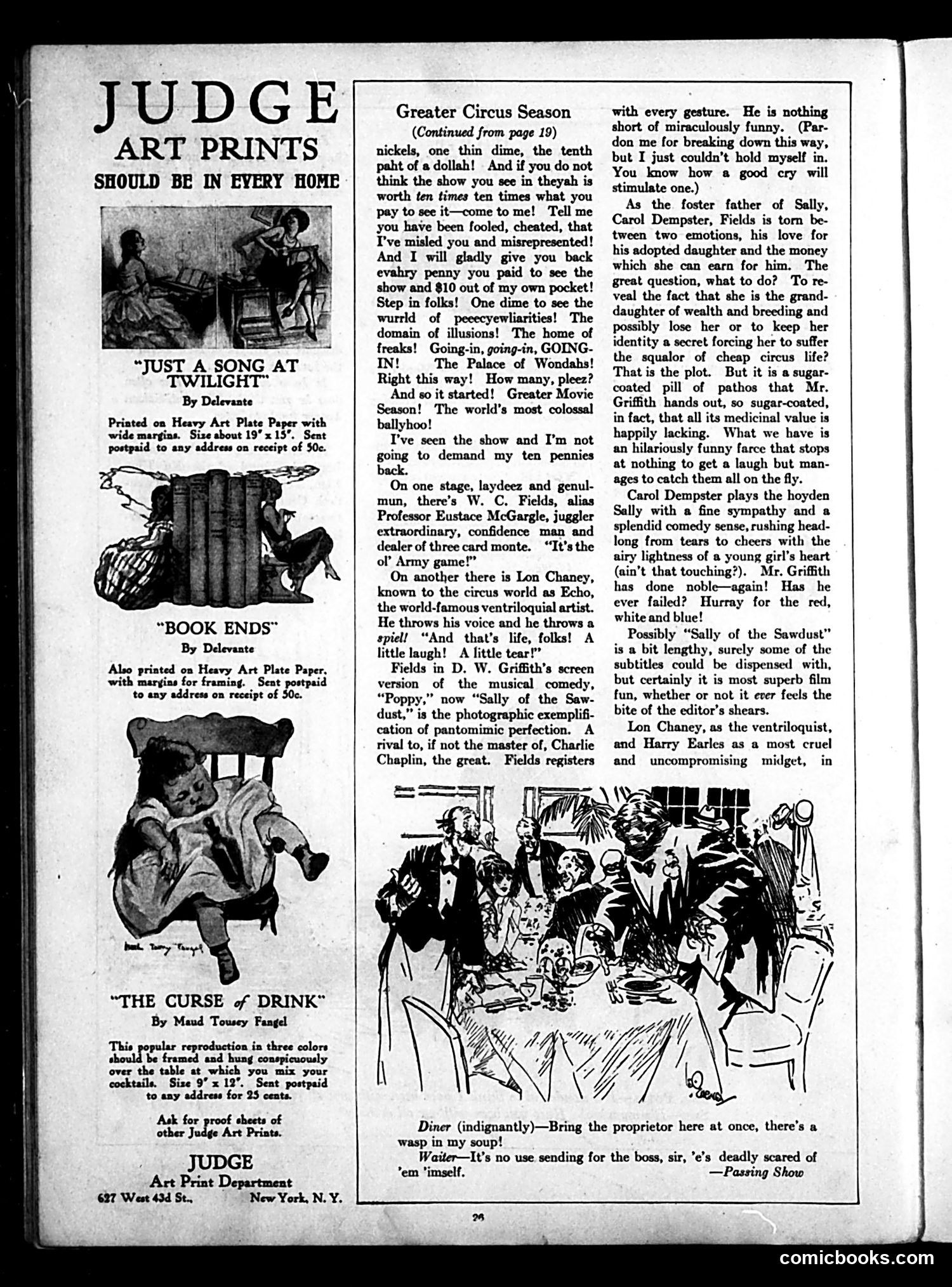
This page primarily advertises Judge art prints alongside a film review of D.W. Griffith's "Sally of the Sawdust" (1921). **The Art Prints:** Three reproductions are offered for home display—sentimental or humorous pieces by artists like Maud Tousey Fangel, priced 25-50 cents. **The Film Review:** The critic uses circus imagery to frame the movie season as spectacle. He praises W.C. Fields (playing con-man Professor McGargle) and Lon Chaney (as a ventriloquist) as exemplars of pantomimic entertainment, comparing Fields favorably to Charlie Chaplin. Carol Dempster plays Sally, a circus performer revealed to be wealthy—the plot concerns whether her guardian (Fields) will exploit her or reveal her identity. **The Satire:** The review adopts the voice of a carnival barker hawking the film as entertainment, mimicking the exaggerated dialect and promotional language of circus performers, establishing that cinema itself has become the modern circus. **Bottom Cartoon:** A diner patron complains about a wasp in soup—a simple gag about restaurant complaints.
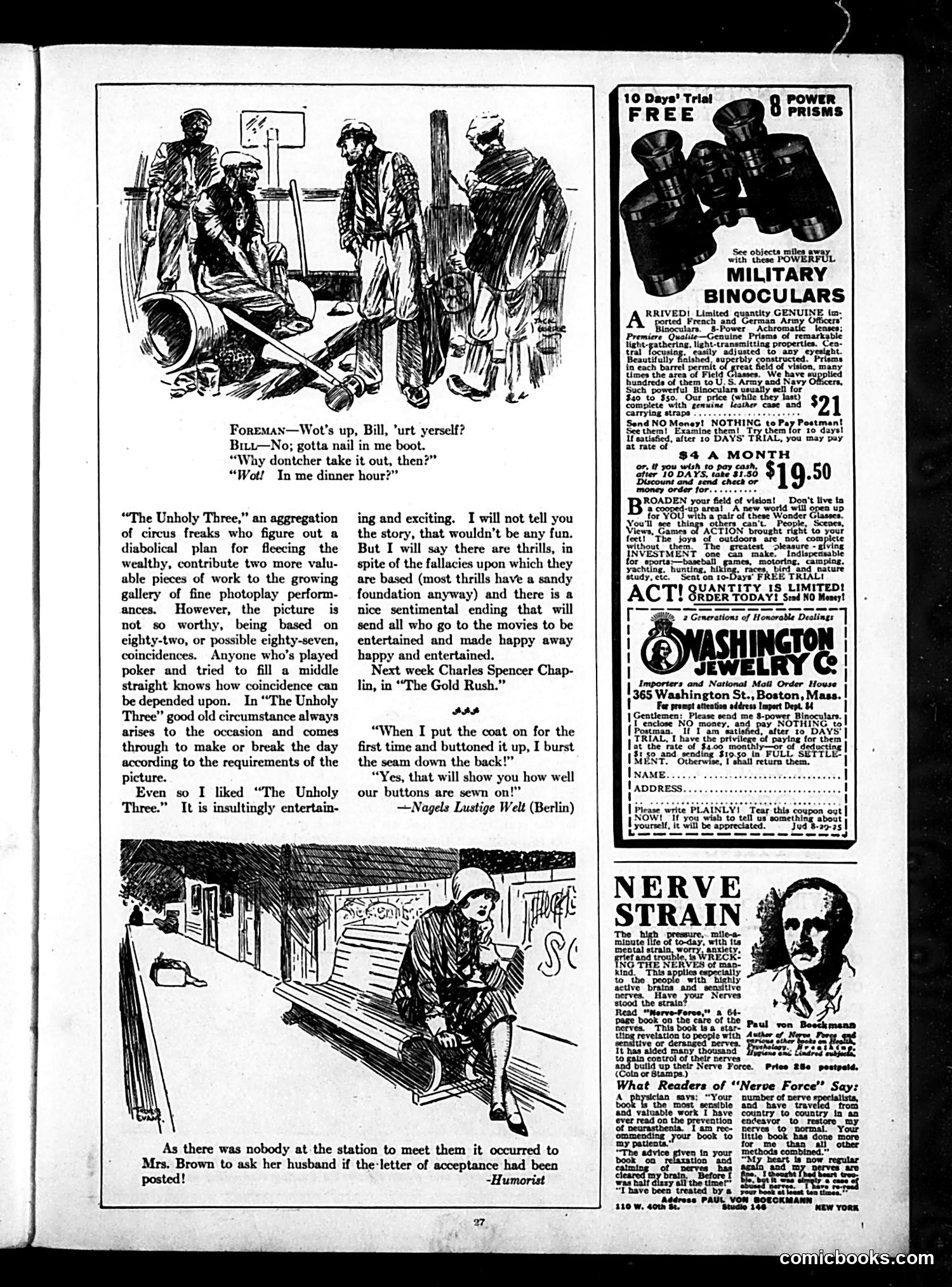
This Judge magazine page contains two satirical cartoons and period advertisements: **The Main Cartoon ("Dinner Hour"):** A foreman discovers a worker has a nail in his boot but won't remove it during lunch break. The joke satirizes rigid British working-class attitudes about strict adherence to schedules and job demarcations—the worker won't address a personal problem outside designated work hours, even when suffering discomfort. **The Second Cartoon ("At the Station"):** Mrs. Brown questions whether her husband posted a letter of acceptance, implying his absent-mindedness caused them to miss meeting someone. It satirizes domestic absent-mindedness and marital anxiety. **Context:** The page also includes a film review of "The Unholy Three" (likely the 1925 silent film), praising it despite its reliance on contrived coincidences, and advertisements for military binoculars and nerve tonics—typical early 20th-century products promising to cure stress-related ailments.
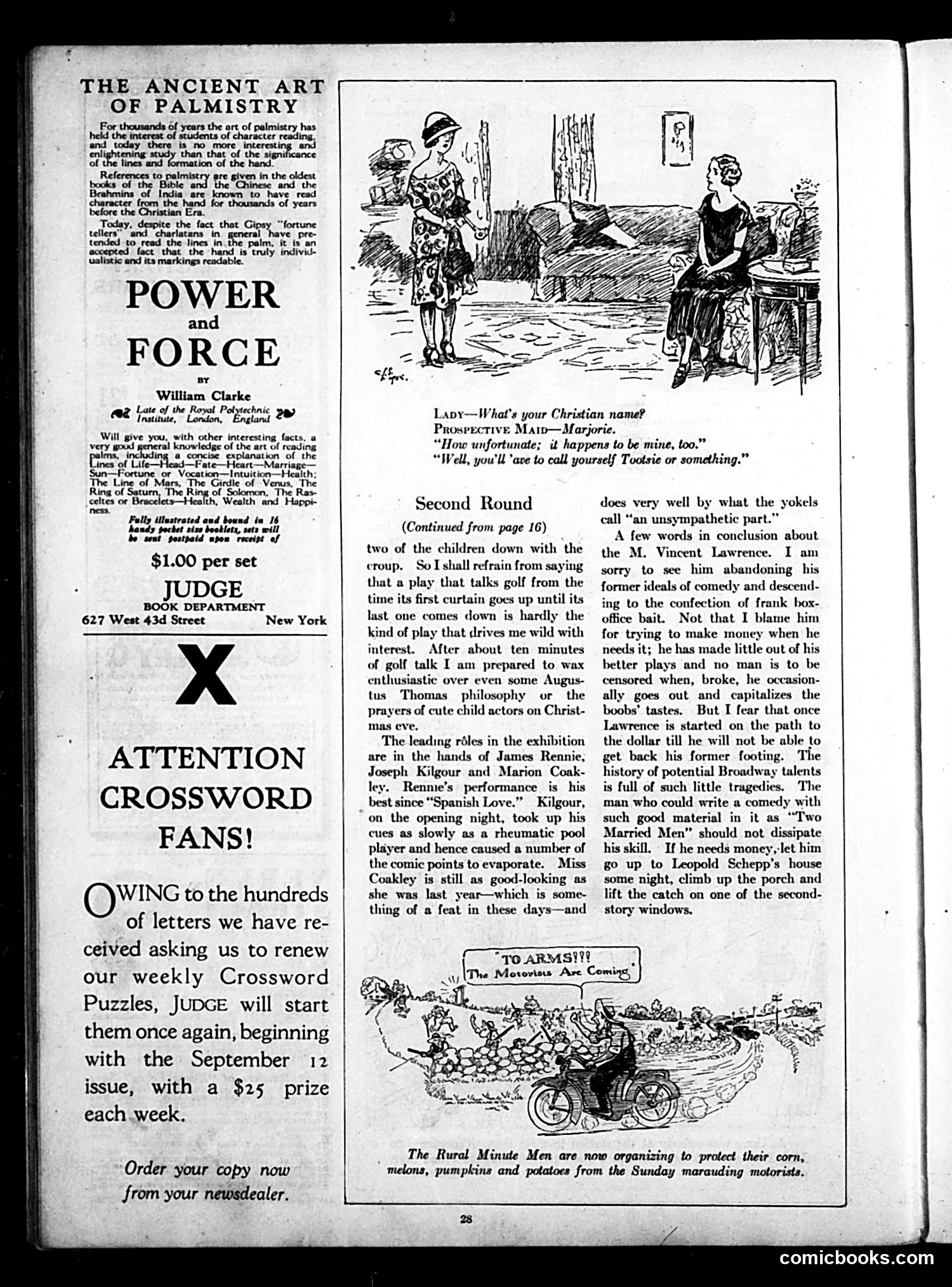
This page mixes advertising with theater criticism and two unrelated cartoons. **Main Content:** A theater review discusses a Broadway play featuring actors James Rennie, Joseph Kilgour, and Marion Coakley. The critic complains the play contains excessive golf dialogue, praises Rennie's performance, notes Kilgour's sluggish opening-night delivery, and warns playwright M. Vincent Lawrence against abandoning quality comedy for commercial "box-office bait"—suggesting once playwrights chase money, they abandon artistic integrity. **Cartoons:** The top illustration shows a prospective maid being hired; the joke centers on both having the same Christian name (Marjorie), forcing the maid to adopt a nickname like "Tootsie." The bottom cartoon depicts "Rural Minute Men" organizing to protect crops from Sunday motorists—satirizing the conflict between rural farmers and urban recreational drivers who trespassed on farmland. **Advertising:** Promotes palmistry instruction booklets and announces Judge's resumption of weekly crossword puzzles with $25 weekly prizes.
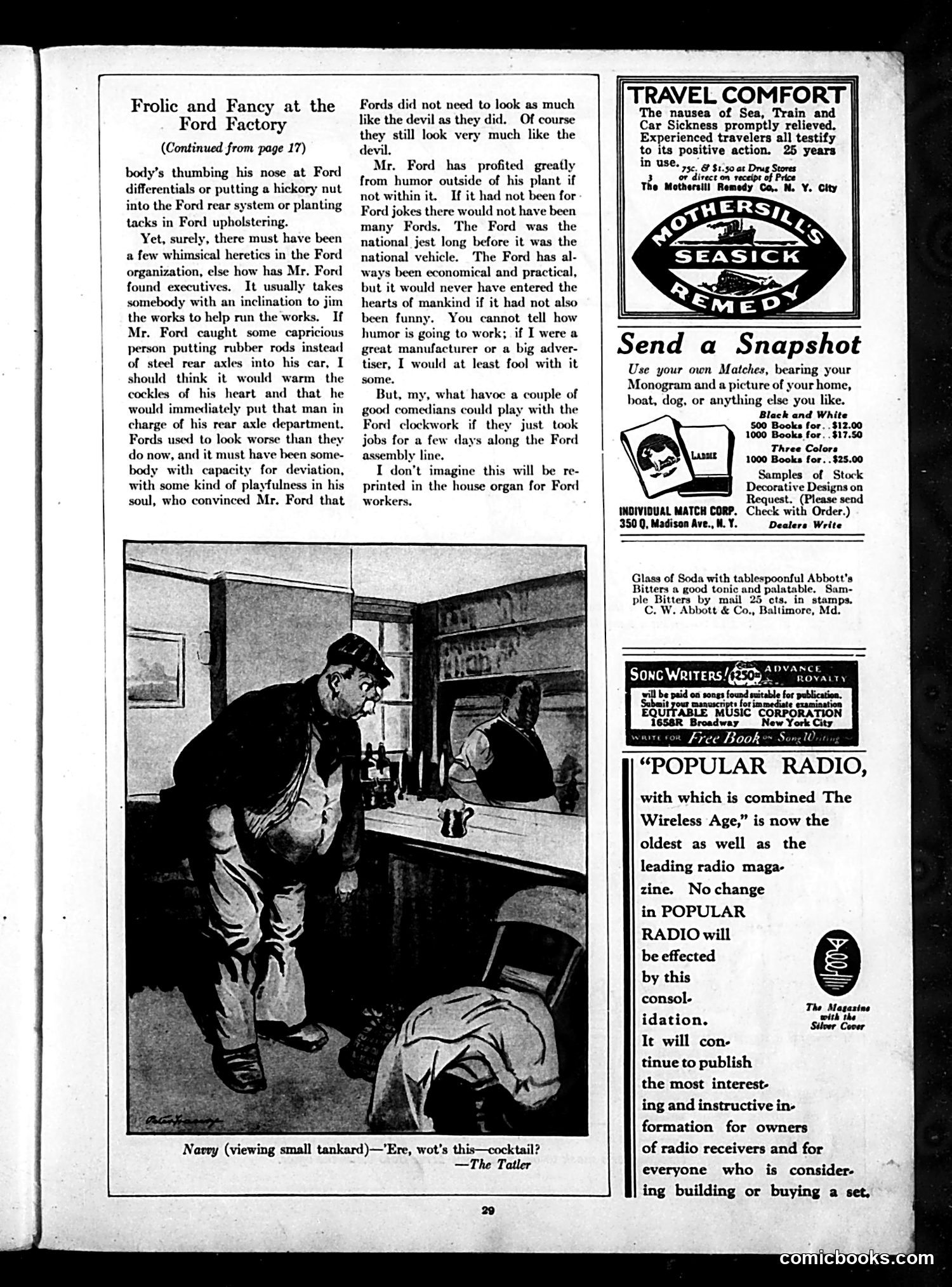
This page contains an article about Henry Ford and humor, plus period advertisements. The main text argues that Ford's success relied partly on jokes about the Model T—the car was famously cheap and utilitarian, appearing comical to the public. The author suggests Ford's organization needed some "playful" people to convince him to make cars less ugly. He humorously warns that if comedians infiltrated the assembly line, they could wreak havoc on Ford's precision manufacturing. The cartoon below shows a naval worker examining a small container, asking if it's a "cocktail"—a visual joke about mistaking something ordinary for alcohol, likely referencing Prohibition-era humor. The page is otherwise filled with advertisements for seasickness remedy, custom matchbooks, radio magazines, and patent medicines—typical of 1920s American magazines.
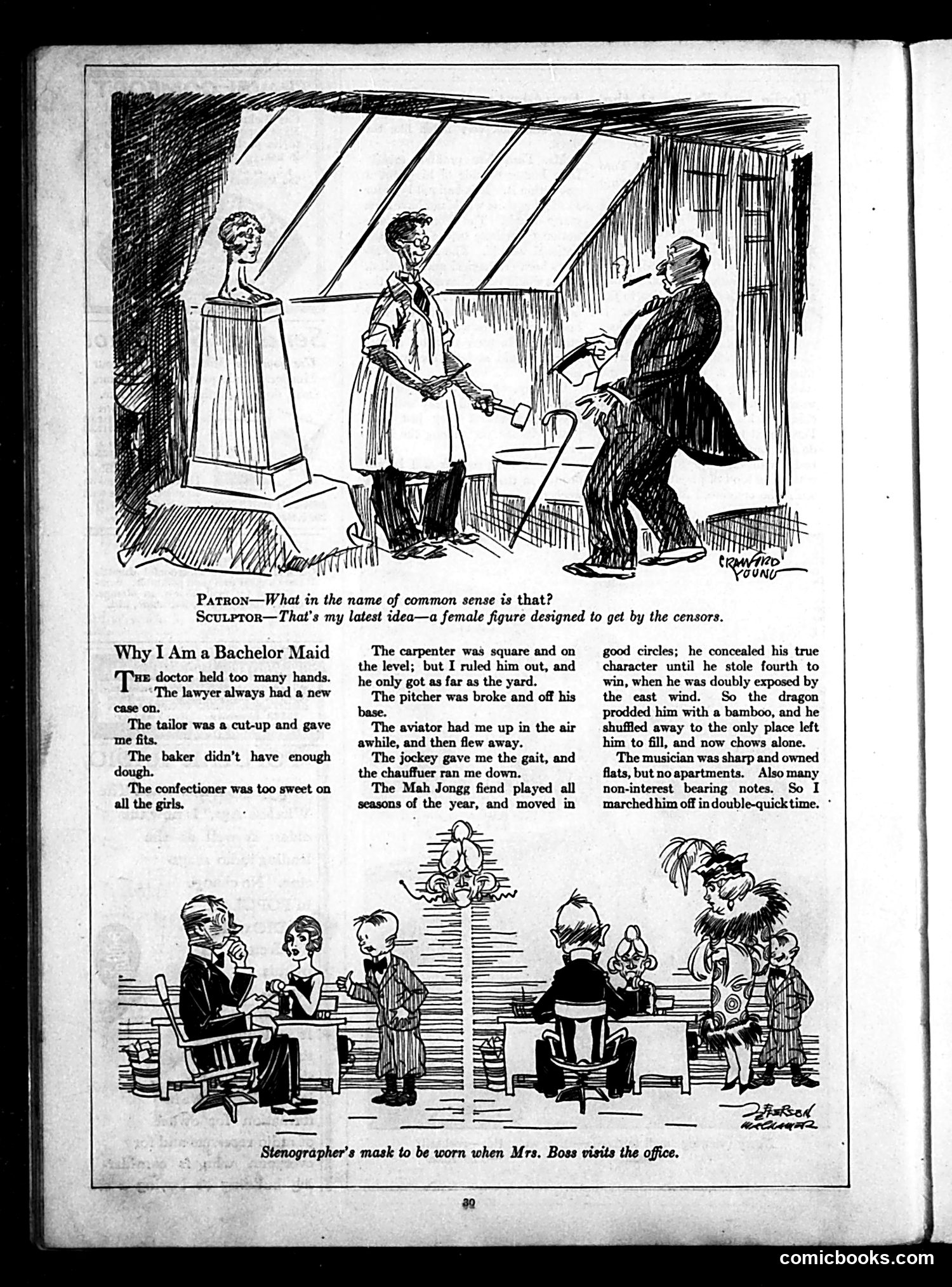
**Top Cartoon:** A sculptor shows a patron a female nude statue, claiming it's "designed to get by the censors." The joke satirizes artistic censorship of the era—the sculptor is implying the figure is intentionally ambiguous or disguised to avoid obscenity laws. **Main Article:** "Why I Am a Bachelor Maid" is a humorous list of occupations and professions, each with a pun-based reason why the narrator rejected suitors from that field. Examples: the baker "didn't have enough dough," the carpenter was "square," the aviator "flew away." The Mah Jongg section adds topical humor about the then-trendy game. **Bottom Cartoon:** Shows office workers wearing a "stenographer's mask" when the boss's wife visits—satirizing workplace propriety and the gap between professional behavior and what actually occurs when authority figures aren't present. **Overall Context:** These pieces reflect 1920s American humor about gender relations, workplace dynamics, and social censorship conventions of the era.
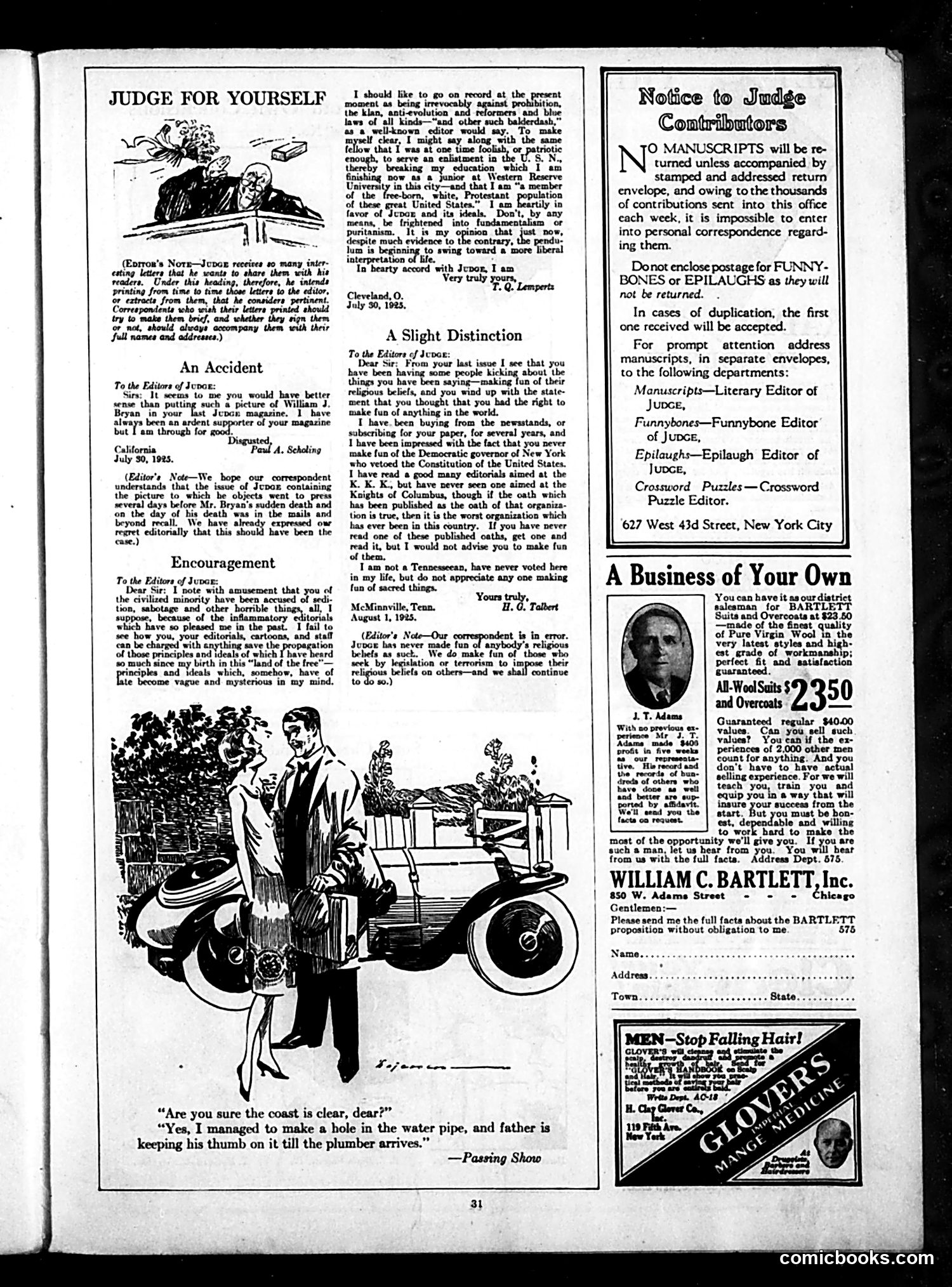
This page consists mainly of reader letters-to-the-editor and editorial responses, typical of magazine correspondence columns. **Key content:** An editor's note explains Judge published a William Jennings Bryan cartoon just before his sudden death in July 1925—an unfortunate timing the editors regret but couldn't prevent due to printing schedules. **Political references:** Letters debate Judge's editorial stance on religious topics. One reader challenges Judge for satirizing the KKK while supposedly avoiding the "Knights of Columbus," implying bias against Protestant vs. Catholic organizations. The editor responds they criticize *all* groups attempting "legislation or terrorism to impose their religious beliefs." Another reader praises Judge for its "inflammatory" satire defending free speech against "fundamentalism" and "Puritanism." **The cartoon:** Shows a woman and man with a car; she asks if "the coast is clear" while he keeps his thumb in a water pipe—a domestic mishap joke about avoiding detection by the plumber, unrelated to politics.
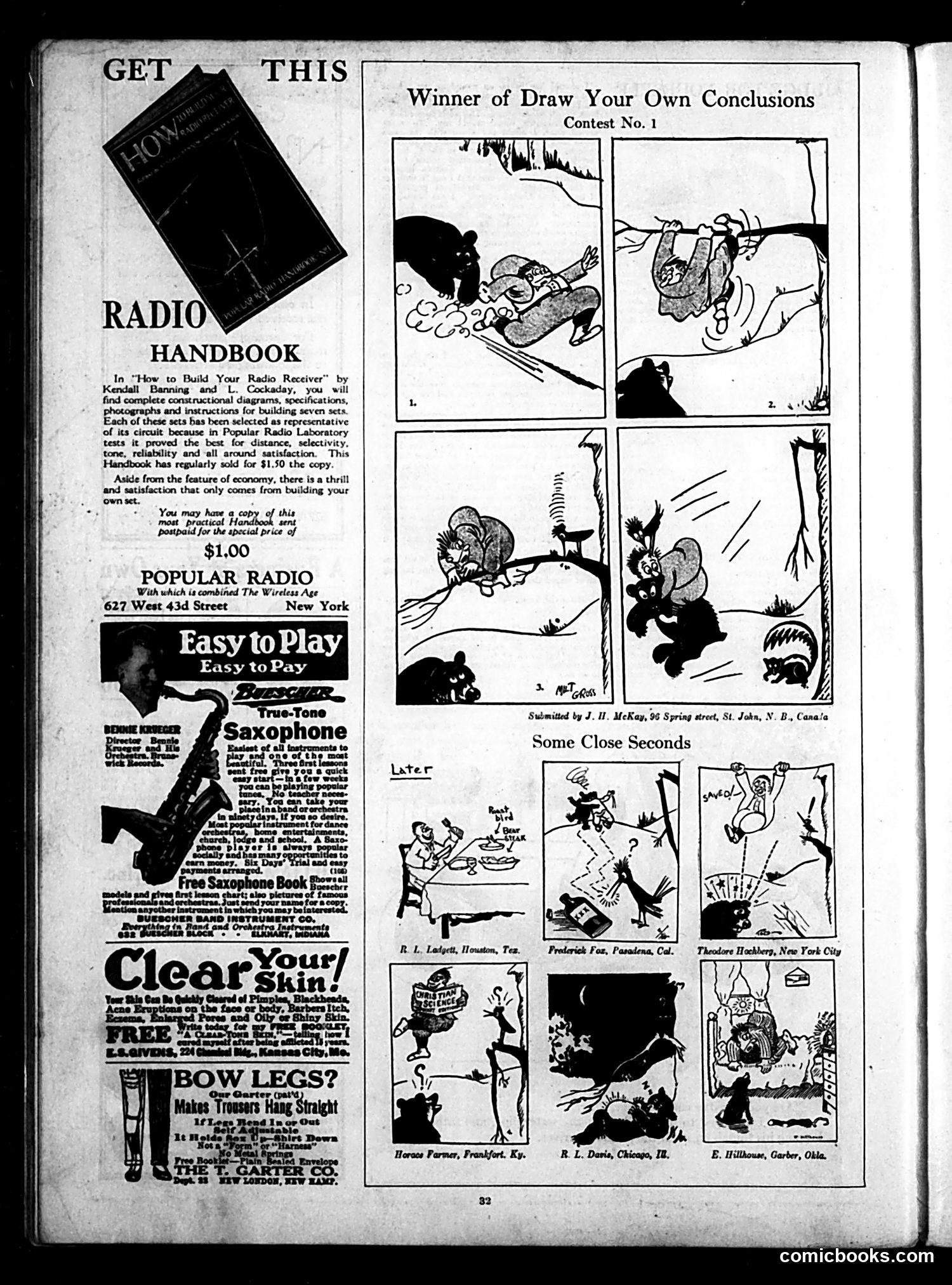
This page is primarily **advertising and contest results**, not political satire. The main content shows the winning entry and runners-up from Judge's "Draw Your Own Conclusions" Contest No. 1—a visual humor competition where readers submitted cartoon captions or conclusions to ambiguous scenes. The winning cartoon (top) depicts animals in comedic situations: what appears to be a hedgehog or porcupine encountering other creatures in increasingly absurd circumstances. The "Some Close Seconds" section shows six runner-up submissions from readers across North America, each offering different humorous interpretations of similar chaotic animal scenarios. The left side advertises a **Radio Handbook** ($1.00), a **True-Tone Saxophone**, skin-care products, and leg-straightening devices—typical early 20th-century mail-order offerings. This reflects Judge's era as a humor magazine that engaged readers through contests, combining editorial cartoons with reader participation and commercial advertisements.
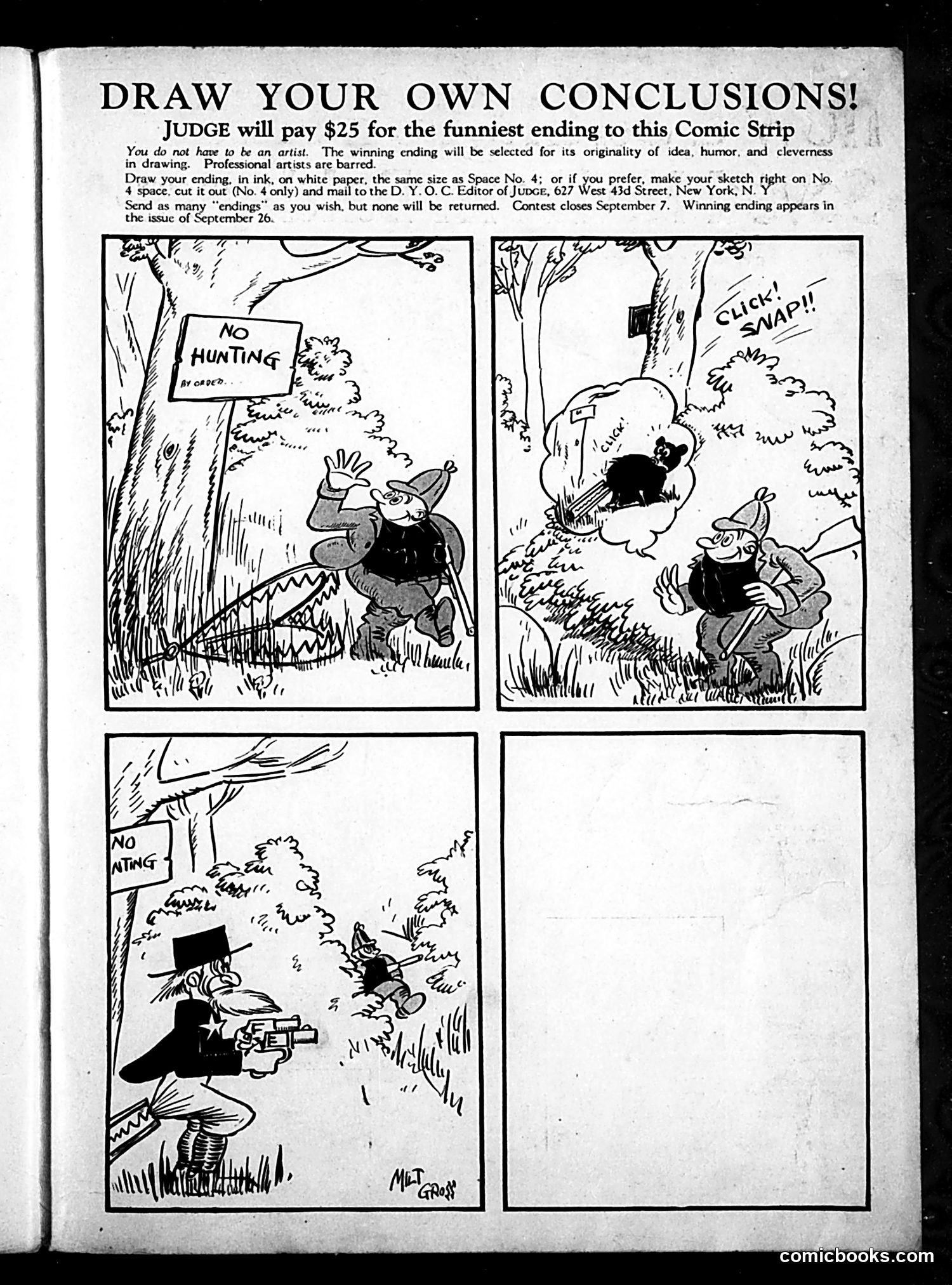
This is a reader-participation contest page from *Judge*, a satirical magazine. The incomplete comic strip shows a hunting scenario: Panel 1 depicts a figure with a "No Hunting" sign near trees. Panel 2 shows a trap snapping shut on what appears to be a beaver or similar animal, with another character reacting. Panel 3 reveals a man in a top hat with a gun confronting the trapped animal, with a "No Hunting" sign visible. The joke setup appears to satirize hunting regulations or game laws—the contrast between the "No Hunting" signs and characters actively hunting suggests irony about rule-breaking or poaching. Readers were invited to submit their own funny conclusions to the strip for a $25 prize (substantial money in the early 20th century when this appeared). Non-artists could compete, though professionals were excluded. The winning entry would appear in the September 26 issue.
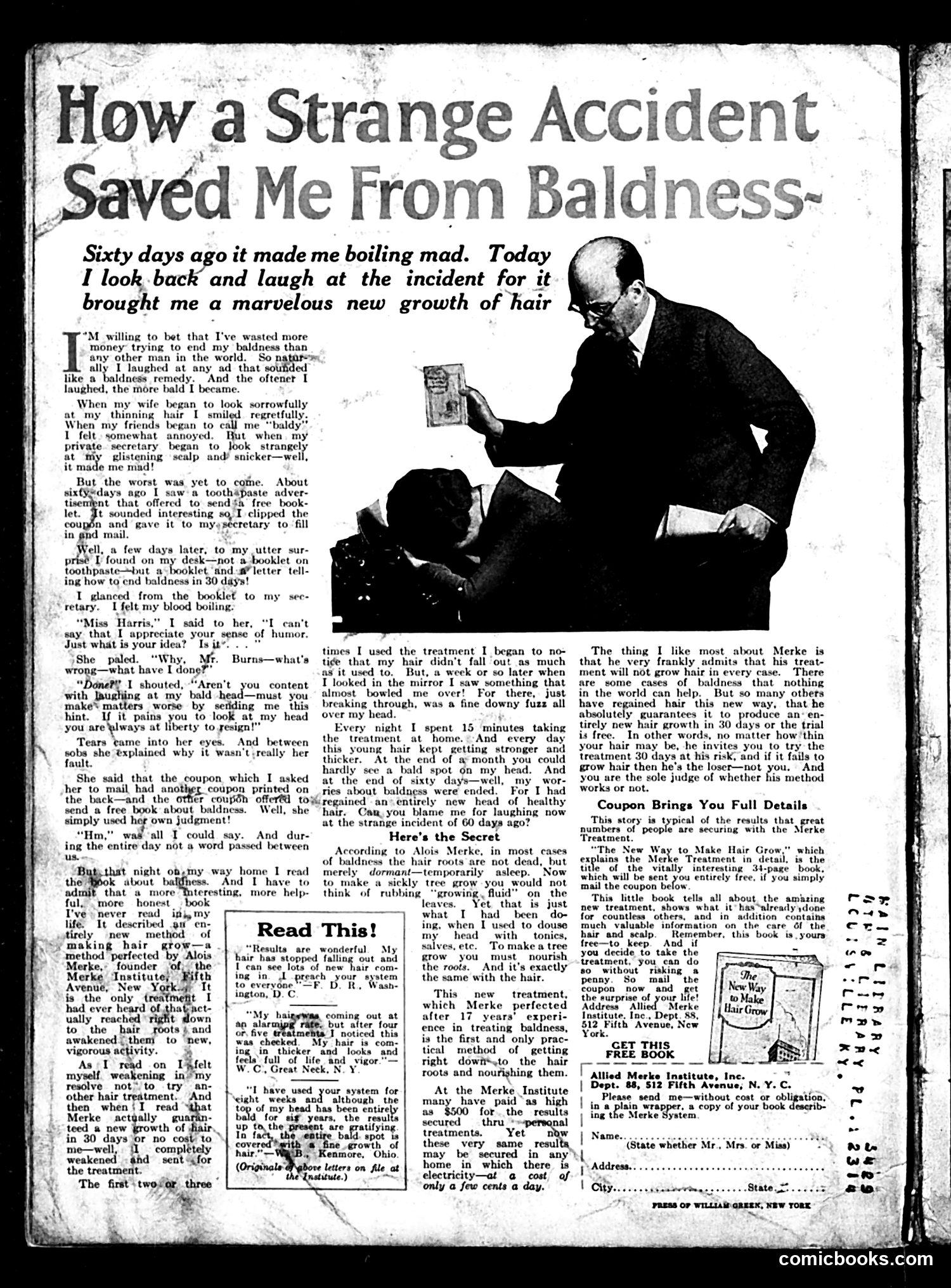
This page is primarily **advertising disguised as editorial content**—a common early 20th-century marketing tactic. The large narrative about a man's baldness cure is actually a testimonial advertisement for the "Merke Institute" hair-growth treatment. **The "Story":** A bald businessman, frustrated after years of failed remedies, accidentally receives a baldness booklet. Initially furious at his secretary, he reads it anyway and becomes convinced by Alois Merke's guaranteed method. After using the treatment for 60 days, he claims new hair growth. **Historical Context:** This reflects genuine anxieties about male baldness and the proliferation of dubious "scientific" cure-alls in that era. The Merke Institute's claims (hair regrowth in 30 days, money-back guarantees) are typical of unregulated patent medicine advertising. **The Satire/Irony:** Judge magazine's inclusion suggests gentle mockery of such extravagant claims, though the page functions primarily as paid advertising rather than satirical critique. **Modern Equivalent:** Think influencer testimonials or sponsored content disguised as personal stories.