
Judge, 1925-08-29 · page 17 of 36
Judge — August 29, 1925 — page 17: what you’re looking at
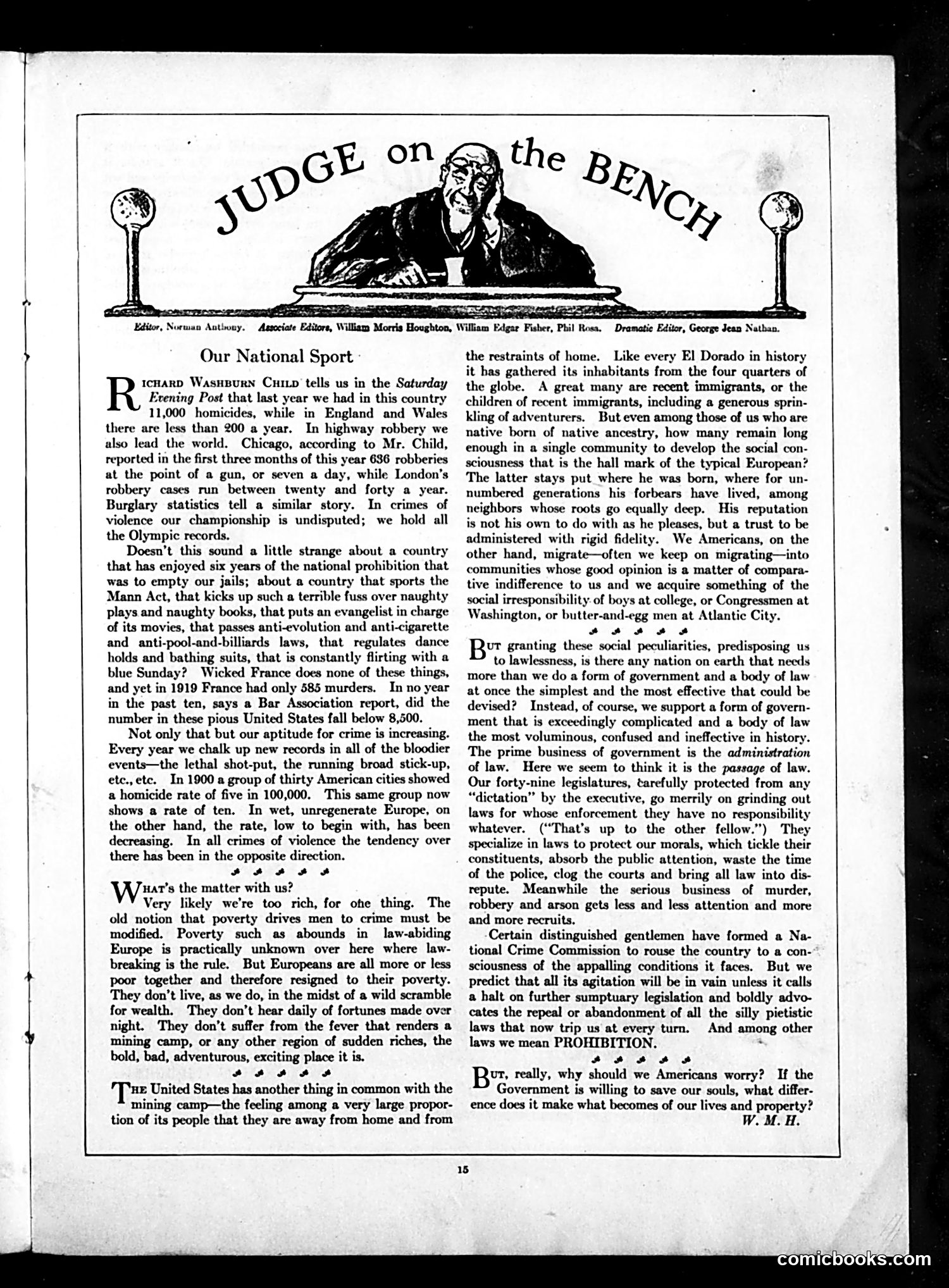
What you’re looking at
This editorial column by Richard Washburn Child contrasts America's soaring violent crime rates with those of Europe, presenting a satirical critique of Prohibition's failure. **The Central Irony**: The U.S. had implemented six years of national Prohibition specifically to "empty our jails," yet simultaneously leads the world in homicides (11,000 annually vs. fewer than 200 in England/Wales), highway robbery, and burglary. Child notes the hypocrisy: America aggressively regulates morality through anti-evolution laws, movie censorship, and blue laws—yet remains lawless. **The Explanation**: Child attributes American lawlessness not to poverty (as traditionally believed) but to *wealth and mobility*. Unlike stable, rooted European communities bound by reputation and ancestral ties, Americans are transient migrants—particularly immigrants and adventurers—lacking community accountability. This "mining camp mentality" encourages criminality. **The Satire**: The piece mockingly asks why Americans should worry if government can "save our souls," implying Prohibition's moral legislation is ineffective window-dressing masking deeper social disorder.
📄 Transcribed text from this page (OCR, searchable)
Machine-transcribed from the original scan — historical spelling and the odd misread are preserved.
Our National Sport Editor, Norman Anthony. IcharD WasuBurN Cup tells us in the Saturday R Ecening Post that last year we had in this country 11,000 homicides, while in England and Wales there are less than 200 a year. In highway robbery we also lead the world. Chicago, according to Mr. Child, reported in the first three months of this year 636 robberies at the point of a gun, or seven a day, while London’s robbery cases run between twenty and forty a year. Burglary statistics tell a similar story. In crimes of violence our championship is undisputed; we hold all the Olympic records. Doesn’t this sound a little strange about a country that has enjoyed six years of the national prohibition that was to empty our jails; about a country that sports the Mann Act, that kicks up such a terrible fuss over naughty plays and naughty books, that puts an evangelist in charge of its movies, that passes anti-evolution and anti-cigarette and anti-pool-and-billiards laws, that regulates dance holds and bathing suits, that is constantly flirting with a blue Sunday? Wicked France does none of these things, and yet in 1919 France had only 585 murders. In no year in the past ten, says a Bar Association report, did the number in these pious United States fall below 8,500. Not only that but our aptitude for crime is increasing. Every year we chalk up new records in all of the bloodier events—the lethal shot-put, the running broad stick-up, etc.,etc. In 1900 a group of thirty American cities showed a homicide rate of five in 100,000. This same group now shows a rate of ten. In wet, unregenerate Europe, on the other hand, the rate, low to begin with, has been decreasing. In all crimes of violence the tendency over there has been in the opposite direction. -~ eee ‘Hat's the matter with us? Very likely we're too rich, for ohe thing. The old notion that poverty drives men to crime must be modified. Poverty such as abounds in law-abiding Europe is practically unknown over here where law- breaking is the rule. But Europeans are all more or less poor together and therefore resigned to their poverty. They don’t live, as we do, in the midst of a wild scramble for wealth. They don’t hear daily of fortunes made over night. They don’t suffer from the fever that renders a mining camp, or any other region of sudden riches, the bold, bad, adventurous, exciting place it is. e~eaaes 'HE United States has another thing in common with the mining camp—the feeling among a very large propor- tion of its people that they are away from home and from bs es Associate Editors, William Morris Houghton, William Edgar Fisher, Phil Rosa, Dramatic Editor, George Jean Nathan. the restraints of home. Like every El Dorado in history it has gathered its inhabitants from the four quarters of the globe. A great many are recent immigrants, or the children of recent immigrants, including a generous sprin- kling of adventurers. But even among those of us who are native born of native ancestry, how many remain long enough in a single community to develop the social con- sciousness that is the hall mark of the typical European? The latter stays put where he was born, where for un- numbered generations his forbears have lived, among neighbors whose roots go equally deep. His reputation is not his own to do with as he pleases, but a trust to be administered with rigid fidelity. We Americans, on the other hand, migrate—often we keep on migrating—into communities whose good opinion is a matter of compara- tive indifference to us and we acquire something of the social irresponsibility. of boys at college, or Congressmen at Washington, or butter-and-egg men at Atlantic City. -~ ee ae Bz granting these social peculiarities, predisposing us to lawlessness, is there any nation on earth that needs more than we do a form of government and a body of law at once the simplest and the most effective that could be devised? Instead, of course, we support a form of govern- ment that is exceedingly complicated and a body of law the most voluminous, confused and ineffective in history. The prime business of government is the administration of law. Here we seem to think it is the passage of law. Our forty-nine legislatures, tarefully protected from any “dictation” by the executive, go merrily on grinding out laws for whose enforcement they have no responsibility whatever. (‘“That’s up to the other fellow.”) They specialize in laws to protect our morals, which tickle their constituents, absorb the public attention, waste the time of the police, clog the courts and bring all law into dis- repute. Meanwhile the serious business of murder, robbery and arson gets less and less attention and more and more recruits, Certain distinguished gentlemen have formed a Na- tional Crime Commission to rouse the country to a con- sciousness of the appalling conditions it faces. But we predict that all its agitation will be in vain unless it calls a halt on further sumptuary legislation and boldly advo- cates the repeal or abandonment of all the silly pietistic laws that now trip us at every turn. And among other laws we mean PROHIBITION. . Ae ea S ur, really, why should we Americans worry? If the Government is willing to save our souls, what differ- ence does it make what becomes of our lives and property? W. M. H. 15