
A complete issue · 36 pages · 1925
Judge — June 13, 1925
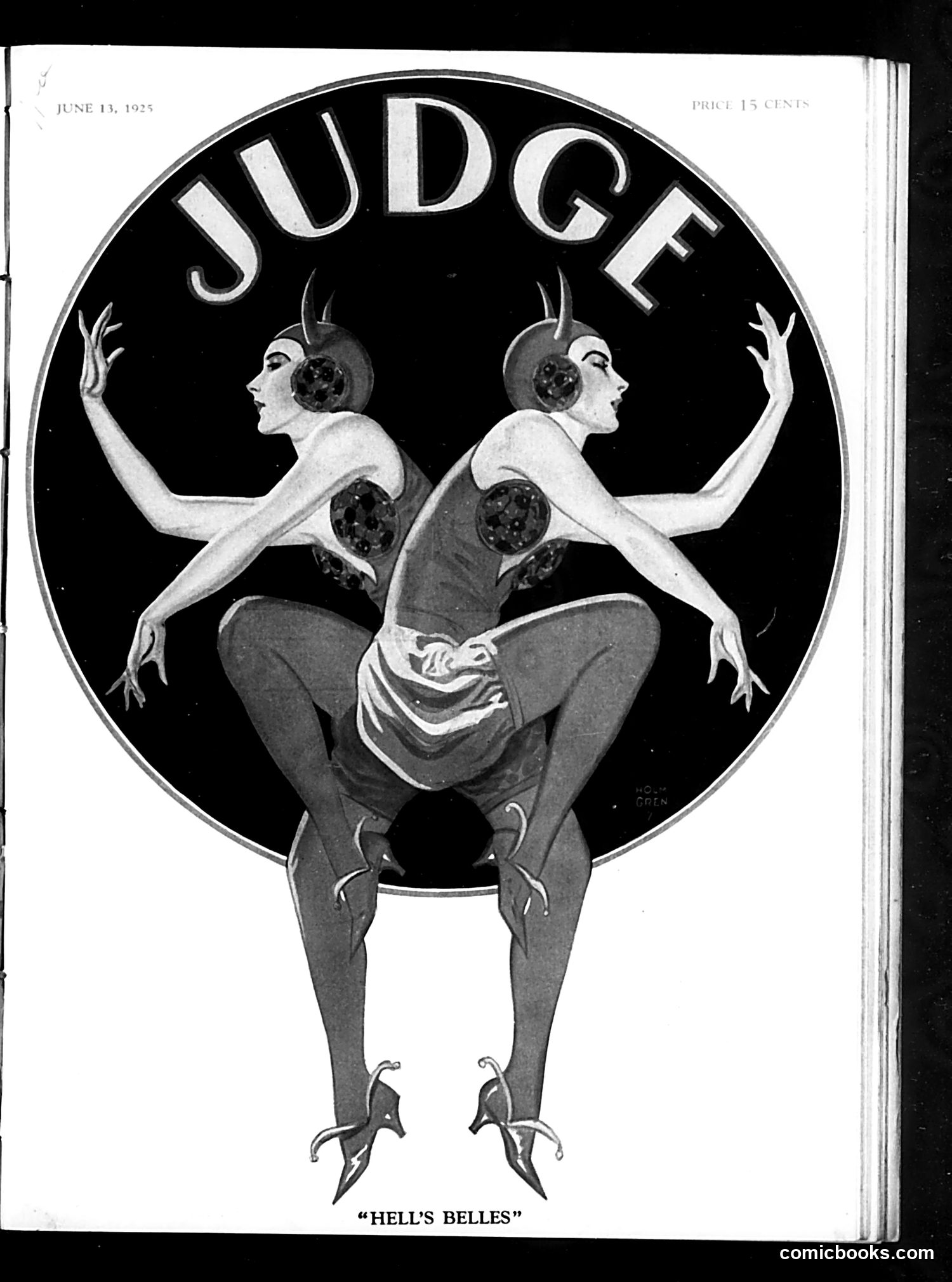
This cover illustration titled "Hell's Belles" depicts a symmetrical figure with two female heads and bodies emerging from a single lower torso, wearing 1920s clothing and sporting bobbed hair and headpieces typical of the era. The imagery satirizes the "flapper" phenomenon—the modern, liberated young women of the Jazz Age who scandalized conservative society with bobbed hair, shortened skirts, and independent behavior. The doubled imagery and demonic title ("Hell's Belles") suggest moral panic about these women, portraying them as duplicitous or inherently corrupting. The satire reflects broader anxieties about changing gender roles and women's newfound social freedoms following women's suffrage (1920). The grotesque presentation expresses conservative disapproval of the era's social transformation.
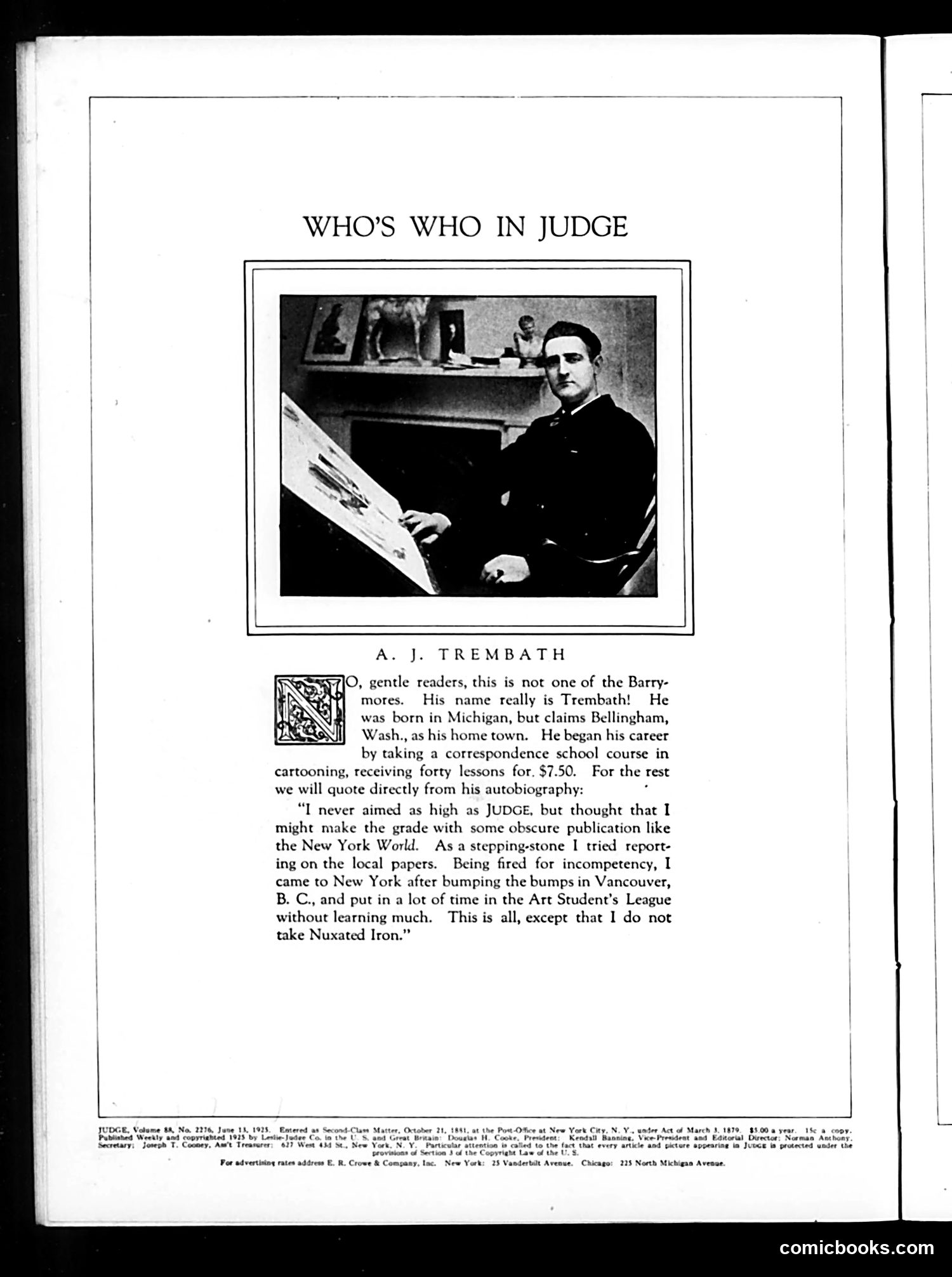
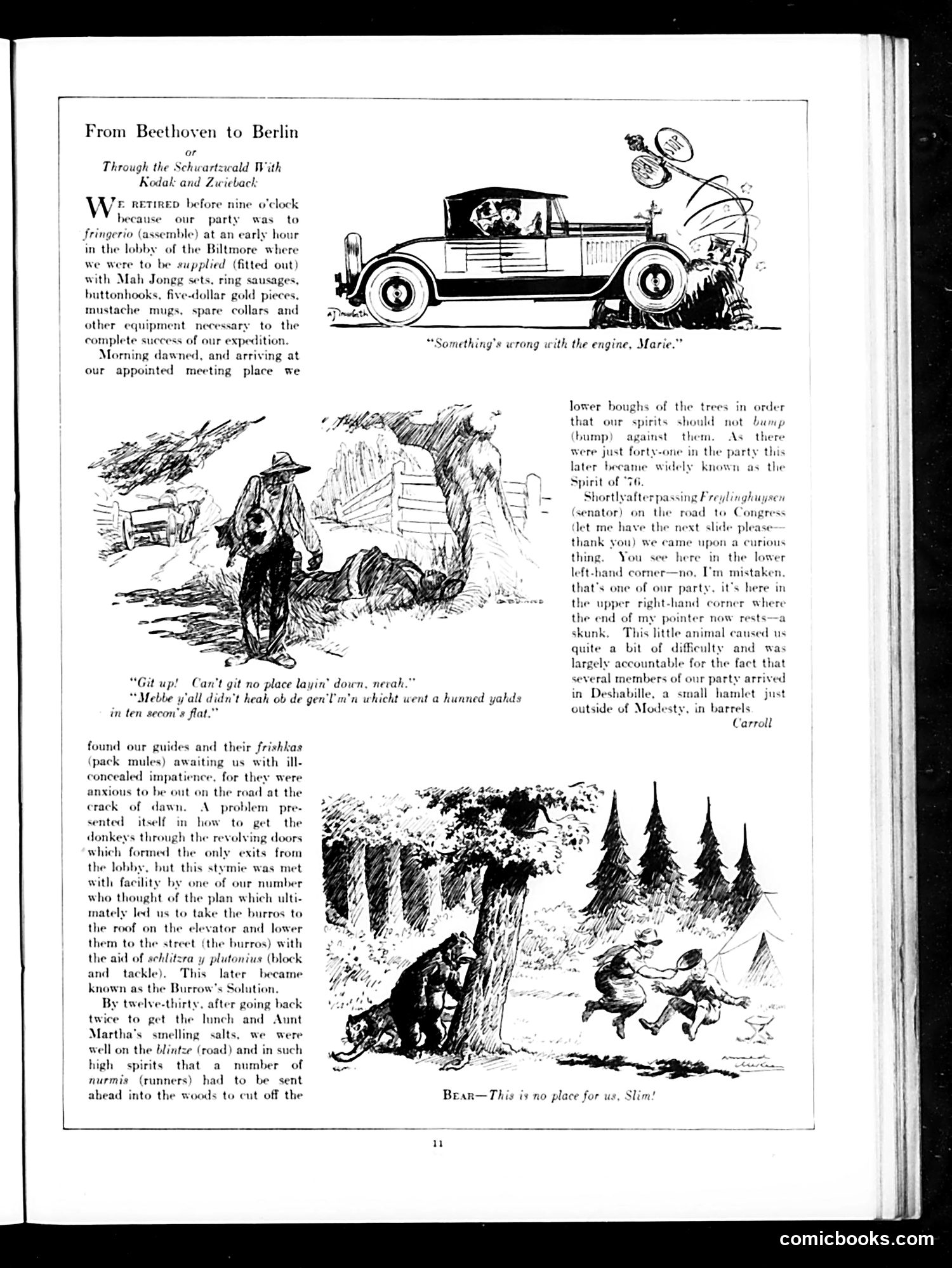
This page profiles cartoonist A.J. Trembath, a contributor to *Judge* magazine. The biographical sketch is presented as light satire, using self-deprecating humor about his career path. Trembath claims he never aspired to be a "Judge" (likely a pun on the magazine's name), but instead hoped to work for publications like the *New York World*. The text humorously recounts his failed attempts at journalism and time spent at the Art Student's League in New York after relocating from Vancouver, B.C. The final quip about not taking "Nuxated Iron" (a contemporary patent medicine/supplement) adds comedic closure to his modest autobiography. This is essentially a lighthearted promotional feature introducing a staff member to readers rather than political satire.
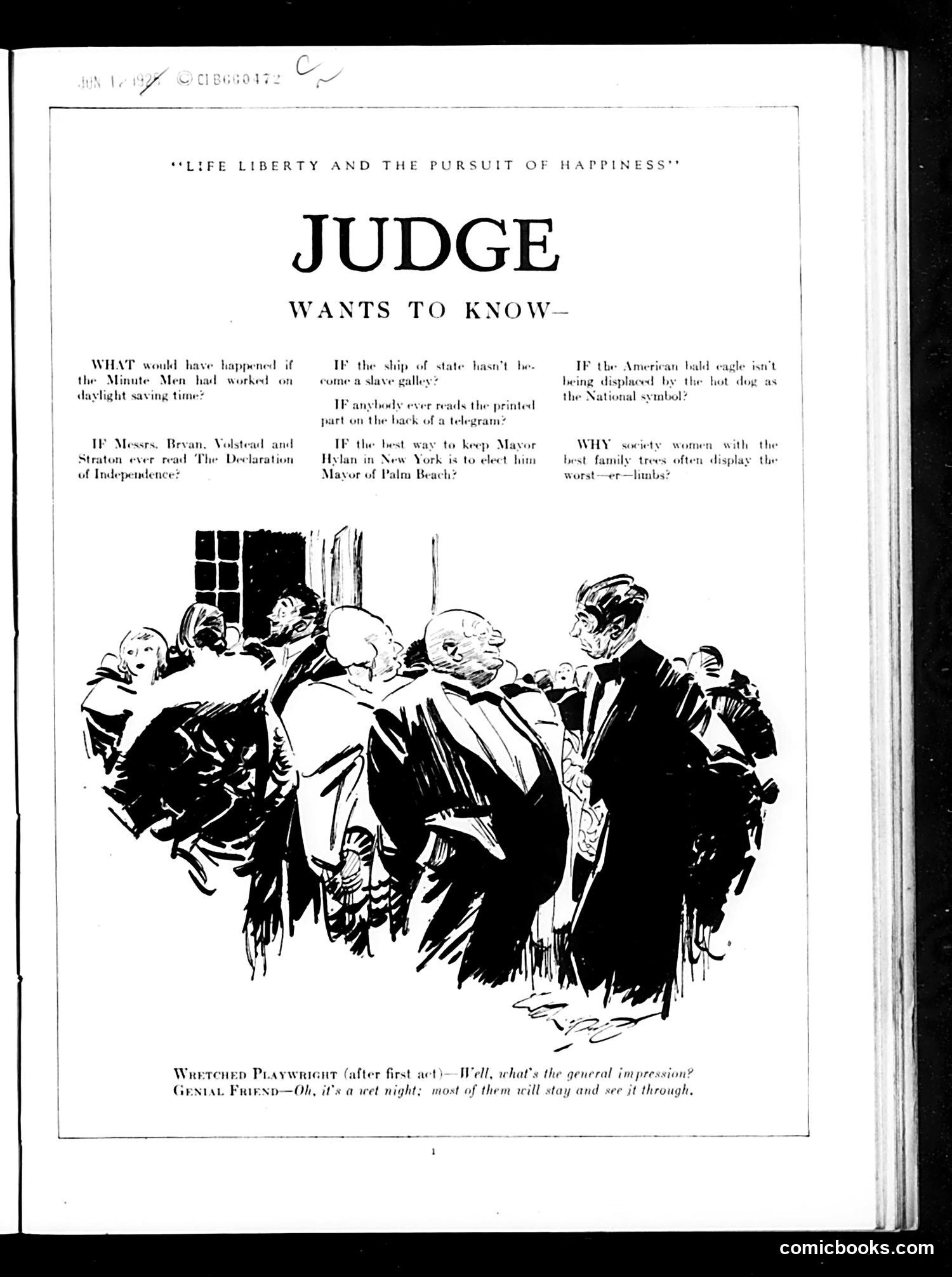
This page satirizes prominent public figures through rhetorical questions posed as "What Judge Wants to Know." The questions reference: - **Daylight saving time** implementation (a WWI-era policy) - **Declaration of Independence** signers (Bryan, Volstead, Straton—likely progressive politicians) - **Telegram etiquette** and postal regulations - **Mayor Hylain of New York** (likely John F. Hylan, NYC mayor 1918-1925) - **American bald eagle symbolism** and national identity - **Family trees/genealogy** as status markers The bottom scene depicts theater patrons' reactions to a play's first act. The satire mocks contemporary political figures, social pretensions, and civic debates through pointed questions implying hypocrisy or absurdity. The tone is typical Judge humor: urbane, occasionally barbed social commentary targeting the educated middle class.
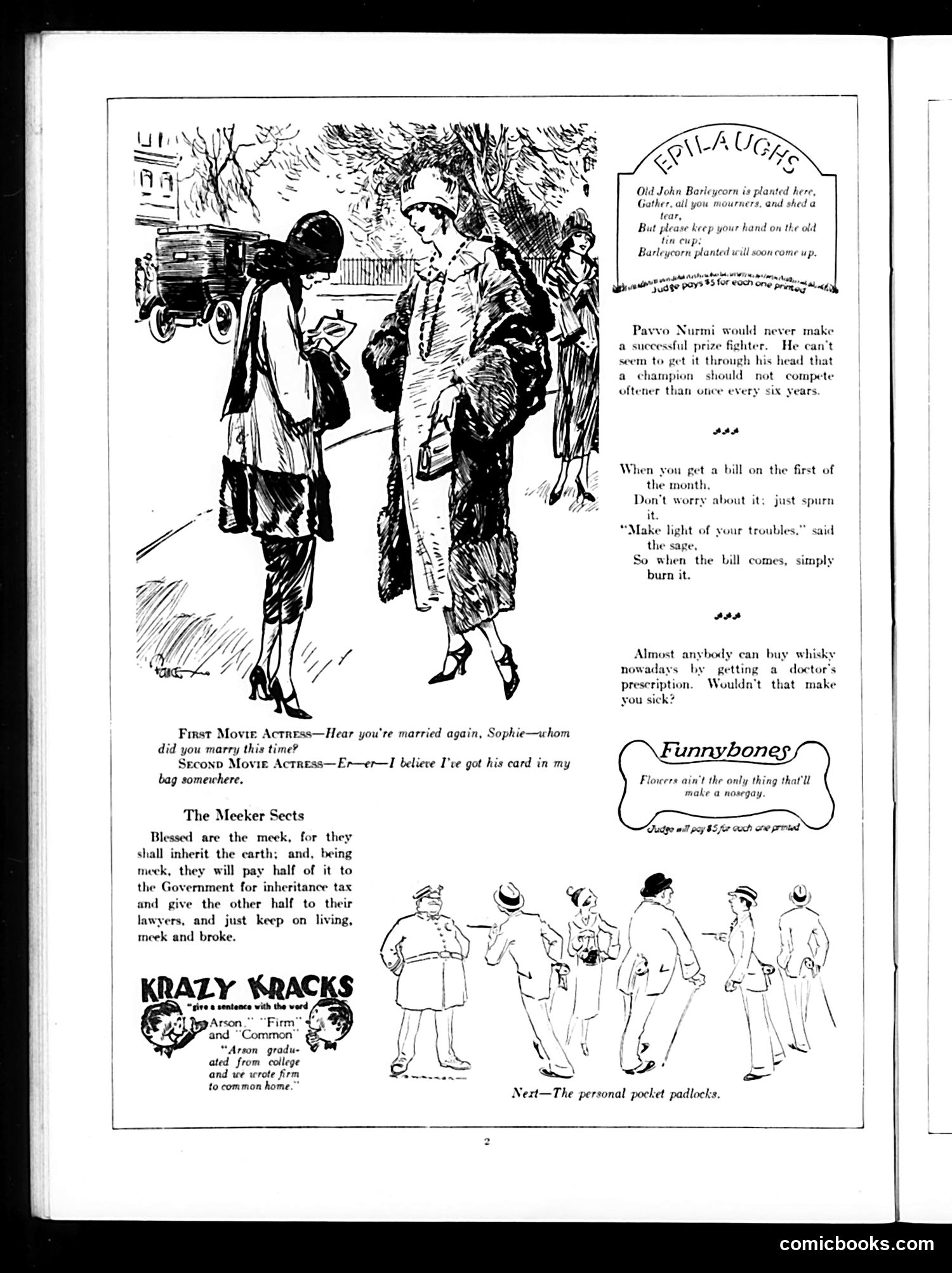
This page contains several satirical pieces typical of 1920s social commentary: **"Epigraphs"**: A joking epitaph for "Old John Barleycorn" (alcohol personified), mocking Prohibition's effects. The joke warns against touching an "old tin cup"—likely referencing illegal liquor containers. **Movie Actresses Dialogue**: Two actresses joke about remarriage and lost identification, satirizing Hollywood's perceived moral laxity and quick marriages. **"The Meeker Sects"**: A biblical reference mocking meek people inheriting the earth by suggesting they'd still end up poor and broken. **"Krazy Kracks"**: Wordplay joke about "Arson," "Firm," and "Common" grades—suggesting even criminals have educational backgrounds. **"Funnybones"**: A gentle joke about flowers making good gifts for the ill. **Bottom cartoon**: Shows men with "personal pocket padlocks"—likely satirizing financial anxiety or penny-pinching during economic uncertainty.
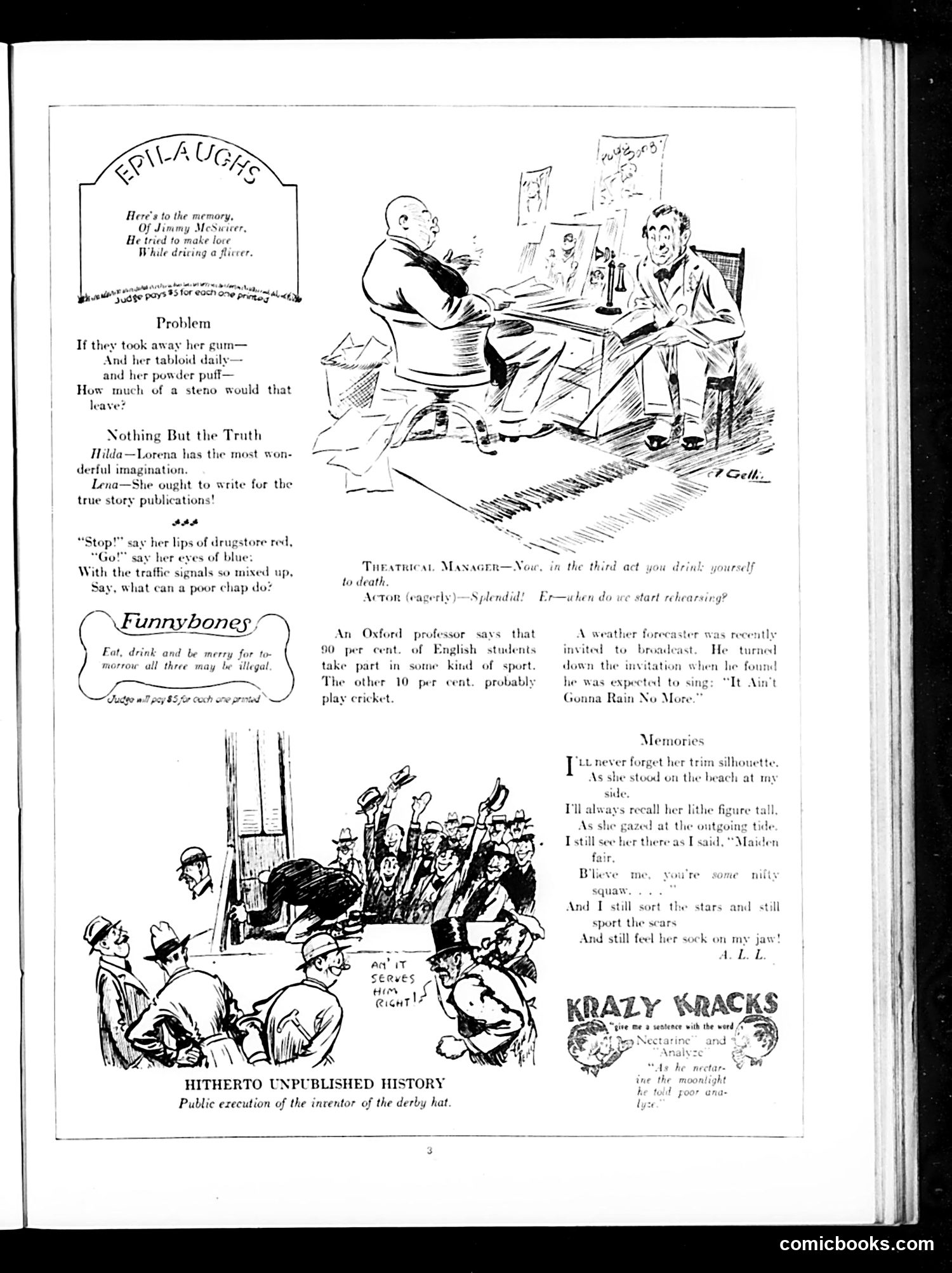
This page contains several distinct pieces of satirical humor: **"Epilaughs"** section mocks death notices, including one about "Jimmy McSouser" dying while driving a hearse—likely satirizing reckless drivers. **"Problem"** presents a math puzzle about a woman losing gum, talcum powder, and a "stereo" (possibly "sterol"?)—unclear reference, may involve cosmetics or early pharmacy items. **"Hitherto Unpublished History"** cartoon at bottom depicts a public execution of "the inventor of the derby hat," satirizing the then-popular bowler hat fashion, suggesting the cartoonist found it ridiculous enough to warrant mockery. **"Theatrical Manager" dialogue** jokes about actors' wages and rehearsal delays. The page overall reflects early-20th-century American humor targeting fashion absurdities, everyday inconveniences, and theater culture.
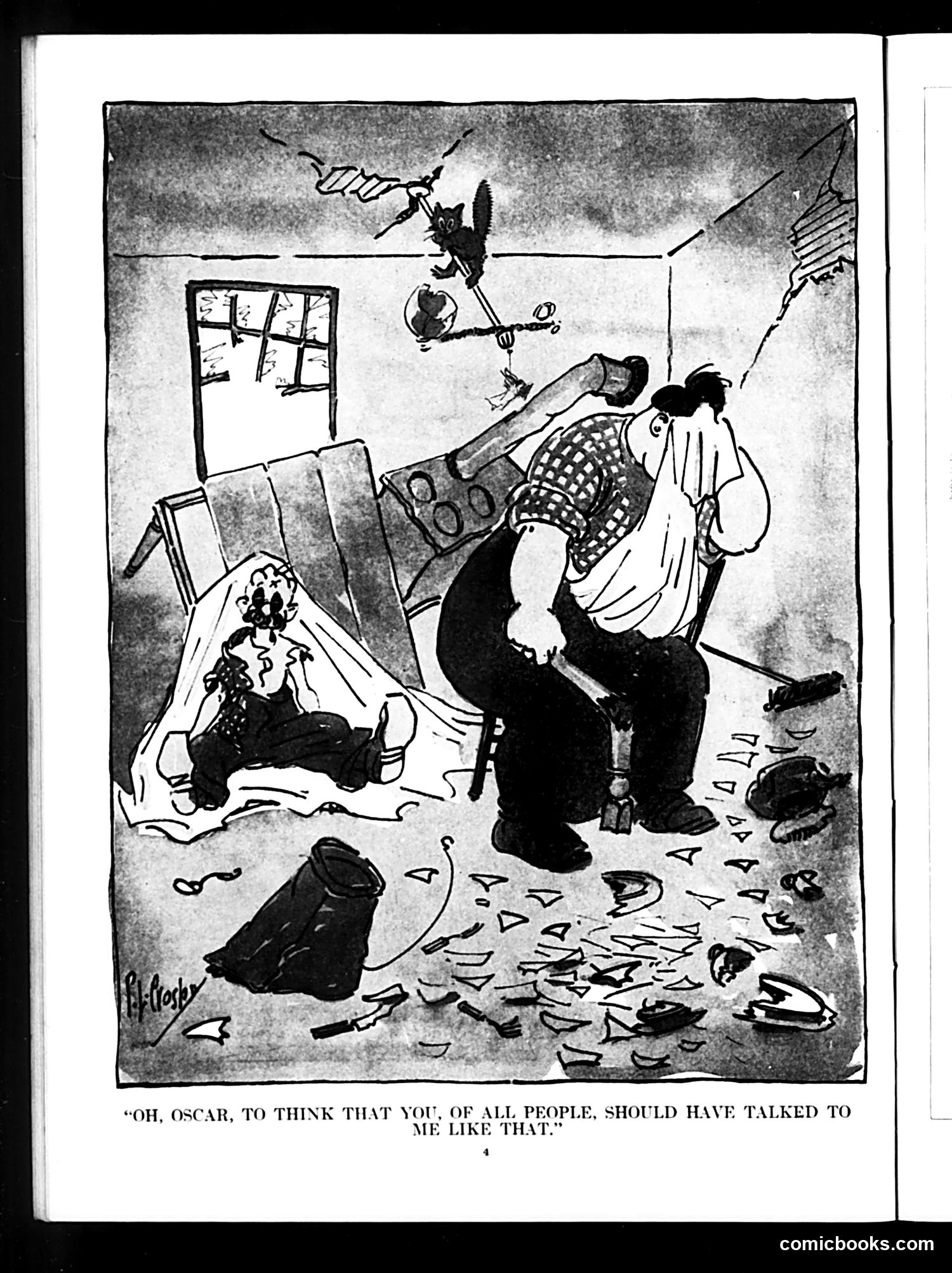
This cartoon appears to depict a domestic scene of marital discord. A woman sits on the floor surrounded by scattered household items and broken objects, while a man stands nearby holding what appears to be a pipe or stick. A child watches from above, and there are mice or rats visible in the room. The caption—"Oh, Oscar, to think that you, of all people, should have talked to me like that"—suggests the woman is expressing hurt over harsh words spoken by someone named Oscar (likely the man pictured). The satire appears to target either domestic violence, marital conflict, or the contrast between a man's public persona and his private behavior toward his wife. The scattered items suggest either rage or neglect of the household. Without more contextual information about the specific issue or date, the exact social commentary remains unclear.
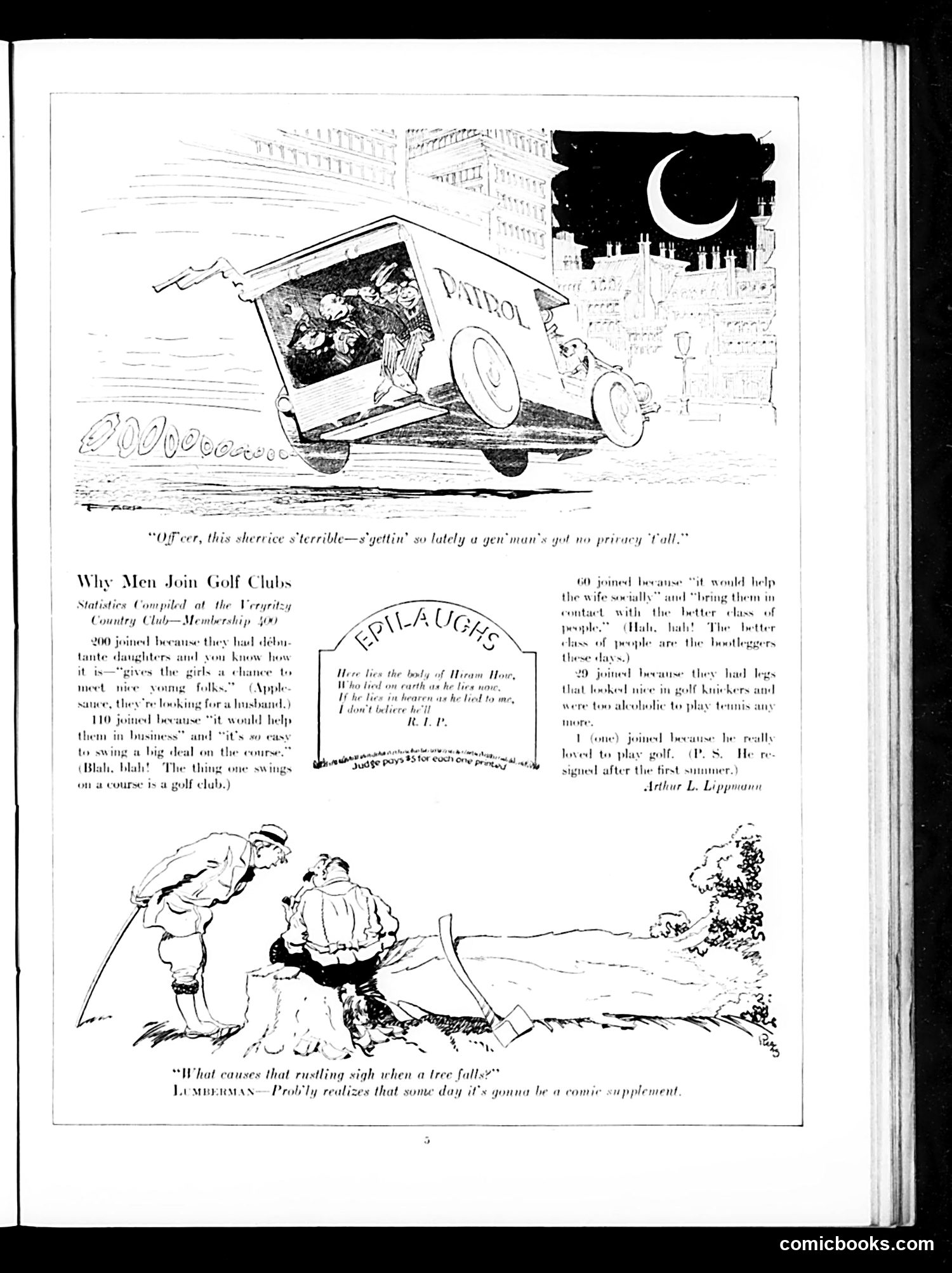
This page satirizes **why men join golf clubs** through humor and cartoons. The top cartoon mocks a police patrol car labeled "PATROL" speeding through the night, captioned about a gentleman having "no privacy." The joke suggests golf club membership provides escape from domestic life and police scrutiny—implying marital troubles drive membership. The middle section lists humorous reasons men join: business networking, helping wives socially, having legs for tennis, and genuinely loving golf. The "Epilaughs" section contains a mock epitaph for someone named "Hiram Hose" who loved golf more than life. The bottom cartoon shows two men observing a fallen tree, joking about the "rustling sigh"—likely referencing golf course mishaps or nature's interruptions to the game. The satire targets golf as both an escape and an obsession for American men.
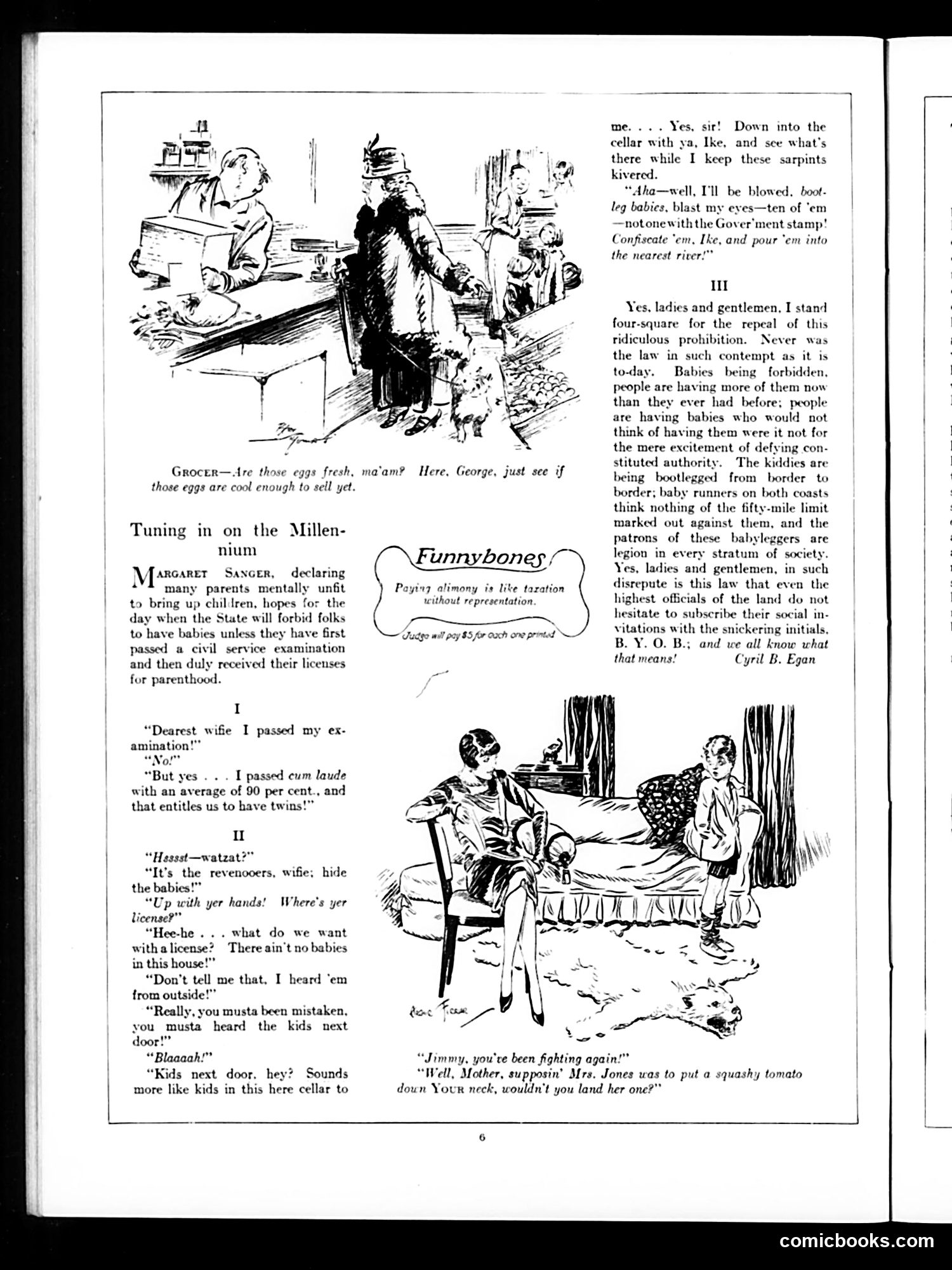
This page satirizes **Prohibition-era America** through absurdist humor. The main cartoon imagines a dystopian future where the State licenses parenthood via civil service exams—a jab at over-regulation. The central conceit: if babies require government permits like Prohibition-regulated alcohol, people will illegally produce them anyway. The sketch depicts federal "revenuers" (Prohibition enforcement agents) raiding a home searching for bootleg babies hidden in the cellar—mirroring actual Prohibition raids on illegal stills. The satirist (Cyril B. Egan) explicitly argues that Prohibition's absurdity has made lawbreaking fashionable across all social classes. Even society elites flout it, evidenced by the acronym "B.Y.O.B." (Bring Your Own Bottle) appearing on their formal invitations—scandalously open defiance of federal law. The "Funnybones" aside mocks alimony law similarly: taxation without consent. The overall message: Prohibition creates contempt for law itself, encouraging precisely the behavior it forbids.
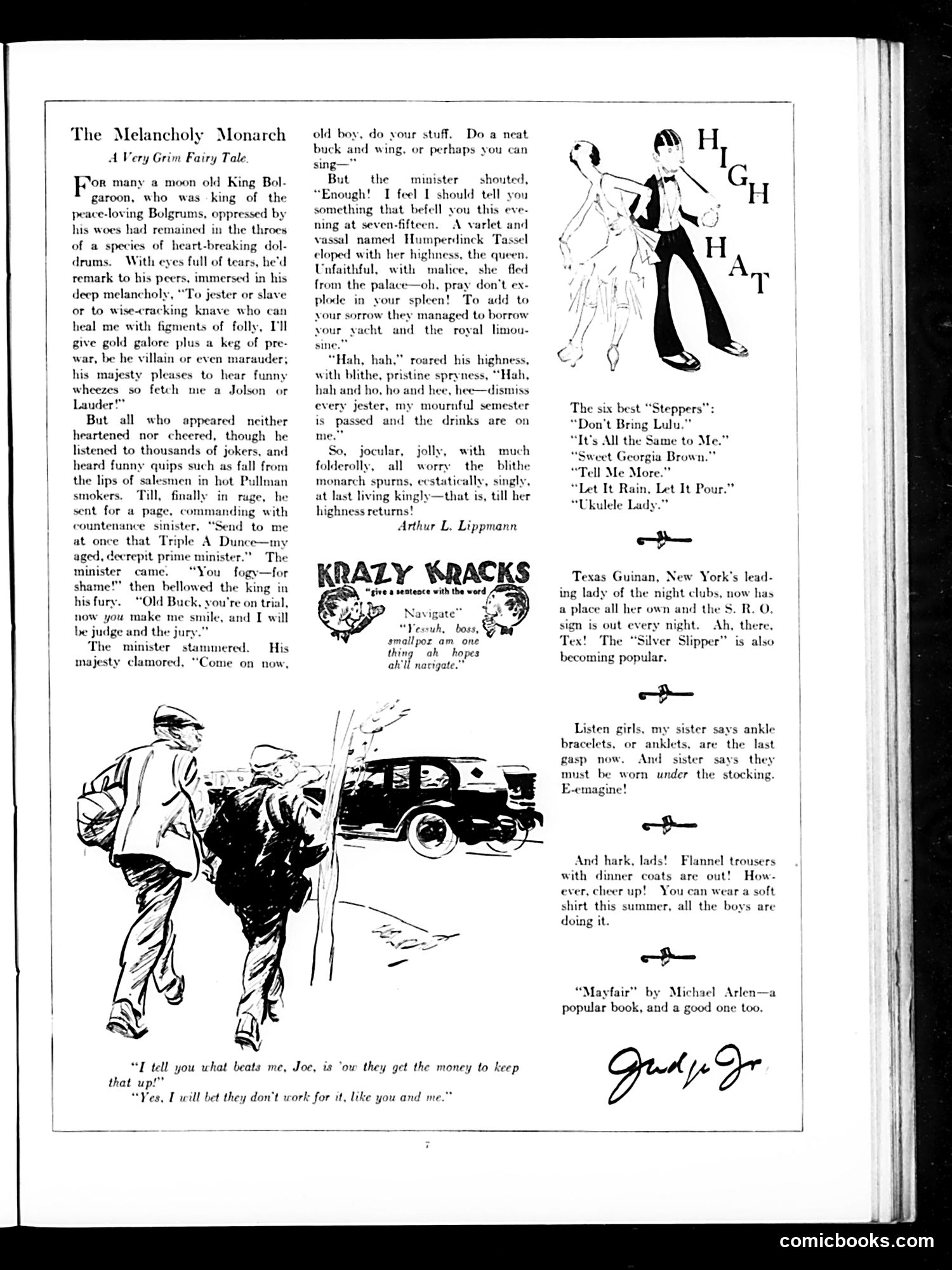
This fairy tale by Arthur L. Lippmann satirizes a king so desperately unhappy that he offers rewards for anyone who can make him laugh. When his prime minister is summoned and ordered to perform, he delivers shocking news: the queen has eloped with a vassal named Humperdinck Tassel, taking the royal yacht and limousine. The joke's twist: rather than despair, the king becomes joyful—relieved to be rid of his wife. The satire targets marital unhappiness and suggests that even monarchs suffer domestic misery. The "Triple A Dunce" prime minister ironically solves the king's melancholy not through entertainment but by delivering catastrophic personal news. The accompanying "Krazy Kracks" and social notes reference 1920s popular culture: Texas Guinan (famous speakeasy operator), trendy songs like "Sweet Georgia Brown," and fashion gossip about anklets and flannel trousers—typical Judge magazine content mixing satire with contemporary social commentary.
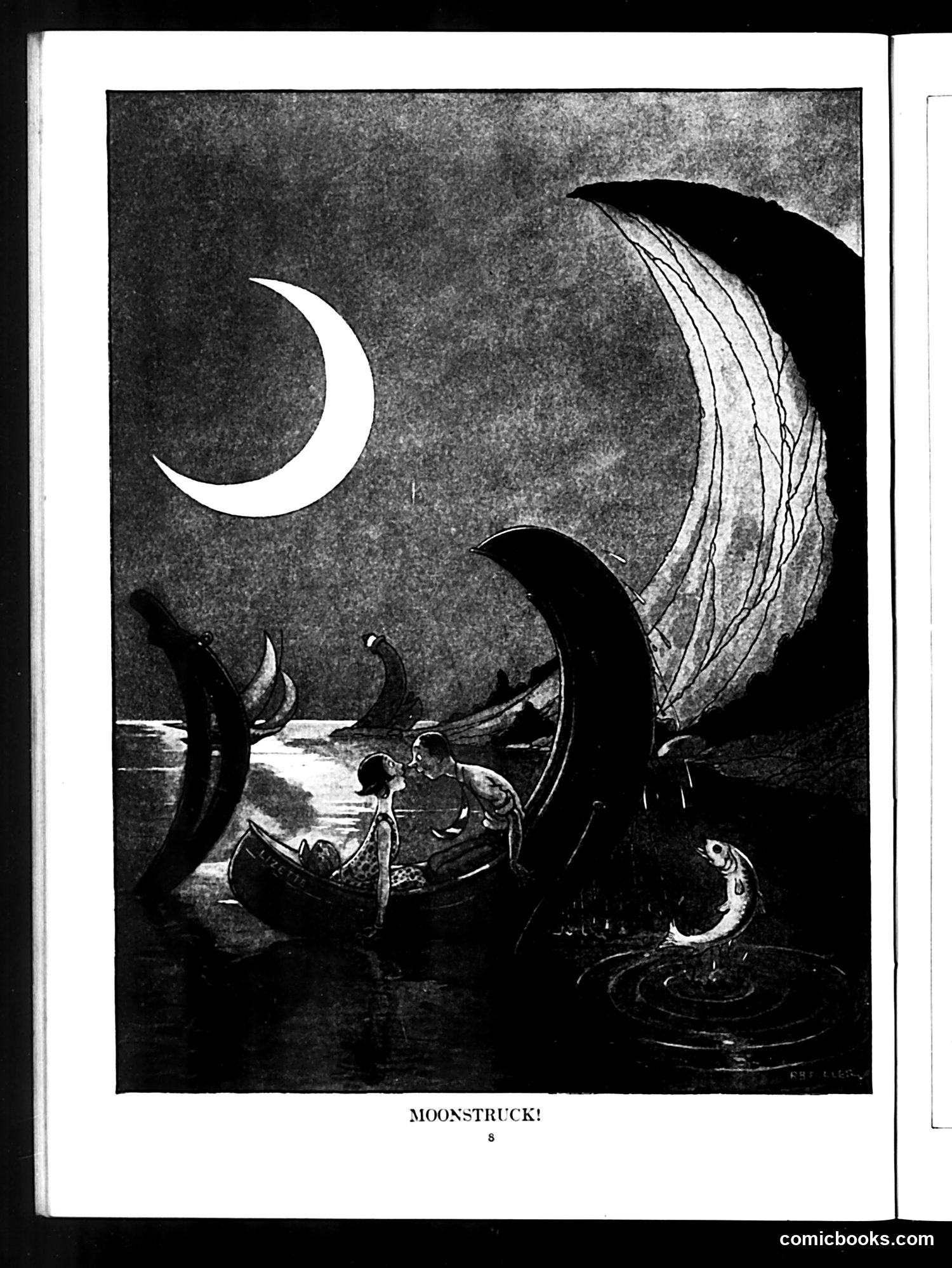
This illustration depicts a fantastical nighttime scene featuring silhouetted figures in boats beneath a crescent moon. The title "MOONSTRUCK!" suggests the cartoon satirizes people affected by moonlight—historically associated with lunacy or irrational behavior. The dramatic composition shows dark, curved shapes (possibly sea creatures or magical elements) surrounding small human figures, emphasizing their vulnerability to supposed lunar influences. The romantic or eerie nighttime setting underscores the satirical treatment of "moonstruck" as a state of enchantment or madness. Without additional context from Judge magazine's publication date or surrounding articles, the specific political or social target remains unclear. The satire likely mocks either literal belief in lunar influence on human behavior, or metaphorically criticizes some contemporary group or phenomenon as irrational.
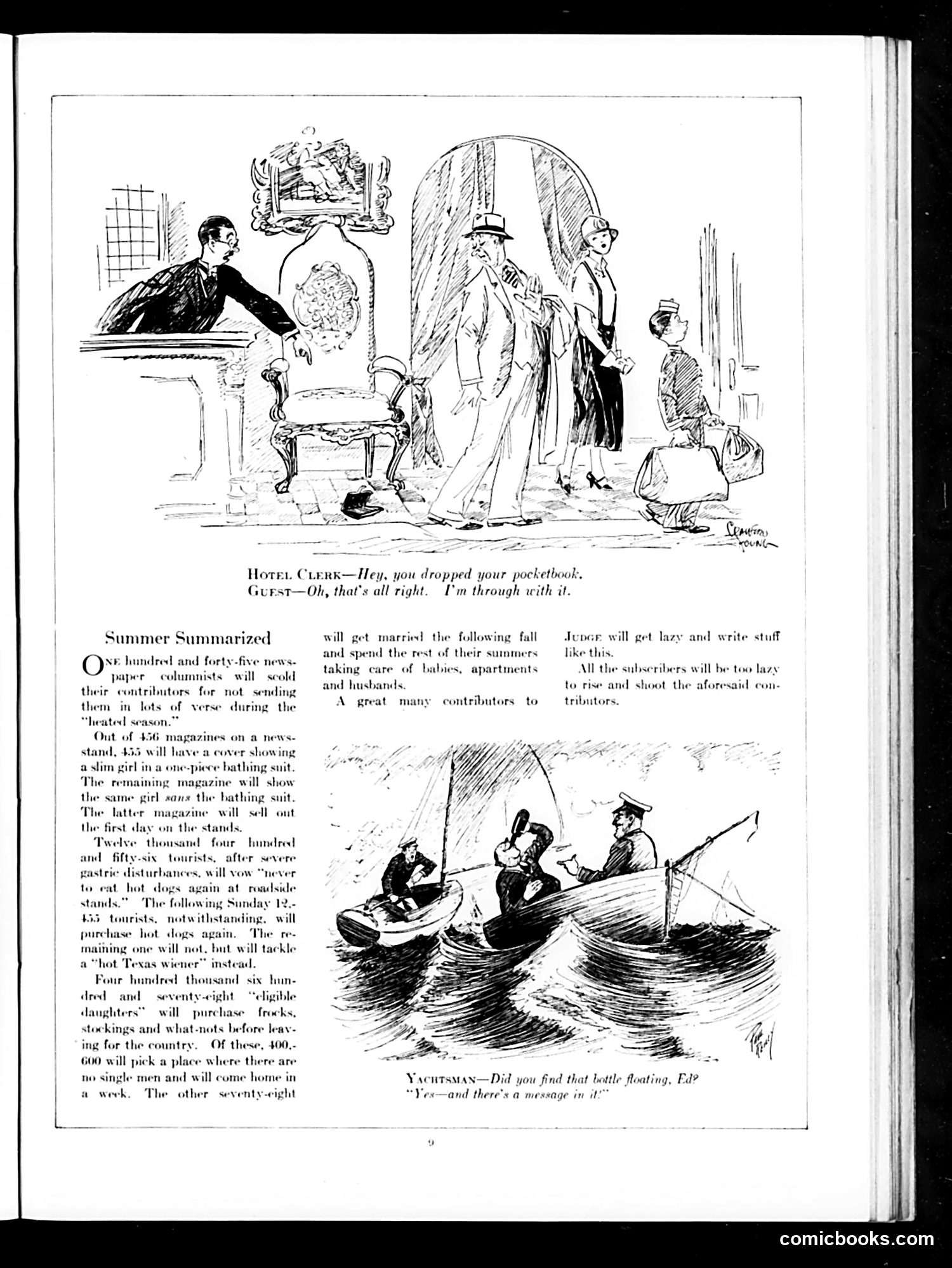
This page contains two unrelated satirical pieces: **Top cartoon**: A hotel clerk and guest exchange pleasantries after the guest drops his pocketbook. The humor is mild—the clerk's offer to return it is rebuffed politely, playing on assumptions about honesty or carelessness. **"Summer Summarized"** article: This is a tongue-in-cheek statistical satire mocking summer tourism and seasonal behaviors. It humorously "counts down" predictable American summer activities: newspaper columnists complaining about lack of contributions, magazine sales boosted by bathing-suit issues, tourists eating hot dogs despite vowing not to, young women getting married before fall, etc. The tone is cynical about mass consumer behavior and middle-class predictability. **Bottom cartoon**: Two yachtsmen find a bottle with a message—a reference to the classic romantic/adventure trope of messages in bottles, played for gentle humor. The satire targets conventional summer behaviors and publishing industry clichés common to the era.
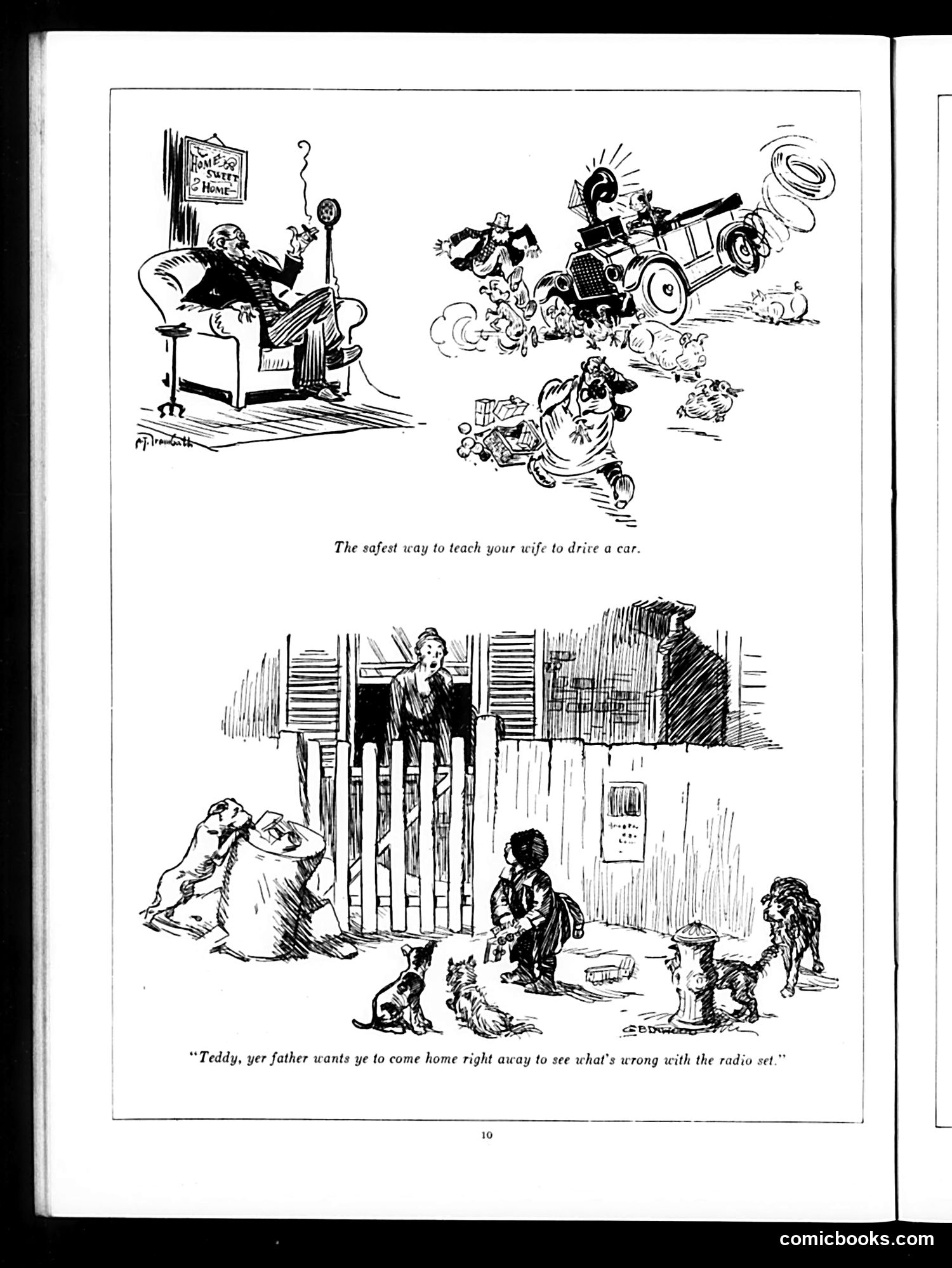
This page contains two satirical cartoons about domestic life and technology: **Top cartoon:** Titled "The safest way to teach your wife to drive a car," it shows a man comfortably seated indoors while chaos erupts outside—a car crashes spectacularly with figures flying. The satire mocks both reckless driving and the idea that wives were incompetent drivers, a common gender stereotype of the era when automobiles were still relatively new. **Bottom cartoon:** Shows a child being called home by his mother to fix the family radio. The humor satirizes men's assumed expertise with new technology—the father expects his son to repair the radio, reflecting early 20th-century assumptions about male technical competence and the novelty of home radio sets as household appliances. Both cartoons humorously address gender roles and the disruptive social changes brought by emerging technologies.
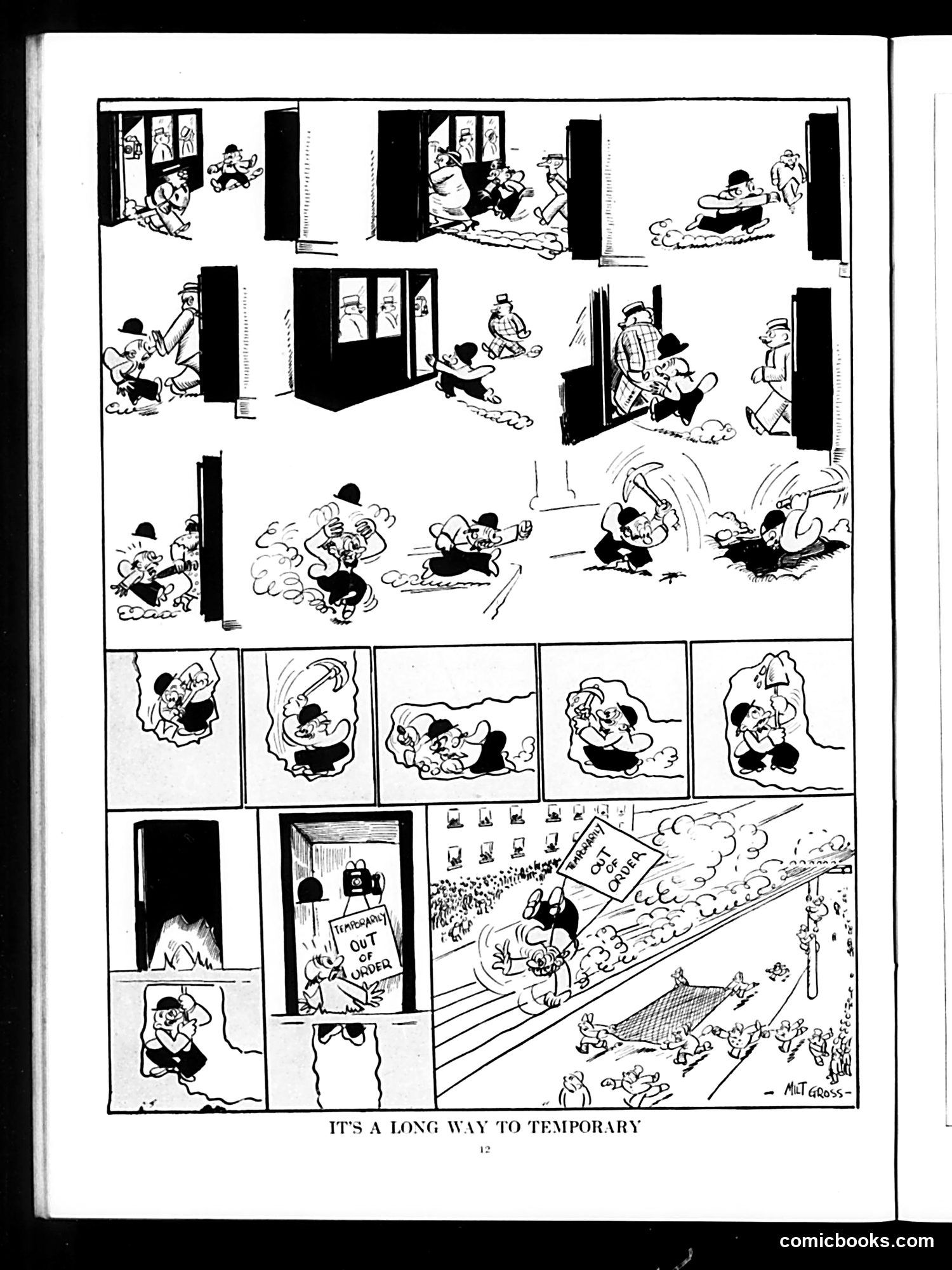
This cartoon by Mitt Gross satirizes the journey to a temporary refuge, likely during Prohibition or a similar period of social upheaval. The narrative follows characters—depicted as working-class men in bowler hats—as they flee their homes through various means: sneaking past authorities, hiding in barrels, and ultimately boarding what appears to be a train or transport vehicle marked "TEMPORARY." The title's irony is key: the destination they desperately seek is only *temporary*, suggesting their troubles are far from over. The escalating chaos across sequential panels, from domestic interiors to open countryside, emphasizes the desperation and absurdity of their flight. The cartoon likely comments on the era's social instability or the lengths people went to escape enforcement of unpopular laws, using physical comedy and visual progression to mock the situation.
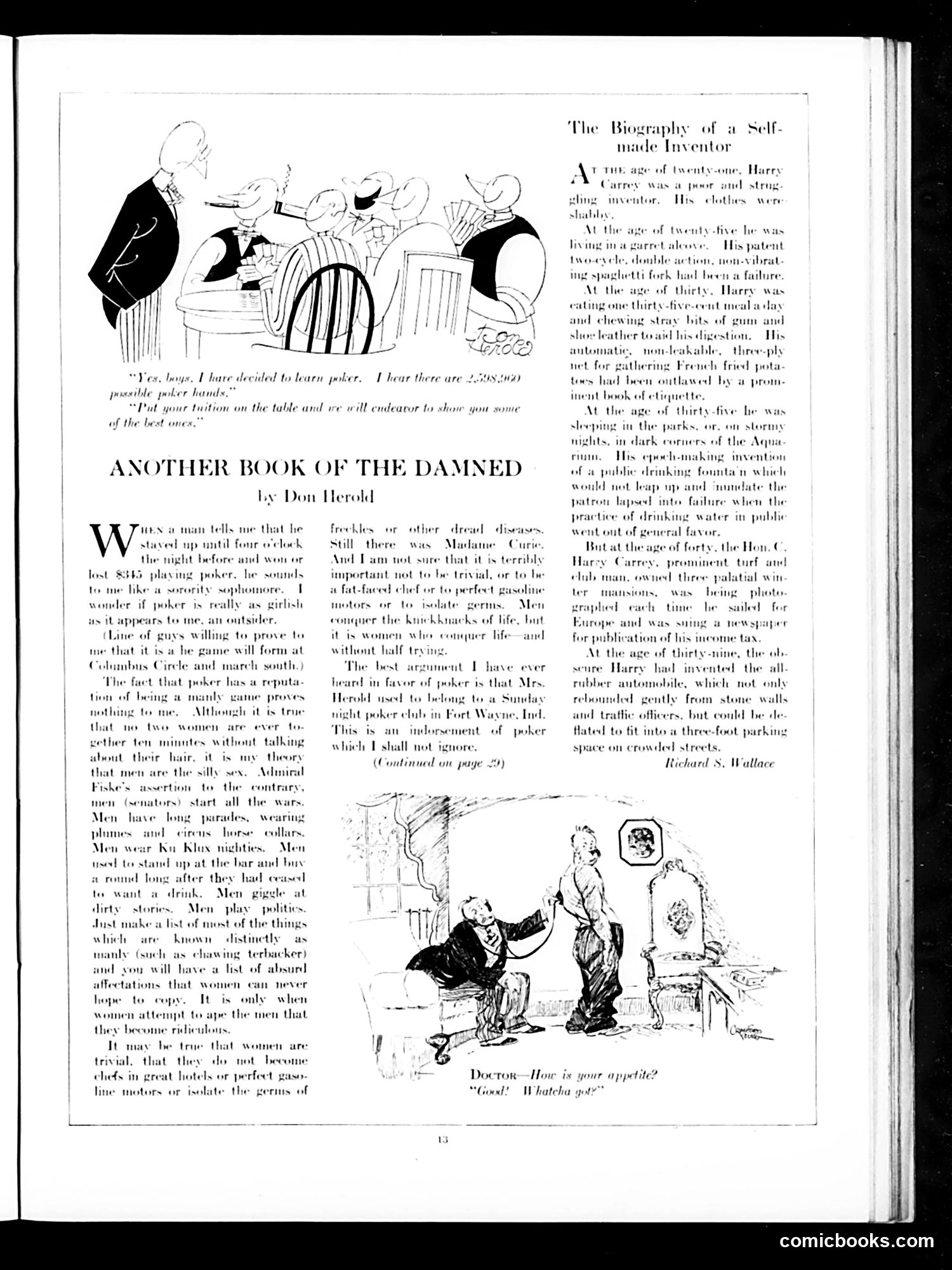
This page contains two satirical pieces typical of early 20th-century American humor. **"Another Book of the Damned"** by Don Herold argues that men, not women, are the frivolous sex. Herold critiques masculine behavior—poker playing, wearing fancy clothes, attending parades, chasing women—as inherently silly, while men stereotypically dismiss women as trivial. The cartoon shows men learning poker, visualizing the game's appeal to male vanity. Herold's point: men mock women's supposed superficiality while engaging in equally absurd conduct. **"Biography of a Self-made Inventor"** by Richard S. Wallace satirizes the rags-to-riches narrative. Harry Carrey's repeated failed inventions (spaghetti fork, potato net, drinking fountain) don't improve his circumstances until age forty, when he mysteriously succeeds with a "rubber automobile." The satire suggests that luck, not innovation, drives success—and that inventor mythology obscures this reality. The doctor cartoon below provides comedic relief, unrelated to the main content.
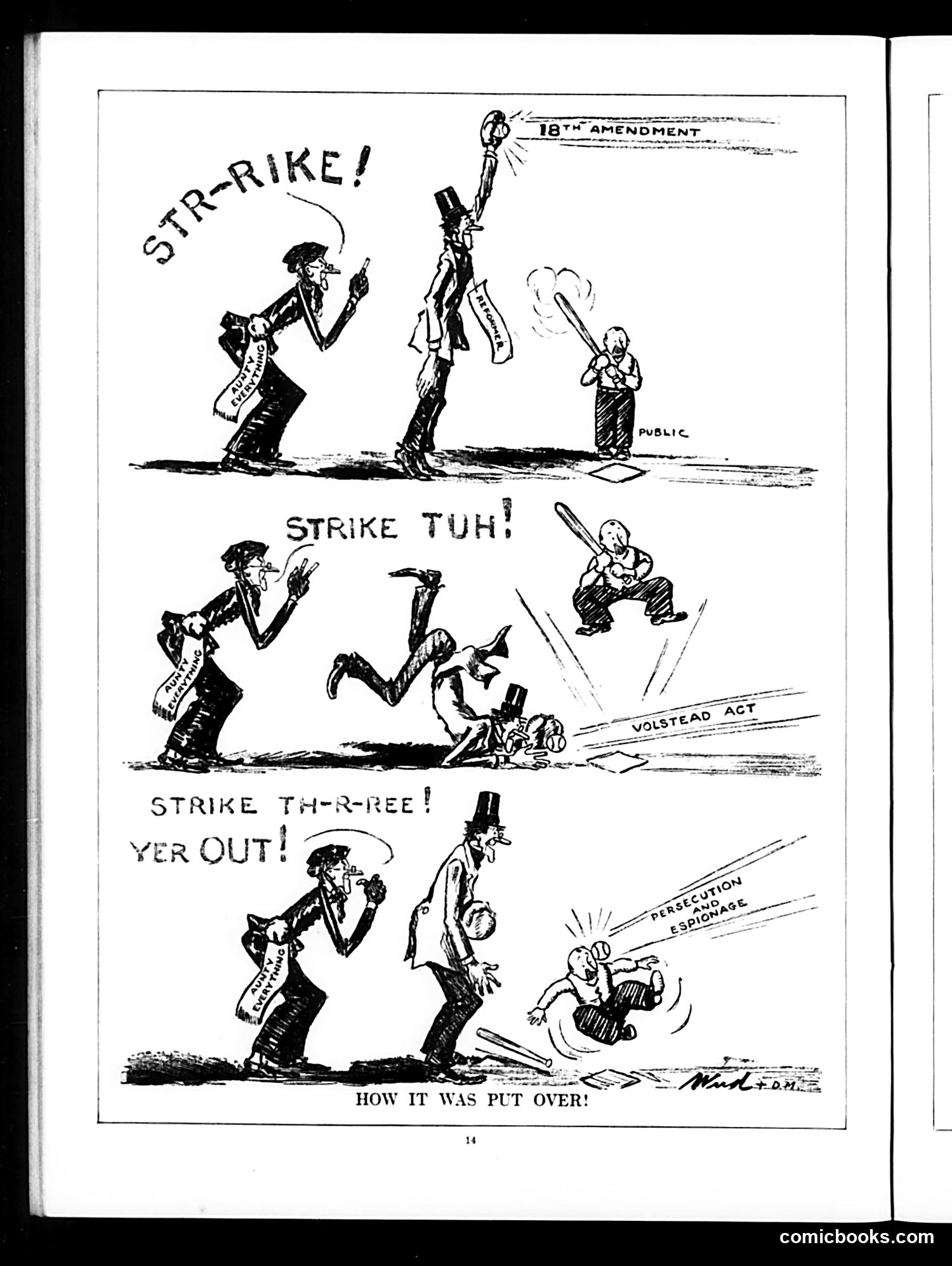
This three-panel satirical cartoon depicts a baseball-themed metaphor for legislative maneuvering. Each panel represents successive "strikes" against what appears to be labor or progressive causes: **Panel 1:** "Strike!" - The 18th Amendment (Prohibition) is depicted as a tall figure being batted by what appears to be a politician, while the "Public" looks on. **Panel 2:** "Strike Tuh!" - The Volstead Act (enforcing Prohibition) is similarly struck down. **Panel 3:** "Strike Three! Yer Out!" - A "Persecution Espionage" measure (likely referencing post-WWI suppression laws) is the final strike, with the public knocked down. The cartoon satirizes how multiple restrictive laws were passed in rapid succession, using baseball language to suggest these measures were "struck" against the American people's interests. The "umpire" figure appears to represent political leadership executing this legislative agenda.
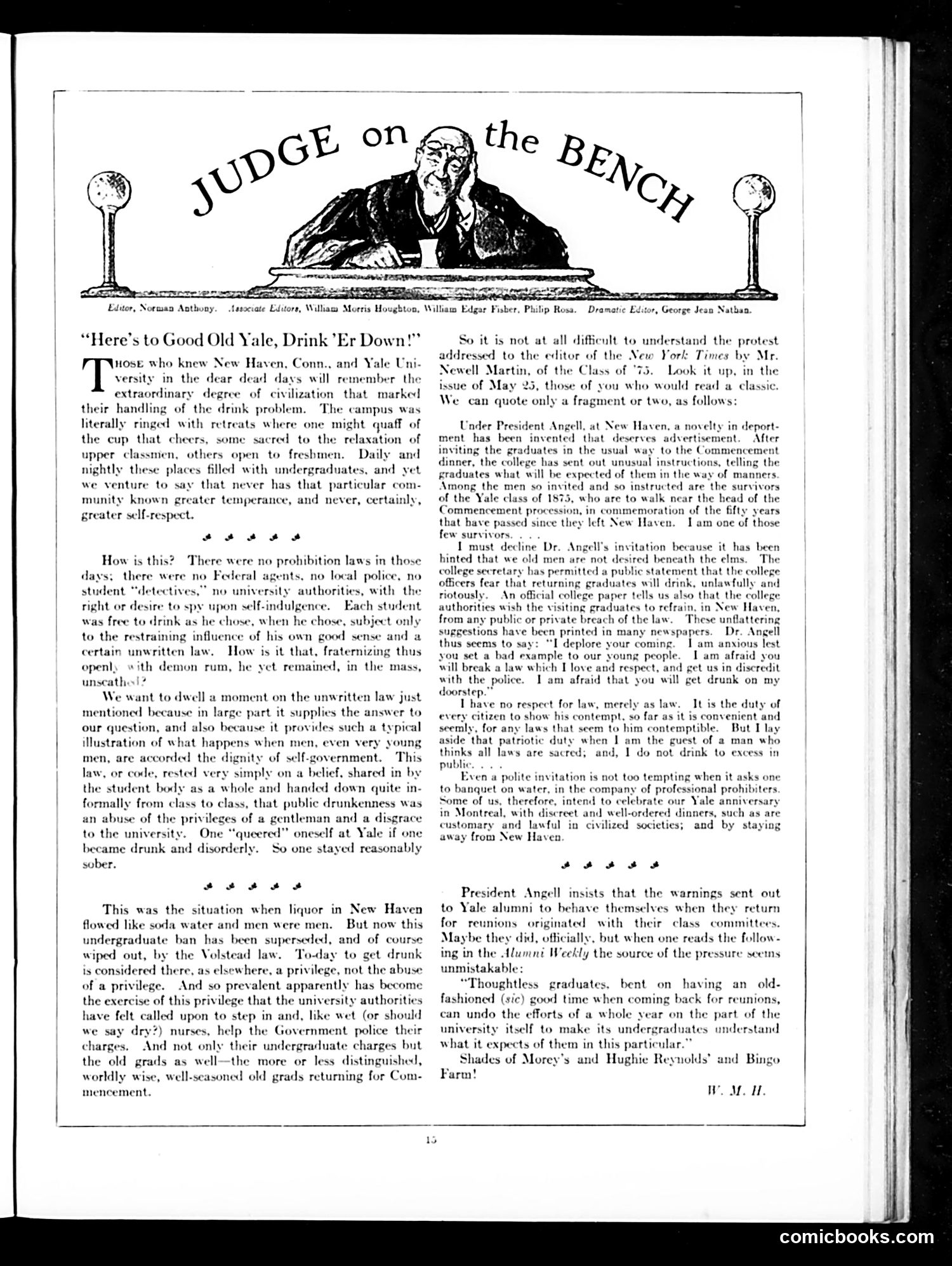
This article satirizes Prohibition-era hypocrisy at Yale University. The piece contrasts pre-Prohibition New Haven, where drinking was unrestricted but governed by an informal "unwritten law" of gentlemanly conduct that kept students relatively sober, with the post-Volstead Act era, where legal prohibition has paradoxically made drinking seem like a forbidden privilege worth abusing. The satire targets Yale administration for sending alumni insulting instructions about proper behavior during Commencement, implicitly warning older graduates they might drink "unlawfully and riotously." The author (W.M.H.) argues that removing personal responsibility through legal prohibition actually *increases* misbehavior, whereas trusting gentlemen's self-governance previously worked effectively. The piece mocks both Prohibition's failure and university authorities' infantilizing oversight of grown men.
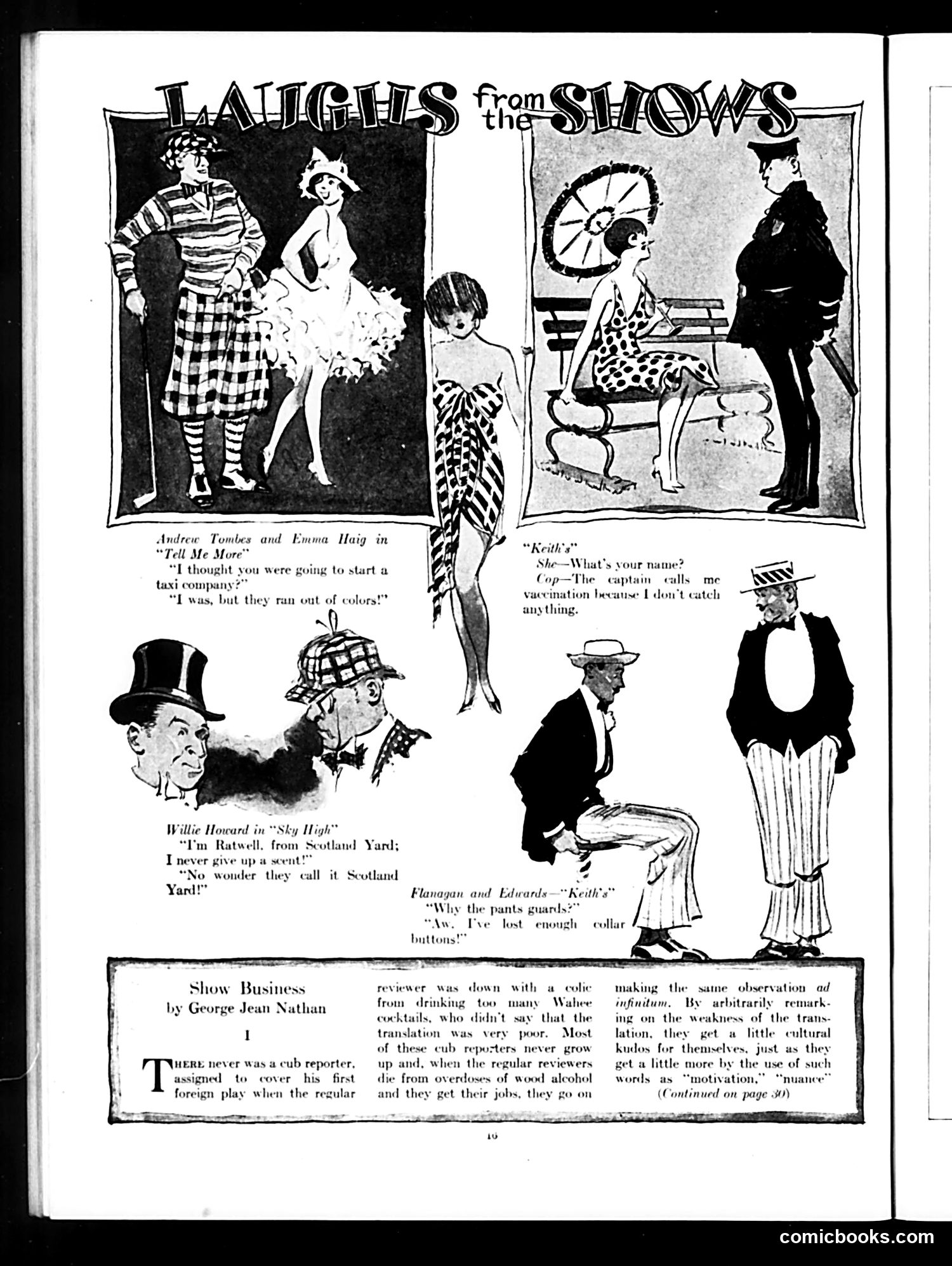
This is a theater humor page featuring jokes from contemporary Broadway productions (circa 1920s, based on style). The top panels show comedic dialogue from shows like "Tell Me More," "Sky High," and "Keith's." The main satirical article by George Jean Nathan targets theater critics—specifically young substitute reviewers filling in for drunk senior critics. Nathan mocks these inexperienced writers for reflexively criticizing foreign play *translations* as "poor" to sound cultured, using pretentious vocabulary like "motivation" and "nuance." He suggests they blindly repeat this criticism without genuine insight, merely parroting established reviewers' habits. The satire captures early-20th-century theater world dynamics: the hierarchical cub-reporter system, alcoholism among established critics, and the performative intellectualism of aspiring cultural commentators who use jargon to fake expertise. It's a pointed critique of critical pretension masquerading as serious analysis.
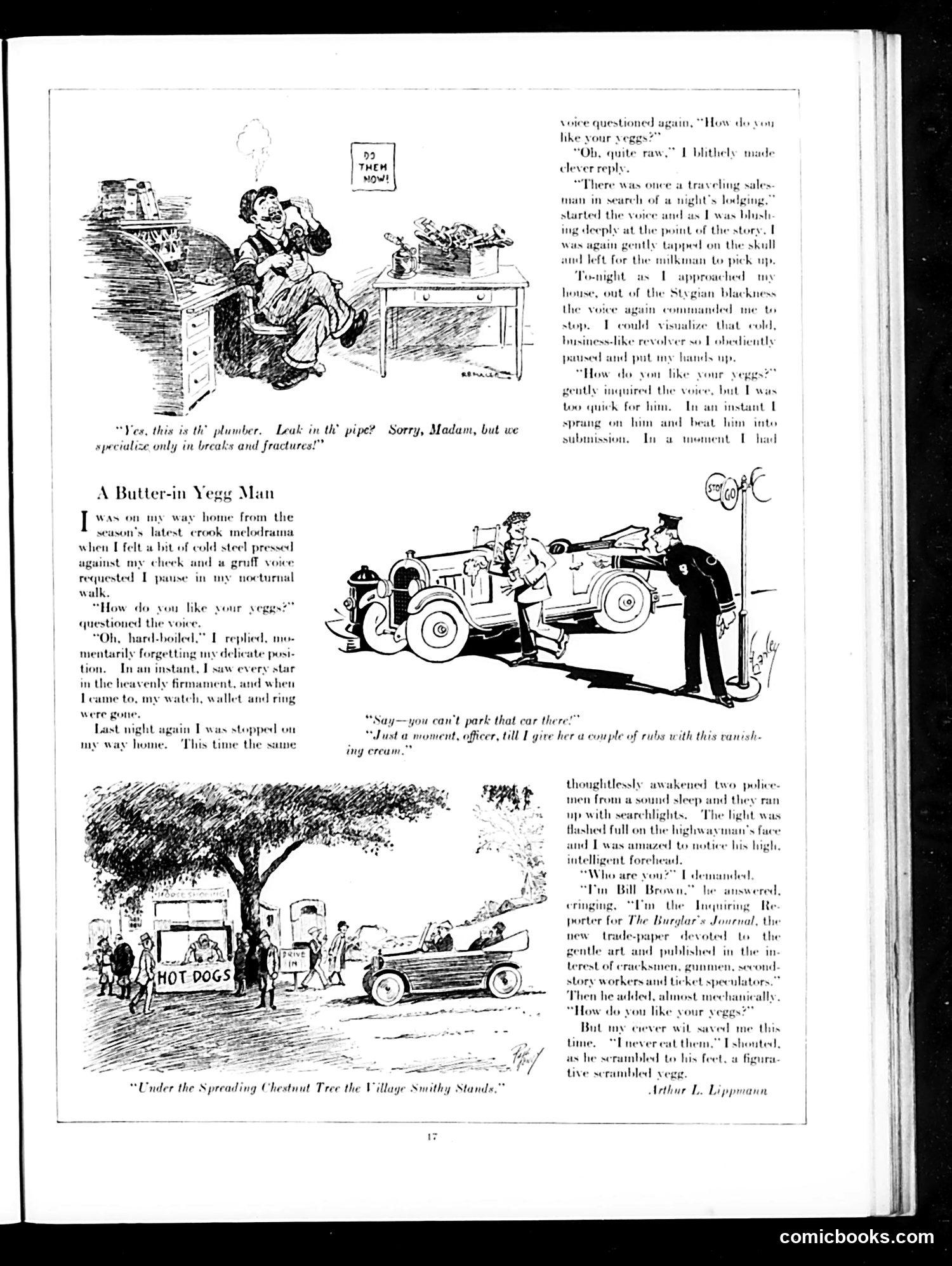
This humorous story by Arthur L. Lippmann satirizes the emerging "trade press" phenomenon of early 20th-century America. The narrator is repeatedly accosted by armed robbers who ask "How do you like your vegs?" — apparently a coded question or catchphrase. The final twist reveals the recurring robber is "Bill Brown," editor of *The Burglar's Journal*, a fictional trade magazine "devoted to the gentle art" of burglary, serving "cracksmen, gunmen, second-story workers and ticket speculators." The satire mocks the proliferation of specialized industry publications and the absurdity of criminals having their own professional journalism. The humor also plays on the narrator's literal interpretations and quick wit surviving dangerous encounters. The accompanying illustrations show domestic and street scenes depicting the encounters, emphasizing the story's comedic tone about this ridiculous "trade paper" legitimizing criminal enterprise.
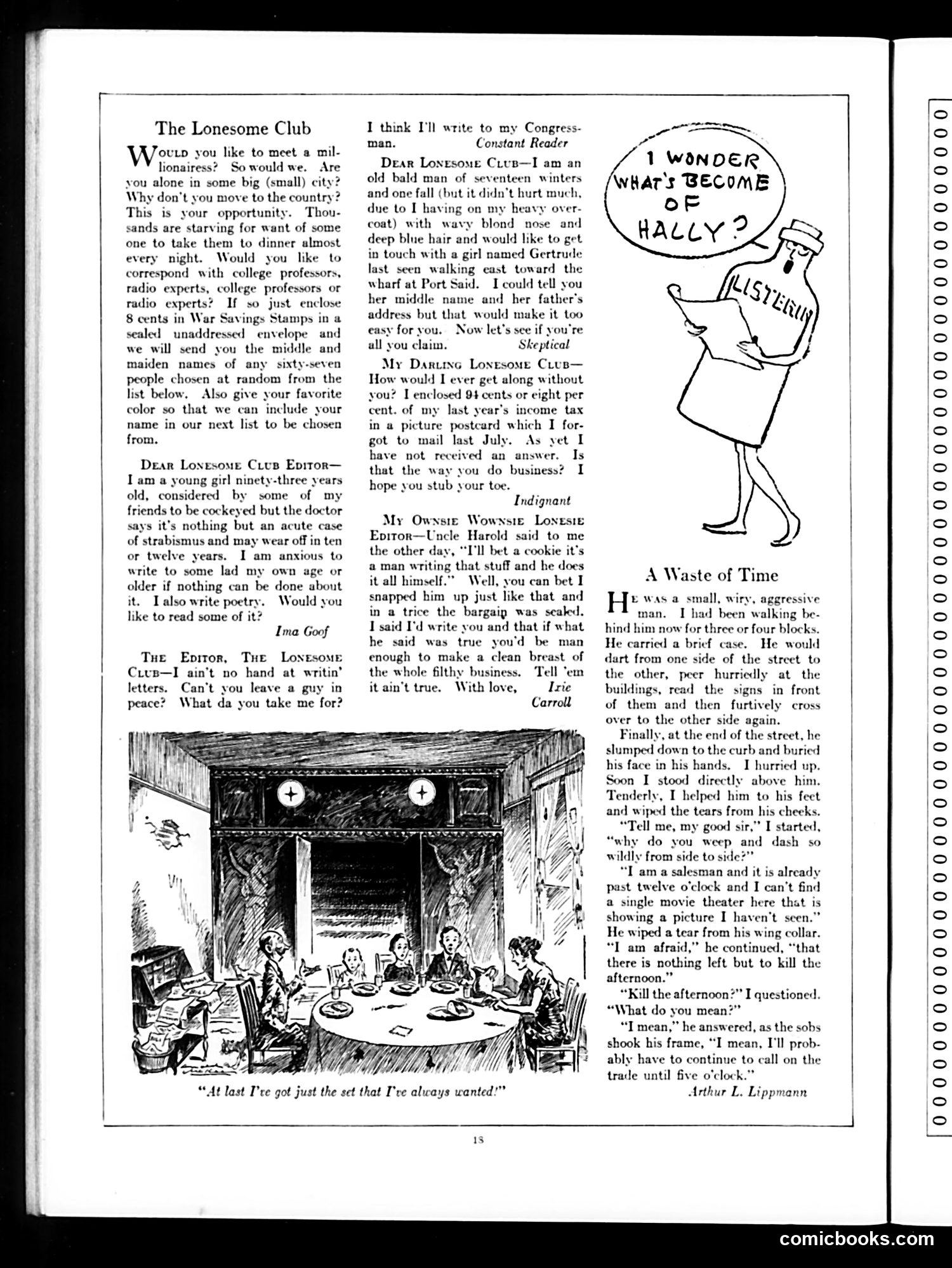
This page satirizes the 1920s-era "lonely hearts" personal ad phenomenon. The main feature mocks absurdly specific and dishonest personal advertisements through fictional letters to a fake matchmaking service. The humor relies on ridiculous premises: a 93-year-old girl seeking romance, a "seventeen-winter-old bald man," someone who forgot to mail their response card months ago, and suspicious accusations that a man wrote the column himself. Each letter escalates the absurdity while poking fun at real social desperation during this period. The accompanying illustration shows a dinner party, supporting the column's opening pitch promising romance and companionship. The cartoon's caption—"At last I've got just the set that I've always wanted!"—suggests satisfaction, likely ironic given the column's ridicule. The "Waste of Time" short story on the right involves a salesman upset about finding no unwatched movies to kill his afternoon, reinforcing Judge's satirical take on modern urban leisure anxieties.
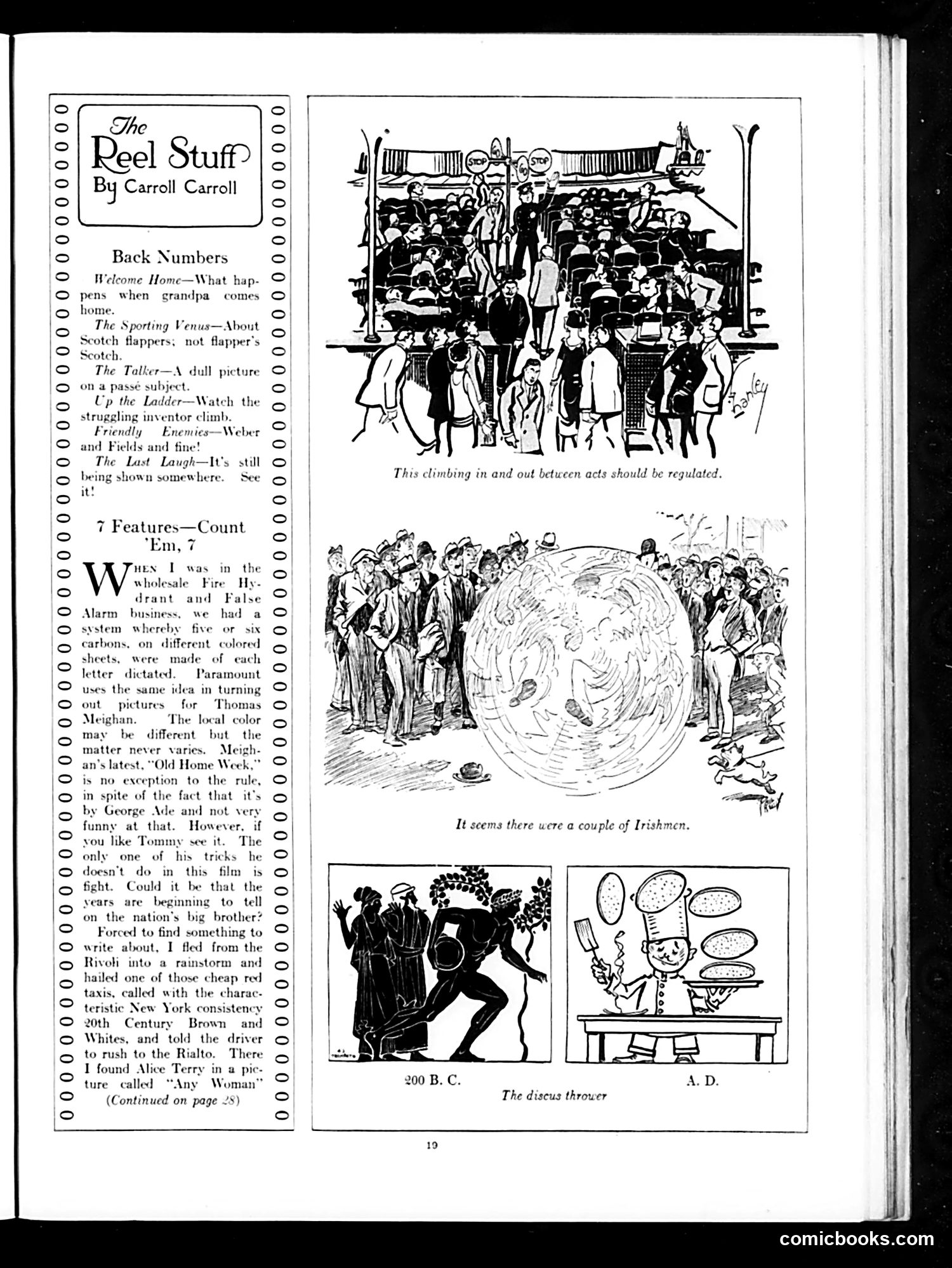
This page contains a film review column by Carroll Carroll critiquing contemporary movies. The main content addresses Thomas Meighan's film "Old Home Week," suggesting Paramount uses a formulaic "carbon copy" approach to production—recycling plots and themes across different pictures. Carroll implies Meighan's comedic talents are declining. The bottom illustrations labeled "The Discus Thrower" compare ancient (200 B.C.) and modern (A.D.) versions of the same athletic feat, likely satirizing how modern entertainment mirrors classical themes without innovation—fitting with the column's critique of repetitive filmmaking. The page also lists back-number film reviews including titles like "The Sporting Venus" (about Scottish flappers) and "The Last Laugh," reflecting 1920s cinema culture and the era's fascination with flappers and slapstick comedy.
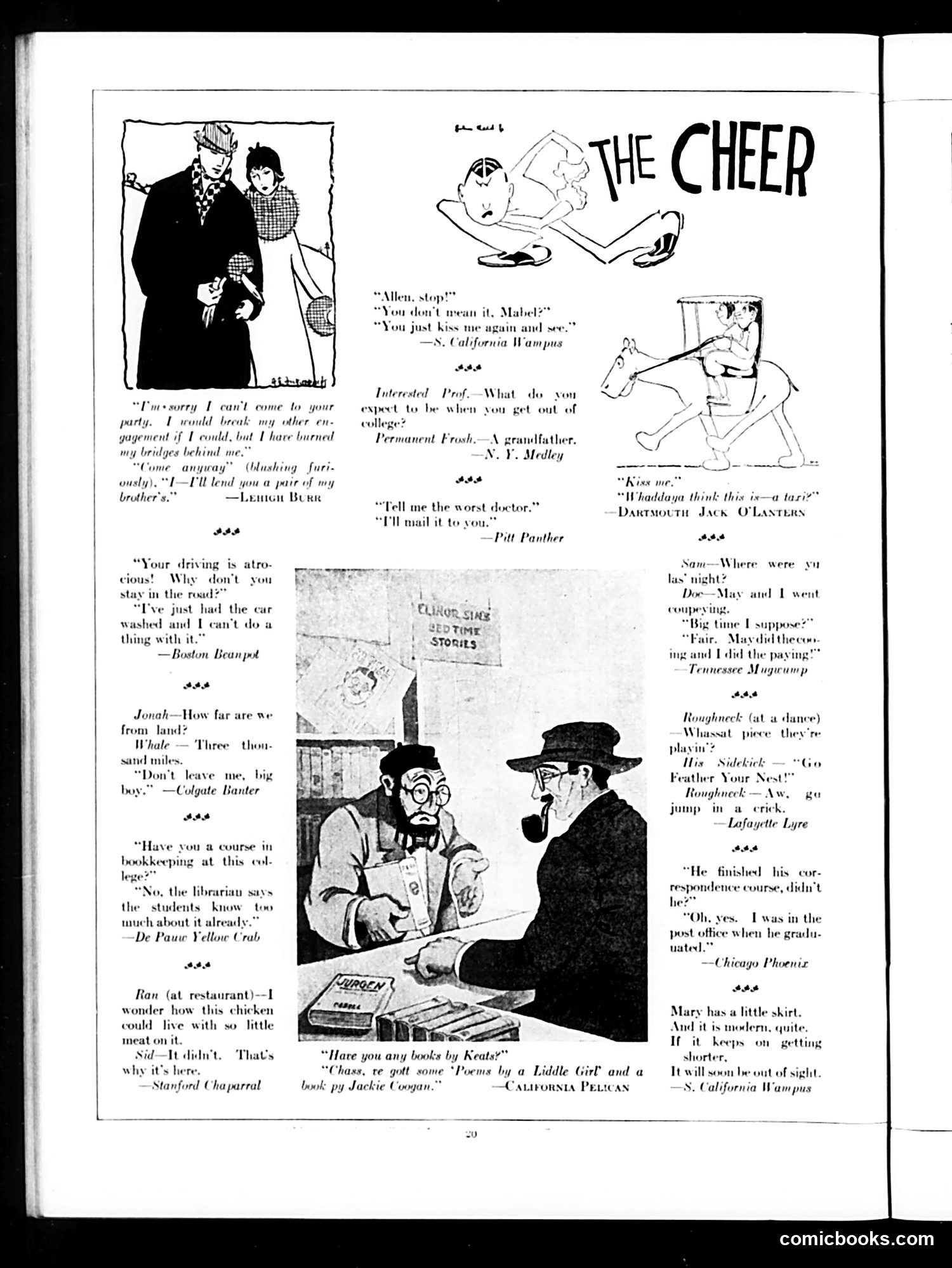
This page collects brief humorous quips and jokes from various college publications, organized around social situations of the 1920s era. **Key themes include:** - **Dating/courtship humor**: References to kissing, "petting" (courting), and modern dating practices - **College life**: Jokes about professors, librarians, and student behavior - **Fashion commentary**: A dig at women's shortening skirts ("modern" dress getting progressively briefer—a contemporary scandal) - **Class/social pretension**: Humor about driving, restaurants, and maintaining appearances - **Jackie Coogan reference**: The child actor was famous around 1920-21, dating this publication The cartoons feature exaggerated character types (old men with goggles, roughnecks, professors) and situational comedy. The overall tone reflects 1920s attitudes: mildly risqué humor about dating and dress, working-class characters portrayed as crude but lovable, and gentle ribbing of academic pretense. This is essentially a humor compilation page, not political satire—it's social comedy targeting college students and young adults of that era.
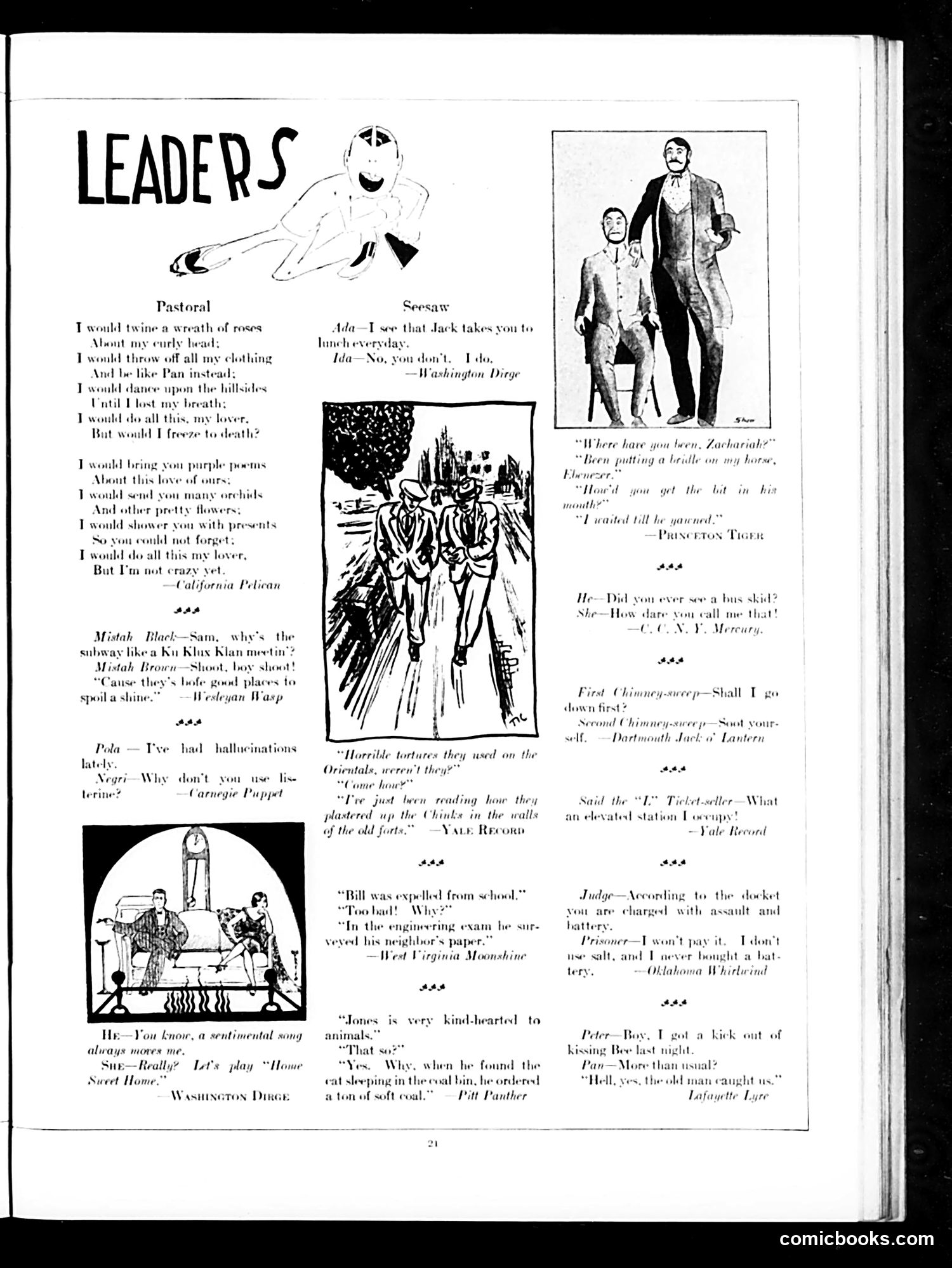
This page collects humorous quotes and jokes satirizing various social "leaders" and authority figures. The content includes: **Visual elements**: A diving figure (possibly representing leadership's risky ventures), two men in formal dress (likely politicians or society figures), period illustrations of groups and domestic scenes. **Satirical targets**: The jokes mock pretension and hypocrisy among the educated classes—romantic poets who lack courage, businessmen compromising ethics, scholars cheating, and authority figures behaving foolishly. **Notable**: Several jokes use racial dialect humor (common in early 20th-century American humor, now recognized as offensive). References to "Chinamen," casual racism, and ethnic caricature reflect period attitudes. **The satire's point**: Authority figures—whether poets, businessmen, engineers, or judges—are exposed as self-serving hypocrites who contradict their own principles. The page ridicules pretentious "leadership" across society's hierarchies. The specific attributions (California Pelican, Washington Dirge, Yale Record, etc.) suggest these jokes were reprinted from college and university humor publications.
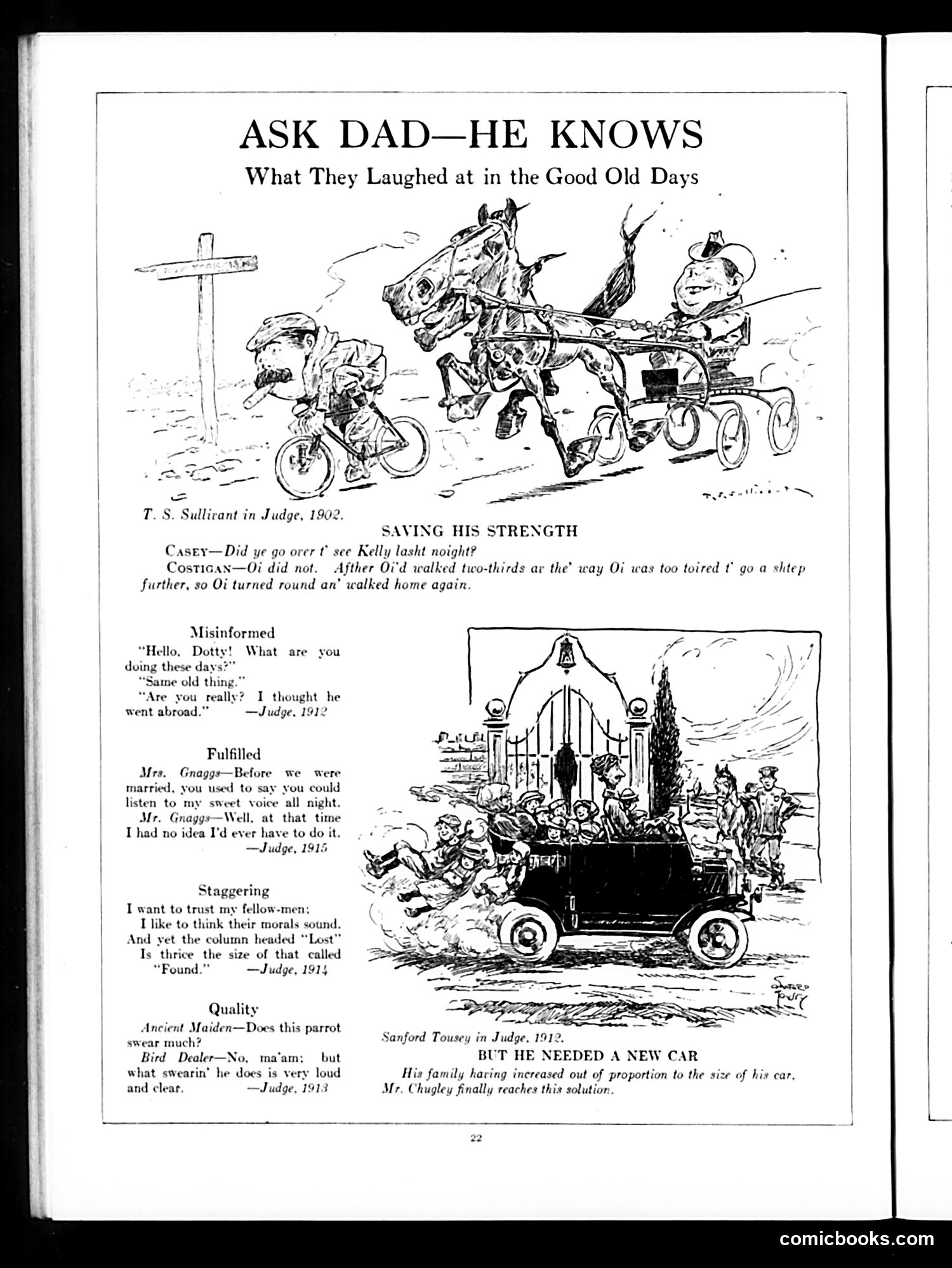
This page collects vintage humor from Judge magazine (1902-1915), presented as nostalgic comedy for readers to share with their fathers. The content includes: **The cartoons and jokes mock everyday situations:** - **"Saving His Strength"**: Irish-accented characters (indicated by dialect spelling) humorously discuss exhaustion from walking - **"Misinformed"**: A woman's boring life contrasted with assumption she'd traveled - **"Fulfilled"**: Marital disillusionment—a husband who once praised his wife's voice now dreads hearing it constantly - **"Staggering"**: Social commentary on lost items vastly outnumbering found ones, suggesting moral decline - **"Quality"**: A parrot's loud profanity despite lacking eloquence - **"But He Needed a New Car"**: A man's family outgrows his automobile, requiring purchase of a larger vehicle The humor relies on period stereotypes (Irish dialect), domestic friction, and consumer anxieties. The framing ("Ask Dad") suggests this collection targets adult male readers nostalgic for earlier comedy styles.
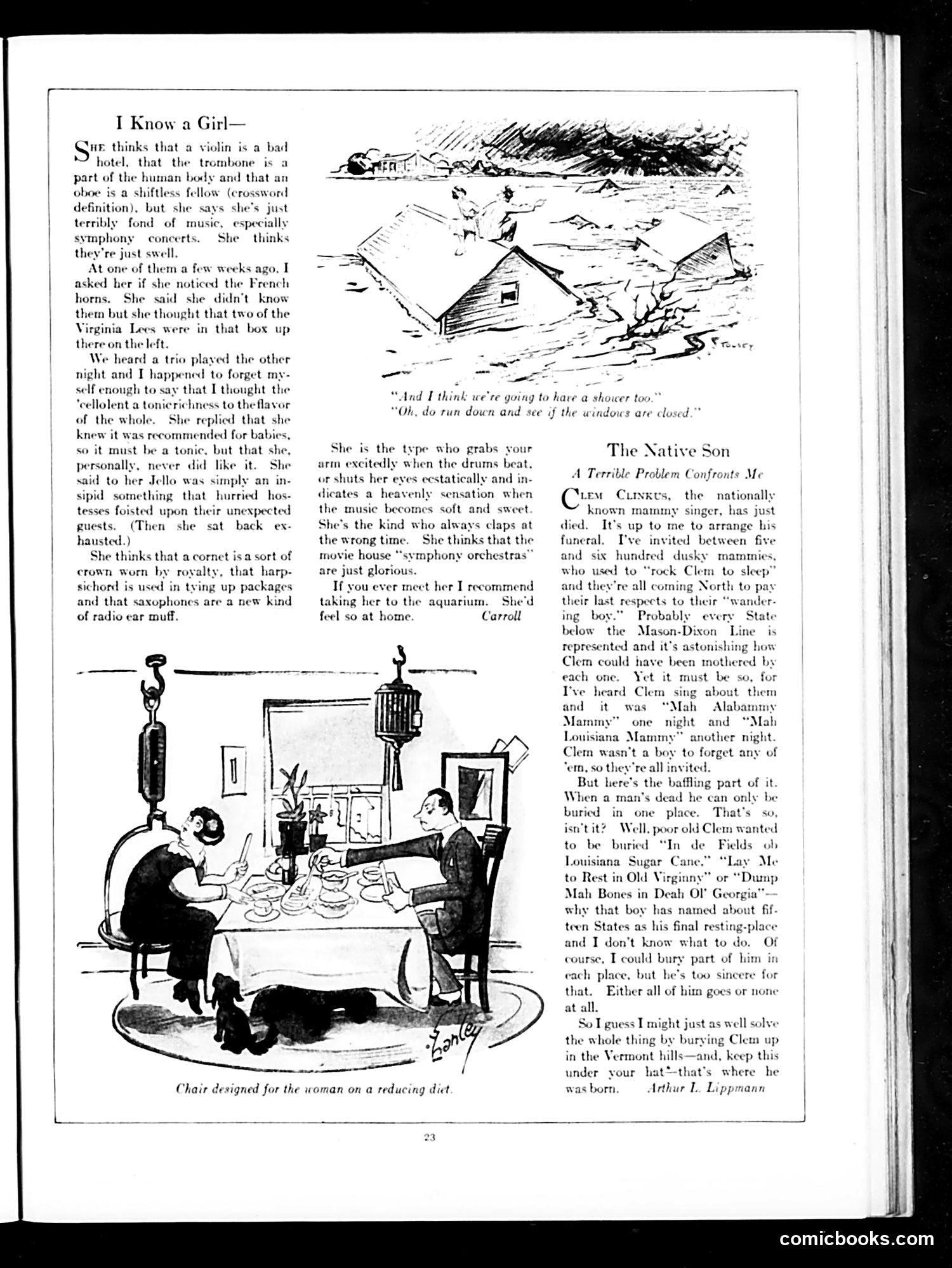
This Judge magazine page contains two satirical pieces mocking early 20th-century American attitudes: **"I Know a Girl"** (left): Ridicules a woman who attends symphony concerts but remains completely ignorant of music terminology. She confuses orchestral instruments with unrelated things (thinks "oboe" is a person, "harp-sichord" is for tying packages, "saxophones" are radio ear muffs). The joke targets pretentious concert-goers who attend for social status rather than genuine appreciation. The accompanying cartoon shows a reducing-diet chair—likely commenting on her superficiality. **"The Native Son"** (right): Satirizes the popularity of "mammy songs" sung by performer Em Cuthkus. The narrator must arrange his funeral despite Cuthkus having sung about being raised by mammies from numerous Southern states. The punchline reveals Cuthkus was actually born in Vermont—mocking both the sentimental artificiality of these songs and the performer's inauthenticity. The reference reflects racist minstrelsy traditions of the era.
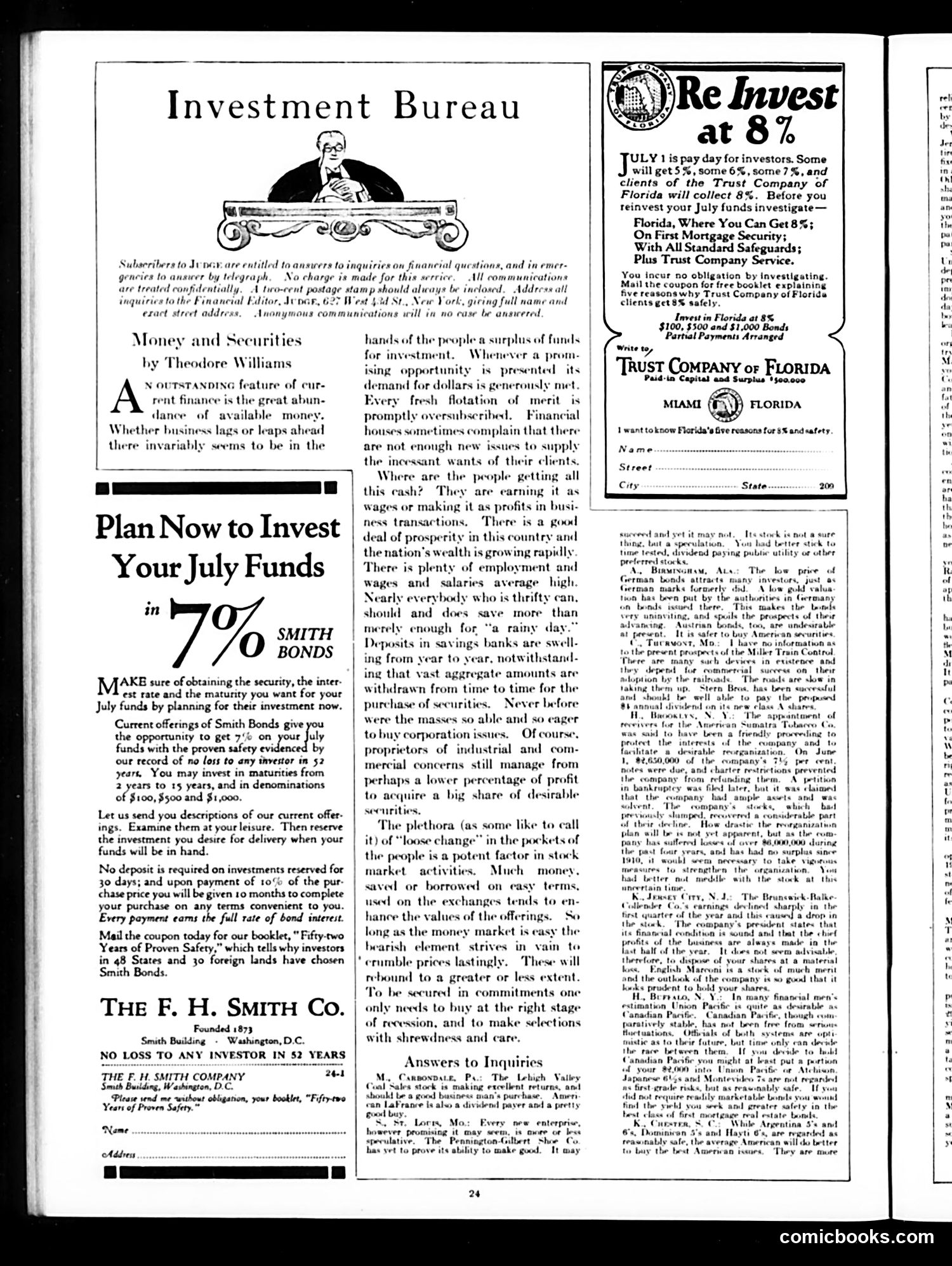
This page is primarily **financial advertising**, not political satire. It contains: **Main Content:** An article by Theodore Williams on "Money and Securities" discussing surplus capital available for investment during what appears to be a prosperous economic period. The piece argues that abundant savings and wages are driving demand for investment opportunities. **Advertisements:** The bulk of the page promotes investment products—particularly Smith Bonds (offering 7% returns with claimed 52-year safety record) and the Trust Company of Florida (advertising 8% returns). **The "Investment Bureau" masthead** at top presents itself as offering financial advice to magazine subscribers. There is **no political cartoon or satire visible** on this page. The imagery is conventional financial-services advertising featuring a desk-bound figure representing the "Investment Bureau." The content reflects early-20th-century financial optimism and reflects magazines like *Judge* carrying substantial advertising revenue alongside editorial content.
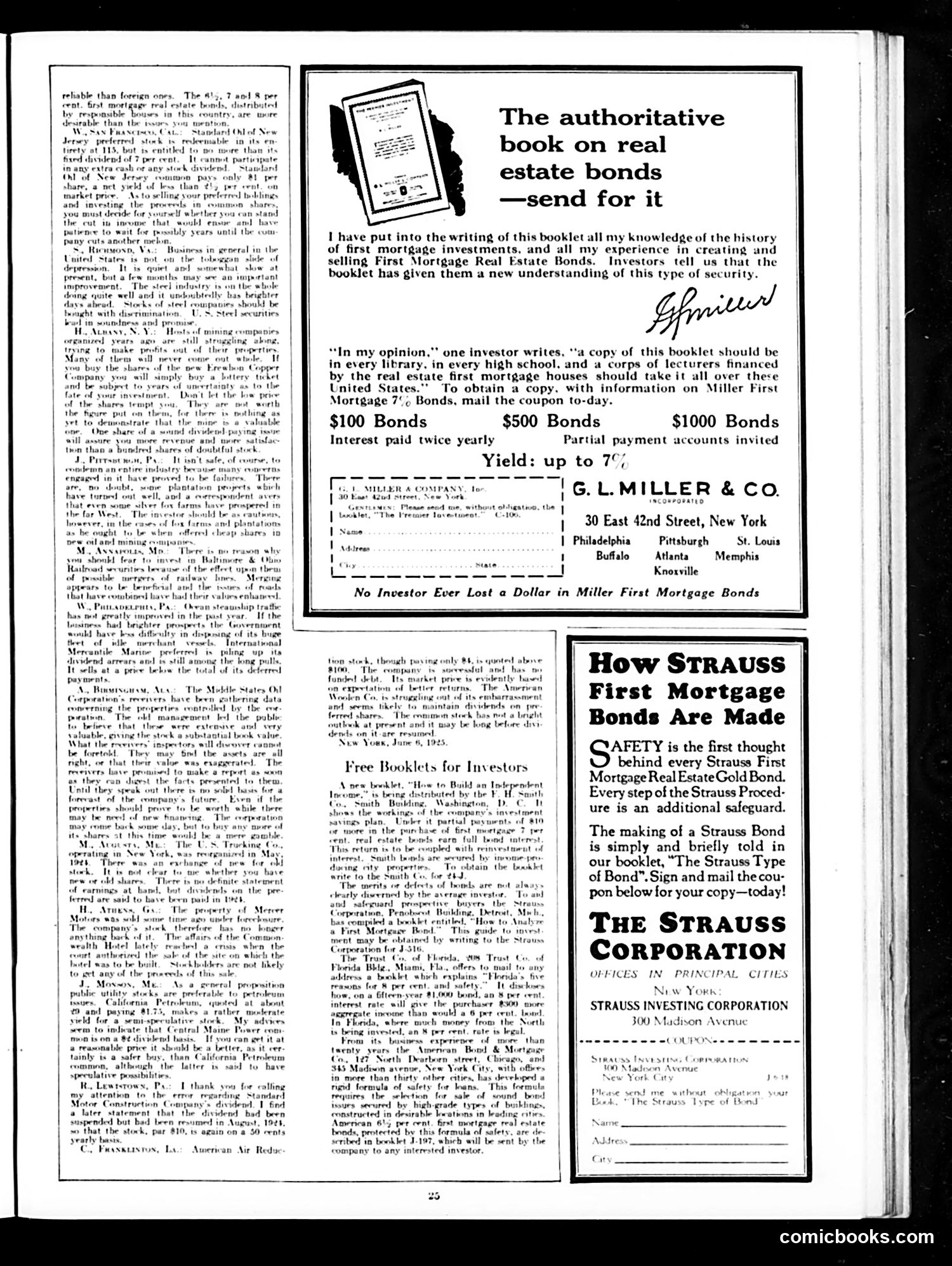
This page is primarily **financial advertising**, not satire or political commentary. It consists of four separate bond investment advertisements from different companies: 1. **G.L. Miller & Co.** (top right) - promoting First Mortgage Real Estate Bonds with yields up to 7%, claiming "No Investor Ever Lost A Dollar" 2. **The Strauss Corporation** (right side) - advertising their First Mortgage Real Estate Gold Bonds with emphasis on safety 3. **Strauss Investing Corporation** (bottom right) - offering free educational booklets about bond investments The left column contains financial advice text (partially OCR'd, difficult to read) discussing various bond types and investment considerations. **Context for modern readers:** This represents the pre-1929 crash era when investment bonds were heavily marketed to ordinary Americans as safe, reliable income sources. The repeated claims of perfect safety ("No Investor Ever Lost A Dollar") are historically ironic, given the financial catastrophe that followed. This page exemplifies how thoroughly unregulated securities advertising preceded the Great Depression.
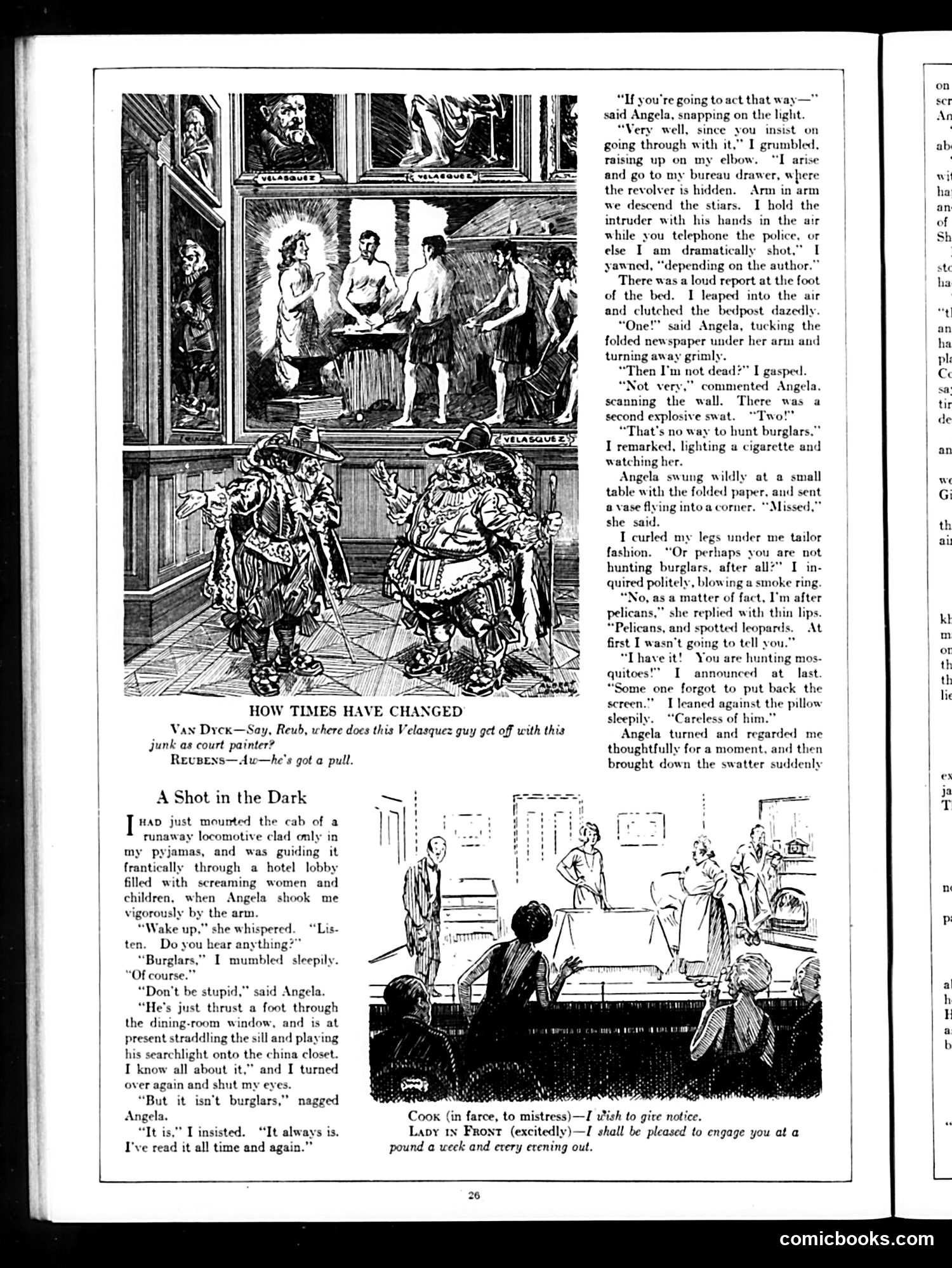
This page contains a humorous domestic fiction piece satirizing melodramatic literature conventions of the era. The narrative mocks overwrought mystery and adventure stories through a couple's nighttime exchange: Angela hears a noise she insists is a burglar; her husband dismissively assumes it's a burglar (having "read it all the time"), expecting the typical plot arc of armed confrontation and police involvement. The joke's payoff reveals Angela is actually swatting insects (mosquitoes, she eventually admits) with a newspaper—anticlimactically deflating the expected burglar narrative. The accompanying illustrations show increasingly absurd scenes, including the husband's dream sequence and domestic chaos. The page also includes period cartoons mocking Old Master painters and servant employment ads, representing typical Judge magazine content. The satire targets both pulp fiction's predictable tropes and the gap between literary excitement and mundane domestic reality.
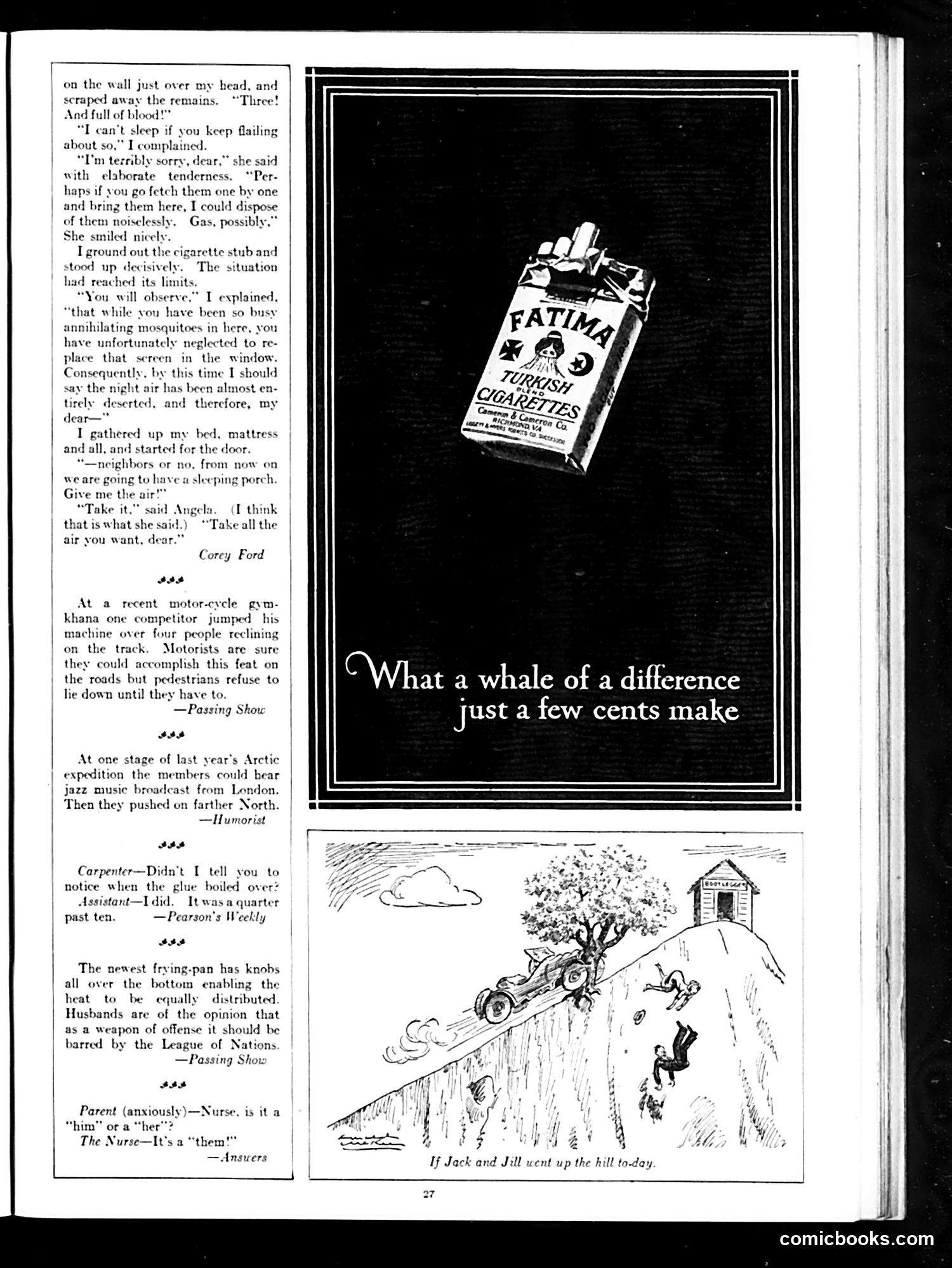
This page contains several short humorous pieces typical of early 20th-century satirical magazines: **Main Comic Story** (by Corey Ford): A domestic humor piece about a husband and wife battling mosquitoes in their bedroom. The wife fusses over killing insects while neglecting to replace the window screen, allowing more inside. The husband sarcastically threatens to move his bed to the porch to escape both mosquitoes and her complaints. The joke relies on marital conflict humor and the husband's exasperated resignation—common themes in period comedy. **Cigarette Advertisement**: A Fatima Turkish cigarettes ad with the tagline "What a whale of a difference just a few cents make"—typical early advertising emphasizing product value. **Bottom Cartoon**: Shows Jack and Jill going up a hill, likely referencing the nursery rhyme, with vintage vehicles tumbling down—probably satirizing dangerous driving or reckless motorists of the era. **Other Short Jokes**: Brief one-liners about motorcyclists, frying pans as weapons, and gender of newborns—reflecting period preoccupations and domestic humor conventions.
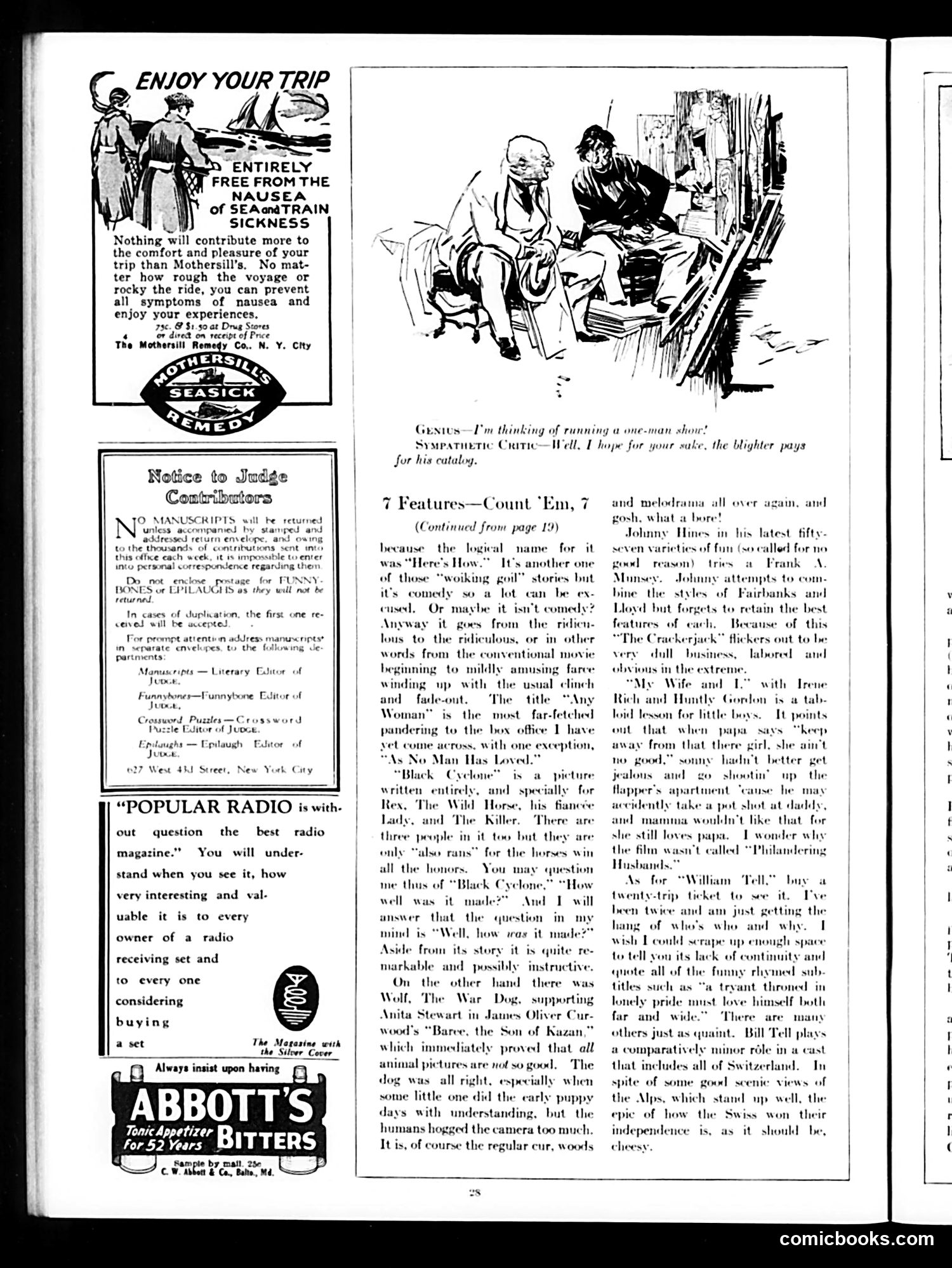
This page is primarily **advertisements and editorial notices** rather than political satire. The main content includes: **Left side:** Ads for Mothersill's seasickness remedy and Abbott's Bitters, plus a "Notice to Judge Contributors" explaining manuscript submission policies. **Right side:** A film review column titled "7 Features—Count 'Em, 7" discussing recent movies. The small cartoon shows two men (one appears to be a "genius" filmmaker, the other a "sympathetic critic") discussing a one-man show, with the critic hoping "the blighter pays" for the production. The film reviews critique contemporary silent movies featuring animal actors and comedians, commenting on their quality with casual dismissal of some productions. There's no significant political content—this is entertainment journalism reflecting 1920s cinema and period advertising.
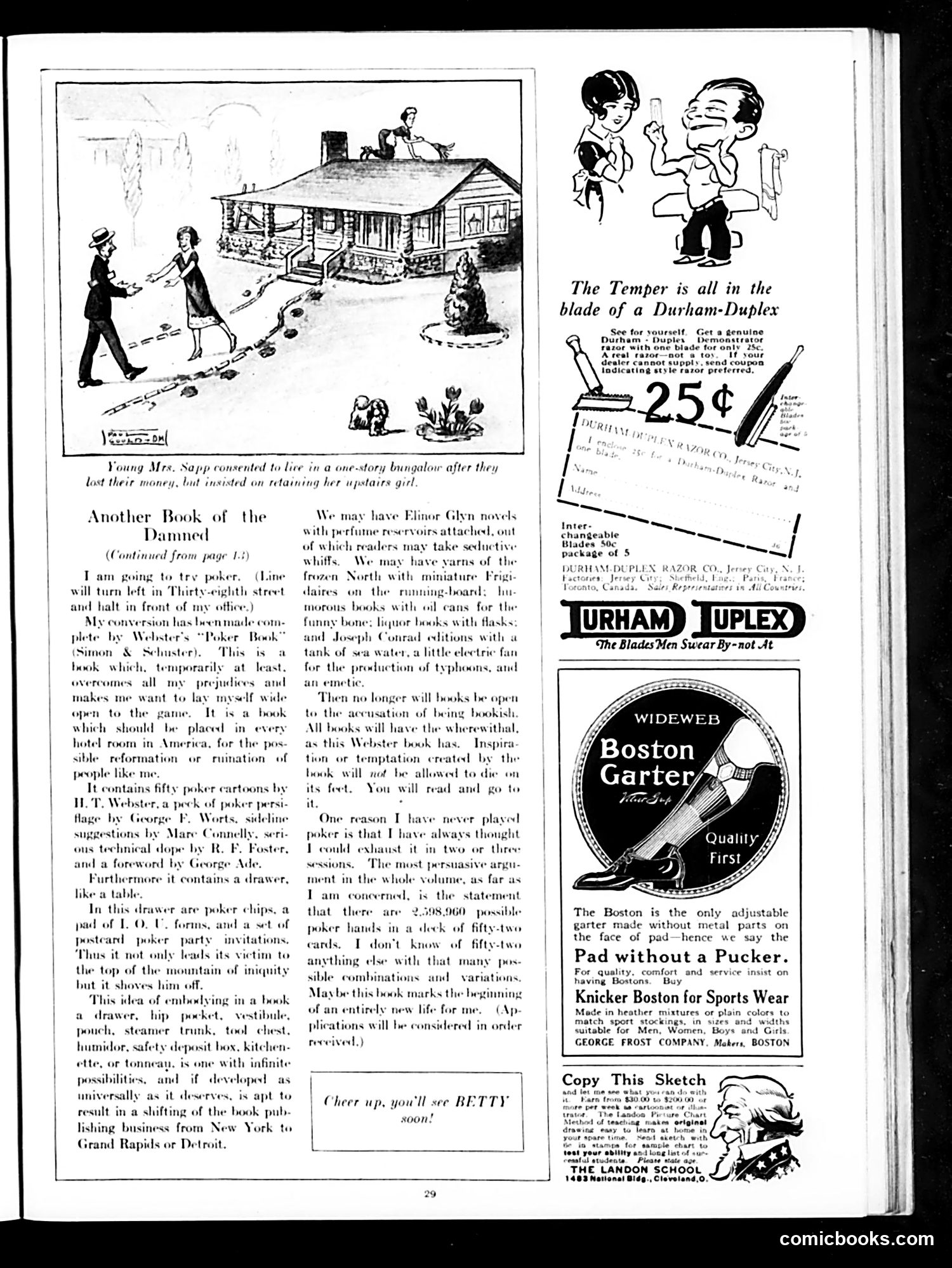
This page mixes editorial content with advertising, typical of 1920s magazines. **Main Cartoon (top left):** Shows "Young Mrs. Sapp" who lost family wealth but refuses to downsize completely—she'll live in a modest one-story bungalow but insists on keeping her "upstairs girl" (a live-in domestic servant). The satire targets wealthy people's stubborn class pretensions during economic hardship; she maintains the appearance of affluence by retaining a servant despite financial ruin. The dotted line showing the servant's daily duties emphasizes the absurdity of this priority. **Editorial Content:** Discusses a new "Poker Book" by Webster containing drawer compartments with actual poker chips and betting forms—a novelty publication format. The author humorously speculates about extending this gimmick to other books (perfumed novels, Conrad editions with sea-water tanks). **Advertisements:** Typical period ads for razor blades (Durham-Duplex at 25¢), Boston garters, and a drawing school—standard magazine filler of the era. The page reflects 1920s middle-class anxieties about maintaining social status during economic uncertainty.
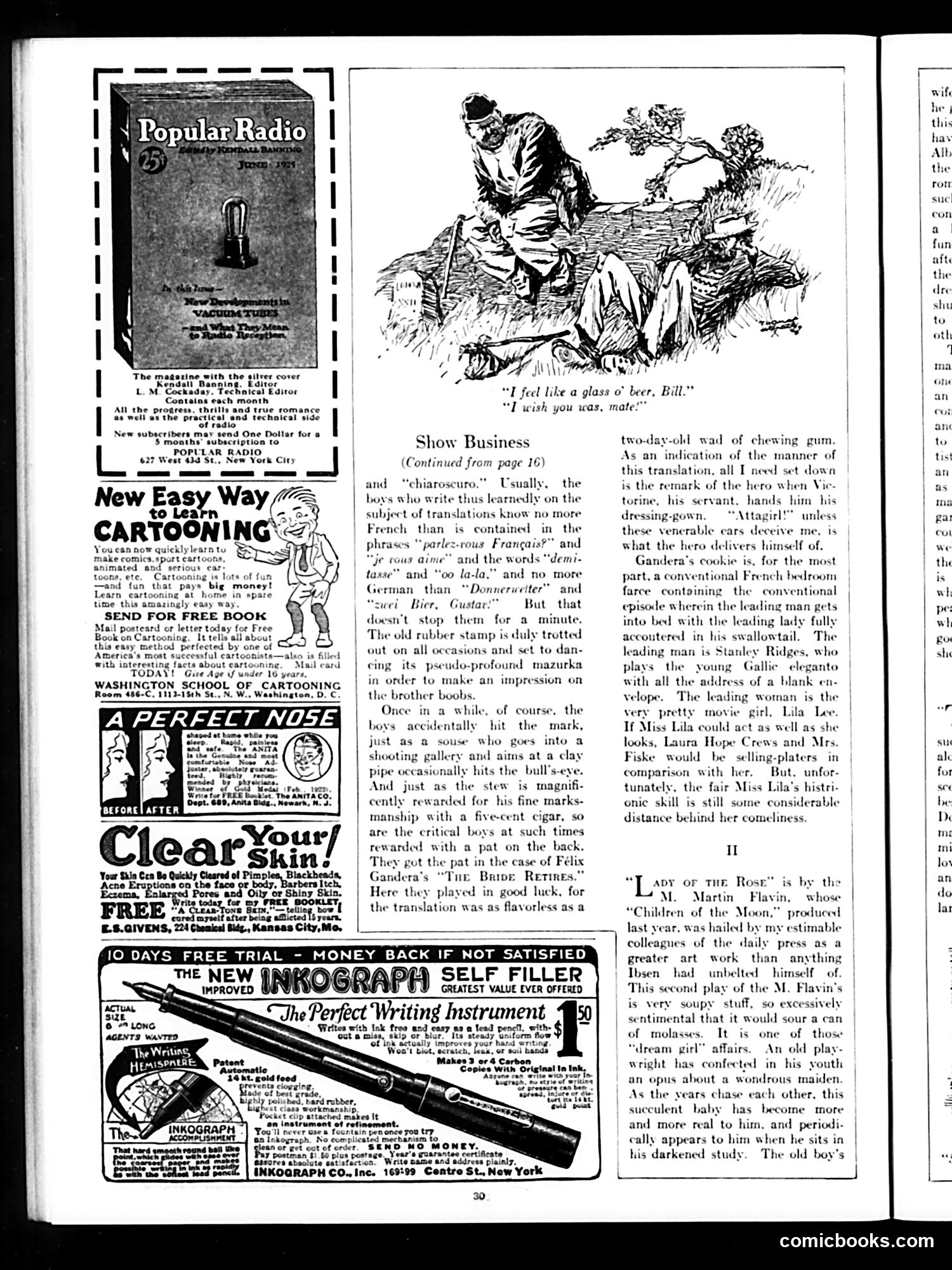
This page is primarily **advertisements and filler content** from Judge magazine, not political satire. The main editorial content is a theater review ("Show Business") critiquing recent Broadway productions. The visible cartoon shows two men in rural dress, one saying "I feel like a glass o' beer, Bill" with the response "I wish you was, mate!" This appears to be a period-appropriate joke, likely referencing Prohibition-era constraints on alcohol availability. The bulk of the page contains vintage advertisements: correspondence courses in cartooning and cartooning schools, a "Perfect Nose" skin-clearing product, and an "Inrograph" pen marketed as a writing instrument. These ads reflect early-20th-century consumer culture. The theater review discusses translations of French plays and contemporary Broadway productions (mentioning actors Stanley Ridges and Lila Lee), dismissing them as derivative farce with poor acting. This represents typical Judge-style cultural criticism of theatrical trends, though it lacks the sharp political satire the magazine was known for.
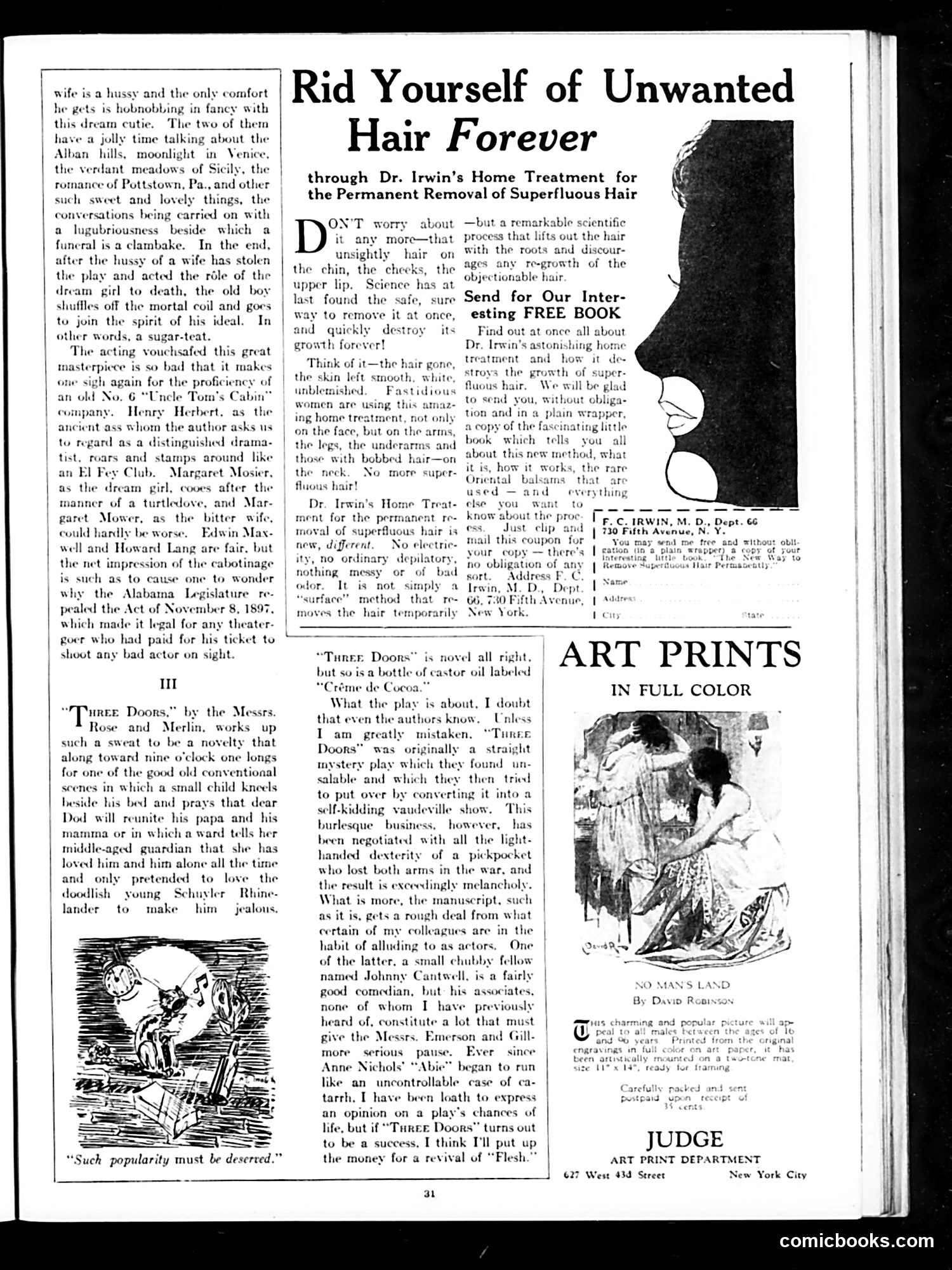
This page contains primarily **advertisements** rather than political cartoons. The main content is a full-page ad for "Dr. Irwin's Home Treatment for the Permanent Removal of Superfluous Hair"—a product promising to eliminate unwanted facial and body hair permanently using an unnamed scientific process. The side columns contain **theatrical criticism**, not satire. The critic reviews "Three Doors," a play by Rose and Merlin, harshly criticizing the acting quality and suggesting the original mystery plot was converted into vaudeville to make it marketable. The critic sarcastically notes Alabama law (apparently) once allowed shooting bad actors, implying this cast deserves such fate. The small illustration shows a figure in theatrical costume but relates to the play review, not political commentary. The page also advertises **art prints in full color** by Judge's art department. This is essentially a **commercial/advertising page** with theater criticism, containing no apparent political satire.
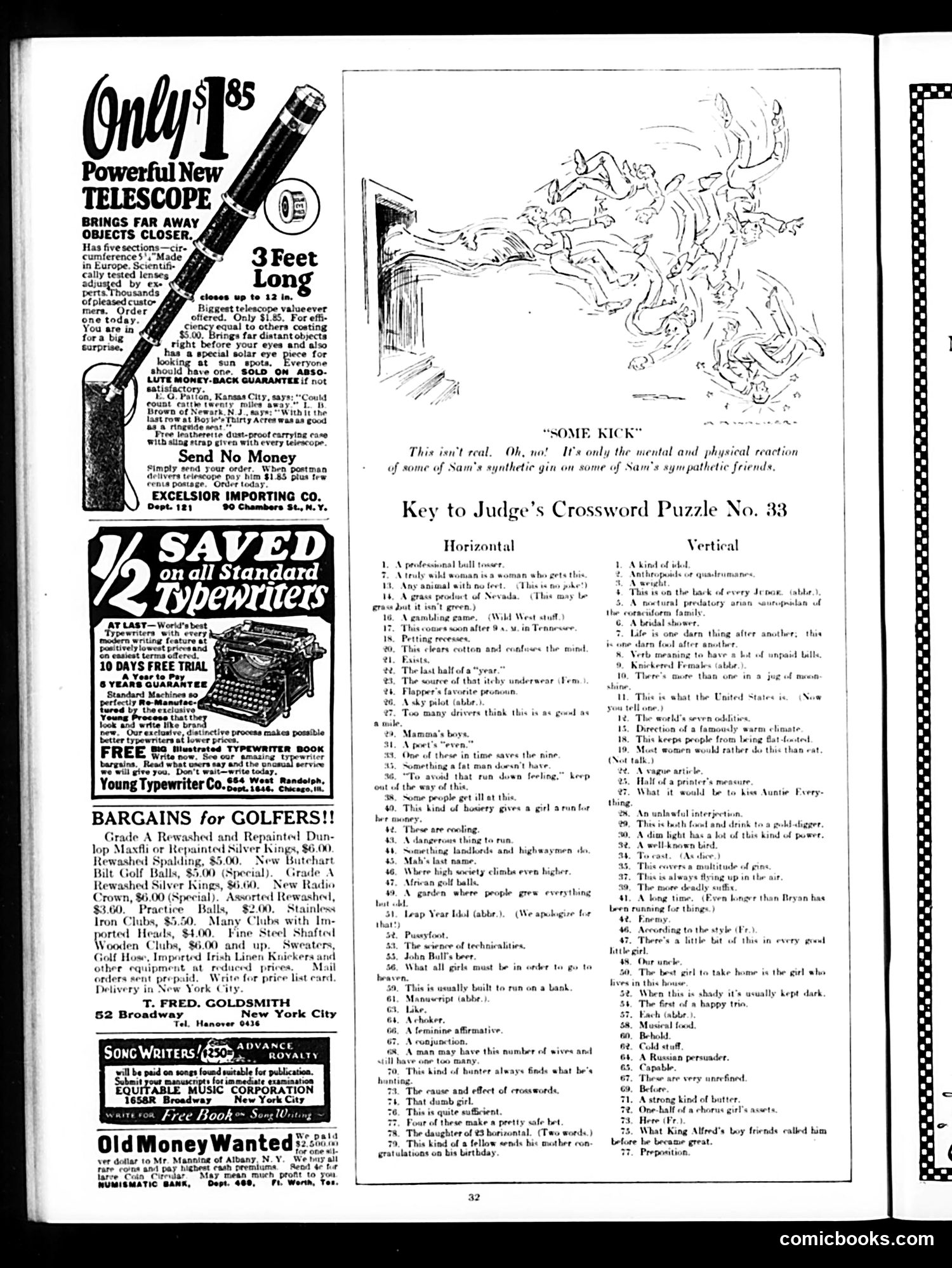
This page is primarily **advertising** with a small cartoon titled "Some Kick" occupying the upper right. The cartoon depicts figures being violently thrown about, apparently reacting to drinking homemade alcohol during Prohibition. The caption reads: "This isn't real. Oh, no! It's only the mental and physical reaction of some of Sam's synthetic gin on some of Sam's sympathetic friends." **The satire:** This mocks the dangerous, unpredictable effects of illegally-produced liquor during Prohibition (1920-1933). "Sam's synthetic gin" refers to bootleg alcohol made in bathtubs or secret stills—notorious for causing serious illness or death due to poor quality and toxic additives. The joke depicts the violent bodily reaction as humorous, while actually commenting on the real dangers of Prohibition-era drinking. The cartoon satirizes both the absurdity of Prohibition enforcement and consumers' desperate, risky consumption of dangerous homemade spirits.
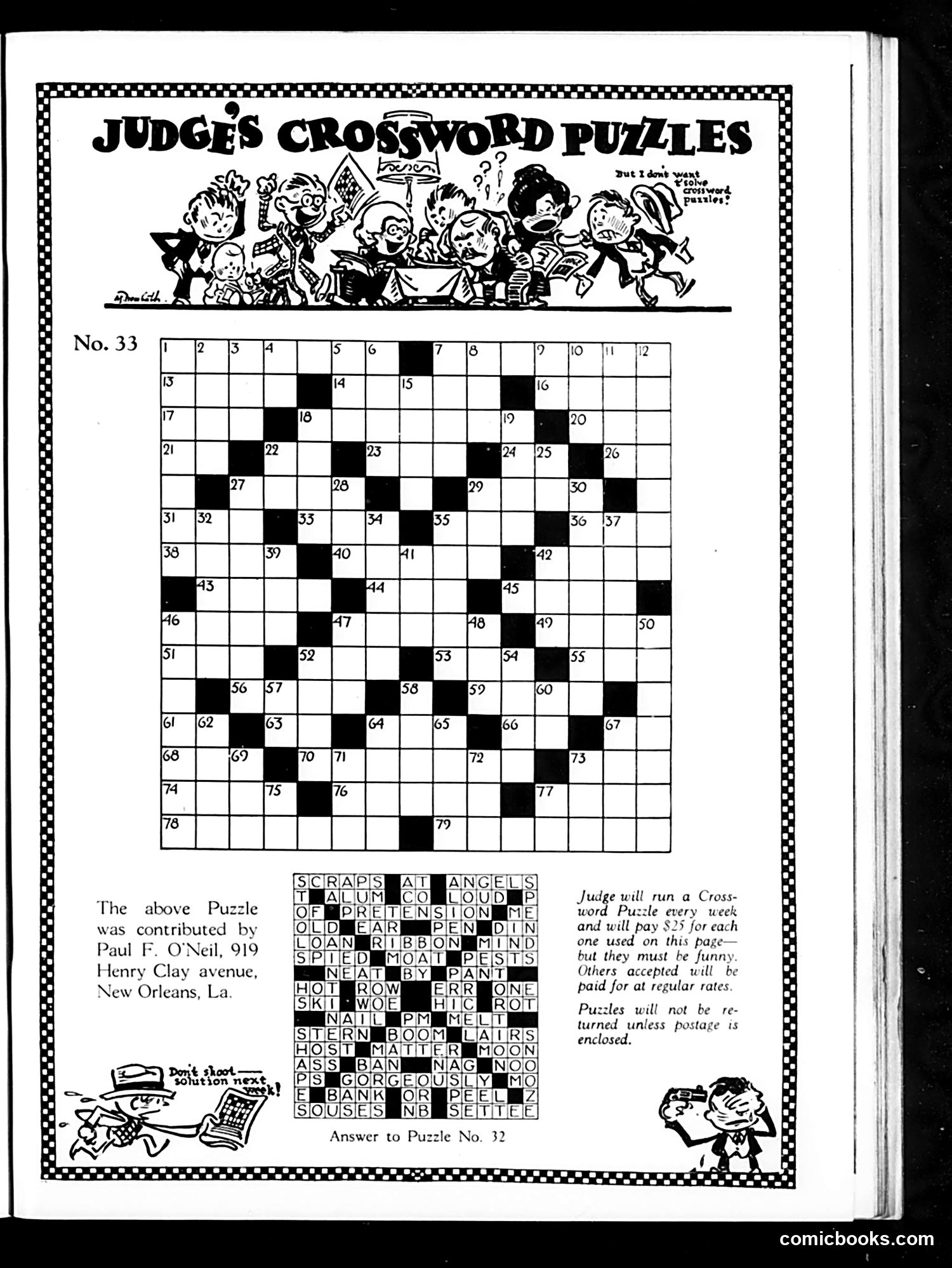
This page is primarily a **crossword puzzle** (No. 33) with no significant political cartoons or satire. The main content is the puzzle grid itself, contributed by a reader in New Orleans. Below it appears the answer key to the *previous* puzzle (No. 32), showing solved answers like "SCRAPS," "ANGELS," "ALBUM," and other words. The editorial note indicates **Judge ran weekly crossword puzzles** as reader-submitted content, paying $25 for published puzzles that were "funny" (likely meaning clever or witty in construction). Additional accepted puzzles received standard rates. The cartoonish illustrations at the page borders are decorative rather than satirical commentary. This appears to be a **puzzle and games page** rather than editorial content with political meaning.
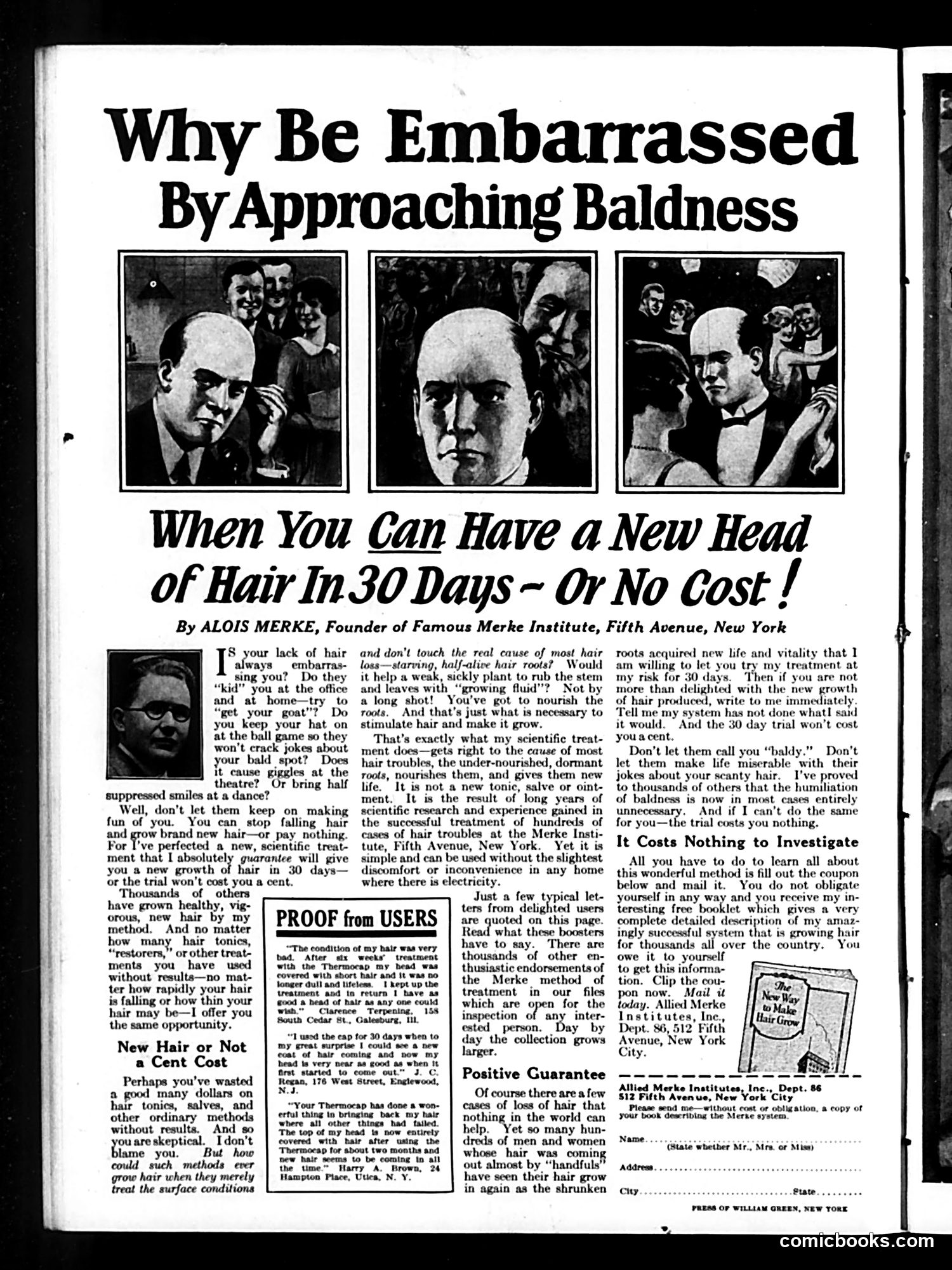
This is a **full-page advertisement**, not satire or political commentary. Alois Merke, founder of the Merke Institute in New York, promotes a hair-growth treatment called "the Thermocap"—an electrical device used at home. The advertisement exploits social anxiety about baldness through shame-based messaging: embarrassment at the office, theater, and social gatherings; mocking from others; the need to keep one's hat on. The three photographs at top show bald men in social situations, reinforcing these anxieties. The pitch promises new hair growth in 30 days "or no cost"—standard advertising hyperbole of the era. It includes "proof from users" (testimonial letters) claiming success after weeks of treatment, a common marketing tactic then and now. The page reflects early 20th-century attitudes: baldness as a source of shame rather than acceptance, electrotherapy as cutting-edge "scientific" treatment, and direct appeals to male insecurity as effective marketing.