
Judge, 1925-06-13 · page 17 of 36
Judge — June 13, 1925 — page 17: what you’re looking at
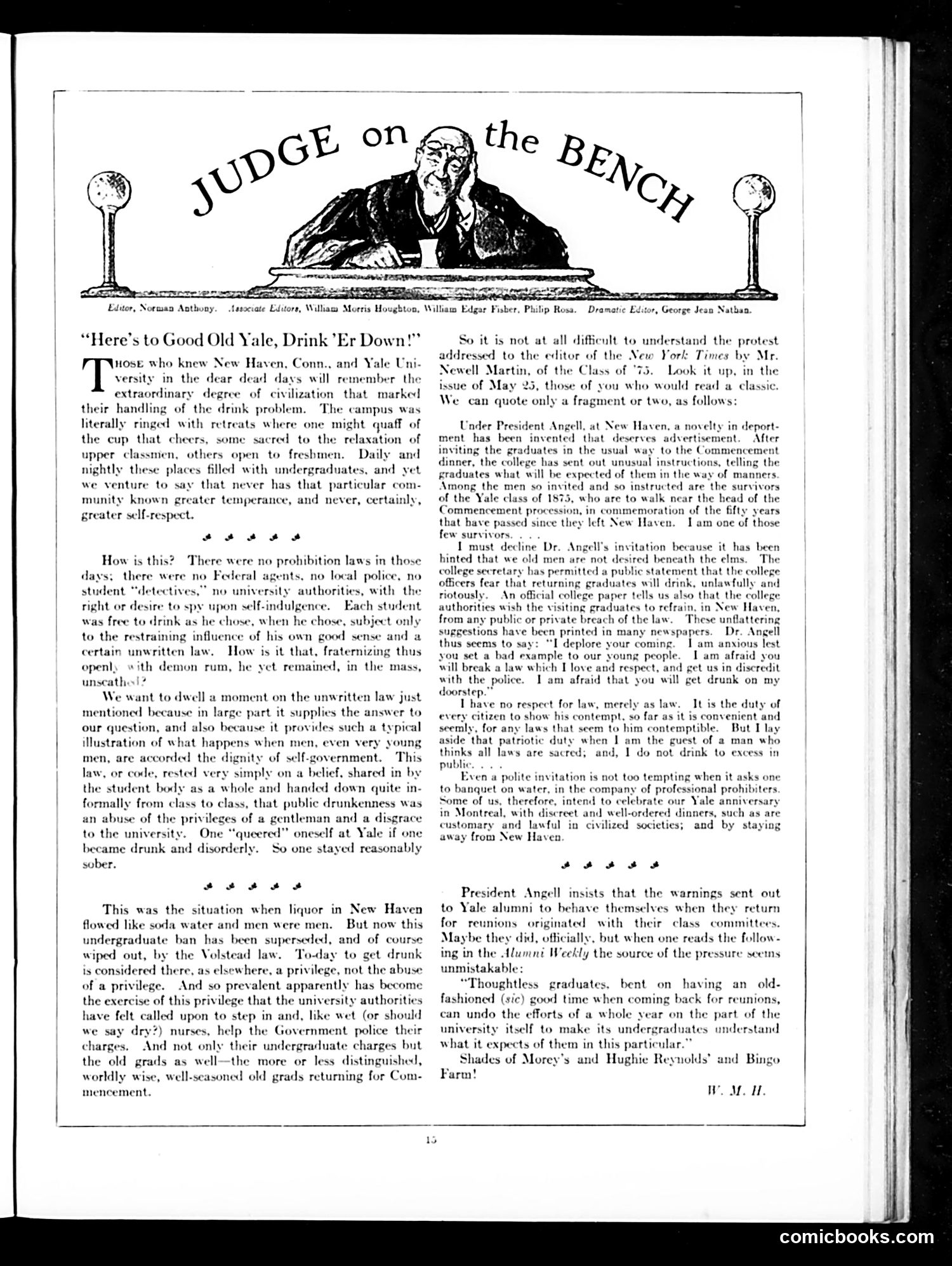
What you’re looking at
This article satirizes Prohibition-era hypocrisy at Yale University. The piece contrasts pre-Prohibition New Haven, where drinking was unrestricted but governed by an informal "unwritten law" of gentlemanly conduct that kept students relatively sober, with the post-Volstead Act era, where legal prohibition has paradoxically made drinking seem like a forbidden privilege worth abusing. The satire targets Yale administration for sending alumni insulting instructions about proper behavior during Commencement, implicitly warning older graduates they might drink "unlawfully and riotously." The author (W.M.H.) argues that removing personal responsibility through legal prohibition actually *increases* misbehavior, whereas trusting gentlemen's self-governance previously worked effectively. The piece mocks both Prohibition's failure and university authorities' infantilizing oversight of grown men.
📄 Transcribed text from this page (OCR, searchable)
Machine-transcribed from the original scan — historical spelling and the odd misread are preserved.
Editor, Norwan Anthony “*Here’s to Good Old Yale, Drink Er Down!” Hose who knew New Haven, Conn., and Yale Uni- versity in the dear dead days will remember the extraordinary degree of civilization that marked their handling of the drink problem. The campus was literally ringed with retreats where one might quaff of the cup that cheers, some sacred to the relaxation of upperclassmen, others open to freshmen. Daily and nightly these places filled with undergraduates, and yet we venture to say that never has that particular com- munity known greater temperance, and never, certainly, greater self-respect. esse ee How is this? There were no prohibition laws in those days; there were no Feder: student “+ agents, no local polic tectives,” no university authorities, with the right or desire to spy upon self-indulgence. Each student was free to drink as he chose, when he chose, subject only to the restraining influence of his own good sense and a certain unwritten law. How is it that, fraternizing thus openly with demon rum, he yet remained, in the mass, unscathe!? We want to dwell a moment on the unwritten law just mentioned because in large part it supplies the answer to our question, and also because it provides such a typical illustration of what happens when men, even very young men, are accorded the dignity of self-government. This. law, or code, rested very simply on a belief, shared in by the student body as a whole and handed down quite in- formally from class to class, that public drunkenness was an abuse of the privileges of a gentleman and a disgrace to the university. One “queered” oneself at Yale if one became drunk and disorderly. So one stayed reasonably sober. i i ad This was the situation when liquor in New Haven flowed like soda w nd men were men. But now this undergraduate ban has been superseded, and of course wiped out, by the Volstead law. To-day to get drunk is considered there, as elsewhere, a privilege, not the abuse of a privilege. And so prevalent apparently has become the exercise of this privilege that the university authorities have felt called upon to step in and, like wet (or should we say dry?) nurses, help the Government police their charges. And not only their undergraduate charges but the old grads as well—the more or less distinguished, worldly wise, well-seasoned old grads returning for Com- mencement. tasociate Editors, Williams Morris Houghton, Williaw Edgar Fisher. Ph ip Rosa. So it is not at all difficult to understand the protest addressed to the editor of the New York Times by Mr. Newell Martin, of the Class of ‘75. Look it up, in the issue of May 25, those of you who would read a classic. We can quote only a fragment or two, as follows: Under President Angell, at New Haven, a novelty in deport- ment has been invented that deserves advertisement. After inviting the graduates in the usual way to the Commencement dinner, the college has sent out unusual instructions, telling the graduates what will be expected of them in the way of manners. Among the men so invited and so instructed are the survivors of the Yale class of 1875, who are to walk near the head of the Commencement proce . in commemoration of the fifty years that have passed since they left New Haven. Iam one of those few survivors. II's invitation because it has been th the elms. hinted that we old men a h college college secretary has permitted a public sta officers fear that returning grac will drink, unlawfully and riotously. An official college paper tells us also that the coll authorities wish the visiting graduates to refrain, in New Haven, from any public or private breach of the law. These unflattering suggestions have been printed in many newspapers. Dr. Angell thus seems to say: “I deplore your coming. I am anxious lest you set a bad example to our young people. I am afraid you will break a law which I love and respect, and get us in discredit with the police. I am afraid that you will get drunk on my doorstep.” I have no respect for law, merely as law. It is the duty of every citizen to show his contempt, so far as it is convenient and seemly, for any laws that seem m contemptible. But I lay aside that patriotic duty when | am the guest of a man wh thinks all laws are sacred; and, I do not drink to excess in en a polite invitation is not too tempting when it asks one banquet on water, in the company of professional prohibiters. Some of us, therefore, intend to celebrate our Yale anniversary in Montreal, with discreet and well-ordered dinners, such as are customary and lawful in civilized societies; and by staying away from New Haven rr! President Angell insists that the warnings sent out to Yale alumni to behave themselves when they return with their committees. Maybe they did, officially, but when one reads the follow- ing in the Alumni Weekly the source of the pressure seems unmistakable: “Thoughtless graduates, bent on having an old- fashioned (sic) good time when coming back for reunions, can undo the efforts of a whole year on the part of the university itself to make its undergraduates understand what it expects of them in this particular.” Shades of Morey’s and Hughie Reynolds’ and Bingo Farm! for reunions originated class WoM. comicbooks.com