
A complete issue · 36 pages · 1925
Judge — January 31, 1925
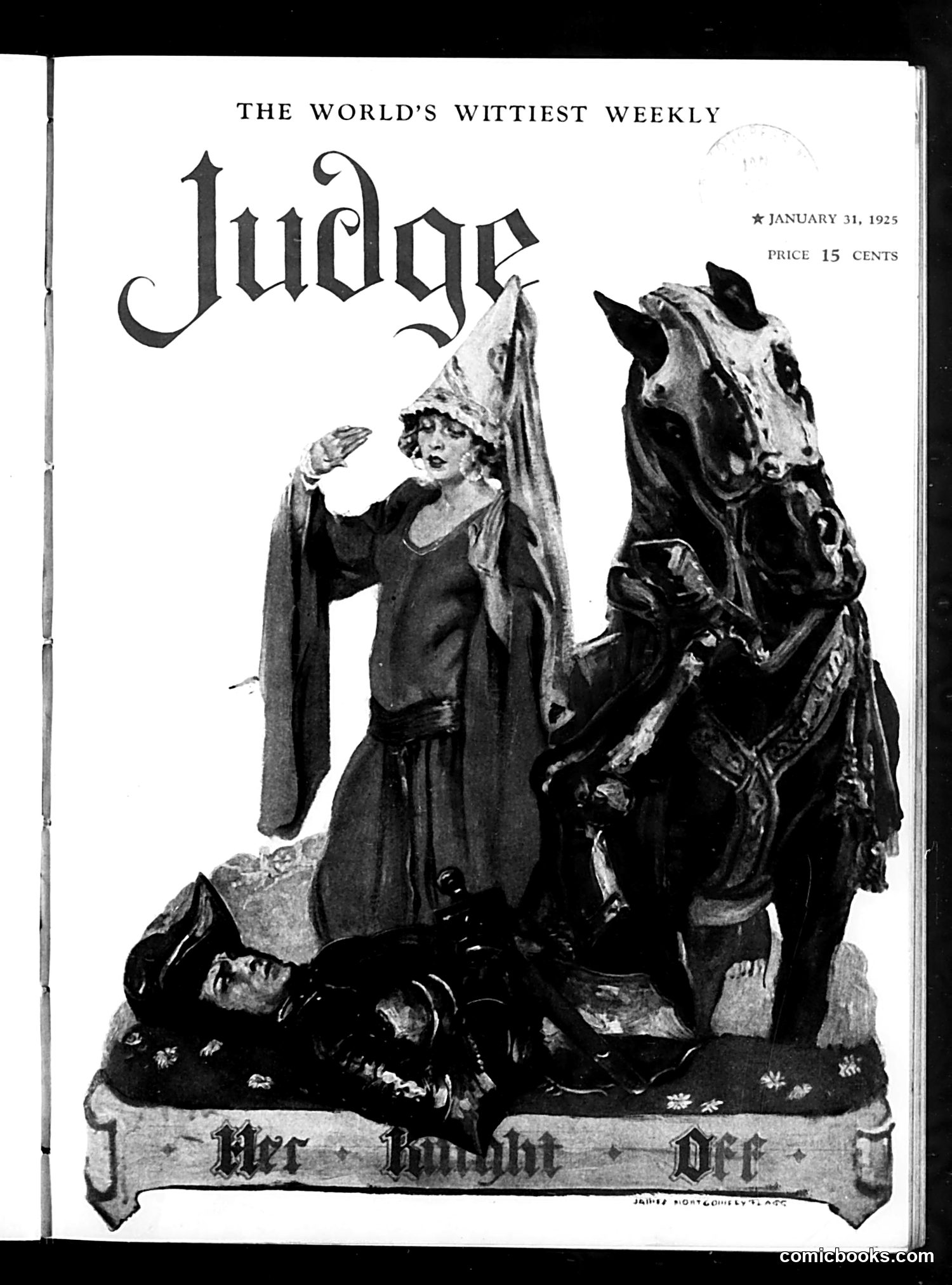
This cover illustrates "Her Knight Ode" (a pun on "Her Knight Ode," likely referencing medieval romance). The image depicts a woman in 1920s dress riding a horse, dressed as or styled after a knight, with what appears to be a fallen figure beneath the horse's hooves. The satire likely comments on the "New Woman" of the 1920s—the independent, modern woman gaining rights and social freedoms. By depicting her as a knight trampling a figure, Judge appears to mock either female empowerment or changing gender relations of the Jazz Age era. The specific identity of the trampled figure remains unclear from the image alone, but the overall message criticizes or ridicules contemporary shifts in women's social roles during this period.
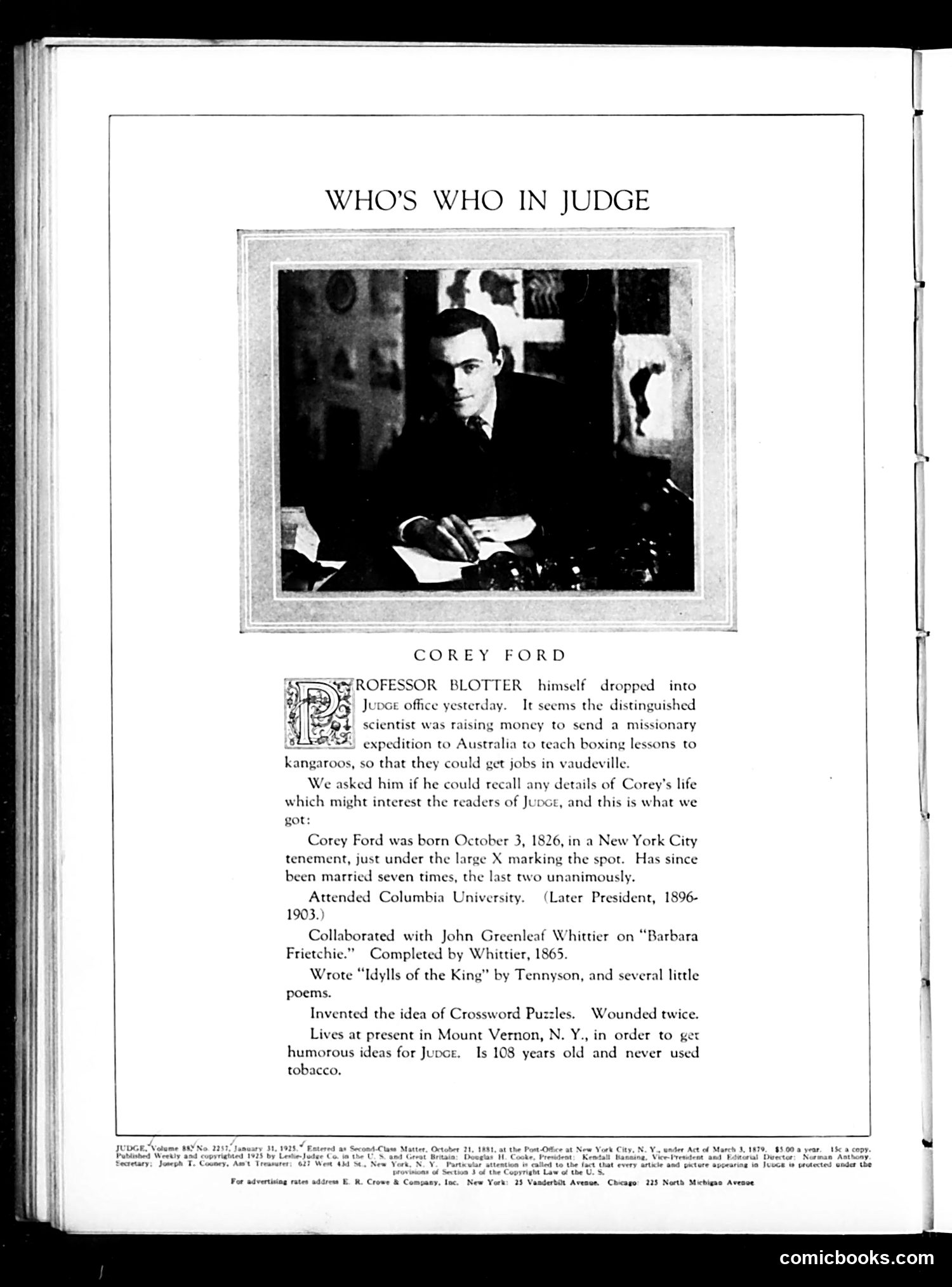
This page is a biographical profile of **Corey Ford**, presented as humor. The accompanying photograph shows a man at a desk, apparently in a judge's office—a visual pun on the magazine's name. The satire is mostly **absurdist**: the text lists supposedly factual details about Ford (born 1826 in New York, married seven times, attended Columbia University) mixed with obviously fictional claims (invented crossword puzzles, lived 108 years old, raised money for kangaroo boxing lessons in Australia). This appears to be gentle mockery of Ford himself—likely a contributor or figure known to Judge's readers—by presenting an exaggerated, deliberately implausible biography. The humor relies on readers recognizing which claims are real versus fabricated.
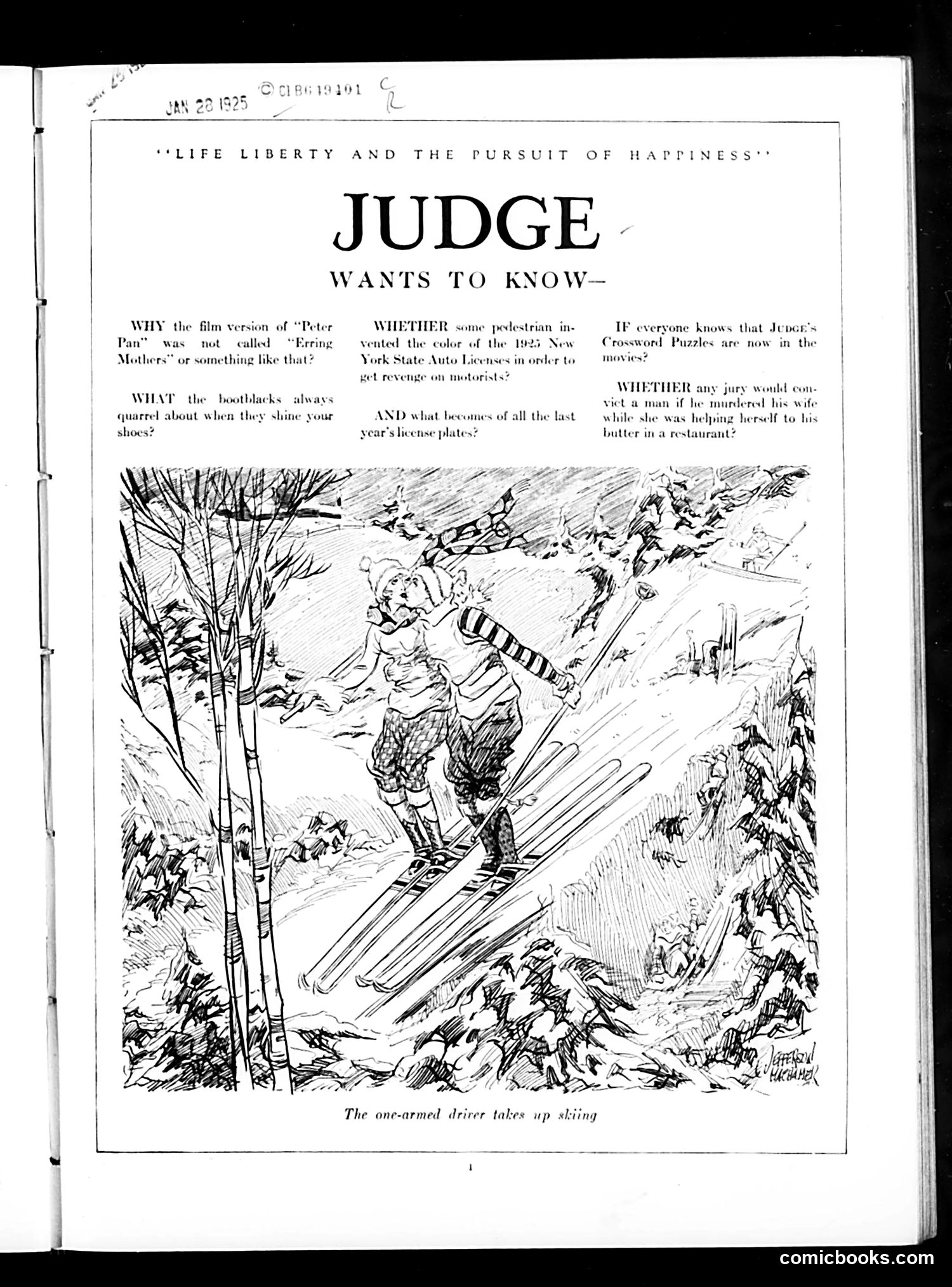
This page from *Judge* (dated January 29, 1925) presents satirical questions the magazine's editors wanted answered. The central cartoon depicts "The one-armed driver takes up skiing," showing a one-armed skier descending a snowy slope. The humor satirizes dangerous or absurd activities. The accompanying questions mock various social concerns: Peter Pan film adaptations, car horn noise, pedestrian safety and motorist revenge, license plate visibility, and jury duty regarding a hypothetical murder case. The skiing cartoon's point appears to be mocking reckless behavior—either criticizing extreme sports participation or poking fun at someone attempting inherently dangerous activities despite physical limitations. The overall page reflects *Judge*'s characteristic satirical tone toward contemporary American life and social anxieties of the 1920s.
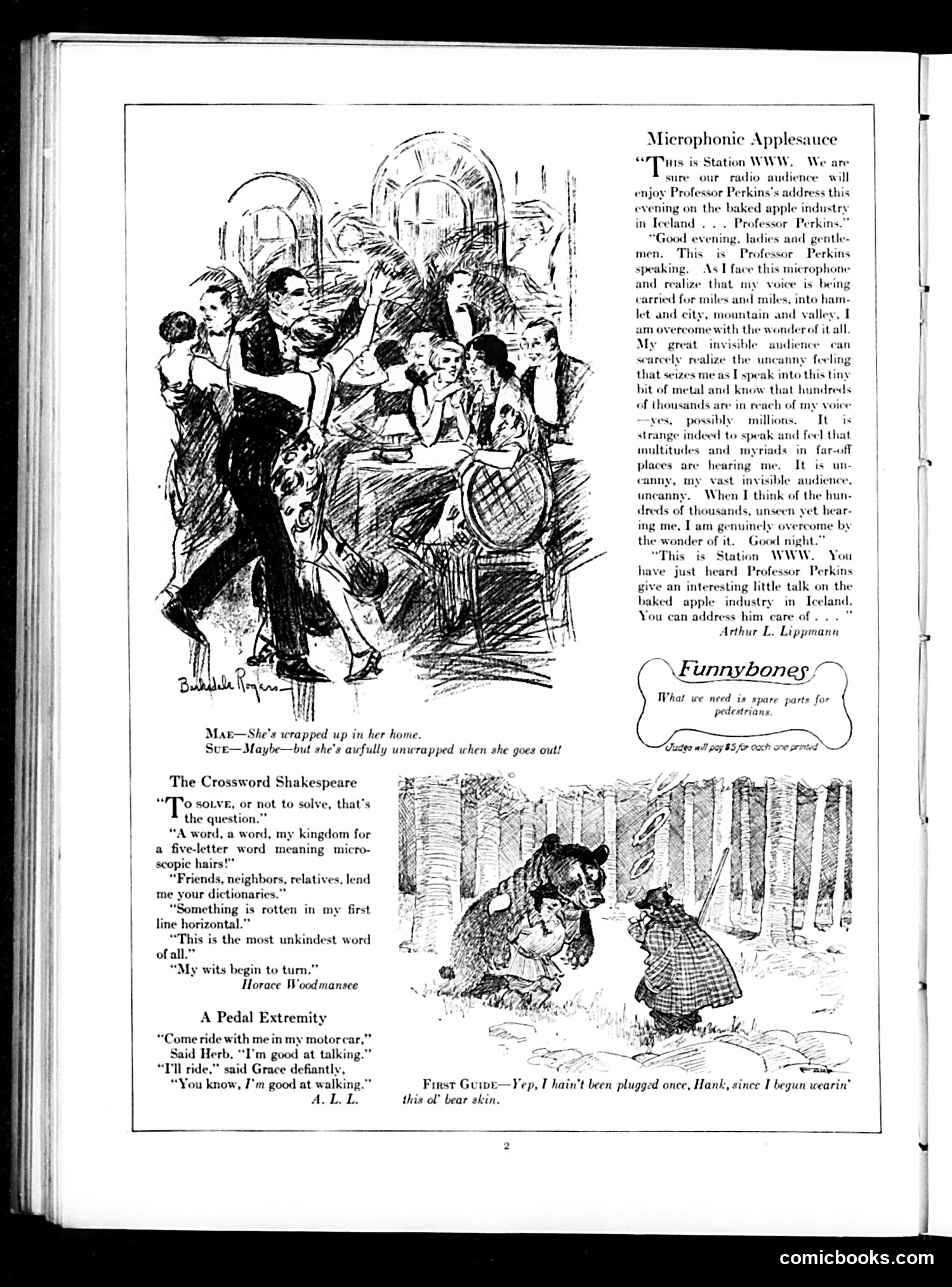
This page contains several satirical pieces: **"Microphonic Applesauce"** depicts Professor Perkins broadcasting about Ireland's baked apple industry via radio to an unseen audience. The satire mocks the wonder people feel about radio technology's ability to reach vast distances—Perkins expresses amazement that invisible audiences hear him, treating this mundane fact as extraordinary. It's a gentle joke about radio's novelty and the pretentiousness of early broadcasters. **"The Crossword Shakespeare"** and **"A Pedal Extremity"** are brief humorous quips unrelated to the radio piece. **"Funnybones"** shows a bear and child in woods, with mild domestic humor. The overall tone reflects 1920s-era satire about emerging mass-media technology and bourgeois social anxieties.
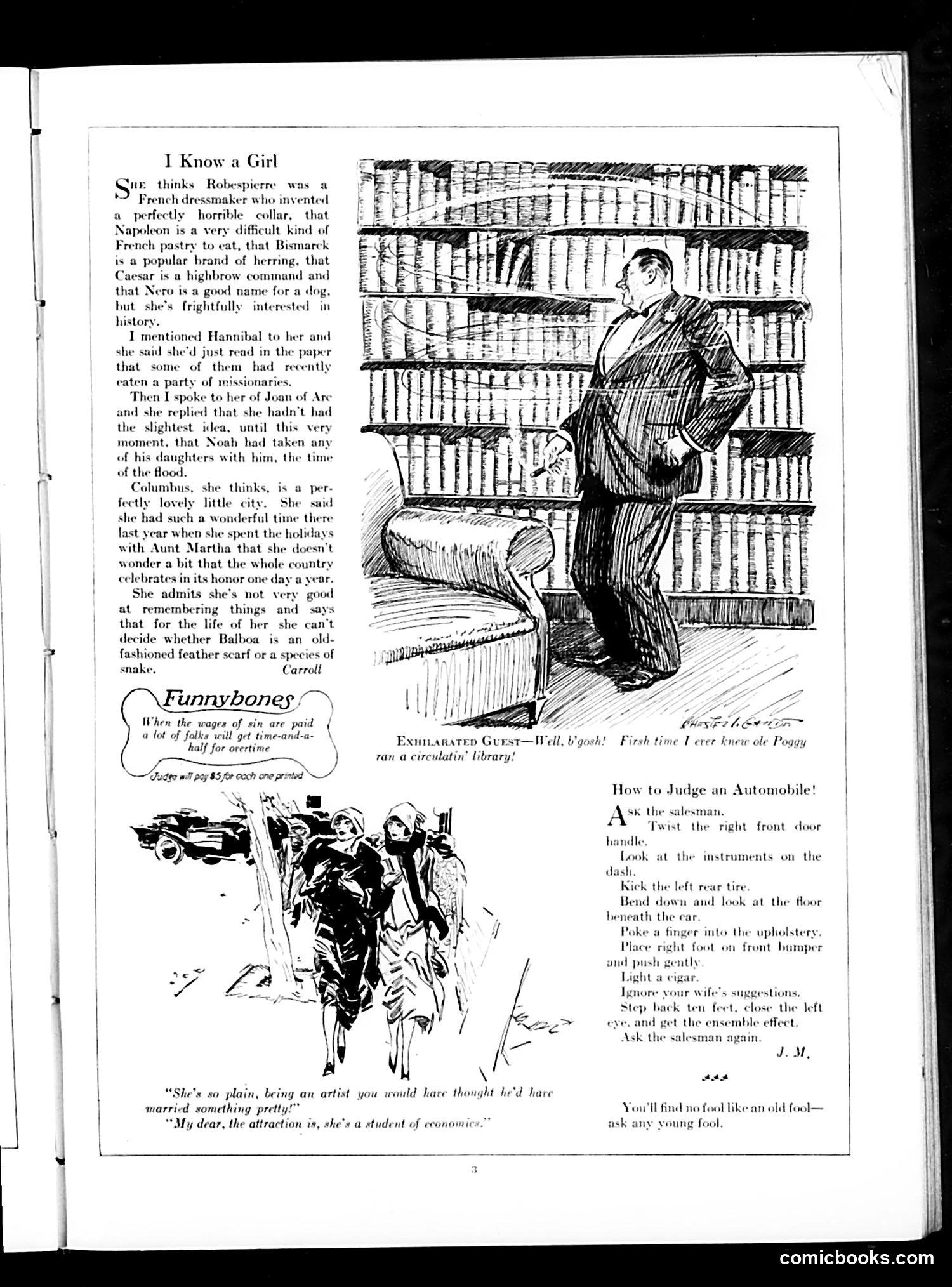
This page contains three separate humor items: **"I Know a Girl"** (top): A anecdotal column where the narrator describes a girl's confused historical knowledge—she thinks Robespierre was a French dressmaker, believes Bismarck invented herring, and confuses various historical figures and facts. The accompanying sketch shows a man in a library, likely representing the bemused listener. **"Funnybones"** (middle): A brief joke about people getting "time-and-a-half for overtime." **"How to Judge an Automobile!"** (bottom right): Satirical instructions for evaluating a car by performing various physical tests and inspections, ending with ignoring your wife's suggestions—poking fun at both automobile salesmanship and marital dynamics. The overall page emphasizes humorous social observation typical of early 20th-century satirical magazines.
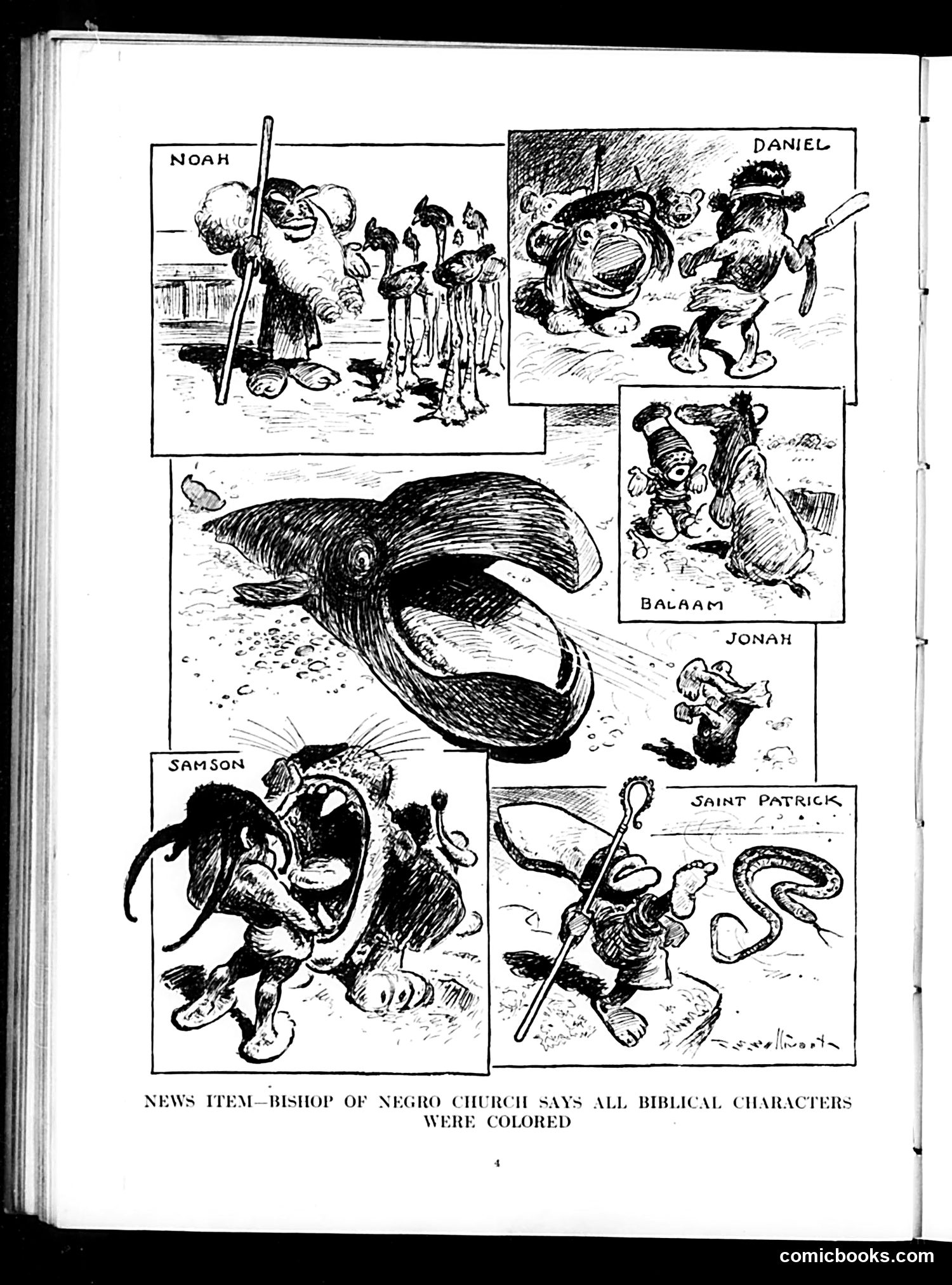
This is a satirical response to a "news item" about a Bishop of a Negro Church claiming all Biblical characters were colored (Black). The cartoons mock this claim by depicting well-known Biblical figures as exaggerated caricatures with racist imagery typical of early-20th-century American publications. Each panel labels a Biblical figure (Noah, Daniel, Balaam, Jonah, Samson, Saint Patrick) rendered as grotesque Black caricatures in stereotypical poses. The satire ridicules the Bishop's assertion through visual mockery rather than serious argument. This reflects a deeply racist era when Judge magazine regularly published demeaning imagery and when such claims about Biblical representation were met with ridicule rather than consideration. The content is historically significant as documentation of period racism, not as humor.
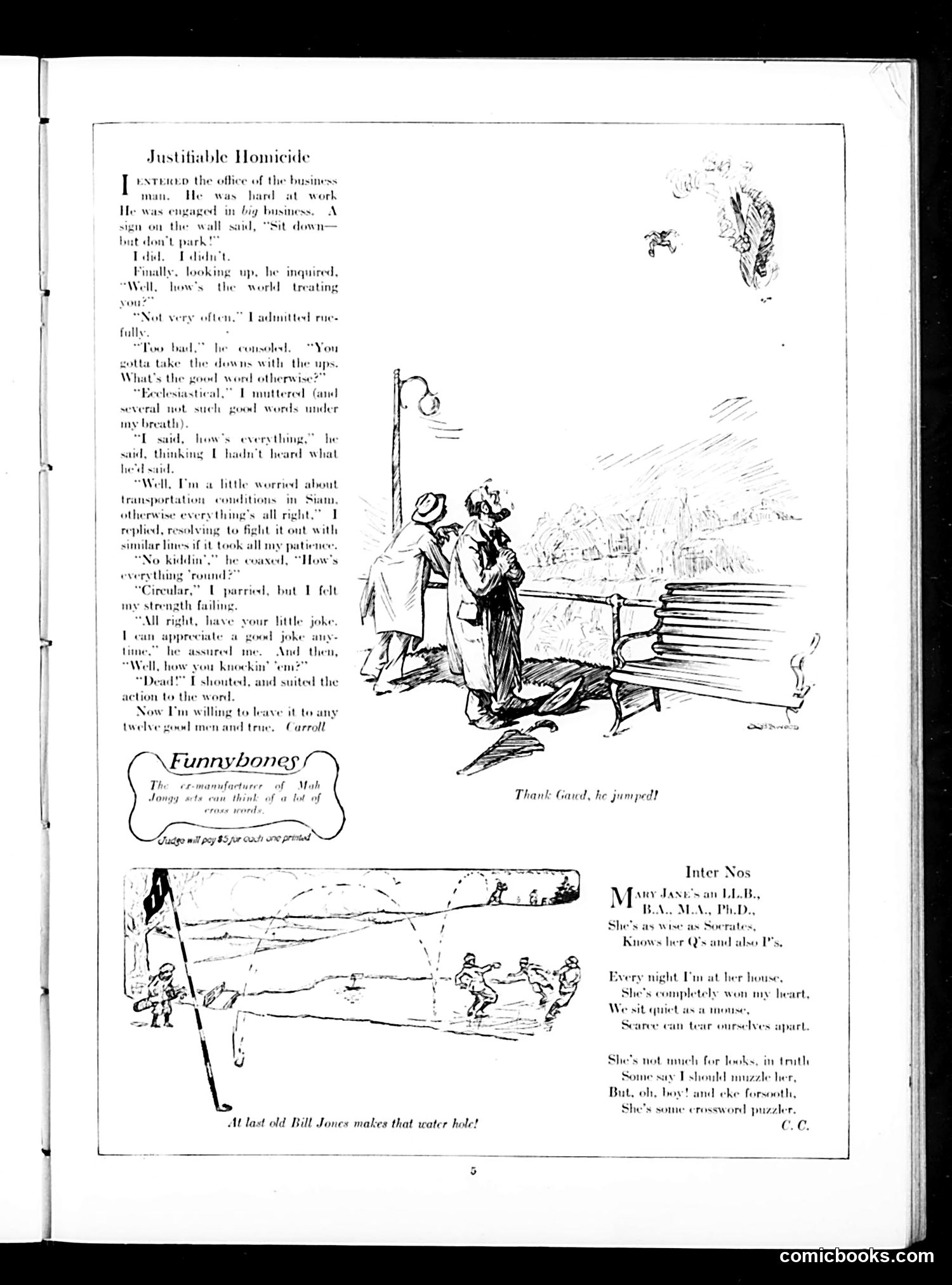
This page contains two distinct pieces: **"Justifiable Homicide"** (top): A comedic dialogue between a businessman and an office worker about life's disappointments. The worker complains the world treats him poorly; the businessman responds that he should "take the downs with the ups." When the worker mentions "Ecclesiastical" matters, the businessman says everything's fine. The worker then threatens violence over "transportation conditions in Spain," prompting the businessman to fight back. The cartoon illustrates frustration with managing employee complaints—a relatable office humor piece about workplace tension and the difficulty of maintaining patience with perpetually dissatisfied workers. **Lower section**: Advertisement for "Funnybones" candy and a poem "Inter Nos" about Miss Jane, an educated woman (B.A., M.A., Ph.D.) who's intellectually brilliant but socially awkward—satirizing overeducated women as unpleasant companions.
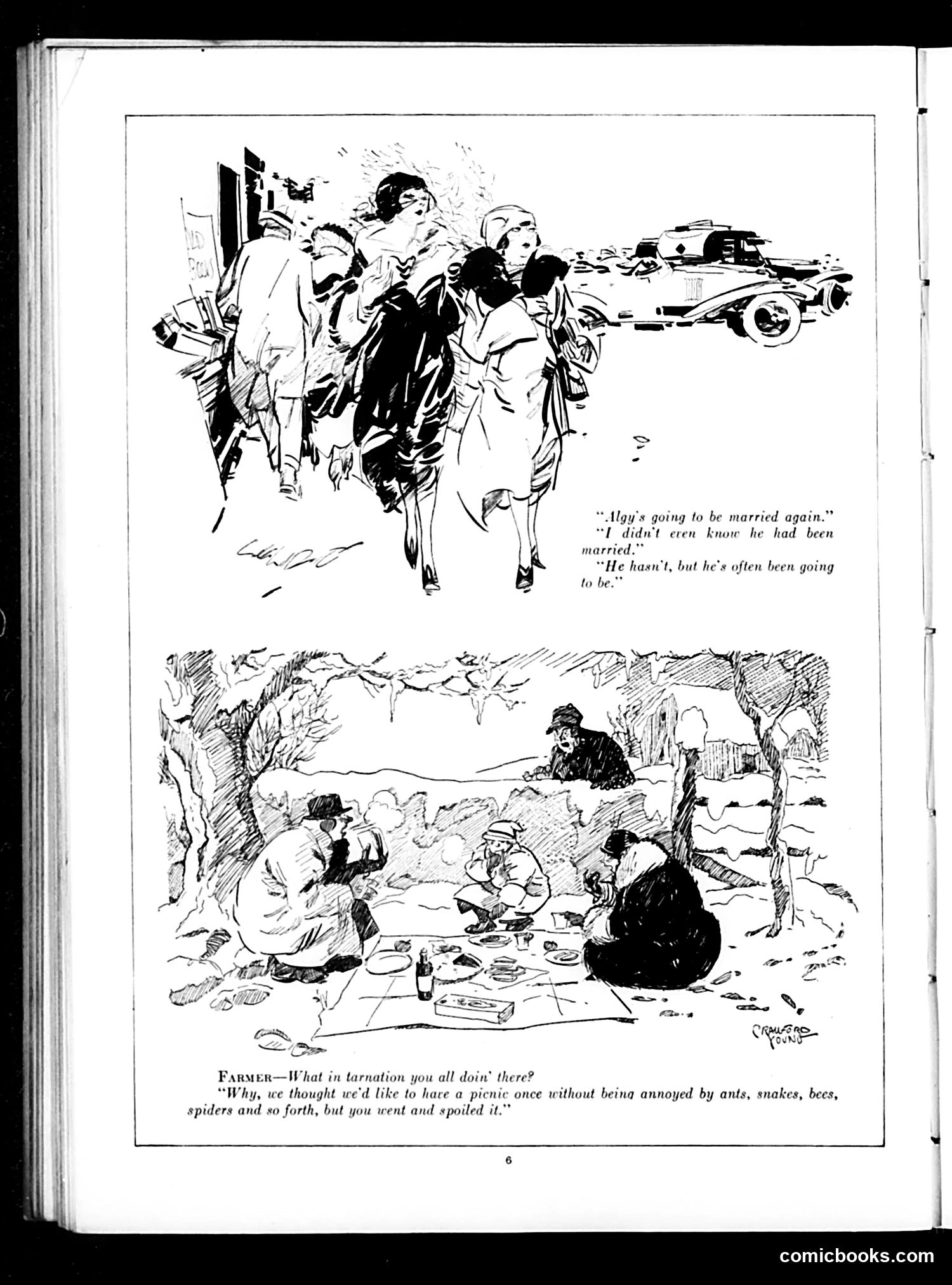
**Top cartoon:** A joke about a man named "Algy" with a reputation for serial engagements. The humor lies in the distinction between being married and repeatedly *planning* to be married—suggesting Algy is a chronic bachelor who perpetually announces engagements but never follows through. This satirizes wealthy or frivolous men who treat marriage proposals casually. **Bottom cartoon:** A farmer discovers city people attempting a country picnic. They claim they wanted to escape nature's nuisances (insects, wildlife), but the farmer's presence has "spoiled" their artificial pastoral experience. The satire mocks urban dwellers seeking curated nature—wanting the countryside without actual rural conditions or, implicitly, actual farmers. It reflects early-20th-century class tensions between urbanites and rural populations. Both comics rely on social observation typical of Judge's satirical humor targeting contemporary manners and pretensions.
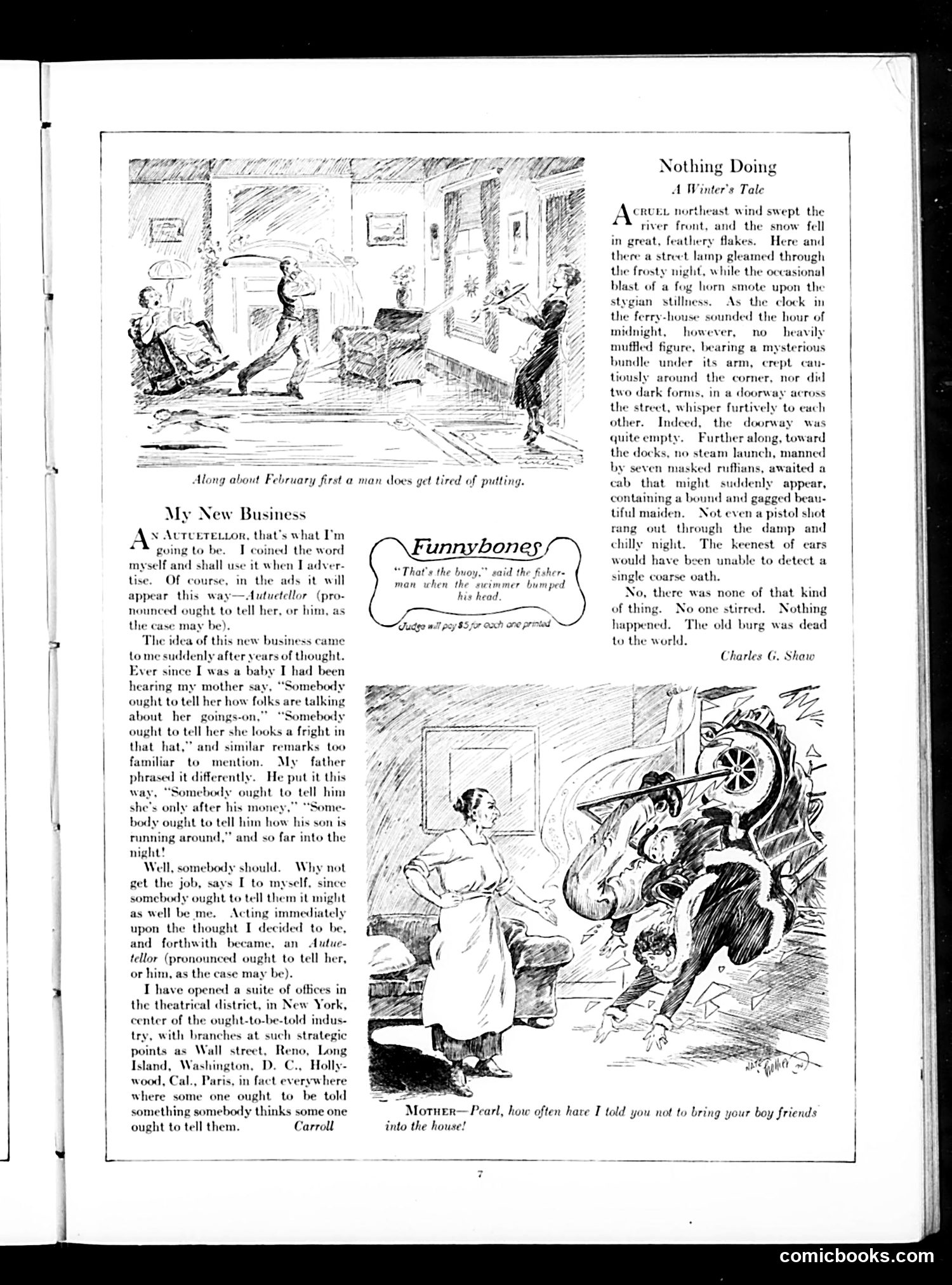
This page contains three satirical pieces typical of Judge's humor: **"My New Business"** mocks the common American habit of unsolicited advice-giving. The narrator invents "Aututellor" (pronounced "ought to tell her/him")—a profession dedicated to telling people what others say about them. The satire targets the ubiquitous busybody culture where everyone has opinions on how others should look, behave, or live. Carroll's joke is that this annoying social obligation deserves its own business enterprise with offices nationwide, from Wall Street to Hollywood. **"Nothing Doing"** parodies overwrought melodramatic fiction. It builds dramatic expectations—a mysterious figure, fog horns, potential kidnapping—then undercuts every cliché by revealing nothing happens. The satire targets pulp fiction's predictable tropes and overwrought atmosphere. **"Funnybones"** offers a brief visual pun about a fisherman and a buoy. The bottom cartoon shows a mother scolding a daughter (Pearl) for inviting boy friends into the house—typical domestic humor about courtship propriety concerns.
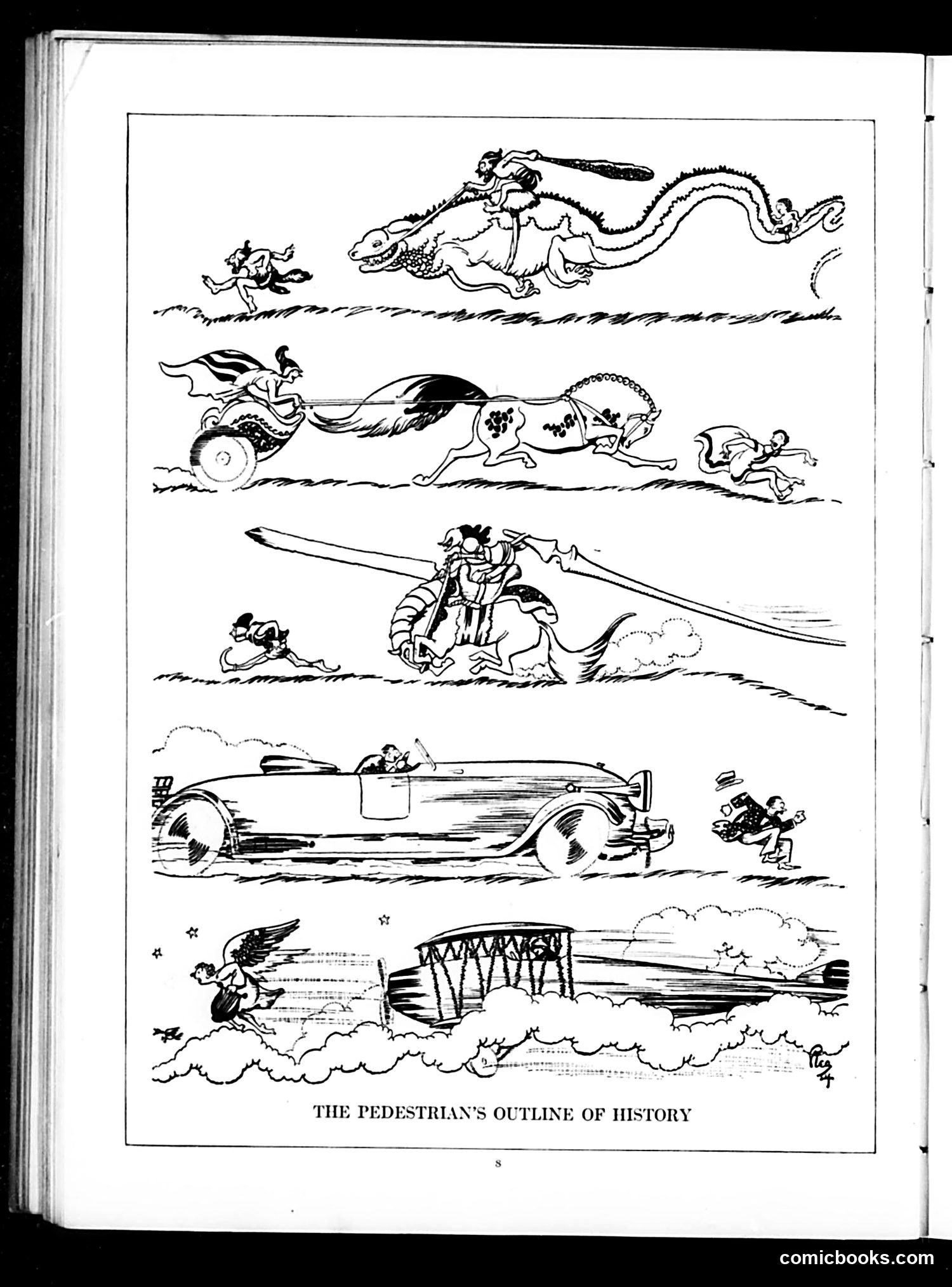
This single-panel cartoon satirizes how pedestrians experience history through encounters with various modes of transportation—the primary dangers to foot traffic across different eras. The progression moves from top to bottom: primitive humans fleeing a dinosaur, classical figures with a chariot, a medieval knight on horseback, a modern automobile, and finally an airplane. Each scene shows small pedestrians being chased or endangered by the dominant transportation technology of that era. The joke mocks how "progress" hasn't actually improved safety for ordinary people on foot—each historical period simply replaces one threat with a faster, more dangerous one. The cartoon critiques modernity's obsession with speed and vehicular advancement while ignoring pedestrian welfare, a relevant concern in the early 20th century when automobiles were becoming commonplace.
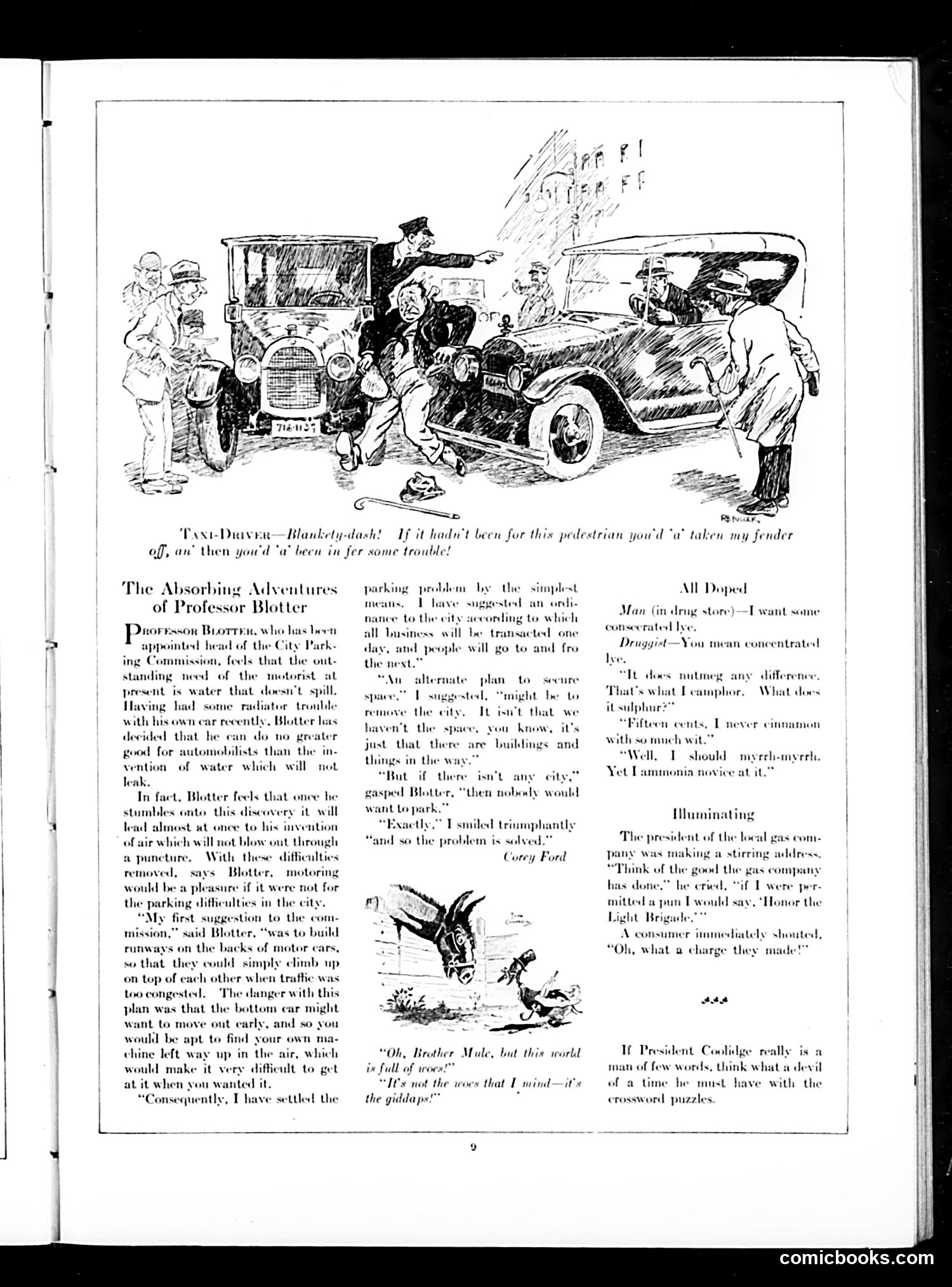
This page satirizes urban traffic congestion and municipal incompetence through Professor Blotter, newly appointed head of the City Parking Commission. The humor lies in Blotter's absurd "solutions" to parking: building runways on car roofs so vehicles stack vertically, or inventing "water that doesn't leak" and "air that won't puncture"—ridiculous technical fixes that miss the actual problem. The satire targets the disconnect between official solutions and real urban problems. Rather than address the fundamental issue (too many cars, limited space), Blotter proposes fantastical inventions, illustrated in the cartoons showing his increasingly illogical schemes. The accompanying jokes about drug store misheard words ("consecrated" for "concentrated") and a gas company executive's pun about "charges" are standard comedy filler typical of 1920s magazines, padding the page with light humor.
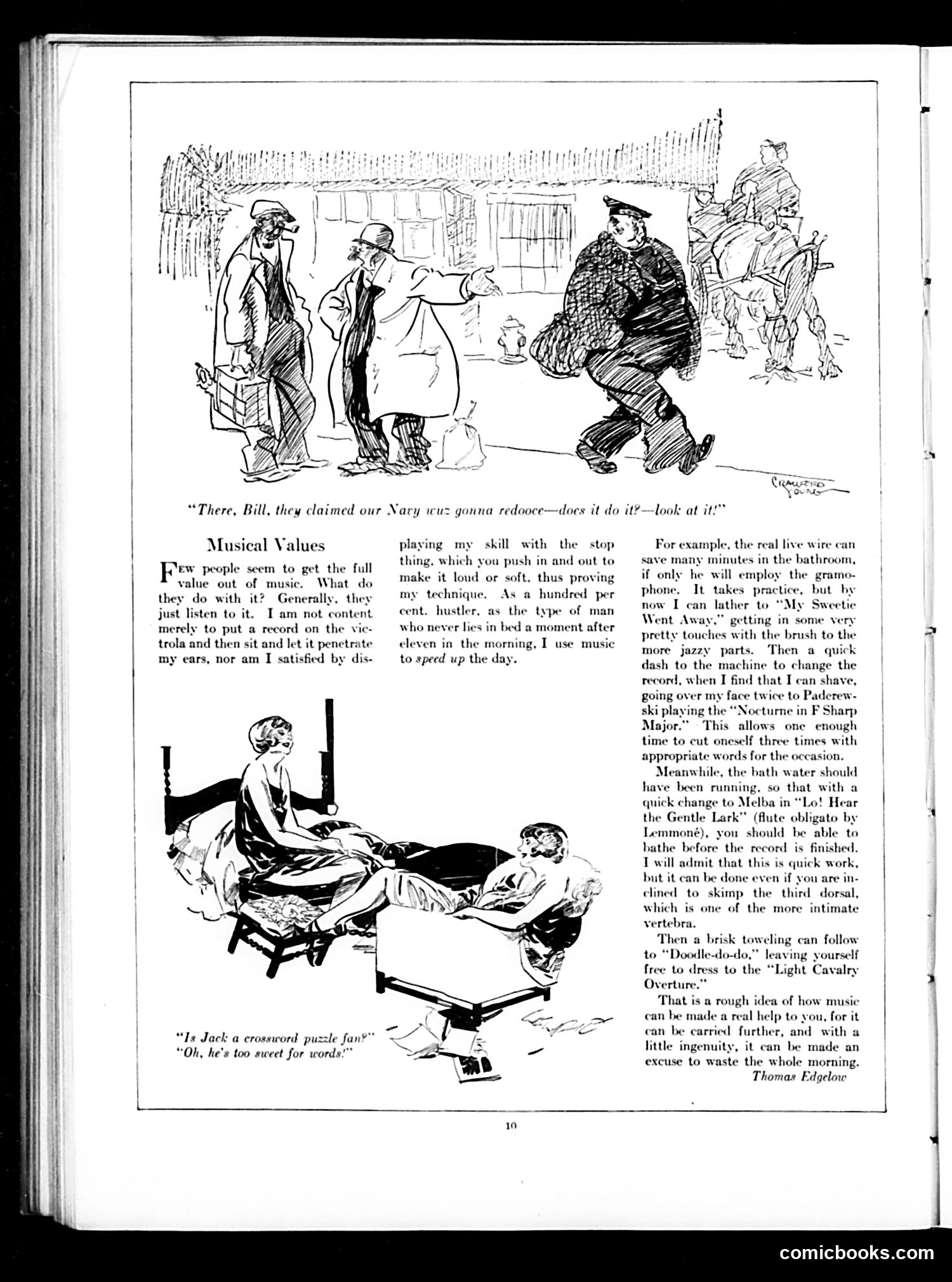
The top cartoon satirizes Navy spending: two working-class men observe sailors/naval personnel, with one remarking that despite claims the Navy would be reduced (presumably in budget or size), it still appears substantial—a jab at political promises unfulfilled. The "Musical Values" article by Thomas Edgelow is humorous satire about the efficiency craze of the early 20th century. It mocks the notion that playing phonograph records during daily routines (bathing, shaving, dressing) can somehow "speed up" one's morning through synchronized timing. The absurdity builds as Edgelow describes cutting himself multiple times while shaving to Paderewski, suggesting the scheme is impractical. The piece satirizes both the obsession with productivity optimization and the romanticization of technology as a life-improvement tool. The bottom cartoon jokes about crossword puzzles being so difficult that even a "sweet" person (Jack) cannot solve them using words.
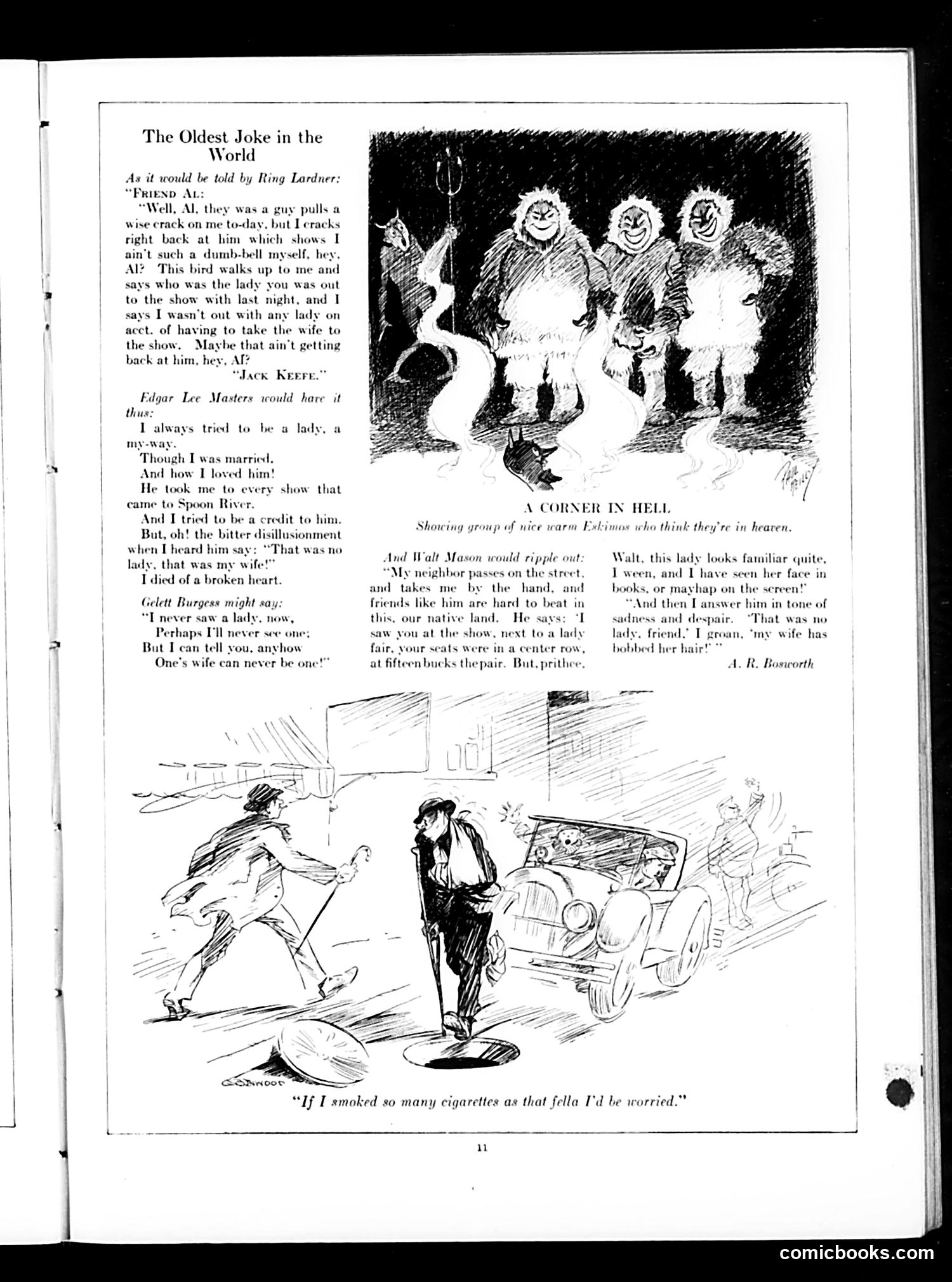
This page satirizes how different celebrated American writers would tell the same basic joke—a man's wife interrupts him at a show, and he makes an awkward excuse. The satire mimics the distinctive styles of: - **Ring Lardner**: colloquial, rambling sports-writer vernacular - **Edgar Lee Masters**: melancholic free verse evoking his *Spoon River Anthology* - **Walt Mason**: sentimental, moralizing verse - **Gelett Burgess**: affected, archaic ("prithee") - **A.R. Bosworth**: brief, pointed commentary on bobbed hair (a 1920s trend) The page mocks these writers' recognizable mannerisms while exploring how the same mundane domestic situation—a husband caught with another woman at a theater—gets filtered through different literary voices. The bottom cartoon about cigarettes appears unrelated. The humor relies on readers recognizing these authors' actual writing styles.
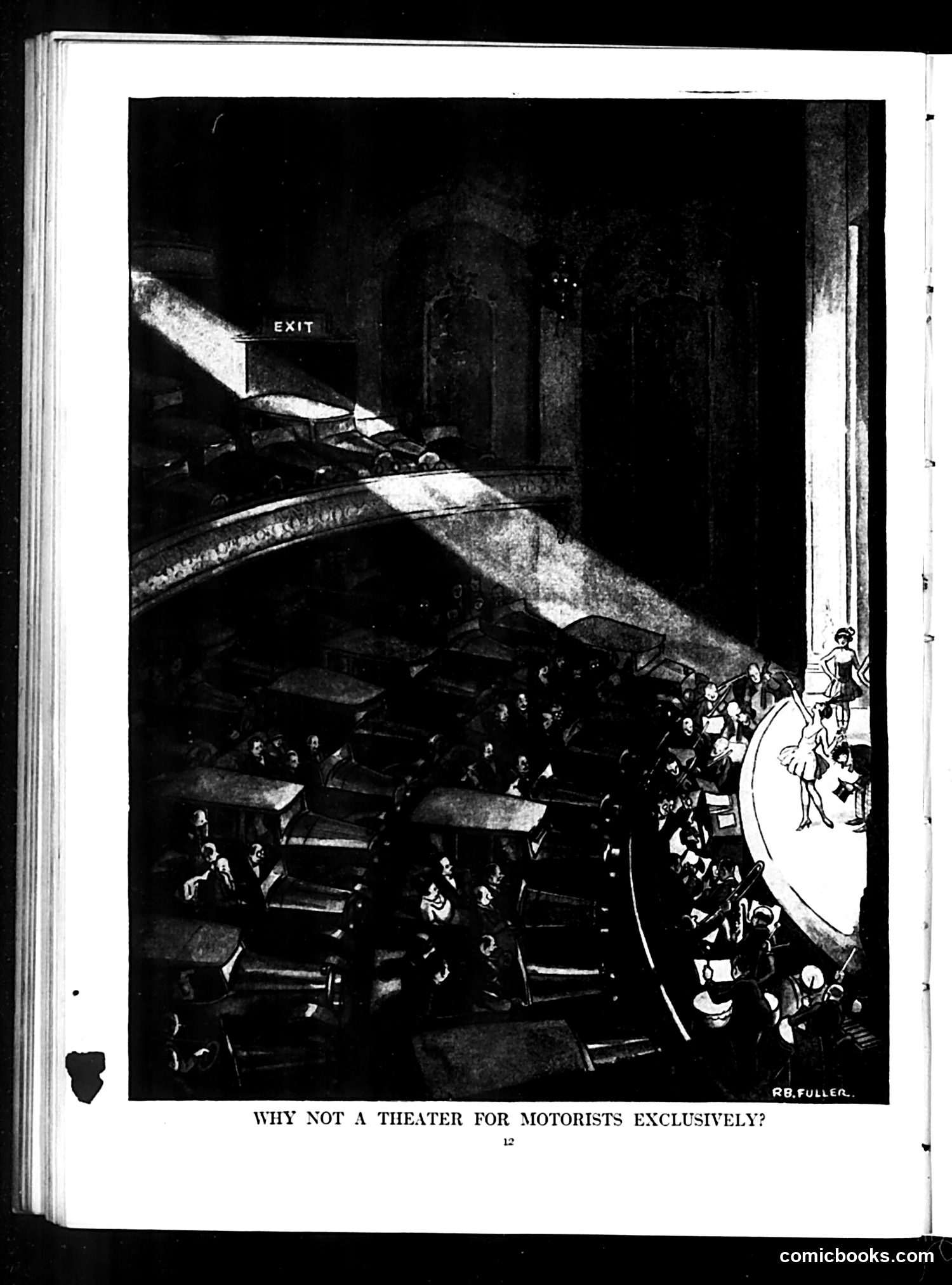
This is a satirical cartoon from *Judge* magazine (credited to R.B. Fuller) proposing a humorous solution to a contemporary problem: automobiles disrupting theater attendance. The image shows a theater interior with rows of parked cars instead of seated audiences, and an "EXIT" sign visible. The caption poses a rhetorical question: "Why not a theater for motorists exclusively?" The satire critiques the early 20th-century phenomenon of automobiles replacing traditional entertainment venues. Rather than people attending theaters to watch performances, the cartoon suggests the real "show" has become people driving and displaying their vehicles. By depicting cars as the actual audience, it mocks both automobile culture's growing dominance and the decline of traditional theater attendance during the automobile era.
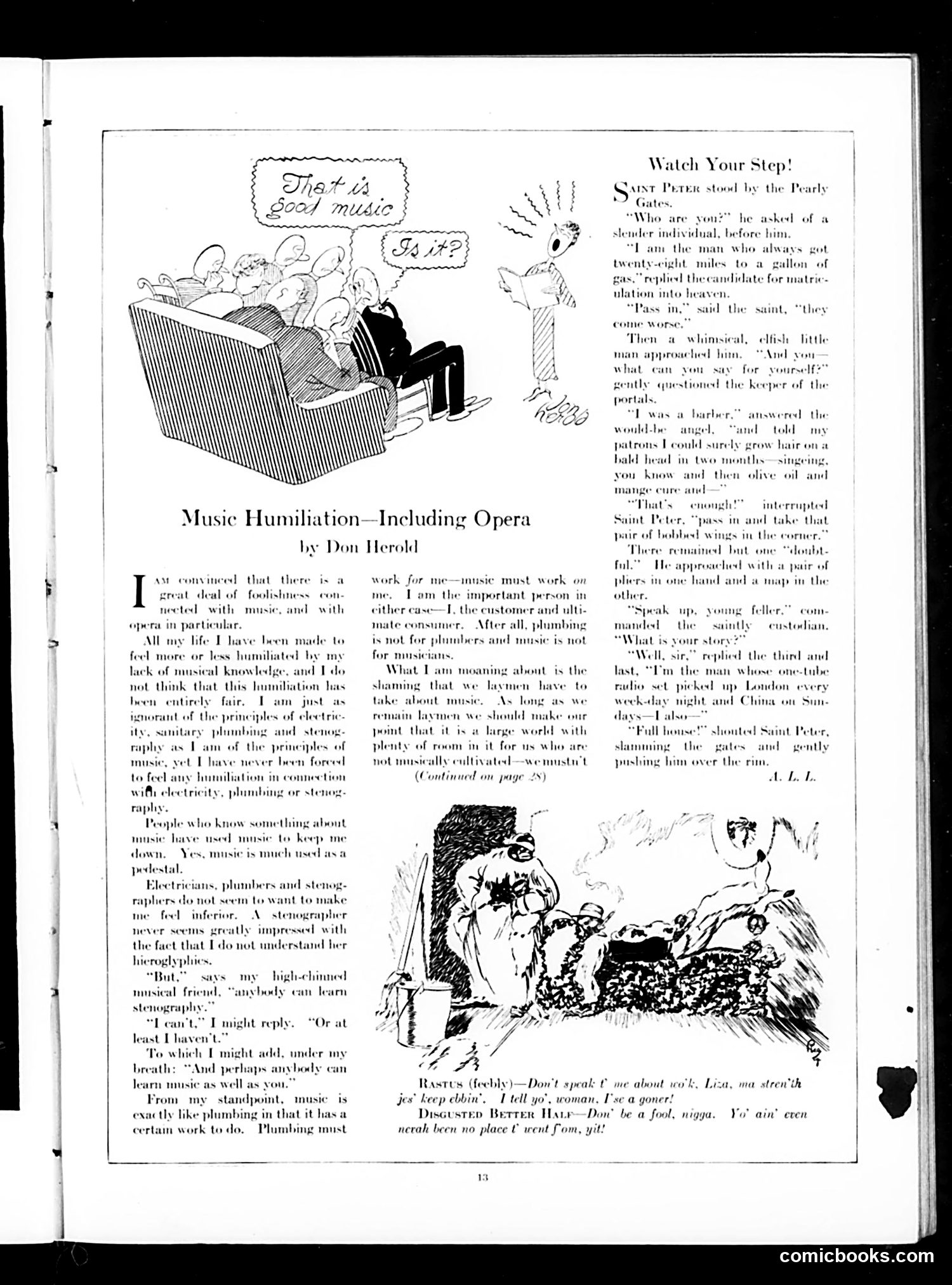
This page contains two distinct pieces of satire: **"Music Humiliation—Including Opera"** by Don Herold critiques the cultural snobbery surrounding music knowledge. Herold, a layman, argues that musicians unfairly use their expertise to humiliate non-musicians socially. He compares music to plumbing—both are specialized trades, yet plumbers don't make customers feel inferior for lacking technical knowledge. The satirical point: musical gatekeeping is pretentious and unjustified. **"Watch Your Step!"** is a heavenly afterlife joke-sequence where Saint Peter interrogates souls at the Pearly Gates. Each figure claims accomplishment (a motorist, a barber, a map salesman), but their boasts are absurdly mundane—hair growth claims, minor commercial success. Saint Peter dismissively admits them anyway. The satire mocks false pride in trivial achievements. **The bottom cartoon** appears to use racial stereotypes (unclear without fuller context), reflecting the period's offensive conventions. The overall theme: deflating human pretension and unwarranted self-importance.
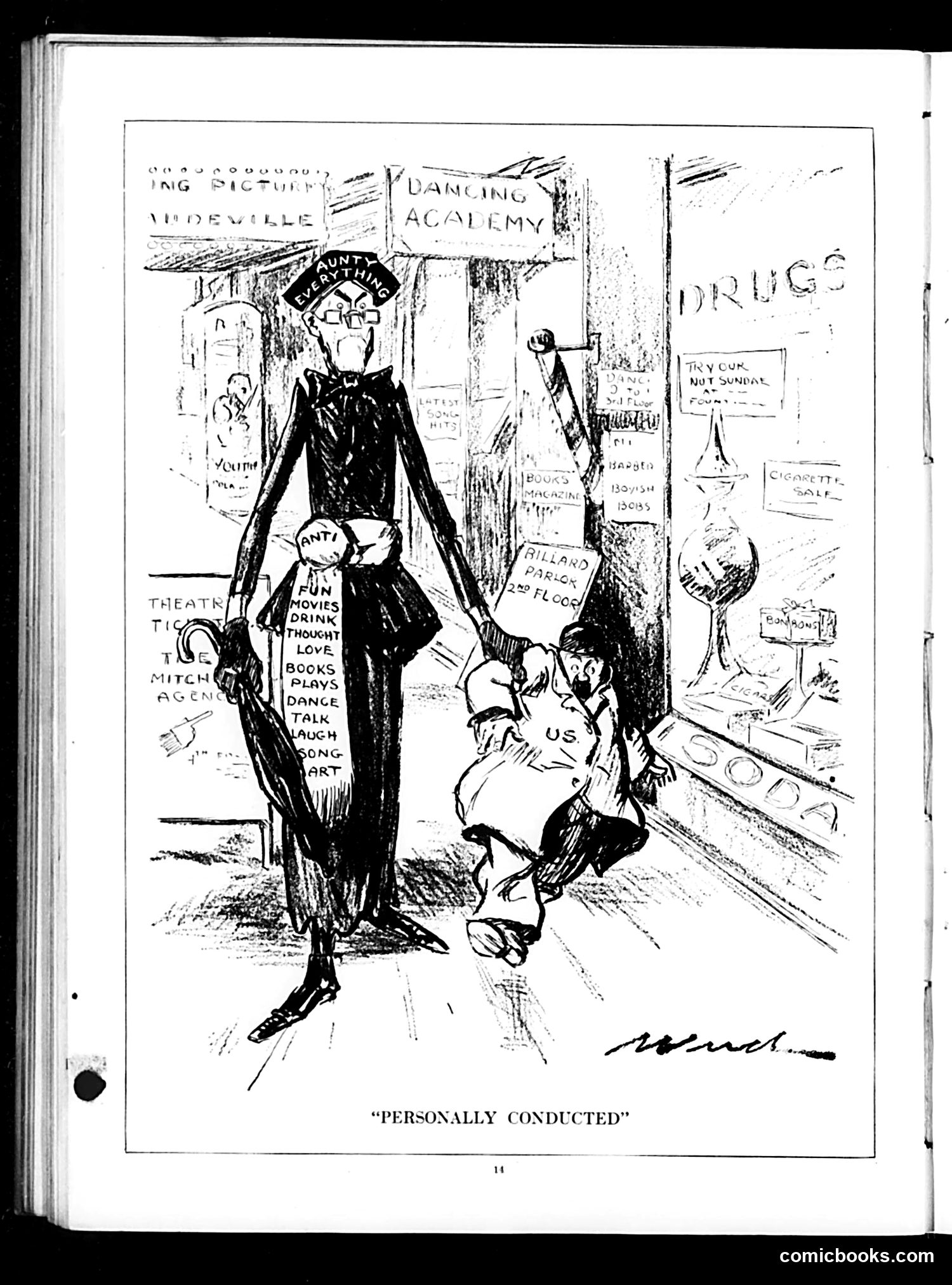
This satirical cartoon depicts a tall, skeletal figure (representing Vice or Corruption) conducting tours through urban vice establishments. The figure holds a baton and stands amid storefronts advertising a "Dancing Academy," drugs, cigarettes, and a theater. Two smaller figures—appearing to be youth—follow obediently behind, labeled "US." The satire critiques how vice industries actively recruit and "conduct" young people through moral degradation, presented as if it were an organized tour. The establishments listed (dancing halls, drug dealers, theaters) represent what the cartoonist viewed as corrupting influences on American youth. The "personally conducted" title sarcastically suggests someone is deliberately guiding the next generation toward vice rather than virtue. This reflects Progressive-era anxieties about urban corruption, vice districts, and their perceived threat to youth morality.
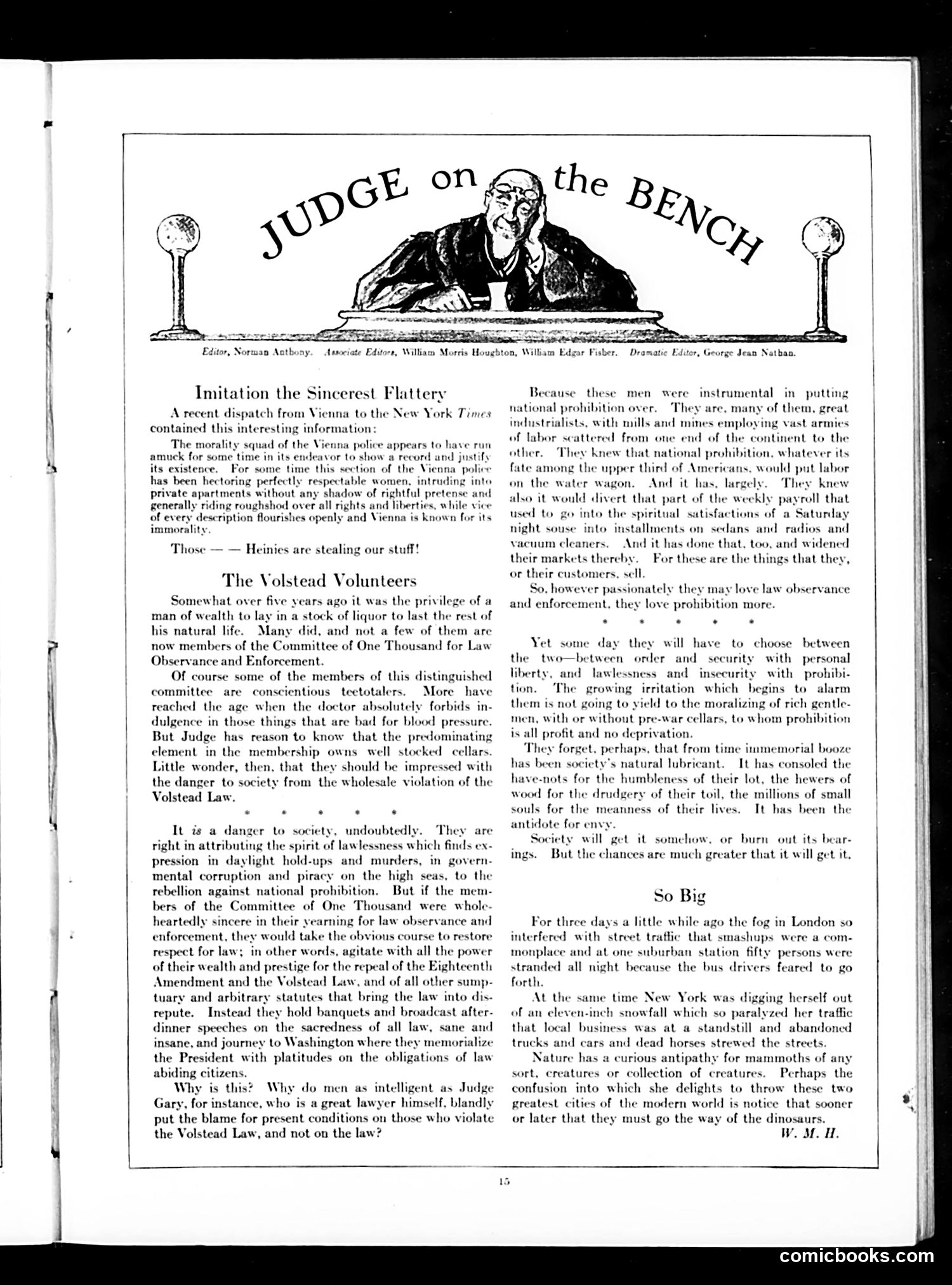
This page satirizes wealthy industrialists who championed Prohibition (the Volstead Act) while secretly maintaining personal liquor supplies. **The Satire's Point:** Judge argues these men—including apparently Judge Gary (a prominent industrialist)—support Prohibition not from moral conviction but from cynical self-interest. They know alcohol restrictions keep workers sober and prevent wages from being spent on drinking, protecting their profits. The magazine exposes their hypocrisy: they "stocked cellars" yet loudly preach law-and-order while opposing repeal of Prohibition itself. **The Target:** The "Committee of One Thousand for Law Observance and Enforcement"—real wealthy advocates who publicly championed Prohibition enforcement while privately violating it. **The Irony:** Judge mocks their claim that crime stems from law-breakers, not bad laws. The magazine suggests Prohibition itself creates lawlessness, yet these men refuse to advocate for repeal because they benefit from the law's existence, even if not its enforcement. The opening cartoon header shows a judge—representing authority and hypocrisy.
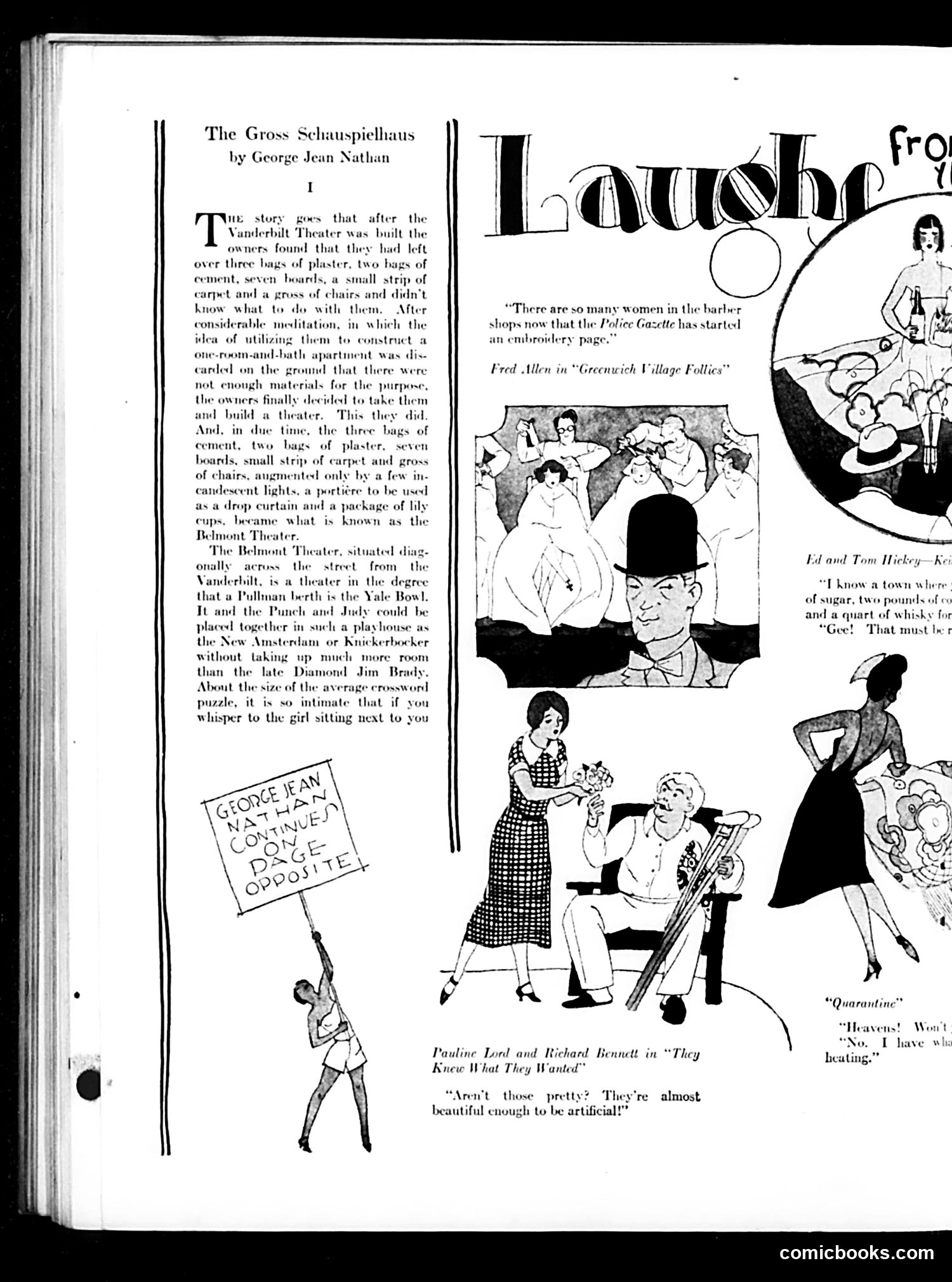
This page satirizes New York theater architecture and the absurd waste of resources. The main article (left) mocks the construction of the Belmont Theater, describing how after the Vanderbilt Theater was built, leftover building materials—plaster, cement, boards—were repurposed to construct an impossibly tiny theater "so intimate" it rivals a Pullman train berth in size. Nathan compares its dimensions unfavorably to a crossword puzzle. The cartoons and theatrical quotes (right) illustrate Broadway's frivolous culture: actresses displayed as decorative objects, and dialogue emphasizing women's appearances in barbershops and whether props are "artificial" enough. The satire targets both architectural wastefulness and the theater industry's superficiality—constructing cramped venues from leftover materials while obsessing over beauty and artifice rather than substance.
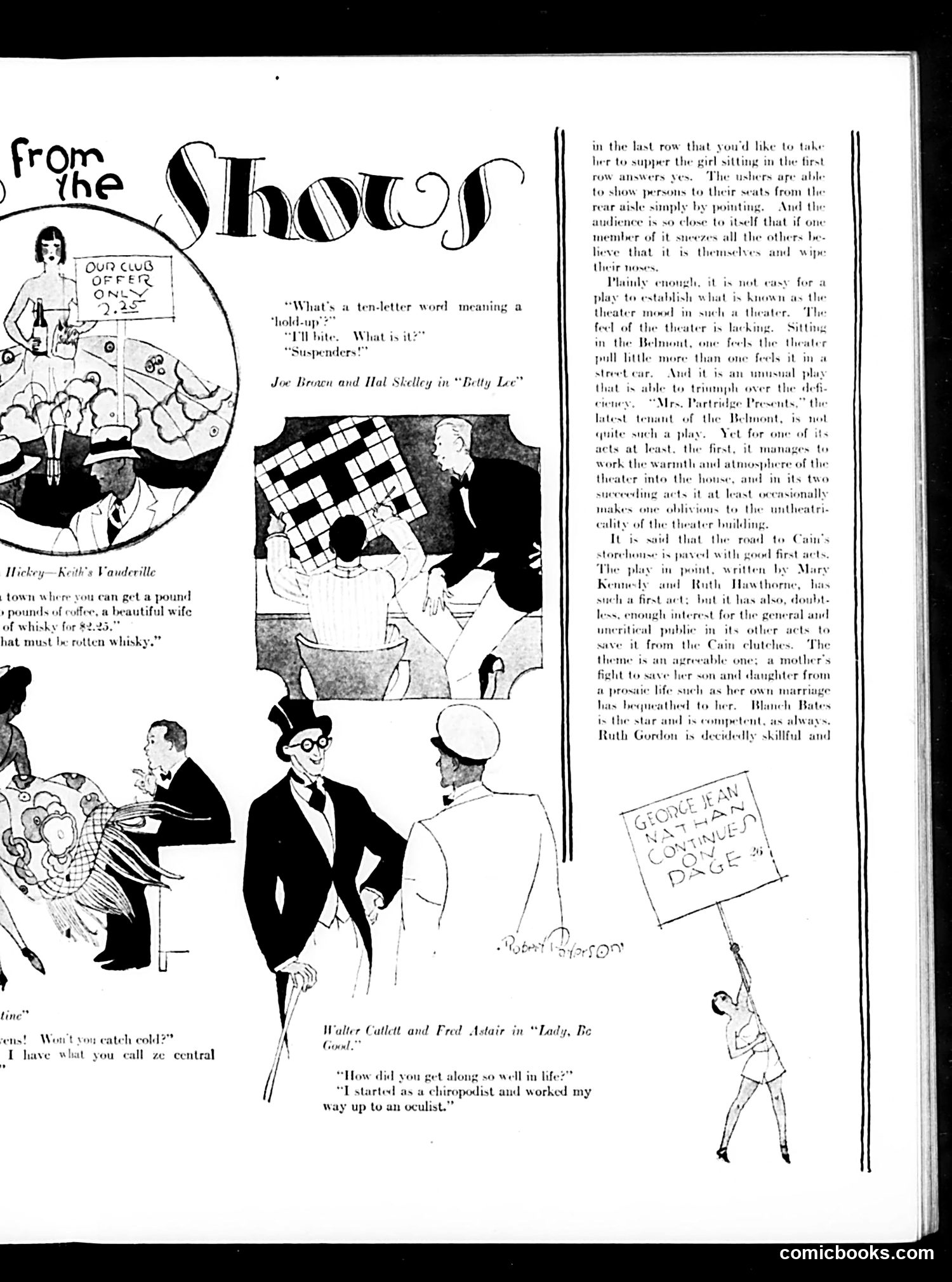
This page contains theater reviews and sketches from Judge magazine's "From the Shoes" column, featuring commentary on Broadway productions and vaudeville acts. The visible reviews discuss performances by Joe Bren and Hal Skelley in "Betty Lee," Walter Catlett and Fred Astaire in "Lady, Be Good," and a play at the Belmont theater (likely "Mrs. Partridge Presents"). The column critiques these shows' theatrical merit and entertainment value. The cartoon sketches illustrate comedic dialogue—one showing a chiropodist-turned-oculist's career progression, another depicting whisky humor. The captions capture vaudeville-style one-liners typical of 1920s entertainment journalism. This represents Judge's dual function: satirizing contemporary culture while covering the entertainment industry that was central to American leisure at the time.
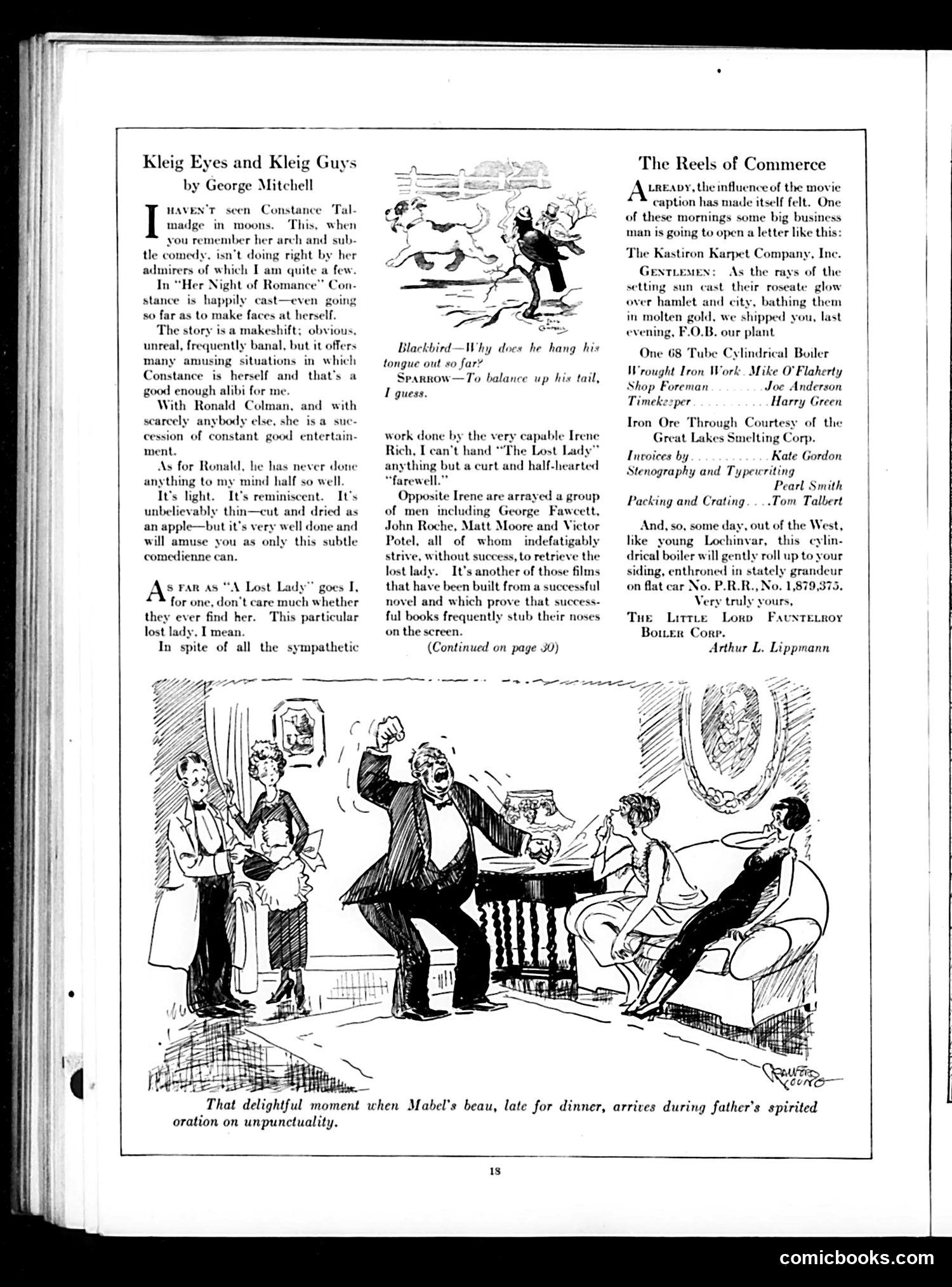
This page contains two separate pieces of satire: **"Kleig Eyes and Kleig Guys"** is a film review column by George Mitchell discussing silent movies starring Constance Talmadge and Ronald Colman. The criticism is typical period film critique—mildly dismissive of plot while praising the actors' performances. "Kleig eyes" refers to the bright lights used in film production. **"The Reels of Commerce"** satirizes how movie title cards (captions required in silent films to convey dialogue and narrative) have infiltrated business writing. The joke shows a mundane industrial invoice written in flowery, cinematic language—as if a boiler shipment were a Hollywood production, complete with "credits" listing crew members. The humor targets how movie conventions were permeating American culture, with even routine business correspondence adopting the grandiose style of film captions. This reflects the 1920s cultural dominance of cinema. The bottom cartoon appears unrelated—a simple animal joke about a blackbird.
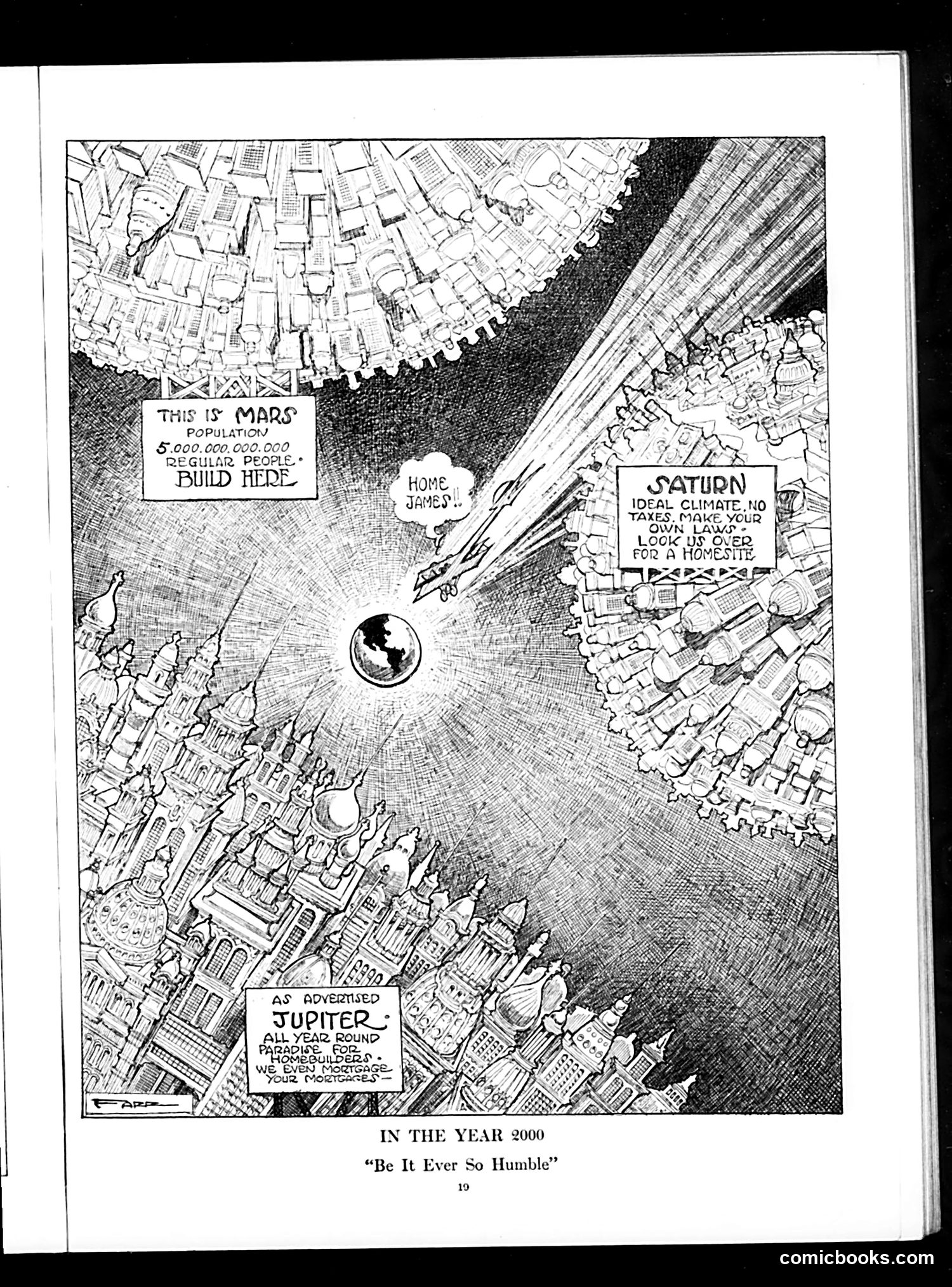
This is a futuristic satirical cartoon imagining planetary real estate in the year 2000. The aerial view shows Earth at center with three celestial bodies as advertising pitches: **Mars** advertises massive population (6 quadrillion) and "regular people" building there—mocking overpopulation anxieties. **Saturn** promises ideal living: no taxes, self-governance, no mortgages—satirizing Americans' desire to escape taxation and bureaucracy. **Jupiter** offers "all year round" pleasant weather and even mortgage availability—absurdly extending American consumer culture to space. The character "Home, James..." suggests a servant/driver, possibly indicating class commentary. The cartoon satirizes 1920s-era anxieties about crowding, taxation, and suburban expansion by literalizing the escape fantasy—if Earth becomes uninhabitable due to overpopulation, people would colonize other planets. The tone mocks both real estate hype and the American impulse toward endless expansion.
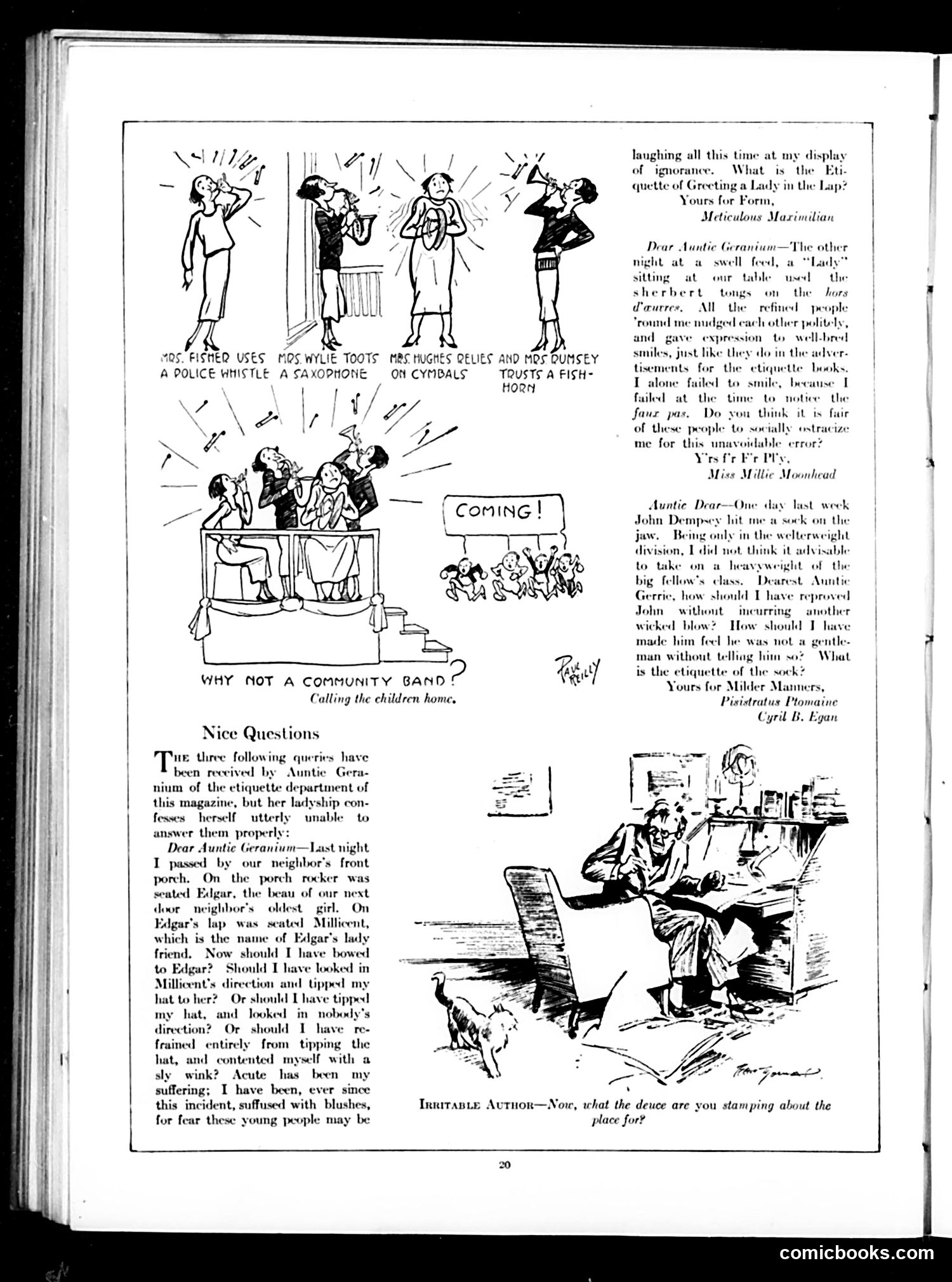
This page satirizes rigid Victorian etiquette rules through humorous "advice column" letters to "Auntie Geranium," the magazine's etiquette expert. The cartoons mock absurd social conventions: the top strip shows increasingly ridiculous noisemaking devices (police whistles, saxophones, cymbals, fish horns) as etiquette violations. Below, a "community band" of children creates chaos—satirizing how strict rules produce opposite results. The letters parody overwrought concern with minor social transgressions: a man agonizes over proper hat-tipping etiquette when encountering a couple (where the woman sits in the man's lap), another worries about failing to smile at the "correct" moment, and a third obsesses over proper decorum after being punched. The satire targets American upper-class anxiety about appearing refined and the absurd complexity of unwritten social codes—suggesting that obsessive rule-following actually produces social dysfunction rather than civility.
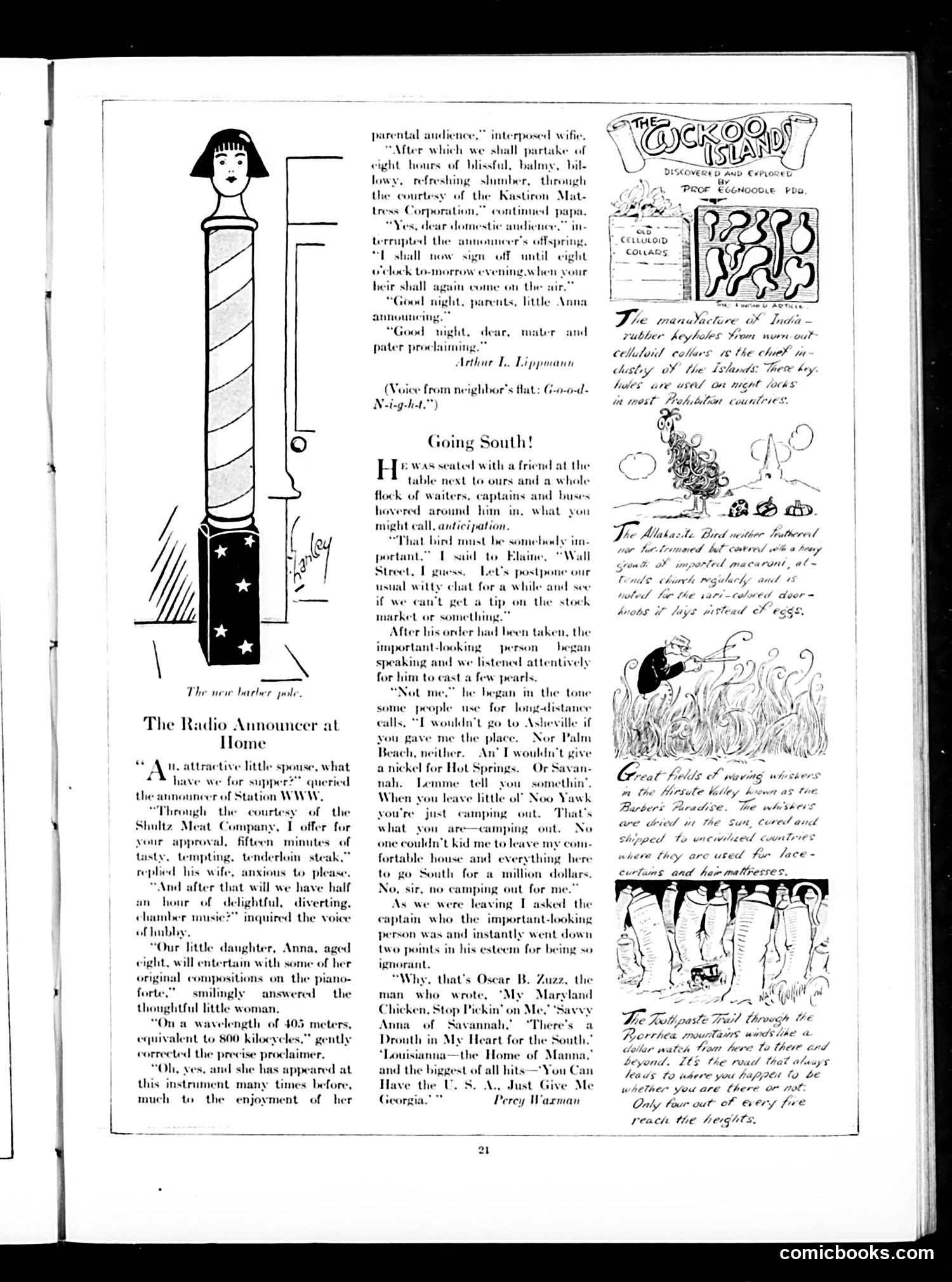
This page contains two distinct pieces of humor satirizing 1920s American culture: **"The Radio Announcer at Home"** mocks the pretentious, overly-formal speech patterns of early radio broadcasters. The joke: a radio announcer speaks in the affected, technical language of his profession even in intimate domestic settings, constantly inserting jargon like "wavelength of 405 meters, equivalent to 800 kilocycles" into casual family conversation. It satirizes how new media professionals adopted grandiose broadcasting conventions. **"Going South!"** ridicules a wealthy stock trader (Oscar B. Zuzz, likely a composite caricature) who dismisses southern vacation destinations as mere "camping out." The humor targets ostentatious New York wealth and the era's snobbish attitudes about leisure travel—contrasting his disparagement of the South with his obsession with popularizing it through sentimental songs ("My Maryland Chicken," etc.). Both pieces humorously capture 1920s class attitudes and the quirks of emerging mass media culture.
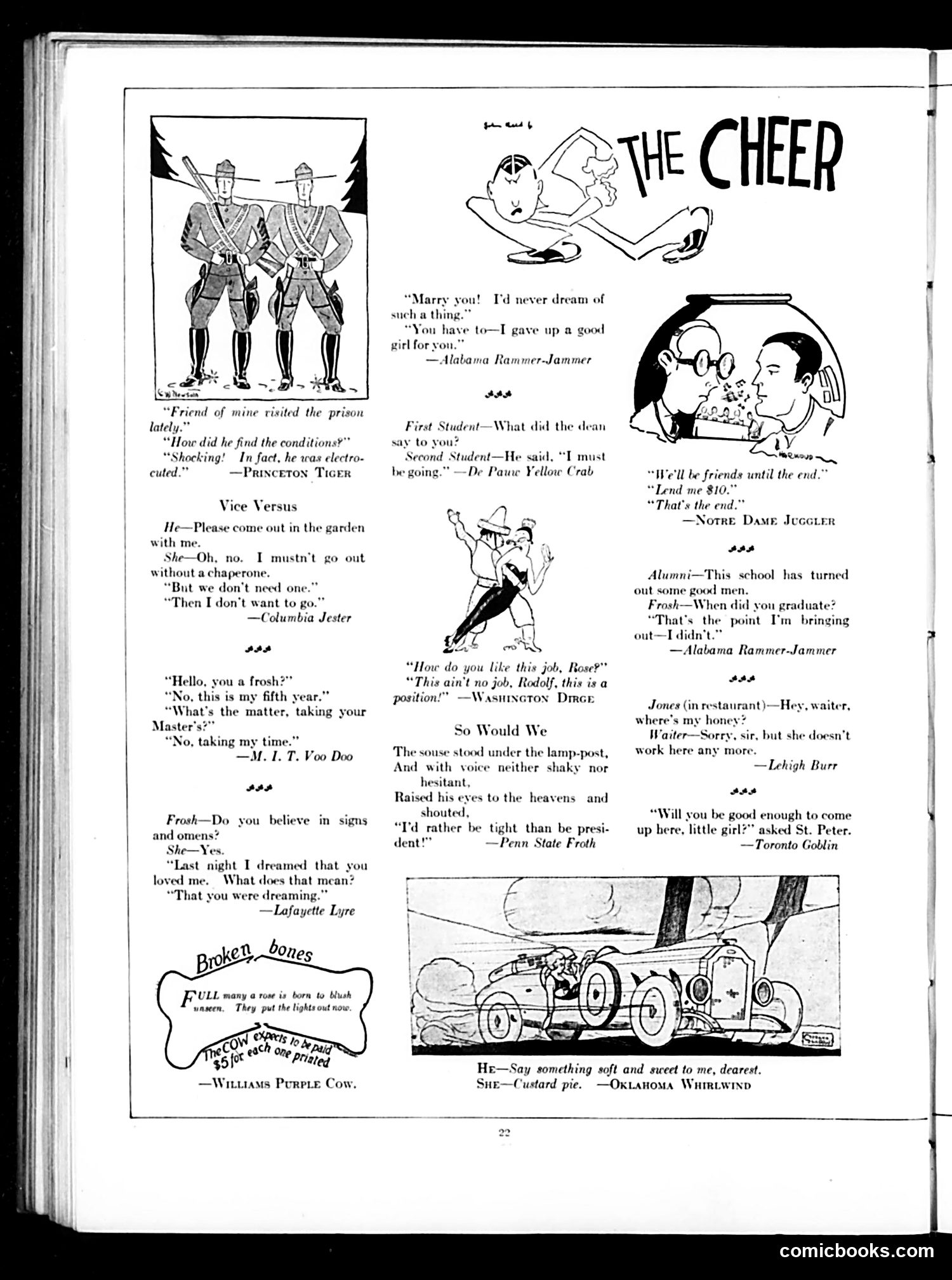
This page collects brief humorous anecdotes and jokes, primarily from college humor magazines of the era (M.I.T., Princeton, Columbia, etc.). The humor reflects early 20th-century college life and social attitudes: **Key themes:** - **Dating/courtship conventions**: Jokes about chaperones, marriage proposals, and romantic entanglements reflect rigid social propriety of the period - **Class/generational humor**: Freshmen vs. upperclassmen dynamics, alumni boasting - **Prohibition-era reference**: The "souse" joke about preferring intoxication to the presidency reflects post-WWI cynicism and the Prohibition period - **Gender stereotypes**: Women portrayed as mercenary ("Lend me $10") or decorative - **Mild social critique**: The Penn State joke satirizes political ambition; the final car illustration and Oklahoma joke are flirtations with risqué humor The content is college-oriented satire aimed at young, educated readers—lighthearted rather than politically pointed, focused on universal social situations rather than specific events or figures.
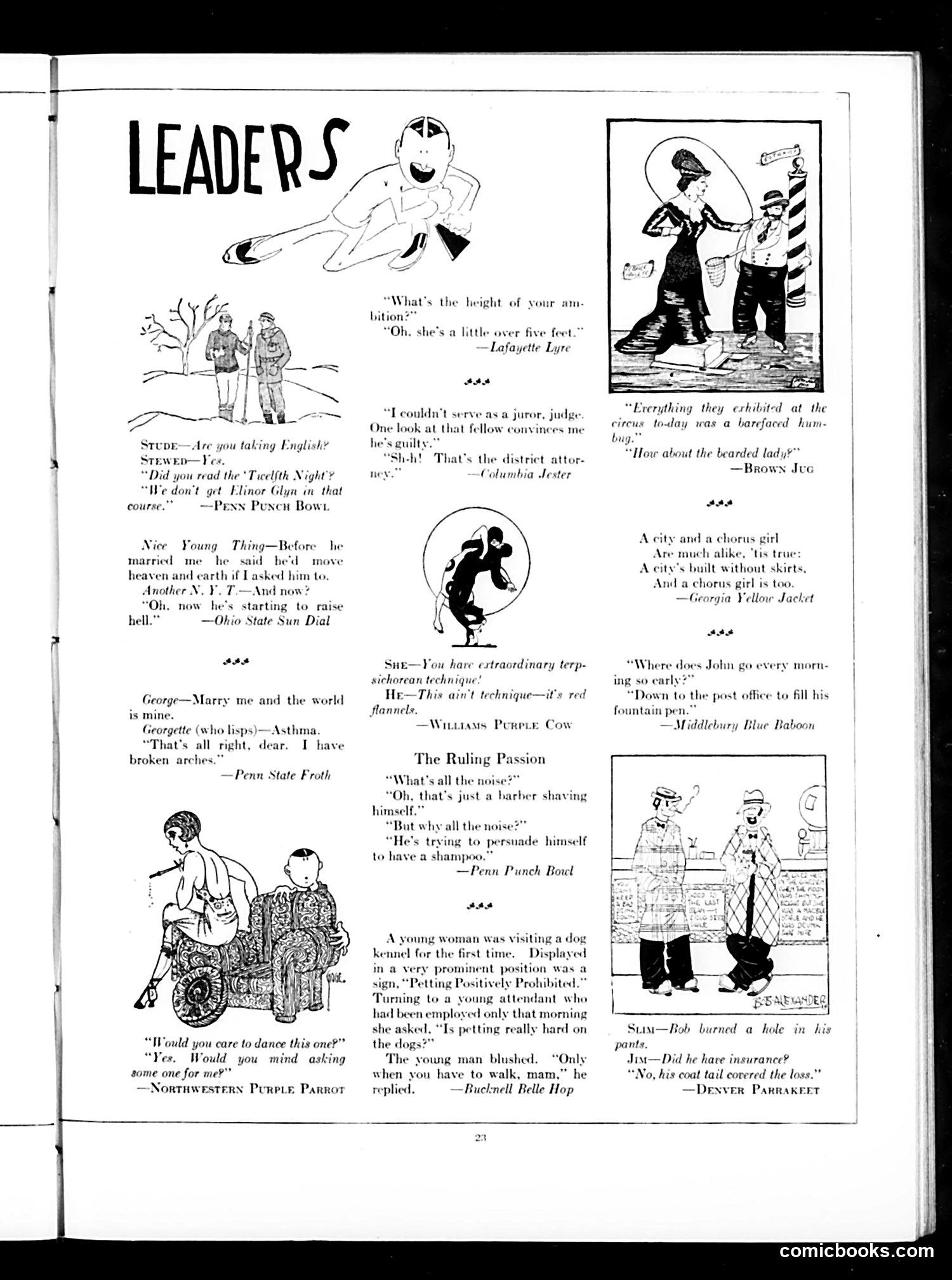
This is a humor compilation page from Judge magazine featuring jokes and cartoons from various college publications. The content is primarily social satire targeting early 20th-century courtship, gender relations, and student life. **Key themes:** - **Dating/marriage humor**: Multiple jokes mock romantic expectations (men promising to "move heaven and earth" then "raising hell"; a woman's ambition being marriage to someone five feet tall) - **Gender satire**: A chorus girl joke plays on the double meaning of "skirts" (clothing/women), suggesting both cities and chorus girls operate without moral restraint - **Collegiate culture**: The sources are college humor magazines (Penn Punch Bowl, Ohio State Sun Dial, etc.), targeting student audiences - **Courtship conventions**: References to Elinor Glyn (a risqué author of romance novels) and euphemistic dog-kennel "petting" jokes reflect anxiety about changing sexual morality The cartoons appear to simply illustrate these jokes with generic figures rather than depicting specific identifiable people. The satire is directed at social behaviors, not individuals or politics.
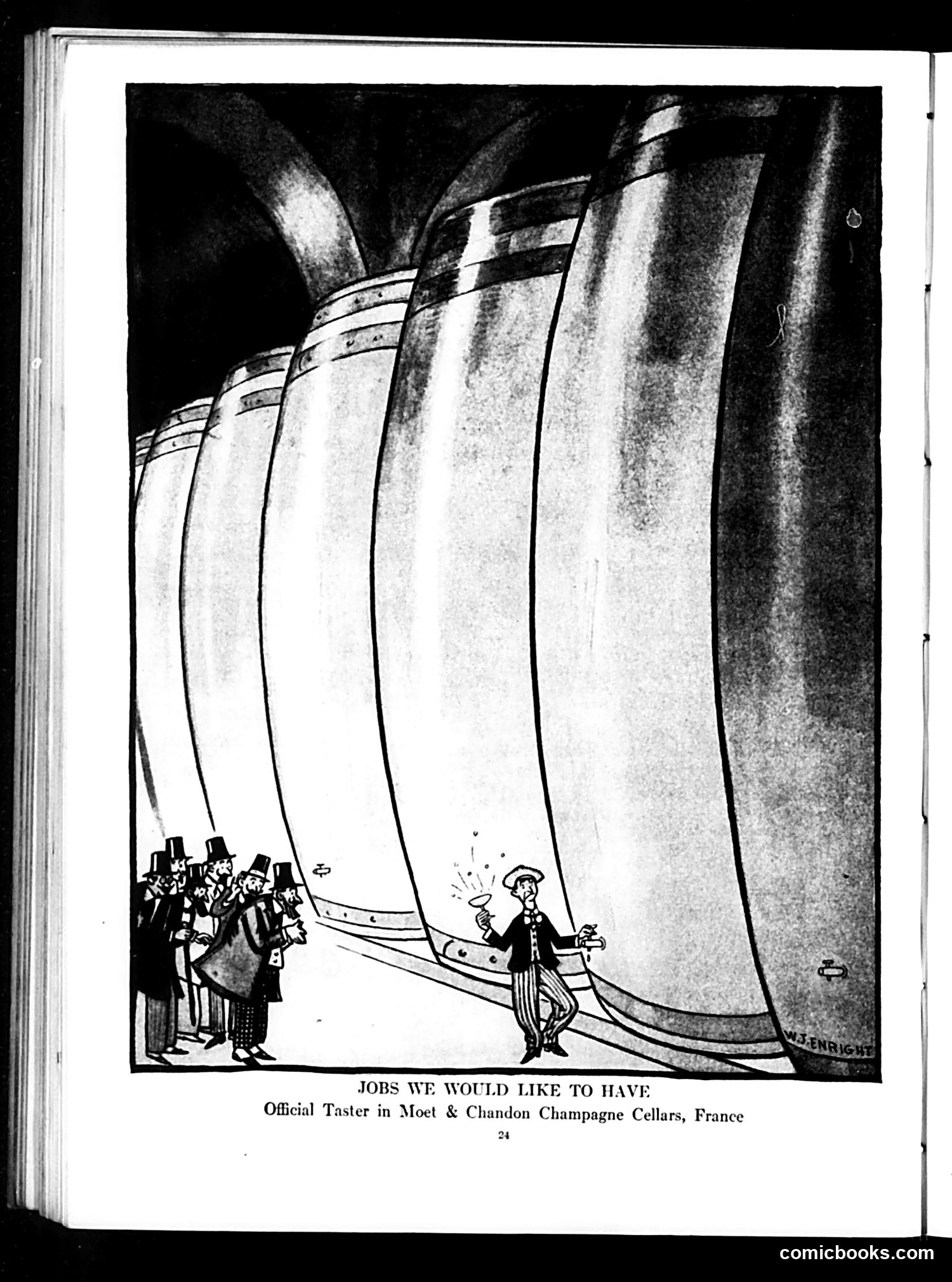
This is a single-panel cartoon satirizing desirable but implausible jobs. The caption identifies the fantasy position: "Official Taster in Moët & Chandon Champagne Cellars, France." The image shows a man in formal attire (top hat, patriotic vest) gleefully gesturing beside massive champagne barrels, while a group of formally-dressed gentlemen on the left observe enviously. The exaggerated scale of the barrels and the man's delighted expression emphasize the absurdity and luxury of the imagined role. The joke targets post-WWI American attitudes: the position appeals because it combines French sophistication, abundant alcohol, and minimal actual work—representing a fantasy escape from ordinary labor. This reflects 1920s satirical commentary on American aspirations during the Jazz Age, possibly also alluding to Prohibition's context in America versus France's wine culture.
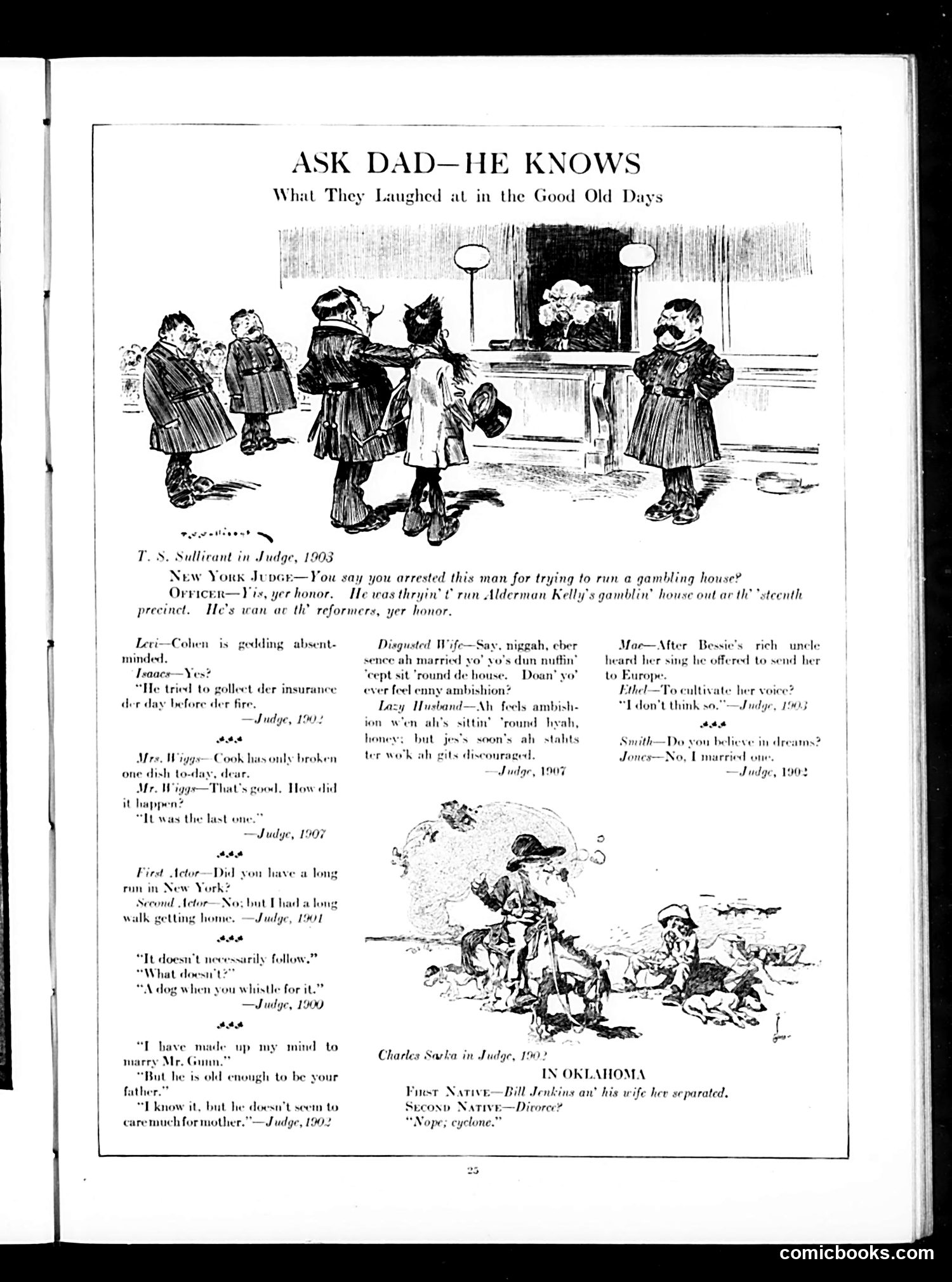
This Judge magazine page (circa 1902-1907) collects humorous anecdotes organized by topic, featuring satirical commentary on contemporary life. The main cartoon depicts a police officer explaining to a judge why he arrested a man for running a gambling house. The officer's Irish dialect ("yer honor," "th' reformers") suggests the man was actually a political reformer—implying corrupt cops protect actual gambling operations while targeting reform efforts. This reflects Progressive Era anxieties about urban political corruption and police collusion with vice. The text anecdotes use ethnic stereotypes (Irish dialect, Black Southern vernacular) common to the era's "humor," mocking working-class aspirations, marital discord, and rural life. The Oklahoma cyclone joke punchline treats natural disaster as casually as divorce. The Charles Siska illustration (lower right) depicts cowboys or settlers, likely referencing frontier life. Overall, the page reflects early-1900s attitudes: suspicion of urban corruption, stereotypical humor targeting immigrants and minorities, and romanticization of rural/frontier America—typical of Judge's affluent, urban readership's worldview.
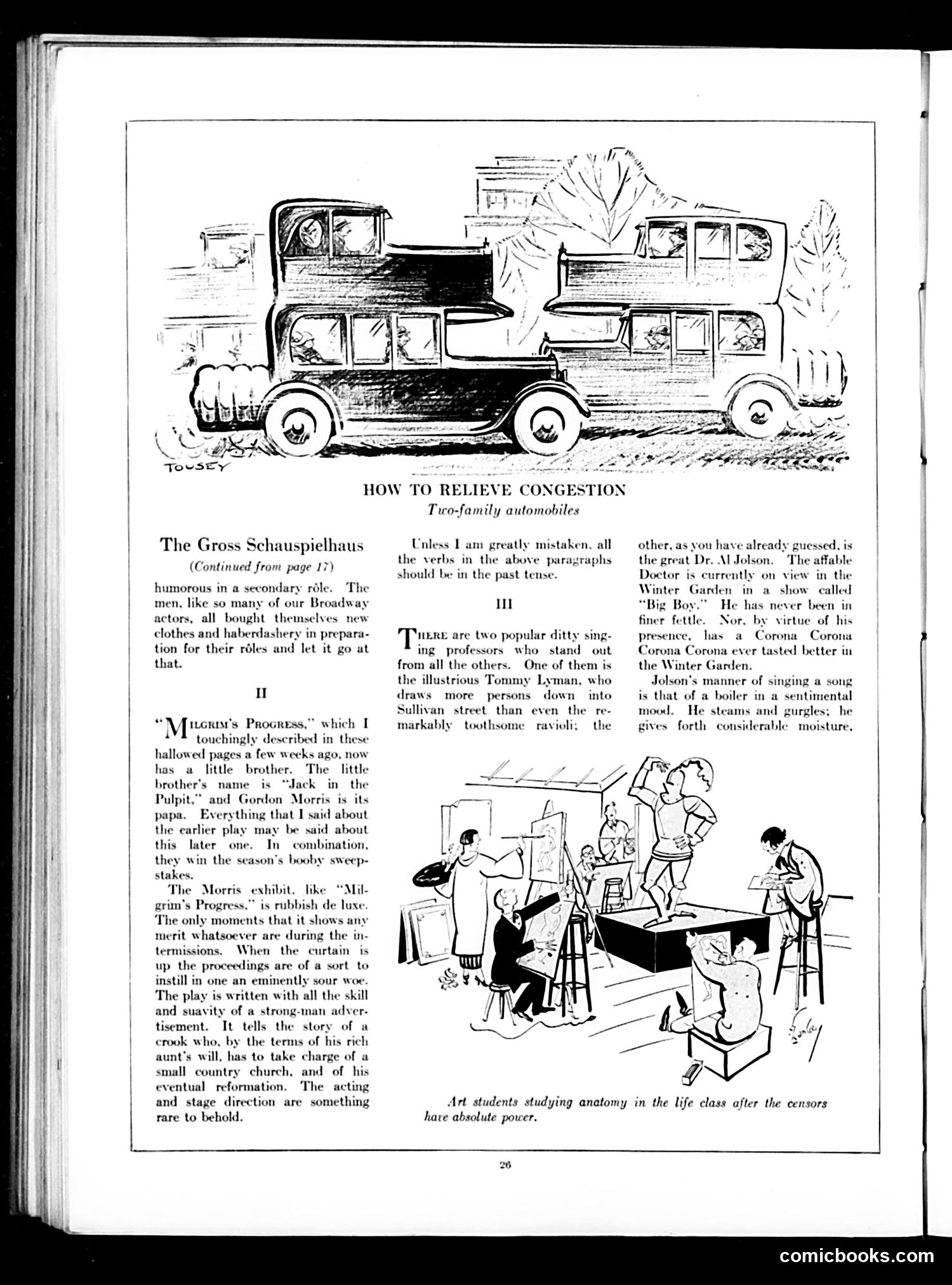
**The Top Cartoon:** A satirical drawing titled "How to Relieve Congestion—Two-family automobiles" depicts two double-decker buses/automobiles stacked vertically, crammed with passengers. This is visual satire on urban traffic and overcrowding—the "solution" of stacking vehicles is absurdly impractical, mocking contemporary proposals for solving city congestion problems. **The Text:** Theater reviews heavily criticizing two Broadway plays: "Milgrim's Progress" and "Jack in the Pulpit" (by Gordon Morris). The reviewer dismisses them as "rubbish de luxe"—fancy garbage. He also satirizes popular entertainers Tommy Lyman and Al Jolson, using exaggerated language ("steams and gurgles"). **The Bottom Cartoon:** Shows art students drawing from a live model in a life-drawing class. The caption jokes that after censorship authorities gained power to restrict such classes, students must work frantically to study anatomy while they can—suggesting contemporary debates over censorship of nude modeling in art education. The page reflects 1920s concerns: urban infrastructure problems, Broadway quality, and artistic freedom versus censorship.
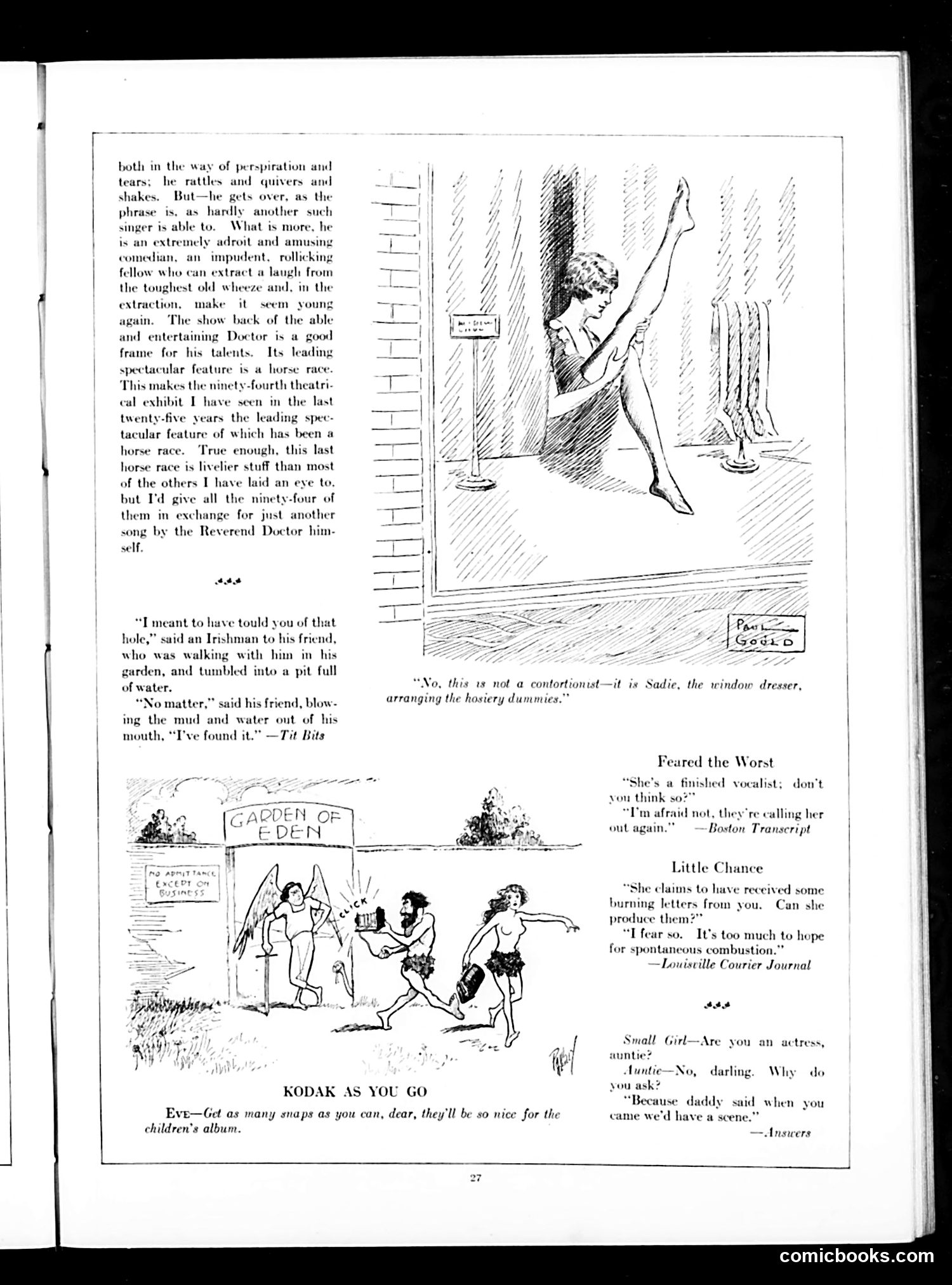
This page from the satirical magazine *Judge* contains several unrelated humor pieces typical of early-20th-century publications: **Top section**: A theater review praising a performer (likely a comedian or vaudeville star, though not named) for his entertaining skills, particularly noting his horse-race act. The critic laments that numerous theatrical productions rely on horse races as their main spectacle. **Middle cartoons**: Simple joke illustrations with captions—an Irishman's pratfall, a window dresser contorting herself among mannequins, and various one-liners about actresses and burning letters. **"Kodak as You Go"**: An advertisement encouraging readers to photograph family outings ("they'll be so nice for the children's album"), featuring a scene labeled "Garden of Eden" with figures in classical dress. The page reflects *Judge*'s format: lightweight social humor, theatrical commentary, and advertising. The material requires no specific political knowledge—it's primarily domestic comedy and gentle satire of everyday life and entertainment trends of the era.
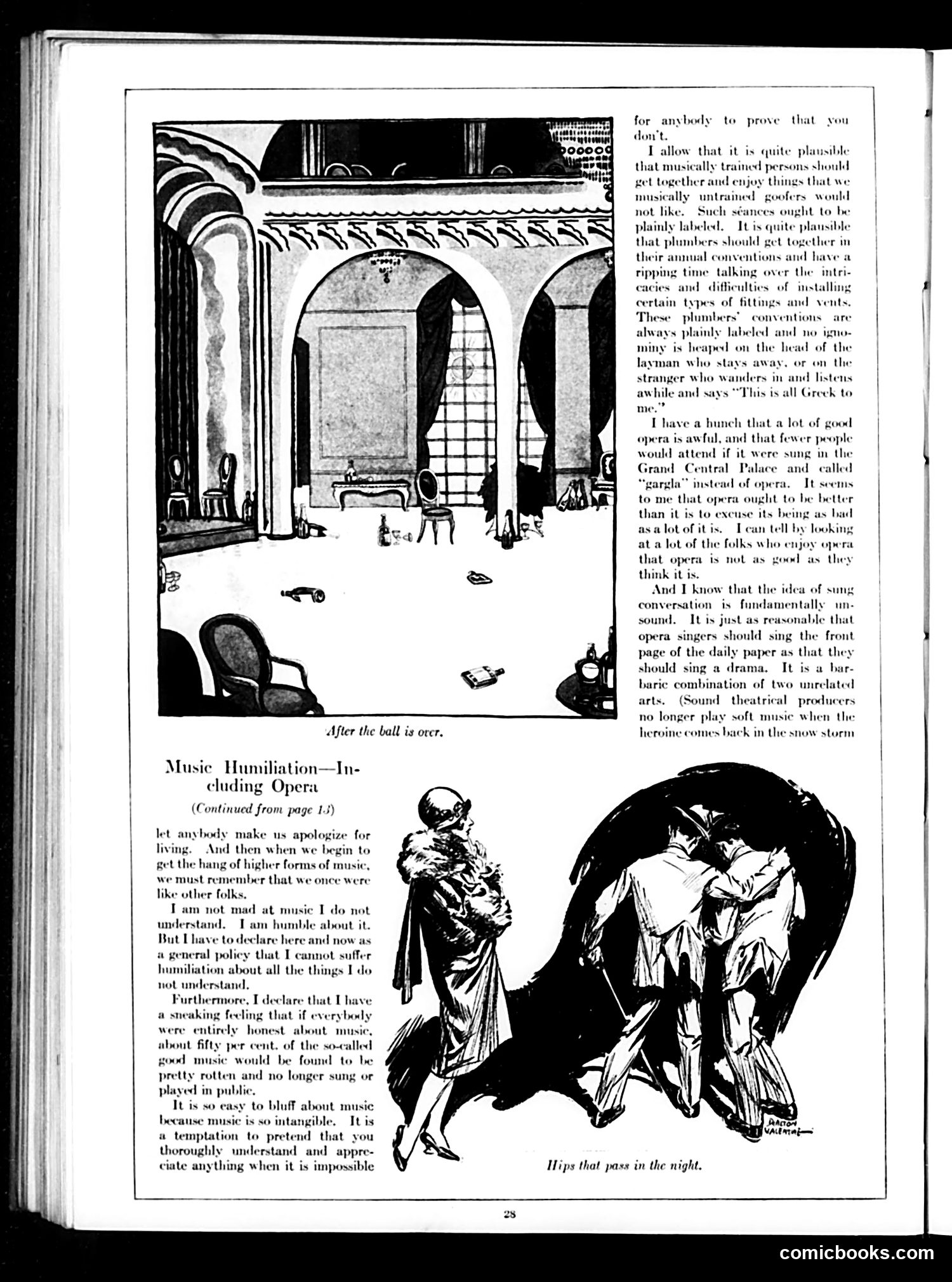
This satirical article mocks pretentious attitudes toward opera and "high" music culture. The author argues that opera is fundamentally flawed—combining unrelated arts (music and drama awkwardly) and that much supposedly "good" music is actually poor quality, kept alive only by social bluffing. The cartoons illustrate this critique: "After the ball is over" shows an elegant interior trashed after a formal event, suggesting chaos beneath refined surfaces. "Hips that pass in the night" depicts shadowy figures, likely contrasting lowbrow entertainment with highbrow pretensions. The core satire: opera-goers and classical music enthusiasts maintain their enthusiasm through social pressure and intellectual posturing rather than genuine appreciation. The author invokes plumbers' conventions as comparison—specialized groups deserve privacy, yet music devotees demand broader cultural legitimacy. This reflects early 20th-century tension between emerging mass culture and established artistic hierarchies.
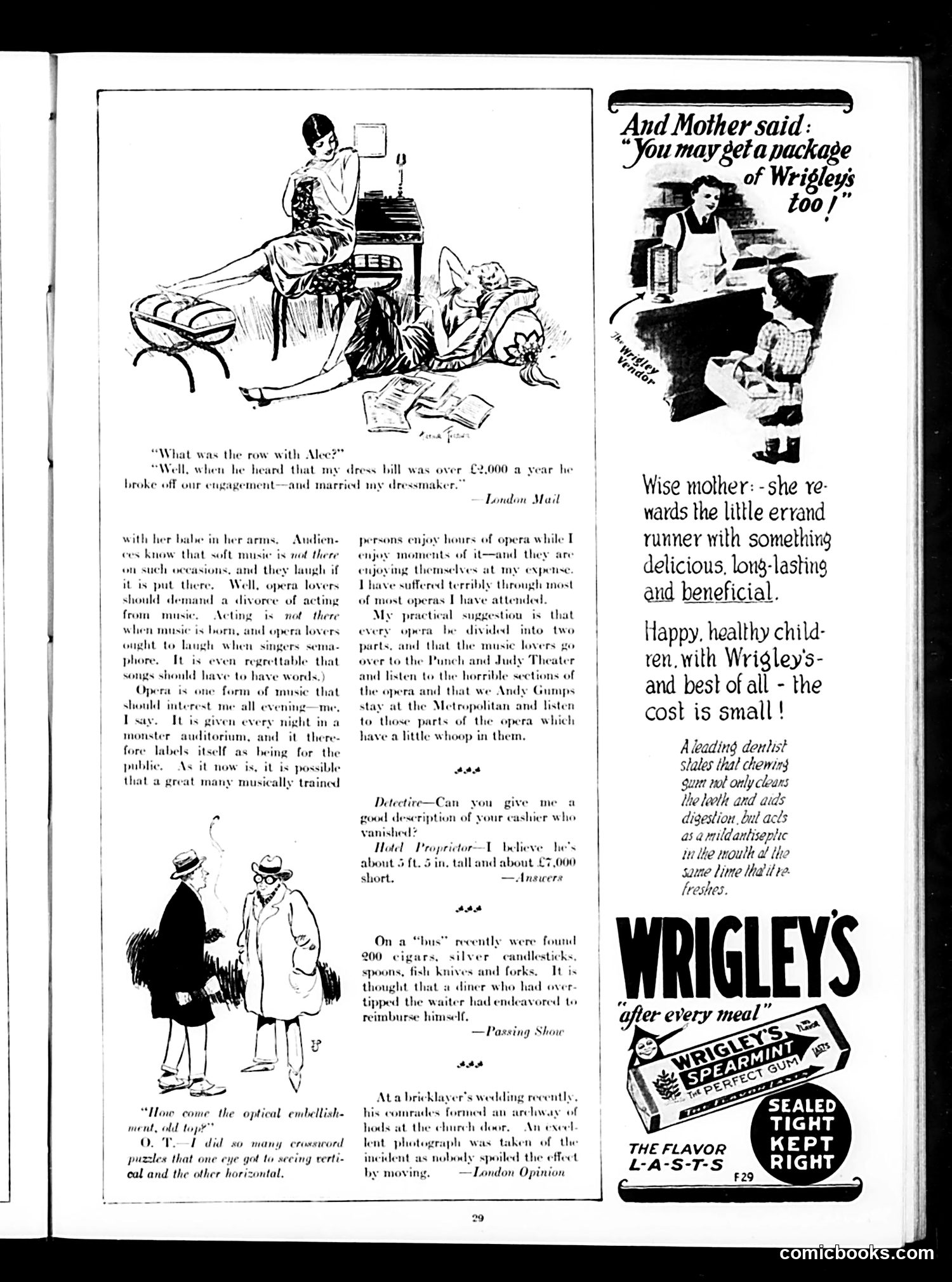
This page from *Judge* magazine contains several brief humorous anecdotes and two advertisements. **The cartoons** satirize everyday absurdities: a man whose expensive fiancée's dress bills (over £2,000 annually—substantial sums in this era) caused his engagement to break, only for her to marry his dressmaker instead. Another joke involves crossword puzzles causing optical problems; a third concerns a hotel cashier who vanished while allegedly short £7,000. A final cartoon mocks opera-goers, arguing that music lovers and plot-followers should be separated into different theaters. **The advertisements** promote Wrigley's chewing gum as a reward for children and a dental benefit, emphasizing its affordability and long-lasting flavor. **Context**: These reflect early 20th-century British and American middle-class concerns—marital economics, petty crime, cultural pretension around opera, and consumer goods marketing. The tone is light satirical commentary on social conventions and human folly.
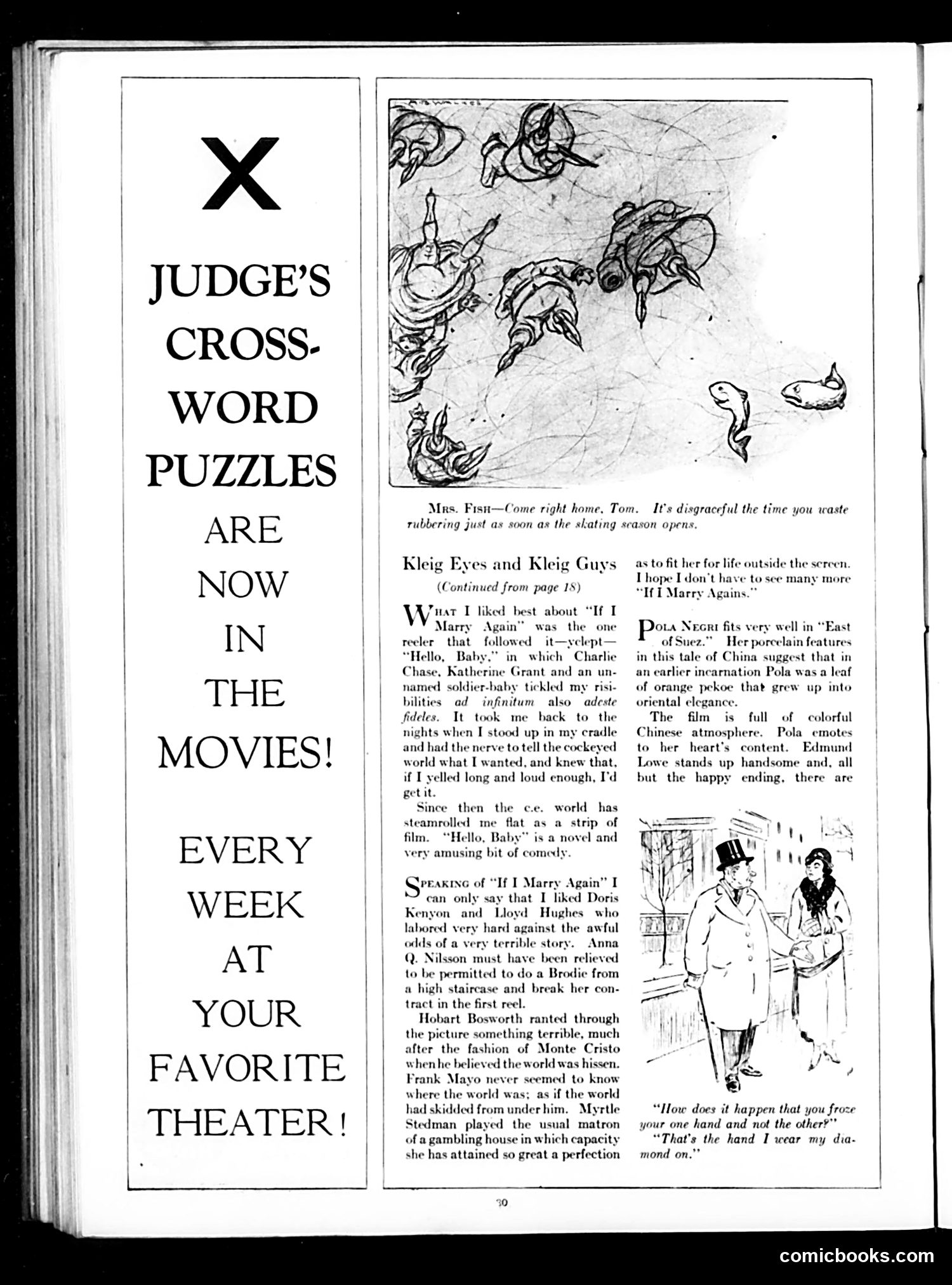
This is primarily an **advertisement** for Judge's crossword puzzles, with film reviews as secondary content. The left panel promotes that Judge now publishes crossword puzzles weekly in theaters—a novelty at the time when cinema was becoming a major entertainment medium. The right side contains reviews of silent films, likely from 1922-1924 based on the actors mentioned (Charlie Chase, Doris Kenyon, Lloyd Hughes, Anna Q. Nilsson). The reviewer critiques performances in movies like "If I Marry Again" and "East of Suez," making harsh judgments about the actors' abilities. The cartoon at bottom shows a domestic joke: a woman asks why a man froze only one hand, and he replies it's the hand without his diamond ring—a jab at male vanity and materialism. The humor assumes readers recognize these now-obscure silent film stars and understand that crossword puzzles were an exciting novelty worth advertising in theaters.
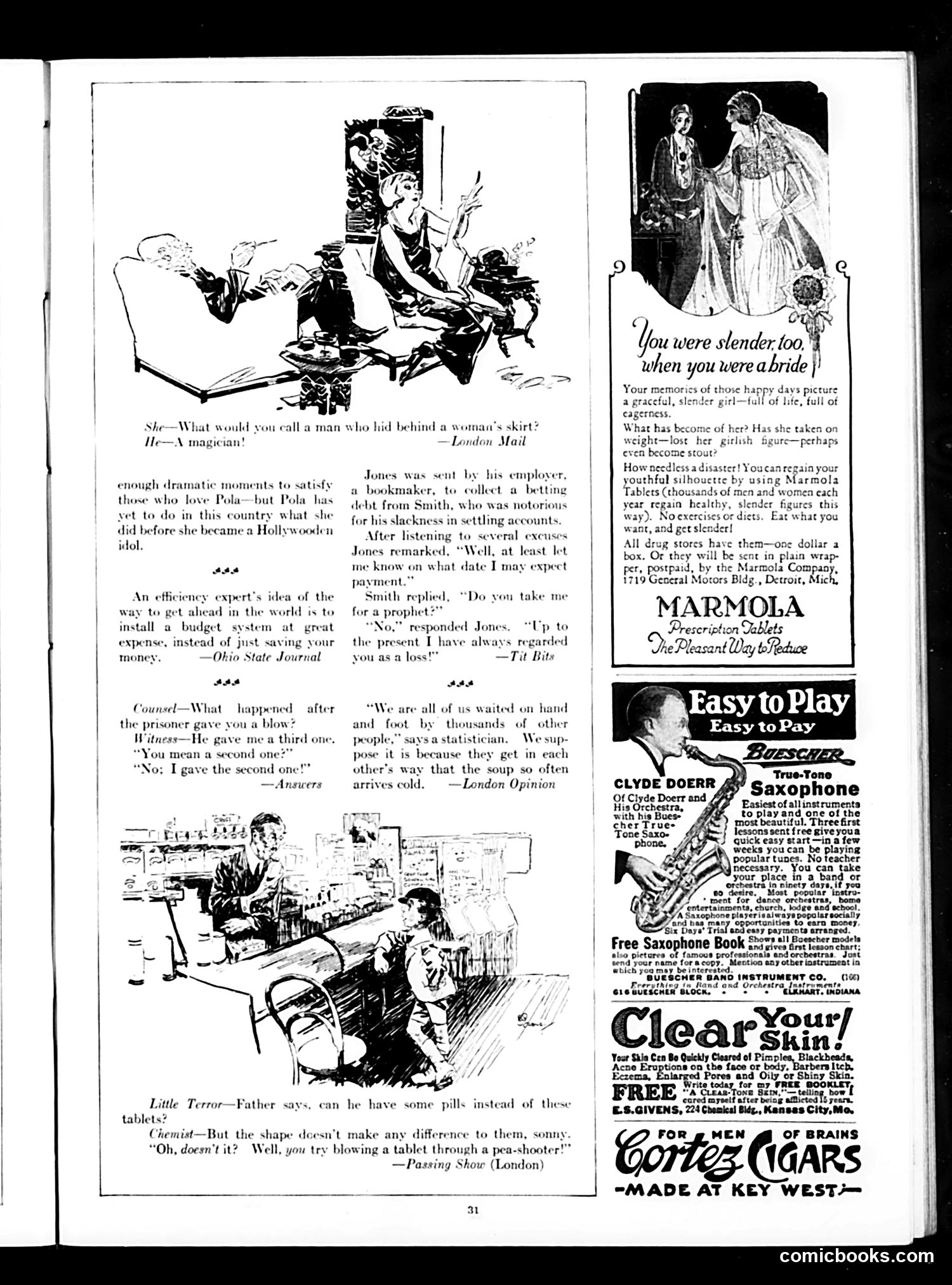
This page contains several short joke items and advertisements typical of early 20th-century American humor magazines. The cartoons are brief, punchy jokes rather than political commentary. The top cartoon plays on a magician's illusion—the "joke" is wordplay about hiding behind a woman's skirt. Lower cartoons involve domestic humor (a father asking a chemist for pills shaped like tablets to blow through a pea-shooter) and workplace situations (a debt collector's exchange about payment dates). The page is dominated by **advertisements**: Marmola weight-reduction tablets (targeting women concerned about losing their pre-marriage figure), a Buescher saxophone for easy home learning, a skin-clearing treatment, and Cortez cigars. The mixed content—light humor interspersed with period advertisements for weight loss, musical instruments, and skin treatments—reflects Judge's function as both entertainment and advertising vehicle for middle-class readers. The tone is genteel rather than satirical or politically charged.
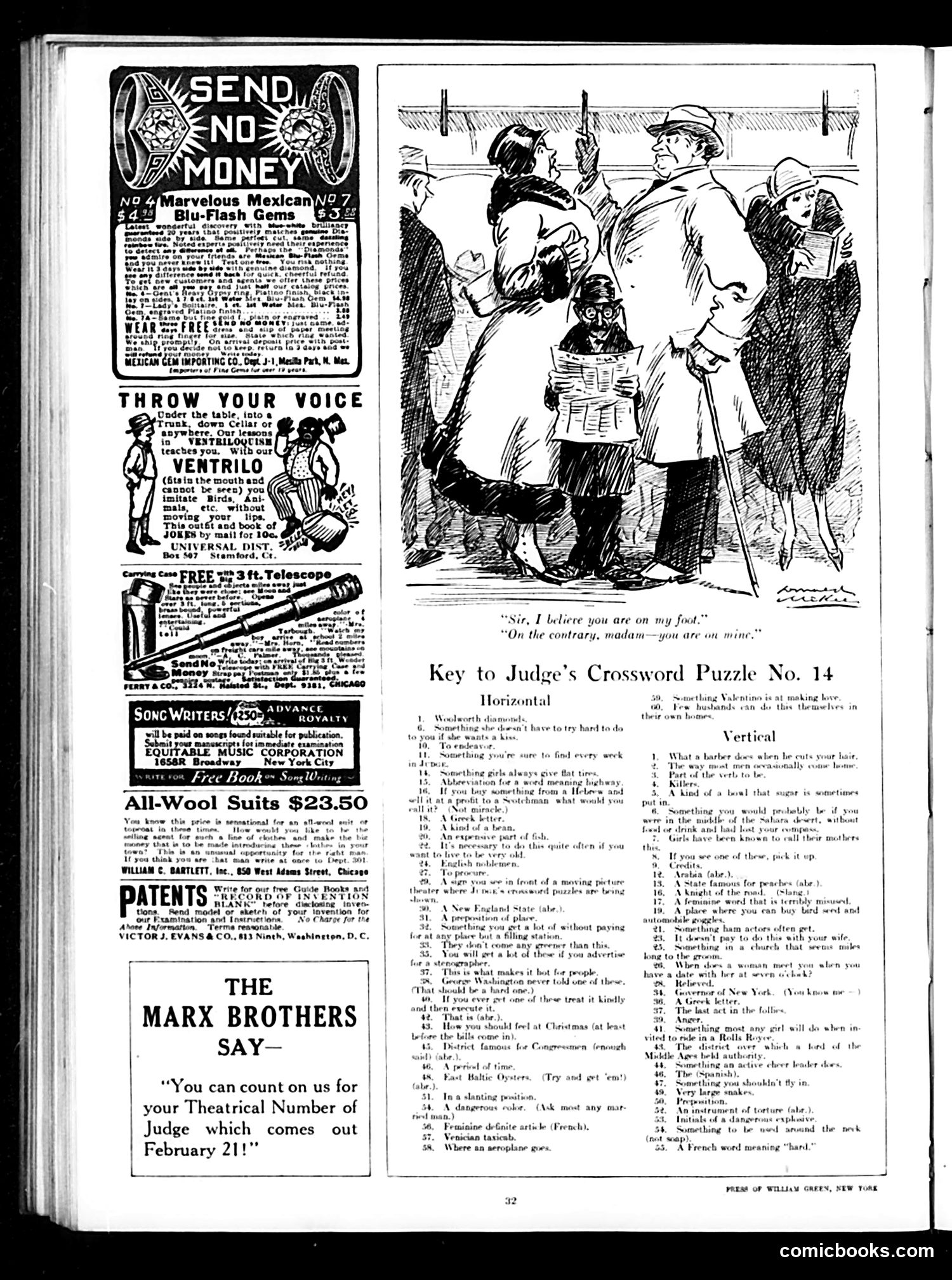
This page is primarily **advertising and features content**, not political satire. The main elements are: **The Cartoon (top right):** A social comedy illustration showing a woman stepping on a man's foot in what appears to be a crowded public space. The caption plays on a common courtesy exchange—she apologizes ("Sir, I believe you are on my foot"), and he politely deflects ("On the contrary, madam—you are on mine"). This is gentle humor about urban congestion and social politeness, not political commentary. **The Advertisements:** The bulk of the page features mail-order novelty items—ventriloquism lessons, telescopes, patent information services, and all-wool suits. These reflect early 20th-century consumer culture. **Marx Brothers Promotion:** A small box mentions the Marx Brothers promoting their "Theatrical Number of Judge" for February 21, typical of entertainment cross-promotion. The page demonstrates Judge's business model: satire mixed with advertising revenue from mail-order vendors and entertainment promotions.
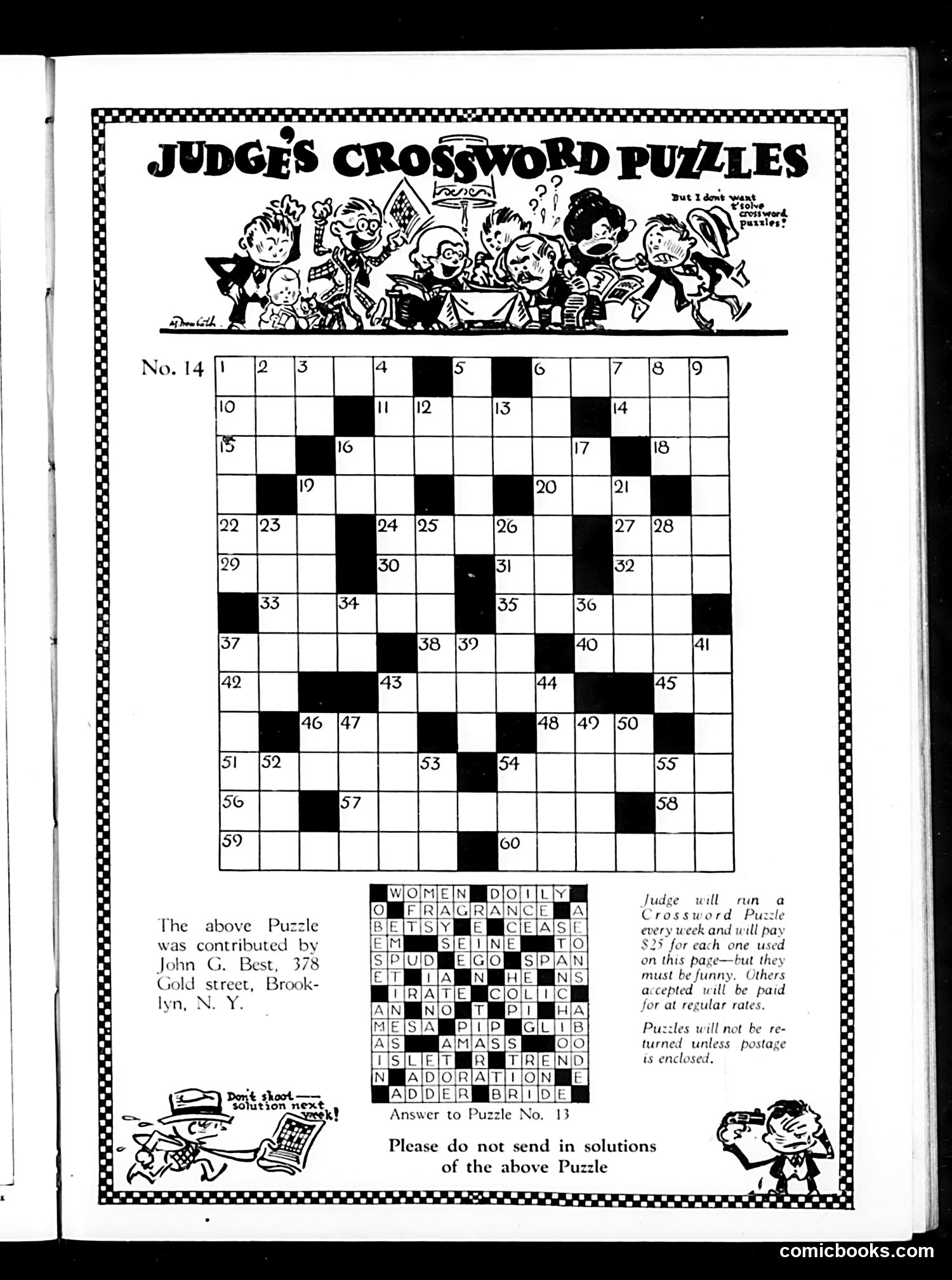
This page primarily features **Judge's weekly crossword puzzle contest** (No. 14), not political satire. The masthead cartoon shows children enthusiastically solving puzzles, with one child protesting "But I don't want snow! I want crossword puzzles?"—reflecting the popularity of crossword puzzles as a fad in early-to-mid 20th century America. The page announces that Judge will publish weekly crossword puzzles and pay $25 for submissions, establishing this as a reader-engagement feature. An answer key to the previous week's puzzle (No. 13) is provided. The small cartoon illustrations at the bottom—showing a character reluctant to solve puzzles—appear to be decorative rather than satirical commentary. This is primarily a **puzzle/contest page** rather than political or social satire, demonstrating how mainstream magazines like *Judge* adapted to entertainment trends of the era.
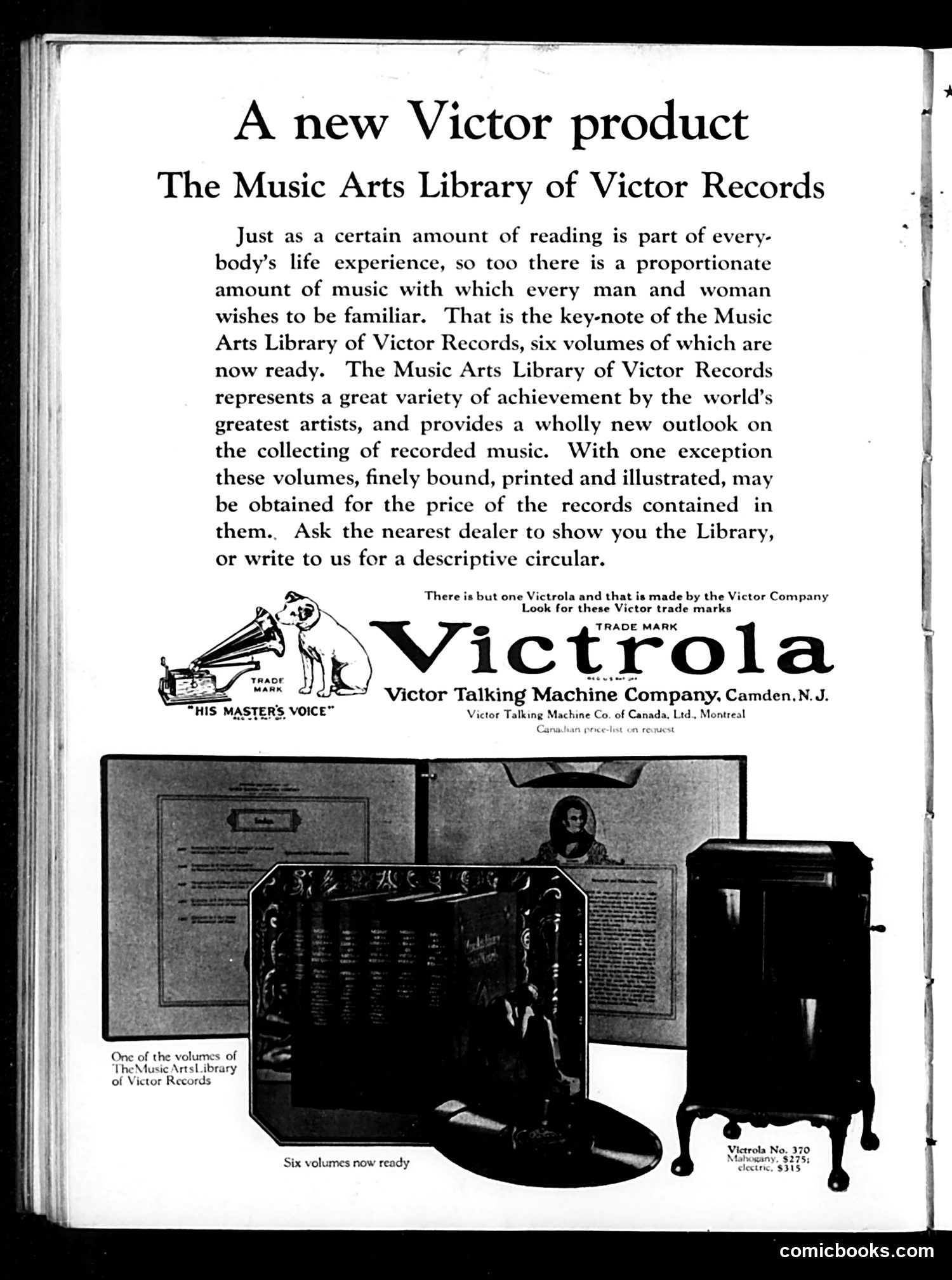
This page is **not a cartoon or satire**—it's a straightforward advertisement for Victor Records' new "Music Arts Library," a curated collection of six volumes of recorded music with accompanying illustrated guides. The ad promotes the Victrola phonograph and argues that musical literacy should be as essential to everyone as reading. The "Music Arts Library" packages classical and popular recordings with printed guides, making recorded music collecting more accessible and organized. Key visual elements include the famous "His Master's Voice" trademark (the dog listening to a gramophone), sample library volumes, and a Victrola cabinet model priced at $275-$315. The appeal is to middle-class consumers seeking cultural refinement—positioning recorded music as educational rather than mere entertainment. This represents early 20th-century marketing that connected consumer products to aspirational self-improvement.