
Judge, 1925-01-31 · page 9 of 36
Judge — January 31, 1925 — page 9: what you’re looking at
What you’re looking at
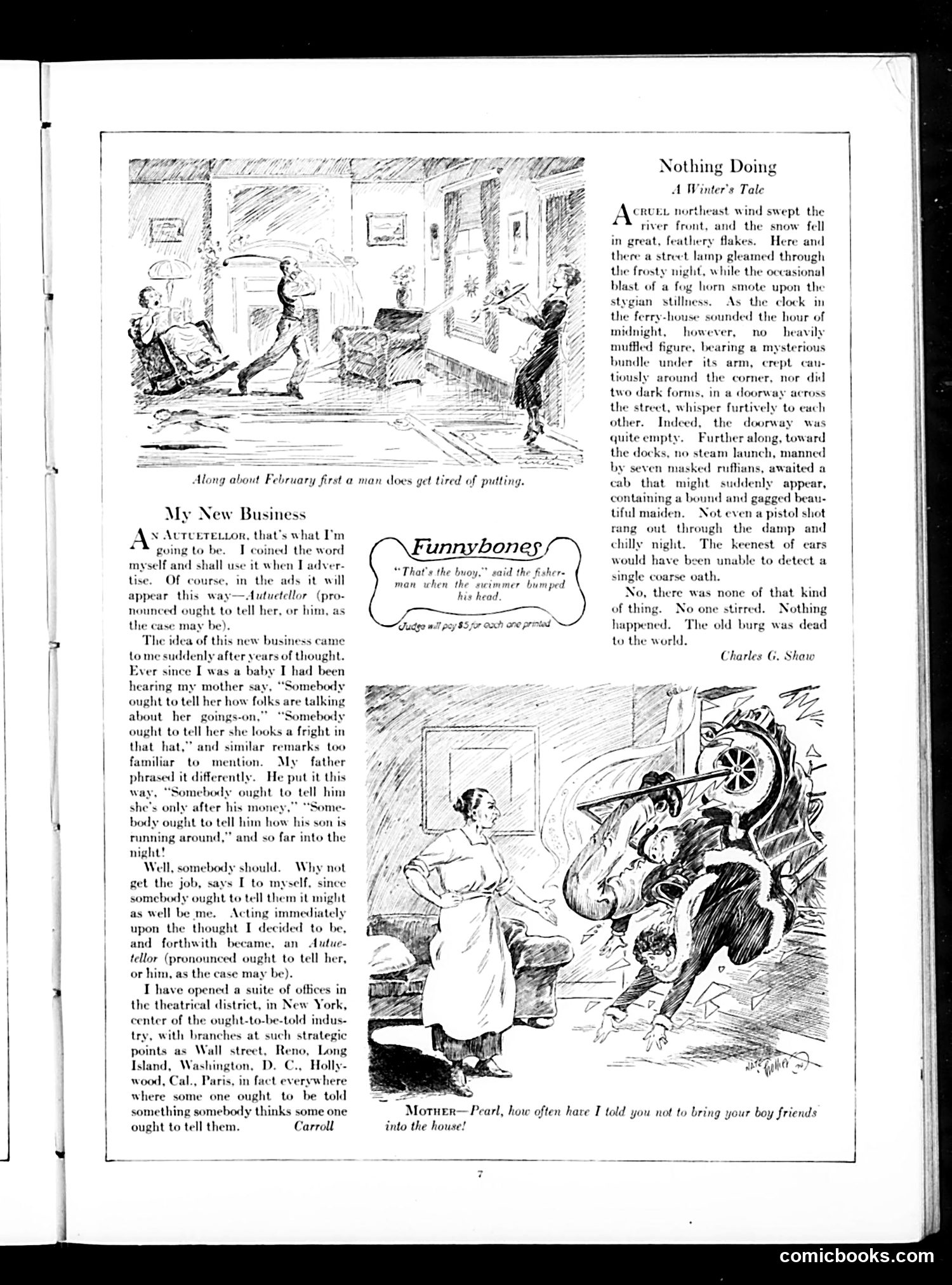
This page contains three satirical pieces typical of Judge's humor: **"My New Business"** mocks the common American habit of unsolicited advice-giving. The narrator invents "Aututellor" (pronounced "ought to tell her/him")—a profession dedicated to telling people what others say about them. The satire targets the ubiquitous busybody culture where everyone has opinions on how others should look, behave, or live. Carroll's joke is that this annoying social obligation deserves its own business enterprise with offices nationwide, from Wall Street to Hollywood. **"Nothing Doing"** parodies overwrought melodramatic fiction. It builds dramatic expectations—a mysterious figure, fog horns, potential kidnapping—then undercuts every cliché by revealing nothing happens. The satire targets pulp fiction's predictable tropes and overwrought atmosphere. **"Funnybones"** offers a brief visual pun about a fisherman and a buoy. The bottom cartoon shows a mother scolding a daughter (Pearl) for inviting boy friends into the house—typical domestic humor about courtship propriety concerns.
📄 Transcribed text from this page (OCR, searchable)
Machine-transcribed from the original scan — historical spelling and the odd misread are preserved.
a | Along about February first a man does get tired of putting. My New Business As AUTUETELLOR, that’s what I'm + going to be. I coined the word myself and shall use it when I adver- tise. Of course, in the ads it will appear this way—Autuetellor (pro- nounced ought to tell her, or him, as the case may be). The idea of this new business came to me suddenly after years of thought. Ever since I was a baby I had been hearing my mother »mebody ought to tell her how folks are talking about her goings-on,” “Somebody ought to tell her she looks a fright in that “and similar remarks too fam to mention. My father phrased it differently. He put it this Somebody ought to tell him ter his money, him how his son is “and so far into the me- body ought t running arounc night! Well, somebody should. get the job, says [I to mys somebody ought to tell them it might as well be me. Acting immediately upon the thought I decided to t and forthwith became, an Autue- tellor (pronounced ought to tell her, or him, as the case may be). T have opened a suite of offices in the theatrical district, in New York, center of the ought-to-be-told indus- try, with branches at such strategic points as Wall street, Reno, Long Island, Washington, D. C., Holl, wood, Cal., Paris, in fact everywhere where some one ought to be told something somebody thinks some one ought to tell them. Carroll Why not f. since Funnybones “That's the buoy,” said the fisher his head. _—_——~ “Judge will poy 85 for each ane printed _ Z Nothing Doing A Winter's Tale A RUEL northeast wind swept the river front, and the snow fell in great, feathery flakes. Here and there a street lamp gleamed through the frosty night, while the occasional blast of a fog horn smote upon the stygian stillness. As the clock in the ferry-house sounded the hour of midnight, heavily muflled figure, bearing a mysterious bundle under its arm, crept. cau- tiously around the corner, nor did two dark forms, in a doorway across the street, whisper furtively to each other. Indeed, the doorway was quite empty. however, no Further along, toward the docks, no steam launch, manned by seven masked ruffians, awaited a cab that might suddenly appear, containing a bound and gagged beau- tiful maiden. Not even a pistol shot rang out through the damp and chilly night. The keenest of ears would have been unable to detect a single coarse oath. No, there was none of that kind of thing. No one stirred. Nothing happened. The old burg was dead to the world. Charles G. Shaw Motner—Pearl, how often have I told you not to bring your boy friends into the house! comicbooks.com