
Judge, 1925-01-31 · page 17 of 36
Judge — January 31, 1925 — page 17: what you’re looking at
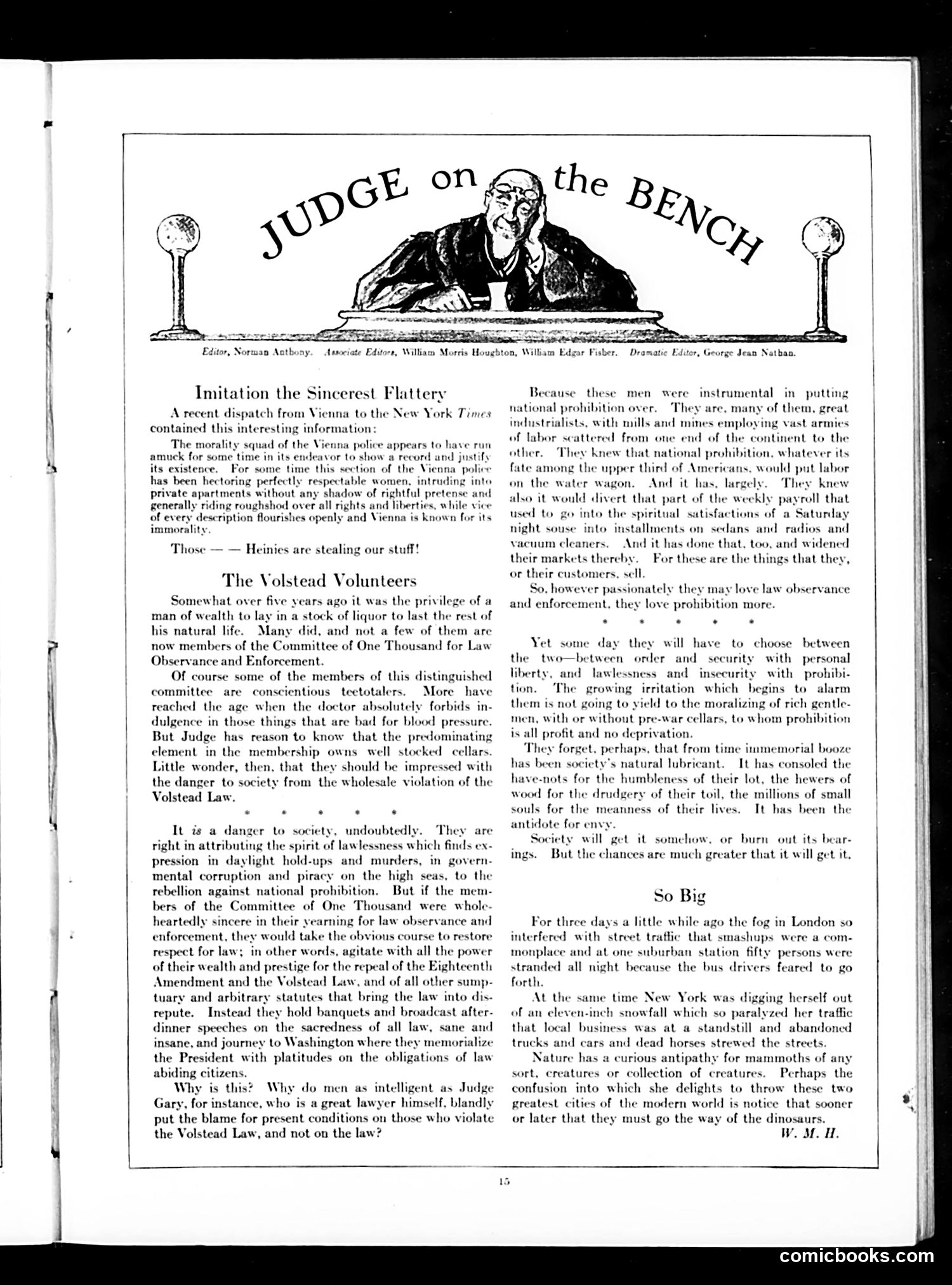
What you’re looking at
This page satirizes wealthy industrialists who championed Prohibition (the Volstead Act) while secretly maintaining personal liquor supplies. **The Satire's Point:** Judge argues these men—including apparently Judge Gary (a prominent industrialist)—support Prohibition not from moral conviction but from cynical self-interest. They know alcohol restrictions keep workers sober and prevent wages from being spent on drinking, protecting their profits. The magazine exposes their hypocrisy: they "stocked cellars" yet loudly preach law-and-order while opposing repeal of Prohibition itself. **The Target:** The "Committee of One Thousand for Law Observance and Enforcement"—real wealthy advocates who publicly championed Prohibition enforcement while privately violating it. **The Irony:** Judge mocks their claim that crime stems from law-breakers, not bad laws. The magazine suggests Prohibition itself creates lawlessness, yet these men refuse to advocate for repeal because they benefit from the law's existence, even if not its enforcement. The opening cartoon header shows a judge—representing authority and hypocrisy.
📄 Transcribed text from this page (OCR, searchable)
Machine-transcribed from the original scan — historical spelling and the odd misread are preserved.
a Editor, Norman Antbony. Associate Editore, William Morris Hou, Imitation the Sincerest Flattery A recent dispatch from Vienna to the New York Times contained this interesting information: The morality squad of the Vienna police appears tc amuck for some time in its vor to show a record g its existence. For some time this section of the Vienna p has been hectoring perfectly respectable women, intruding inte Private apartments without any shadow of rightful pr: generally riding roughshod over all rights and liberties, whi of every description flourishes openly and Vienna is known for its immorality Those — — Heinies are stealing our stuff! The Volstead Volunteers Somewhat over five years ago it was the privilege of a man of wealth to lay in a stock of liquor to last the rest of his natural life. Many did, and not a few of them are now members of the Committee of One Thousand for Law Observance and Enforcement. Of course some of the members of this distinguished committee are conscientious teetotalers. More have reached the when the doctor absolutely forbids in- dulgence in those things that are bad for blood pressure. But Judge has reason to know that the predominating element in the membership owns well stocked. cellars Little wonder, then, that they should be impressed with the danger to society from the wholesale violation of the Volstead Law. . . . + . It is a danger to society, right in attributing the spirit pression in daylight hold-ups and murders, in govern- mental corruption and piracy on the high seas, to the rebellion against national prohibition. But if the mem- bers of the Committ of One Thousand were whole- heartedly sincere in their yearning for enforcement, they would take the obvious course to restore respect for law; in other words, agitate with all the power of their wealth and prestige for the repeal of the Eighteenth Amendment and the Volstead Law, and of all other sump- tuary and arbitrary statutes that bring the law into dis- repute. Instead they hold banquets and broadcast after- dinner speeches on the sacredness of all law, sane and insane, and journey to Washington where they memorialize the President with platitudes on the obligations of law abiding citizens. Why is this? Why do men as intelligent as Judge Gary, for instance, who is a great lawyer himself, blandly put the blame for present conditions on those who violate the Volstead Law, and not on the law? undoubtedly. They. are lawlessness which finds ex- aw observance and ‘a, William Edgar Fisber, Dramatic Editor, George Jean Nathan. Because these men were instrumental in’ putting national prohibition over. They are, many of them, great industrialists, with mills and mines employing vast armies of labor scattered from one end of the continent to the other. They knew that national prohibition, whatever its fate among the upper third of Americans. would put labor on the water wagon. And it has, largely. They knew also it would divert that part of the weekly payroll that used to turday vs and ne that, too, and widened For these are the things that they, » into the spiritual sutisfactions of a $ night souse into installments on sedans and vacuum cleaners. And it has ¢ their markets there! . or their customers, sell. So, however passionately they may love law observance and enforcement, they love prohibition more. . * . . . Yet some day they will have to choose between r and. security with personal liberty, and lawlessness and insecurity with prohibi- tion. The growing irritation which begins to alarm them is not going to yield to the moralizing of rich gentle- men, with or without pre-war cellars, to whom prohibition is all profit and no deprivation. They forget, perhaps, that from time immemorial booze has been society's ural lubricant. It has consoled the have-nots for the humbleness of their lot, the hewers of wood for the drudgery of their toil, the millions of small souls for the meanness of their lives. It has been the antidote for envy Society will the two—between 4 it somehow, or burn out its bear- ings. But the chances are much greater that it will get it. So Big For three days a little while ago the fog in London so interfered with street traffic that smashups were a com- monplace and at one suburban station fifty persons were stranded all night because the bus drivers feared to go forth. At the same time New York was digging herself out of an eleven-inch snowfall which so paralyzed her traffic that local business was at a standstill and abandoned trucks and s and dead horses strewed the streets. Nature has a curious antipathy for mammoths of any sort, creatures or collection of creatur Perhaps the confusion into which she delights to throw these two greatest cities of the modern world is notice that sooner or later that they must go the way of the dinosaurs. W. M. H. comicbooks.com