
Judge, 1925-01-31 · page 30 of 36
Judge — January 31, 1925 — page 30: what you’re looking at
What you’re looking at
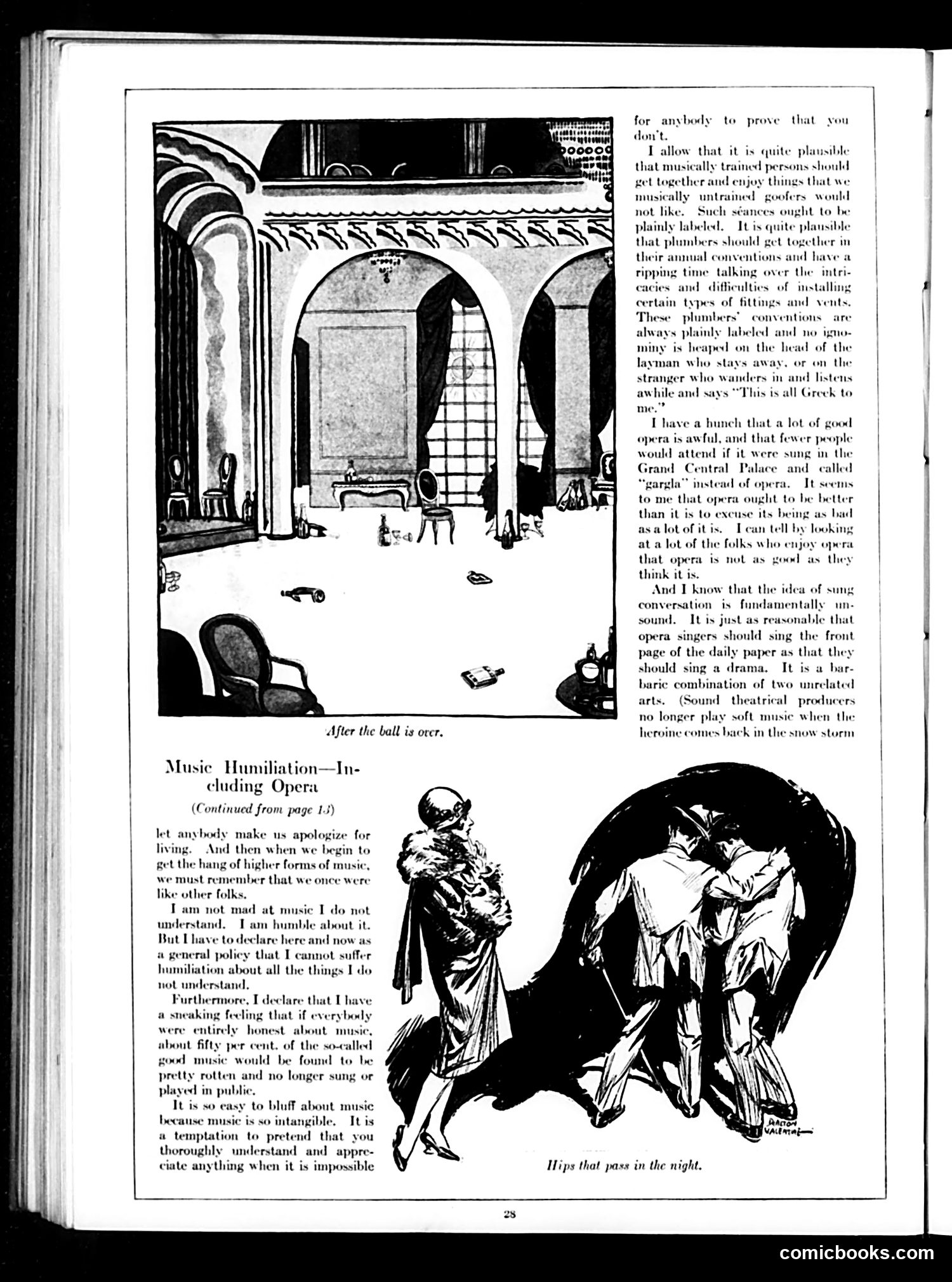
This satirical article mocks pretentious attitudes toward opera and "high" music culture. The author argues that opera is fundamentally flawed—combining unrelated arts (music and drama awkwardly) and that much supposedly "good" music is actually poor quality, kept alive only by social bluffing. The cartoons illustrate this critique: "After the ball is over" shows an elegant interior trashed after a formal event, suggesting chaos beneath refined surfaces. "Hips that pass in the night" depicts shadowy figures, likely contrasting lowbrow entertainment with highbrow pretensions. The core satire: opera-goers and classical music enthusiasts maintain their enthusiasm through social pressure and intellectual posturing rather than genuine appreciation. The author invokes plumbers' conventions as comparison—specialized groups deserve privacy, yet music devotees demand broader cultural legitimacy. This reflects early 20th-century tension between emerging mass culture and established artistic hierarchies.
📄 Transcribed text from this page (OCR, searchable)
Machine-transcribed from the original scan — historical spelling and the odd misread are preserved.
for anybody to prove that) you don't. I allow that it is quite plausible that musically trained persons should get together and enjoy things that we musically untrained goofers would not like. Such séances ought to be | plainly labeled. It is quit that plumbers should get together in their annual conventions and have a / ipping time talking over the intei- | ] and difficulties of installing plausible | I certain types of fittings and vents. 1] These plumbers’ conventions are | Hi always plainly labeled and no igno- | miny is heaped on the head of the | layman who stays away, or on the — | | stranger who wanders in and listens | awhile and says “This is all Greek to | me.” T have a hunch that a lot of good | | opera is awful, and that fewer people | | would attend if it were sung in the — | \ | Palace and called | gargla” instead of opera. It seems to me that opera ought to be better | than it is to exe asalotof itis. Lean tell by looking — | ata lot of the folks who enjoy opera that opera is not as they | think it is. And I know that the idea of sung conversation ix fundamentally un. sound. It is just as reasonable that ] opera singers should sing the front ¥ page of the daily paper as that they should sing a drama. It is a bar- baric combination of two unrelated arts. (Sound theatrical producers se its being as bad no longer play soft music when the After the ball is over. heroine comes back in the snow storm | Music Humiliation—In- | | cluding Opera | \ (Continued from page 1.3) | let anybody make us apologize for | living. And then when we begin to | get the hang of higher forms of music, | | | we must remember that we once were f at) | like other folks. | i I am not mad at music I do not understand. Tam humble about it. But L have to declare here and now as a general policy that I cannot suffer ion about all the things I do I declare that Lhave a sneaking fi that if everybody were entirely honest about music, about fifty per cent. of the so-called good music would be found to be pretty rotten and no longer sung or played in public. a) It is so easy to bluff about music because music is so intangible, It is a temptation to pretend that you i thoroughly understand and appre- ate anything when it is impossible Hips that pass in the night. comicbooks.com