
A complete issue · 36 pages · 1925
Judge — January 24, 1925
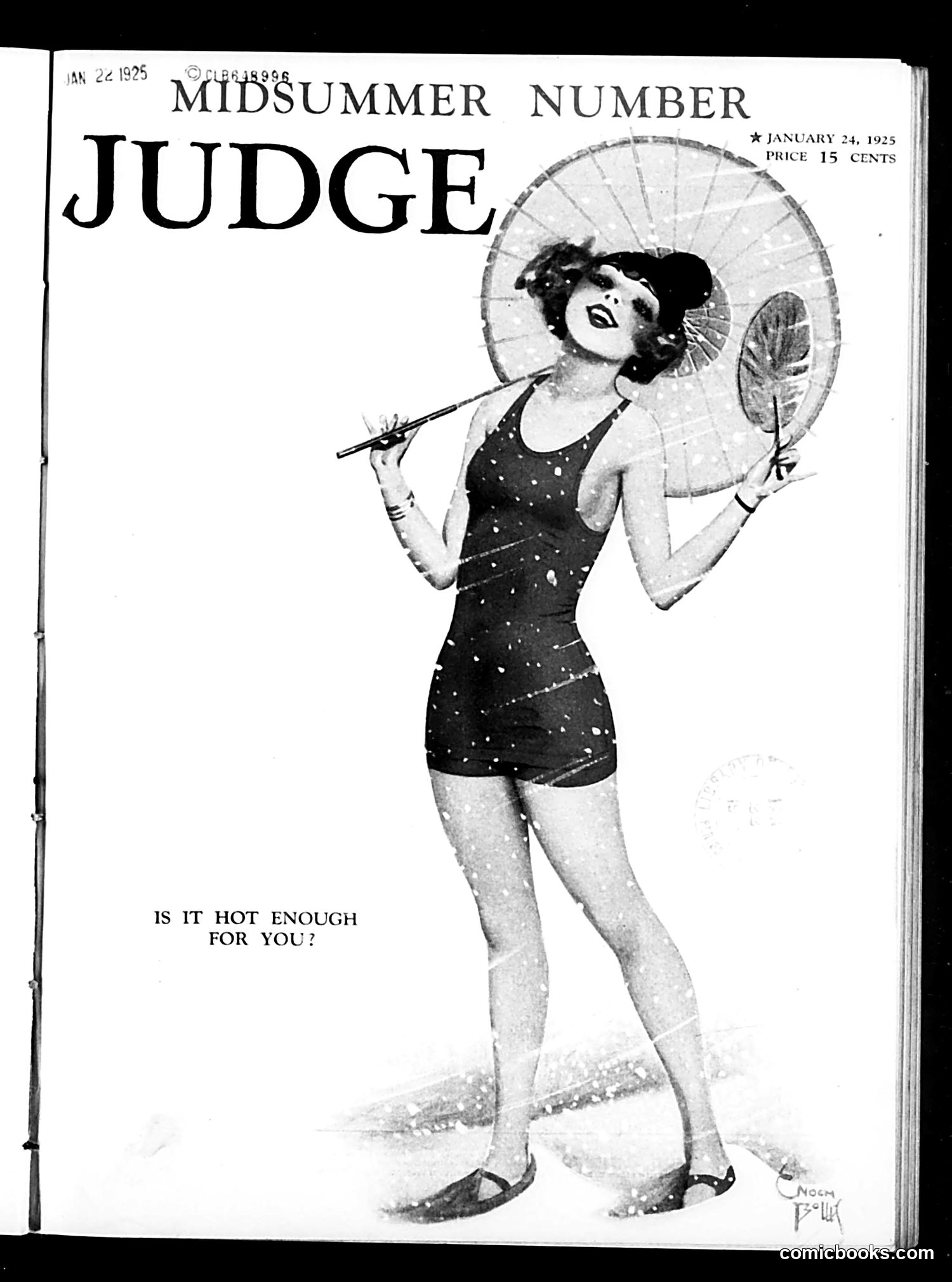
This is the midsummer issue cover featuring a woman in a scanty bathing suit holding a parasol and fan, with the caption "IS IT HOT ENOUGH FOR YOU?" The joke plays on two meanings: literal summer heat and the provocative display itself. In the 1920s, women's swimwear was becoming increasingly revealing—a source of social controversy during this conservative period. The "flapper" era celebrated modern women's fashion freedoms, which scandalized many. The caption suggests the image itself is "hot"—using heat as metaphor for the woman's attractiveness and the scandalous brevity of her outfit. The parasol provides ironic contrast: traditionally protective feminine accessory paired with minimal clothing. This reflects Judge's satirical commentary on changing social norms and the decade's moral anxieties about women's liberation and fashion.
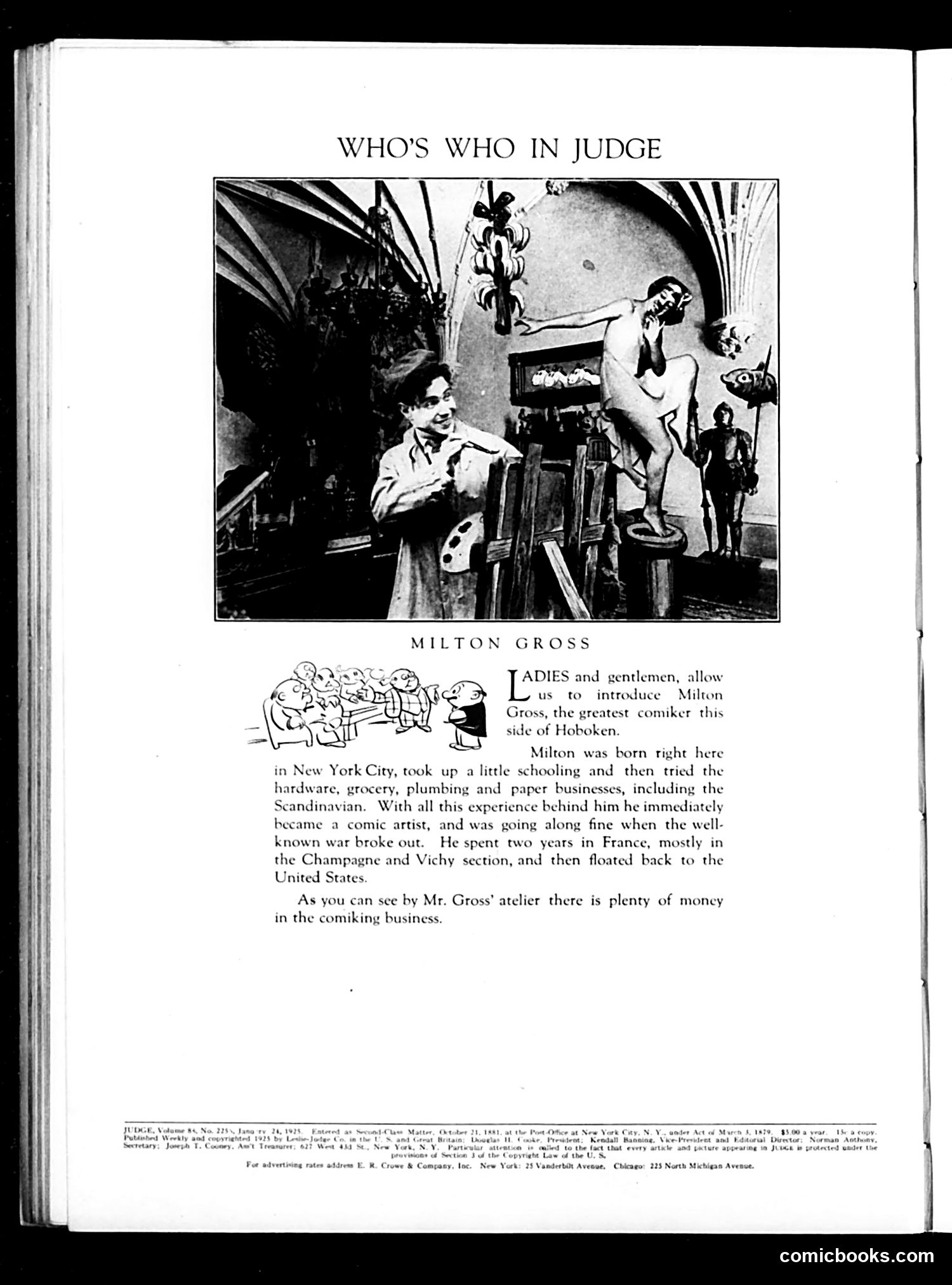
This is a profile piece in *Judge* magazine introducing Milton Gross, described as "the greatest comicker this side of Hoboken." The text provides biographical details: Gross was born in New York City, worked various trades (schooling, hardware, grocery, plumbing, paper businesses, including a Scandinavian operation), became a comic artist, served in France during World War I (in the Champagne and Vichy sections), and returned to the United States. The cartoon above shows Gross at work in his studio. The accompanying illustration depicts him surrounded by cartoon characters and creative materials, visually emphasizing his productivity and success in the "comicing business." The text's closing line—"there is plenty of money in the comicing business"—suggests this is promotional content celebrating Gross's professional success and prosperity as a cartoonist.
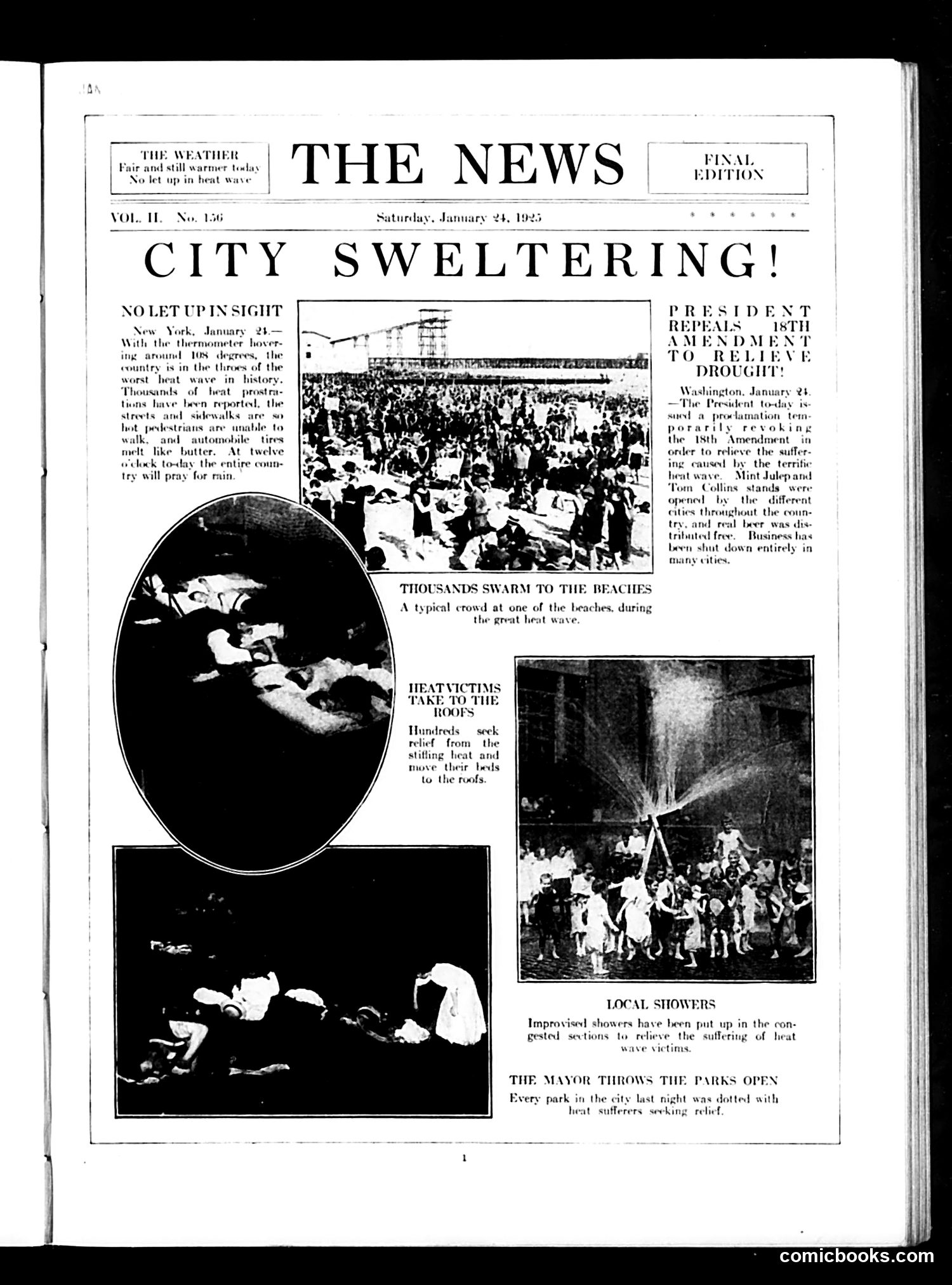
This is not a satirical cartoon page, but rather a **news front page** from "The News" (January 24, 1925), documenting a severe **heat wave crisis**. The headline "CITY SWELTERING!" describes an actual weather emergency affecting New York. The photographs show real disaster response: crowds seeking relief at beaches, people sleeping on roofs to escape heat, improvised public showers, and park facilities opened for heat victims. A caption notes temperatures "hovering around 95 degrees" with thousands seeking refuge. The accompanying article reports President Coolidge's proclamation invoking the 18th Amendment to relieve drought conditions—referencing Prohibition era politics. This documents genuine public health emergency coverage, not satire.
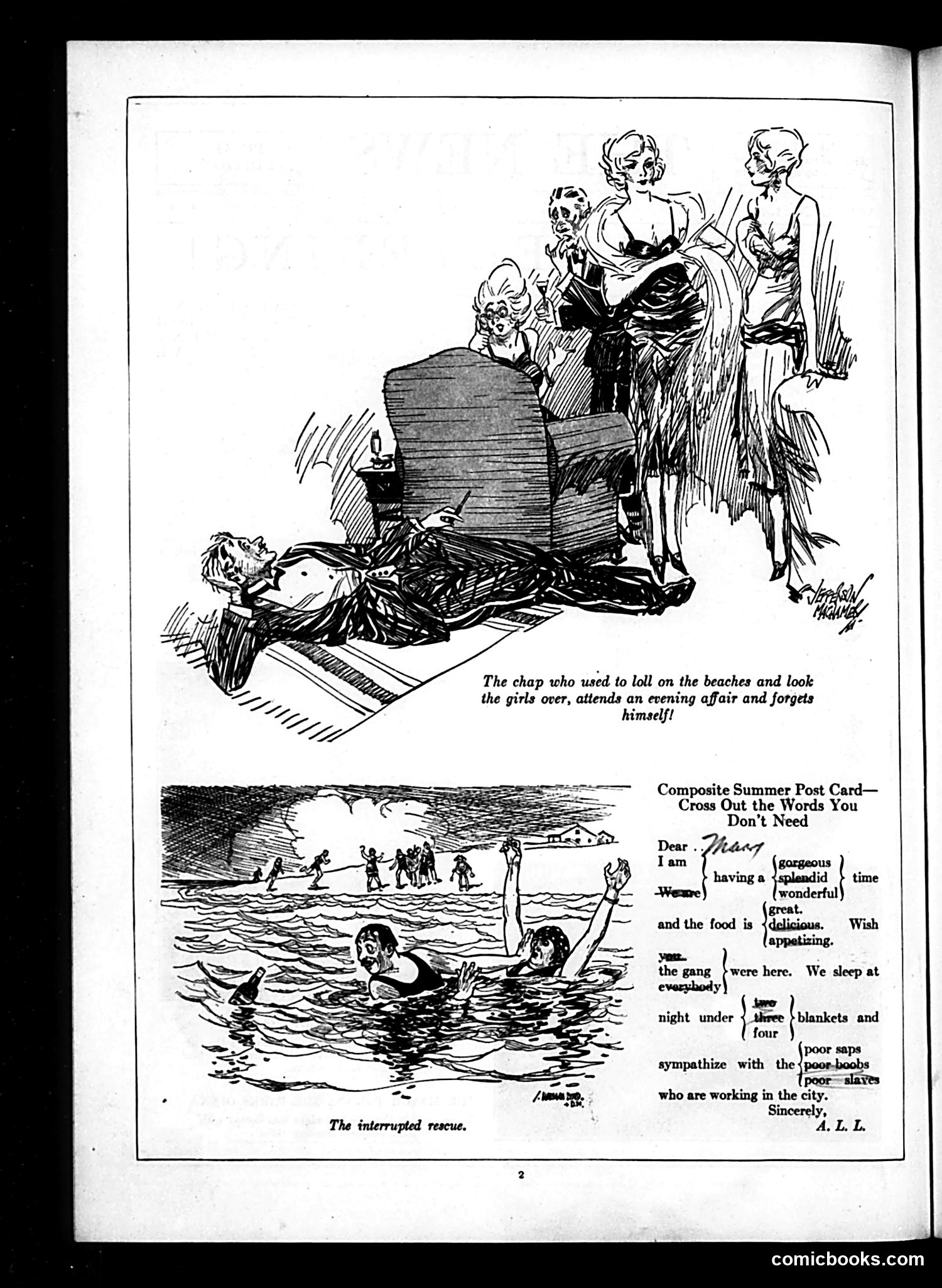
This page contains two satirical cartoons from *Judge* magazine mocking summer social behavior. The **top cartoon** ridicules a man who habitually lounged on beaches watching women but neglected his appearance—now attending an evening social event looking disheveled and dishonest while well-dressed women observe him critically. The **bottom cartoon** shows "The Interrupted Rescue," depicting a comedic postcard with people swimming. The accompanying text is a deliberately silly "summer postcard" template where readers cross out unnecessary phrases to create absurd messages—mixing vacation pleasantries ("splendid time," "delicious food") with contradictory complaints ("poor saps," "poor slaves") about city workers. Both pieces humorously target summer leisure culture and the performative aspects of vacation communication—exposing the gap between idealized holiday narratives and reality.
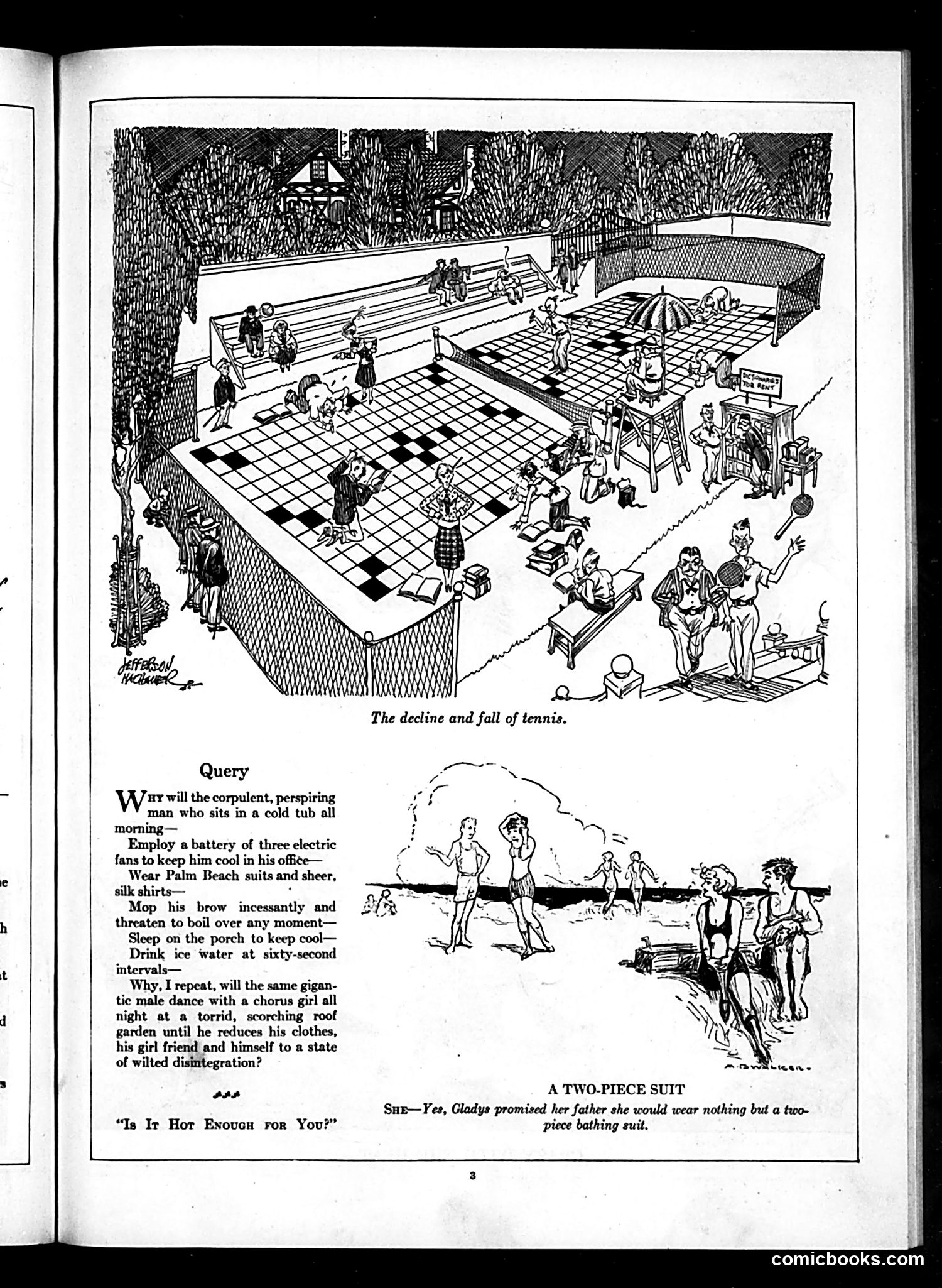
**Top Cartoon:** "The decline and fall of tennis" depicts an elaborate indoor tennis facility filled with spectators and players. The satire critiques how tennis—once an athletic pursuit—has become a fashionable social spectacle, with courts surrounded by idle observers rather than serious athletes. **"Query" Section:** This humorous poem mocks the contradiction of a man suffering through uncomfortable heat-reduction measures (cold tubs, electric fans, Palm Beach suits) while later engaging in strenuous dancing that undoes all these efforts. It satirizes the absurdity of modern cooling rituals. **"A Two-Piece Suit":** A brief joke about women's bathing attire, referencing fashion norms where two-piece swimsuits were novel or scandalous. The humor relies on period attitudes about women's fashion propriety.
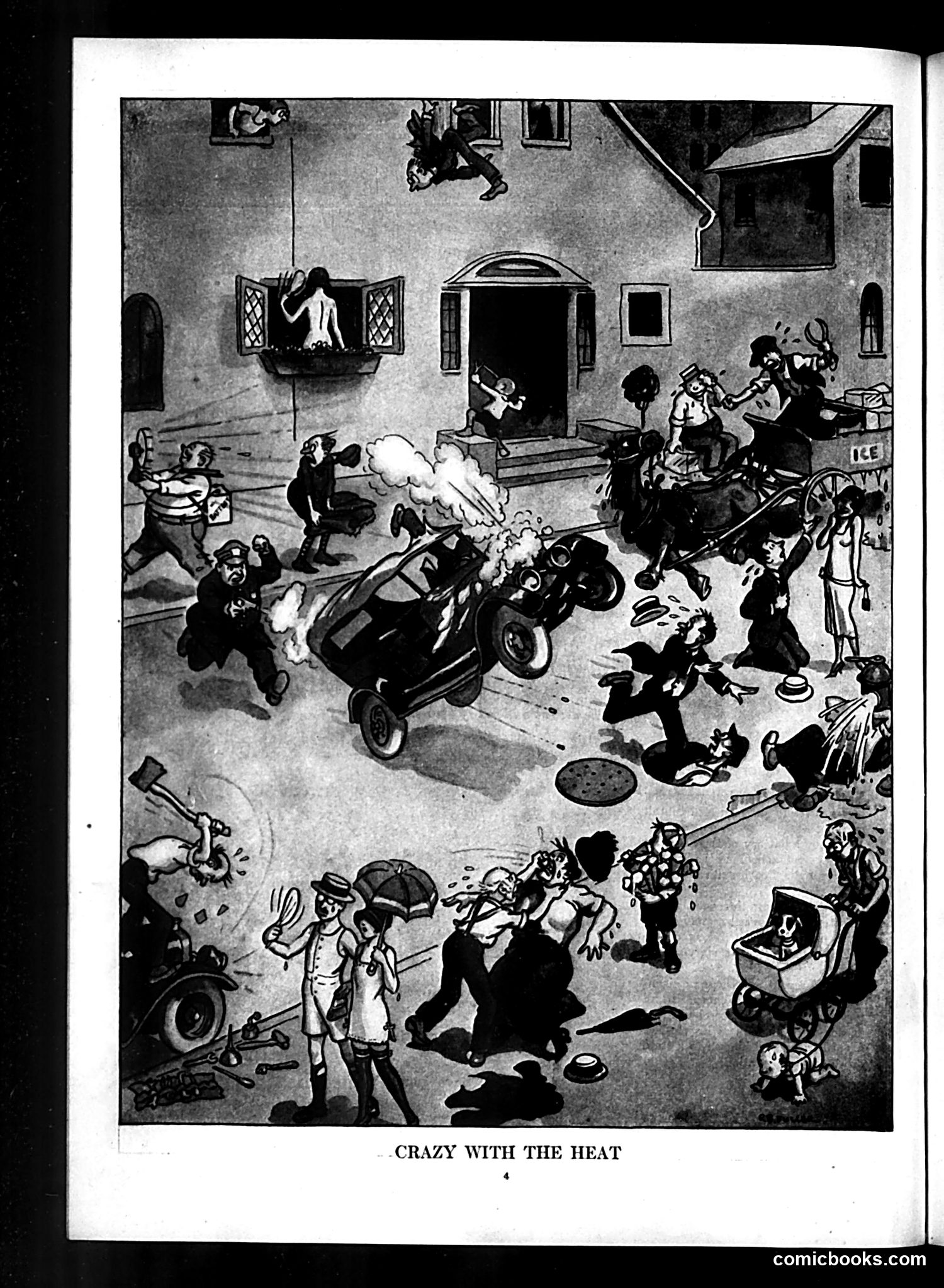
This cartoon satirizes the chaos and social breakdown caused by extreme summer heat in an urban neighborhood. The bird's-eye view shows a courtyard scene where residents have gone wild: a car crash in the center, people fighting, children running amok, laundry and belongings scattered everywhere, an ice wagon (visible on the right), and general pandemonium. The satire targets how oppressive heat drives ordinary people to lose composure and civility. The crowded tenement setting suggests this affects working-class neighborhoods particularly. Details like the ice vendor indicate common heat-relief measures of the era. The title "Crazy With the Heat" is both literal and ironic—the cartoon uses exaggeration to mock how meteorological discomfort becomes an excuse for urban disorder and social breakdown among the masses.
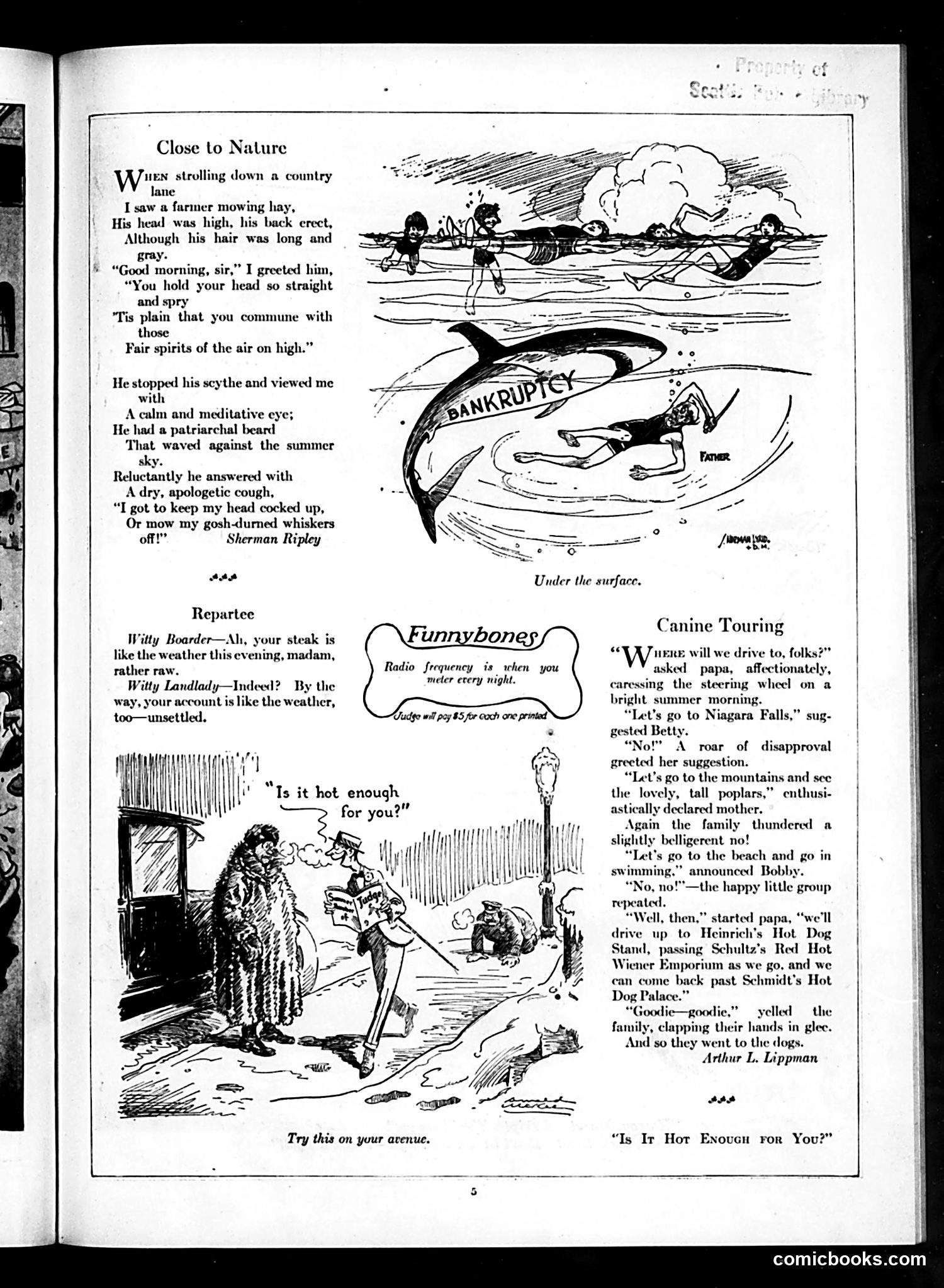
This page contains three separate pieces of light humor rather than political satire: 1. **"Close to Nature"**: A poem by Sherman Ripley about greeting a dignified farmer. The joke plays on his appearance of spiritual elevation—the narrator assumes his upright posture reflects communion with nature, but the farmer cynically explains he's just keeping his head up to prevent his hat from blowing off. 2. **"Funnybones"**: A one-liner joke about radio frequency. 3. **"Canine Touring"**: A humorous story by Arthur L. Lippman about a family's car trip, with debate over destinations (Niagara Falls vs. the beach vs. various hot dog stands). The humor derives from the family's inability to agree and their ultimate compromise visiting multiple hot dog establishments. The cartoons are domestic comedy rather than political commentary.
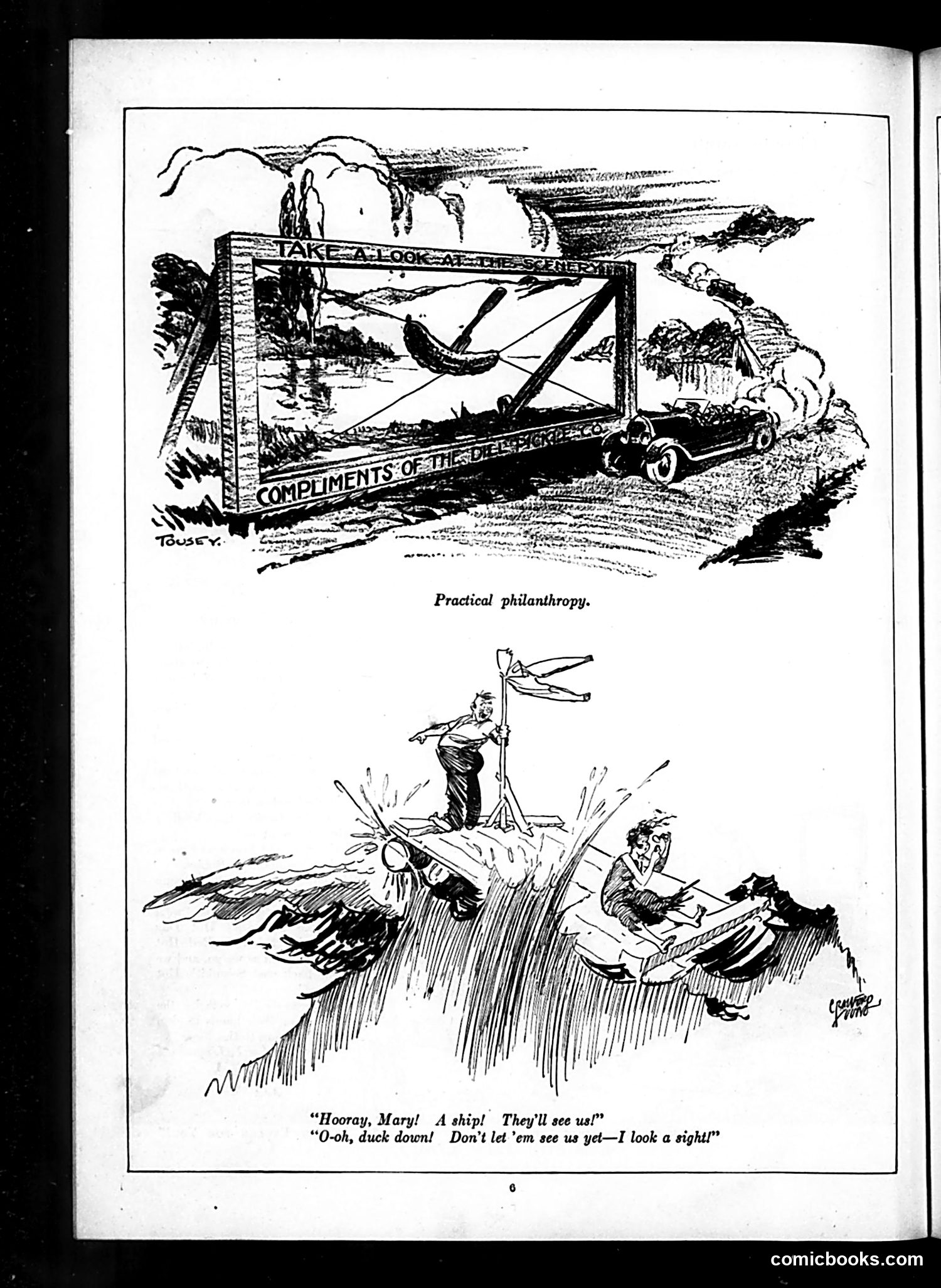
This page contains two cartoons satirizing different topics: **Top cartoon** ("Practical philanthropy"): A billboard advertisement for a luxury resort appears designed to attract wealthy tourists. The satire suggests that public displays of philanthropy or charitable gestures are often performative—essentially advertisements meant to enhance the giver's image rather than genuine altruism. The "compliments" framing implies self-promotion disguised as generosity. **Bottom cartoon**: Two figures stranded at sea spot a rescue ship but the woman insists on remaining hidden because she's disheveled. The humor satirizes women's vanity and concern with appearance, even in life-threatening situations—a common comic trope of the era suggesting women prioritize looks over practical survival. Both cartoons employ period-typical gender stereotypes for comedic effect.
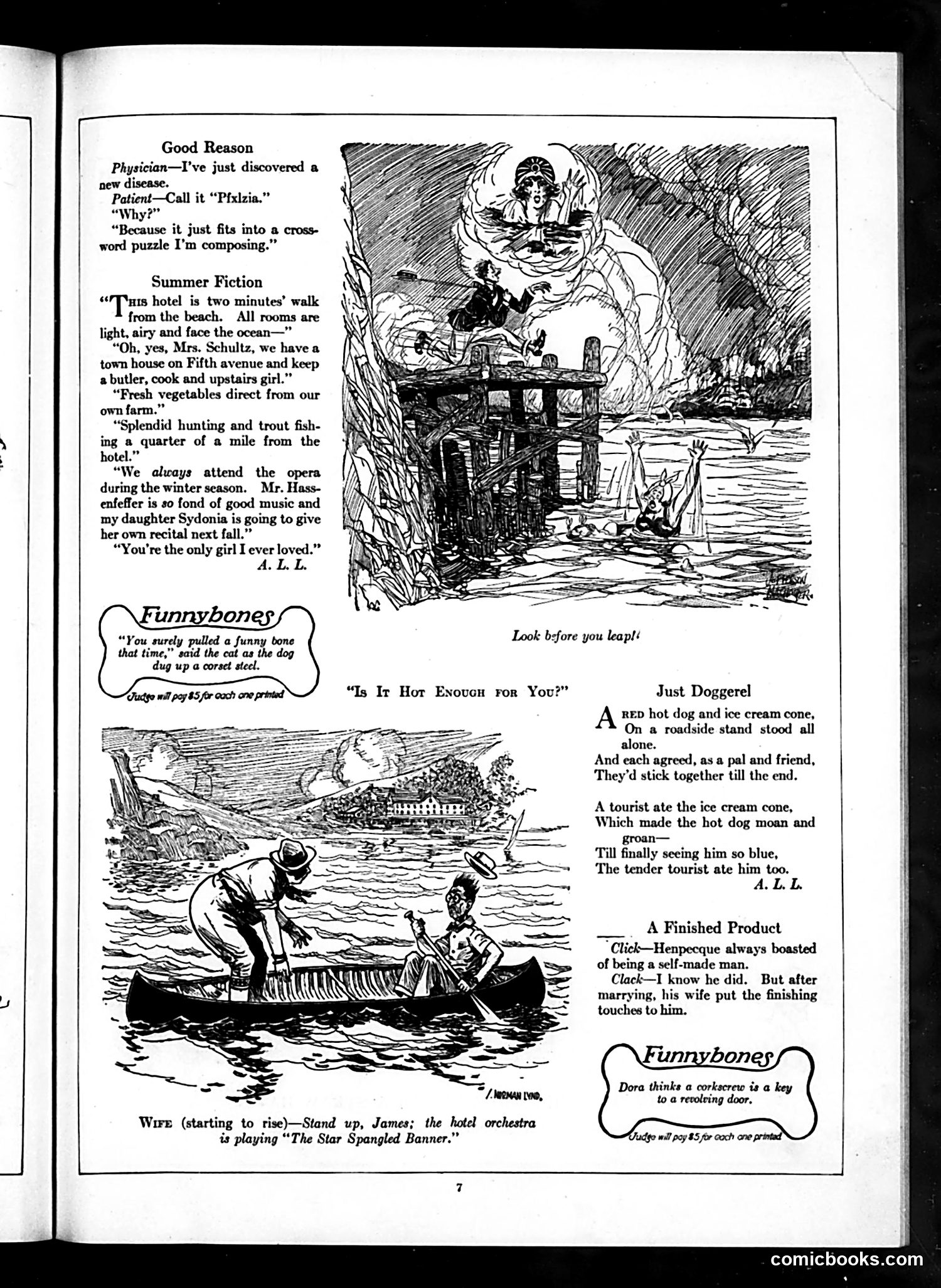
This page from Judge satirizes early 20th-century social pretensions and absurdities through brief comedic pieces. **"Good Reason"** mocks the crossword puzzle craze (newly popular) by having a patient name a disease after it fits his puzzle—prioritizing wordplay over medical accuracy. **"Summer Fiction"** ridicules exaggerated hotel advertising. A hotel manager describes modest amenities (beach proximity, fresh vegetables) while a guest one-ups each claim with ostentatious references (Fifth Avenue townhouse, opera attendance)—satirizing both inflated marketing and social snobbery. **"Is It Hot Enough for You?"** is a humorous doggerel about a hot dog and ice cream cone who befriend each other, only to be consumed by a tourist. **"A Finished Product"** jokes that a self-made man becomes "finished" (refined/controlled) only after marriage, implying wives domesticate their husbands. The **Funnybones** section contains brief witticisms about dogs and corkcrews. Overall, the page targets consumer culture, advertising dishonesty, class pretension, and marriage dynamics—typical Judge targets.
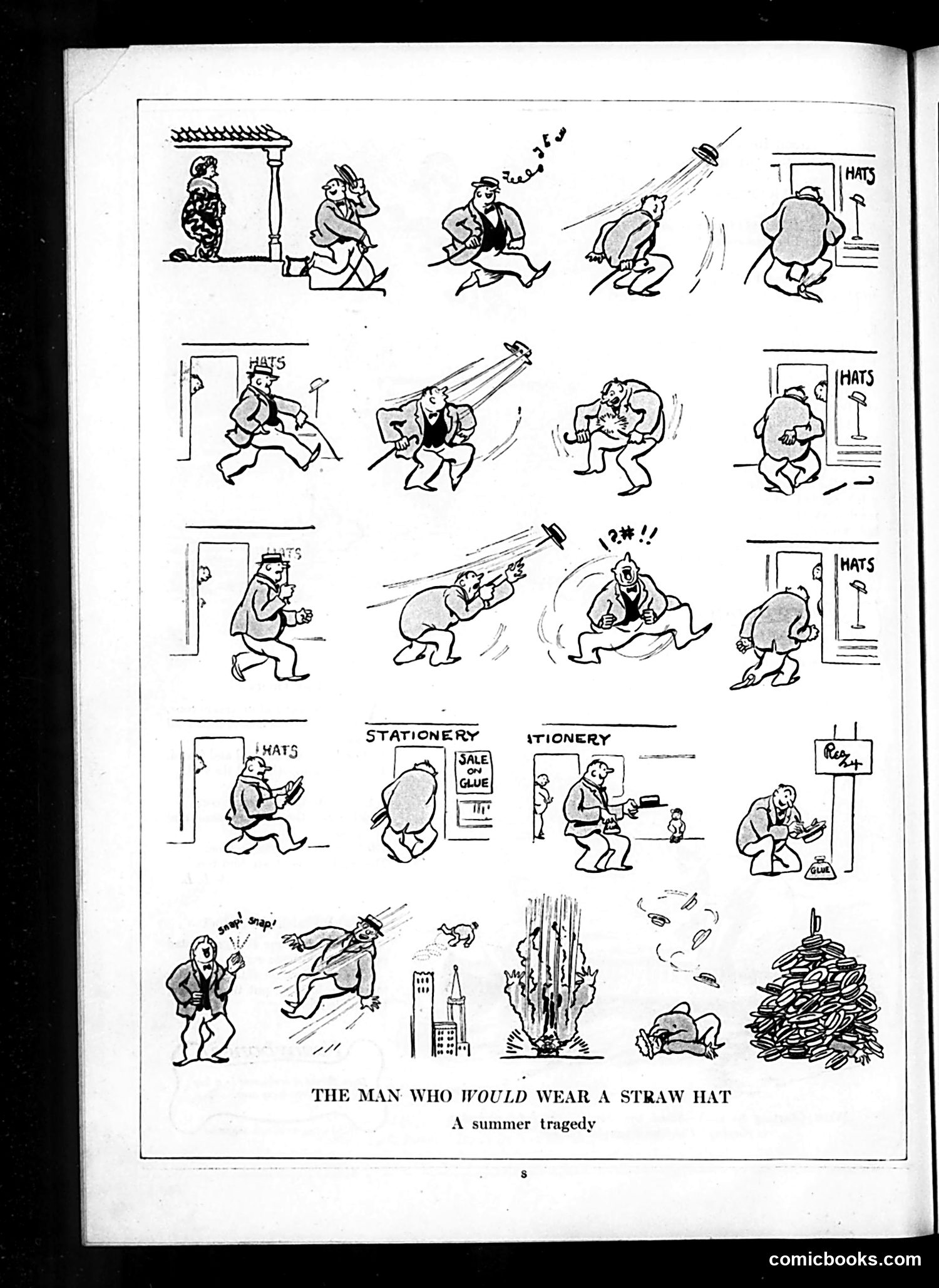
This is a visual gag comic strip showing the escalating chaos caused by one man's decision to wear a straw hat in summer. The narrative progresses through increasingly absurd consequences: the hat blows away, triggering a chase sequence involving other pedestrians, eventually escalating to citywide destruction—buildings catch fire, explosions occur, and massive piles of debris accumulate. The humor relies on exaggerated cause-and-effect: a simple fashion choice spirals into apocalyptic chaos. This satirizes both the frivolity of fashion trends and the unpredictable nature of urban life. The straw hat, a common summer accessory, becomes the unlikely catalyst for total disaster, mocking how minor social conventions can have outsized consequences when everyone participates in pursuing them.
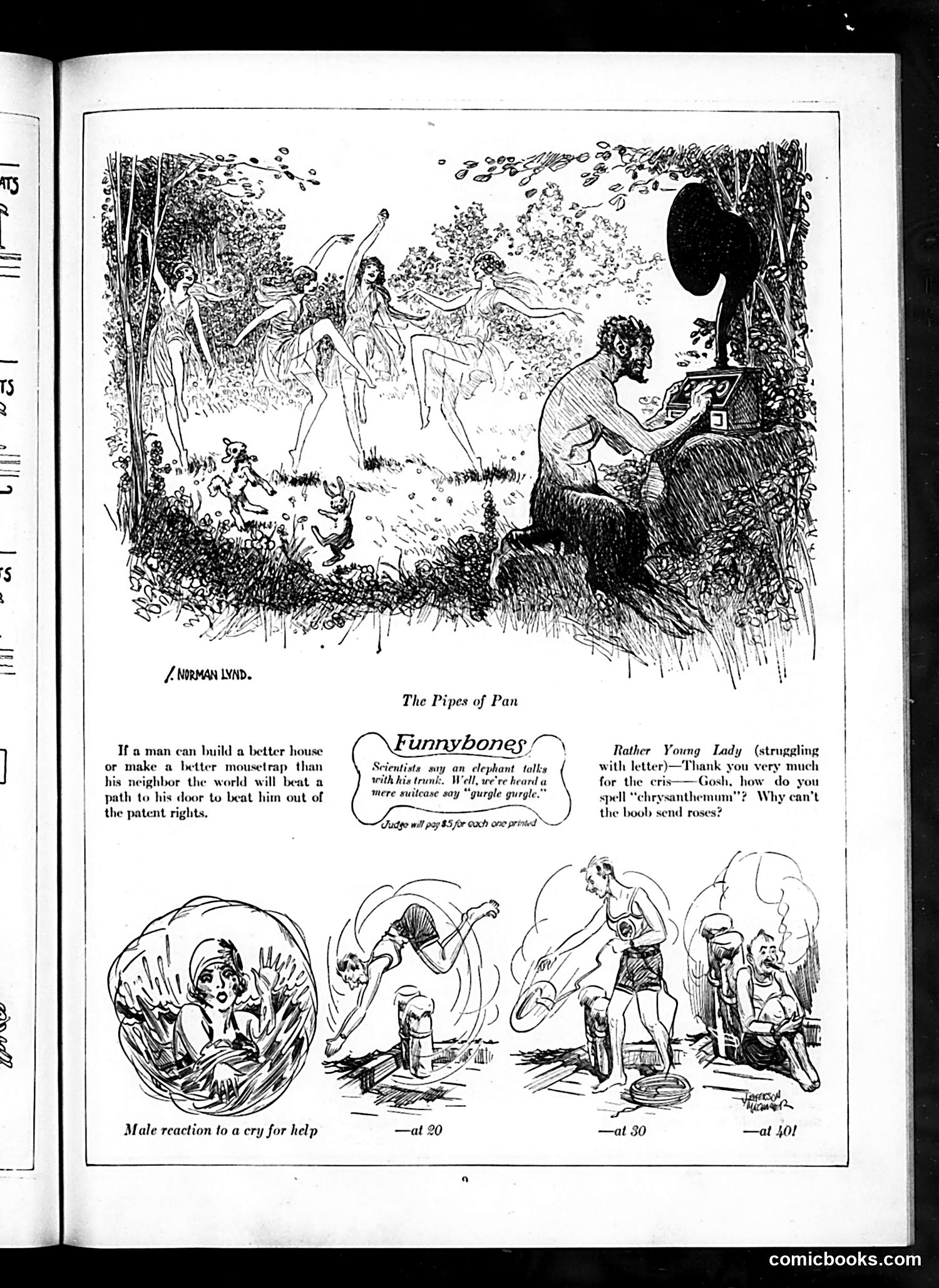
This page contains three satirical pieces: **"The Pipes of Pan"** (top): A Norman Lynd illustration depicting a man observing nude figures dancing in nature—a classical artistic reference. The accompanying text is a cynical quip about patent rights, suggesting innovators get exploited rather than rewarded. **"Funnybones"** (middle): A short joke mocking pseudo-scientific claims. It sarcastically contrasts the idea that elephants "talk with their trunks" with absurd observations (suitcases making sounds), poking fun at dubious scientific assertions. **"Rather Young Lady"** (bottom): A comic strip showing a woman struggling to spell "chrysanthemum" in a thank-you letter. The joke critiques modern courtship manners—she's annoyed her suitor sent flowers instead of roses, yet can't even spell the flower's name properly. It satirizes both pretentious social expectations and women's education or attention to detail. All three pieces use humor to mock contemporary social conventions, scientific pretension, and modern romance.
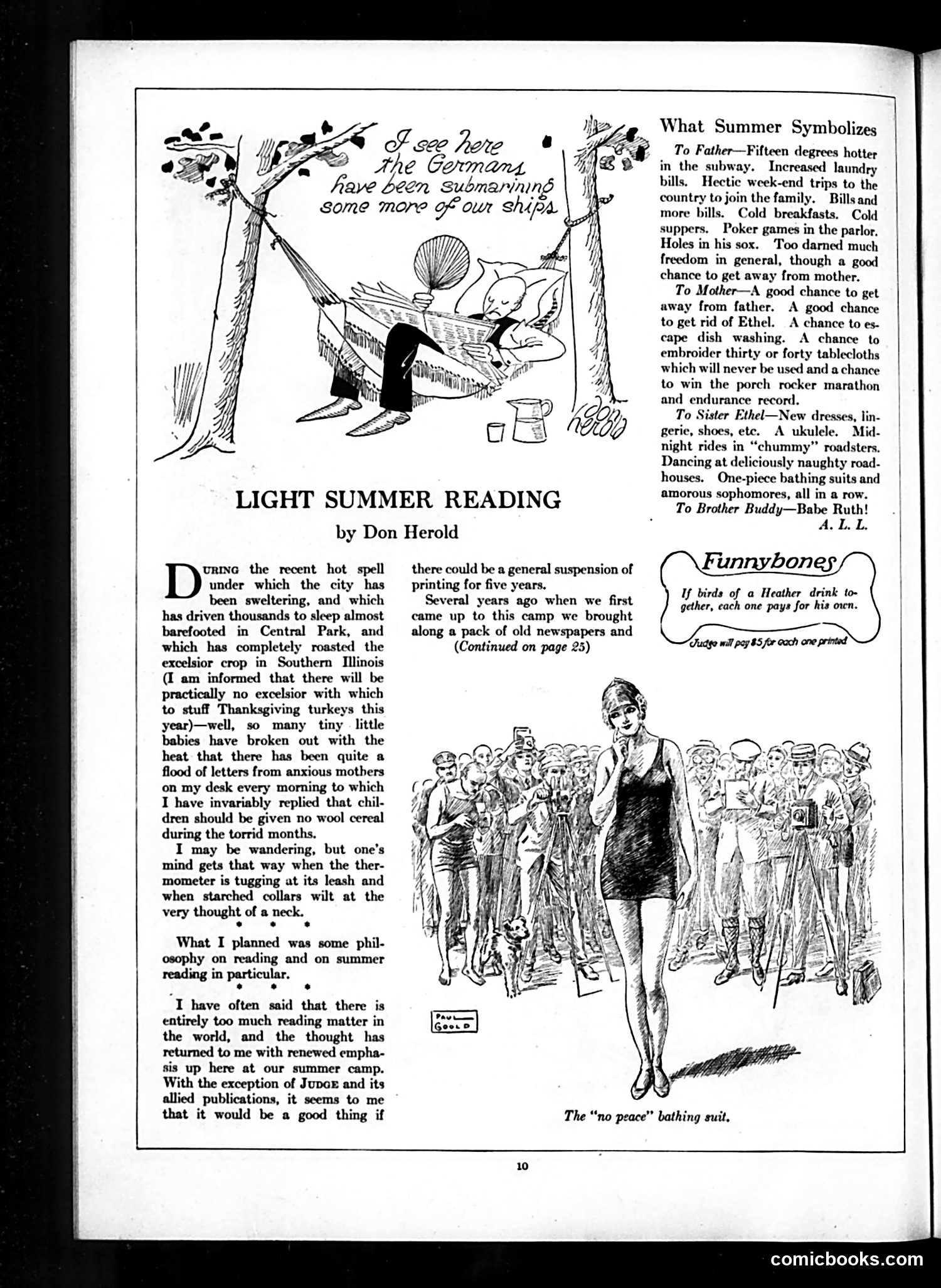
This is a humorous essay by Don Herold about summer leisure and reading, paired with satirical observations of family dynamics. **Main Content:** Herold complains about the oppressive heat in the city and argues there's too much reading material published worldwide—he'd prefer a five-year printing suspension. He notes that summers at camp became bearable years ago when they brought old newspapers for entertainment. **The Sidebar: "What Summer Symbolizes"** This is biting social satire listing what summer means to different family members. For the father: subway heat, bills, forced family trips, lost freedom. For the mother: escape from the father, household drudgery, pointless embroidery projects. For sister Ethel: fashionable clothes, ukuleles, late-night car dates, and "amorous sophomores"—suggesting sexual adventure. For brother Buddy: baseball (Babe Ruth reference). The humor lies in exposing family members' conflicting desires and the mother's particular domestic entrapment, while the sister's passage hints at 1920s youth rebellion and dating culture. The "no peace bathing suit" cartoon mocks one-piece swimwear popularity.
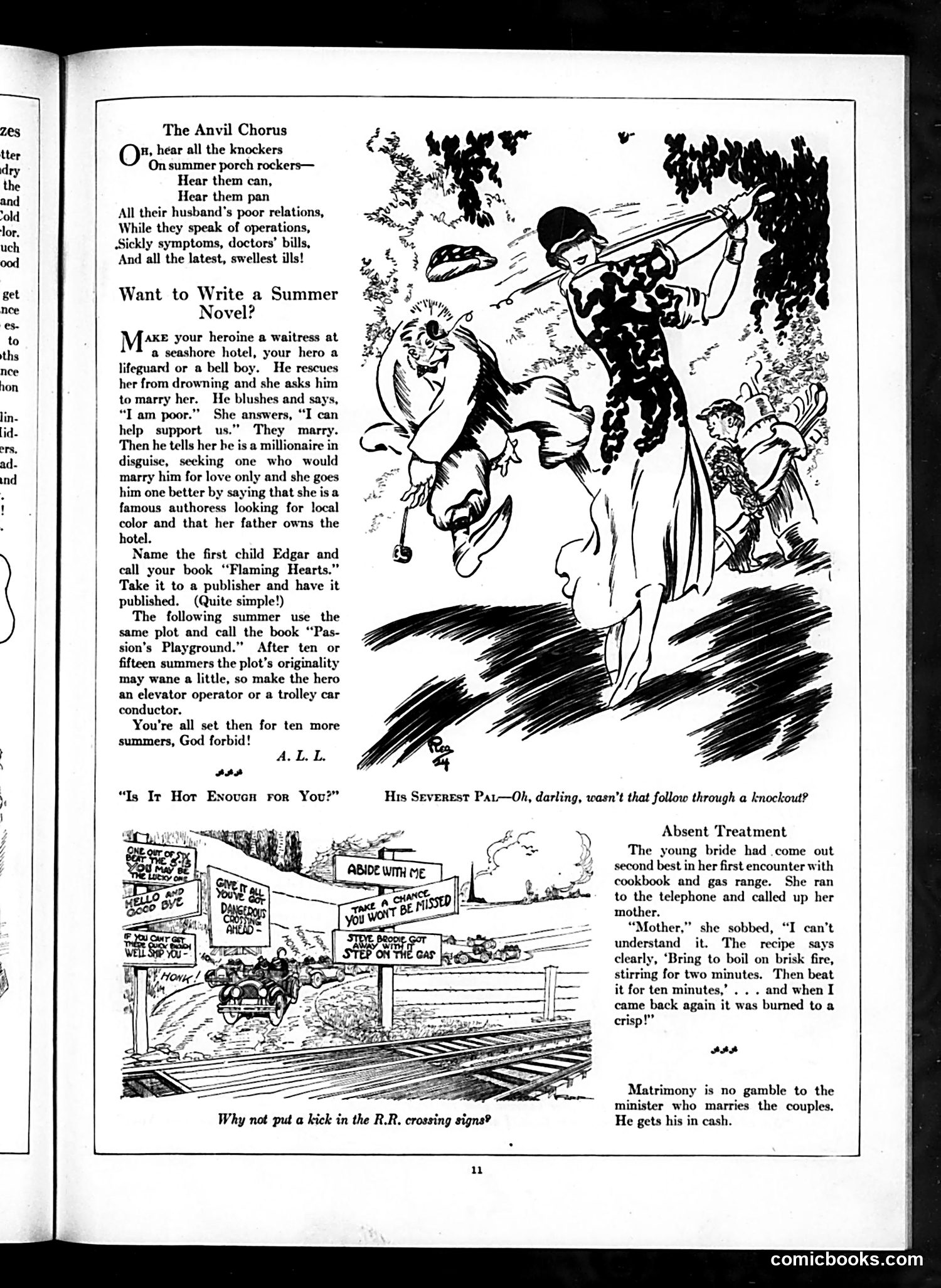
This page contains three distinct satirical pieces mocking early 1900s domestic life: **"The Anvil Chorus"** lampoons women gossiping on summer porches, endlessly complaining about husbands' relatives, medical ailments, and doctors' bills—the "knockers" producing noise like an anvil. **"Want to Write a Summer Novel?"** parodies formulaic romantic fiction: waitress heroine, lifeguard hero, poverty-to-wealth revelation, famous authoress twist. The joke mocks the predictable, recycled plots publishers churned out annually, suggesting writers could reuse the same story indefinitely with minor character changes (elevator operator instead of lifeguard). **The cartoons below** satirize newlywed incompetence: a boxing/boxing-match reference about marital disagreements, and "Absent Treatment" ridicules a young bride's failure to follow basic cooking instructions, burning her dish while calling mother for help—mocking both new wives' domestic ignorance and their dependence on their mothers. **"Matrimony is no gamble to the minister"** is a cynical one-liner: clergy collecting marriage fees regardless of outcome. The page's overall theme: women's domestic inadequacy and gossip.
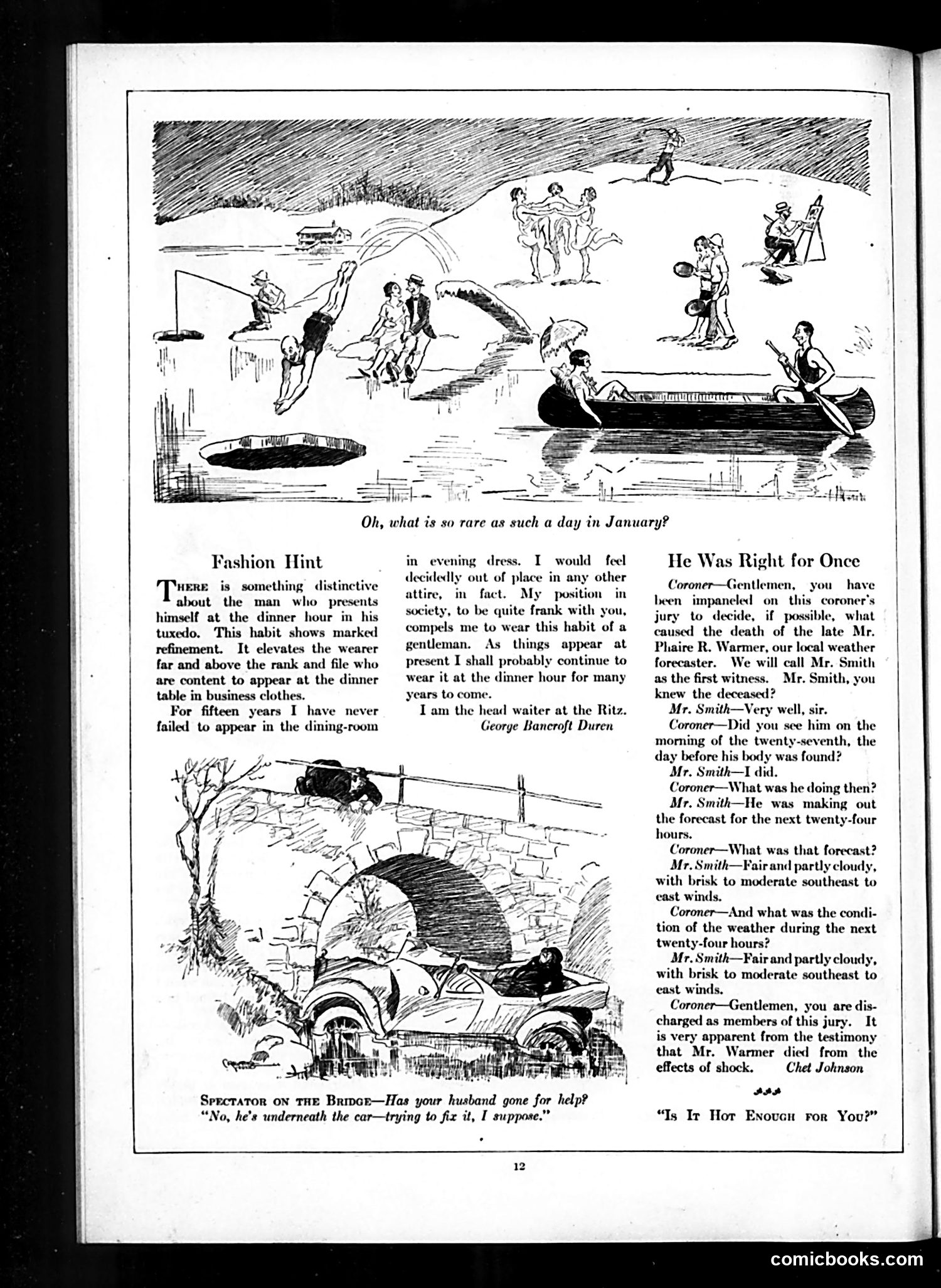
This page contains two distinct pieces of satire: **"Fashion Hint"** mocks snobbish dinner etiquette. A head waiter at the Ritz defends wearing a tuxedo to formal dinners as a marker of "refinement" and social superiority, dismissing those in business clothes as inferior. The satire targets pretentious class consciousness and rigid social conventions around formal dress. **"He Was Right for Once"** is a coroner's inquest joke mocking a weather forecaster (Mr. Phaire R. Warmer) who died from shock. The humor lies in the absurdist irony: the forecaster predicted "fair and partly cloudy" weather, which came true—making his prediction correct for once. His shock at being right literally kills him. This satirizes the apparent incompetence of weather forecasters as a running social joke. The bottom cartoon shows a woman reassuring a spectator that her husband is "underneath the car—trying to fix it," another genteel domesticity joke about male mechanical incompetence.
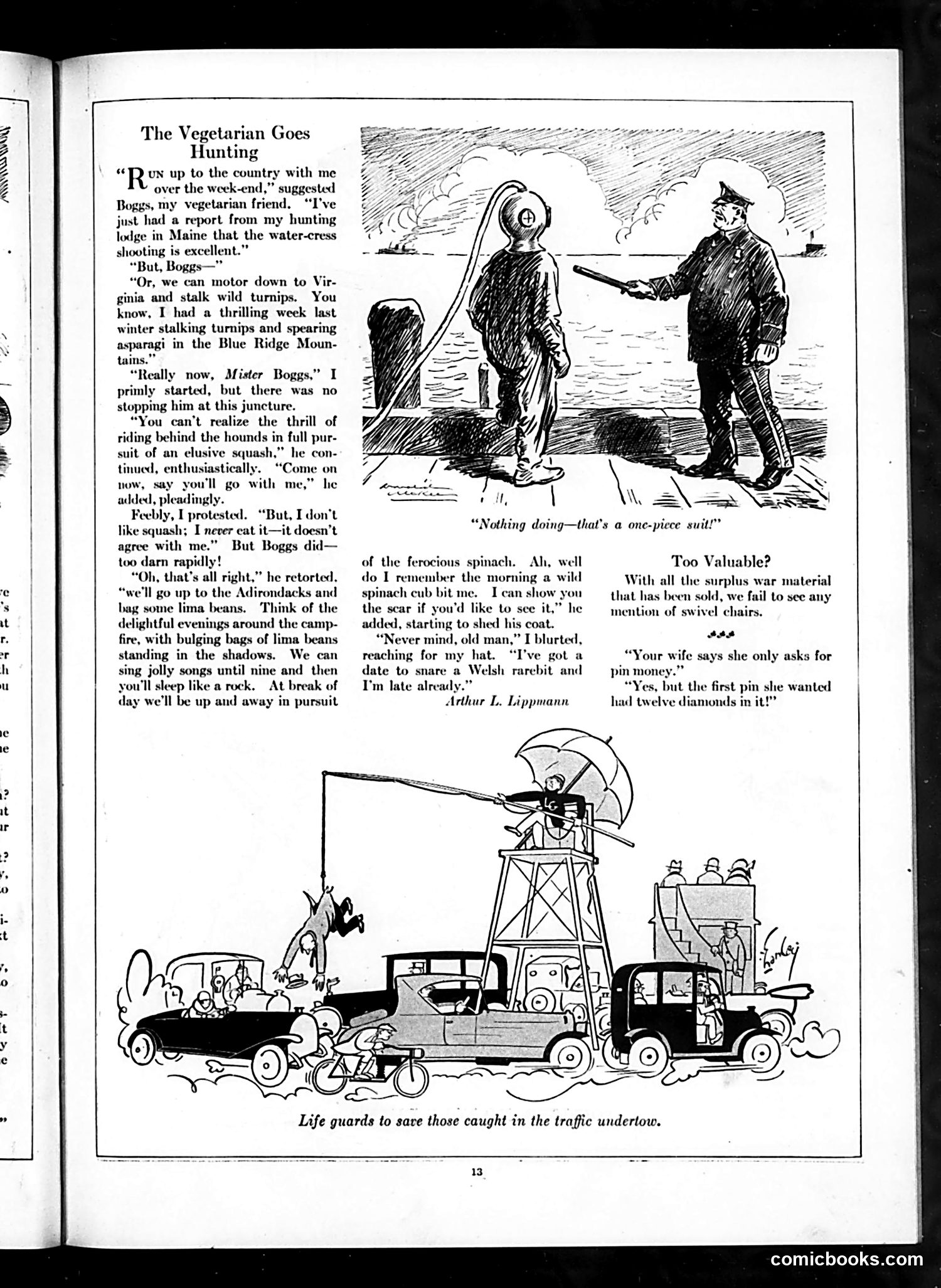
This is a humorous story-cartoon mocking vegetarians by literalizing their diet through hunting metaphors. The protagonist's vegetarian friend "Boggs" describes pursuing vegetables with the language and enthusiasm of traditional game hunting—"stalking" turnips, "riding behind hounds" chasing squash, and "bagging" lima beans as if they were wild animals. The absurdity is the joke: vegetarians are portrayed as so committed to avoiding meat that they've adopted all the trappings of hunting culture but applied ridiculously to produce. The accompanying cartoon shows a woman in hunting attire being offered a rifle, with her rejecting it as "a one-piece suit"—a visual pun on the phrase "one-piece" (the garment vs. the weapon). Below, "Too Valuable?" contains unrelated office humor about a wife requesting "pin money" (allowance) but wanting expensive diamond pins instead. This reflects early 20th-century attitudes: mild mockery of vegetarianism as an eccentric lifestyle choice, presented through exaggerated sporting-life imagery typical of Judge's satirical style.
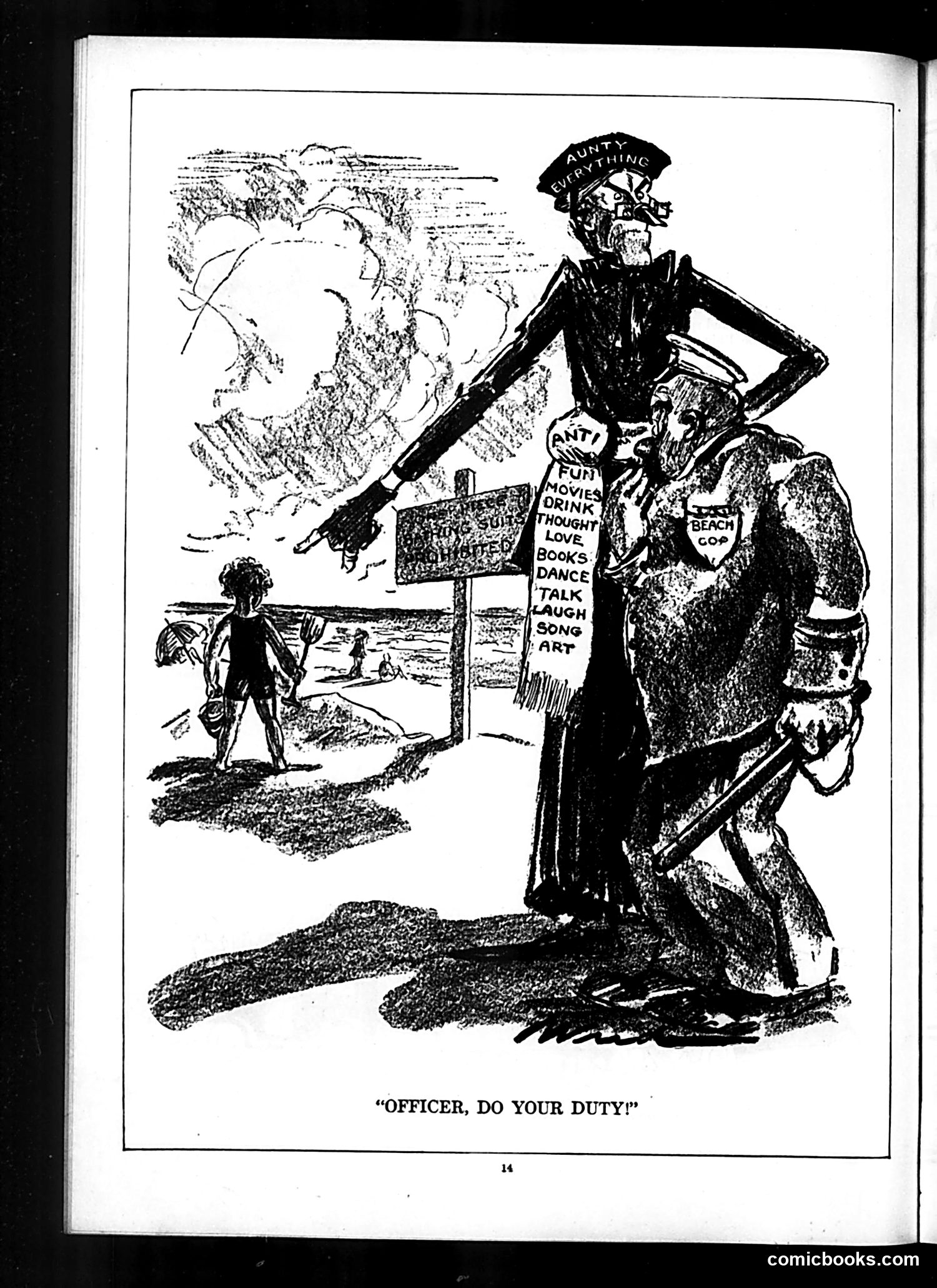
This cartoon depicts a skeletal figure labeled "Aunty Everything" wielding a large club, standing over a sign listing various activities: "Movies, Drink, Thought, Love, Book, Dance, Talk, Laugh, Song, Art." A small child stands in the background near what appears to be a beach or seaside scene. The satire targets censorship and moral busybodies of the early 20th century. "Aunty Everything" represents overzealous authority figures or reform movements attempting to suppress or regulate nearly all forms of entertainment and expression. The "Officer" in the caption suggests appealing to law enforcement to enforce these restrictions. The child represents youth whose freedoms are being threatened by excessive moral policing.
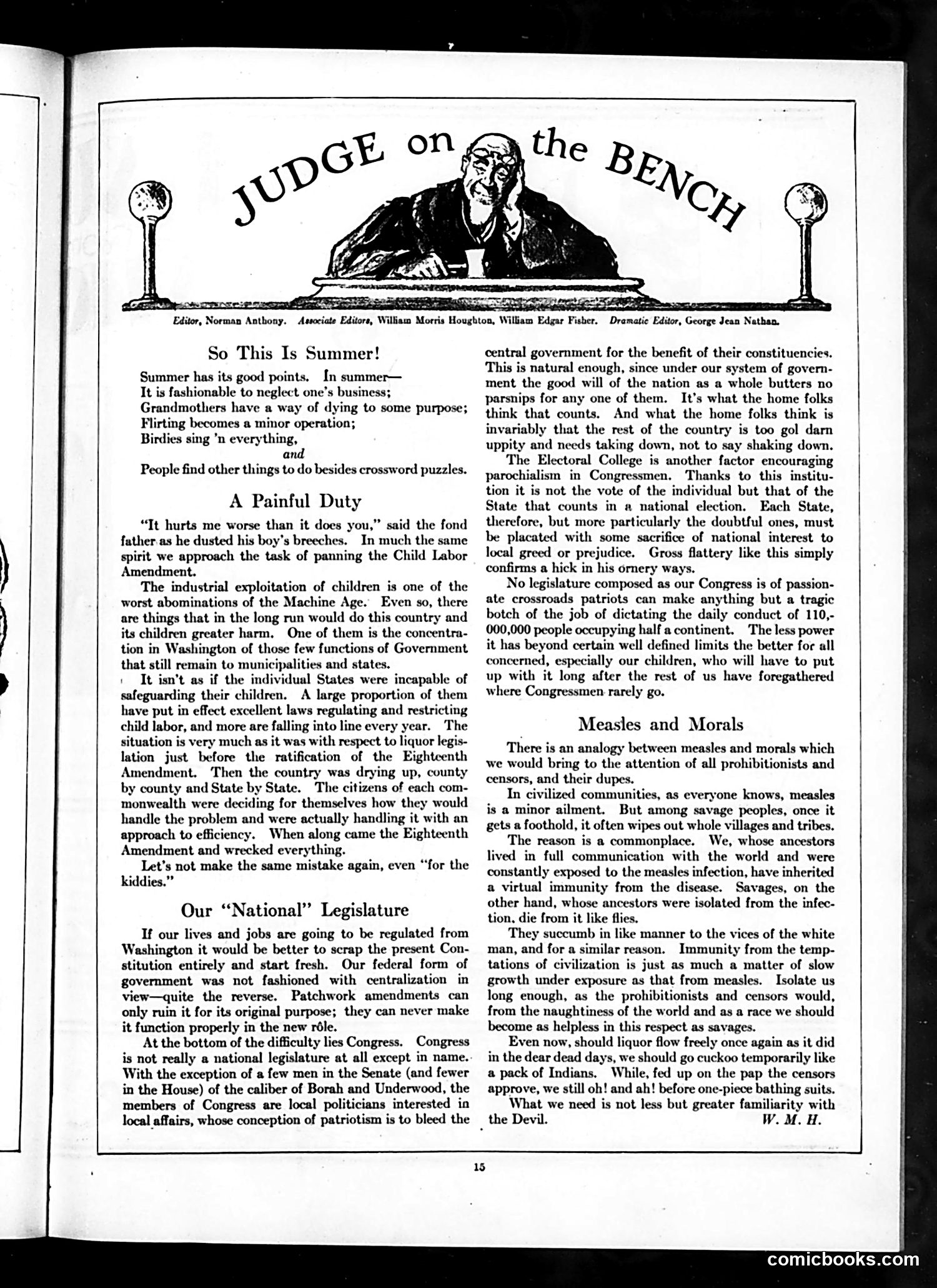
This page from Judge magazine contains three satirical essays criticizing federal centralization and advocating states' rights. **"So This Is Summer"** is a lighthearted opening, listing summer's pleasantries. **"A Painful Duty"** opposes a proposed Child Labor Amendment, arguing that while child exploitation is wrong, concentrating regulatory power in Washington poses greater danger. The author draws a parallel to Prohibition, claiming states were already successfully addressing child labor individually before federal intervention would "wreck everything." **"Our 'National' Legislature"** attacks Congress itself, claiming most members are parochial politicians serving local interests rather than national ones. The Electoral College system, the author argues, forces candidates to placate swing states over national welfare. The piece contends Congress cannot competently regulate 110 million people and should have limited powers. **Context**: This reflects 1920s-30s conservative opposition to New Deal-style federal expansion, advocating federalism and limited central government.
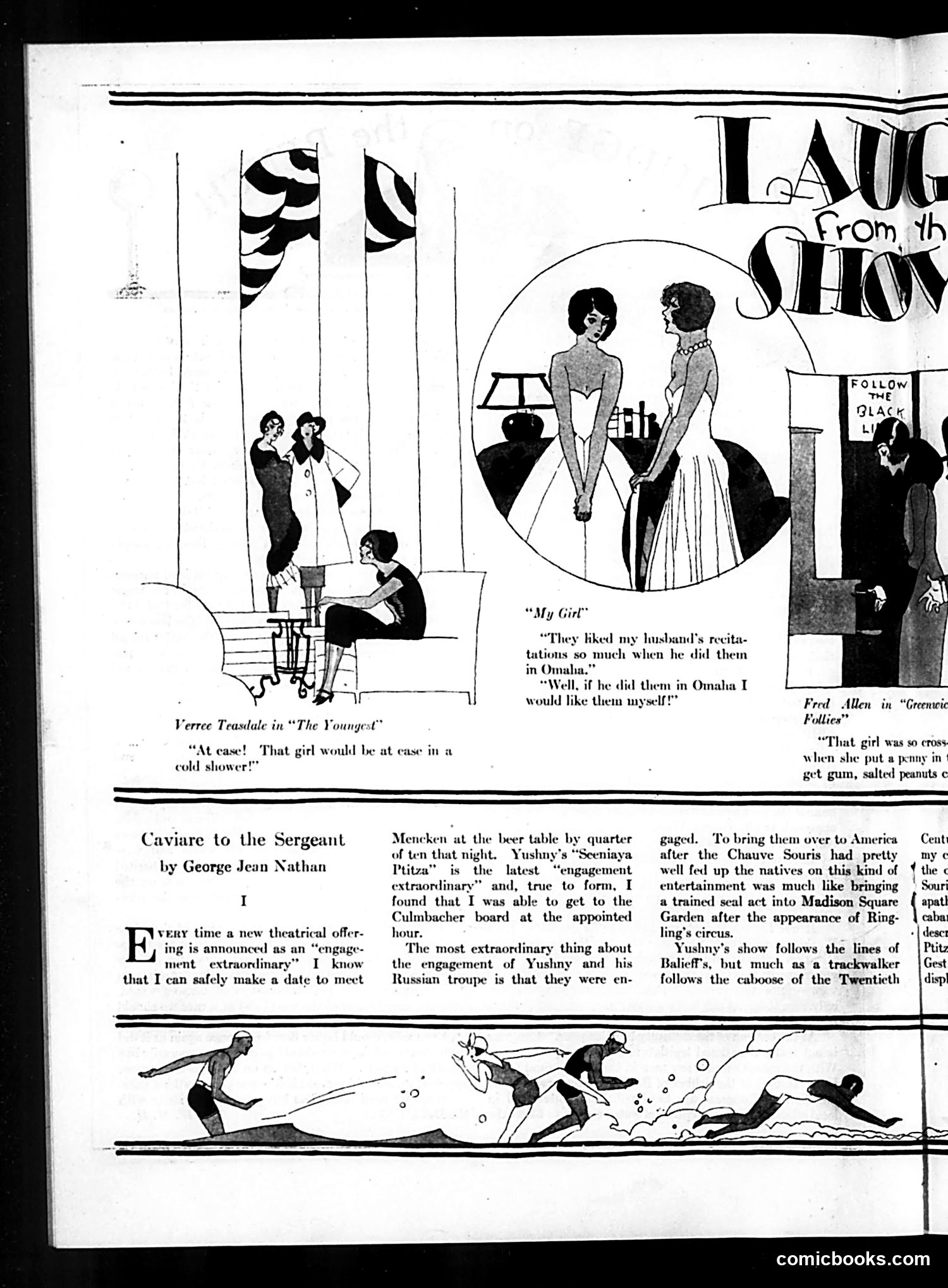
This page contains theatrical reviews and satirical commentary on 1920s Broadway entertainments. **Main Article**: George Jean Nathan critiques Yushny's Russian theatrical troupe as the latest hyped "engagement extraordinary." Nathan, a prominent drama critic, sarcastically notes that after the popular French revue *Chauve-Souris* (literally "Bat") had already saturated American audiences with similar exotic entertainment, bringing another Russian act feels redundant—like staging a trained seal act after a major circus. **Top Cartoons**: Quick humor sketches mocking social situations—women's fashion, domestic life, and dating behavior typical of 1920s Judge magazine satire. **Context**: The page reflects Jazz Age appetite for European avant-garde theater while simultaneously mocking it as a passing fad. Nathan's snobby, knowing tone was characteristic of his influential criticism.
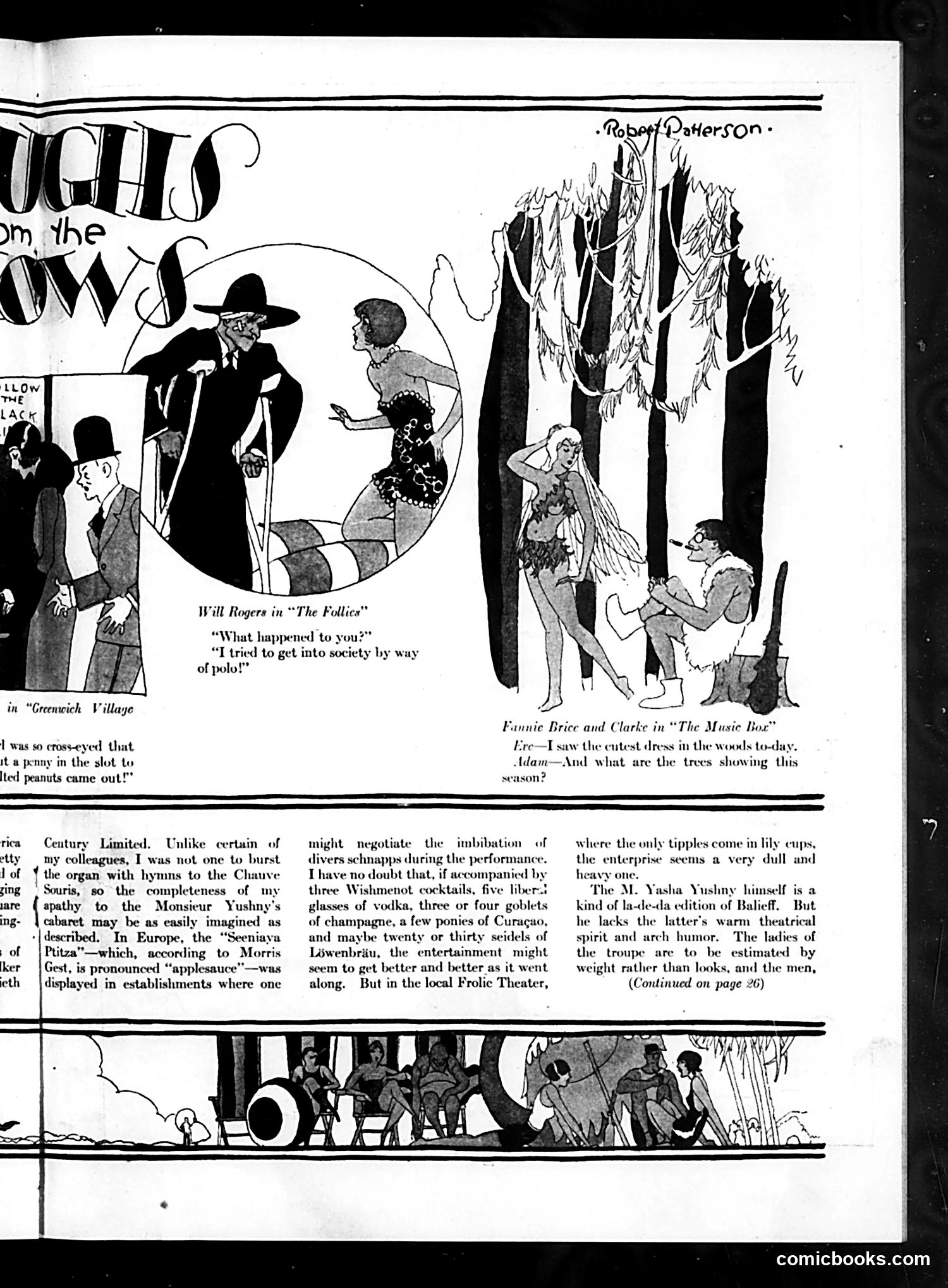
This page showcases Broadway entertainment reviews and satirical commentary typical of 1920s Judge magazine. **The cartoons** feature three movie/theater jokes: - Will Rogers attempting to enter high society through polo (mocking the artificiality of class aspiration) - A "Greenwich Village" gag about cross-eyed penny-slot mechanics - Fannie Brice and Clarke in a woodland costume joke about trees and fashion **The main text** reviews a Russian cabaret performance—likely the "Chauve Souris" (Bat)—touring in America. The critic dismisses the Yasha Yushny troupe as a pale imitation of Morris Gest's superior European production. The satire targets: - American pretension toward European "high culture" - The necessity of alcohol to enjoy experimental theater - The troupe's physical unattractiveness (commenting cruelly on performers' weight) The piece exemplifies Judge's sophisticated, somewhat snobbish humor aimed at educated, urban readers skeptical of both imported cultural trends and their American imitators.
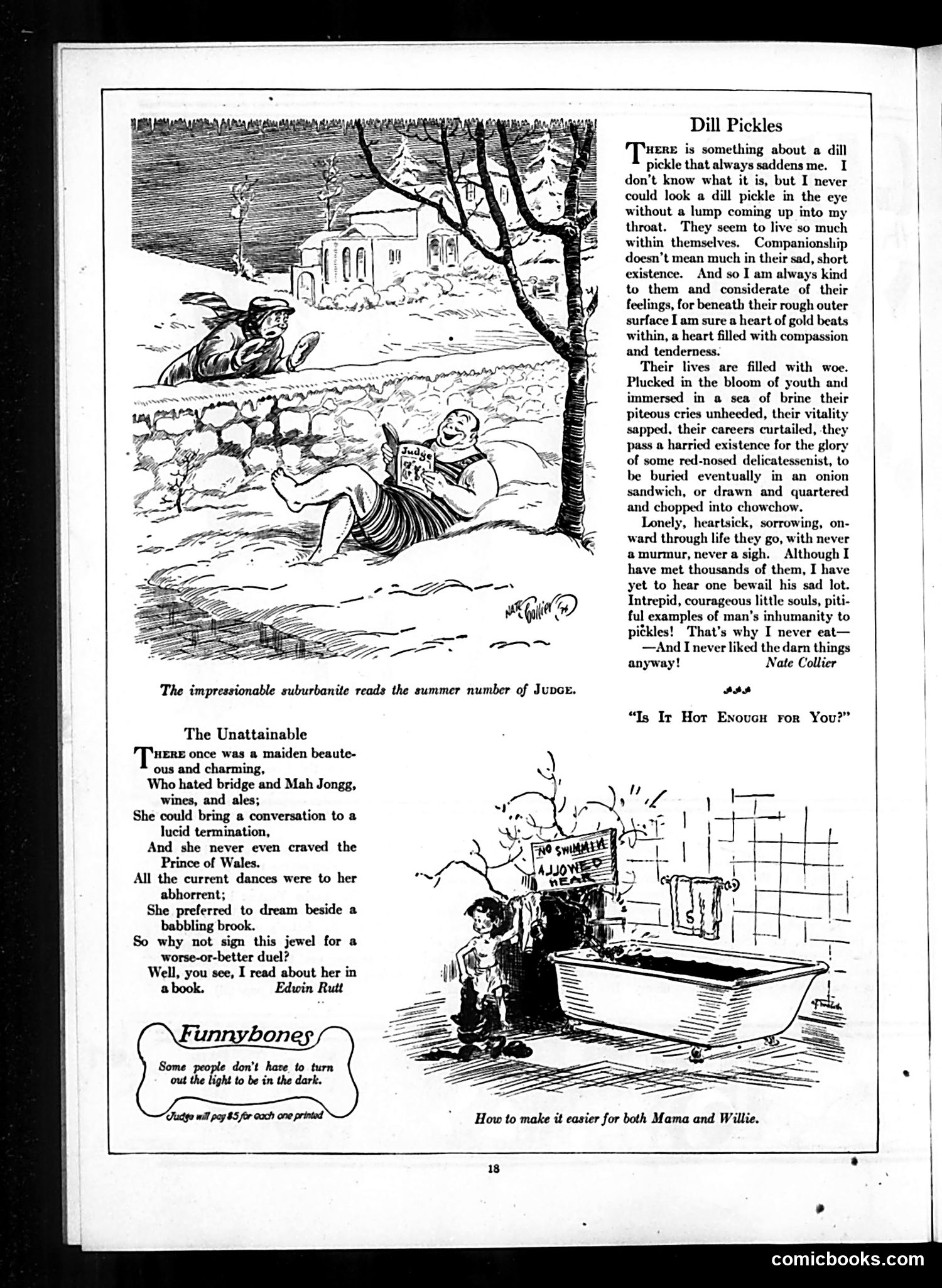
This page contains three distinct satirical pieces: **"Dill Pickles"** (Nate Collier): A humorous mock-serious essay anthropomorphizing pickles, treating them as tragic figures destined for consumption. It's absurdist humor—the author ironically expresses deep sympathy for pickles' "sad existence" while simultaneously admitting he never liked eating them anyway. The joke relies on overwrought emotional language applied to an absurd subject. **"The Unattainable"** (Edwin Rutt): A poem satirizing impossible ideals in women. It describes a woman who rejects current fashions (bridge, Mah-Jongg, dancing) and desires only simple pleasures—yet remains perpetually unavailable because "I read about her in a book." The satire targets how men construct idealized women from literature rather than accepting real ones. **"Is It Hot Enough for You?"**: A cartoon showing a child in a bathtub labeled "No Smut Here" with an adult nearby, captioned "How to make it easier for both Mama and Willie." The joke appears to reference bathing during summer heat, though the exact meaning is unclear without additional context.
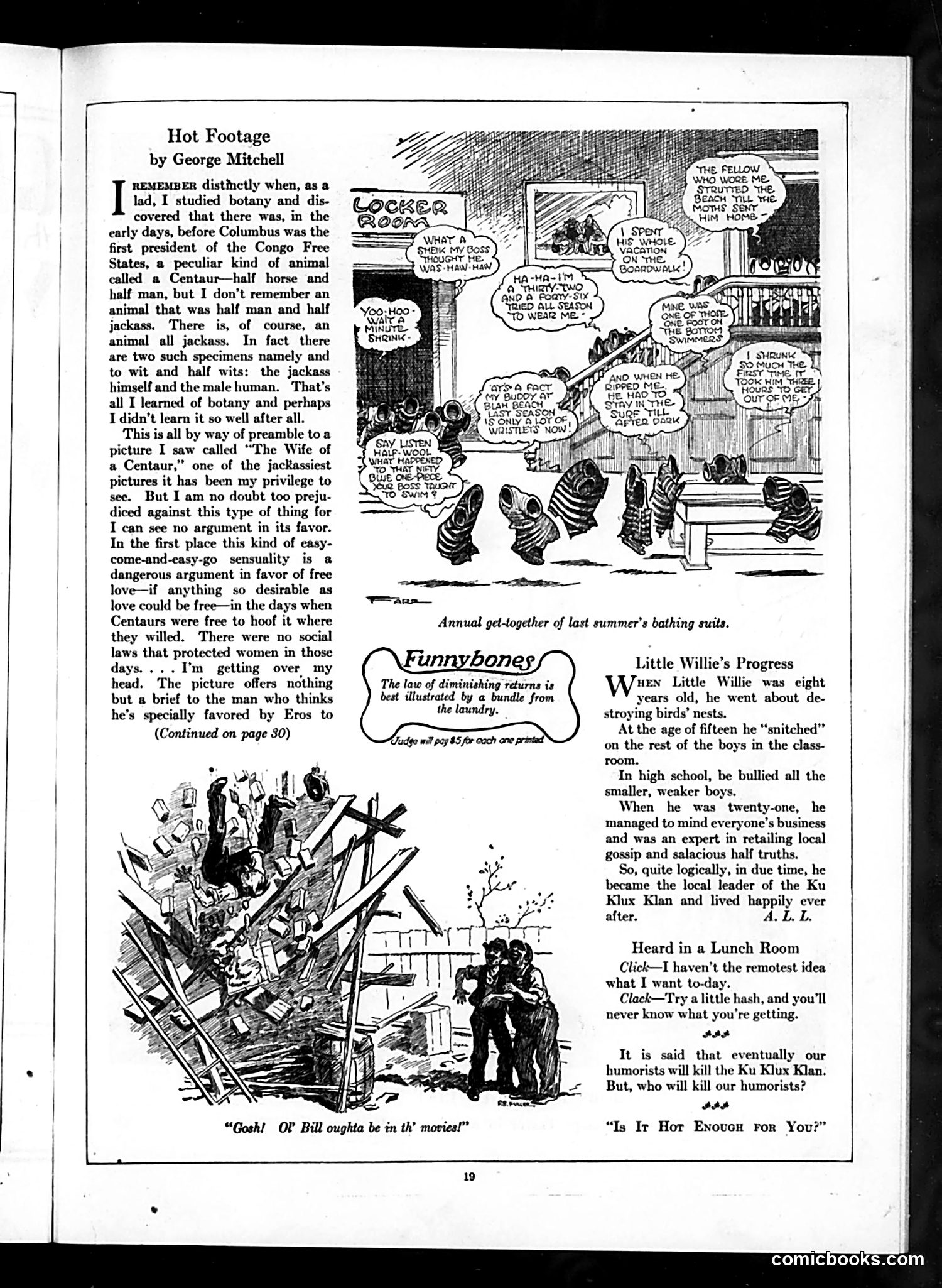
This page contains multiple satirical pieces: **"Hot Footage"** critiques a risqué film called "The Wife of a Centaur." The author argues such "easy-come-and-easy-go sensuality" dangerously promotes free love by depicting mythological creatures without social constraints protecting women—a concern reflecting 1920s moral anxieties about cinema's influence. **"Little Willie's Progress"** is biting social satire: Willie evolves from destructive child to neighborhood busybody to KKK leader, presented as a logical progression. The final caption—"It is said that eventually our humorists will kill the Ku Klux Klan. But, who will kill our humorists?"—suggests the magazine itself recognized the KKK as a threat yet feared satire alone couldn't stop it. This appears to critique both the organization and satirists' limited effectiveness. The other cartoons address everyday observations about bathing suits and restaurant dining. The page reflects 1920s-30s concerns: cinema's moral impact, rise of the KKK, and satire's role in social commentary.
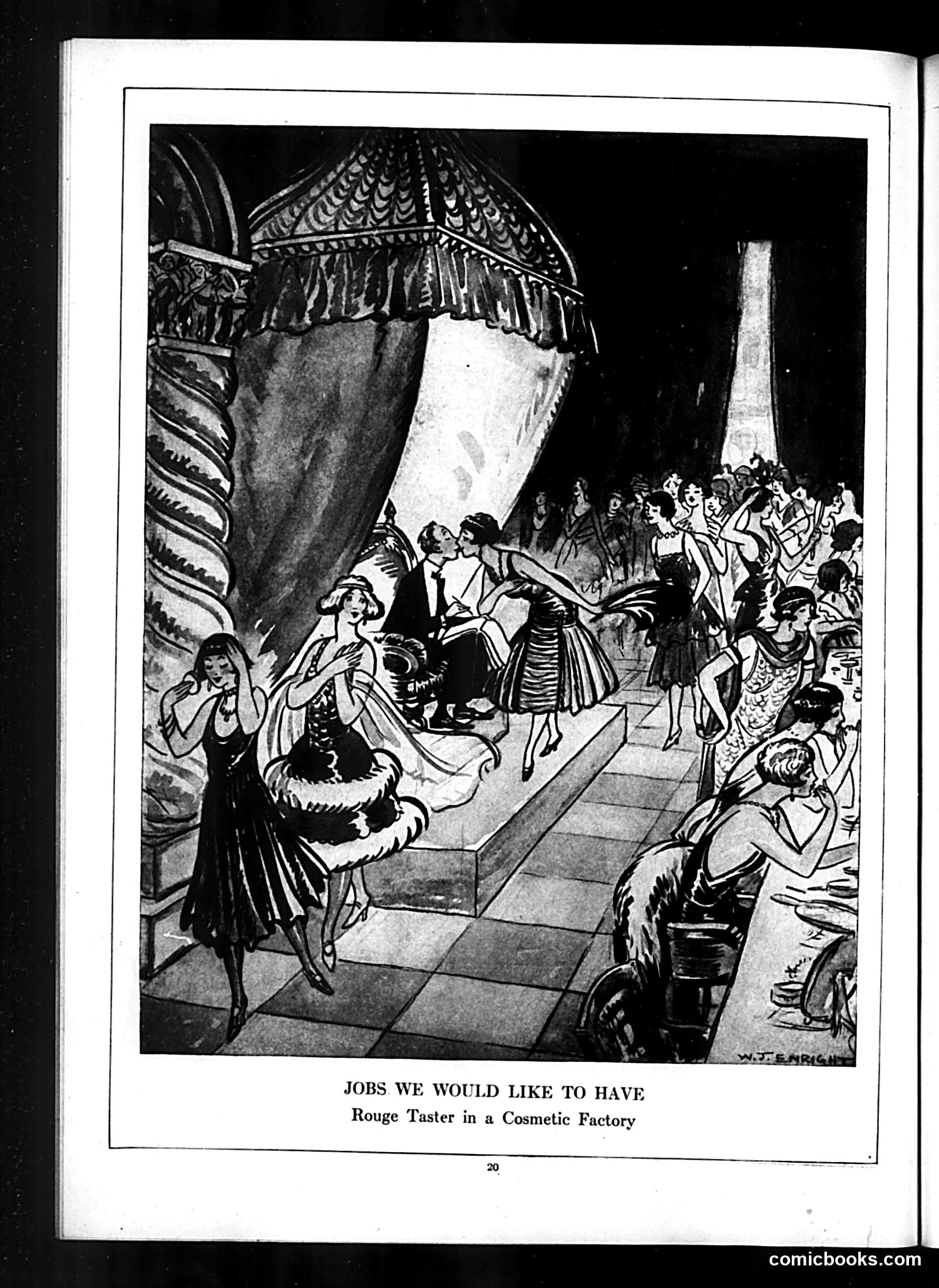
This satirical cartoon is titled "Jobs We Would Like to Have," presenting a humorous fantasy about cosmetic factory work. The illustration depicts an elaborate, ornate interior (possibly meant to evoke luxury or excess) where a woman in fashionable dress appears to be sampling or "tasting" rouge (face powder/blush). Numerous other women observe or participate in this activity. The satire likely mocks both the glamorization of cosmetics manufacturing and the absurdity of treating cosmetic testing as a desirable job. It may also satirize women's aspirations regarding beauty products and factory labor during this era. The ornate setting contrasts ironically with actual factory conditions, highlighting the gap between the fantasy of cosmetics work and its reality. The exact publication date is unclear from this page alone.
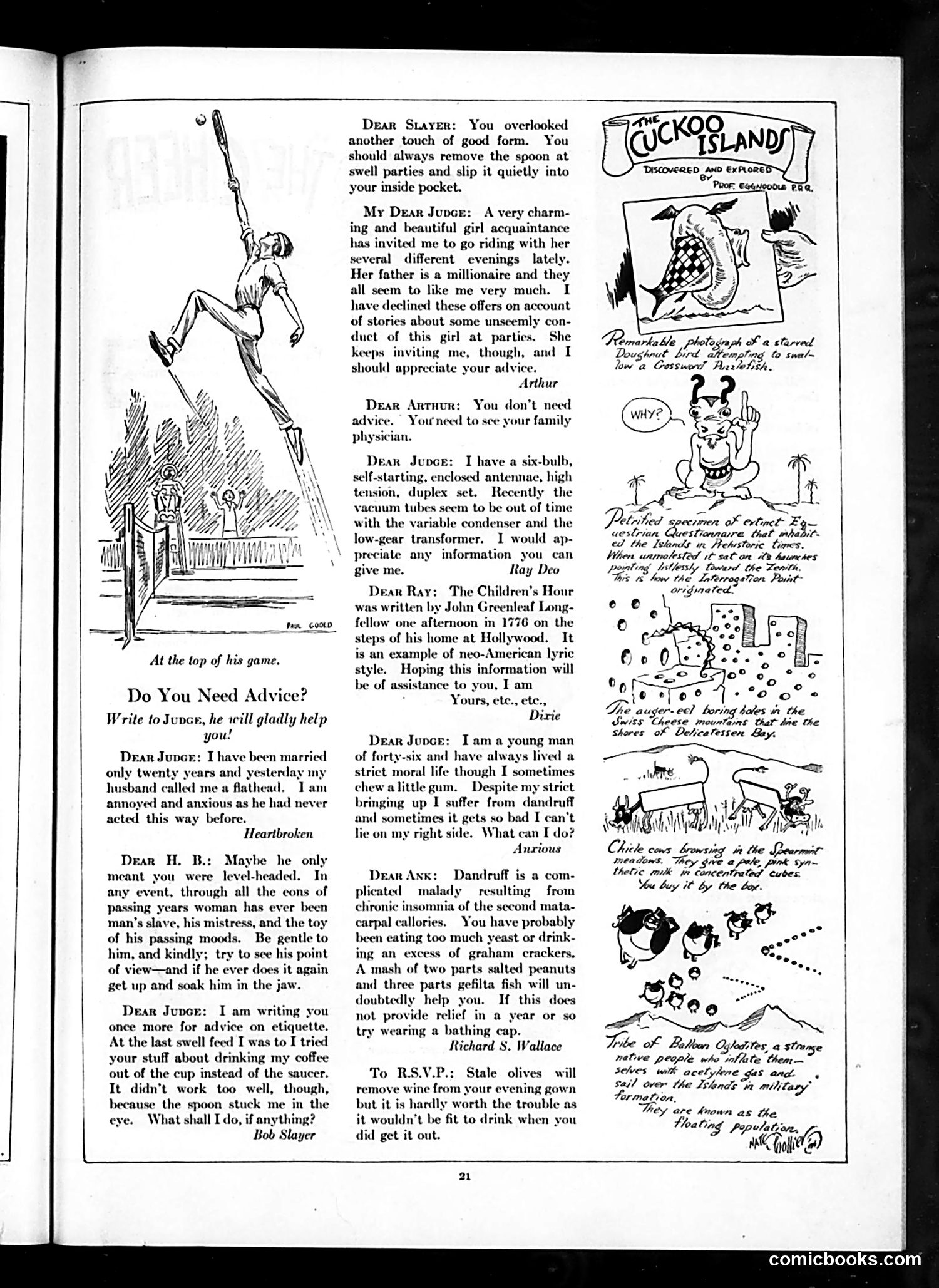
This page presents "Juvar's" advice column—a parody of serious advice columnists. The humor works through **deliberate absurdity**: the columnist gives wildly inappropriate, nonsensical, or dangerous advice to sincere questions. Examples include: - **"Soak him in the jaw"** for marital discord (violent overreaction) - **Removing the spoon into your pocket** as etiquette (absurd) - **Responding about "The Children's Hour"** to a radio question (completely wrong topic) - **Prescribing "gefilta fish and salted peanuts"** for dandruff (medical nonsense) The right-side illustrations labeled "The Cuckoo Island" mock pseudo-scientific or fabricated discoveries with fake captions about extinct creatures and imaginary phenomena. The satire targets both advice columnists' pretense of expertise and readers' gullibility. The magazine mocks early-20th-century confidence in quick-fix solutions to complex problems, presented with mock-authoritative tone.
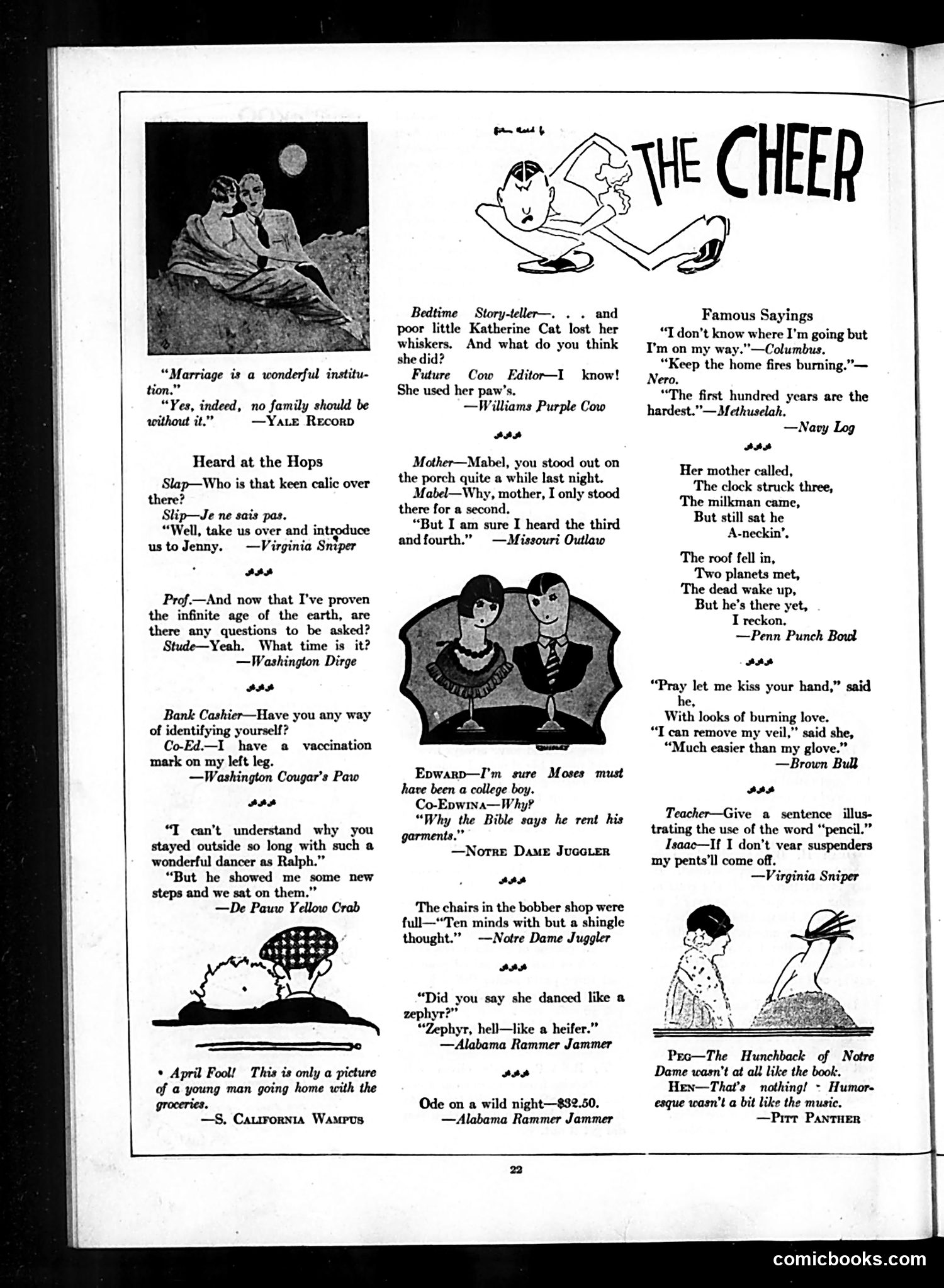
This is a humor page collecting short jokes and quips from college newspapers and humor magazines, typical of Judge's "The Cheer" column format. **Key content:** The jokes target college students and young people through romantic misunderstandings, wordplay, and campus life scenarios. Examples include: - A co-ed identifying herself by a vaccination mark (poking fun at women's limited identifying documents) - A couple sitting on dance steps rather than dancing (innuendo about petting/necking) - Isaac's malapropism about "pents" and suspenders (ethnic/class humor, possibly Jewish given the name) - Mock comparisons of movie adaptations to source material ("Hunchback of Notre Dame wasn't like the book") **Social context:** These reflect 1920s-era college culture, courtship customs, Prohibition-era references, and casual sexism. The repeated "neckin'" reference points to period anxieties about youth morality. Most jokes originate from university humor publications—Yale, Notre Dame, Washington, etc.—creating an in-group collegiate audience. The humor is mildly risqué but ultimately genteel by modern standards.
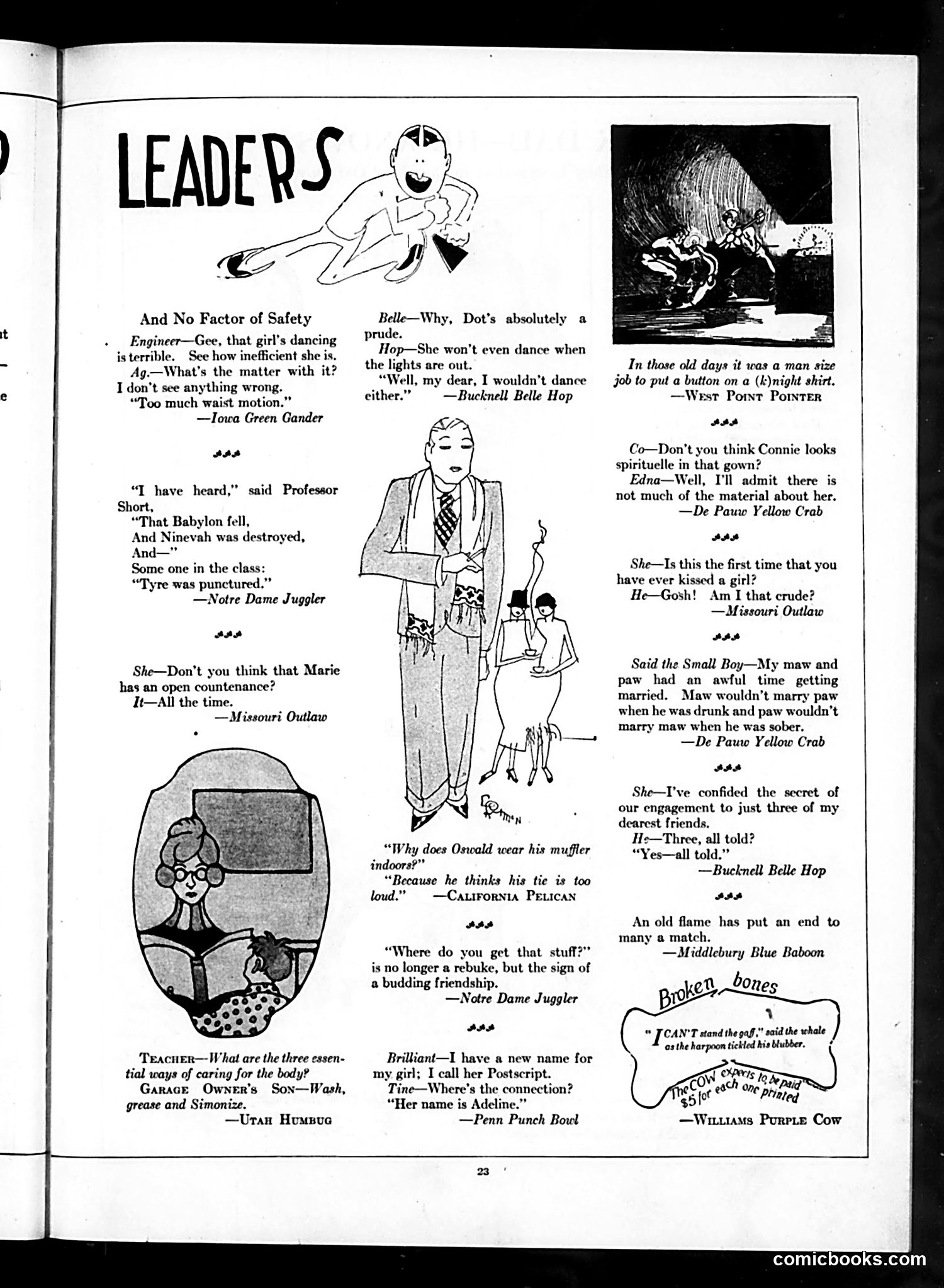
This is a humor page of short jokes ("Leaders") from Judge, a satirical weekly. The cartoons and quips mock social conventions and dating customs of the era. **Key humor themes:** - **Engineering critique** of dance ("too much waist motion"): Satire of overly technical, prudish attitudes toward women's bodies - **Historical collapse jokes**: Puns equating ancient civilizations' fall with modern trivialities ("Tyre was punctured") - **Dating awkwardness**: Multiple jokes about kissing, engagement secrets, and courtship etiquette - **Gender observations**: Jokes about women's modesty (won't dance with lights out), appearance, and "spirituelle" (refined) fashion - **Class humor**: The garage owner's son treating car maintenance language as body care The cartoon illustrations show flapper-era fashions and social situations. The overall tone satirizes both excessive prudishness and modern social pretension among young people, typical of 1920s-30s college humor magazines. Attribution credits go to various college publications (Notre Dame, Penn, etc.), suggesting this compiled student submissions.
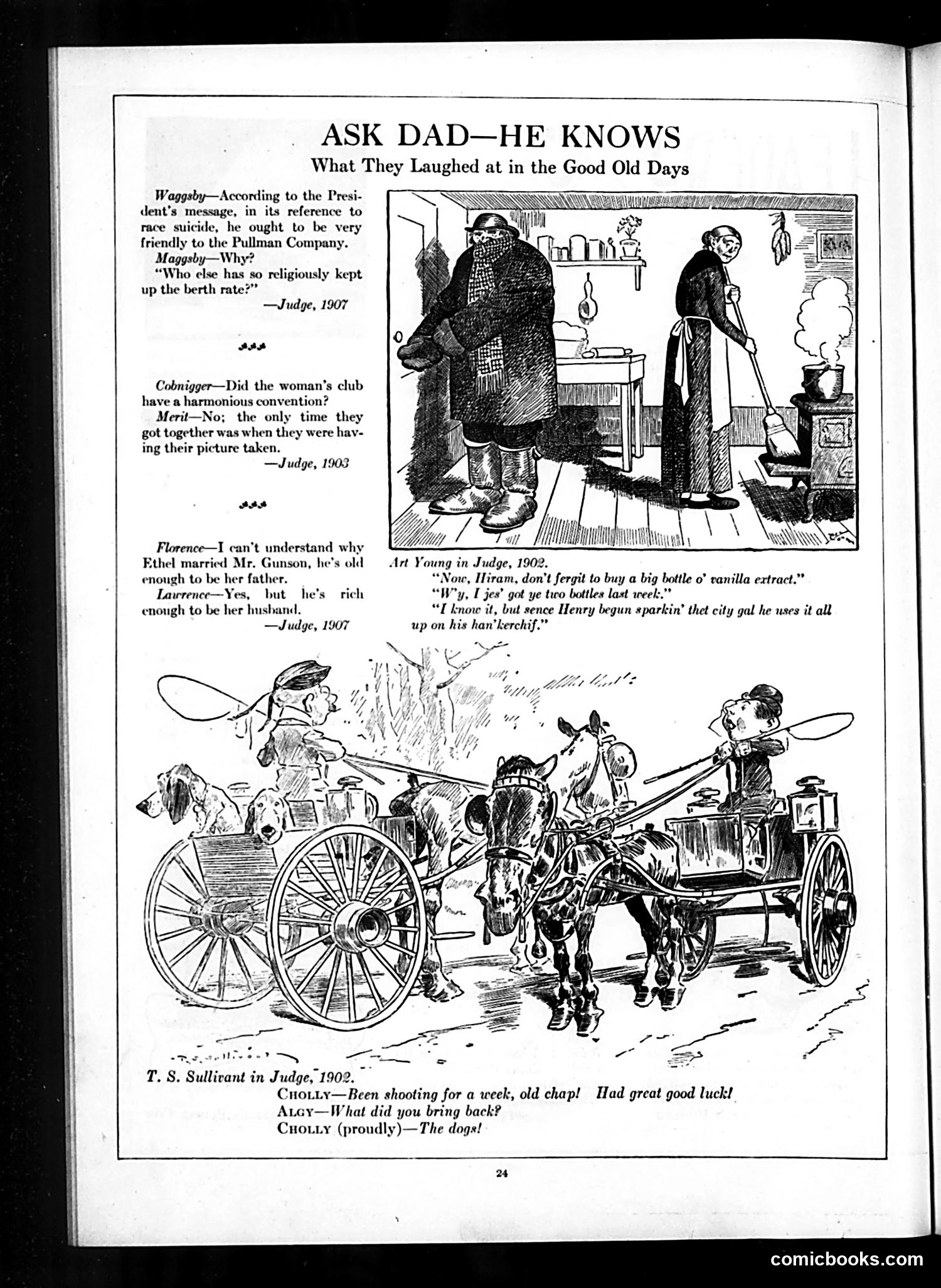
This page compiles short jokes from Judge's archives (1902-1907), presented as nostalgic humor. The cartoons and quips satirize early 1900s social anxieties: **Top joke**: References President Theodore Roosevelt's 1901 "race suicide" message warning that native-born Americans weren't reproducing enough. The pun mocks the Pullman Company's sleeping cars by suggesting their "berth rate" (births/berths) contributes to population growth—dark humor about demographic concerns. **Middle section**: A woman's club joke mocking female organizations as quarrelsome; the hunting cartoon depicts a wealthy hunter proudly returning with only his dogs, satirizing upper-class incompetence. **Bottom narrative**: Rural dialect humor about vanilla extract—actually used as alcohol during Prohibition concerns—with a young man using it as cologne to impress a city girl, mocking rural/urban class divisions and courtship rituals. The overall theme exploits period anxieties: immigration, women's organizations, wealth inequality, and rural-urban cultural gaps—presented as "quaint" nostalgia.
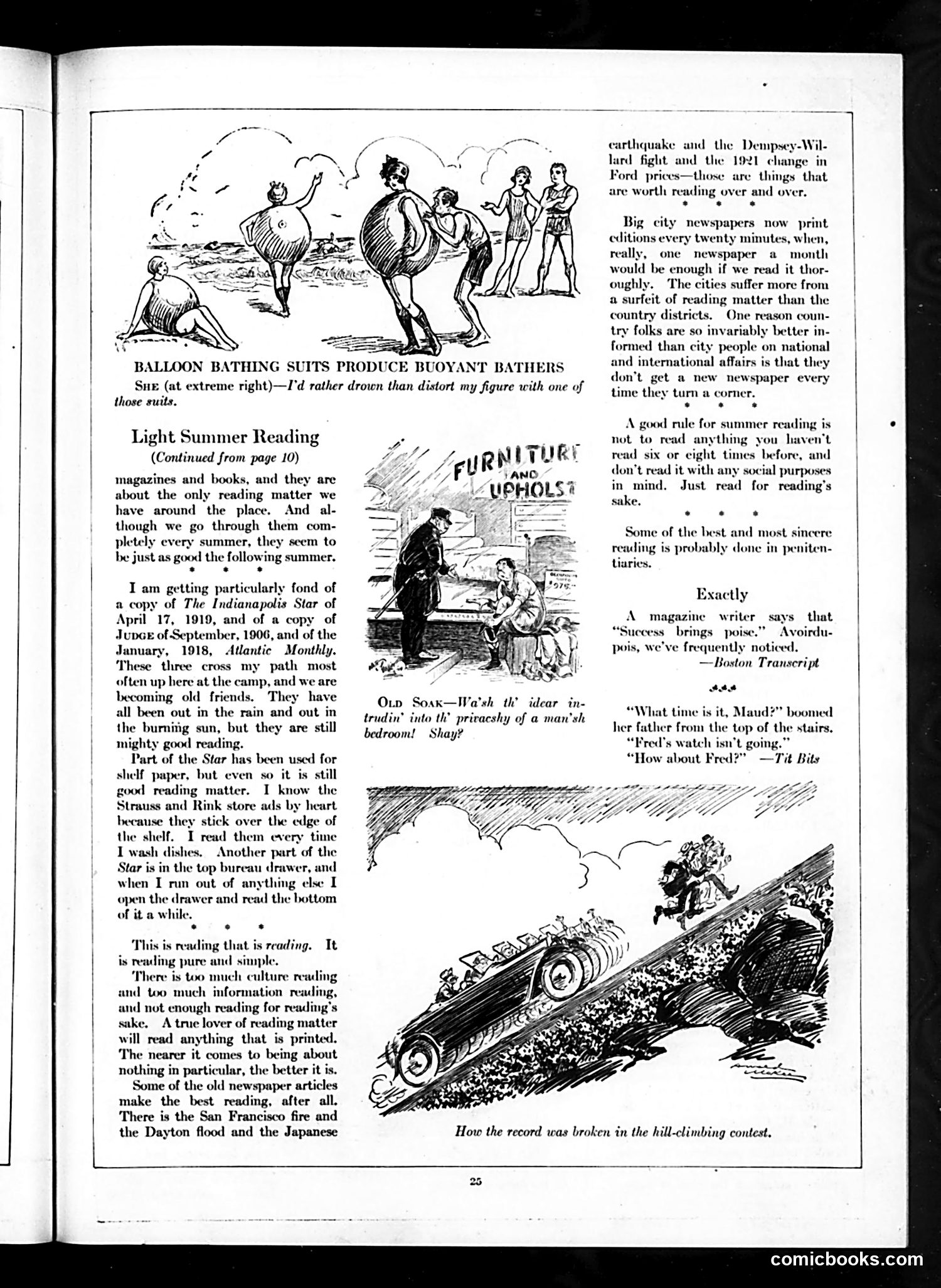
This Judge magazine page contains two distinct elements: **Top Cartoon**: "Balloon Bathing Suits Produce Buoyant Bathers" satirizes women's early 20th-century swimwear. The oversized, balloon-like suits were designed to be modest but rendered women comically buoyant and shapeless. The joke mocks both the impractical fashion and women's reluctance to wear such unflattering garments—Sue prefers drowning to wearing one. **Main Article**: "Light Summer Reading" is an essay praising simple, repetitive reading (old newspapers, discarded magazines) over constant consumption of news. The author argues reading for pleasure's sake—not information—is valuable, and that country people are better informed *because* they read less frequently and more thoroughly. It's social commentary critiquing urban newspapers' proliferation (new editions every twenty minutes) as excessive and counterproductive. The scattered jokes below are unrelated humor fillers typical of the era.
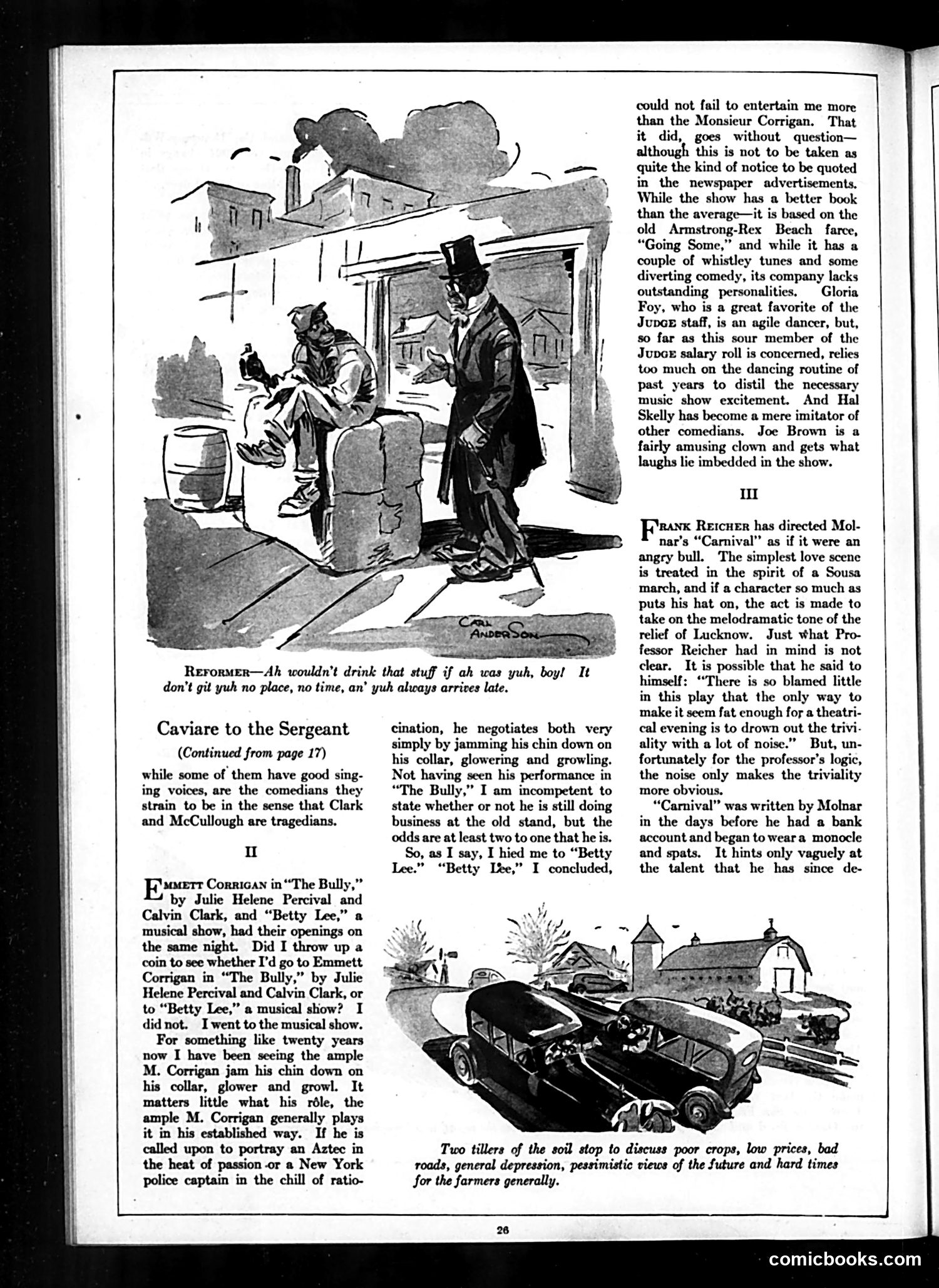
This is a theater critic's column reviewing three Broadway productions: "The Bully," "Betty Lee," and "Carnival." The cartoons and text work together to satirize both the shows and theatrical conventions. The main cartoon depicts a drunk "Reformer" warning others against alcohol—ironic social commentary on prohibition-era hypocrisy. Below, farmers discuss economic hardship, likely referencing 1920s agricultural depression. The critic skewers actor **Emmett Corrigan** for his one-note performance style—regardless of role (Aztec warrior, police captain), he performs identically, "jamming his chin down on his collar, glowering and growling." The review dismisses "Betty Lee" as mediocre despite better material, and savagely critiques director **Frank Reicher's** overly dramatic staging of Molnar's "Carnival," suggesting he artificially inflates trivial material with melodrama to fill an evening. The implication: Reicher compensates for weak material through directorial excess rather than serving the play's actual needs.
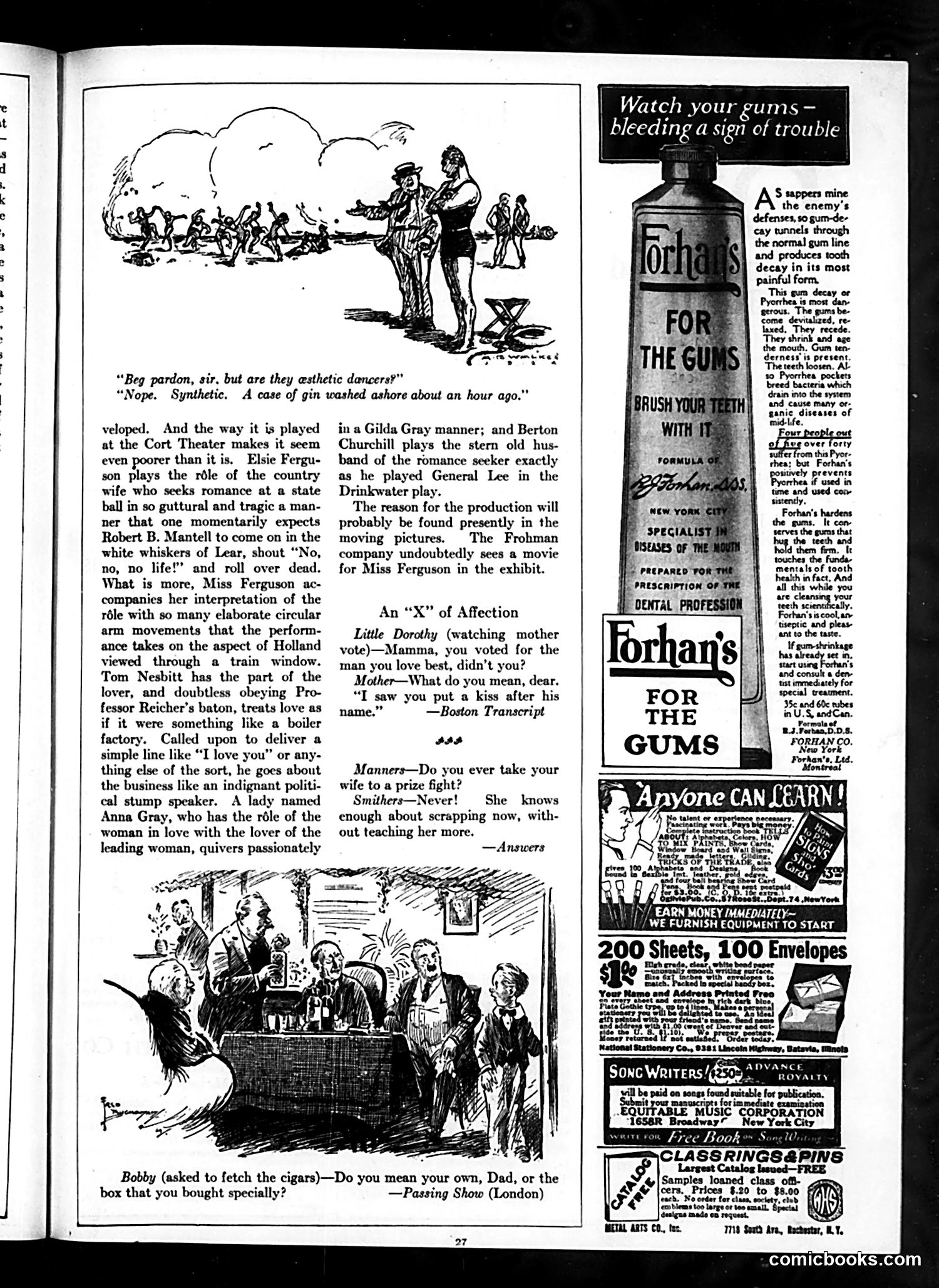
This page contains theatre criticism and humor pieces typical of Judge's satirical content, plus period advertisements. **The Main Cartoon:** The top sketch shows Prohibition-era satire. Two men observe people dancing near a large cloud/fog. One asks if they're "aesthetic dancers"; the other replies "Nope. Synthetic"—explaining they're actually intoxicated from "a case of gin washed ashore about an hour ago." This mocks Prohibition (then in effect) by suggesting even washed-up contraband alcohol was being consumed and caused erratic behavior mistaken for modernist dance. **Theatre Criticism:** The text reviews a play at the Cort Theater, criticizing actress Elsie Ferguson's overwrought, melodramatic performance with exaggerated arm movements. The comparison to "Holland viewed through a train window" is an absurdist jab at her stilted movements. **Humor Pieces:** Brief jokes about voting, prize fights, and cigars—light domestic comedy typical of the era. **Advertisements:** The right column features tooth powder, songwriting opportunities, and correspondence courses—standard period ads.
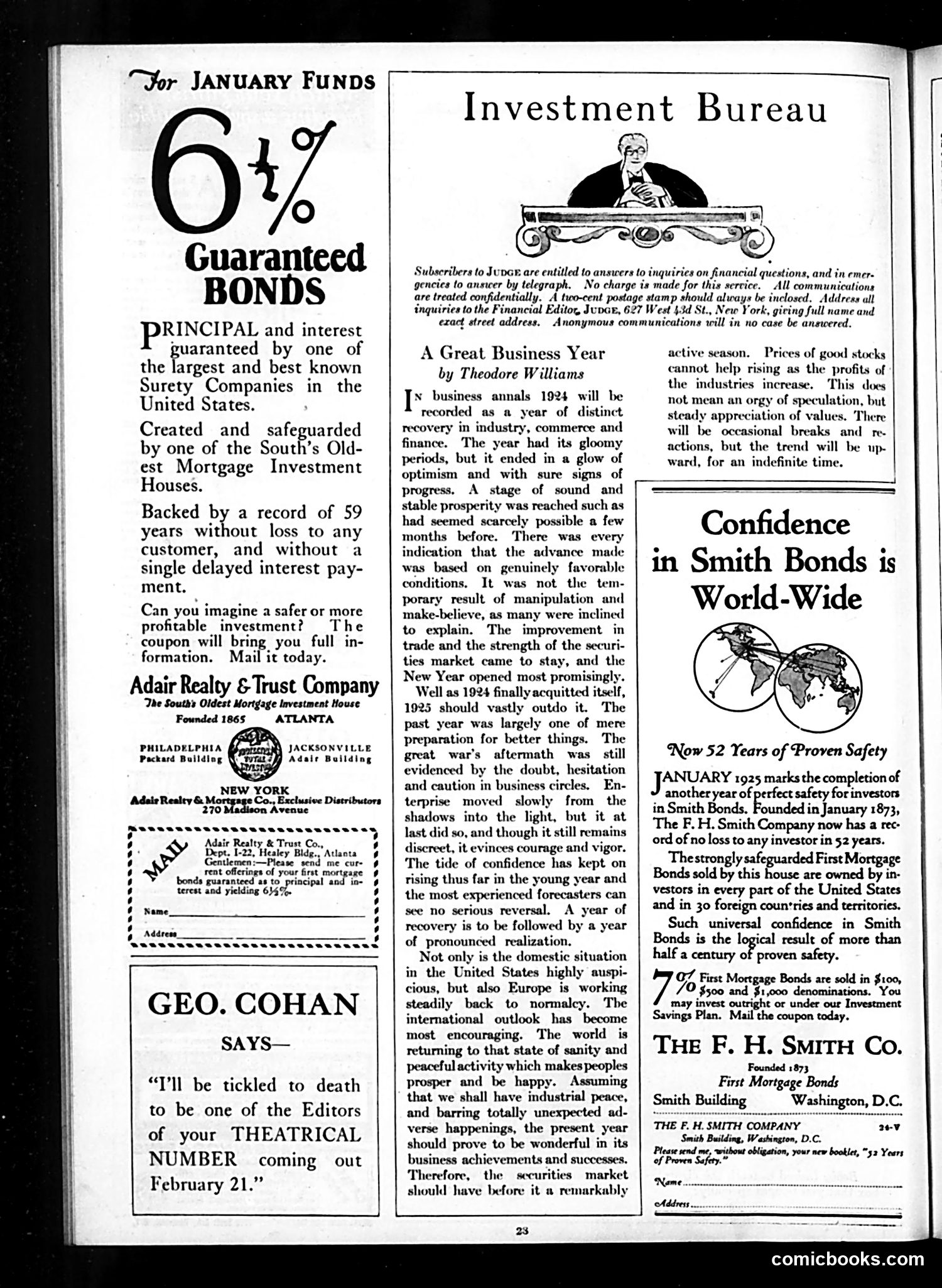
This page is **primarily advertising**, not political satire. It contains investment pitches for bonds and mortgages targeting wealthy readers. **Key content:** - **Adair Realty & Trust Company** advertises guaranteed 6.5% bonds backed by 59 years of safety—typical 1920s financial marketing emphasizing security and profit. - **The F.H. Smith Company** touts "52 Years of Proven Safety" in mortgages, claiming worldwide investor confidence and zero losses since 1873. - **Theodore Williams' article** optimistically forecasts 1925 as a year of business recovery and stock market growth, reflecting post-WWI economic confidence. - **George M. Cohan** (the famous playwright/actor) provides a celebrity endorsement for Judge's upcoming "Theatrical Number." The page reflects pre-1929 **financial optimism and confidence**—before the stock market crash revealed many such "guaranteed" investments were unsafe. The era's investment culture promised security while actively courting wealthy speculators.
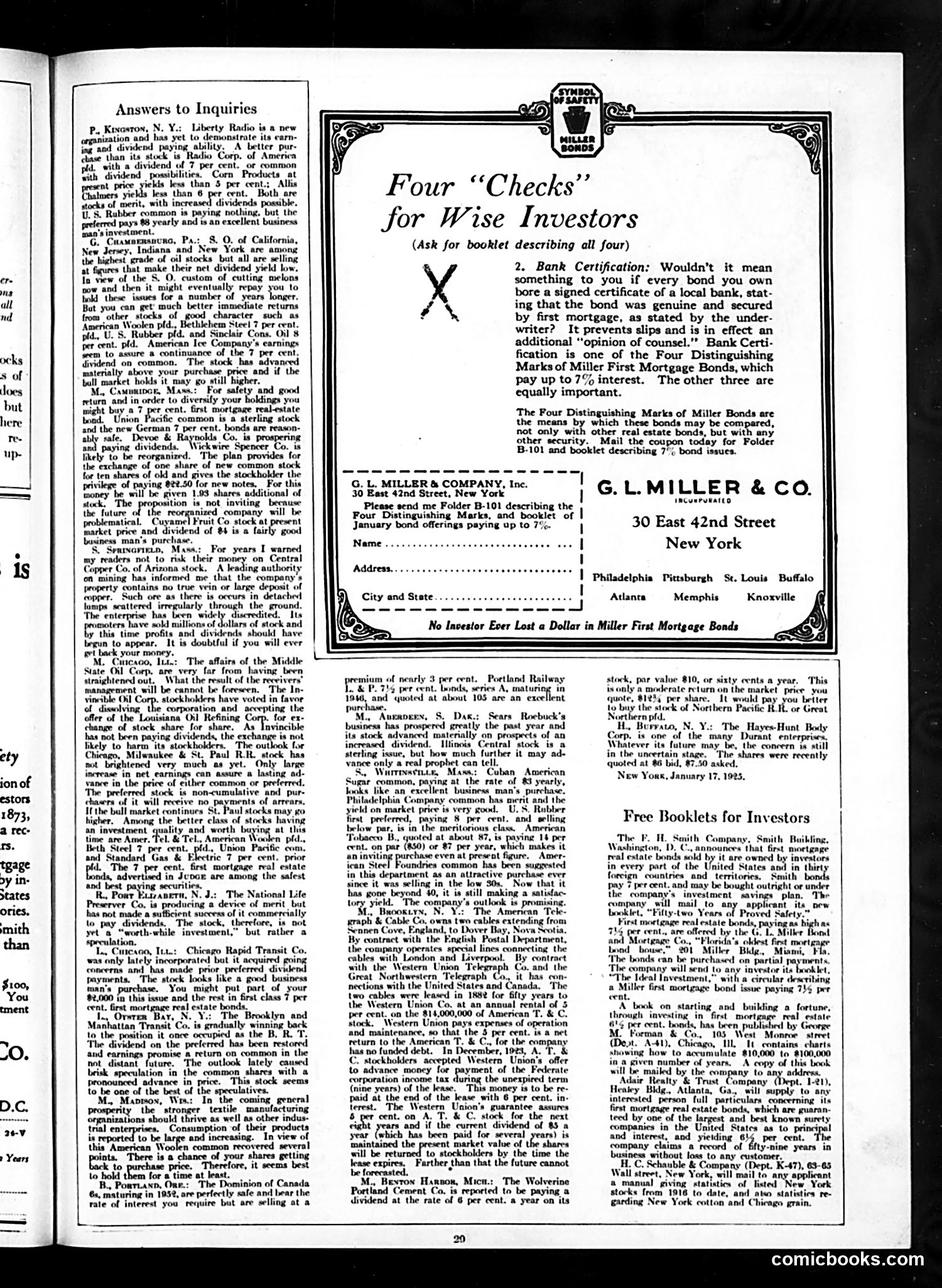
This page is primarily **financial advertising**, not political satire. The large central advertisement promotes **Miller First Mortgage Bonds**, marketed as a safe investment vehicle. The "Four Checks" referenced in the headline appear to be validation marks (✓ symbols) emphasizing reliability. The left column contains **"Answers to Inquiries"**—a financial advice column addressing readers' stock and bond questions, recommending various railroad, oil, utility, and manufacturing stocks based on dividend yields and safety. The bottom section advertises **"Free Booklets for Investors"** from G.L. Miller & Company, a New York bond dealer with branches nationwide. This represents *Judge* magazine's financial services content—typical of 1920s periodicals that mixed satire with legitimate investment advisory. There is **no visible political cartoon or satire** on this page; it's substantially educational/commercial content.
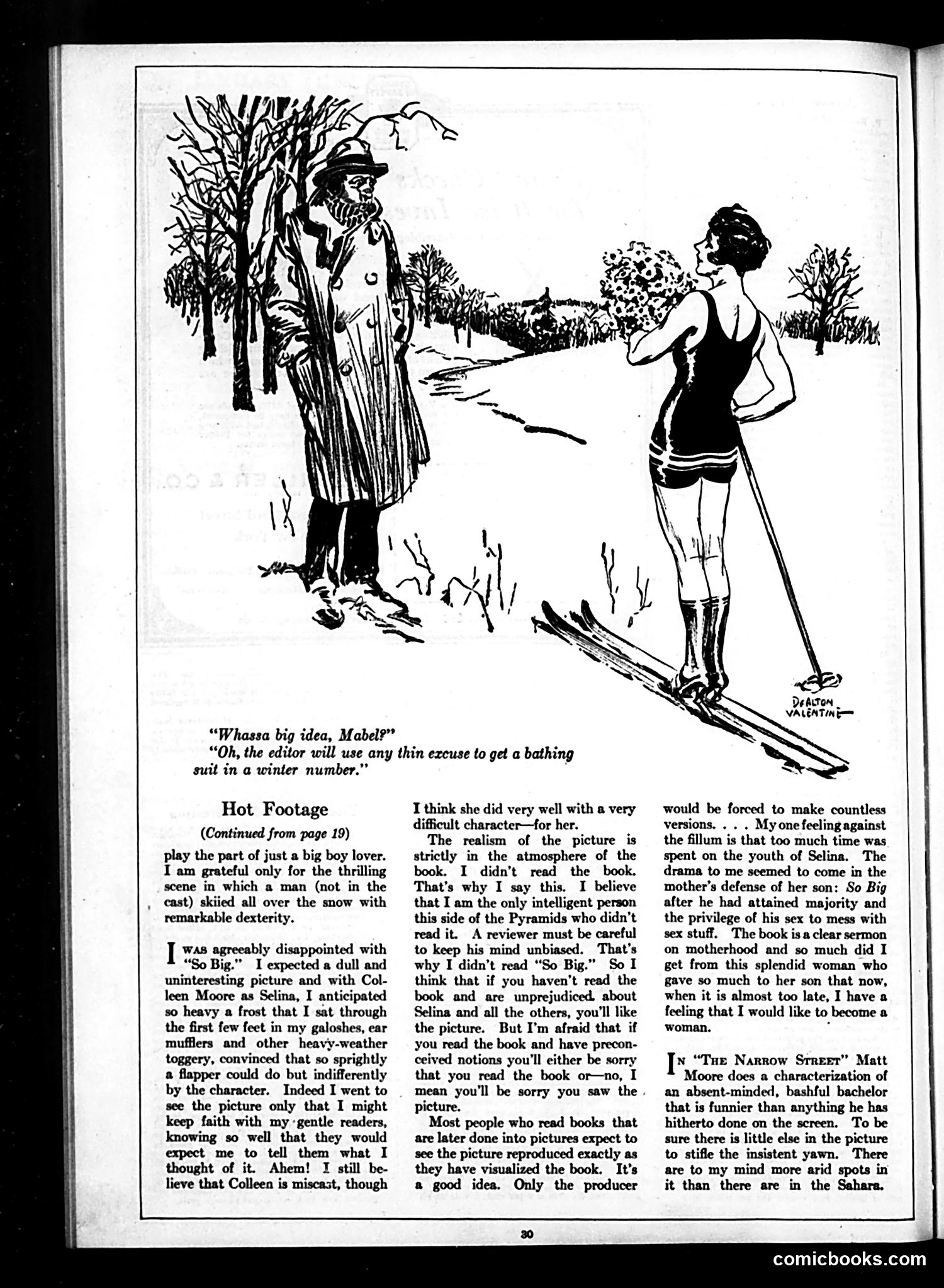
The page contains a cartoon and film reviews from an early 1920s Judge magazine. **The Cartoon:** A man in winter clothing confronts a woman in a bathing suit and skis. She responds that the editor will use any thin excuse to feature a bathing suit in a winter issue. This satirizes the magazine's editorial practice of including cheesecake imagery regardless of seasonal appropriateness or context—poking fun at both the editor's priorities and the publication's own editorial choices. **The "Hot Footage" Reviews:** A film critic discusses several movies including adaptations of books ("So Big" with Colleen Moore, "The Narrow Street" with Matt Moore). The critic humorously admits to deliberately not reading source material to remain "unbiased," while complaining about other viewers' expectations that film adaptations match their imagined versions. The reviews critique both the films' quality and audiences' unrealistic expectations about adapting literature. The overall tone is satirical self-awareness about entertainment industry practices and consumer expectations.
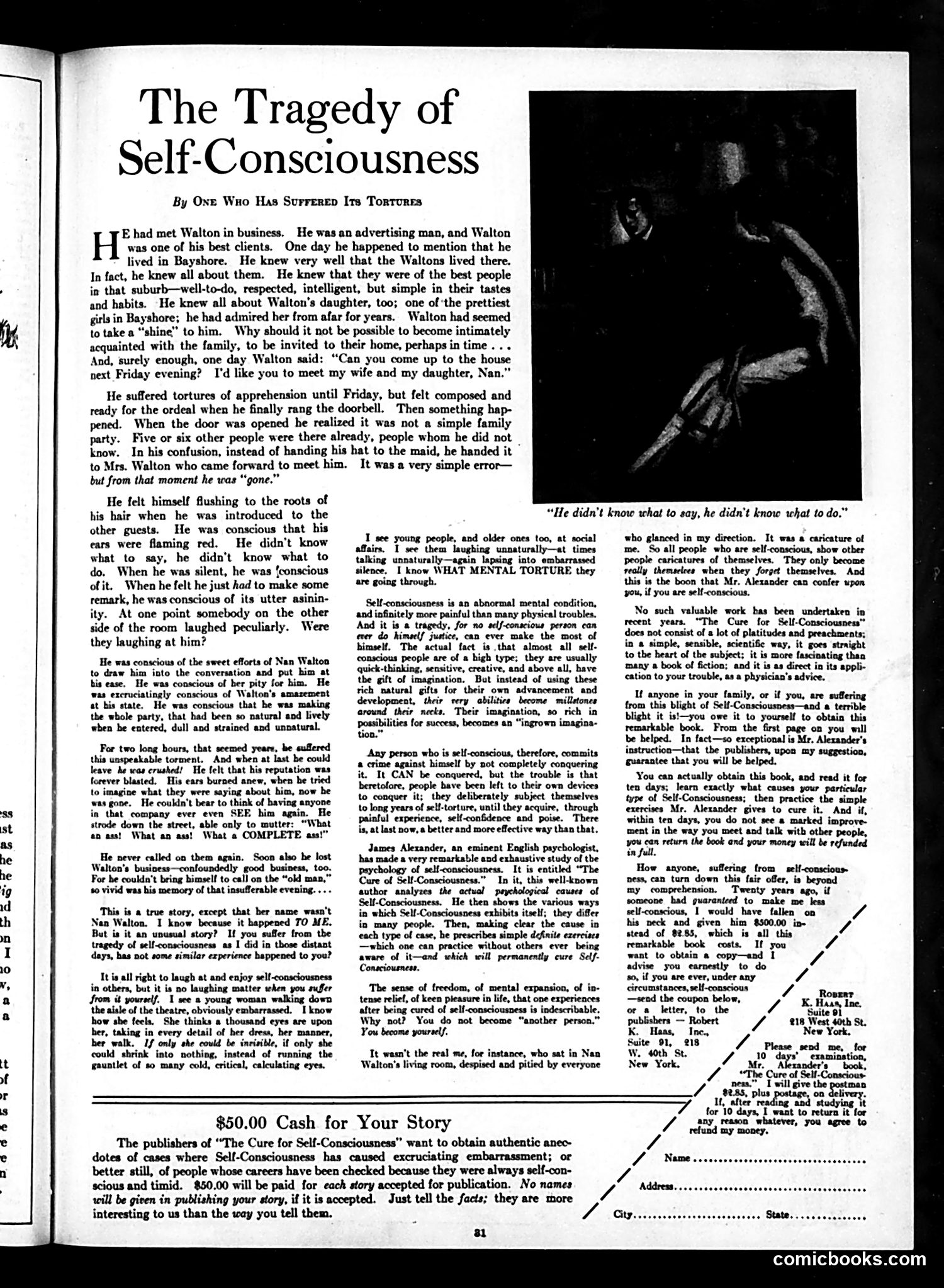
This is a cautionary story (not a political cartoon) about social anxiety. The narrative describes a man invited to dinner at his client Walton's home who commits a minor social error—handing his hat to the hostess instead of the maid. This trivial mistake triggers intense self-consciousness that spirals into humiliation. The piece satirizes how self-awareness can become paralyzing: the protagonist becomes hyperaware of his blushing, his silence, and imagined judgment from others. His anxiety proves so consuming he avoids the family entirely, losing their business. The satire targets a recognizable early-20th-century social phenomenon—the anxiety of climbing social ladders in suburban, respectable circles. For modern readers, it's notable as an early literary exploration of what we'd now call social anxiety disorder, presented here with sympathetic humor rather than mockery.
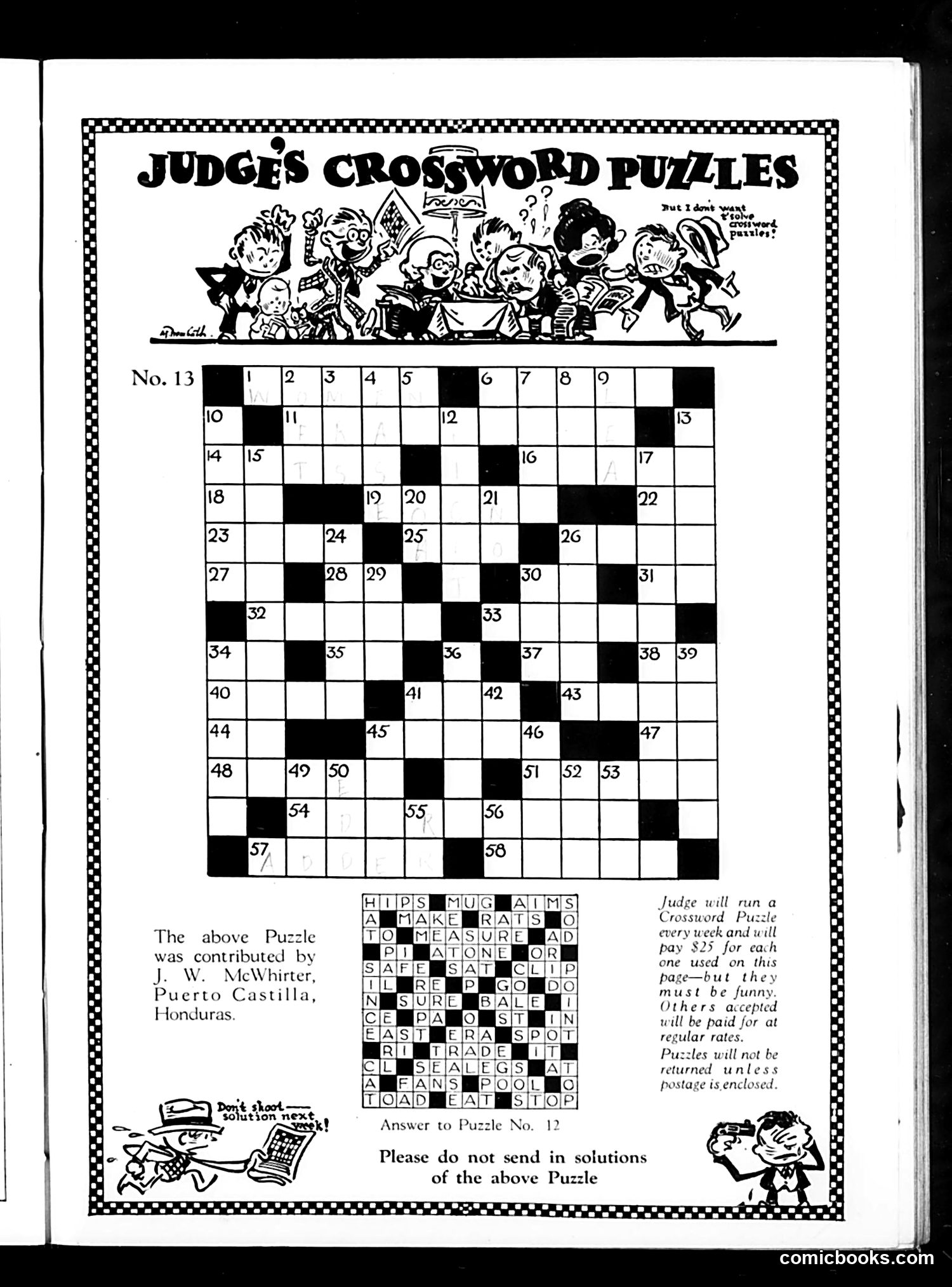
This page is primarily a **crossword puzzle feature** rather than political satire. It presents: **Main Content:** - Puzzle No. 13, contributed by J.W. McWhirter from Puerto Castilla, Honduras - The solution to the previous week's Puzzle No. 12 (visible in the grid) **Header Cartoon:** A whimsical illustration showing cartoon characters around a judge's bench, with one character saying "But I don't want to go to parties!" This appears to be generic humor unrelated to the puzzle itself—likely just decorative branding for Judge magazine's puzzle section. **Editorial Note:** Judge announces it will run weekly crossword puzzles, paying $25 for accepted submissions (substantial money in this era), with additional payment for particularly funny puzzles. Contributors must include return postage for non-accepted submissions. **Historical Context:** Crossword puzzles were enormously popular in early-to-mid 20th century America. This represents Judge magazine's attempt to increase reader engagement and submissions through a competitive puzzle feature. The page contains no political commentary or identifiable caricatures of public figures.
This is primarily a **commercial advertisement**, not political satire. It promotes the "Merke System" for hair loss treatment, disguised as a personal testimonial article. The page features a first-person narrative from a man who suffered social humiliation from baldness—nicknamed "Baldy" and "Bald Bean Bill" by peers, particularly while golfing. This framing establishes the social stigma around hair loss in the era, using relatable embarrassment to sell the product. The "satire" or humor is indirect: the testimony uses exaggerated earnestness about hair loss's emotional toll to justify the product's necessity. A sister's retort comparing skepticism about the Merke System to disbelief in airplanes mocks the reader's potential doubt. The page includes "proof" testimonials from satisfied customers and promises the treatment awakens "dormant" hair roots through electrical stimulation. **This reflects early 20th-century advertising practices**: mixing editorial-style copy with product promotion, relying on pseudoscientific claims, and exploiting social anxieties about appearance.