
Judge, 1925-01-24 · page 17 of 36
Judge — January 24, 1925 — page 17: what you’re looking at
What you’re looking at
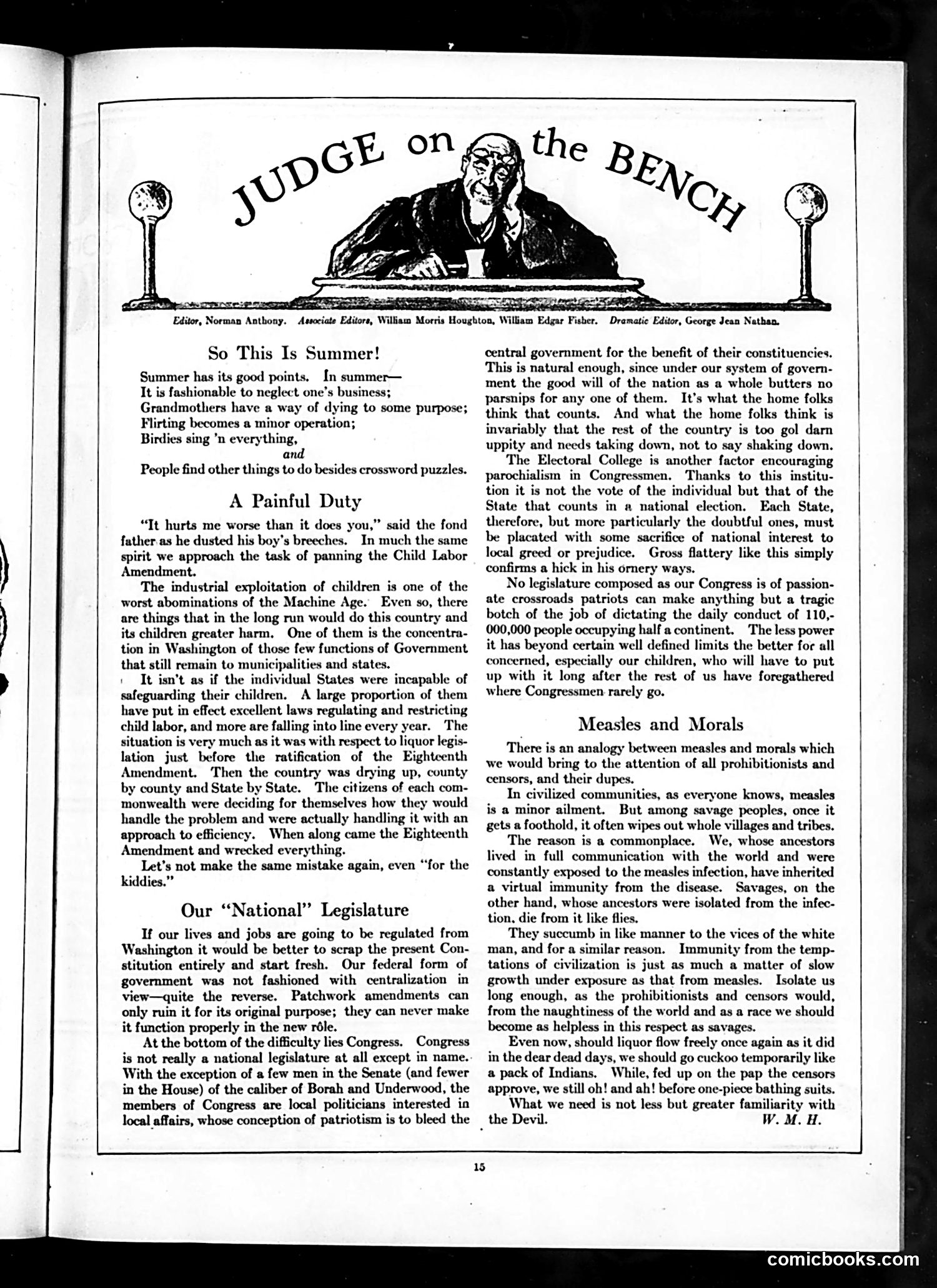
This page from Judge magazine contains three satirical essays criticizing federal centralization and advocating states' rights. **"So This Is Summer"** is a lighthearted opening, listing summer's pleasantries. **"A Painful Duty"** opposes a proposed Child Labor Amendment, arguing that while child exploitation is wrong, concentrating regulatory power in Washington poses greater danger. The author draws a parallel to Prohibition, claiming states were already successfully addressing child labor individually before federal intervention would "wreck everything." **"Our 'National' Legislature"** attacks Congress itself, claiming most members are parochial politicians serving local interests rather than national ones. The Electoral College system, the author argues, forces candidates to placate swing states over national welfare. The piece contends Congress cannot competently regulate 110 million people and should have limited powers. **Context**: This reflects 1920s-30s conservative opposition to New Deal-style federal expansion, advocating federalism and limited central government.
📄 Transcribed text from this page (OCR, searchable)
Machine-transcribed from the original scan — historical spelling and the odd misread are preserved.
Editor, Norman Anthony. Associate Edito So This Is Summer! Summer has its good points. In summer— It is fashionable to neglect one’s business; Grandmothers have a way of dying to some purpose; Flirting becomes a minor operation; Birdies sing ’n everything, and People find other things to do besides crossword puzzles. A Painful Duty “It hurts me worse than it does you,” said the fond father.as he dusted his boy’s breeches. In much the same spirit we approach the task of panning the Child Labor Amendment. The industrial exploitation of children is one of the worst abominations of the Machine Age. Even so, there are things that in the long run would do this country and its children greater harm, One of them is the concentra- tion in Washington of those few functions of Government that still remain to municipalities and states. It isn’t as if the individual States were incapable of safeguarding their children. A large proportion of them have put in effect excellent laws regulating and restricting child labor, and more are falling into line every year. The situation is very much as it was with respect to liquor legis- lation just before the ratification of the Eightcenth Amendment. Then the country was drying up, county by county and State by State. The citizens of each com- monwealth were deciding for themselves how they would handle the problem and were actually handling it with an approach to efficiency. When along came the Eighteenth Amendment and wrecked everything. Let’s not make the same mistake again, even “for the kiddies.” Our “National” Legislature If our lives and jobs are going to be regulated from Washington it would be better to scrap the present Con- stitution entirely and start fresh. Our federal form of government was not fashioned with centralization in view—quite the reverse. Patchwork amendments can only ruin it for its original purpose; they can never make it function properly in the new réle. At the bottom of the difficulty lies Congress. Congress is not really a national legislature at all except in name. With the exception of a few men in the Senate (and fewer in the House) of the caliber of Borah and Underwood, the members of Congress are local politicians interested in local affairs, whose conception of patriotism is to bleed the _ the Devil. William Morris Houghton, William Edgar Fisher. Dramatic Editor, George Jean Nathan, central government for the benefit of their constituencies. This is natural enough, since under our system of govern- ment the good will of the nation as a whole butters no parsnips for any one of them. It’s what the home folks think that counts. And what the home folks think is invariably that the rest of the country is too gol darn uppity and needs taking down, not to say shaking down. The Electoral College is another factor encouraging parochialism in Congressmen. Thanks to this institu- tion it is not the vote of the individual but that of the State that counts in a national election. Each State, therefore, but more particularly the doubtful ones, must be placated with some sacrifice of national interest to local greed or prejudice. Gross flattery like this simply confirms a hick in his ornery ways. No legislature composed as our Congress is of passion- ate crossroads patriots can make anything but a tragic botch of the job of dictating the daily conduct of 110,- 000,000 people occupying half a continent. The less power it has beyond certain well defined limits the better for all concerned, especially our children, who will have to put up with it long after the rest of us have foregathered where Congressmen rarely go. Measles and Morals There is an analogy between measles and morals which we would bring to the attention of all prohibitionists and censors, and their dupes. In civilized communities, as everyone knows, measles is a minor ailment. But among savage peoples, once it gets a foothold, it often wipes out whole villages and tribes. The reason is a commonplace. We, whose ancestors lived in full communication with the world and were constantly exposed to the measles infection, have inherited a virtual immunity from the disease. Savages, on the other hand, whose ancestors were isolated from the infec- tion. die from it like flies. They succumb in like manner to the vices of the white man, and for a similar reason. Immunity from the temp- tations of civilization is just as much a matter of slow growth under exposure as that from measles. Isolate us long enough, as the prohibitionists and censors would, from the naughtiness of the world and as a race we should become as helpless in this respect as savages. Even now, should liquor flow freely once again as it did in the dear dead days, we should go cuckoo temporarily like a pack of Indians. While, fed up on the pap the censors approve, we still oh! and ah! before one-piece bathing suits. What we need is not less but greater familiarity with W.M. H. ss comicbooks.com