
Judge, 1925-01-24 · page 28 of 36
Judge — January 24, 1925 — page 28: what you’re looking at
What you’re looking at
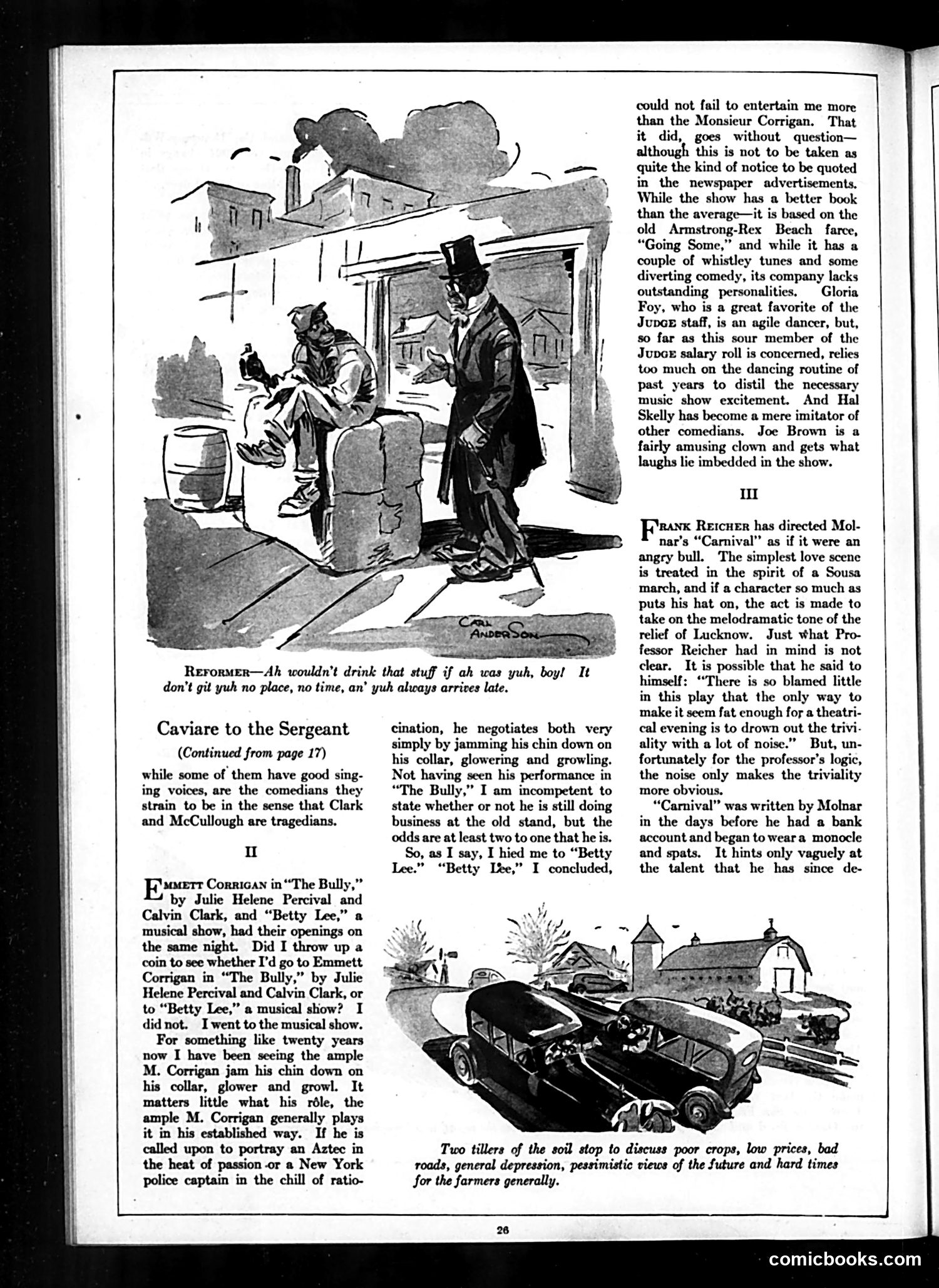
This is a theater critic's column reviewing three Broadway productions: "The Bully," "Betty Lee," and "Carnival." The cartoons and text work together to satirize both the shows and theatrical conventions. The main cartoon depicts a drunk "Reformer" warning others against alcohol—ironic social commentary on prohibition-era hypocrisy. Below, farmers discuss economic hardship, likely referencing 1920s agricultural depression. The critic skewers actor **Emmett Corrigan** for his one-note performance style—regardless of role (Aztec warrior, police captain), he performs identically, "jamming his chin down on his collar, glowering and growling." The review dismisses "Betty Lee" as mediocre despite better material, and savagely critiques director **Frank Reicher's** overly dramatic staging of Molnar's "Carnival," suggesting he artificially inflates trivial material with melodrama to fill an evening. The implication: Reicher compensates for weak material through directorial excess rather than serving the play's actual needs.
📄 Transcribed text from this page (OCR, searchable)
Machine-transcribed from the original scan — historical spelling and the odd misread are preserved.
Caviare to the Sergeant (Continued from page 17) while some of them have good sing- ing voices, are the comedians they strain to be in the sense that Clark and McCullough are tragedians. I mMeETT Corrican in “The Bully,” by Julie Helene Percival and Calvin Clark, and “Betty Lee,” a musical show, had their openings on the same night. Did I throw up a coin to see whether I'd go to Emmett Corrigan in “The Bully,” by Julie Helene Percival and Calvin Clark, or to “Betty Lee,” a musical show? I did not. I went to the musical show. For something like twenty years now I have been seeing the ample M. Corrigan jam his chin down on his collar, glower and growl. It matters little what his rdéle, the ample M. Corrigan generally plays it in his established way. If he is called upon to portray an Aztec in the heat of passion or a New York police captain in the chill of ratio- Rerormer—Ah wouldn't drink that stuff if ah was yuh, boy! It don't git yuh no place, no time, an’ yuh always arrives late. cination, he negotiates both very simply by jamming his chin down on his collar, glowering and growling. Not having seen his performance in ‘The Bully,” I am incompetent to state whether or not he is still doing business at the old stand, but the odds are at least two to one that he is. So, as I say, I hied me to “Betty Lee.” “Betty Lee,” I concluded, Two tillers of the soil stop to discuss poor crops, low prices, bad roads, general depression, pessimistic views of the future and hard times Sor the farmers generally. | could not fail to entertain me more than the Monsieur Corrigan. That it did, goes without question— although this is not to be taken as quite the kind of notice to be quoted in the newspaper advertisements, While the show has a better book than the average—it is based on the old Armstrong-Rex Beach farce, “Going Some,” and while it has a couple of whistley tunes and some diverting comedy, its company lacks outstanding personalities, Gloria Foy, who is a great favorite of the JupcE staff, is an agile dancer, but, so far as this sour member of the Junce salary roll is concerned, relies too much on the dancing routine of past years to distil the necessary music show excitement. And Hal Skelly has become a mere imitator of other comedians. Joe Brown is a fairly amusing clown and gets what laughs lic imbedded in the show. I RANK REICHER has directed Mol- nar’s “Carnival” as if it were an | angry bull. The simplest love scene is treated in the spirit of a Sousa march, and if a character so much as puts his hat on, the act is made to take on the melodramatic tone of the relief of Lucknow. Just what Pro- fessor Reicher had in mind is not clear. It is possible that he said to himself: “There is so blamed little in this play that the only way to make it seem fat enough for a theatri- cal evening is to drown out the trivi- ality with a lot of noise.” But, un- | fortunately for the professor’s logic, | the noise only makes the triviality more obvious. “Carnival” was written by Molnar in the days before he had a bank account and began to weara monocle and spats. It hints only vaguely at the talent that he has since de- I~ comicbooks.com