
Judge, 1925-01-24 · page 13 of 36
Judge — January 24, 1925 — page 13: what you’re looking at
What you’re looking at
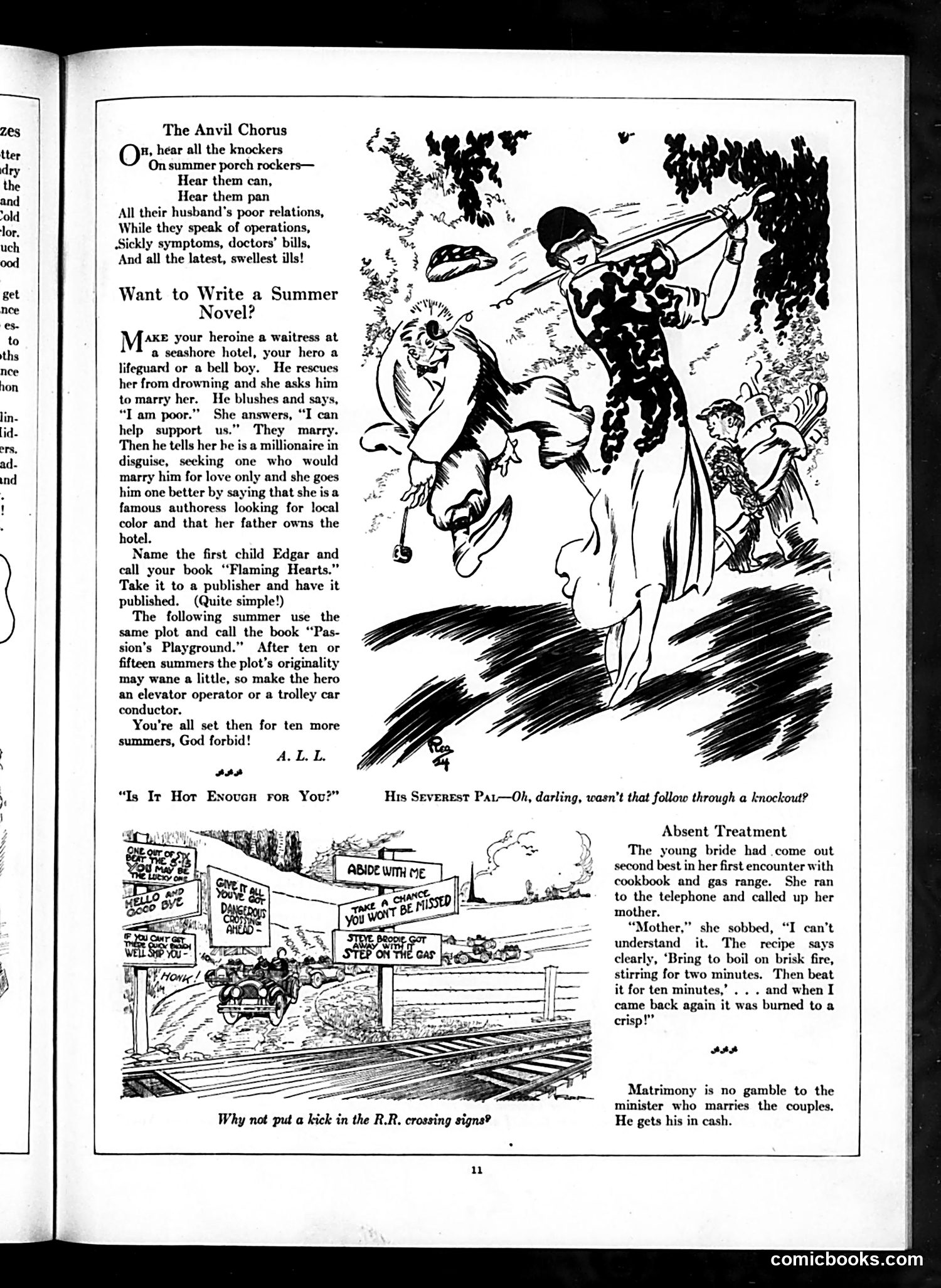
This page contains three distinct satirical pieces mocking early 1900s domestic life: **"The Anvil Chorus"** lampoons women gossiping on summer porches, endlessly complaining about husbands' relatives, medical ailments, and doctors' bills—the "knockers" producing noise like an anvil. **"Want to Write a Summer Novel?"** parodies formulaic romantic fiction: waitress heroine, lifeguard hero, poverty-to-wealth revelation, famous authoress twist. The joke mocks the predictable, recycled plots publishers churned out annually, suggesting writers could reuse the same story indefinitely with minor character changes (elevator operator instead of lifeguard). **The cartoons below** satirize newlywed incompetence: a boxing/boxing-match reference about marital disagreements, and "Absent Treatment" ridicules a young bride's failure to follow basic cooking instructions, burning her dish while calling mother for help—mocking both new wives' domestic ignorance and their dependence on their mothers. **"Matrimony is no gamble to the minister"** is a cynical one-liner: clergy collecting marriage fees regardless of outcome. The page's overall theme: women's domestic inadequacy and gossip.
📄 Transcribed text from this page (OCR, searchable)
Machine-transcribed from the original scan — historical spelling and the odd misread are preserved.
— The Anvil Chorus iH, hear all the knockers On summer porch rockers— Hear them can, Hear them pan All their husband's poor relations, While they speak of operations, .Sickly symptoms, doctors’ bills, And all the latest, swellest ills! Want to Write a Summer Novel? M“*= your heroine a waitress at a seashore hotel, your hero a lifeguard or a bell boy. He rescues her from drowning and she asks him to marry her. He blushes and says, “I am poor.” She answers, “I can help support us.” They marry. Then he tells her he is a millionaire in disguise, seeking one who would marry him for love only and she goes him one better by saying that she is a famous authoress looking for local color and that her father owns the hotel. Name the first child Edgar and call your book ‘‘Flaming Hearts.” Take it to a publisher and have it published. (Quite simple!) The following summer use the same plot and call the book ‘Pas- sion’s Playground.” After ten or fifteen summers the plot’s originality may wane a little, so make the hero an elevator operator or a trolley car conductor. You're all set then for ten more summers, God forbid! ALL. L. ry “Is Ir Hor Enovcn ror You?’ His Severest Pat—Oh, darling, wasn’t that follow through a knockout? Absent Treatment The young bride had come out second best in her first encounter with cookbook and gas range. She ran to the telephone and called up her mother. “Mother,” she sobbed, “I can’t understand it. The recipe says clearly, ‘Bring to boil on brisk fire, stirring for two minutes. Then beat it for ten minutes,’ . . . and when I came back again it was burned to a ” Raed Matrimony is no gamble to the minister who marries the couples. He gets his in cash. comicbooks.com