
Judge, 1925-01-24 · page 33 of 36
Judge — January 24, 1925 — page 33: what you’re looking at
What you’re looking at
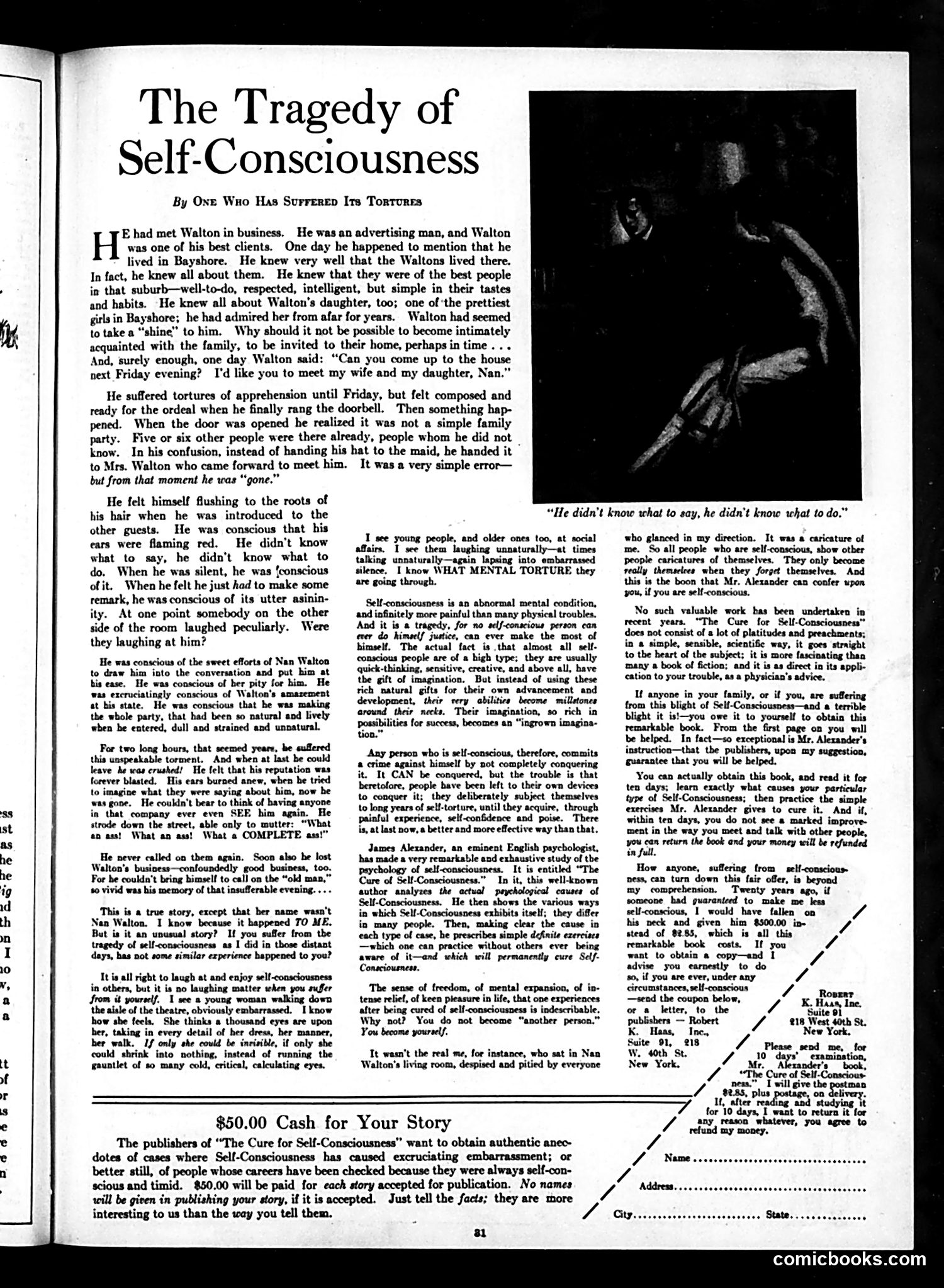
This is a cautionary story (not a political cartoon) about social anxiety. The narrative describes a man invited to dinner at his client Walton's home who commits a minor social error—handing his hat to the hostess instead of the maid. This trivial mistake triggers intense self-consciousness that spirals into humiliation. The piece satirizes how self-awareness can become paralyzing: the protagonist becomes hyperaware of his blushing, his silence, and imagined judgment from others. His anxiety proves so consuming he avoids the family entirely, losing their business. The satire targets a recognizable early-20th-century social phenomenon—the anxiety of climbing social ladders in suburban, respectable circles. For modern readers, it's notable as an early literary exploration of what we'd now call social anxiety disorder, presented here with sympathetic humor rather than mockery.
📄 Transcribed text from this page (OCR, searchable)
Machine-transcribed from the original scan — historical spelling and the odd misread are preserved.
The Tragedy of Self-Consciousness By Oxe Wao Has Surreren Its Tortores E had met Walton in business. He was an advertising man, and Walton H was one of his best clients. One day he happened to mention that he lived in Bayshore. He knew very well that the Waltons lived there. In fact, he knew all about them. He knew that they were of the best people in that suburb—well-to-do, respected, intelligent, but simple in their tastes and habits. He knew all about Walton's daughter, too; one ofthe prettiest girls in Bayshore; he had admired her from afar for years. Walton had seemed to take a “shine” to him. Why should it not be possible to become intimately acquainted with the family, to be invited to their home, perhaps in time . . . And, surely enough, one day Walton said: “Can you come up to the house next Friday evening? I'd like you to meet my wife and my daughter, Nan.” He suffered tortures of apprehension until Friday, but felt composed and ready for the ordeal when he finally rang the doorbell. Then something hap- pened. When the door was opened he realized it was not a simple family party. Five or six other people were there already, people whom he did not know. In his confusion, instead of handing his hat to the maid, he handed it to Mrs. Walton who came forward to meet him. It was a very simple error— but from that moment he was “‘gone.” He felt himself flushing to the roots of his hair when he was introduced to the other guests. He was conscious that his ears were flaming red. He didn’t know what to say, he didn't know what to do. When he was silent, he was (conscious of it. When he felt he just had to make some remark, he was conscious of its utter asinin- ity. At one point somebody on the other side of the room laughed peculiarly. Were they laughing at him? He was conscious of the sweet efforts of Nan Walton to draw him into the conversation and put him at bis ease. He was conscious of her pity for him. He was excruciatingly conscious of Walton's amazement at bis state. He was conscious that he was making the whole party, that had been so natural and lively when he entered, dull and strained and unnatural. For two long hours, that seemed years, be suflered this unspeakable torment. And when at last be could leave he was crushed! He felt that his reputation was forever blasted. His ears burned anew, when be tried to imagine what they were saying about him, now he was gone. He couldn't bear to think of having anyone in that company ever even SEF him again. He strode down the street, able only to mutter: “What an ass! What an ass! What a COMPLETE ass!” He never called on them again. Soon also he lost Walton's business—confoundedly good business, too. For he couldn't bring himself to cal] on the “old man, so vivid was his memory of that insufferable evening. This is a true story, except that ber name wasn't Nan Walton. I know because it happened TO ME. But is it an unusual story? If you suffer from the tragedy of self-consciousness as I did in those distant days, has not some similar experience happened to you? It is all right to laugh at and enjoy self-consciousness in others, but it is no laughing matter when you suffer from it yourself. 1 see 9 young woman walking dowo the aisle of the theatre, obviously embarrassed. I know how she feels, She thinks a thousand eyes are upon her, taking in every detail of her dress, her manner, ber walk. If only she could be inrisible, if only she could shrink into nothing, instead of running the gauntlet of so many cold, critical, calculating eyes. “He didn't know what to say, he didn't know what to do.” I see young people, and older ones too, at social affairs. I see them laughing unnaturally—at times talking unnaturally—again lapsing into embarrassed silence. I know WHAT MENTAL TORTURE they are going through. Self-consciousness is an abnormal mental condition, and infinitely more painful than many physical troubles. And it is a tragedy, for no self-conscious person can exer do himself justice, can ever make the most of himself, The actual fact is that almost all self- conscious people are of a high type; they are usually quick-thinking, sensitive, creative, and above all, have the gift of imagination. But instead of using these rich natural gifts for their own advancement and development, their very abilities become millstones around their necks. Their imagination, so rich in possibilities for success, becomes an “ingrown imagina- tion.” Any person who is self-conscious, therefore, commits a crime against himself by not completely conquering it, It CAN be conquered, but the trouble is that heretofore, people have been left to their own devices to conquer it; they deliberately subject themselves to long years of self-torture, until they acquire, through painful experience, self-confidence and poise. There is, at last now, a better and more effective way than that. James Alexander, an eminent English psychologist, has made a very remarkable and exhaustive study of the of self-consciousness. It is entitled “The Cure of Self-Consciousness.” In it, this well-known author analyzes the actual psychological causes of Self-Consciousness. He then shows the various ways in which Self-Consciousness exhibits itself; they differ in many people. Then, making clear the cause in each type of case, he prescribes simple definite exercises —which one can practice without others ever being aware of it—and which will permanently cure Self- Consciousness. ‘The sense of freedom, of mental expansion, of in- tense relief, of keen pleasure in life, that one experiences after being cured of self-consciousness is indescribable. Why not? You do not become “another person.” You become yourself. Tt wasn't the real me, for instance, who sat in Nan Walton's living room, despised and pitied by everyone $50.00 Cash for Your Story The publishers of “The Cure for Self-Consciousness” want to obtain authentic anec- dotes of cases where Self-Consciousness has caused excruciating embarrassment; or better still, of people whose careers have been checked because they were always self-con- scious and timid. $50.00 will be paid for each story accepted for publication. No names will be given in publishing your story, if it is accepted. Just tell the facts; they are more 7 interesting to us than the way you tell them. a1 who glanced in my direction. It was a caricature of me. So all people who are self-conscious, show other people caricatures of themselves. They only become really themselees when they forget themselves. And this is the boon that Mr. Alexander can confer upon you, if you are self-conscious, No such valuable work bas been undertaken in recent years. “The Cure for Self-Consciousness” does not consist of a lot of platitudes and preachments; in a simple, sensible, scientific way, it goes straight to the heart of the subject; it is more fascinating than many a book of fiction: and it is as direct in its appli- cation to your trouble, as a physician's advice. If anyone in your family, or if you, are suffering from this blight of Self-Consciousness—and a terrible blight it isi—you owe it to yourself to obtain this remarkable book. From the first page on you will be helped. In fact—so exceptional is Mr. Alexander's instruction—that the publishers, upon my suggestion, guarantee that you will be belped. You can actually obtain this book, and read it for ten days; learn exactly what causes your particular type of Self-Consciousness; then practice the simple exercises Mr. Alexander gives to cure it. And if, within ten days, you do not see a marked improve- ment in the way you meet and talk with other people, you can return the book and your money will be refunded in full. How anyone, suffering from self-conscious ness, can turn down this fair offer, is beyond my comprehension, Twenty years ago, if someone had guaranteed to make me less self-conscious, 1 would have fallen on 4 his neck and given him $500.00 in- 7 stead of @2.85, which is all this remarkable book costs. If you 7 want to obtain a copy—and I 7 advise you earnestly to do 0, if you are ever, under any Greumstances, self-conscious —send the coupon below, letter, to the publishers — Robert K. Haas, Inc, Suite 91, 218 W. 40th St. New York, any reason wi refund my money, 7 Name. bees 7 AddreSS....sseserereccccceeecersesrceerecesees 7 you agree to 7 City. se seececeereereceereeees SUMO. seeeesererees comicbooks.com