
A complete issue · 36 pages · 1924
Judge — October 11, 1924
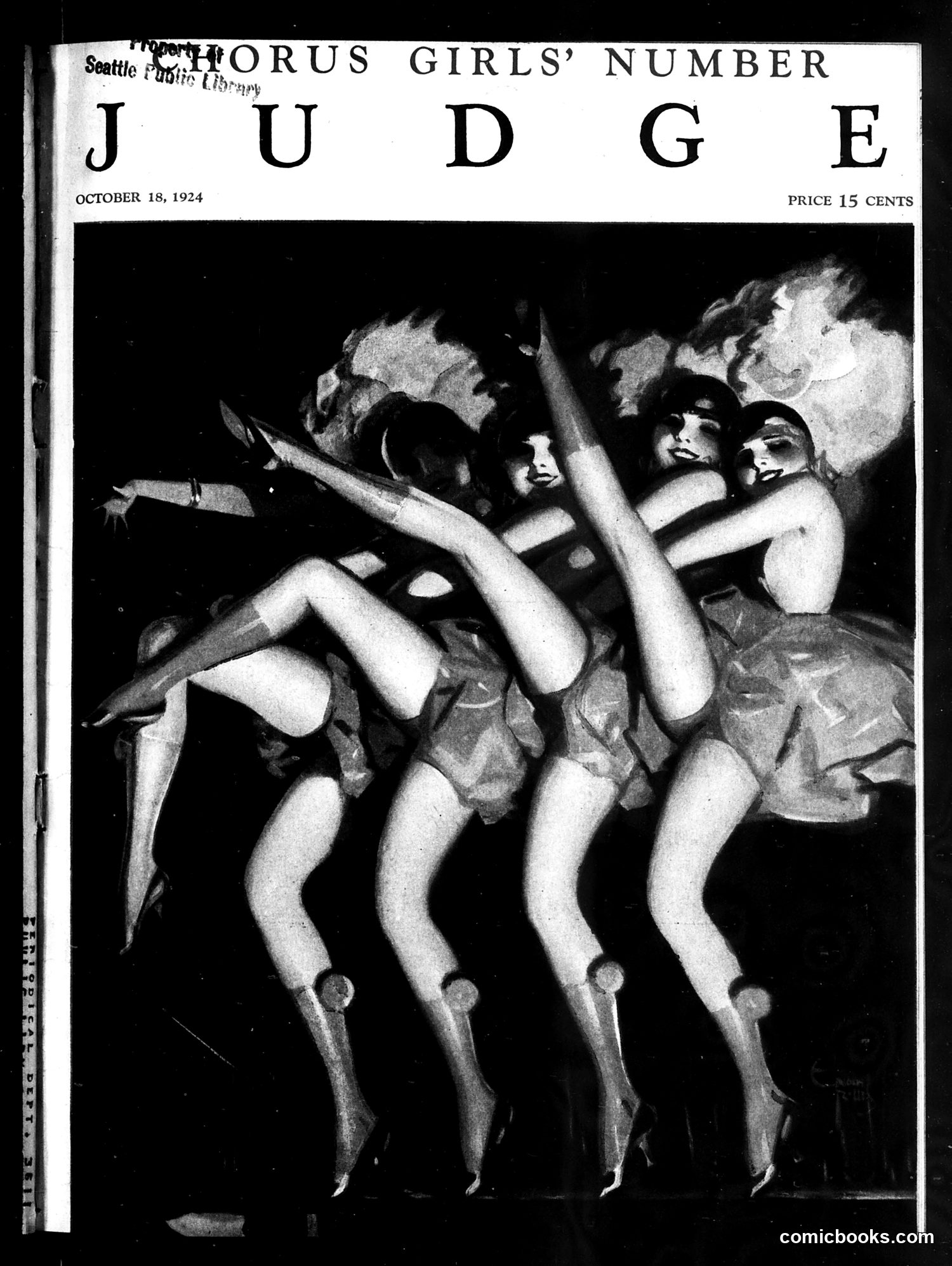
This is the cover of Judge magazine's "Chorus Girls' Number" from October 18, 1924. The image shows four women in a choreographed high-kick pose, wearing 1920s flapper-style costumes with headbands and feathered accessories—typical Broadway chorus line attire of the Jazz Age era. The cover celebrates the theatrical chorus girl, a prominent cultural figure of the 1920s. This likely references the popular Broadway musicals and revue shows that dominated entertainment at the time. The synchronized, energetic pose emphasizes the precision and athleticism required of professional dancers. The magazine's satirical focus here appears to be documenting popular entertainment culture rather than direct political commentary, showcasing the glamorous, modern image of women performers in the Roaring Twenties.
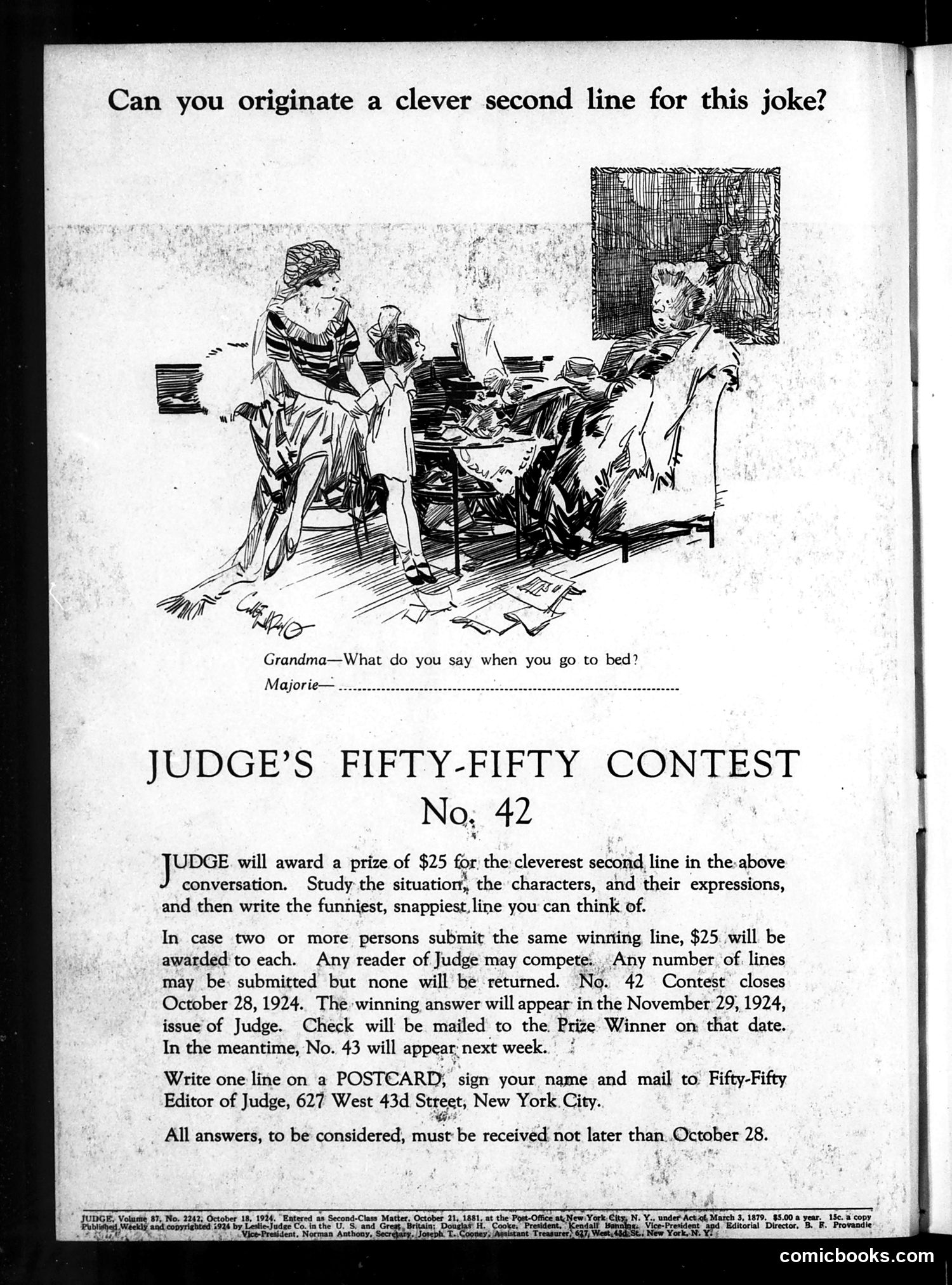
This page features "Judge's Fifty-Fifty Contest No. 42," a reader-participation humor competition. The illustration shows a domestic scene where a grandmother asks her granddaughter Marjorie, "What do you say when you go to bed?" The cartoon invites readers to submit a clever punchline for Marjorie's response—presumably something witty or unexpected rather than the conventional "prayers" answer a grandmother might expect. The $25 prize reflects the magazine's approach to crowdsourced humor. This type of contest was typical for Judge, a major American satirical publication that relied on reader engagement. The cartoon itself appears to be gentle domestic comedy rather than political satire, making it accessible to broad audiences and encouraging participation.
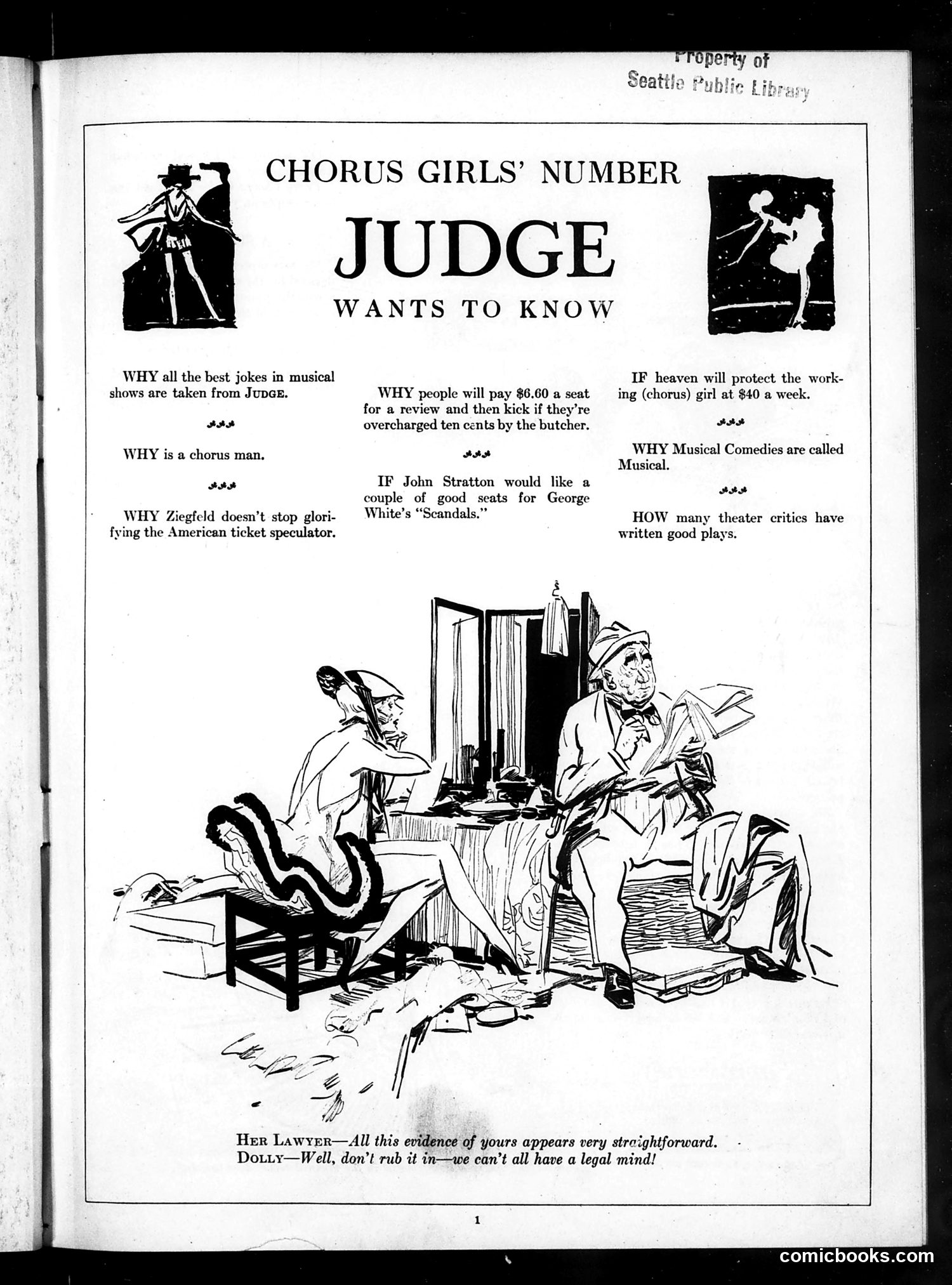
This page satirizes the theater world, particularly musical comedies and chorus girls' working conditions circa early 20th century. The headline poses rhetorical questions mocking various theater industry absurdities: ticket speculation, overpriced theater reviews, chorus girls earning only $40 weekly, and John Stratton's involvement with George White's "Scandals." The central cartoon depicts what appears to be a courtroom scene where a lawyer presents evidence to a judge, while "Dolly" responds dismissively: "Well, don't rub it in—we can't all have a legal mind!" The satire suggests chorus girls face legal/financial troubles they're unprepared to handle. Overall, the page critiques exploitation of chorus performers and theater industry corruption.
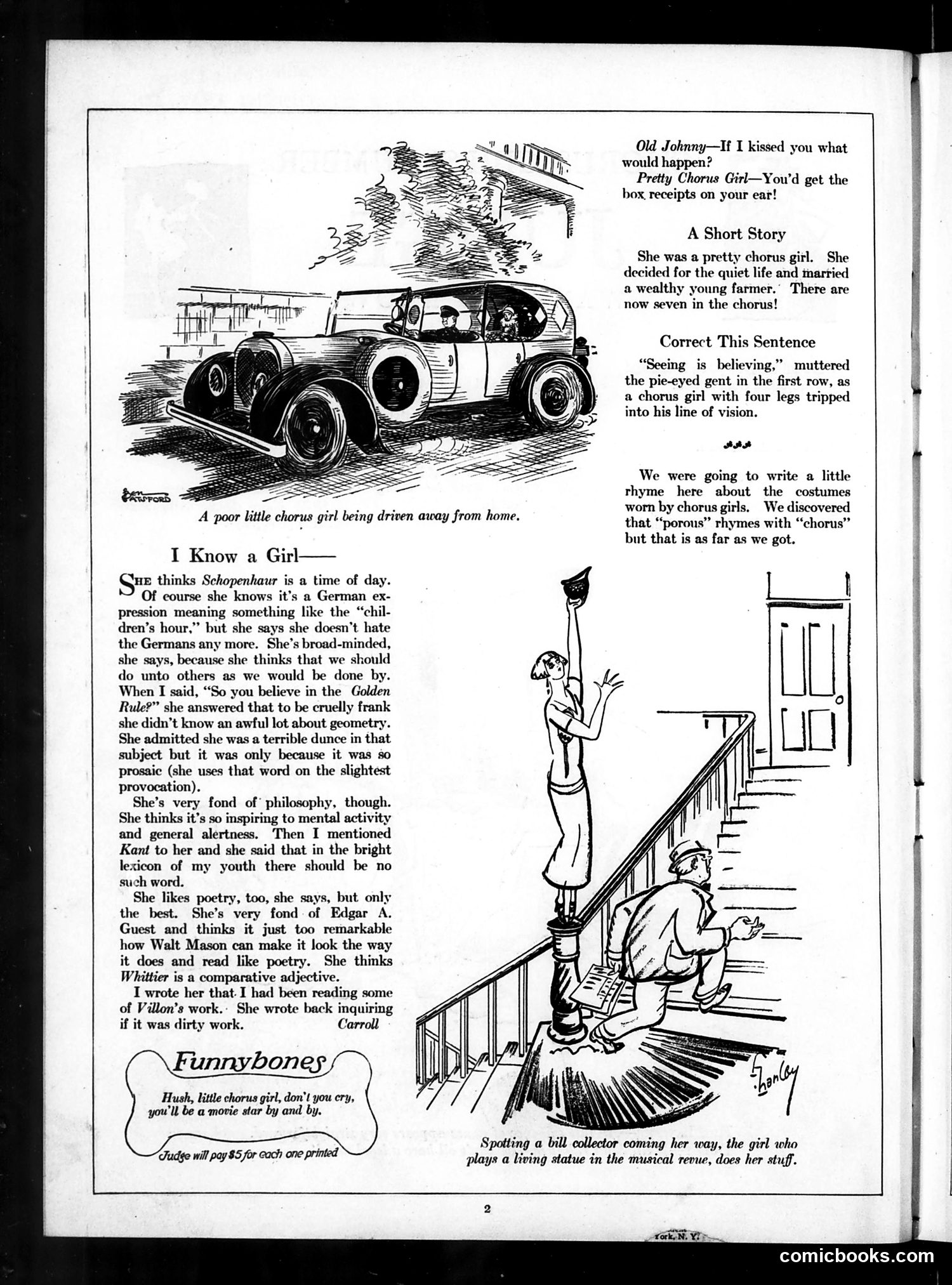
This page contains satirical commentary on contemporary social issues circa the 1910s-1920s. The main automobile cartoon depicts "a poor little chorus girl being driven away from home," satirizing the precarious economic situation of chorus girls who often faced pressure to marry wealthy men for financial security. The "I Know a Girl" column mocks an educated woman who uses sophisticated vocabulary (referencing Kant, Villon, Walt Mason) to discuss philosophy and literature, presenting intellectual pretension as affected. The satire targets both her pedantry and the absurdity of expecting meaningful intellectual discourse from someone in her social position. The staircase cartoon shows a chorus girl as a "living statue" in a musical revue, satirizing the objectification and commodification of female performers in entertainment. Overall, the page critiques the vulnerability and limited options available to working women in this era.
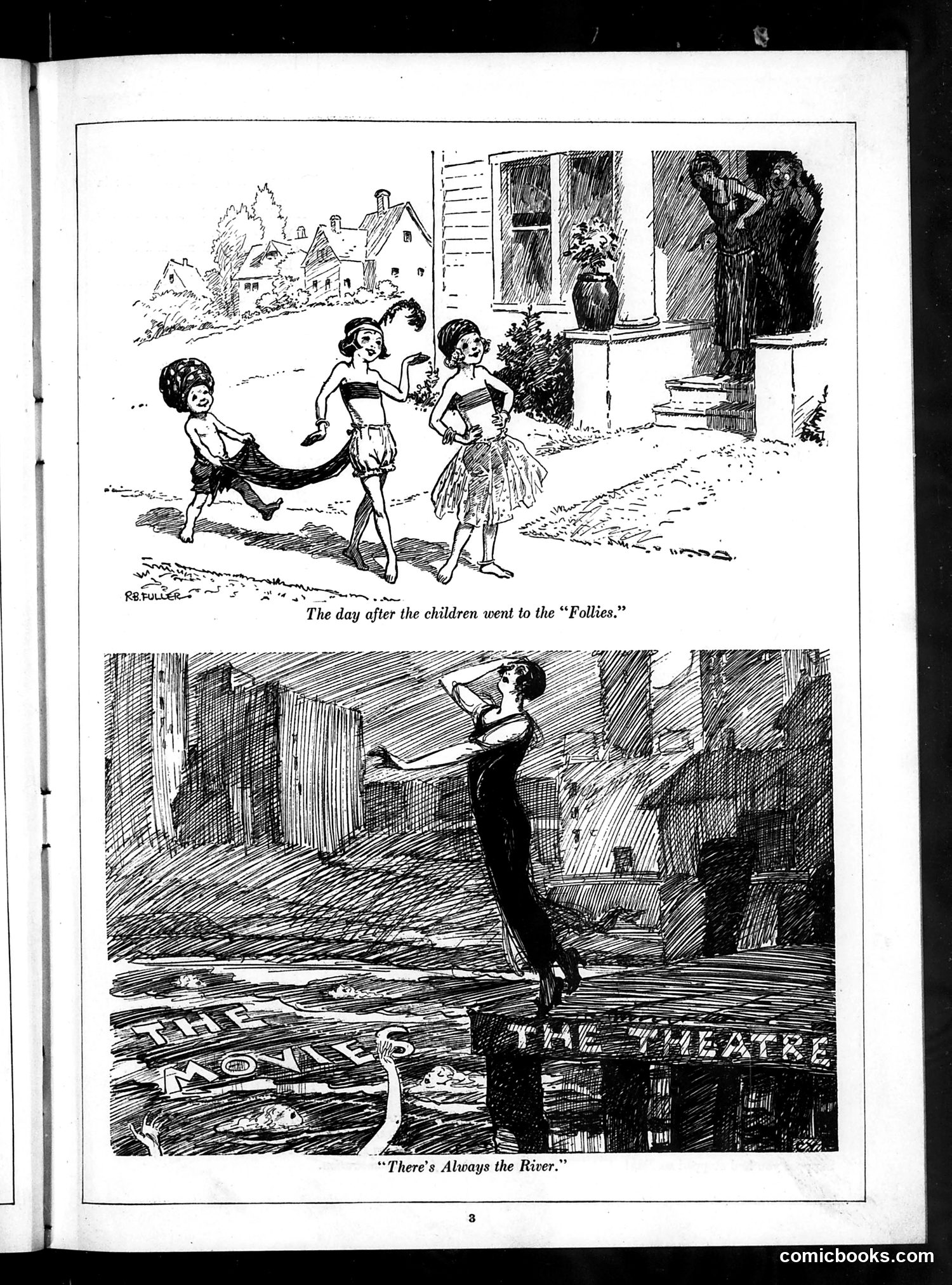
This page contains two satirical cartoons about theatrical life: **Top cartoon:** "The day after the children went to the 'Follies'" depicts children imitating what they saw at a theatrical revue. An adult woman watches disapprovingly as the youngsters mimic dance moves and poses from the show, suggesting concern about children's exposure to entertainment deemed unsuitable or overly adult. **Bottom cartoon:** "There's Always the River" shows a figure on a theater building contemplating suicide, likely representing financial ruin or professional failure in show business. The theatrical setting and dramatic pose reference the cliché of desperate performers driven to despair. Both cartoons satirize early 20th-century theater culture and its perceived social effects—one mocking concerns about children's innocence, the other the precarious lives of performers.
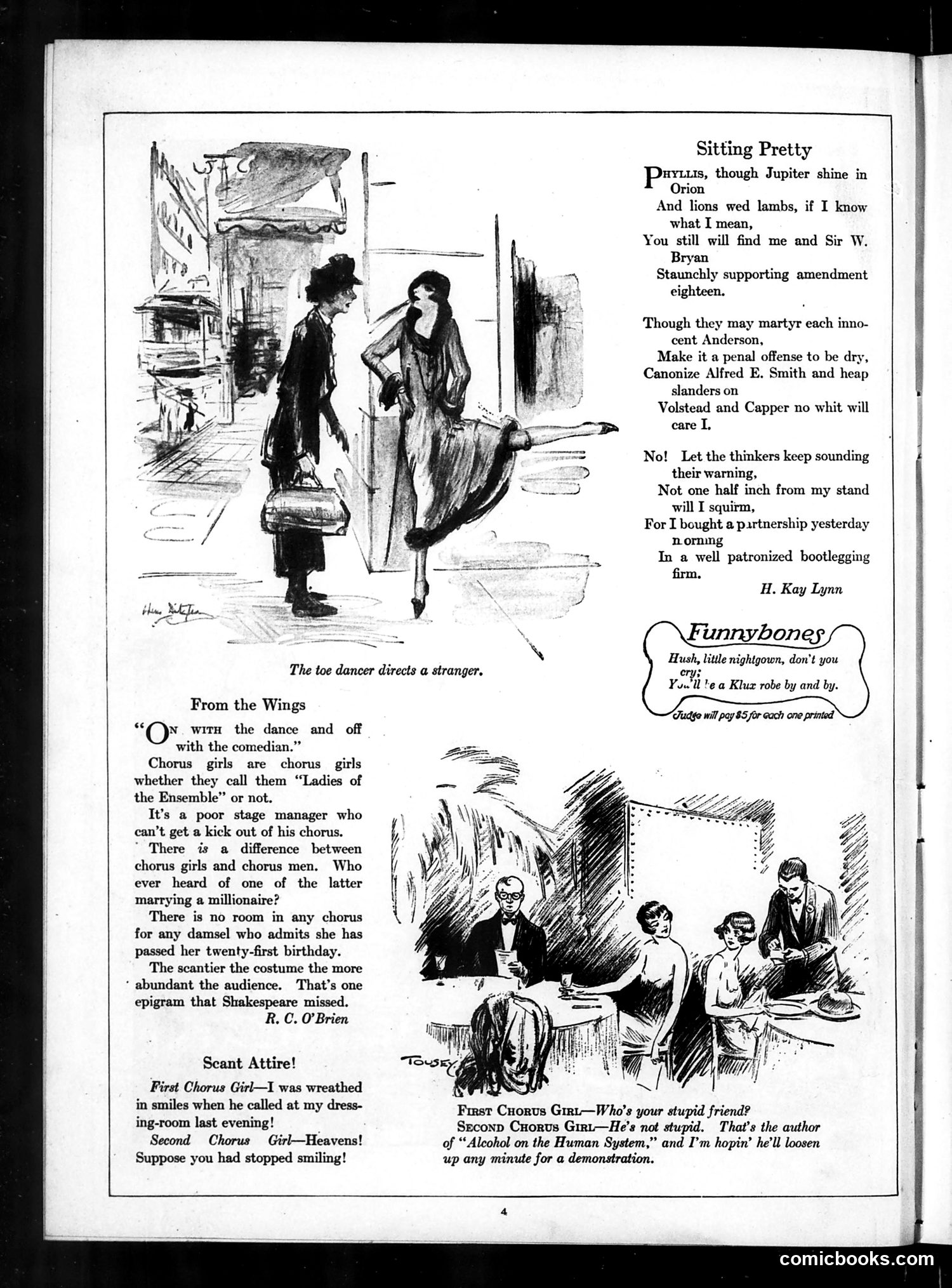
This page contains theatrical satire and commentary. "Sitting Pretty" references contemporary theater personalities and Amendment Eighteen (Prohibition), mocking both the law and theater figures like Alfred E. Smith. The "Funnybones" humor references the Ku Klux Klan obliquely ("Klux robe"). The main cartoon "The toe dancer directs a stranger" shows two women in what appears to be backstage theater banter—satirizing chorus girls and theatrical hierarchy. "From the Wings" offers cynical observations about chorus girls, stage managers, and the theater world, including a Shakespeare reference. The accompanying illustration shows a dining scene with chorus girls and a man, likely satirizing theatrical social dynamics. "Scent Attire!" presents short comedic exchanges between chorus girls, highlighting romantic entanglement and theatrical gossip. The content reflects 1920s Jazz Age theater culture and social attitudes.
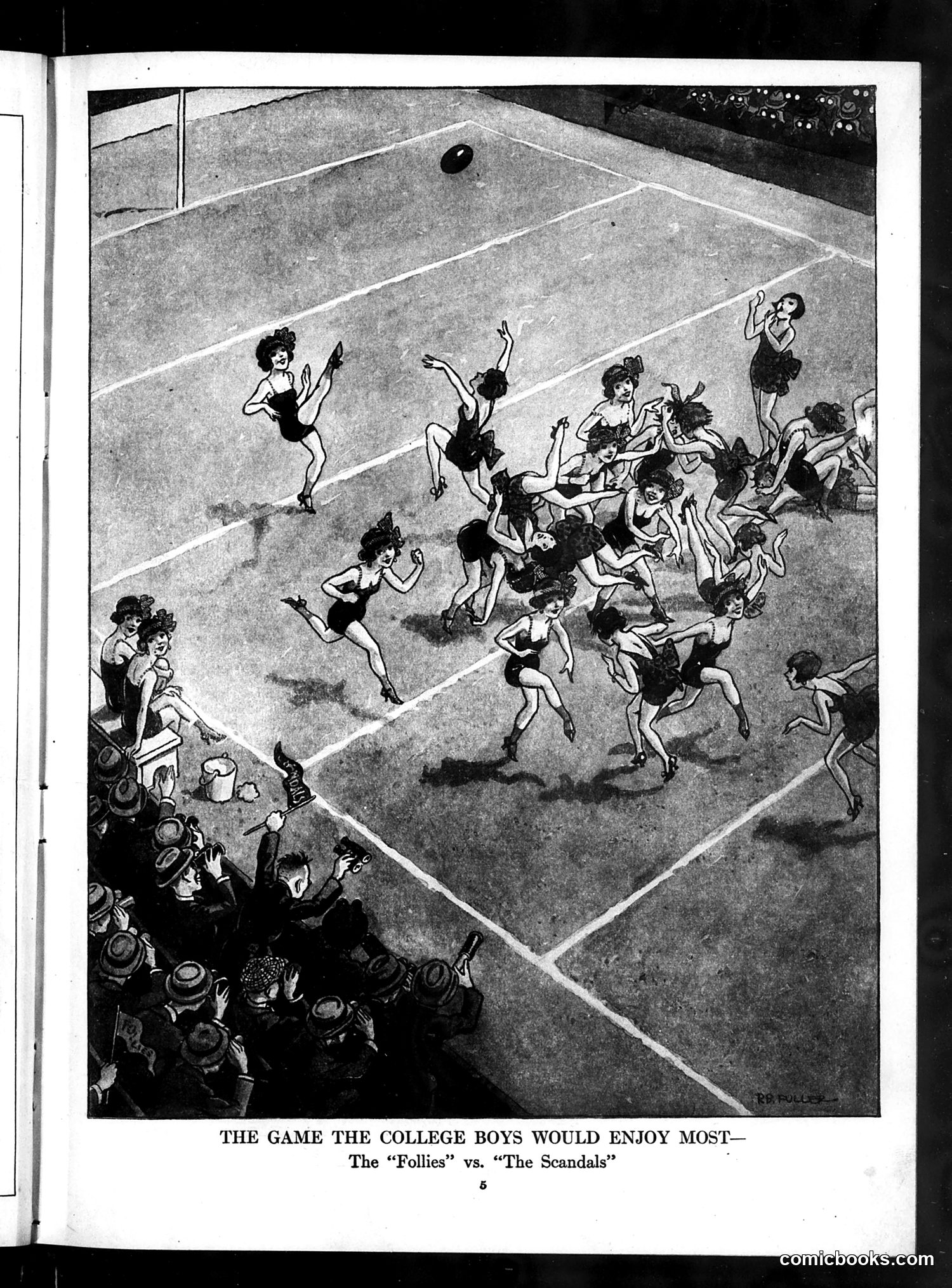
This is a satirical cartoon depicting a volleyball game between two teams labeled "The Follies" versus "The Scandals." The players are drawn as young women in bathing suits, while male spectators wearing hats crowd the sidelines below. The humor targets college men's interest in theatrical revue shows of the era—Broadway's "Follies" (Ziegfeld Follies) and "Scandals" (George White's Scandals) were famous for their attractive chorus girls and risqué entertainment. The cartoon satirizes male college students' priorities, suggesting they'd be far more interested in watching scantily-clad women play volleyball than in serious academic or athletic pursuits. The exaggerated male enthusiasm (visible in the crowded, excited spectators) underscores the joke about shallow entertainment preferences among young men.
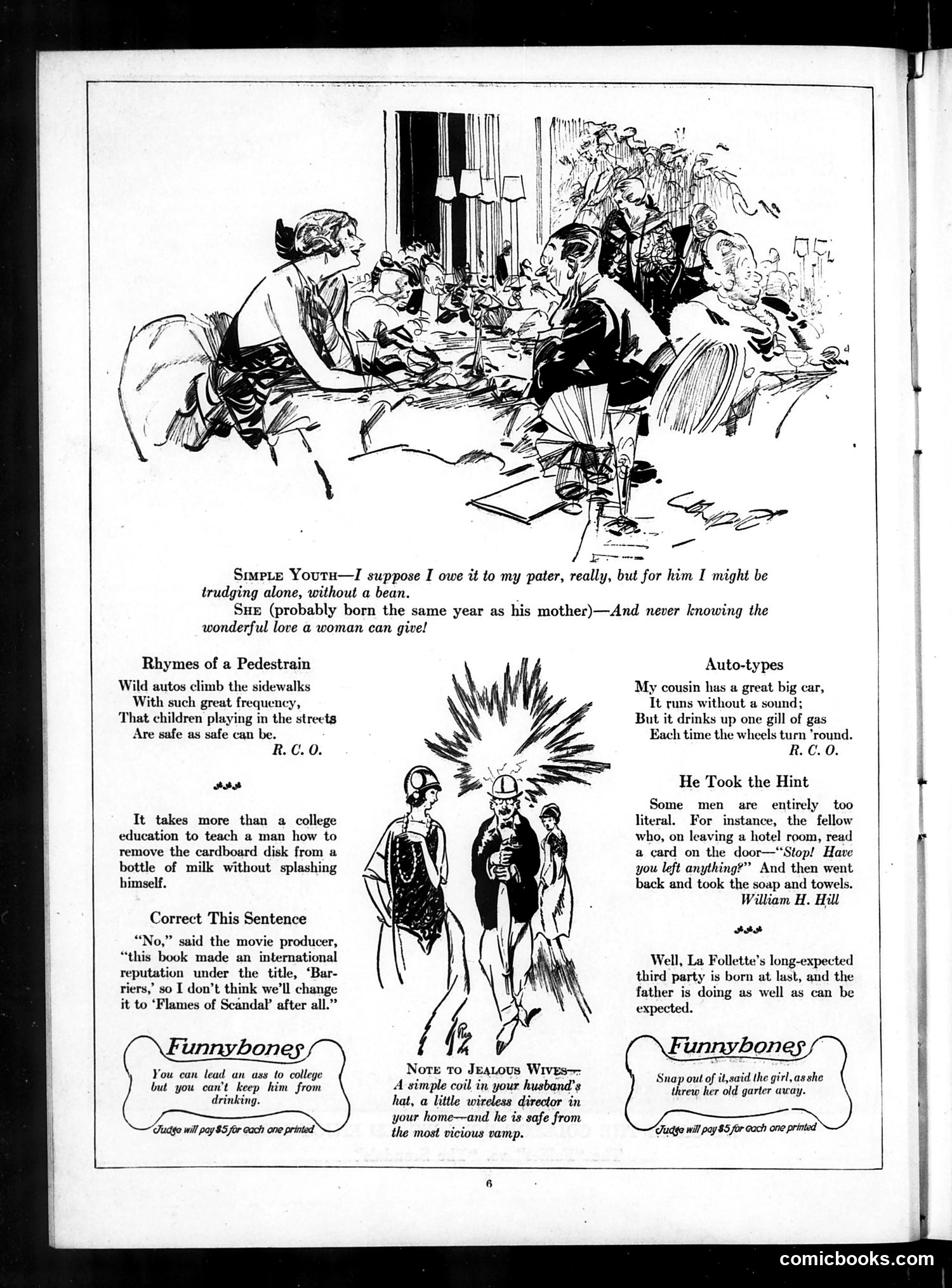
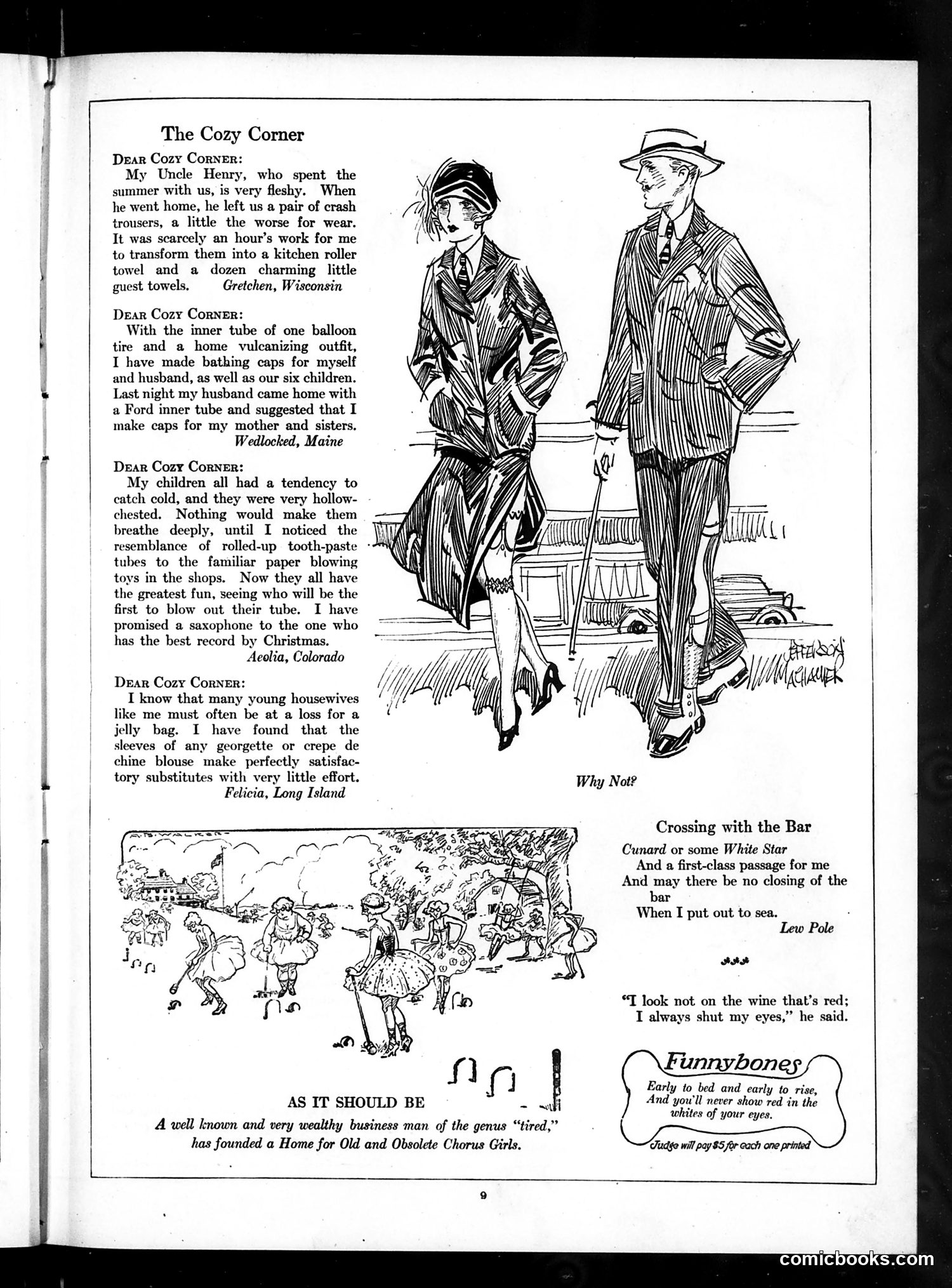
This page from the satirical magazine **Judge** contains multiple short humorous pieces targeting early 20th-century social concerns: **"Simple Youth"** depicts a young man's romantic naiveté—he credits his father for his existence but doesn't understand "the wonderful love a woman can give," mocking youthful ignorance. **"Rhymes of a Pedestrian"** uses ironic verse to satirize dangerous automobile traffic, claiming children are "safe as safe can be" while wild autos climb sidewalks—clearly the opposite is true, critiquing reckless drivers. **Auto-types** jokes about cars' fuel consumption and silent operation. **"He Took the Hint"** mocks literal-minded people: a hotel guest interprets "Have you left anything?" as permission to steal soap and towels. **"Note to Jealous Wives"** references wireless technology as a humorous surveillance tool for controlling husbands' fidelity. The reference to **"La Follette's third party"** likely alludes to Robert La Follette's Progressive ("Bull Moose") political movement, though the specific context is unclear without a date. Overall: lighthearted satire on modern technology, social manners, and politics.
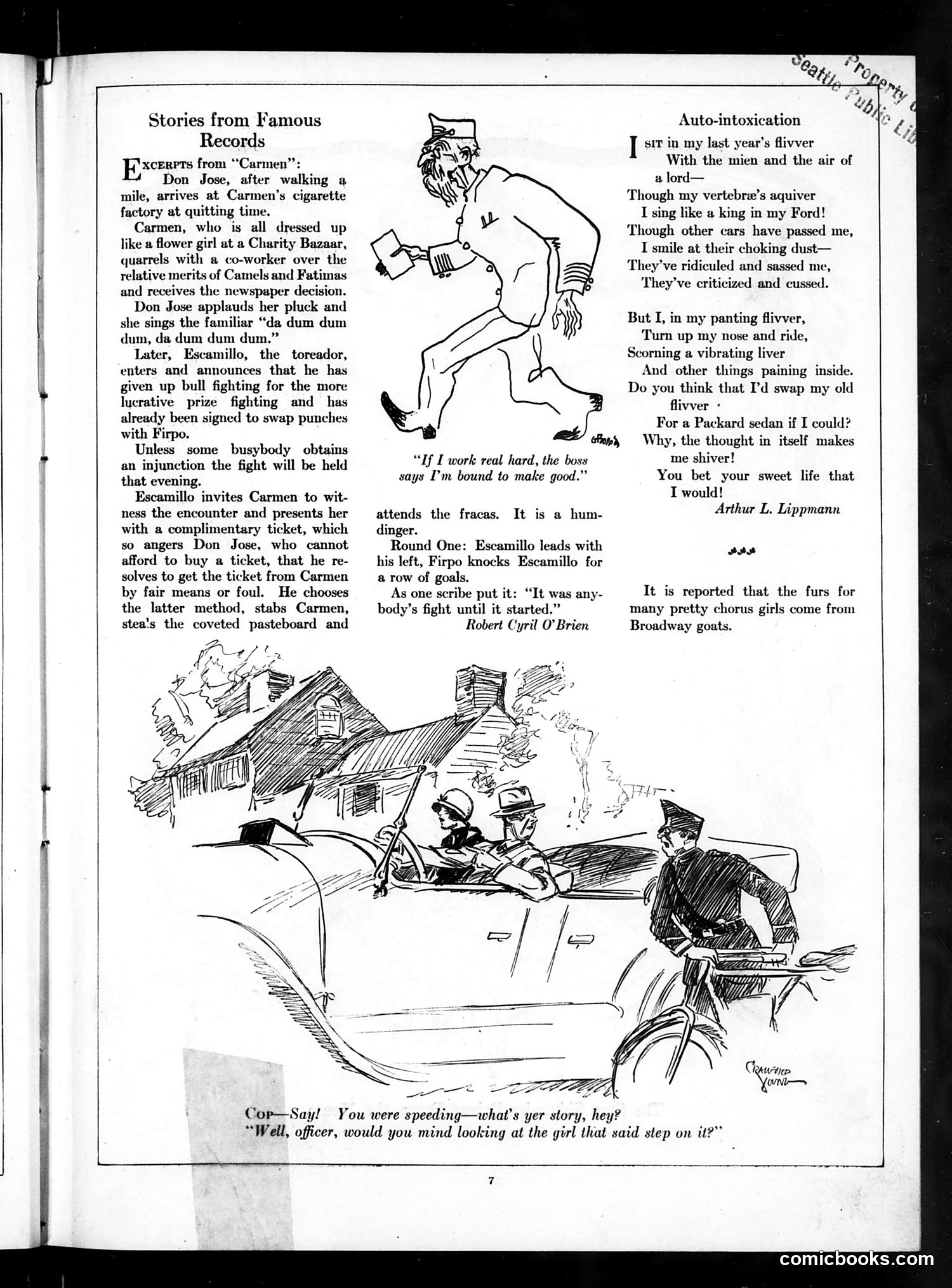
This page from *Judge* magazine contains two satirical pieces: **"Stories from Famous Records"** parodies the opera *Carmen* by modernizing it with 1920s American references. Don Jose becomes a jealous boyfriend, Escamillo the toreador is reimvented as a prize fighter (specifically one who fights boxer Luis Firpo), and Carmen works at a cigarette factory. The satire mocks both opera's melodrama and contemporary boxing/sports culture. The accompanying cartoon shows a speeding driver—when a cop stops him, the driver deflects blame onto a girl who told him to "step on it," satirizing how people evade responsibility. **"Auto-intoxication"** is a poem by Arthur L. Lippmann celebrating attachment to an old Ford ("flivver")—even refusing a fancy Packard sedan. It's humorous self-mockery of American working-class car pride and the cultural status-anxiety surrounding automobile ownership in the 1920s. The final item notes Broadway chorus girls receive fur coats from wealthy "goats" (slang for foolish men), satirizing transactional relationships in entertainment.
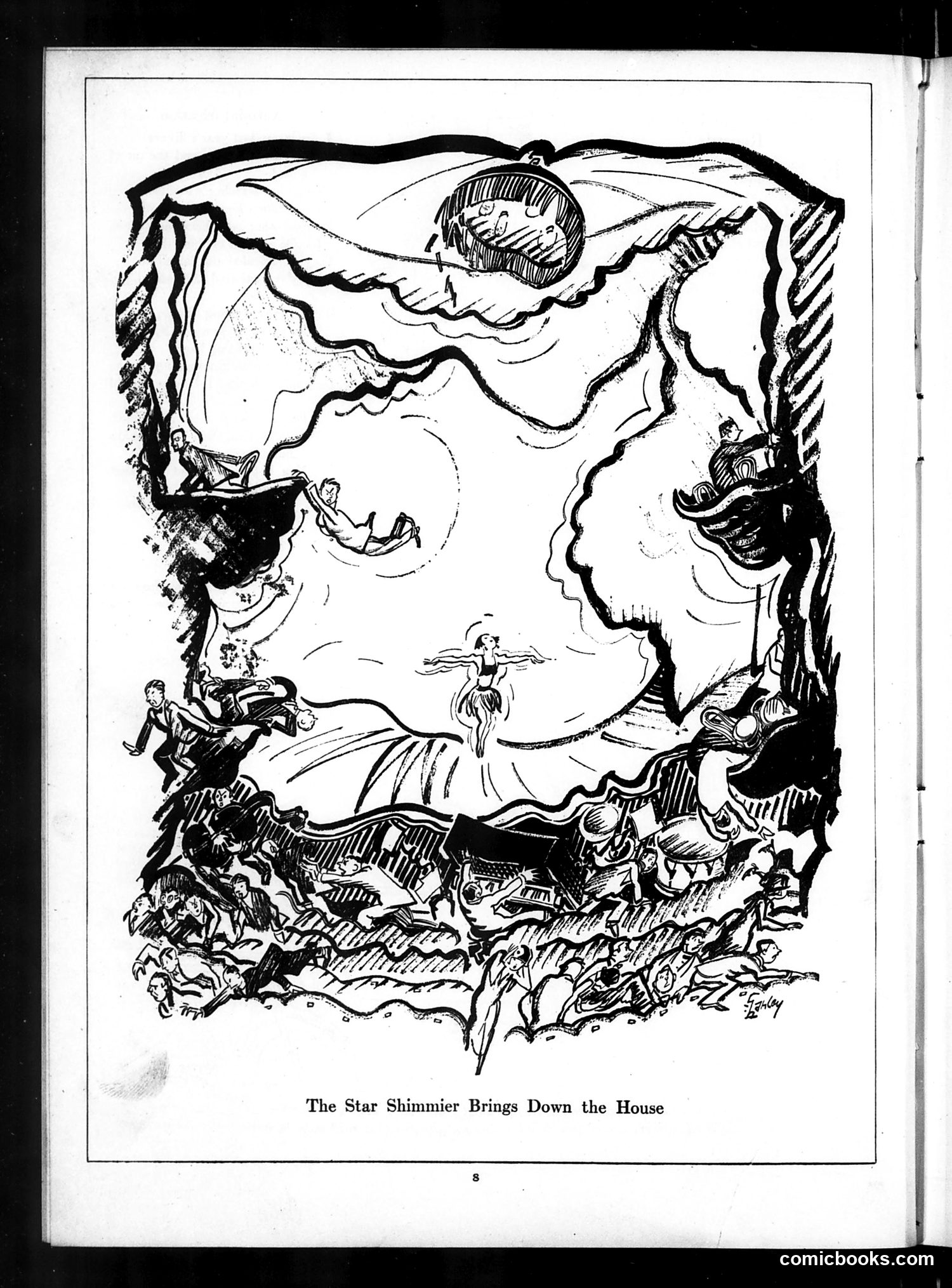
This Judge magazine cartoon satirizes the "shimmy"—a popular dance craze of the 1920s featuring shaking hip movements. The image depicts a massive female head (a caricatured entertainer) whose shimmying literally causes the collapse of a theater building, with panicked audience members and performers tumbling from the destruction below. The satire mocks both the dance's wild popularity and moral anxieties about it. Conservative critics viewed the shimmy as scandalous and sexually inappropriate. By literalizing the phrase "brings down the house" (meaning creates excitement), Judge ridicules the hysteria surrounding the dance while commenting on its cultural power to captivate and disrupt society. The exaggerated scale emphasizes how thoroughly this entertainment phenomenon dominated public attention in the Jazz Age.
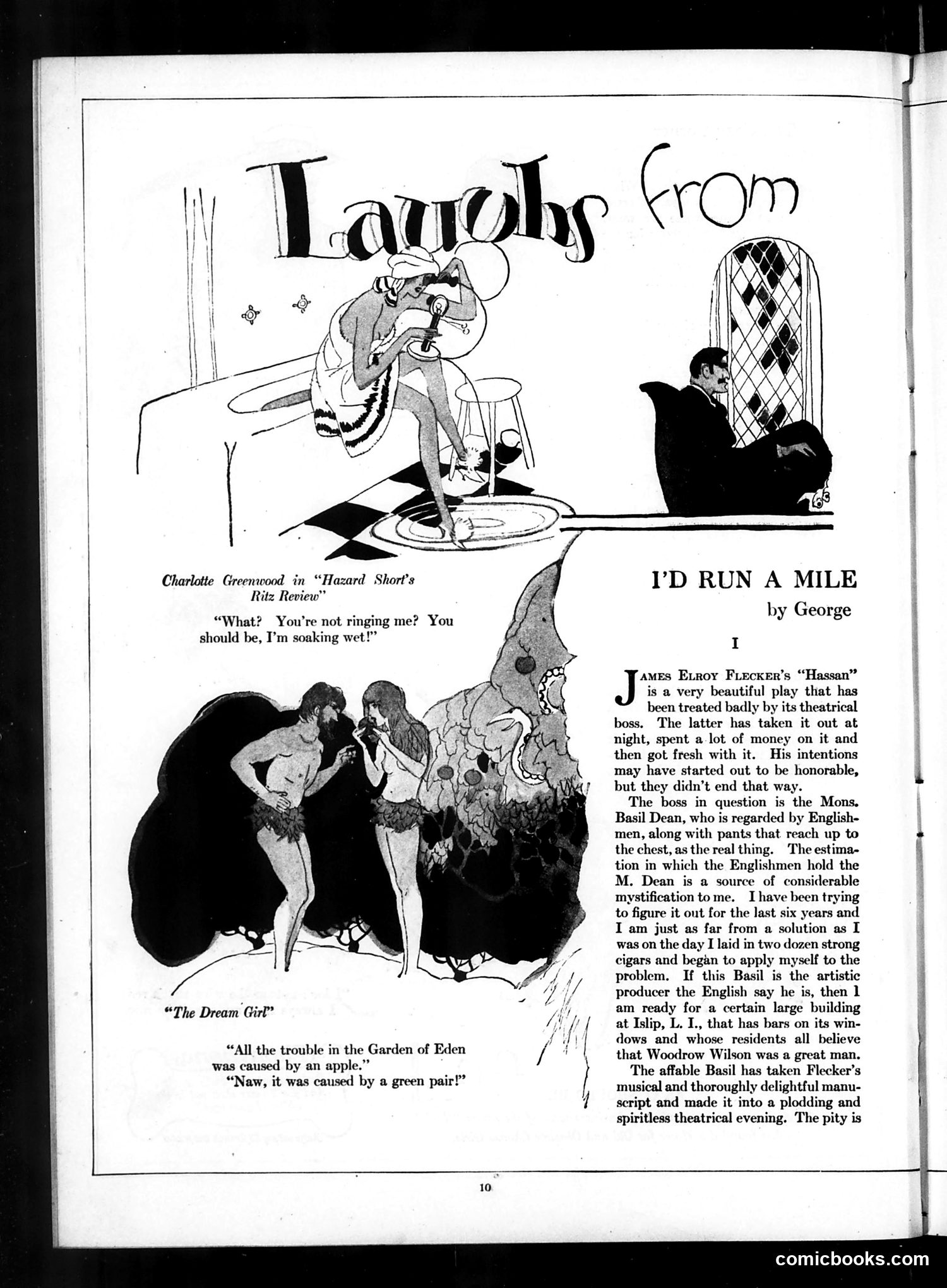
This page contains theatrical humor and criticism rather than political satire. The "Laughs" section features two entertainment cartoons: one showing Charlotte Greenwood in a bathing scene from "Hazard Short's Ritz Review," and another titled "The Dream Girl" with a crude joke about the Garden of Eden (the "green pair" is a pun on female anatomy). The main article, "I'd Run a Mile" by George, is a scathing theater review criticizing producer Basil Dean's staging of James Elroy Flecker's play "Hassan." The author (whose full identity is unclear) argues that Dean, highly regarded by Englishmen, has taken Flecker's beautiful musical script and transformed it into a tedious, lifeless production. The final punch is a threat to commit himself to an asylum rather than endure such work—contemporary slang referencing Islip's mental institution.
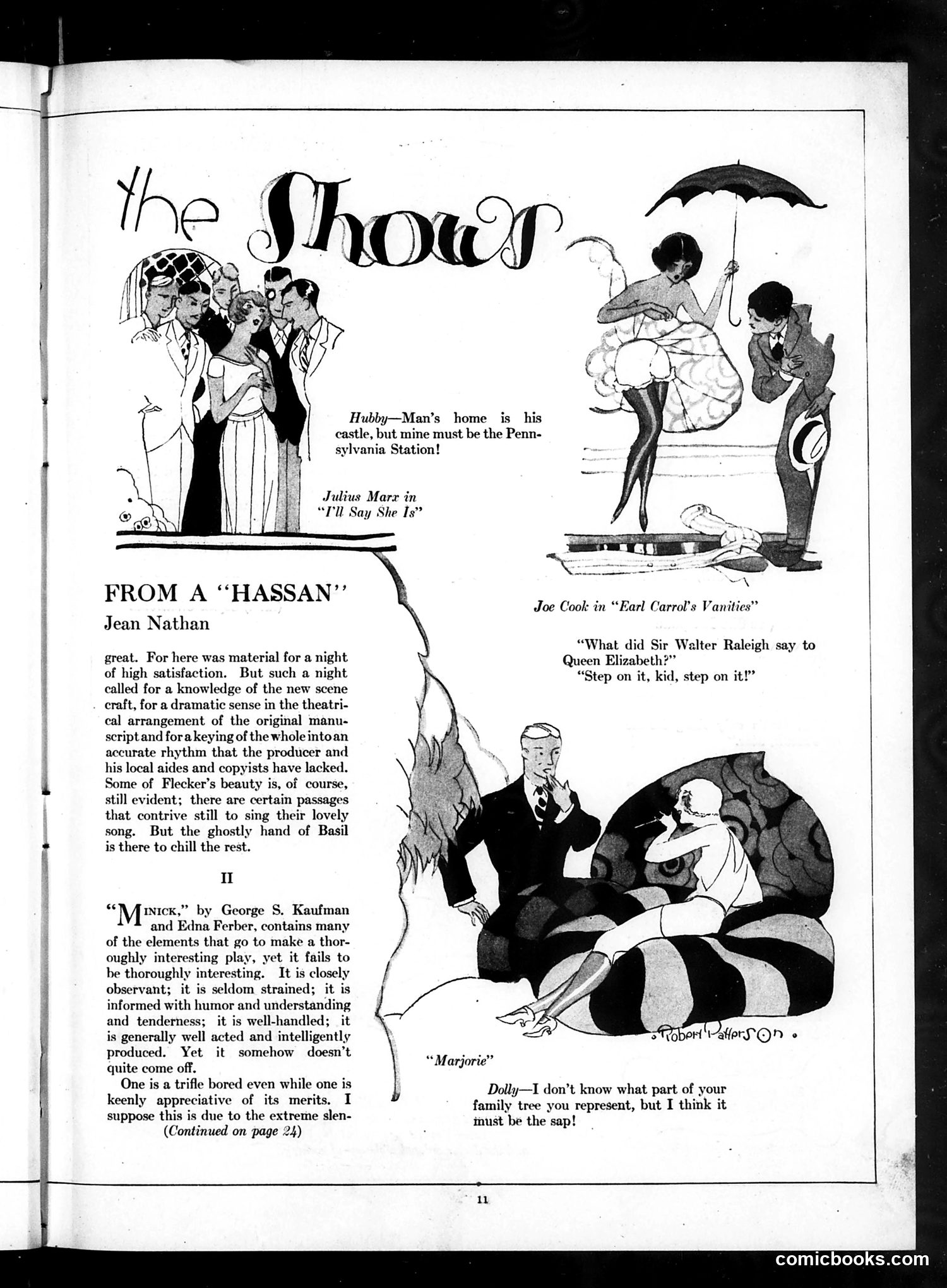
This page from Judge presents theatrical reviews and related humor illustrations. The main content includes: **Theater Reviews** by Jean Nathan critiquing Broadway productions: "From a Hassan" (adapted from Flecker's play) and "Minick" (by Kaufman and Ferber). Nathan praises elements of both but finds them ultimately unsatisfying—well-crafted yet somehow boring or incomplete in execution. **Accompanying Cartoons** feature vaudeville/Broadway performers (Julius Marr, Joe Cook) in comic situations. The humor is period-typical domestic comedy: a husband preferring Penn Station to home; a Sir Walter Raleigh joke about stepping on a woman's dress; a family-tree "sap" pun. The page assumes readers' familiarity with current Broadway shows and performers. The satire is gentle—critiquing theatrical craftsmanship rather than politics. The cartoons use slapstick and wordplay typical of 1920s-era entertainment journalism.
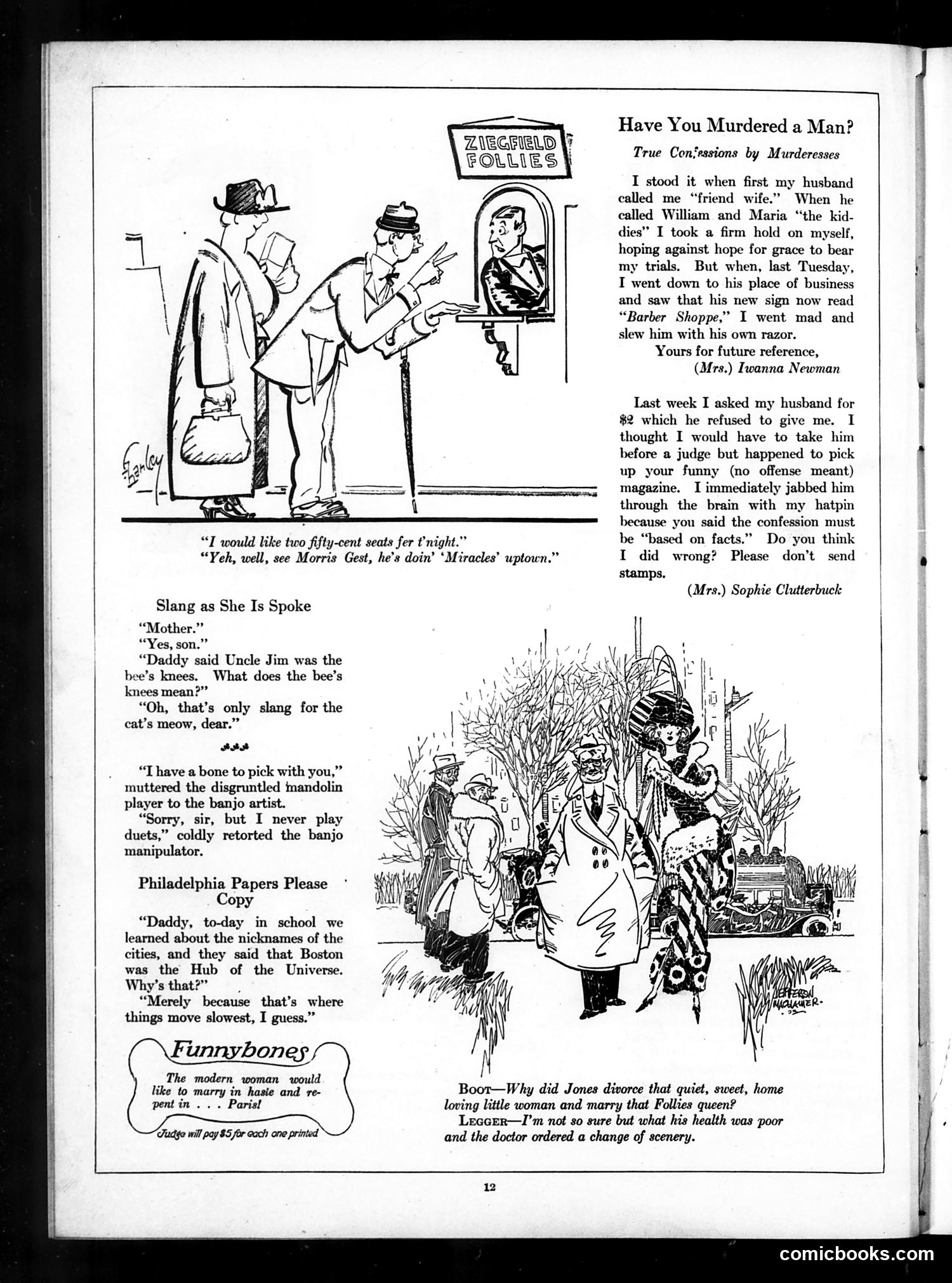
This page satirizes women's changing roles and modern marriages through darkly comic "confessions." **Top section**: Two fake murder confessions parody sensational crime stories. Mrs. Newman kills her husband over his embarrassing "Barber Shoppe" sign; Mrs. Clutterbuck murders hers with a hatpin after reading Judge's humor magazine—blaming the publication for requiring "facts." The humor targets both marital discord and women's frustration with trivial male behavior. **Middle sections**: "Slang as She Is Spoke" mocks modern slang (bee's knees, cat's meow) through generational conversation. Other brief jokes ridicule musicians and Boston's slowness. **Bottom**: A Follies girl becomes desirable precisely *because* she's a performer—the "Follies queen" wins over a "quiet, sweet, home loving" wife. The joke suggests men prefer glamorous show girls, implying wives have become boring by comparison. **Overall context**: This reflects 1920s anxiety about women's independence, theatrical culture, and shifting marriage dynamics post-WWI, presented through Judge's characteristic irreverent humor targeting modern social disruption.
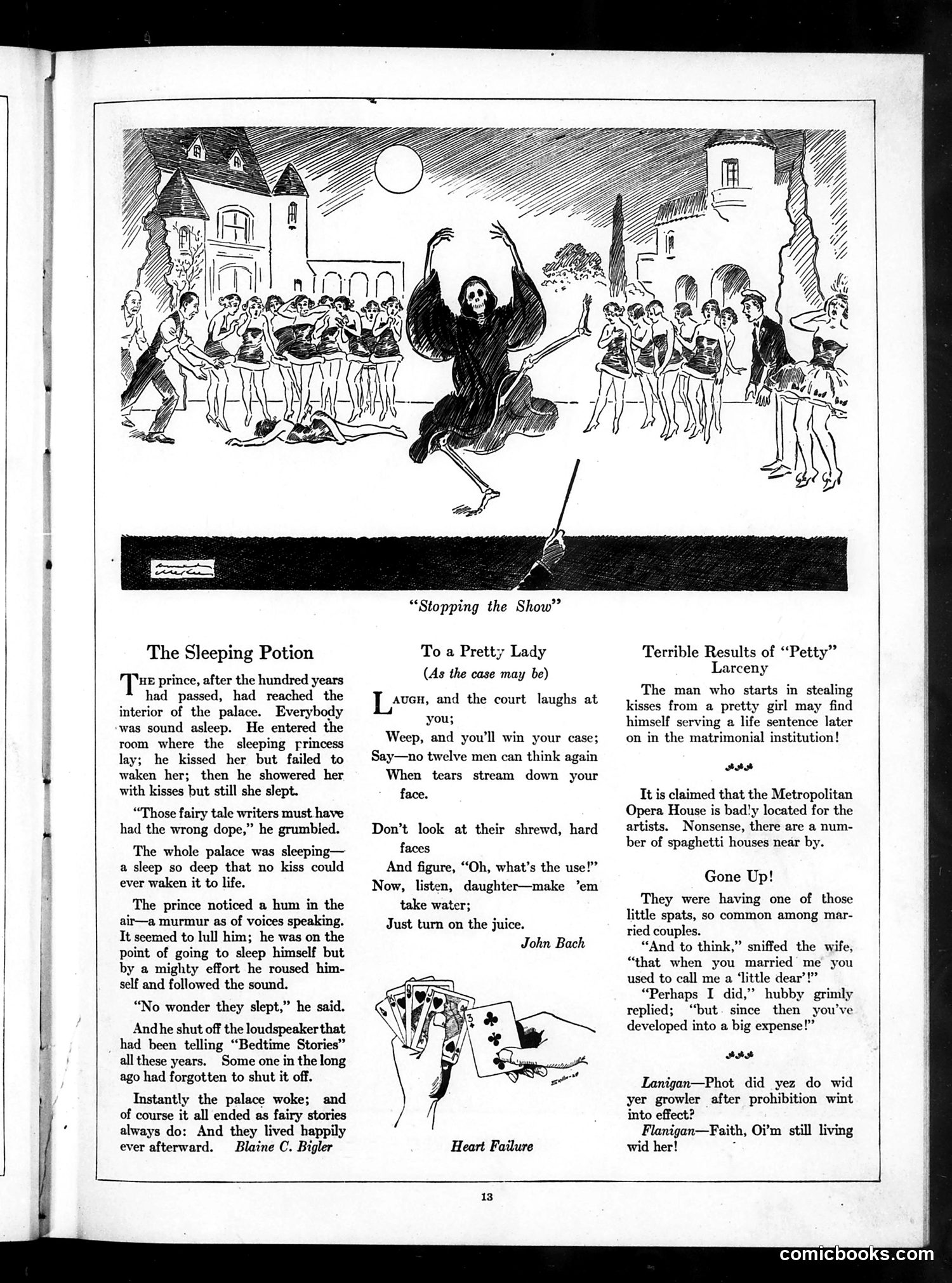
This page contains satirical humor pieces typical of early 20th-century Judge magazine: **"The Sleeping Potion"** mocks fairy tale logic by having a prince discover the palace sleeps not from enchantment but from a continuously-playing "Bedtime Stories" radio broadcast that no one shut off. The joke critiques both the implausibility of fairy tales and the new intrusion of radio into modern life. **"To a Pretty Lady"** offers cynical courtroom advice: female witnesses should cry to manipulate male jurors rather than appeal to reason—satirizing both courtroom sexism and women's limited legal power. The remaining pieces are brief quips: a warning that stealing kisses leads to marriage (implying matrimony as punishment); a jab at the Metropolitan Opera House's location near Italian restaurants; and domestic humor about a wife's expense being called "a little dear" becoming "a big expense." The bottom exchanges use Irish dialect humor, common in period publications. Overall, the page reflects 1920s-30s anxieties about modernity, gender relations, and marriage.
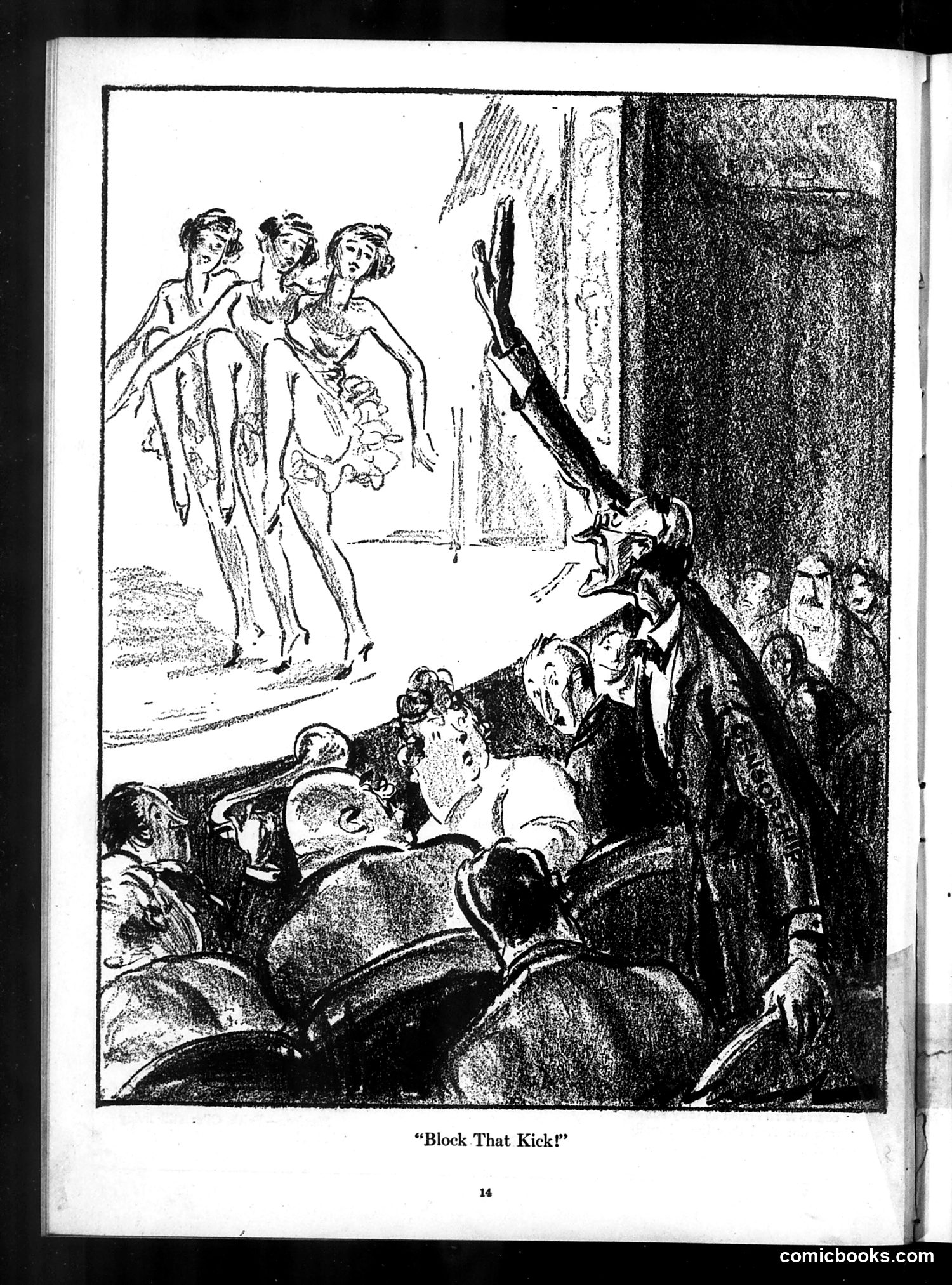
This cartoon depicts a theatrical or performance scene. Three scantily-clad female performers (appearing to be chorus girls or dancers) are shown on stage in the upper portion. Below them, a group of men in formal attire—appearing to be theater patrons or officials—react with alarm or disapproval, with one figure notably pointing upward in a censorious gesture. The title "Block That Kick!" suggests the joke concerns censorship or moral objection to the dancers' performance, likely their high kicks. This reflects early 20th-century tensions over theatrical morality and propriety. The cartoon satirizes either the prudishness of audiences/authorities attempting to suppress risqué entertainment, or conversely, the scandalous nature of such performances. The formal men's shocked reactions emphasize the social controversy surrounding such entertainment.
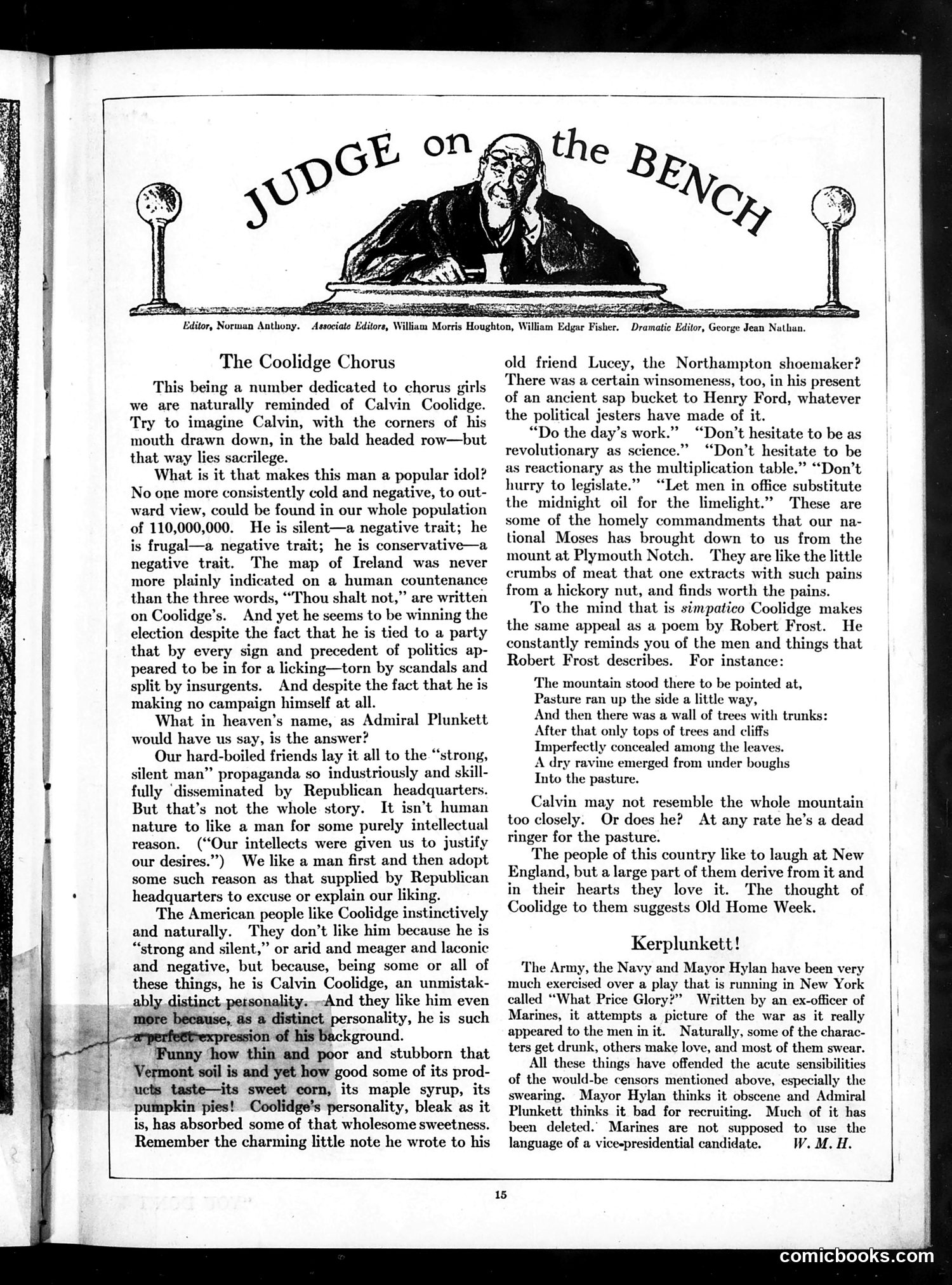
This editorial celebrates President Calvin Coolidge's popularity despite his austere, negative personality. The author argues Americans instinctively like him not because of Republican propaganda about his "strong, silent" image, but because he authentically embodies his Vermont background—frugal, laconic, and morally stern. The piece compares Coolidge to poet Robert Frost, suggesting his appeal lies in representing wholesome New England values. The repeated phrase "Thou shalt not" captures his image as a moral authority figure ("national Moses") dispensing homely wisdom. This likely dates to the 1924 election campaign, when Coolidge ran for a full term despite Republican scandals (Teapot Dome). The satire's tone is affectionate rather than mocking—praising Coolidge as an genuine personality that transcends political machinery.
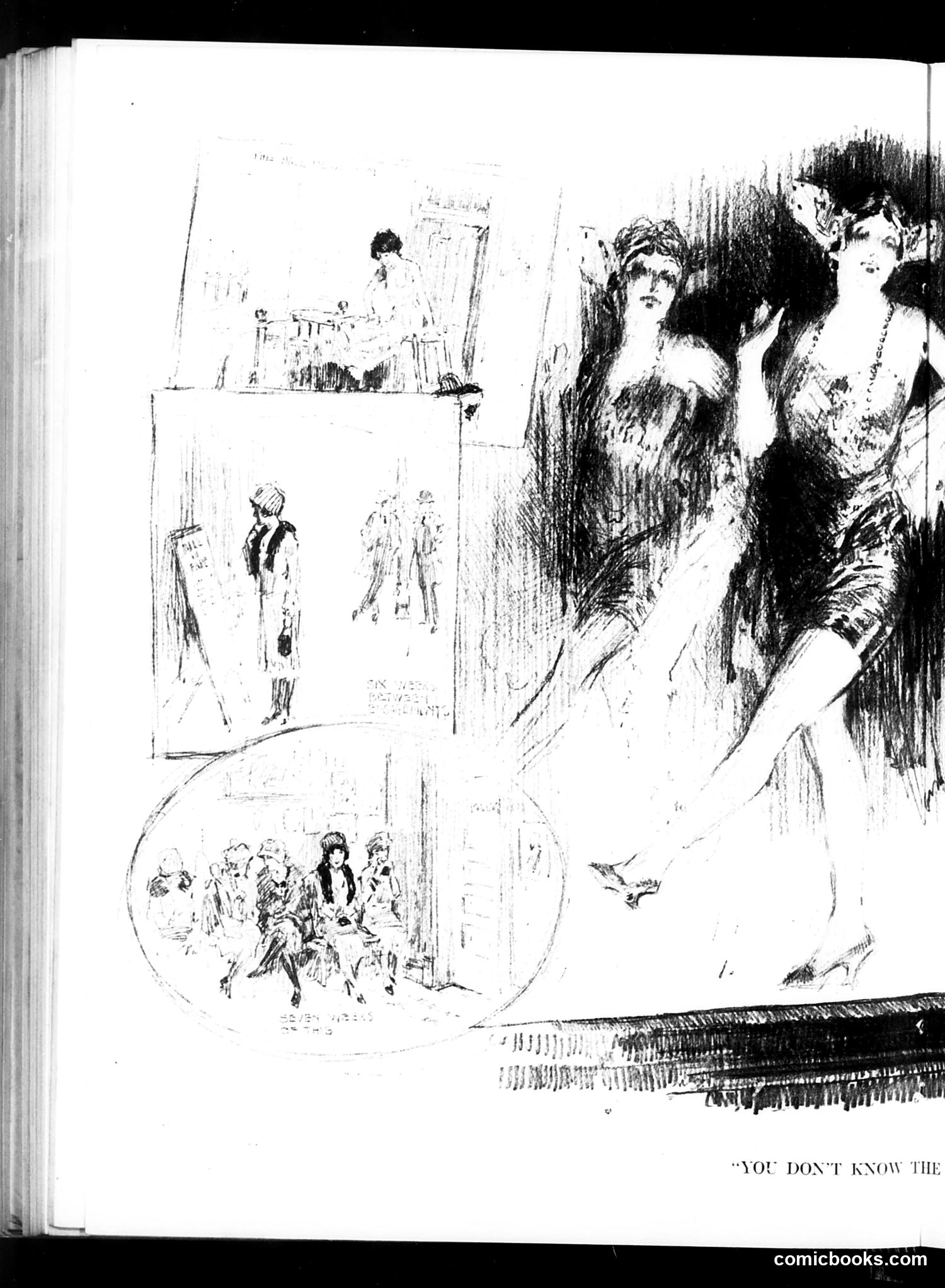
This appears to be a satirical illustration from *Judge* magazine showing a scene with multiple panels. On the right, three elegantly dressed women in what appears to be fashionable 1910s-1920s attire are depicted. The left side shows smaller vignettes of various social scenarios. The incomplete caption—"YOU DON'T KNOW THE"—suggests the satire targets something about women's social experiences or pretenses that the viewer might be unaware of. Given the era and style, this likely satirizes women's fashion, social climbing, or the gap between women's public personas and private lives. The contrast between the prominent, well-dressed figures and smaller background scenes suggests commentary on social hierarchies or hypocrisy among fashionable society women. Without the complete caption, the specific target remains unclear.
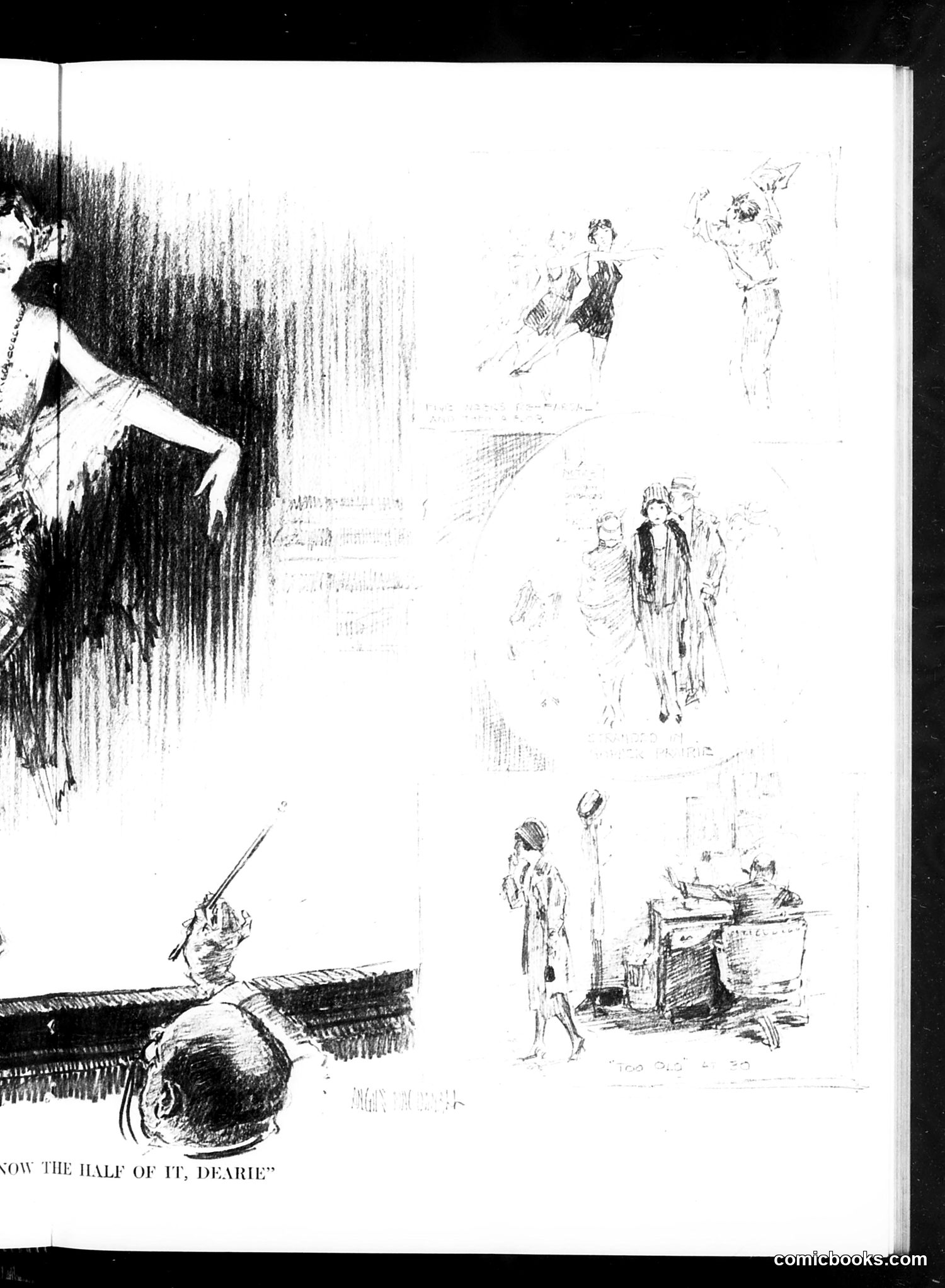
This appears to be a satirical illustration from *Judge* magazine depicting a scene with multiple figures in what looks like a domestic or social setting. The caption "'OW THE HALF OF IT, DEARIE'" suggests wordplay or a pun—likely a play on "how the half of it" (meaning "you don't know the half of it"). The sketch shows various characters in period dress (early 20th century, based on style) engaged in what may be a comedic social interaction. Without clearer identification of specific figures or visible dates, the exact political or social reference remains unclear. The illustration style is typical of *Judge*'s satirical humor, but the specific subject of satire—whether marital relations, class commentary, or current events—cannot be definitively determined from the image alone.
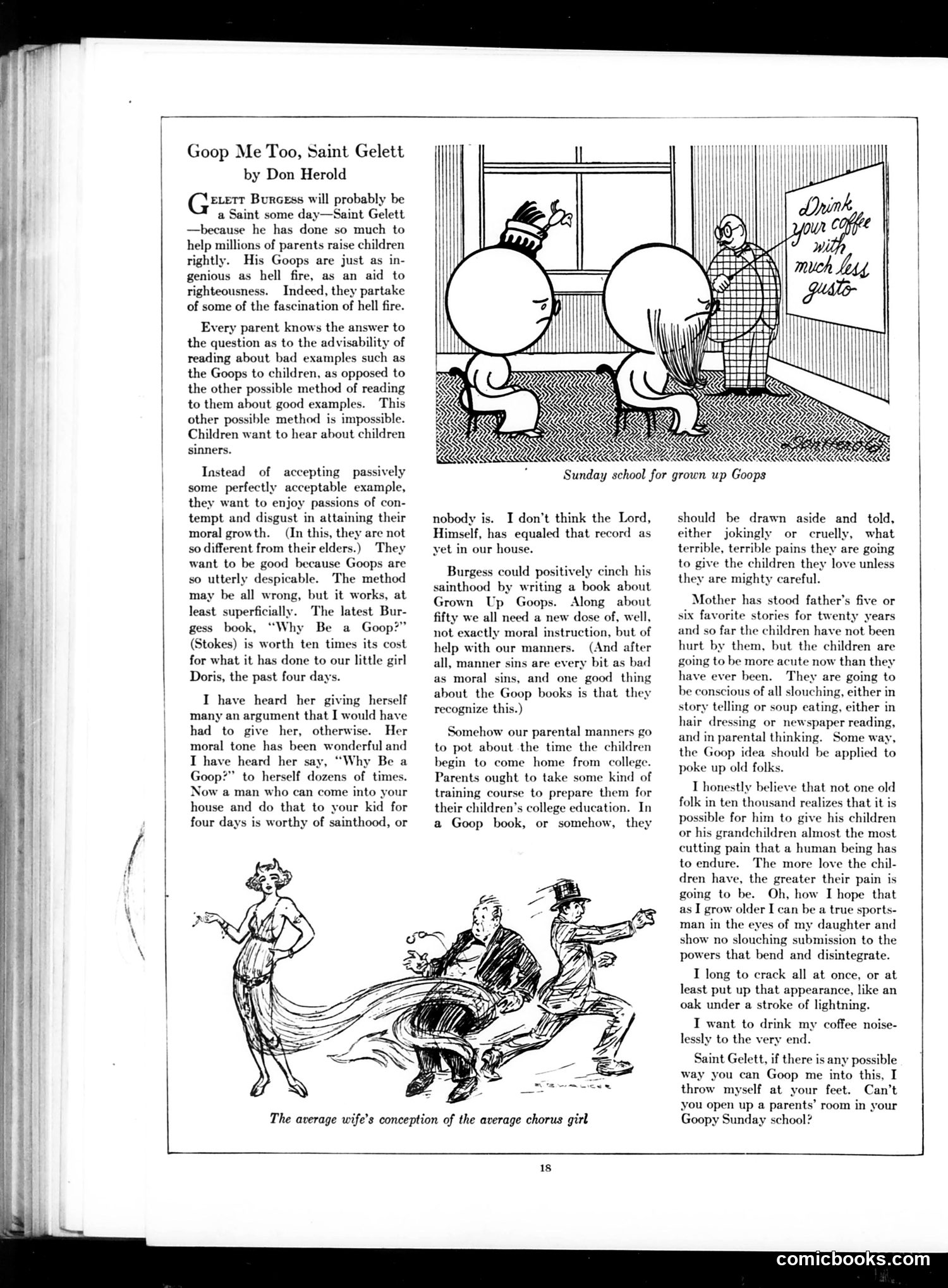
This article by Don Herold celebrates Gelett Burgess, creator of "The Goops"—misbehaving child characters in morality books. Herold argues Burgess deserves sainthood because his negative examples effectively teach children good behavior better than positive role models do. The satire targets parenting philosophy: children naturally prefer cautionary tales about misbehavior over virtuous examples. Herold extends this to adults, humorously requesting a "Grown Up Goops" book to shame aging parents into better manners—particularly fathers who become slovenly and annoying as they age. The cartoons illustrate this: one shows grotesquely rude creatures at a "Sunday school for grown up Goops"; another depicts a wife's exaggerated fantasy of chorus girls' wild behavior, contrasting respectable propriety with perceived immorality. The humor lies in applying children's moral instruction methods to reform adult behavior through shame and ridicule.
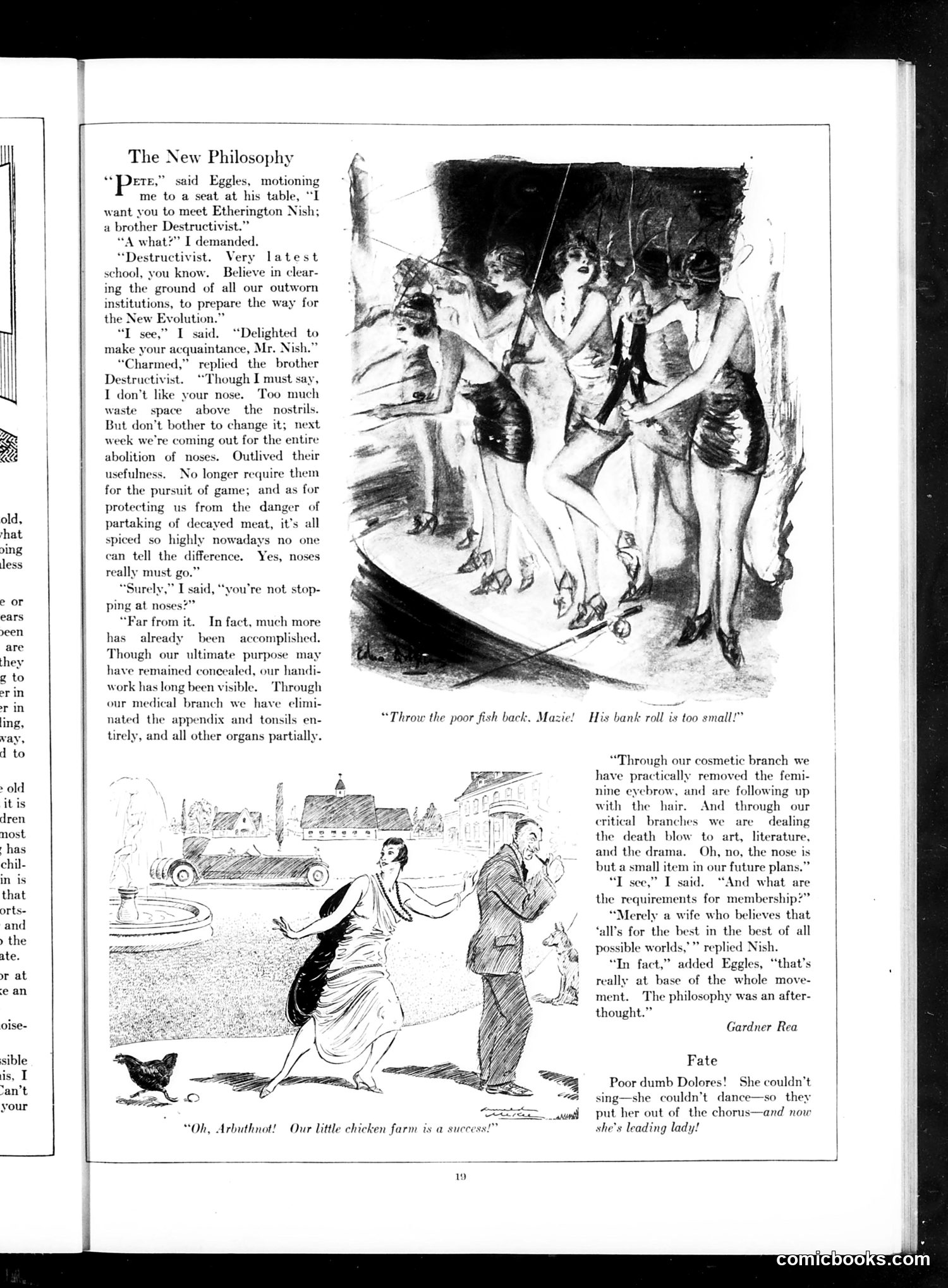
This Judge satire mocks an intellectual movement called "Destructivism"—likely a jab at radical early-20th-century philosophies advocating wholesale dismantling of existing institutions. The character Etherington Nish embodies the movement's absurdity: he proposes eliminating noses (arguing they're evolutionary relics), having supposedly already removed appendixes and tonsils through a "medical branch," and destroyed art, literature, and drama through "critical branches." The joke exposes how such radical ideologies prioritize destruction over coherent reconstruction. When asked membership requirements, Nish reveals the real basis: wives who accept "best of all possible worlds"—mocking blind faith justifying any destructive policy. The cartoon's bottom illustrations reinforce the satire: one shows people pursuing frivolous pursuits, another shows poor judgment about money. Together, they suggest Destructivism appeals to people disconnected from practical consequences.
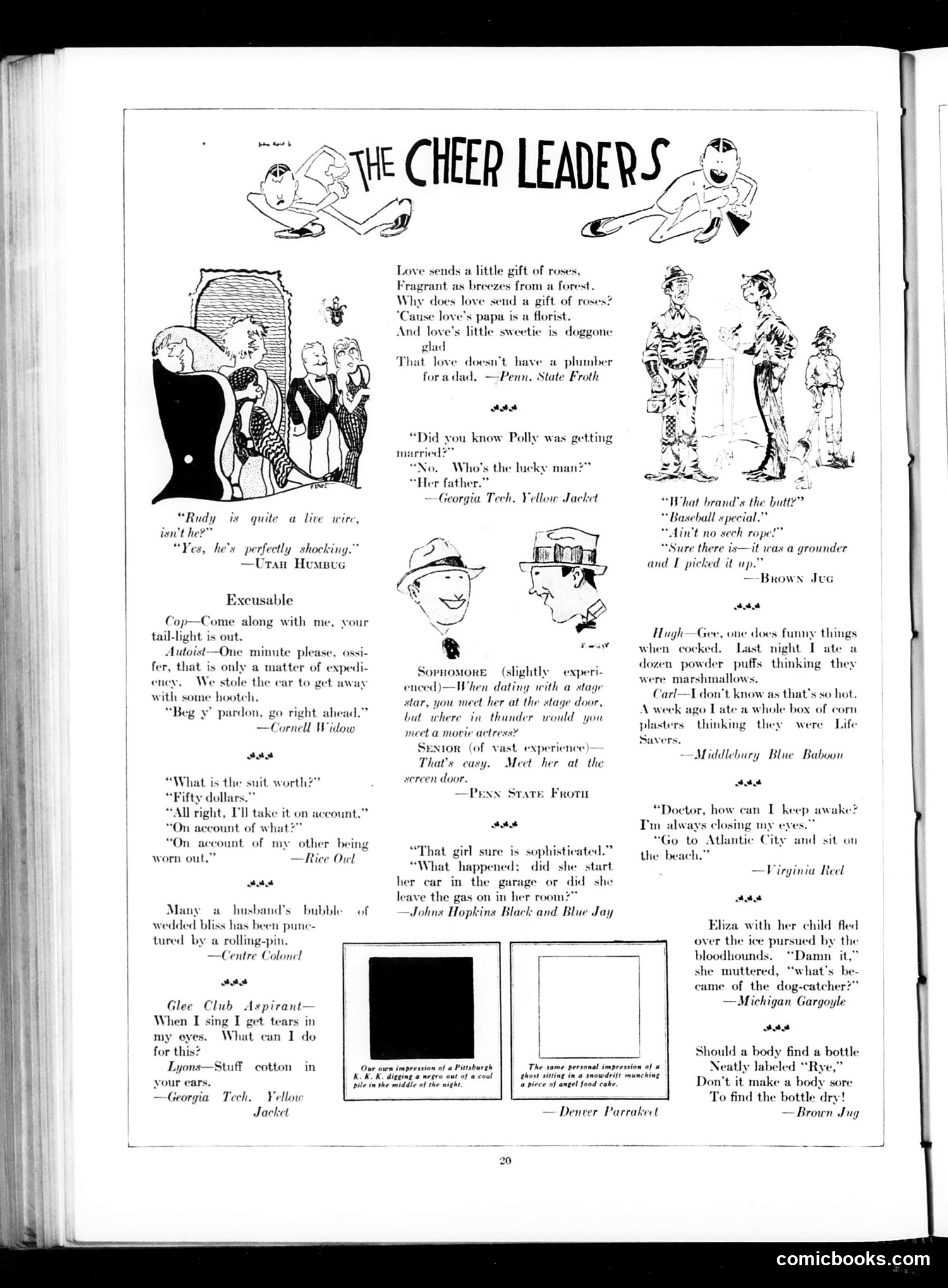
This page collects humorous one-liners and jokes from college publications, organized under the heading "The Cheer Leaders." The content reflects early-20th-century college humor, featuring: **Main themes:** - Prohibition-era jokes (stealing cars "with some hootch," getting "cocked") - Dating and courtship humor (the Polly joke implies her father benefits from her marriage) - Comic misunderstandings (confusing powder puffs for marshmallows, corn plasters for Life Savers) - Vaudeville/stage references (meeting movie actresses at "screen doors" vs. stage doors) **Social context:** The jokes assume familiarity with 1920s college life, automotive culture, speakeasies, and theatrical entertainment. References to "Atlantic City" and mild sexual innuendo ("sophisticated" girls) reflect Jazz Age attitudes. **The cartoons** (small illustrations) appear decorative rather than narrative, showing generic flapper-era figures. This is essentially a joke compilation page—entertainment rather than political satire—typical of Judge's lighter collegiate humor sections.
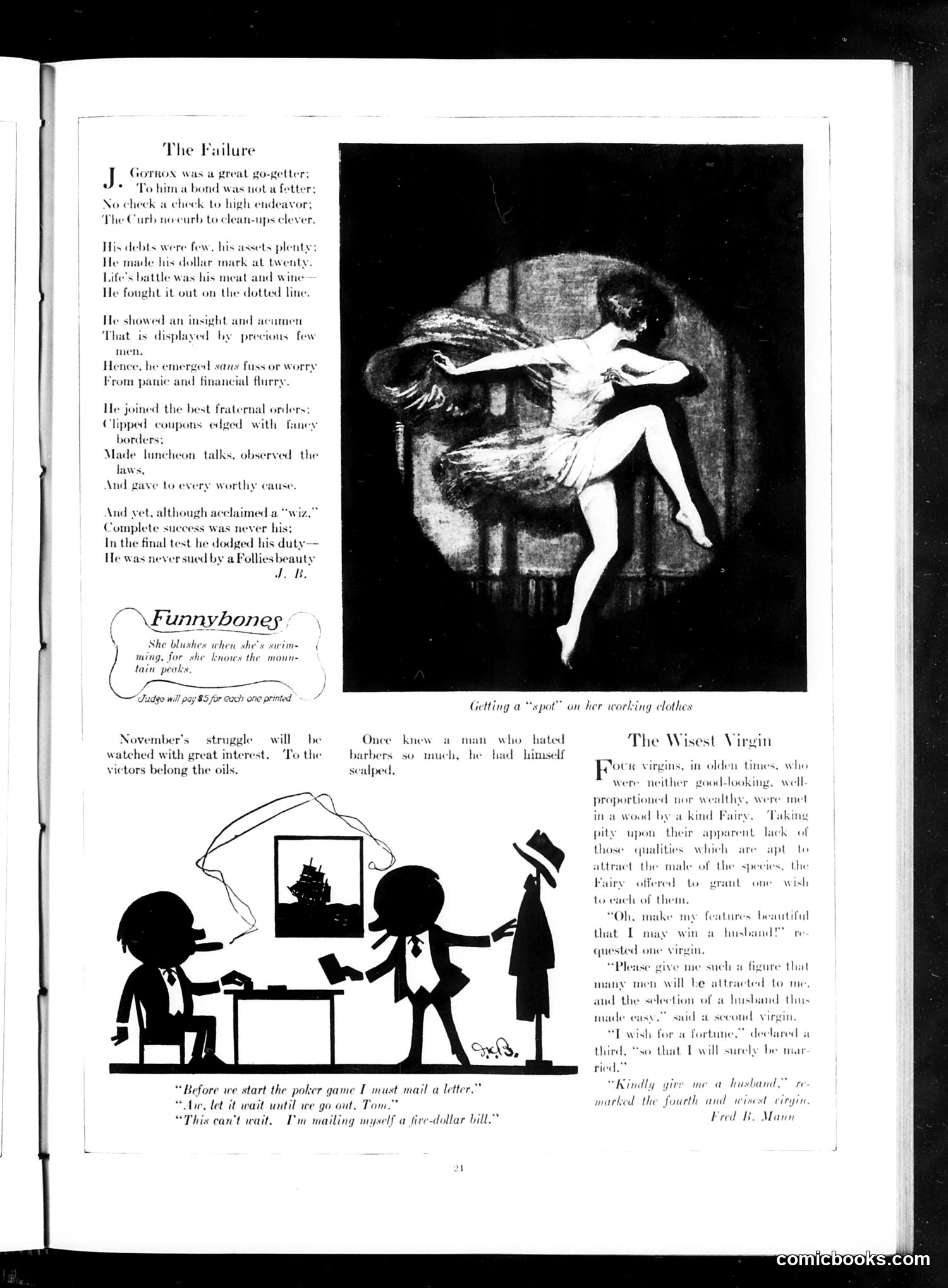
This page contains three separate humorous pieces typical of early 20th-century satirical magazines: **"The Failure"** (poem with photo): Satirizes a successful businessman ("Gorrox") who achieves wealth, joins clubs, and maintains respectability, yet ultimately "dodged his duty" by never marrying a Follies beauty—suggesting that material success without romantic/sexual conquest equals failure. The humor targets both shallow masculinity and the obsession with showgirl romance. **Middle cartoon**: Shows men discussing a poker game while one character insists on mailing himself a "five-dollar bill"—absurdist humor playing on the phrase "mailing it in" or avoiding direct action. **"The Wisest Virgin"** (story): Four unmarried women receive wishes from a fairy. Three choose beauty, figure, or fortune to attract husbands; the fourth—deemed wisest—simply asks for "a husband." The joke critiques women's conflicting priorities and suggests direct pragmatism beats calculated self-improvement. All three pieces mock vanity, materialism, and romantic desperation across genders typical of Jazz Age satire.
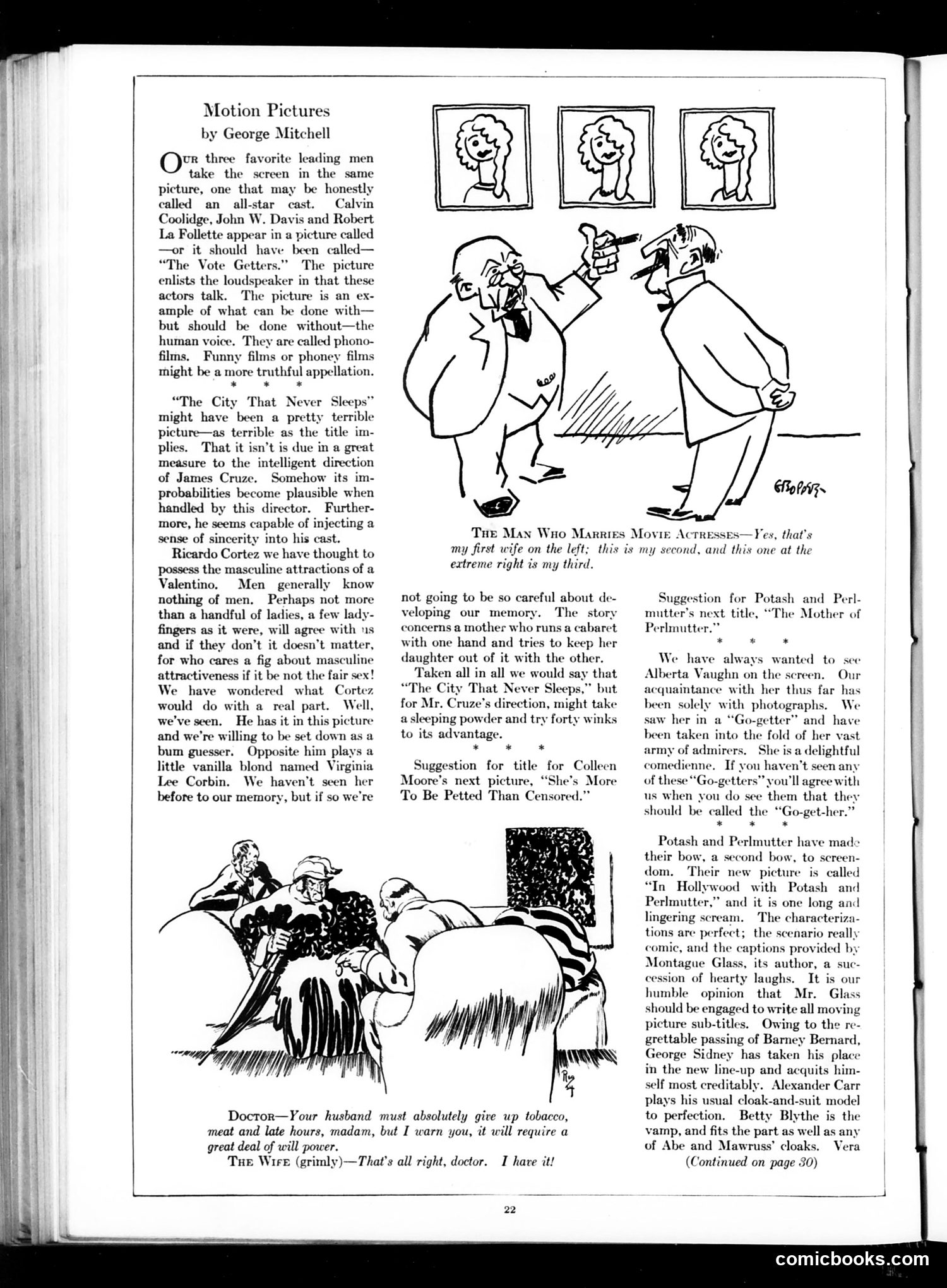
This page from *Judge* magazine contains film reviews and satirical cartoons about 1920s cinema and silent films. The main political cartoon at top mocks a 1924 presidential race featuring three candidates: Calvin Coolidge (incumbent Republican), John W. Davis (Democrat), and Robert La Follette (Progressive). The reviewer sarcastically suggests their political "picture" should be called "The Vote Getter"—criticizing these candidates as mere performers engaged in empty talk, comparing them unfavorably to the new "phono-films" (early sound pictures). Below, a domestic humor cartoon shows a wife telling her doctor she has the willpower to enforce her husband's health regimen—a joke about matrimonial control. The remaining text reviews silent films and actors of the era (Ricardo Cortez, Virginia Lee Corbin, Colleen Moore), with playful title suggestions mocking film studios' attempts at censorship and morality. The "Man Who Married Movie Actresses" cartoon jokes about serial marriage among Hollywood actors—a contemporary scandal.
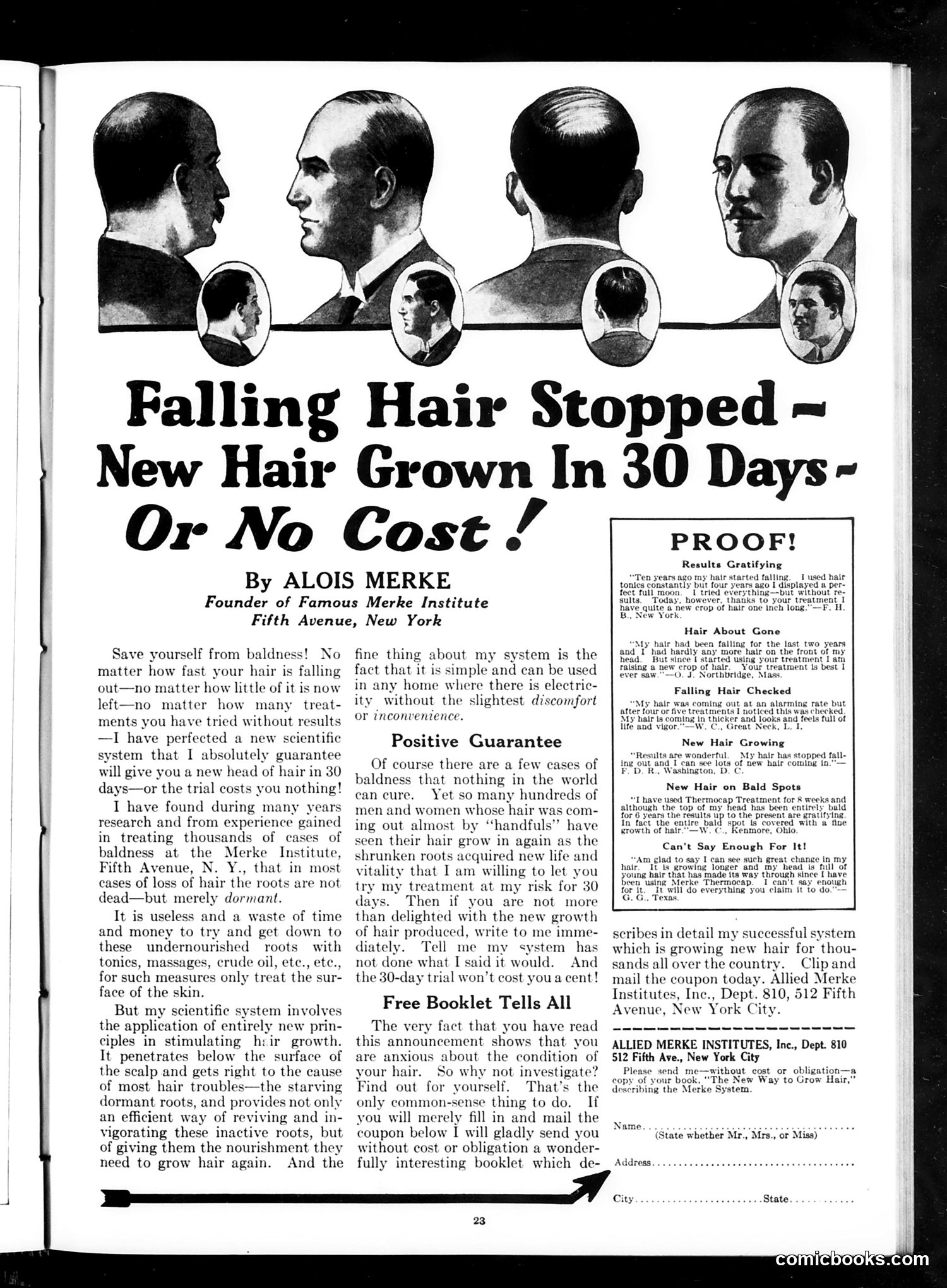
This is primarily a **full-page advertisement** for the Merke Institute's hair-loss treatment, not a political cartoon or satire. The page appears in *Judge* magazine but functions as commercial promotion rather than editorial content. **The Visual Elements:** Four male profile illustrations demonstrate supposed before-and-after results, with smaller inset portraits showing claimed improvements. This was standard advertising imagery of the era. **The Pitch:** Alois Merke, claiming to be a founder of a Fifth Avenue institute, promises to stop hair loss and regrow hair within 30 days "or no cost." The appeal targets male baldness anxiety—a persistent consumer concern across eras. **Historical Context:** This reflects early 20th-century advertising practices: unregulated health claims, pseudo-scientific language ("stimulating hair growth," "dormant roots"), celebrity-style endorsements with initials only, and the free-trial-coupon marketing strategy that became ubiquitous. **For Modern Readers:** This reveals how timeless male vanity marketing is, and how historically unrestricted such claims were before FDA regulation.
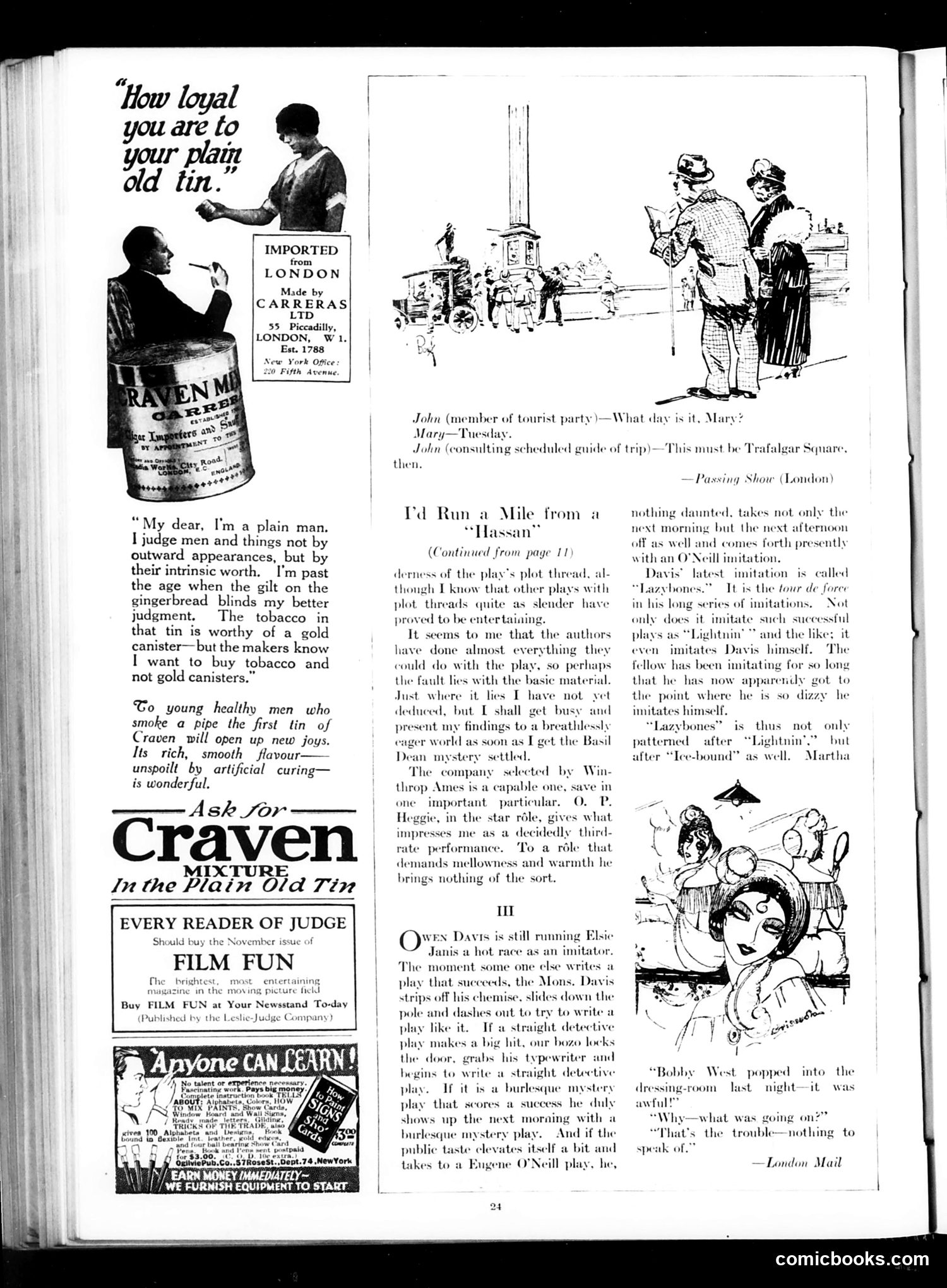
This page mixes advertisements with theater criticism. The dominant visual is a **Craven tobacco advertisement** (British, imported from London) featuring a quote about judging quality by intrinsic worth rather than packaging—a pitch to masculine sophistication. The main text critiques a theatrical production called **"I'd Run a Mile from a Hassan,"** reviewing its plot coherence and the performance of actor **Winthrop Ames** (likely the director). The critic notes the play lacks depth but acknowledges the company's competence. The satire involves **Owen Davis**, an impressionist/imitator, who apparently has become so prolific at mimicking successful contemporary plays (referenced: "Lightnin'" and "Ice-bound") that he's now imitating his own imitations. The joke is that Davis has become a parody of himself—a commentary on unoriginal theater and entertainment trends of the era. Minor cartoon shows tourists at **Trafalgar Square**, poking gentle fun at tourist confusion and guided tours.
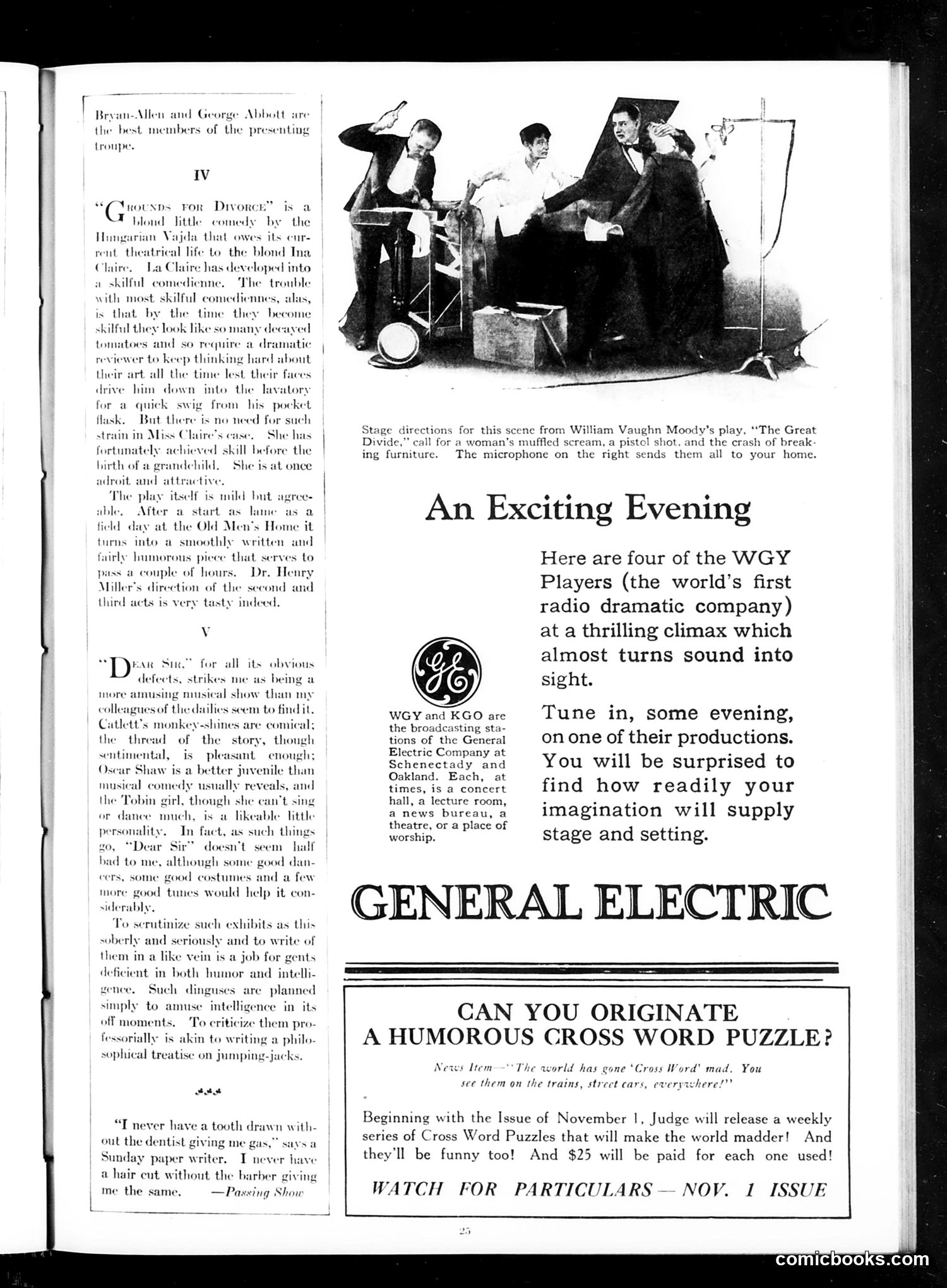
This page mixes theater reviews with advertising. The left columns contain dismissive critiques of three Broadway productions: "Grounds for Divorce" (praising actress Ina Claire despite calling the play "mild"), "Dear Sir" (a musical the reviewer finds competent but not serious art), and an unnamed show. The right side advertises **General Electric's radio drama initiative**—specifically WGY Players, described as "the world's first radio dramatic company." The photograph shows actors performing a scene from William Vaughn Moody's "The Great Divide" for radio broadcast. General Electric owned WGY (Schenectady) and KGO (Oakland) radio stations. The advertisement's pitch—that radio drama requires only sound, letting listeners' "imagination will supply stage and setting"—was novel in the 1920s when radio was still experimental entertainment. The page also announces Judge's new "humorous cross word puzzle" contest (offering $25 per published puzzle), capitalizing on the crossword craze then sweeping America.
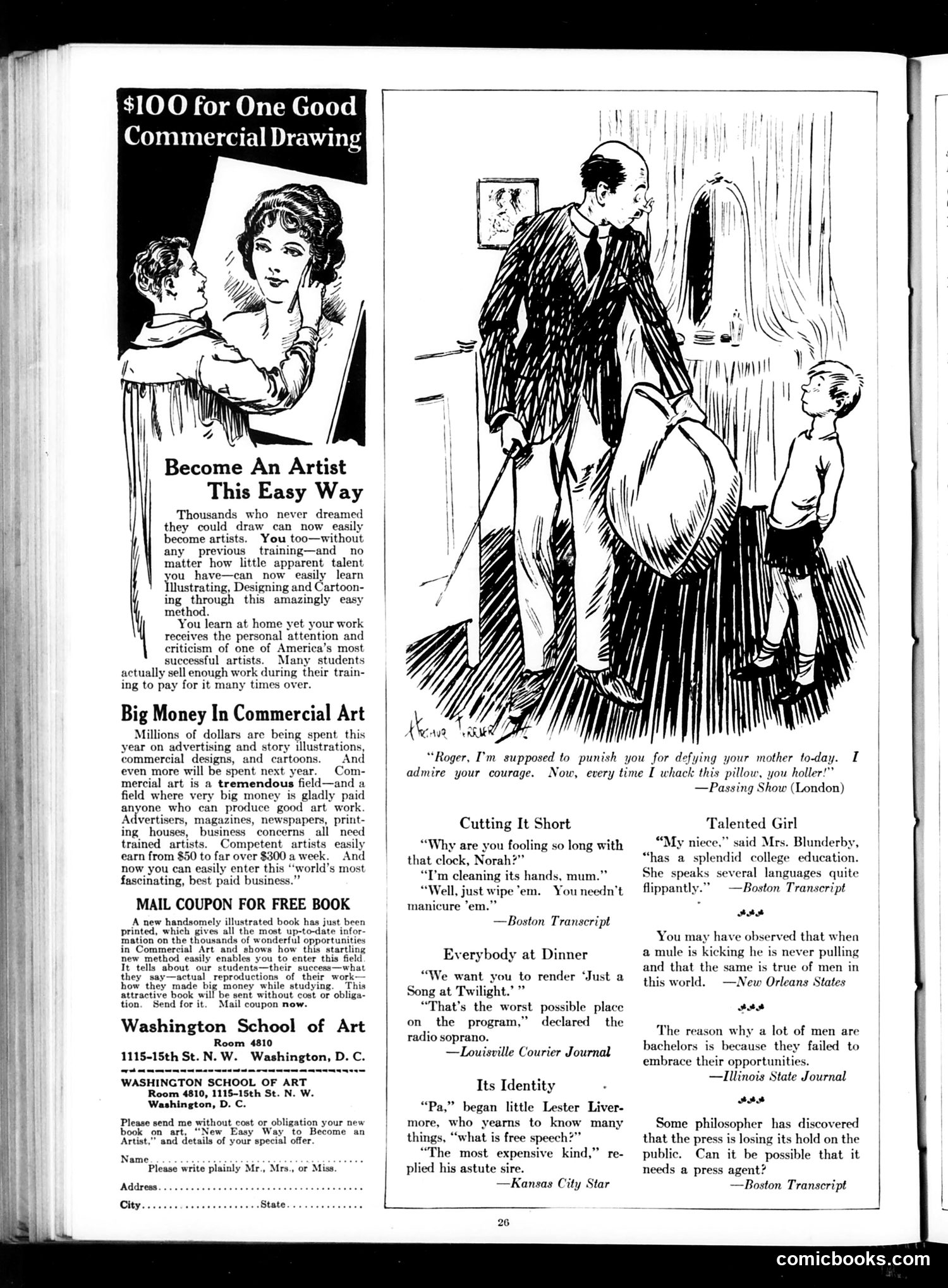
This page mixes **advertising with humor content**. The dominant left section is a commercial art school advertisement promising easy income ("$100 for One Good Commercial Drawing") to aspiring artists—a common early-20th-century pitch exploiting people's desire for lucrative work-from-home opportunities. The right side contains **six short joke cartoons and gags**, all satirizing domestic and social life: - A father fake-punishing his son while admiring his defiance - A maid over-maintaining a clock's "hands" - A child learning "free speech" costs money - A college-educated woman who speaks languages "flippantly" (implying superficiality despite education) - Observations about mules and men's contradictory natures - Bachelors failing to seize romantic opportunities The humor targets **class dynamics, gender roles, and the gap between appearance and reality**—typical Judge magazine satire. The cartoons mock both working-class incompetence and upper-class pretension, reflecting period anxieties about education, social mobility, and gender.
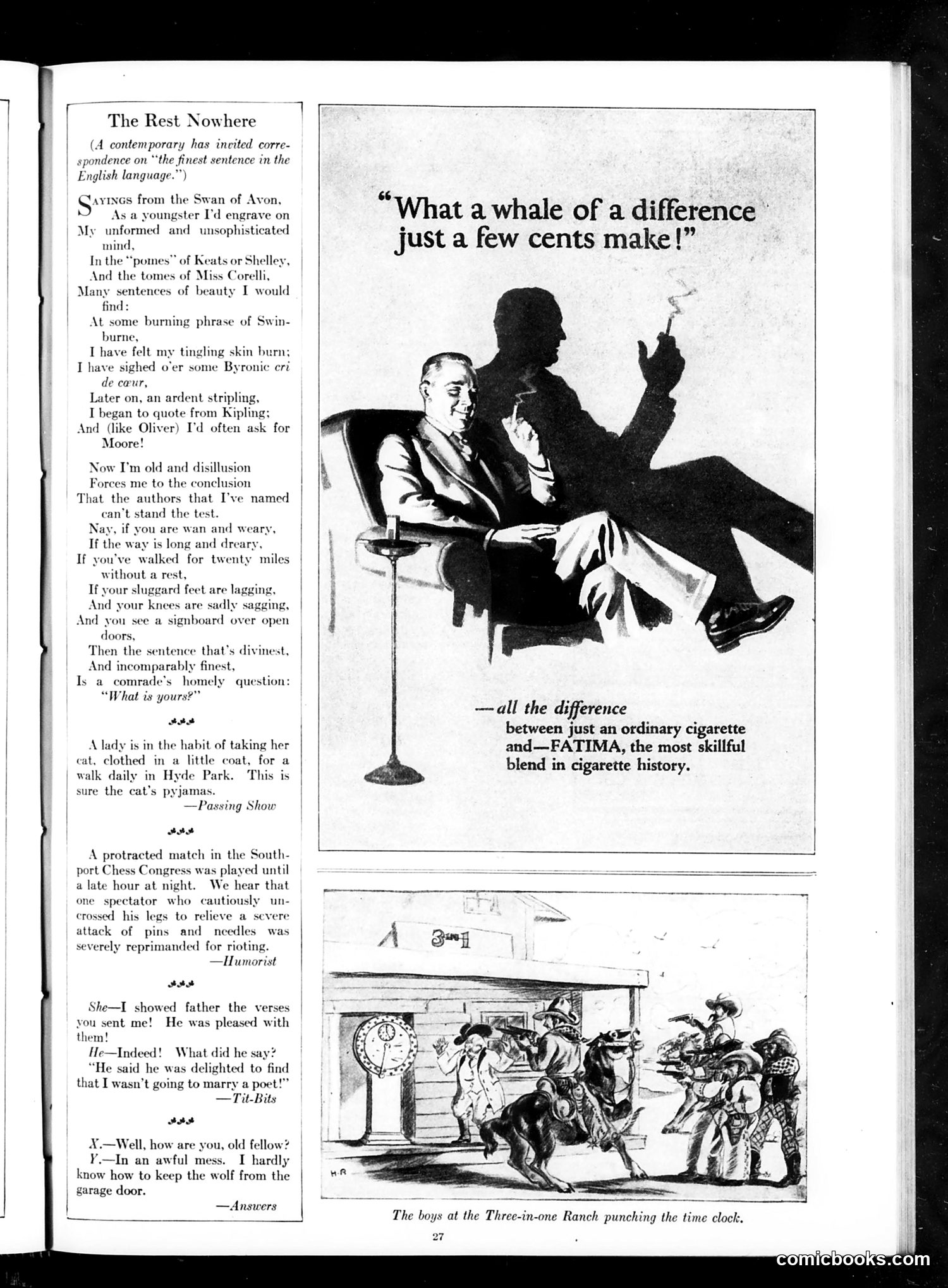
This page mixes literary commentary with advertisements and humor. **"The Rest Nowhere"** is a poem about how great literature—Shakespeare, Keats, Byron, Kipling—loses its appeal with age. The poet concludes the finest sentence in English is simply "What is yours?"—a bartender's question when you're exhausted. It's satire on romantic literary pretension versus practical life needs. **The Fatima cigarette advertisement** shows a businessman claiming a few cents difference in cigarette price is significant, marketing their brand as superior. This reflects early 20th-century consumer advertising before health warnings. **The lower cartoon** titled "The boys at the Three-in-one Ranch punching the time clock" appears to show cowboys at a ranch performing modern office work (timeclock). The satire likely mocks the mechanization of even rural/frontier life, or perhaps the absurdity of applying industrial time-discipline to ranch work. The scattered anecdotes (about chess, a cat in a coat, a poet) are typical Judge magazine filler humor from the period.
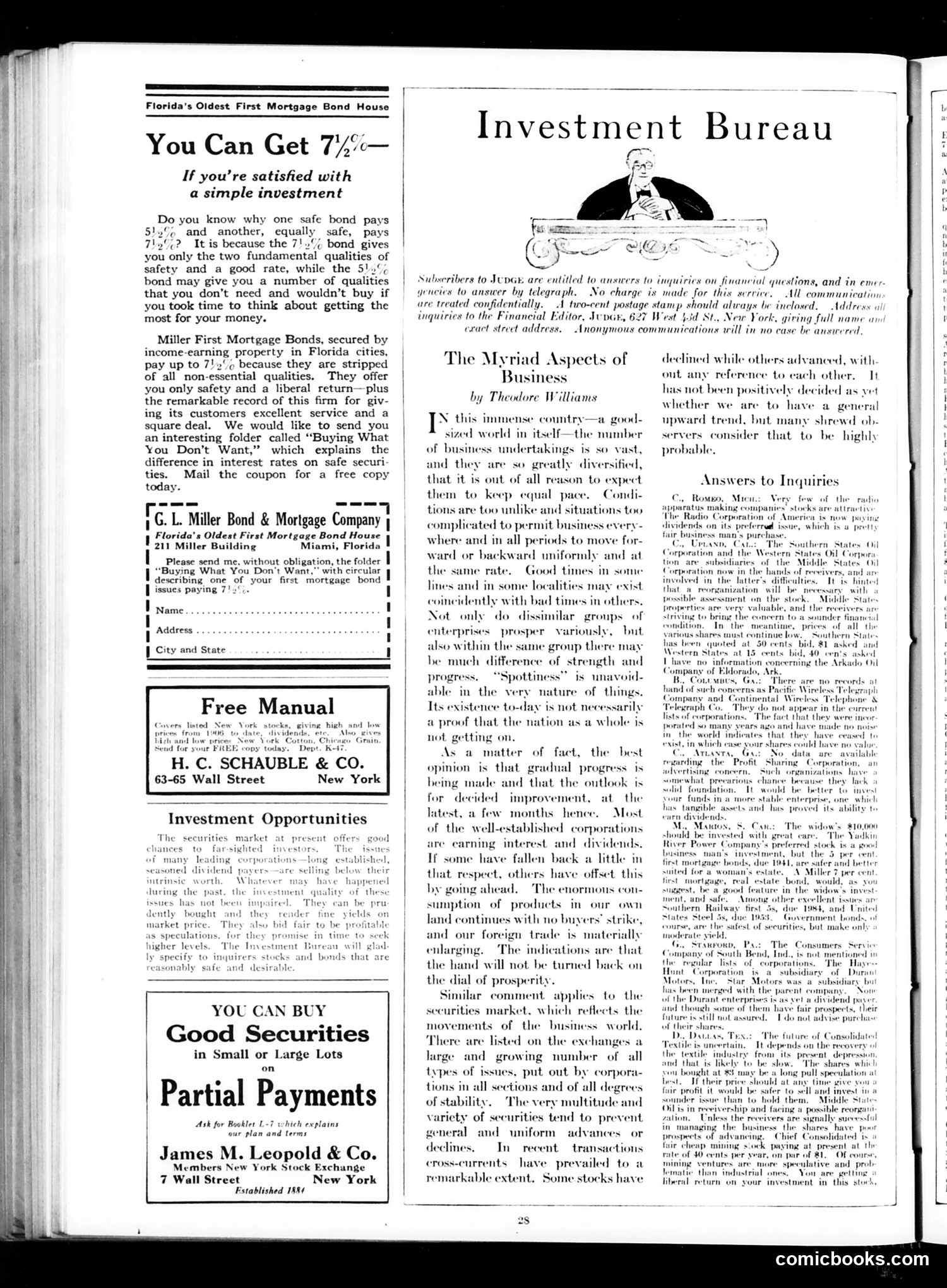
This page is primarily **advertising and financial content**, not satire or political commentary. It features investment solicitations from four financial firms (Miller Bond & Mortgage Company, H.C. Schauble & Co., James M. Leopold & Co., and an Investment Bureau). The main article, "The Myriad Aspects of Business" by Theodore Williams, is a straightforward economic commentary arguing that despite uneven business conditions across regions and industries, the nation is making gradual progress. The author notes that some sectors lag while others advance, but overall prosperity continues with strong consumer demand and foreign trade. The only cartoon element visible is a small illustration atop the Investment Bureau section showing a man at a desk—likely meant to represent a financial advisor, not a political figure. **Context for modern readers**: This represents pre-1929 financial journalism, before the stock market crash, promoting securities to the investing public with confidence in perpetual prosperity.
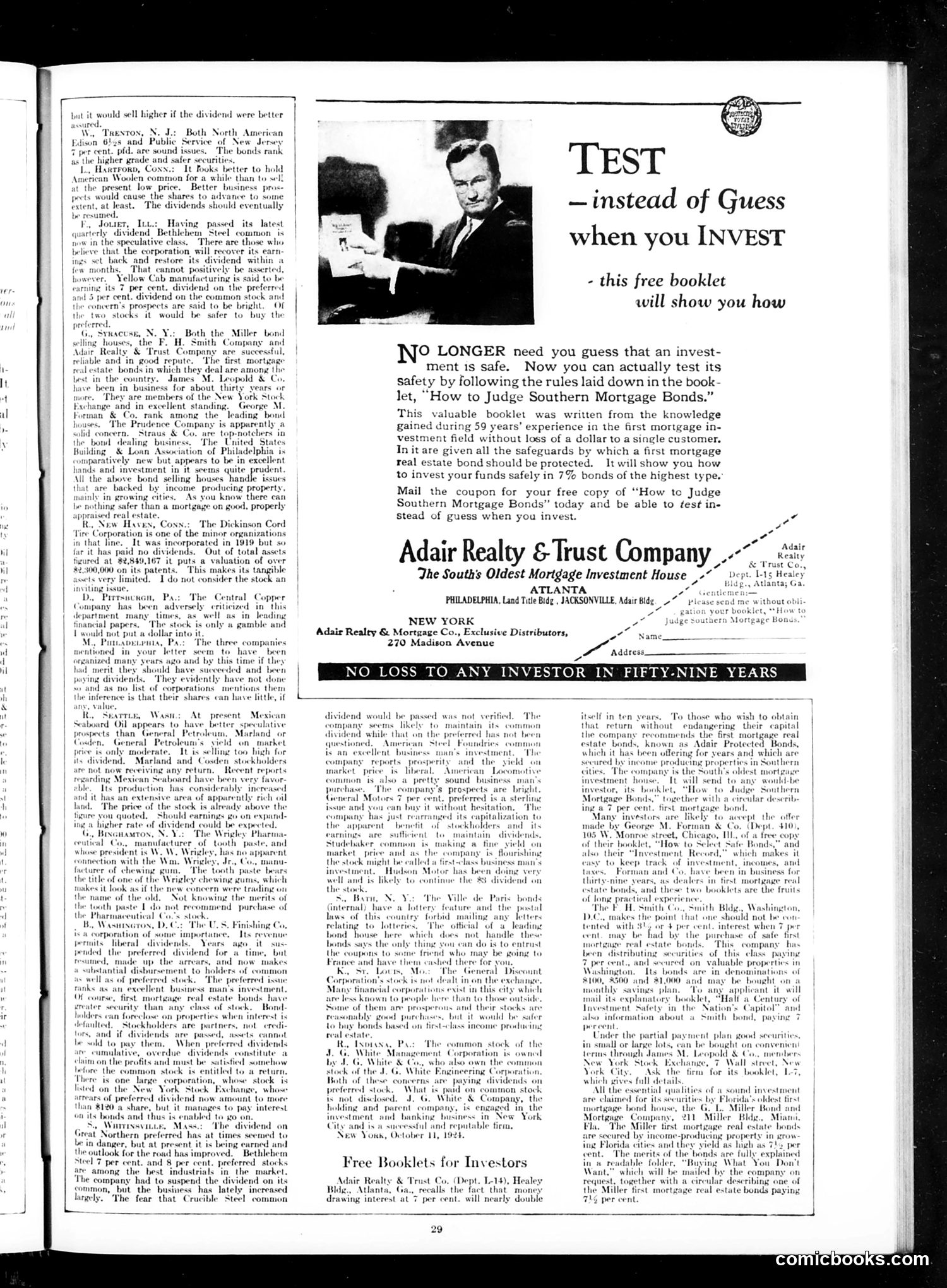
This page is primarily **advertising, not editorial cartoon content**. The dominant feature is a large advertisement for Adair Realty & Trust Company, promoting their "How to Judge Southern Mortgage Bonds" booklet. The small photograph shows a businessman examining documents, positioned to suggest careful financial evaluation. The advertisement's headline—"Test—instead of Guess when you Invest"—reflects 1920s Progressive Era concerns about financial safety and consumer protection, following recent stock market volatility and investment scandals. The left column contains investment advice letters from readers, addressing bond and stock valuations of various companies (Bethlehem Steel, Hudson Motor, etc.), typical of financial advice columns of the era. **Historical context**: This reflects post-WWI American investment culture, when mortgage bonds and industrial stocks were popular investments. The emphasis on "testing" safety rather than "guessing" suggests investor wariness following market disruptions.
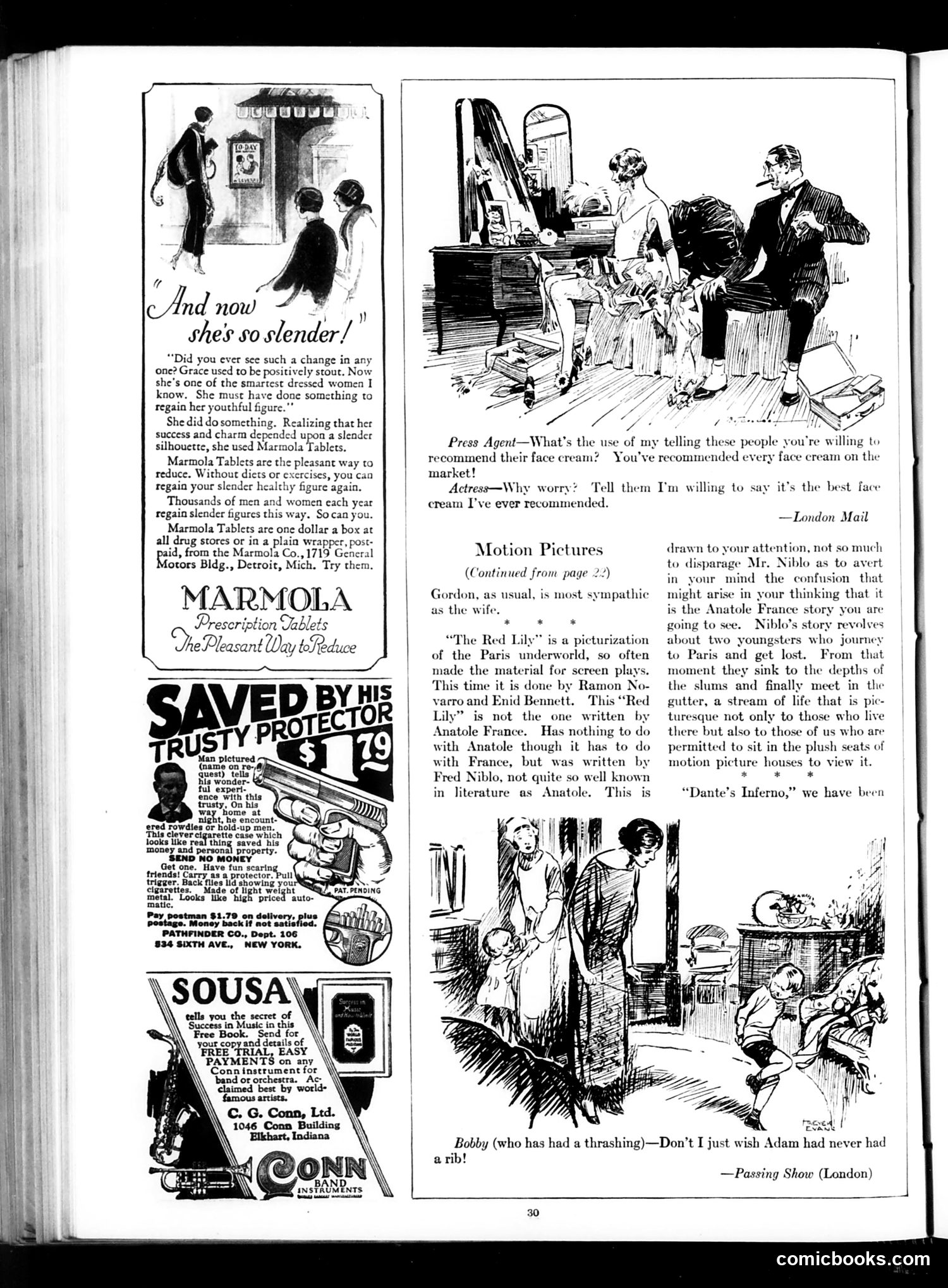
This page is primarily **advertising** with minimal editorial content. The main items are: **Advertisements:** - **Marmola Tablets**: A weight-loss product marketed to women, using before/after social commentary. The copy suggests a woman's value depends on being "slender" and fashionable—reflecting 1920s beauty standards emphasizing thinness. - **Pathfinder cigarette case**: Sold as a self-defense novelty disguised as a cigarette case, appealing to urban anxieties about crime and "hold-up men." - **Sousa Band Instrument**: Musical equipment advertisement. **Editorial Content (Minor):** A brief "Motion Pictures" section reviews films including "The Red Lily" and "Dante's Inferno," with a humorous exchange between a press agent and actress about endorsing face creams indiscriminately. A small cartoon shows a child wishing Adam "never had a rib" (biblical reference to Eve's creation), commenting on gender relations. The page reflects early 20th-century consumer culture, gender roles, and urban safety concerns.
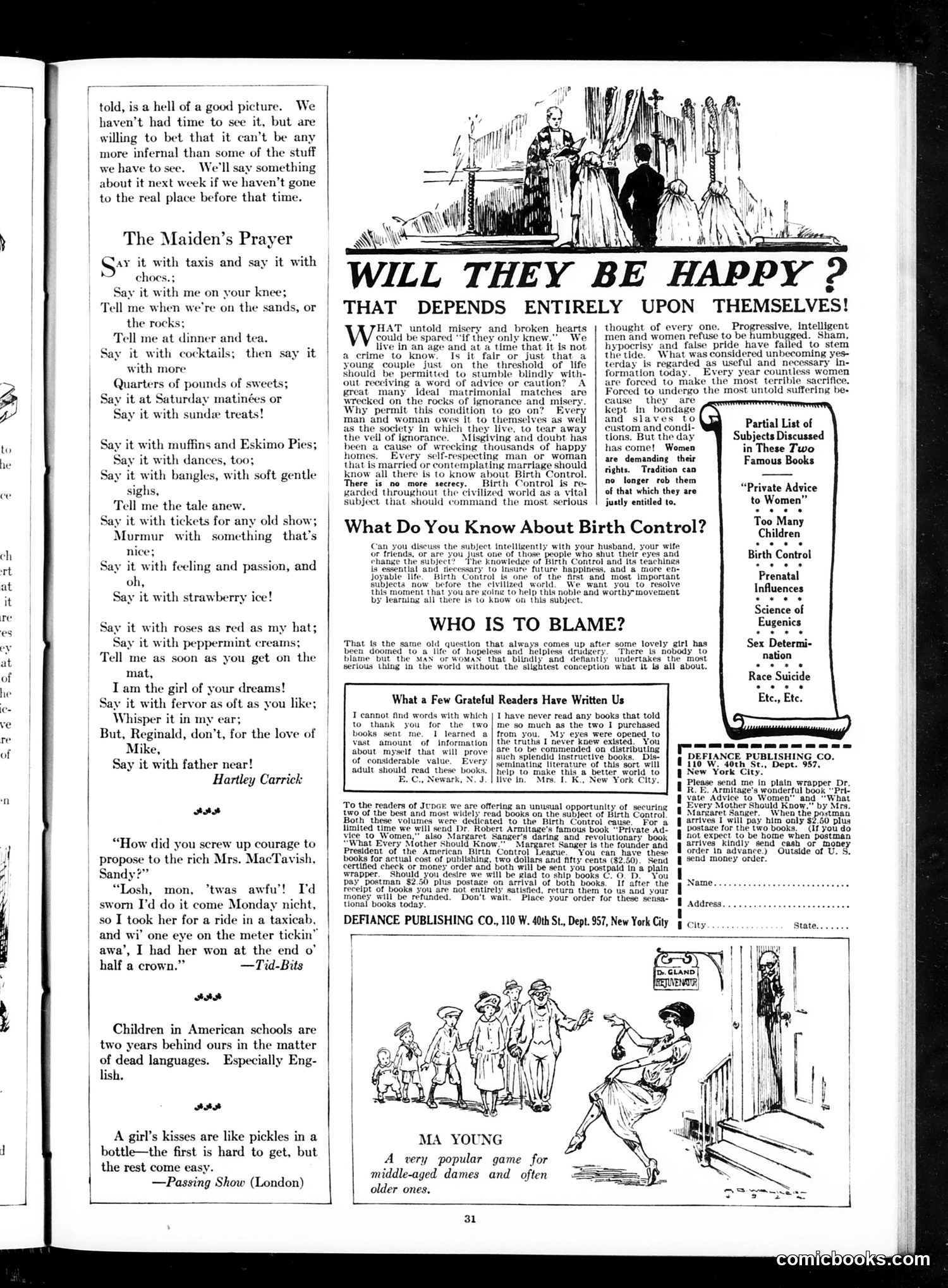
This page contains advocacy material for **birth control**, disguised within entertainment content. The central cartoon "Will They Be Happy?" shows a young couple at what appears to be a wedding, with accompanying text arguing that newlyweds need sex education and contraception knowledge to ensure marital happiness. The framing is progressive for the era: the text argues that ignorance about birth control causes "wrecked" marriages and that women are "kept in bondage" by forced pregnancies. It directly addresses readers: "Can you discuss the subject intelligently with your husband?" The sidebar advertises books on related topics ("Sex Determination," "Race Suicide," "Eugenics"), suggesting this was likely a **1920s-era publication** when birth control advocacy was controversial but gaining traction among reformers. "The Maiden's Prayer" poem appears to be satirical filler, mocking romantic sentimentality. The overall message: modern couples deserve frank information about contraception, not Victorian silence.
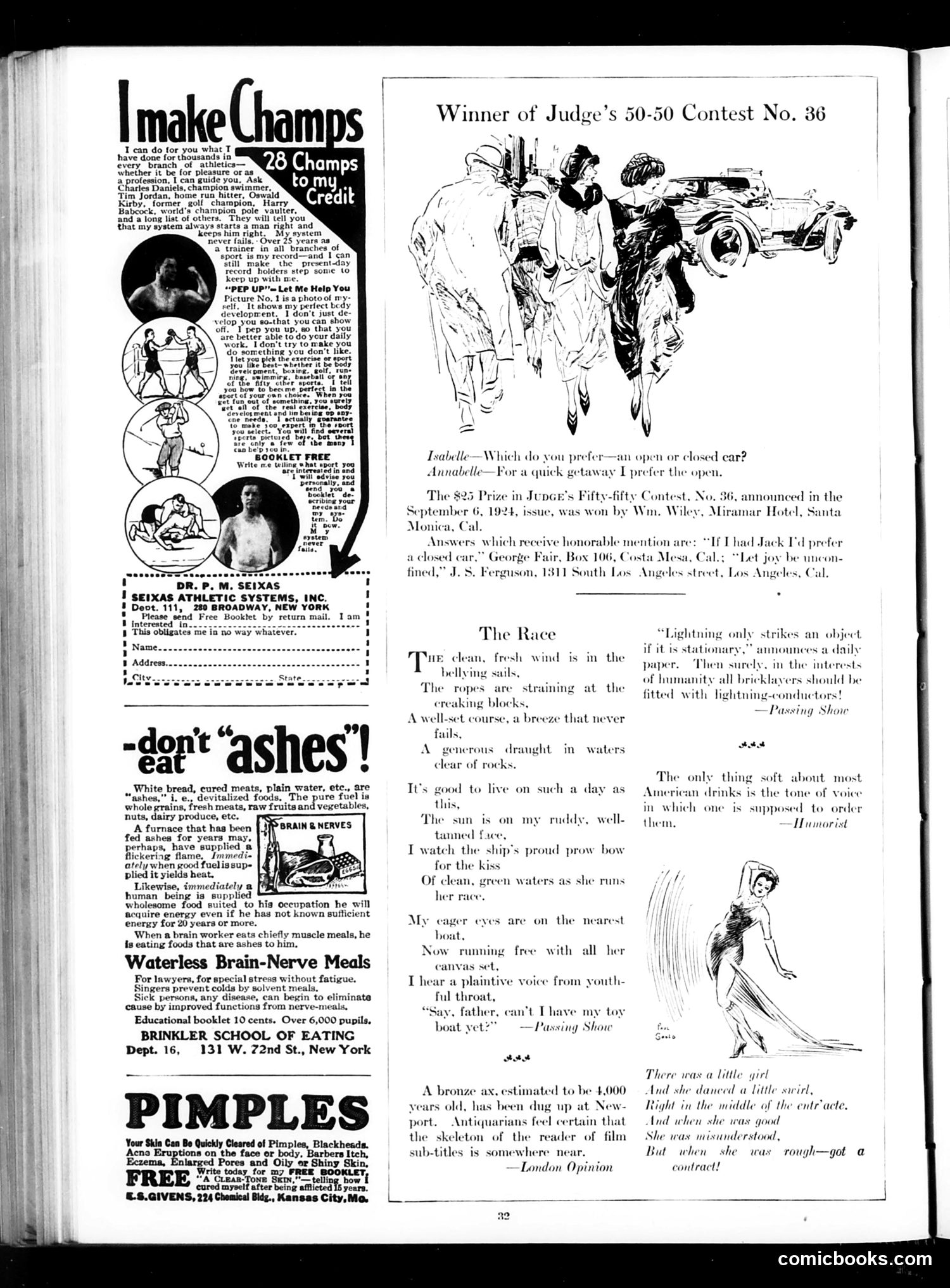
This is primarily an **advertising and miscellaneous content page** from Judge magazine (September 1924). The main satirical content is minimal. **Key Elements:** The left side features an advertisement for **M. Seixas Athletic Systems**—a trainer claiming to develop champions in various sports (swimming, baseball, golf, pole vaulting). The advertiser references famous athletes and promises physical "pep." The right side contains: - A winning entry from Judge's "Fifty-fifty Contest" (a humor caption contest): A joke about whether to prefer open or closed cars, answered "for a quick getaway I prefer the open"—mild automotive humor. - **"The Race,"** a romantic poem about sailing ships - A brief joke about lightning conductors - A comment on American beverages - A humorous short poem about a dancing girl **The Satire:** The page's modest humor reflects 1920s preoccupations: physical fitness crazes, automobiles, and light romantic/social comedy. The advertising dominates over editorial content, which was typical of Judge's revenue model.
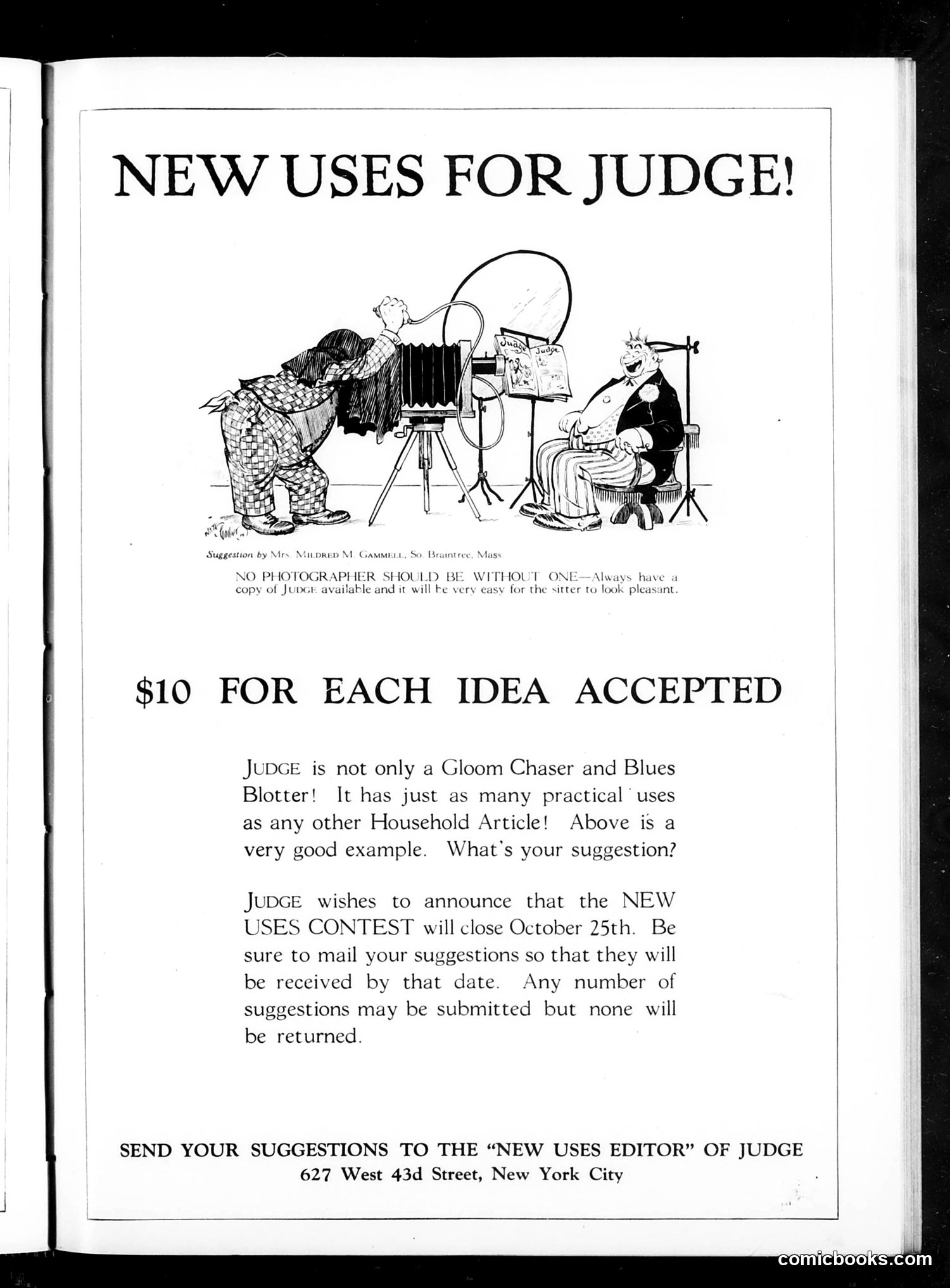
This is a self-promotional advertisement for *Judge* magazine's creative contest. The cartoon shows a photographer using a copy of *Judge* as a reflector to brighten a subject's face during a portrait session—a practical photography tip from reader Mrs. Mildred M. Gammet of South Braintree, Massachusetts. The joke plays on *Judge*'s self-description as a "Gloom Chaser and Blues Blotter" (a humor magazine that lifts spirits), extending this metaphorically to literal household utility. The magazine is soliciting reader suggestions for unconventional uses of *Judge* beyond reading it, offering $10 per accepted idea. The contest closes October 25th. This reflects early 20th-century magazine marketing strategies—encouraging reader engagement and community participation while humorously promoting the publication's supposed indispensability to American households.
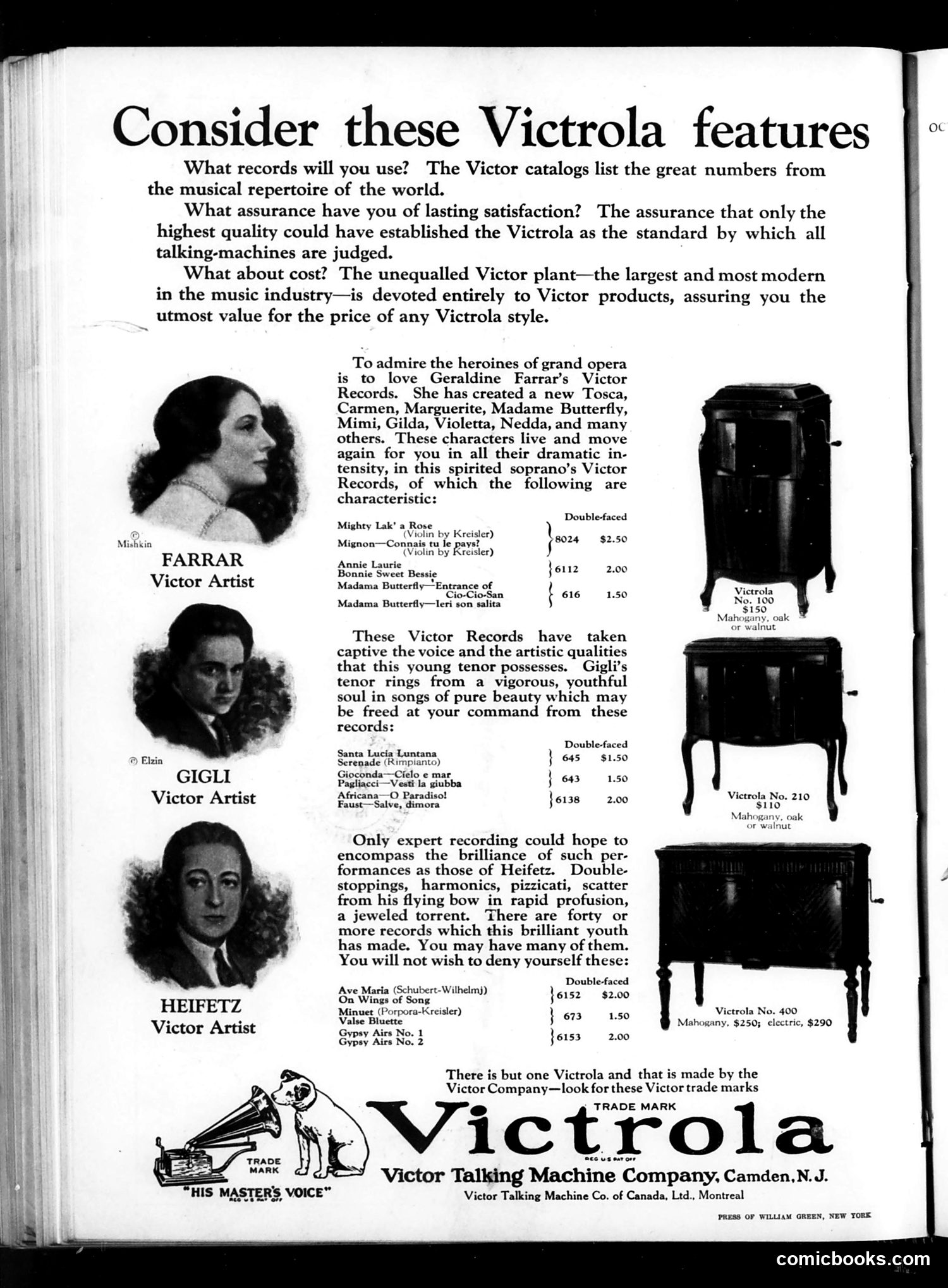
This is a **product advertisement**, not a political cartoon or satire. It appears in *Judge* magazine but functions as a commercial endorsement for Victrola phonographs. The page promotes Victor Records featuring famous opera singers: Geraldine Farrar (soprano), Beniamino Gigli (tenor), and Jascha Heifetz (violinist). Each artist's photograph and recording catalog are displayed to establish credibility and prestige. The marketing strategy emphasizes: - **Extensive catalog** of world-class music - **Quality assurance** (Victor as industry standard) - **Manufacturing superiority** (largest modern plant) - **Value for price** Three Victrola cabinet models are pictured with prices ranging from $110–$290, appealing to different economic levels. The "His Master's Voice" trademark (dog listening to gramophone) anchors Victor's brand identity. This is essentially luxury consumer marketing using celebrity endorsements—not satire or political commentary.