
Judge, 1924-10-11 · page 17 of 36
Judge — October 11, 1924 — page 17: what you’re looking at
What you’re looking at
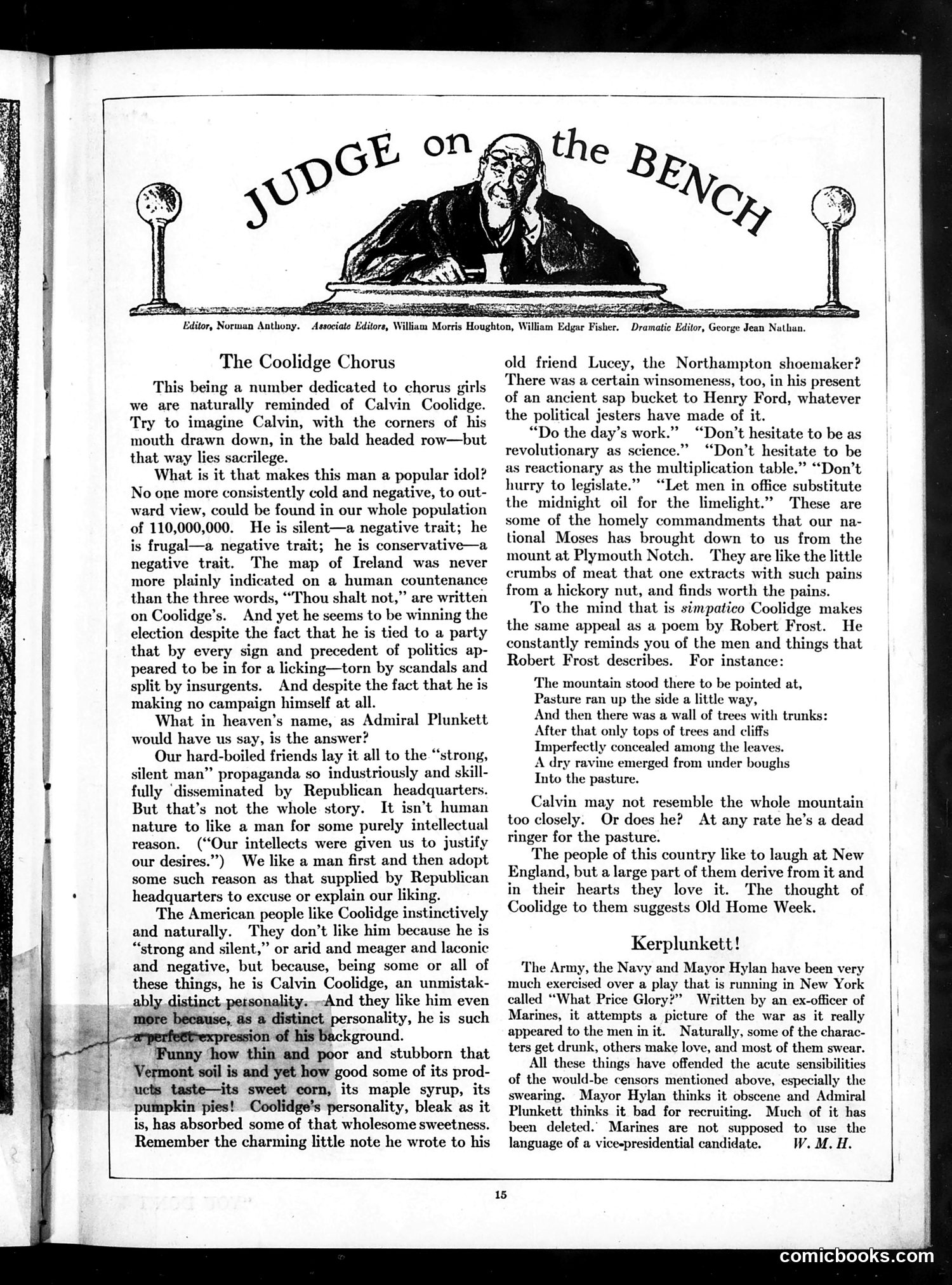
This editorial celebrates President Calvin Coolidge's popularity despite his austere, negative personality. The author argues Americans instinctively like him not because of Republican propaganda about his "strong, silent" image, but because he authentically embodies his Vermont background—frugal, laconic, and morally stern. The piece compares Coolidge to poet Robert Frost, suggesting his appeal lies in representing wholesome New England values. The repeated phrase "Thou shalt not" captures his image as a moral authority figure ("national Moses") dispensing homely wisdom. This likely dates to the 1924 election campaign, when Coolidge ran for a full term despite Republican scandals (Teapot Dome). The satire's tone is affectionate rather than mocking—praising Coolidge as an genuine personality that transcends political machinery.
📄 Transcribed text from this page (OCR, searchable)
Machine-transcribed from the original scan — historical spelling and the odd misread are preserved.
Editor, Norman Anthony. Associate Editors, The Coolidge Chorus This being a number dedicated to chorus girls we are naturally reminded of Calvin Coolidge. Try to imagine Calvin, with the corners of his mouth drawn down, in the bald headed row—but that way lies sacrilege. What is it that makes this man a popular idol? No one more consistently cold and negative, to out- ward view, could be found in our whole population of 110,000,000. He is silent—a negative trait; he is frugal—a negative trait; he is conservative—a negative trait. The map of Ireland was never more plainly indicated on a human countenance than the three words, “Thou shalt not,” are written on Coolidge’s. And yet he seems to be winning the election despite the fact that he is tied to a party that by every sign and precedent of politics ap- peared to be in for a licking—torn by scandals and split by insurgents. And despite the fact that he is making no campaign himself at all. What in heaven’s name, as Admiral Plunkett would have us say, is the answer? Our hard-boiled friends lay it all to the “strong, silent man” propaganda so industriously and skill- fully ‘disseminated by Republican headquarters. But that’s not the whole story. It isn’t human nature to like a man for some purely intellectual reason. (“Our intellects were given us to justify our desires.”) We like a man first and then adopt some such reason as that supplied by Republican headquarters to excuse or explain our liking. The American people like Coolidge instinctively and naturally. They don’t like him because he is “strong and silent,” or arid and meager and laconic and negative, but because, being some or all of these things, he is Calvin Coolidge, an unmistak- ably. distinct. petsonality.--And they like him even more because, as a distinct personality, he is such jon of his background. Funny how thin and poor and stubborn that Vermont soil is and yet how good some of its prod- ucts taste—its sweet corn, its maple syrup, its pumpkin pies! Coolidge’s personality, bleak as it is, has absorbed some of that wholesome sweetness. Remember the charming little note he wrote to his % liam Morris Houghton, William Edgar Dramatic Editor, George Jean Nathan. old friend Lucey, the Northampton shoemaker? There was a certain winsomeness, too, in his present of an ancient sap bucket to Henry Ford, whatever the political jesters have made of it. “Do the day’s work.” “Don’t hesitate to be as revolutionary as science.” ‘Don’t hesitate to be as reactionary as the multiplication table.” “Don’t hurry to legislate.” ‘‘Let men in office substitute the midnight oil for the limelight.” These are some of the homely commandments that our na- tional Moses has brought down to us from the mount at Plymouth Notch. They are like the little crumbs of meat that one extracts with such pains from a hickory nut, and finds worth the pains. To the mind that is simpatico Coolidge makes the same appeal as a poem by Robert Frost. He constantly reminds you of the men and things that Robert Frost describes. For instance: The mountain stood there to be pointed at, Pasture ran up the side a little way, And then there was a wall of trees with trunks: After that only tops of trees and cliffs Imperfectly concealed among the leaves. A dry ravine emerged from under boughs Into the pasture. Calvin may not resemble the whole mountain too closely. Or does he? At any rate he’s a dead ringer for the pasture. The people of this country like to laugh at New England, but a large part of them derive from it and in their hearts they love it. The thought of Coolidge to them suggests Old Home Week. Kerplunkett! The Army, the Navy and Mayor Hylan have been very much exercised over a play that is running in New York called “What Price Glory?” Written by an ex-officer of Marines, it attempts a picture of the war as it really appeared to the men in it. Naturally, some of the charac- ters get drunk, others make love, and most of them swear. All these things have offended the acute sensibilities of the would-be censors mentioned above, especially the swearing. Mayor Hylan thinks it obscene and Admiral Plunkett thinks it bad for recruiting. Much of it has been deleted.’ Marines are not supposed to use the language of a vice-presidential candidate. W.M.H. comicbooks.com