
A complete issue · 36 pages · 1924
Judge — June 21, 1924
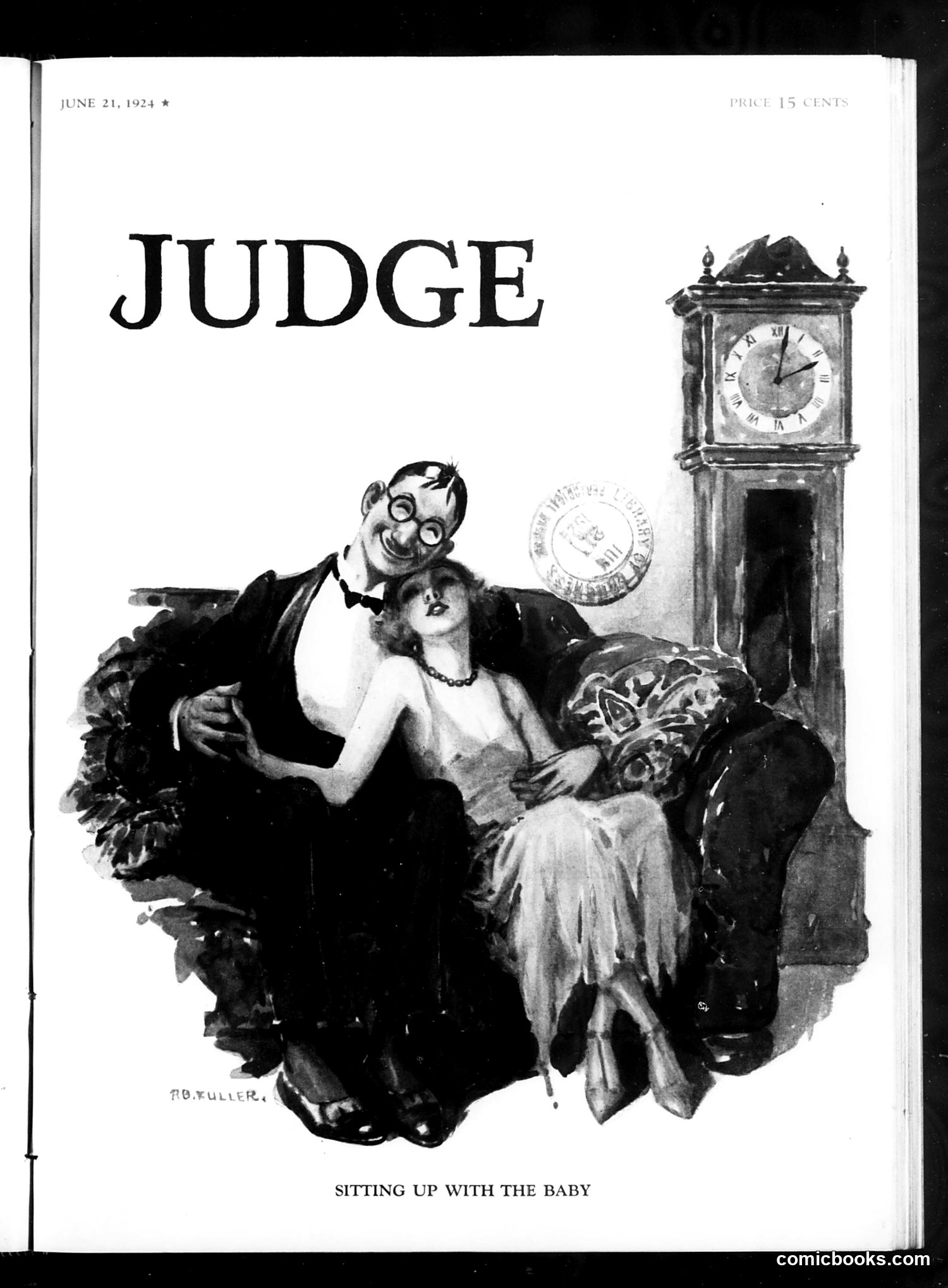
This cartoon depicts a domestic scene with humorous intent. A man in formal attire (tuxedo and glasses) sits beside a woman in an evening dress, both positioned near a grandfather clock. The caption "Sitting Up with the Baby" suggests a play on the phrase—traditionally meaning staying awake to care for an infant. The satire appears to mock the man's pretentious formality and the couple's fancy setting for what should be routine childcare. The exaggerated facial features and the contrast between their elegant dress and mundane domestic duty create the joke. This likely satirizes either specific social pretensions of the 1920s upper class or generalizes husbands' awkwardness with infant care, common comedic themes in Judge magazine's social commentary.
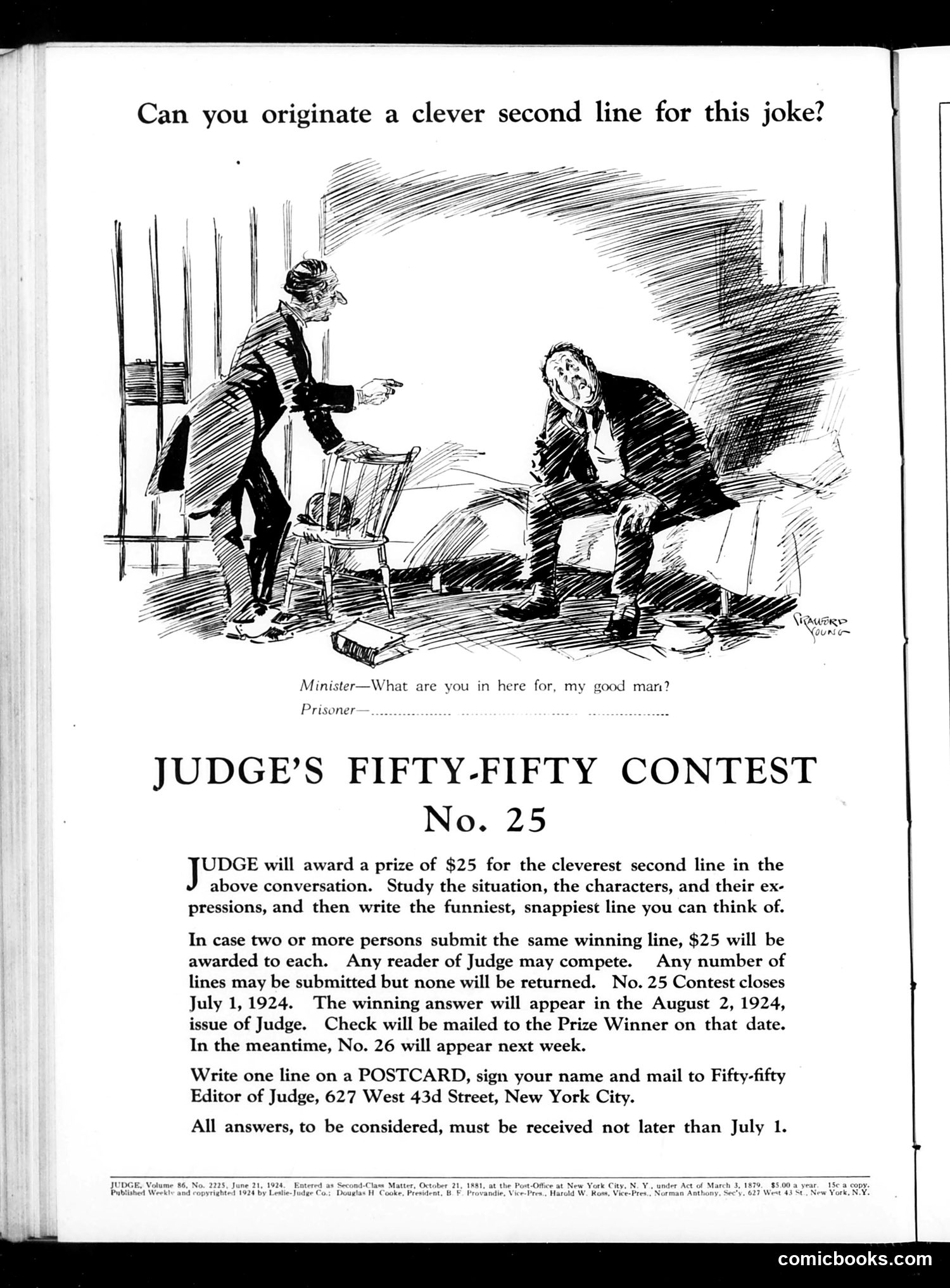
This cartoon depicts a **Minister visiting a Prisoner** in what appears to be a jail cell. The setup is a classic joke format: the Minister asks "What are you in here for, my good man?" and readers are invited to complete the Prisoner's response. The satire likely plays on **hypocrisy or moral contradiction**—perhaps suggesting the Minister himself belongs in prison, or that the prisoner's crime mirrors clergy misconduct. Without the original answer, the exact target is unclear, but Judge's satirical tradition suggests the joke critiques institutional authority figures (religious or legal). This is part of Judge's "Fifty-Fifty Contest," where readers submitted punchlines for $25 prizes, a common interactive feature in 1920s humor magazines.
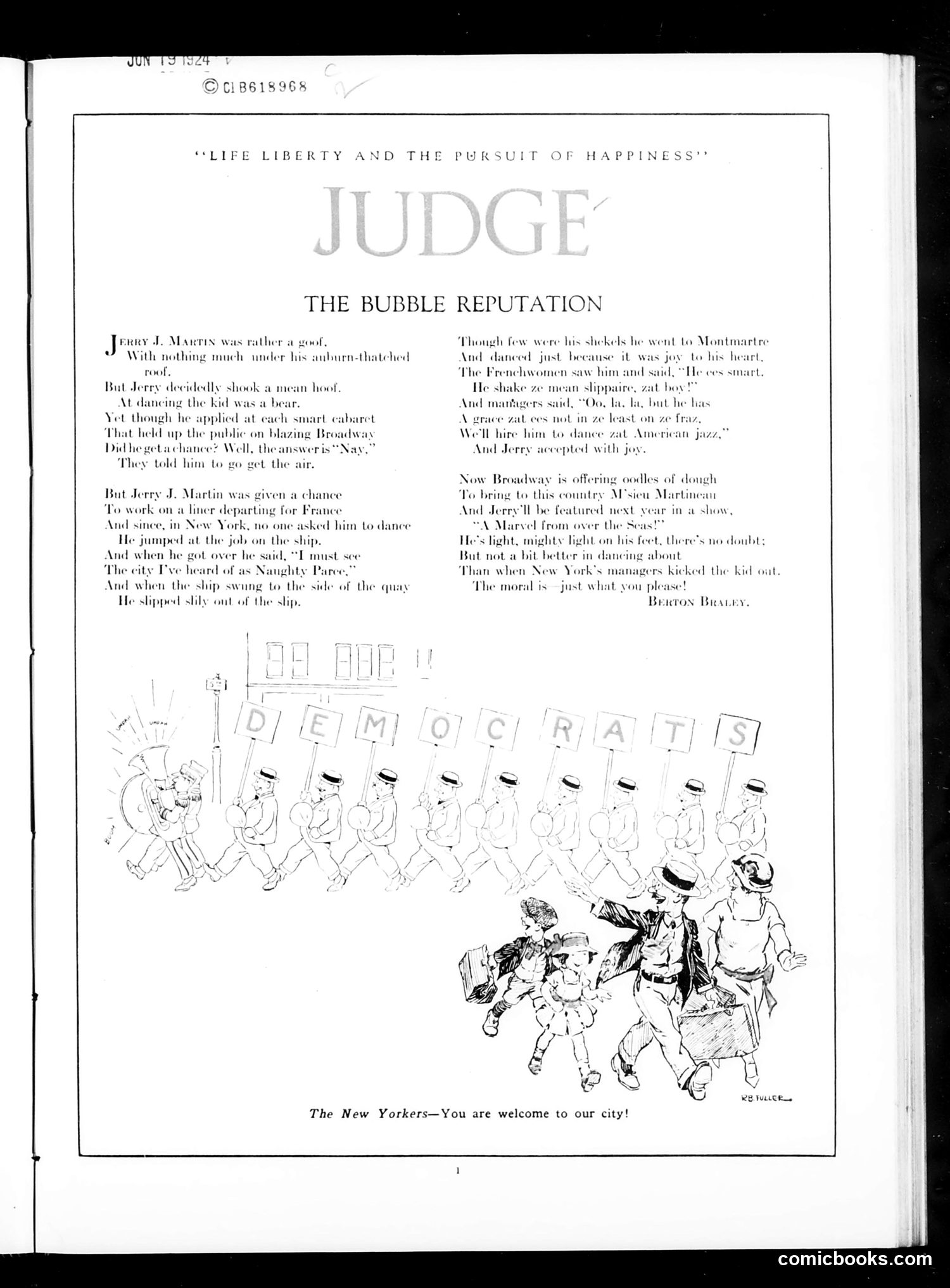
This 1924 page satirizes **Jerry J. Martin**, a dancer who briefly became a Broadway sensation. The poem recounts his trajectory: though initially unremarkable, he gained attention through cabaret performances and ship entertainment. Despite New York managers kicking him out, Martin gained buzz in France and returned to modest Broadway success. The cartoon depicts a parade of **democrats** (holding signs) welcoming Martin to New York, suggesting his inflated celebrity status. The satire critiques how quickly reputations inflate and deflate in entertainment and public opinion—Martin's "bubble reputation" bursts as rapidly as it formed. The piece mocks both the fickleness of show business fame and the media's role in manufacturing celebrity from thin substance.
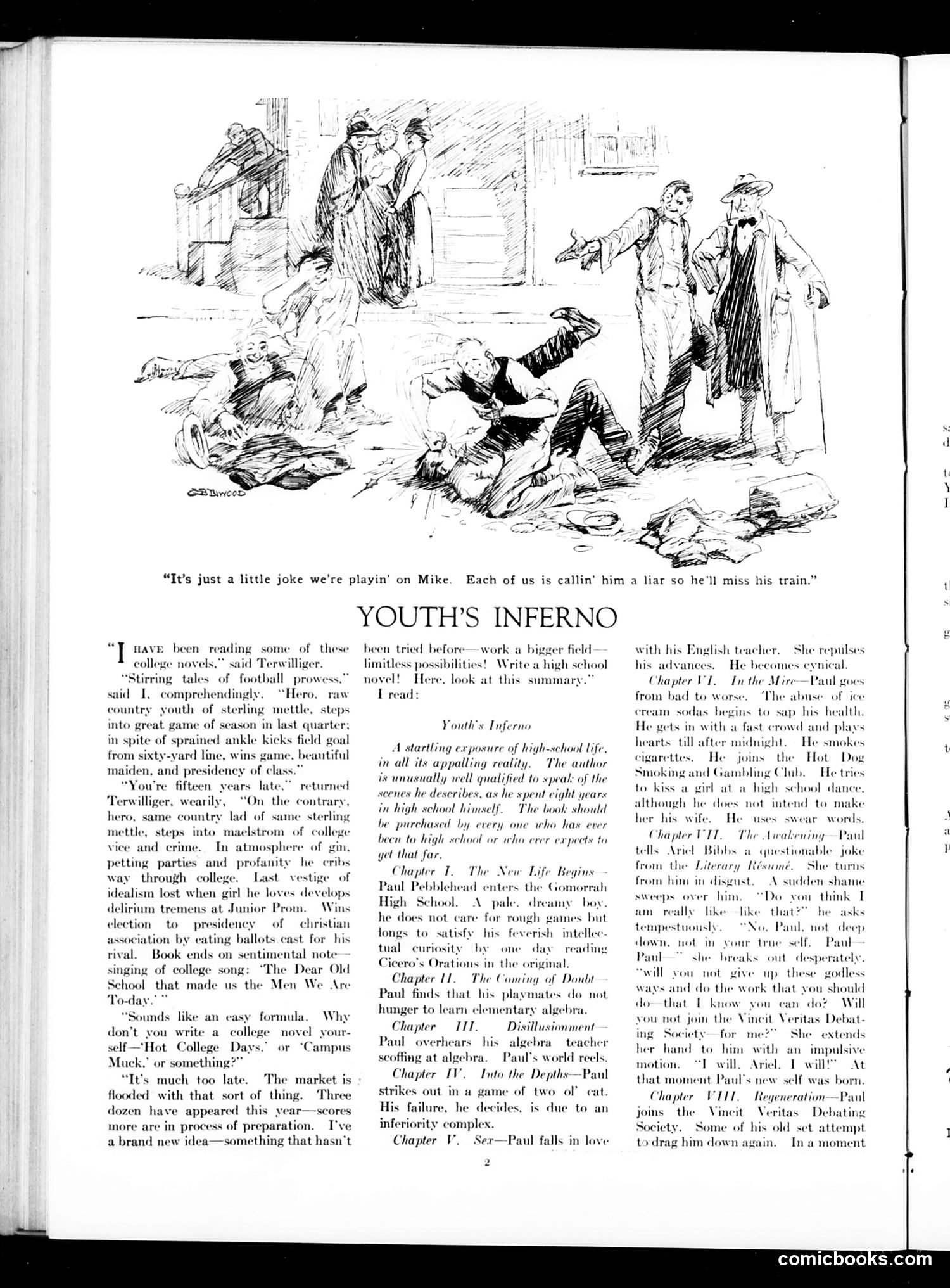
This page reviews a high school novel titled *Youth's Inferno*, a coming-of-age story about a student named Paul navigating prep school life. The cartoon at top depicts schoolboys engaged in rough hazing or pranks—some lying on the ground, others standing nearby—illustrating the "appalling reality" the review describes. The satire targets sensationalized college fiction popular at the time. The reviewer critiques how such novels dramatize school life through fights, romantic entanglements, and moral crises. The caption's joke about "calling him a liar so he'll miss his train" exemplifies the petty, absurd bullying portrayed in these tales. The piece mocks both the novels' overwrought plotting and their appeal to readers seeking scandalous school narratives.
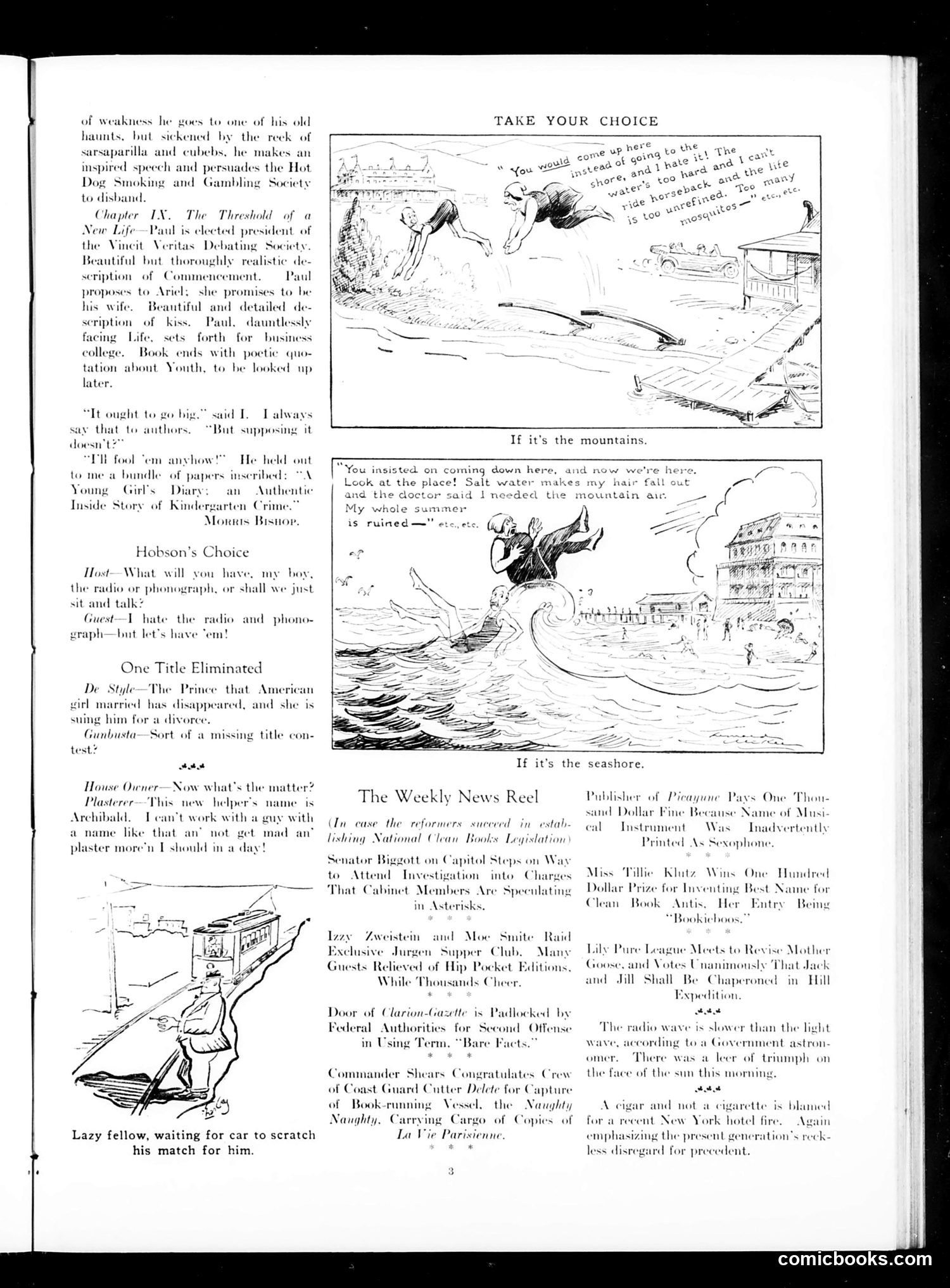
This page presents two cartoon scenarios depicting vacation choices. The upper cartoon shows a man being pressured to visit mountains ("come up here...instead of going to the shore"), while the lower cartoon depicts seaside complications—a woman complaining that salt water ruins her hair and she needs mountain air for health. The satire mocks the contemporary debate between two competing vacation destinations (mountains vs. seashore) and the contradictory health claims made by resort promoters. It's also commentary on the conflicting advice people received about which environment benefited health—a genuine concern in the early 20th century when fresh mountain air and sea air were both marketed as medicinal cures. The humor lies in the absurd, circular logic: neither destination satisfies everyone.
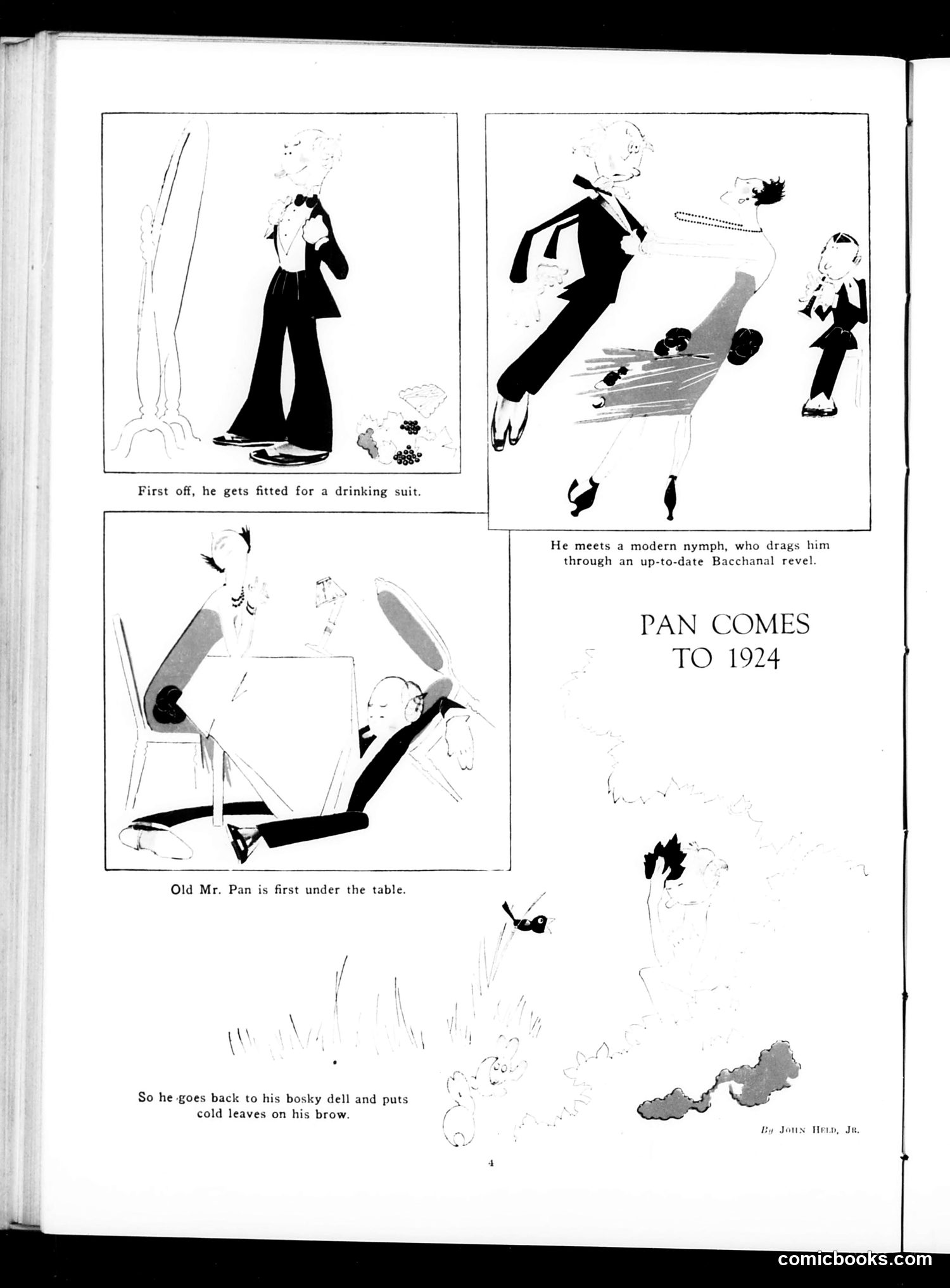
This satirical comic by John Held Jr. depicts the mythological god Pan arriving in 1920s modern society. The sequence shows Pan experiencing contemporary urban life: 1. Getting fitted for a "drinking suit" (referencing Prohibition-era speakeasies) 2. Meeting a "modern nymph" at a Bacchanal revel (jazz-age nightlife) 3. Getting drunk and ending up under a table 4. Recovering with cold compresses The satire contrasts Pan's classical association with wild revelry and intoxication against the supposedly "civilized" 1920s. The joke suggests that despite modern pretensions to respectability, contemporary America—particularly during Prohibition—engages in the same hedonistic behavior as ancient mythological excess. Held's elegant art style emphasizes this ironic gap between appearance and reality.
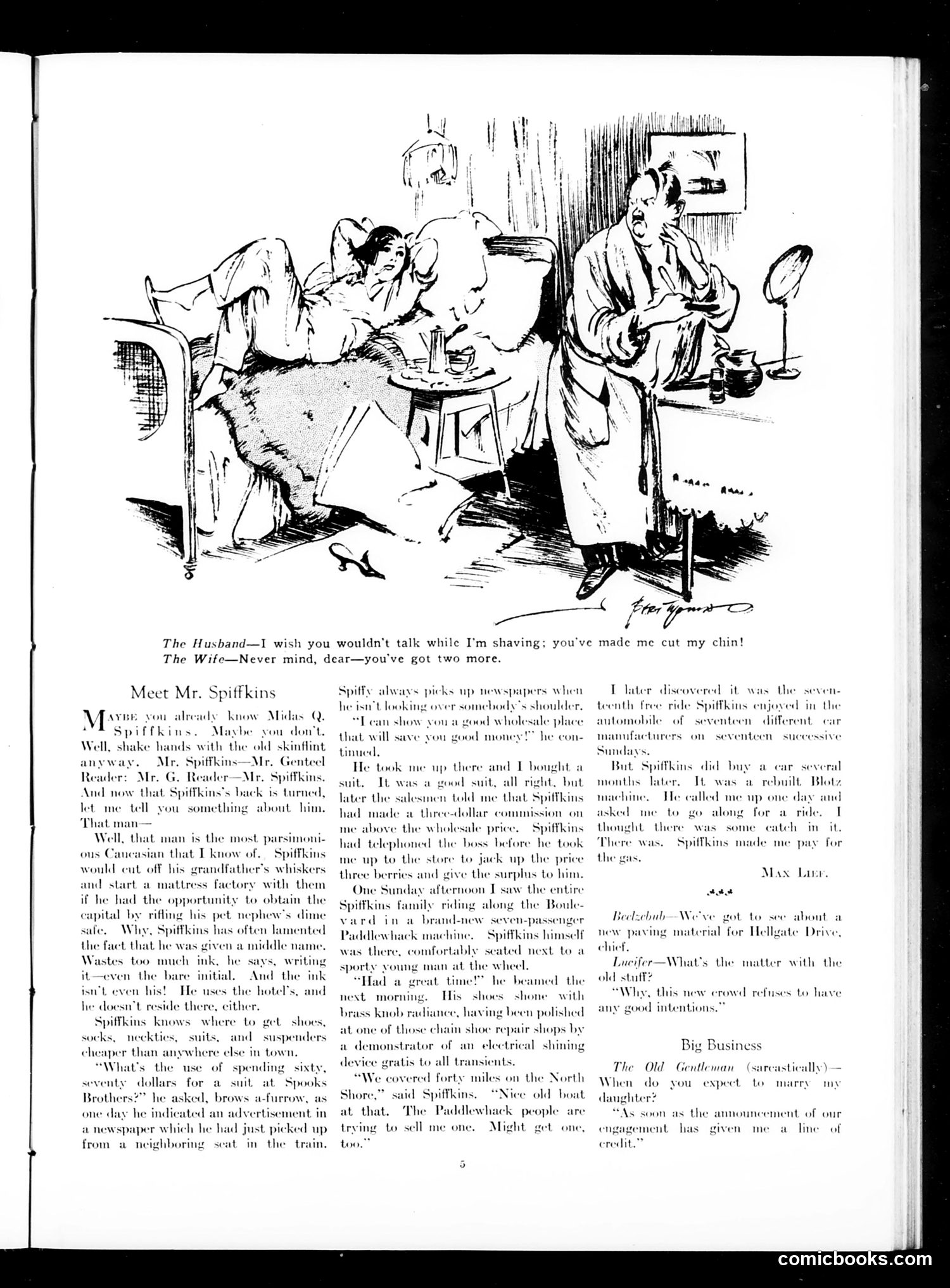
## Top Cartoon A domestic humor joke: A husband complains his wife's talking made him cut his chin while shaving. She replies he has "two more" chins—a common insult implying obesity or a double chin. This reflects early 20th-century magazine humor mocking married couples and physical appearance. ## "Meet Mr. Spiffkins" Story A satirical character sketch of an extreme cheapskate. Spiffkins embodies penny-pinching excess: he refuses to waste ink on his middle initial, steals newspapers from trains, manipulates wholesale prices for personal commission, and exploits free rides from car manufacturers before finally buying a rebuilt vehicle—still making a companion pay for gas. The humor targets miserliness as both character flaw and social vice. Spiffkins represents American business culture's obsession with profit-extraction at others' expense, presented as absurdly pathological. ## "Big Business" Fragment An old gentleman sarcastically asks when he'll see his daughter marry. The reply suggests their engagement announcement has given him "a line of credit"—implying the engagement is primarily a financial transaction rather than romantic commitment.
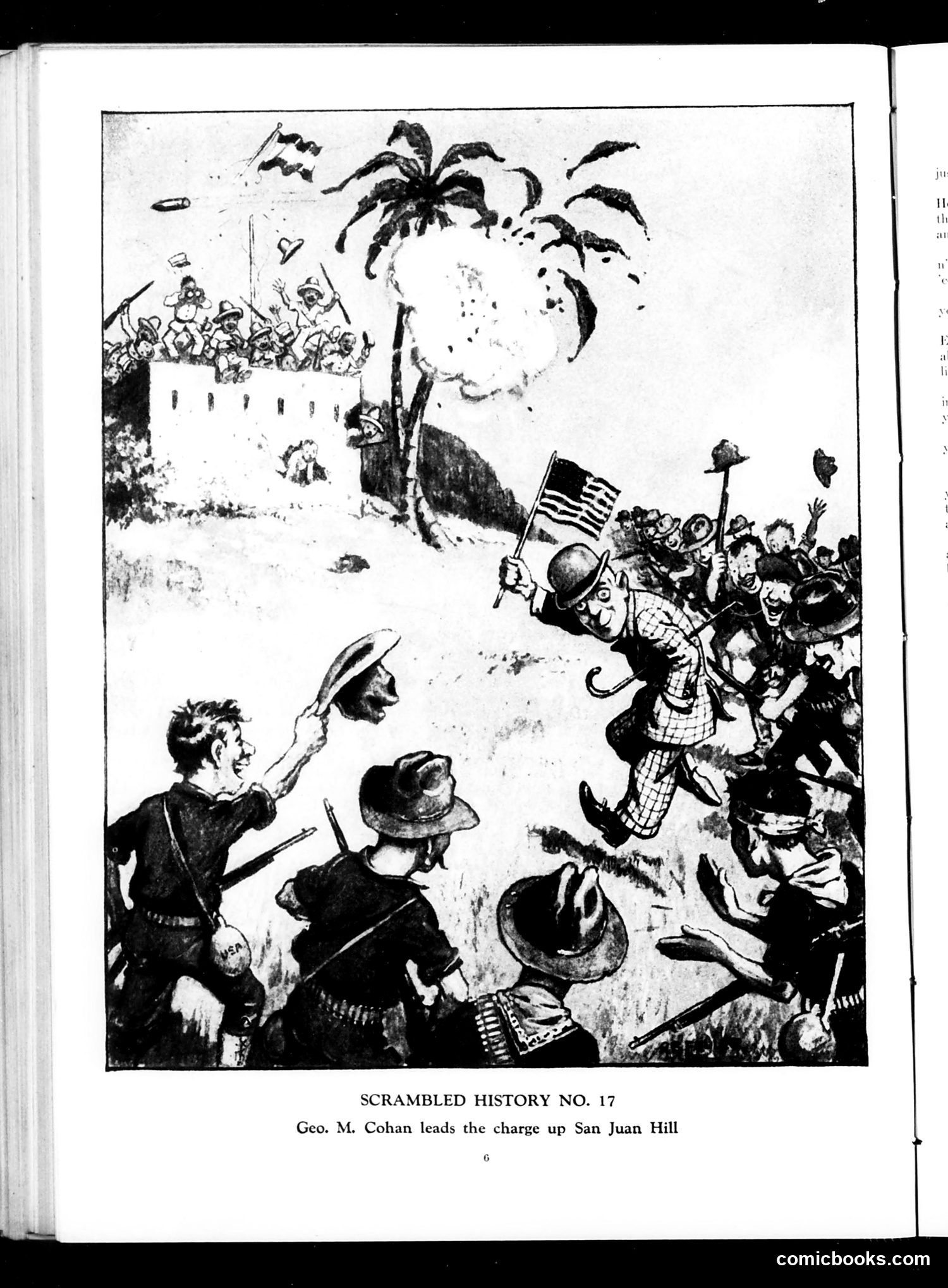
This cartoon satirizes George M. Cohan, the famous American entertainer and songwriter, by humorously inserting him into the Spanish-American War's most iconic moment: the charge up San Juan Hill (1898). The image shows Cohan leading troops carrying an American flag, with soldiers and cheering crowds depicted in exaggerated, comedic style. The satire works by conflating entertainment with military heroism—Cohan was known for patriotic songs and theatrical performances, not actual combat. By literally placing him at this famous battle, Judge magazine jokes about American popular culture's tendency to claim credit for historical events or blur entertainment with genuine historical significance. The title "Scrambled History" signals this is intentional comedic reimagining rather than factual claim.
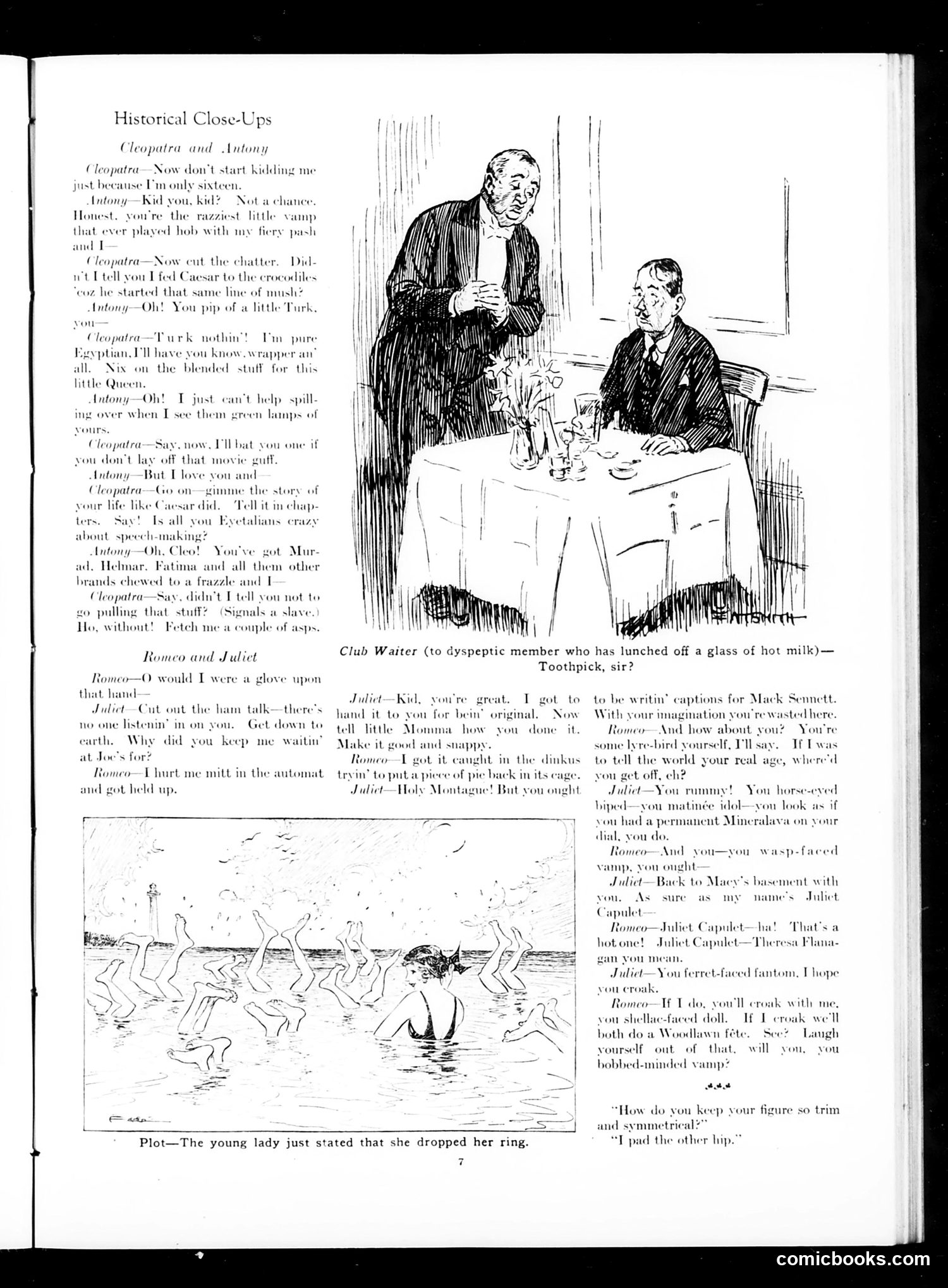
This page contains two comedic dialogues parodying famous literary lovers—Cleopatra/Antony and Romeo/Juliet—reimagined as 1920s characters speaking in period slang. **The satire works by:** Transplanting classical tragic figures into modern vernacular. Cleopatra becomes a flapper rejecting "movie guff," Romeo complains about waiting at a automat, and both couples bicker like ordinary 1920s couples rather than doomed lovers. The dialogue mocks both the original melodramatic source material and contemporary 1920s affectations (bobbed hair, Macy's references, "Mineralava" beauty products). **The club waiter cartoon** above jokes about dyspepsia—offering a toothpick to someone who ate poorly, a common 1920s digestive concern. **The bottom illustration** (captioned "Plot—The young lady just stated that she dropped her ring") appears to show swimmers in water, likely a visual non-sequitur gag about misinterpreting statements. The overall effect: affectionate mockery of both classical literature and contemporary 1920s popular culture.
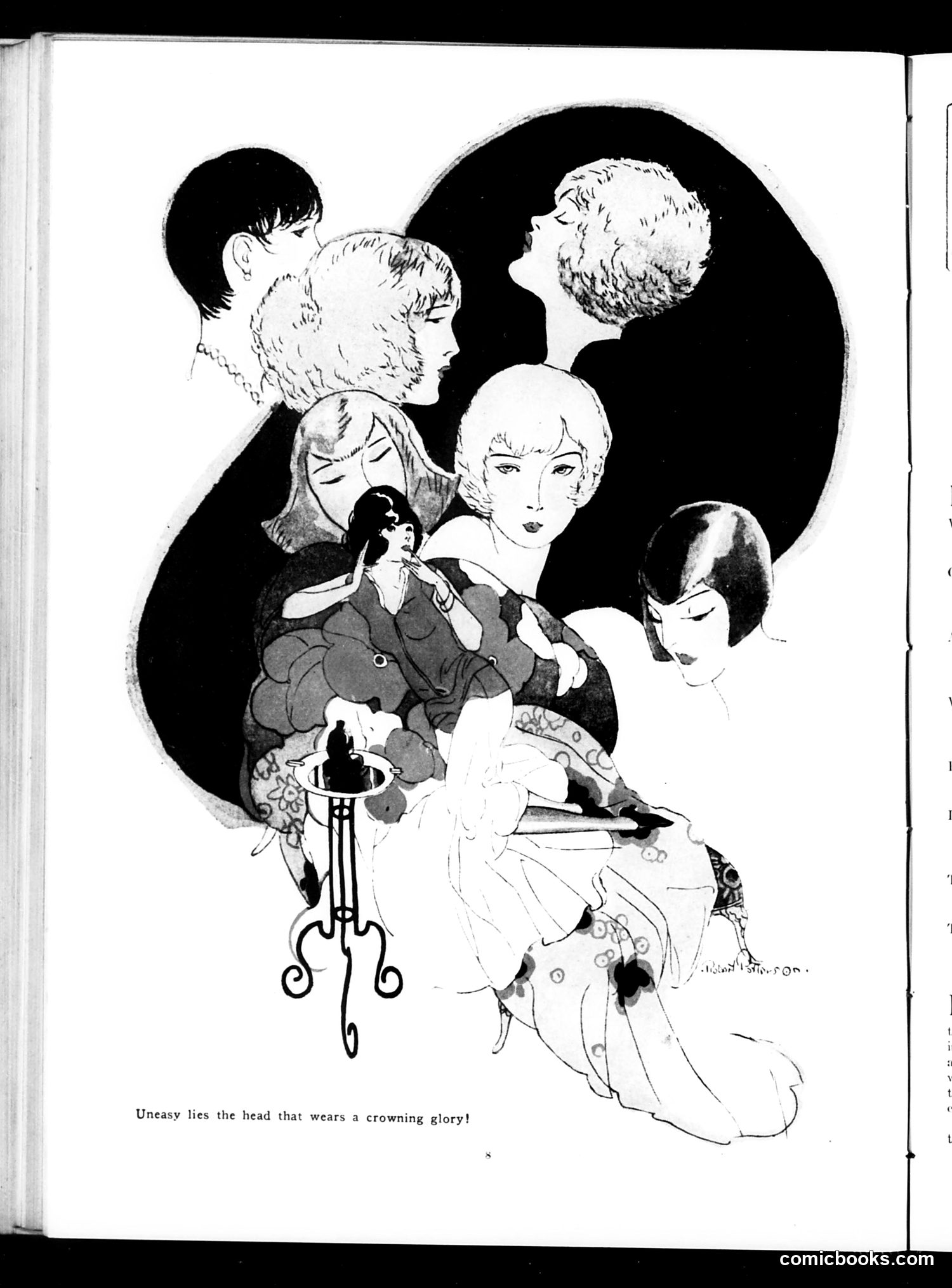
This illustration appears to be a satirical commentary on female vanity and fashion, specifically regarding elaborate hairstyles or "crowning glory." The image shows multiple female heads in various states—some shown from behind, others in profile—displaying different coiffures and styling. A woman in the foreground sits at what appears to be a dressing table with an ornamental mirror or styling implement. The caption, "Uneasy lies the head that wears a crowning glory," is a play on Shakespeare's *Henry IV* ("Uneasy lies the head that wears a crown"), replacing political power with beauty/fashion concerns. The satire mocks women's preoccupation with hairstyles and appearance, suggesting this obsession causes anxiety rather than pride. The elaborate black shadow behind the figures emphasizes the weight of these concerns.
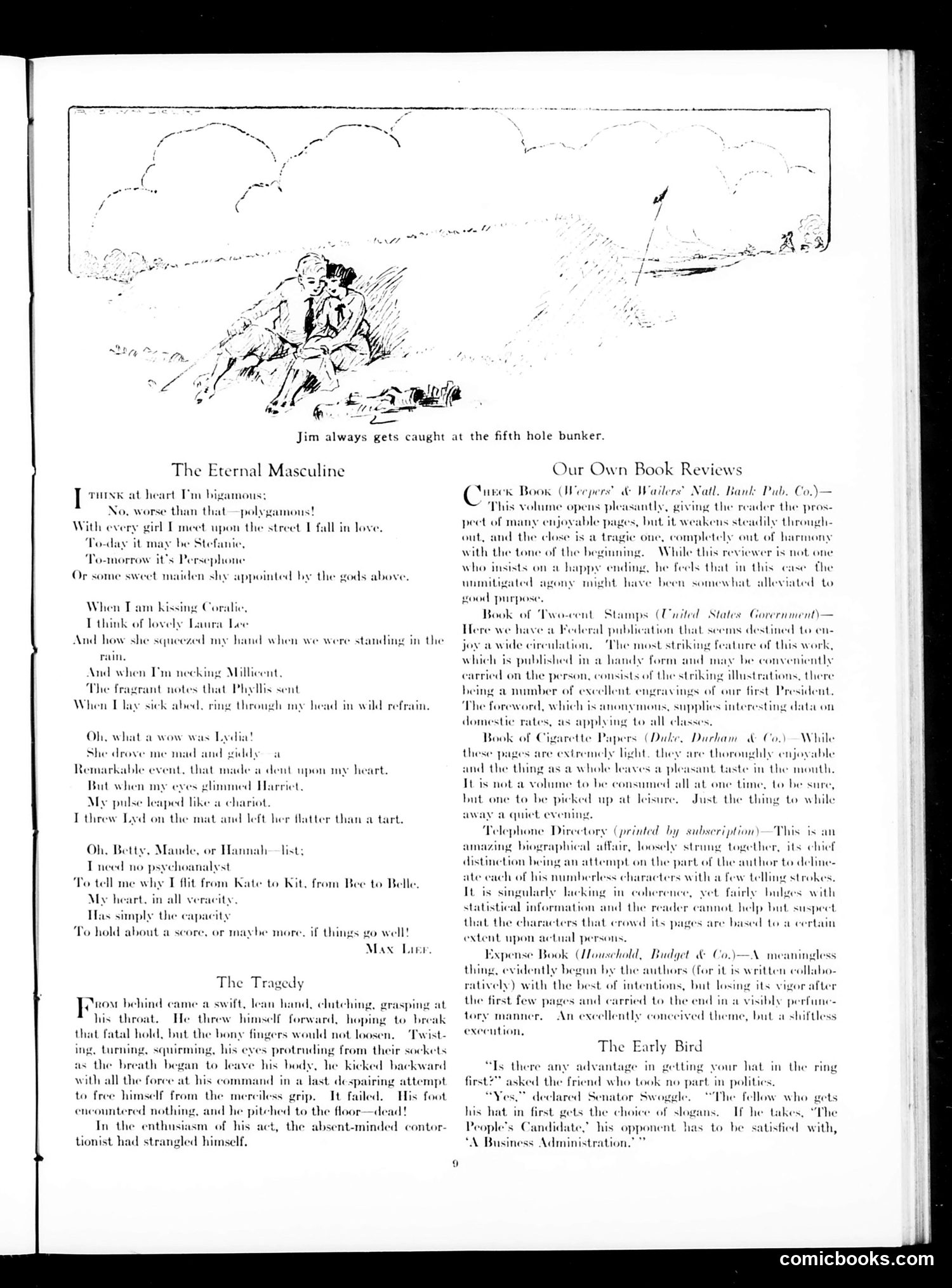
The small cartoon at the top depicts "Jim always gets caught at the fifth hole bunker" — a golf joke showing a man trapped in sand, illustrating his repeated misfortune at this particular hazard. It's a straightforward sports humor gag. The main text pieces are literary rather than political satire. "The Eternal Masculine" is a humorous poem by Max Lire about a fickle man who constantly falls in love with different women (Stefanie, Persephone, Coralie, Laura Lee, Millicent, etc.), mocking romantic inconstancy. "The Tragedy" presents darkly comic irony: an absent-minded contortionist accidentally strangles himself while performing, treating attempted violence as slapstick. The "Our Own Book Reviews" section offers witty critiques of contemporary publications—government stamp books, cigarette papers, telephone directories—using clever mockery of their limitations and purposes. This reflects Judge's typical satirical approach to American culture and commerce. No specific politicians or dated events are referenced on this page.
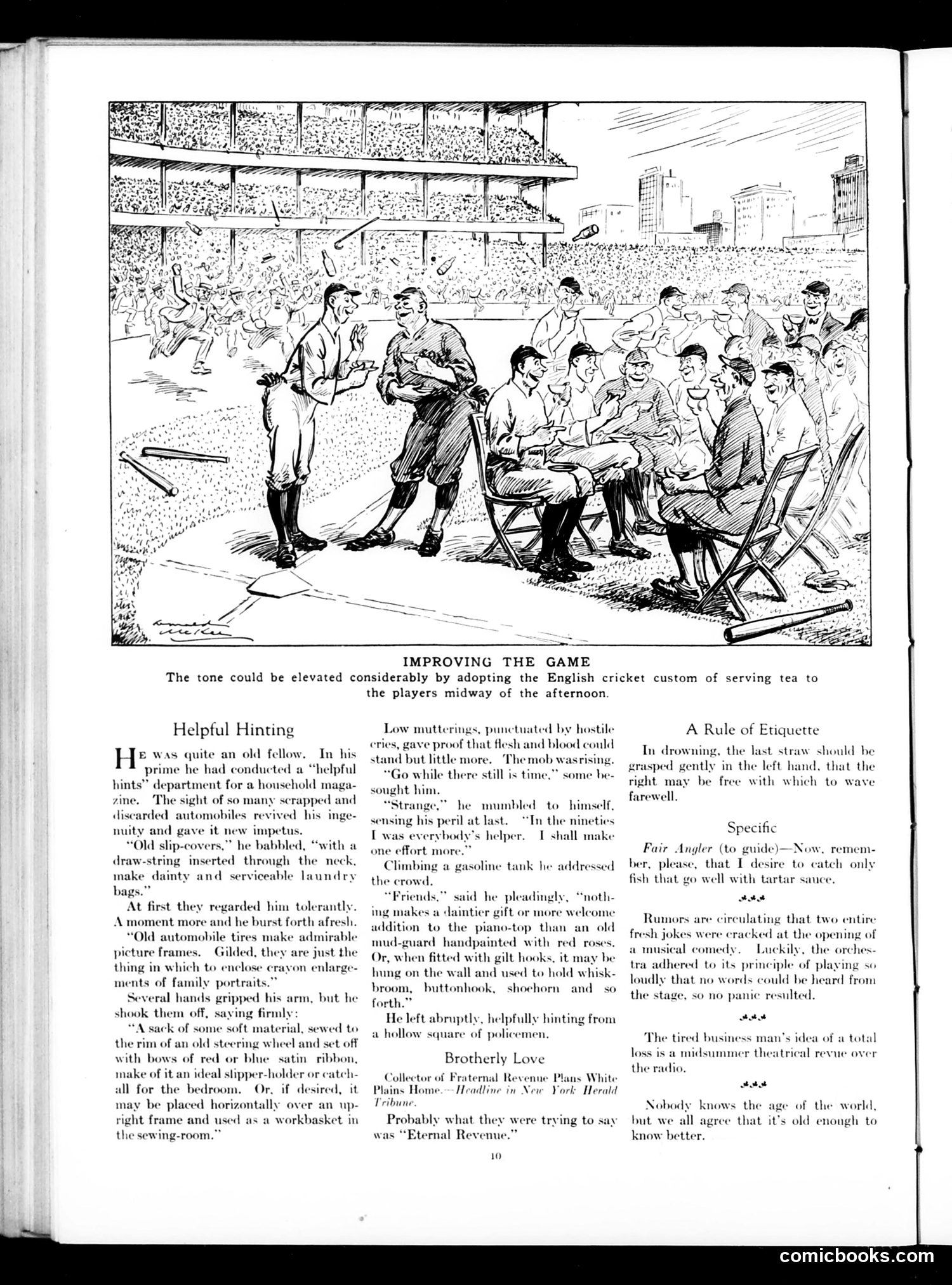
The main cartoon mocks an insufferable "helpful hints" columnist who won't stop dispensing domestic advice, even as an angry mob gathers at a baseball stadium. His tips—repurposing old car parts and tires into household items—are so tedious that the crowd becomes hostile. He frantically climbs a gasoline tank to keep talking until police finally remove him. The satire targets the early 20th-century craze for household economy tips and upcycling advice, which saturated magazines and newspapers. The joke is that this advice-peddler is so compulsively helpful and oblivious to his audience's contempt that even a mob of angry baseball fans can't silence him. The header suggests serving tea at baseball games (mimicking English cricket) as an alternative way to "elevate" the sport—itself a gentle jab at pretentiousness.
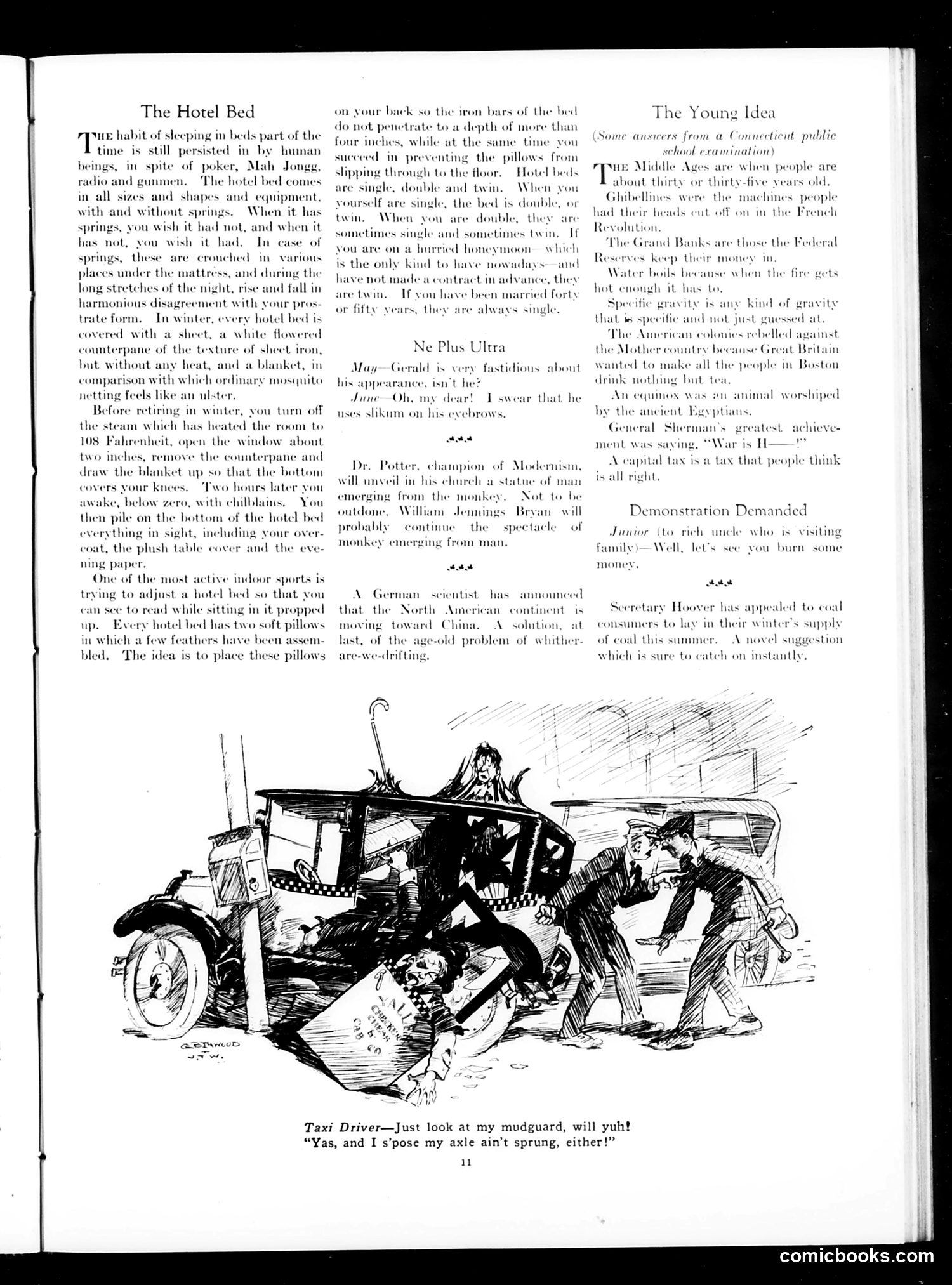
This Judge magazine page contains three satirical sections: **"The Hotel Bed"** is a humorous complaint about hotel bedding—uncomfortable mattress springs, inadequate blankets, and the impossible task of reading while propped up in bed. The joke targets the poor quality of hotel furnishings of the era. **"No Plus Ultra"** contains brief gossip items: mocking a fastidious man's grooming habits, and satirizing Dr. Potter's plan to unveil a church statue of "man emerging from the monkey" (a jab at Modernism vs. religious tradition). A German scientist's claim that North America is drifting toward China is presented as absurd. **"The Young Idea"** ridicules students' written exam answers from a Connecticut school—deliberately absurd definitions showing educational failure (e.g., "specific gravity is any kind of gravity that is specific"). **The taxi cartoon** shows a driver with a damaged mudguard sarcastically claiming nothing's wrong with his vehicle—simple working-class humor. The overall tone is light satire targeting hotels, modern religious controversy, scientific sensationalism, and educational inadequacy.
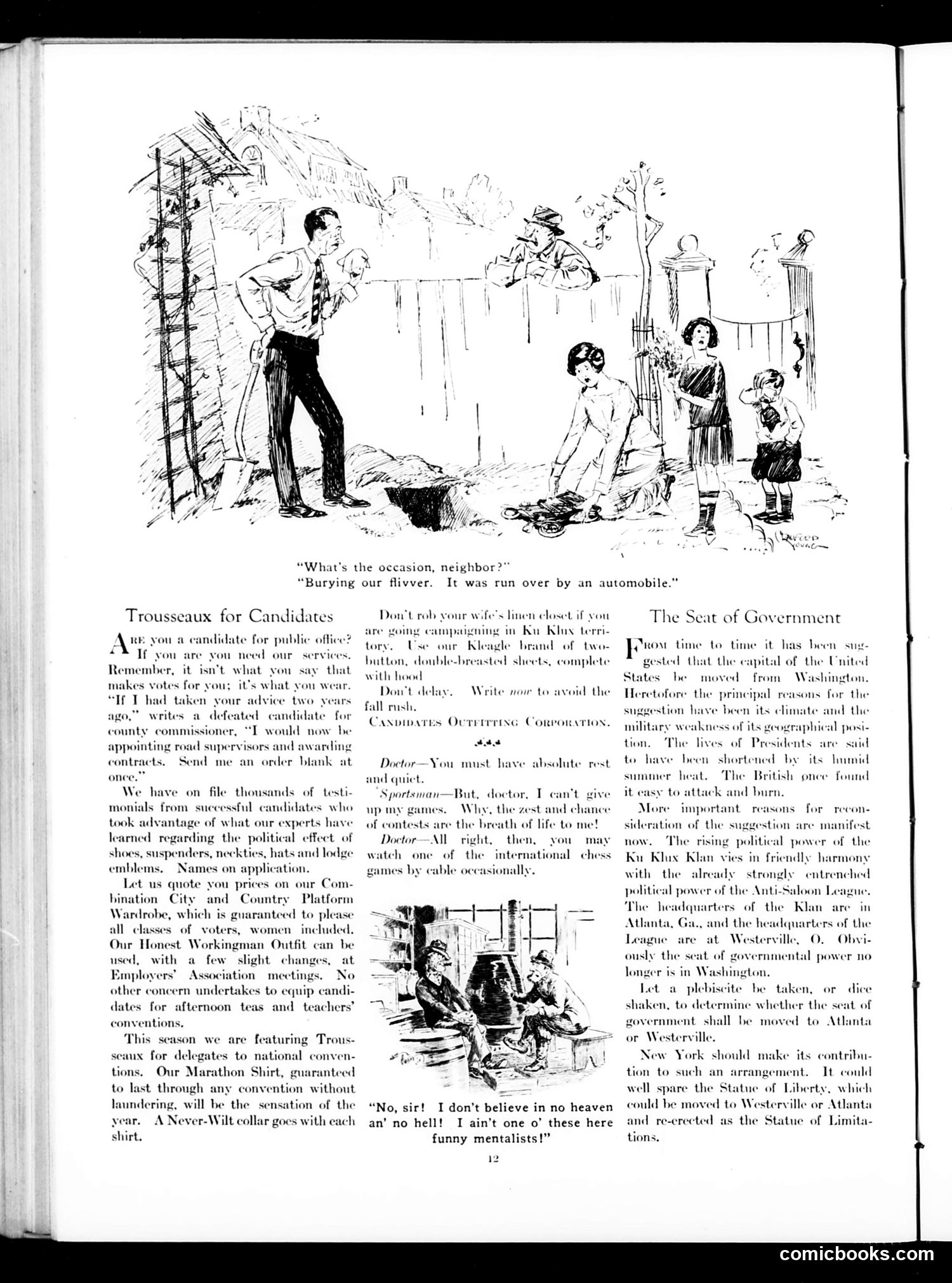
This page contains multiple satirical pieces mocking American politics and social movements of the 1920s. **Top cartoon:** Depicts a neighbor burying an automobile ("flivver")—likely satirizing the early auto industry or economic hardship. **"Trousseaux for Candidates":** Mock advertisement skewering how candidates win elections through appearance rather than substance. It cynically suggests successful politicians succeed via proper clothing and accessories, not policy. **"Ku Klay" section:** References the KKK (disguised as "Ku Klay"), warning against using wife's linens for campaign purposes in KKK territory—dark satire about the Klan's strength during the 1920s. **"Seat of Government":** Argues the U.S. capital should move from Washington because the KKK (headquartered in Atlanta, Georgia) and Anti-Saloon League now wield comparable political power to traditional government. The sarcastic suggestion to move the Statue of Liberty to "Westerville" (likely Westerville, Ohio—Anti-Saloon League headquarters) as the "Statue of Limitations" mocks these organizations' outsized influence. The satire reflects anxiety about extremist groups' political power in 1920s America.
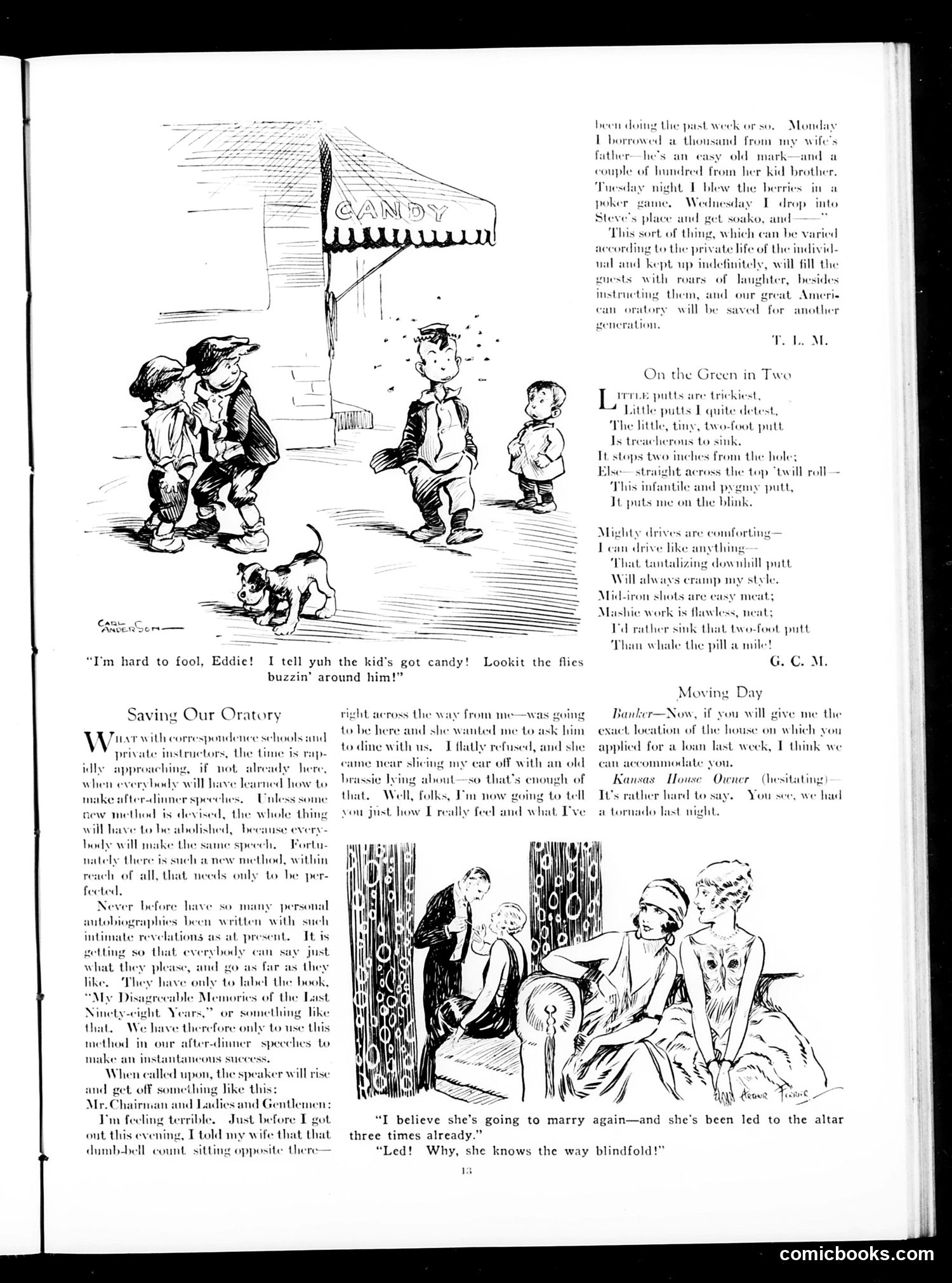
This Judge magazine page contains three satirical pieces mocking American social conventions: **"Saving Our Oratory"** attacks the proliferation of correspondence schools and self-help instructors by suggesting they've standardized public speaking into formulaic, self-absorbed confessions. The satire imagines speakers robotically reciting personal grievances (borrowing money, losing at poker) as though reading from a template. It's critiquing both the commodification of education and Americans' perceived narcissism. **"On the Green in Two"** is a humorous golf poem about the frustration of short putts—lightweight sports humor with no deeper political meaning. **"Moving Day"** presents a banker refusing a real estate loan because the applicant cannot specify the house's location, implying the applicant is either dishonest or incompetent. The final dialogue mocks a woman who's been married three times, suggesting she's so experienced at marriage she could navigate it "blindfold." The cartoon at top shows children spotting another child with candy by observing flies—simple observational humor.
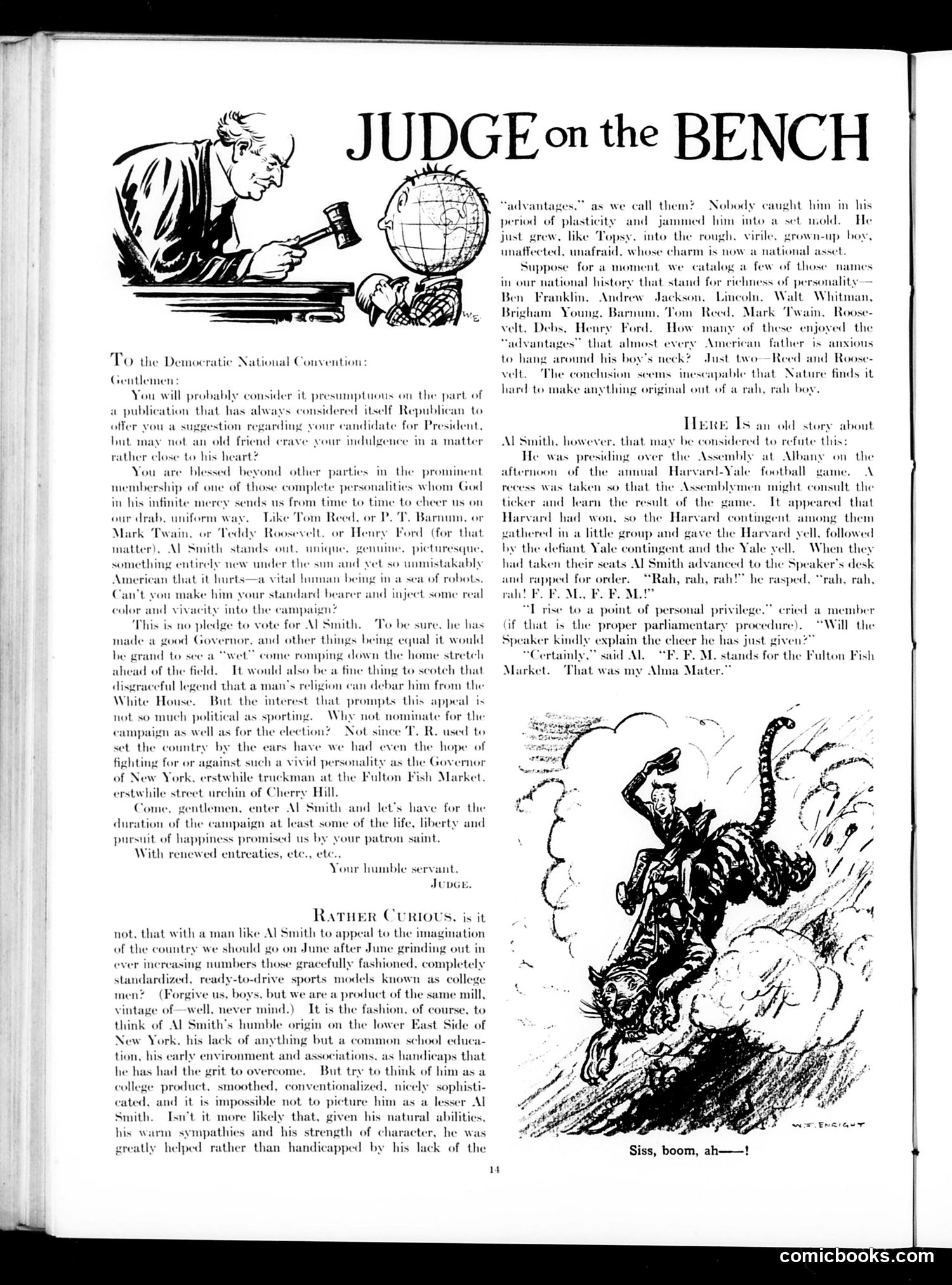
This page from *Judge* magazine advocates for Al Smith as the Democratic presidential candidate. The left cartoon depicts a stern judge hammending down a decision, symbolizing *Judge* magazine's editorial authority. The text argues Smith is a genuinely colorful personality—unlike standardized "college men"—citing his humble Lower East Side origins and self-made success. It compares him favorably to historical figures like Ben Franklin, Lincoln, and Mark Twain, arguing that lack of elite education didn't handicap these men but rather preserved their authentic character. The second cartoon (bottom right) shows Smith riding triumphantly on an elephant, suggesting his potential electoral power. The satire targets two things: (1) the Democratic Party's potential failure to nominate such a compelling candidate, and (2) American culture's obsession with mass-producing "standardized" college-educated men rather than nurturing distinctive individuals. Smith was an Irish-Catholic New York politician—his religion and background were controversial issues at the time, which the text obliquely references.
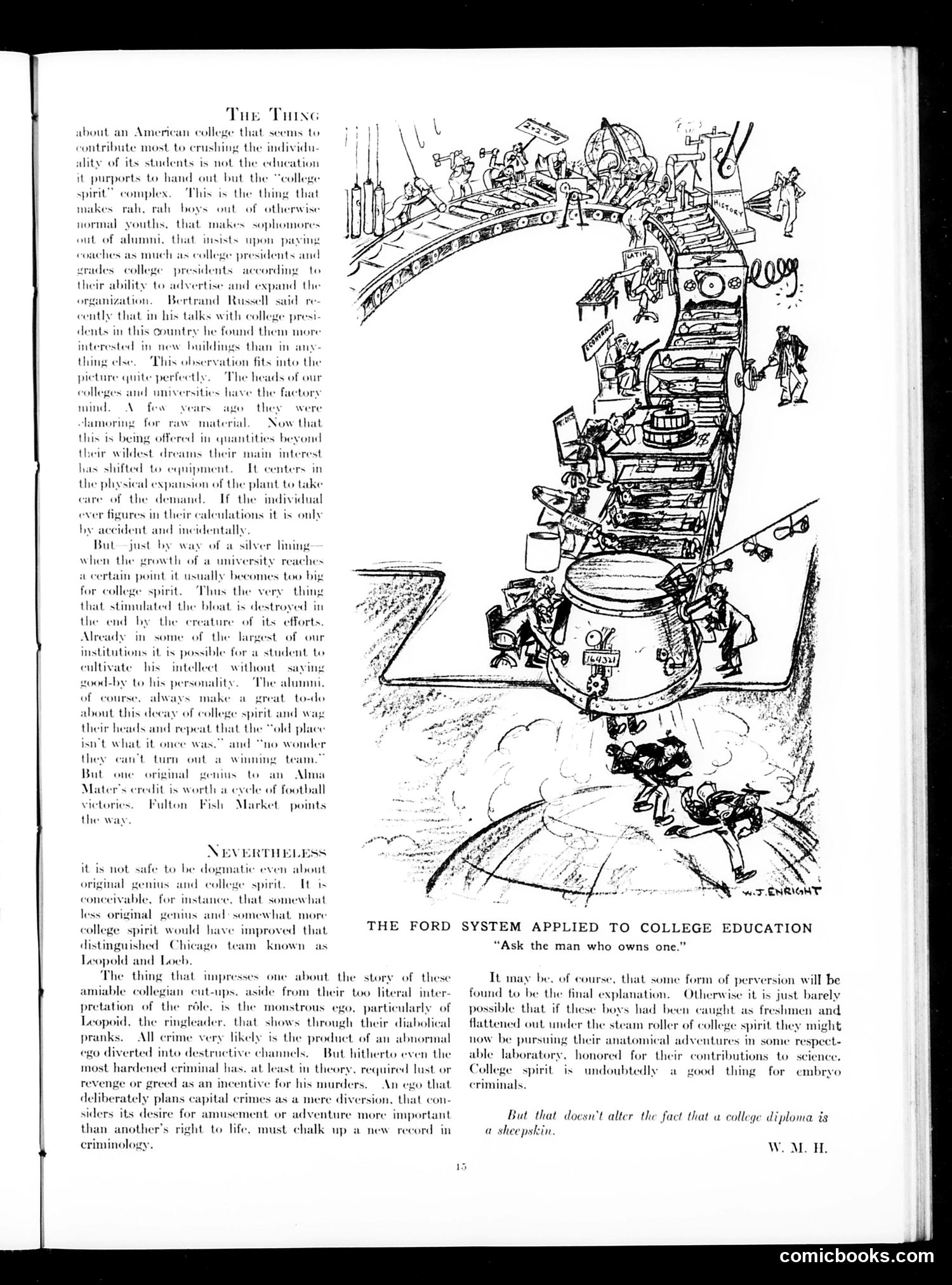
This satirical cartoon critiques American colleges for prioritizing physical expansion and "college spirit" over intellectual development. The illustration depicts a massive, chaotic factory-like machine labeled "The Ford System Applied to College Education"—referencing Henry Ford's assembly-line manufacturing model applied absurdly to education. The text argues that college administrators care more about buildings and equipment than students, and that "college spirit" (football, school pride, conformity) crushes individuality. The piece then pivots to the Leopold and Loeb case—two wealthy University of Chicago students who committed murder in 1924 as an intellectual "thrill." The author sardonically suggests that while college spirit crushes originality dangerously, ironically it *might* have prevented these particular crimes by conforming their monstrous egos. The satire targets both educational institutions' factory-minded expansion and the dangerous ego-inflation that college elitism can enable.
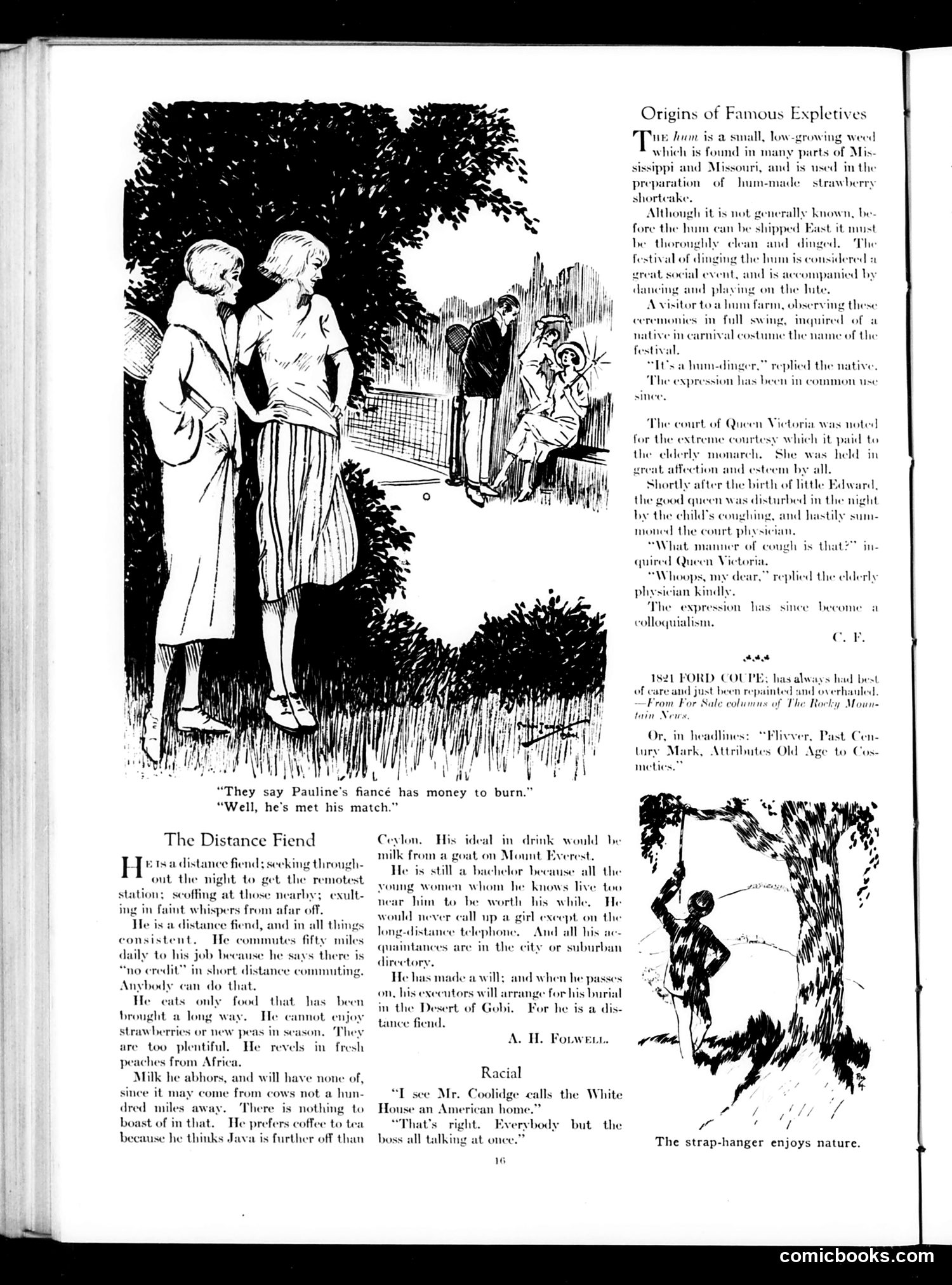
**"The Distance Fiend"** satirizes an absurd personality type: someone obsessively seeking status through geographical remoteness. The joke targets social climbing via conspicuous consumption—he commutes fifty miles daily, eats African peaches instead of local produce, imports Ceylon milk, and only courts women via long-distance telephone. His will specifies burial in the Gobi Desert. The satire mocks wealthy eccentrics who confuse distance/exoticism with superiority, unable to find value in accessible pleasures. **"They say Pauline's fiancé has money to burn"** appears to be a caption joke about wealthy suitors. **"Racial"** presents a quip about President Coolidge calling the White House "an American home"—likely ironic commentary on his perceived coldness or detachment. The page includes fanciful etymologies for "hum-dinger" and "whoops" (supposedly from royal court anecdotes), which appear to be humorous fabrications rather than serious historical claims.
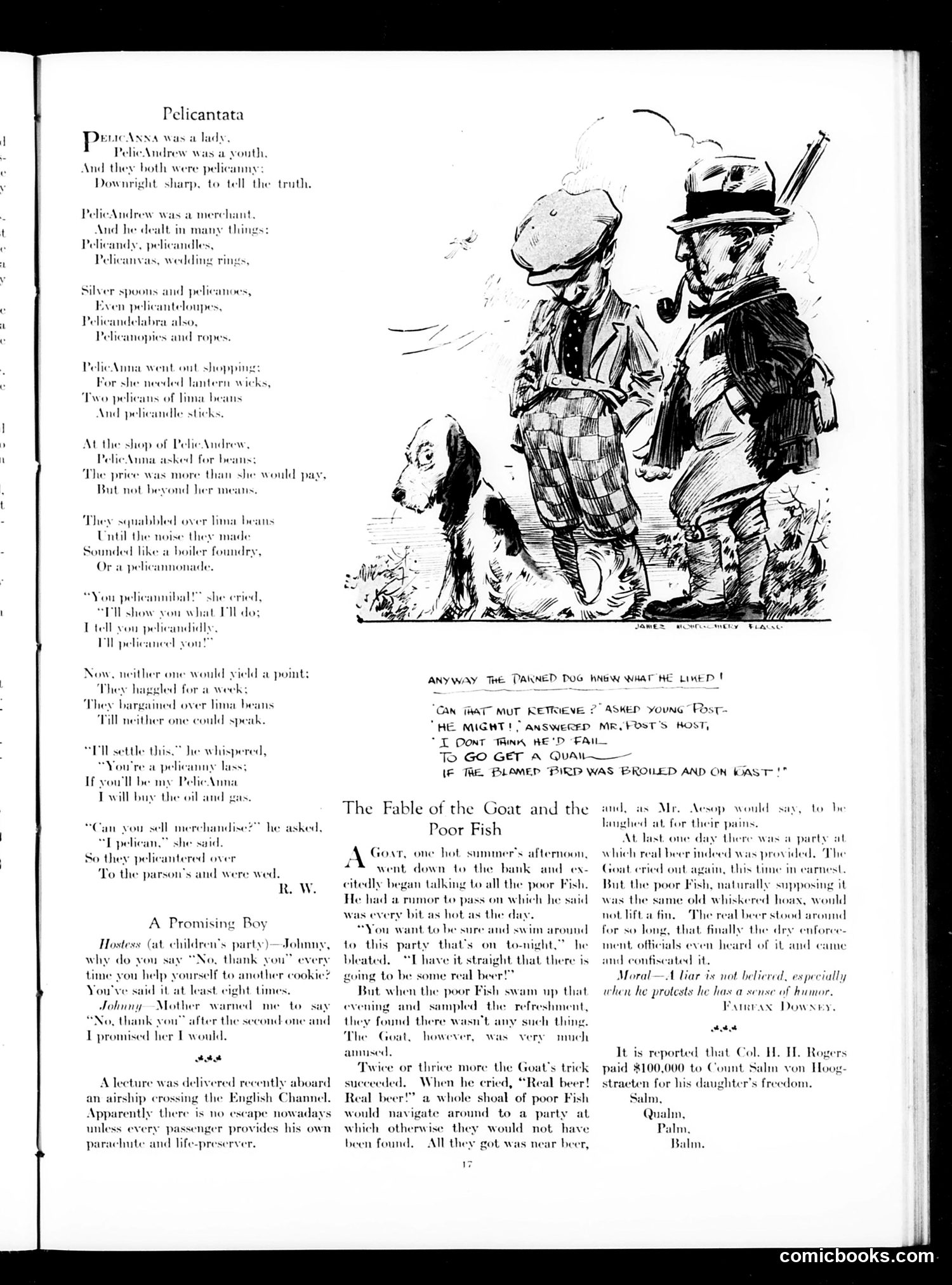
This page contains three separate humorous pieces from *Judge* magazine: **"Pelicantata"** is a lighthearted poem-story playing on the word "pelican" through relentless puns ("pelicanny," "pelicandles," "pelicannonade"). PelicAnna and PelicAndrew, a merchant couple, squabble over lima bean prices with such noise it sounds like a cannon. They eventually marry—a silly, pun-driven romantic narrative with no deeper satirical meaning beyond wordplay humor. **"A Promising Boy"** mocks a child's excessive politeness, suggesting his mother forced him to say "thank you" so often (eight times for cookies) that he's become mechanically obedient—satire on parental over-training of etiquette. **"The Fable of the Goat and the Poor Fish"** is a moral fable: a deceitful goat repeatedly tricks fish with false promises of "real beer" to lure them to parties where there's only cheap beer. When the goat finally tells the truth about real beer, the fish don't believe him. The moral critiques liars—once trust is broken, even truth-telling fails. No identifiable political figures appear on this page.
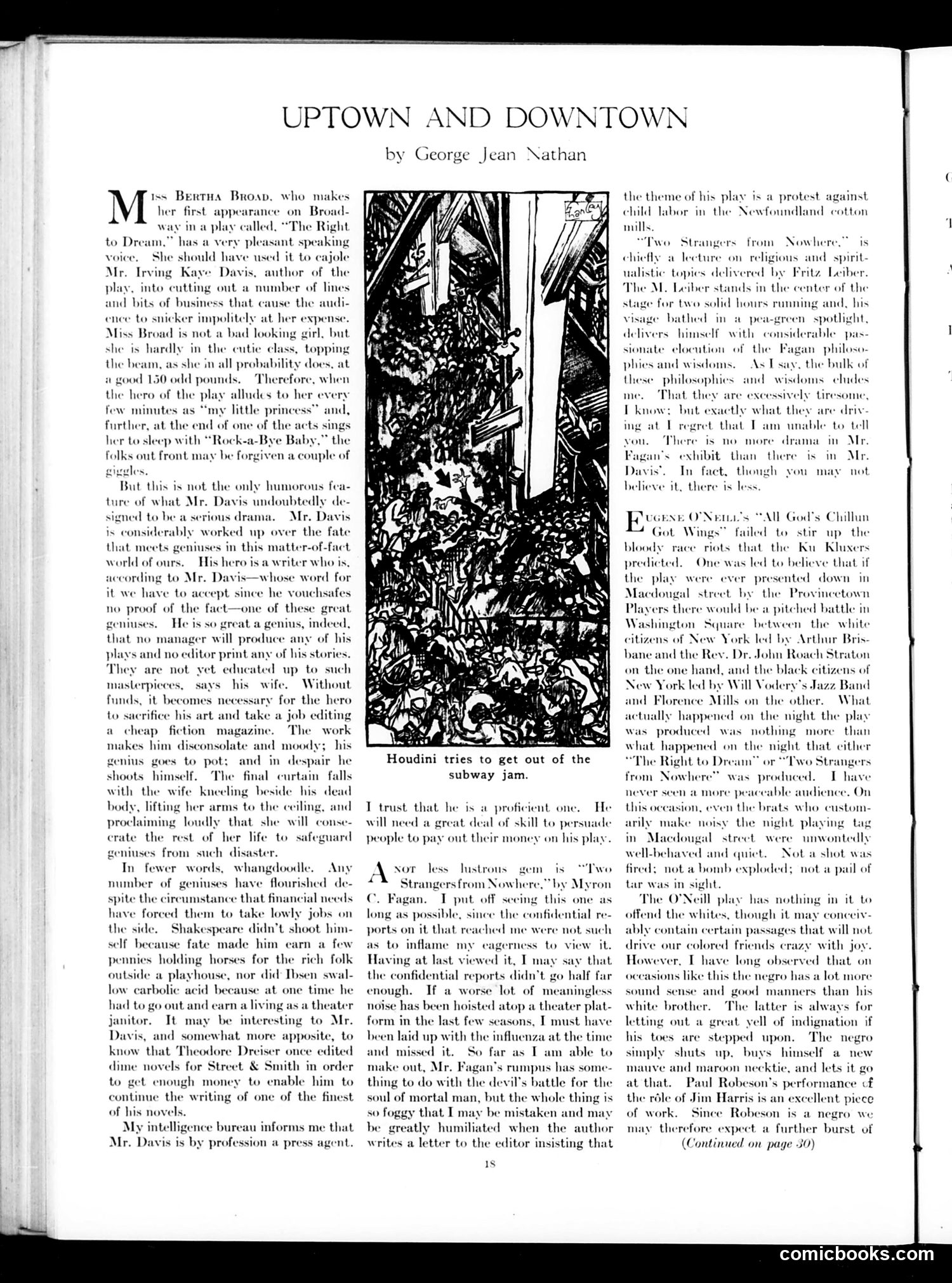
This page contains a theater review by George Jean Nathan critiquing recent Broadway productions. The main cartoon depicts **Houdini** (the famous magician/escape artist) trapped in a subway jam—a visual pun on his profession, showing him unable to escape an everyday modern predicament. The text reviews several plays, including Davis's "The Right to Dream," which Nathan satirizes mercilessly. He mocks the plot: a "genius" writer so uncompromising he refuses commercial work, takes a job at a pulp magazine, then shoots himself—leaving his widow to "safeguard geniuses from disaster." Nathan's satire targets this romanticized notion of artistic suffering, noting that actual great writers (Shakespeare, Ibsen, Dreiser) took day jobs without killing themselves. Nathan also briefly dismisses other plays ("Two Strangers from Nowhere," O'Neill's work) as either tedious or pretentious. The tone is acerbic criticism of both poor playwriting and the self-pitying mythology surrounding artistic struggle in 1920s theater.
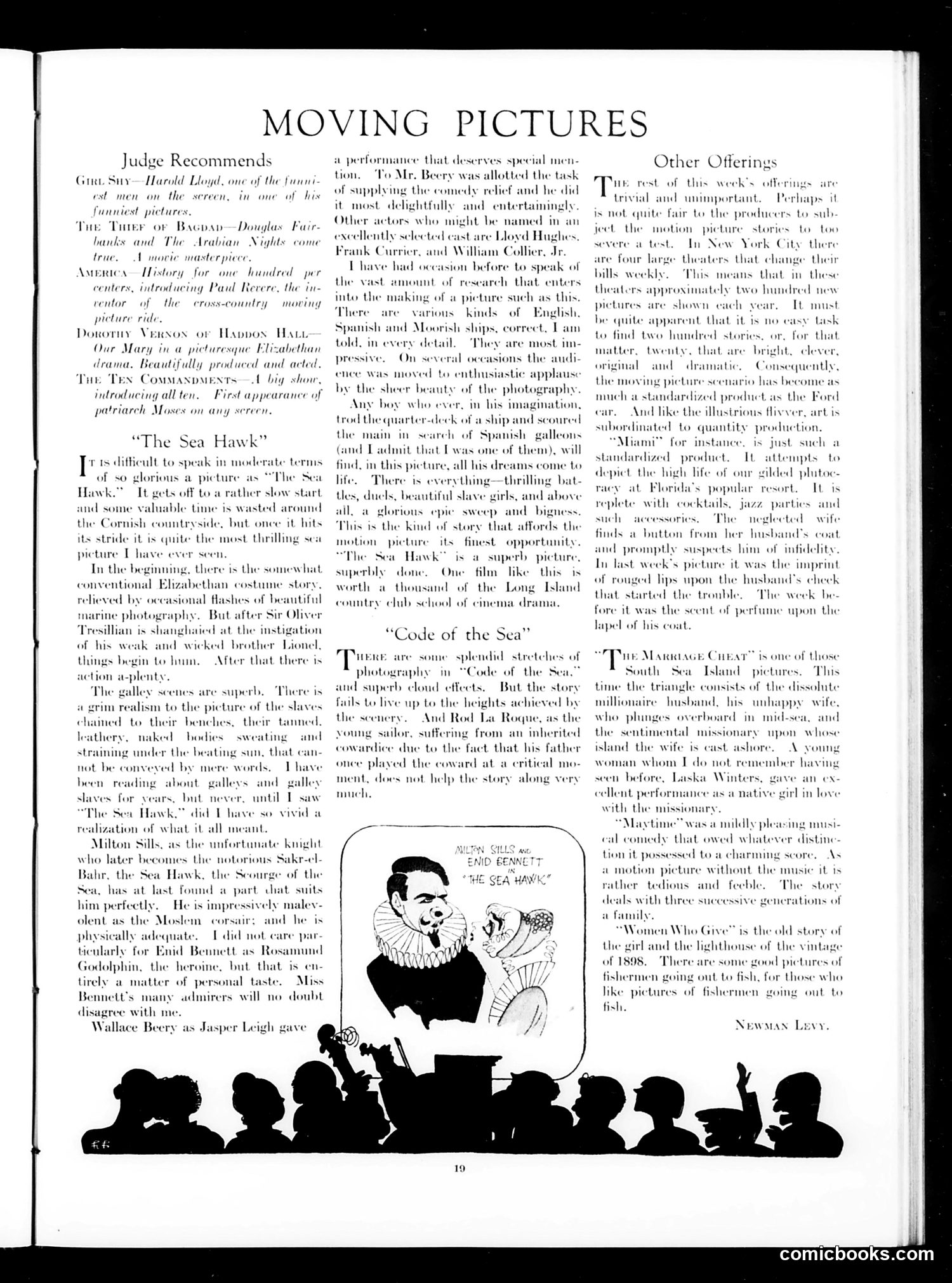
This page contains film reviews from Judge magazine's "Moving Pictures" section, recommending recent movies to readers. The main illustrated piece features **Milton Sills as the title character in "The Sea Hawk,"** a swashbuckling adventure film about a noble knight turned pirate. The caricature shows Sills in Elizabethan costume with an exaggerated expression. The reviewer praises "The Sea Hawk" enthusiastically for its thrilling action sequences, particularly galley scenes with enslaved men, and authentic period ship details. He also recommends films featuring Harold Lloyd, Douglas Fairbanks, and Dorothy Vernon of Haddon Hall. The reviews also cover "Code of the Sea" and "The Marriage Cheat," critiquing their stories and performances. This represents Judge's coverage of silent-era cinema, aimed at upscale readers seeking entertainment guidance. The tone is sophisticated and detailed, reflecting how seriously early film criticism was taken by quality magazines.
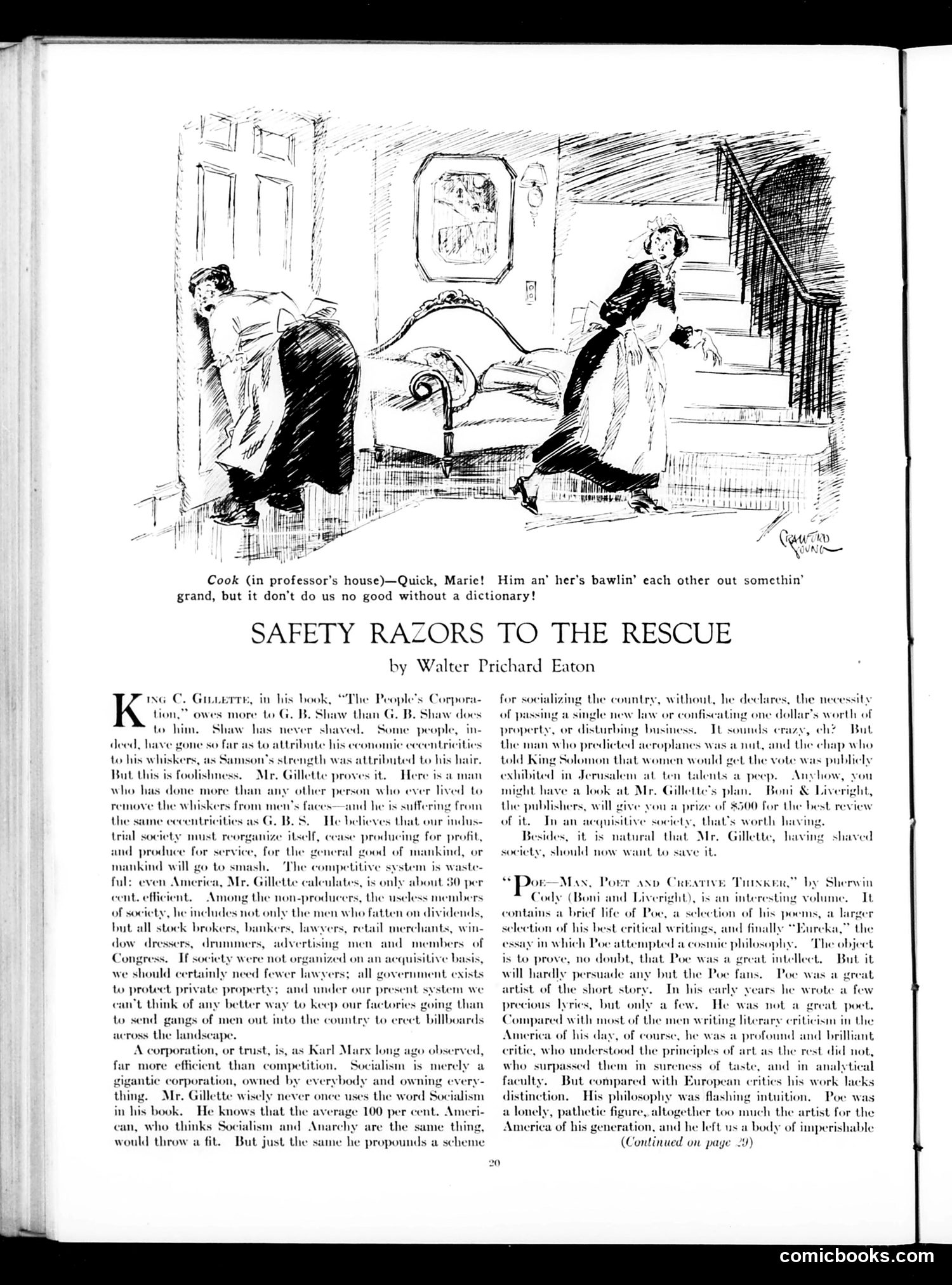
The top cartoon depicts a domestic scene in a professor's house where two people are having a heated argument. The cook observes their conflict and notes ironically that while they're "bawlin' each other out," they accomplish nothing without a dictionary—suggesting their quarrel is pointless or unintelligible without proper communication tools. This appears to be a visual pun: the article below discusses King C. Gillette's vision for socializing property and reorganizing society. The "safety razors" in the title is a play on Gillette's famous invention—the safety razor—being metaphorically applied to solve social problems. The joke suggests that just as safety razors could shave away difficulties, Gillette believed his business model and ideas about property ownership could "rescue" society from conflict and inefficiency. The accompanying article critiques Gillette's quasi-socialist theories while acknowledging his genuine success as an industrialist and inventor.
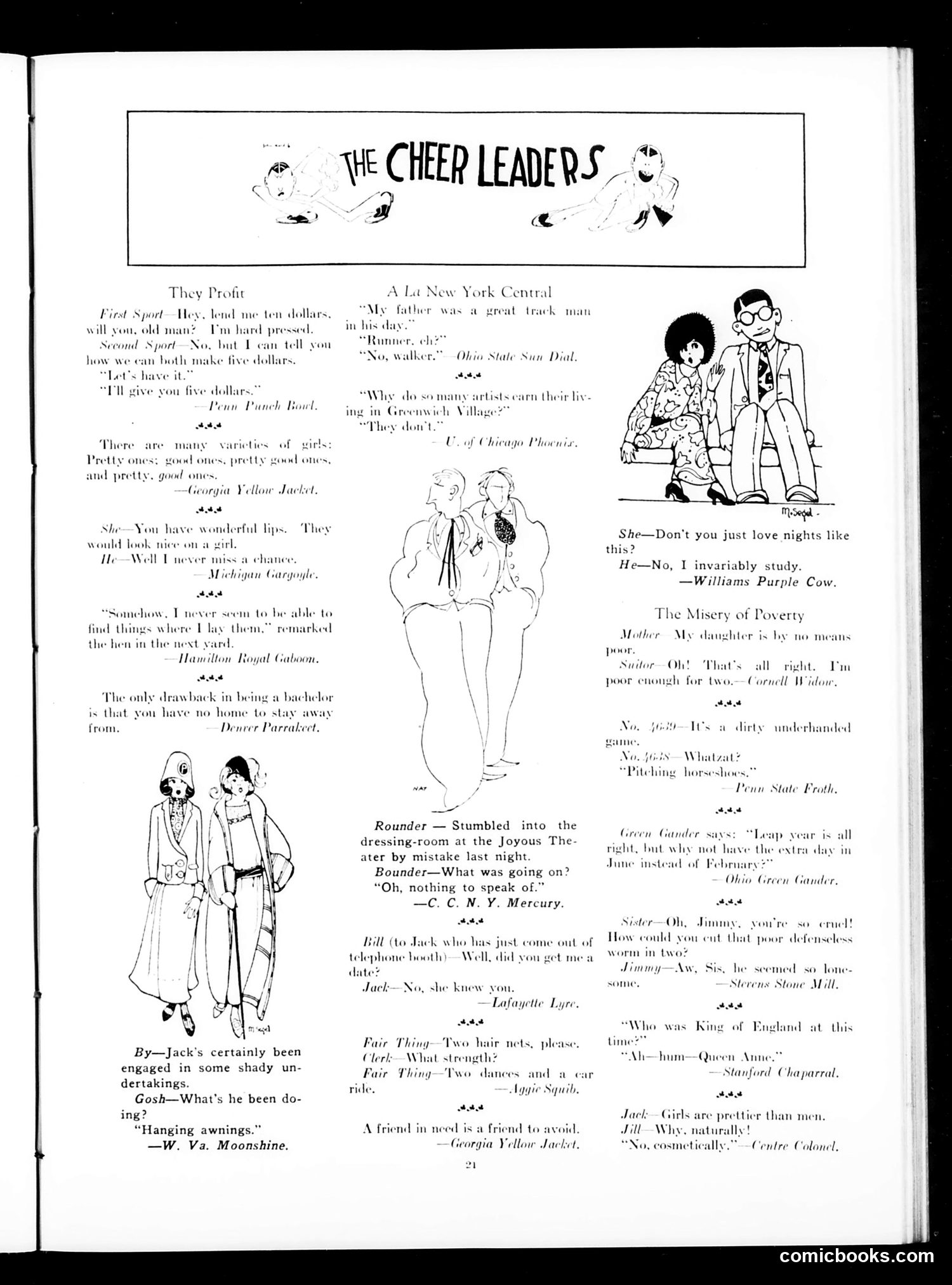
This page collects brief humorous exchanges from various college humor magazines, presented as satirical commentary on early 20th-century American social life. The jokes target predictable targets: **financial scheming** ("They Profit" depicts small-time con artists), **bachelor life** (the drawback of having nowhere to escape to), **dating and romance** (the telephone booth joke about being rejected because the woman already knows the man), and **gender dynamics** (women's cosmetic artificiality versus natural beauty). The "Leap Year" exchange references the tradition where women propositioned men. The poverty jokes mock courtship across class lines. Several pieces mock **artistic bohemianism** in Greenwich Village and questionable theater conduct. The humor relies on contemporary college slang and social assumptions—particularly around dating rituals, class anxiety, and gender performance—that modern readers would find either quaint or mildly offensive depending on the joke's target.
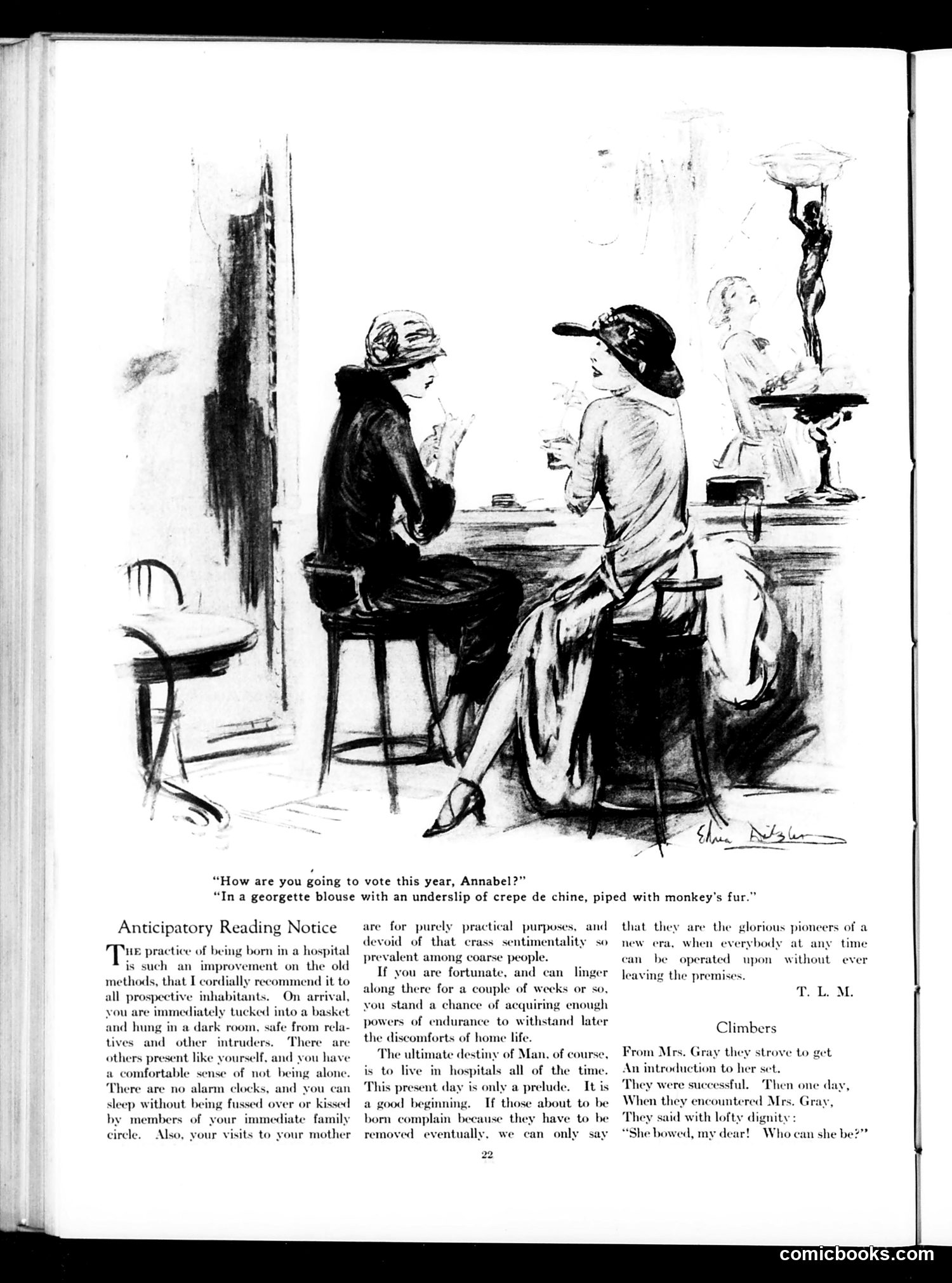
**The Cartoon:** Two women discuss voting. One asks how the other will vote; the response is purely about fashion—a georgette blouse with crepe de chine slip "piped with monkey's fur"—suggesting women voters care only about appearance, not substantive political issues. **The Satire:** This mocks women's suffrage (newly granted or being debated). The joke implies women are frivolous and unfit voters because they prioritize clothing over politics. It's anti-feminist satire typical of the era. **The Text Below:** "Anticipatory Reading Notice" satirizes hospital births as superior to home births, praising the isolation and lack of family intrusion—a darkly humorous jab at modern institutional life. **"Climbers":** A brief poem mocking social climbers who, after gaining entry to Mrs. Gray's social circle, snub her in public, suggesting shallow social ambition and ingratitude. **Context:** This reflects early 20th-century anxieties about women's changing roles and emerging modernist critiques of institutional society.
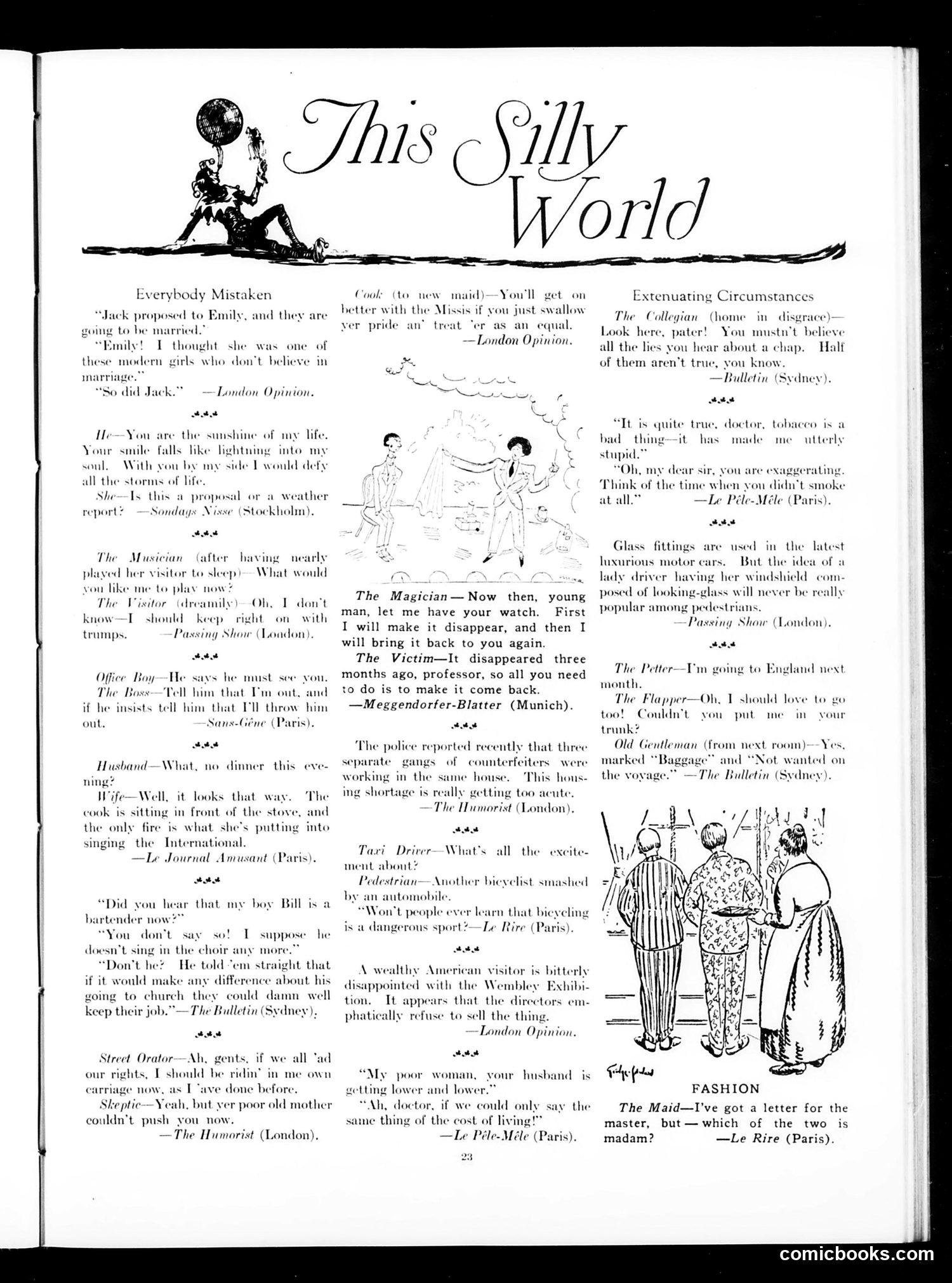
This page collects brief humorous anecdotes from international publications, satirizing everyday social absurdities of the era (likely 1920s-30s based on style). **Key satirical targets include:** - **Modern courtship rituals**: Men's flowery romantic declarations contrasted with women's practical indifference to marriage - **Class and servant dynamics**: Working-class figures (cook, maid, office boy) navigating hierarchies with backtalk and dignity - **Post-war housing shortage**: Darkly joking that counterfeiting gangs must share houses due to scarcity - **Modern transportation**: Unsafe bicyclists, dangerous automobiles, lady drivers with windshield proposals - **Gender roles**: Flapper independence, confused domesticity, ambiguous household authority - **Economic hardship**: Living costs, unemployment, marital financial strain The humor relies on **class observation** and **social commentary**—poking fun at both working-class impudence and upper-class pretension. The cartoons feature ordinary people in domestic or street scenarios, with the joke typically puncturing false sentimentality or exposing economic hardship masked by politeness.
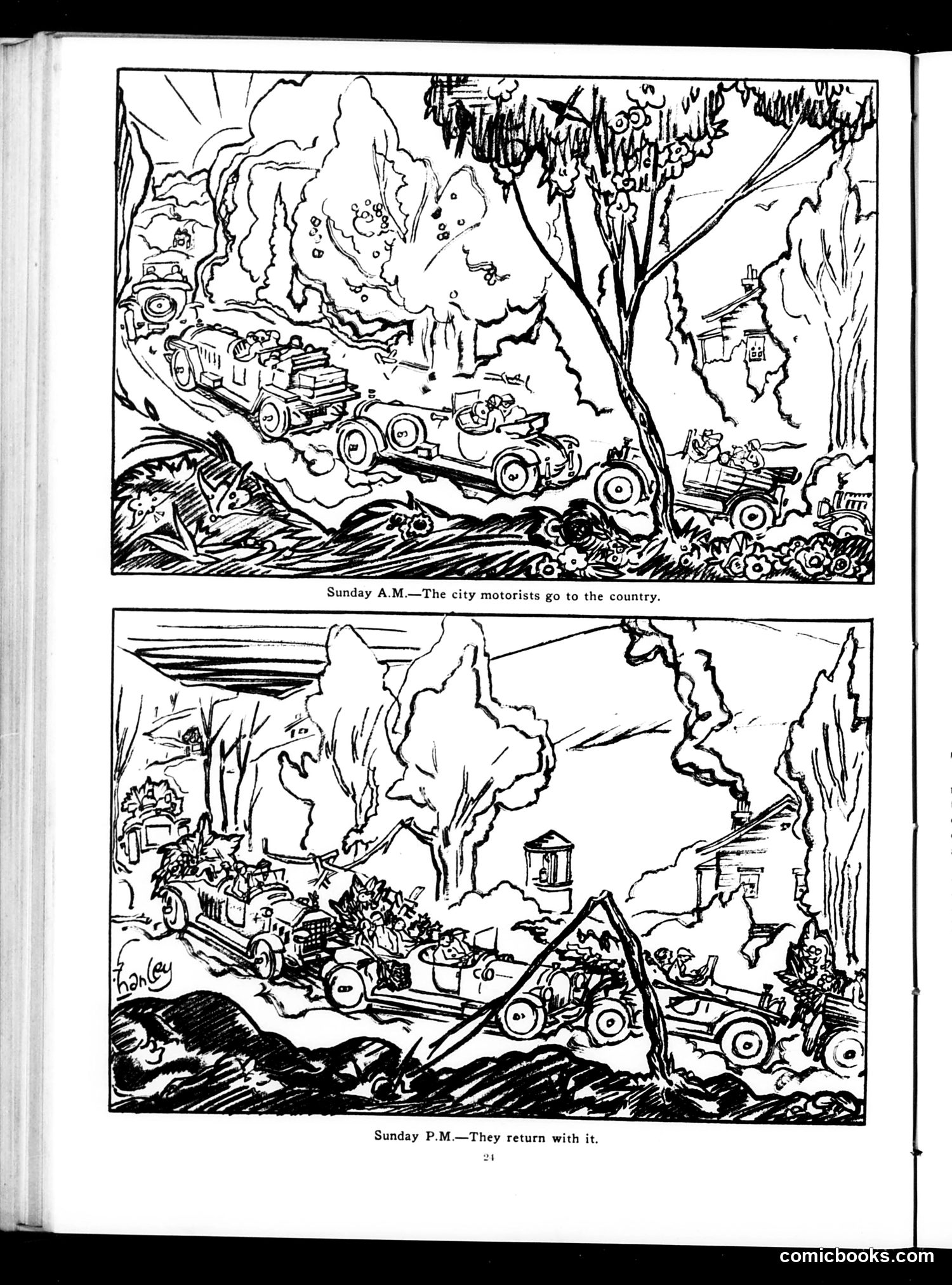
This two-panel cartoon satirizes urban motorists' weekend behavior. The top panel, "Sunday A.M.—The city motorists go to the country," shows well-dressed city dwellers driving automobiles into a pristine natural landscape. The bottom panel, "Sunday P.M.—They return with it," depicts the same motorists departing, having visibly damaged and littered the countryside—trees are broken, the landscape is scarred and strewn with debris. The satire targets early 20th-century leisure culture: wealthy city residents' automobile tourism and their destructive environmental impact. The cartoon implies that city people, escaping urban life for nature, ironically destroy what they seek to enjoy, leaving the countryside degraded. It's a critique of careless recreation and environmental disregard among the motorized leisure class.
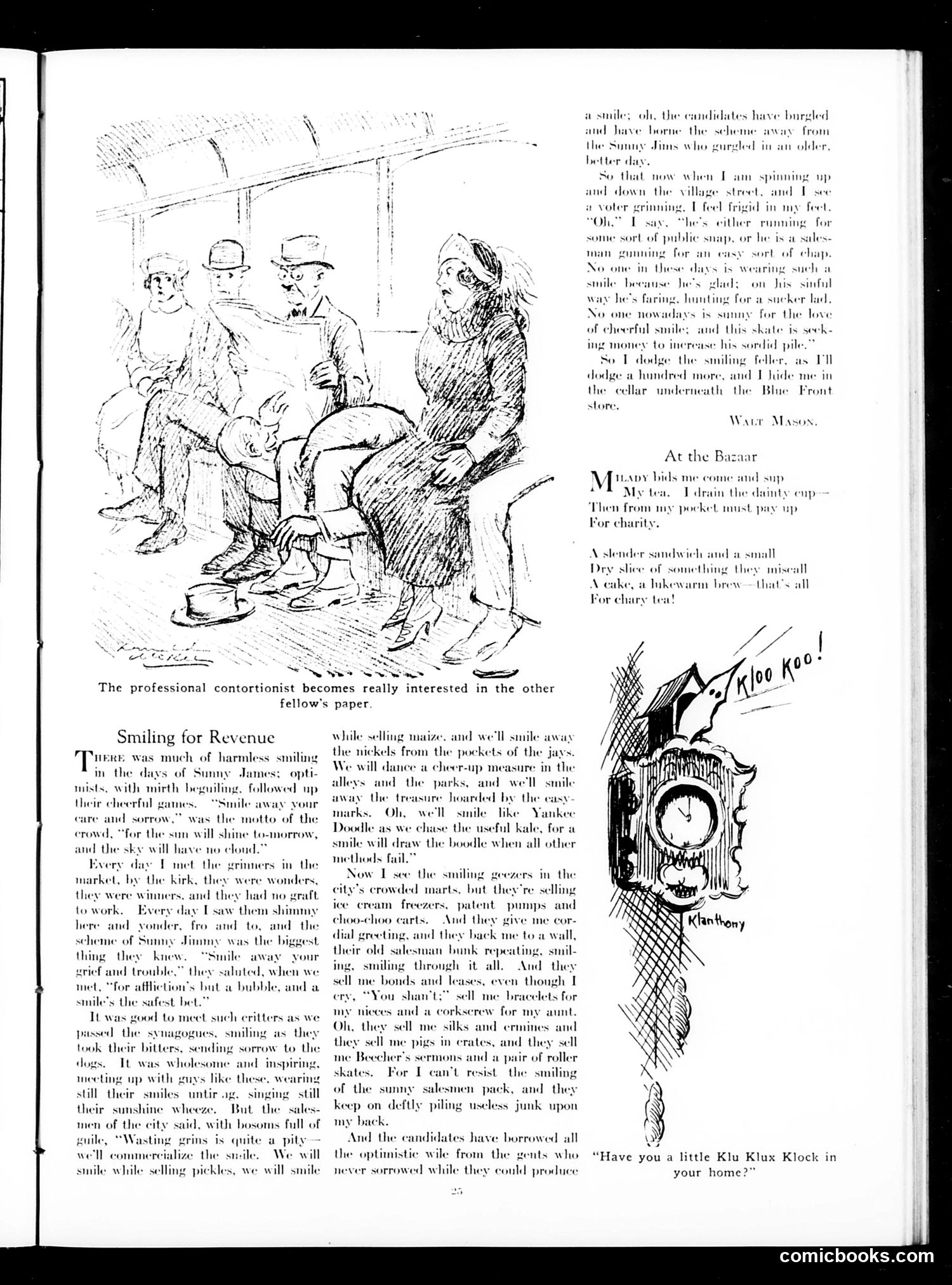
This page satirizes **commercialized smiling and manipulative salesmanship** in early 20th-century America. The main article "Smiling for Revenue" (by Walt Mason) contrasts the "Sunny James" era—when genuine optimism and cheerful grins were honest virtues—with the modern marketplace, where salesmen use calculated smiles as a predatory sales technique. The speaker laments that contemporary merchants weaponize cheerfulness to extract money from customers, hawking worthless goods ("useless junk") and fraudulent schemes (bonds, leases, even "Beecher's sermons"). The cartoon depicts a **contortionist** becoming fascinated by another person's newspaper—a visual pun suggesting how salesmen distort themselves (emotionally and morally) to manipulate others. The secondary piece "At the Bazaar" ridicules charity events where women pressure men to spend money under the guise of socializing. The **Klu Klux Klock advertisement** (right margin) parodies aggressive commercial marketing with a grotesque clock image—likely satirizing both absurd product promotion and, possibly, anxieties about secret societies or hidden agendas in commerce. Overall: critiques how capitalism corrupts authentic human warmth into a sales tool.
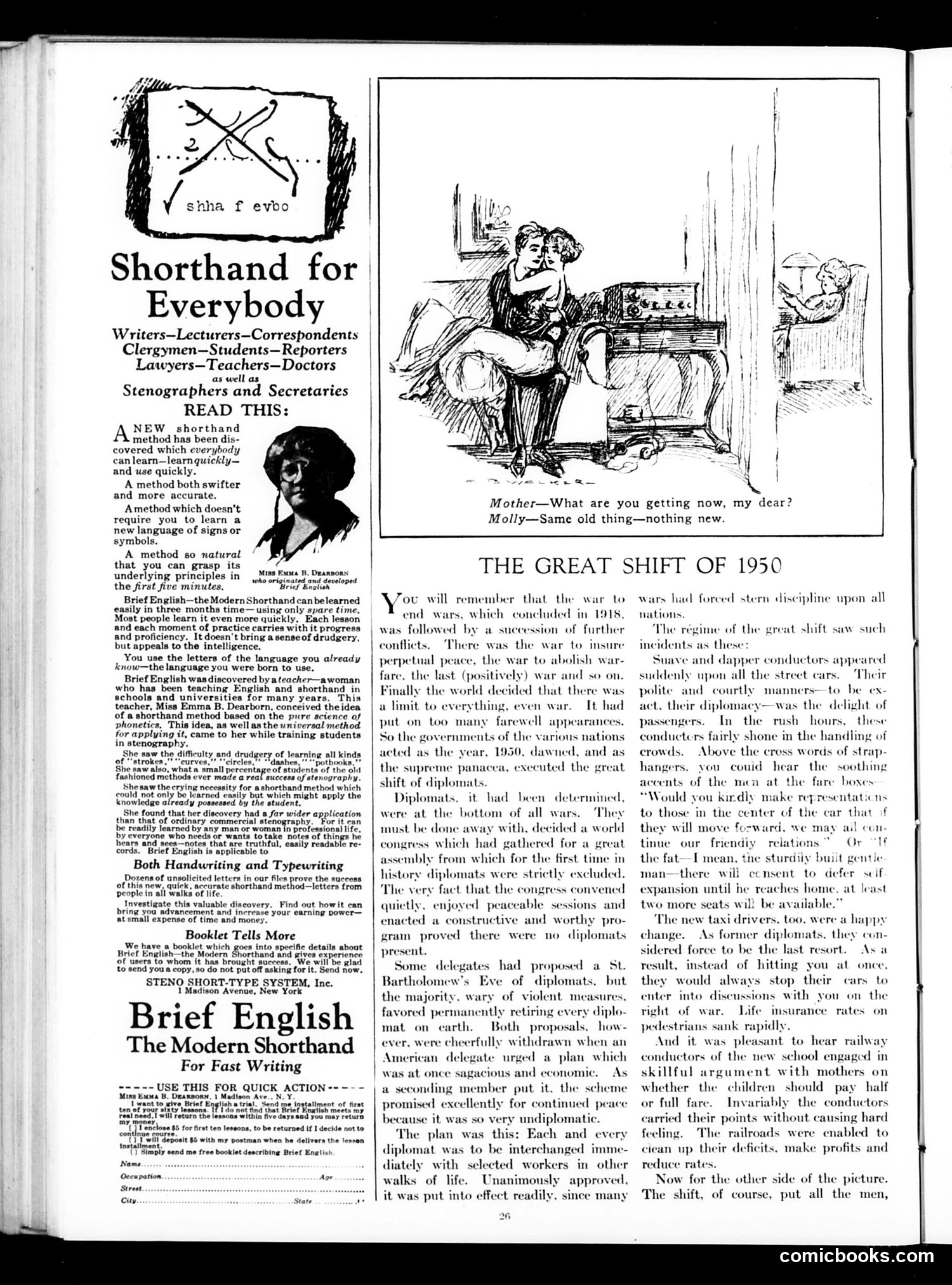
This page combines advertising for "Brief English" shorthand with a satirical cartoon and article. The cartoon shows a mother and daughter (labeled "Molly") at home, with the mother asking what news Molly is getting—Molly replies "same old thing—nothing new." The accompanying article, titled "The Great Shift of 1950," is satirical fiction imagining a future world (from Judge's 1920s perspective) where diplomats are abolished as the root cause of war. It describes how after WWI and successive conflicts, nations decided diplomats caused all wars and executed "the great shift"—apparently eliminating the diplomatic corps entirely. The satire mocks the naive post-war optimism that eliminating diplomacy could prevent future conflict, while the cartoon suggests ordinary life continues unchanged despite grand governmental schemes. The humor lies in the contrast between utopian political solutions and mundane domestic reality.
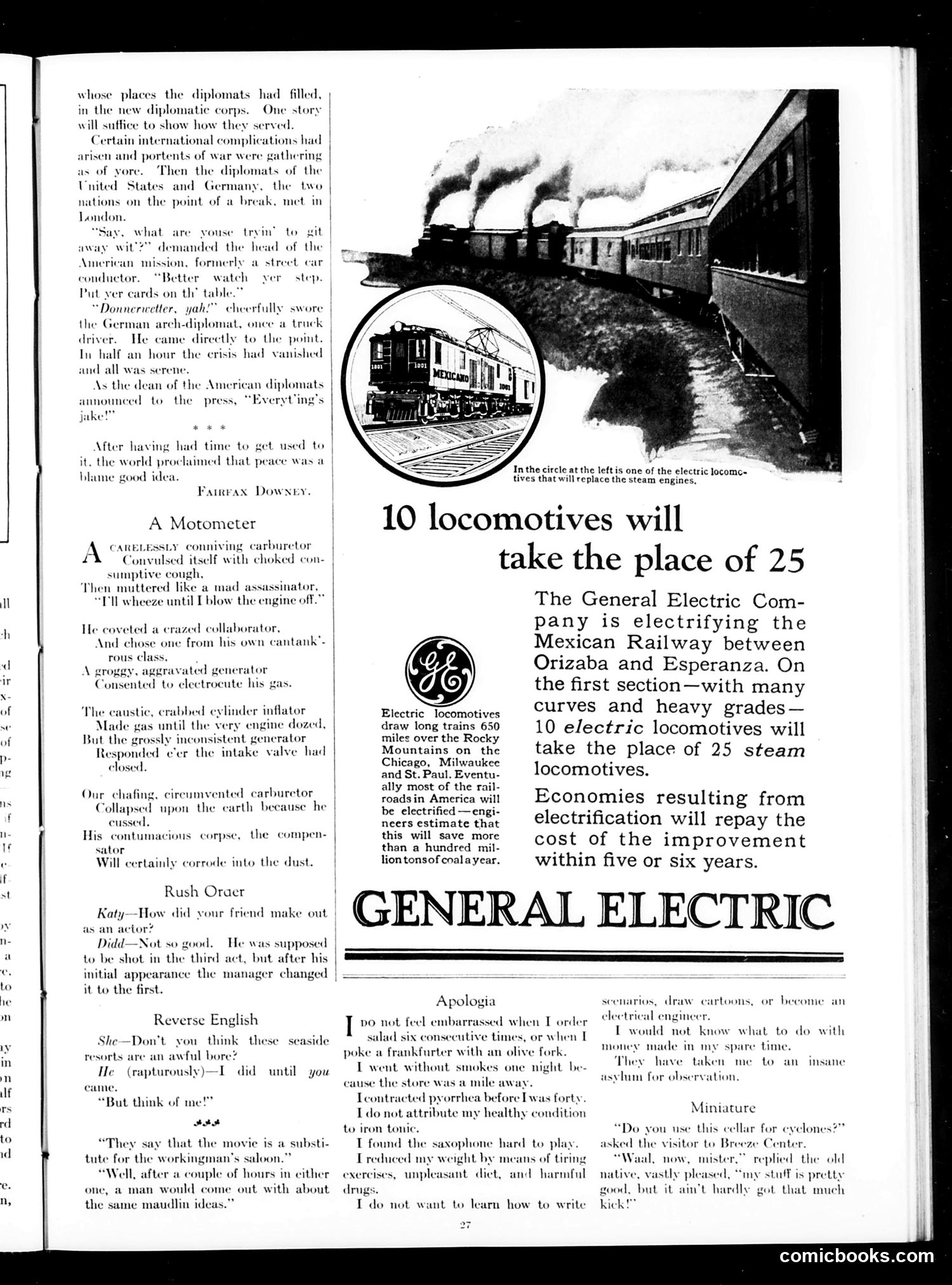
This page contains satirical articles and advertisements typical of Judge magazine's early 20th-century format. **Main content**: A story by Fairfax Downey satirizes American diplomatic corps by depicting U.S. and German diplomats as former working-class men (street car conductor and truck driver) who resolve an international crisis through blunt, colloquial speech rather than formal diplomacy. The satire mocks both the pretense of diplomatic protocol and suggests rough pragmatism works better—a commentary on how the "new diplomatic corps" had filled positions formerly held by career diplomats. **Poems**: "A Motometer," "Rush Order," and brief jokes ("Reverse English") use personification and wordplay typical of Judge's humor style. **Advertisement**: General Electric promotes electrification of Mexican railways, claiming 10 electric locomotives will replace 25 steam engines—emphasizing efficiency gains and cost recovery within five years. **"Apologia"**: A self-deprecating humor piece listing embarrassing personal habits, a common Judge feature. The page reflects early-20th-century concerns: diplomatic modernization, industrial electrification, and working-class humor.
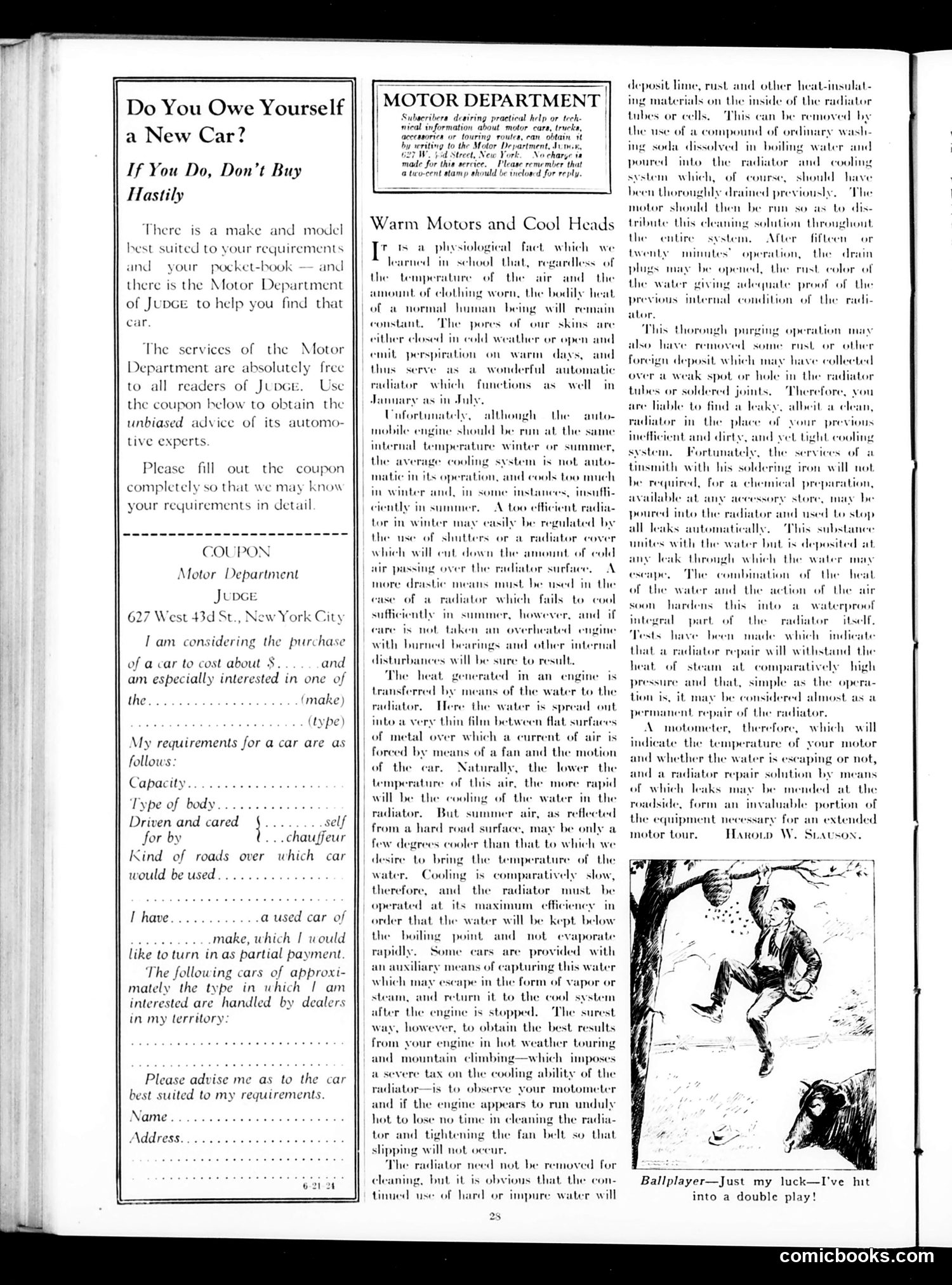
This page combines two elements: a **service advertisement** and a **technical article** about automobile maintenance. The left column promotes Judge magazine's free "Motor Department" advisory service, inviting readers considering a car purchase to fill out a coupon with their requirements. This reflects early 1920s consumer culture—automobiles were still relatively new, and magazines positioned themselves as trusted guides for major purchases. The right column, "Warm Motors and Cool Heads," is a technical explainer about engine cooling systems. It addresses a practical problem: automobile engines need constant internal temperature year-round, but radiator cooling systems perform inconsistently across seasons. The article advises readers on regulating radiator efficiency through shutters and maintenance, and warns against overheating during mountain driving. The cartoon at bottom shows a baseball player mid-play (a "double play" pun), providing light relief from technical content. **Context for modern readers:** This reflects when car ownership required substantial knowledge; magazines served as essential information sources before digital manuals and internet research.
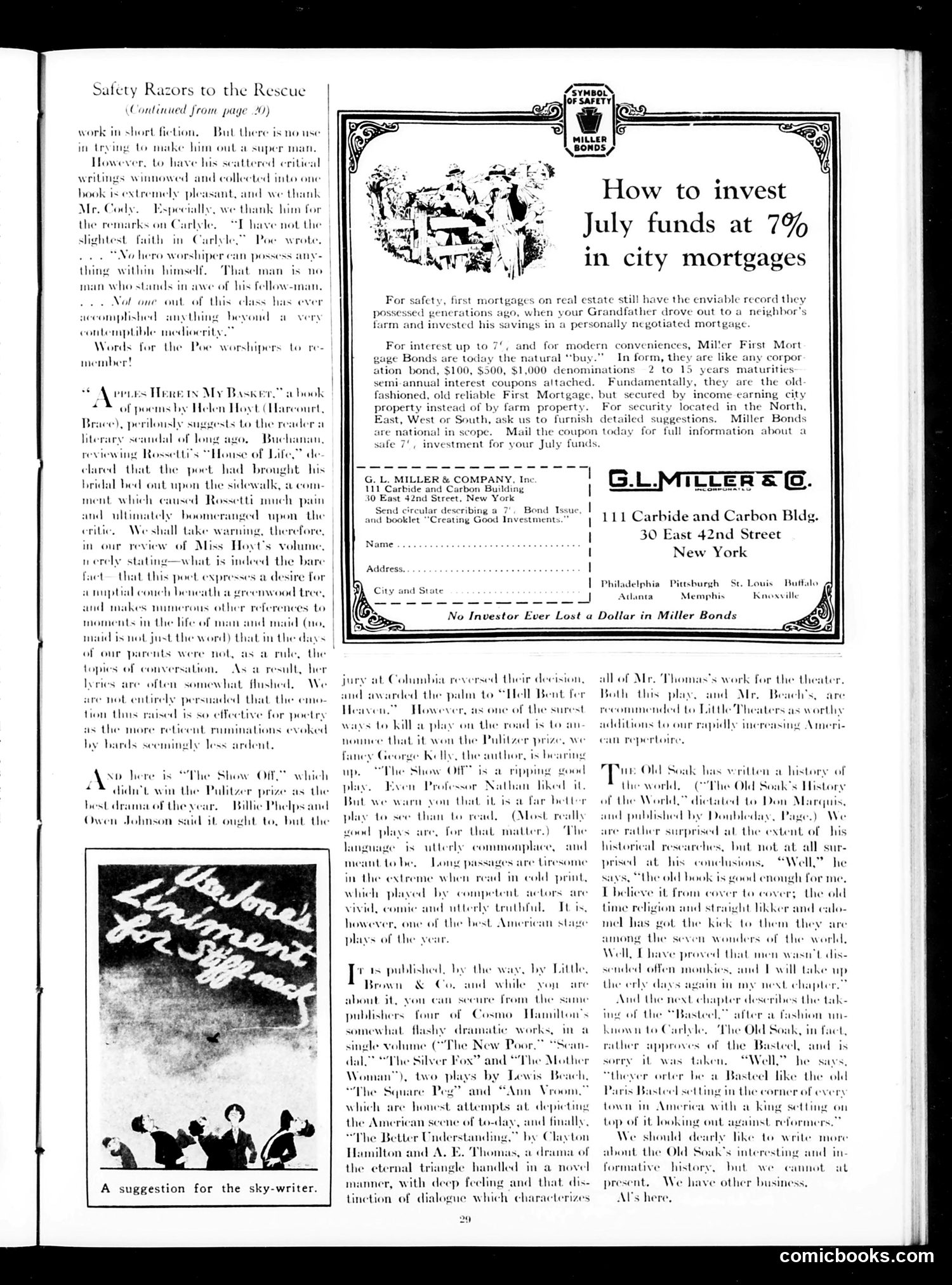
This Judge magazine page contains **primarily advertising and book reviews**, not political satire. The main content is: **The Advertisement (right side):** G.L. Miller & Company promotes investment in city mortgages at 7% interest, emphasizing their historical safety record ("No Investor Ever Lost a Dollar in Miller Bonds"). **The Book Reviews (left side):** The text discusses contemporary literary works, including favorable mention of a play called "The Show Off" by George Kelly, which the reviewer argues deserved the Pulitzer Prize more than Owen Johnson's submission. Reviews also cover poetry collections and dramatic works by various authors. **The Small Cartoon (bottom left):** Shows silhouettes of what appears to be theatrical figures, labeled "A suggestion for the sky-writer"—a light joke about aerial advertising. There is **no significant political cartoon or satire** on this page. The "Safety Razors to the Rescue" headline references a previous article (page 39) and doesn't relate to the current page's content.
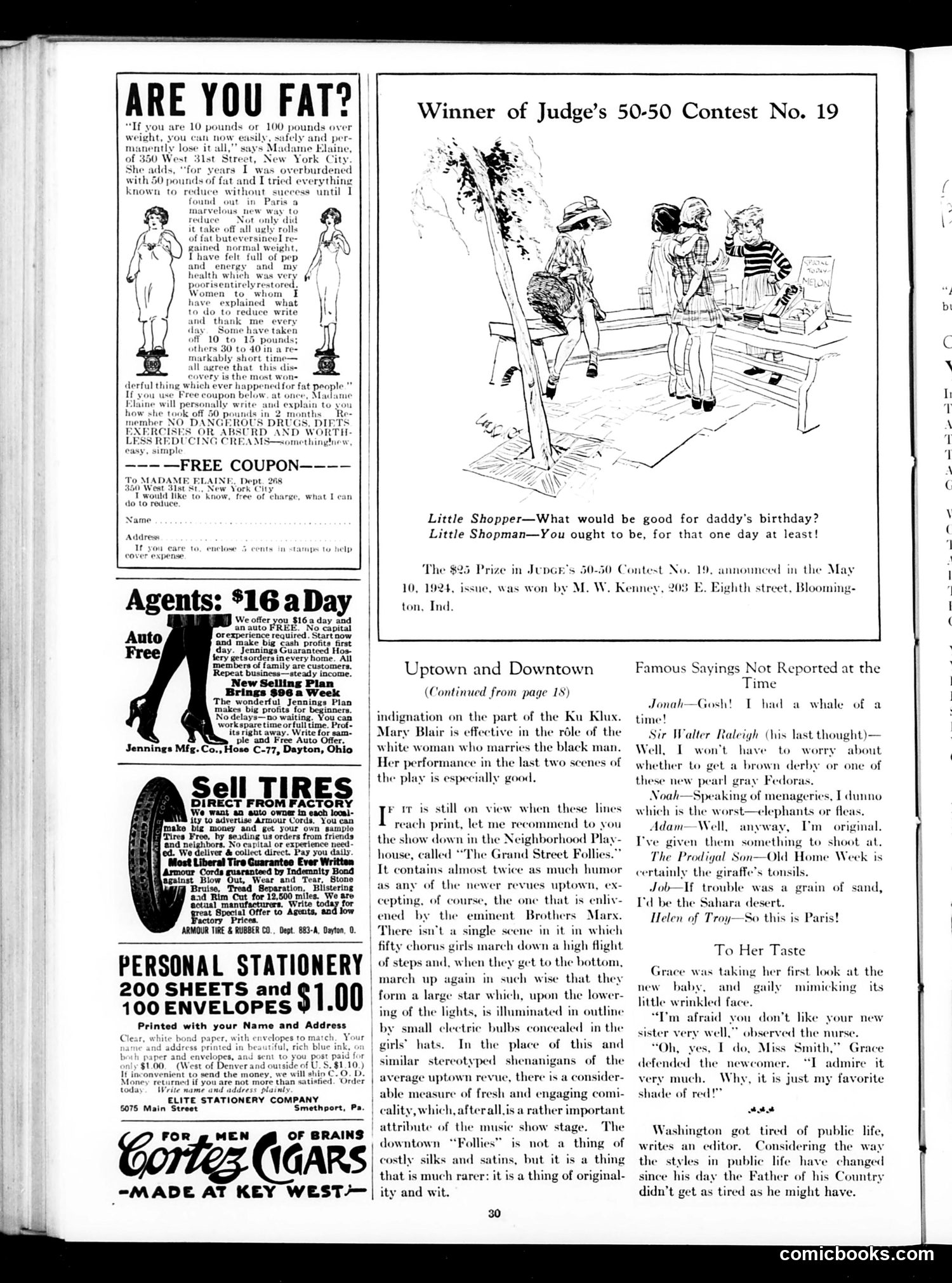
This Judge magazine page (May 10, 1924) mixes advertising with theatrical commentary. The main cartoon shows a beach or poolside scene winning the magazine's "50-50 Contest No. 19"—a humor competition. The joke appears to involve a woman in a bathing suit surrounded by onlookers, with dialogue suggesting social embarrassment or body-related humor ("What would be good for daddy's birthday?" / "You ought to be, for that one day at least!"). The exact satire is somewhat unclear without fuller context. The page is dominated by period advertisements: weight-loss promises from "Madame Elaine," sales pitches for agents earning "$16 a Day," tire sales, and stationery offers—typical hustles targeting Depression-era readers seeking income or self-improvement. The "Uptown and Downtown" theater review discusses recent Broadway shows, including commentary on "The Grand Street Follies" as superior to typical expensive revues—praising wit over elaborate chorus-line spectacle, a common 1920s cultural debate.
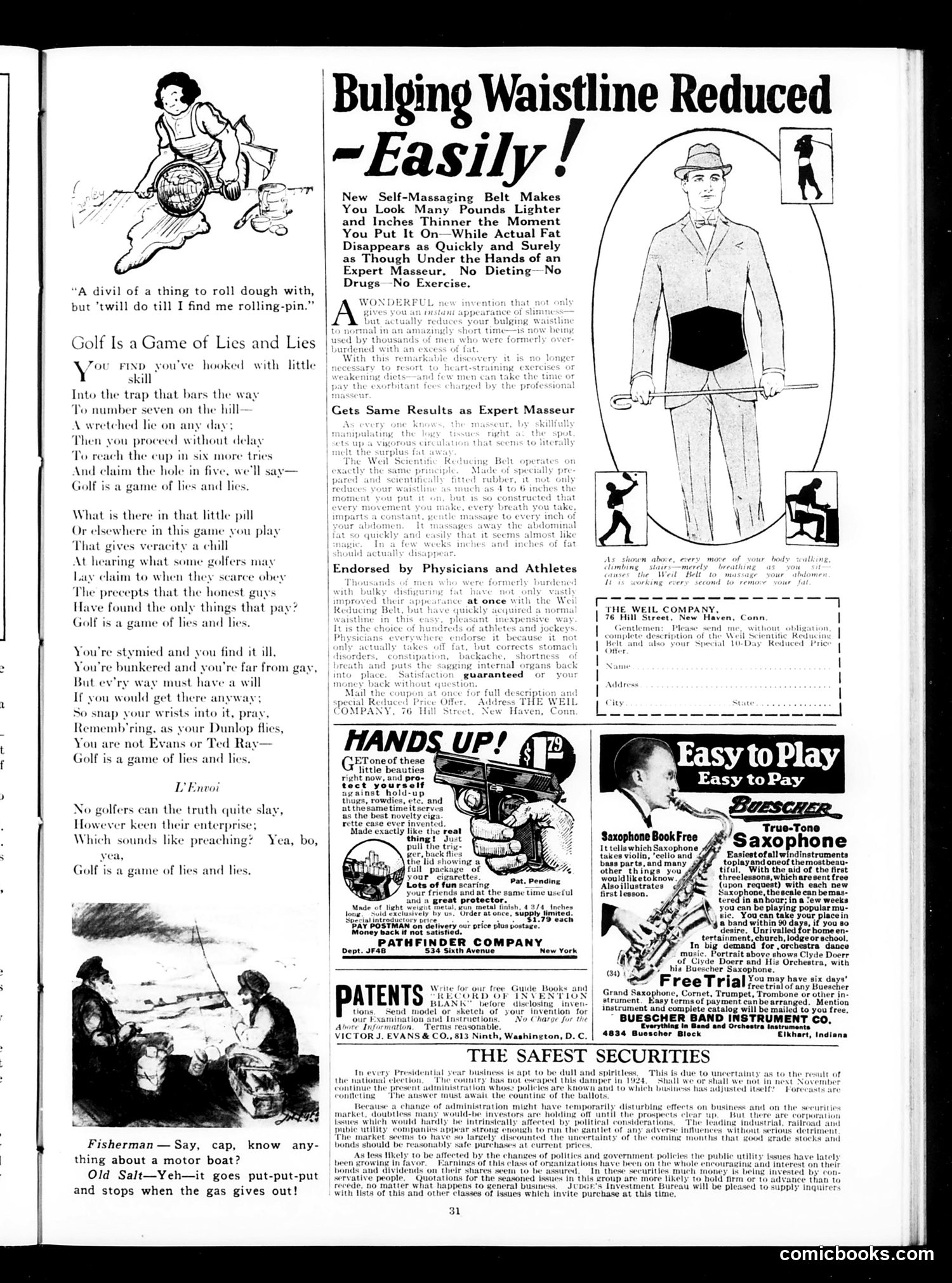
This page primarily contains **advertisements and light humor** rather than political satire. The main content includes: **"Golf Is a Game of Lies and Lies"** — a humorous poem mocking golfers' dishonesty about their scores and abilities. The repeated refrain suggests golfers routinely misrepresent their performance, fabricate excuses, and exaggerate their skill. **"Bulging Waistline Reduced—Easily!"** — a prominent ad for a self-massaging belt claiming to reduce weight without diet or exercise, endorsed by physicians and athletes (a dubious claim typical of 1920s patent medicine advertising). **Additional ads** for a saxophone, patents, pathfinder company, and investment securities occupy the lower portion. **"Old Salt" joke** at bottom: A fisherman asks a sailor about motor boats; the sailor jokes that a motor boat "goes put-put-put and stops when the gas gives out"—simple mechanical humor. The page reflects typical Judge content: satirizing everyday social behaviors (golf culture's dishonesty) alongside the pseudo-scientific health products and mail-order schemes common in that era.
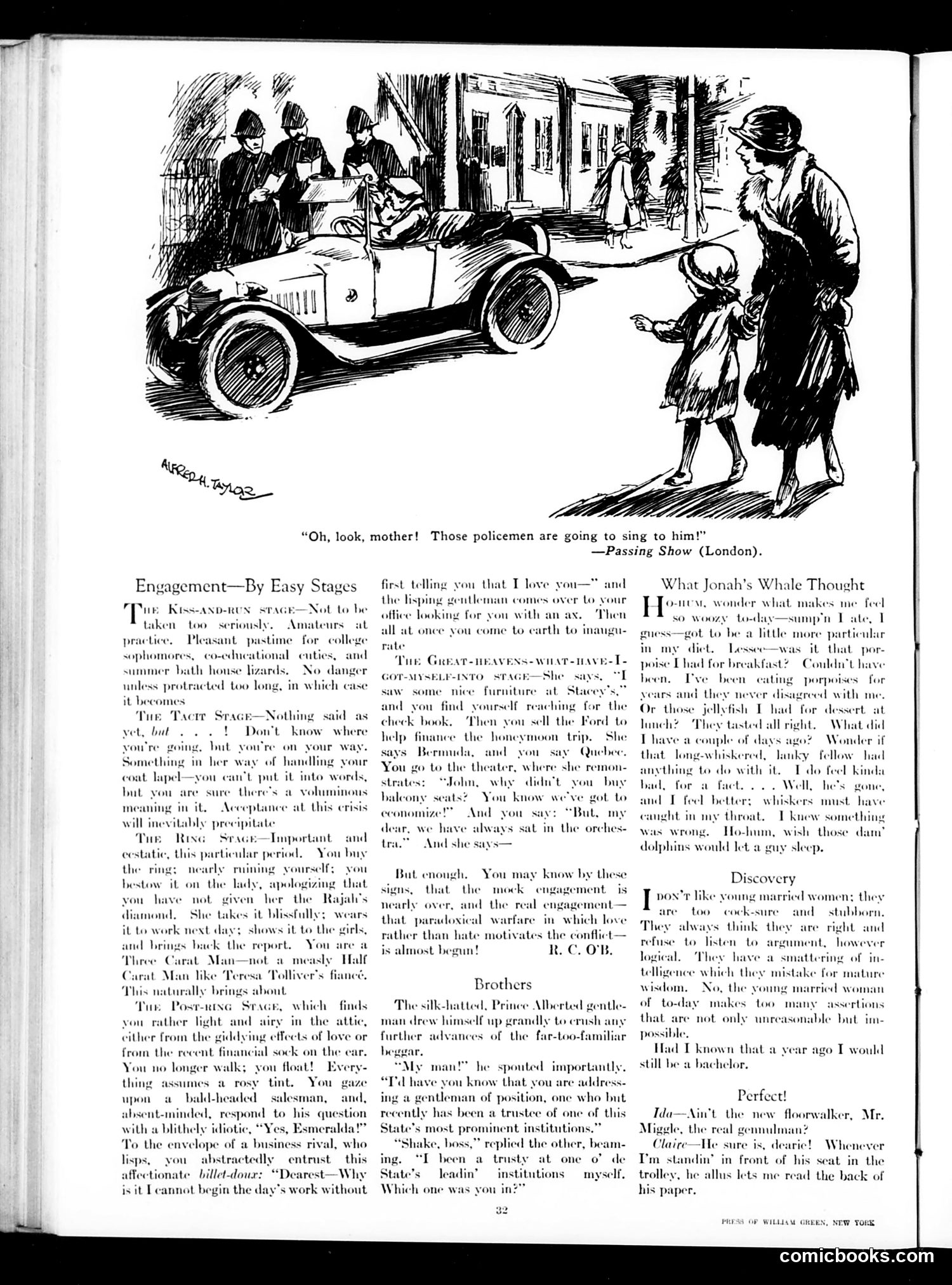
This page from *Judge* magazine contains three distinct humor pieces satirizing early 20th-century courtship and social customs. **The top cartoon** mocks automobile culture and police attention. The caption quotes a child saying policemen will "sing to" the car's occupants—likely referring to sirens or traffic enforcement, satirizing both the novelty of automobiles and public concern about them. **"Engagement—By Easy Stages"** is the main article, which humorously catalogs the stages of courtship from first kiss through post-engagement, describing the psychological and financial toll on young men. It satirizes the conventional engagement process, particularly mocking the financial burden (buying expensive rings, financing honeymoons) and the shift from romantic euphoria to domestic reality. **"Brothers"** depicts class satire: a wealthy gentleman attempts to snub a working-class man by emphasizing his family's institutional prominence, only to learn the man is an inmate at a state prison—reversing the power dynamic through humor. The remaining pieces continue this vein of social satire about marriage, gender relations, and class distinctions typical of early 20th-century American humor magazines.
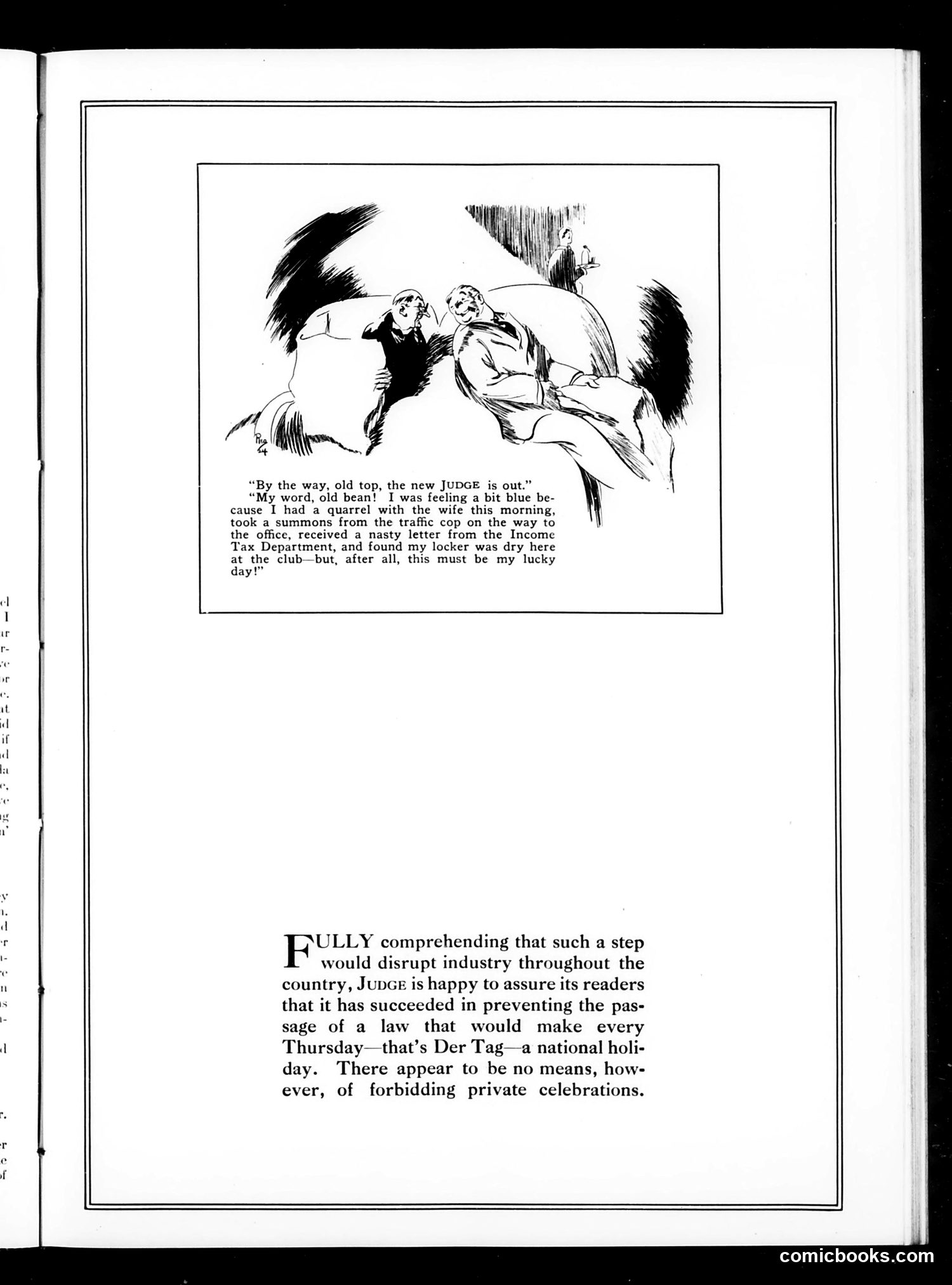
The cartoon satirizes the misfortunes of an upper-class man ("old top," "old bean") who catalogs his terrible day: domestic quarrel, traffic summons, tax department letter, and an empty locker at his club. The joke is his absurd conclusion that receiving the new *Judge* magazine somehow makes it his "lucky day"—hyperbolically endorsing the publication's value. The accompanying text boasts that *Judge* magazine successfully prevented legislation making every Thursday a national holiday called "Der Tag" (German for "The Day"). The satire mocks both the magazine's self-importance and likely references labor movement efforts seeking additional holidays. *Judge* congratulates itself for blocking this disruption to industry while smugly noting private celebrations remain permitted—a backhanded acknowledgment of the proposal's appeal despite its defeat.
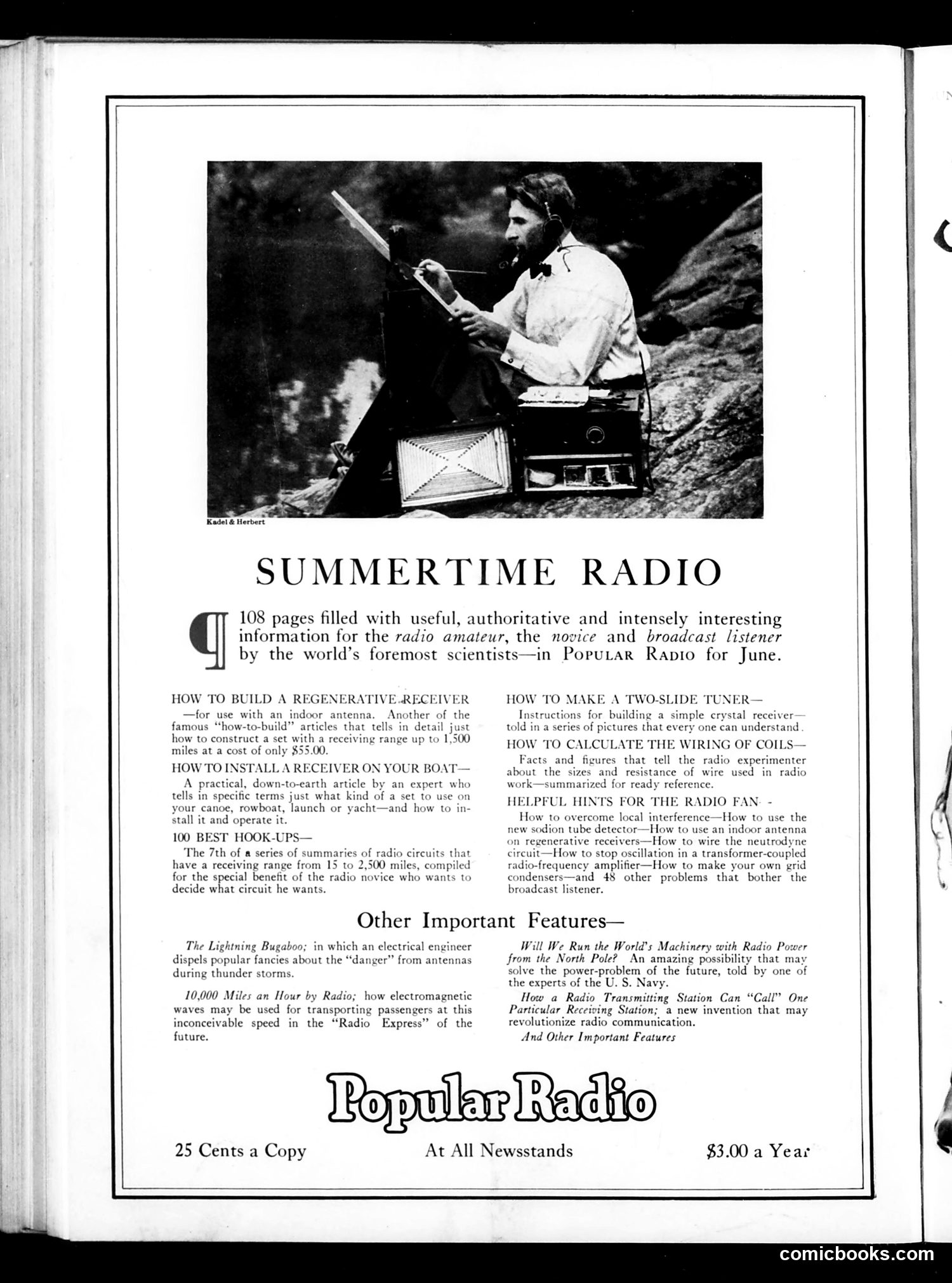
This is primarily a **full-page advertisement**, not a political cartoon. It promotes the June issue of *Popular Radio* magazine, featuring a photograph (credited to Kadel & Herbert) of a man operating early radio equipment outdoors. The content reflects the **early 1920s radio boom**, when amateur radio was a growing hobbyist interest. The advertisement emphasizes practical DIY instruction for building crystal receivers and regenerative receivers—technologies that were novel and exciting to average consumers. Notable details include: - Instructions for installing receivers on boats (reflecting leisure-class interests) - Articles about transmitting at "10,000 Miles an Hour" and powering machinery from the North Pole—speculative futurism typical of the era - The affordable price ($25 cents/copy) and accessibility focus ("radio amateur," "novice") This represents the **popularization of radio technology** during the interwar period, when magazines like *Popular Radio* helped democratize what had been largely a military/technical domain.