
Judge, 1924-06-21 · page 30 of 36
Judge — June 21, 1924 — page 30: what you’re looking at
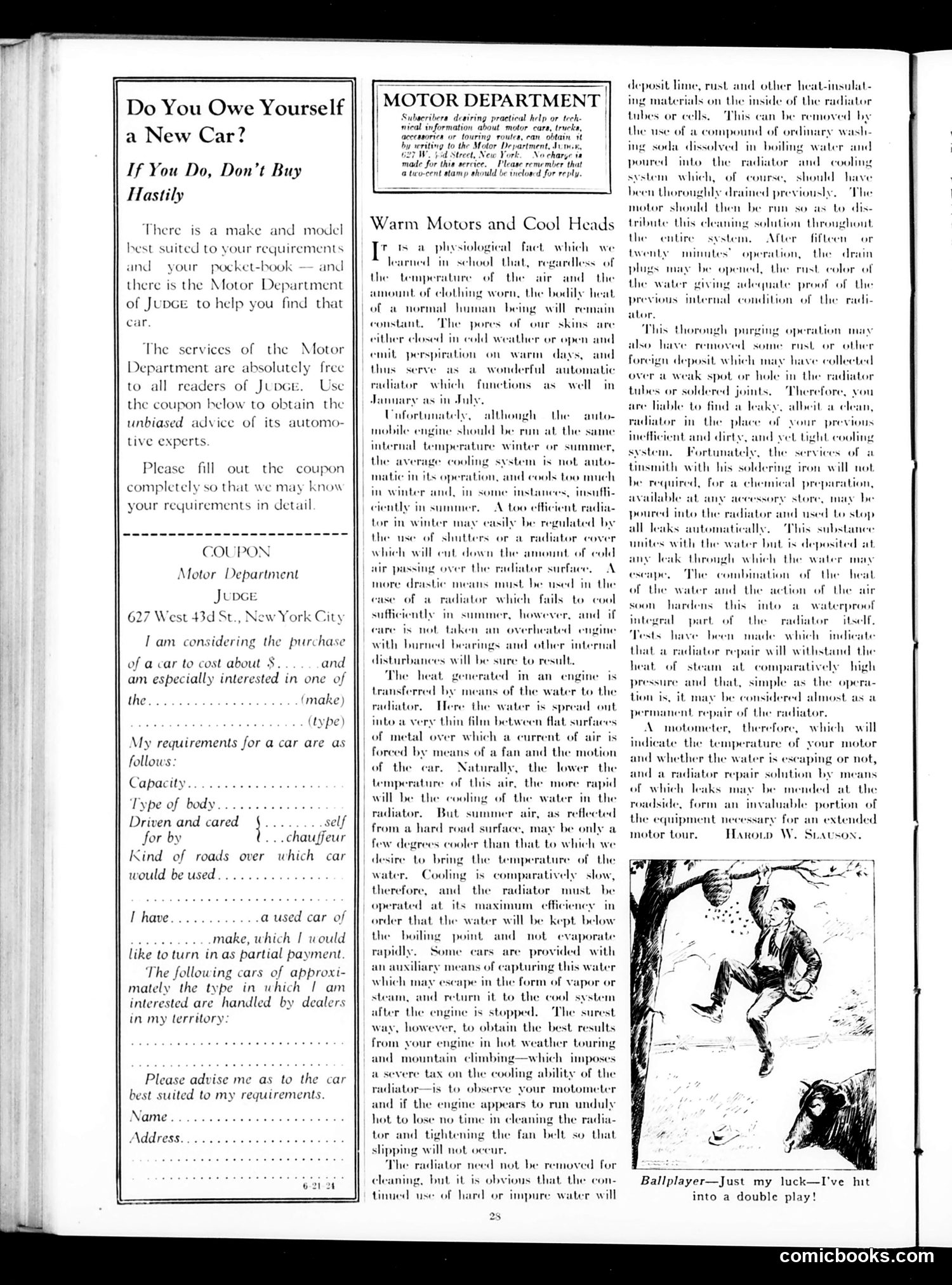
What you’re looking at
This page combines two elements: a **service advertisement** and a **technical article** about automobile maintenance. The left column promotes Judge magazine's free "Motor Department" advisory service, inviting readers considering a car purchase to fill out a coupon with their requirements. This reflects early 1920s consumer culture—automobiles were still relatively new, and magazines positioned themselves as trusted guides for major purchases. The right column, "Warm Motors and Cool Heads," is a technical explainer about engine cooling systems. It addresses a practical problem: automobile engines need constant internal temperature year-round, but radiator cooling systems perform inconsistently across seasons. The article advises readers on regulating radiator efficiency through shutters and maintenance, and warns against overheating during mountain driving. The cartoon at bottom shows a baseball player mid-play (a "double play" pun), providing light relief from technical content. **Context for modern readers:** This reflects when car ownership required substantial knowledge; magazines served as essential information sources before digital manuals and internet research.
📄 Transcribed text from this page (OCR, searchable)
Machine-transcribed from the original scan — historical spelling and the odd misread are preserved.
Do You Owe Yourself a New Car? If You Do, Don’t Buy Hastily Chere is a make and model best. suited to your requirements and your pocket-book — and there is the Motor Department of Jupce to help you find that car The services of the Motor Department are absolutely free to all readers of Juoce. Use the coupon below to obtain the unbiased advice of its automo- tive experts. Please fill out the coupon completely so that we may know your requirements in detail COUPON Motor Department JUDGE 627 West 43d St., New York City T am considering the purchase of a car to cost about 8. and am especially interested in one of RB s.c0c008 bse (make) cosets (type) My requirements for a car are as follows: Capacity . Type of body. Driven and cared } : for by ...chauffeu Kind of roads over which car would be used T have.... .....@used car of wears make, which | would like to turn inas partial payment The following cars of approxi- mately the type in which | am interested are handled by dealers in my territory best suited to my requirements. Name \ddress. MOTOR DEPARTMENT | Subscribera desiring practical help or tech- nical information about motor cara, orick or touring routes, can ol ting to the Motor Department, f New York. No chary made for thie sercice. 1 remember that a two-cent stamp ahold be inclosed for reply. Warm Motors and Cool Heads [7 # physiological fact whieh we red in school that, ardless of the temperature of the air and the amount of clothing worn, the bodily heat of a normal human being will) remain constant. The pores of our skins are either closed in cold y ather or open and emit perspiration on warm days, and thus serve as a wonderful automatic ator which functions as well in January as in July. Unfortunately, althongh the autos mobile engine should be run ab the same internal temperature winter or summer, the matic in its operation, and cools too much erage cooling system is not aute in winter and, in some instar insufli- vt radia ulated by ciently in summer. A too effici tor in winter may easily be re the use of shutters or a radiator cover which will cut down the amount of « or surface, A air passing over the radi more drastic means must be used in the tils to cool ver, and if ease of a radiator which sufficiently in summer, how care is not taken an overh 1 engine r internal with burned bearings and oth disturbances will be sure to result. The heat ge rated in an engine is transferred by means of the water to the Hore the water is spread out thin film between flat sur of metal over which a current of air is forced by means of a fan and the motion of the car. Naturally, the lower the temperature of this air, the more rapid will be the cooling of the water in’ the radiator. But summer a a hard road surface, may be only a grees cooler than that to whieh we desire to bring the temperature of the water. Cooling is com ely slow, therefore, and the radiator must be operated at its maximum. cfficieney in r that the water will be kept below ore the boiling point and) not evaporate rapidly, Some cars are provided with an auxiliary means of capturing this water which may escape in the form of v or or id return it to the cool system steam, after the engine is stopped. The surest way, however, to obtain the best results from your engine in hot weather touring and mountain climbing—which imposes a severe tax on the cooling ability of the radiator—is to observe your motometer and if the engine appears to run unduly hot to lose no time in cleaning the radia- tor and tightening the fan belt so that slipping will not occur. The radiator need not be removed for Dut it is obvious that th er will deposit lime, rust and other heat-insulat- ing materials on the inside of the radiator tubes or cells. ‘This can be removed hy the use of a compound of ordinary: wash- ing soda dissolved in boiling water and poured into the rad tor and cooling system which, of course, should have heen thoroughly drained previously. ‘The motor should then be run so tribute this eh ining solution throughout the entire system. After fifteen or twenty minutes’ operation, the drain of the water giving adequate proof of the plugs may be opened, the rust previous internal condition of the radi- ator, This thorough purging operation miry also have removed some rust or ot foreign deposit which may have collected over a weak spot or hole in the radi tubes or soldered joints. Therefore sTiable to find a leaky, albeit iator in the place of your previous ient and dirty, and vel. tig system. Fortunately, the tinsmith with his solderin tor ineflic cooling vices of a iron will not be required, for a chemical preparation, Ito stop available at any poured into the all leaks auton unites with the wate: any leak through w essory stor tor and us Hy. ‘This substance Dut is deposited at ich the water may jon of the tion of the air apes The combi of the water and th soon hardens this into a waterproof integral part of the radiator itself. Tests 1 that tor repair will withstand the heat of steam al comy pressure and that, simpk de which indicate vom ud atively high s the opera- tion is, it may be consic almost as a permanent repair of the radiator. A motometer, therefore, whieh will indicate the temperature of your motor and whether the water is escaping or not, and a radiator repair solution by means of which ks may be mended at’ the rman invaluable portion of the equipment necessary for an extended motor tour. TIanoip W. roadside, LAUSON. cy / Ballplayer—Just_ my luck—I've hit into a double play! comicbooks.com