
Judge, 1924-06-21 · page 36 of 36
Judge — June 21, 1924 — page 36: what you’re looking at
What you’re looking at
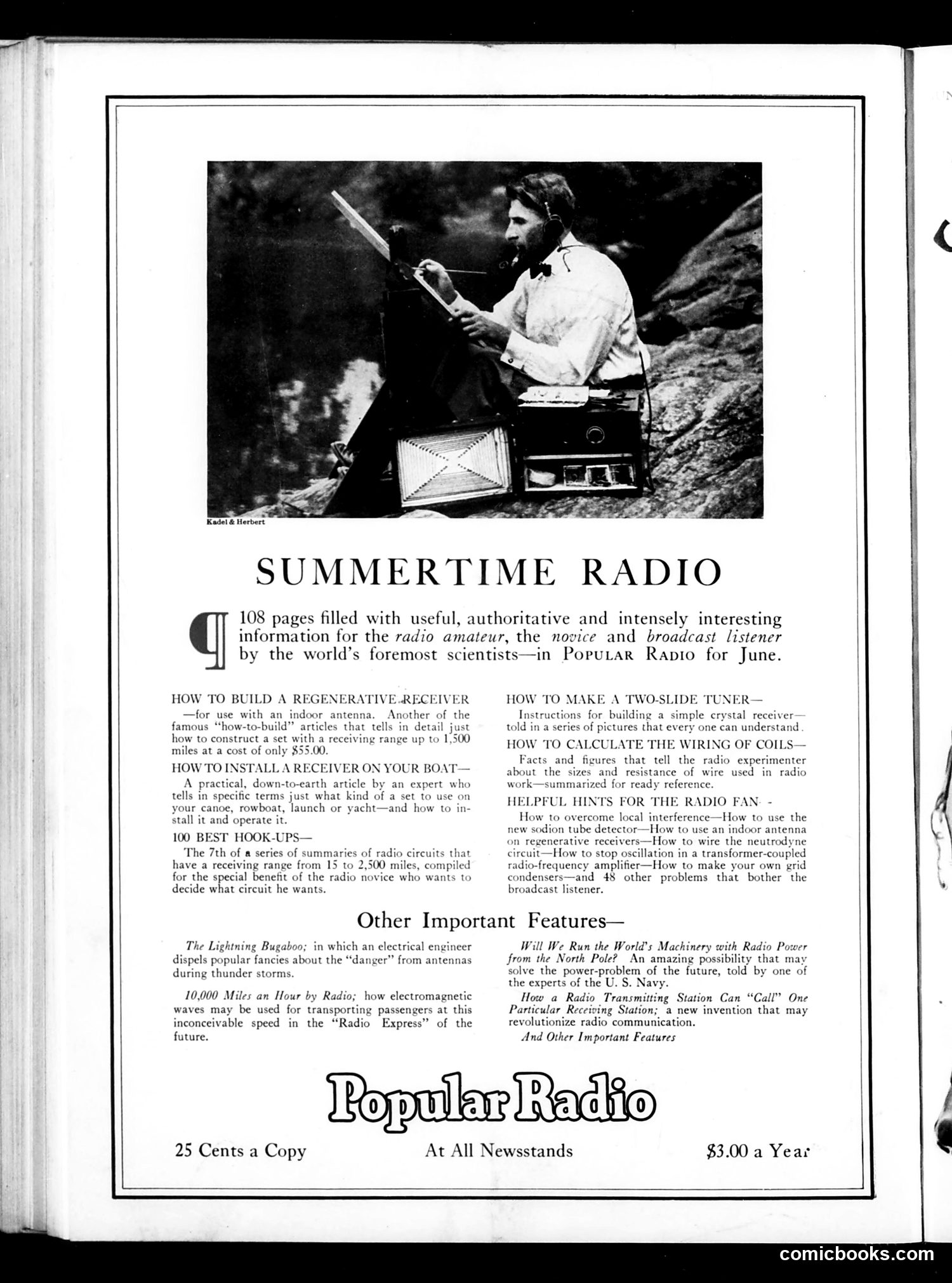
This is primarily a **full-page advertisement**, not a political cartoon. It promotes the June issue of *Popular Radio* magazine, featuring a photograph (credited to Kadel & Herbert) of a man operating early radio equipment outdoors. The content reflects the **early 1920s radio boom**, when amateur radio was a growing hobbyist interest. The advertisement emphasizes practical DIY instruction for building crystal receivers and regenerative receivers—technologies that were novel and exciting to average consumers. Notable details include: - Instructions for installing receivers on boats (reflecting leisure-class interests) - Articles about transmitting at "10,000 Miles an Hour" and powering machinery from the North Pole—speculative futurism typical of the era - The affordable price ($25 cents/copy) and accessibility focus ("radio amateur," "novice") This represents the **popularization of radio technology** during the interwar period, when magazines like *Popular Radio* helped democratize what had been largely a military/technical domain.
📄 Transcribed text from this page (OCR, searchable)
Machine-transcribed from the original scan — historical spelling and the odd misread are preserved.
Kadel & Herbert SUMMERTIME RADIO 108 pages filled with useful, authoritative and intensely interesting information for the radio amateur, the novice and broadcast listener by the world’s foremost scientists—in Poputar Rapio for June. HOW TO BUILD A REGENERATIVE.RECEIVER —for use with an indoor antenna. Another of the famous “how-to-build” articles that tells in detail j how to construct a set with a receiving range up to 1 miles at a cost of only $55.00. HOW TO INSTALL A RECEIVER ON YOUR BOAT— A practical, down-to-earth article by an expert who tells in specific terms just what kind of a set to use on your canoe, rowboat, launch or yacht—and how to in- stall it and operate it. 100 BEST HOOK-UPS— The 7th of a series of summaries of radio circuits that have a receiving range from 15 to 2,500 miles, compiled for the special benefit of the radio novice who wants to decide what circuit he wants. HOW TO MAKE A TWO-SLIDE TUNER— Instructions for building a simple crystal receiver told in a series of pictures that every one can understand HOW TO CALCULATE THE WIRING OF COILS— Facts and figures that tell the radio experimenter about the sizes and resistance of wire used in radio work—summarized for ready reference. HELPFUL HINTS FOR THE RADIO FAN. - How to overcome local interference—How to use the new sodion tube detector—How to use an indoor antenna on regenerative receivers—How to wire the neutrodyne circuit—How to stop oscillation in a transformer-coupled radio-frequency amplifier—How to make your own grid condensers—and 48 other problems that bother the broadcast listener. Other Important Features— The Lightning Bugaboo; in which an electrical engineer dispels popular fancies about the “danger” from antennas during thunder storms. 10,000 Miles an Hour by Radio; how electromagnetic waves may be used for transporting passengers at this inconceivable speed in the “Radio Express” of the future. Will We Run the World's Machinery with Radio Pot from the North Pole? An amazing possibility that m solve the power-problem of the future, told by one of the experts of the U.S. Na How a Radio Transmitting Station Can “Call” One Particular Receiving Station; a new invention that may revolutionize radio communication. And Other Important Features 25 Cents a Copy At All Newsstands $3.00 a Year comicbooks.com