
A complete issue · 36 pages · 1924
Judge — May 31, 1924
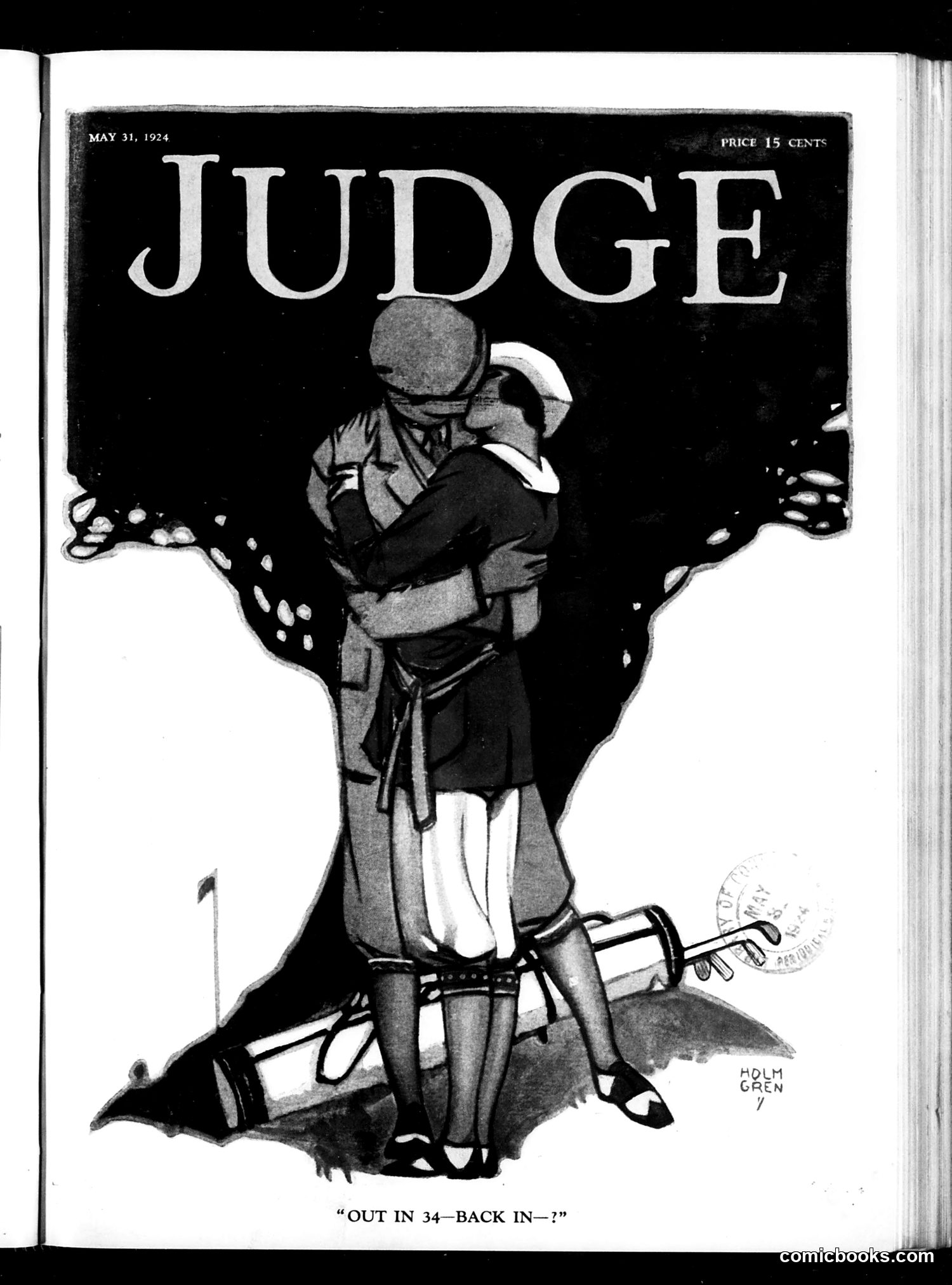
This cover depicts a golfer holding a baby while standing on a large golf club. The caption reads "OUT IN 34—BACK IN—?" The satire appears to reference the tension between leisure pursuits and family responsibilities—a common Judge magazine theme of the era. The golfer's focus on his golf score (34 strokes) contrasts with his awkward burden of carrying an infant, suggesting the difficulty of balancing recreational interests with parental duties. The question mark in "BACK IN—?" leaves his return time ambiguous, humorously implying he might prioritize his game over getting home to care for the child. This reflects 1920s anxieties about modern leisure culture and shifting gender roles regarding paternal responsibility. The illustration is signed by Holm Greenberg.
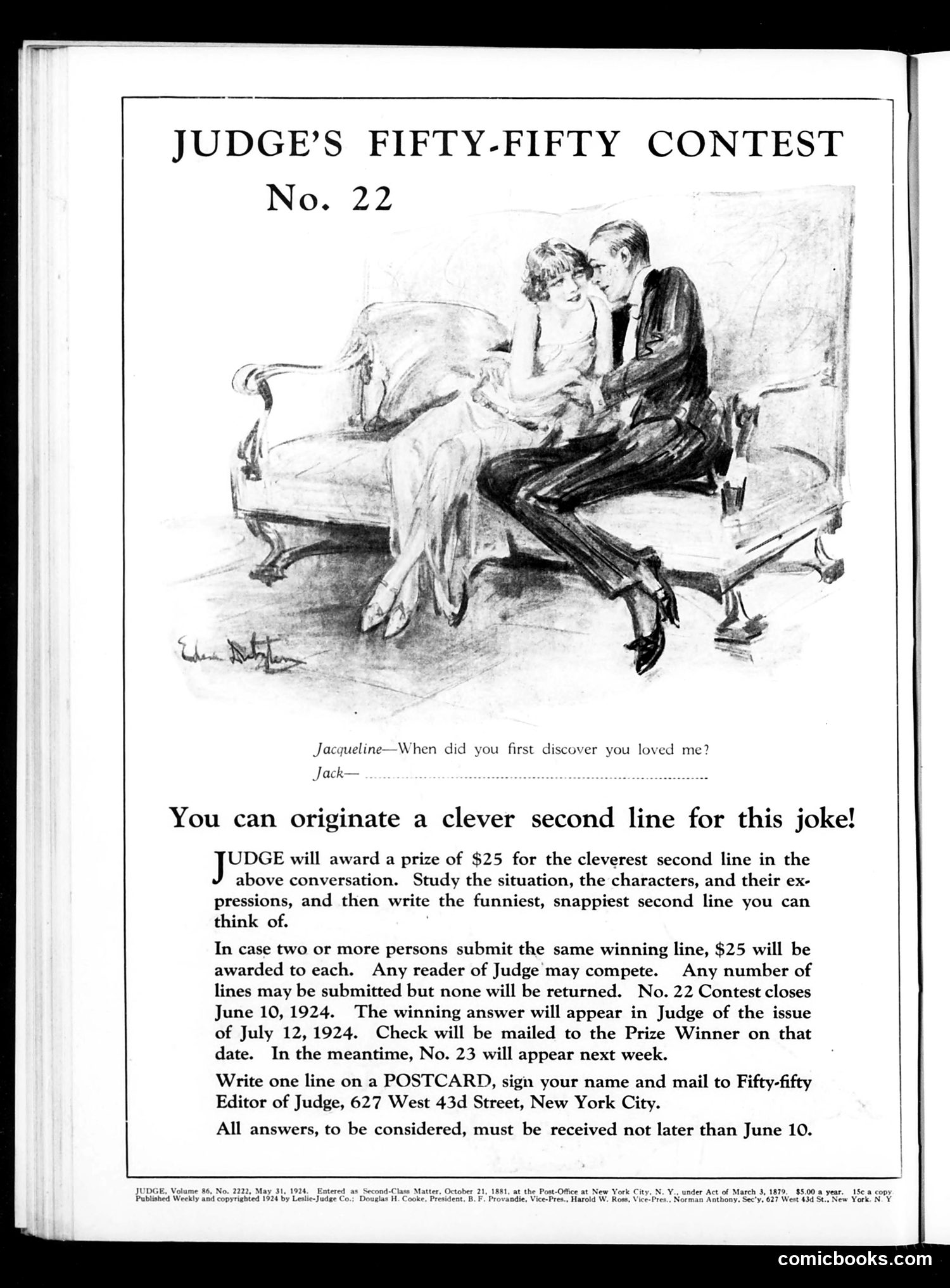
This page features a "Fifty-Fifty Contest" soliciting reader submissions for a joke's punchline. The illustration shows a man and woman in an intimate moment on a couch; the woman asks "When did you first discover you loved me?" The man's response is blank, inviting readers to submit clever answers. The contest offered a $25 prize for the wittiest second line, with entries due by June 10, 1924. This reflects Judge's format as a humor magazine that engaged readers as collaborators in comedy-writing. The illustration style and domestic scenario are typical of 1920s romantic humor—likely playing on expectations of sentimentality or revealing comedic misunderstandings between courting couples. The contest itself was a common feature of Judge magazine during this era.
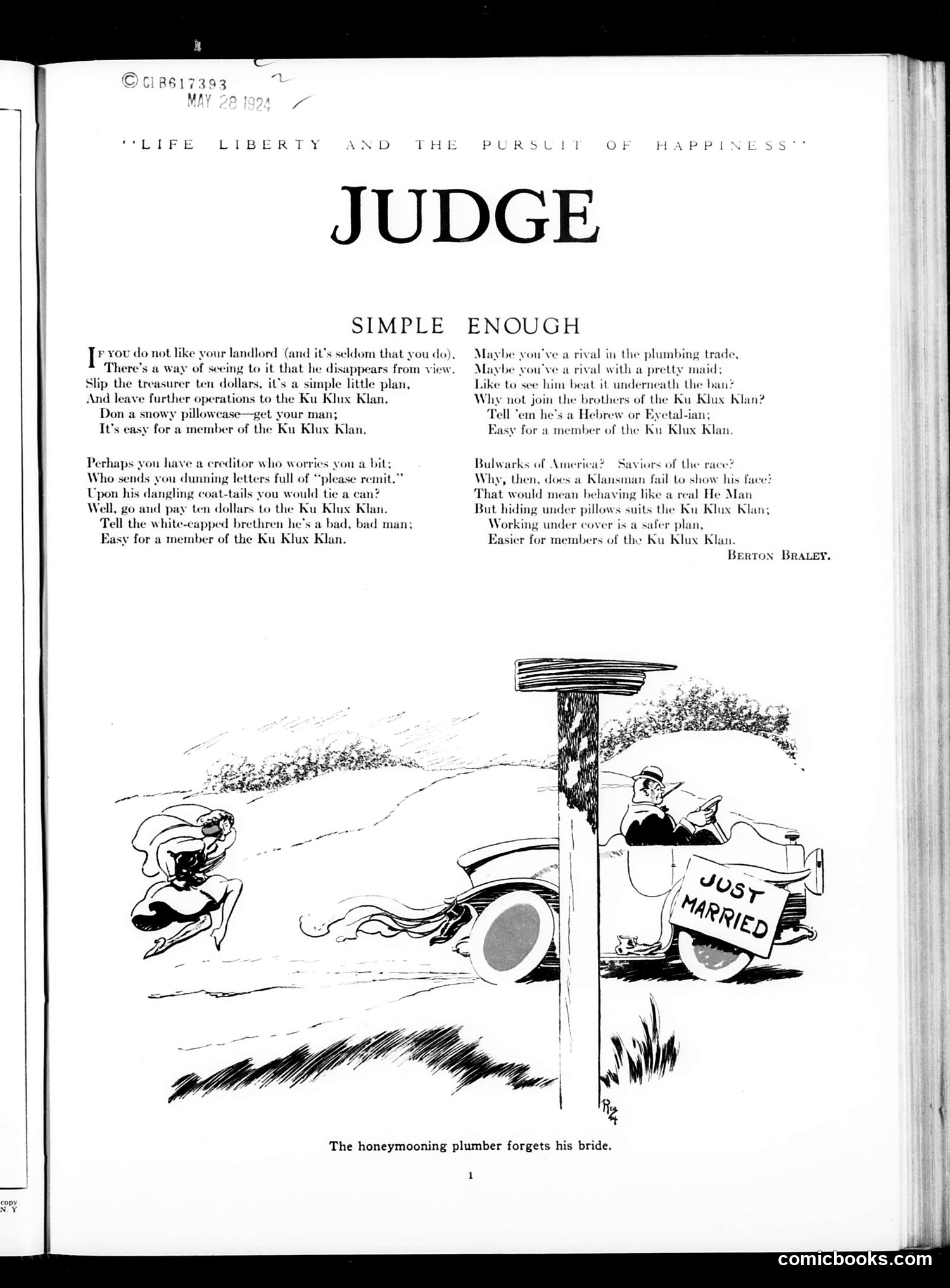
This page contains a poem by Bertton Braley titled "Simple Enough," which satirizes the Ku Klux Klan by proposing its "solutions" to various social problems—landlord disputes, creditors, business rivals, and racial tensions. The poem ironically presents KKK membership as an easy answer to everyday grievances. The cartoon below depicts a newlywed couple in a car labeled "Just Married." The caption reads "The honeymooning plumber forgets his bride," showing the groom distracted and driving away while his bride is left behind. This illustrates the poem's earlier reference to a plumber with a rival, suggesting the KKK's violent solutions take priority over personal relationships and normal life. The satire criticizes the Klan's appeal to working-class men and its destructive impact.
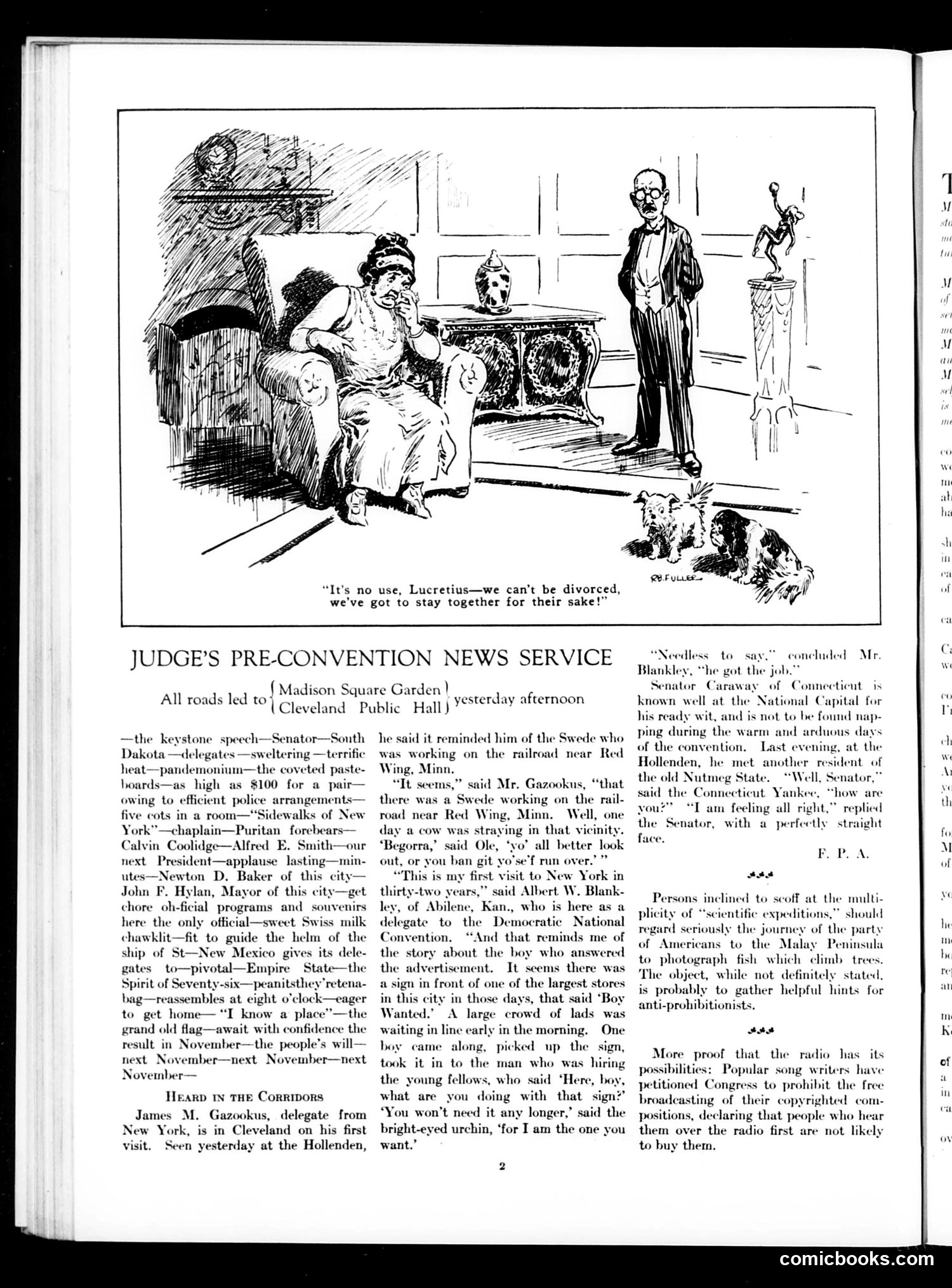
The main cartoon depicts a domestic dispute. A woman sits in an armchair while a man stands nearby; the caption reads: "It's no use, Lucretius—we can't be divorced, we've got to stay together for their sake!" A dog lies in the foreground, apparently the "their" referenced—the couple must remain married for the pet's welfare, a satirical reversal of the common excuse "staying together for the children." The surrounding text reports on Democratic National Convention news from various cities, mentioning delegates, speeches, and political gossip. This appears to be part of Judge's "Pre-Convention News Service," mixing political reporting with humorous commentary typical of the magazine's satirical approach to contemporary events. The cartoon's joke mocks the rationalization people use to justify unhappy marriages.
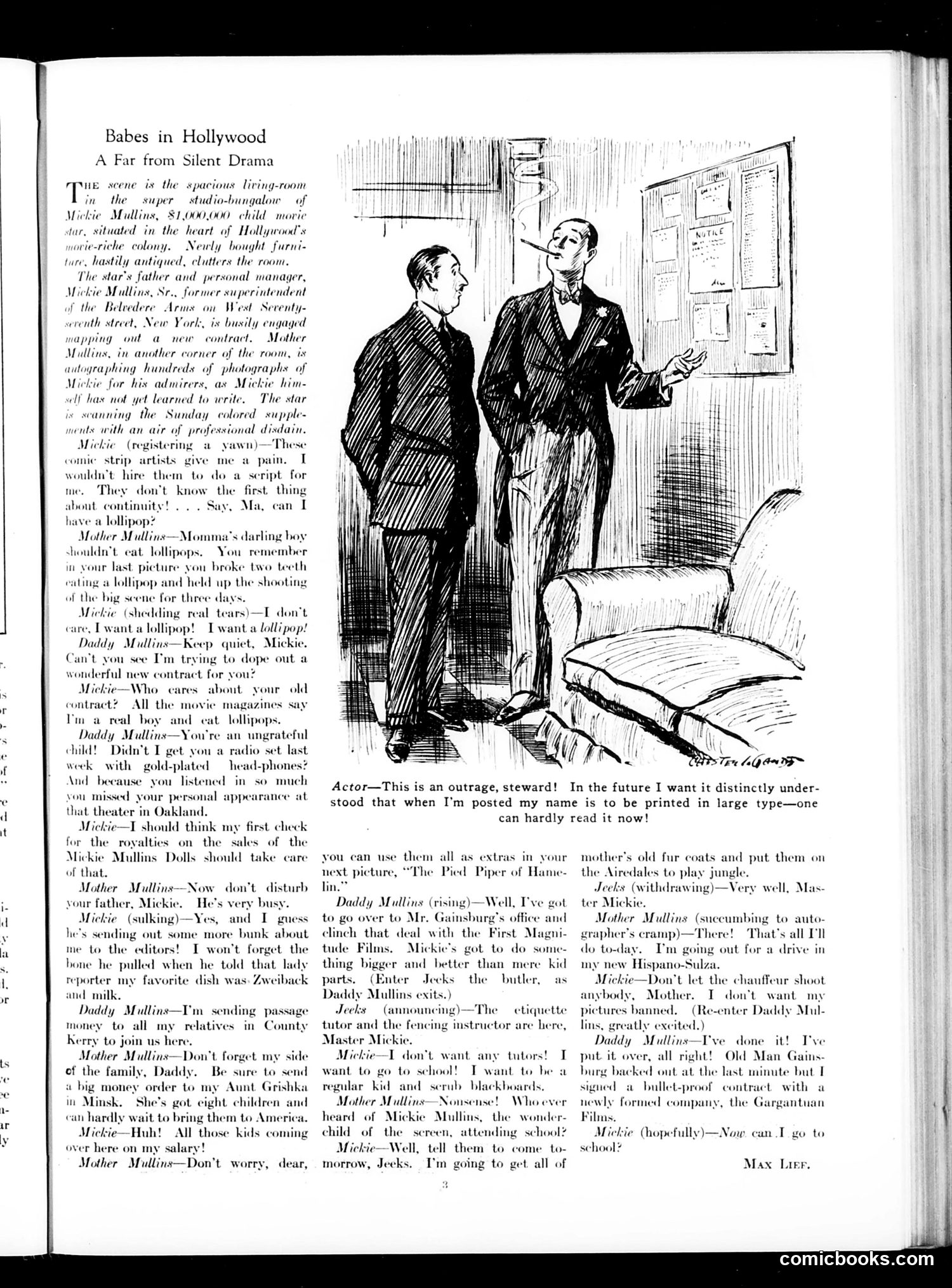
This satirical piece mocks the film industry's casual attitude toward contracts and professional standards. The cartoon depicts two men examining papers on a wall—likely a studio office scene where contracts are being negotiated or displayed. The dialogue ridicules Hollywood producers' unprofessionalism: they hire "comic strip artists" without proper agreements, break teeth eating lollipops during shoots, and make absurd promises to child actors. The satire targets the industry's chaotic management, loose ethics, and tendency to exploit performers—particularly children—through hastily made deals and broken commitments. The piece suggests early Hollywood operated with minimal legal structure or genuine professionalism, treating talent as disposable commodities rather than skilled workers deserving proper contracts and respect.
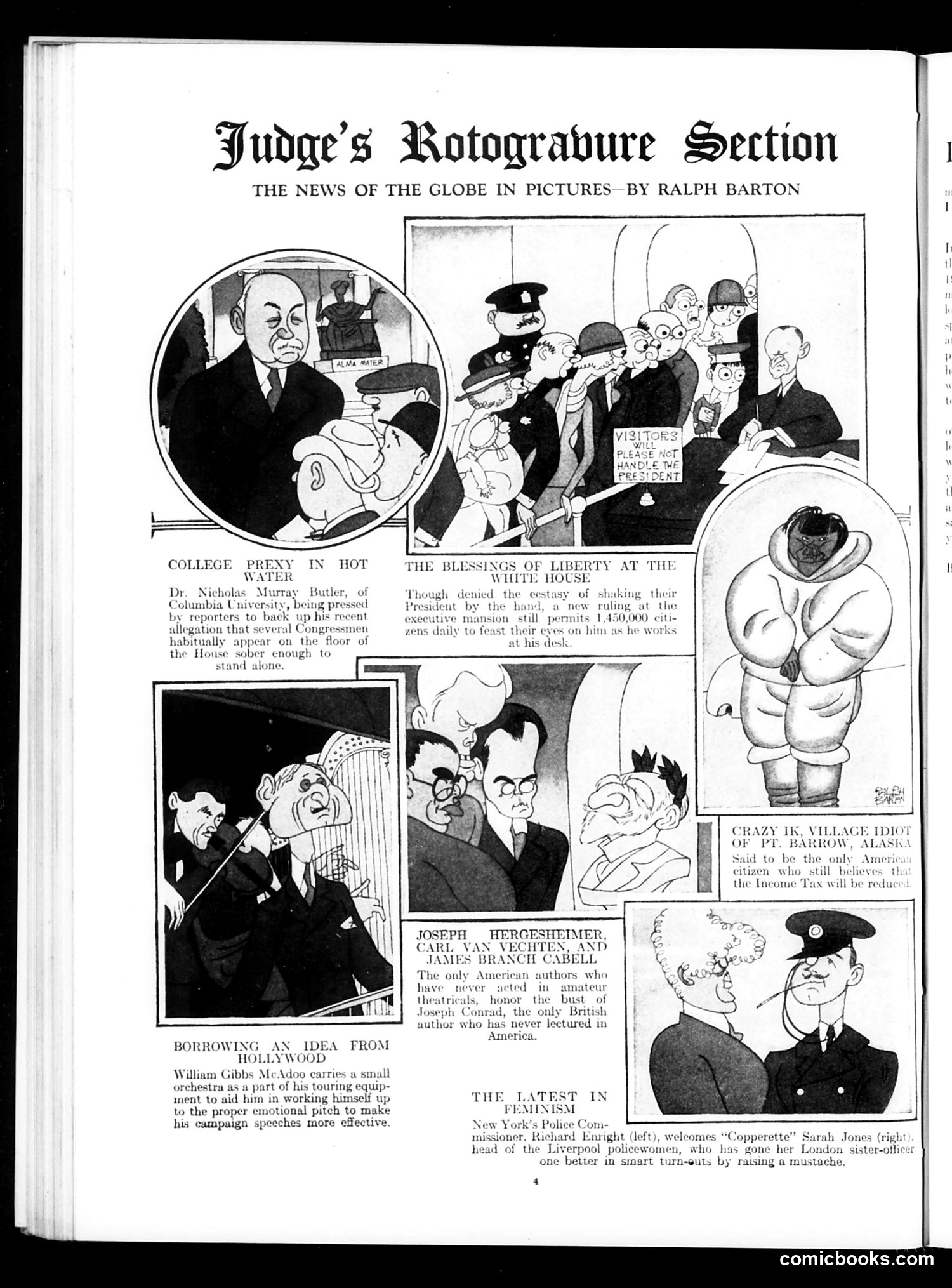
This page contains four satirical cartoons by Ralph Barton commenting on contemporary news and figures: 1. **"College Prexy in Hot Water"**: Dr. Nicholas Murray Butler of Columbia University allegedly told reporters he was sober enough to stand alone—political humor about a university president's credibility. 2. **"The Blessings of Liberty at the White House"**: Depicts visitors crowding to view the President at his desk, satirizing public access to the executive mansion. 3. **"Borrowing an Idea from Hollywood"**: William Gibbs McAdoo carries an orchestra as campaign equipment, mocking theatrical campaign tactics. 4. **"The Latest in Feminism"**: A New York Police Commissioner welcomes a Liverpool policewoman with a raised mustache—satirizing changing gender roles in law enforcement. The cartoons reflect 1920s American social and political anxieties.
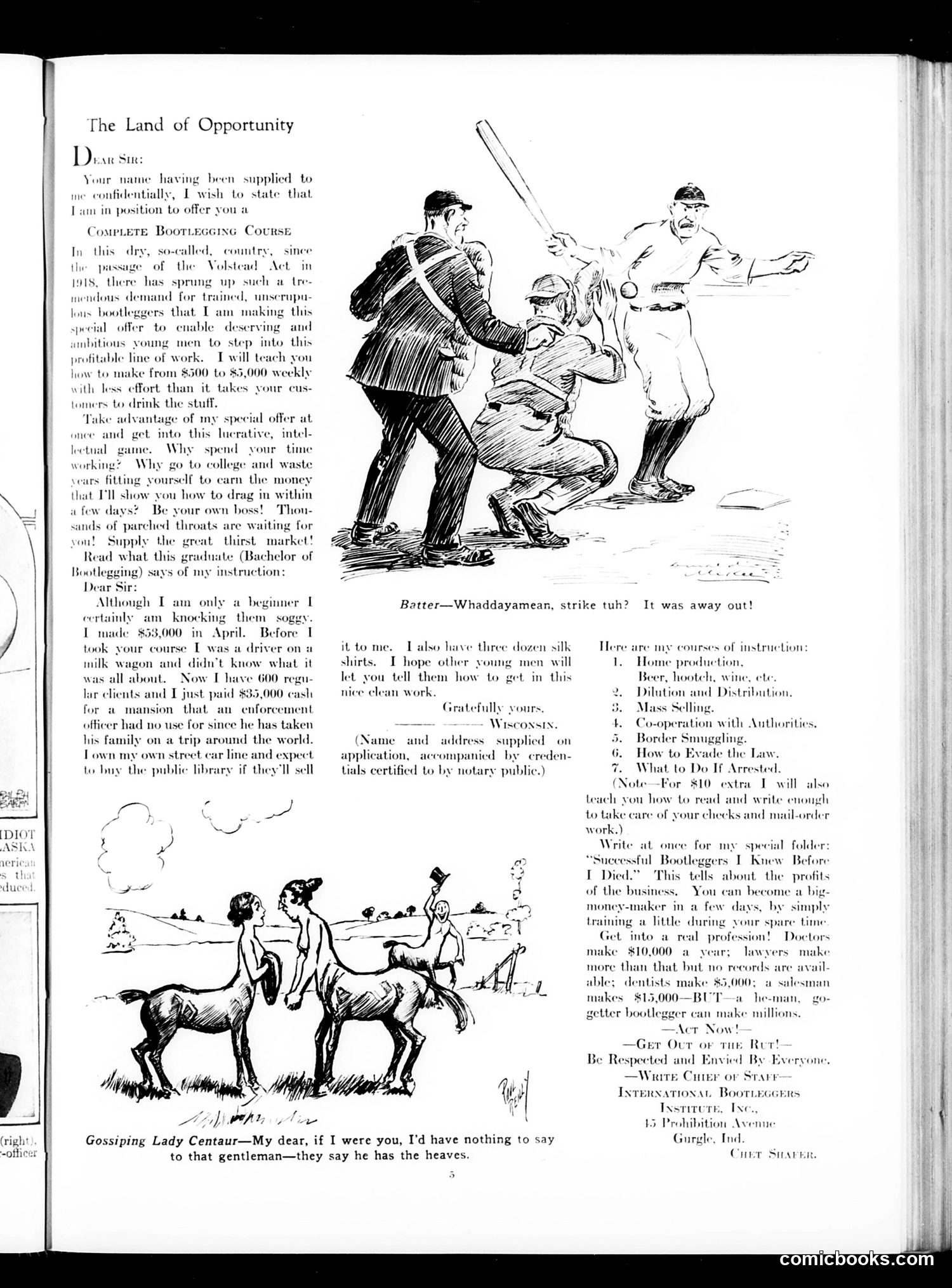
This page satirizes **Prohibition-era bootlegging** (illegal alcohol production/distribution following the 1918 Volstead Act). The main text mocks a fraudulent "bootlegging course" advertisement promising young men $500-$5,000 weekly by entering the illegal liquor trade. A testimonial from a "graduate" boasts of making $53,000 in April—clearly exaggerated to expose the scheme's absurdity. The satire critiques how Prohibition created perverse incentives: criminals grew wealthy while enforcement officers could afford world trips on bribes. The course offerings (home production, border smuggling, evading law) enumerate bootlegging's actual illegal activities, presented deadpan as legitimate instruction. The top cartoon shows a baseball scene ("Batter—Whaddayamean, strike tuh? It was away out!"), likely unrelated commentary on the same page. The bottom cartoon's centaur joke appears separate. **The satire's point:** Prohibition transformed crime into a lucrative "profession," inverting American values and creating perverse economic incentives.
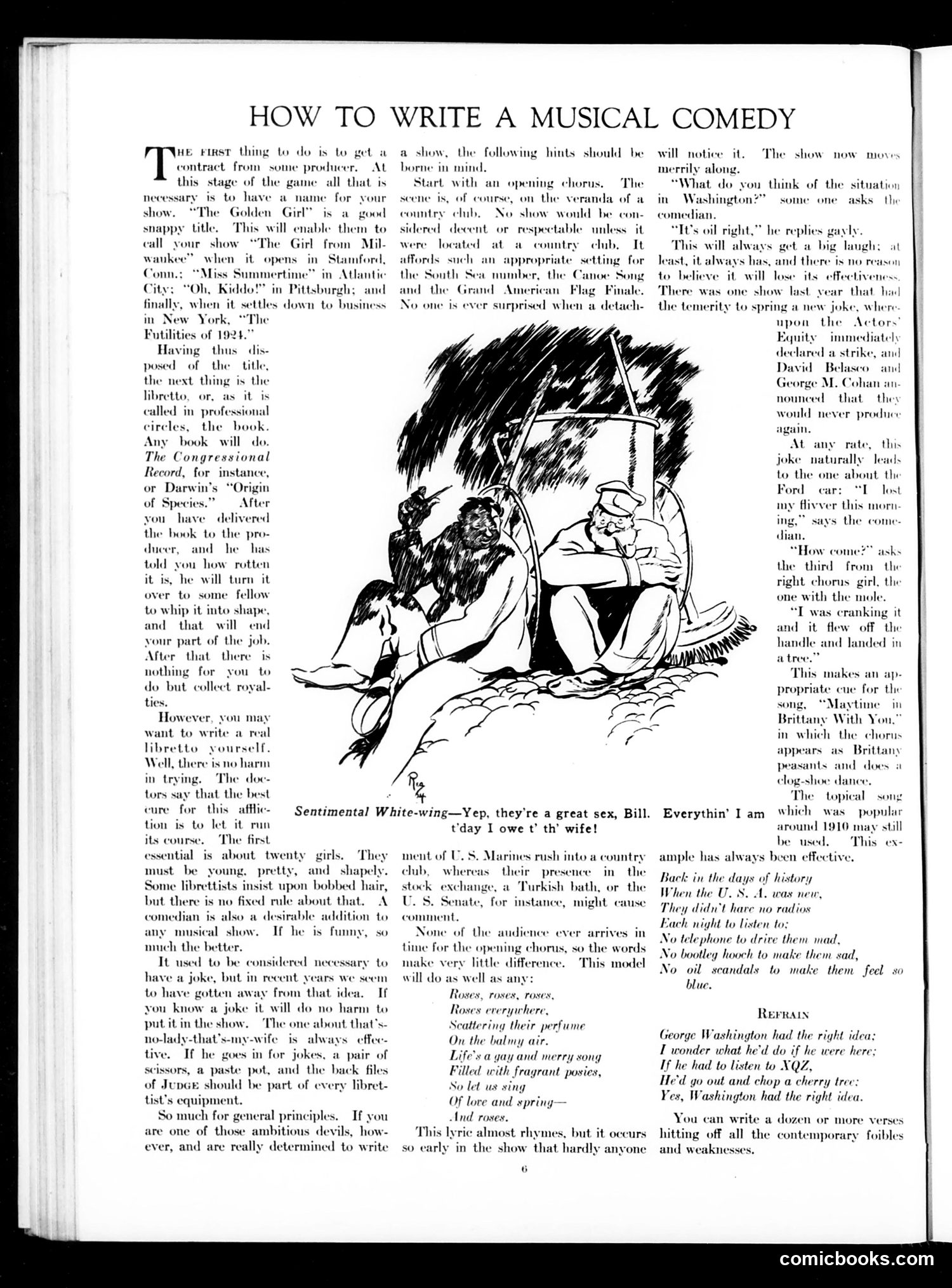
This is a satirical instructional article about composing Broadway musical comedies, likely from the early 1920s. The accompanying cartoon depicts two men in a canoe, humorously illustrating the absurdity of musical-theater conventions. The piece mocks standard practices: interchangeable titles, formulaic plots (always set at a country club), mandatory chorus girls, weak jokes recycled from *Judge* magazine files, and opening numbers with lazy rhyming lyrics. The text notes these elements are so predictable that audiences don't arrive until after the opening chorus anyway. The cartoon's caption—a crude sex joke about a man and his "great sex" wife—exemplifies the lowbrow humor the article both satirizes and employs. The overall tone is cynical about commercial Broadway's reliance on tired formulas, pretty girls, and dated gags rather than genuine wit or originality.
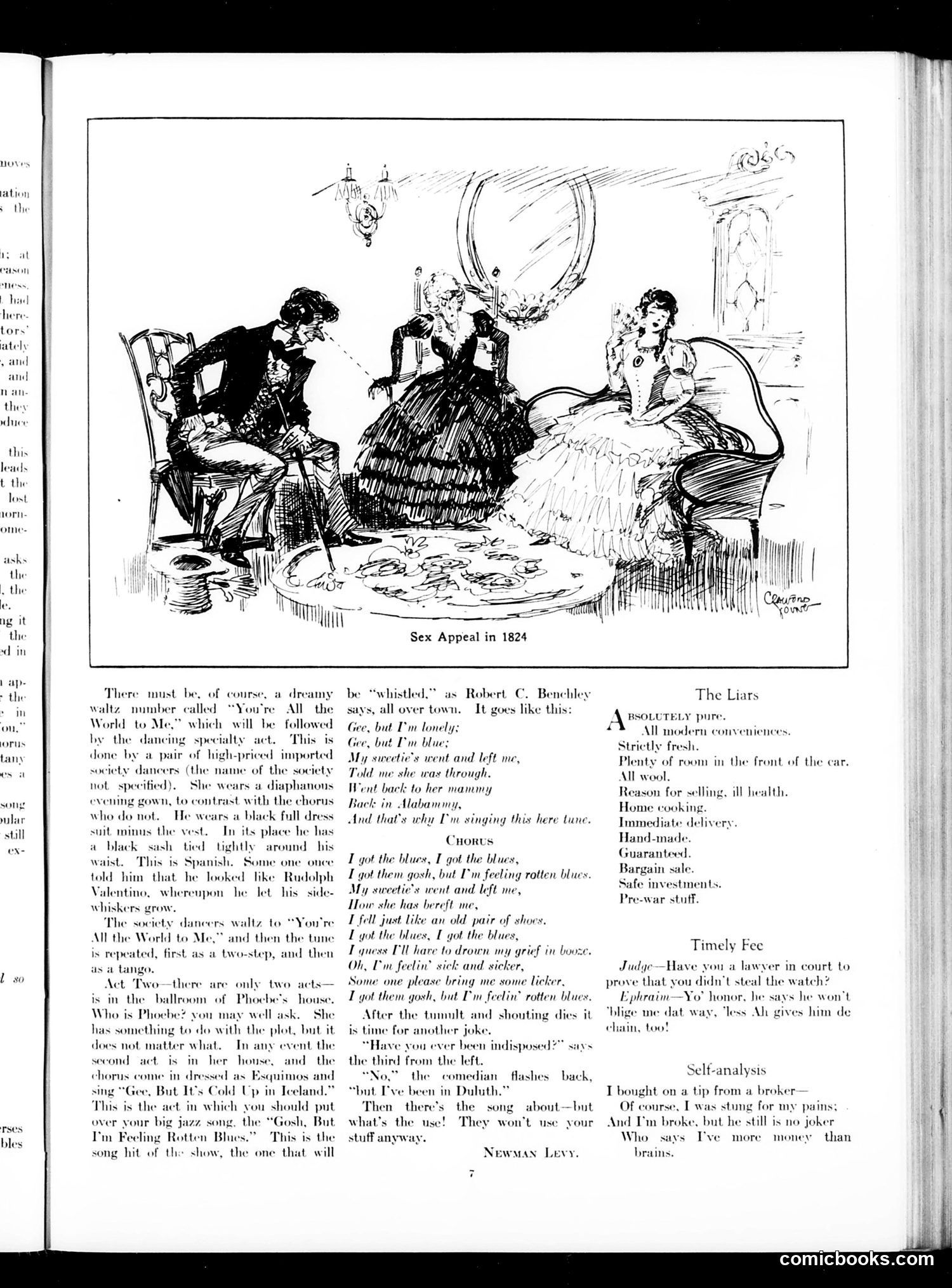
This page satirizes contemporary Broadway productions and popular entertainment. The cartoon depicts a theatrical scene titled "Sex Appeal in 1824"—a deliberate anachronism mocking modern shows that rely on spectacle and sensuality rather than substance. The accompanying text by Newman Levy describes a frivolous musical with minimal plot: two acts featuring high-priced imported dancers, a male lead in Spanish costume (absurdly fashioned after actor Rudolph Valentino), and minimal narrative coherence. The "dreamy waltz" and jazz song "I Got the Blues" exemplify the era's popular music. The satire targets 1920s theater's emphasis on visual appeal, exotic costumes, and jazzy entertainment over meaningful storytelling. By setting this vapid show in "1824," Judge ridicules how modern productions package sexuality and novelty as art—suggesting timeless human vanity rather than genuine theatrical innovation. The sidebar advertisements mocking false sales claims reinforce themes of commercial deception.
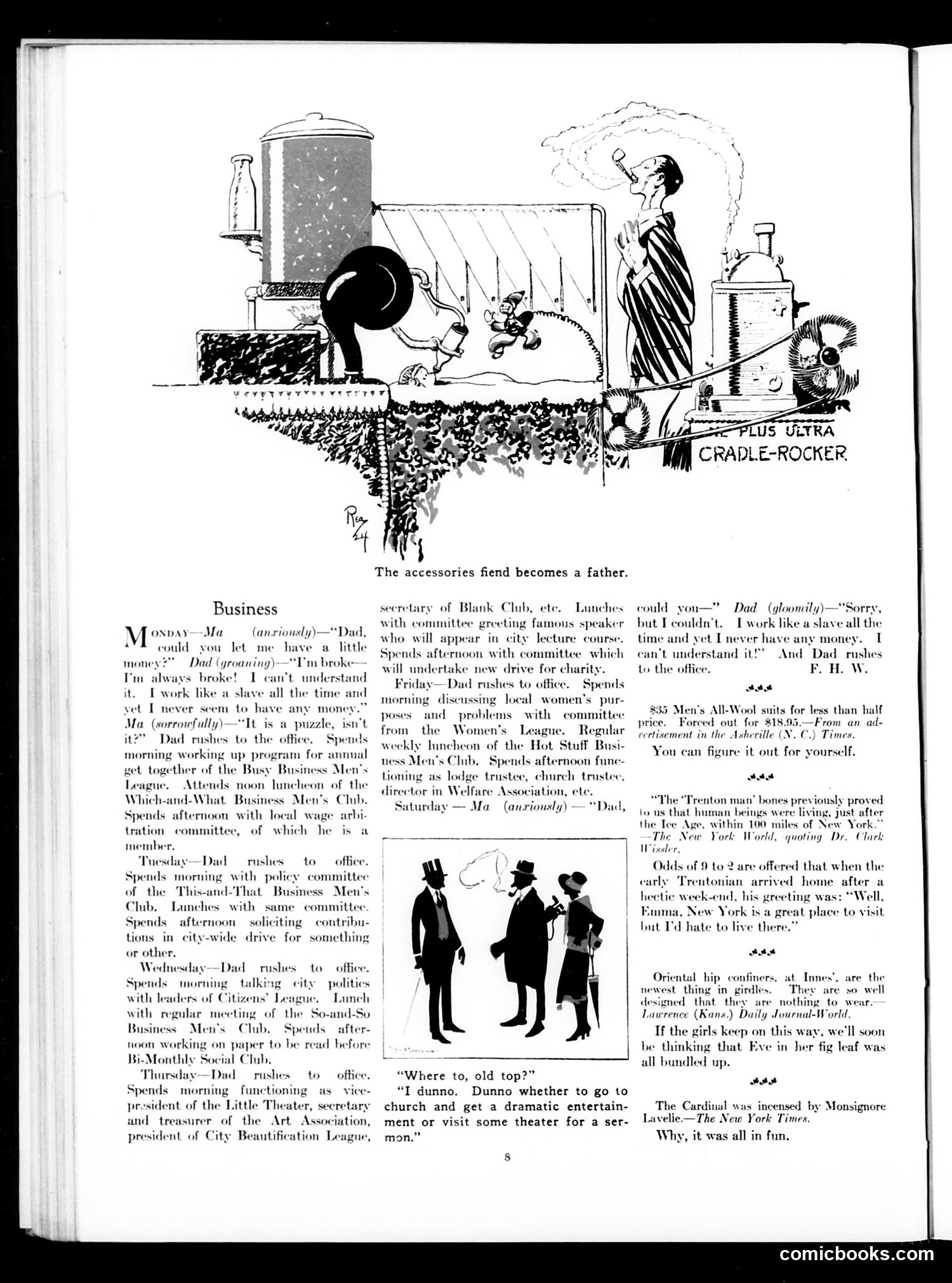
This page satirizes the overscheduled American businessman of the early 20th century. The cartoon "The Accessories Fiend Becomes a Father" depicts "Dad," who is perpetually broke despite working constantly. The joke: he devotes his life to committees, club memberships, and civic organizations—the "accessories" of respectability—rather than focusing on actual income or family needs. The daily schedule shows Dad rushing between business lunches, committee meetings, theater boards, and charity drives. By Saturday, he's so confused by his obligations that he can't distinguish between attending church for a sermon versus theater for entertainment. The satirical point targets the era's culture of joiners and civic-minded men who accumulated prestigious-sounding committee posts as status symbols while neglecting basic financial responsibility to their families. Ma and the children repeatedly ask for money; Dad always "rushes to the office," but his busyness is performative rather than productive.
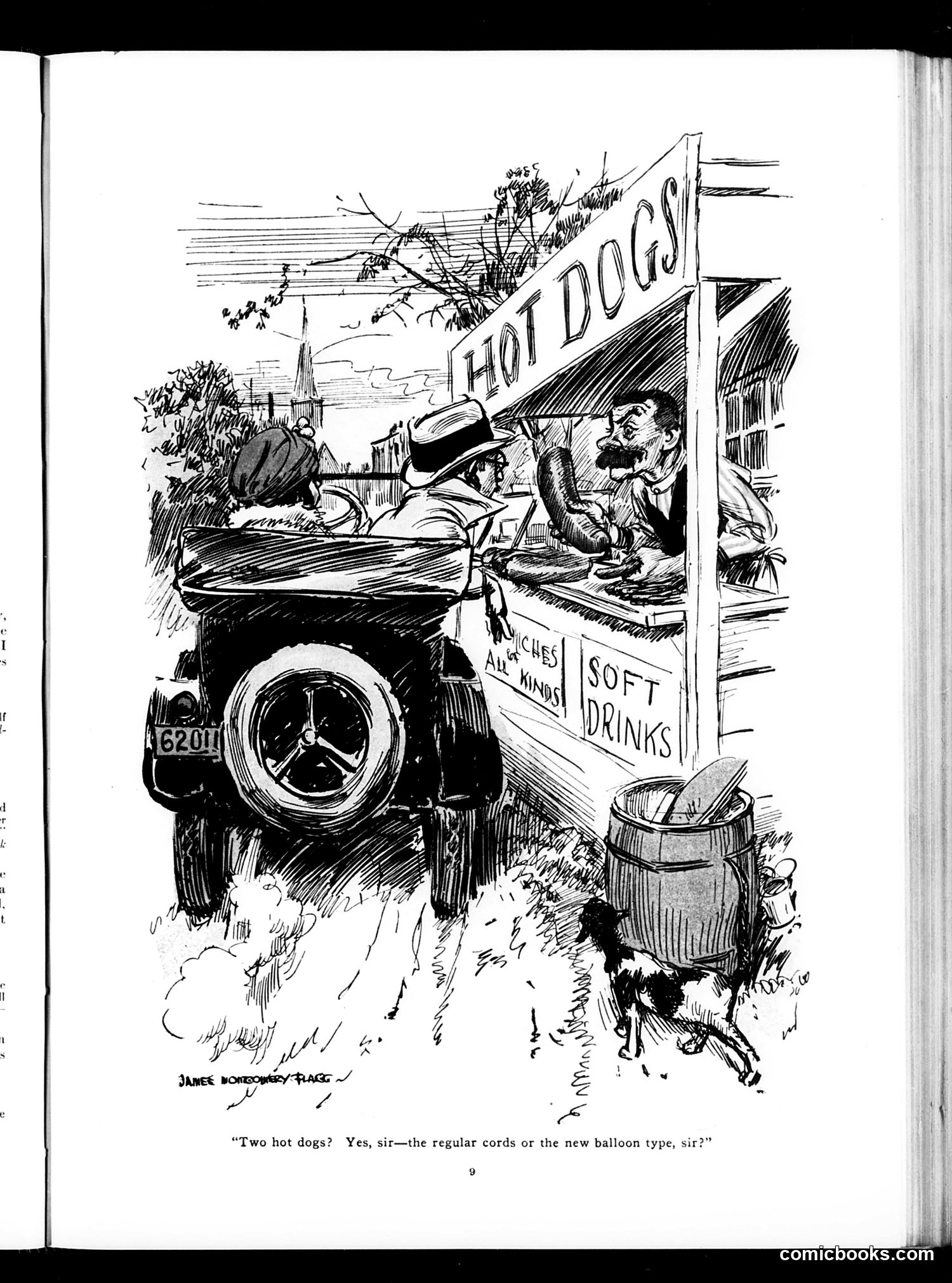
This is a humorous cartoon about automobiles and hot dogs. A well-dressed man in a car (license plate 6201) pulls up to a "Hot Dogs" stand advertising "All kinds" and "Soft Drinks." The vendor asks if he wants "two hot dogs" — or clarifies whether he means "the regular cords or the new balloon type, sir?" The joke plays on early automotive terminology. "Cords" refers to cord tires (made with cord reinforcement), while "balloon type" refers to newer pneumatic balloon tires with lower pressure. The vendor's confusion humorously treats tire types as equivalent to hot dog varieties, conflating automobile technology with food service. This reflects the novelty of evolving tire technology in the early automobile era, likely 1920s-1930s.
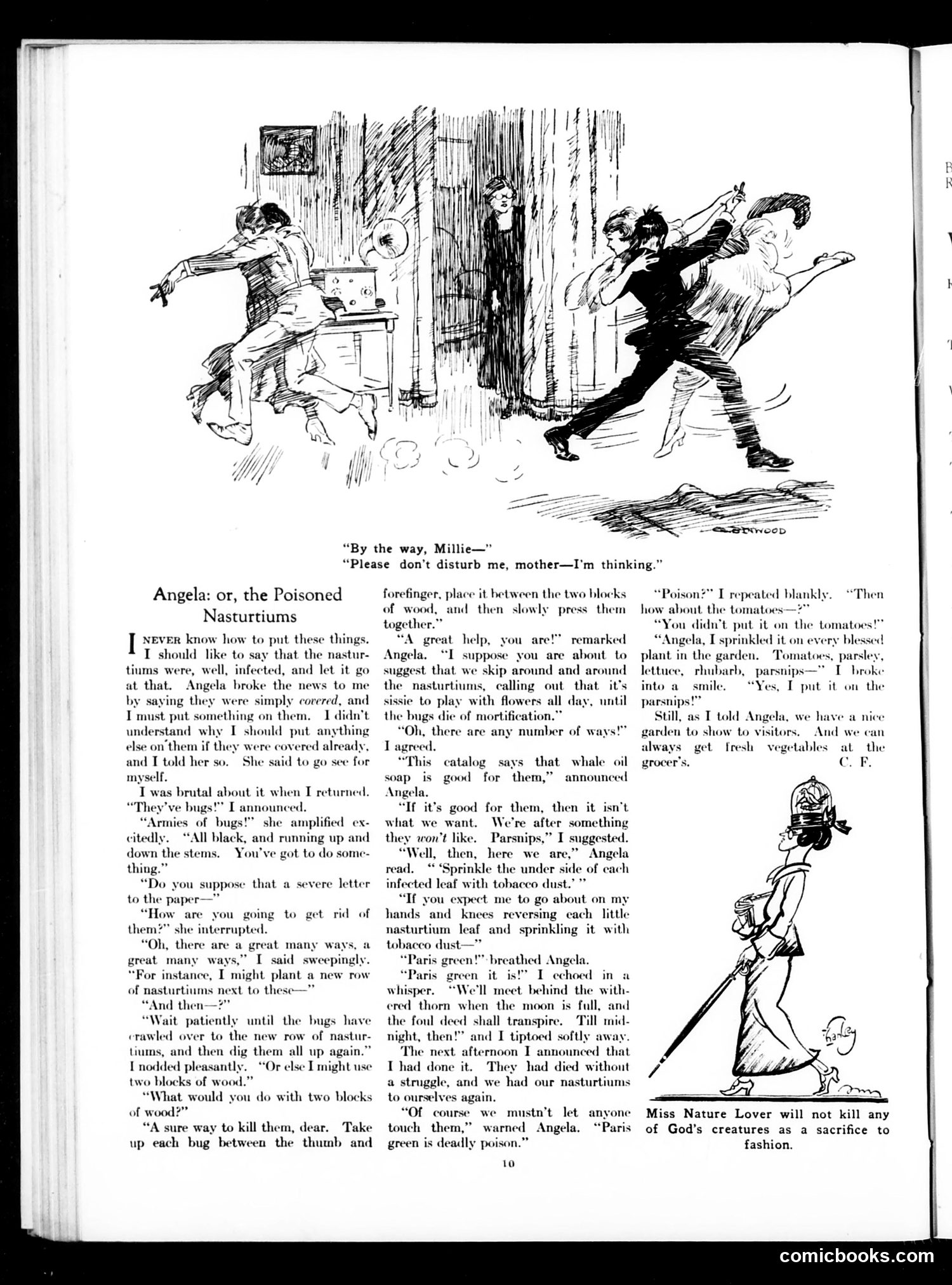
This is a humorous domestic story about a husband and wife dealing with garden pests. Angela discovers bugs on their nasturtium plants and pressures her husband to eliminate them. He suggests absurd solutions (planting new rows, using wooden blocks to crush individual bugs), which she dismisses. When they consult a catalog, they settle on "Paris green"—a real arsenic-based pesticide widely used in the early 20th century. The husband applies it to eliminate the bugs successfully. The joke's punchline: he admits he sprinkled the poison on *all* their garden vegetables (tomatoes, lettuce, rhubarb, parsnips), making them inedible. Angela's response is darkly pragmatic—they'll simply buy vegetables from the grocer instead. The accompanying cartoon shows a woman dramatically gesturing while a man flees, illustrating marital chaos. The footer moralizes that "Miss Nature Lover will not kill any of God's creatures as a sacrifice to fashion"—likely mocking contemporary environmental or animal-welfare concerns.
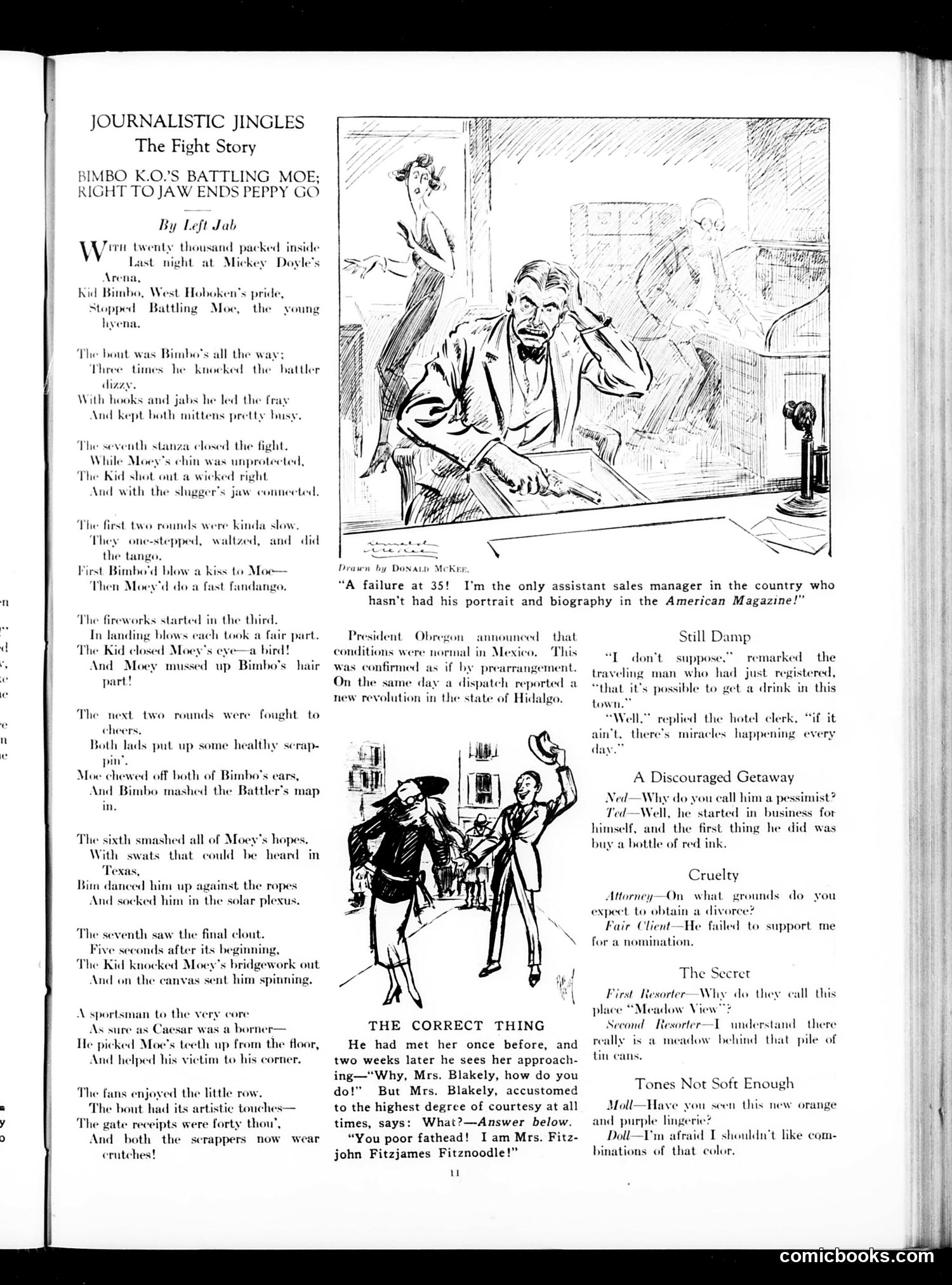
This page contains humorous short pieces typical of early 20th-century Judge magazine. **"The Fight Story"** is a comedic boxing narrative poem about a bout between "Kid Bimbo" and "Battling Moe" at Mickey Doyle's Arena in West Hoboken. The humor lies in exaggerated fight descriptions—Bimbo knocks out Moe's teeth and bridgework, they "waltz" and "tango" in early rounds, and Moe chews off Bimbo's ears. The joke concludes with Bimbo sportingly helping his defeated opponent to his corner despite the brutality. The piece satirizes sensationalized boxing journalism of the era. **The remaining items** are brief one-joke pieces: a salesman's vanity about missing American Magazine coverage, a traveling salesman's complaint about dry towns, a pessimist who buys red ink starting a business, divorce grounds humor, and quips about hotels and fashion. The cartoon by Donald McKee shows a dejected man lamenting his professional failure—a satire of middle-class American ambition and status anxiety in this period.
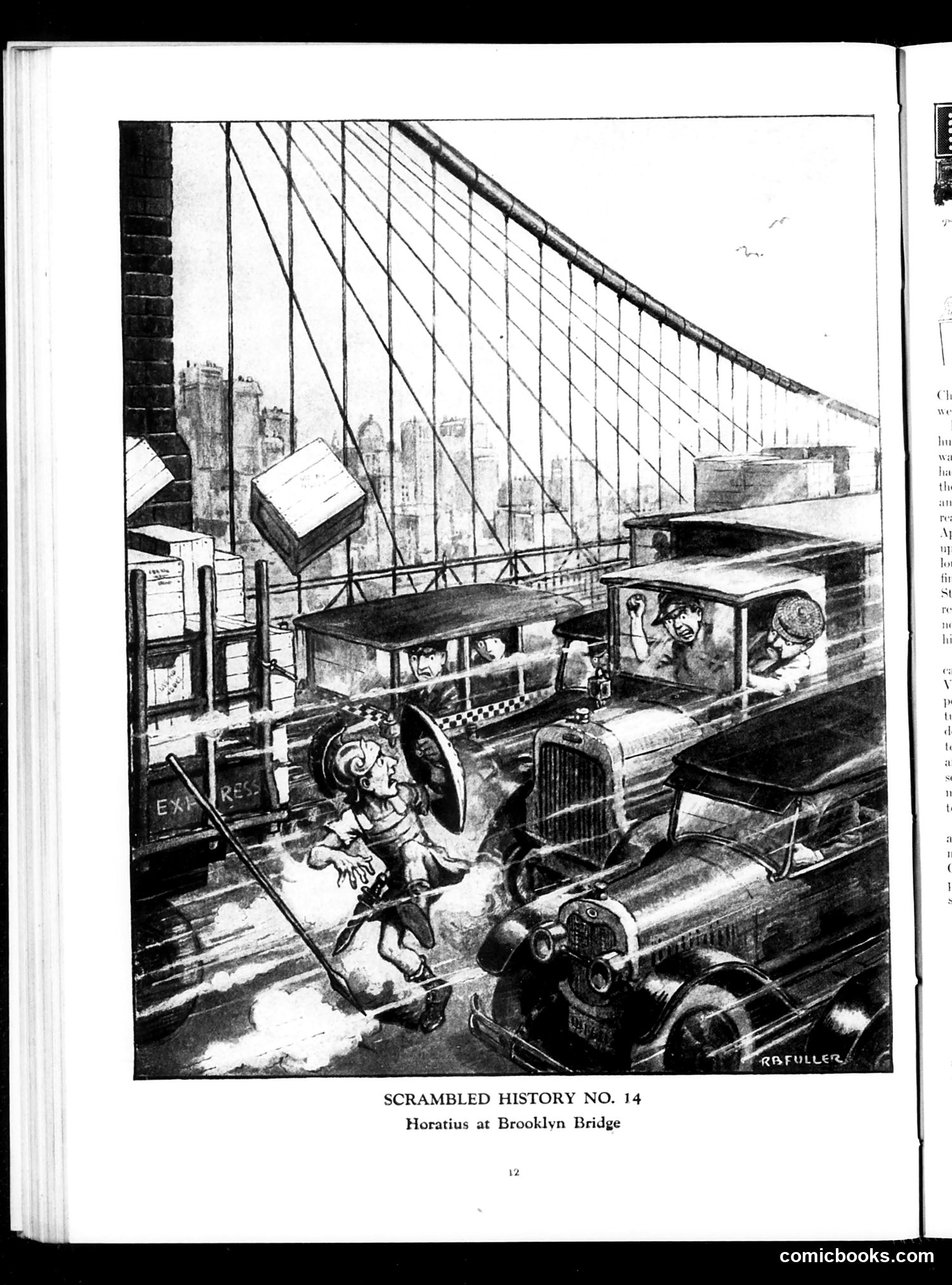
This is a satirical cartoon reimagining the classical Roman legend of Horatius Cocles (who famously defended a bridge against invaders) in a modern American setting. The cartoon transplants the ancient heroic scene to the Brooklyn Bridge, replacing Roman soldiers and weapons with early 20th-century automobiles, trucks, and urban infrastructure. The humor derives from the incongruity: a dignified historical epic is "scrambled" into contemporary American life, with cars instead of warriors and the iconic Brooklyn Bridge substituting for the Pons Sublicius. The central figure appears to be Horatius in classical dress, awkwardly out of place among modern traffic and machinery. The satire likely comments on how Americans mythologize their own engineering achievements (the Brooklyn Bridge) as heroic accomplishments comparable to ancient Rome.
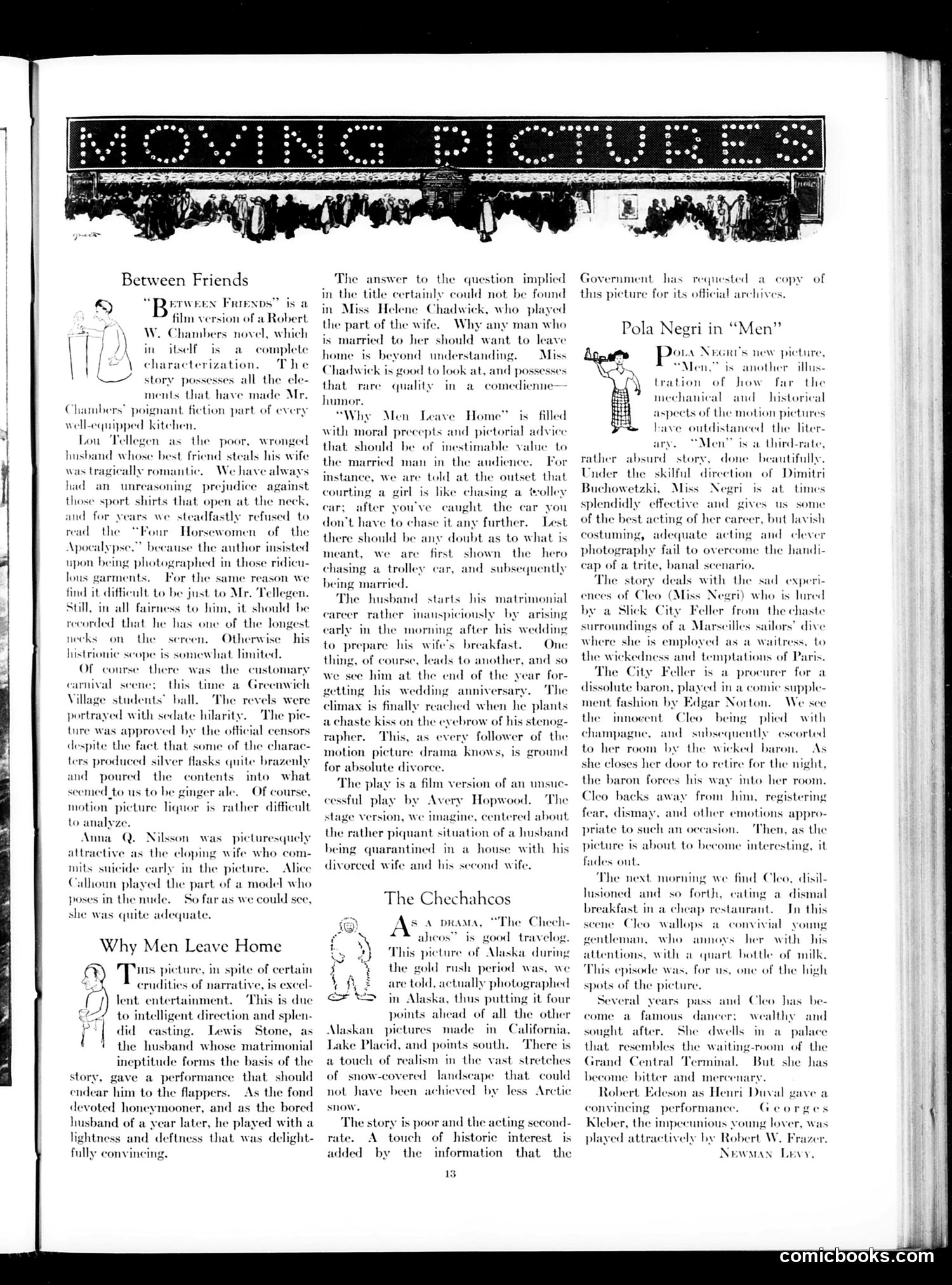
This is a film review page from Judge magazine covering three movies. The reviews mock the films and their stars with characteristic satirical wit. "Between Friends" adapts a Robert W. Chambers novel—itself dismissed as generic popular fiction. The reviewer ridicules actor Lou Tellegen's conspicuously long neck and the film's portrayal of a "Greenwich Village students' ball" featuring characters brazenly displaying silver flasks (a Prohibition-era joke about obvious fake "ginger ale"). "Why Men Leave Home" presents marital advice through slapstick: courting equals chasing a trolley car; marriage means stopping the chase. The reviewer mocks the heavy-handed moralism. "The Chechahcos" supposedly features genuine Alaskan gold-rush footage, though the review's brevity suggests skepticism about this claim. Throughout, Judge's tone combines snobbish dismissal of lowbrow cinema with good-natured mockery of both films and audiences, typical of 1920s highbrow magazine satire.
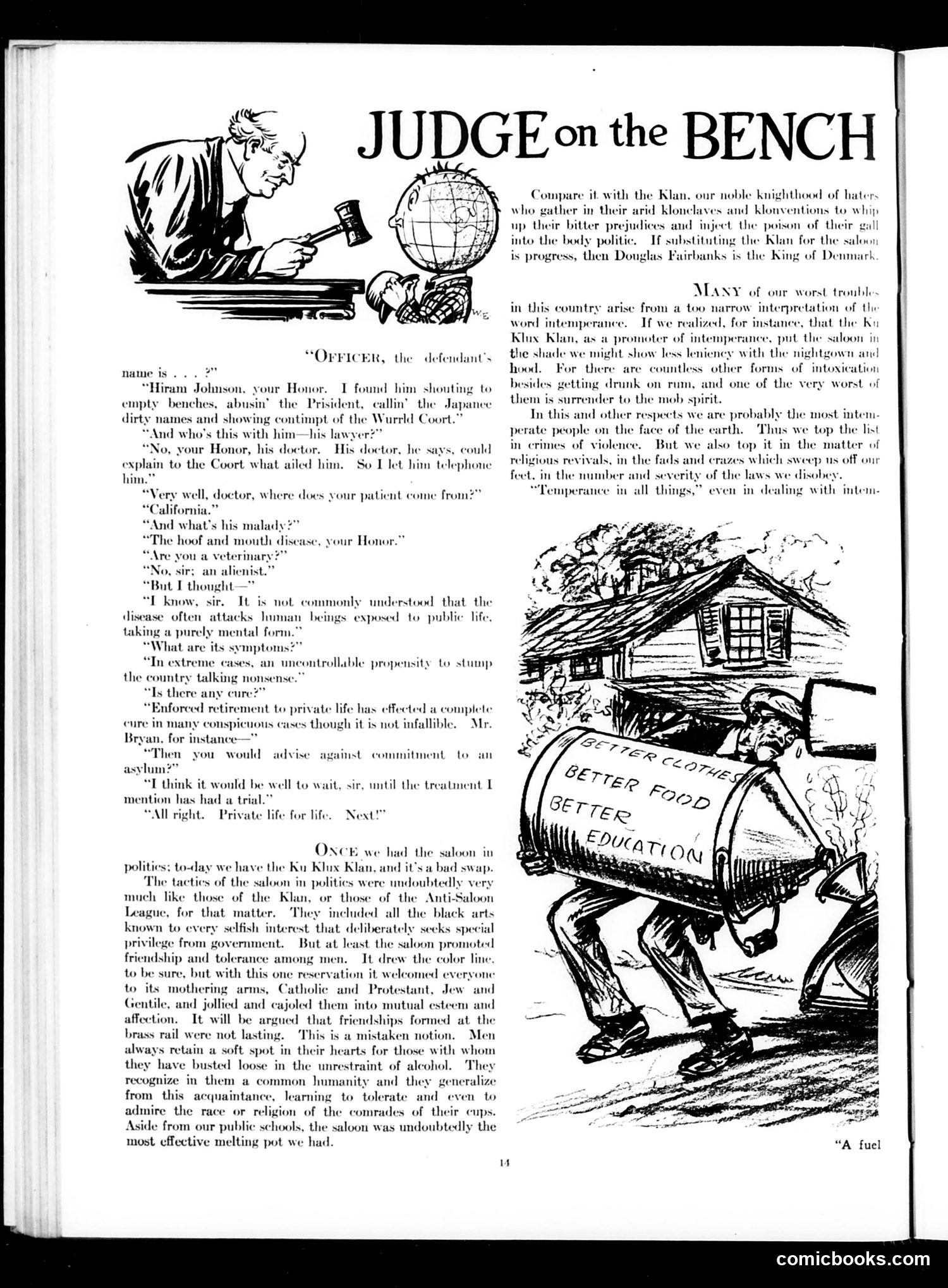
This 1920s satirical piece attacks Senator Hiram Johnson of California through two separate critiques: **The Courtroom Cartoon (top):** Johnson is portrayed as mentally ill—a patient with "hoof and mouth disease" brought before a judge by his doctor. The satire mocks Johnson's public speeches against the President and his vocal opposition (likely to U.S. foreign policy or the League of Nations). The "disease" metaphor suggests his political positions are symptomatic of mental disturbance, not legitimate argument. **The Editorial (bottom):** Judge magazine argues that the Ku Klux Klan is worse than the pre-Prohibition saloon. While acknowledging the saloon's social problems, the author claims it at least promoted cross-ethnic tolerance through shared drinking, whereas the Klan actively promotes hatred and violence. The piece equates mob mentality and intoxication with alcohol, suggesting Americans are dangerously "intemperate" in embracing violent movements. Both sections use satire to delegitimize Johnson's dissent and warn against the Klan's rise, framing both as threats to rational governance.
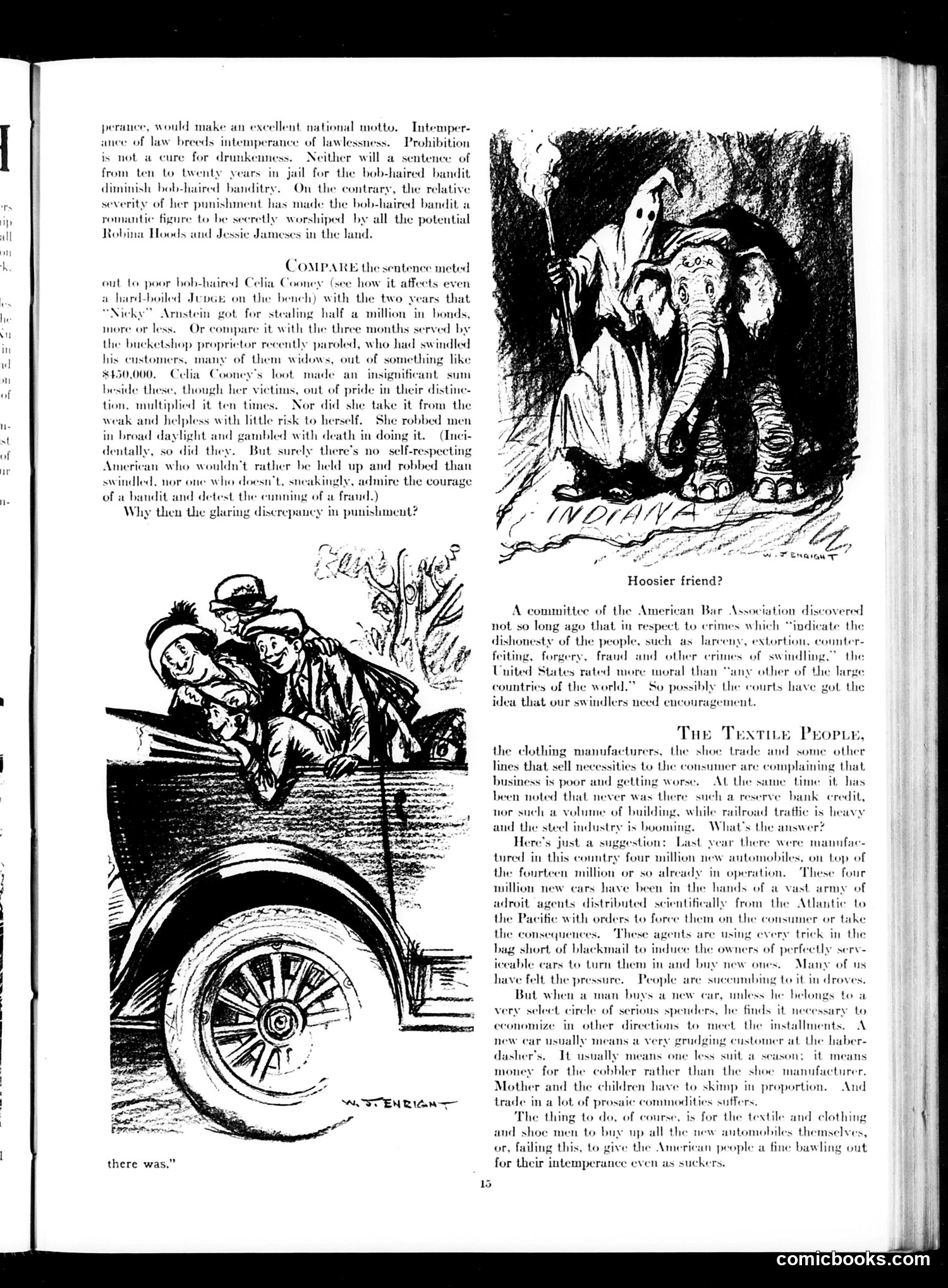
This page critiques **judicial inconsistency and inequality**, using the "bob-haired bandit" case as its focal point. **The Main Argument:** The text compares Celia Cooney's harsh sentence for armed robbery against far lighter punishments for white-collar criminals—"Nicky" Arnstein (bonds theft) and a bucketshop operator (swindling widows of $450,000). The satire questions why violent crime receives disproportionate punishment while fraud and embezzlement go lightly penalized. **The Cartoons:** The upper illustration shows an elephant labeled "Indiana," likely referencing the 1920s "bob-haired bandit" era when Celia Cooney and similar young female robbers became folk heroes. The lower cartoon depicts criminals escaping in an automobile, visually reinforcing the romanticization of bandits. **The Point:** Judge argues that severe punishment actually *glorifies* criminals rather than deterring crime, and that the courts show bias favoring wealthy offenders. The piece advocates for proportional, rational sentencing rather than harsh reactive measures—a progressive critique of 1920s criminal justice.
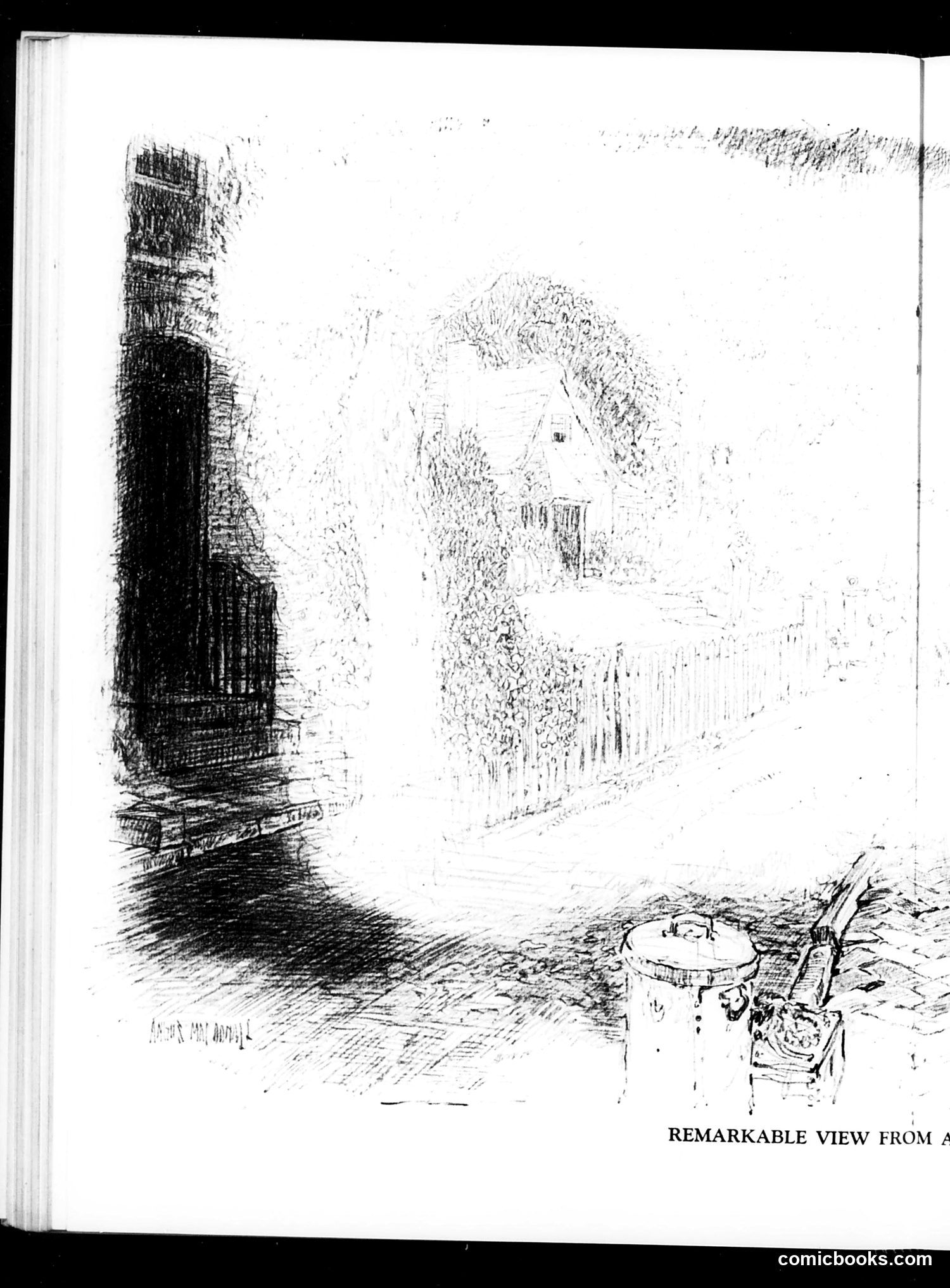
This page shows a sketch-style illustration with the caption "REMARKABLE VIEW FROM A" (text appears cut off). The drawing depicts a tall, dark tower or chimney on the left side, with a cottage or small house visible in the distance on the right, surrounded by vegetation. In the foreground are what appear to be simple objects—possibly a pot or vessel. The OCR text is largely illegible characters, suggesting either printing quality issues or non-textual elements. **Without the complete caption or accompanying article text, I cannot definitively identify what political or social event this cartoon references.** The "remarkable view" framing suggests it may be satirizing something about perspective, inequality, or industrial/rural contrast, but asserting a specific meaning would require the full text. This appears to be either a partial page scan or the caption is incomplete.
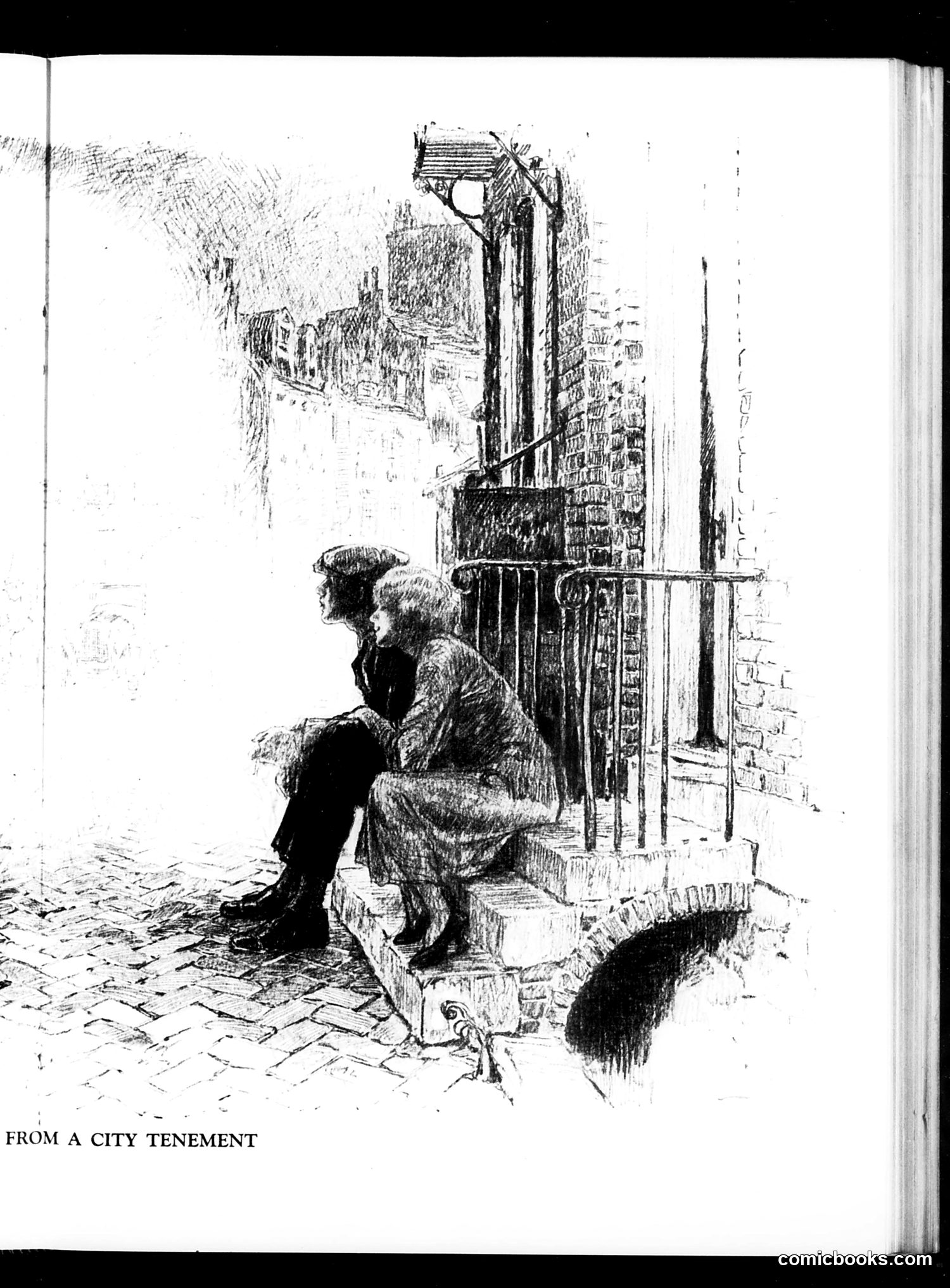
This is a sketch depicting poverty in urban housing. Two figures—appearing to be a woman and child—sit huddled outside a tenement building entrance, surrounded by worn stonework and a bare streetscape. The illustration's style emphasizes their shabby clothing and dejected posture. The caption "FROM A CITY TENEMENT" suggests social commentary on urban poverty conditions. Judge magazine frequently used satirical illustrations to critique social problems. This appears to be a straightforward documentary-style piece rather than satirical humor, likely addressing the deplorable living conditions in crowded tenement districts that plagued American cities in the late 19th/early 20th century. The artwork advocates awareness of urban poverty rather than mocking the poor themselves.
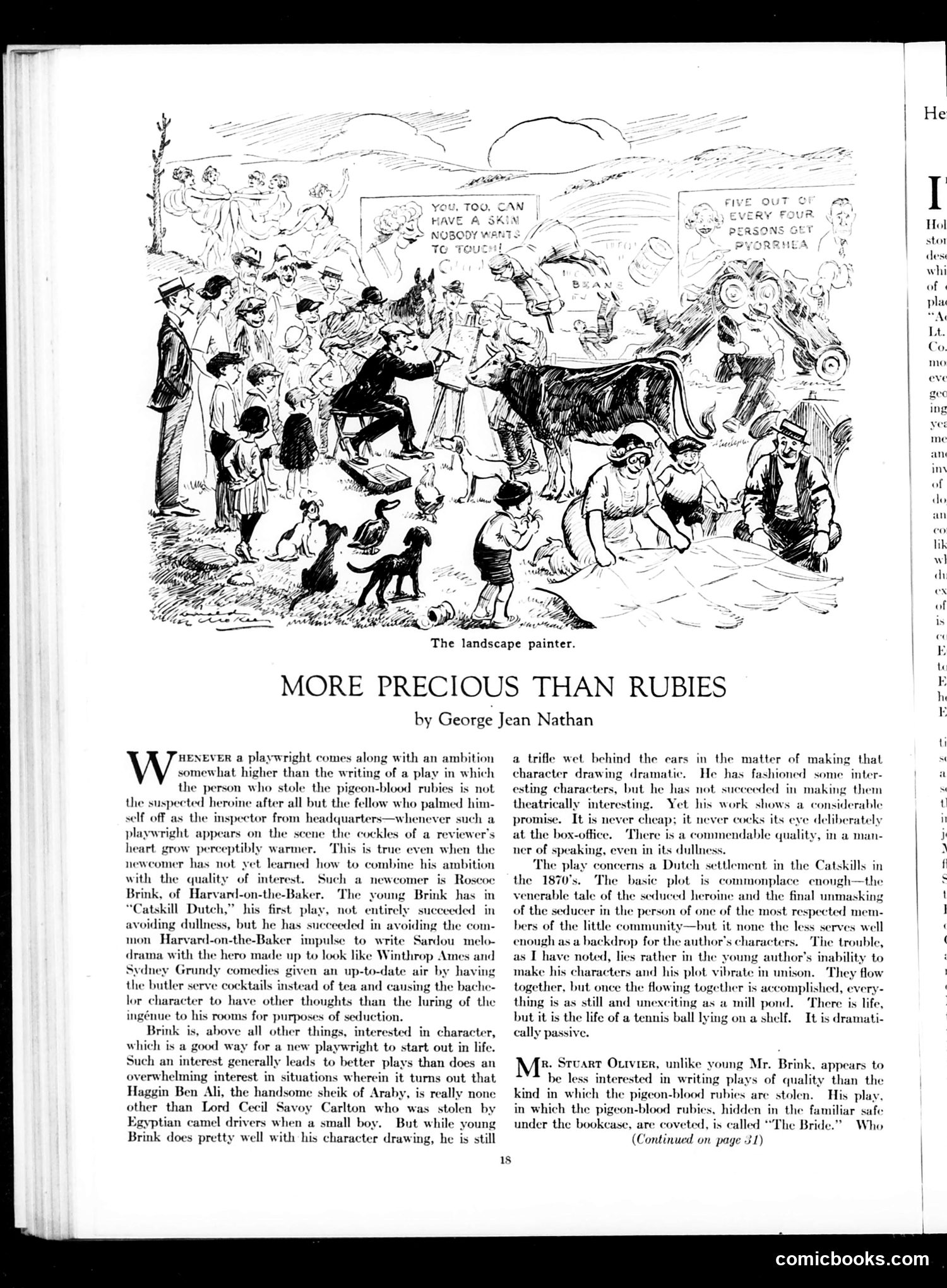
This page contains a theater critique by George Jean Nathan, not primarily a political cartoon. The small illustration titled "The landscape painter" at the top depicts a chaotic outdoor scene with crowds and a cow—likely a humorous vignette unrelated to the main text. Nathan's article reviews new playwrights, particularly praising Roscoe Brink for writing character-driven drama rather than melodramatic plots involving stolen "pigeon-blood rubies"—a satirical reference to overwrought, clichéd theatrical plots common in early 20th-century theater. Nathan criticizes plays featuring contrived twists (like a character revealed as nobility stolen by camel drivers) or shallow comedy (butlers serving cocktails instead of tea). The satire mocks low-quality commercial theater and praises ambition toward serious dramaturgy. References to playwrights like Sardou and Grundy were recognizable to contemporary audiences as representatives of melodramatic convention.
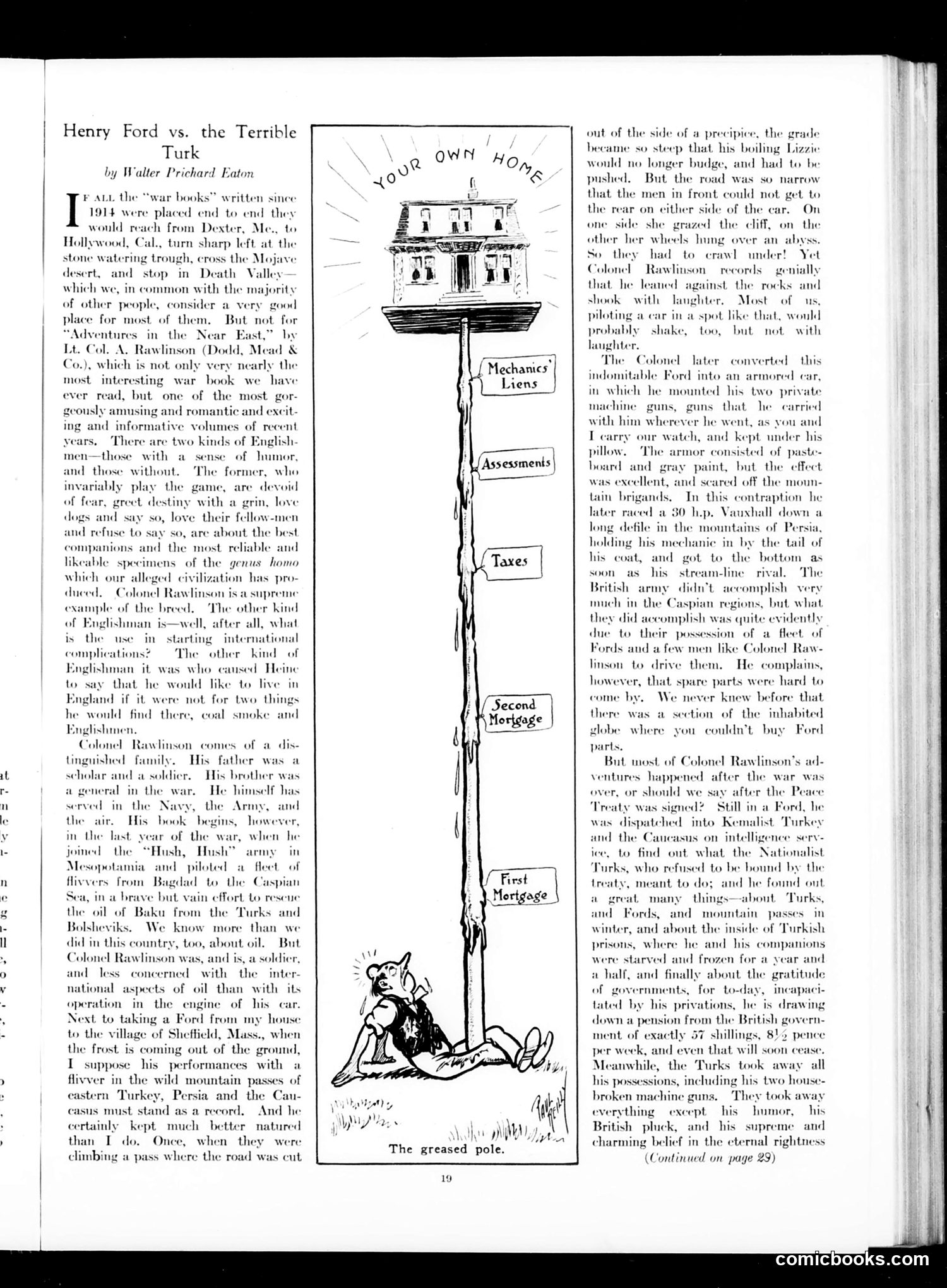
This page reviews Lt. Col. A. Rawlinson's memoir "Adventures in the Near East," a WWI account of military operations in Turkey, Persia, and the Caucasus. The cartoon's central image shows a pole labeled with financial burdens ("Your Own Home," "Mechanics Liens," "Assessments," "Taxes," "Second Mortgage," "First Mortgage") climbing upward—likely satirizing the accumulating debts and obligations weighing on ordinary Americans. The review praises Rawlinson as an exemplary Englishman who maintained humor and good nature while operating a Ford automobile (a "Lizzie" or "flivver") through treacherous Turkish mountain passes. The author humorously contrasts Rawlinson's calm competence with typical American anxiety, suggesting British soldiers handled wartime logistics in the Ottoman territories more resourcefully than Americans might. The satire targets American financial anxiety and working-class struggles post-war, using the contrast between British operational efficiency and American domestic economic burden as its point.
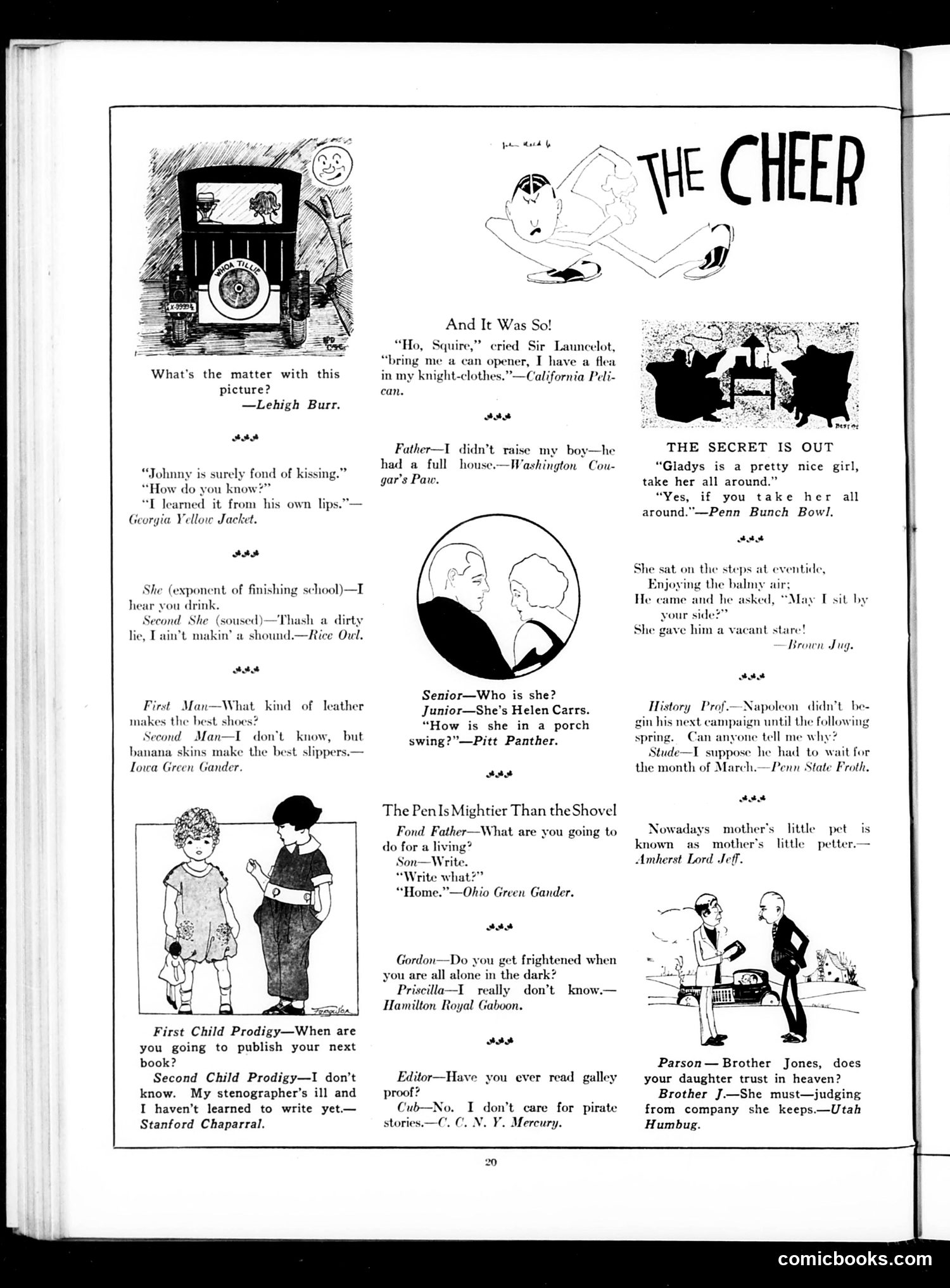
This page from *Judge* magazine collects brief humorous jokes and quips from various college publications, arranged around small illustrations. The content reflects early 20th-century college humor—largely puns and wordplay rather than political satire. Key jokes include: a pun on "knight-clothes" (can opener for a flea), a poker reference ("full house"), and observations about student life (stenographers, galley proofs, unfinished schoolwork). The humor targets recognizable figures like Napoleon and references courtship customs (porch swings, sitting on steps). Most jokes rely on double meanings, misunderstandings, or mild social commentary—a girl who gives a "vacant stare" when asked to sit together, or a daughter whose choice of "company" suggests questionable judgment. The illustrations are small, decorative vignettes rather than developed cartoons. The page represents college magazine humor of the era: gentle, domestic, focused on youth, romance, and intellectual pretense rather than hard political commentary.
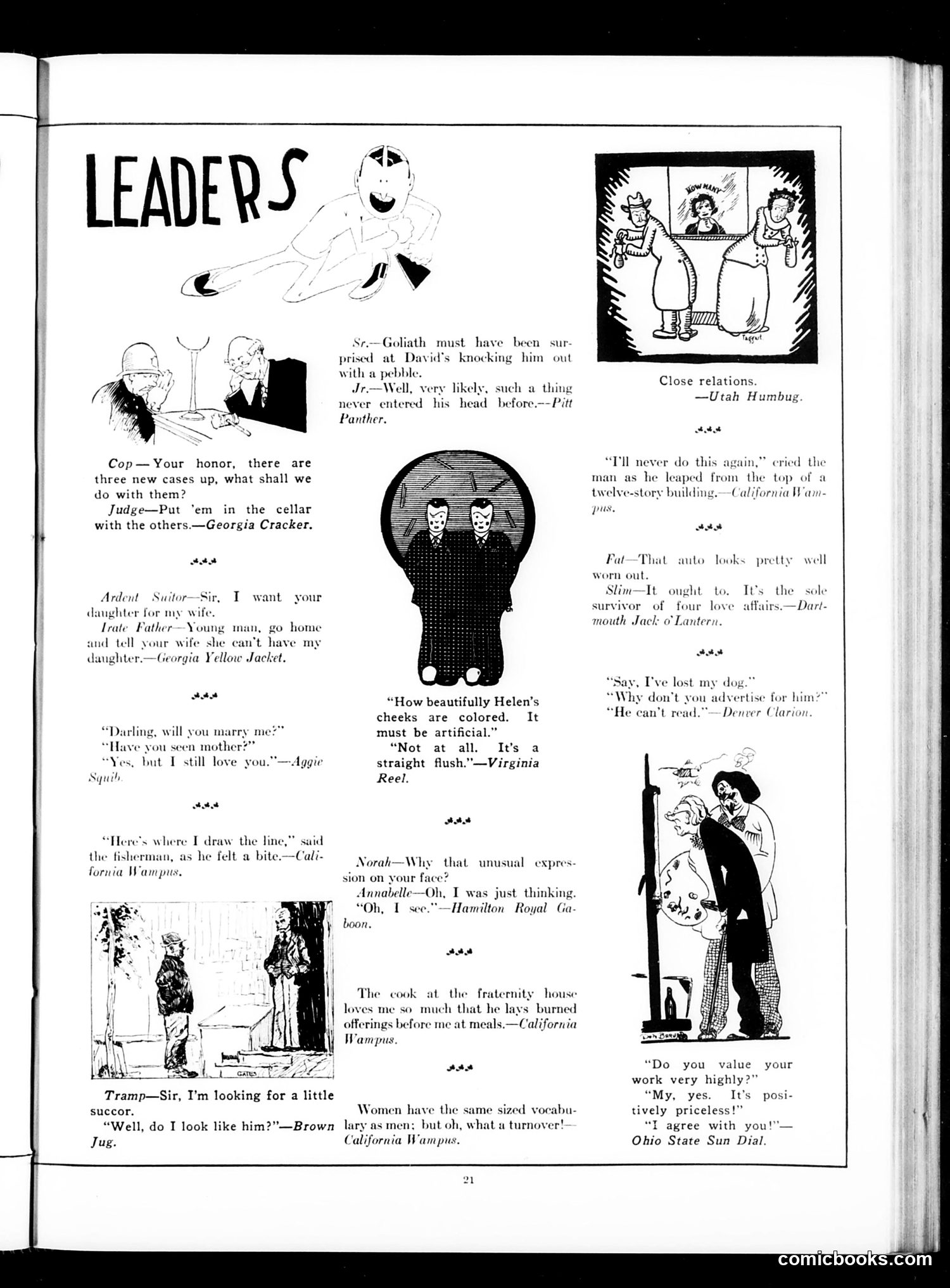
This page contains various short humorous quips and cartoons typical of early 20th-century American satirical magazines. Rather than political cartoons, these are mostly social humor jokes lampooning everyday situations and regional American stereotypes. Notable content includes: - A joke about a judge telling a cop to put criminals "in the cellar with the others"—satirizing judicial leniency or corruption - A fish-related pun about "drawing the line" - Repeated jokes about romantic entanglements and infidelity ("survivor of four love affairs") - Gender-based humor about women's vocabulary and cosmetics - A dark joke about suicide ("leaped from the top of a twelve-story building") - Regional attributions (Georgia Cracker, Utah Humbug, California Wampus) suggesting syndicated humor from various American publications The cartoons appear to be generic domestic/social satire rather than addressing specific political events, though the judicial corruption joke reflects contemporary concerns about court systems.
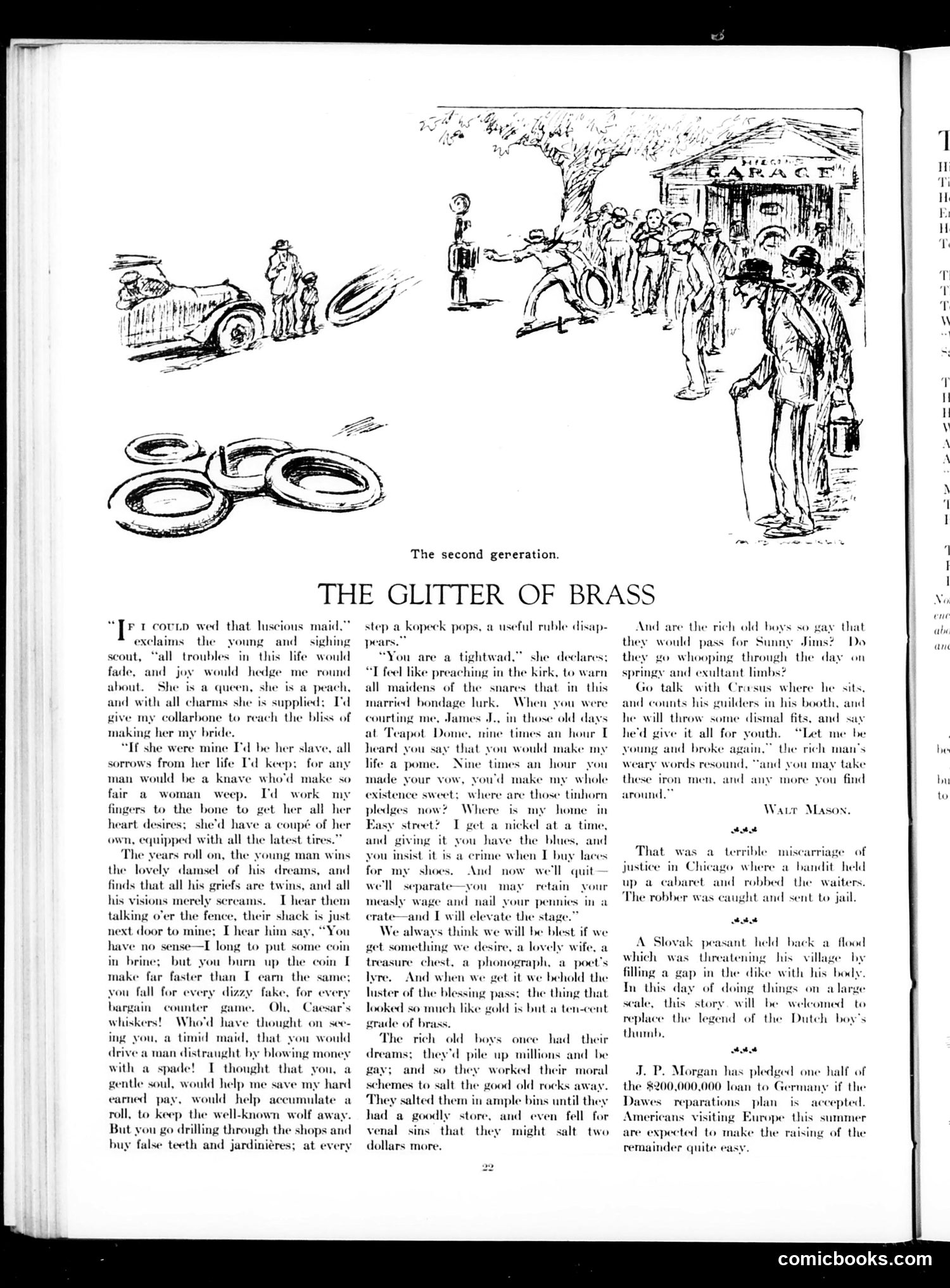
This illustrated story contrasts romantic idealism with married disillusionment. A young man passionately courts a woman, promising lifelong devotion and financial security. After marriage, reality sets in: he earns meager wages while she wastefully spends on luxuries (false teeth, decorative plants), and both become bitter and resentful rather than joyful. The satire extends to wealth: rich men dream of accumulating fortunes through moral compromise ("salt the good old rocks away"—likely referring to hidden assets or corruption). Yet even the wealthy cannot buy happiness or youth, discovering their brass treasures are hollow. The title's pun—"glitter of brass" (both the metal and slang for money)—suggests all material aspirations ultimately deceive. The story critiques both working-class financial struggles and wealthy moral bankruptcy, implying that pursuing money or status, whether through love or business schemes, leads only to disappointment.
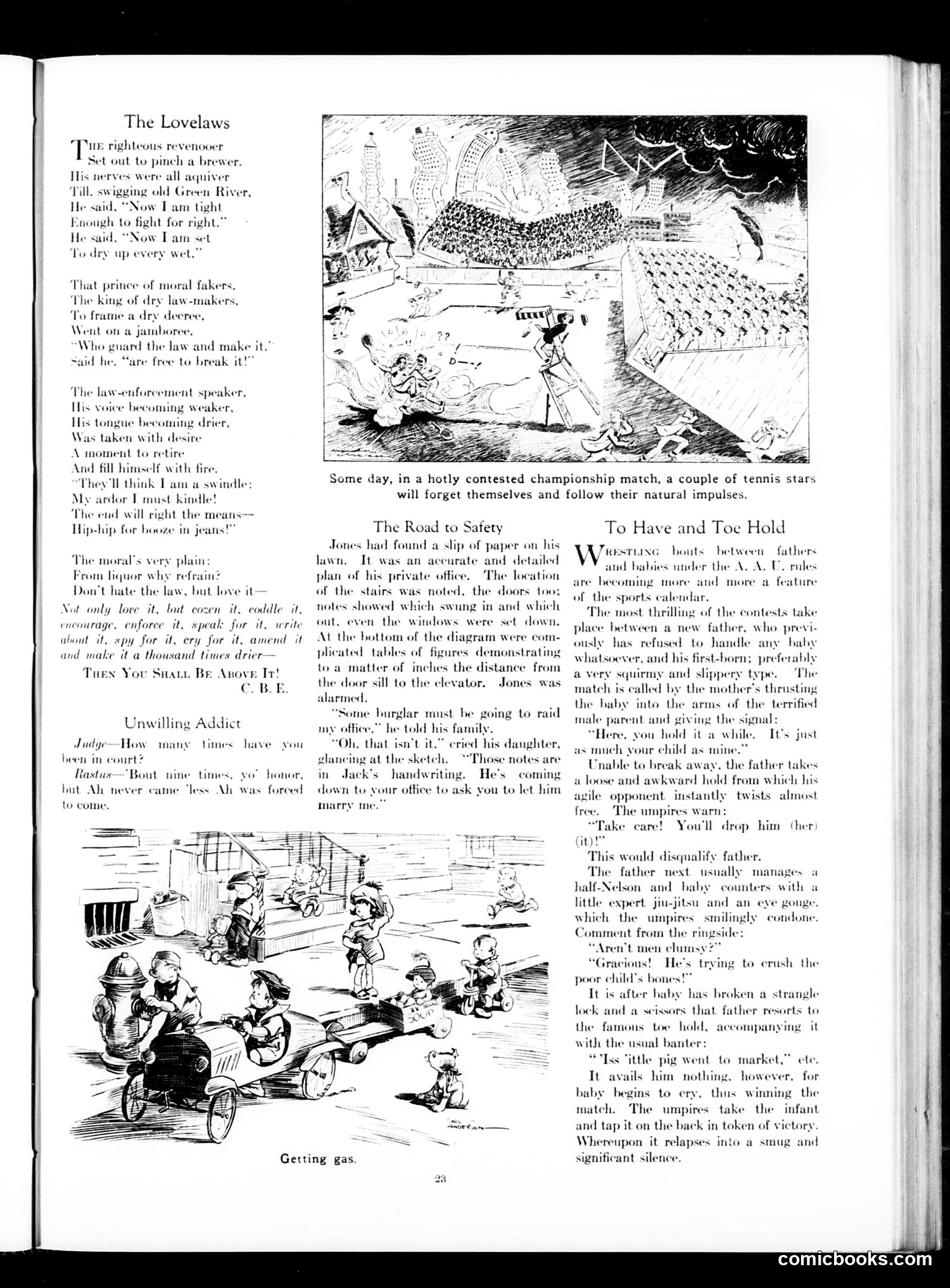
This page contains three satirical pieces mocking American social hypocrisy: **"The Lovelaws"** attacks Prohibition enforcers as frauds. A self-righteous federal agent ("revenooer") vows to stop drinking and enforce dry laws, but secretly gets drunk to maintain courage for his moral crusade. The satire: those enforcing temperance are themselves drunkards, undermining their authority. **"The Road to Safety"** jokes about a father's paranoia. He finds detailed blueprints of his office and assumes a burglar is planning a heist—until his daughter reveals they're her boyfriend's notes preparing to ask permission to marry her. The punchline: fathers fear sons-in-law more than actual criminals. **"To Have and Toe Hold"** humorously compares new fathers holding babies to wrestling matches, where the infant is the superior competitor. The father's clumsy grip versus the baby's agility makes him the inevitable loser—satirizing masculine incompetence at domestic tasks and the mother's amusement at paternal helplessness. All three pieces reflect early 20th-century Judge magazine's approach: social satire targeting hypocrisy, marital dynamics, and evolving gender roles.
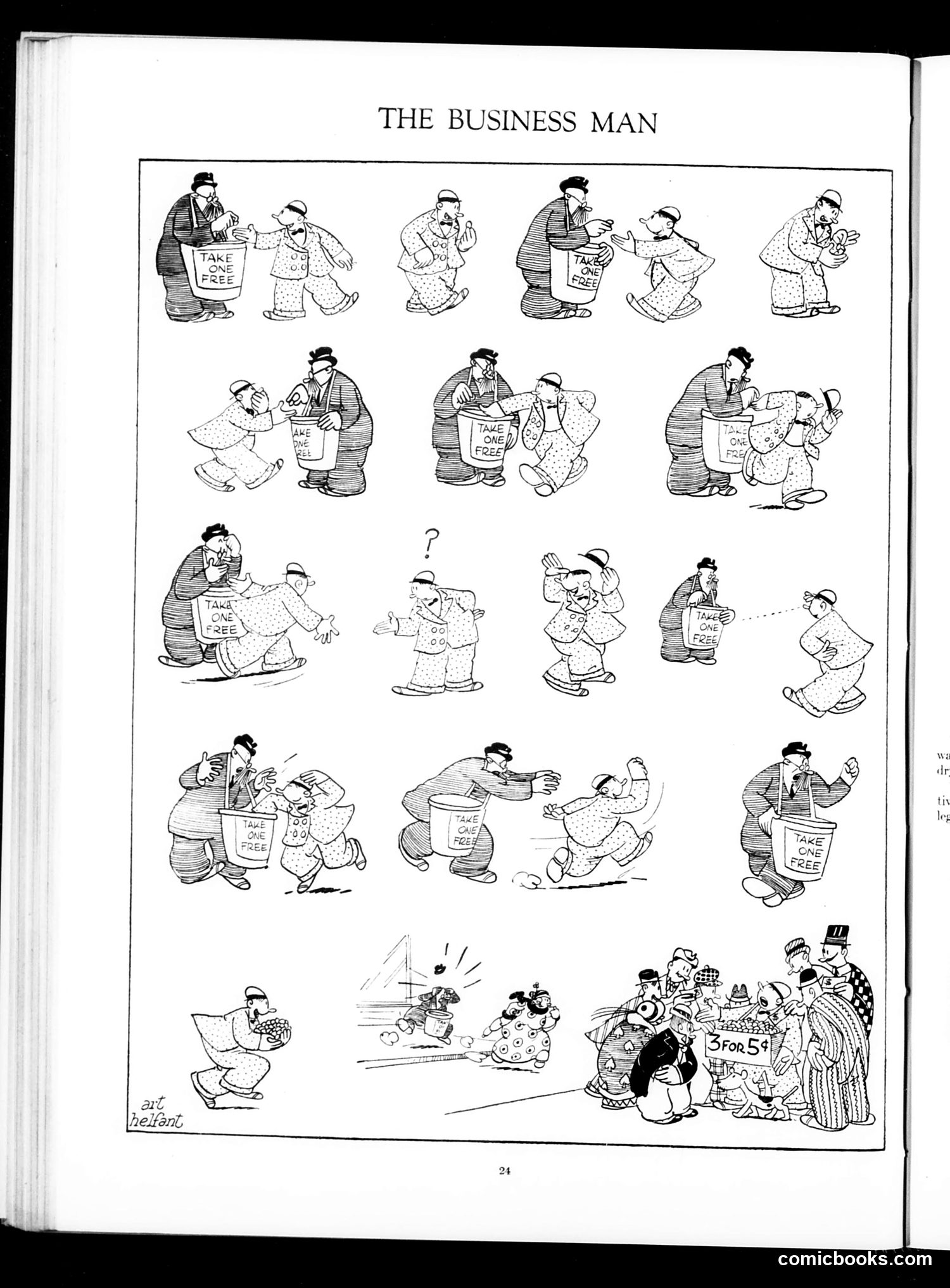
This satirical cartoon depicts a well-dressed businessman (wearing a bowler hat and striped suit) aggressively distributing free samples labeled "TAKE ONE FREE" to children and families. The sequence shows him persistently pursuing customers who are initially reluctant or fleeing. The satire appears to critique aggressive commercial tactics and manipulative marketing practices targeting vulnerable populations, particularly children. The businessman's relentless pursuit despite customers' resistance suggests predatory business behavior disguised as generosity. The final panel shows him operating what appears to be a market stall with a "3 FOR 5¢" sign, indicating the "free" samples are ultimately part of a sales scheme. Without the magazine's date, the specific product being promoted remains unclear, though the cartoon mocks how businesses exploit the appearance of charity for profit.
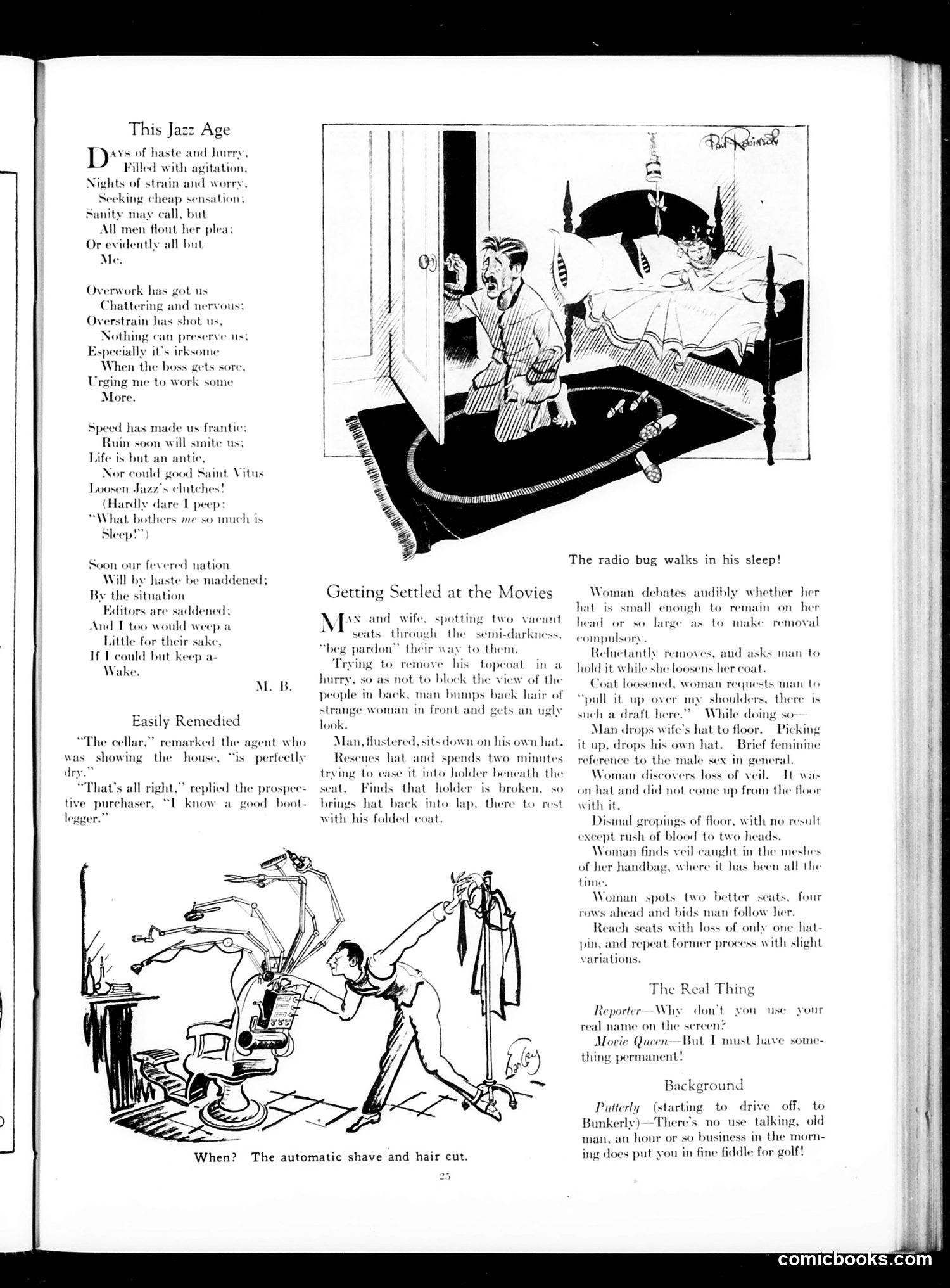
This Judge magazine page satirizes 1920s American anxieties about modern life's frenetic pace. The poem "This Jazz Age" criticizes how speed, overwork, and constant stimulation have made people frantic and sleepless—the author ironically claims his main complaint is that he can't *stay* awake, mocking the era's obsession with constant activity. The accompanying cartoons mock everyday frustrations of the Jazz Age: - **"Getting Settled at the Movies"** depicts the slapstick chaos of a couple entering a dark theater, bumping into strangers, losing hats repeatedly—satirizing how even leisure activities have become stressful and undignified in modern times. - **"When?"** shows a man operating an absurdly complex automatic barber machine, suggesting technology has made even simple grooming needlessly complicated. - Small comic bits mock movie stars ("The Real Thing") and golf-obsessed businessmen, capturing period concerns about celebrity culture and leisure. The overall message: modernity promised progress but delivered chaos, anxiety, and the ironic loss of simple pleasures.
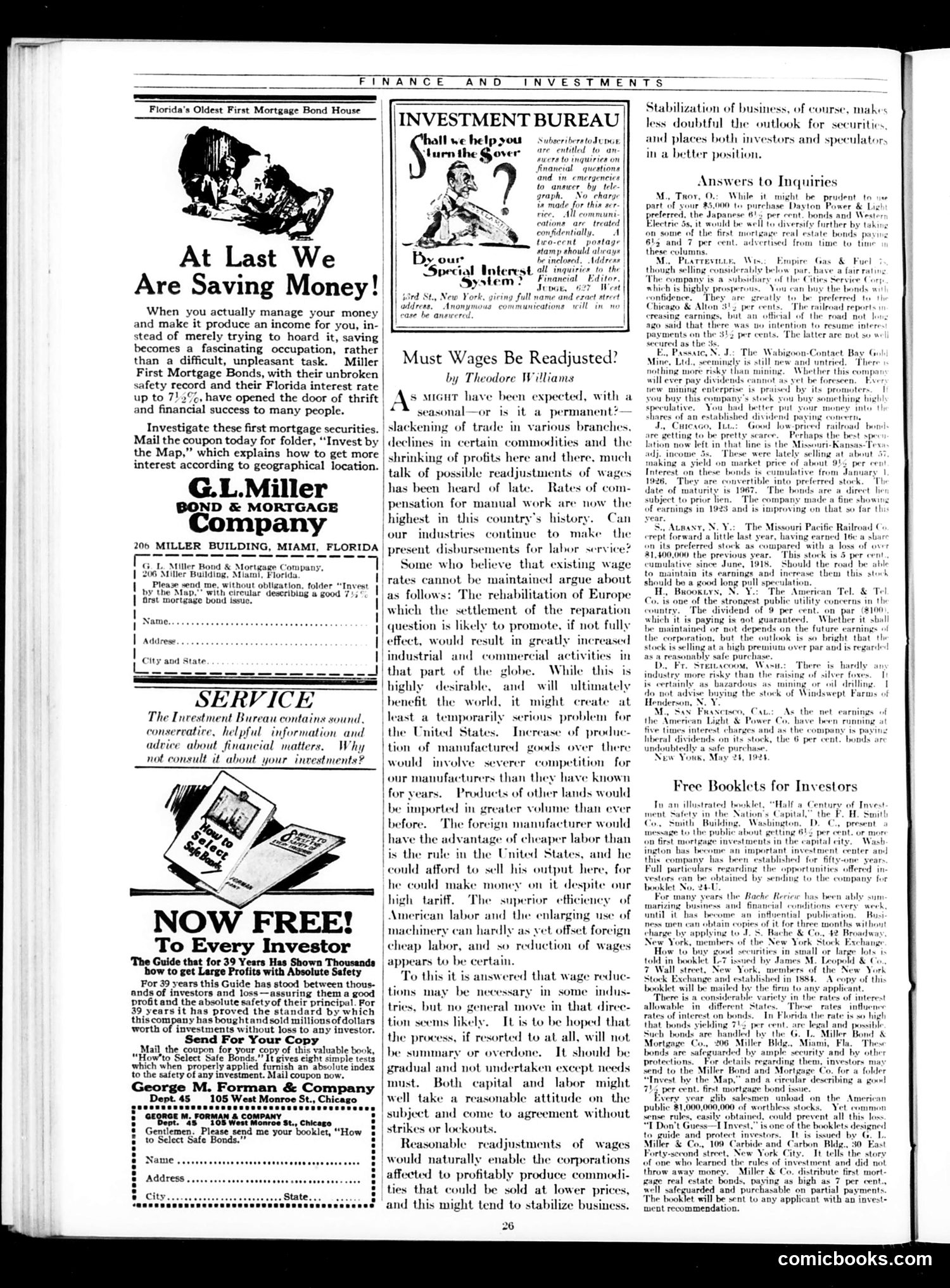
This page from *Judge* magazine is primarily **financial advertising** rather than political satire. It contains investment pitches for Florida real estate bonds and safe investment guides, plus one brief opinion article. The single substantive piece is Theodore Williams' article "Must Wages Be Readjusted?" arguing **against wage cuts** during the 1920s economic slowdown. Williams contends that while European reconstruction might temporarily hurt American manufacturers through foreign competition, reducing American workers' wages—currently at historic highs—would be wrong. He suggests corporations should accept reduced profits rather than cut labor compensation. The article reflects post-WWI economic anxieties: fears of European competition, concerns about industrial profitability, and labor disputes. Williams takes a pro-worker stance unusual for the era's business-focused publications, arguing wages should remain stable even if corporate margins shrink. The remainder is boilerplate investment solicitation typical of the period's speculative Florida real estate boom.
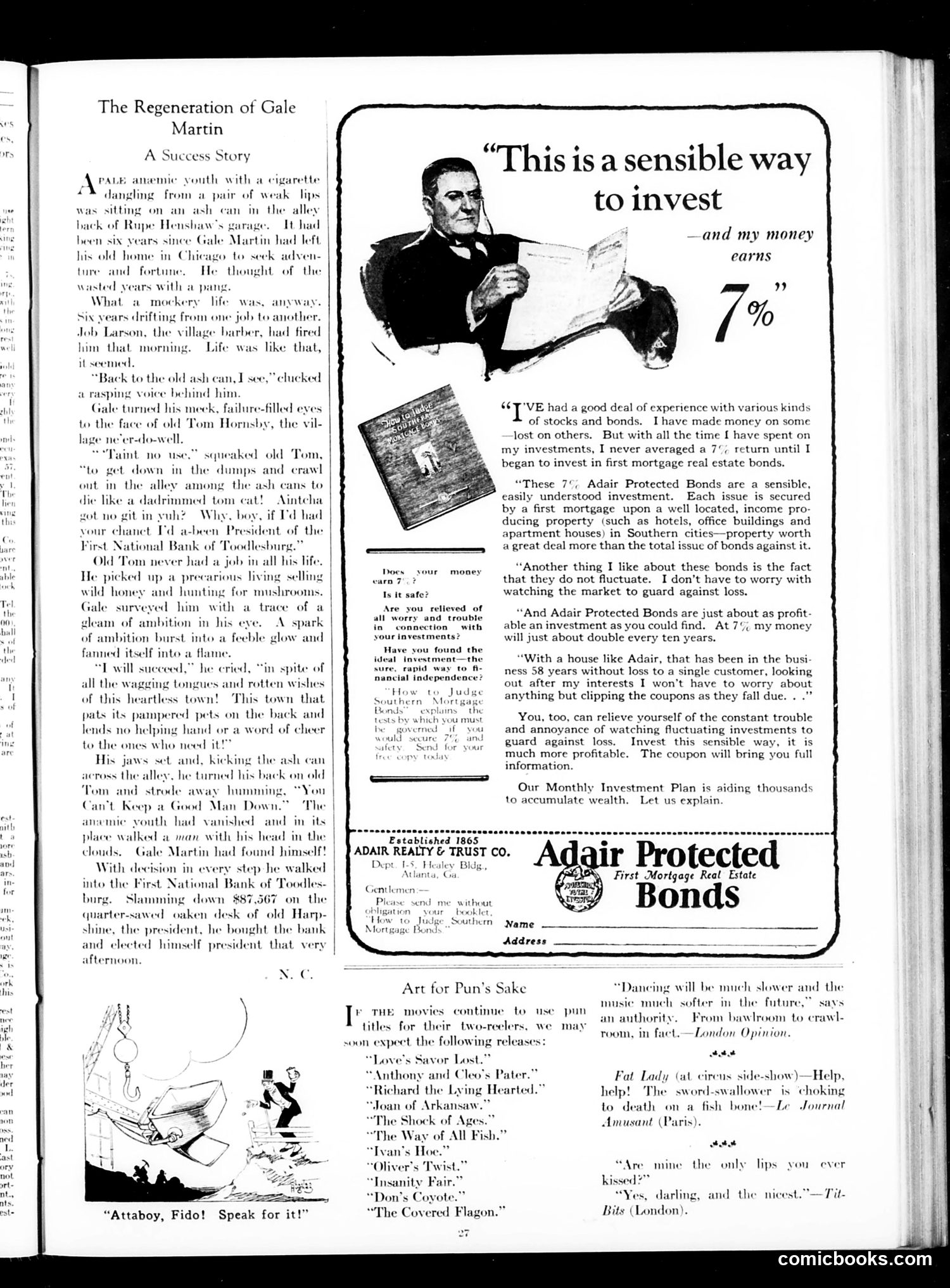
This page contains two distinct elements: **Left side:** "The Regeneration of Gale Martin" is a fictional success story—a rags-to-riches narrative common to early 20th-century American literature. A destitute young man, inspired by an old villager's boast about becoming a bank president, transforms himself through ambition and determination, eventually depositing $87,567 and becoming president of the First National Bank. **Right side:** A full-page advertisement for Adair Protected Bonds (first mortgage real estate investments). The ad uses the fictional character's success story as implicit endorsement—suggesting that sensible investment in secured bonds at 7% returns is the practical path to financial independence, similar to Gale's dramatic success. The satire appears unintentional: the advertisement earnestly promotes bonds as reliable wealth-building, unaware that using a fictional character's implausibly rapid ascent to validate "sensible" investing undercuts its own credibility. The juxtaposition suggests financial promoters exploited American aspirations for quick wealth.
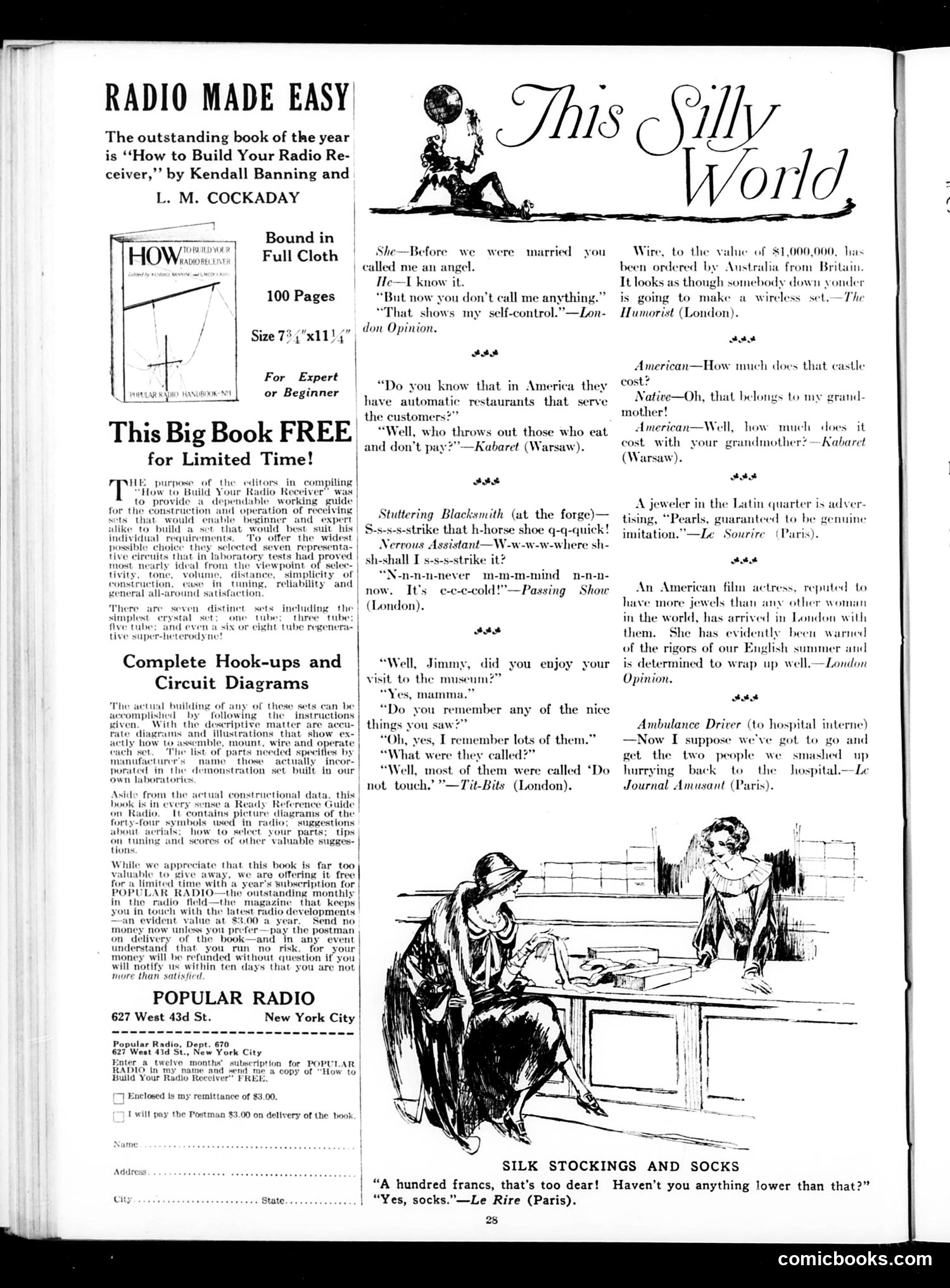
This page combines advertising with a humor column featuring jokes reprinted from international publications. The cartoon shows a man and woman at what appears to be a shop counter, illustrating a joke about silk stockings and socks from *Le Rire* (a French satirical magazine). The "This Silly World" section collects brief anecdotes and jokes from publications worldwide—Paris, London, Warsaw, and elsewhere—showcasing cultural observations. These include: Americans' unfamiliarity with automatic restaurants, a blacksmith's stuttering assistant, a child's museum visit where everything says "Do not touch," and commentary on an American actress arriving in London with excessive jewelry. The humor reflects pre-WWII cosmopolitan attitudes, with gentle jibes at American materialism and European social customs. The page primarily advertises a radio-building instruction book, positioning itself as highbrow entertainment for educated readers interested in both technology and international satire.
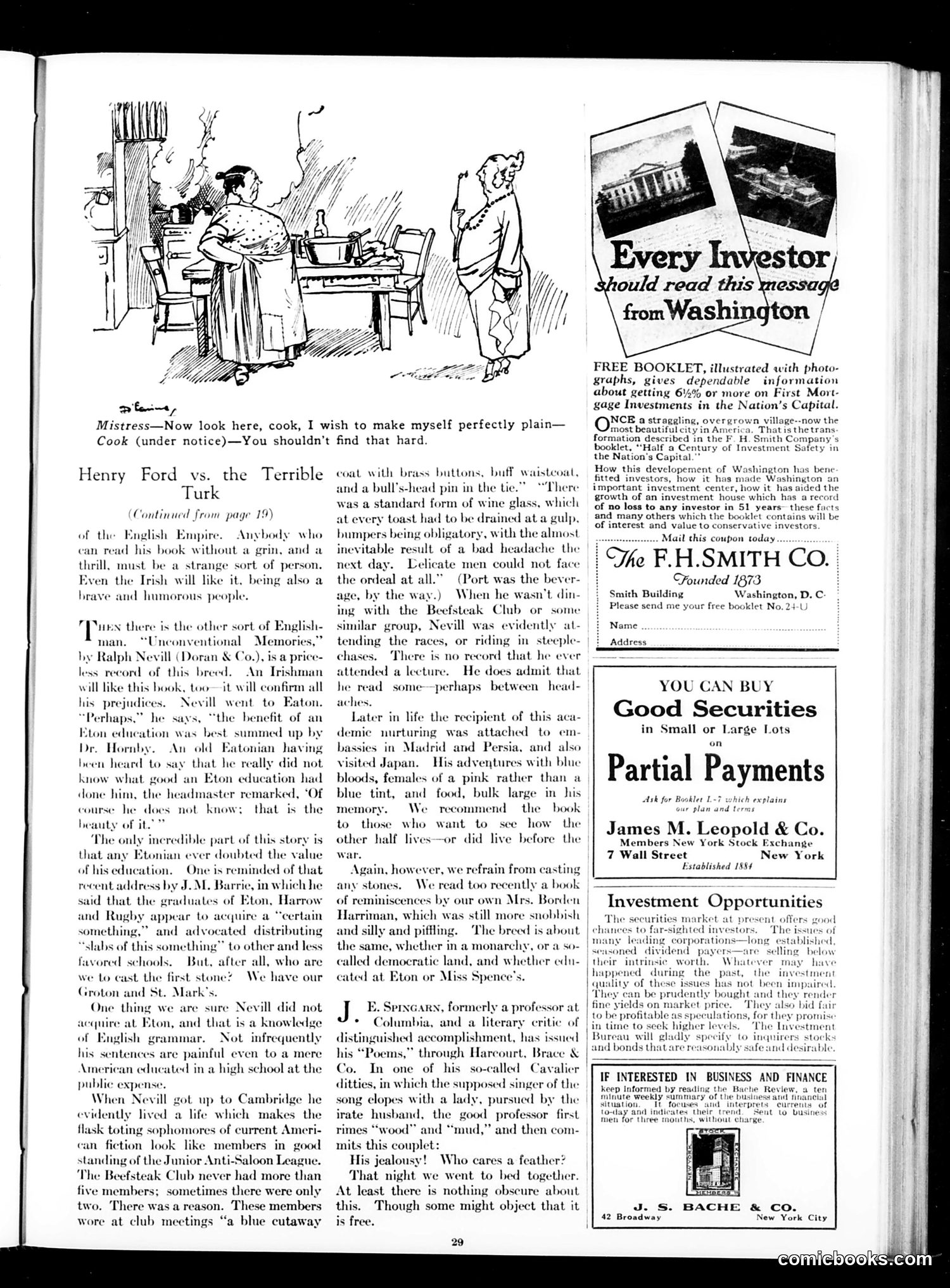
The small cartoon at top left depicts a domestic scene: a mistress is firing her cook, stating "I wish to make myself perfectly plain." The cook interrupts with "You shouldn't find that hard"—a sarcastic jab suggesting the mistress lacks intelligence or sophistication. This is a brief joke about class relations and female employer-employee dynamics in the early 20th century. The humor relies on the cook's cheeky insubordination and implied insult about the mistress's mental capacity. It reflects the era's class-conscious humor common in *Judge* magazine, where servants were depicted as clever enough to deliver cutting remarks to their social superiors while maintaining plausible deniability. The rest of the page contains book reviews by the editor, including commentary on Ralph Nevill's memoir depicting upper-class English society at Cambridge and the Beefsteak Club—frivolous, alcoholic, and intellectually empty despite their prestigious education.
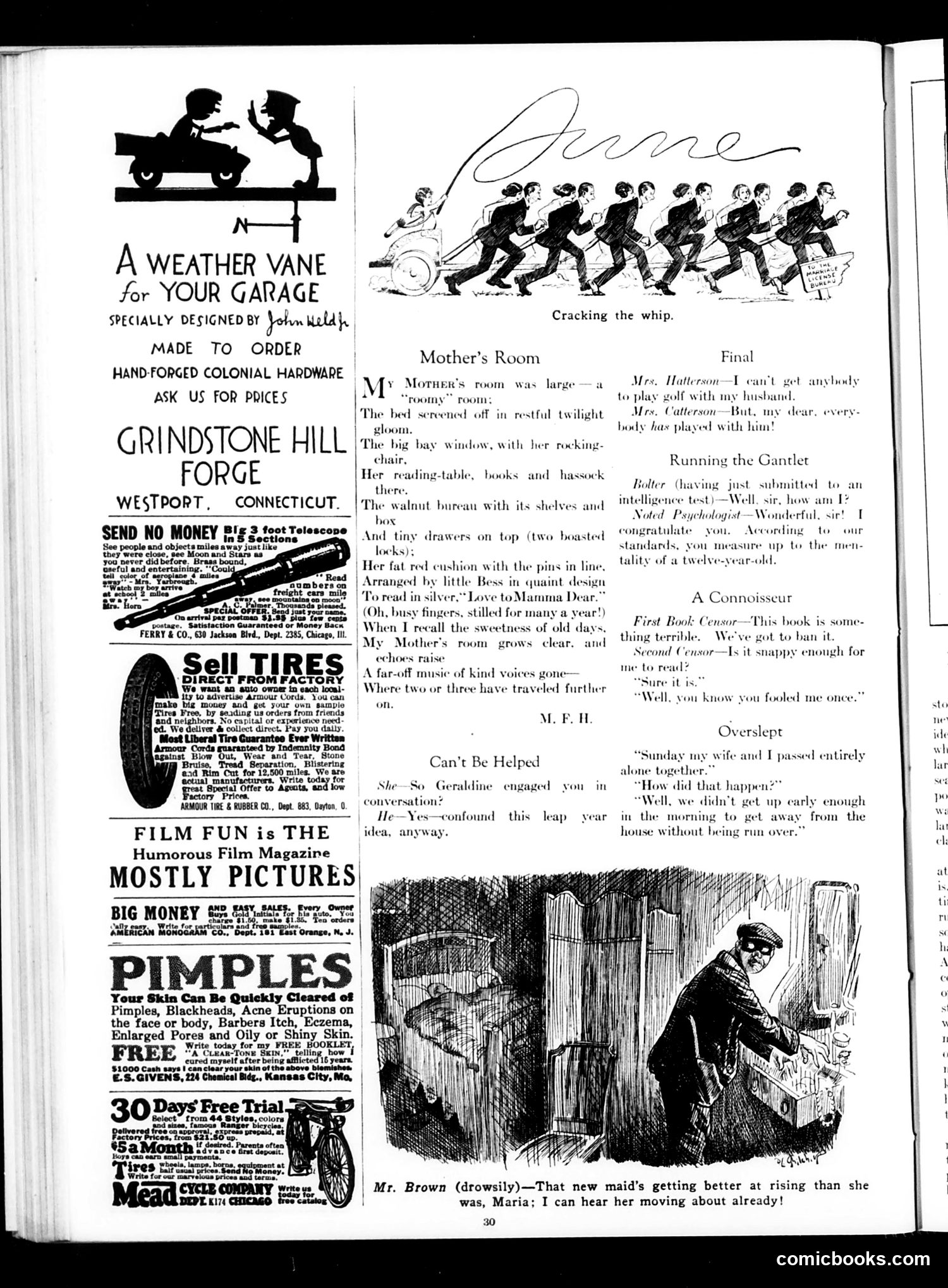
This page is primarily **advertisements and filler content** rather than political satire. The main elements are: **Advertisements:** The bulk of the page features product ads (weather vanes, telescopes, tires, film magazines, acne treatments, motorcycles) typical of early 20th-century magazines. **Comic Content:** The brief humorous pieces are domestic/social humor, not political: - "Mother's Room": Sentimental recollection of a mother's bedroom - "Can't Be Helped," "Final," "Running the Gantlet," "A Connoisseur," "Overslept," and the Mr. Brown caption: All are mild domestic jokes about marriage, parenting, psychological testing, and household situations **Context for Modern Readers:** These jokes rely on early 20th-century middle-class conventions—wives managing households, husbands avoiding golf partners, servants, and censorship debates. There's no significant political or social commentary; this appears to be a lighter section of Judge magazine focused on entertainment and advertising rather than satirical editorial content.
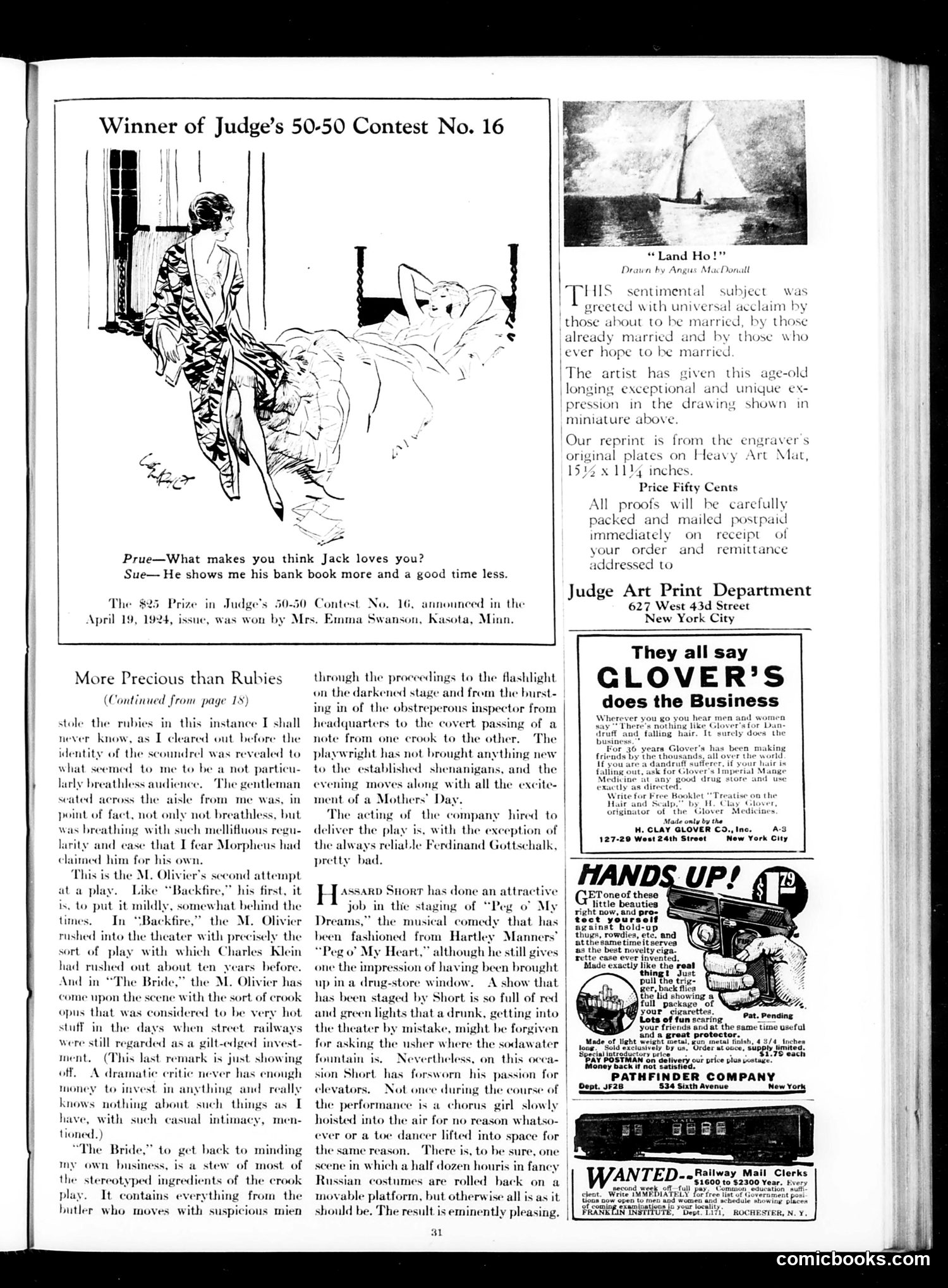
This page from Judge (c. 1924) contains theater criticism and advertisements rather than political satire. **Main Content:** A critical review titled "More Precious than Rubies" discusses M. Olivier's theatrical production "The Bride"—a crime melodrama featuring conventional plot devices (crooks, inspectors, secret notes). The reviewer dismisses it as dated and tedious, comparing it unfavorably to earlier works by playwright Charles Klein. **The Cartoon:** The small cartoon at top shows a domestic scene with the caption: "Prue—What makes you think Jack loves you? Sue—He shows me his bank book more and a good time less." This is satirical commentary on marriage dynamics, suggesting husbands prioritize financial caution over entertaining their wives—a reflection of 1920s gender and marital expectations. **Secondary Theater Review:** Brief praise for "Peg o' My Dreams," noting director Assaro Short's excessive use of theatrical lighting and elevators, though he restrained himself here. The page is primarily entertainment criticism with light domestic humor rather than political commentary.
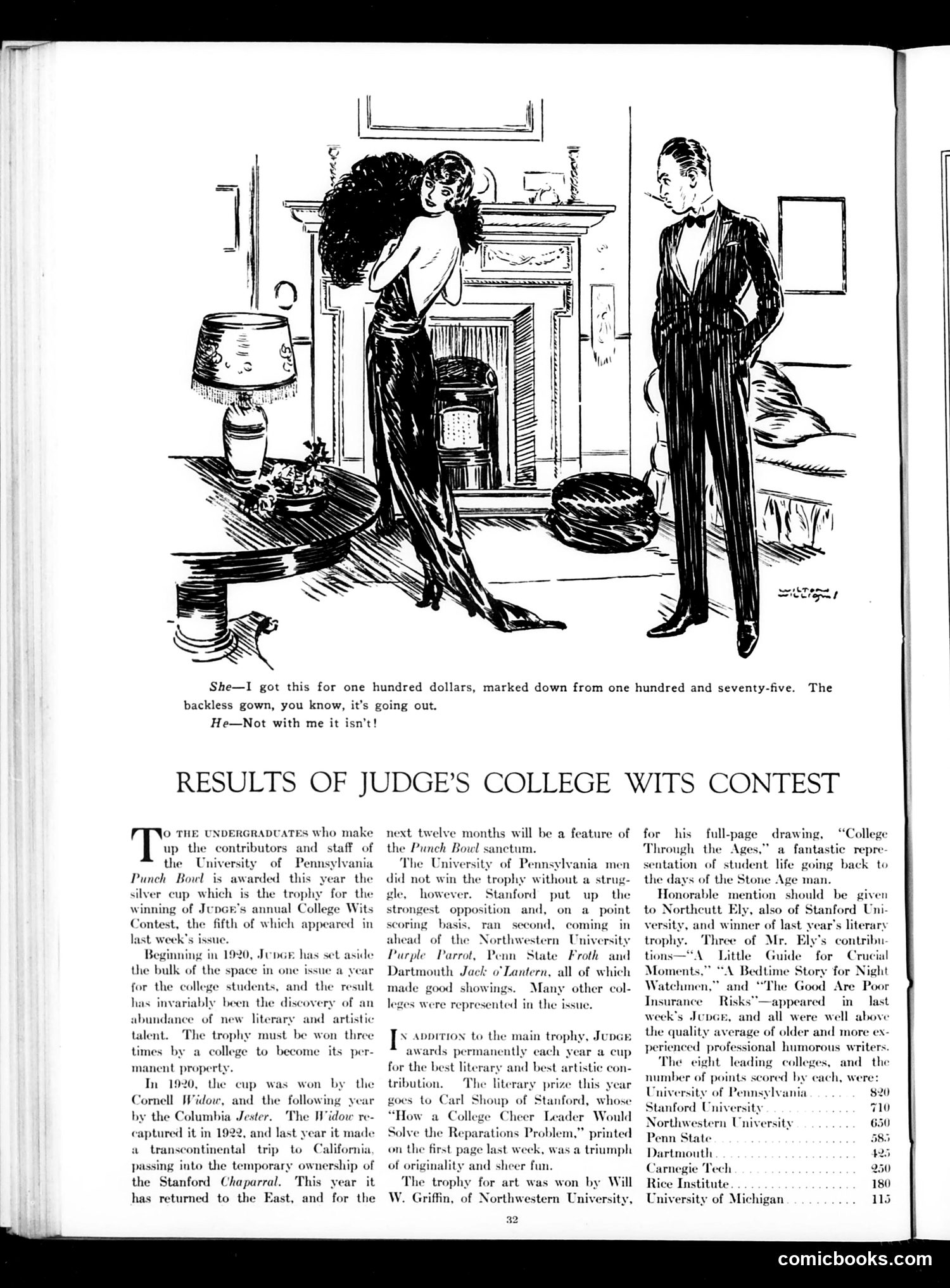
This page reports on Judge magazine's annual college humor competition among undergraduate publications. The satirical cartoon at top depicts a domestic scene: a woman shows her husband a "backless gown" she purchased at a steep discount, remarking the style is "going out." His response—"Not with me it isn't!"—is a double entendre: he refuses to let her wear it publicly while also making a crude joke about the exposed back. The text celebrates University of Pennsylvania's Punch Bowl winning the competition's silver trophy for the third time, making it permanent property. Stanford's *Chaparral* came second. The contest identifies winning humor contributions: Carl Shoup's piece on reparations and Will W. Griffin's "College Through the Ages" artwork. The page lists the eight highest-scoring college publications and their points. The humor reflects 1920s collegiate culture and flapper-era fashion anxieties.
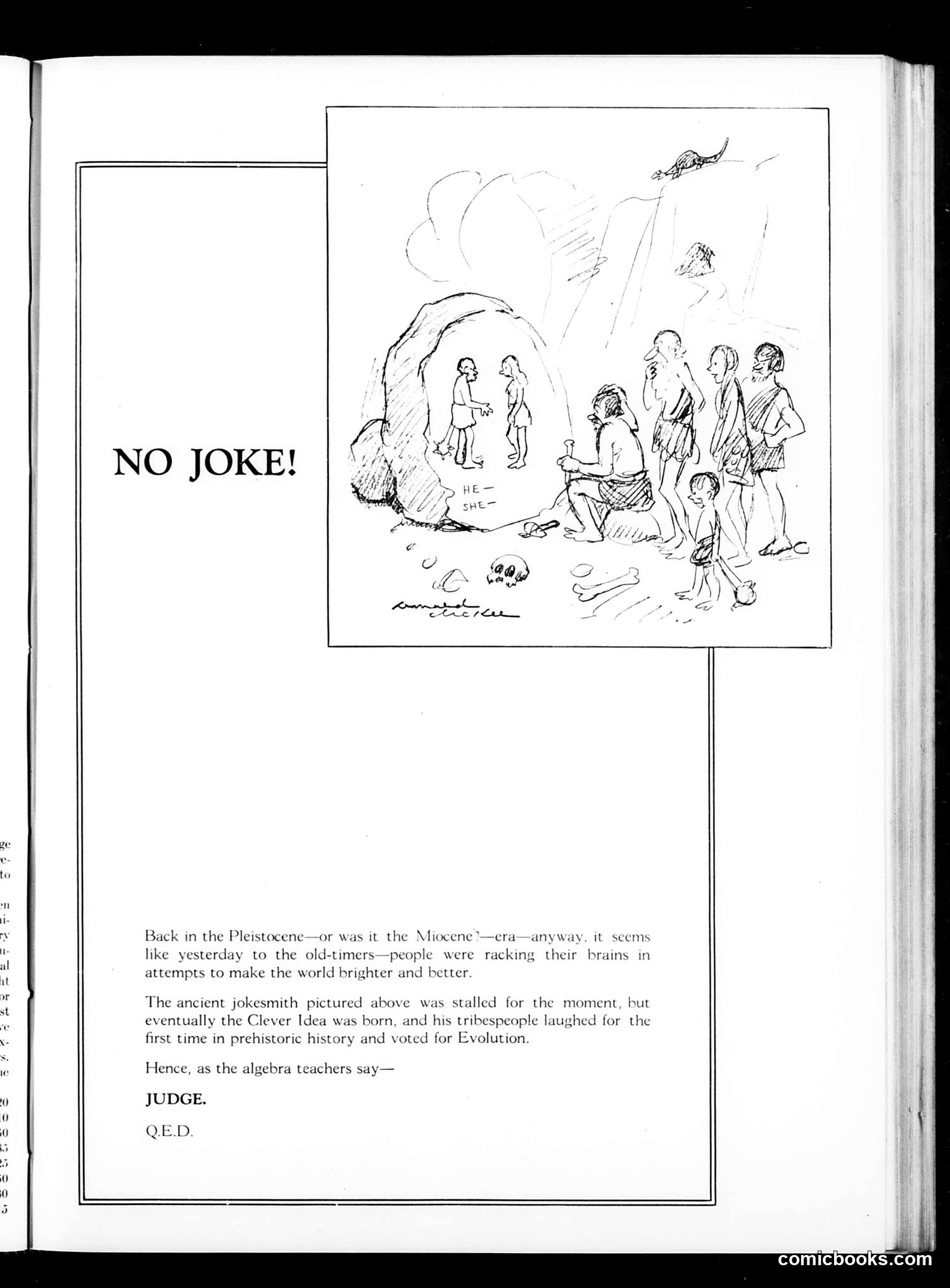
This is a full-page advertisement for *Film Fun*, a movie magazine competing for readers' attention. The ad uses a rhetorical question to challenge readers about whether they're reading the "best" movie magazine, implying *Film Fun* is superior. It advertises three selling points: "Much humor," "More pictures," and "Lotsa information"—appealing to entertainment seekers with casual, colloquial language ("Lotsa"). The July issue announcement and "NOW!" urgency suggest this is a time-sensitive promotional push. At 20 cents per copy, it targets mass-market consumers. The ad reflects the early 20th-century proliferation of fan magazines devoted to Hollywood, when cinema was wildly popular and numerous competing publications sought reader subscriptions. This is marketing, not satire—typical advertising copy from Judge magazine's pages.