
Judge, 1924-05-31 · page 20 of 36
Judge — May 31, 1924 — page 20: what you’re looking at
What you’re looking at
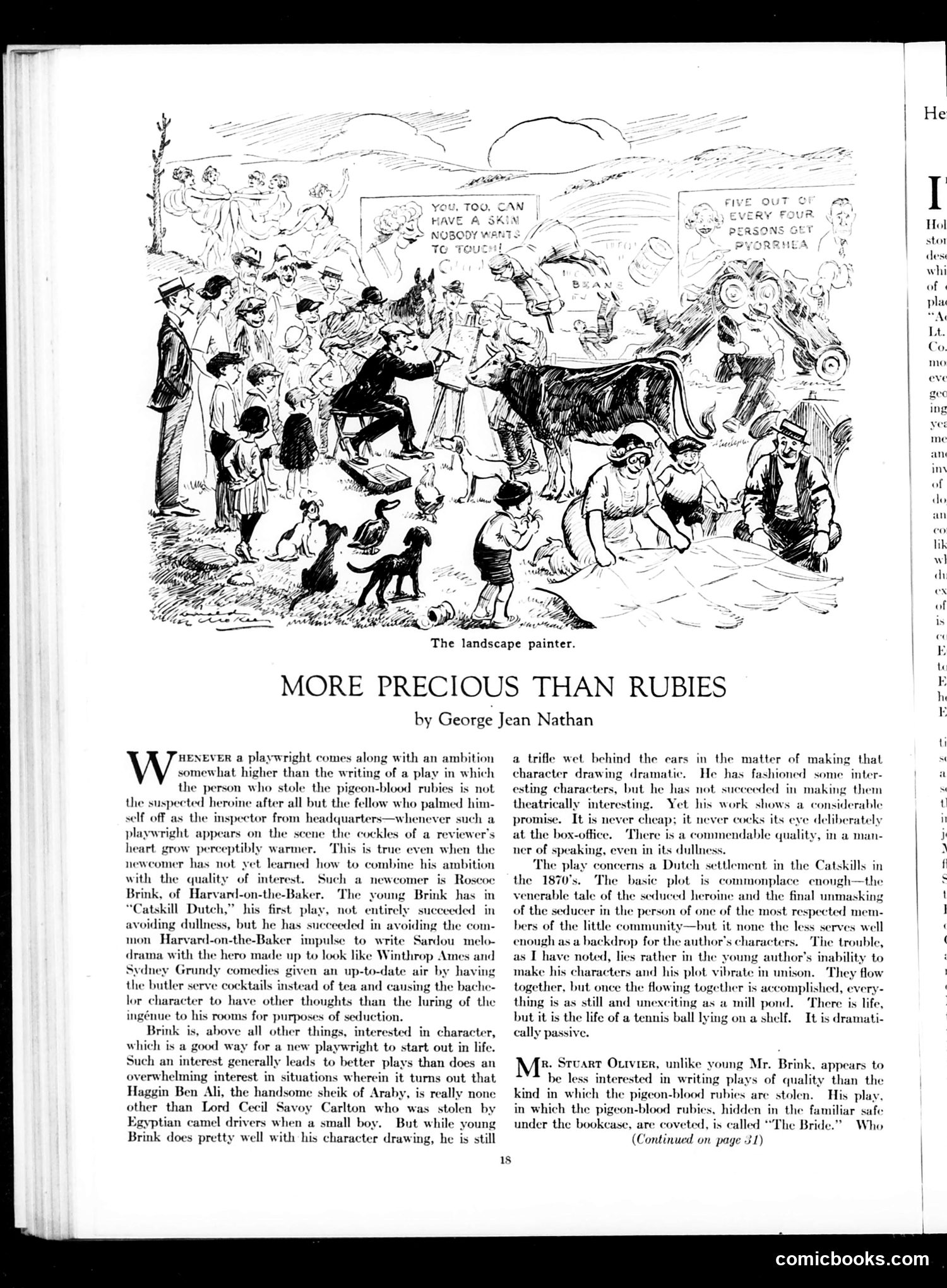
This page contains a theater critique by George Jean Nathan, not primarily a political cartoon. The small illustration titled "The landscape painter" at the top depicts a chaotic outdoor scene with crowds and a cow—likely a humorous vignette unrelated to the main text. Nathan's article reviews new playwrights, particularly praising Roscoe Brink for writing character-driven drama rather than melodramatic plots involving stolen "pigeon-blood rubies"—a satirical reference to overwrought, clichéd theatrical plots common in early 20th-century theater. Nathan criticizes plays featuring contrived twists (like a character revealed as nobility stolen by camel drivers) or shallow comedy (butlers serving cocktails instead of tea). The satire mocks low-quality commercial theater and praises ambition toward serious dramaturgy. References to playwrights like Sardou and Grundy were recognizable to contemporary audiences as representatives of melodramatic convention.
📄 Transcribed text from this page (OCR, searchable)
Machine-transcribed from the original scan — historical spelling and the odd misread are preserved.
Dy, The landscape painter. MORE PRECIOUS THAN RUBIES by George Jean Nathan HENEVER a playwright comes along with an ambition somewhat higher than the writing of a play in which the person who stole the pigeon-blood rubies is not the suspected heroine after all but the fellow who palmed hi self off as the inspector from headquarters—whenever such 4 playwright appears on the scene the cockles of a reviewer's heart grow perceptibly warmer. This is true even when the neweomer has not yet learned how to combine his ambition with the quality of interest. Such a newcomer is Roscoe Brink, of Harvard-on-the-Baker. The young Brink has in “Catskill Dutch,” his first p! not entirely succeeded in avoiding dullness, but he has succeeded in avoiding the com- mon Harvard-on-the-Baker impulse to write Sardou melo- drama with the hero made up to look like Winthrop Ames and Sydney Grundy co given an up-to-date air by having the butler serve cocktails instead of tea and causing the bache- lor character to have other thoughts than the luring of the ingénue to his rooms for purposes of seduction. Brink is, above all other things, interested in character, which is a good way for a new playwright to start out in life. Such an interest ge Ily leads to better plays than does an overwhelming interest in situations wherein it turns out that Haggin Ben Ali, the handsome sheik of Araby, is really none other than Lord Cecil Savoy Carlton who was stolen by Egyptian camel drivers when a small boy. But while young Brink does pretty well with his character drawing, he is still a trifle wet behind the ears in the matter of making that character drawing dramatic. He has fashioned some inter- esting char theatric promise. at the box-offic ner of speaking, ¢ The play con s, but he has not succeeded in making them Yet his work shows a consi ble it never cocks its eye deliberately a commendable quality, in a man- its dullness. Dutch settlement in the Catskills in the 1870's. The basic plot is commonplace enough—the venerable tale of the seduced heroine and the final unmasking of the seducer in the person of one of the most respected mem- hers of the little communit but it none the less serves well enough as a backdrop for the author's cha rs. The trouble, as I have noted, lies rather in the young author's inability to make his characters and his plot vibrate in unison. They flow together, but once the flowing together is accomplished thing is as still and unexciting as a mill pond. ‘There is 5 but it is the life of a tennis ball lying on a shelf. It is dramati- cally passive. rR. Stuart Outvier, unlike young Mr. Brink, appears to be interested in writing plays of quality than the kind in which the pigeon-blood rubies are stolen. His play, in which the pigeon-blood rubies, hidden in the familiar safe under the bookcase, are coveted, is called “The Bride.” Who (Continued on page 31) comicbooks.com