
Judge, 1924-05-31 · page 4 of 36
Judge — May 31, 1924 — page 4: what you’re looking at
What you’re looking at
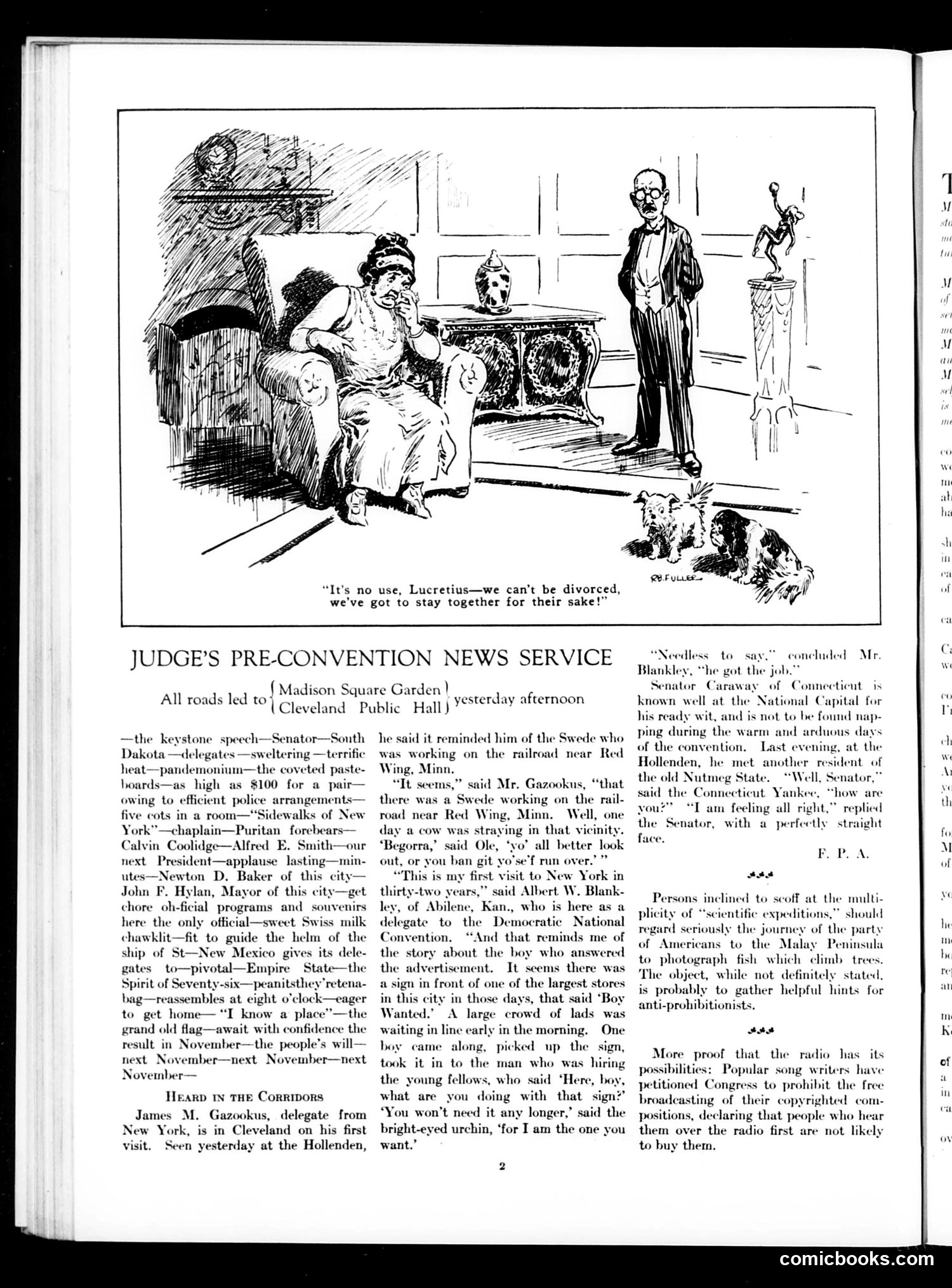
The main cartoon depicts a domestic dispute. A woman sits in an armchair while a man stands nearby; the caption reads: "It's no use, Lucretius—we can't be divorced, we've got to stay together for their sake!" A dog lies in the foreground, apparently the "their" referenced—the couple must remain married for the pet's welfare, a satirical reversal of the common excuse "staying together for the children." The surrounding text reports on Democratic National Convention news from various cities, mentioning delegates, speeches, and political gossip. This appears to be part of Judge's "Pre-Convention News Service," mixing political reporting with humorous commentary typical of the magazine's satirical approach to contemporary events. The cartoon's joke mocks the rationalization people use to justify unhappy marriages.
📄 Transcribed text from this page (OCR, searchable)
Machine-transcribed from the original scan — historical spelling and the odd misread are preserved.
“It’s no use, Lucretius—we can’t be divorced, we've got to stay together for their sake!” JUDGE’S PRECCONVENTION NEWS SERVICE All roads led to i Cleveland —the keystone speech—Senator—South Dakota gates —sweltering —terrific heat—pandemonium—the coveted paste- hoards—as high as $100 for a pair— owing to efficient police arrangements— five cots in a roon—"Sidewalks of New York”—chaplain—Puritan forebears— Calvin Coolidge—Alfred E, Smith—our next President—applause lasting—min- utes—Newton D. Baker of this city— John F. Hylan, Mayor of this city—get chore oh-ficial programs and souvenirs here the only official—sweet Swiss milk chawklit—fit to guide the helm of the ship of St—New Me ives its dele- to get home— “I know a place”—the grand old flag—await with confidence the result in Novermber—the people’s will— next November—next November—next Novernber— HEARD IN THE CorrtpoRS James M. Gazookus, delegate from New York, is in Cleveland on his first visit. Seen yesterday at the Hollenden, { Madison Square Garden } Public yesterday afternoon Hall ) he said it reminded him of the Swede who was working on the railroad near Red Wing, Minn. “It seems,” said Mr. Gazookus, “that there was a Swede working on the rail- road near Red Wing, Minn. Well, one day a cow was stri in that vicinity. “Begorra,’ said Ole, ‘yo’ all better look out, or you ban git y run 07 3 “This is my first visit to New York in thirty-two years,” said Albert W. Blank- le of Abilene, Kan., who is here as a delegate to the Democratic National Convention. ‘And that reminds me of the story about the boy who red the advertisement. It seems there was a sign in front of one of the largest stores in this city in those days, that said ‘Boy Wanted.’ A large crowd of lads was waiting in line early in the morning. One boy along, picked up the sign, took it in to the man who was hiring the young fellows, who said ‘Here, boy, what are you doing with that sign? ‘You won't need it any longer,’ said the bright-eyed urchin, ‘for I am the one you want.’ “Nees to say. concluded = Mr. Blankley, “he got the job. Senator Caraway of Connecticut is known well at the National Capital for his ready wit, and is not to be found nap- ping during the warm and arduous days of the convention. Last evening, at the Hollenden, he met another resident of the old Nutmeg State. “Well, Senator,” said the Connecticut Yankee, you?” “I am feeling all right,” replied the Senator, with a perfectly straight face. how are tae Persons inclined to scoff at the multi- plicity of “scientific expeditions,” should regard seriously the journey of the party of Americans to the Malay Peninsula to photograph fish which climb trees. The object, while not definitely stated, is probably to gather helpful hints for anti-prohibitionists. sae More proof that the radio has its possibilities: Popular song writers have petitioned Congress to prohibit the free broadcasting of their copyrighted com- positions, declaring that people who hear them over the radio first are not likely to buy them. comicbooks.com