
Judge, 1924-05-31 · page 17 of 36
Judge — May 31, 1924 — page 17: what you’re looking at
What you’re looking at
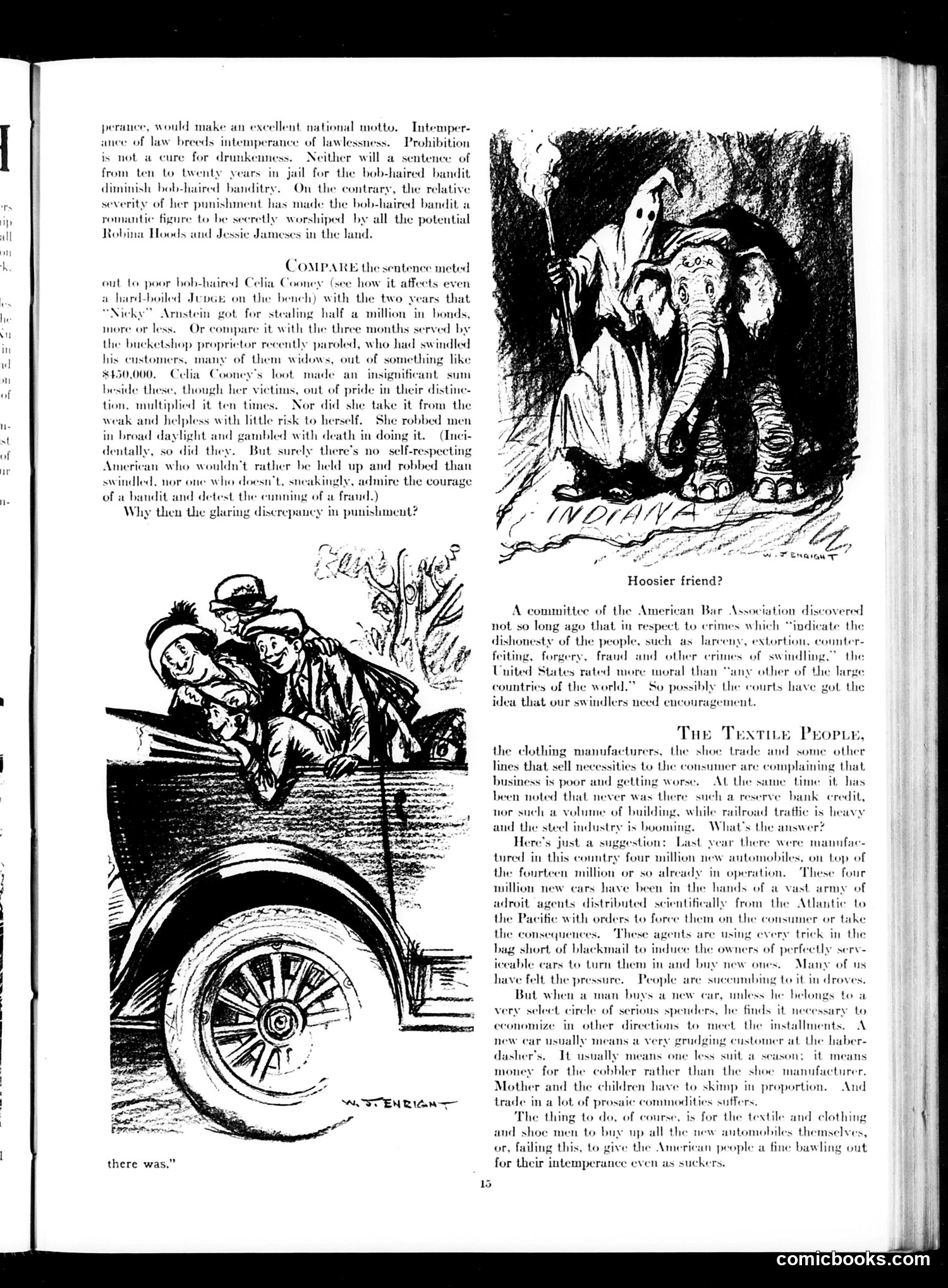
This page critiques **judicial inconsistency and inequality**, using the "bob-haired bandit" case as its focal point. **The Main Argument:** The text compares Celia Cooney's harsh sentence for armed robbery against far lighter punishments for white-collar criminals—"Nicky" Arnstein (bonds theft) and a bucketshop operator (swindling widows of $450,000). The satire questions why violent crime receives disproportionate punishment while fraud and embezzlement go lightly penalized. **The Cartoons:** The upper illustration shows an elephant labeled "Indiana," likely referencing the 1920s "bob-haired bandit" era when Celia Cooney and similar young female robbers became folk heroes. The lower cartoon depicts criminals escaping in an automobile, visually reinforcing the romanticization of bandits. **The Point:** Judge argues that severe punishment actually *glorifies* criminals rather than deterring crime, and that the courts show bias favoring wealthy offenders. The piece advocates for proportional, rational sentencing rather than harsh reactive measures—a progressive critique of 1920s criminal justice.
📄 Transcribed text from this page (OCR, searchable)
Machine-transcribed from the original scan — historical spelling and the odd misread are preserved.
perance, would make an excellent national motto. Intemper- ance of law breeds intemperance of lawlessness. Prohibition is not a cure for drunkenness. Neither will a sentence of from ten to twenty years in jail for the bob-haired bandit. diminish bob-haired banditry. On the contrary, the rela severity of her punishment has made the bob-haired bandit a romantic figure to be secretly worshiped by all the potential Robina Hoods and Jessie Jameses in the land. COMPARE the sentence meted out to poor bob-haired Celia Cooney: (see how it affects even a hard-boiled JepGe on the bench) with the two years that “Nicky” Arnstein got for stealing half a million in’ bonds, more or less. Or compare it with the three months served by the bucketshop proprietor recently paroled, who had swindled his customers, many of them widows, out of something like $450,000, Celia Cooney’s loot made an_ insignificant’ sum beside these, though her victims, out of pride in their distine- tion, multiplied it ten times. Nor did she take it from the weak and helpless with little risk to herself. She robbed men in broad daylight and gambled with death in doing it. (Inci- dentally, so did they. But surely there’s no_ self-respecting American who wouldn't rather be held up and robbed than swindled, nor one who doesn’t, sneakingly, admire the courage of a bandit and detest the cunning of a fraud.) Why then the glaring discrepancy in punishment? Hoosier friend? A committee of the American Bar Association discovered not so long ago that in respect to crimes which “indicate the dishonesty of the people, such as. larceny, extortion, counter- feiting, forgery, fraud and other crimes of swindling,” the United States rated more moral than “any other of the large countries of the world.” So possibly the courts have got the idea that our swindlers need encouragement. Tue Textive Prorie, the clothing manufacturers, the shoe trade and some other lines that sell necessities Lo the consumer are complaining that business is poor and getting worse. At the same time it has been noted that never was there such a reserve bank credit, nor such a volume of building, while railroad trafic is heavy and the steel industry is booming. What's the answer? Here’s just a suggestion: Last year there were manufac- tured in this country four million new automobiles, on top of the fourteen million or so already in operation. These four iillion new cars have been in the hands of a vast army of adroit agents distributed scientifically from the Atlantic to the Pacific with orders to force them on the consumer or take the consequences. These agents are using every trick in the bag short of blackmail to induce the owners of perfectly serv- iceable cars to turn them in and buy new ones. Many of us have felt the pressure. People are succumbing to it in droves. But when a man buys a new car, unless he belongs to a very select circle of serious spenders, he finds it necessary to economize in other directions to mect the installments. A new car usually means a very grudging customer at the haber- dasher’s. It usually means one less suit a season; it means money for the cobbler rather than the shoe manufacturer. Mother and the children have to skimp in proportion. And WL STEN RIG trade in a lot of prosaic commodities suffers. 4 The thing to do, of course, is for the textile and clothing and shoe men to buy up all the new automobiles themselves, or, failing this, to give the American people a fine bawling out there was.” for their intemperance even as suckers. comicbooks.co