
Judge, 1924-05-31 · page 8 of 36
Judge — May 31, 1924 — page 8: what you’re looking at
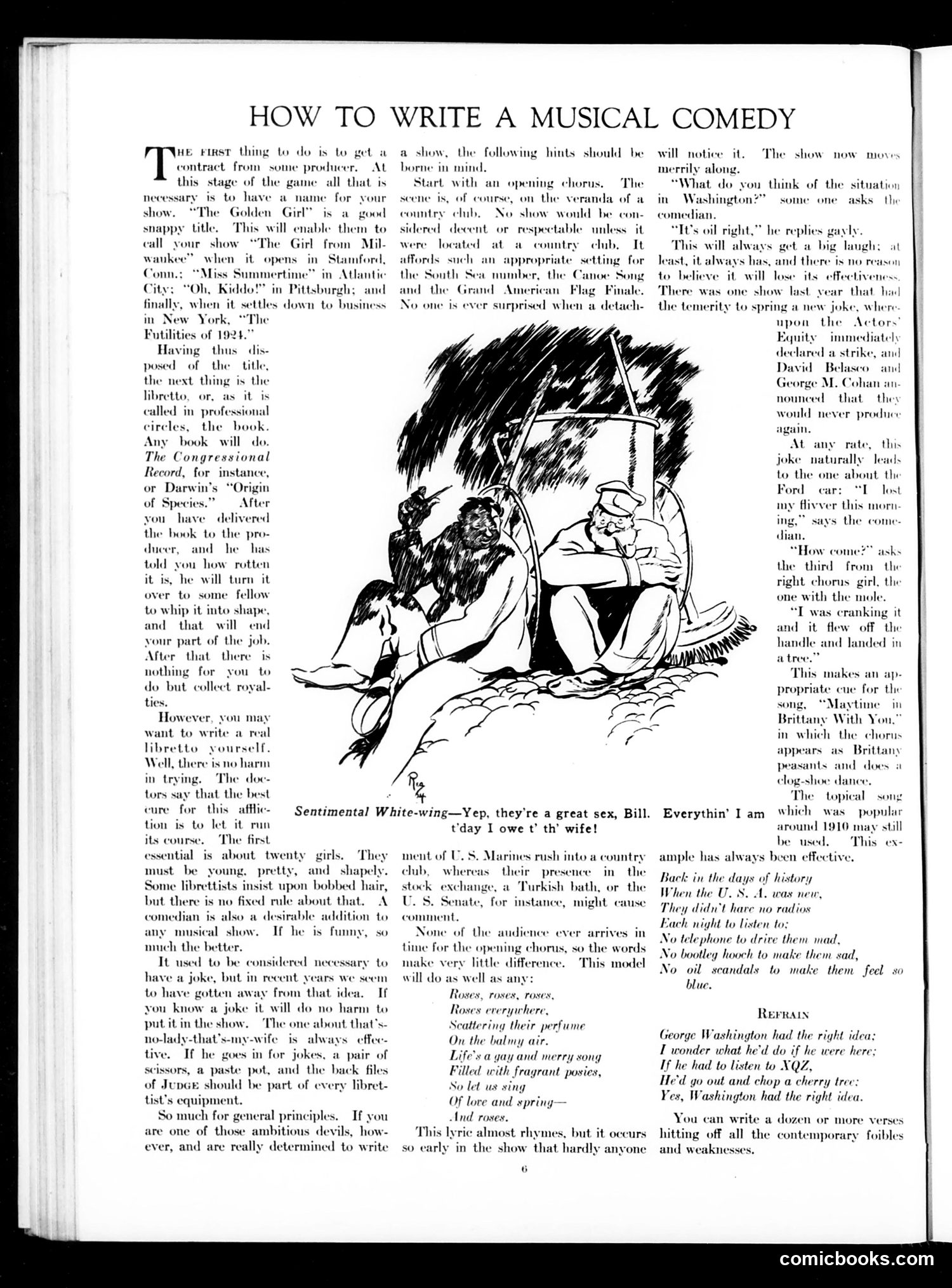
What you’re looking at
This is a satirical instructional article about composing Broadway musical comedies, likely from the early 1920s. The accompanying cartoon depicts two men in a canoe, humorously illustrating the absurdity of musical-theater conventions. The piece mocks standard practices: interchangeable titles, formulaic plots (always set at a country club), mandatory chorus girls, weak jokes recycled from *Judge* magazine files, and opening numbers with lazy rhyming lyrics. The text notes these elements are so predictable that audiences don't arrive until after the opening chorus anyway. The cartoon's caption—a crude sex joke about a man and his "great sex" wife—exemplifies the lowbrow humor the article both satirizes and employs. The overall tone is cynical about commercial Broadway's reliance on tired formulas, pretty girls, and dated gags rather than genuine wit or originality.
📄 Transcribed text from this page (OCR, searchable)
Machine-transcribed from the original scan — historical spelling and the odd misread are preserved.
HOW TO WRITE A MUSICAL COMEDY HE First thing to do is to get a ] contract from some producer, At this stage of the game all that is necessary is to have a name for your “The Golden Girl” snappy title. This will enable them to call your show “The Girl from Mil- wankee™ when it opens in’ Stamford, Com; “Miss Summertime” in Atlantic “Oh, Kiddo!” in Pittsburgh; and finally, when it settles down to business in New York, “The Futil of 1924." Having thus dis- posed of the title, the next thing is the libretto. Jed in professional circles, the book. Any book will The Congressional Record, for instance, or Darwin's “Origin of Species. After you hi delivered the book to the pro- duc has told you how rotten it is, he will turn it show. is a good or, as it is and he over to some fellow to whip it into shape, and that will end your part of the job. After that nothing for do but collect reyal- there is you to ties. However, you 1 want to write libretto yourself. Well, there is no harm in trying. The doe- tors say that the | cure for this affli tion is to let it) run its course. ‘The first essential is about twenty girls. They must be young, pretty, and shapely. Some librettists insist upon bobbed hair, but there is no fixed rule about that. A comedian is also a desirable addition to any musical show. If he is funy, so much the better. It used to be considered necessary. to have a joke, but in recent years we seem to have gotten away from that ic If you know a joke it will do no harm to put itin the show. ‘The one about that's- dy-that’s-my-wife is always effec- If he goes in for jokes, a pair of scissors, a paste pot, and the back files of JupGe should be part of every libret- tist's equipment. So much for general principles. If you are one of those ambitious devils, how- ever, and are really determined to write a show, the following hints should: be borne in mind. The nda of a No show would be con- Start with an opening chorus. scene is, of course, on the ver: country. chub, sidered decent. or respectable unless. it country club, It affords such an appropriate. setting for the South Sea numbe and the Ame were located ata the Canoe Song Sentimental White-wing—Yep, they're a great sex, Bill. t'day I owe t’ th’ wife! ment of U.S. Marines rush into a country club, their presence in the a Turkish bath, or the instance, might cause sof the audience ever arrives in time for the opening chorus, so the words make very little difference. This model will do as well as any: Roses, roses, roses, Roses everywhere, Scattering their perfume On the balmy air. Life's a yay and merry song Filled with fragrant posies, So let us sing Of love and spring— -Ind roses. ‘This lyric almost rhymes, but it occurs so carly in the show that hardly anyone notice it, The show merrily along. “What do you think of the in Washington?” i will now moves sume one comedian, “It's oil right,” he replies gayly. This will always get a big laugh: at least, it always has, and there is no reason to belie it will lose There was one show last year that had its effectiveness the temerity to spring a new wher: the Actors’ immediately declared a strike, and David and George M. Cohan an nounced that — they would never produc upon Equity asco this leads any rate, joke naturally to the one about the Ford 2 SE Tost iy flivver this morn ing,” dian. says the come. “How come?” asks the third) from the right chorus. girl, the one with the mole. “T was cranking it and it flew. off the handle and landed in atree.” This makes an ap- propriate cue for the song, “Maytime in Brittany With You.” in which the chorus appears as. Brittany peasants and does how dane The which topical song was popular around 1910 may still be used. This ex- ample has always been effective, Back: in the di When the U. They didwt have no radios Each night to listen to: No telephone to drive them mad, No bootleg hooch to make them sad, No oil scandals to make them feel so blue. Everythin’ I am sof history was new, Rerrain George Washington had the right idea: T wonder what he'd do if he were here: If he had to listen to XQZ, He'd go out and chop a cherry tree: Yes, Washington had the right idea. You can write a dozen or more verses hitting off all the contemporary foibles and weaknesses. comicbooks.com