
A complete issue · 36 pages · 1924
Judge — May 10, 1924
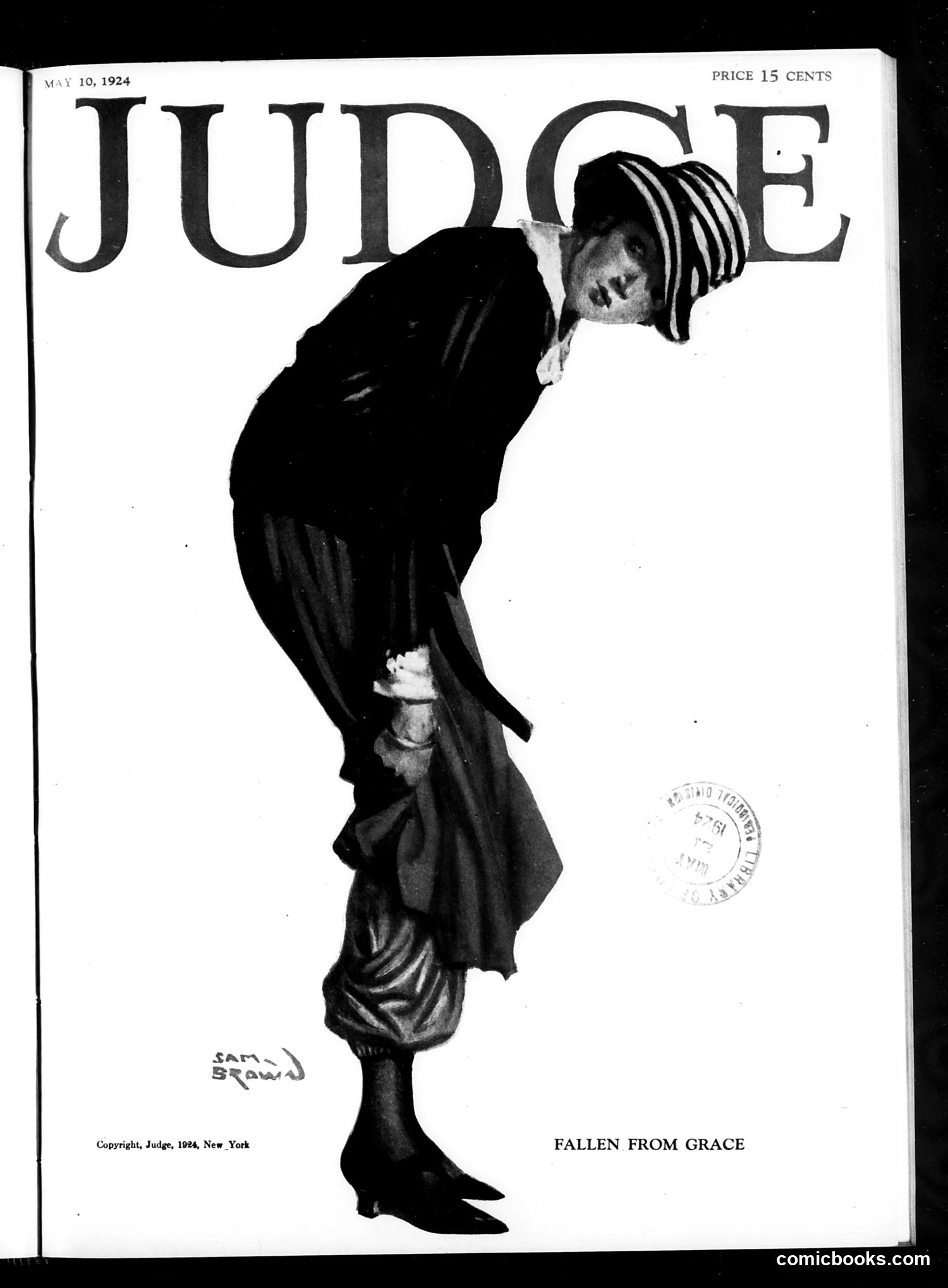
This cover illustration by Sam Brow depicts a figure in formal attire bent over with a dumbbell, titled "Fallen from Grace." The satire appears to address moral or social decline—likely referring to a public figure or political scandal of 1924. The contorted posture and weight suggest someone struggling under burden or disgrace. Without identifying the specific individual caricatured, the cartoon employs physical exaggeration typical of Judge's satirical style to mock someone perceived as having lost respectability or power. The formal dress contrasts with the undignified posture, emphasizing the fall from a position of prominence or authority. The exact political or social context remains unclear without additional documentation, though Judge frequently targeted politicians and public figures of the era.
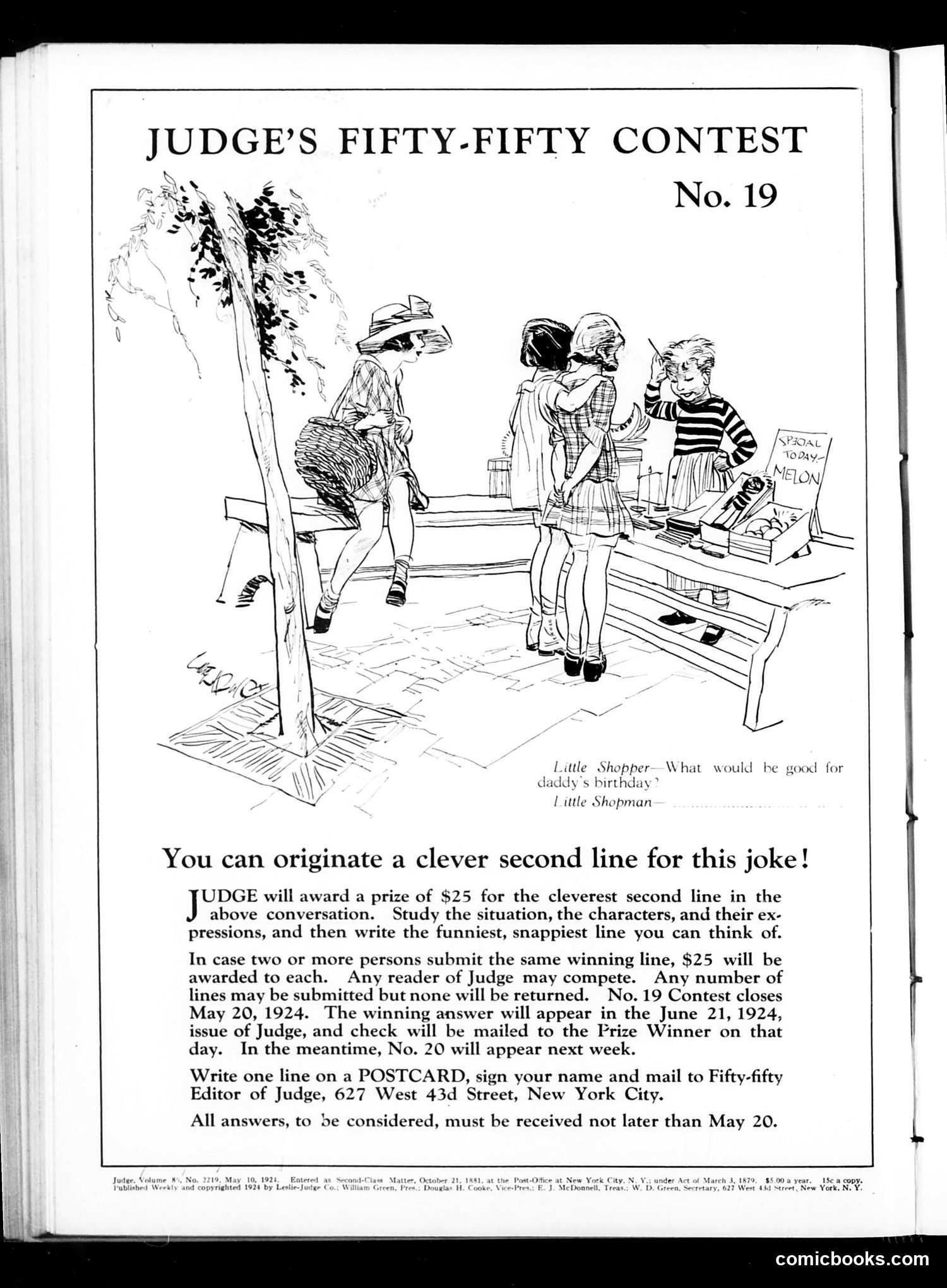
This page features a "Judge's Fifty-Fifty Contest" inviting readers to complete a joke. The cartoon shows a retail scene where a "Little Shopper" asks a "Little Shopman" what would be good for daddy's birthday. The setup appears to be a straightforward retail interaction, likely setting up a double-entendre or clever wordplay punchline typical of 1920s humor. Readers were invited to submit their own second line for $25, with the winning answer to appear June 21, 1924. The contest reflects Judge magazine's interactive nature—engaging readers as humor contributors while maintaining the publication's focus on social satire through everyday scenarios and suggestive humor characteristic of the post-WWI era.
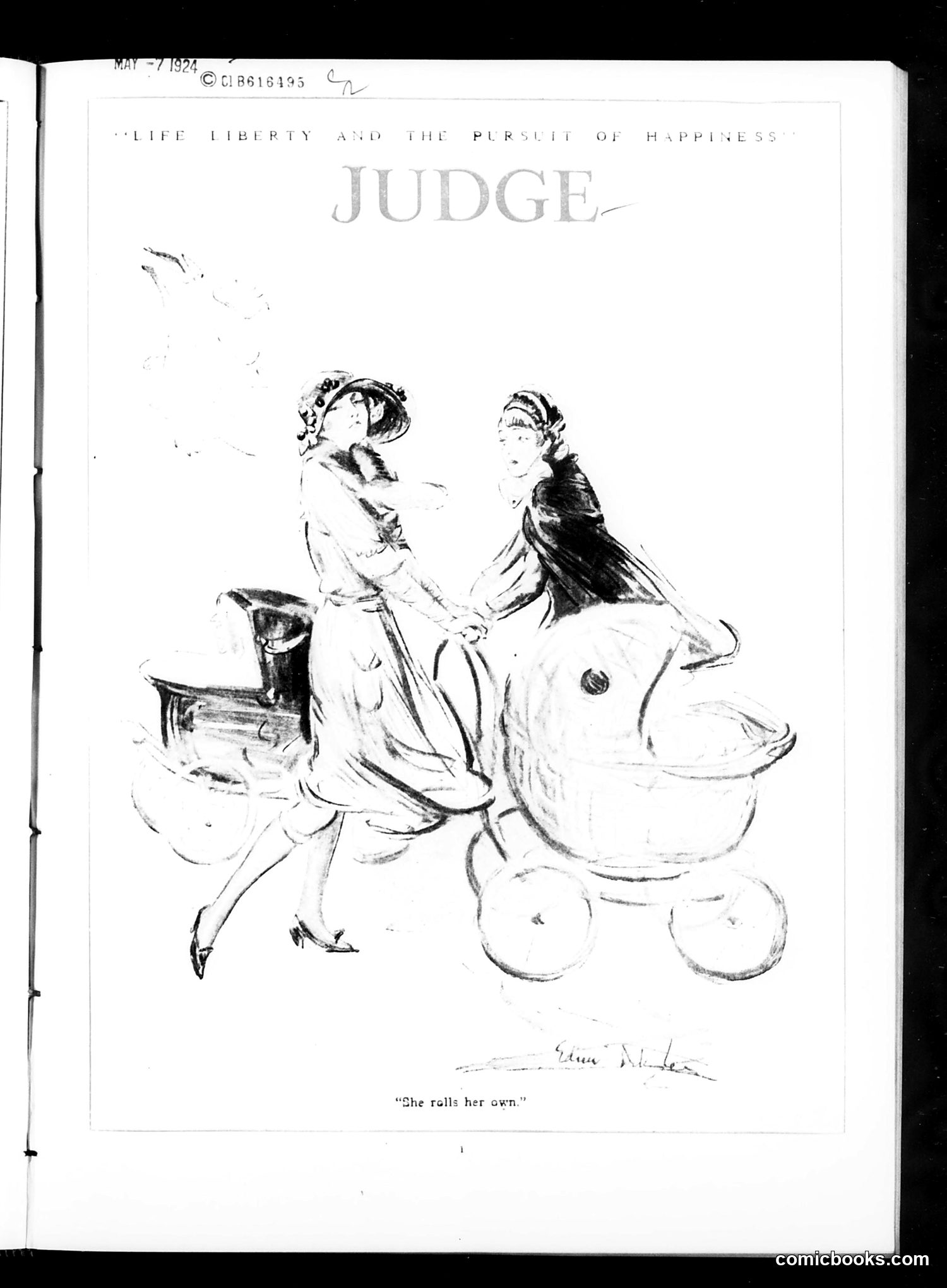
This Judge magazine page from May 1924 features a cartoon titled "She rolls her own." The image shows two women with a large baby carriage, one pushing while the other guides it. The caption's double meaning is the joke: "rolling her own" refers to both literally propelling a baby carriage and the period slang phrase meaning a woman managing her own affairs independently—likely without male assistance or traditional social constraints. The cartoon appears to satirize 1920s women's increasing independence and autonomy, particularly post-suffrage (women gained voting rights in 1920). The exaggerated, almost absurd carriage suggests mild mockery of women taking control of their own lives, a contentious social topic during this era of changing gender roles.
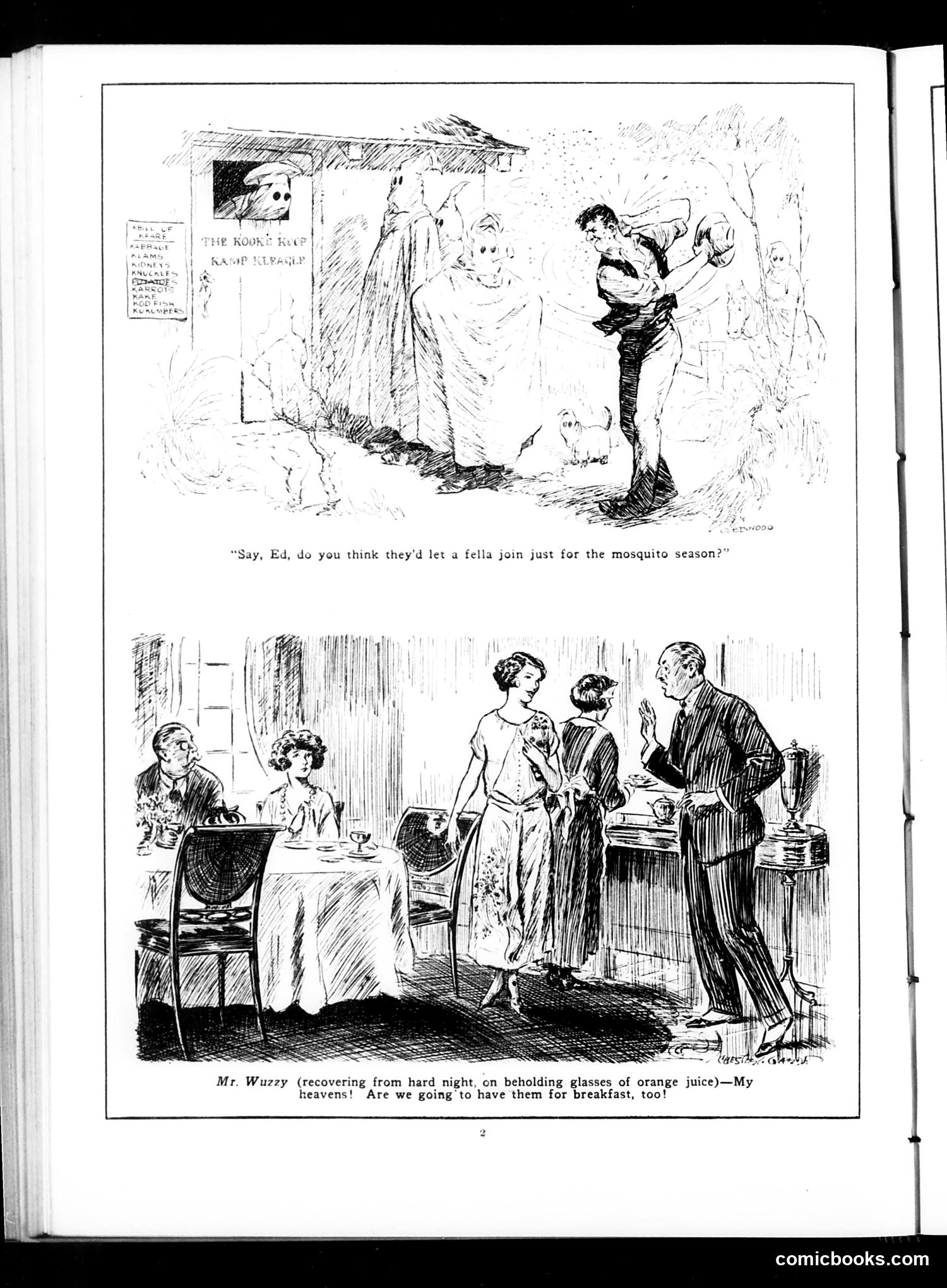
This page contains two cartoons from an early 20th-century American humor magazine. **Top cartoon:** A man (Ed) asks another about joining a club "just for the mosquito season"—a joke about seasonal membership, likely referencing exclusive clubs that operated only during certain months. **Bottom cartoon:** Titled "Mr. Wuzzy," it shows a hungover man ("recovering from hard night") surprised to see orange juice at breakfast, exclaiming "My heavens! Are we going to have them for breakfast, too!" The humor relies on the implication of excessive drinking the previous night, playing on the common "hair of the dog" remedy and the contrast between alcohol indulgence and wholesome morning beverages. Both cartoons use gentle social satire typical of Judge's approach to American leisure and domestic life.
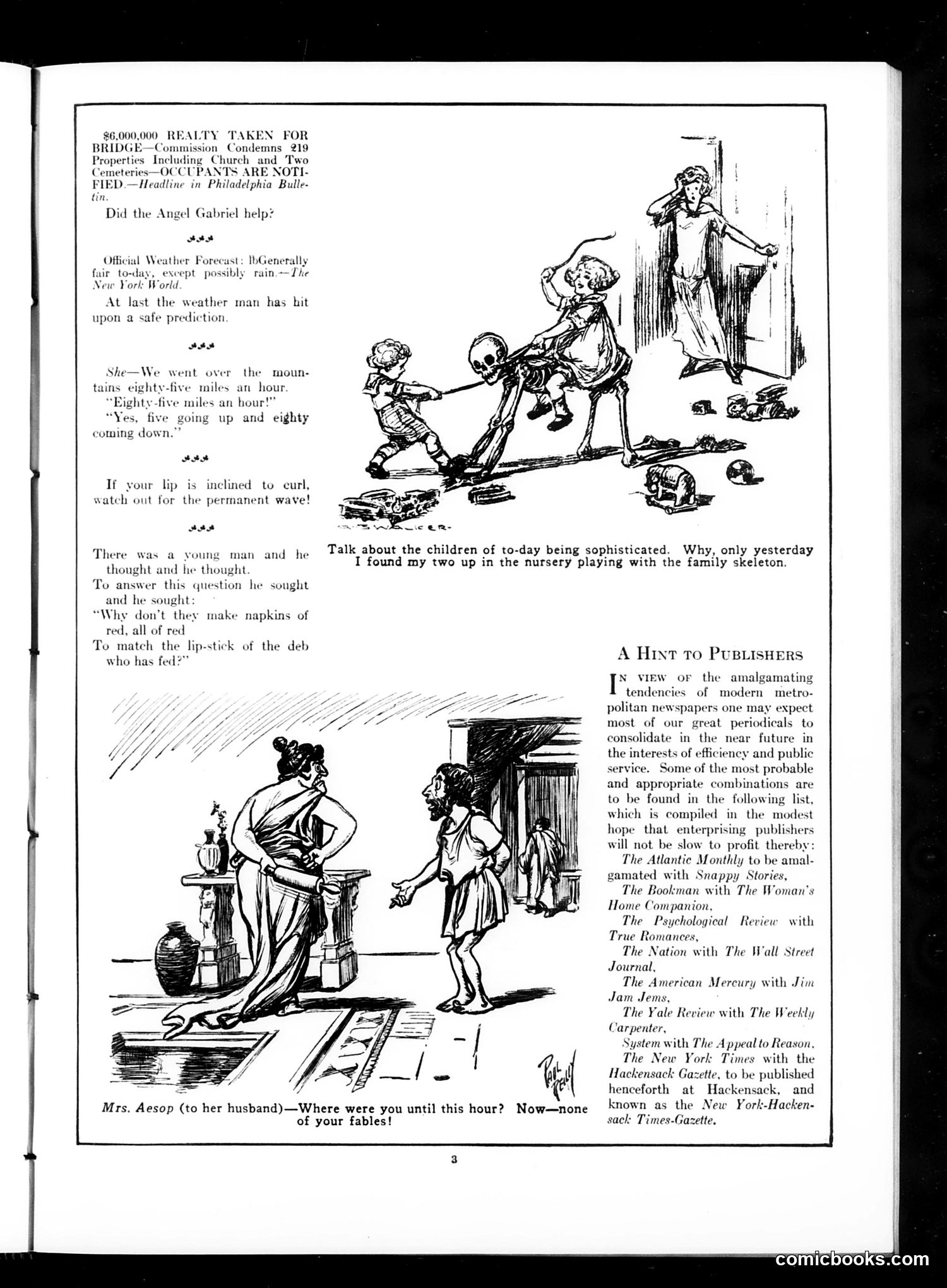
The page contains several satirical vignettes typical of early 20th-century humor magazines: **Top cartoon**: Children playing with a skeleton, captioned about modern children being "sophisticated." The joke satirizes parental anxiety about children losing innocence—finding kids casually playing with a family skeleton would horrify Victorian sensibilities. **Bottom cartoon**: Captioned "Mrs. Aesop (to her husband)—Where were you until this hour? Now—none of your fables!" This references Aesop, the classical fabulist, using marital infidelity humor. The wife confronts her husband about his whereabouts, sardonically dismissing his excuses as mere "fables" (lies). Both cartoons employ visual irony and wordplay typical of Judge's satirical style, mocking contemporary domestic life and social pretensions.
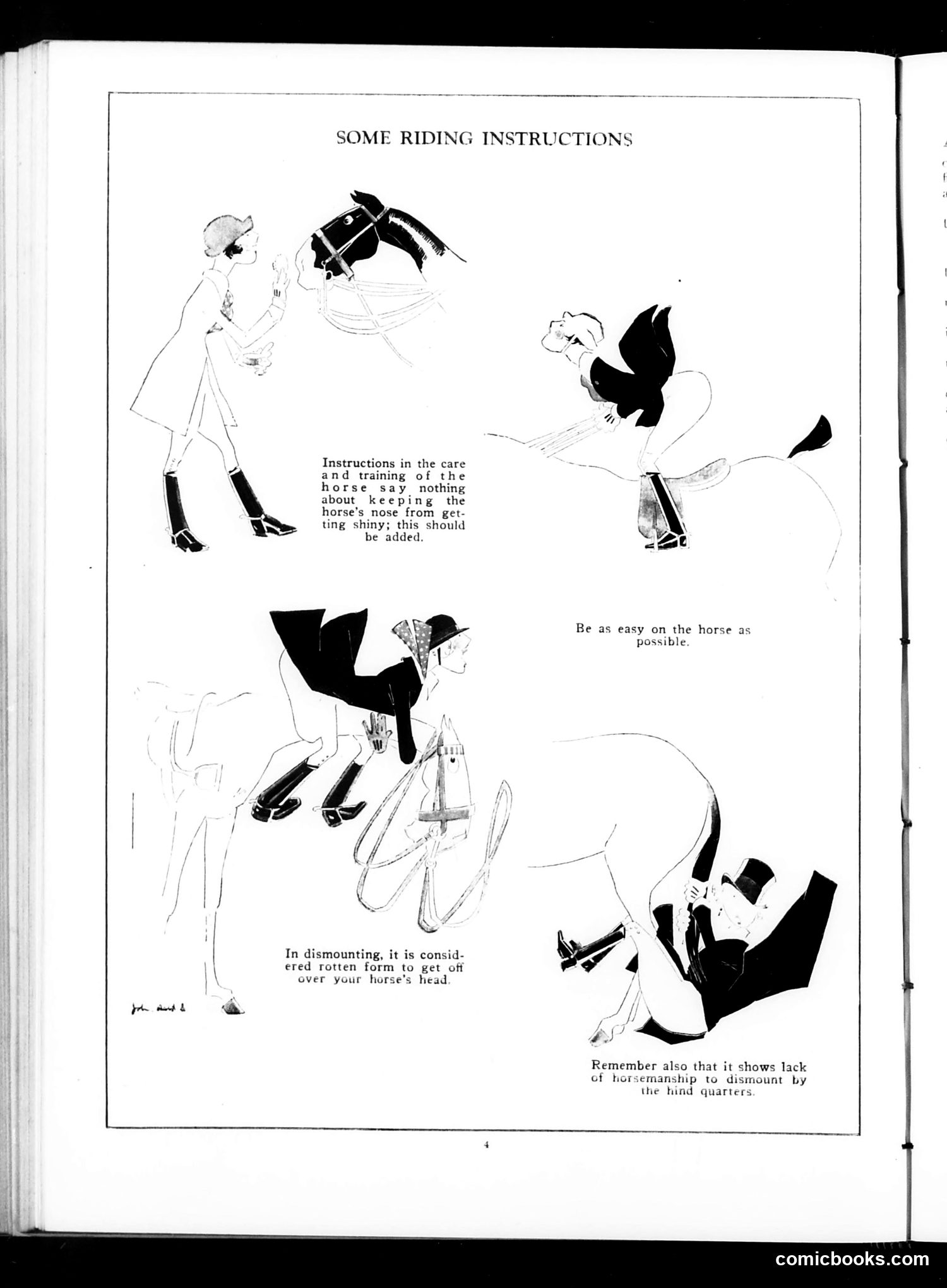
This page contains humorous illustrated advice about horseback riding, presented through exaggerated drawings of riders in various positions. The cartoons demonstrate both correct and incorrect techniques: The text advises keeping a horse's nose from getting shiny (suggesting gentle handling), being easy on the horse, and proper dismounting form. One caption notes that dismounting "over your horse's head" and dismounting "by the hind quarters" both demonstrate poor horsemanship. This appears to be general satirical humor about riding etiquette rather than political commentary—typical of Judge magazine's lighthearted content. The comic drawings mock clumsy or ungraceful riders through visual exaggeration, poking fun at people unfamiliar with proper equestrian technique during an era when horseback riding was still common.
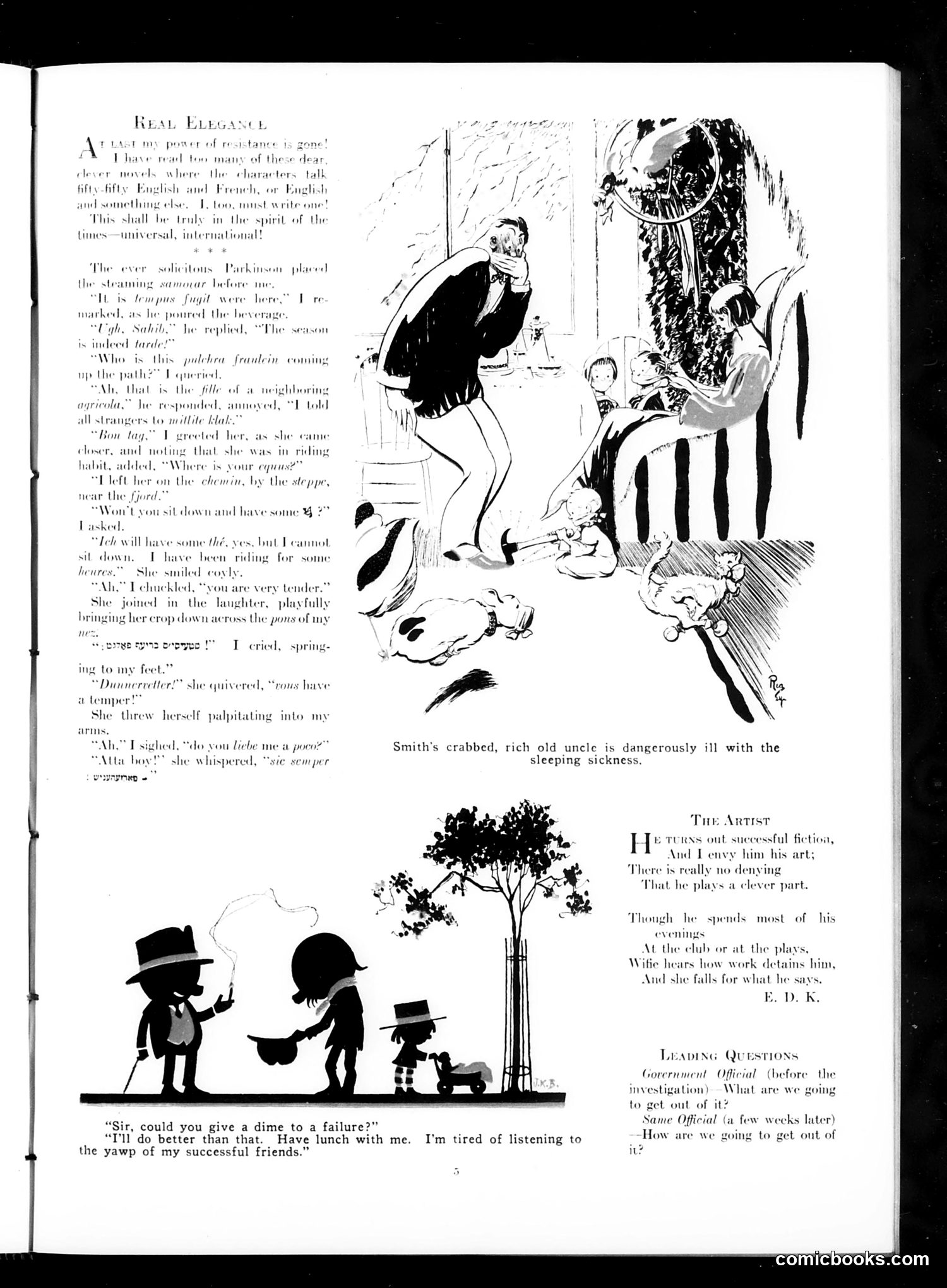
This page satirizes **pretentious literary ambition**. The main story, "Real Elegance," mocks writers attempting cosmopolitan, multilingual fiction by mixing languages (French, German, Hindi, Spanish) into a deliberately absurd romantic narrative. The protagonist, narrating in broken polyglot style, recounts an encounter with a woman on horseback using laughably mismatched vocabulary ("fjord," "samovar," "agrégola") to sound sophisticated and international. The joke: **contrived "world literature"** is pretentious nonsense. Judge's satire targets American authors desperately inserting foreign words and settings to appear cultured. The secondary cartoons mock **successful phoniness**: a poet lies about working late while actually at clubs; a government official cynically asks what he'll "get out of" an investigation; a wealthy man pays off a failure with lunch rather than genuine help. Overall, the page ridicules social pretense, false sophistication, and the gap between appearance and reality in early 20th-century American society.
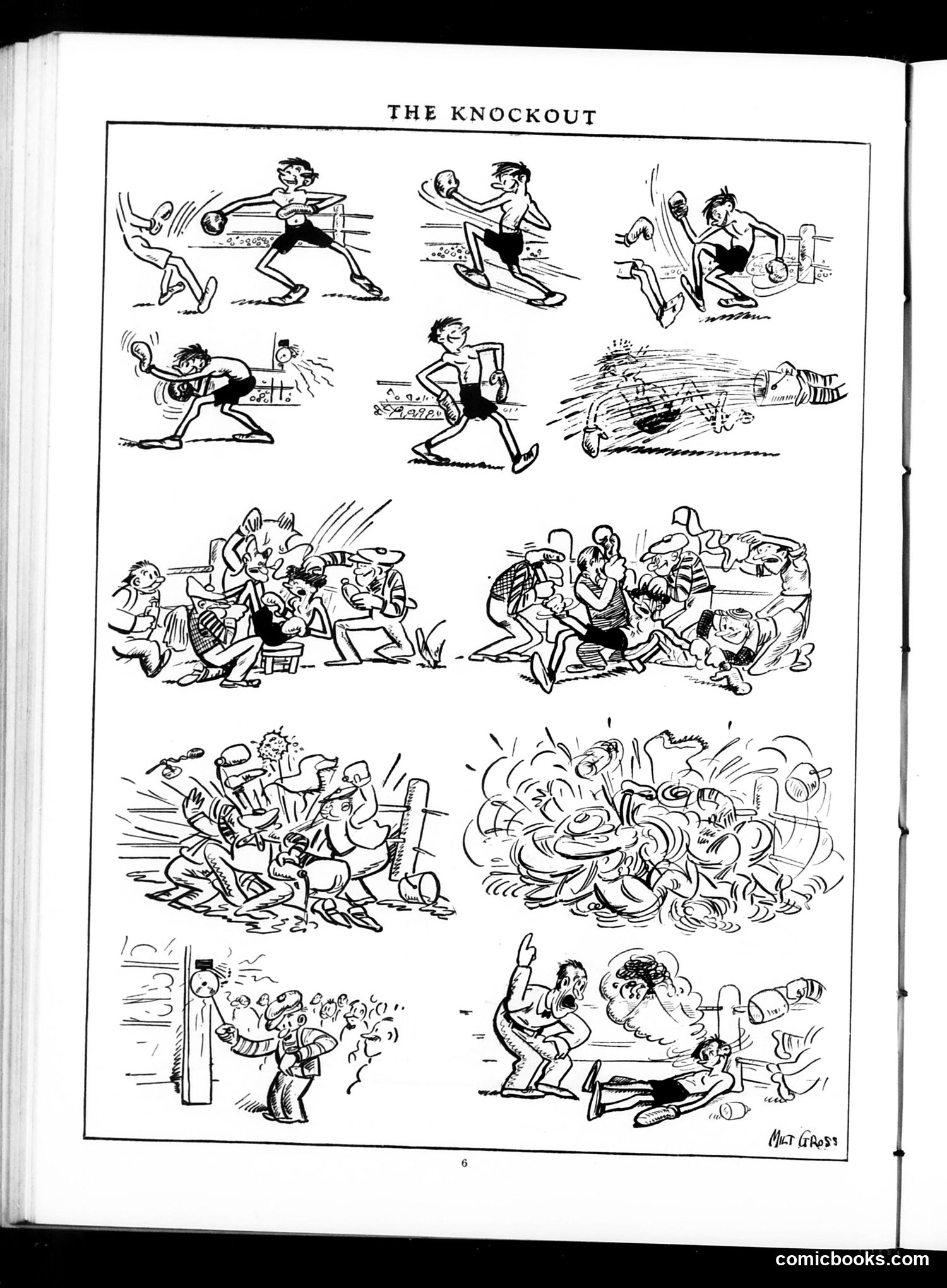
This is a wordless, sequential comic strip depicting the chaos of a knockout punch in boxing. The narrative unfolds from top to bottom: a boxer lands a powerful blow on his opponent, who stumbles backward through increasingly chaotic scenes. The victim crashes through domestic spaces, bowling pins, and crowds, leaving destruction in his wake. Each panel escalates the absurdist humor—furniture breaks, people scatter, objects fly—emphasizing the violent trajectory of the knockout's aftermath. The satire likely mocks both boxing's brutality and slapstick comedy conventions. Gross uses exaggerated cartooning to transform a single punch into an elaborate domino effect of mayhem, making physical comedy the subject rather than realistic sport. The humor derives from the disproportionate consequences of one action, a common theme in 1920s-30s comic strips.
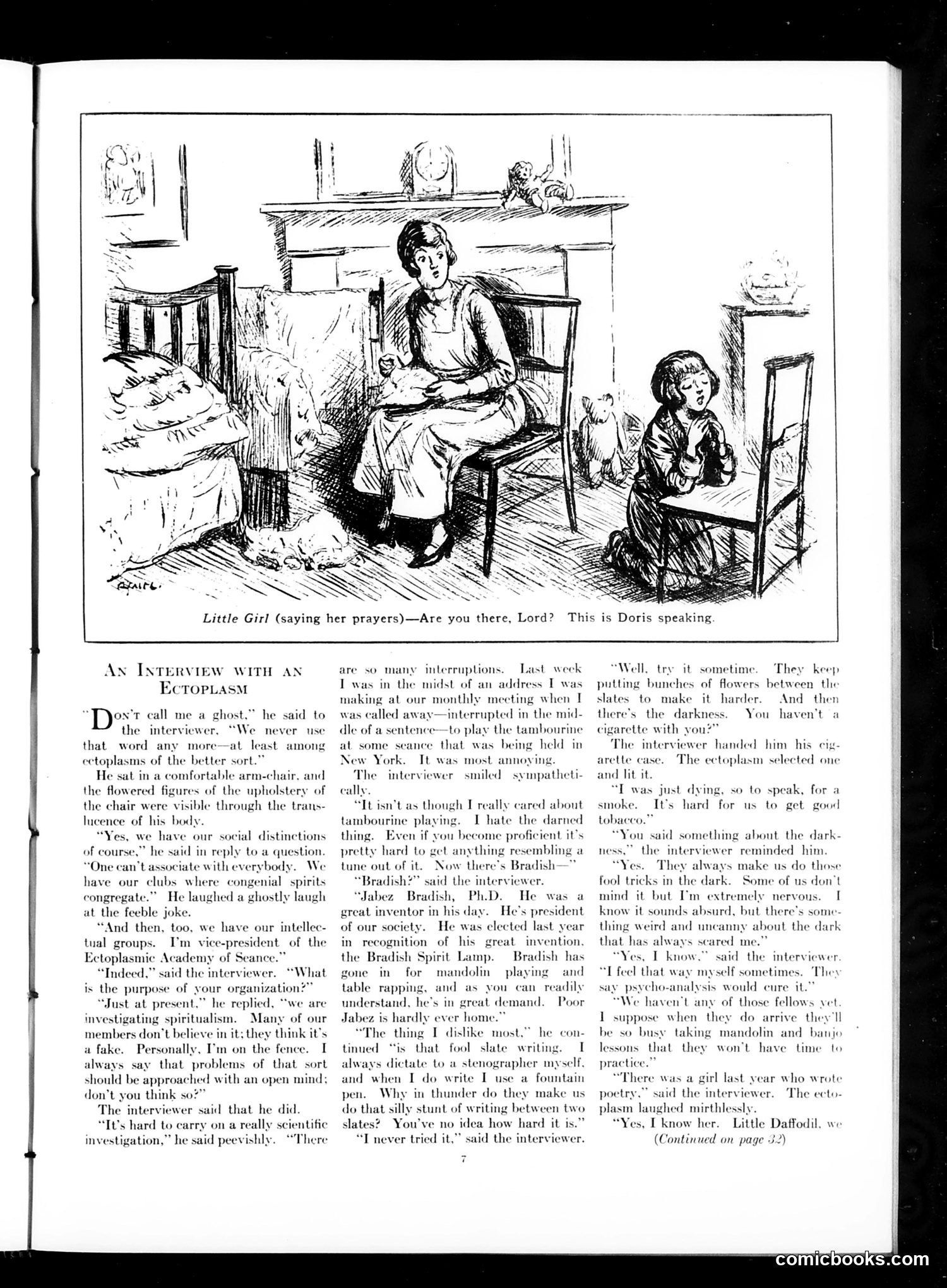
This satirical piece mocks the spiritualism craze popular in early 20th-century America. The main cartoon shows a translucent ghost-like figure (an "ectoplasm") being interviewed. The joke targets spiritualists' pretensions: this supposedly supernatural being complains about mundane problems—interruptions at seances, poor tambourine skills, difficulty writing on slate boards, and nervousness in the dark. The satire is twofold: First, it ridicules spiritualists for their pseudoscientific claims while pretending seriousness (the "Ectoplasmic Academy of Seance"). Second, it mocks spiritualism's social pretensions—even ghosts have "clubs" and "intellectual groups." The small cartoon below depicts a child's prayer, "Are you there, Lord? This is Doris speaking"—likely a jab at spiritualists' claims to contact the dead through mediums, suggesting such conversations are childishly naive. Overall, Judge dismisses the spiritualist movement as elaborate nonsense dressed up in false respectability.
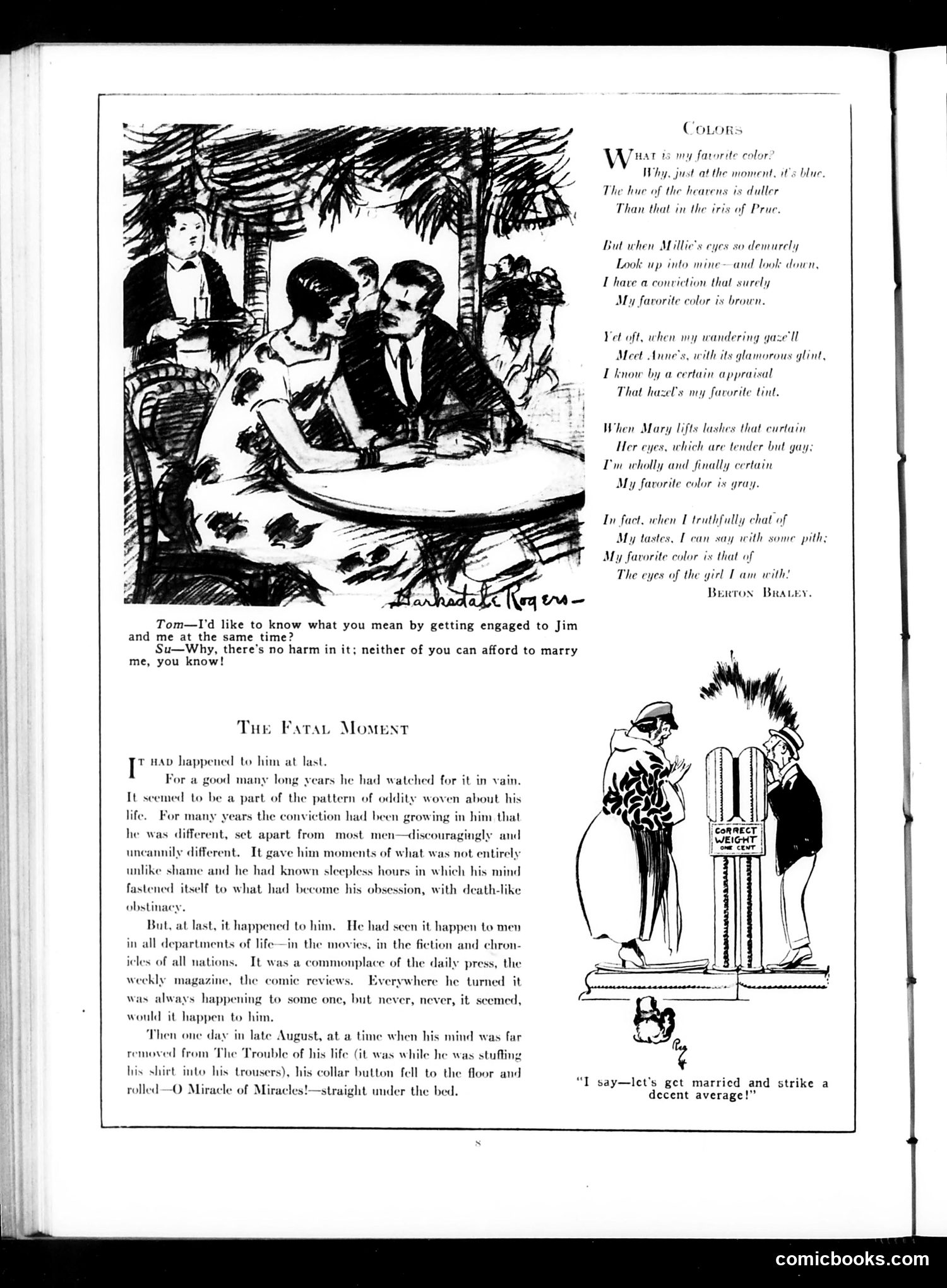
The page contains two unrelated pieces of early-20th-century humor: **Top cartoon:** A woman (Su) is engaged to two men simultaneously—Tom and Jim. When confronted, she shrugs it off: neither can afford to marry her anyway, so there's "no harm" in keeping both on the hook. The joke satirizes the economic precarity of working-class men and women's pragmatism about marriage as a financial transaction rather than romantic commitment. **"The Fatal Moment" story:** A neurotic man has spent years waiting for something to happen to him—something he's seen happen to everyone else. When his collar button falls under the bed, he finally experiences this "commonplace" occurrence. The satire mocks male anxiety and the obsessive self-consciousness of certain personality types who feel perpetually excluded from normal life. **"Colors" poem:** By Berton Brayley. A lighthearted verse about how a man's "favorite color" constantly changes depending on which woman he's looking at—their eye colors determine his preferences. It's gentle romantic satire about male fickleness.
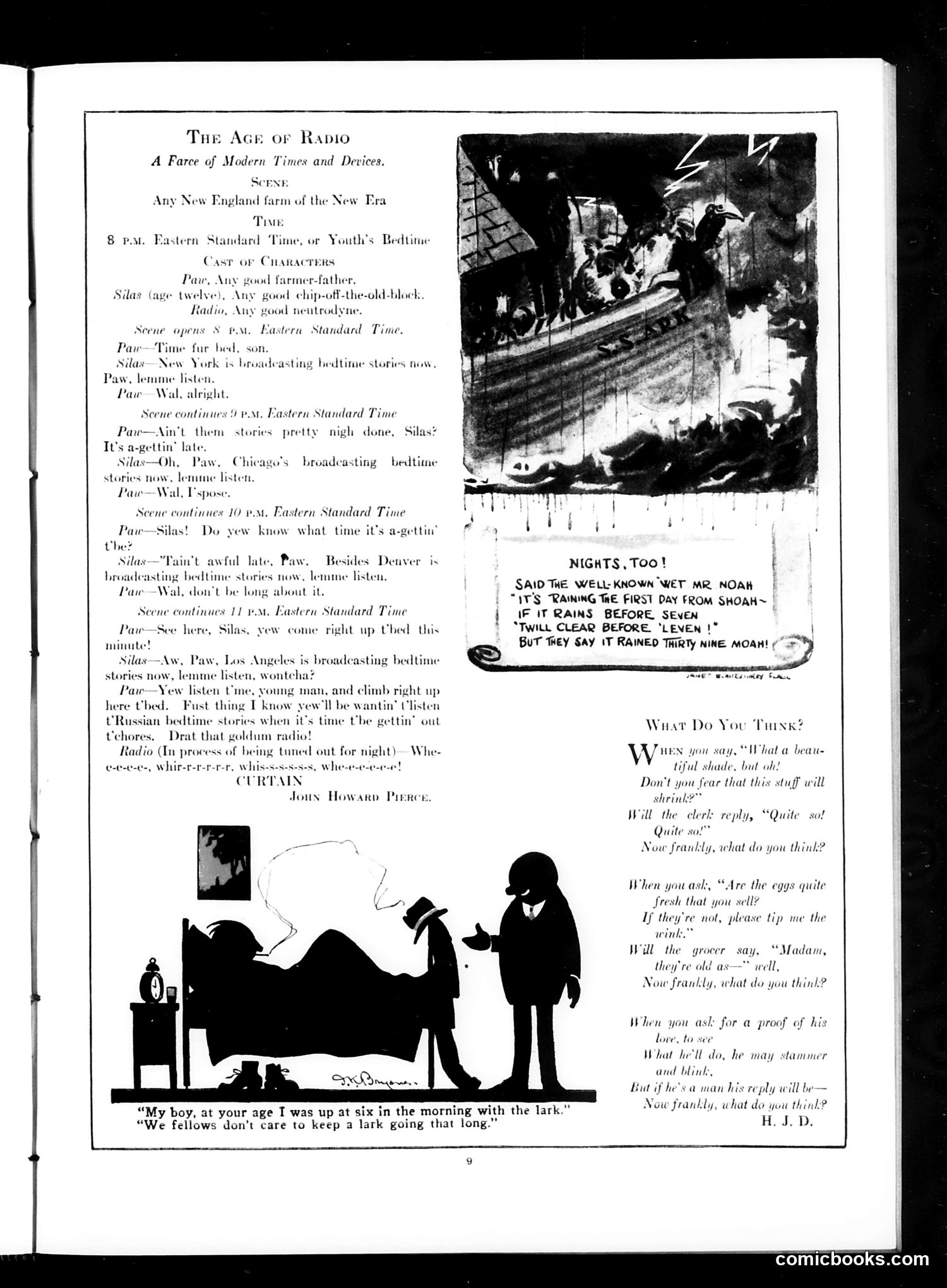
This play-format cartoon satirizes the early radio era's grip on American households. The setup is simple: a New England farmer ("Paw") tries to send his 12-year-old son ("Silas") to bed, but radio broadcasts keep the boy awake. As bedtime passes (8 p.m., then 9, 10, 11 p.m.), Silas uses each time zone's broadcasting—New York, Chicago, Denver, Los Angeles—to delay bedtime further, always claiming another station is airing bedtime stories. The joke targets parental authority undermined by modern technology. The radio becomes an endless excuse; the boy exploits geographic expansion of broadcasts to extend his listening indefinitely. When Paw finally insists, the radio "whirs" off mid-tune—suggesting technology's pervasive, almost sentient intrusion into domestic life. The satire reflects 1920s anxiety: rapid technological change was disrupting traditional family structures and parental control.
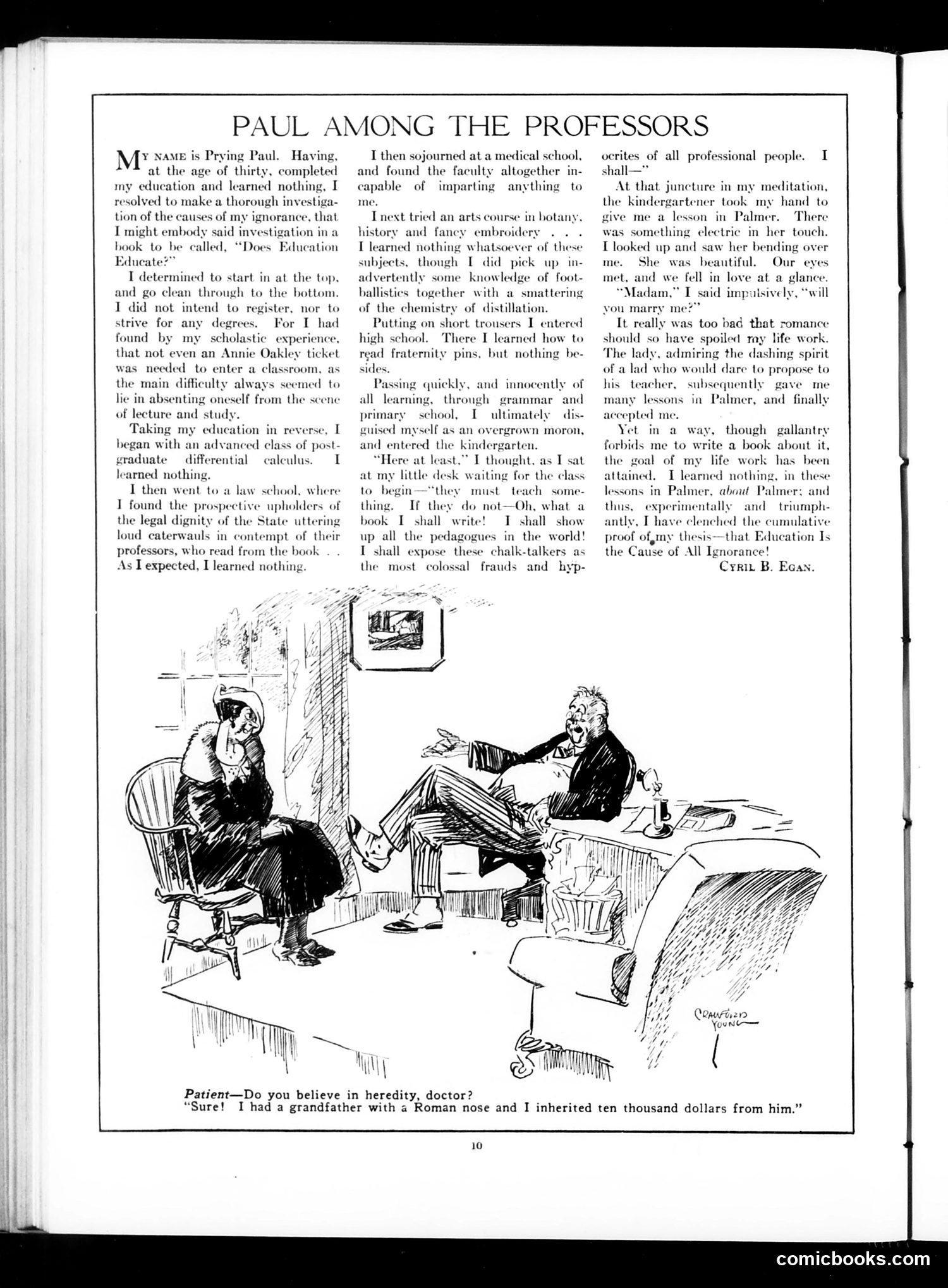
This satirical essay by Cyril B. Egan mocks the American education system by following "Prying Paul" through every level—from postgraduate studies down to kindergarten—where he claims to learn nothing at each stage. The piece ridicules professors as fraudulent "chalk-talkers" who merely read from books without teaching genuine knowledge. The humor culminates in an ironic twist: Paul's only "learning" occurs when he falls in love with his kindergarten teacher and proposes to her instead of pursuing his planned exposé. The cartoon shows a doctor and patient discussing heredity, with the patient claiming he inherited ten thousand dollars from his grandfather—a joke about inheriting only money, not traits or intellect. The satire targets widespread early-20th-century skepticism about institutional education's actual value.
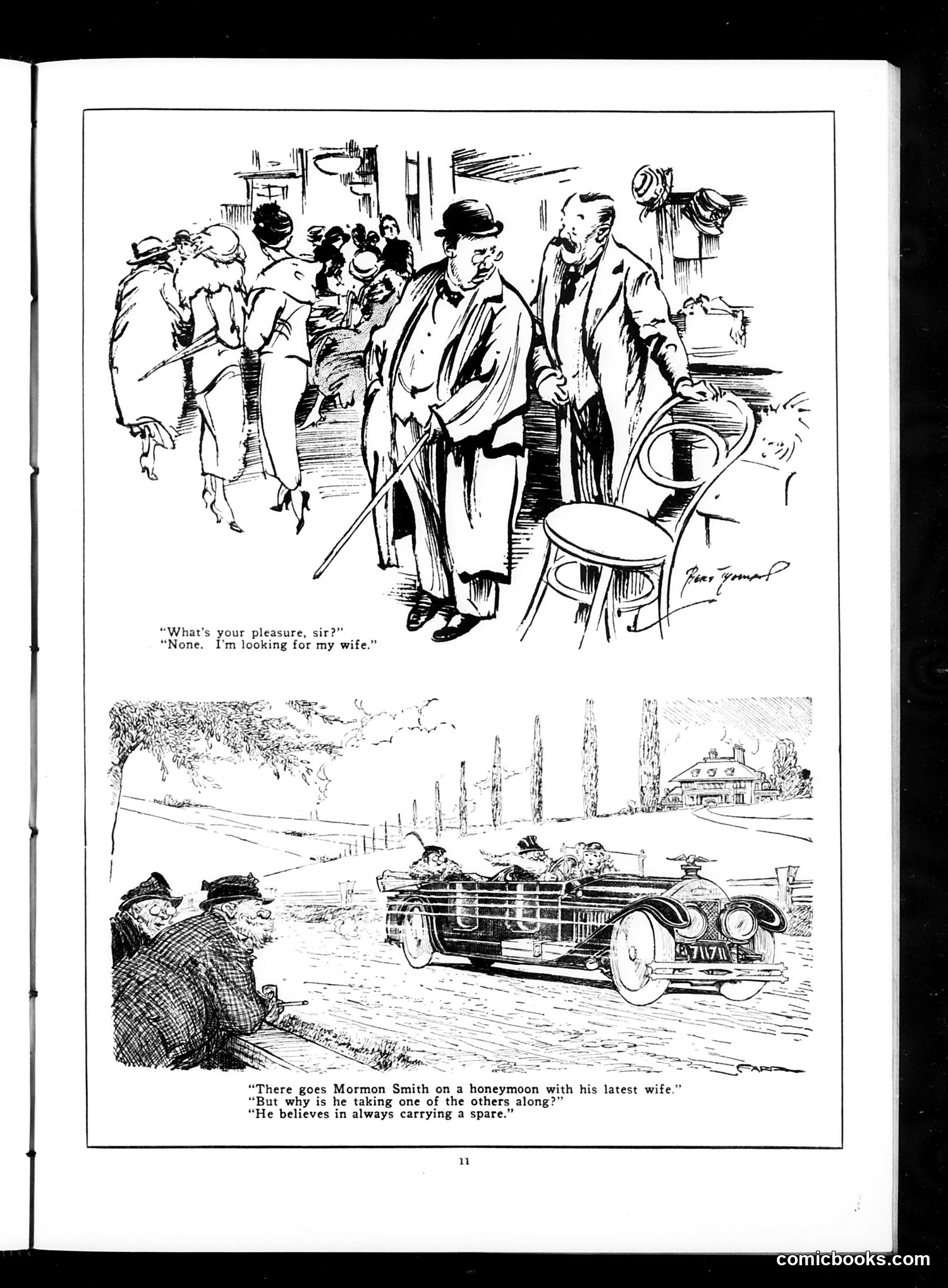
This page contains two satirical cartoons about marital infidelity and polygamy. The **top cartoon** shows a man at what appears to be a social venue, telling someone he's searching for his wife rather than seeking entertainment—a joke about marital obligation. The **bottom cartoon** mocks "Mormon Smith" traveling with multiple women simultaneously. The humor relies on anti-Mormon stereotypes prevalent in early 20th-century America, specifically referencing historical polygamy practices in the LDS church. The phrase "carrying a spare" treats wives as interchangeable objects, like replacement automobile tires. The cartoon's satire targets both the man's casual approach to multiple marriages and—through exaggeration—criticizes polygamous practices generally. The artist appears to be Cesare, based on the signature visible in the image.
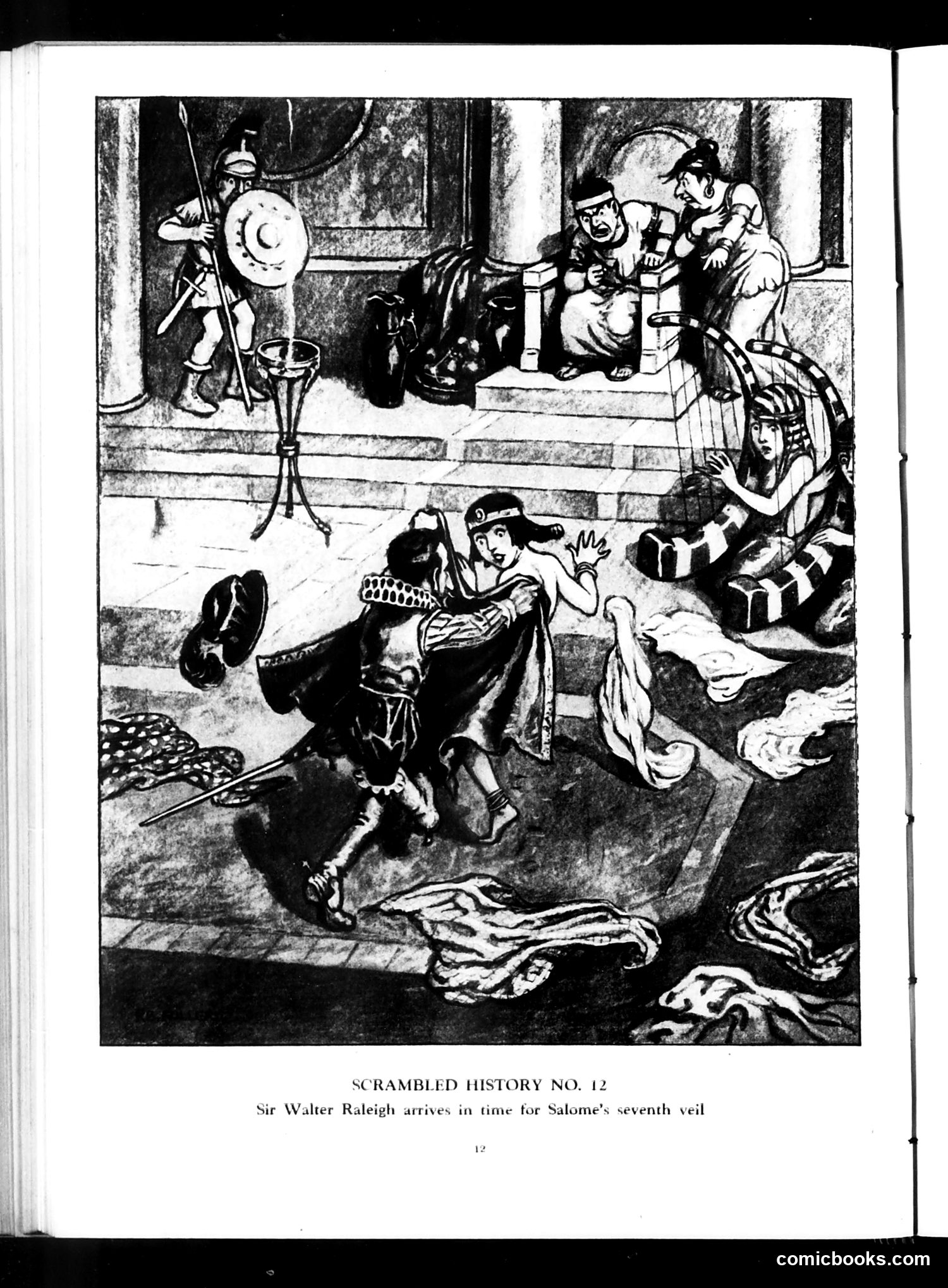
This is a humorous "Scrambled History" cartoon that deliberately mixes two historical/biblical narratives for comedic effect. The caption references Sir Walter Raleigh (Elizabethan explorer) arriving to witness Salome's "seventh veil" — a reference to the biblical/operatic story of Salome, whose dance of the seven veils is famous in art and culture. The joke conflates these unrelated historical moments: Raleigh (16th-century English colonizer) is anachronistically inserted into Salome's narrative. The cartoon shows what appears to be a theatrical scene with various figures in period costumes, some appearing to be Roman soldiers or guards, with Salome presumably performing. The satire mocks how historical events get scrambled, misremembered, or theatricalized in popular culture. By deliberately placing Raleigh in ancient Palestine, *Judge* magazine was poking fun at how audiences confused or blended historical narratives—a common source of humor in early 20th-century satirical magazines.
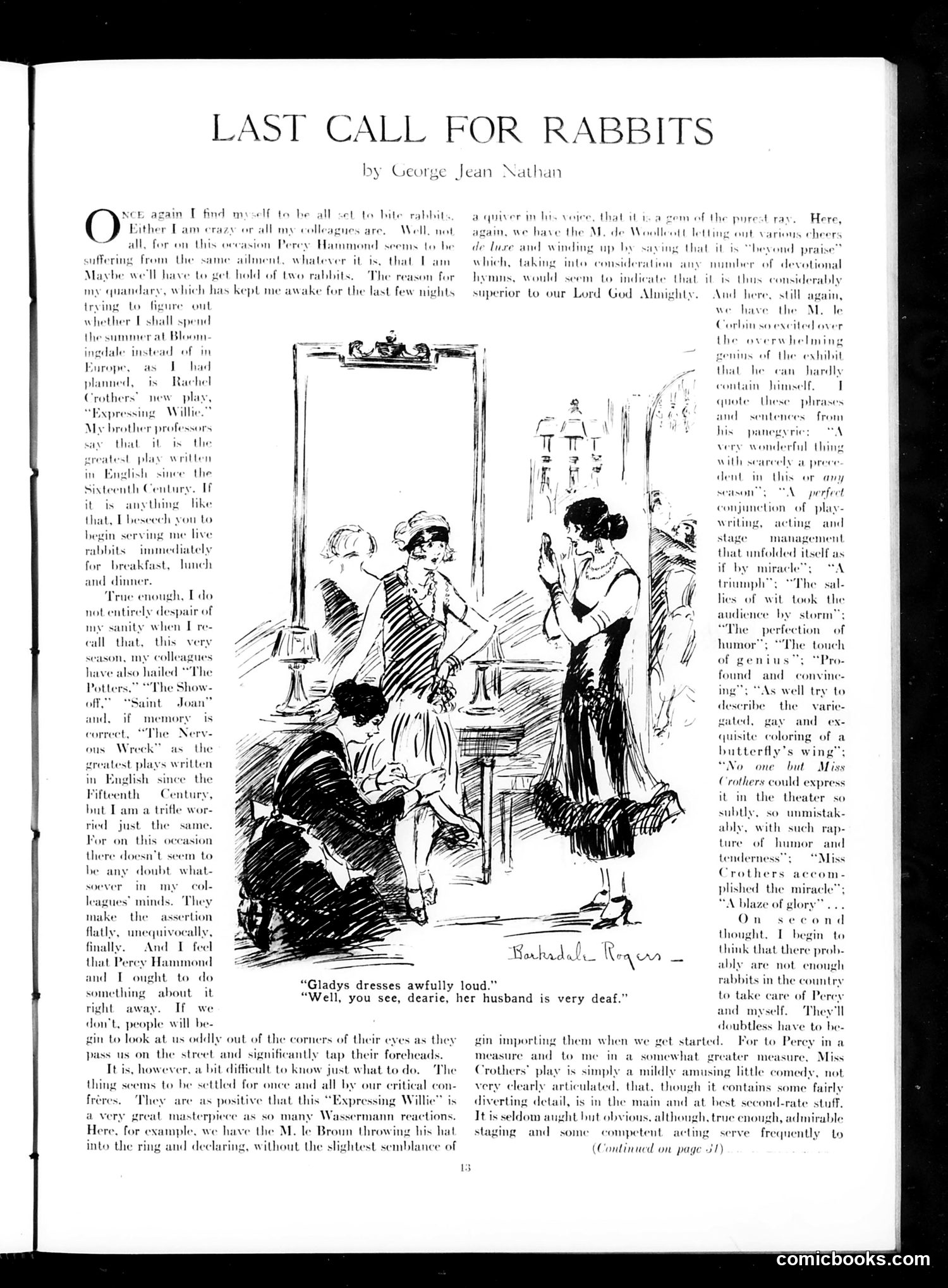
George Jean Nathan, a prominent theater critic, satirizes his colleagues' extreme praise of Rachel Crothers' play "Expressing Willie." Nathan argues the play is merely a "mildly amusing little comedy" and "second-rate stuff," yet critics like Percy Hammond and M. de Corbin have declared it a masterpiece—comparing it favorably to God himself and using absurdly florid language ("No one but Miss Crothers could express it"). The cartoon illustrates a domestic scene, likely from the play. Nathan's bitter joke: if colleagues truly believe the play is as great as they claim, he should be served live rabbits for breakfast—implying he'd need to be institutionalized. The "last call" suggests this is Crothers' final chance before critics' hyperbole becomes unbearably ridiculous. This reflects early 20th-century theater criticism wars, where Nathan frequently attacked what he saw as critical excess and artistic mediocrity.
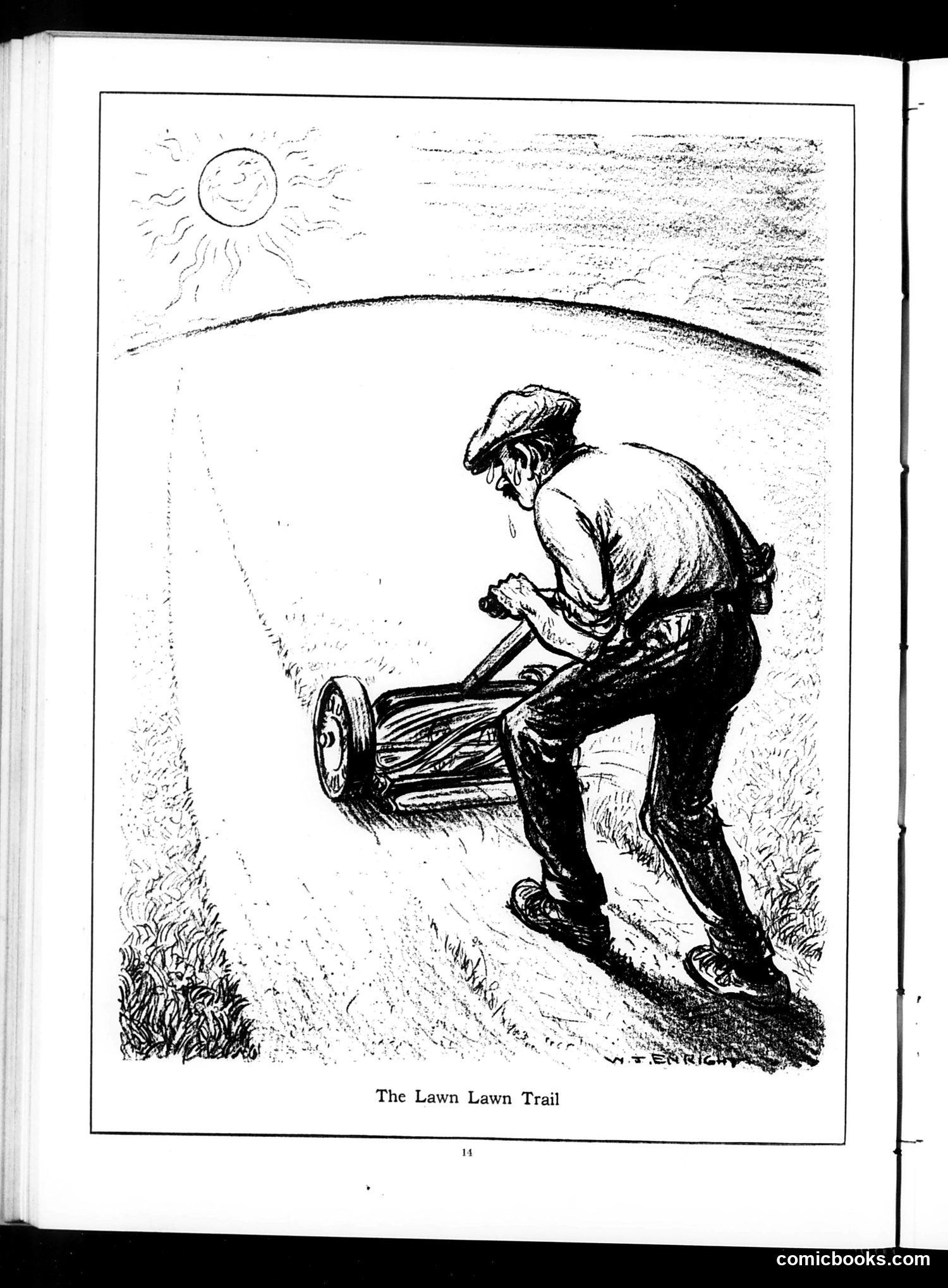
This single-panel cartoon depicts a man pushing an old-fashioned reel-type lawn mower under a bright sun. The title creates a pun on "the Lawn Lawn Trail"—likely referencing a popular hiking destination or travel narrative of the era, but applying it humorously to the mundane domestic task of lawn mowing. The satire appears to target the tedium and labor intensity of lawn maintenance. By evoking a famous "trail," the cartoon suggests that pushing a heavy manual mower is as grueling and adventure-filled as a wilderness journey. This mocks both the romanticization of outdoor activities and the unglamorous reality of suburban yard work that homeowners must endure. The sun beating down reinforces the physical exertion involved.
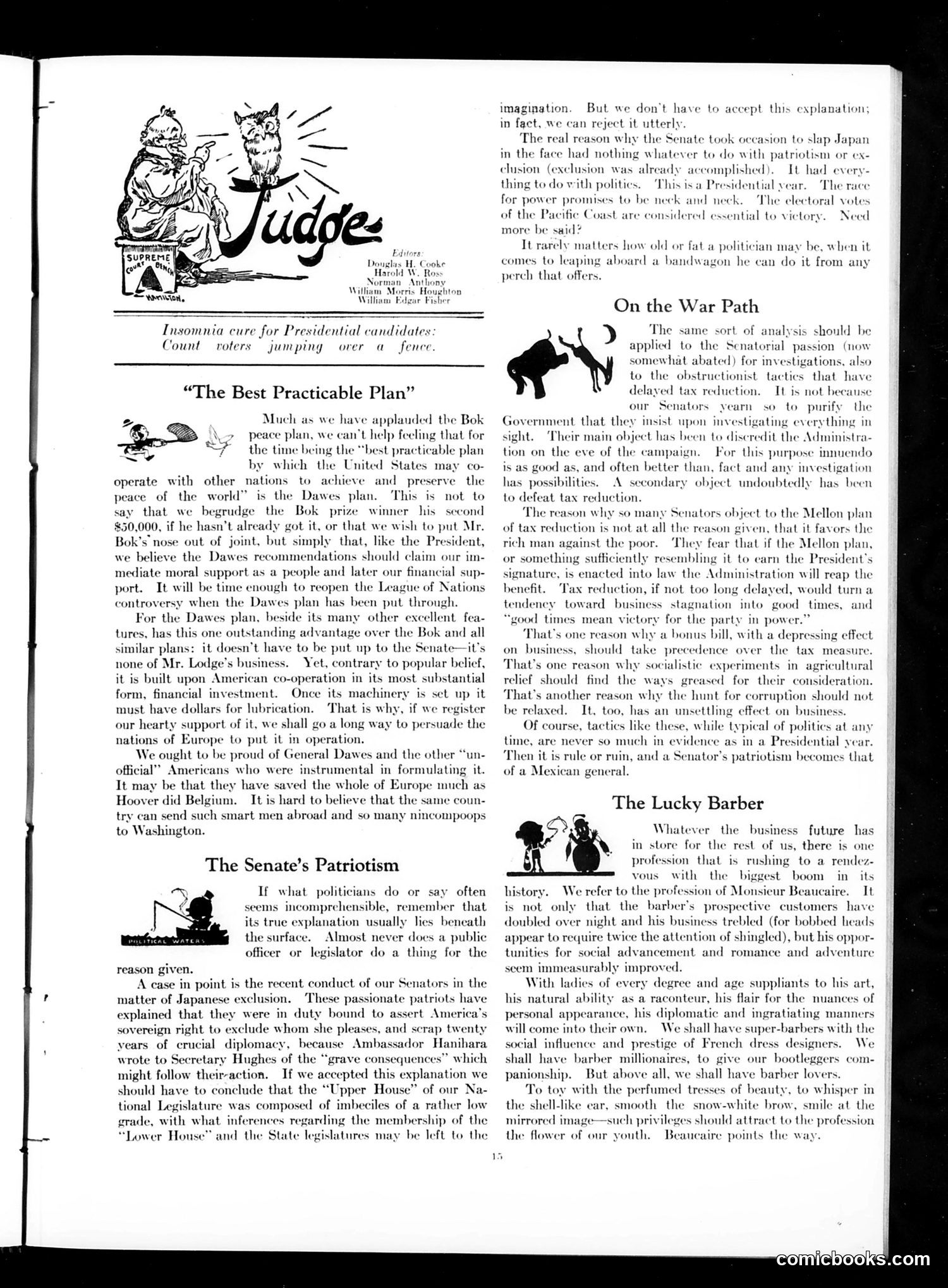
This page satirizes American political hypocrisy in the 1920s. **Top cartoon**: A judge figure scolds two quarreling figures (likely representing presidential candidates), captioning an "insomnia cure" as counting voters "jumping over a fence"—mocking campaign exhaustion. **Main articles** critique Senate behavior: 1. **"The Best Practicable Plan"** praises the Dawes Plan (a post-WWI economic recovery proposal) over the Bok Peace Plan, because it bypasses Senate approval—implying Senators obstruct rather than govern responsibly. The author sarcastically notes America sends "smart men abroad" but "nincompoops to Washington." 2. **"The Senate's Patriotism"** directly attacks Senators' 1924 Japanese exclusion vote. Judge argues they falsely claimed patriotic duty; the *real* reason was securing Pacific Coast electoral votes for the presidential election. The satire exposes how politicians cynically use nationalism to gain power. The message: look beneath politicians' stated justifications—self-interest and electoral calculation drive their actions.
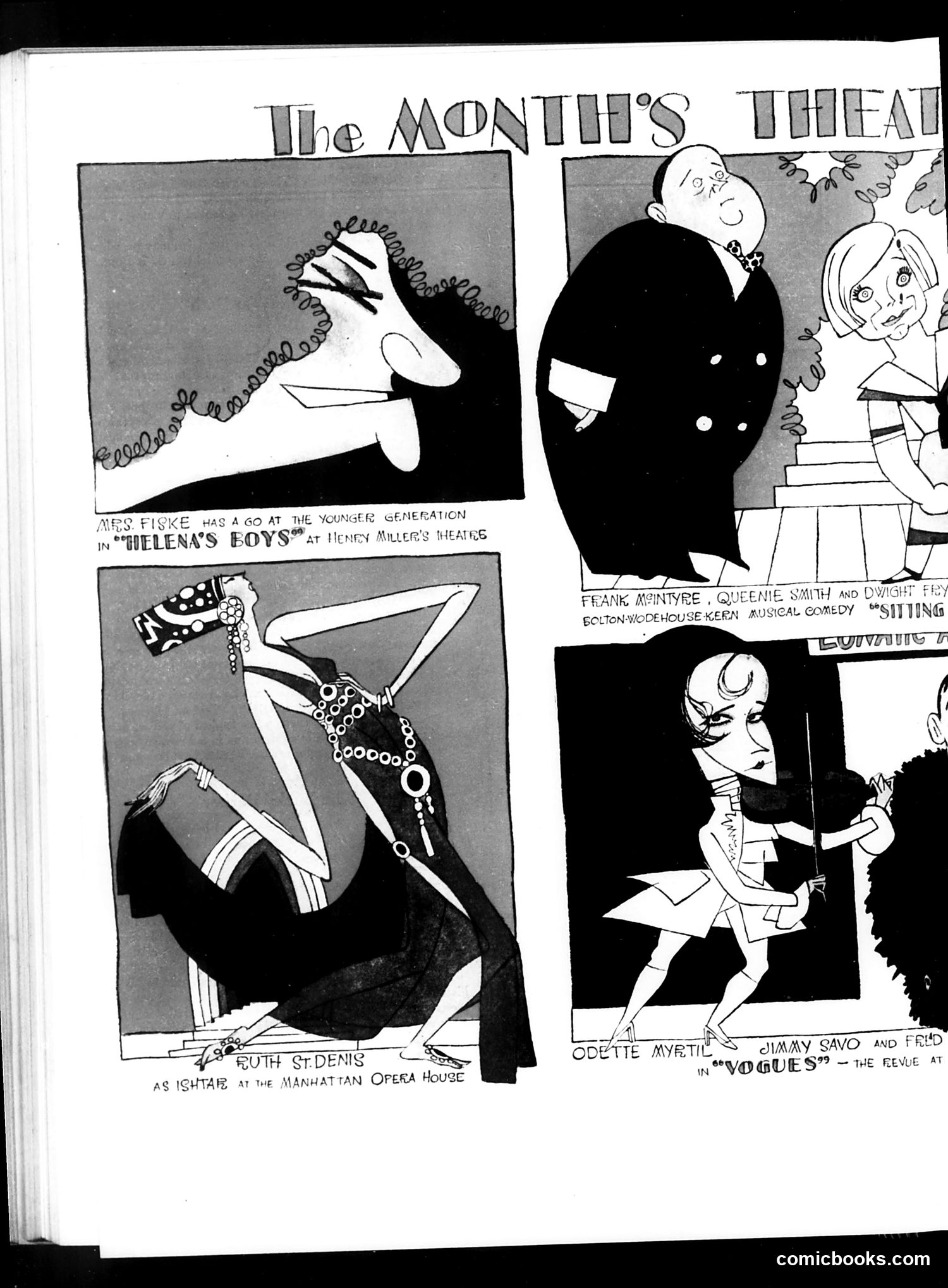
This page showcases theatrical caricatures highlighting Broadway productions. The top left features **Mes Fiske** in "Helena's Boys" at Henry Miller's Theatre—a caricature emphasizing her expressive face and dramatic gestures. The bottom left shows **Ruth St. Denis** as "Ishtar" at the Manhattan Opera House, depicted in an exotic dance pose with elaborate costume and jewelry, satirizing the orientalist spectacle popular in early 20th-century theater. The right panels feature **Frank McIntyre, Queenie Smith, and Dwight Frye** in the musical comedy "Sitting," and **Odette Myrtil, Jimmy Savo, and Fred Bolton-Wodehouse-Kern** in the revue "Vogues." The cartoons employ exaggerated physical features and poses typical of Judge's satirical style to mock performers and theatrical trends of the era.
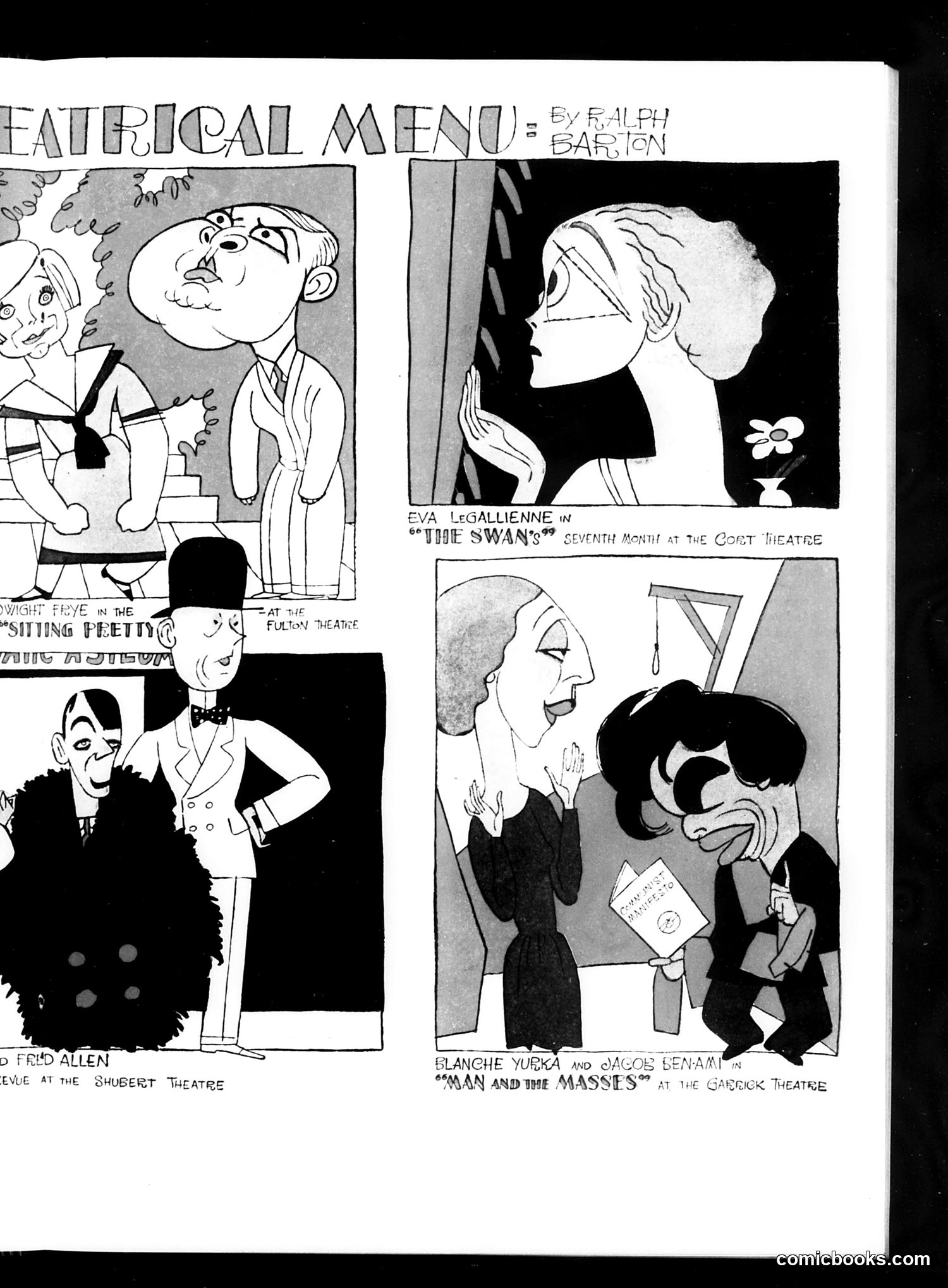
This satirical page presents caricatures of prominent Broadway performers and their current productions. The "menu" format humorously treats these theatrical offerings as if they were dishes to sample. Featured are Eva LeGallienne in "The Swan" (Cort Theatre), Fred Allen (Shubert Theatre), Blanche Yurka and Jacob Ben Ami in "Man and the Masses" (Garrick Theatre), and others. The exaggerated facial caricatures—typical of Judge magazine's style—mock the performers' distinctive features and theatrical personas. The satire works on multiple levels: treating theater as consumable entertainment, reducing celebrated actors to physical grotesqueries, and implying these are interchangeable offerings for the sophisticated New York audience. This reflects 1920s-era criticism of Broadway's commercialization and the celebrity culture surrounding stage performers.
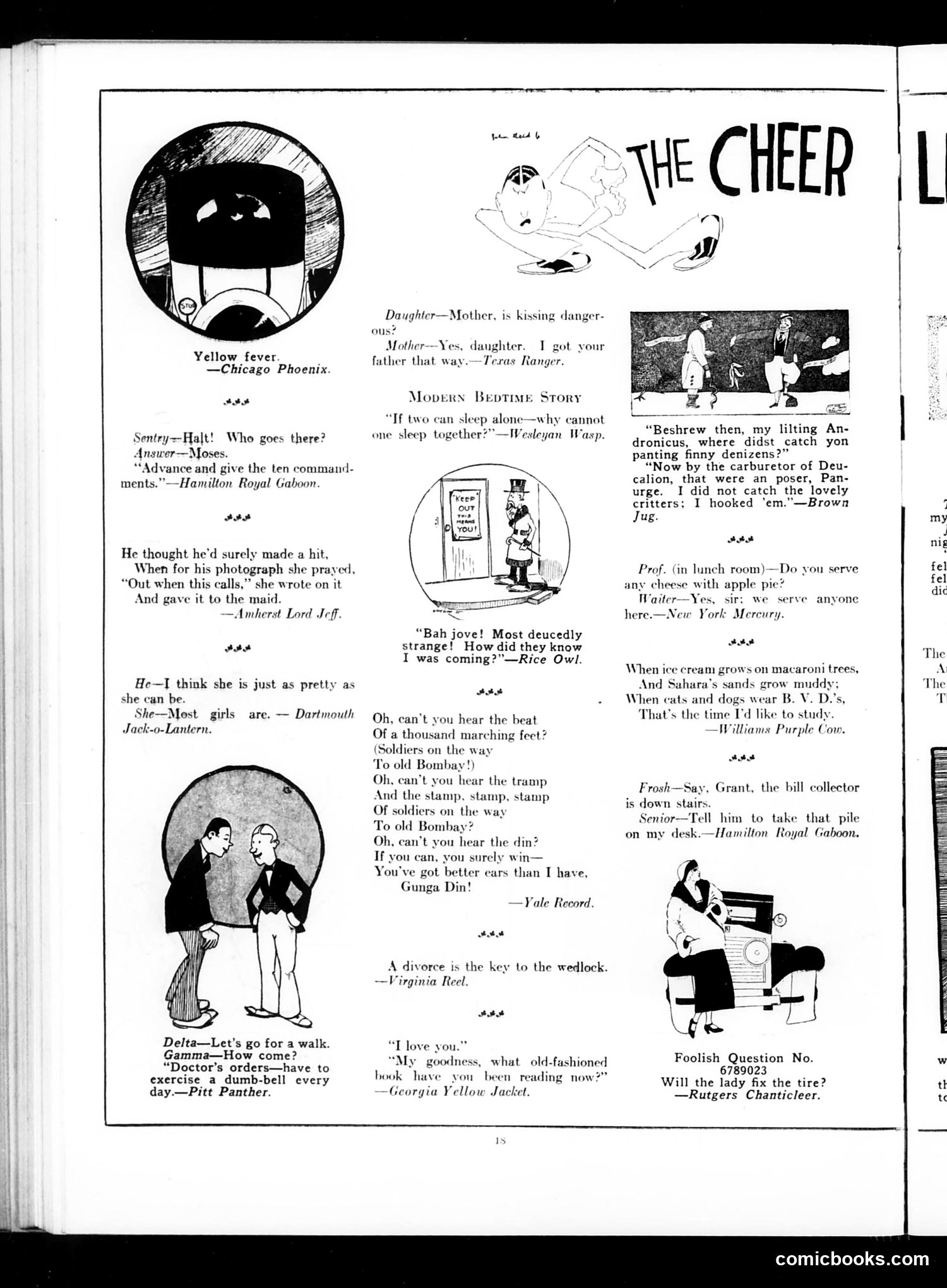
This is a collection of collegiate humor from various university magazines (Yale, Dartmouth, Rutgers, etc.), typical of Judge's early 20th-century content. The jokes target college students and social conventions: **Key themes:** - **Dating/romance**: Mild flirtation humor ("she's as pretty as she can be") - **Courtship dangers**: A woman warns her daughter that kissing leads to marriage (she "got your father that way") - **Gender dynamics**: Women portrayed as coy or manipulative (the photograph joke) - **Military references**: A marching song to "old Bombay" suggests British colonial military service, appealing to readers familiar with Empire - **Wordplay**: Bad puns ("divorce is the key to the wedlock") - **Academic life**: Fraternity exercises, bill collectors, studying avoidance The humor is gentle, domestic, and nostalgic for collegiate life. The "Yellow fever" illustration (top left) remains unclear in context. Overall, this reflects upper-class American concerns with propriety, courtship rituals, and campus life circa 1900s-1920s.
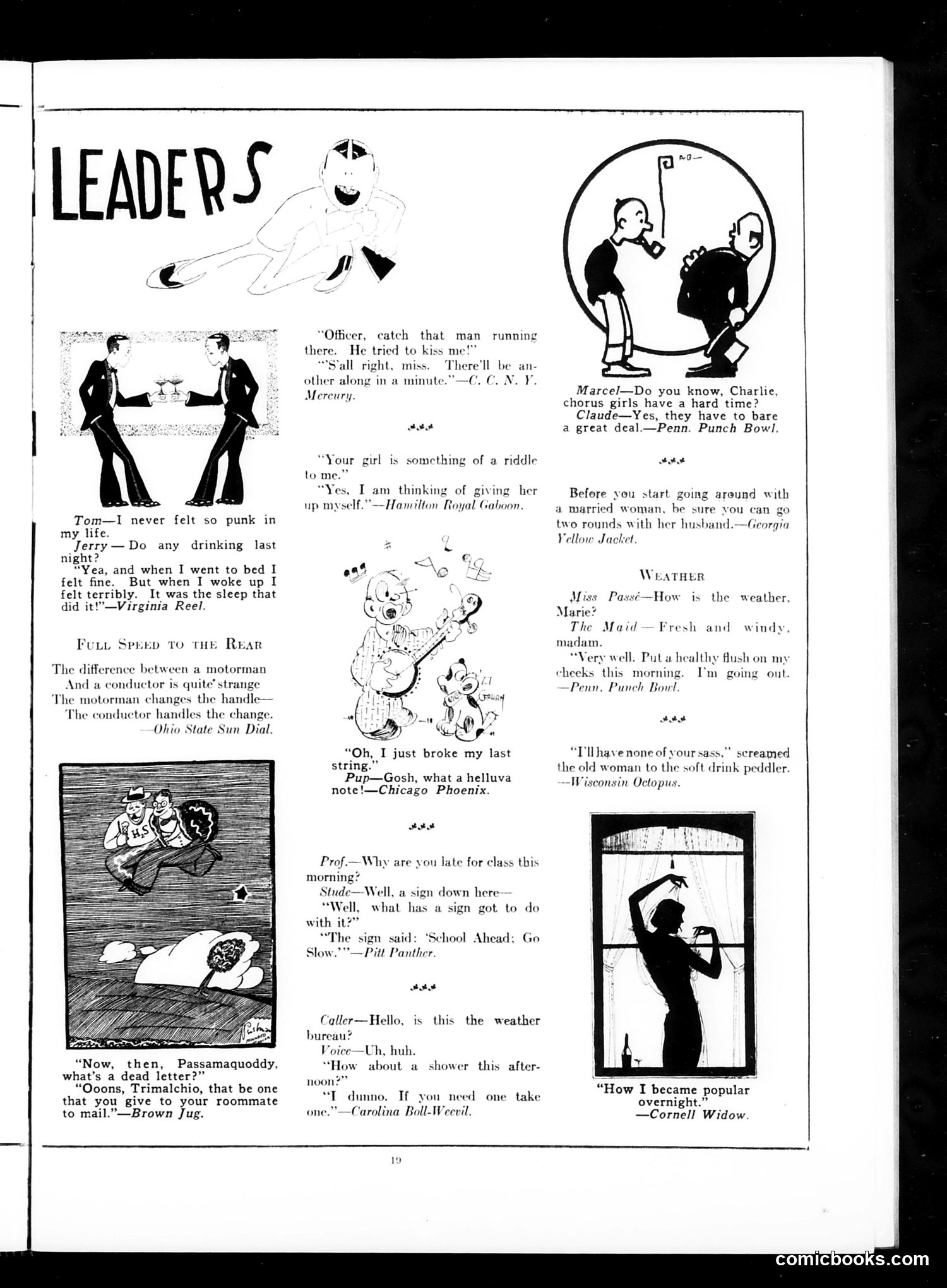
This is a **humor/jokes collection page** from Judge, a satirical magazine popular in early-to-mid 20th century America. It contains no political cartoons, but rather **light social satire and collegiate humor**. The content includes: - **Drinking jokes** ("When I woke up I felt terribly. It was the sleep that did it") - **Wordplay and puns** about conductors "handling change" and motormen "changing handles" - **Dating/romance humor** mocking men's romantic failures and chorus girls - **College pranks** (students citing road signs as excuses for tardiness) - **Gender dynamics** (jokes about women and marriage) - **Physical comedy illustrations** showing slapstick and romantic mishaps The credited sources are college humor magazines (Brown Jug, Pitt Panther, Penn Punch Bowl, etc.), indicating this reprinted student humor. The tone is innocent by modern standards—focused on hangovers, dating troubles, and general absurdism rather than serious social commentary. The illustrations use simple line drawings typical of 1920s-30s publication style.
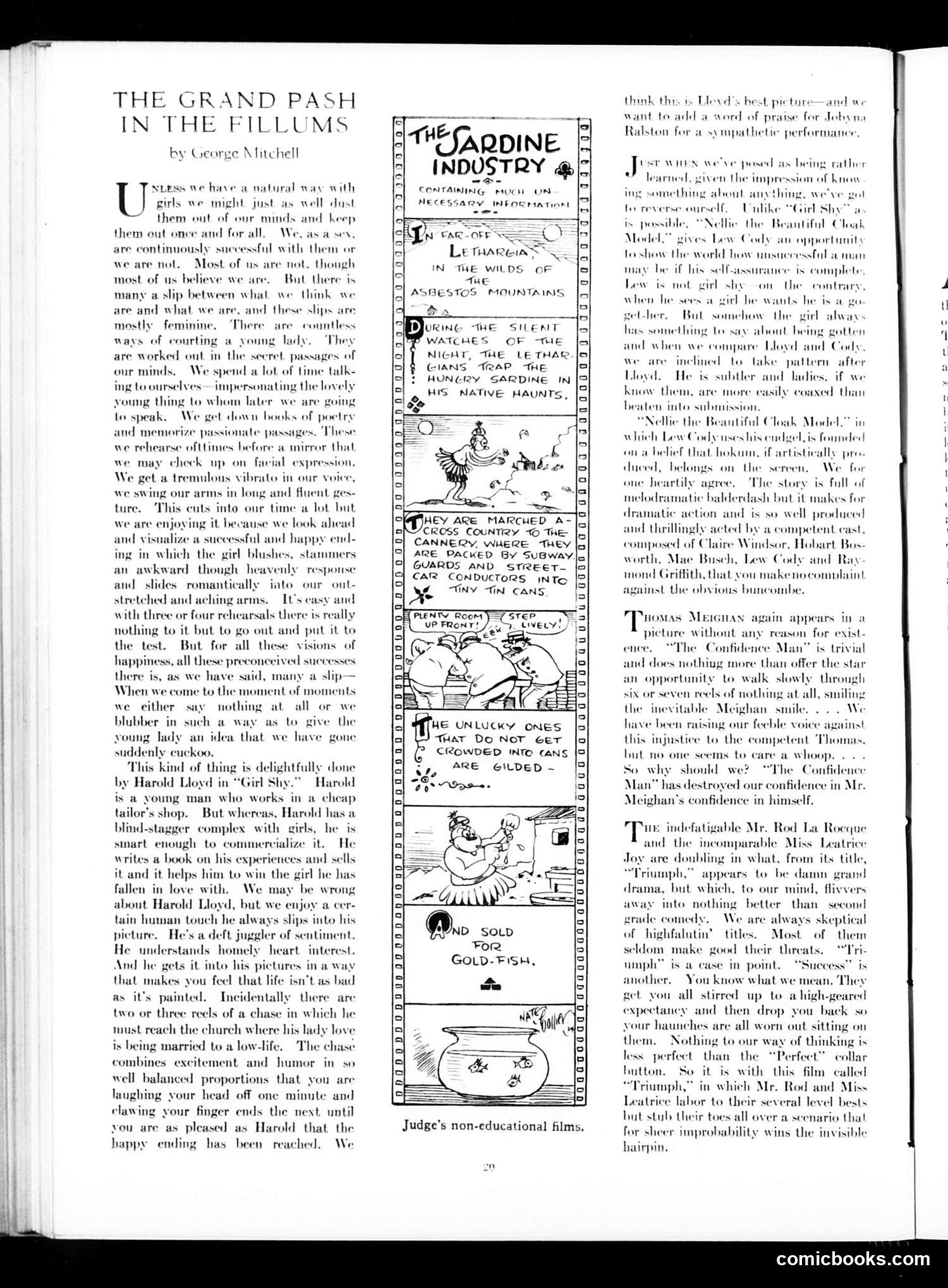
This page contains a film review by George Mitchell praising Harold Lloyd's silent comedy "Girl Shy." The article argues that courting young women requires either natural success or careful rehearsal—Lloyd's character embodies the latter, writing a book about his romantic failures to win over his love interest. Mitchell emphasizes Lloyd's skill at combining sentiment with humor, particularly noting the climactic chase sequence to prevent his lady's marriage to a "low-life." The accompanying cartoon strip, "The Sardine Industry," is satirical mock-educational content depicting sardines as creatures herded, processed, and canned by human "guards" and "conductors." The final panel shows unsold sardines being "gilded"—a joke about making unmarketable products appear valuable. The humor targets both romantic fumbling and industrial processing, reflecting 1920s concerns about commercialization and the gap between appearance and reality.
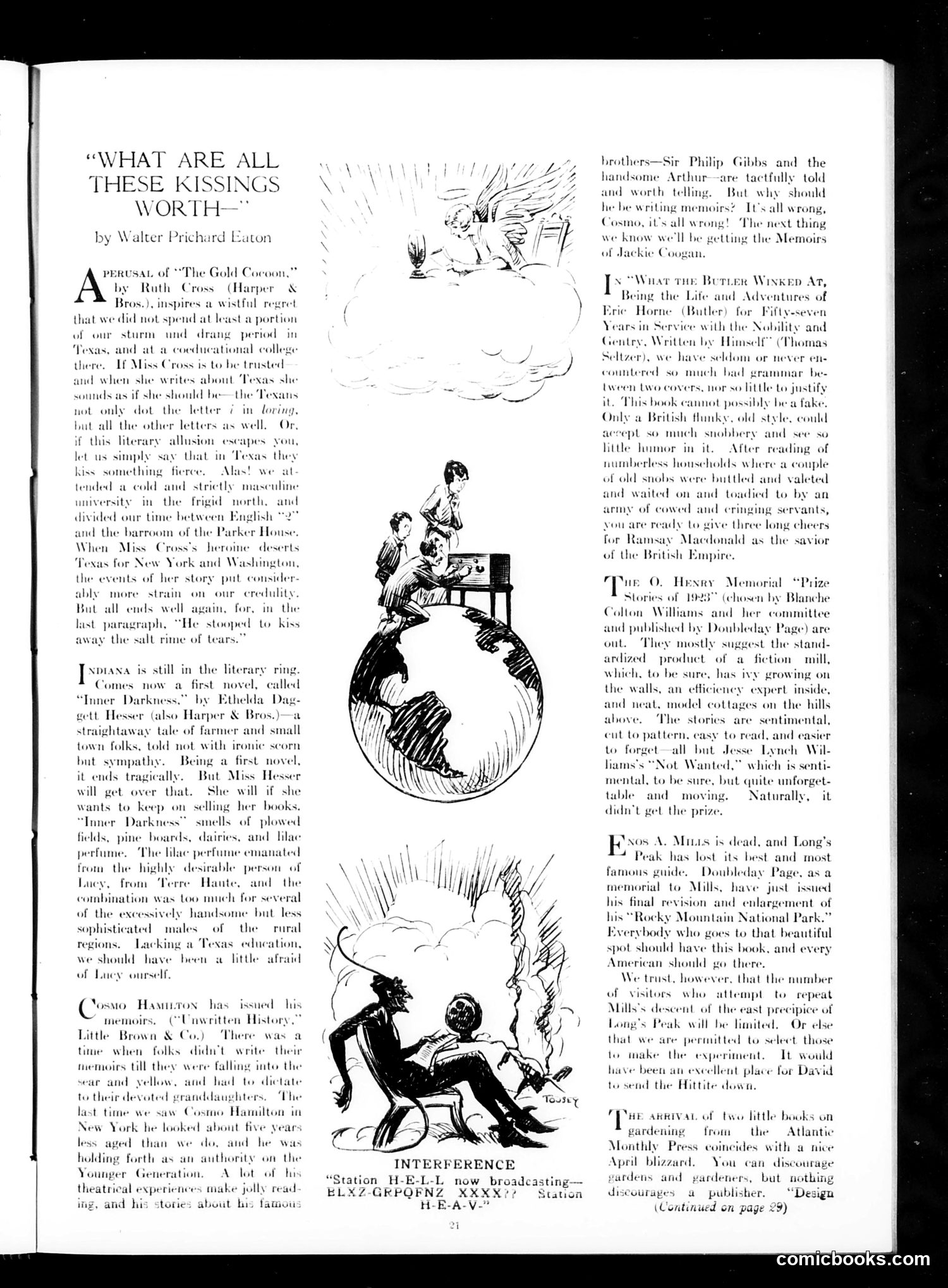
This page is primarily a book review column by Walter Prichard Eaton discussing recent American novels and memoirs. The cartoons are illustrative rather than political satire. The main cartoon labeled "INTERFERENCE" depicts two figures in a physical struggle, parodying radio broadcast static—a topical 1920s reference to new radio technology experiencing technical problems during transmission. The text reviews books including Ruth Cross's *The Gold Cocoon* (praising Texas settings and romance), Ethelda Daggett Hesser's *Inner Darkness* (criticizing its melodrama despite rural authenticity), Cosmo Hamilton's memoirs (questioning why minor figures write autobiographies), and the O. Henry Memorial Prize Stories (mocking their formulaic nature). The tone is witty but conventional literary criticism. The Jackie Coogan reference jokes that even child actors might publish memoirs—Coogan was a famous 1920s child star. The Ramsay MacDonald reference critiques British class hierarchy. No overtly political satire is evident; this is entertainment and cultural commentary for Judge's educated readership.
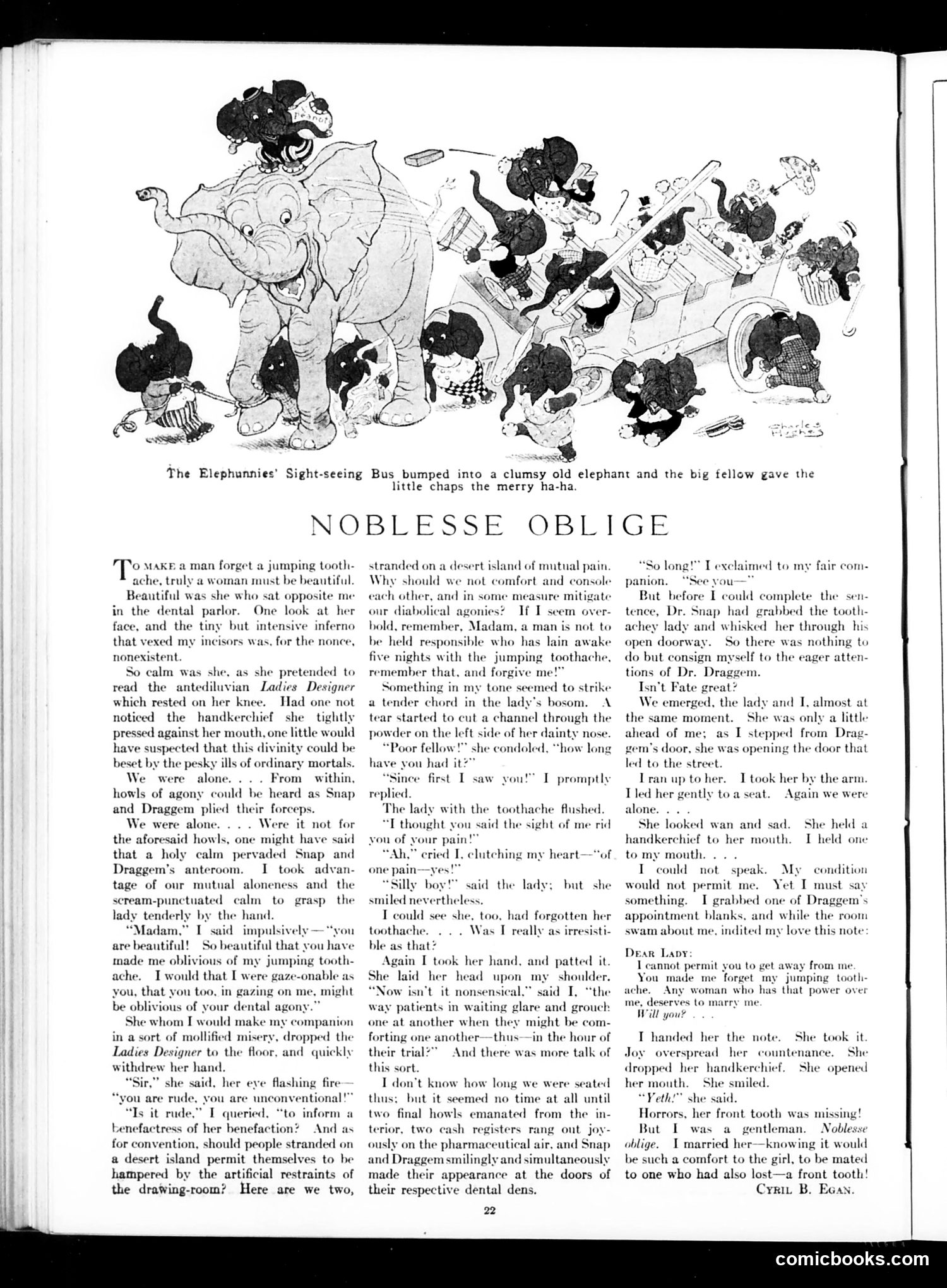
This illustrated short story depicts a romantic encounter between two strangers in a dental waiting room, both suffering from toothaches. The cartoon at top shows "The Elephunnies' Sight-seeing Bus" colliding with an elephant—a visual pun unrelated to the main narrative. The story's satire targets upper-class social conventions. The male narrator, emboldened by shared suffering, breaks conventional decorum by flirting with the woman, arguing that their mutual "desert island" predicament of dental pain exempts them from drawing-room proprieties. The woman initially rebukes his "rudeness," but gradually softens. The joke relies on the tension between Victorian formality and human vulnerability: pain and proximity override social restraint. The title "Noblesse Oblige" (nobility obliges) ironically suggests that refined people should maintain standards—yet both characters abandon formality for comfort. The anticlimactic ending, where dentists whisk them away before romance fully develops, adds comedic frustration typical of Judge's satirical humor.
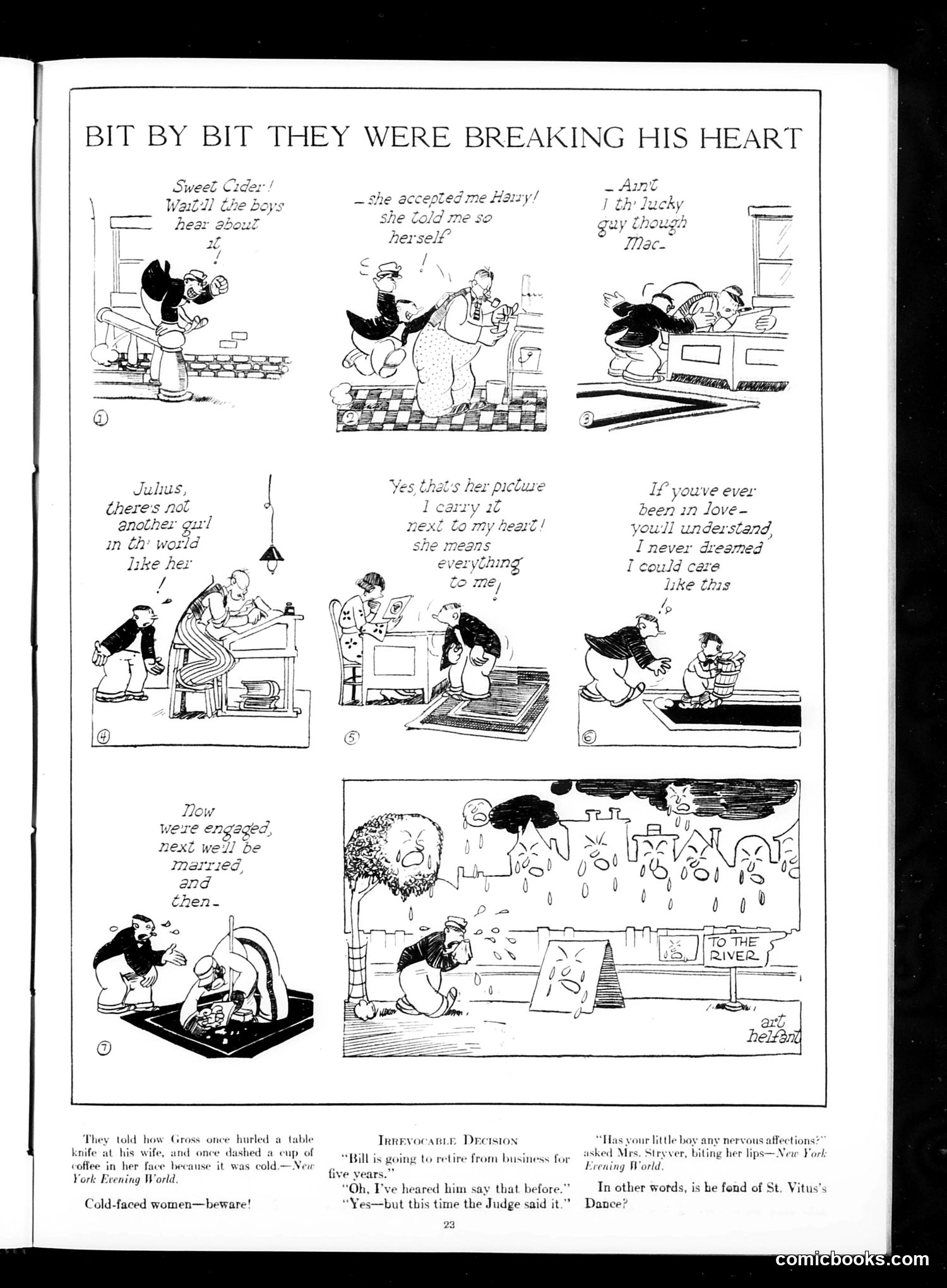
This is a romantic comic strip depicting a man's heartbreak over a woman who has rejected him. The narrative follows his emotional deterioration as he realizes she has accepted another suitor ("she accepted me, Harry / she told me so / herself"). The six panels show him progressively devastated: reminiscing over her picture, confessing his depth of feeling, and eventually attempting suicide (the final panel shows him near a river marked "TO THE RIVER"). The satirical notes at bottom mock "cold-faced women" and reference a real incident involving someone named Gross who allegedly threw objects at his wife—contrasting domestic violence with romantic idealization. The adjoining advice column joke plays on nervous disorders, likely alluding to "St. Vitus's Dance" (a neurological condition). The strip critiques sentimental romance narratives while the contextual notes expose the harsh realities of period domestic relations.
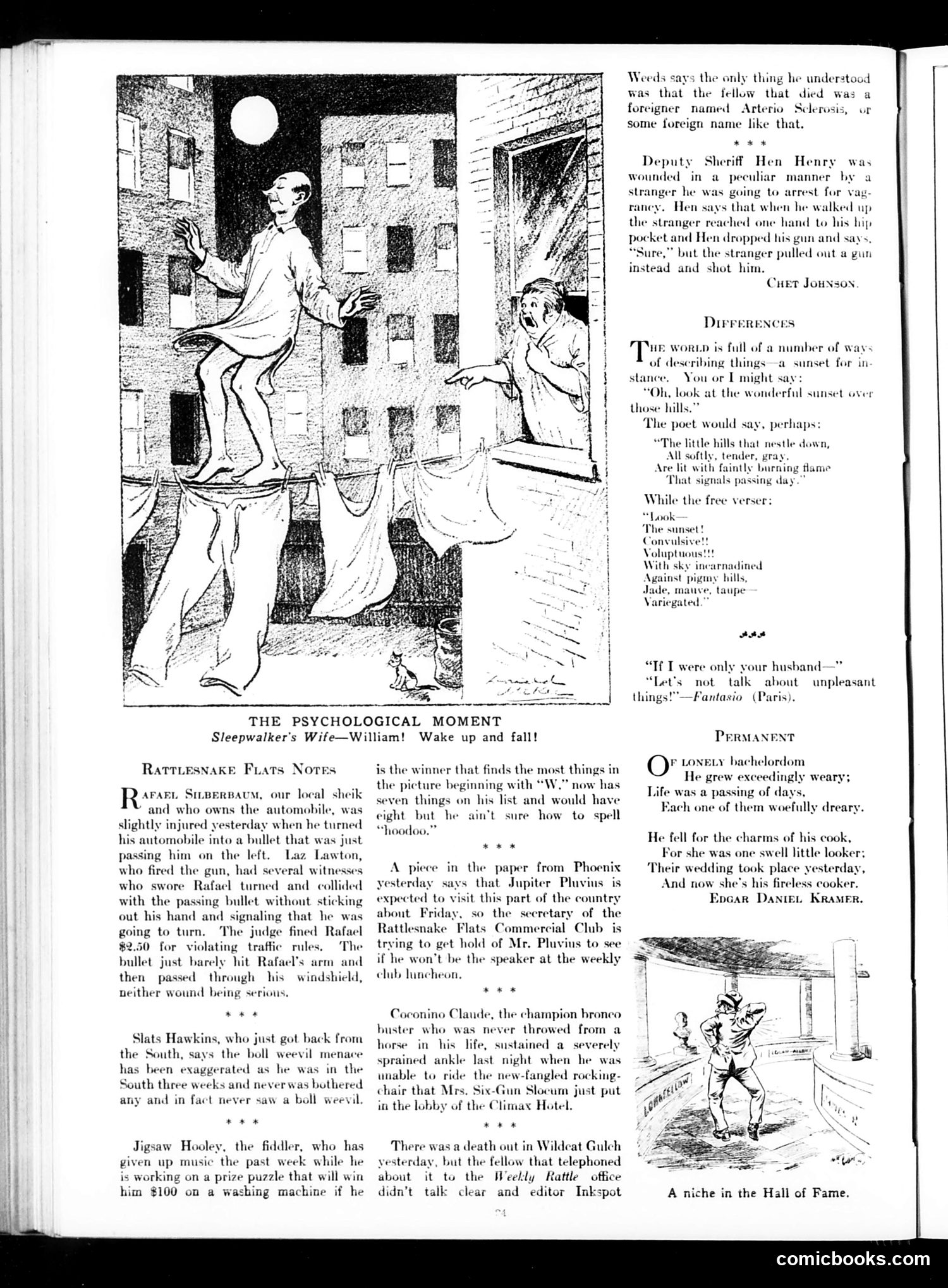
This page from Judge contains several satirical pieces mocking small-town Western life (specifically "Rattlesnake Flats"). **Main cartoon** ("The Psychological Moment"): Shows a man sleepwalking on a rooftop while a woman tries to wake him—the joke being the dangerous situation created by his sleepwalking. **Rattlesnake Flats Notes**: A recurring humor column featuring absurd local incidents: - A man injured by a stray bullet, then fined for "violating traffic rules" - Jupiter Pluvius (Roman god of rain) being invited as a speaker - A bronco buster claiming the boll weevil threat is exaggerated - A fiddle player injuring himself on a newfangled rocking-chair **"Differences"** section: Mocks pretentious poetry by contrasting plain speech about a sunset with overly flowery poetic language and incomprehensible "free verse." The humor relies on rural ignorance, malapropisms, and absurdist logic typical of early 20th-century American satirical magazines targeting urban audiences who found frontier life ridiculous.
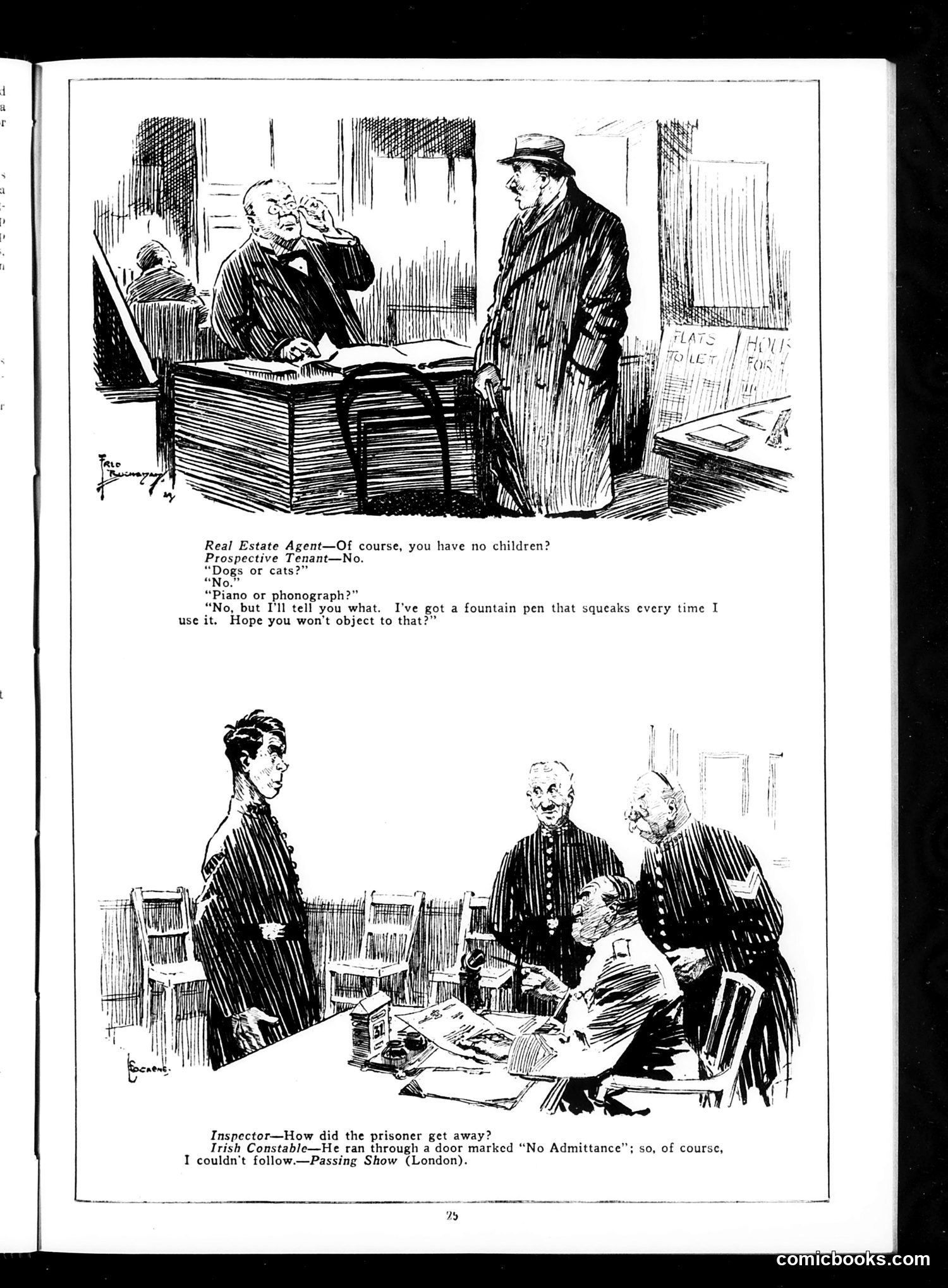
**Top Cartoon: "Real Estate Agent"** A prospective tenant meets with a real estate agent. Through a series of dismissive questions about children, pets, and musical instruments, the agent establishes the tenant has none of these. The tenant then reveals his one annoying possession: a squeaky fountain pen. The satire mocks both demanding landlords who impose strict tenant restrictions AND the absurdity of tenants willing to accept unreasonable conditions while clinging to minor personal quirks. **Bottom Cartoon: "Irish Constable"** An Irish police officer explains to an inspector how a prisoner escaped: the man simply ran through a door marked "No Admittance." The joke satirizes the constable's literal-minded obedience to rules—he couldn't follow the prisoner through the "No Admittance" door because rules prevented him, even in pursuit of his duty. This plays on period stereotypes of Irish police as dim-witted and overly rule-bound.
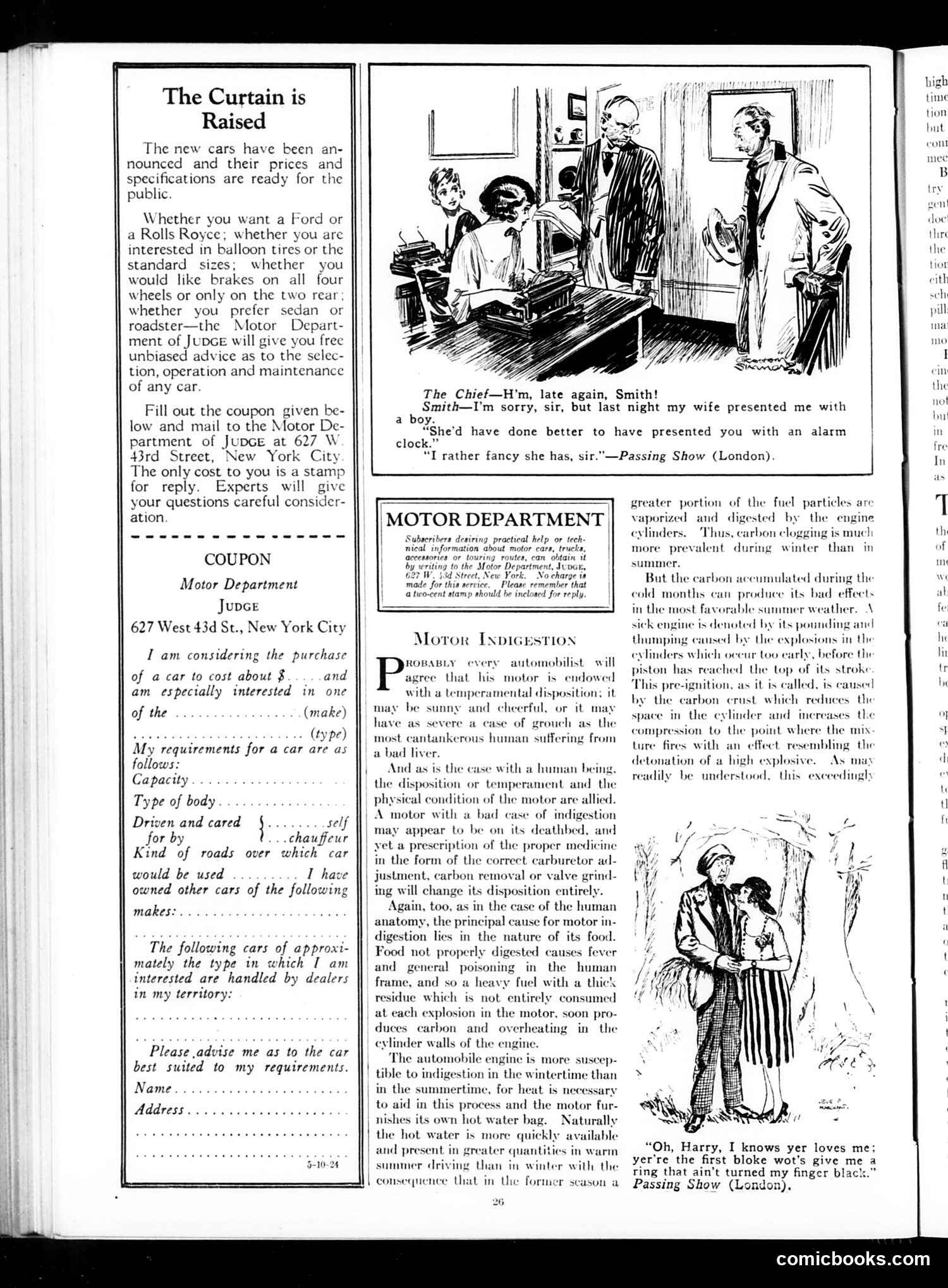
This page primarily features **automotive service content** rather than political satire. It consists of: 1. **"The Curtain is Raised"** - An advertisement for Judge's Motor Department, inviting readers to submit a coupon requesting expert automotive advice about car selection and maintenance. 2. **Two comedic cartoons** from *Passing Show* (London): - A workplace joke about a man arriving late; his boss assumes his wife gave him a boy (child), but the man quips she gave him an "alarm clock" instead—meaning the baby kept him awake. - A street scene cartoon (text partially obscured) with similar domestic humor. 3. **"Motor Indigestion"** - A technical article explaining engine problems using digestive system metaphors: comparing carburetor issues to human indigestion, suggesting that fuel quality and winter conditions cause carbon buildup. **Context for modern readers**: This reflects early-1920s automotive enthusiasm, when car ownership was growing and specialized advice was marketable. The humor assumes readers found domestic/marital jokes and personification of mechanical problems entertaining.
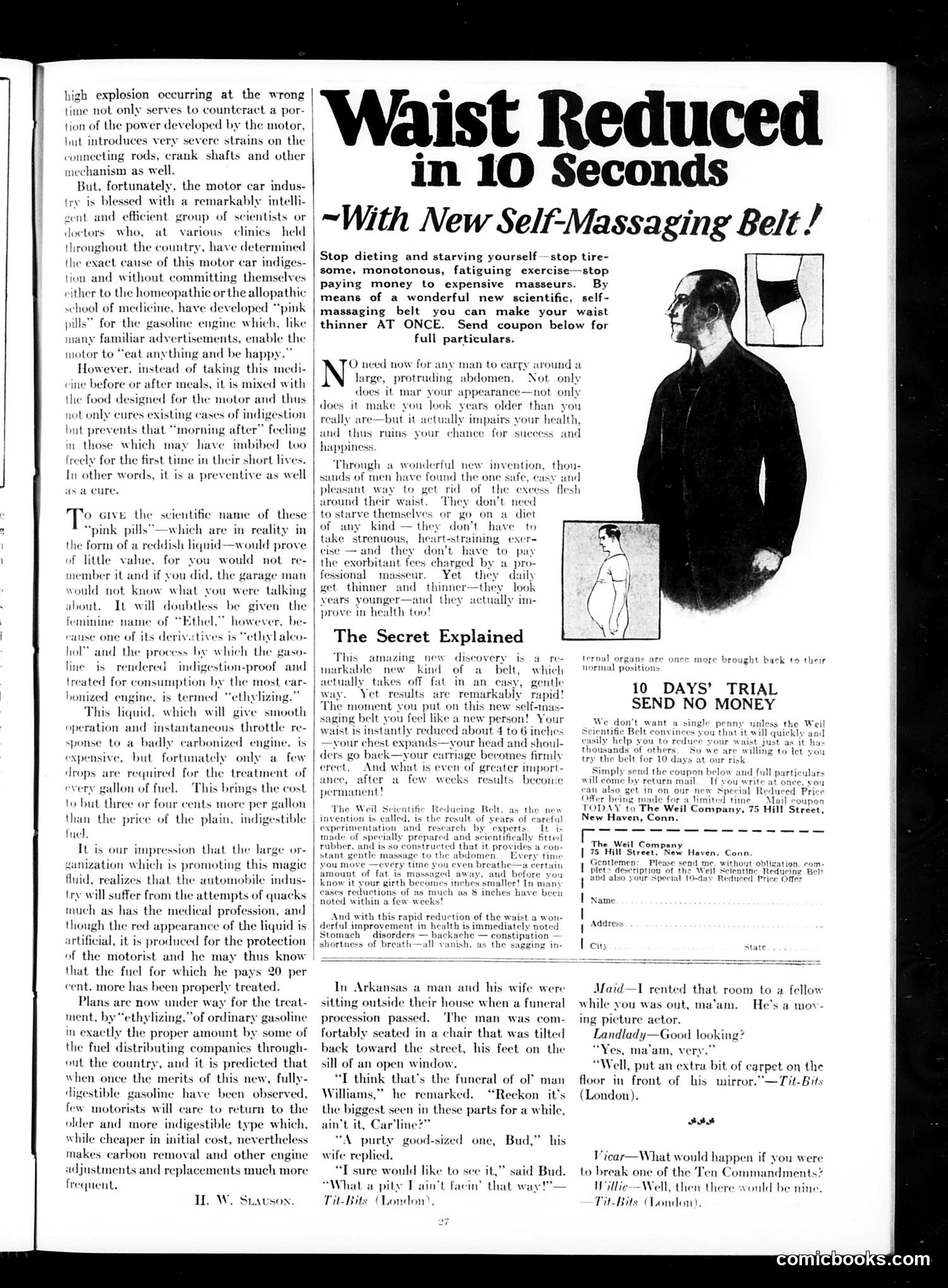
This page is primarily **advertising rather than satire**. The main content is a full-page advertisement for a "Self-Massaging Belt" claiming to reduce waist size in 10 seconds—a classic example of the fraudulent health gadget marketing that flourished in early 20th-century America. The accompanying article (left column) appears to discuss gasoline engine treatment, using medical metaphors ("pink pills," "ethylizing") to describe fuel additives. This juxtaposition creates unintentional dark humor: while the text earnestly explains motor mechanics using health terminology, the adjacent belt advertisement peddles the exact sort of quack remedy the era was notorious for. **The satire, if intended, is subtle**: the contrast between scientific-sounding motor treatment and obviously bogus weight-loss claims. However, Judge may simply be running both the article and advertisement straight, reflecting period attitudes toward both automotive innovation and dubious health products. The coupon at bottom invites readers to request information from The Weil Company in New Haven, Connecticut.
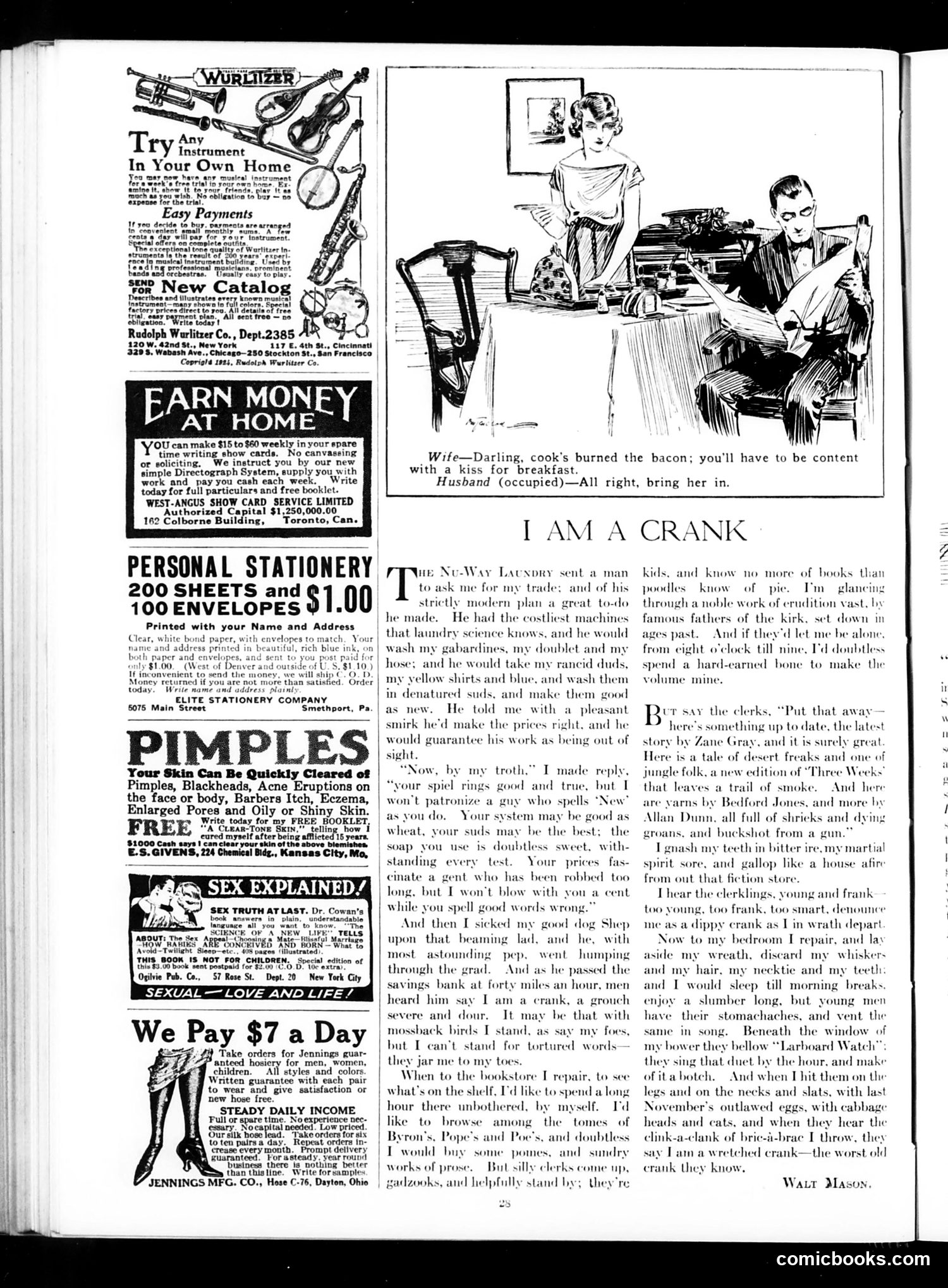
This page is primarily **advertising**, with a brief humorous cartoon and short story. ## The Main Cartoon A domestic scene shows a husband (occupied at his typewriter) telling his wife to "bring in" the cook because the bacon burned—implying he'll settle for a kiss instead of breakfast. The joke plays on economic hardship or marital affection during lean times; it's gentle domesticated humor typical of the era. ## "I Am a Crank" Story Walt Mason's brief essay (bylined at bottom) is a curmudgeonly complaint about modern life. The narrator resents: - A laundry's aggressive sales pitch and modern machinery - Clerks pushing trendy books (Zane Grey novels) - His dog being deemed inadequate - General changes to traditional ways The piece is self-aware satire: Mason positions himself as an out-of-touch grouch resistant to progress—a common theme in Judge's satirical commentary on generational and cultural friction during the early 20th century. **The rest is period advertising** for musical instruments, stationery, skin treatments, hosiery, and work-from-home schemes—typical of Judge's commercial revenue model.
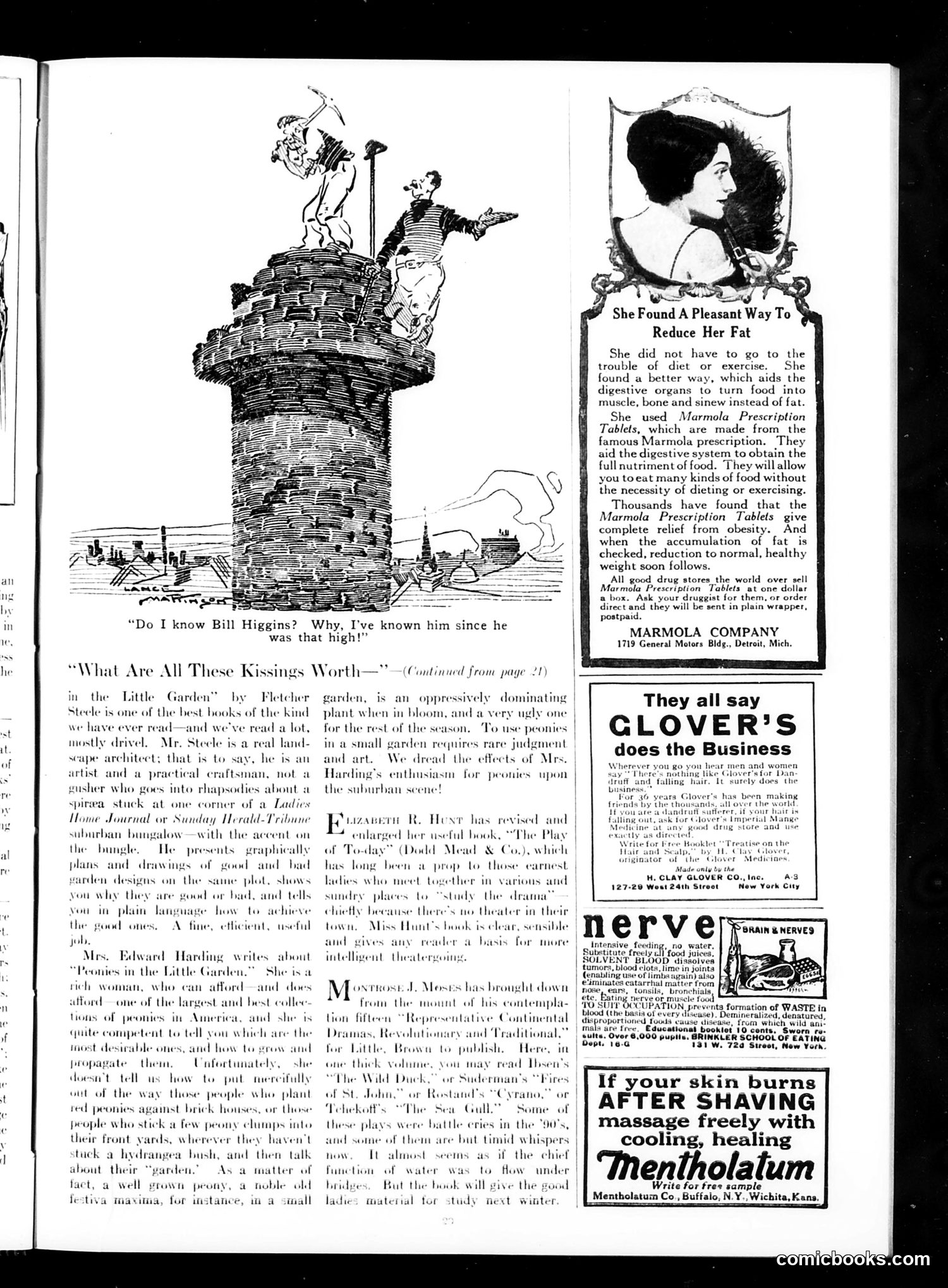
This page is primarily **advertising**, not political satire. The main content consists of book reviews and product advertisements typical of early 20th-century magazines. The visible cartoons/illustrations are: - A large architectural sketch of what appears to be a tower or building with figures, accompanying a book review of "The Little Garden" by Fletcher Steele - A portrait of a woman in a decorative frame promoting "Marmola Prescription Tablets" for weight loss The advertisements promote: - **Marmola tablets** (obesity treatment) - **Clover's hair product** (for hair loss) - **Menthol atum** (shaving product) - **Nerve** (appears to be a health product) The book reviews discuss gardening and drama publications. There's a humorous snippet ("Do I know Bill Higgins? Why, I've known him since he was that high!") but no clear political content. **Overall**: This is a standard magazine page mixing literary criticism with period advertising. The humor is mild and commercial rather than satirical.
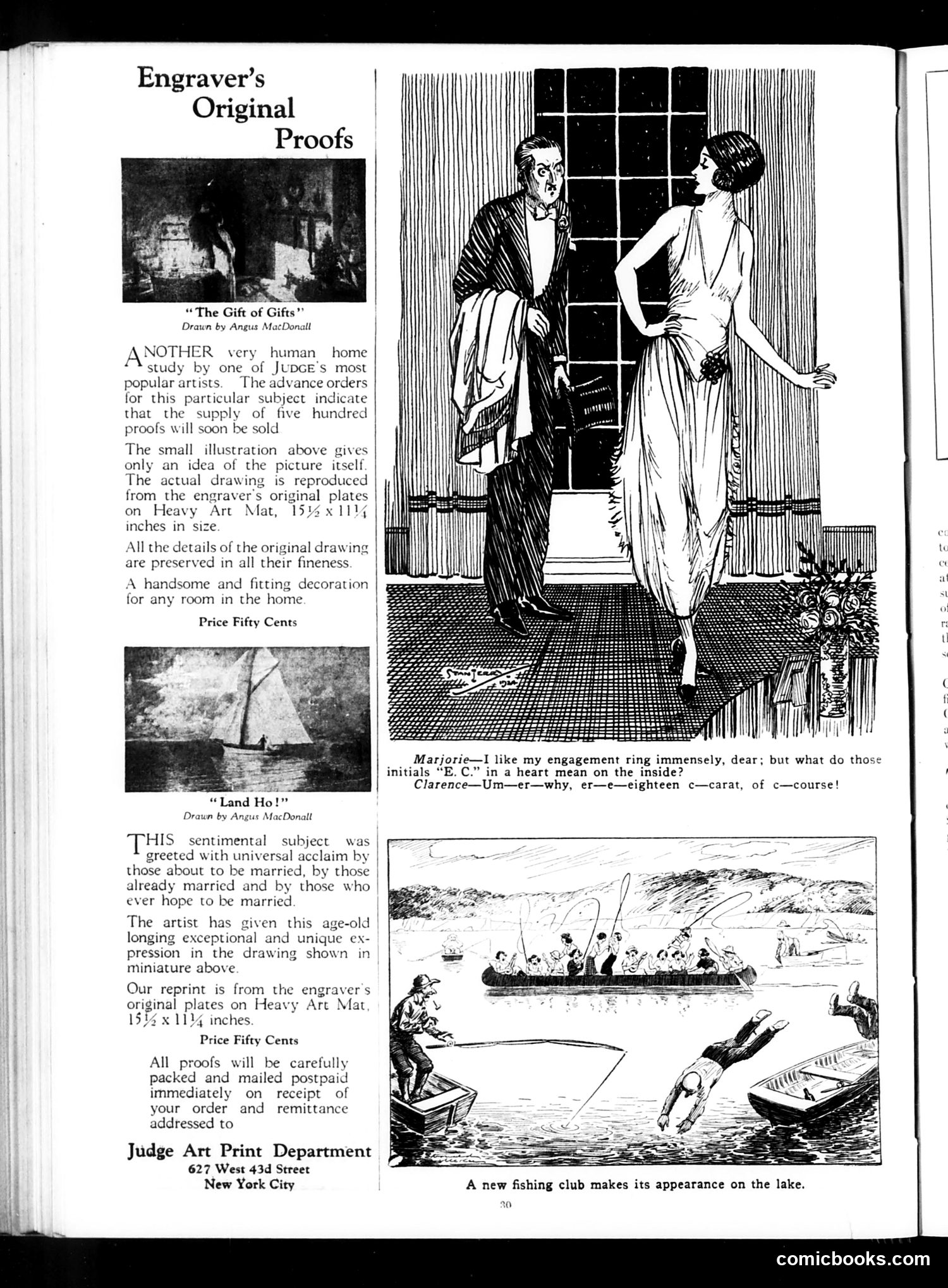
This page advertises engraver's proofs—high-quality reproductions of original artwork—sold by Judge magazine's print department. The main cartoon shows an engagement ring joke: a woman (Marjorie) questions why her fiancé's ring bears initials "E.C." in a heart. His stammering response—claiming it's "eighteen c-carat" gold—is a comedic dodge implying the ring is actually recycled from a previous relationship (the initials presumably belonging to an ex). The secondary cartoon titled "Land Ho!" depicts romanticized maritime nostalgia, appealing to the newly married and engaged. Both images are described as sentimental "home studies" by popular artist Angus MacDonald, sold for fifty cents each. The bottom illustration shows a fishing scene, likely satirizing a new social club appearing on a lake. The page functions primarily as **advertising**—promoting these reproducible artworks to Judge readers as affordable decorative prints.
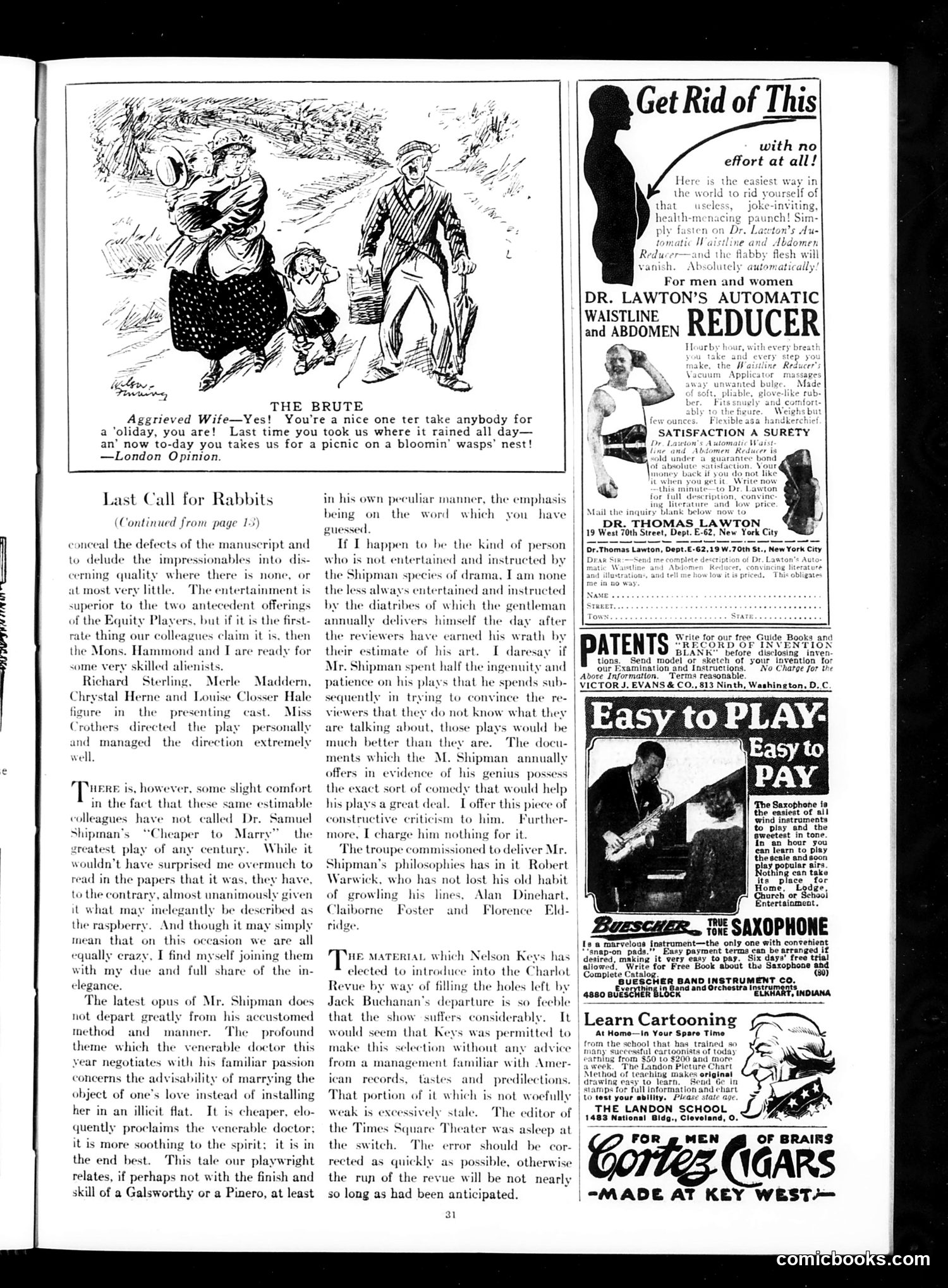
This page from **Judge** (a satirical magazine) contains primarily **theater criticism and advertising**, with one cartoon. ## The Cartoon ("The Brute") The small sketch at top-left shows a wife complaining to her husband about a disastrous family outing. She sarcastically calls him "a nice one" for taking the family on a picnic where it rained all day, and now to a location infested with wasps. The joke targets **husbands' incompetence at planning leisure activities**—a common domestic humor trope of the era. The wife's exasperation at his poor judgment is the satire's target. ## The Text The bulk of the page reviews theatrical productions, particularly criticizing **Dr. Shipman's play "Cheaper to Marry"** as philosophically heavy-handed despite critical acclaim. The critic notes Shipman spends more energy defending his work to reviewers than improving his actual plays. The page also advertises period products like Dr. Lawton's weight-reduction device and saxophone lessons—typical early 20th-century magazine filler.
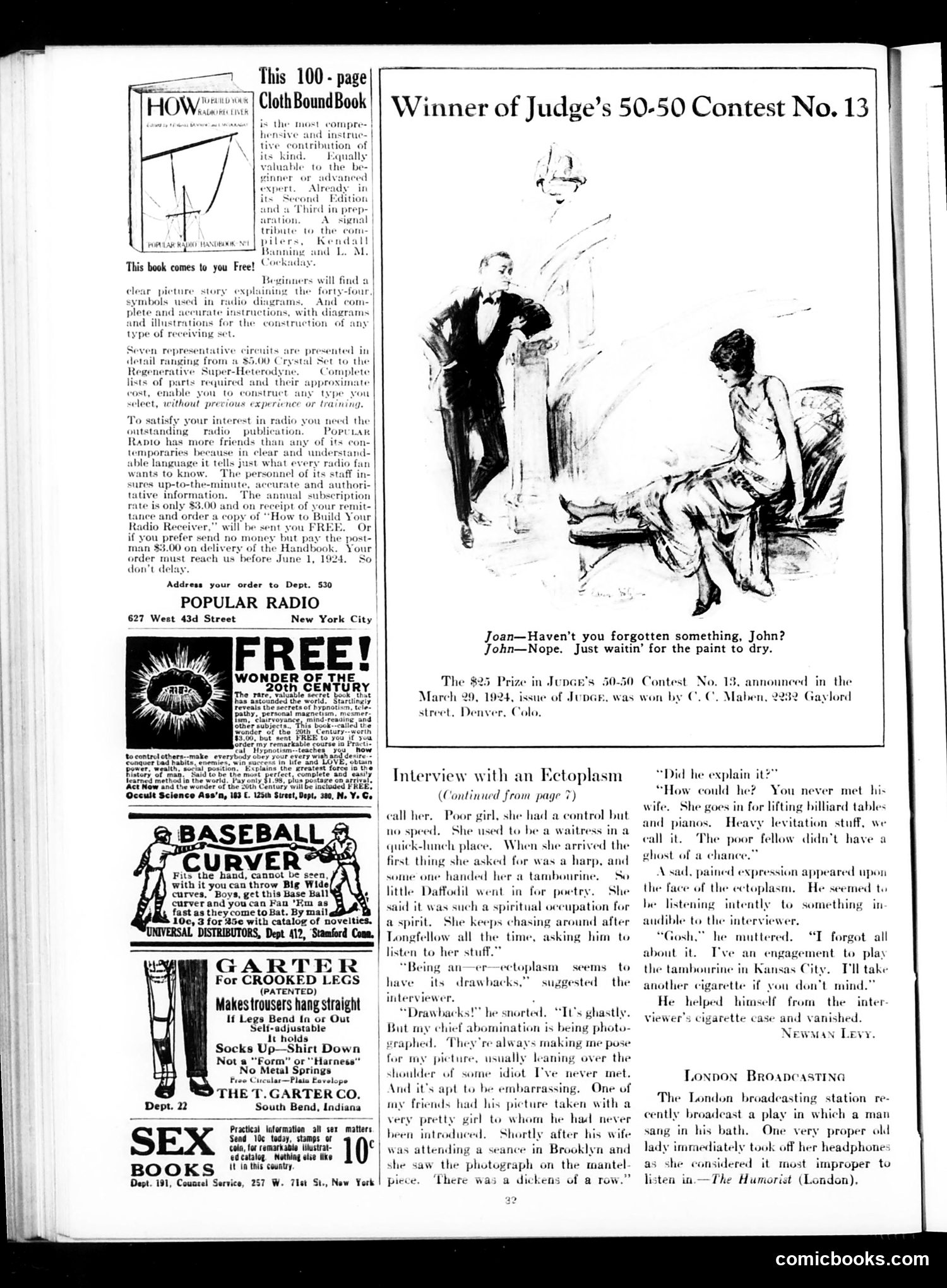
This page is primarily **advertising** with one cartoon contest winner featured. **The Main Cartoon:** "Winner of Judge's 50-50 Contest No. 13" shows a domestic scene where a husband (John) tells his wife (Joan) he's waiting for paint to dry—a humorous excuse for inaction or procrastination. The joke relies on the simple domestic frustration familiar to 1920s audiences: husbands avoiding household tasks. **The Rest of the Page:** Consists entirely of advertisements typical of 1920s publications: - Radio building manuals and Popular Radio magazine - A novelty baseball toy - A medical device (a "garter" for straightening crooked legs) - Sex education books The "Interview with an Ectoplasm" article discusses spiritualist séances, reflecting 1920s fascination with the occult and spiritualism—a popular but often-mocked cultural phenomenon. **Historical Context:** This reflects post-WWI American consumer culture and emerging mass media industries (radio, novelty goods, spiritualist entertainment).
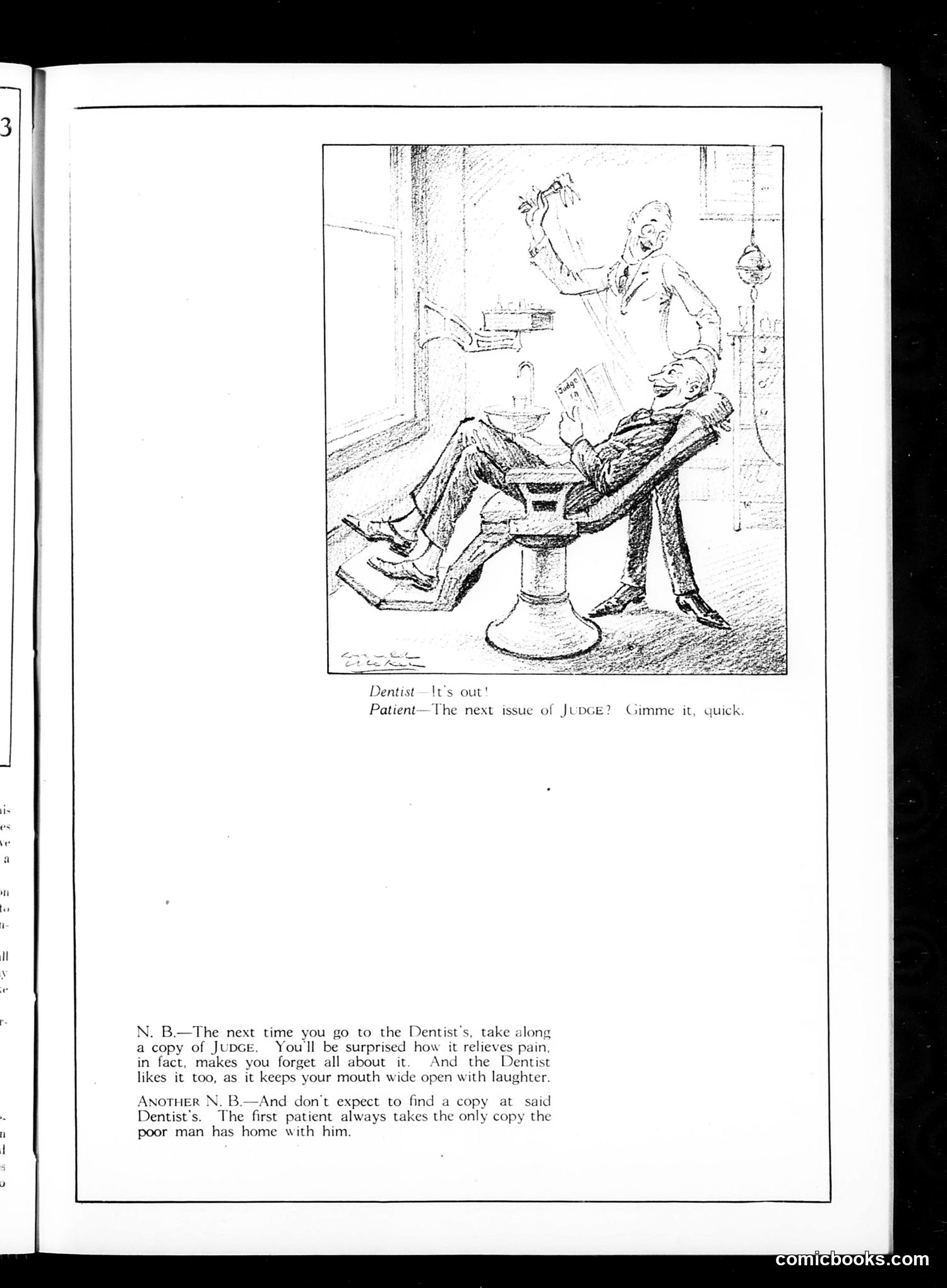
This is a self-promotional joke from *Judge* magazine advertising its own comedic value. The cartoon shows a dentist extracting a tooth while a patient eagerly demands the next issue of *Judge* instead of focusing on the pain. The satire works on two levels: First, it suggests *Judge*'s humor is so effective it distracts from dental pain—a lighthearted exaggeration of the magazine's comedic power. Second, the accompanying notes joke that dentists stock *Judge* because it keeps patients' mouths open through laughter, and that the first patient always steals the only copy, leaving none for the dentist's office. It's essentially an in-house advertisement disguised as humor, playing on the cultural assumption that reading material in medical waiting rooms was both valuable and frequently pilfered.
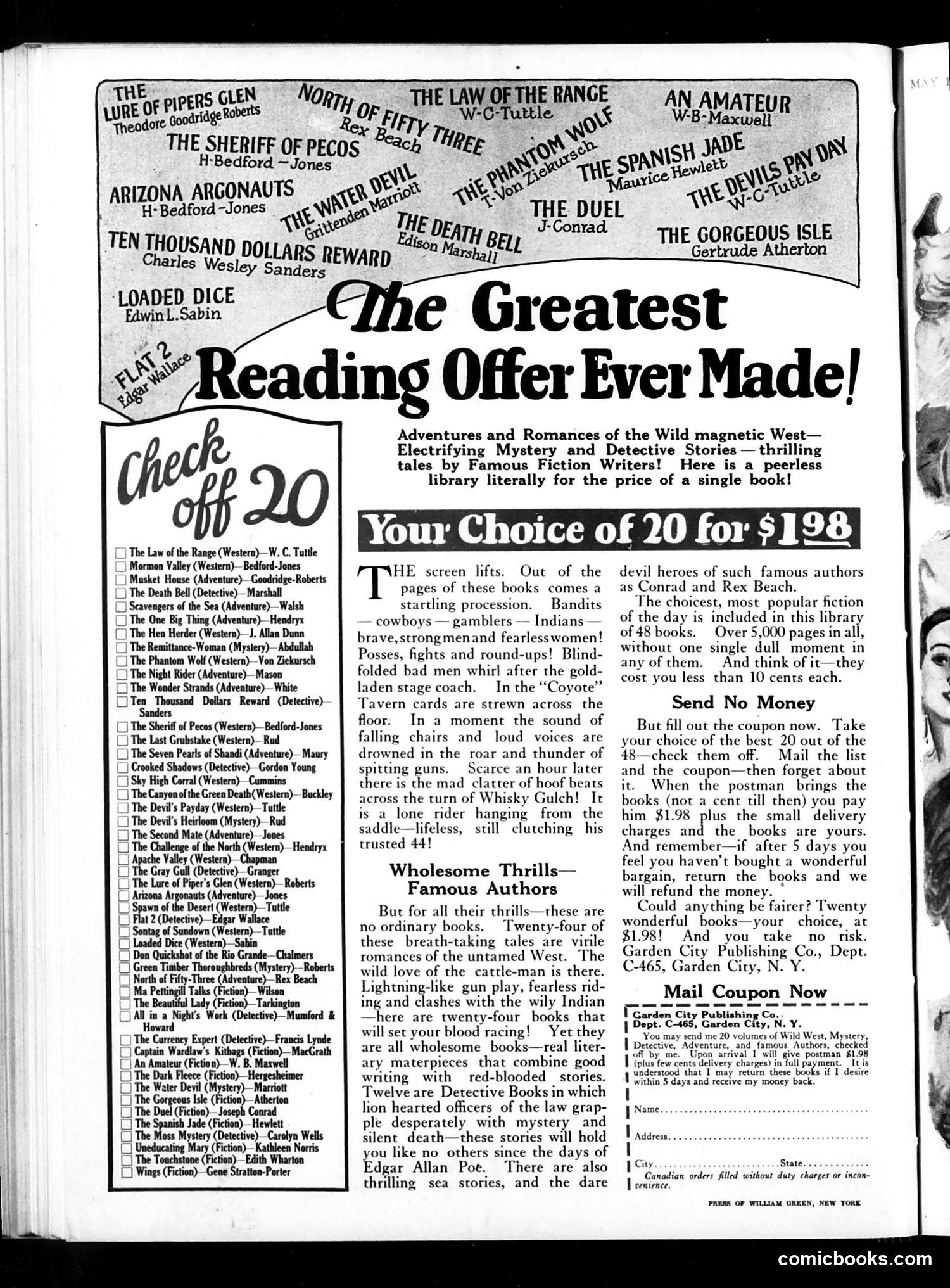
This page is primarily **advertising**, not political satire. It's a book club promotion from Garden City Publishing Co. offering 20 Western and detective novels for $1.98. The listed titles showcase popular pulp fiction genres of the era: Westerns featuring cowboys, outlaws, and frontier action ("The Sheriff of Pecos," "Arizona Argonauts," "North of Fifty-Three"); detective mysteries ("The Death Bell," "Crooked Shadows"); and adventure tales. Authors like Conrad, Rex Beach, and Goodridge Roberts were contemporary fiction writers. The ad emphasizes mass-market appeal through vivid imagery—bandits, gunfights, saloons—targeting readers seeking escapist entertainment about "the untamed West." The "$1.98 for 20 books" offer (roughly 10 cents per book) marketed accessibility to working-class audiences. This reflects 1920s-30s publishing: inexpensive pulp fiction distributed via mail order represented democratic access to entertainment, though critics often dismissed such stories as lowbrow literature.