
Judge, 1924-05-10 · page 12 of 36
Judge — May 10, 1924 — page 12: what you’re looking at
What you’re looking at
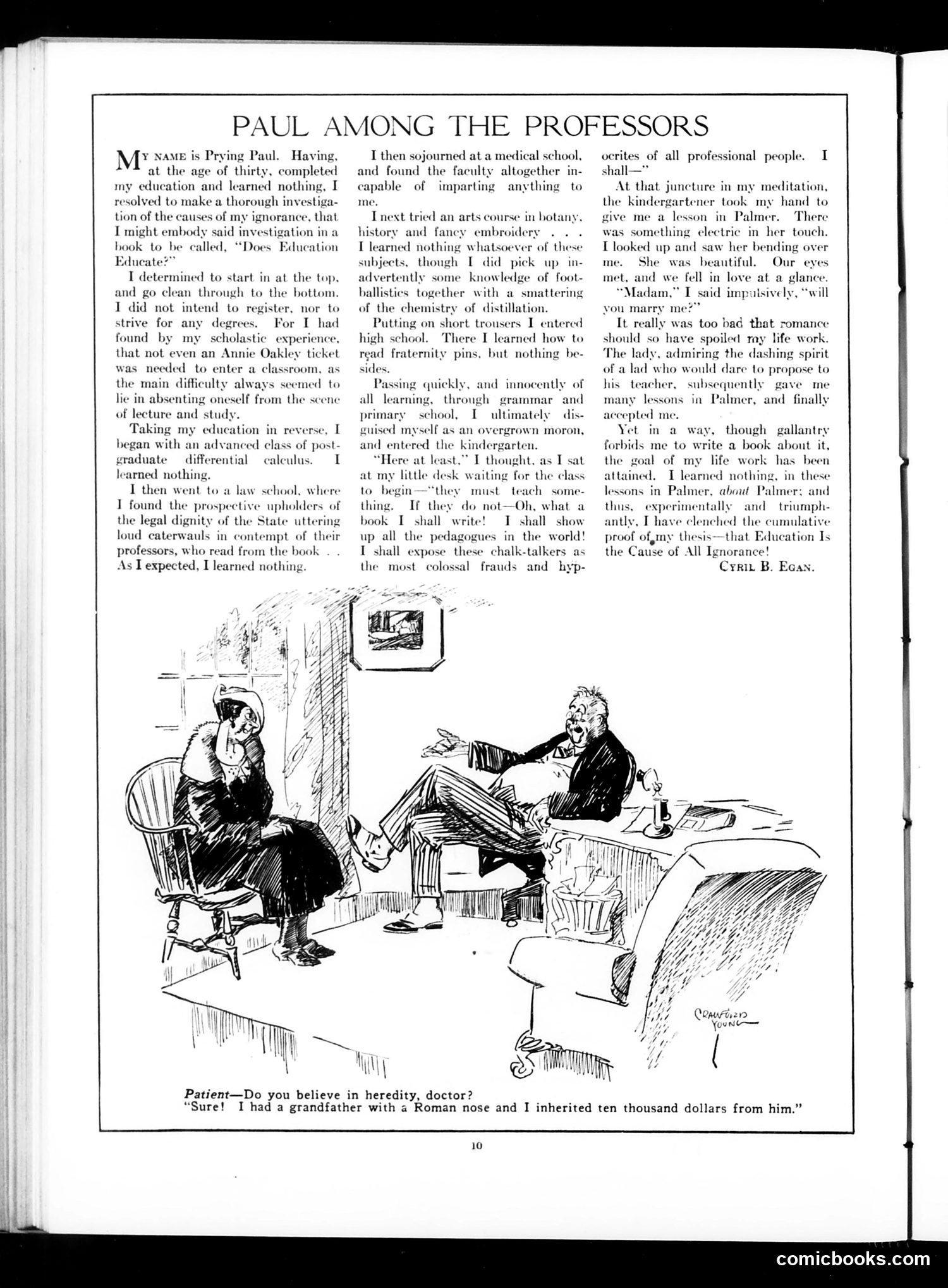
This satirical essay by Cyril B. Egan mocks the American education system by following "Prying Paul" through every level—from postgraduate studies down to kindergarten—where he claims to learn nothing at each stage. The piece ridicules professors as fraudulent "chalk-talkers" who merely read from books without teaching genuine knowledge. The humor culminates in an ironic twist: Paul's only "learning" occurs when he falls in love with his kindergarten teacher and proposes to her instead of pursuing his planned exposé. The cartoon shows a doctor and patient discussing heredity, with the patient claiming he inherited ten thousand dollars from his grandfather—a joke about inheriting only money, not traits or intellect. The satire targets widespread early-20th-century skepticism about institutional education's actual value.
📄 Transcribed text from this page (OCR, searchable)
Machine-transcribed from the original scan — historical spelling and the odd misread are preserved.
y Name is Prying Paul. Having, cof thirty, completed my education and learned nothing, I resolved to make a thorough investiga- tion of the causes of my ignorance, that I might embody said investis Educate?” on ina lucation I determined to start in at the top, and go clean through to the bottom. I did not intend to register, nor to strive for any degrees. For I had found by my. scholastic experience, that not even an Annie Oakley ticket was needed to enter a classroom, as the main difficulty always seemed to lie in absenting oneself from the scene of lecture and study. Taking my education in reverse, I began with an advanced class of post- graduate — differential learned nothing. I then went to a law school, where I found the prospective upholders of the legal dignity of the State uttering loud caterwauls in contempt of their professors, who read from the book As I expected, I learned nothing. calculus. — I PAUL AMONG THE PROFESSORS I then sojourned at a medical school, and found th capable of im me. anything to arting T next tried an arts course in botany, history and faney embroidery T learned nothing whatsoever of these subjects, though [ did pick up in- advertently some knowledge of foot- ballisties together with a smattering of the chemistry of distillation. Putting on short trousers I entered high school. There I learned how to read fraternity pins, but nothing be- sides. Passing quickly, and innocently of all learning, through grammar and primary school, I ultimately dis- guised myself as an overgrown moron, and entered the kindergarten. “Here at least.” I thought, as T sat at my little desk waiting for the class to begin—they must teach some- thing. If they do not—Oh, what a book I shall write! TI shall show up all the pedagogues in the world! I shall expose these chalk-talkers as the most colossal frauds and hyp- Patient—Do you believe in heredity, doctor? “Sure! ocrites of all professional people. I shall—" At that juncture in my meditation, the kindergartener took my hand to give me a lesson in Palmer. There was something electric in her touc! T looked up and saw her bending ov me. She was beautiful. Our ey met, and we fell in love at a glance “Madam,” I said impuisively, “will you marry me?” It really was too bad that romance should so have spoiled ray life work. The lady, admiring the dashing spirit of a lad who would dare to propose to his teacher, subsequently gave me many lessons in Palmer, and finally accepted me. Yet in a y, though gallantry forbids me to write a book about it, the goal of my life work has been a red. T learned nothing, in these lessons in Palmer, about Palmer; and thus, experimentally antly, I and triumph- ave clenched the cumulative proof ofgmy thesis—that Education Is the Cause of All Ignorance! Cyrin B. Eaan. I had a grandfather with a Roman nose and I inherited ten thousand dollars from him.” comicbooks.com