
Judge, 1924-05-10 · page 17 of 36
Judge — May 10, 1924 — page 17: what you’re looking at
What you’re looking at
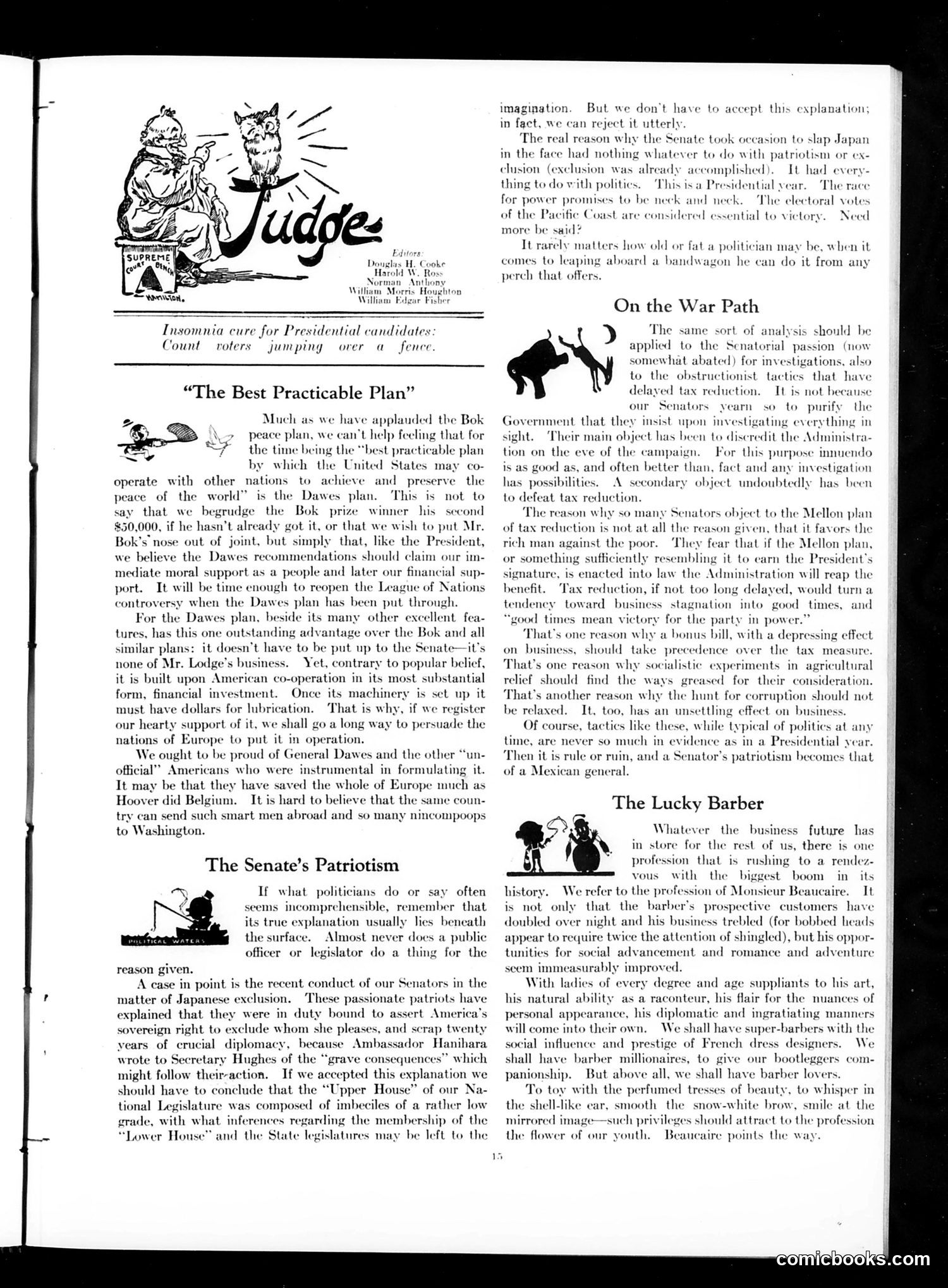
This page satirizes American political hypocrisy in the 1920s. **Top cartoon**: A judge figure scolds two quarreling figures (likely representing presidential candidates), captioning an "insomnia cure" as counting voters "jumping over a fence"—mocking campaign exhaustion. **Main articles** critique Senate behavior: 1. **"The Best Practicable Plan"** praises the Dawes Plan (a post-WWI economic recovery proposal) over the Bok Peace Plan, because it bypasses Senate approval—implying Senators obstruct rather than govern responsibly. The author sarcastically notes America sends "smart men abroad" but "nincompoops to Washington." 2. **"The Senate's Patriotism"** directly attacks Senators' 1924 Japanese exclusion vote. Judge argues they falsely claimed patriotic duty; the *real* reason was securing Pacific Coast electoral votes for the presidential election. The satire exposes how politicians cynically use nationalism to gain power. The message: look beneath politicians' stated justifications—self-interest and electoral calculation drive their actions.
📄 Transcribed text from this page (OCR, searchable)
Machine-transcribed from the original scan — historical spelling and the odd misread are preserved.
Donglas H. Cooke Harold W. Ross Norman Anthony William Morris Houghton William Edgar Fisher Insomnia cure for Presidential candidates Count voters” jumping over a fence. “The Best Practicable Plan” Much as we have applauded the Bok peace plan, we can’t help feeling that for Y the time being the “best practicable plan = by which the United States may co- operate with other nations to a and preserve the peace of the world” is the Dawes plan. This is not to say that we begrudge the Bok prize winner his second $50,000, if he hasn’t already got it, or that we wish to put Mr. Bok’s nose out of joint, but simply that, like the President, we believe the Dawes recommendations should claim our im- mediate moral support as a people and later our financial sup- port. It will be time enough to reopen the League of Nations controversy when the Dawes plan has been put through. For the Dawes plan, beside its many other excellent fea- tures, has this one outstanding advantage over the Bok and all similar plans: it doesn’t have to be put up to the Senate—it’s none of Mr. Lodge’s business. Yet, contrary to popular belief, it is built upon American co-operation in its most substantial form, financial investment. Once its machinery is set up it must have dollars for lubrication. That is why, if we register our hearty support of it, we shall go a long way to persuade the nations of Europe to put it in operation. We ought to be proud of General Dawes and the other “un- official” Americans who were instrumental in formulating it. It may be that they have saved the whole of Europe much as Hoover did Belgium. It is hard to believe that the same coun- try can send such smart men abroad and so many nincompoops to Washington. hieve The Senate’s Patriotism If what politicians do or say often seems incomprehensible, remember that its true explanation usually lies beneath the surface. Almost never does a public officer or legislator do a thing for the reason given. A case in point is the recent conduct of our Senators in the matter of Japanese exclusion. These passionate patriots have explained that they were in duty bound to assert America’s sovereign right to exclude whom she pleases, and scrap twenty years of crucial diplomacy, because Ambassador Hanihara wrote to Secretary Hughes of the * which might follow their-action. If we accepted this explanation we should have to conclude that the “Upper House” of our Na- tional Legislature was composed of imbeciles of a rather low grade, with what inferences regarding the membership of the “Lower House” and the State legislatures may be left to the rave consequences” imagination. But we don't have to accept this explanation; in fact, we can reject it utterly The real reason why the Senate took occasion to slap Japan in the face had nothing whatever to do with patriotism or ex- clusion (exclusion was It had ever: The r: ‘The electoral votes Need Iready. accomplished thing to do with politi This isa Pr for power promises to be neck ¢ lential year. wl neck. of the Pacific Coast are considered essential to victory. more be said? It rarely matters how old or fat a politician may be, when it comes to leaping aboard a bandwagon he ean do it from any perch that offers. On the War Path y The same sort of analysis should be applied to the Senatorial passion (now somewhat abated) for investigations, also to the obstructionist tactics that It is not because have delayed tax reduction. our Senators yearn so to purify the Government that they insist upon investigating everything in sight. Their main object has been to discredit the Administra- tion on the eve of the campaign. For this purpose innuendo is as good as, and often better than, fact and any investigation has possibilities. A secondary object undoubtedly has been to defeat tax reduction. The reason why so many Senators object to the Mellon plan of tax reduction is not at all the reason given, that it favors the rich man against the poor. ‘They fear that if the Mellon plan, or something sufficiently resembling it to earn the President's signature, is enacted into law the Administration will reap the benefit. Tax reduction, if not too long delayed, would turn a tendency toward business stagnation into good times, and “good times mean victory for the party in power.” ‘That's one reason why a bonus bill, with a depressing effect on business, should take precedence over the tax measure. That’s one reason why socialistic experiments in agricultural relief should find the ways greased for their consideration. ‘That's another reason why the hunt for corruption should not be relaxed. Of course It, too, has an unsettling effect on business ctics like these, while typical of politi time, are never so much in evidence at any as in a Presidential year. Then it is rule or ruin, and a Senator's patriotism becomes that of a Mexican general. The Lucky Barber Whatever the future has in store for the rest of us, there is one ax: business profession that is rushing to a rendez- with the biggest’ boom in its history. We refer to the profession of Monsieur Beaucaire. It is not only that the barber's prospective customers have doubled over night and his business trebled (for bobbed heads appear to require twice the attention of shingled), but his oppor- tunities for social advancement and romance and adventure seem immeasurably improved. vous With ladies of every degree and age suppliants to his art, his natural ability as a raconteur, his flair for the nuances of personal appearance, his diplomatic and ingratiating manners will come into their own. We shall have super-barbers with the social influence and prestige of F We shall have barber millionaires, to give our bootleggers com- panionship. But above all, we shall have barber lovers. onch dress designers. To toy with the perfumed tresses of beauty, to whisper in the shell-like ear, smooth mirrored image the snow-white brow, smile at the such privileges should attract to the profession the flower of our youth. Beaucaire points the way.