
A complete issue · 36 pages · 1924
Judge — April 5, 1924
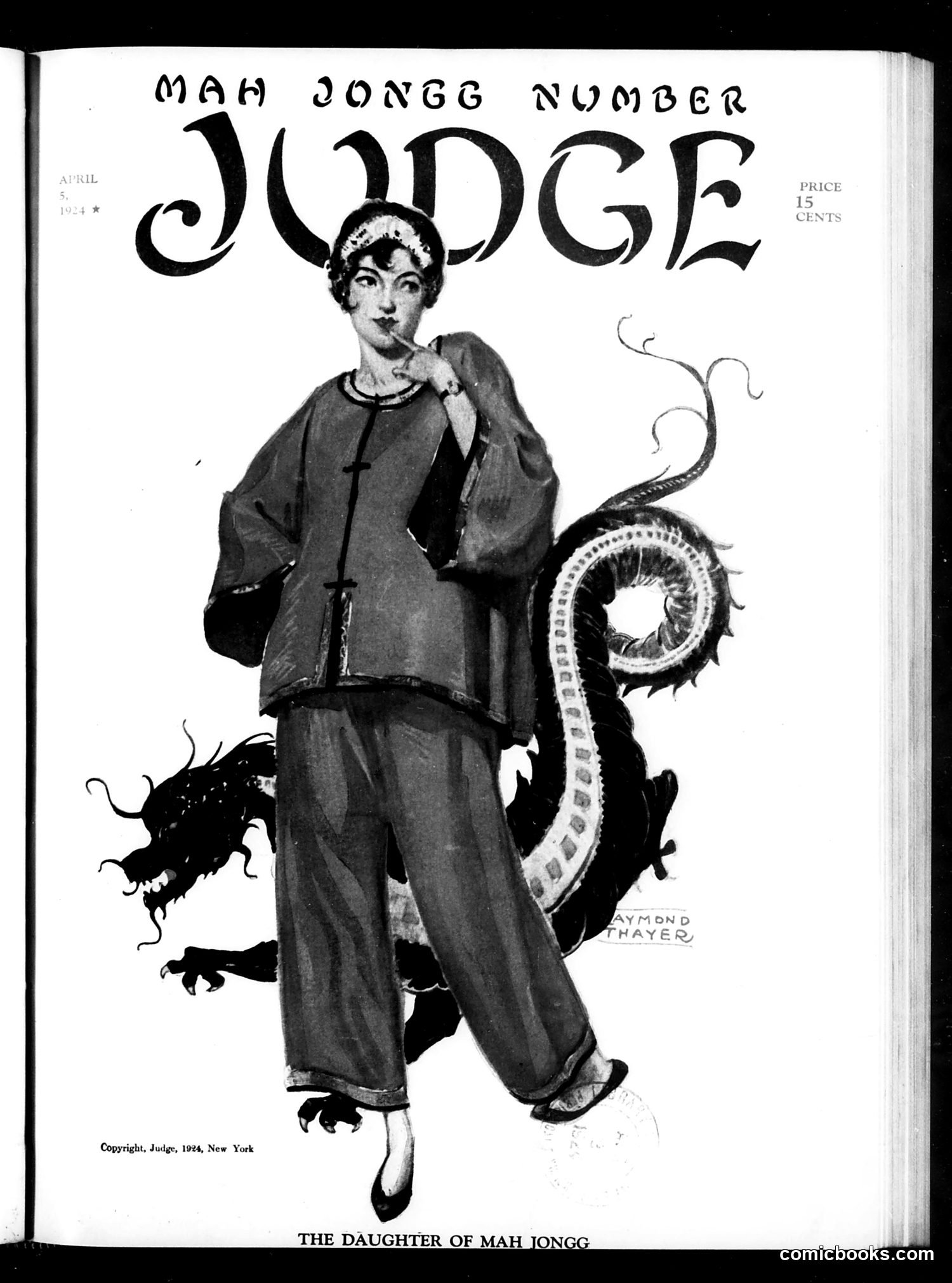
This cover satirizes the mahjong craze that swept America in the early 1920s. The illustration shows a fashionable woman in loose-fitting pajama-style clothing (reflecting Oriental aesthetics associated with the game) playfully posing with stylized dragon figures. The title "The Daughter of Mah Jongg" treats the game almost as a deity or cultural force spawning a new generation. The joke targets how thoroughly mahjong had infiltrated American society—it was viewed as an exotic foreign import that had become obsessively popular among middle and upper-class players, particularly women. The absurdist imagery suggests the game's perceived grip on American leisure culture was humorously exaggerated. The artist's signature reads "Aymond Thayer."
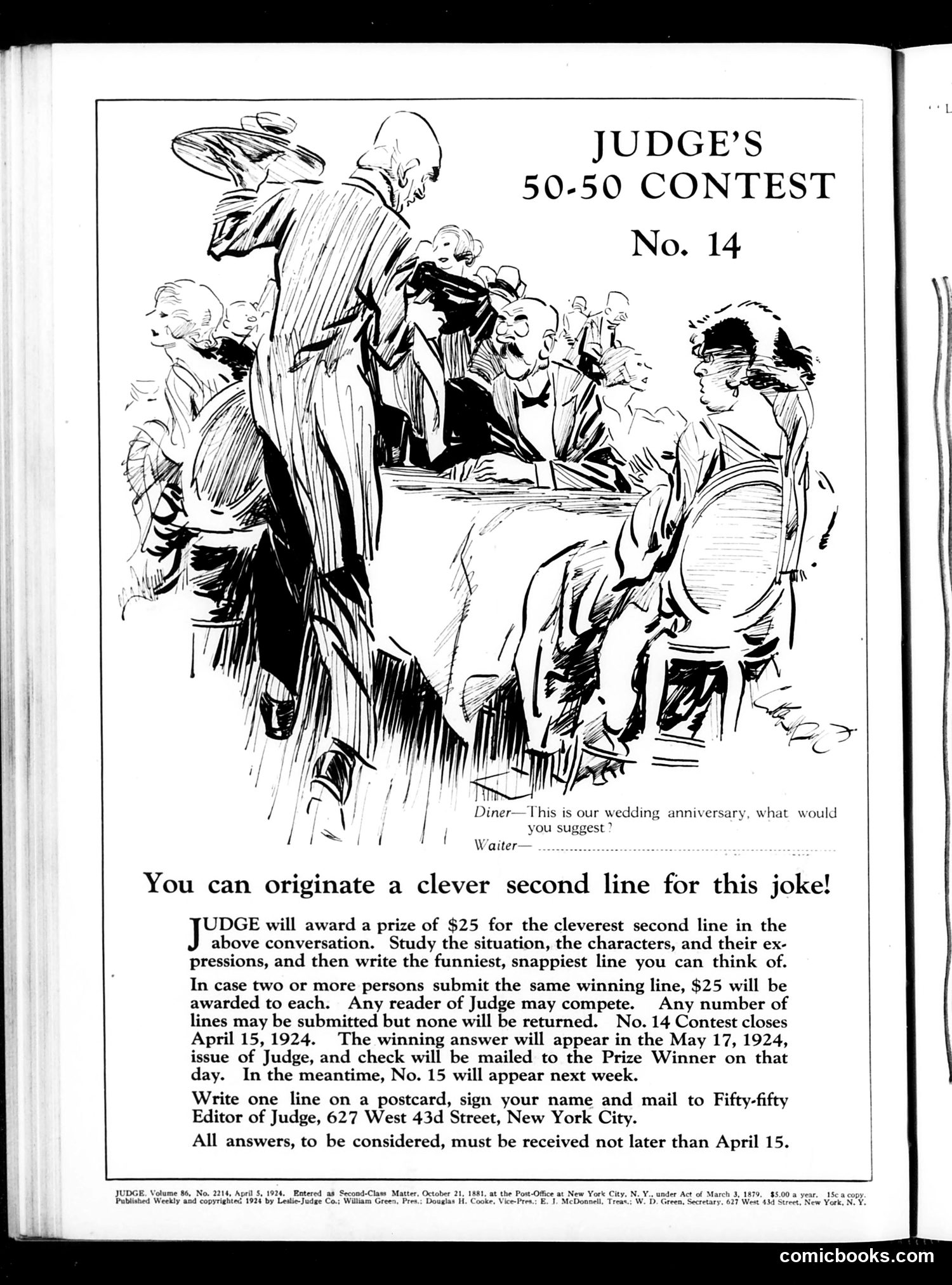
This page features a "50-50 Contest" inviting readers to complete a joke. The cartoon depicts a formal dinner scene where a diner asks a waiter: "This is our wedding anniversary, what would you suggest?" The waiter's response line is blank—readers must submit their own witty second line by April 15, 1924, for a chance to win $25. The joke's premise plays on the ambiguity of "suggest"—the diner might expect dining recommendations, but the satire likely implies marital commentary or cynical observations about anniversary celebrations. The cartoon captures early 20th-century formal dining culture and the era's humor about marriage. This was a common audience-participation feature in Judge magazine.
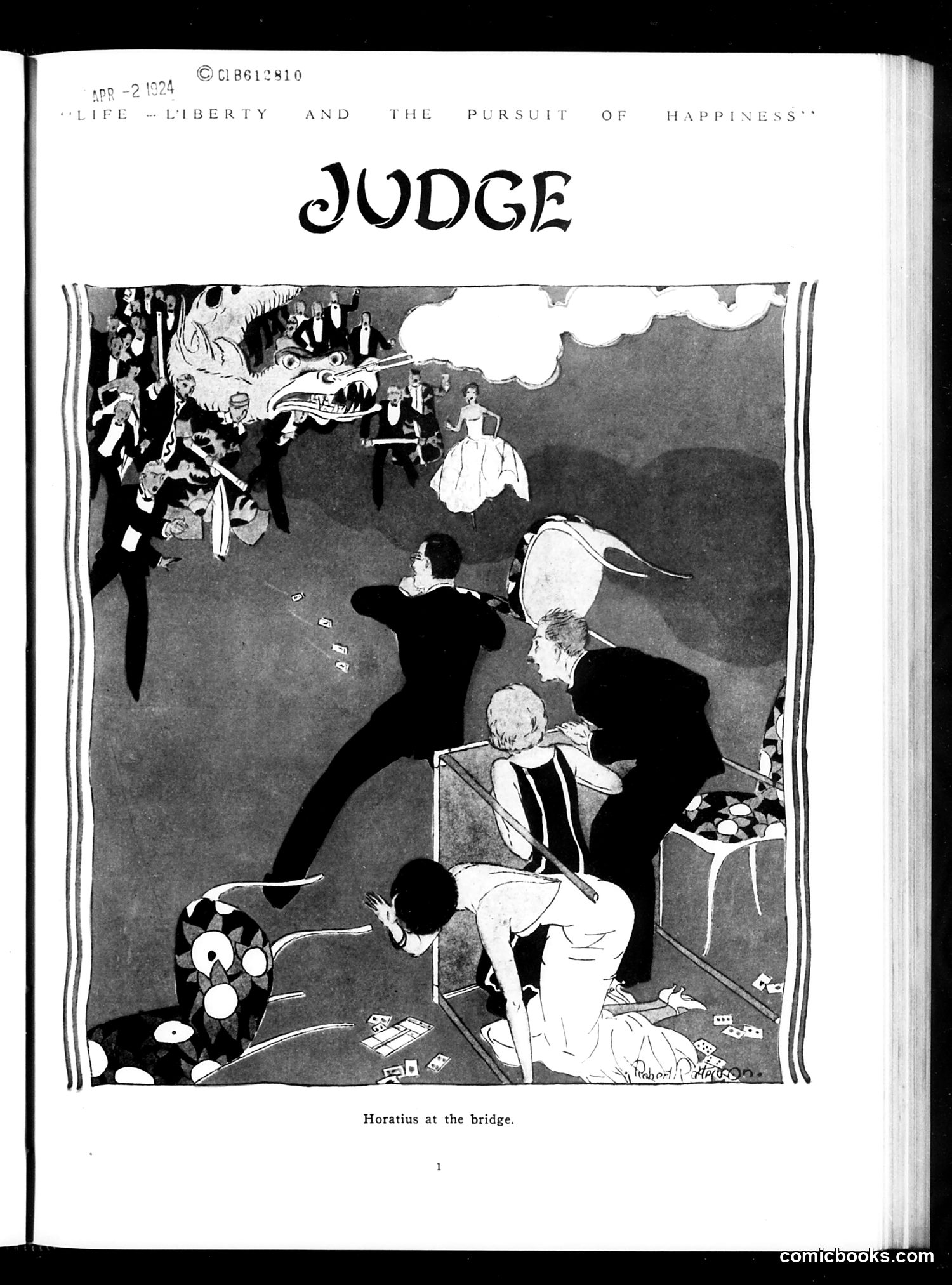
This page satirizes a contemporary political or social figure through classical allusion. The caption "Horatius at the bridge" references the legendary Roman hero who single-handedly defended a bridge against invaders—a classical metaphor for courageous defense against overwhelming odds. The cartoon depicts a solitary figure (bottom center) in a defensive posture against a chaotic crowd (left side), suggesting someone standing firm against pressure or opposition. The scene's theatrical quality—with formal-dressed observers and a woman in the upper right—indicates this addresses a public figure or event. Without additional context from the magazine's date or articles, the specific identity of "Horatius" and the controversy he represents remains unclear, though the satire clearly mocks either his pretensions to heroism or his isolated position.
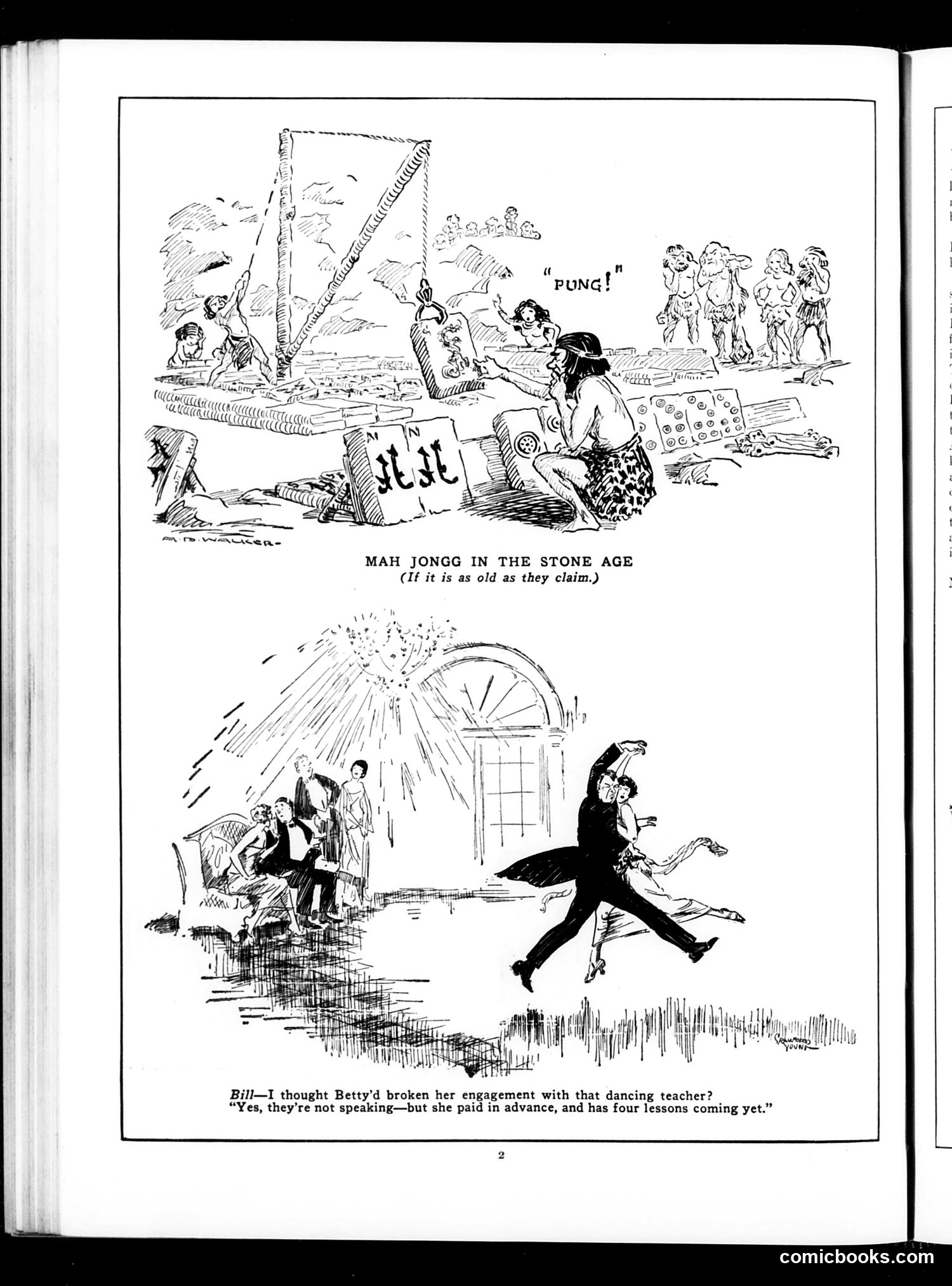
This page contains two separate cartoons satirizing early 20th-century American life: **Top cartoon** ("Mah Jongg in the Stone Age"): Mocks the recent craze for mah-jongg, a Chinese tile game that became wildly popular in the 1920s. The joke compares players huddled over the game to primitive stone-age humans, suggesting the obsession is intellectually regressive. The "PUNG!" exclamation references mah-jongg terminology. **Bottom cartoon**: A domestic humor piece about a woman named Betty who broke an engagement with a dancing teacher. The joke centers on her having prepaid for dance lessons she no longer needs—highlighting her practical, no-nonsense approach despite the romantic breakup. The man's exaggerated dance pose suggests the absurdity of the situation. Both reflect 1920s social anxieties about fads and changing gender dynamics.
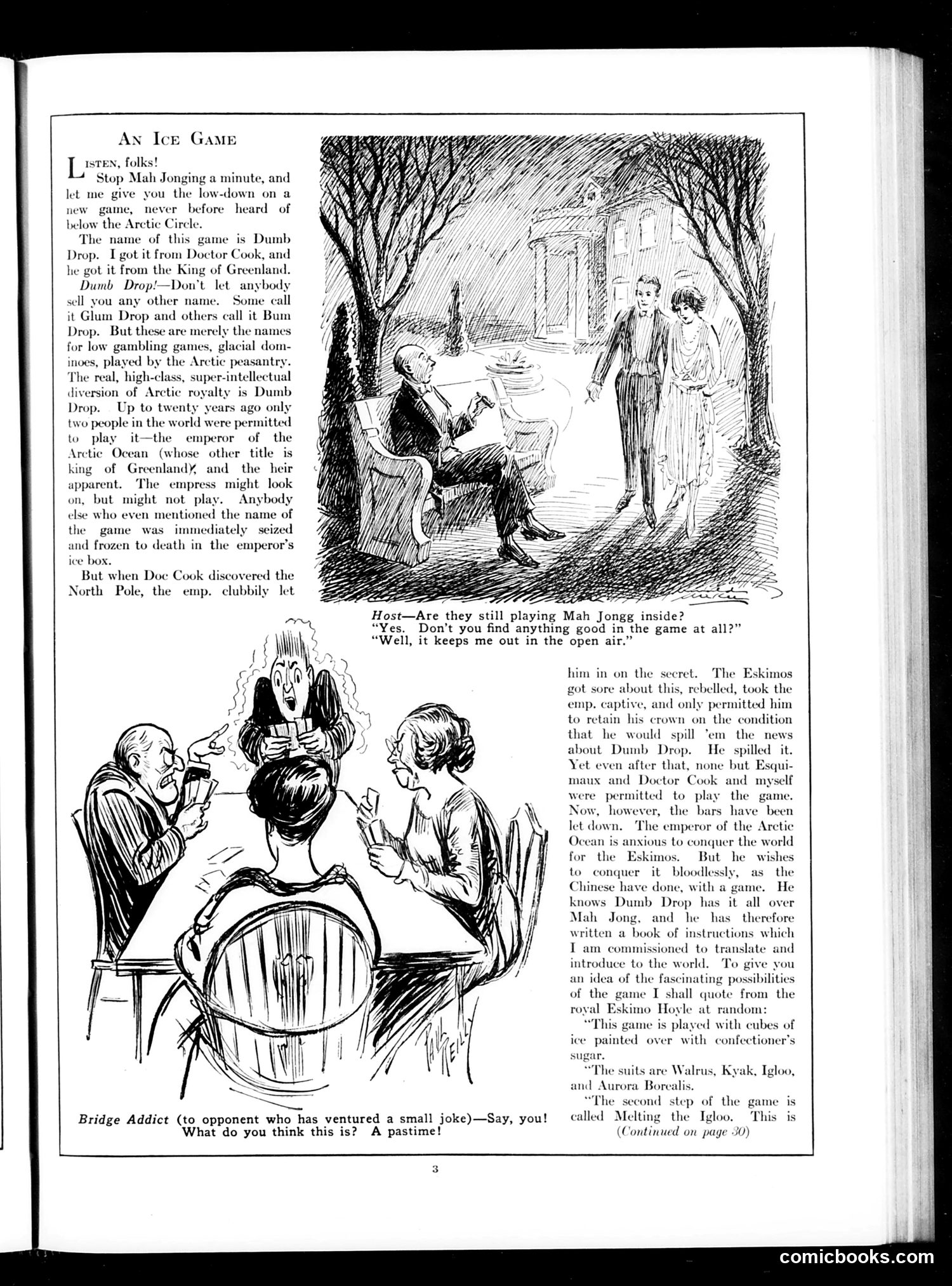
This page satirizes **Dumb Drop**, a gambling game allegedly invented by Arctic explorers and played by Inuit peoples. The satire mocks the game's exotic appeal to wealthy society—the text notes that when the "Emperor of the Arctic Ocean" discovered the North Pole, he introduced this exclusive pastime. The upper cartoon shows aristocrats playing in a winter setting. The lower cartoon depicts enthusiastic card players, captioned "Bridge Addict," suggesting wealthy Americans were obsessed with card games. The satire targets both the fashionable obsession with Arctic exploration narratives (popular in this era) and the gambling culture among the elite. By presenting an absurd "Arctic" game, Judge ridicules how wealthy society exoticizes distant cultures and embraces any novelty, no matter how trivial.
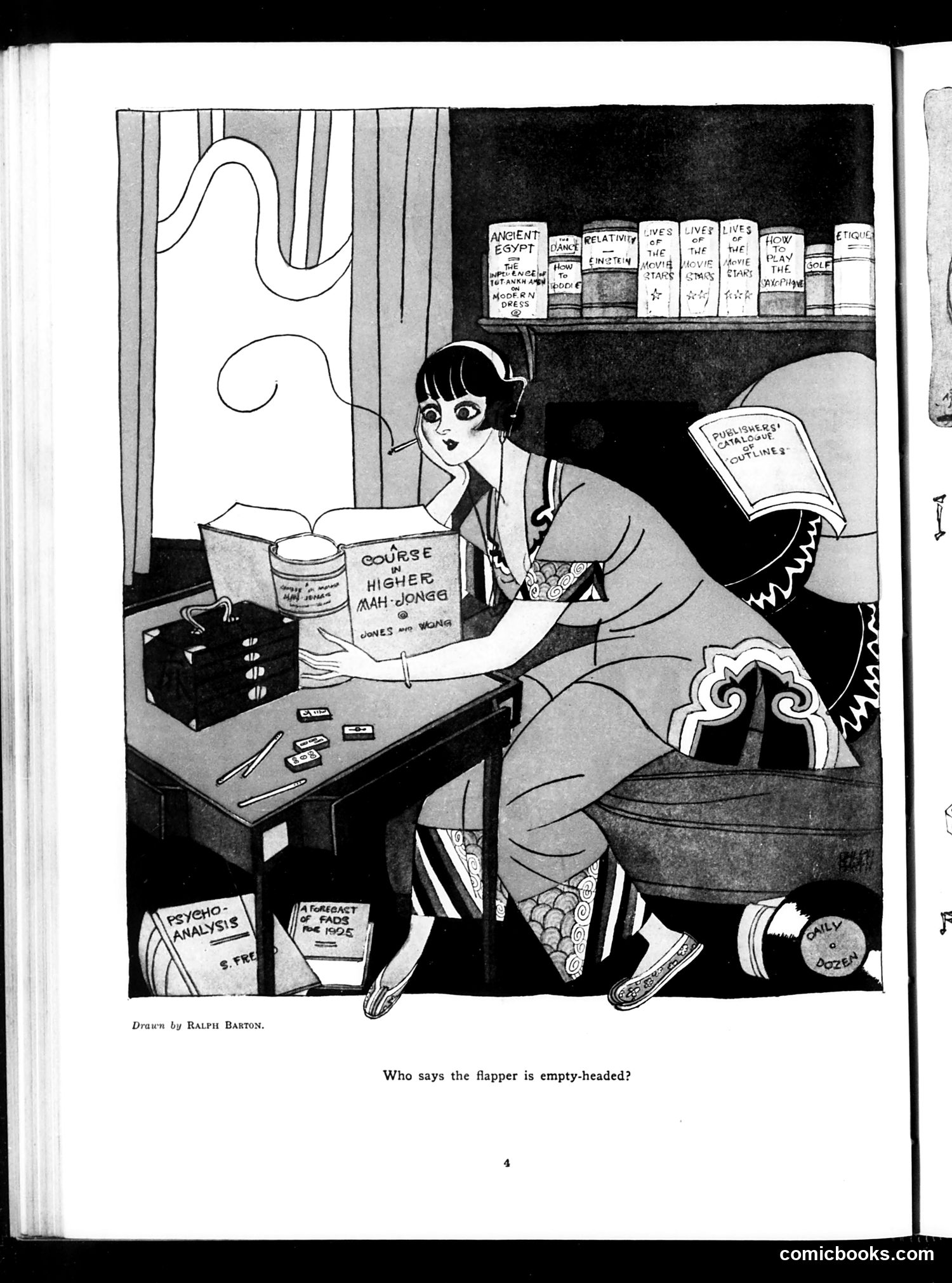
This cartoon satirizes 1920s "flappers"—young women who defied Victorian conventions through bobbed hair, short skirts, and independent behavior. The caption "Who says the flapper is empty-headed?" ironically challenges that stereotype. The illustration shows a woman at her desk surrounded by intellectual pursuits: books on psychology, psychoanalysis, Einstein's relativity, ancient Egypt, and philosophy crowd her workspace. She holds books titled "Higher Mathematics" and "Costume," suggesting she balances serious study with fashion interest. The cartoonist (Ralph Barton) uses visual evidence to defend flappers against critics who dismissed them as intellectually vacant. By depicting her surrounded by substantial reading material, the cartoon argues that modern young women were actually engaged, thoughtful, and cultured—directly contradicting widespread contemporary prejudices.
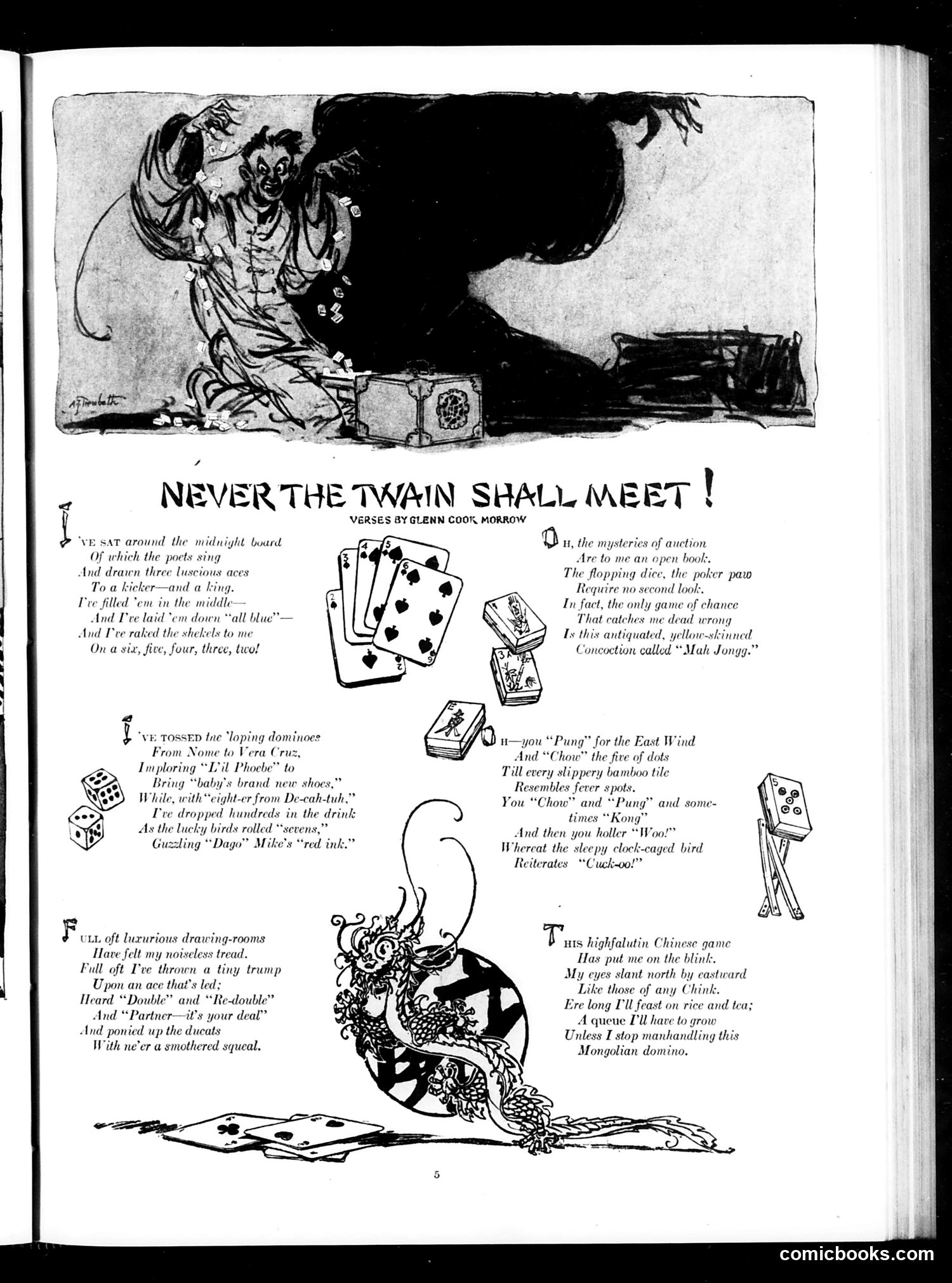
This page satirizes the American obsession with mah-jong, a Chinese tile game that became wildly popular in the 1920s among wealthy Americans. The verses, by Glenn Cook Morrow, humorously contrast the narrator's expertise at Western gambling games (poker, bridge, dominoes) with his complete bafflement at mah-jong. The satire relies on period stereotypes: the poem jokes that playing mah-jong causes the player's eyes to "slant" and threatens to transform him into a Chinese person (growing a "queue" or traditional braid). The crude caricatures and ethnic humor reflect early 20th-century attitudes. The point is ironic—a sophisticated American gambler is humbled by this foreign game, rendered helpless despite his cosmopolitan experience. The title "Never the Twain Shall Meet" references Kipling's famous line about East and West, suggesting cultural incompatibility, even as Americans eagerly adopted Eastern pastimes.
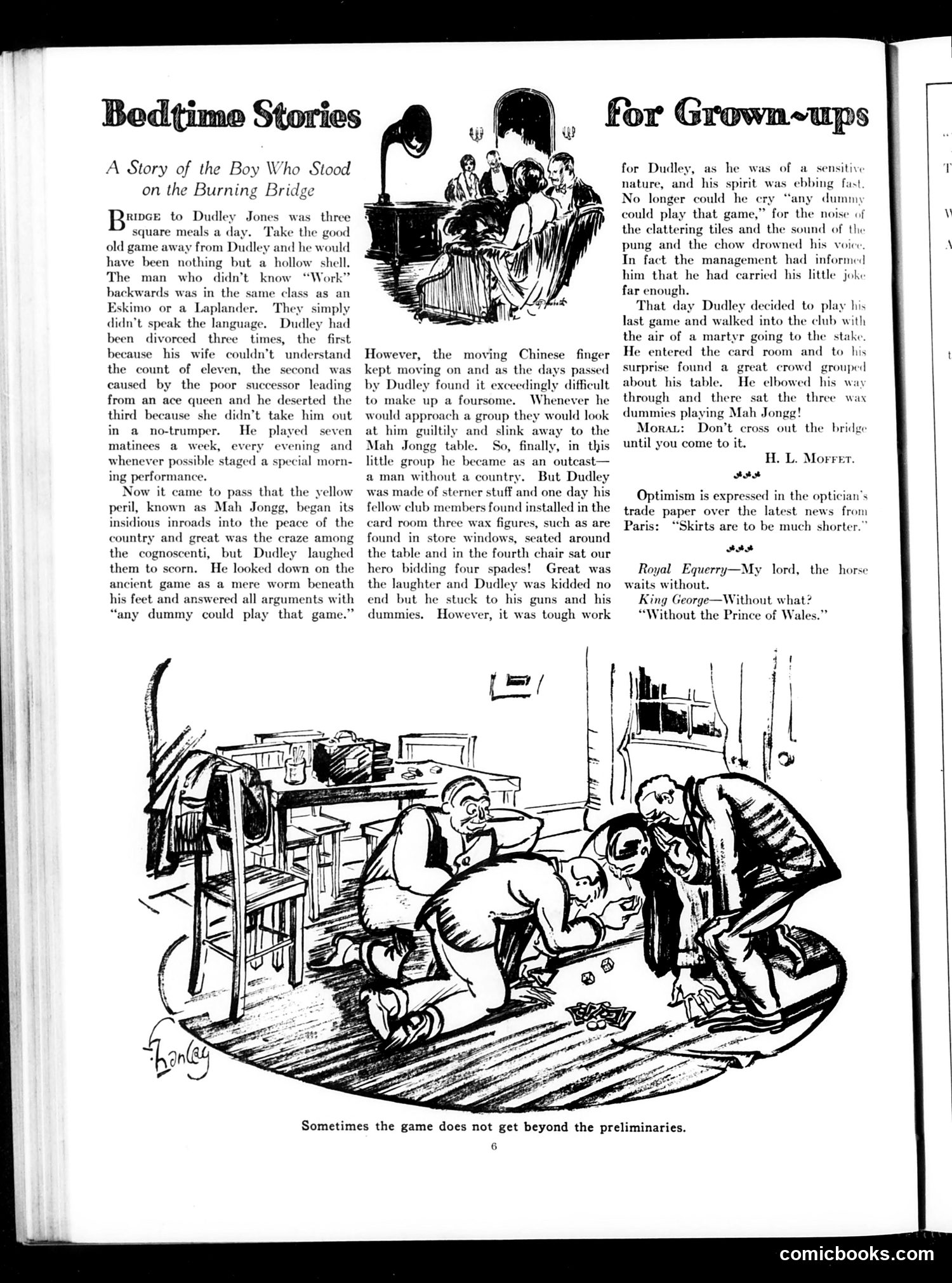
This page satirizes the 1920s craze for Mah Jong, a Chinese card game that swept American society. The main story mocks "Dudley Jones," a bridge fanatic who dismissively claims "any dummy could play that game" about Mah Jong. As the game's popularity isolates him socially—club members abandoning bridge for Mah Jong—Dudley stubbornly installs three department-store mannequins at a bridge table to play with him. The joke's irony: his joke backfires when club members actually gather to watch, treating his "dummies" as a curiosity. The caption's moral warns against dismissing trends before understanding them. Sidebar jokes reference 1920s topics: shorter skirts (fashion trend), and King George without the Prince of Wales (likely referencing Edward, Prince of Wales's notoriety). The satire mildly ridicules resistance to cultural change and social snobbery about new fashions.
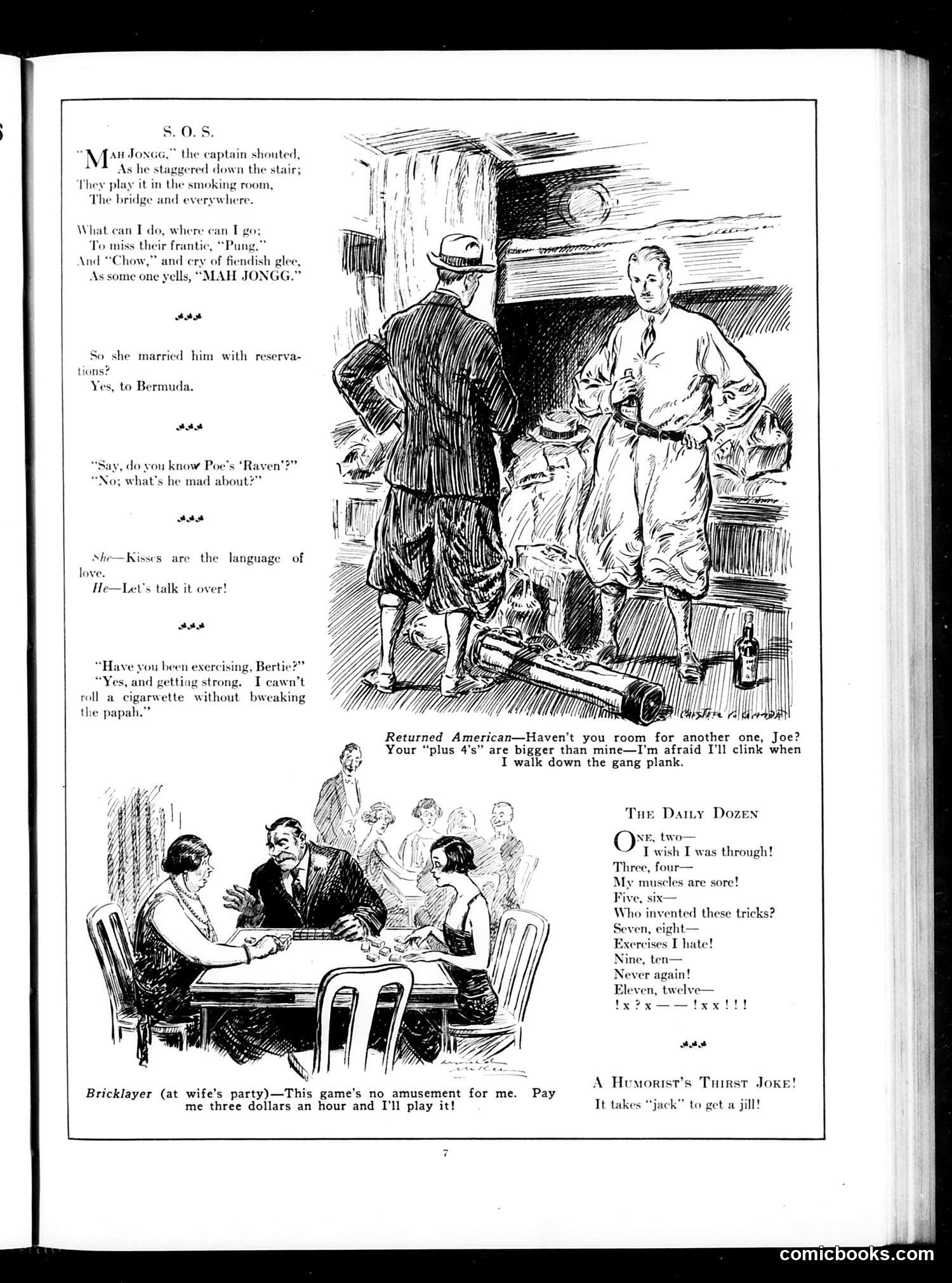
This page from *Judge* magazine contains several short jokes and cartoons satirizing 1920s American social trends: **Mah-Jongg obsession**: The opening poem mocks the craze for the Chinese tile game, which swept America in the 1920s. Everyone played it everywhere—it was inescapable. **Various dating/relationship jokes**: These poke fun at courtship conventions (the Poe's "Raven" gag seems nonsensical, suggesting the joke itself is intentionally dumb). **The bricklayer cartoon**: A working-class man at a party refuses to play mah-jongg without payment, treating it as labor rather than entertainment—satirizing how the wealthy treat games as leisure while he needs wages. **The "Returned American"**: A joke about a soldier returning from overseas, nervous about his large stature fitting through the ship's gangway. **"The Daily Dozen"**: A satirical poem about a popular 1920s exercise routine that caused muscle soreness—mocking the fitness craze. Overall, these pieces humorously critique fads, class differences, and changing social customs of the Jazz Age.
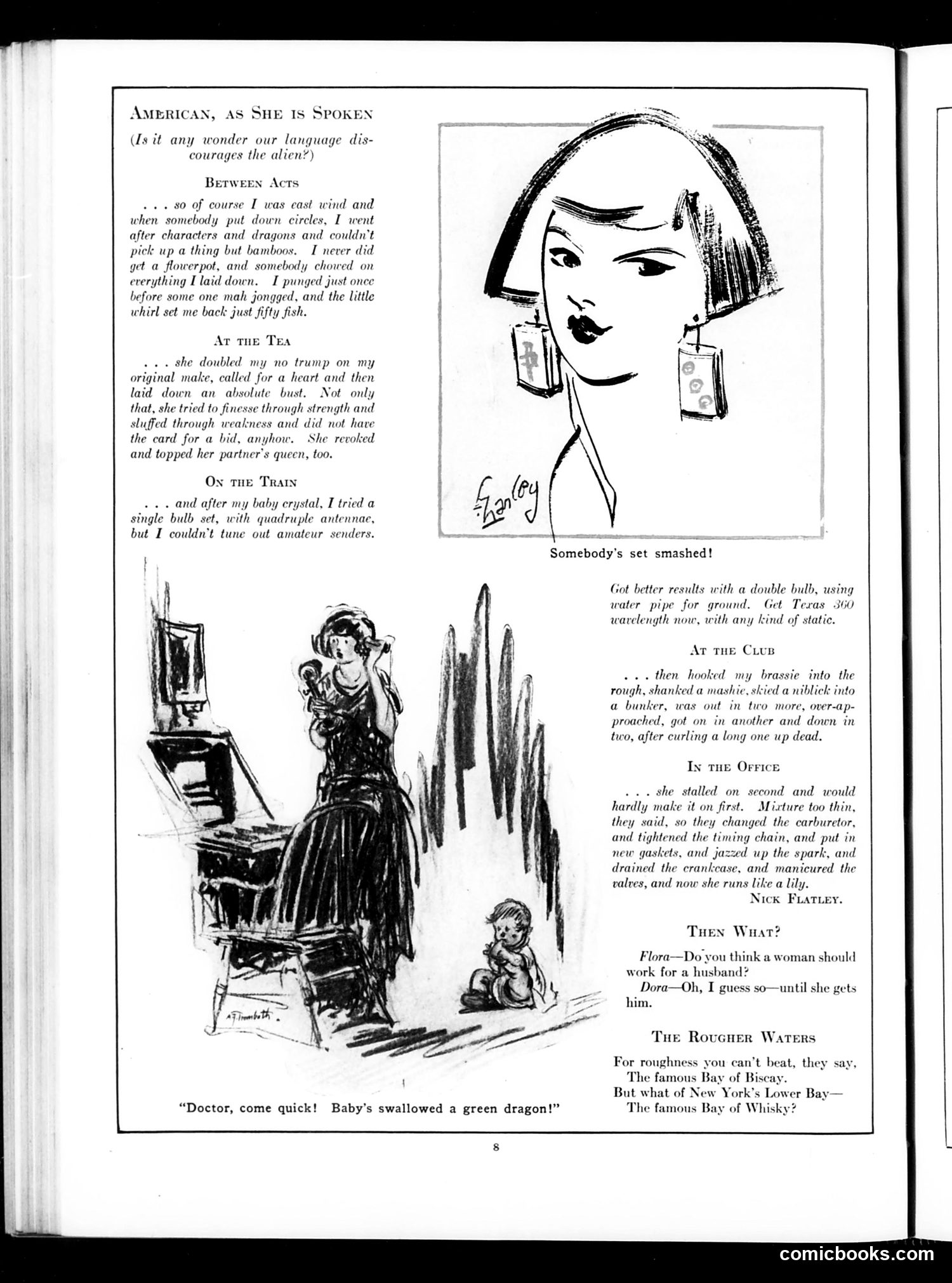
This page satirizes women's incompetence across modern leisure and domestic activities. The title mocks American English as spoken by women, suggesting their speech and abilities are equally garbled. Each vignette—mahjong, bridge, tea parties, radio, golf, automobiles, and office work—depicts women bungling specialized vocabularies and skills. Women misuse technical terms (confusing radio parts, golf clubs, car mechanics), making costly mistakes or creating disasters. The humor relies on 1920s-30s stereotypes of women as intellectually unsuited for anything beyond homemaking. The final exchange ("Do you think a woman should work for a husband?") reinforces the period's assumption that women's proper role was domestic, not professional. The closing joke about "Bay of Whisky" appears to reference Prohibition-era drinking culture, though the connection is unclear. The caricature portrait at top shows the stereotypical "modern woman" with fashionable bob haircut and dangling earrings—visual shorthand for the independent, ambitious woman Judge's audience apparently viewed as ridiculous.
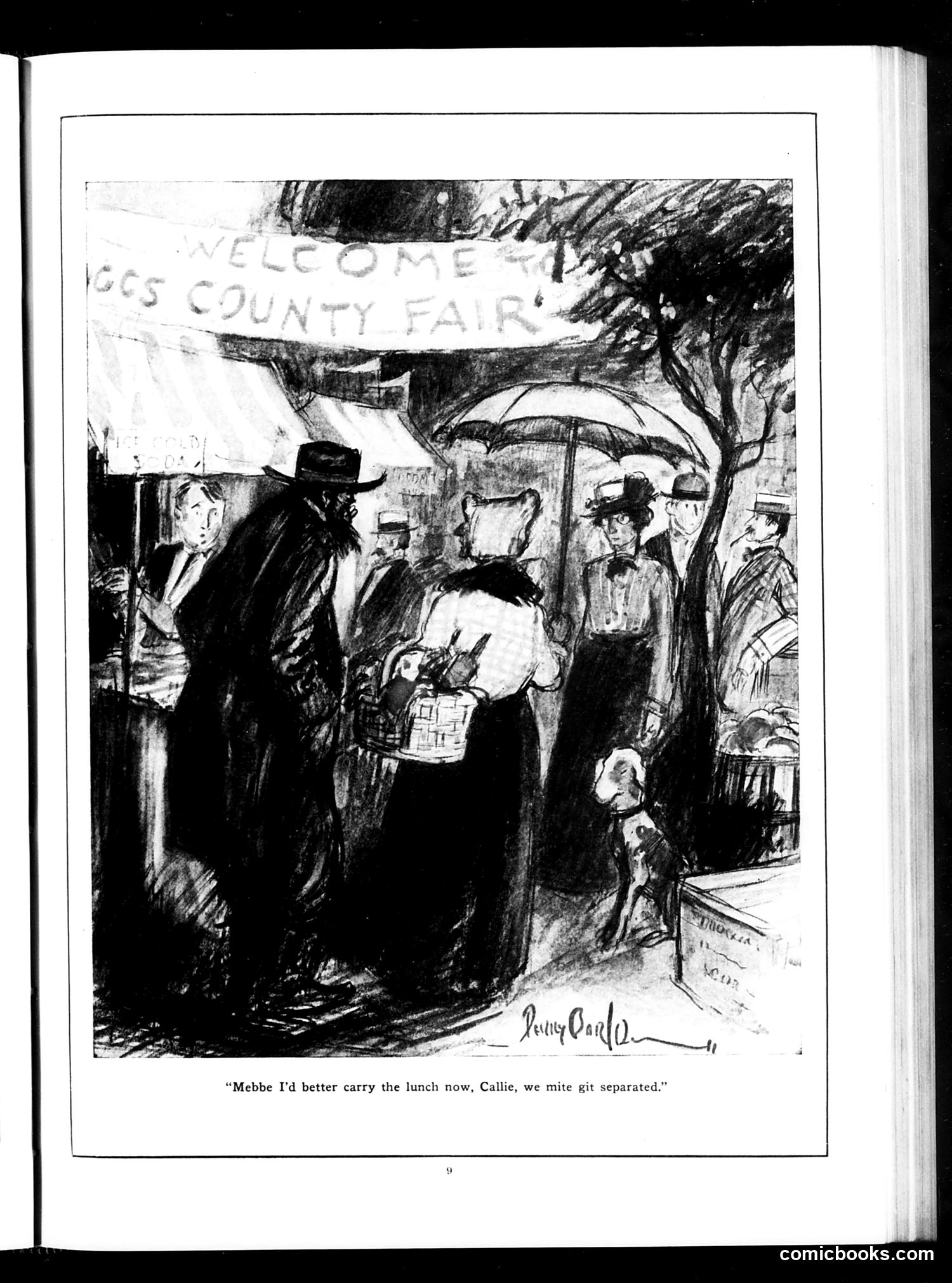
This cartoon depicts a scene at a "Los Angeles County Fair" (visible on the banner). A man in a cowboy hat speaks to a woman named Callie, suggesting he should carry their lunch because they might get separated in the crowd. The satire appears to target **crowding at county fairs**—a social complaint about increasingly packed public events. The man's colloquial dialect ("Mebbe," "mite") and rural clothing (cowboy hat) suggest a rustic character uncomfortable with urban crowds, contrasting his simple expectations of a county fair with the actual throng of city visitors. The joke's point: the fair has become so mobbed that even couples risk losing each other, making practical reorganization of their belongings necessary. This reflects early 20th-century concerns about urbanization and overcrowding at once-rural institutions.
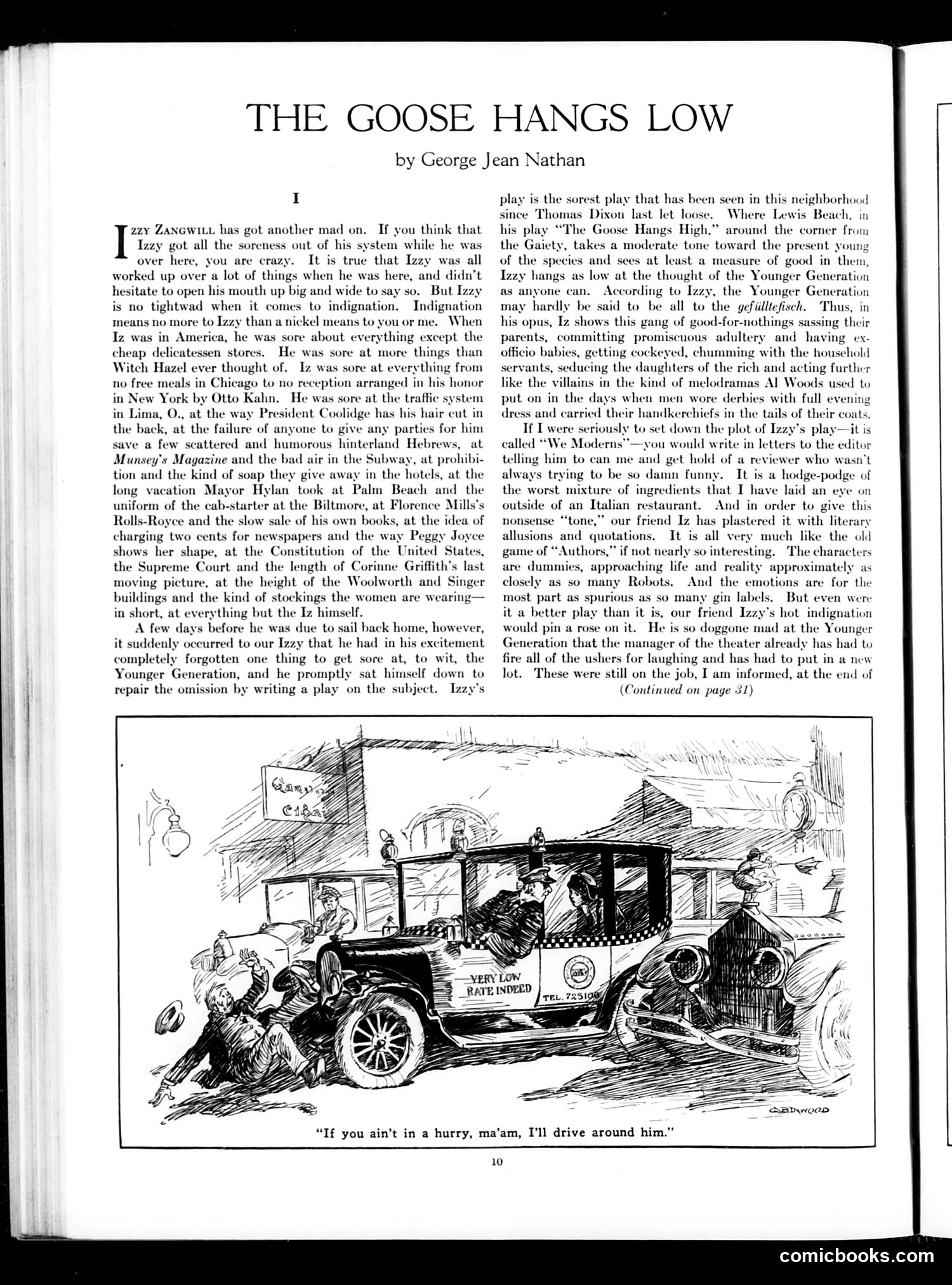
This page satirizes playwright **Israel Zangwill** (referred to as "Izzy"), a real writer known for social commentary. Critic George Jean Nathan mocks Zangwill's perpetually angry disposition and his recent play "We Moderns," which attacks the younger generation as immoral and dissolute. Nathan contrasts Zangwill's harsh treatment with Lewis Beach's gentler play "The Goose Hangs High" (playing nearby). He argues Zangwill's work is melodramatic and intellectually shallow—stuffed with literary references to seem sophisticated but populated by cardboard characters. The **cartoon below** shows a chauffeur-driven car hitting a pedestrian, with the driver's dismissive comment: "If you ain't in a hurry, ma'am, I'll drive around him." This likely reflects the article's broader theme about generational contempt and recklessness, though its specific connection to the Zangwill critique is unclear.
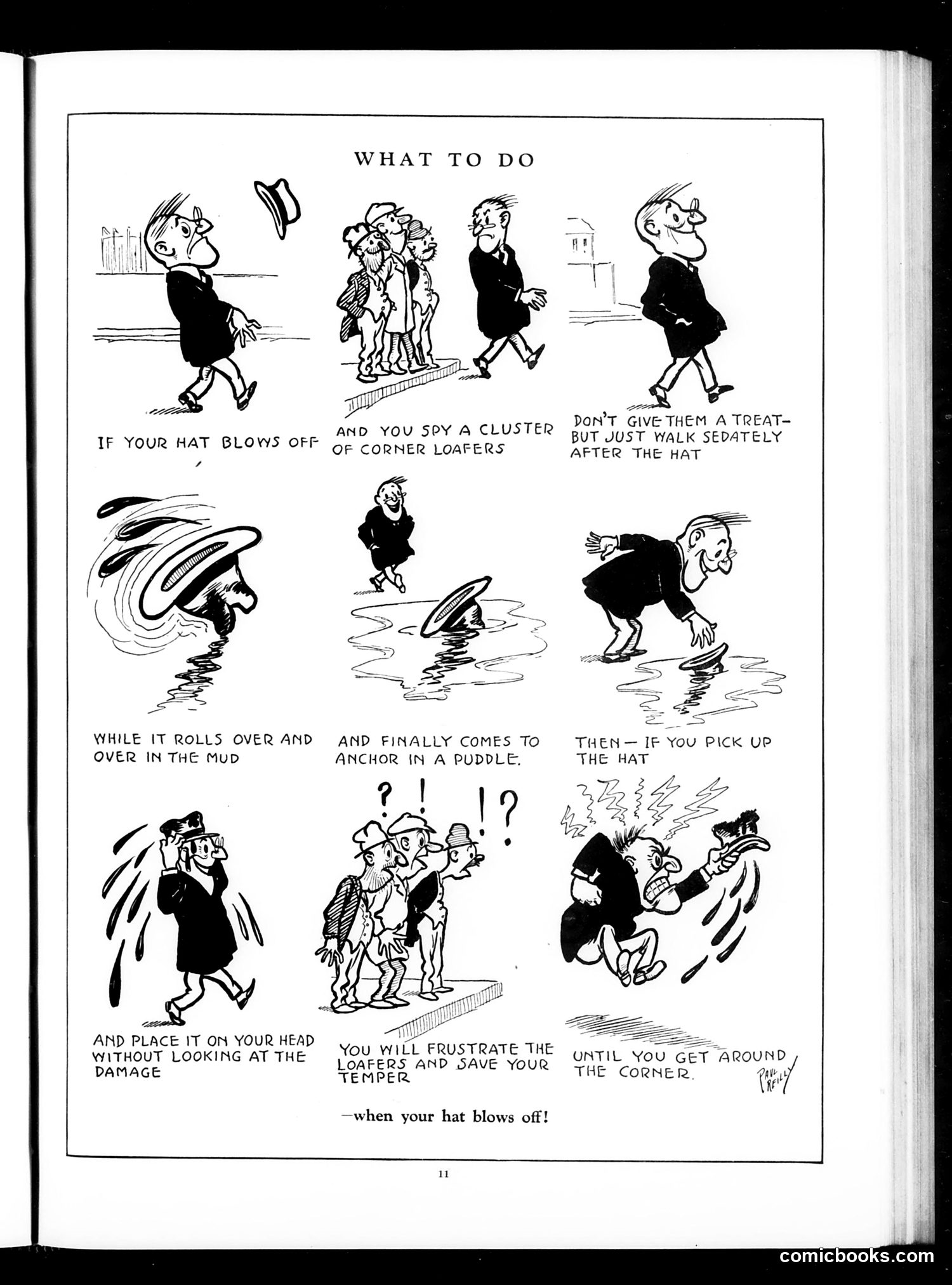
This is a humorous instructional cartoon about the embarrassing scenario of losing one's hat in public. The joke targets "corner loafers"—unemployed or idle men who stood around street corners, a common sight during economic downturns. The satire works on two levels: First, it mocks the practical indignity of hat loss (rolling through mud, anchoring in puddles). Second, it satirizes social anxiety around these loafers—the cartoon suggests the wearer should avoid acknowledging them while retrieving the hat, to escape their mocking attention. The humor relies on the shared understanding that corner loafers enjoyed taunting well-dressed pedestrians, and that maintaining dignity while humiliated was the gentleman's primary concern. This reflects Depression-era anxieties about unemployment and class visibility.
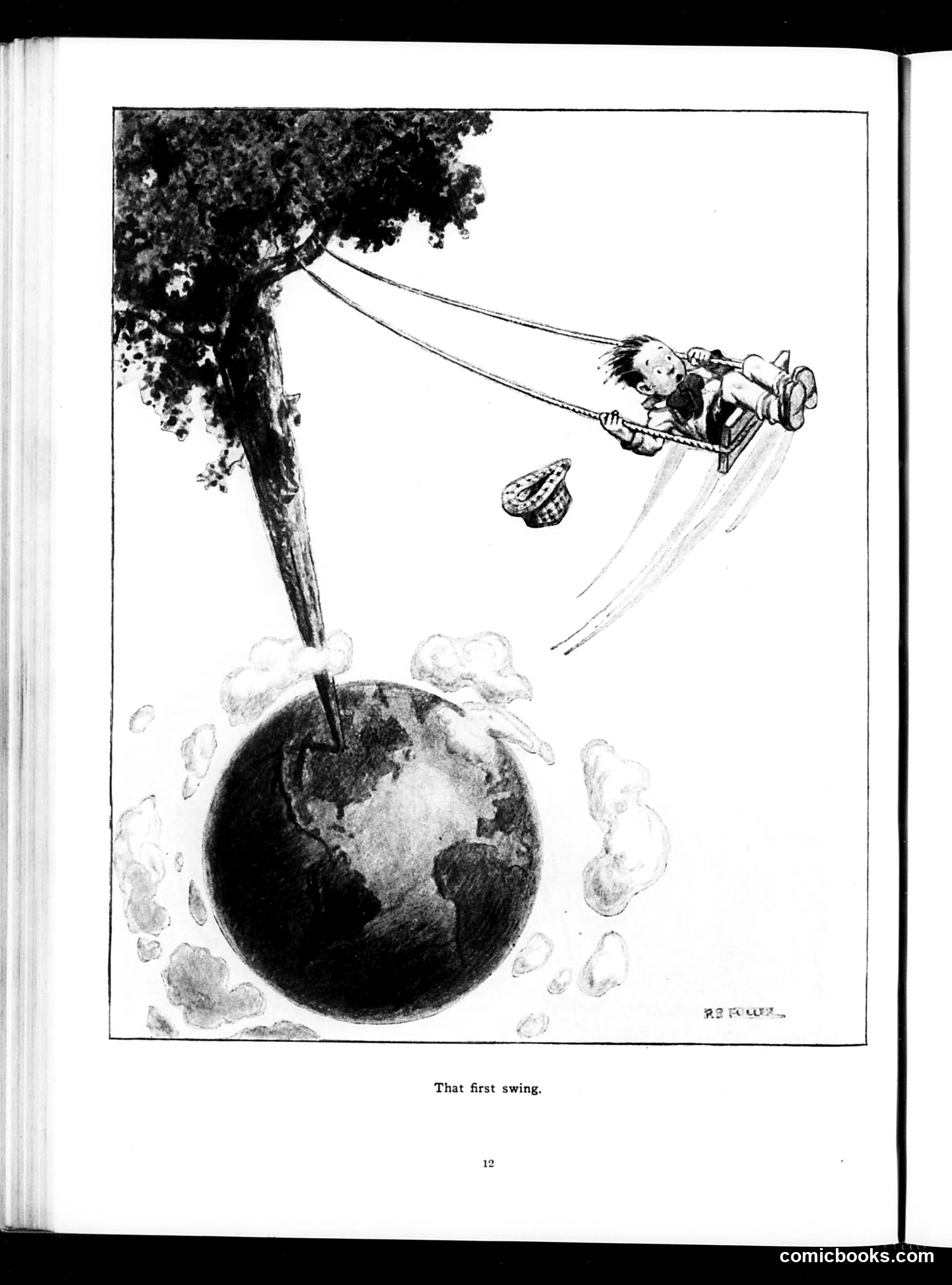
This illustration depicts a child on a swing suspended from a tree growing from Earth itself. The child swings outward into space while a hat floats nearby, suggesting the dramatic height and danger of the motion. The caption "That first swing" appears to be a humorous commentary on childhood experience—likely satirizing either parental anxiety about children's play or the exaggerated sense of danger parents perceive in ordinary activities. The cosmic scale (Earth visible below) amplifies what is actually a mundane childhood moment into something grandiose and perilous. Without additional context or visible byline, the specific satirical target remains unclear, though the image evokes common Judge magazine themes mocking middle-class parental concerns or romanticizing simple pleasures.
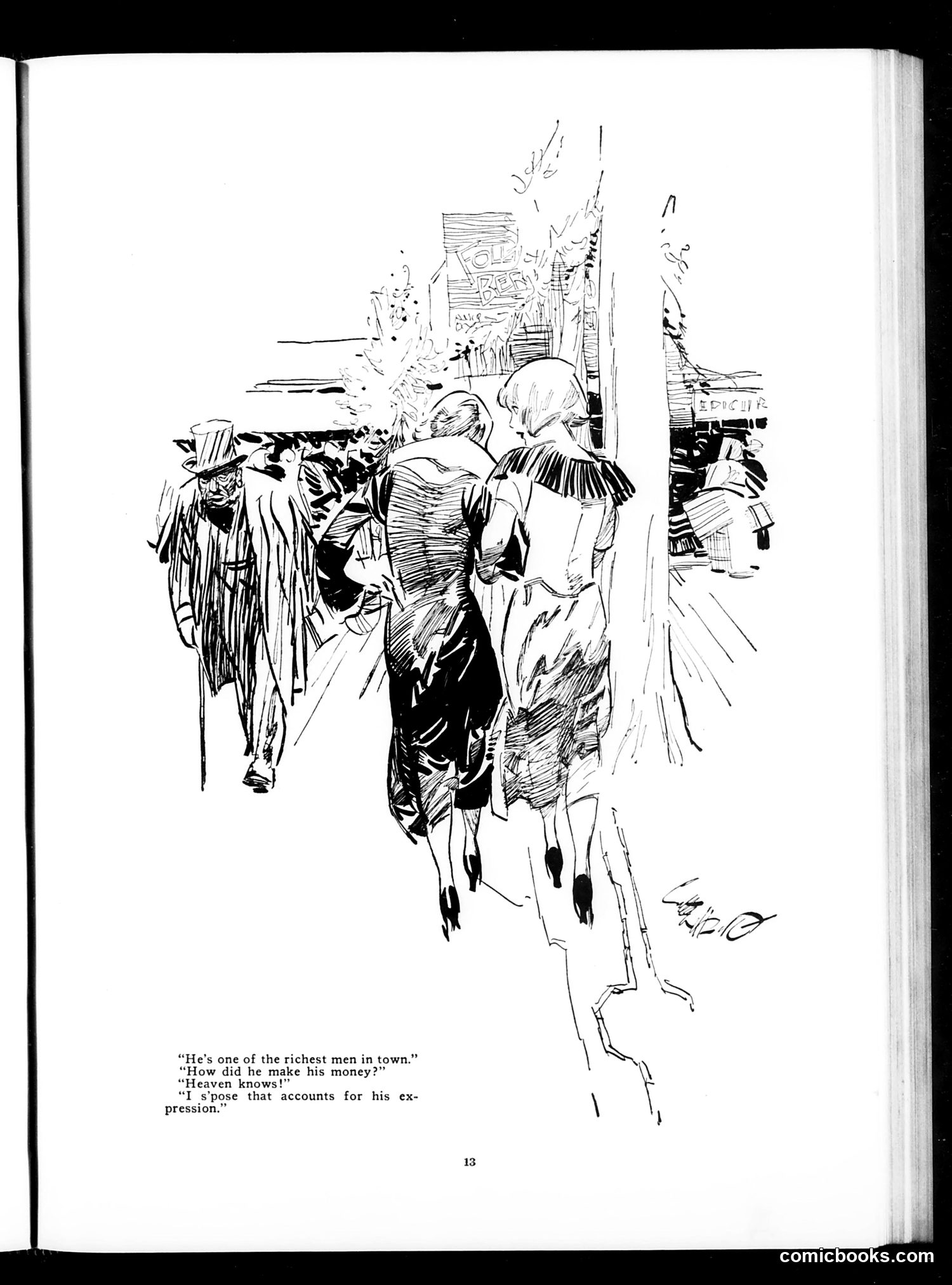
This sketch depicts a street scene with fashionably dressed women and military officers in conversation. The dialogue critiques wealth inequality and questionable business practices: - **"He's one of the richest men in town"** - **"How did he make his money?"** - **"Heaven knows!"** - **"I s'pose that accounts for his expression."** The satire suggests the wealthy businessman's grim demeanor reflects guilt or moral compromise about his fortune's origins. The implication is that his riches came through dubious means—perhaps fraud, corruption, or unethical dealings—rather than honest work. The military uniforms and formal dress suggest this is an elite social gathering, emphasizing the contrast between outward respectability and suspected moral bankruptcy. The cartoon mocks both the wealthy's opacity about their fortunes and society's willingness to overlook questionable origins of wealth.
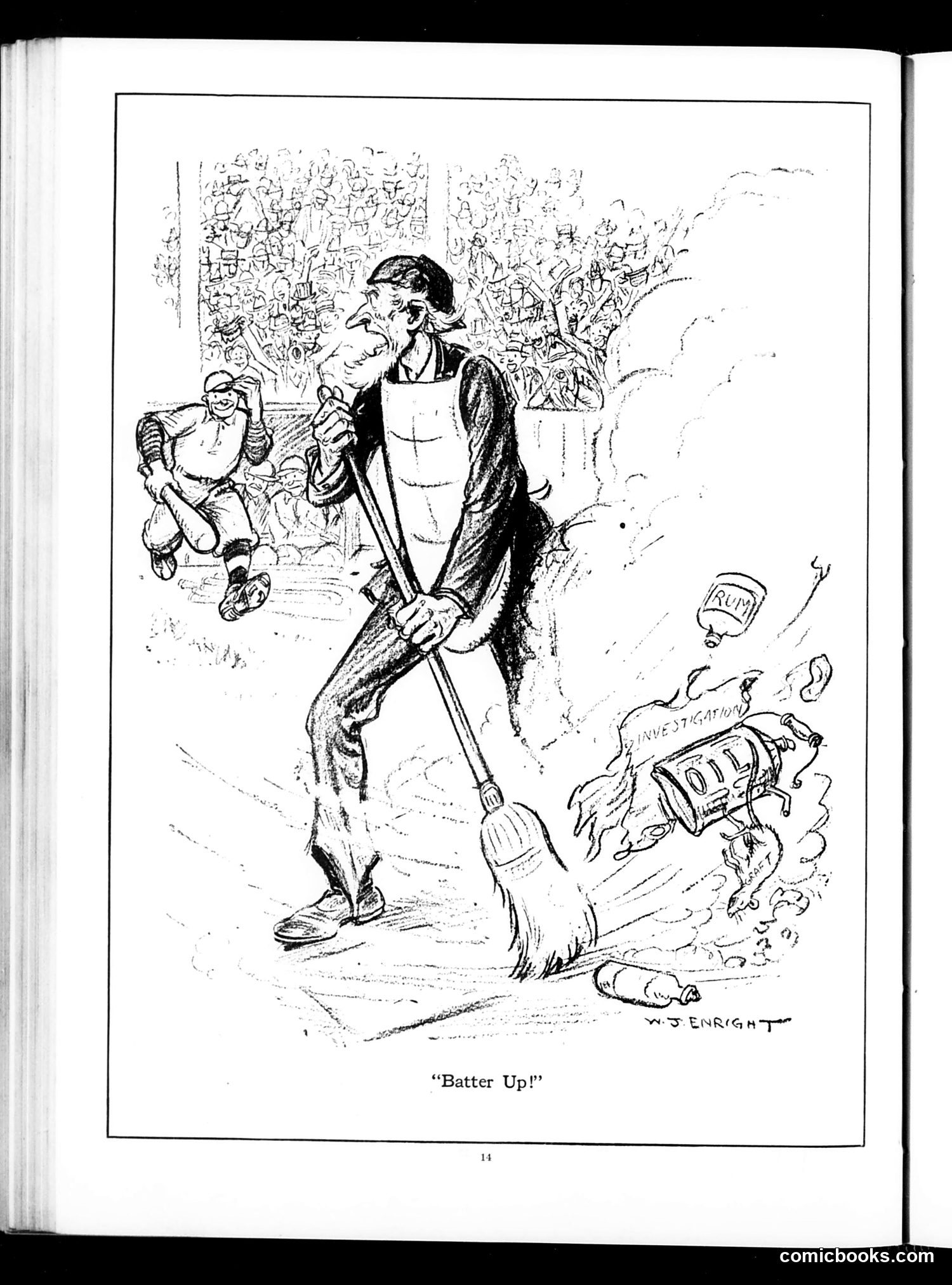
This cartoon by W.S. Enright depicts a man in an apron wielding a large baseball bat against what appears to be a hornet's nest labeled "INVESTIGATIONS" with a bomb or explosive device labeled "RUIN" nearby. A small figure runs in the background, and crowds are visible. The satire likely comments on someone (identity unclear without additional context) attempting to suppress or violently counter government investigations—"batting them up" rather than cooperating. The hornet's nest and "ruin" imagery suggest such aggressive resistance will backfire dangerously. The cartoon appears critical of obstruction tactics, portraying them as reckless rather than protective. The specific investigation and figure remain uncertain without Judge magazine's date and accompanying text.
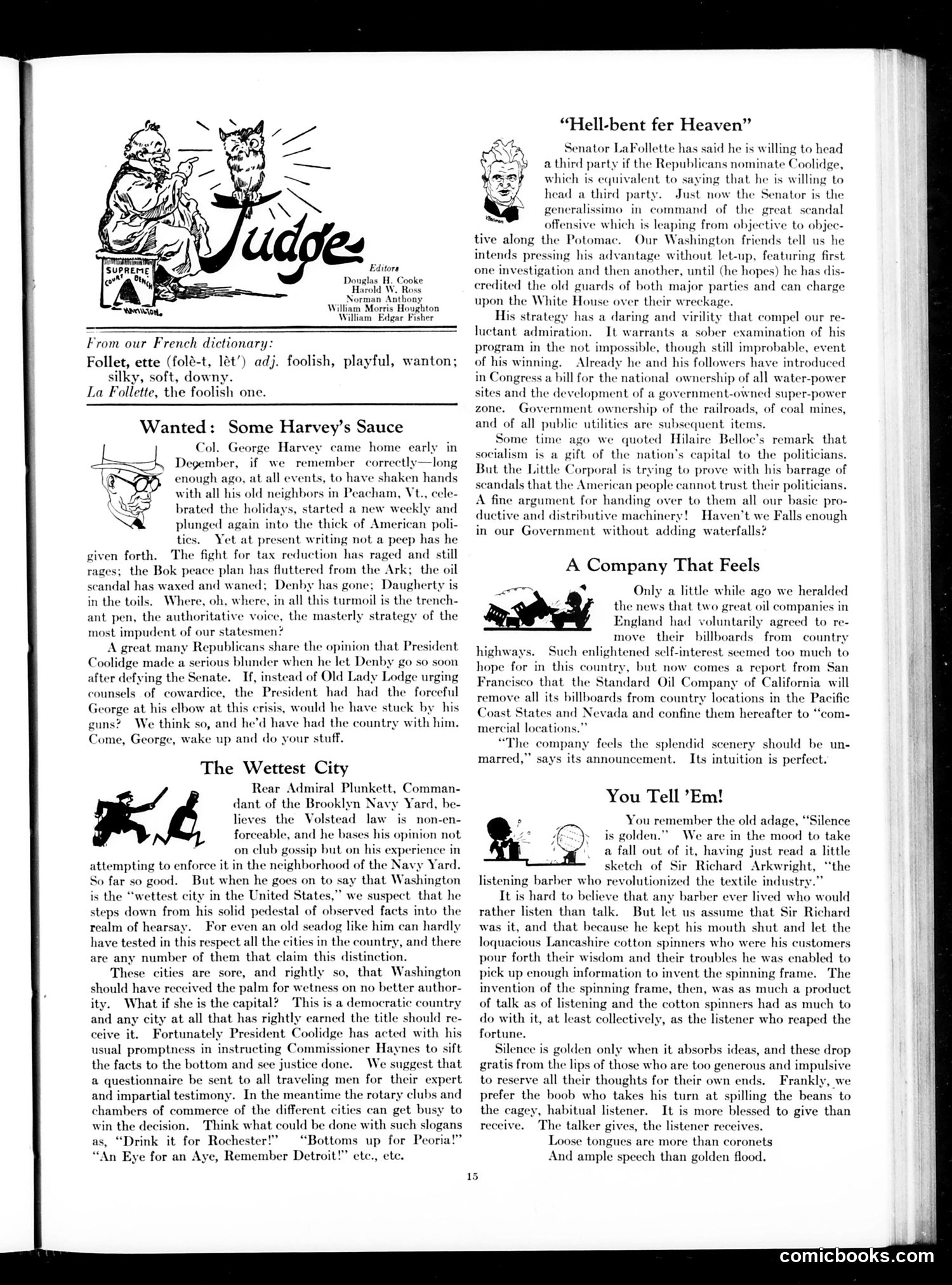
This page contains several satirical pieces targeting 1920s American politics: **"Hell-bent fer Heaven"** attacks Senator Robert LaFollette, depicting him as opportunistically leading investigations (likely the Teapot Dome scandal) to discredit both major parties and position himself for a third-party presidential run. The piece questions whether his radical program could actually govern effectively. **"Wanted: Some Harvey's Sauce"** mocks Colonel George Harvey, a prominent Republican editor and diplomat who had recently gone quiet after being politically active. The satire suggests President Coolidge needs Harvey's forceful voice during the scandals plaguing his administration. **"The Wettest City"** ridicules Admiral Plunkett's claim that Washington D.C. is the wettest city during Prohibition. The piece satirizes the absurdity of the claim and sarcastically suggests other cities compete for this "distinction" — mocking both Prohibition's unenforceable failure and the hypocrisy of Washington's alcohol consumption. All pieces reflect the corrupt, scandal-ridden Harding-Coolidge era (circa 1924).
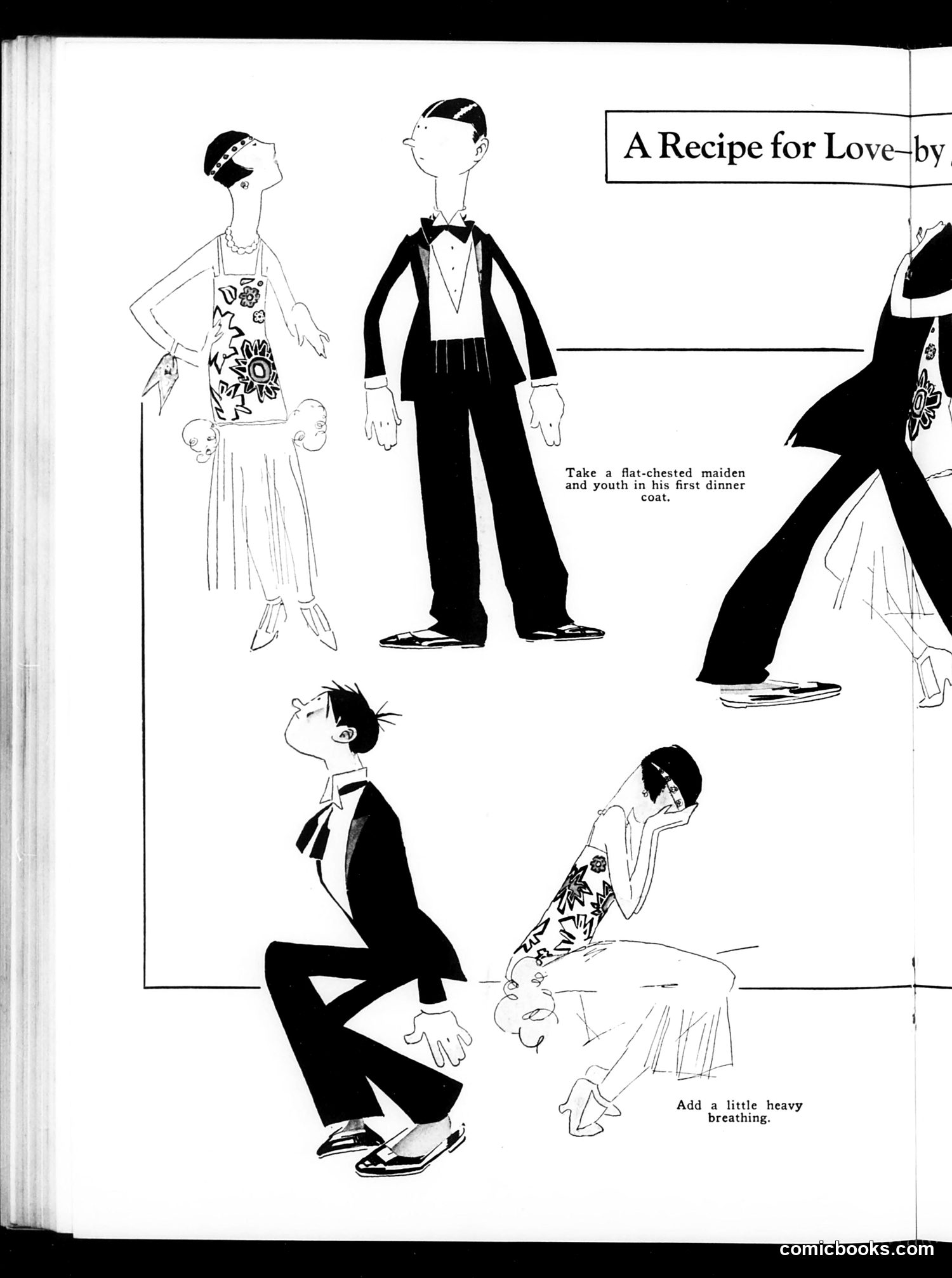
This humorous illustrated "recipe" uses the cooking metaphor to satirize romantic courtship among young people, likely from the 1920s-1930s based on the art style and fashion (the woman's cloche hat and flapper dress; the man's formal dinner jacket). The joke presents romance as something that can be mechanically "assembled" like a dish. The visible instruction reads "Take a flat-chested maiden and youth in his first dinner coat," reducing both figures to physical/superficial components. A second instruction states "Add a little heavy breathing," treating emotional response as merely another ingredient. The satire mocks both the artificiality of formal courtship rituals and perhaps the shallow materialism of the era's dating culture, where appearance and proper attire seemed to matter more than genuine connection.
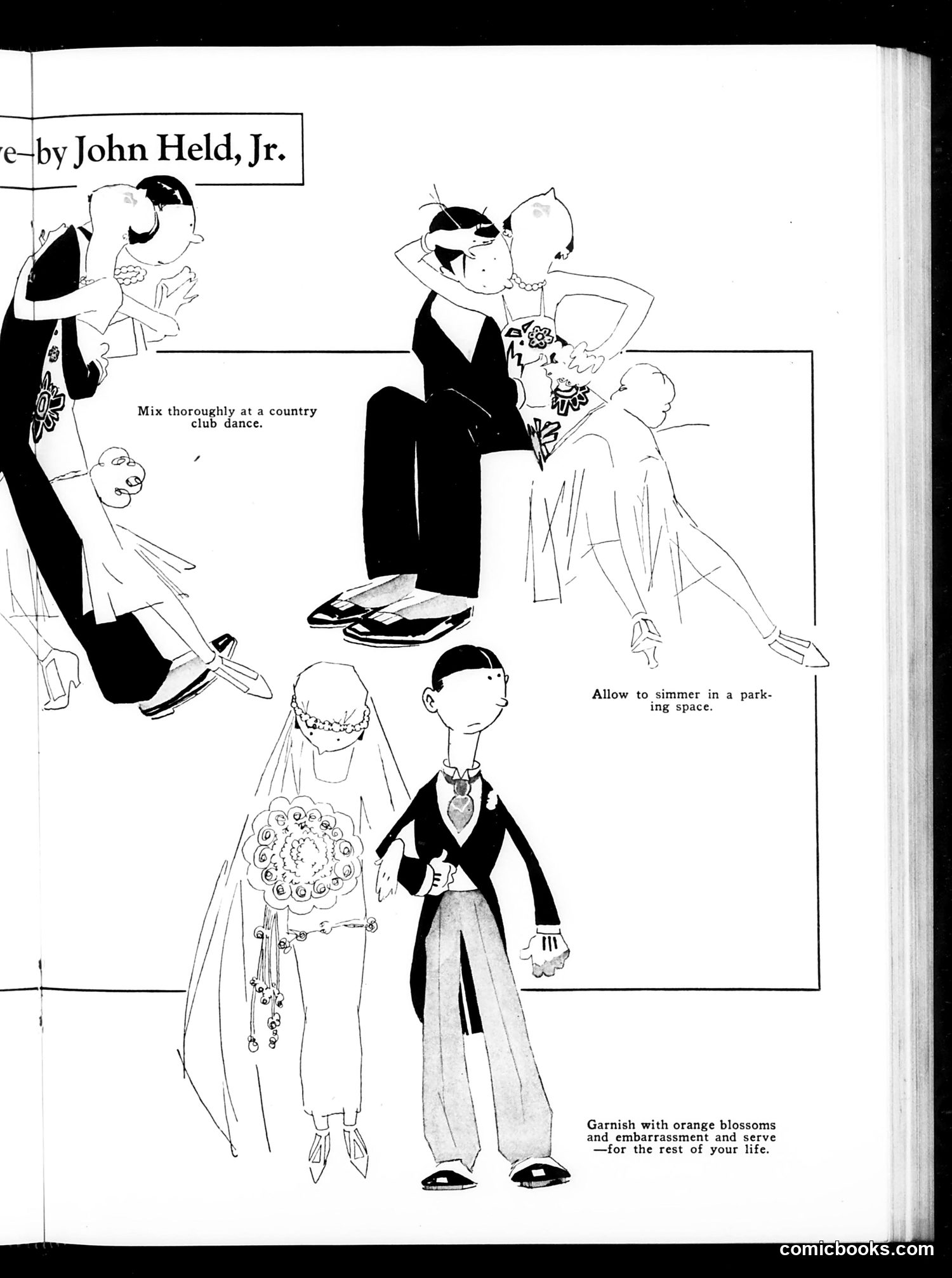
This is a humorous "recipe" satirizing upper-class courtship and marriage rituals of the 1920s-30s era. The illustrated steps show: 1. **Meeting at a country club dance** — where wealthy young people mixed socially 2. **Parking in a car** — referencing the newfound dating practice enabled by automobiles 3. **Wedding** — the inevitable conclusion, garnished with orange blossoms (traditional bridal flowers) and "embarrassment" The joke's dark punchline — "serve for the rest of your life" — satirizes marriage as a binding, inescapable commitment. John Held Jr. was famous for cartooning Jazz Age youth culture and social customs. This gently mocks both the predictability of upper-class courtship rituals and the somewhat grim permanence of marriage itself, presented as a comedic "recipe" anyone could follow.
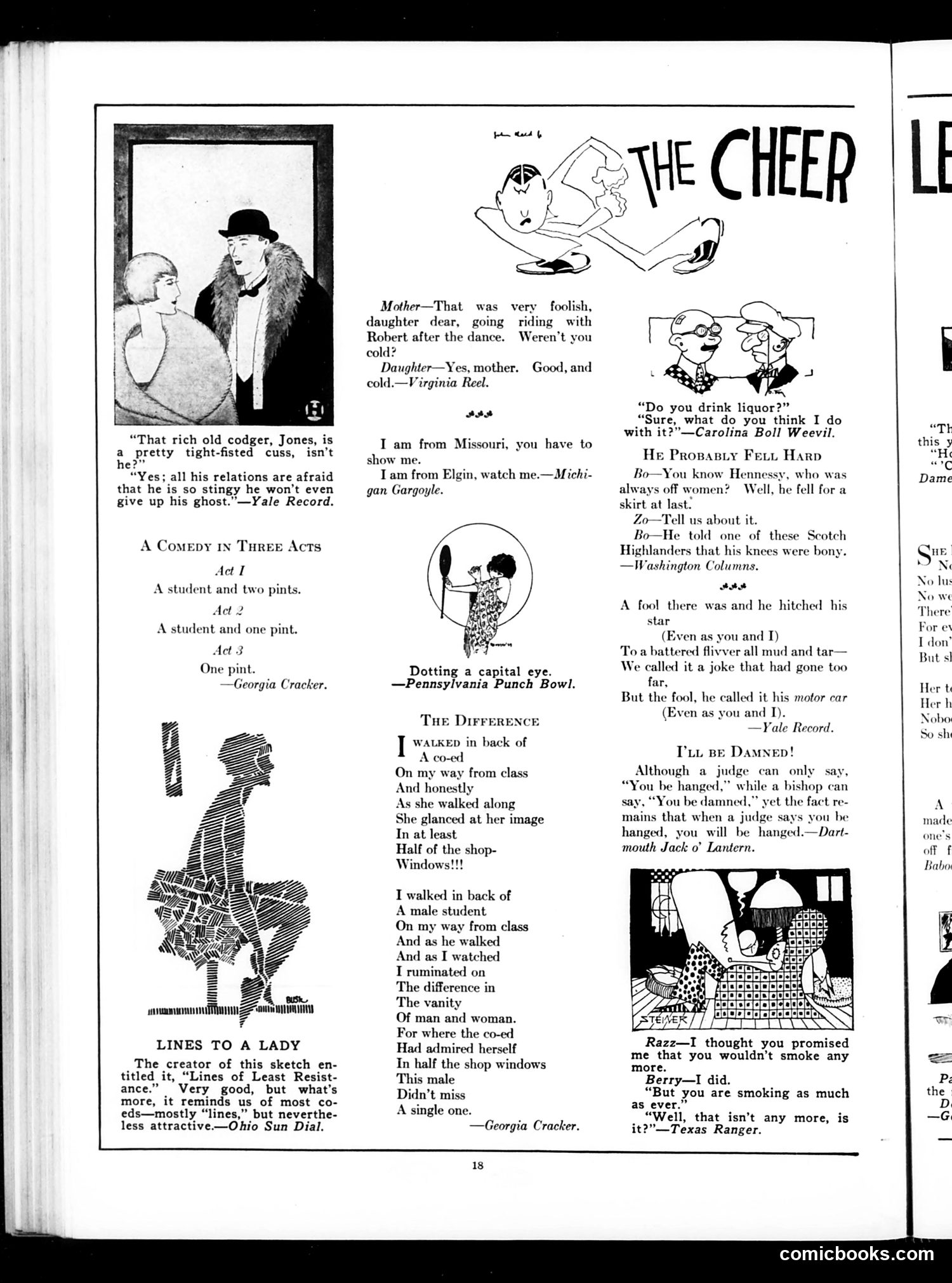
This page collects brief humorous sketches and jokes typical of 1920s college humor magazines. The content satirizes social behaviors and gender differences: **"The Difference"** contrasts vanity between coeds and male students—the joke being that while the coed checked her reflection in half the shop windows, the male student didn't miss *a single one*, inverting expected gender stereotypes about narcissism. **"Lines to a Lady"** criticizes young women for being all "talk" ("lines") but still attractive—a dig at coeds' conversational skills and dating behavior. Other pieces mock drinking culture ("A Comedy in Three Acts" shows alcohol consumption declining), Prohibition-era behavior, and courtship customs (the coed riding with a boy after a dance). **"Motor Car" joke** plays on a fool's delusion—calling a beat-up jalopy his "motor car" with mock-Kiplingesque dignity. The humor reflects Jazz Age college life: coeds' increasing social freedom, drinking, dating norms, and gender role anxieties among educated young Americans.
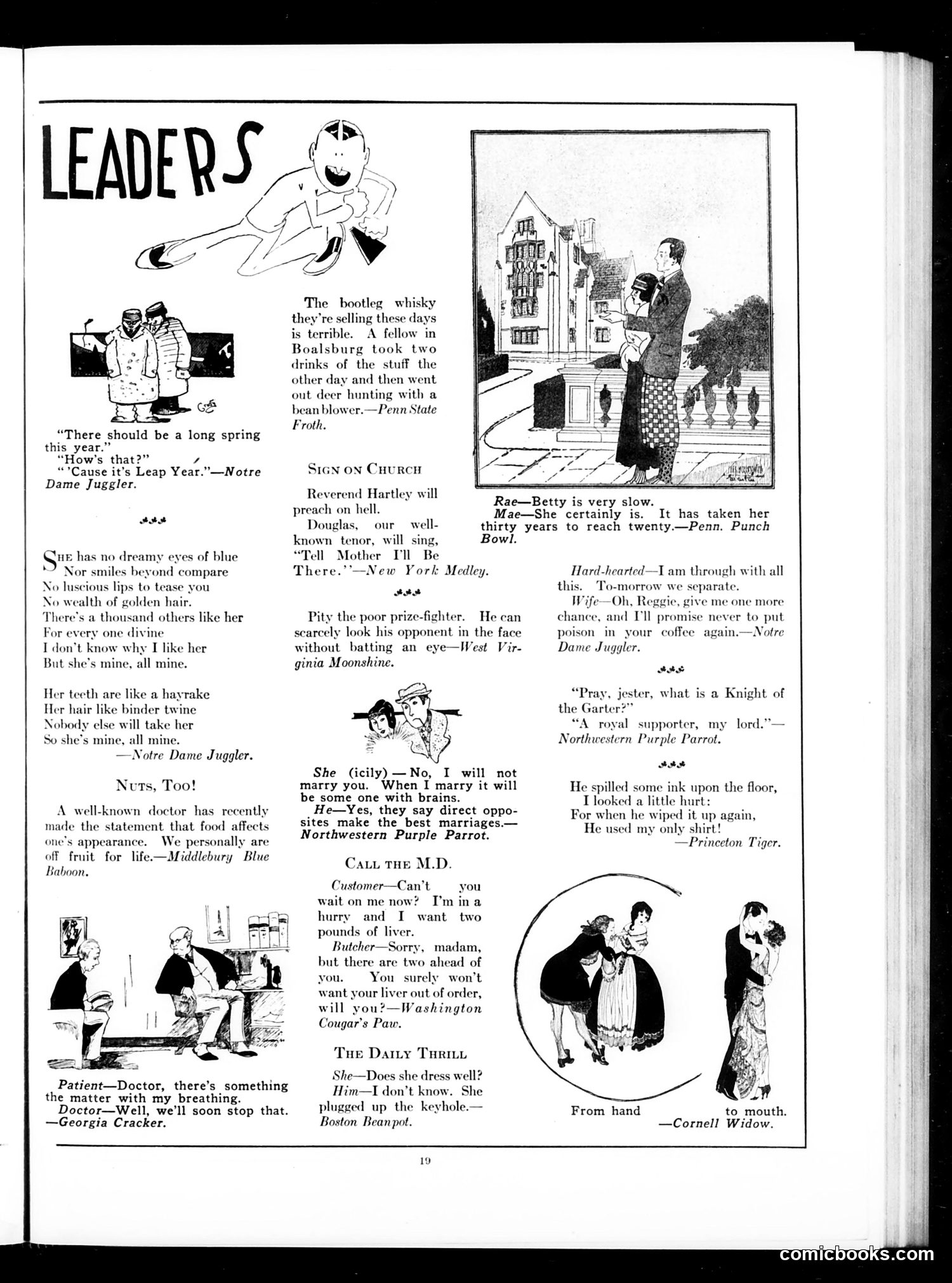
This page from *Judge* magazine collects brief humorous anecdotes and jokes from college publications, reflecting 1920s-era humor. The content reveals period concerns and attitudes: **Prohibition-era references**: Multiple jokes mention bootleg whisky and "bean blowers" (hunting equipment), reflecting the illegal alcohol trade during Prohibition. **College humor**: Most items are reprinted from university publications (Notre Dame, Penn State, Northwestern), featuring the casual misogyny typical of that era—jokes mocking women's appearance and intelligence. **Social observations**: References to prize-fighters, doctors, and butchers represent working-class subjects. One cartoon shows a church sign advertising a sermon on hell alongside a tenor singing "Tell Mother I'll Be There"—likely satirizing the contrast between hellfire preaching and sentimental hymns. **The cartoons** appear to be single-panel gags illustrating accompanying text rather than political satire. Overall, this page represents mainstream American collegiate humor from the early Prohibition period, unfiltered by modern sensibilities.
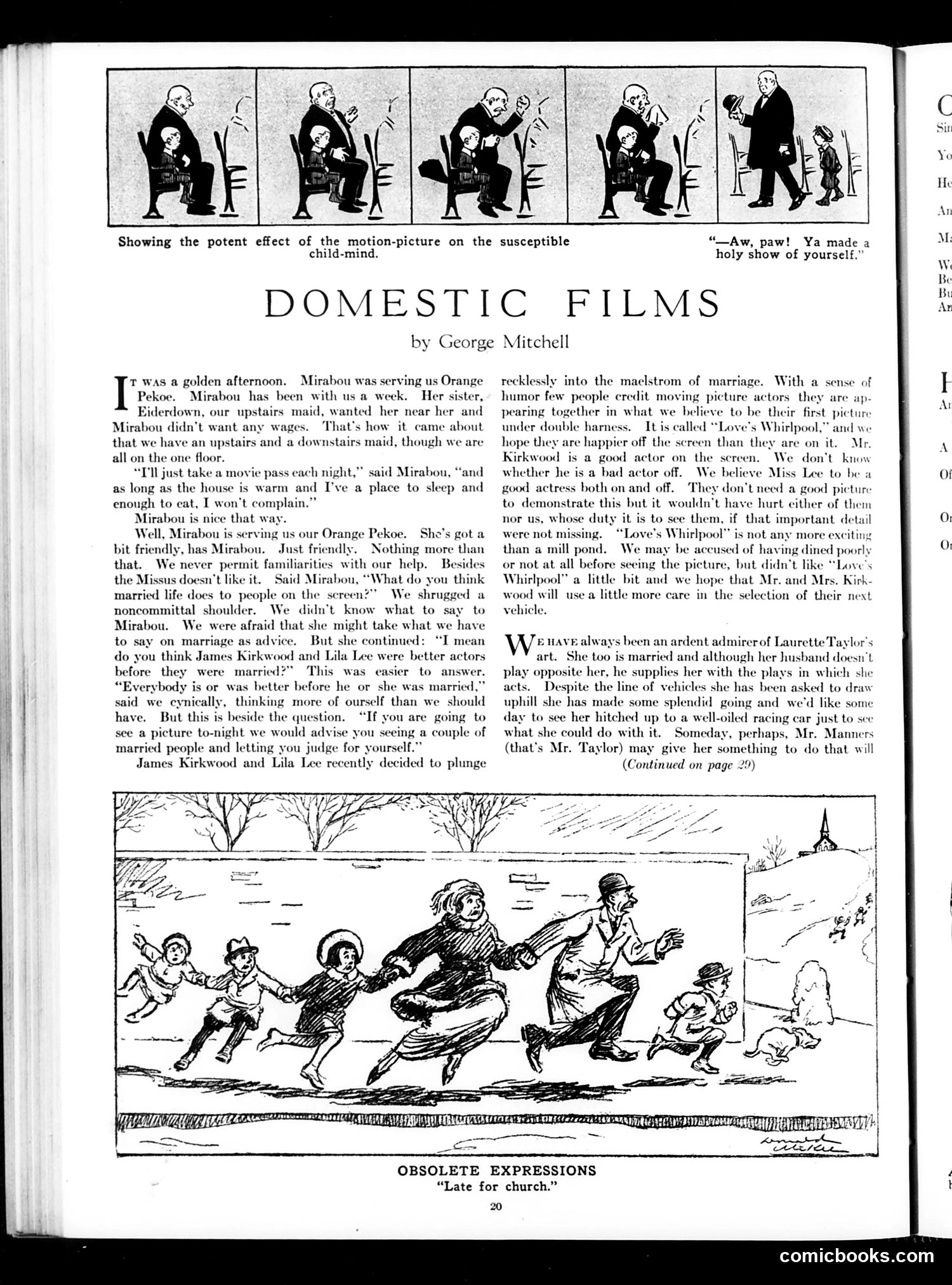
This satirical article critiques early cinema's influence on domestic life and marriage. The page features two cartoons: The **top strip** shows a child imitating dramatic movie behaviors after watching motion pictures—illustrating cinema's "potent effect on the susceptible child-mind." The **bottom cartoon** depicts a family rushing late to church, labeled "Obsolete Expressions," suggesting that cinema-going has replaced traditional religious observance. The main article mocks Hollywood marriages, specifically discussing actors James Kirkwood and Lila Lee's recent marriage and their film "Love's Whirlpool." The author criticizes the couple's on-screen chemistry as uninspired, suggesting their real marriage has diminished their acting abilities. The piece also discusses actress Laurette Taylor, whose husband supplies her scripts. The underlying satire: cinema was reshaping American social priorities and values, with movie-going replacing church attendance, and Hollywood marriages treated as entertainment commodities rather than private matters.
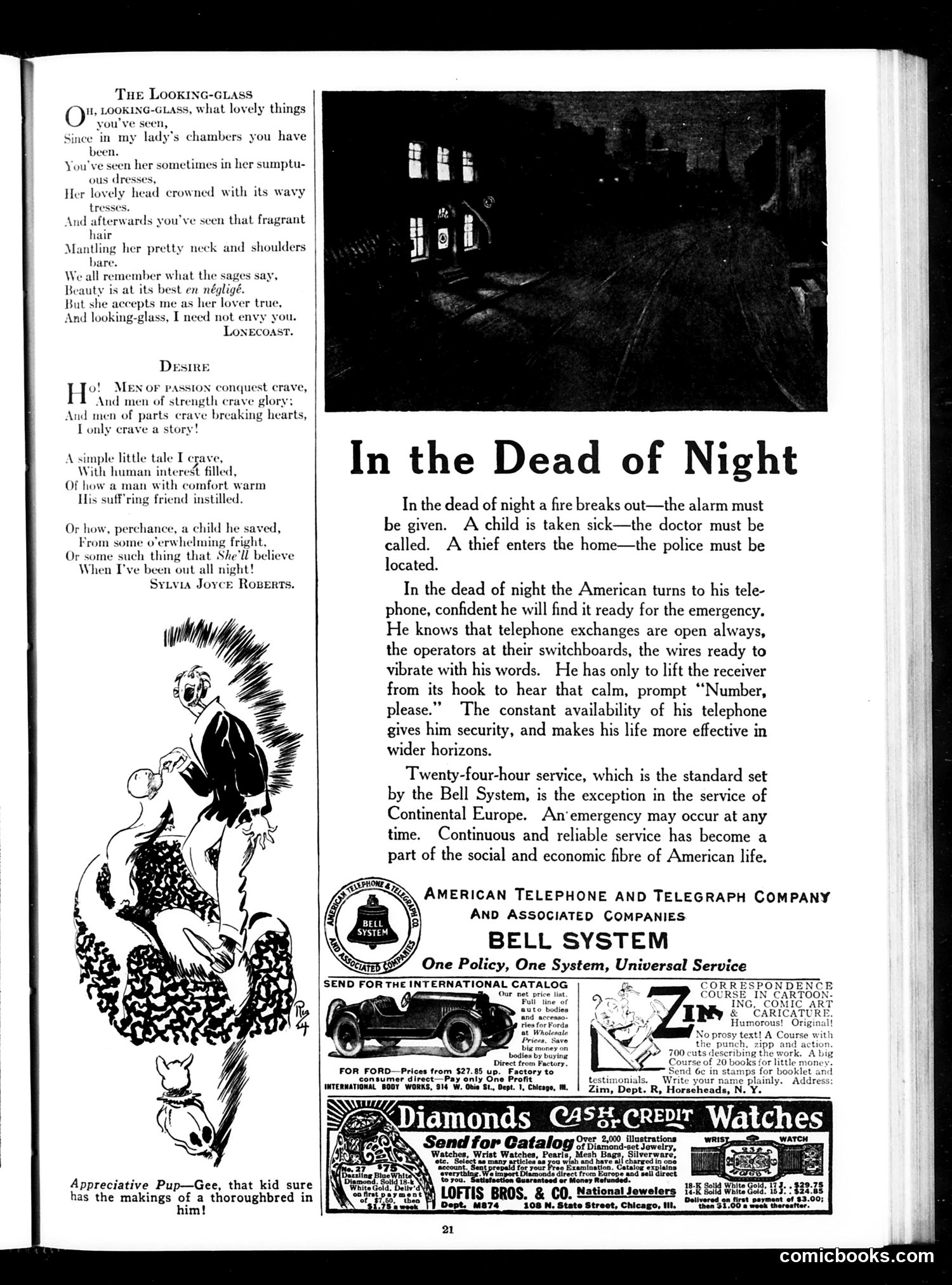
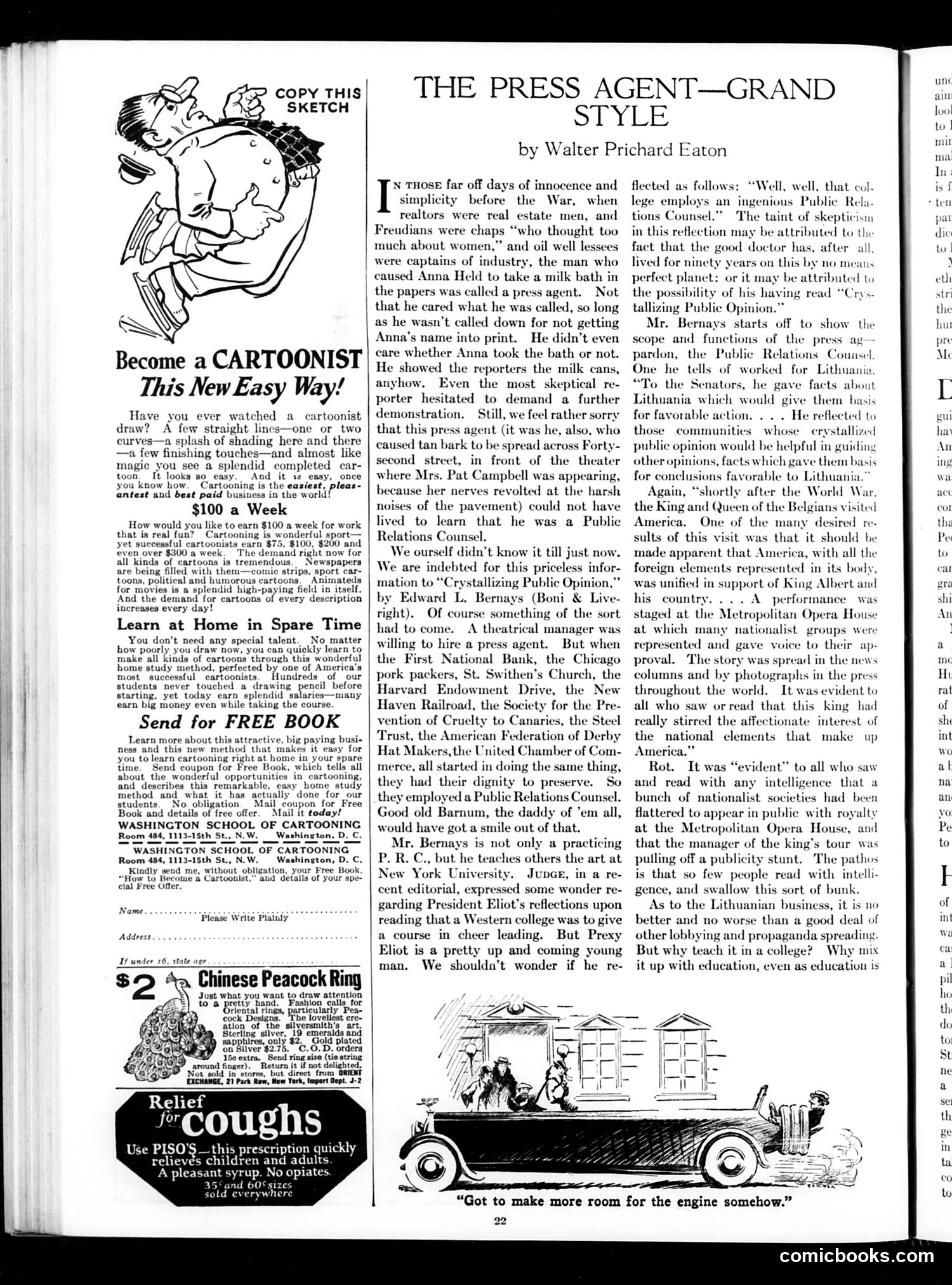
This page primarily features an article by Walter Prichard Eaton satirizing the evolution of "press agents" into the grander-sounding "Public Relations Counsel." Eaton nostalgically recalls pre-WWI press agents—citing real figures like Anna Held (actress associated with Florenz Ziegfeld) and Mrs. Pat Campbell (famous British actress)—who used theatrics to generate publicity. He mocks how a simple press agent is now rebranded with pretentious terminology through Edward Bernays's book "Crystallizing Public Opinion," suggesting modern society inflates job titles to sound more important than the actual work warrants. The accompanying cartoon (bottom) humorously depicts a car with an oversized engine, captioned "Got to make more room for the engine somehow"—likely satirizing how public relations has become bloated and disproportionate to legitimate necessity, mirroring Eaton's critique of unnecessary professional aggrandizement.
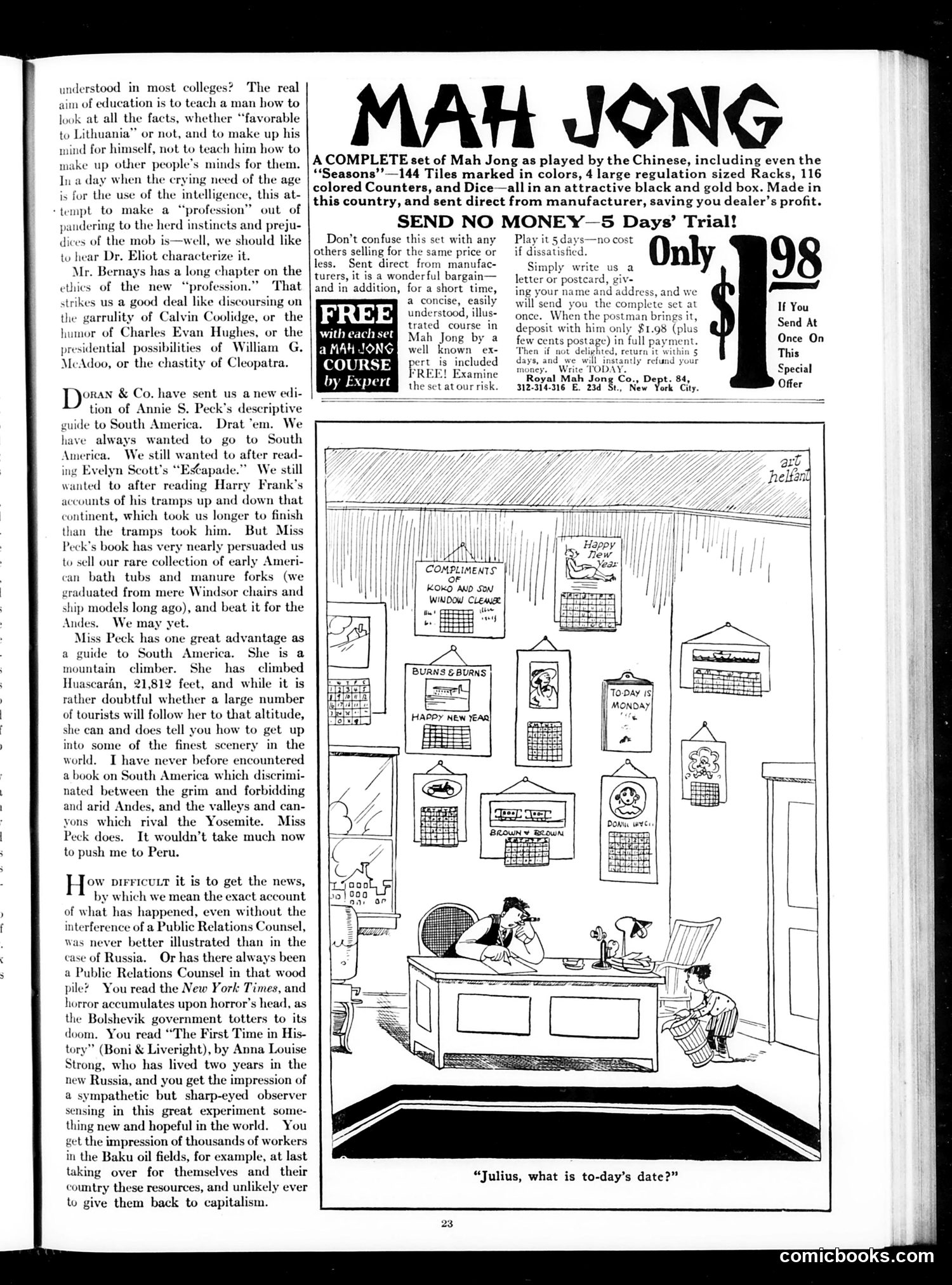
This page combines editorial commentary with advertising and a cartoon. The main content critiques **Edward Bernays**, a pioneering public relations expert, sarcastically comparing his new "profession" of managing public opinion to the non-existent virtues of Calvin Coolidge (garrulity) and Charles Evans Hughes (humor)—implying PR work is equally absurd. The cartoon below depicts an office scene with a man at a desk surrounded by calendars marked with various holidays and greetings. A woman enters asking "Julius, what is to-day's date?"—the joke being that amid the clutter of promotional materials and greeting-card imagery, the actual date has become obscured. This satirizes the emerging advertising/PR industry's obsession with manufactured occasions and commercial messaging that obscure reality. The large **Mah Jong advertisement** represents the magazine's commercial content—promoting the then-trendy Chinese game directly to readers.
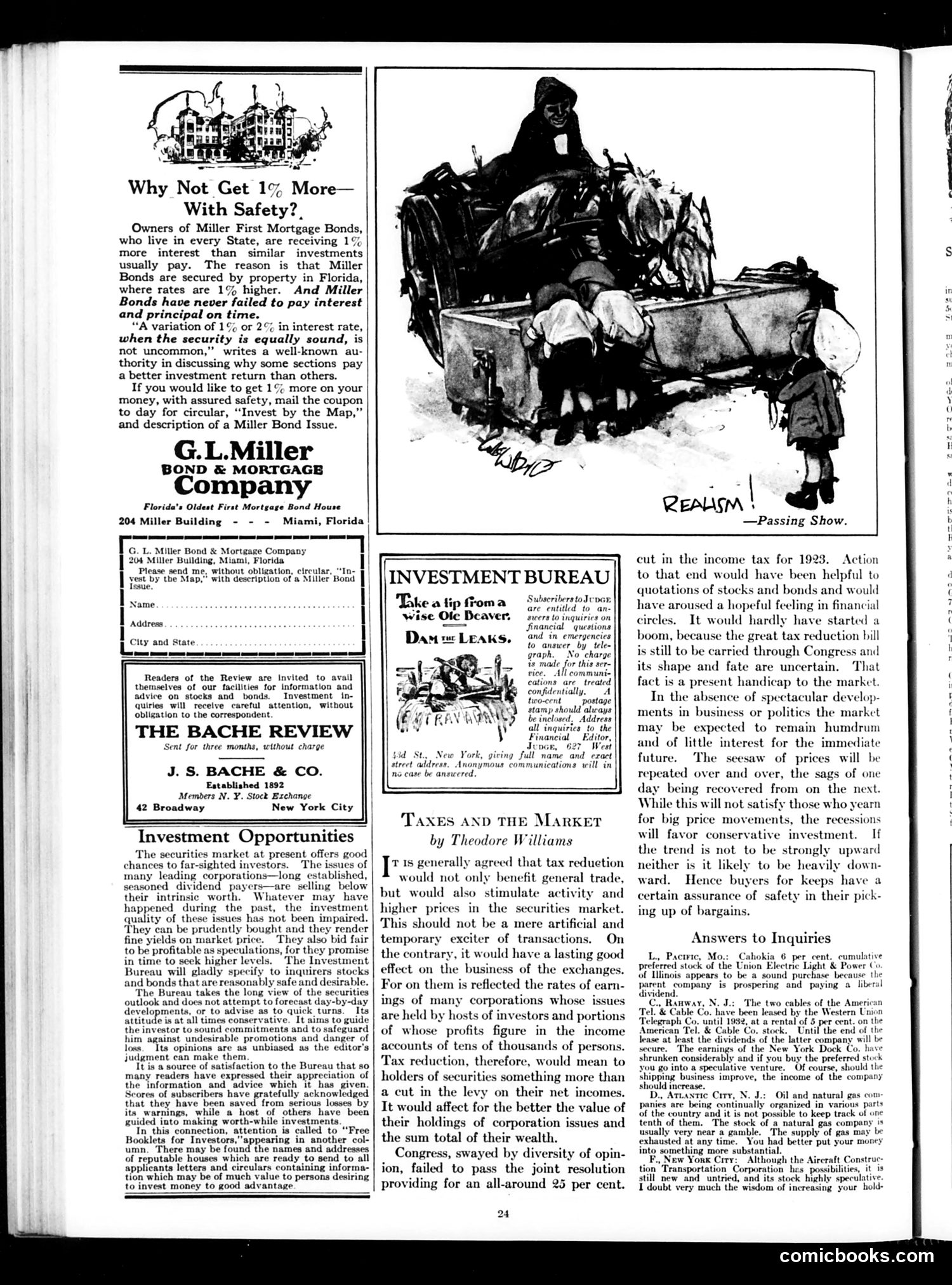
This page consists primarily of **financial advertisements and investment advice columns**—not political satire. The one illustration is titled "Realism—Passing Show" and depicts a shabby, thinly-clad figure driving a decrepit wagon/sleigh pulled by emaciated animals, observed by a child. The cartoon appears to comment on **economic hardship and poverty**, showing the grim reality ("realism") of impoverished conditions during what was likely the post-WWI economic period. The contrast between the child's innocent observation and the depressing scene suggests social commentary on inequality or economic struggle. The surrounding advertisements pitch investment bonds, mortgage offerings, and stock advice—ironically juxtaposed with imagery of destitution, perhaps critiquing the financial establishment's disconnect from ordinary citizens' struggles, or simply offering a stark visual reminder of why sound investments matter. The page lacks clear political figures or specific dated references beyond its apparent economic context.
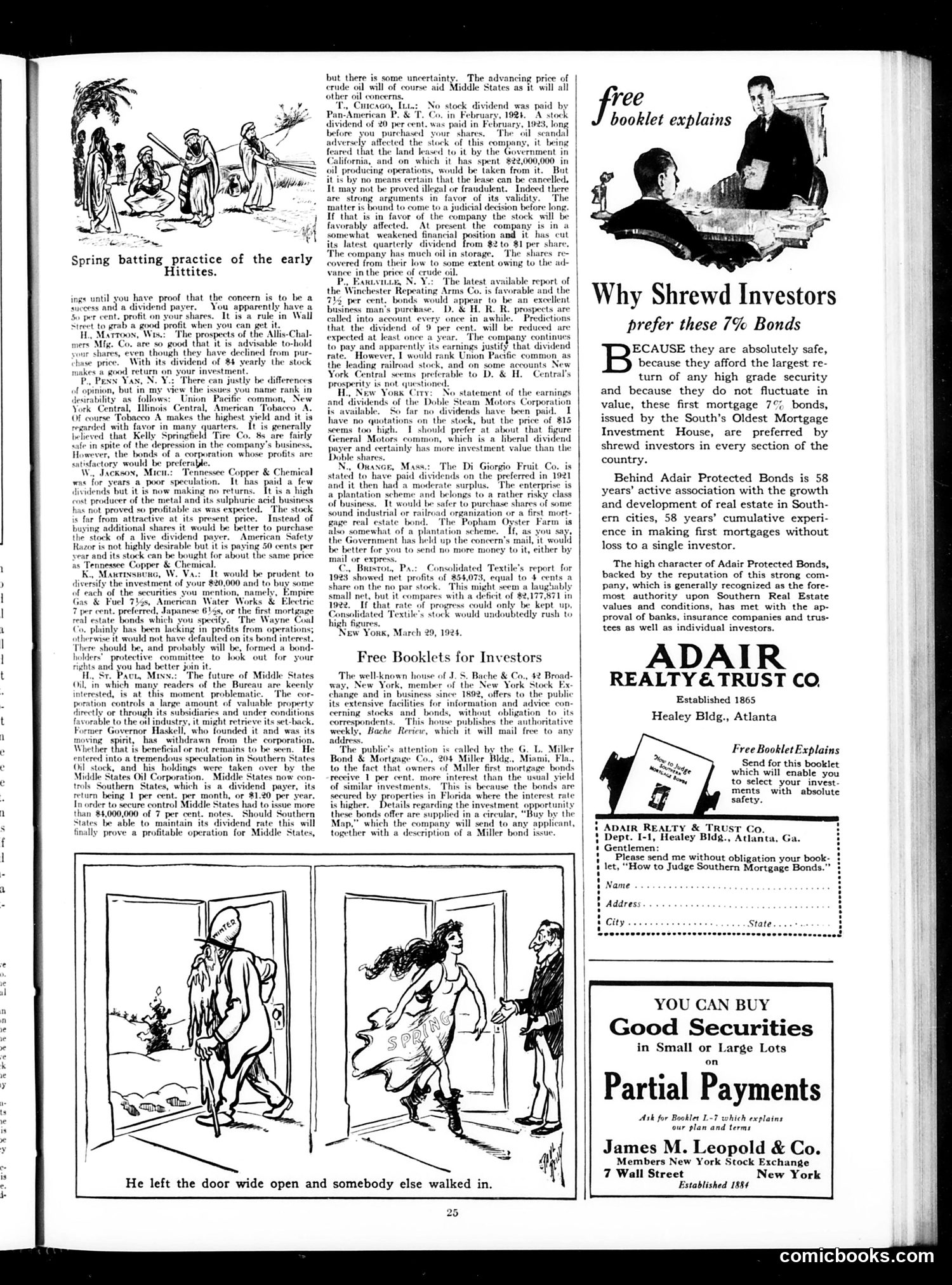
This page contains two distinct elements: a small cartoon at the top left and extensive financial advice columns dominating the rest. **The Cartoon:** "Spring batting practice of the early Hittites" depicts ancient figures engaged in what appears to be a crude baseball game. This is a simple visual pun—the "Hittites" (an ancient civilization) are shown "hitting" a ball, playing on the double meaning of their name. It's mild humor with no political significance. **The Content:** The bulk of the page is investment advice responding to reader questions about stocks and bonds during the 1920s. The questions concern specific companies (Pan-American P&T, Union Pacific, Tennessee Copper) and whether they're sound investments. This reflects the era's active retail investor culture and the financial optimism preceding the 1929 crash. The advertisements for bonds and brokerage services reinforce this focus on securities investment as ordinary consumer activity.
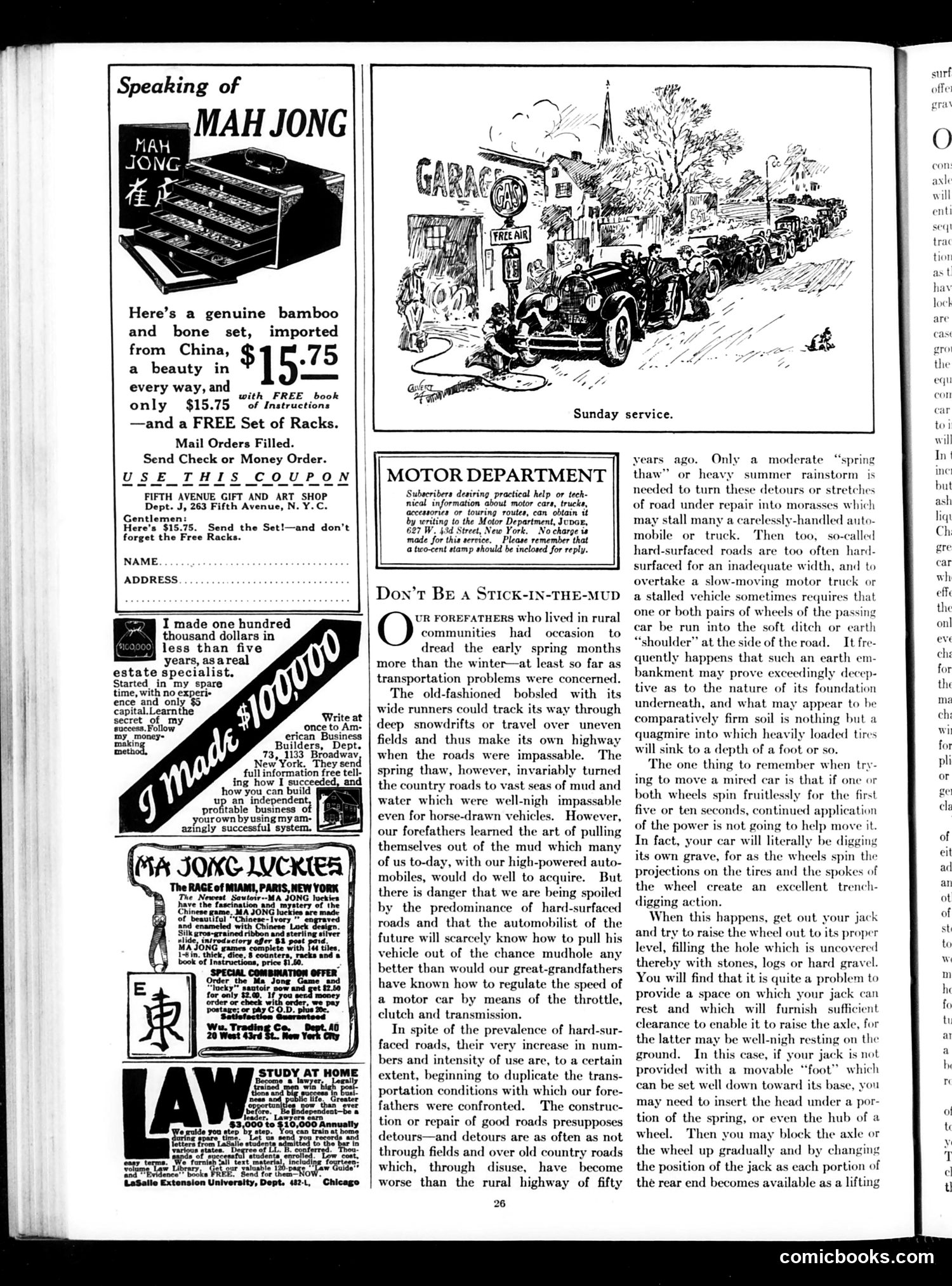
This page from Judge magazine (date unclear) primarily contains **advertisements and advice columns**, not political satire. The main content is "Don't Be a Stick-in-the-Mud," a Motor Department article warning automobile drivers that despite modern hard-surfaced roads, they're losing the practical skills their forefathers possessed for extracting vehicles from mud. The piece notes that road construction, repairs, and spring thaws still create impassable conditions requiring old-fashioned extraction techniques. The advertisements include: a Mahjong set imported from China ($15.75), real estate training courses, Ma Jong games, and a motor department advice column. The cartoon illustration shows a vintage automobile at a garage with the caption "Sunday service"—likely a humorous reference to weekend automobile breakdowns requiring repair work. The tone is practical and instructional rather than satirical, reflecting early-to-mid-20th-century American automobile culture and the transition from horse-drawn to motorized transportation.
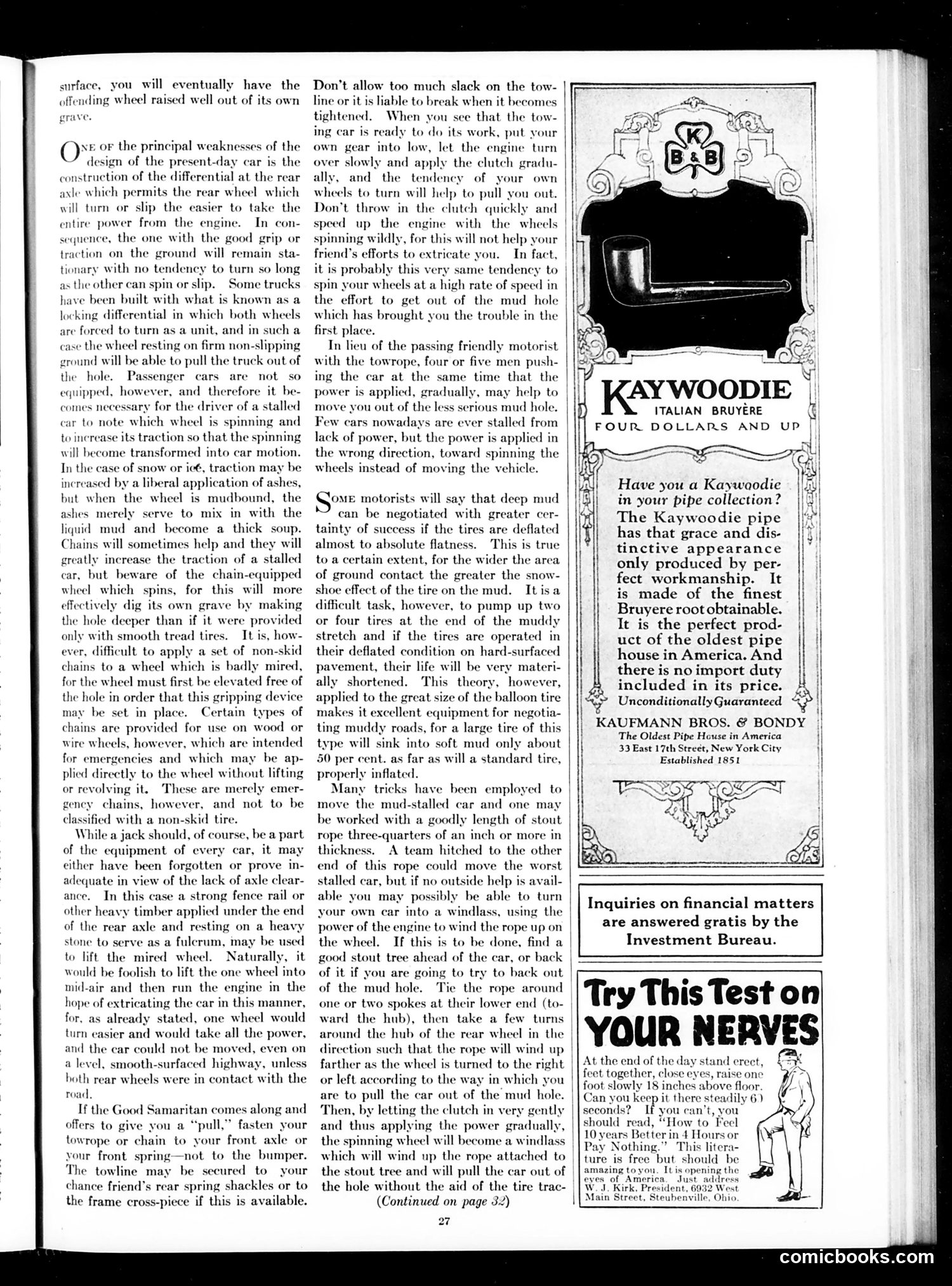
This page is primarily **instructional automotive content**, not satirical or political in nature. The left column presents practical advice on freeing mud-stuck automobiles—discussing differential design, tire chains, jacking techniques, and proper towing procedure. The tone is serious and technical, addressing real mechanical problems early motorists faced. The right side contains two distinct elements: a **Kaywoodie pipe advertisement** (a commercial product endorsement typical of Judge's revenue model) and a separate advertisement titled "Try This Test on Your Nerves," which appears to be a novelty/gag item about balancing. There are **no identifiable political cartoons, caricatures, or satirical commentary** visible on this page. It represents Judge functioning as a general-interest magazine mixing humor, practical information, and advertising rather than pure political satire. The page lacks the cartoons and pointed social criticism the magazine was known for.
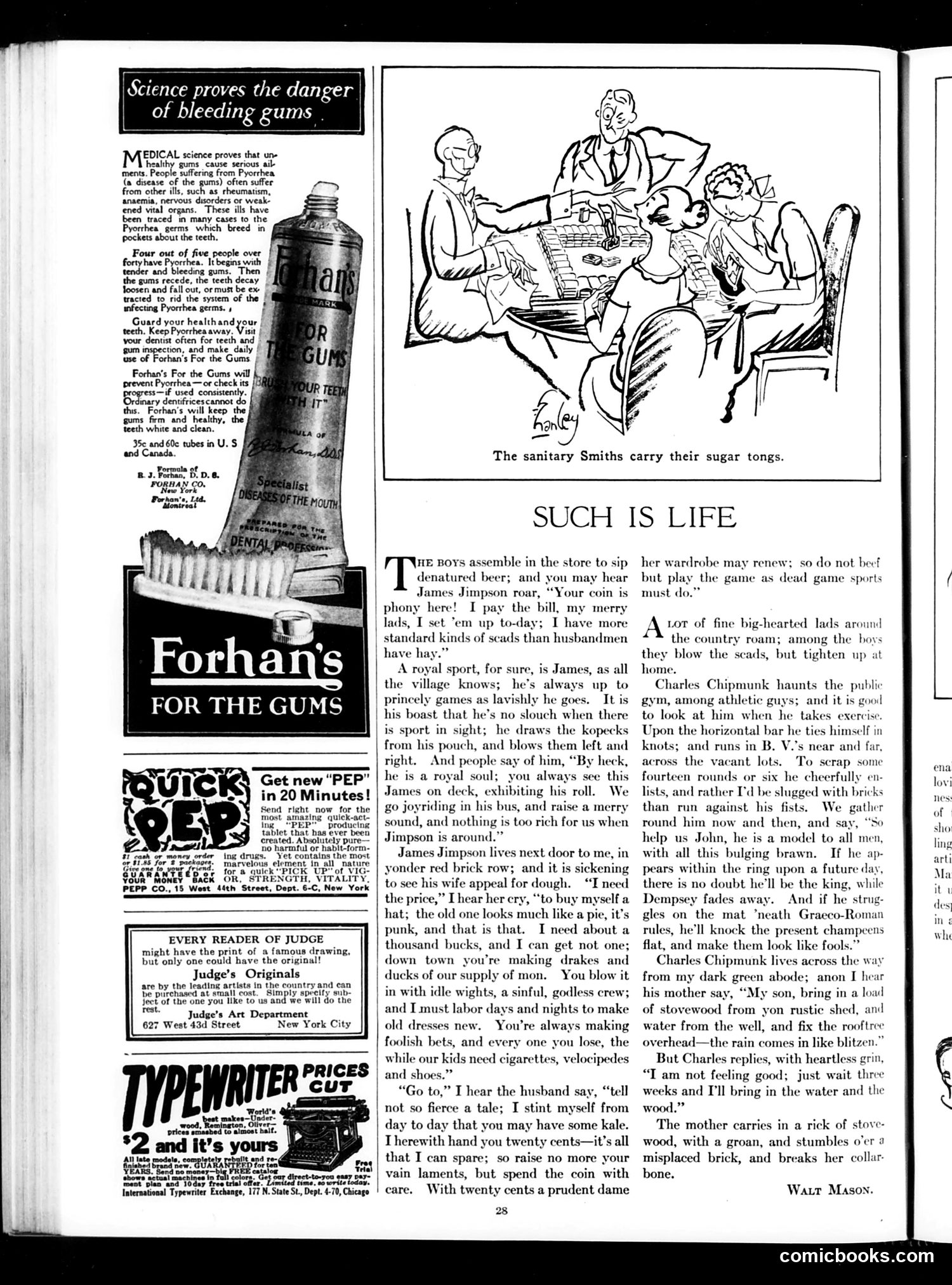
This page from *Judge* magazine contains mostly advertisements and a short humorous story titled "Such is Life," with minimal political satire. **The Story**: "Such is Life" depicts James Jimpson, a working-class man who poses as wealthy, buying rounds at the local store while his wife struggles financially at home. He boasts about his spending and "roll" of money, but his wife desperately needs funds for basic necessities—a hat, clothes for their children. When she pleads for money, he dismissively offers twenty cents, claiming he's already sacrificing by not spending more. **The Satire**: The joke mocks male irresponsibility and false bravado. Jimpson prioritizes public display of generosity (buying drinks) over actual family needs, then gaslights his wife by suggesting he's the one making sacrifices. It's social commentary on working-class financial mismanagement and the disconnect between performative masculinity and domestic responsibility. **Advertisements**: The page features dental care (*Forhan's*), a "pep" tablet, typewriter sales, and *Judge*'s art reproduction service—typical period marketing.
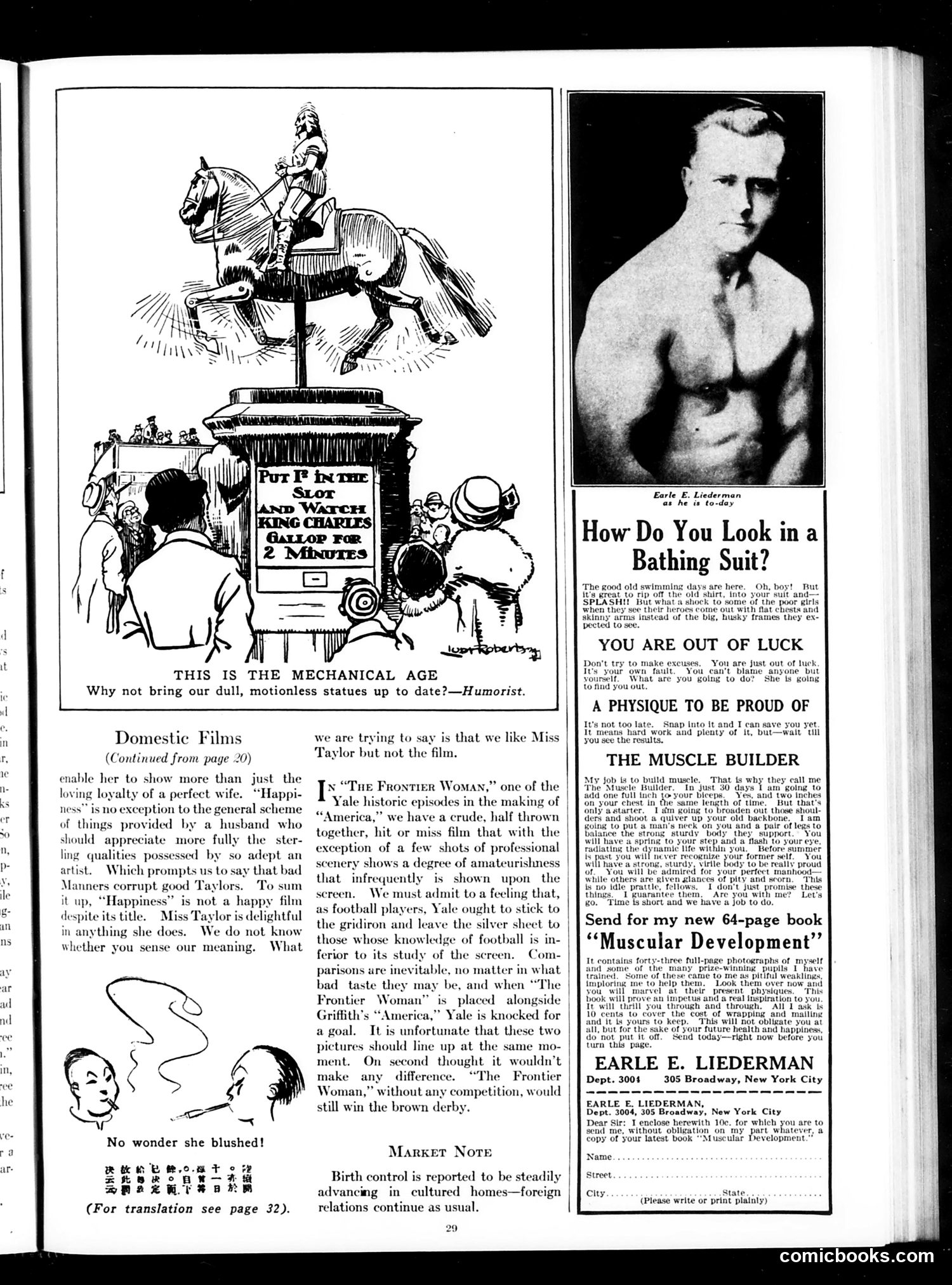
**The Cartoon ("This Is the Mechanical Age"):** This satirical cartoon mocks the idea of modernizing public monuments by replacing static equestrian statues with mechanical ones that "gallop for 2 minutes." It's a humorous jab at the era's enthusiasm for automation and mechanical innovation—suggesting the impulse to mechanize everything, even cherished civic art, is absurd. The crowd gathered below represents public fascination with such technological gimmicks. **The Liederman Advertisement:** The page primarily features a bodybuilding advertisement starring "Earle E. Liederman." The copy uses social pressure tactics ("She is going to find you out") to shame men into purchasing his muscle-building program. It reflects 1920s anxieties about male physique and the emerging fitness industry, playing on fears of embarrassment in bathing situations—a common advertising strategy of the era. **The Film Reviews:** Dismissive critiques of two movies featuring "Miss Taylor" and Yale's "Frontier Woman," suggesting amateur filmmaking and unconvincing performances.
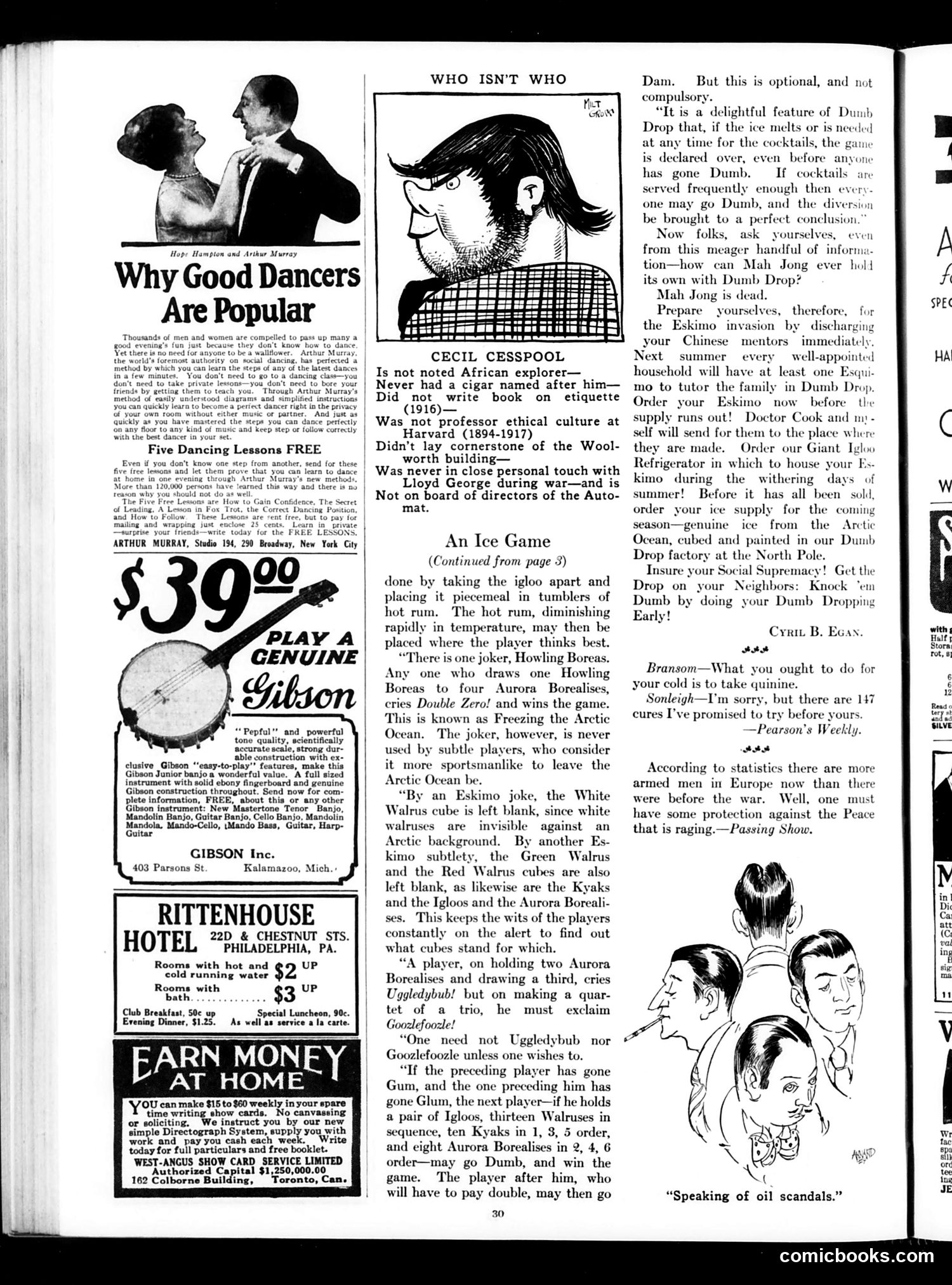
The top cartoon presents a mock biographical entry for **Cecil Cesspool**, a fictional non-entity. The satire lists accomplishments he *didn't* achieve: he's not an African explorer, didn't have a cigar named after him, didn't write an etiquette book, wasn't a Harvard professor, didn't lay the Woolworth Building cornerstone, and wasn't connected to Lloyd George during WWI or the Automat board. This is Judge magazine's jab at contemporary figures—likely a specific wealthy or prominent person of the 1920s—who cultivated false or exaggerated public personas. By inverting the format (stating what he *didn't* do), the satire mocks pretension and the gap between celebrity mythology and reality. The name "Cesspool" itself reinforces the contemptuous tone. The surrounding page features advertisements and an unrelated absurdist game article, typical of Judge's satirical magazine format.
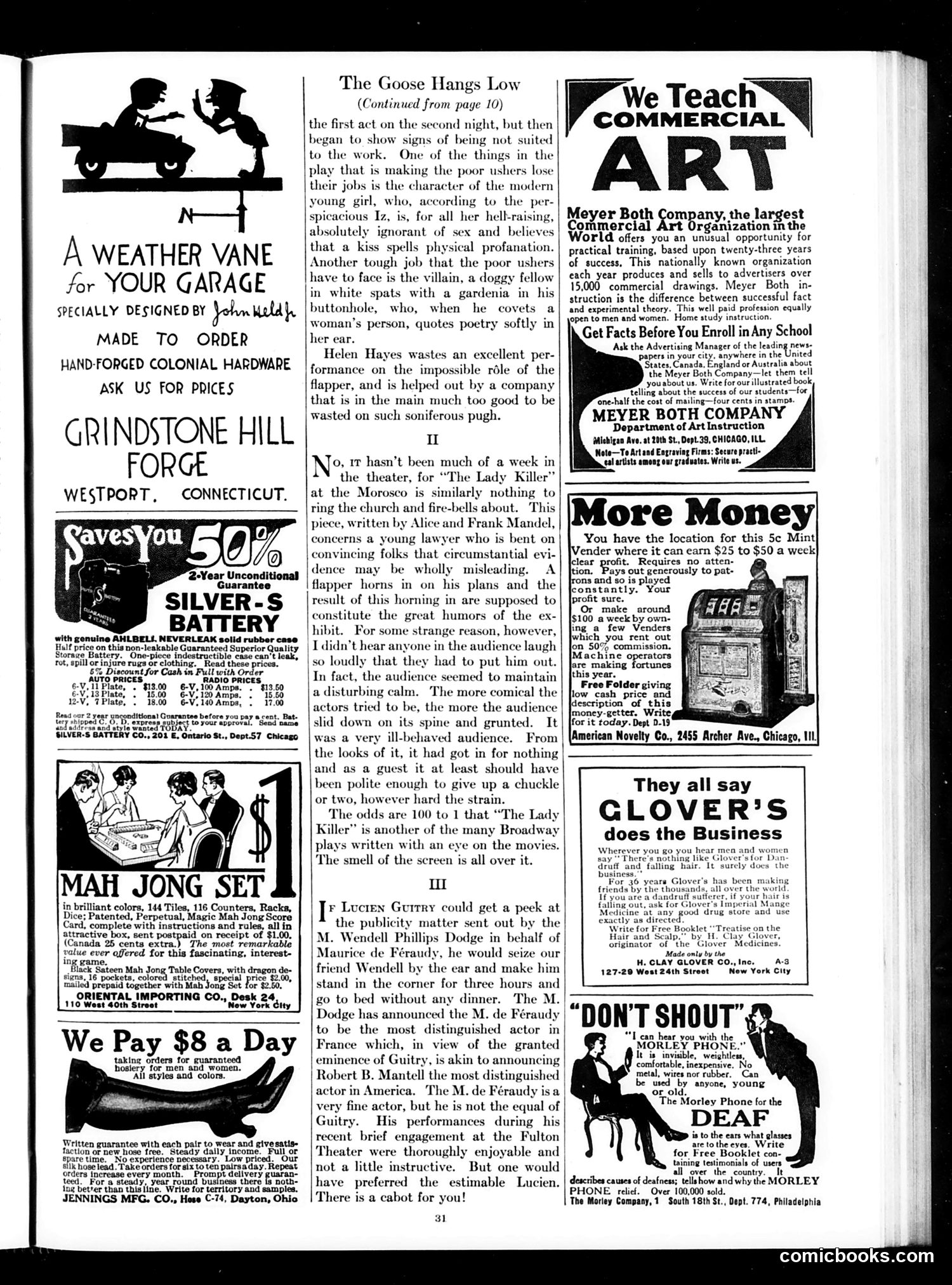
This page is primarily **advertising** with a small amount of editorial content. The main feature is "The Goose Hangs Low," a theater review column discussing Broadway productions. The reviewer critiques two plays: one featuring Helen Hayes as a "modern young girl" who is prudishly ignorant about sex (satirizing 1920s flapper stereotypes), and "The Lady Killer," which the reviewer found tediously unfunny. The piece mocks both the plays' plots and the audiences' dead reactions. The advertisements reflect 1920s consumer goods: weather vanes, batteries, Mah Jong sets (a craze then), and hosiery sales jobs—typical of period magazines. **The satire here is theatrical, not political**—the columnist uses wit to eviscerate Broadway productions and contemporary character types (the innocent flapper, the melodramatic villain), rather than targeting specific public figures or political events.
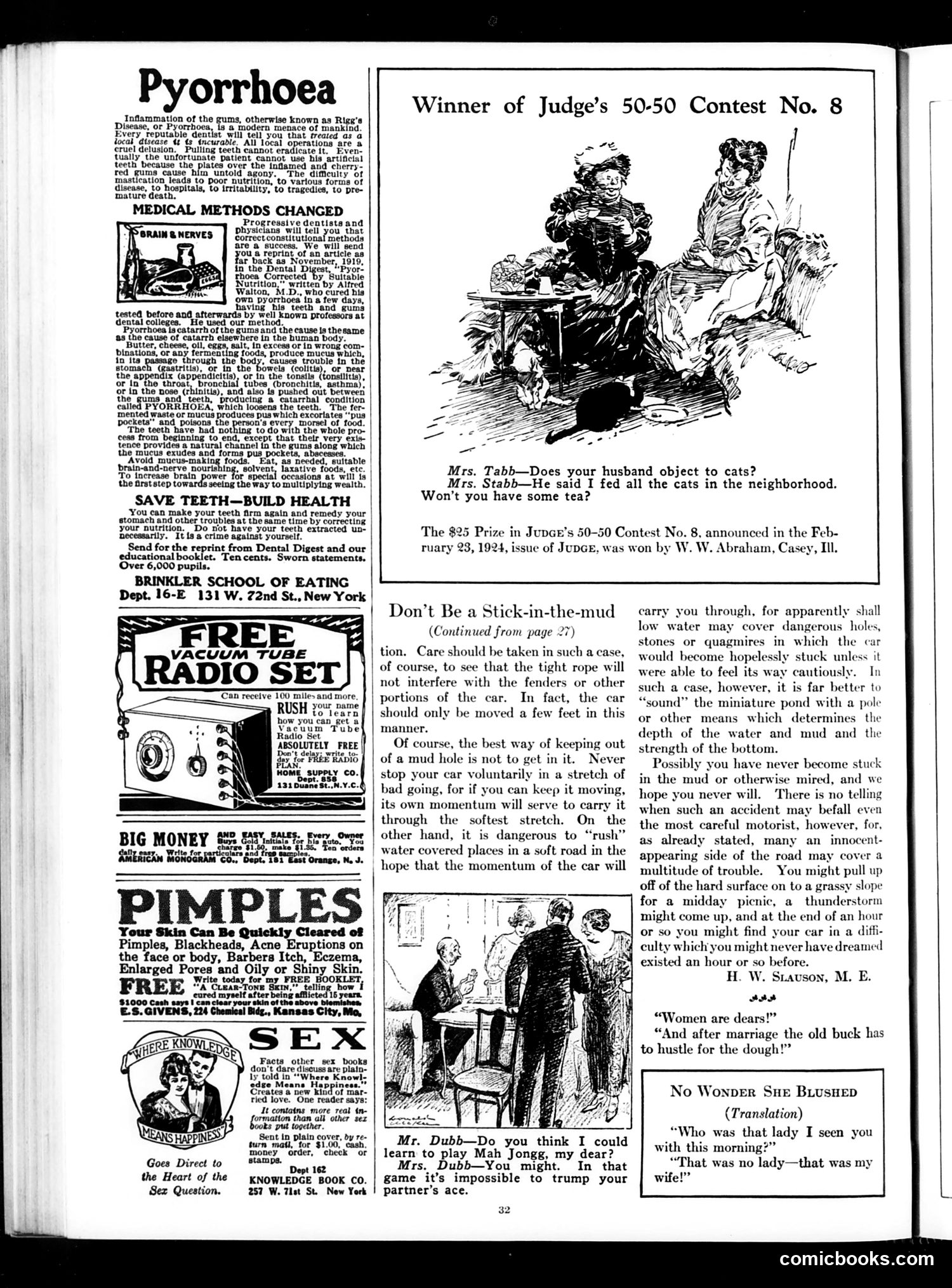
This page contains primarily **medical and self-help advertisements** rather than political satire. The main content is a lengthy ad for the Brinkler School of Eating, promoting a dietary cure for pyorrhea (gum disease). It exemplifies early-20th-century medical pseudoscience—claiming that avoiding "mucus-making" foods like butter and cheese could cure tooth problems and numerous other ailments. The page also includes typical period advertisements for skin conditions, a mail-order sex education book, and a radio set giveaway. The only cartoon humor appears in the **top right**: a Judge contest-winning comic strip showing two women discussing cats. One woman mentions her husband objects to cats; the other jokes that her husband said she fed "all the cats in the neighborhood." This is simple domestic humor about a woman's cat-keeping habits—nothing deeper than that. The "Stick-in-the-Mud" article discusses practical advice about getting cars unstuck from mud, not satire. This page is primarily **commercial advertising** rather than satirical content.
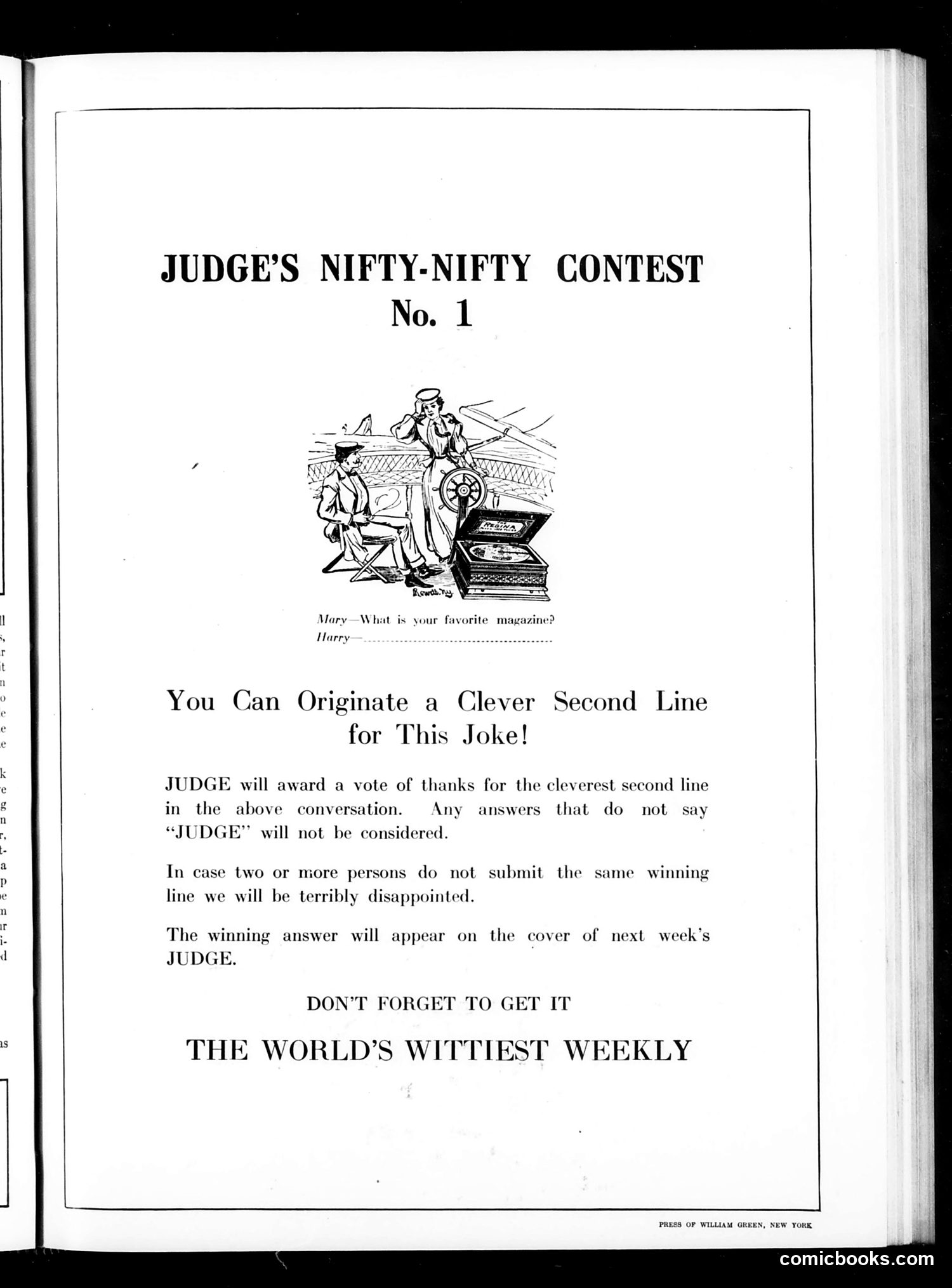
This page is a **reader participation contest**, not political satire. Judge magazine invites readers to complete a joke setup where Mary asks Harry his favorite magazine. The punchline must be "JUDGE" (the magazine itself). The cartoon shows two figures on what appears to be a ship, establishing a casual conversational setting. This is essentially **self-promotional advertising**—Judge uses humor to encourage readers to engage with the publication and submit entries for the chance to see their wit published. The magazine promises the winning answer will appear on next week's cover, making it an incentive for reader participation. The tone is lighthearted and playful, typical of early-to-mid 20th-century magazine marketing strategies that blurred entertainment with advertisement.
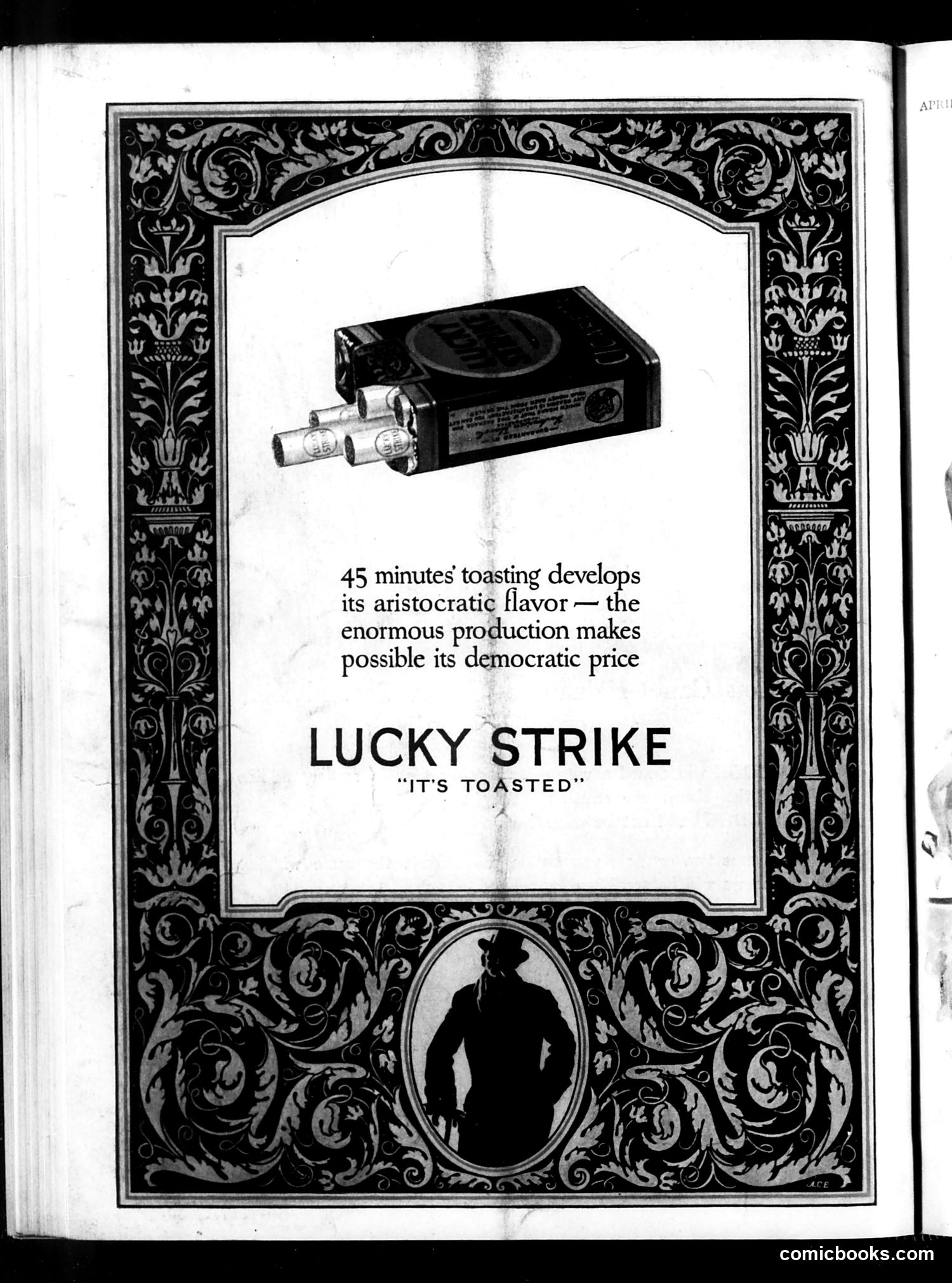
This is a Lucky Strike cigarette advertisement, not political satire. The ad promotes Lucky Strike's "toasted" process, claiming it develops "aristocratic flavor" while mass production keeps the price "democratic"—accessible to ordinary people rather than just the wealthy. The ornate decorative border mimics high-end luxury goods advertising, reinforcing the "aristocratic" positioning. The silhouetted figure at the bottom appears generic, likely representing an everyman consumer. The ad's class-based language is notable: it equates toasting with refinement while using "democratic price" to suggest affordable luxury for the masses. This reflects 1920s-30s marketing that positioned mass-produced goods as democratizing previously elite products. The "It's Toasted" slogan was Lucky Strike's actual advertising campaign during this era.