
Judge, 1924-04-05 · page 12 of 36
Judge — April 5, 1924 — page 12: what you’re looking at
What you’re looking at
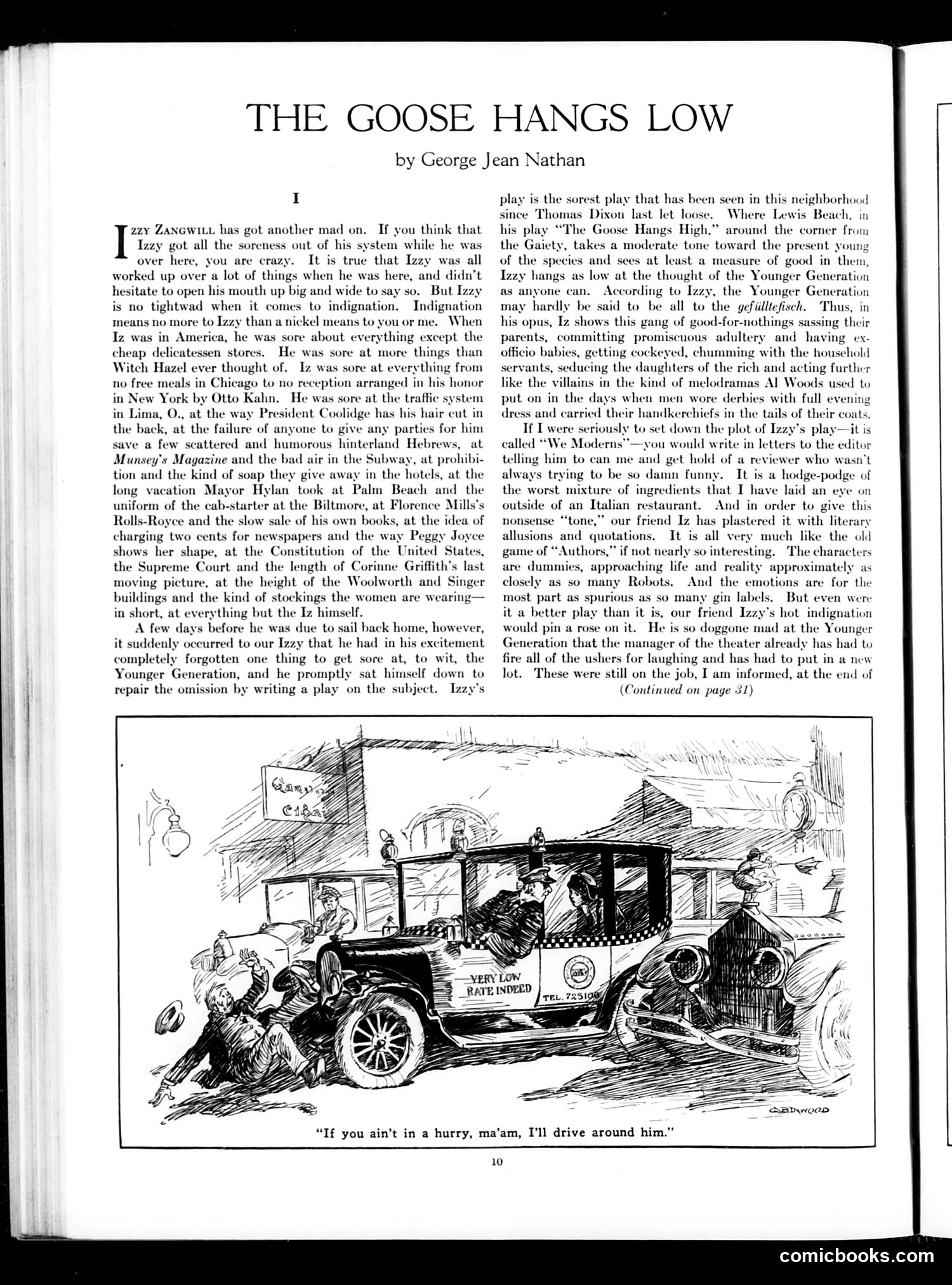
This page satirizes playwright **Israel Zangwill** (referred to as "Izzy"), a real writer known for social commentary. Critic George Jean Nathan mocks Zangwill's perpetually angry disposition and his recent play "We Moderns," which attacks the younger generation as immoral and dissolute. Nathan contrasts Zangwill's harsh treatment with Lewis Beach's gentler play "The Goose Hangs High" (playing nearby). He argues Zangwill's work is melodramatic and intellectually shallow—stuffed with literary references to seem sophisticated but populated by cardboard characters. The **cartoon below** shows a chauffeur-driven car hitting a pedestrian, with the driver's dismissive comment: "If you ain't in a hurry, ma'am, I'll drive around him." This likely reflects the article's broader theme about generational contempt and recklessness, though its specific connection to the Zangwill critique is unclear.
📄 Transcribed text from this page (OCR, searchable)
Machine-transcribed from the original scan — historical spelling and the odd misread are preserved.
THE GOOSE HANGS LOW by George Jean Nathan I zzy ZANGWILL has got another mad on. If you think that I zzy got all the soreness out of his system while he was over here, you are crazy. It is true that Izzy was all worked up over a lot of things when he was here, and didn’t hesitate to open his mouth up big and wide to say so. But Izzy is no tightwad when it comes to indignation, Indignation means no more to Izzy than a nickel means to you or me. When Iz was in America, he was sore about everything except the cheap delicatessen stores. He was sore at more things than Witch Hazel ever thought of. Iz was sore at everything from no free meals in Chicago to no reception arranged in his honor in New York by Otto Kahn, He was sore at the traffic system in Lima, O., at the way President Coolidge has his hair cut in the back, at the failure of anyone to give any parties for him a few scattered and humorous hinterland Hebrews, at Munsey’s Magazine and the bad air in the Subway, at prohibi- tion and the kind of soap they give away in the hotels, at the long vacation Mayor Hylan took at Palm Beach and the uniform of the cab-starter at the Biltmore, at Florence Mills’s Rolls-Royce and the slow sale of his own books, at the idea of charging two cents for newspapers and the way Peggy Joyce shows her shape, at the Constitution of the United States, the Supreme Court and the length of Corinne Griffith's last moving picture, at the height of the Woolworth and Singer buildings and the kind of stockings the women are wearing— in short, at everything but the Iz himself. A few days before he due to sail 1 home, however, it suddenly occurred to our Izzy that he had in his excitement comple forgotten one thing to get sore at, to wit, the Younger Generation, and he promptly sat himself down to repair the omission by writing a play on the subject. Izzy’ play is the sorest play that has been seen in this neighborhood since Thomas Dixon last let loose. Where Lewis Beach, in his play “The Goose Hangs High,” around the corner from the Gaiety, takes a moderate tone toward the present young of the species and sees at least a measure of good in them, Taz: s low at the thought of the Younger Generation as anyone can. According to Izzy, the Younger Generation may hardly be said to be all to the gefiilltefisch. Thus, in his opus, Iz shows this gang of good-for-nothings sassing their parents, committing promiscuous adultery and having ex- officio babies, getting cockeyed, chumming with the household vants, seducing the daughters of the rich and acting further like the villains in the kind of melodramas Al Woods used to put on in the days when men wore derbies with full evening dress and carried their handkerchiefs in the tails of their coats. If I were seriously to set down the plot of Izzy's play—it is called “We Moderns”—you would write in letters to the editor telling him to can me and get hold of a reviewer who wasn’t always trying to be so damn funny. It is a hodge-podge of the worst mixture of ingredients that I have laid an eye on outside of an Italian restaurant. And in order to give this nonsense “tone,” our friend Iz has plastered it with literary allusions and quotations. It is all vi much like the old game of “Authors,” if not nearly so interesting. The characters are dummies, approaching life and reality approximately as closely as so many Robots. And the emotions are for the most part as spurious as so many gin labels. But even were it a better play than it is, our friend Izzy’s hot indignation would pin a rose on it. He is so doggone mad at the Younger Generation that the manager of the theater already has had to fire all of the ushers for laughing and has had to put in a new lot. These were still on the job, I am informed, at the end of (Continued on page 31) hangs comicbooks.com