
Judge, 1924-04-05 · page 29 of 36
Judge — April 5, 1924 — page 29: what you’re looking at
What you’re looking at
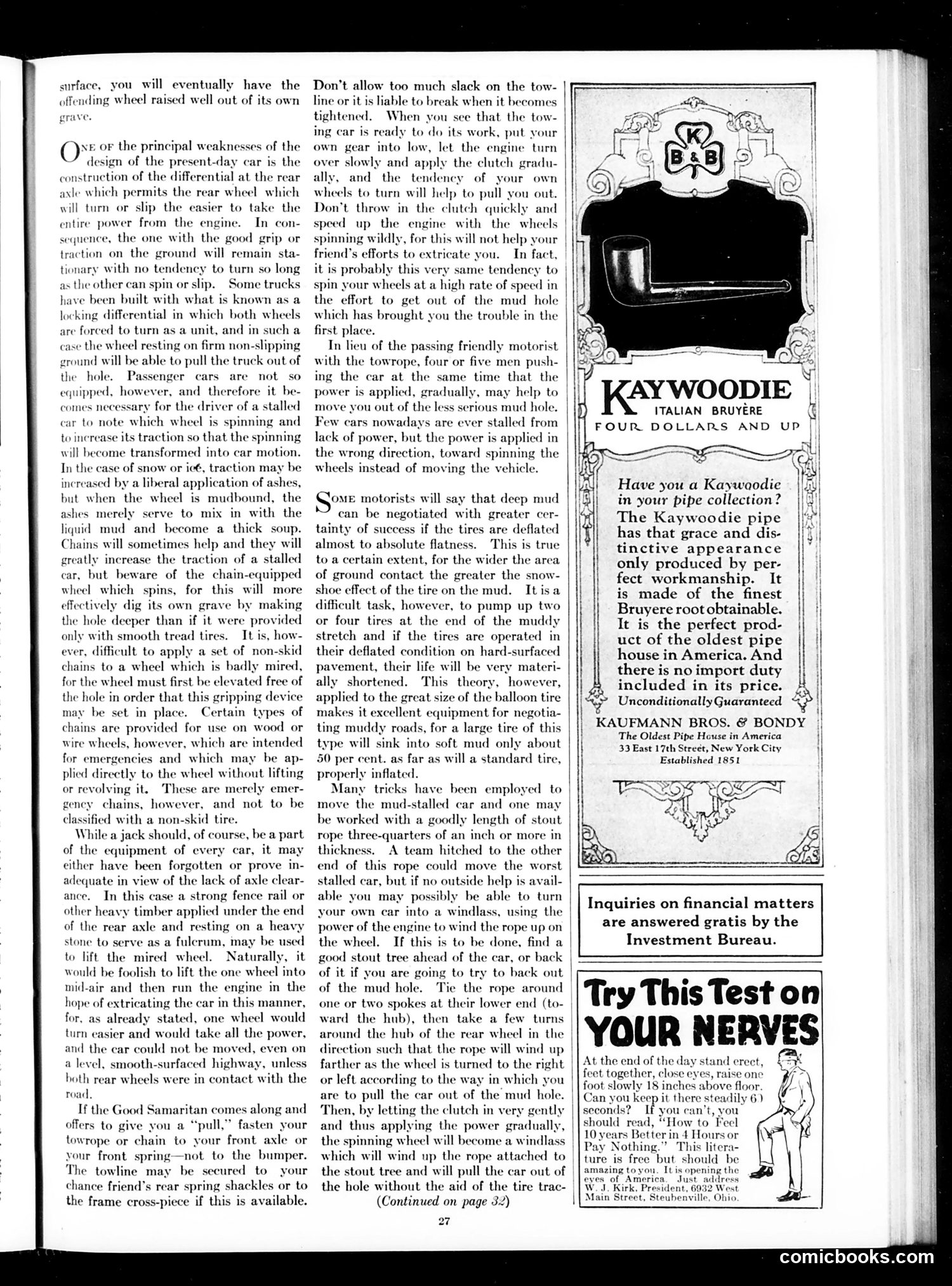
This page is primarily **instructional automotive content**, not satirical or political in nature. The left column presents practical advice on freeing mud-stuck automobiles—discussing differential design, tire chains, jacking techniques, and proper towing procedure. The tone is serious and technical, addressing real mechanical problems early motorists faced. The right side contains two distinct elements: a **Kaywoodie pipe advertisement** (a commercial product endorsement typical of Judge's revenue model) and a separate advertisement titled "Try This Test on Your Nerves," which appears to be a novelty/gag item about balancing. There are **no identifiable political cartoons, caricatures, or satirical commentary** visible on this page. It represents Judge functioning as a general-interest magazine mixing humor, practical information, and advertising rather than pure political satire. The page lacks the cartoons and pointed social criticism the magazine was known for.
📄 Transcribed text from this page (OCR, searchable)
Machine-transcribed from the original scan — historical spelling and the odd misread are preserved.
surface, you will eventually have the offending wheel raised well out of its own grave. Over the principal weaknesses of the design of the present-day car is the construction of the differential at the rear axle which permits the rear wheel which will turn or slip the easier to take the entire power from the engine. In con- the one with the good grip or traction on the ground will remain sta- tionary with no tendency to turn so long as the other can spin or slip. have been built with what is known as a locking differential in which both wheels are forced to turn as a unit, and in such a case the wheel resting on firm non-slipping ground will be able to pull the truck out of the hole. not equipped, however, and therefore it be- comes necessary for the driver of a stalled car to note which wheel is spinning and sequence, Some trucks Passenger cars are so. to increase its traction so that the spinning will become transformed into car motion. In the case of snow or icé, traction may be increased by a liberal application of ashes, but when the wheel is mudbound, the ashes merely to mix in with the mud and become a thick soup. Chains will sometimes help and they will greatly increase the traction of a stalled car, but beware of the chain-equipped wheel which spins, for this will effectively dig its own grave by making the hole deeper than if it were provided only with smooth tread tires. It is, how- ever, difficult to apply a set of non-skid chains to a wheel which is badly mired, for the wheel must first be elevated free of the hole in order that this gripping device may be set in place. Certain types of chains are provided for use on wood or wire wheels, however, which are intended for emergencies and which may be ap- plied directly to the wheel without lifting or revolving it. These are merely emer- gency chains, however, and not to be classified with a non-skid tire. While a jack should, of course, be a part of the equipment of every it may cither have been forgotten or prove in- adequate in view of the lack of axle cl ance. In this case a strong fence rail or other heavy timber applied under the end of the rear axle and resting on a heavy stone to serve as a fulcrum, may be used to lift the mired wheel. Naturally, it would be foolish to lift the one wheel into mid-air and then run the engine in the ing the car in this manner, ly stated, one wheel would asier and would take all the power, and the car could not be moved, even on a level, smooth-surfaced highway, unless both rear wheels were in contact with the road, serve liquid more car, par- If the Good Samaritan comes along and “pull,” towrope or chain to your front axle or your front spring—not to the bumper. The towline may be secured to your chance friend’s rear spring shackles or to the frame cross-piece if this is available. offers to give you a fasten your Don’t allow too much slack on the tow- line or it is liable to break when it becomes tightened. When you see that the tow- ing car is ready to do its work, put your own gear into low, let the engine turn over slowly and apply the clutch gradu- ally, and the tendency of your wheels to turn will help to pull you out. Don't throw in the clutch quickly and speed up the engine with the wheels spinning wildly, for this will not help your | friend’s efforts to extricate you. In fact, it is probably this very same tendency to spin your whe which has brought you the trouble in the first place. In lieu of the passing friendly motorist with the towrope, four or five men push- ing the car at the same time that the power is applied, gradually, may help to | move you out of the less serious mud hole. Few cars nowadays are ever stalled from lack of power, but the power is applied in the wrong direction, toward spinning the wheels instead of moving the vehicle. Soue motorists will can be negotiated with greater cer- tainty of success if the tires are deflated almost to absolute flatness. This is true to a certain extent, for the wider the area of ground contact the greater the snow- shoe effect of the tire on the mud. It is a difficult task, however, to pump up two or four tires at the end of the muddy stretch and if the tires are operated in their deflated condition on hard-surfaced pavement, their life will be very materi- ally shortened. This theory, however, applied to the great size of the balloon tire makes it excellent equipment for negotia- ting muddy roads, for a large tire of this type will sink into soft mud only about 50 per cent. as far as will a standard tire, properly inflated. Many > the mo mud-stalled car and one may be worked with a goodly length of stout | rope three-quarters of an inch or more in thicknes: end of this rope could move the worst stalled car, but if no outside help is avail- able you may possibly be able to turn your own car into a windlass, using the power of the engine to wind the rope up on the wheel. If this is to be done, good stout tree ahead of the car, or back of it if you are going to try to back out of the mud hole. one or two spoke Tie the rope around at their lower end (to- ward the hub), then take a few turns around the hub of the rear wheel in the direction such that the rope will wind up farther or left are to pull the car out of the mud hole. ‘Then, by letting the clutch in very gently and thus applying the power gradually the spinning wheel will become a windlass which will wind up the rope attached to the stout tree and will pull the car out of the hole without the aid of the tire trac- (Continued on page 32) 27 own | s at a high rate of speed in | the effort to get out of the mud hole | that deep mud | tricks have been employed to | A team hitched to the other | Kaw WOODIE * FOUR DOLLARS AND UP Have you a Kaywaodie in your pipe collection? The Kaywoodie pipe has that grace and dis- tinctive appearance only produced by per- fect workmanship. It is made of the finest Bruyere root obtainable. It is the perfect prod- uct of the oldest pipe house in America. And there is no import duty included in its price. UnconditionallyGuaranteed < KAUFMANN BROS. & BONDY The Oldest Pipe House in America 33 East 17th Street, New York City Established 1851 ITALIAN BRUYERE k i | i| i ij i find a | the wheel is turned to the right | ecording to the way in which you Inquiries on financial matters are answered gratis by the Investment Bureau. Try This Test on YOUR — At the end of the day sts ad erect, feet together, close ¢ foot slowly 18 inches ab Can you rep it there s' seconds? If you can’ should read, “How 10 years Better in 4 Hours or Pay Nothing.” This litera- ture is free but should be amazing to you. It is opening the eves of America, Just address W. J. Kirk, President, 6932 West Main Street, Steubenville, Ohio. comicbooks.com