
Judge, 1924-04-05 · page 28 of 36
Judge — April 5, 1924 — page 28: what you’re looking at
What you’re looking at
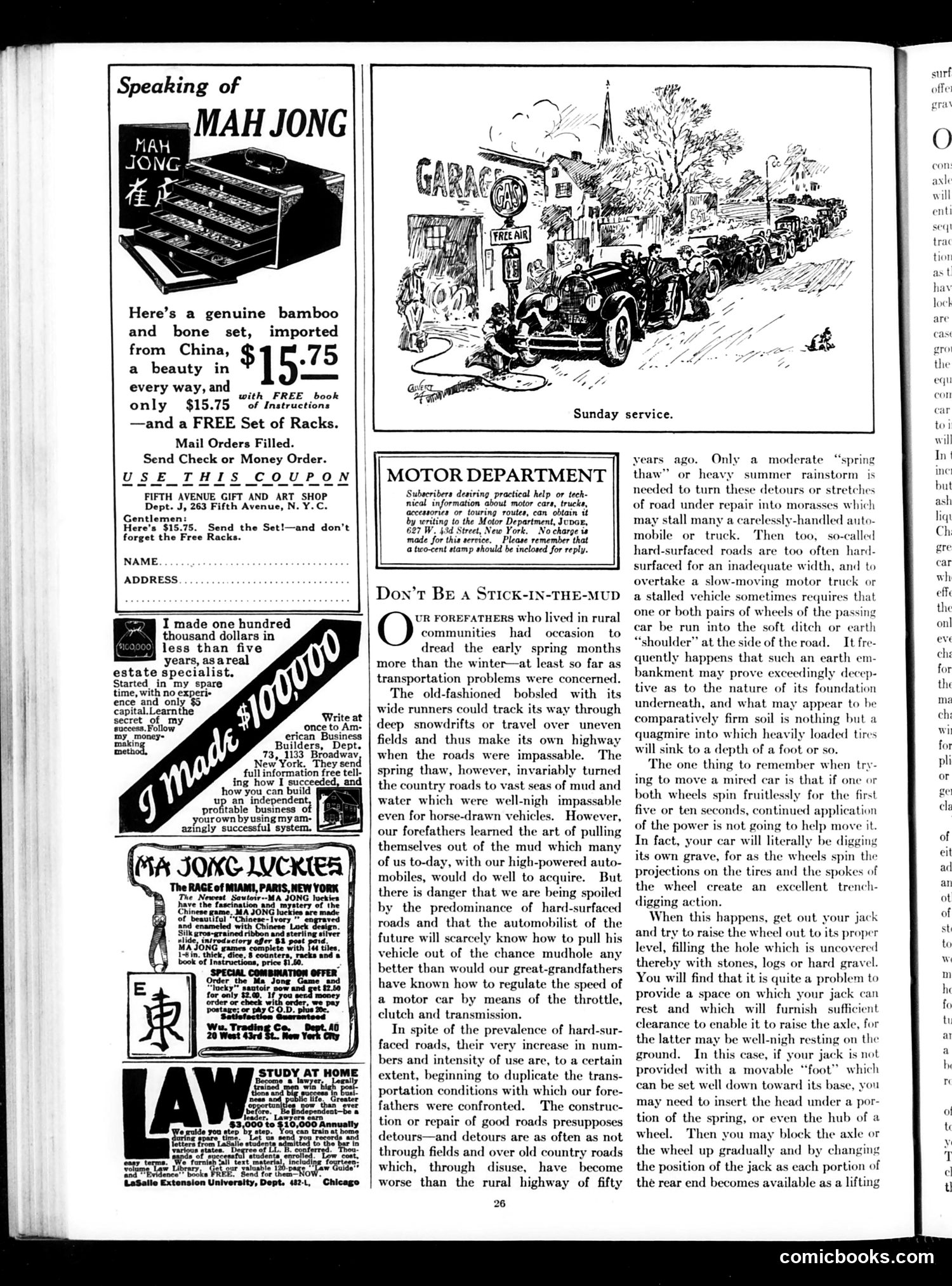
This page from Judge magazine (date unclear) primarily contains **advertisements and advice columns**, not political satire. The main content is "Don't Be a Stick-in-the-Mud," a Motor Department article warning automobile drivers that despite modern hard-surfaced roads, they're losing the practical skills their forefathers possessed for extracting vehicles from mud. The piece notes that road construction, repairs, and spring thaws still create impassable conditions requiring old-fashioned extraction techniques. The advertisements include: a Mahjong set imported from China ($15.75), real estate training courses, Ma Jong games, and a motor department advice column. The cartoon illustration shows a vintage automobile at a garage with the caption "Sunday service"—likely a humorous reference to weekend automobile breakdowns requiring repair work. The tone is practical and instructional rather than satirical, reflecting early-to-mid-20th-century American automobile culture and the transition from horse-drawn to motorized transportation.
📄 Transcribed text from this page (OCR, searchable)
Machine-transcribed from the original scan — historical spelling and the odd misread are preserved.
Speaking of Here’s a genuine bamboo and bone set, imported from China, a beauty in $15.75 every way, and with FREE book only $15.75 © of Instructions —and a FREE Set of Racks. Mail Orders Filled. Send Check or Money Order. USE THIS COUPON FIFTH AVENUE GIFT AND ART SHOP Dept. J, 263 Fifth Avenue, N. Y.C. Gentlemen: Here's $15.75. Send the Set!—and don’t forget the Free Racks. NAME ADDRESS. I made one hundred thousand dollars in less than five years, asareal estate specialist. Started in my spare time, with no experi- ence and only capital.Learnthe Write at secret of my success. Follow _ once to Am- ; my, money- erican Business i makin Builders, Dept. ih} = 73,1133 Broadway, New’ York. They send , full information free tell- ing how I succeeded, and how you can build ‘an independent profitable business of yourown byusingmyam- azingly successful system. ft ‘game, MA JONG luck of beeultet J Chlsese: Ivory, ‘And enameled with Chinese Silk uros-grained ribbon und sterling’ silver slide, dnizeductory afer 88 post MAJONG games complete with fe Hain thleb® lee, § cobnter money order or cheek with order, we pay OF | postage; wa SOD. plus 20e. Wu, Tradin: a Jo Weel tied St ew York CY ee bya eet eeehearaes ae = AS ipbtogeen Gone MOTOR DEPARTMENT Subscribers desiring practical help or teck- nical information about motor cara, trucks, accessories or touring routes, can obtain tt by writing to the Motor Department, Juda, 627 W. 43d Street, New York. No charge is made for this service. Please remember that a twco-cent stamp should be inelosed for reply. Don’t BE a STICK-IN-THE-MUD UR FOREFATHERS who lived in rural O communities had occasion to dread the early spring months more than the winter—at least so far as transportation problems were concerned. The old-fashioned bobsled with its wide runners could track its way through deep snowdrifts or travel over uneven fields and thus make its own highway when the roads were impassable. The spring thaw, however, invariably turned the country roads to vast seas of mud and water which were well-nigh impassable even for horse-drawn vehicles. However, our forefathers learned the art of pulling themselves out of the mud which many of us to-day, with our high-powered auto- mobiles, would do well to acquire. But there is danger that we are being spoiled by the predominance of hard-surfaced roads and that the automobilist of the future will scarcely know how to pull his vehicle out of the chance mudhole any better than would our great-grandfathers have known how to regulate the speed of a motor car by means of the throttle, clutch and transmission. In spite of the prevalence of hard-sur- faced roads, their very increase in num- bers and intensity of use are, to a certain extent, beginning to duplicate the trans- portation conditions with which our fore- fathers were confronted. The construc- tion or repair of good roads presupposes detours—and detours are as often as not through fields and over old country roads which, through disuse, have become worse than the rural highway of fifty 26 Sunday service. years ago. Only a moderate “spring thaw” or heavy summer rainstorm. is needed to turn these detours or stretches of road under repair into morasses which may stall many a carelessly-handled auto- mobile or truck. Then too, so-called hard-surfaced roads are too often hard- surfaced for an inadequate width, and to overtake a slow-moving motor truck or a stalled vehicle sometimes requires that one or both pairs of wheels of the passing car be run into the soft ditch or earth “shoulder” at the side of the road. It fre- quently happens that such an earth em- bankment may prove exceedingly decep- tive as to the nature of its foundation underneath, and what may appear to be comparatively firm soil is nothing but a quagmire into which heavily loaded tires will sink to a depth of a foot or so. The one thing to remember when try- ing to move a mired car is that if one or both wheels spin fruitlessly for the first five or ten seconds, continued application of the power is not going to help move it. In fa your car will literally be digging its own grave, for as the wheels spin the projections on the tires and the spokes of the wheel create an excellent’ trench- digging action. When this happens, get out your jack and try to raise the wheel out to its proper level, filling the hole which is uncovered thereby with stones, logs or hard gravel. You will find that it is quite a problem to provide a space on which your jack can rest and which will furnish sufficient clearance to enable it to raise the axle, for the latter may be well-nigh resting on the ground. In this case, if your jack is not provided with a movable “foot” which can be set well down toward its base, you may need to insert the head under a por- tion of the spring, or even the hub of a wheel. Then you may block the axle or the wheel up gradually and by changing the position of the jack as each portion of the rear end becomes available as a lifting comicbooks.com surf offe O con axle will enti seq trac tion ast hav loch are cas gro the equ con car tor will In inc but ash liq Ch gre car wh effe the onl eve ch for the ma chi wil for pl or ge cl of ci ad an ot of st to w m he fo t an