
Judge, 1924-04-05 · page 8 of 36
Judge — April 5, 1924 — page 8: what you’re looking at
What you’re looking at
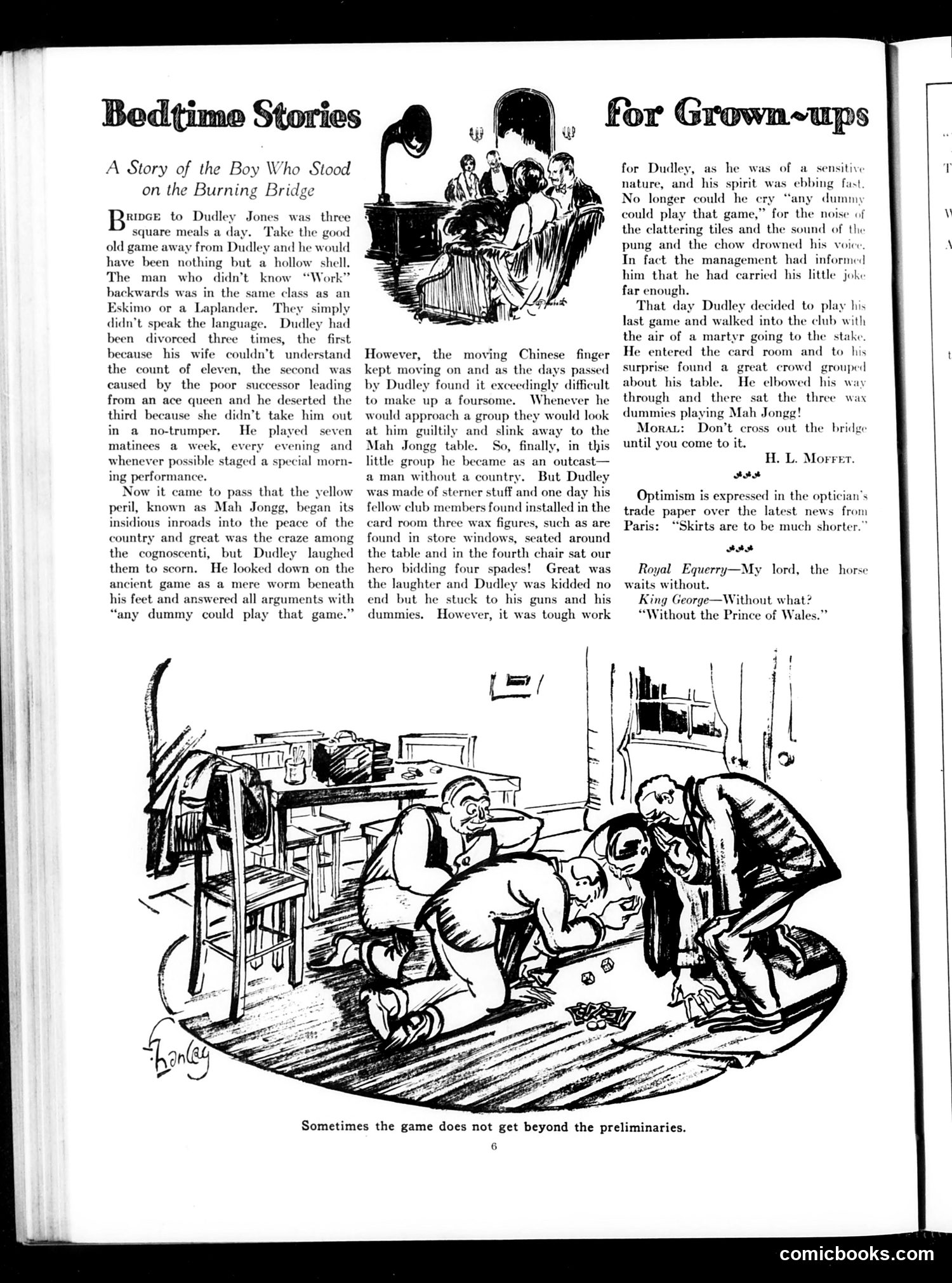
This page satirizes the 1920s craze for Mah Jong, a Chinese card game that swept American society. The main story mocks "Dudley Jones," a bridge fanatic who dismissively claims "any dummy could play that game" about Mah Jong. As the game's popularity isolates him socially—club members abandoning bridge for Mah Jong—Dudley stubbornly installs three department-store mannequins at a bridge table to play with him. The joke's irony: his joke backfires when club members actually gather to watch, treating his "dummies" as a curiosity. The caption's moral warns against dismissing trends before understanding them. Sidebar jokes reference 1920s topics: shorter skirts (fashion trend), and King George without the Prince of Wales (likely referencing Edward, Prince of Wales's notoriety). The satire mildly ridicules resistance to cultural change and social snobbery about new fashions.
📄 Transcribed text from this page (OCR, searchable)
Machine-transcribed from the original scan — historical spelling and the odd misread are preserved.
Bedtime Stories A Story of the Boy Who Stood on the Burning Bridge Brece to Dudley Jones square meals a day. Take the good old game away from Dudley and he would have been nothing but a hollow shell. The man who didn’t know ‘Work” backwards was in the same cl. Eskimo or a Laplander. The} didn’t speak the language. Dudley had been divorced three times, the first because his wife couldn't understand the count of eleven, the second was caused by the poor successor leading from an ace queen and he deserted the third because she didn’t take him out in a no-trumper. He ple matinees a week, every was three s as an > simply ed seven evening and whenever possible staged a special morn- ing performance. Now it came to pass that the yellow peril, known as Mah Jongg, began its insidious inroads into the peace of the country and great was the craze among the cognoscenti, but Dudley laughed them to scorn. He looked down on the ancient game as a mere worm beneath his feet and answered all arguments with “any dummy could play that game.” Wate] However, the moving Chinese finger kept moving on and as the days passed by Dudley found it exceedingly difficult to make up a foursome. Whenever he would approach a group they would look at him guiltily and slink y to the Mah Jongg table. So, finally, in this little group he became as an outcast— a man without a country. But Dudley was made of sterner stuff and one day his fellow club members found installed in the card room three wax figures, such as are found in store windows, seated around the table and in the fourth chair sat our hero bidding four spades! Great was the laughter and Dudley was kidded no end but he stuck to his guns and his dummies. However, it was tough work Sometimes the game does not get beyond the preliminaries. for Grown-ups for Dudley, as he was of a_ sensitive nature, and his spirit was ebbing fast No longer could he ery “any dummy could play that game,” for the noise of the clattering tiles and the sound of th: pung and the chow drowned his voice In fact the management had informed him that he had carried his little jokc far enough. That day Dudley decided to play his last game and walked into the club with the air of a martyr going to the stake. He entered the card room and to his surprise found a great crowd grouped about his table. He elbowed his way through and there sat the three wax dummies playing Mah Jongg! Morat: Don’t cross out the bridg: until you come to it. H. L. Morrer. PR ad Optimism is expressed in the optician’s trade paper over the latest news from Paris: “Skirts are to be much shorter.” ao Royal Equerry—My lord, the horse waits without. King George—Without wha! “Without the Prince of Wales.” comicbooks.com