
A complete issue · 36 pages · 1924
Judge — March 1, 1924
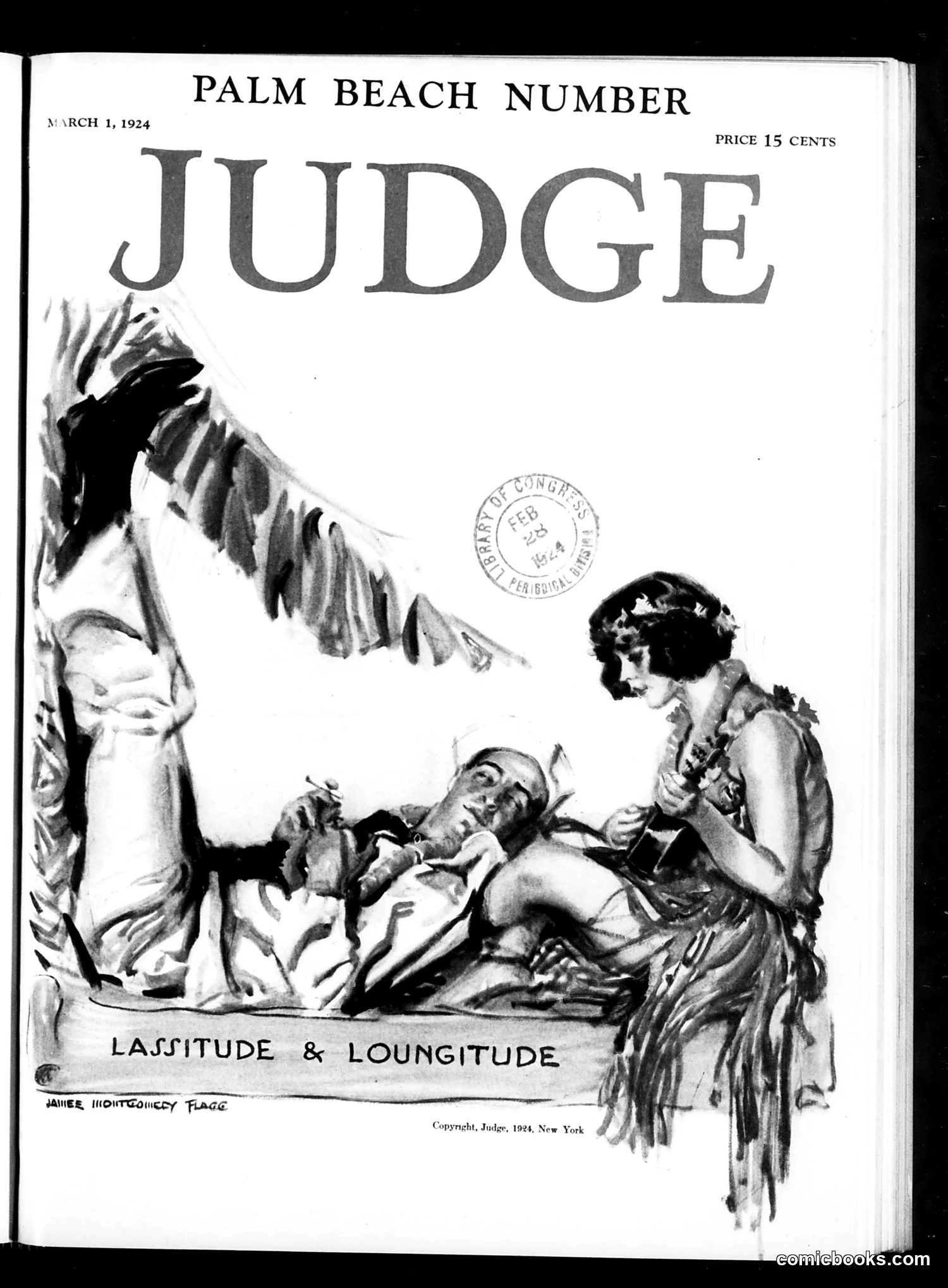
This satirical cover depicts a man reclining beneath a palm tree while two women attend to him, titled "Lassitude & Loungitude." The cartoon appears to satirize leisurely Palm Beach vacation culture—a destination associated with wealthy Americans during the 1920s. The humor relies on the invented word "loungitude" (combining "lounge" with "longitude," a geographical term), suggesting that idleness and relaxation have become defining characteristics of Palm Beach visitors. The man's languid posture and the women's attentive service mock the indulgent lifestyle of wealthy vacationers during the prosperous 1920s. The illustration is credited to James Montgomery Flagg, a prominent American illustrator. The satire targets upper-class leisure culture and vacation excess.
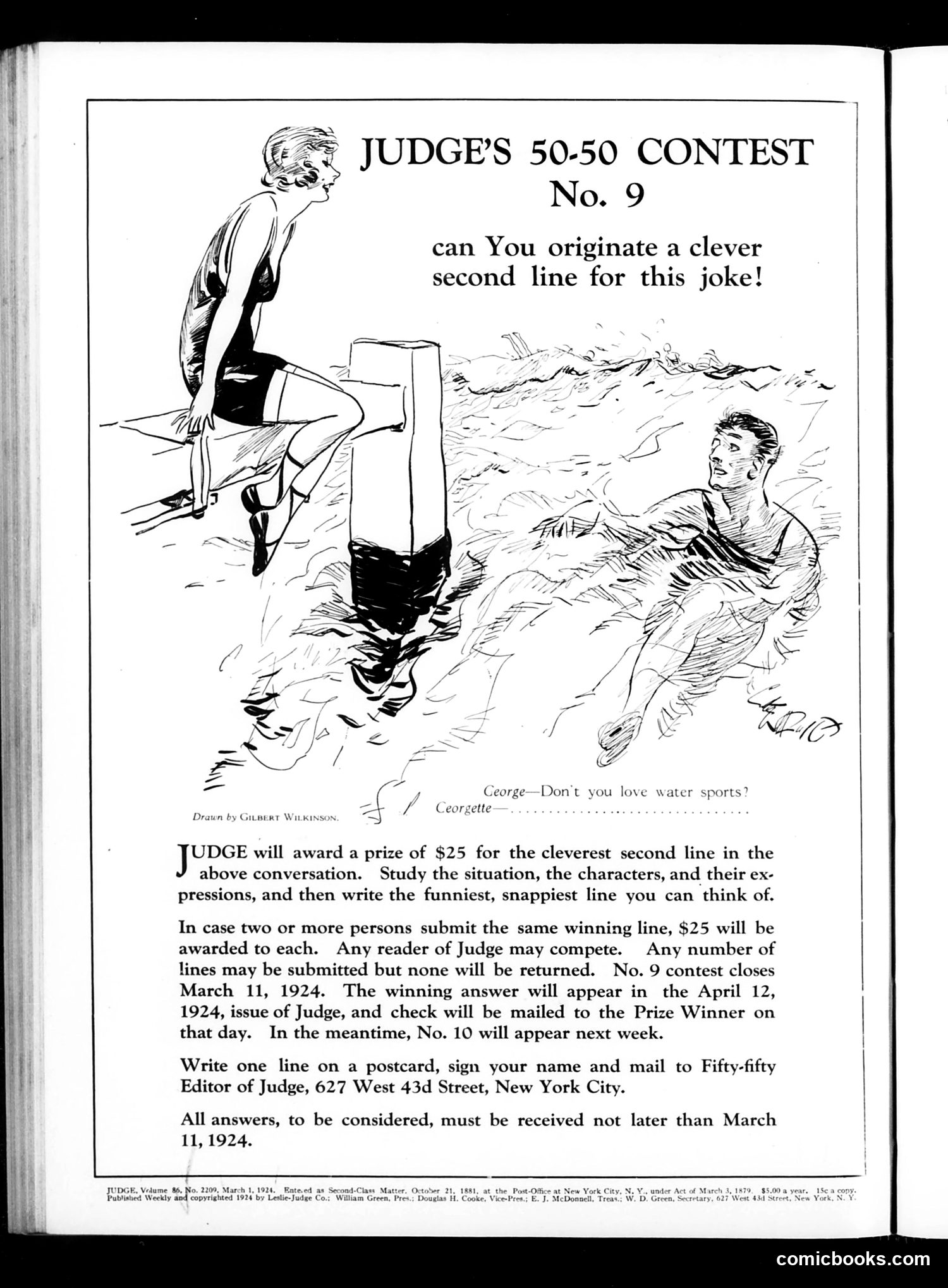
This is a humor competition page, not political satire. The cartoon shows a couple at the beach: a woman sitting on a man (who appears stuck headfirst in the sand) with a beach umbrella. The man says, "Don't you love water sports?" Readers were invited to submit a clever second line to complete the joke, competing for a $25 prize. The humor relies on a visual pun—the woman's weight pressing the man into the sand while referencing "water sports," creating an absurd and mildly suggestive domestic comedy typical of 1924 Judge magazine. The contest closed March 11, 1924, with results to appear April 12.
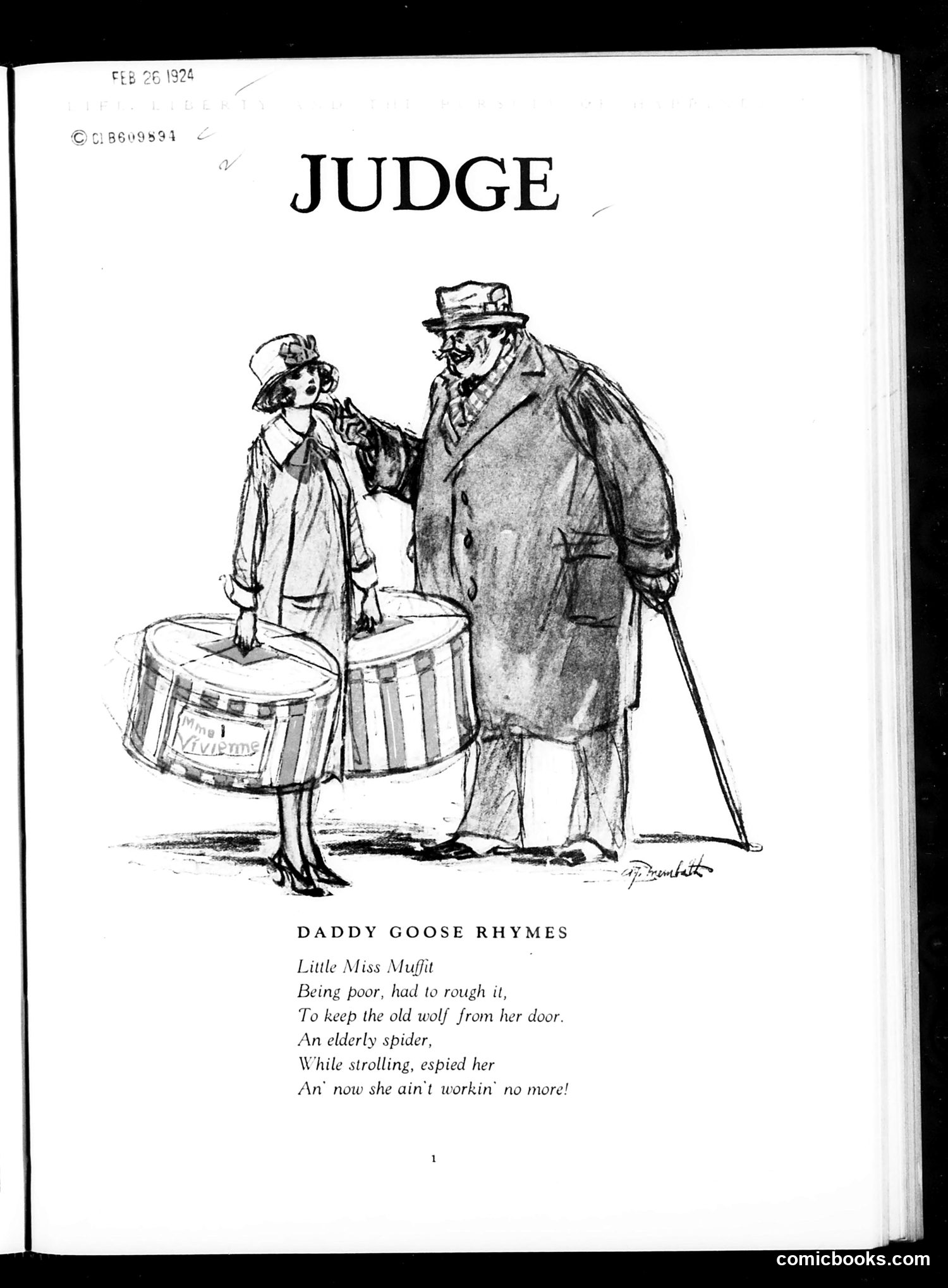
This page from Judge magazine presents "Little Miss Muffet," a Daddy Goose Rhymes parody. The illustration shows an elderly man with a cane confronting a young woman standing on a barrel or tub. The satirical twist subverts the traditional nursery rhyme. Rather than a spider frightening Miss Muffet away, the cartoon reimagines her as a poor woman forced into rough labor to survive and keep "the old wolf from her door" (a period idiom meaning starvation). An "elderly spider" (likely representing a predatory older man or figure of authority) encounters her while she works. The dark humor suggests social commentary on poverty, labor conditions, and the vulnerability of working women in the 1920s. The rhyme's cynical conclusion—"An' now she ain't workin' no more!"—implies ominous consequences, likely commenting on economic precarity and exploitation.
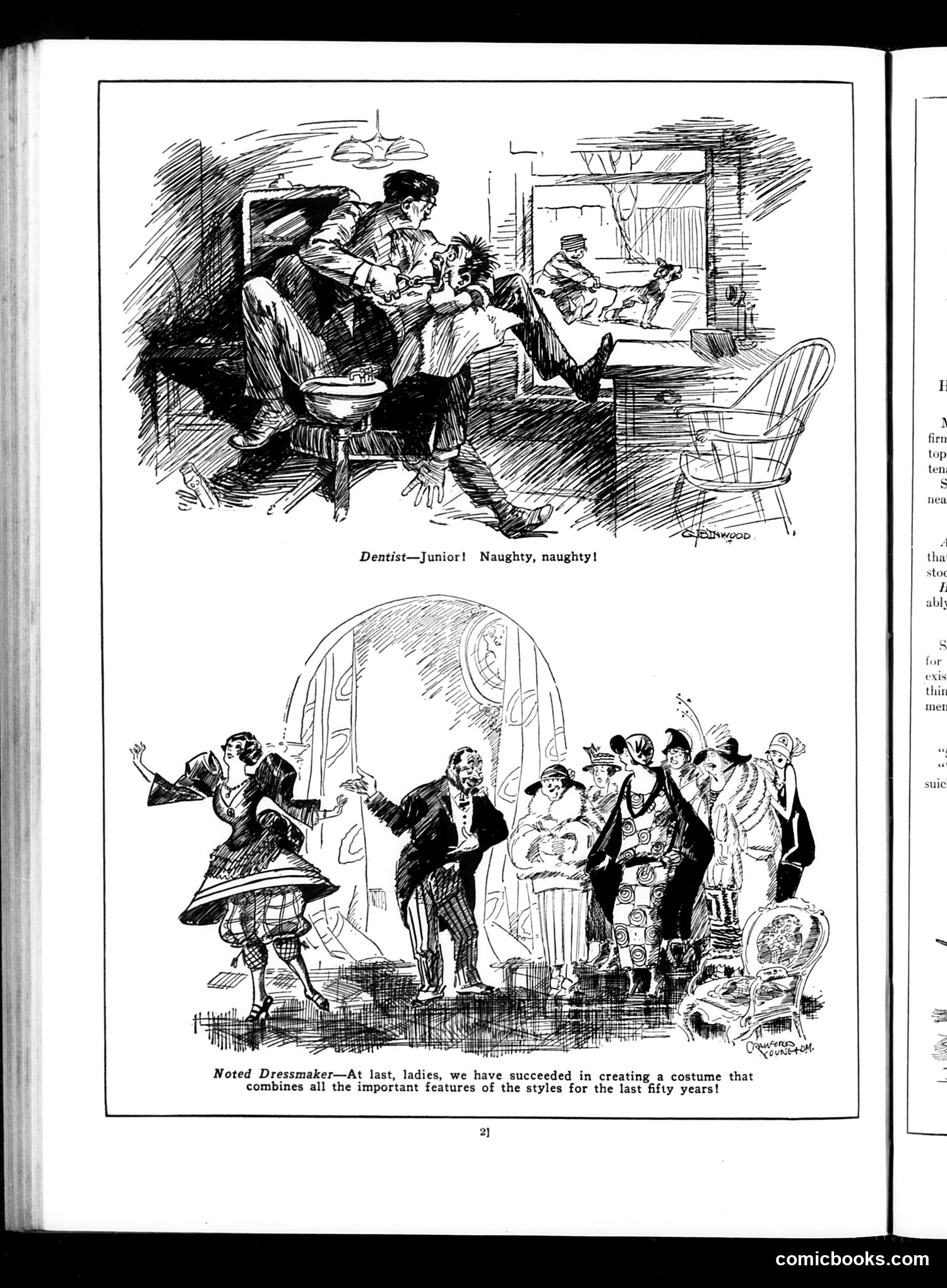
This page contains two satirical cartoons from *Judge* magazine: 1. **"Dentist—Junior! Naughty, naughty!"** shows a dental office where a young assistant is misbehaving while the dentist works on a patient. The joke satirizes workplace discipline and youthful misbehavior. 2. **"Noted Dressmaker"** depicts a fashion designer presenting an elaborate costume to society ladies, claiming it "combines all the important features of the styles for the last fifty years!" This mocks the fashion industry's cyclical trends and designers' pretentious claims—suggesting that "new" fashions are merely rehashed combinations of past styles. The exaggerated costume visually reinforces the absurdity of blending decades of disparate fashion elements into one garment. Both cartoons use humor to critique contemporary professional and consumer culture.
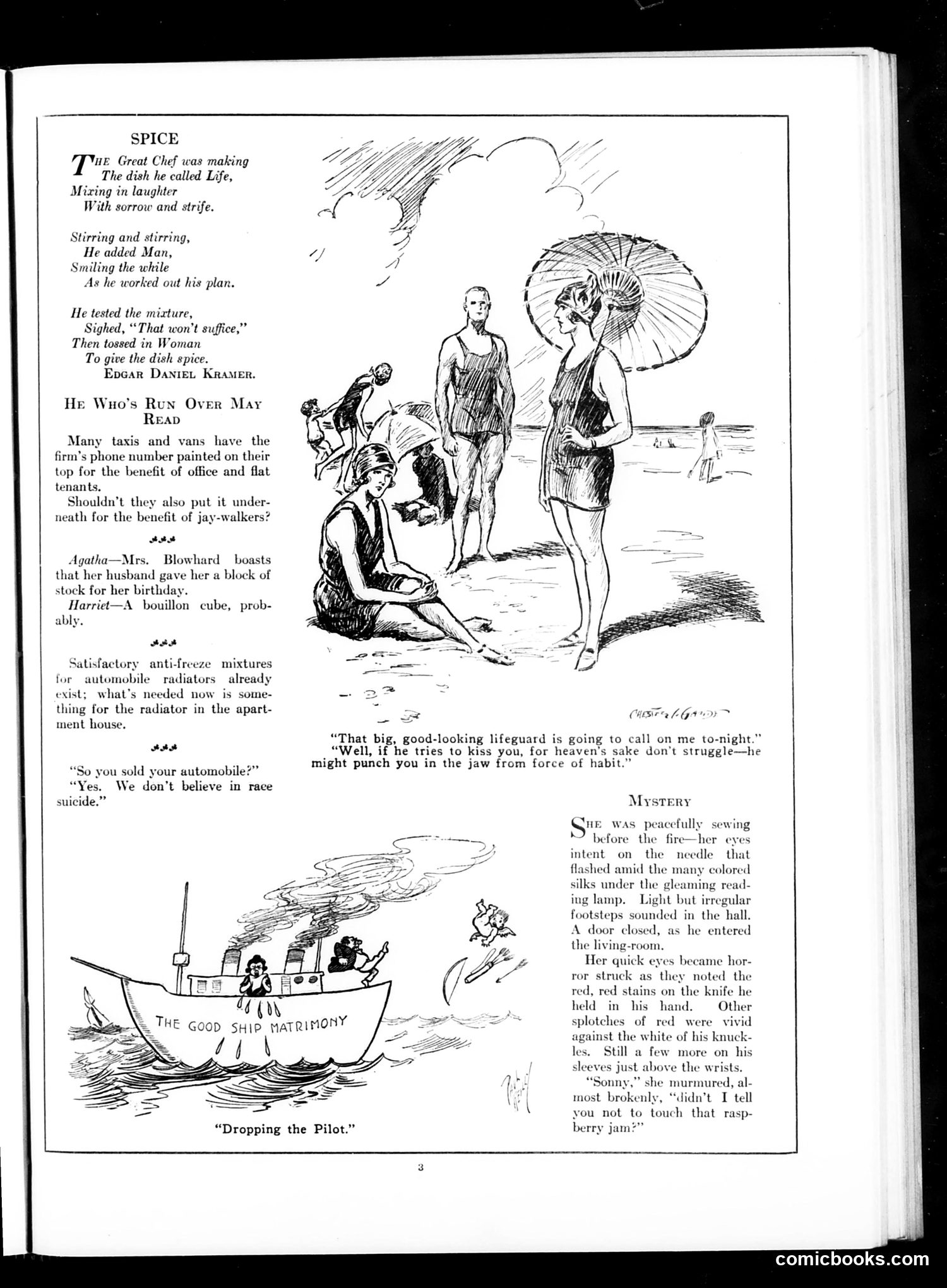
This page contains three distinct satirical pieces: 1. **"Spice"** - A poem by Edgar Daniel Kramer about a chef creating "Life" by adding "Man" and "Woman" to a mixture, then testing it on Woman—a commentary on gender relations and domestic life. 2. **"He Who's Run Over May Read"** - Social commentary suggesting taxi companies should paint phone numbers under cabs for pedestrians' benefit, alongside brief humorous anecdotes about automobiles and dating. 3. **"Mystery"** - A narrative sketch depicting a woman discovering bloodstains on a man's hands and clothing, creating dramatic suspense. The illustration "Dropping the Pilot" shows a ship labeled "The Good Ship Matrimony." The overall theme appears to satirize modern urban life, automobiles, and particularly marital/romantic relationships with dark humor typical of early 20th-century Judge magazine.
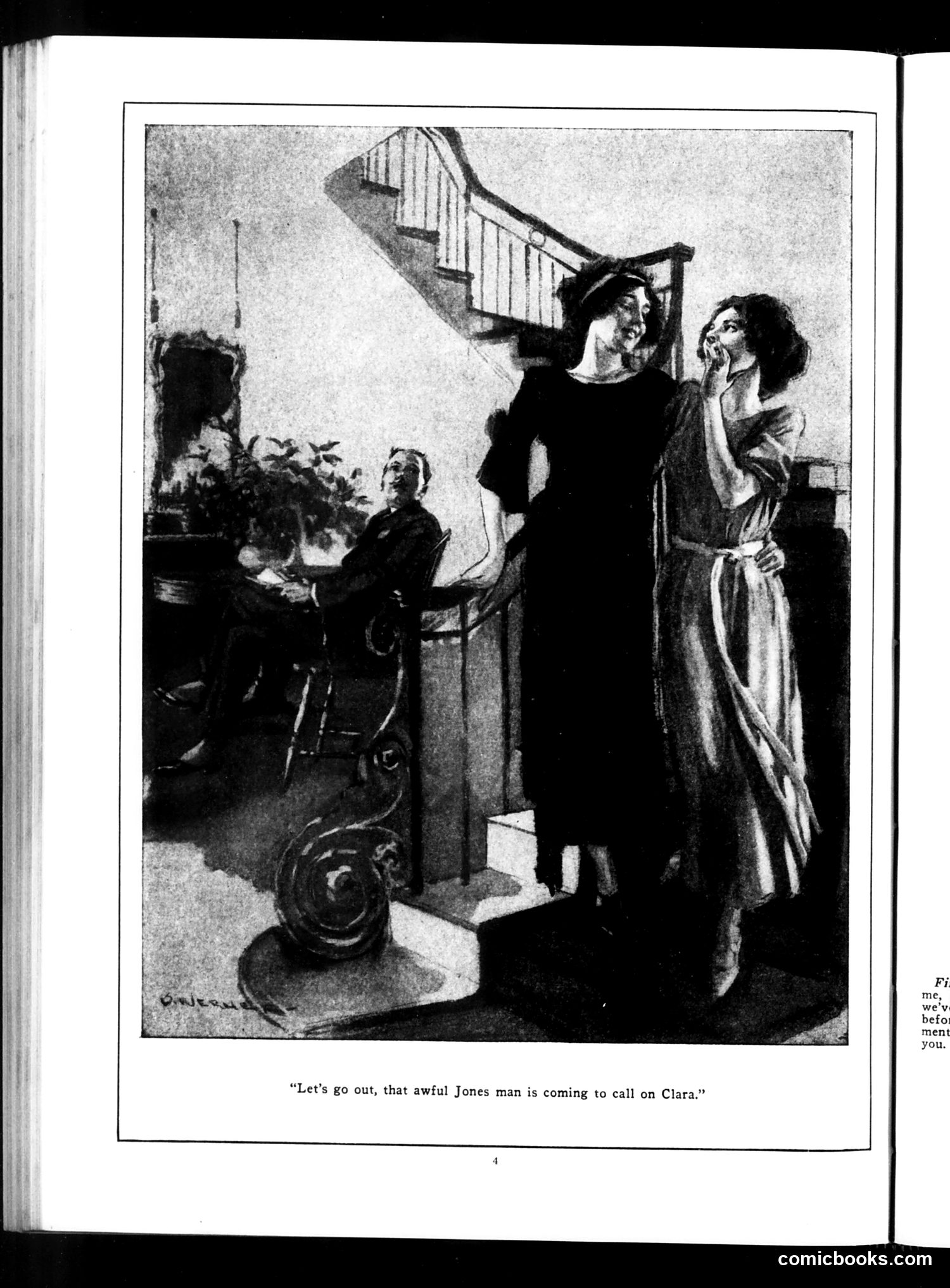
This appears to be a scene from an early 20th-century domestic comedy or social satire. The caption reads: "Let's go out, that awful Jones man is coming to call on Clara." The image shows what appears to be a household interior with several figures. Two women on the right (one in dark clothing, one in lighter dress) seem to be fleeing upstairs, while a seated figure on the left observes. The "Jones man" reference suggests social anxiety about an unwanted suitor or visitor of lower social standing—a common satirical theme in Judge magazine. The humor likely derives from the snobbish avoidance of this supposedly "awful" caller, reflecting early 20th-century class consciousness and domestic social hierarchies. Without additional context, the specific identity of "Jones" remains unclear, though the joke centers on social pretension and romantic/marital anxieties.
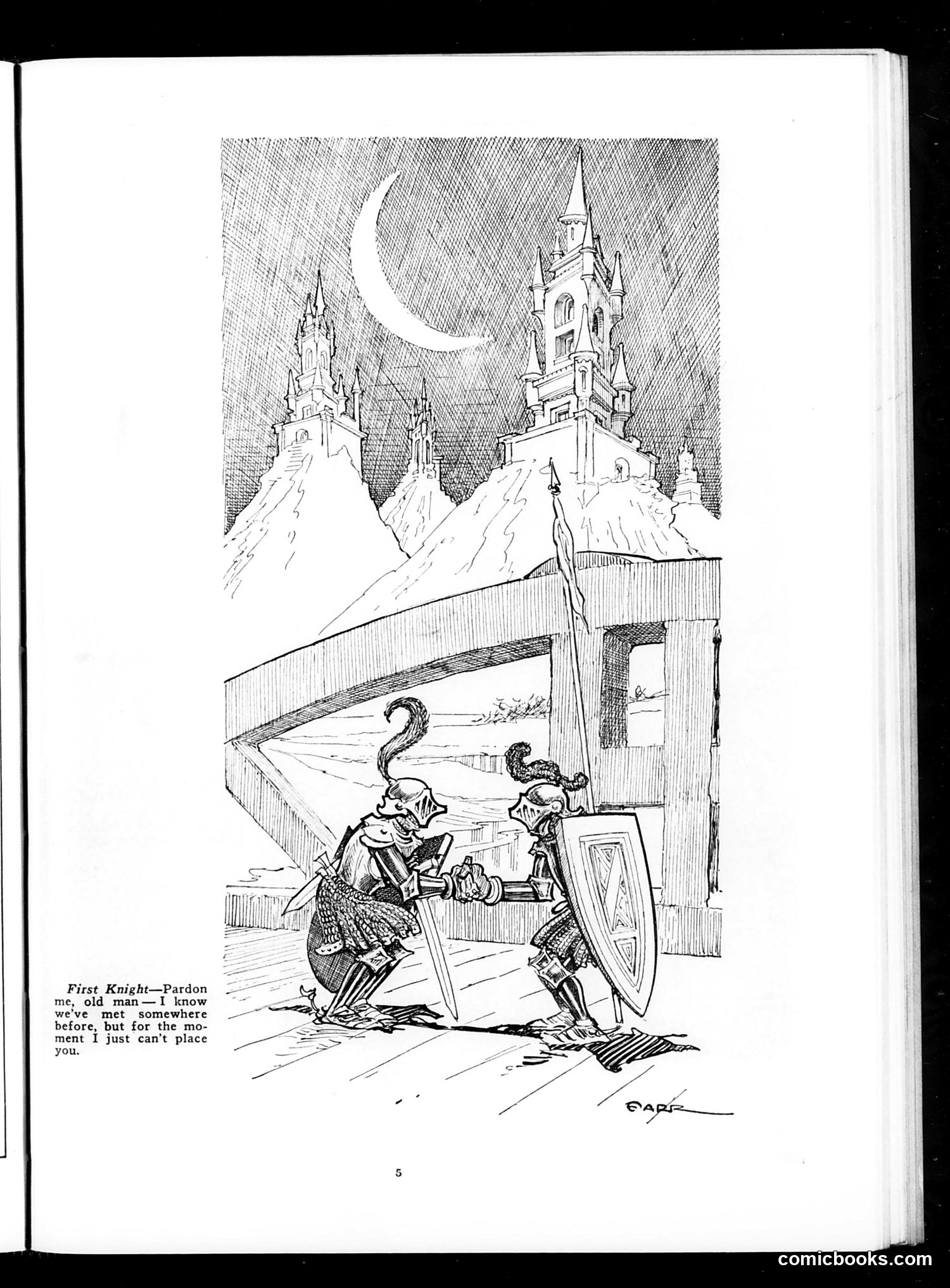
This cartoon depicts two medieval knights meeting outside a castle, with one unable to recognize the other despite believing they've met before. The artwork is signed and styled as a humorous illustration rather than political satire. The joke appears to be a visual pun: the recognizable knight wears armor with distinctive heraldic shields, while the "First Knight" genuinely cannot place him. Without additional context about Judge magazine's publication date or contemporary references, the specific identities remain unclear. This could reference: - A well-known historical or legendary figure - A contemporary public figure of the era depicted as a knight - Simply a generic "can't remember where I know you from" humor The fantasy medieval setting suggests either literary reference or timeless social comedy rather than immediate political commentary.
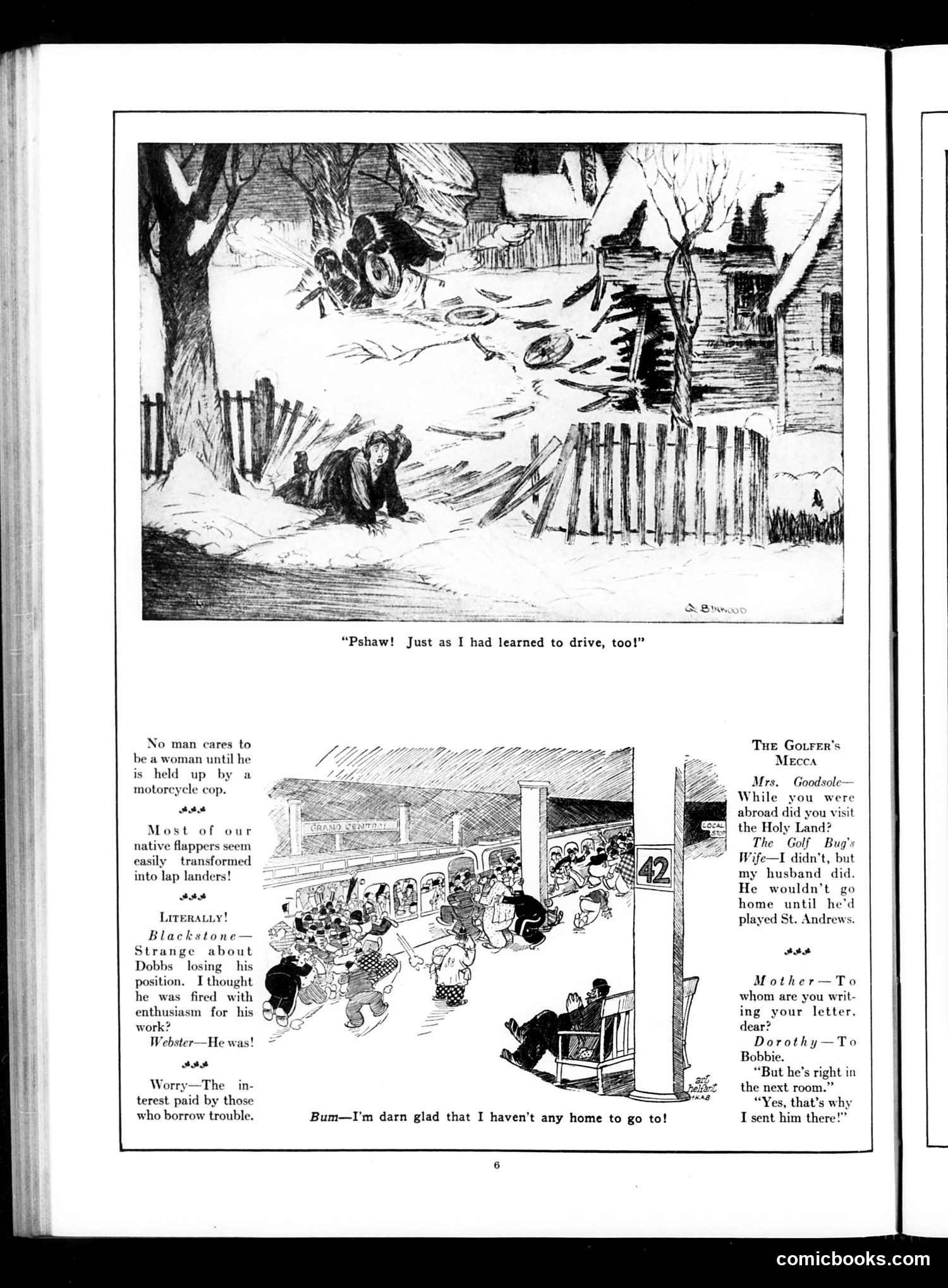
This page contains multiple brief satirical jokes reflecting 1920s social attitudes: **Top cartoon**: A woman complains about learning to drive before a motorcycle cop stopped her—satirizing both women's newfound independence (driving) and police authority. **Left column jokes**: - Mock "flappers" (modern young women of the 1920s) as easily transformed into "lap landers" (unclear reference, possibly derogatory) - A pun about "Blackstone" and "Dobbs" losing his job despite enthusiasm - Define "Worry" as unpaid interest on borrowed trouble **Center cartoon**: Shows a crowded train or bus with caption "I'm darn glad I haven't any home to go to!"—satirizing homelessness or preference for public spaces. **Right column**: Golf and domestic jokes—a wife notes her husband wouldn't return home until completing golf at St. Andrews (Scotland); a daughter writes letters to a boy in the next room rather than visit. The page's humor targets emerging social changes (women drivers, youth independence) and timeless domestic absurdities, typical of Judge's satirical style.
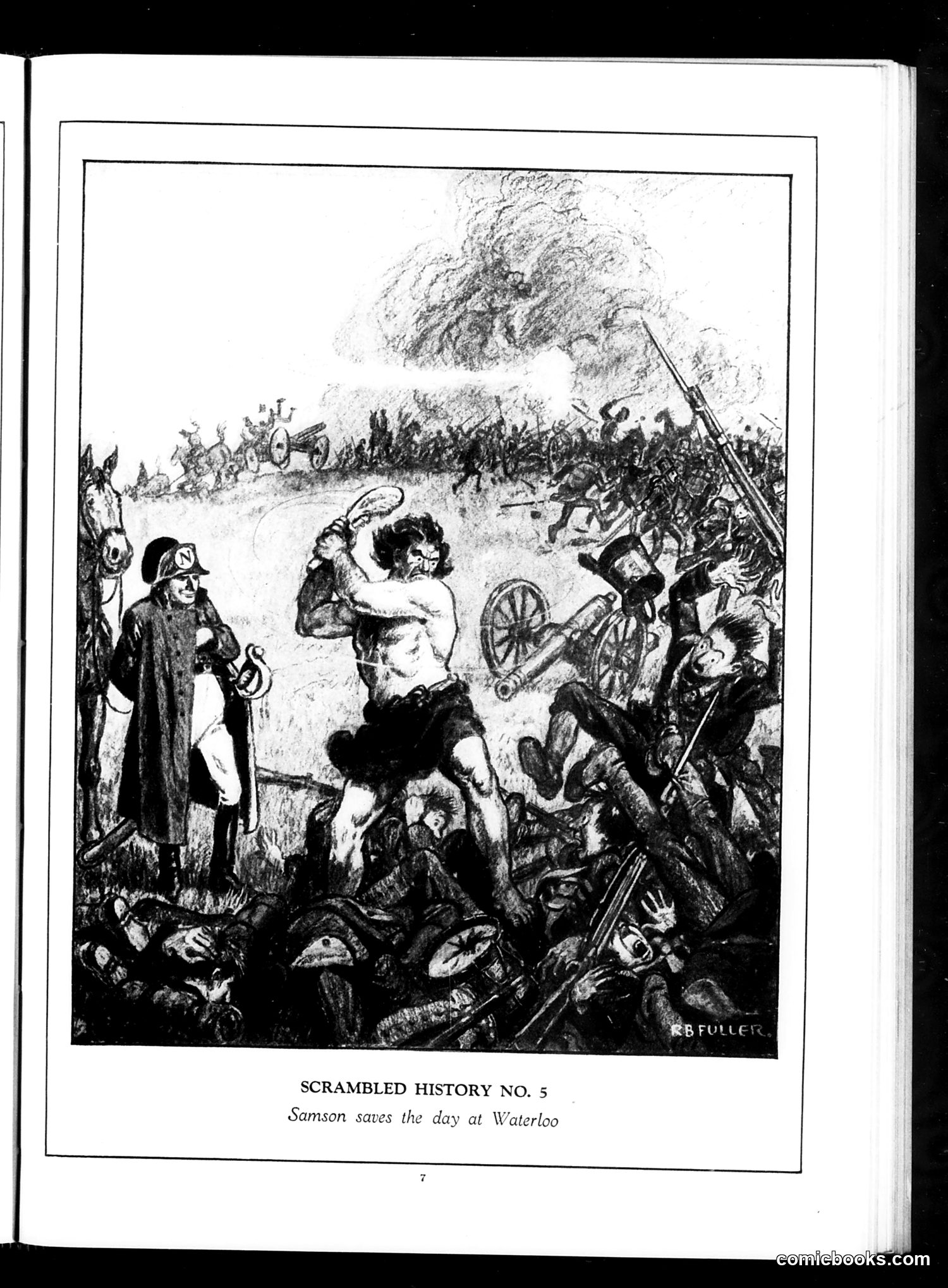
This is a humorous "Scrambled History" cartoon that deliberately conflates two historical events: the Biblical story of Samson with the 1815 Battle of Waterloo (Napoleon's decisive defeat). The illustration shows a muscular, bare-chested figure (Samson) wielding a jawbone or club in the center of a chaotic battlefield scene, surrounded by soldiers, cannons, horses, and military equipment. The satire works by absurdly inserting the ancient strongman into a famous Napoleonic battle, treating these completely unrelated historical moments as if they were one continuous narrative. The joke relies on readers recognizing both references and finding humor in the ridiculous anachronism—essentially a visual pun on "history" itself, treating it as malleable or nonsensical. This appears to be part of a series ("No. 5") mocking historical knowledge or education.
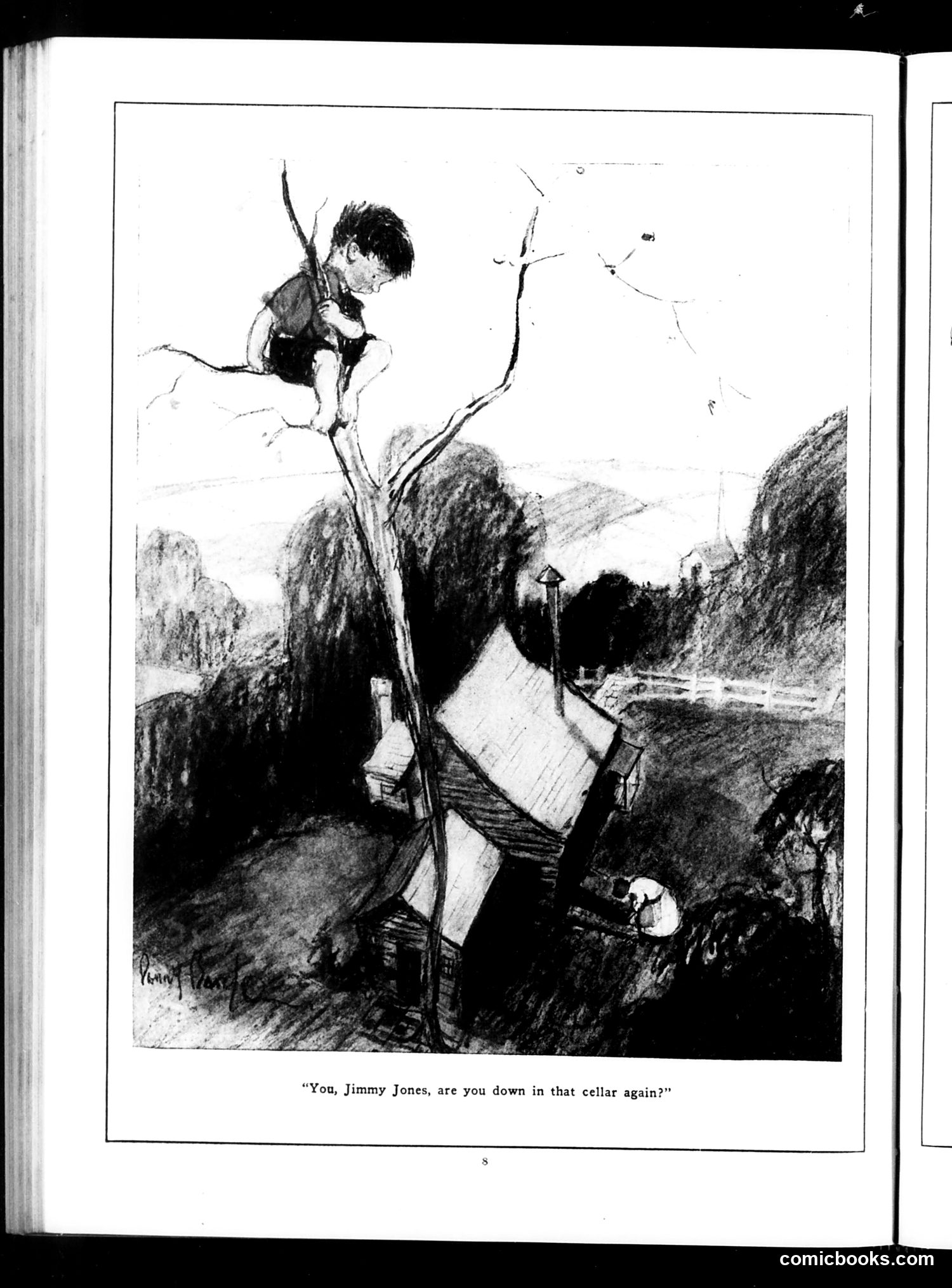
This cartoon depicts a domestic scene with humorous intent. A woman stands above, addressing a man named Jimmy Jones who appears to be in a cellar or basement below. The man is positioned on what looks like a barrel or container, suggesting he's hiding or retreating to the cellar—likely to escape his wife's supervision or complaints. The joke plays on a common domestic trope of the era: a husband seeking refuge in the basement or workshop to escape nagging or household demands. The woman's exasperated question suggests this is a recurring behavior. The satire mocks both marital dynamics and male escapism, presenting the cellar as a man's refuge from domestic oversight and female authority. This reflects early 20th-century attitudes about marriage and gender roles in American households.
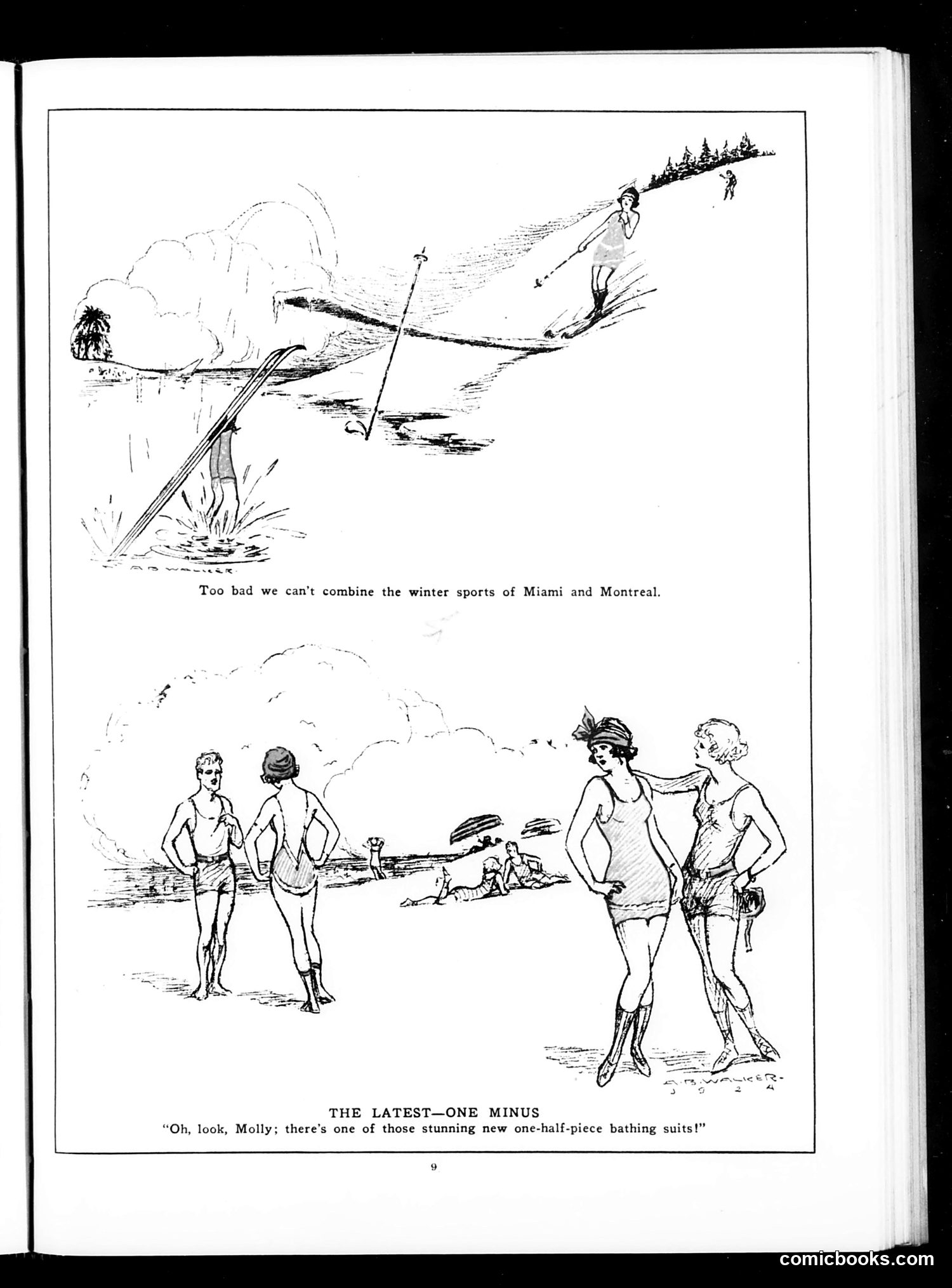
This page contains two related cartoons satirizing fashion and geography. The top cartoon depicts winter sports: a skier on a snowy Montreal slope and swimmers in Miami's warm waters. The caption expresses ironic regret that these climates can't be combined. The bottom cartoon, titled "The Latest—One Minus," shows beachgoers in Miami-style swimwear. One figure remarks on a "one-half-piece bathing suit"—a satirical jab at increasingly minimal women's beachwear fashions of the era. The humor derives from the observation that a woman appears to be wearing even less than the already-scanty one-piece bathing suits that were fashionable at the time. This reflects early 20th-century anxieties about changing women's fashion and beach culture, mocking both the trend toward more revealing swimwear and society's fascination with it.
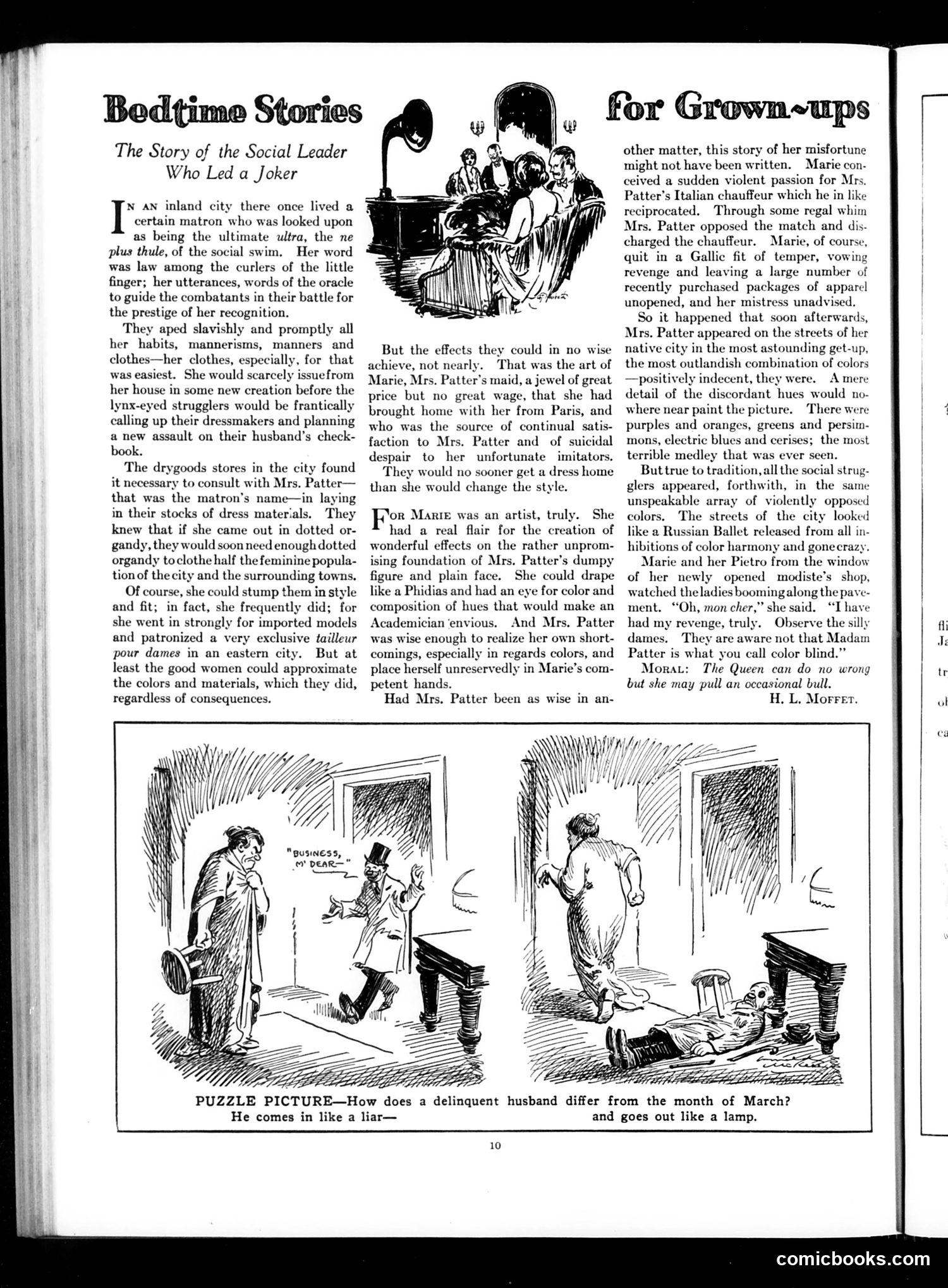
This satirical story mocks high-society fashion conformity and the power of social elites to dictate taste. Mrs. Patter is a wealthy matron whose fashion choices are slavishly copied by aspiring social climbers desperate for prestige. The twist: her French maid Marie, spurned when Mrs. Patter forbids her romance with the Italian chauffeur, takes revenge by dressing her mistress in a deliberately hideous, clashing color combination. The joke is that all the fashion-obsessed imitators immediately copy this disaster, making the entire city look ridiculous. The accompanying puzzle picture plays on the phrase "comes in like a lion, goes out like a lamb" (about March), substituting "liar" and "lamp"—depicting a deceiving husband's double life. The satire targets both wealthy women's vanity and the absurdity of blind fashion conformity.
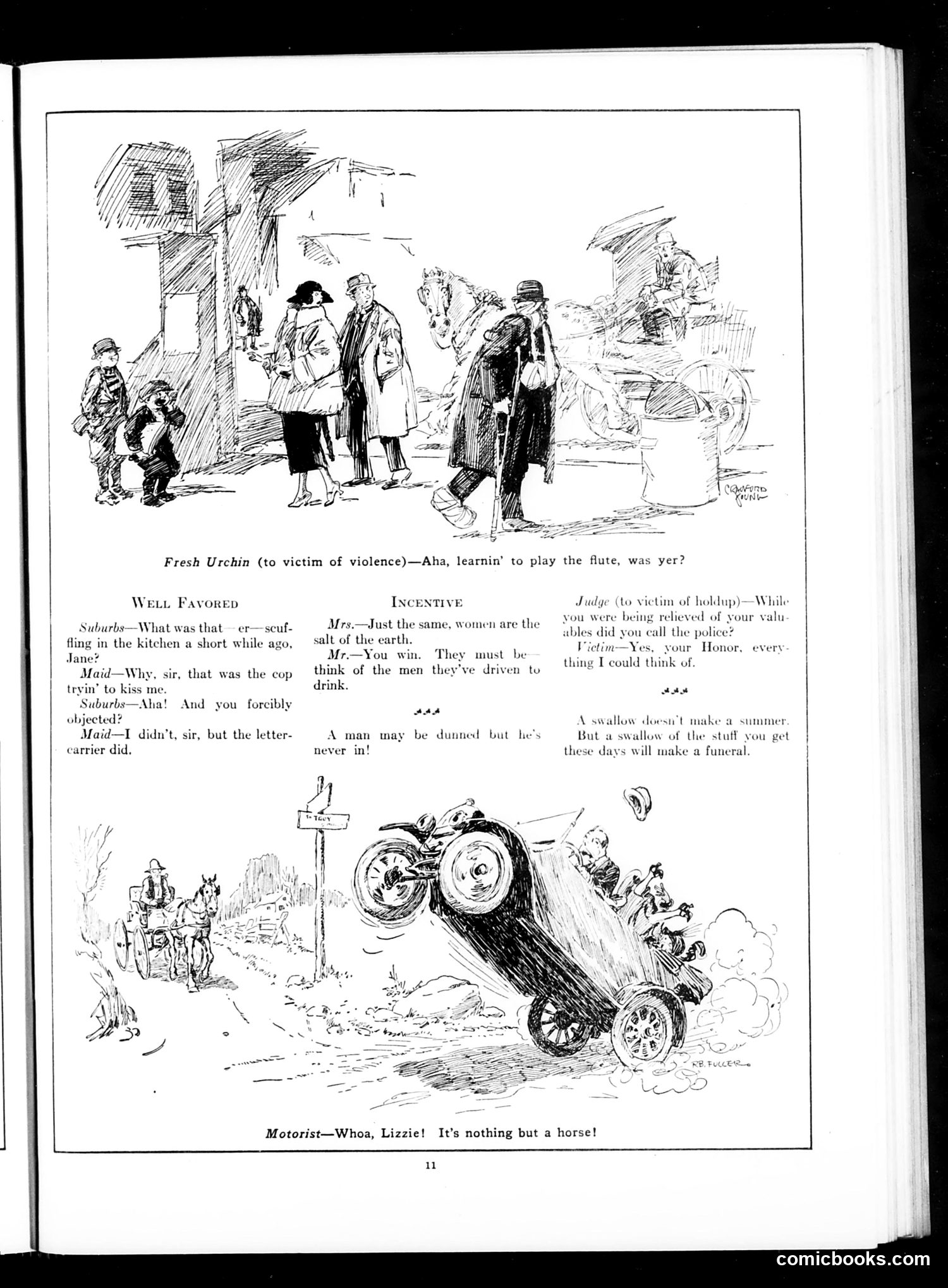
This page contains three satirical vignettes critiquing early 20th-century urban life: **"Well Favored"** mocks a suburban husband's outrage that a police officer kissed his maid, then learns the maid called police on the officer—inverting expected class dynamics humorously. **"Incentive"** suggests women drive men to drink through nagging, a common period stereotype about marital discord and alcohol consumption. **"Motorist"** shows a car flipped upside-down; the motorist assures his female passenger (presumably "Lizzie") it's merely a horse—dark humor about early automobiles' unreliability and danger, treating a serious crash casually. The page satirizes contemporary anxieties: police misconduct, domestic tension, women's influence on male behavior, and the chaotic novelty of motorized vehicles. The humor relies on exaggeration and class/gender stereotypes typical of Judge's satirical approach to American social issues of that era.
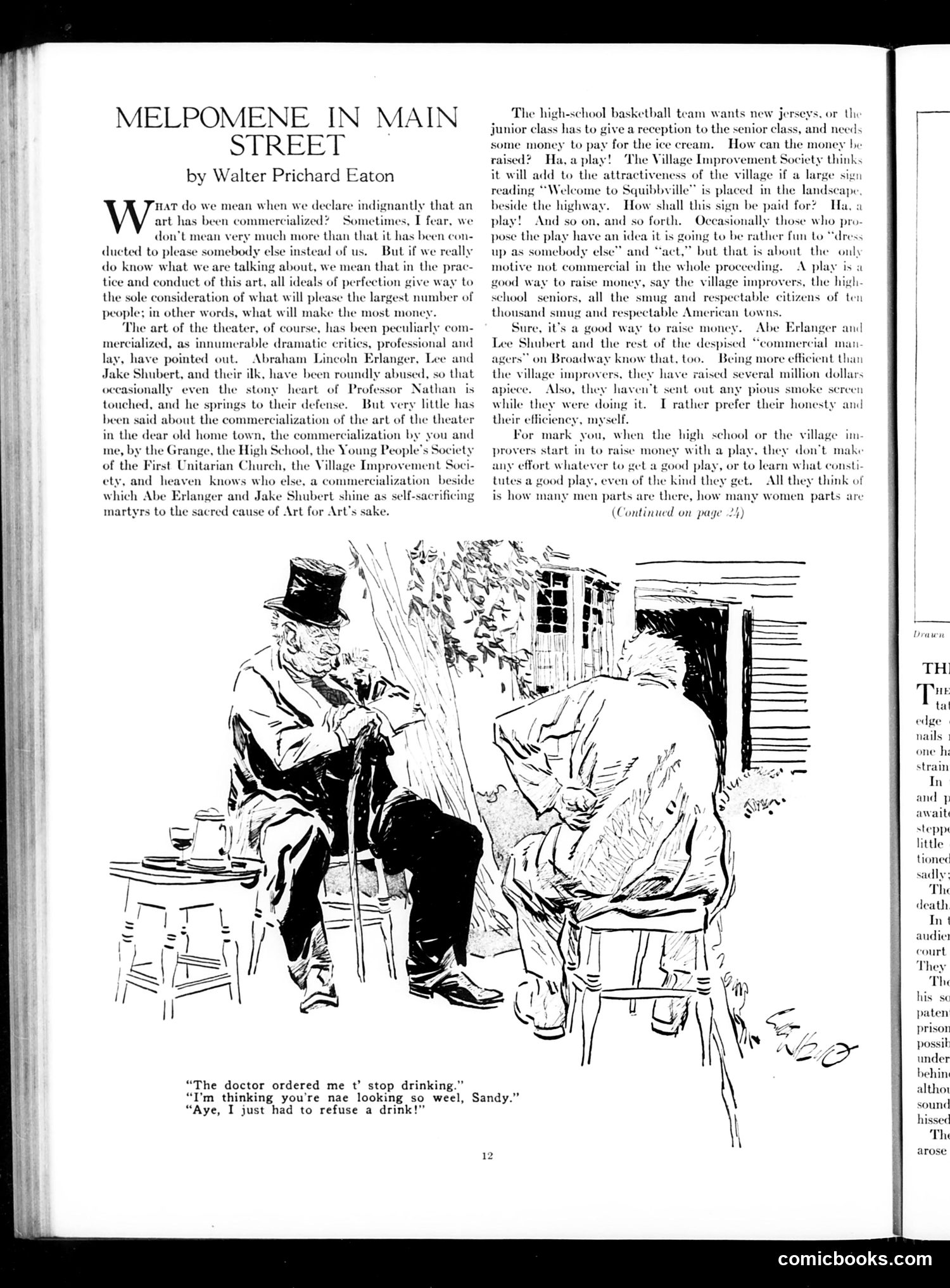
**The Essay & Cartoon:** Walter Prichard Eaton's article critiques the "commercialization" of theater in small-town America. He argues that while Broadway moguls like Erlanger and the Shubert brothers are openly profit-driven, small towns hypocritically use theatrical productions to fundraise—claiming to promote "art" while actually just seeking money for basketball jerseys, ice cream socials, and highway signs. **The Cartoon:** The sketch shows two men in conversation (one wearing a top hat) with caption dialogue: "The doctor ordered me to stop drinking" / "I'm thinking you're nae looking so weel, Sandy" / "Aye, I just had to refuse a drink!" This appears unrelated to the main article—a separate joke about health and abstinence, using Scottish dialect ("nae," "weel"). **Key Point:** Eaton's satire targets hypocrisy: rural communities claim cultural superiority over crass Broadway while themselves exploiting theater purely for profit, without caring about artistic quality or merit.
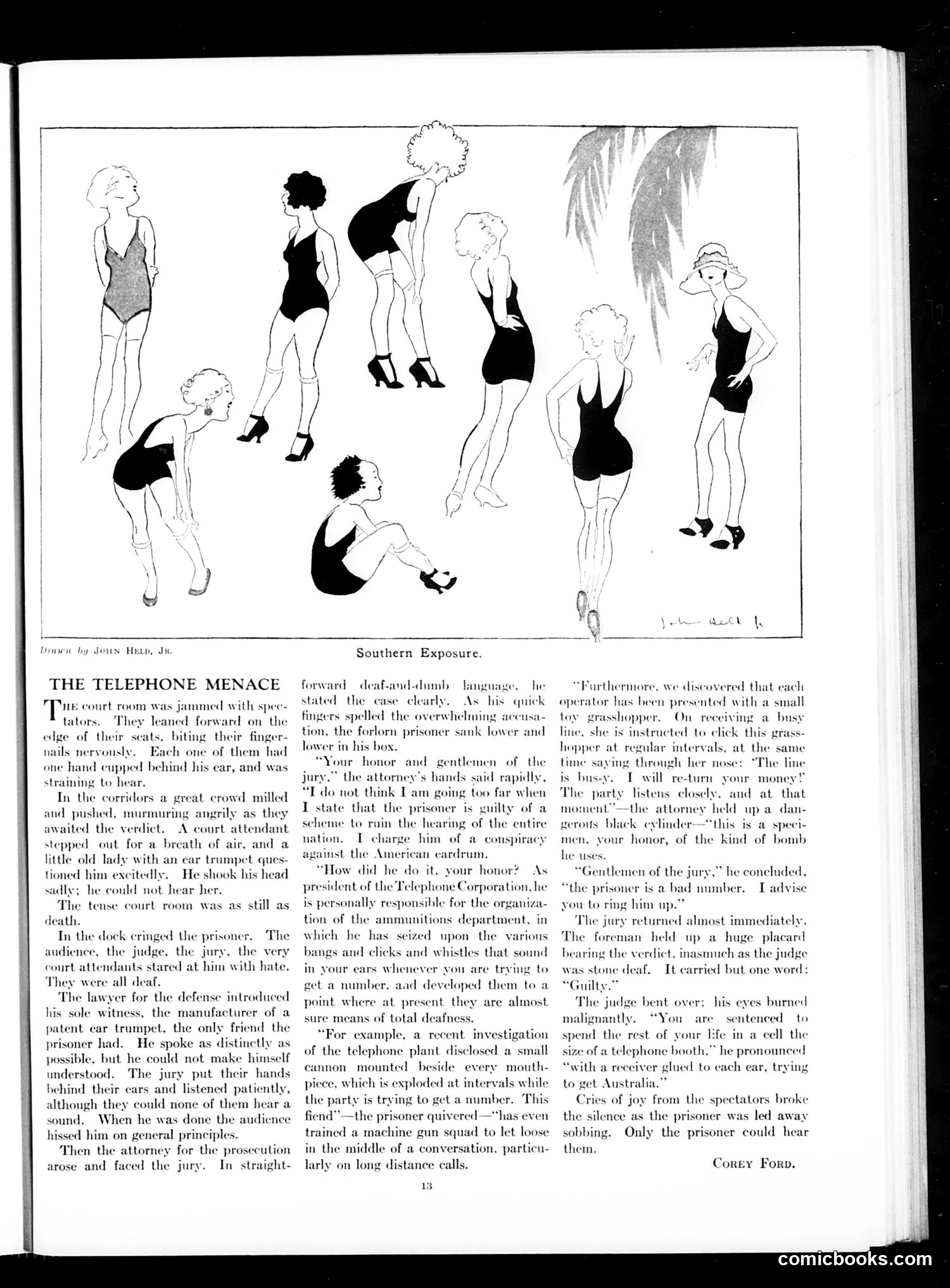
This satirical story mocks early telephone technology and its disruptive effects. The courtroom drama depicts a Telephone Corporation president on trial for conspiring to damage public hearing through telephone noise. The satire targets the cacophony of early telephone systems—the bangs, clicks, whistles, and mechanical sounds that accompanied calls, particularly long-distance ones. These were genuine annoyances of early telephone use. The absurdist humor escalates: prosecutors describe operators trained to make grasshopper-clicking sounds, cannons fired during conversations, and bomb-like devices. The final sentence—solitary confinement in a phone booth-sized cell with a receiver glued to each ear, trying to reach Australia—represents the ultimate torture: being trapped with the very technology on trial. The accompanying illustrations labeled "Southern Exposure" appear to be unrelated fashion sketches, possibly advertising or filler content typical of Judge magazine. The piece satirizes both the Telephone Corporation's indifference to user complaints and the public's frustration with unreliable, noisy communication technology.
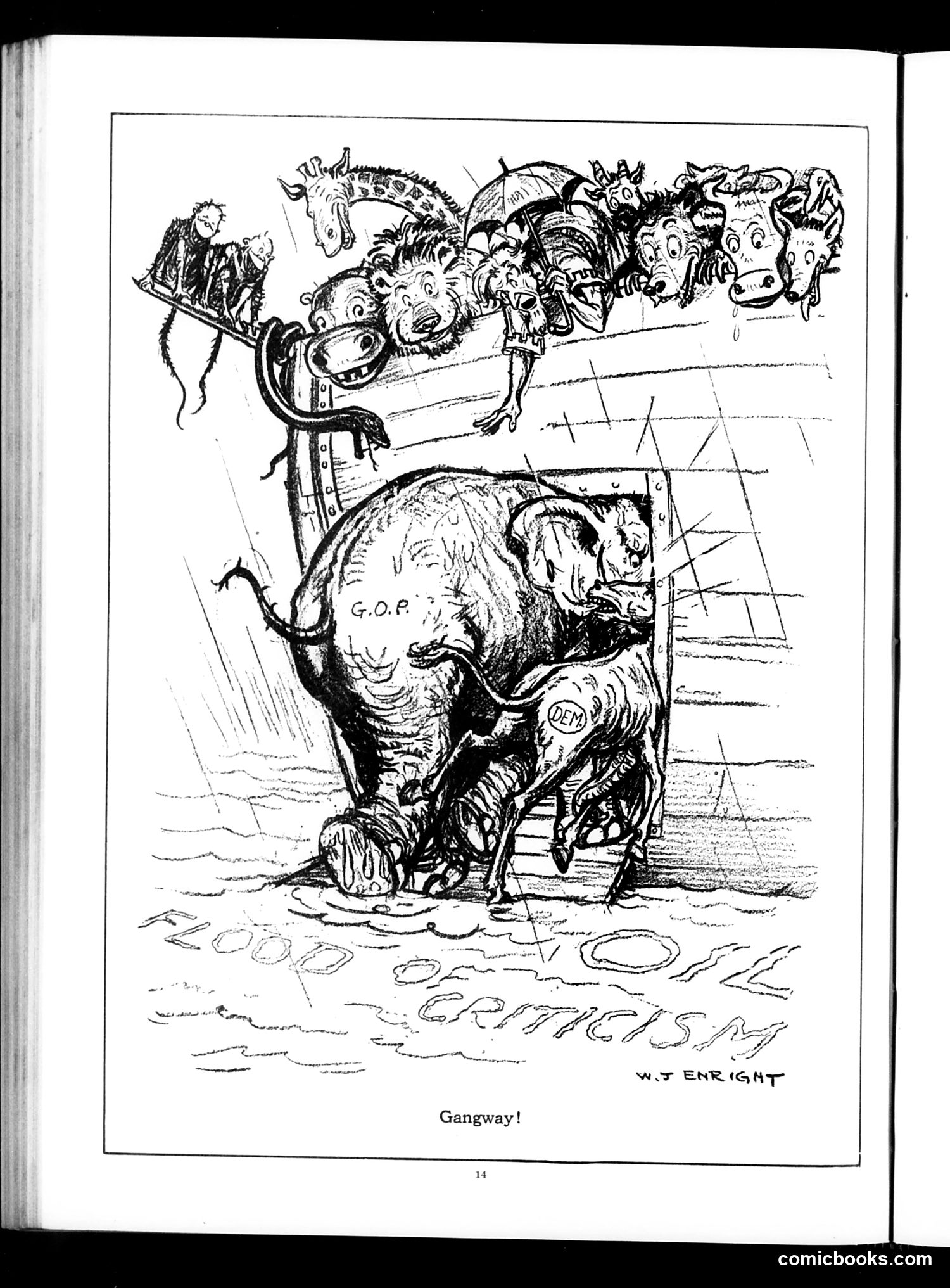
This cartoon by W.J. Enright depicts a large elephant labeled "G.O.P." (Republican Party) being led by a smaller donkey labeled "DEM" (Democratic Party). The elephant carries a massive load labeled "ZOO" and "POLITICIAN'S" while a crowd of grotesque, demonic-looking creatures peer down from above. The satire suggests that Democrats are leading Republicans into political chaos or corruption—the elephant bearing the burden while following the smaller donkey's direction. The "zoo" reference and monstrous crowd likely represent the chaotic, absurd nature of contemporary politics or specific political figures looming over the process. The title "Gangway!" implies alarm or warning about this political arrangement. This appears to be commentary on party dynamics during a specific electoral or political crisis, though the exact historical moment is unclear without publication date context.
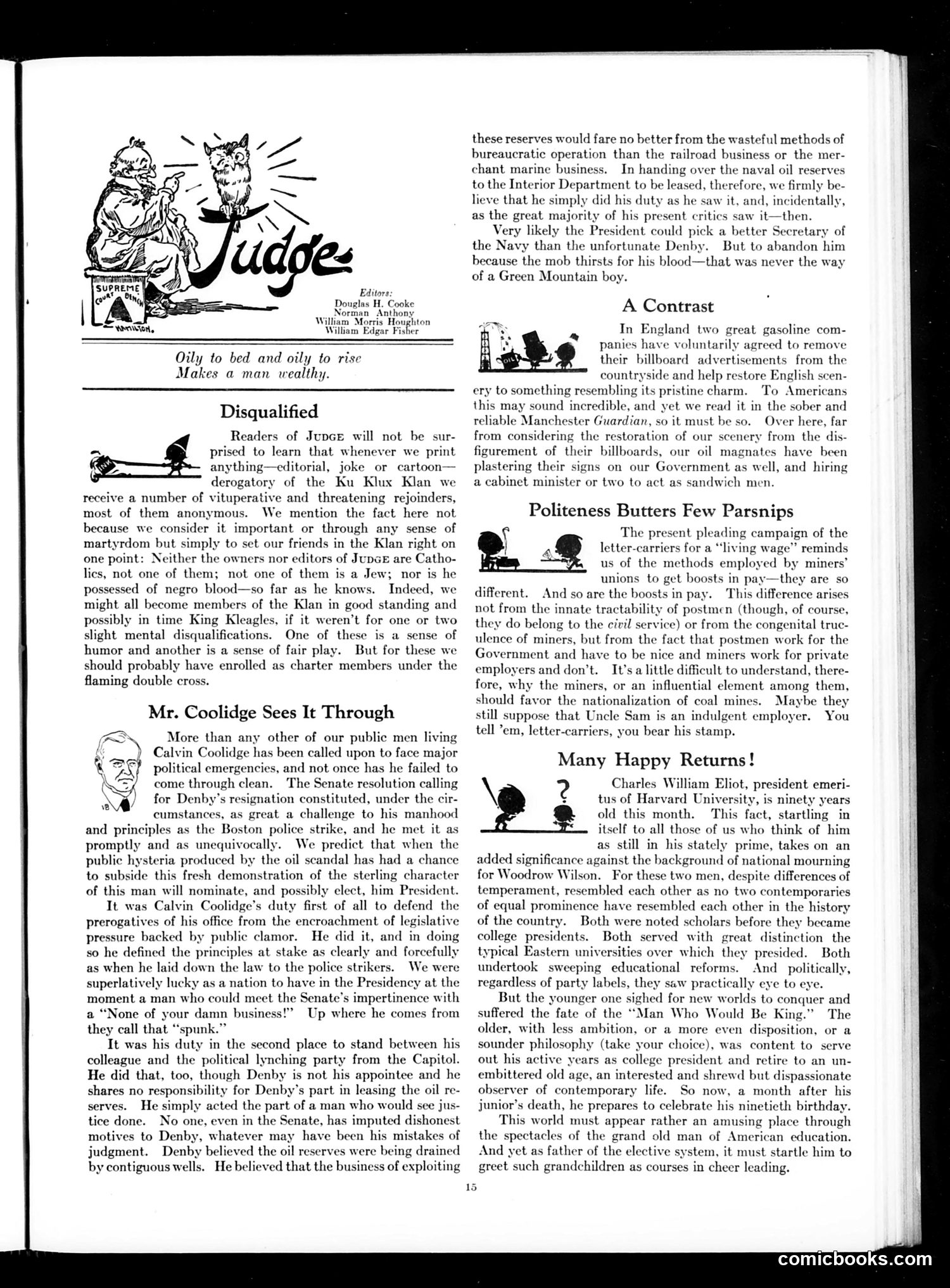
This page contains **editorial commentary defending Calvin Coolidge and his Secretary of the Navy, Edwin Denby**, during the Teapot Dome scandal (early 1920s oil reserves leasing controversy). The **"Disqualified" section** responds to Ku Klux Klan threats against Judge's anti-Klan editorial stance. The editors sarcastically claim they'd qualify for KKK membership except for two disqualifications: "a sense of humor and another is a sense of fair play"—a cutting indictment of the Klan's lack of both. The main **"Mr. Coolidge Sees It Through"** article praises Coolidge for defending Denby against Senate calls for resignation, framing it as principled leadership rather than protection of a subordinate. The piece argues Denby acted honestly, if mistakenly, in leasing naval oil reserves to private interests. The final sections discuss British companies voluntarily removing countryside billboards and note Charles William Eliot's 90th birthday, adding lighter content to balance the heavier political commentary.
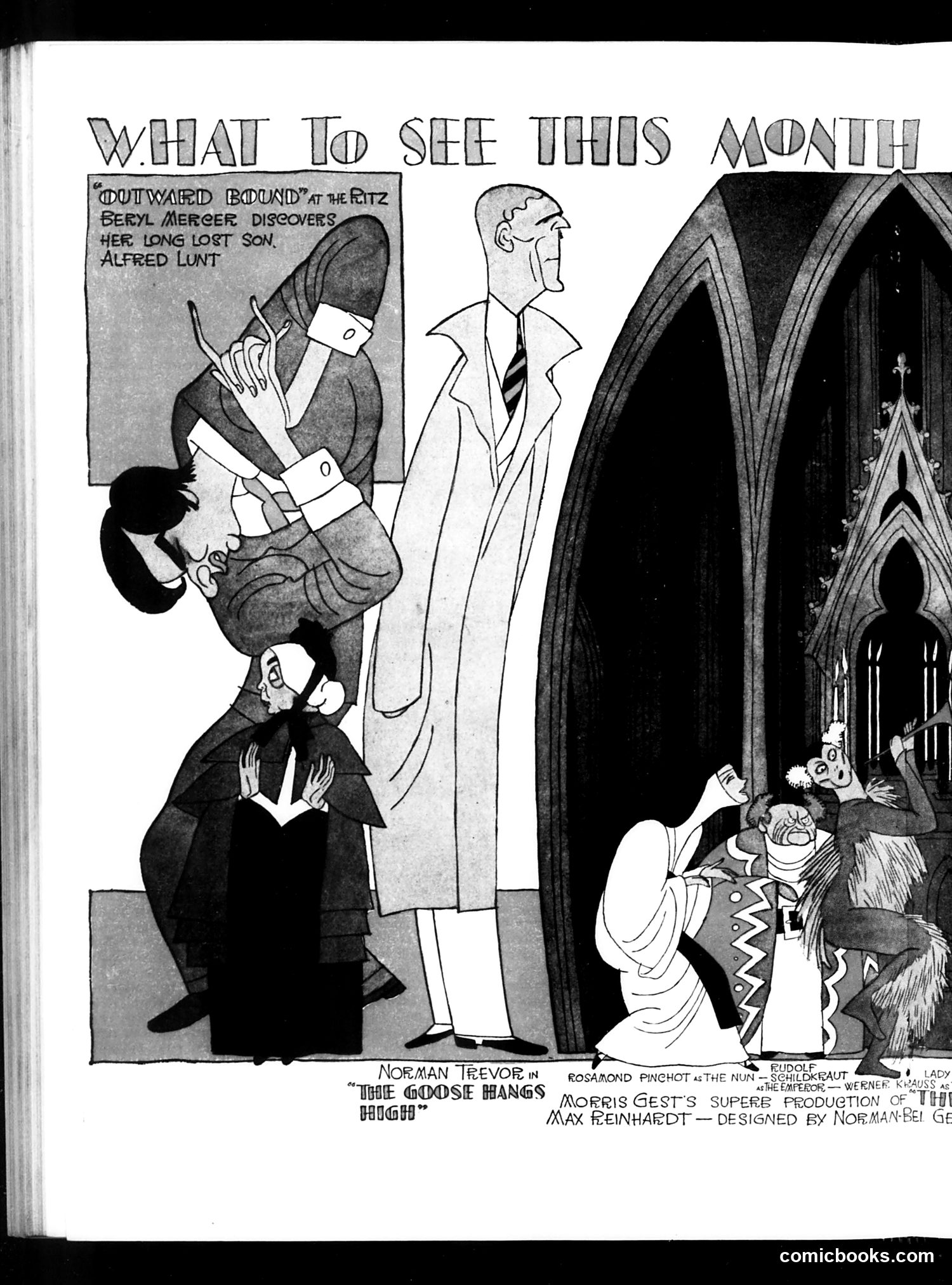
This page advertises theatrical releases, not political cartoons. The top section promotes "Outward Bound" at the Ritz, featuring Beryl Mercer discovering her long-lost son Alfred Lunt. The bottom advertises "The Goose Hangs High," a Morris Gest production designed by Norman Bel Geddes, featuring Norman Trevor, Rosamond Pinchot, and others. These appear to be stage plays being promoted to Judge magazine's readers. The illustrations show characters from these productions—including what appears to be religious figures and civilians—rather than satirizing current events or politics. The page functions primarily as entertainment advertising for Broadway or theatrical productions popular with the magazine's audience during this period.
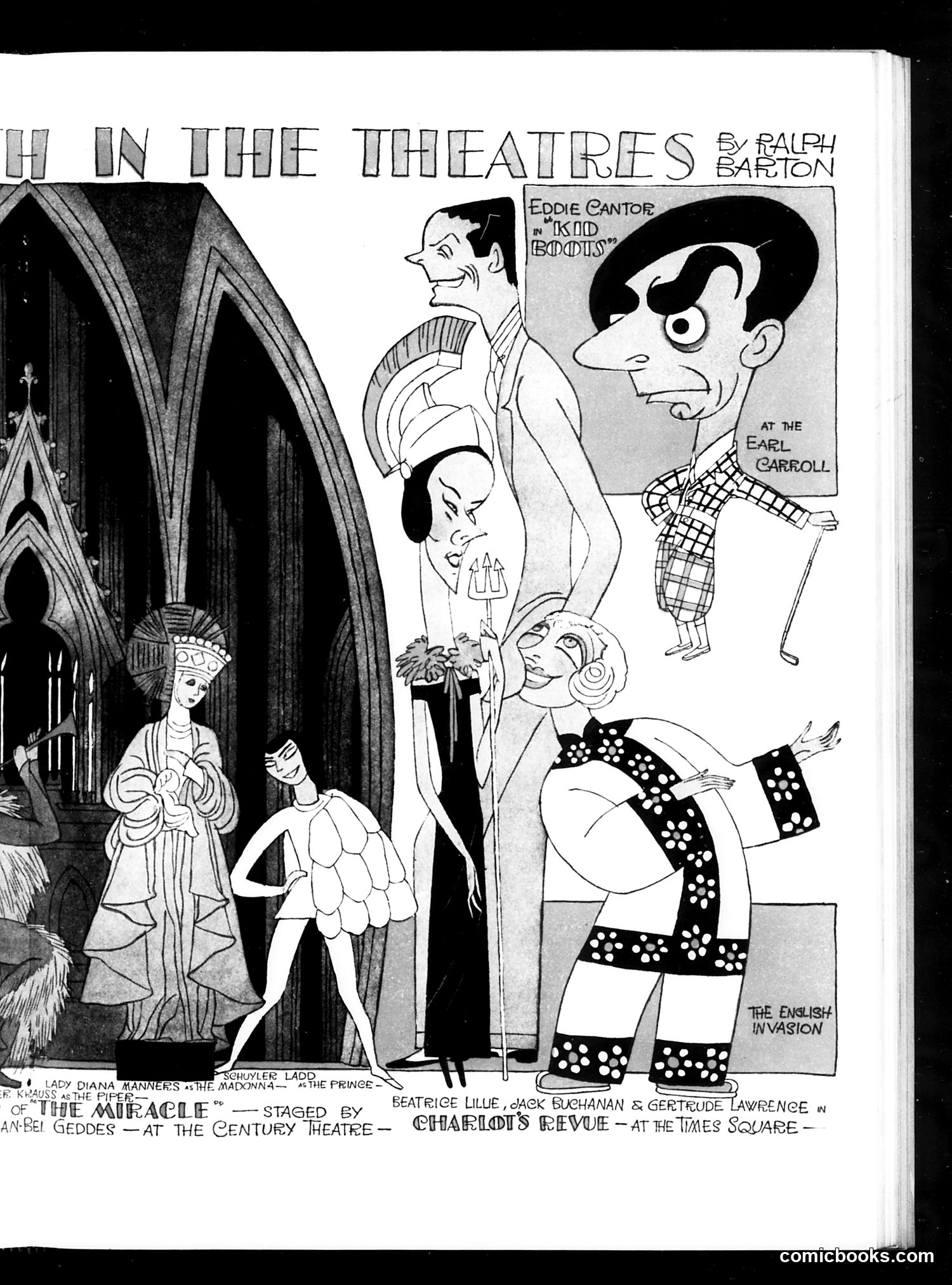
This page satirizes "The English Invasion"—British theatrical productions and performers conquering New York stages. The cartoons mock fashionable British entertainers appearing in Broadway shows circa the 1920s. The caricatures include Eddie Cantor (right panel), labeled at the Earl Carroll theatre, alongside exaggerated drawings of British performers like Lady Diana Manners and Jack Buchanan. The theatrical productions mentioned—"The Miracle" and "Charlot's Revue"—were actual British imports that dominated Times Square. The satire plays on American anxieties about foreign cultural dominance: elaborate, sophisticated British theater was seen as threatening native American entertainment. The grotesque caricatures and dismissive tone suggest Judge magazine's skepticism toward what it presents as pretentious British theatrical fashion invading American popular culture.
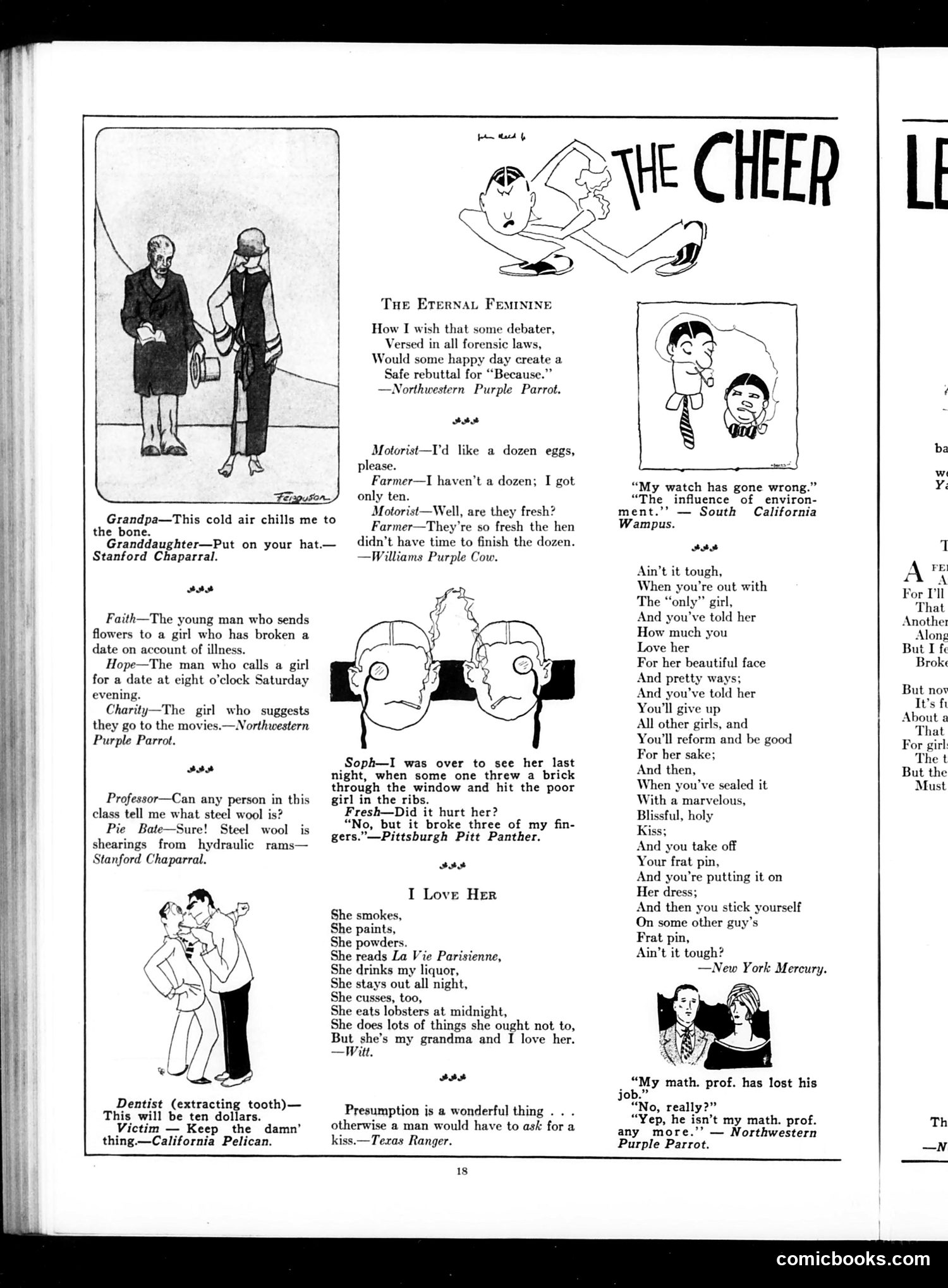
This is a humor page from Judge magazine featuring jokes and comic verses from college publications (Stanford Chaparral, Northwestern Purple Parrot, etc.). The content reflects early 20th-century collegiate and social satire. **Key themes:** - **Dating rituals**: Jokes about young men pursuing dates, broken engagements due to illness, Saturday evening calls—reflecting formal courtship conventions of the era - **Gender commentary**: "The Eternal Feminine" poem mocks debates about women's nature; "I Love Her" satirizes a young man's grandmother who smokes, drinks, and stays out late—shocking behavior for an older woman, implying generational shifts in female behavior - **College life**: References to fraternity pins, math professors, dormitory humor - **Wordplay and puns**: The dentist joke, the farmer's eggs, the frat pin mishap The satire targets courtship formality, generational anxiety about changing women's roles, and collegiate pretension—common Judge magazine subjects aimed at educated urban readers amused by social observation.
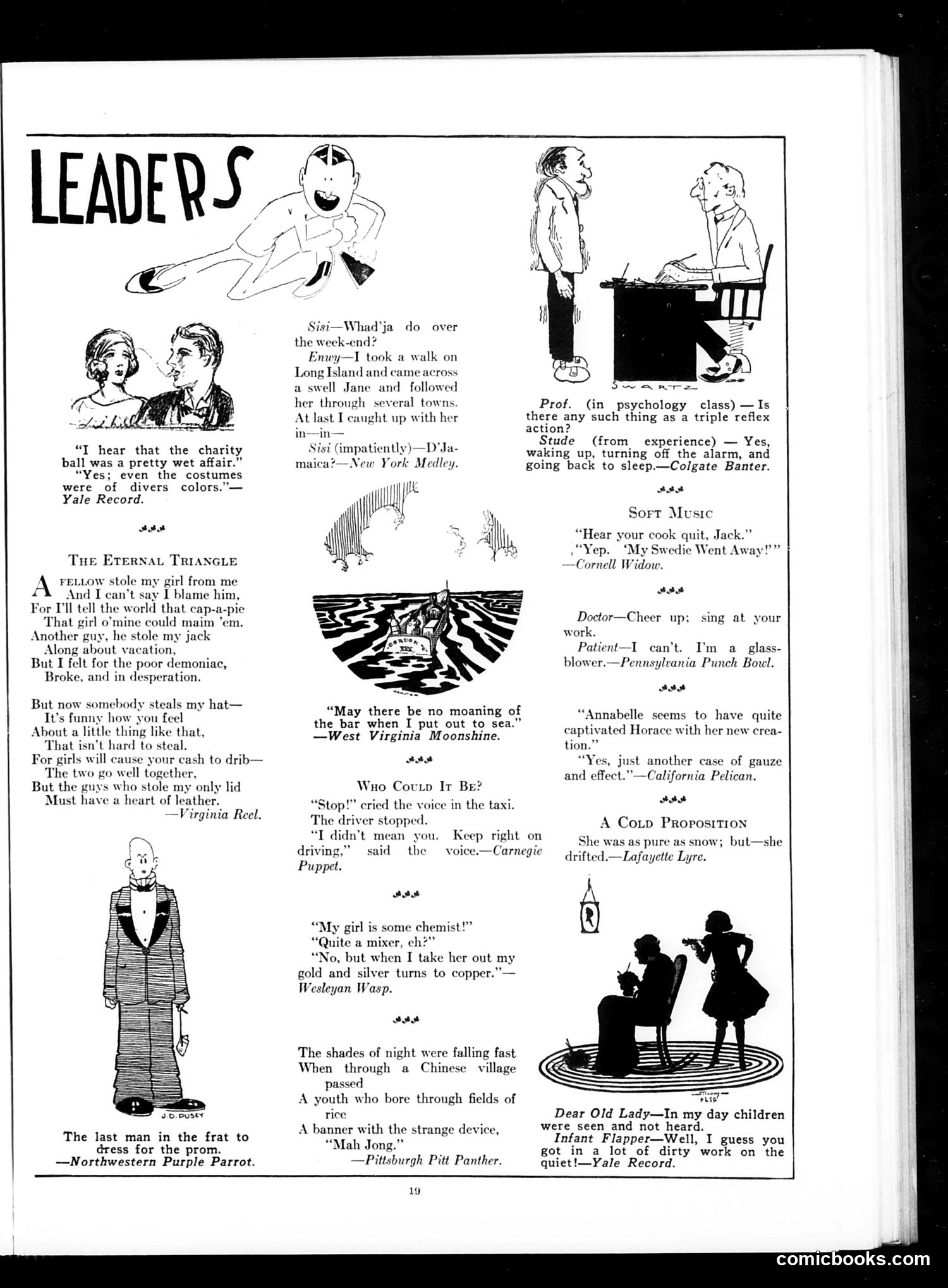
This page collects humorous short jokes and verses from college humor magazines (Yale Record, Cornell Widow, Wesleyan Wasp, etc.), not political cartoons. The satire targets collegiate and young adult social life circa 1920s. Key themes include romantic jealousy ("The Eternal Triangle"), petty theft (a stolen hat matters more than a stolen girlfriend), and dating mishaps. Several jokes mock specific college types: the unprepared fraternity member, the psychology student who oversleeps, the glass-blower patient who can't sing. The humor is gentle and era-specific—references to "flappers" (modern young women), chemistry puns, and mah jong's recent popularity. One joke satirizes class when a taxi passenger tells the driver to stop (meaning the passenger), creating ambiguity about who deserves obedience. The cartoons are simple decorative illustrations accompanying the text, not the main satirical content. Overall, this represents collegiate humor aimed at upper-middle-class youth rather than political commentary.
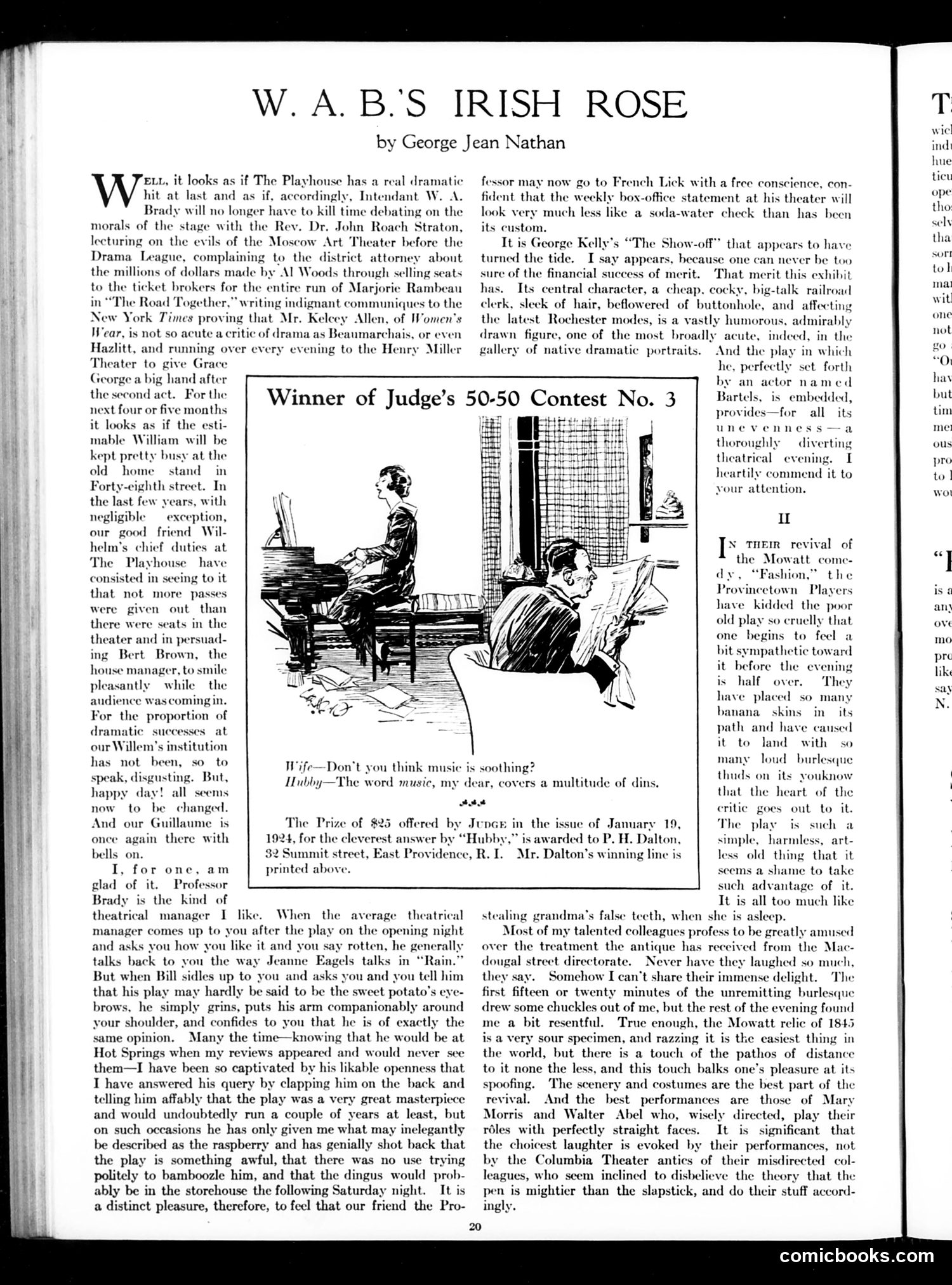
This page discusses **W.A.B.'s Irish Rose** and praises George Kelly's play **"The Show-off,"** which appears to have finally given theatrical producer W.A. Brady a financial success at his Playhouse theater. The cartoon shows a husband and wife in domestic conversation. The wife asks if he thinks music is soothing; the husband replies that "music" covers "a multitude of dims"—a play on the phrase "multitude of sins," suggesting the wife's singing is so bad it requires euphemistic language. The article describes Brady as an unusually likable theater manager who, unlike others, honestly admits when his plays are failures rather than pretending they're successes. The writer celebrates that Brady can finally leave for French Lick (a resort town) confident his box office will show actual profit, rather than the disappointing results his theater typically produced.
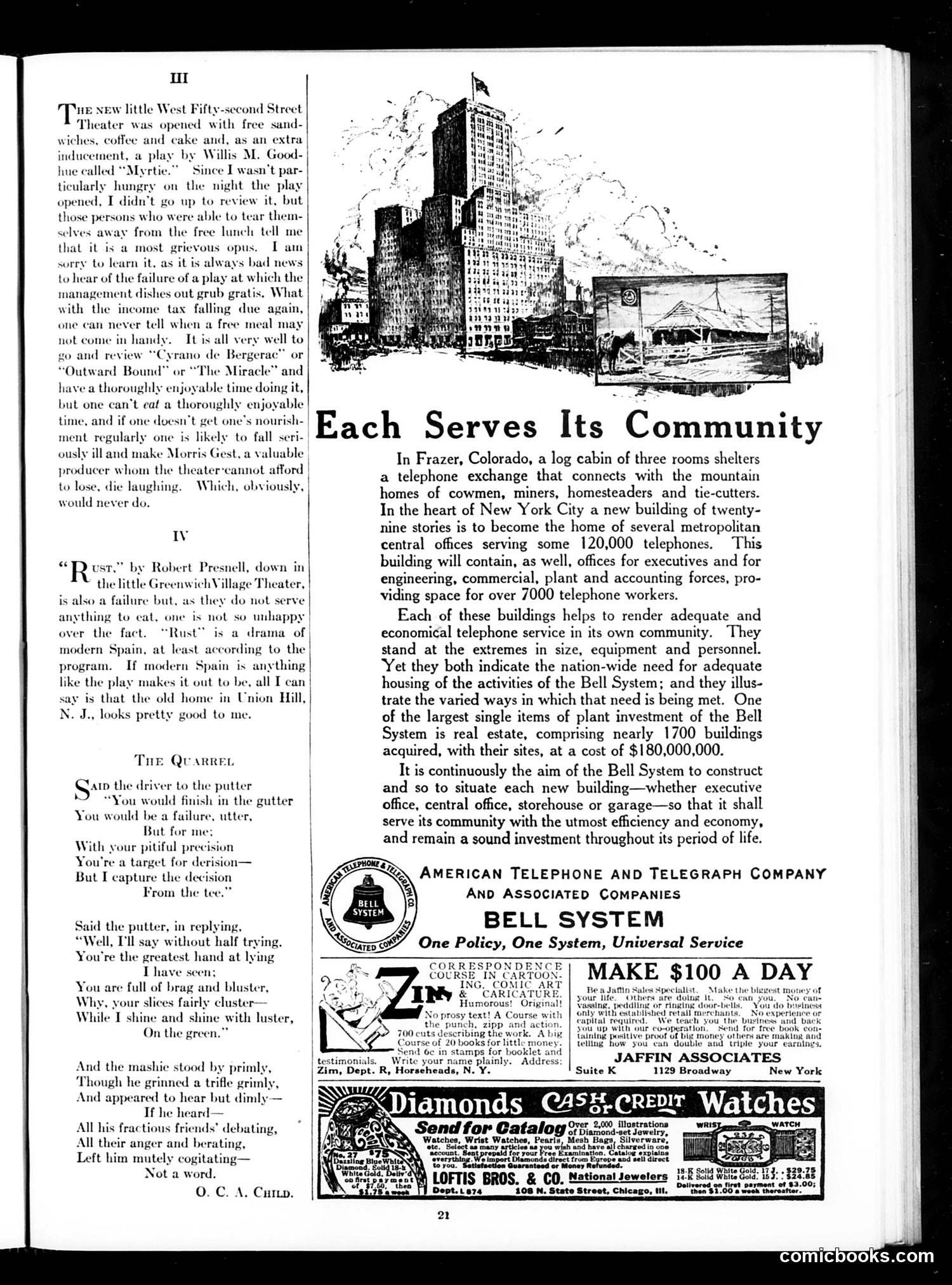
This page contains theater reviews and light verse rather than political satire. The top sections critique recent Broadway failures—a play called "Myrtie" at a West 52nd Street theater (criticized as poor despite offering free food to lure audiences) and "Rust" at Greenwich Village Theater. The humor is self-deprecating: during economic hardship (income tax season), a critic admits he'd rather attend plays serving meals than quality productions. "The Quarrel" is a humorous poem personifying golf clubs arguing over credit for good shots—the driver boasts, the putter replies sarcastically, while the mashie stays silent. The joke relies on golf knowledge and club personalities. The substantial remainder is a corporate advertisement for Bell Telephone System, contrasting service in a tiny Colorado cabin versus a 29-story Manhattan building—presenting the company's infrastructure investment as serving all communities equally. This is promotional content, not satire.
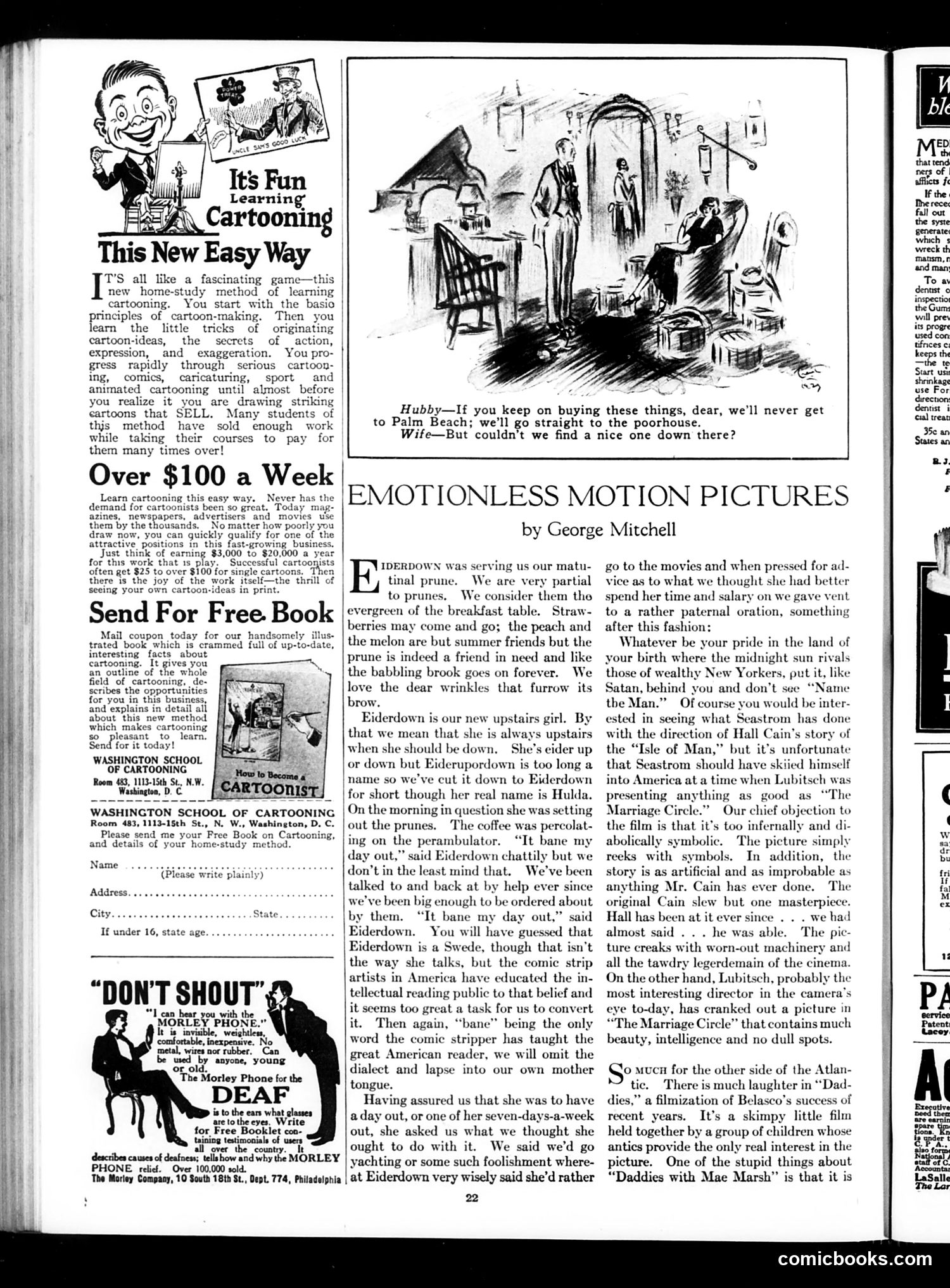
This satirical essay mocks contemporary cinema's inability to capture genuine emotion. Mitchell critiques films that rely on overly symbolic or artificially constructed narratives rather than authentic human experience. The accompanying cartoon illustrates the essay's theme: a husband and wife discuss furniture purchases while facing financial ruin—they're so preoccupied with material consumption they ignore their impending poverty. The wife suggests finding "a nice one down there" (implying a cheaper home), completely missing the absurdity of their situation. Mitchell uses this domestic scenario to exemplify how modern films present emotionless, mechanical depictions of life. He contrasts this with *real* emotional engagement, suggesting cinema has become disconnected from genuine human concerns and reactions. The satire targets both filmmakers' pretension and audiences' willingness to accept artificial representations of emotion as entertainment.
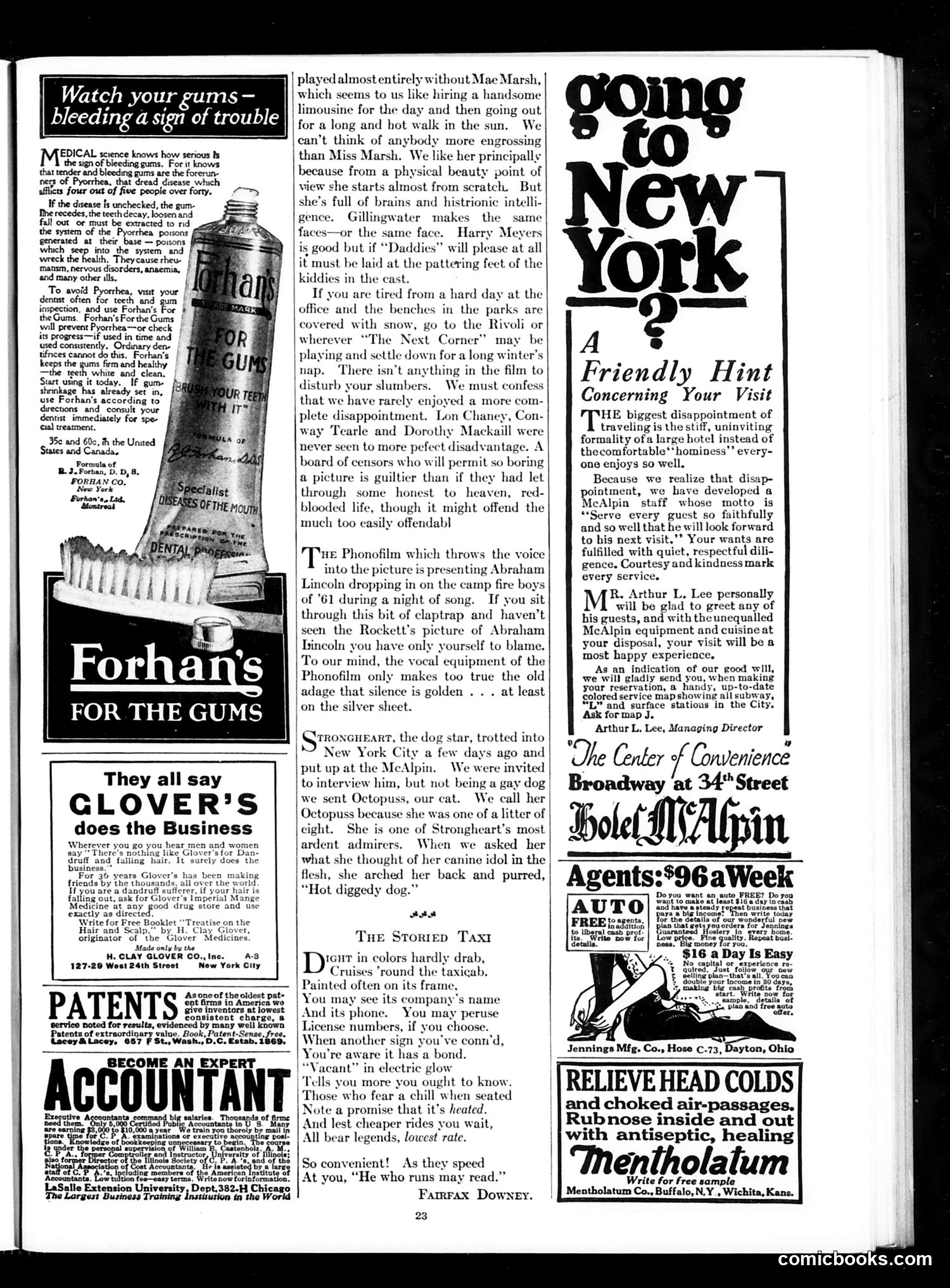
This page is primarily **advertising and entertainment reviews**, not political satire. The main content includes: **Film Reviews**: Critiques of movies like "The Next Corner," "Daddies," and a Phonofilm presentation of Abraham Lincoln. The reviewer dismisses "The Next Corner" as tedious, criticizing actors Conway Tearle and Dorothy Mackaill, while praising Mae Marsh's appeal despite her plain appearance. **Product Advertisements**: - Forhan's toothpaste (for gum disease/pyorrhea prevention) - Glover's dandruff remedy - Patent law services - Accountancy courses - Hotel advertising (Hotel McAlpin) **Notable References**: The mention of "Phonofilm" suggests early sound-film technology being demonstrated. The Lincoln reference appears to be a novelty short film. This page reflects 1920s consumer culture and entertainment journalism rather than political commentary. The advertisements target health anxieties (dental disease, hair loss) common to the era.
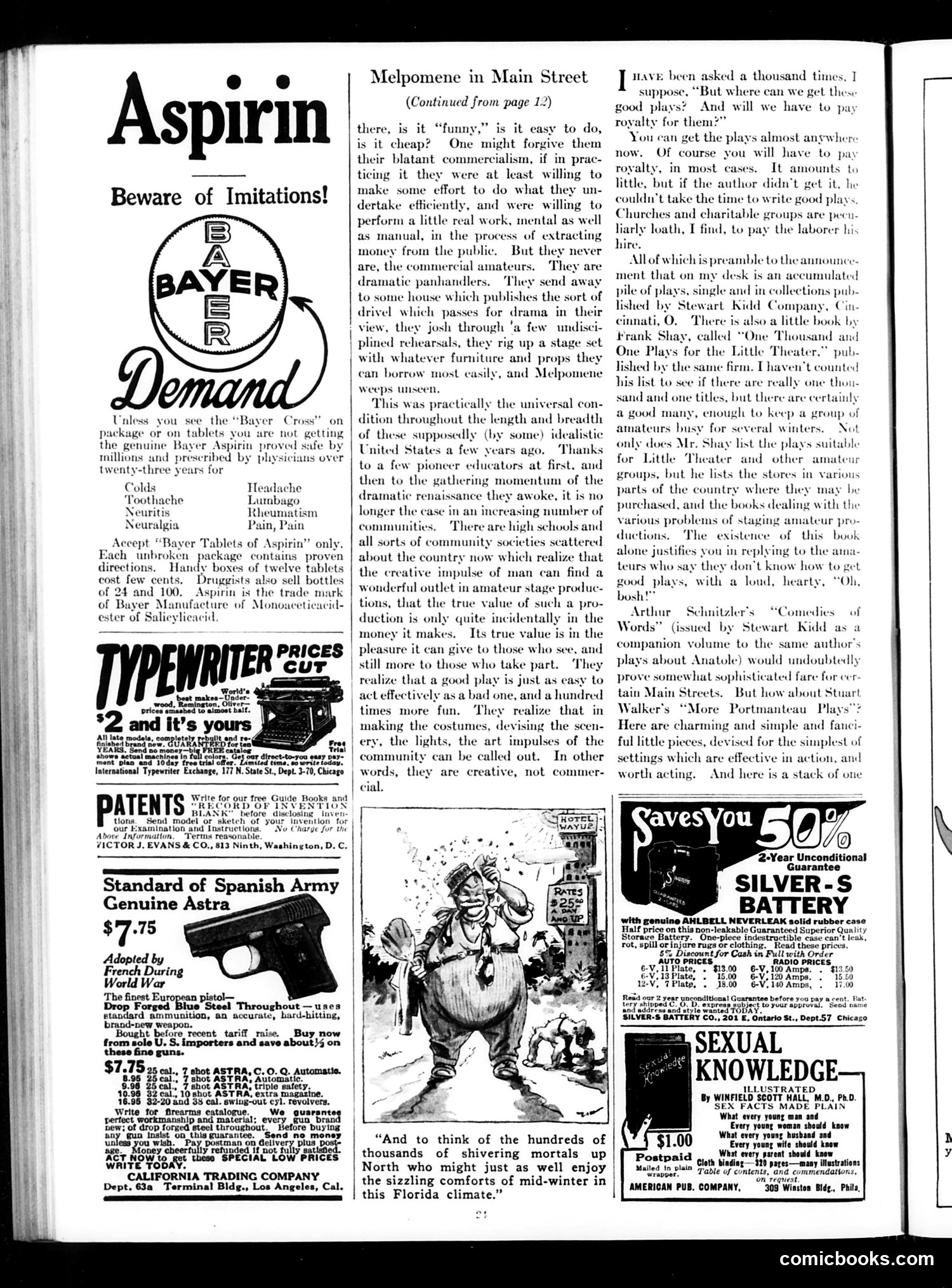
This page reprints a theater criticism essay about amateur theatrical productions in America. The author laments that commercial theater companies historically treated amateur drama poorly—sending out cheap, formulaic scripts and expecting minimal effort from local producers. However, he celebrates a recent shift: communities now recognize theater's creative value beyond profit-making. Amateur groups increasingly invest genuine effort in costumes, set design, and lighting, treating theater as an artistic outlet rather than mere entertainment-for-hire. The surrounding advertisements (Aspirin, typewriters, firearms, batteries, and sexual education books) are typical Judge magazine filler and represent the era's consumer culture. The essay itself contains no satire—it's sincere advocacy for elevating community theater from commercialism to art.
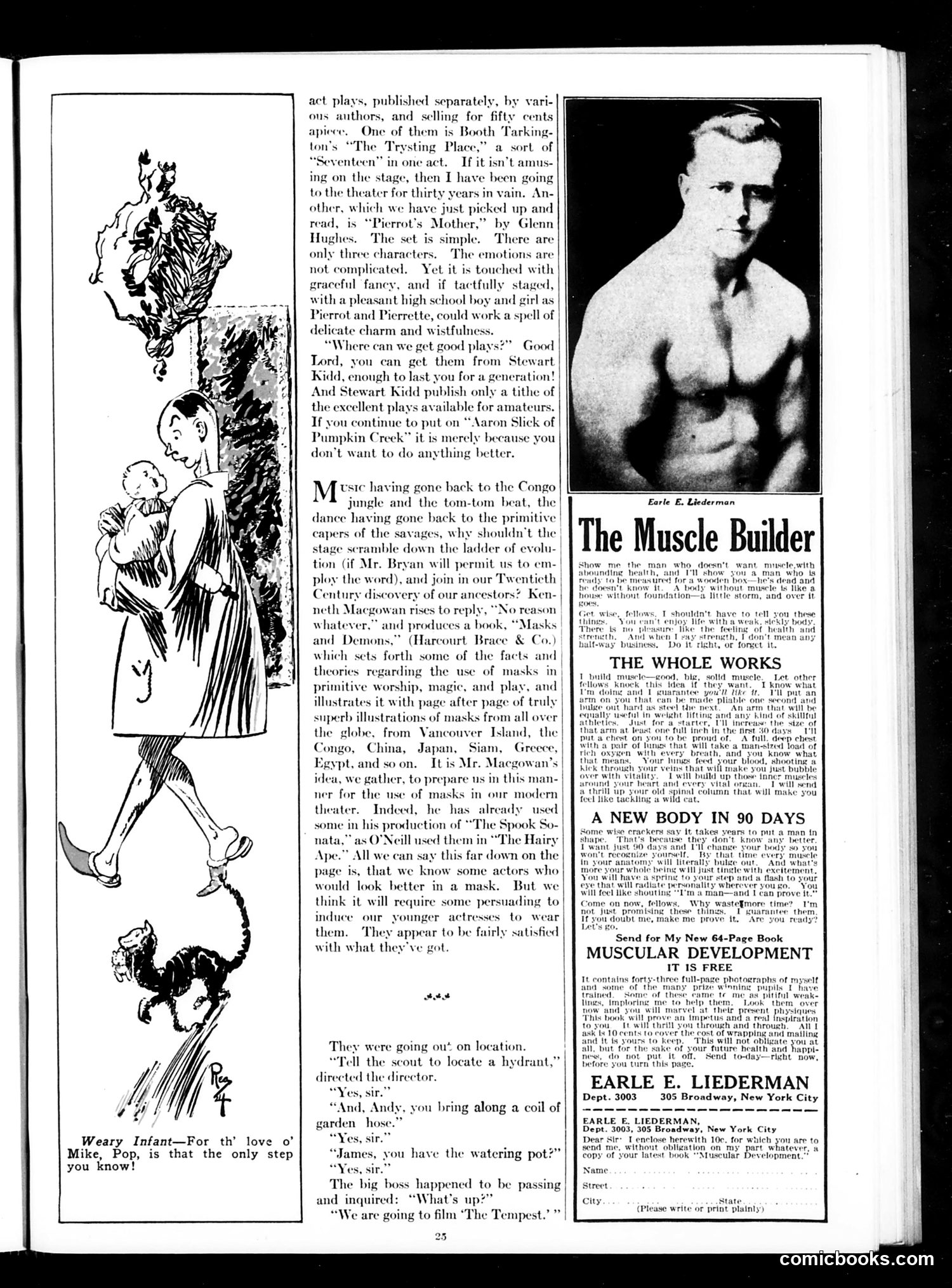
This page contains three distinct elements: **The cartoon** (left): A "Weary Infant" complains to "Pop" about repetitive dancing—likely satirizing contemporary dance crazes (possibly jazz-age dances) by depicting them as exhaustingly monotonous for even very young participants. **Theater column** (center): A discussion of amateur theatrical productions, critiquing reliance on dated plays like "Aaron Slick of Pumpkin Creek" while promoting Stewart Kidd's better plays. References Kenneth Macgowan's book on primitive masks, discussing whether modern theater should adopt mask-work from non-Western cultures—reflecting early 20th-century fascination with "primitivism." **Advertisement** (right): Earle E. Liederman's "Muscle Builder" promoting physical fitness through his system, guaranteeing a "new body in 90 days." This reflects widespread 1920s-era bodybuilding and physical culture marketing aimed at men. The page represents typical Judge content: satirical commentary on entertainment and cultural trends alongside period advertisements.
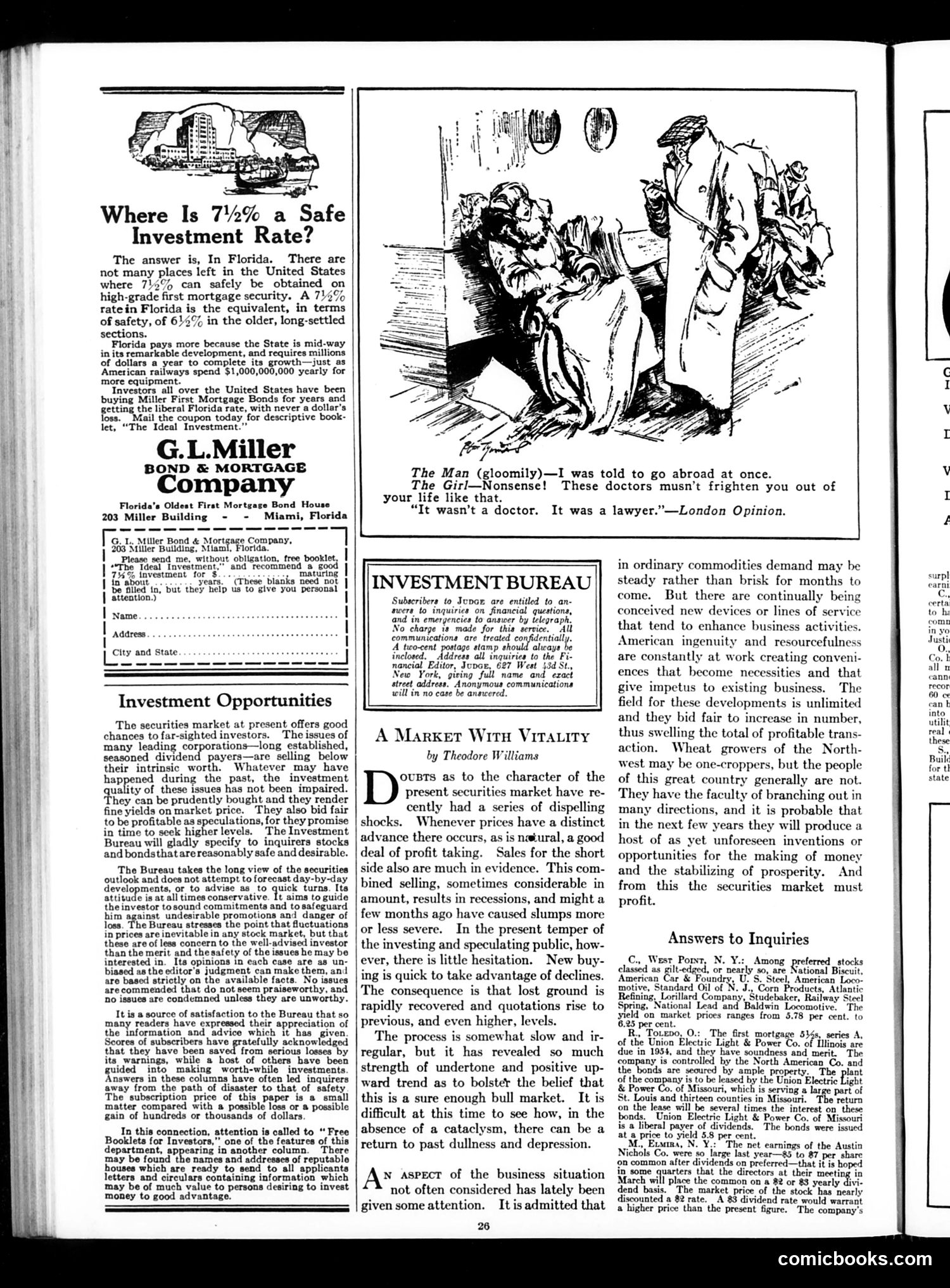
This page combines **real estate/investment advertising with political satire**. The main cartoon depicts a lawyer being mistaken for a doctor by someone seeking medical help abroad. The caption attributes this to a *London Opinion*, suggesting British commentary on American confusion or incompetence—likely satirizing how Americans abroad were perceived as either charlatans or bumbling professionals. The dominant content, however, is advertising for **G.L. Miller Bond & Mortgage Company** in Miami, Florida. It promotes 7½% investment returns on Florida mortgages, framed as safe because Florida was experiencing rapid development (comparable to railroad expansion). This reflects the **Florida land boom of the 1920s**, when real estate speculation was rampant and heavily marketed to investors nationwide. The "Investment Bureau" section below offers cautious financial advice—a editorial counterweight to the aggressive advertising above it, warning readers against speculation and emphasizing long-term value over quick gains. This juxtaposition itself may be subtle satire: the magazine profits from investment ads while editorially advising restraint.
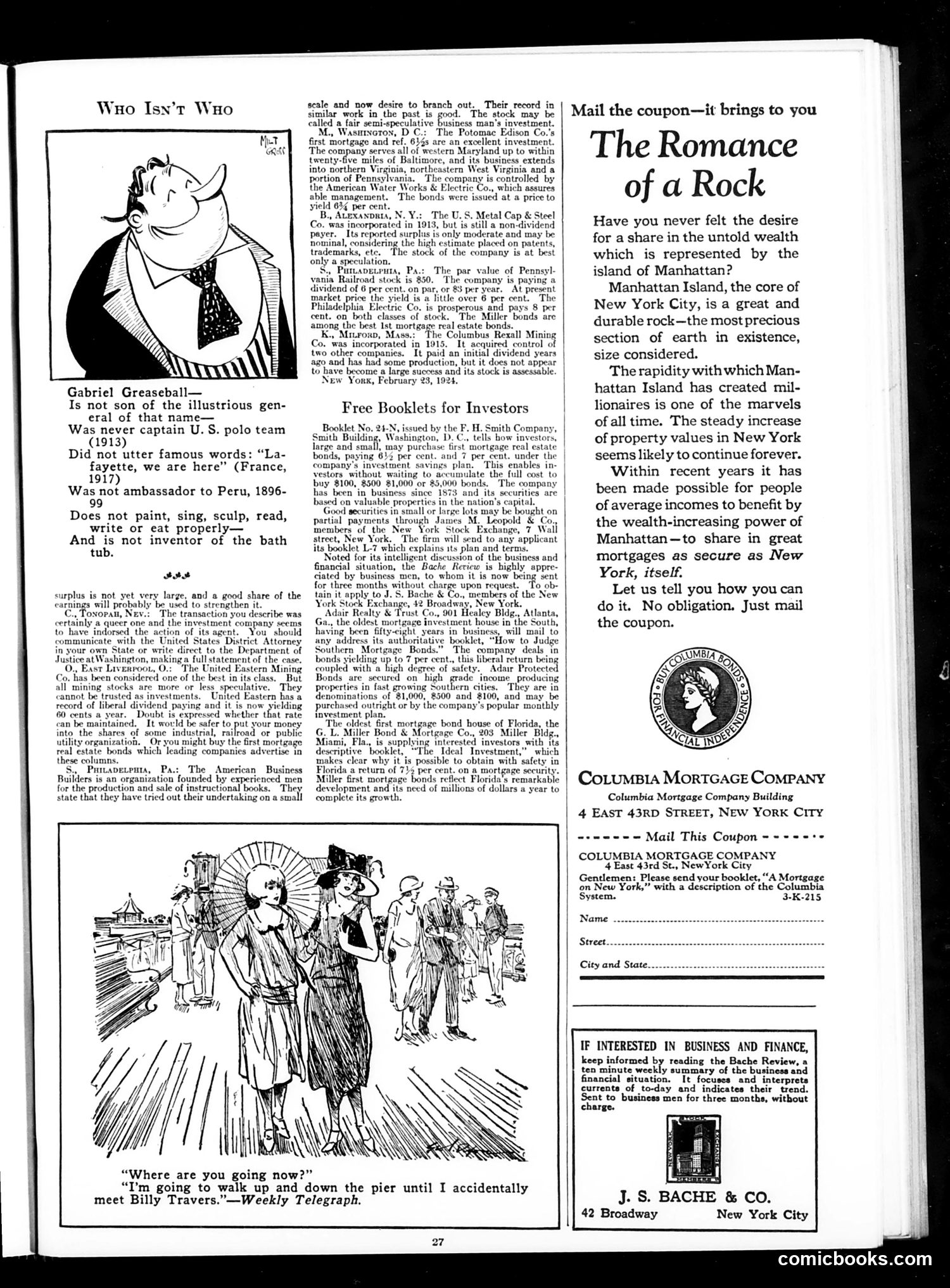
This cartoon satirizes **Gabriel Greaseball**, a figure of apparent mediocrity or fraud. The joke's structure—listing what he *didn't* do—mocks someone who falsely claims distinguished accomplishments. The text references real American figures: a General Greaseball, a U.S. polo captain, Lafayette's famous WWI phrase, and a Peruvian ambassador. Greaseball, by contrast, "does not paint, sing, sculp, read, write or eat properly"—he's incompetent at everything, including basic etiquette. The cartoon below shows street-level humor: a woman tells her friend she plans to accidentally "meet Billy Travers" by repeatedly walking the pier—a joke about contrived romance or social maneuvering. The page is primarily **financial advertising** for investment bonds and mortgage companies, using the satirical content as editorial filler. This reflects *Judge* magazine's mix of humor and business-focused readership circa 1924.
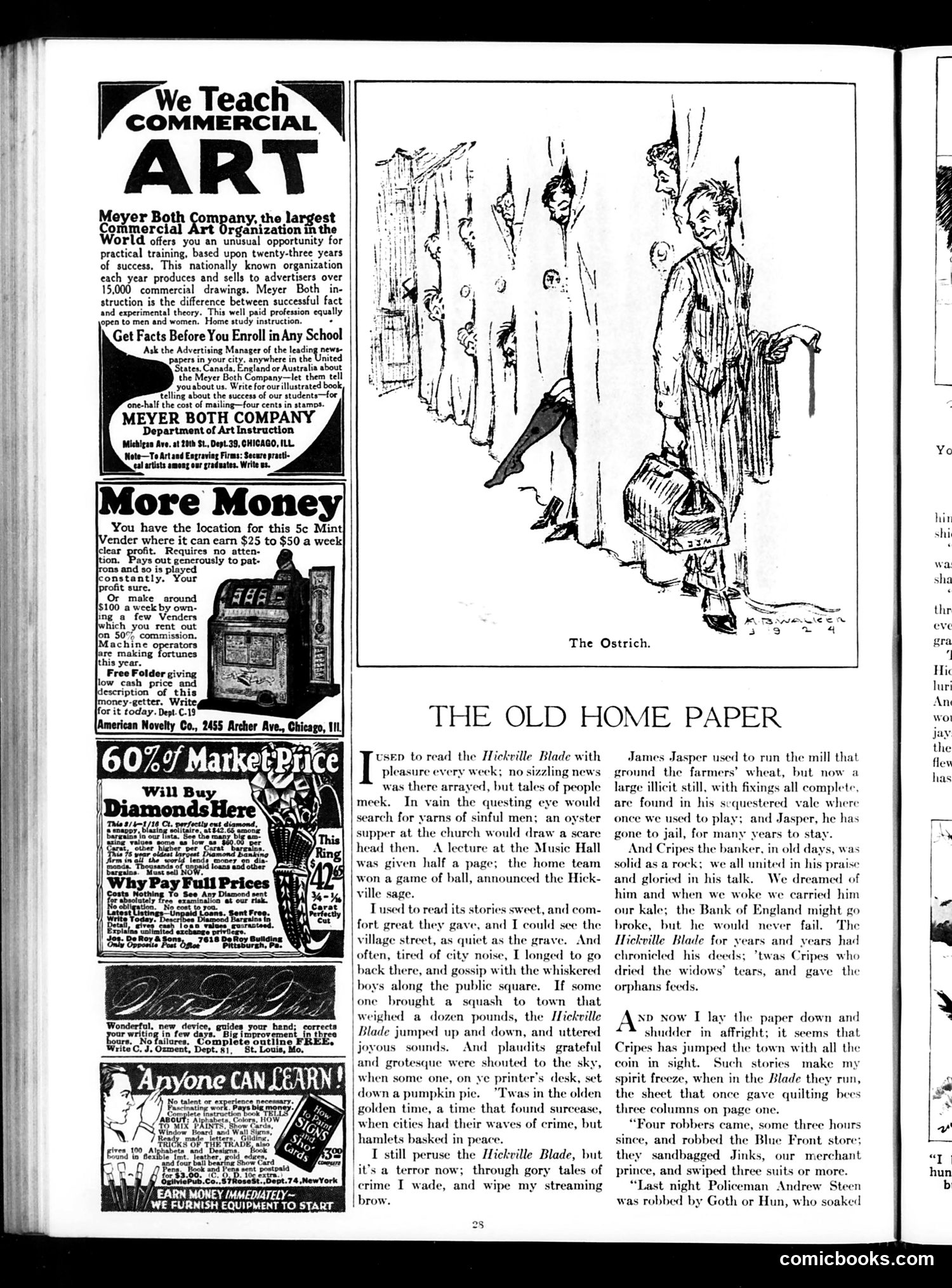
The main article contrasts small-town virtue with urban decay. The author recalls reading the *Hickville Blade*, a rural newspaper filled with wholesome local stories—church suppers, ball games, harvest celebrations—that provided comfort and moral certainty. Now that same paper chronicles crime: embezzlement by the trusted banker Cripes, James Jasper running an illegal still, robberies and assaults. The accompanying cartoon titled "The Ostrich" visually reinforces the theme: figures with their heads in sand (the ostrich metaphor for willful ignorance) represent those refusing to acknowledge society's moral collapse. The satire critiques both nostalgia and denial. The piece suggests that either small-town newspapers once whitewashed crime, or genuine social degradation has occurred. Either way, readers—like ostriches—cannot escape reality through selective attention. The contrast between innocent past and corrupt present was a common Progressive Era anxiety about urbanization and social breakdown.
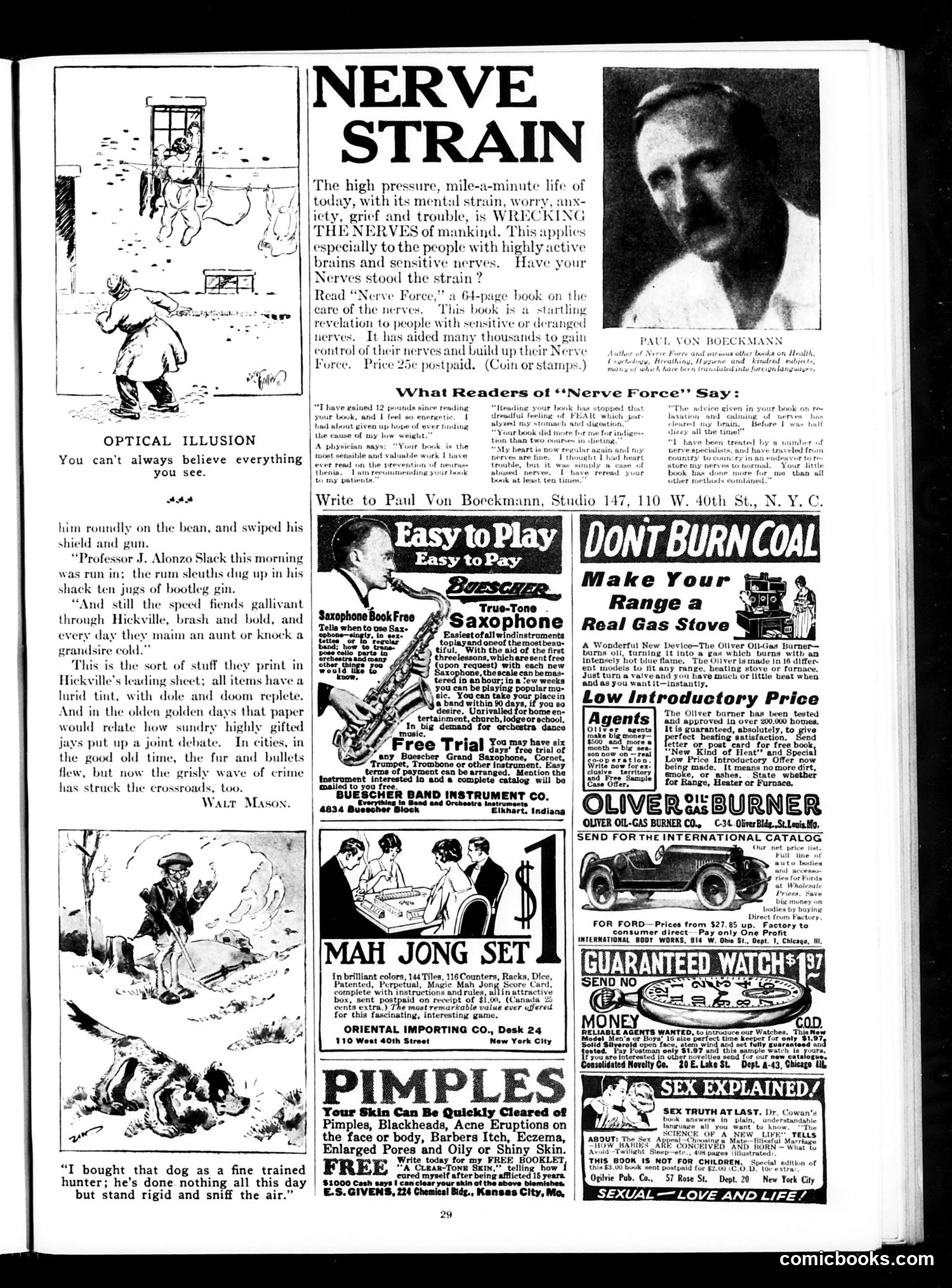
This page mixes editorial content with advertisements typical of early 20th-century magazines. The main feature is "Nerve Strain," promoting a self-help book by Paul Von Boeckmann about managing nervous exhaustion—a genuine concern in the modern industrial age. The satirical cartoons critique contemporary American life: one depicts the chaotic speed and danger of modern urban society (the "speed fiends" reference suggests reckless drivers), contrasting it nostalgically with calmer "olden golden days." Another, titled "Optical Illusion," warns against believing everything you see—likely social commentary on media manipulation. The advertisements reflect 1920s consumer culture: mail-order self-improvement books, musical instruments, Mahjong sets (then a trendy fad), gas stoves, and skin-care treatments. The "bootleg gin" reference dates this to Prohibition era. The final cartoon jokes about a poorly-trained hunting dog, unrelated to the page's themes. Overall, the page reflects anxieties about modern life's pace and nervous strain while promoting commercial solutions.
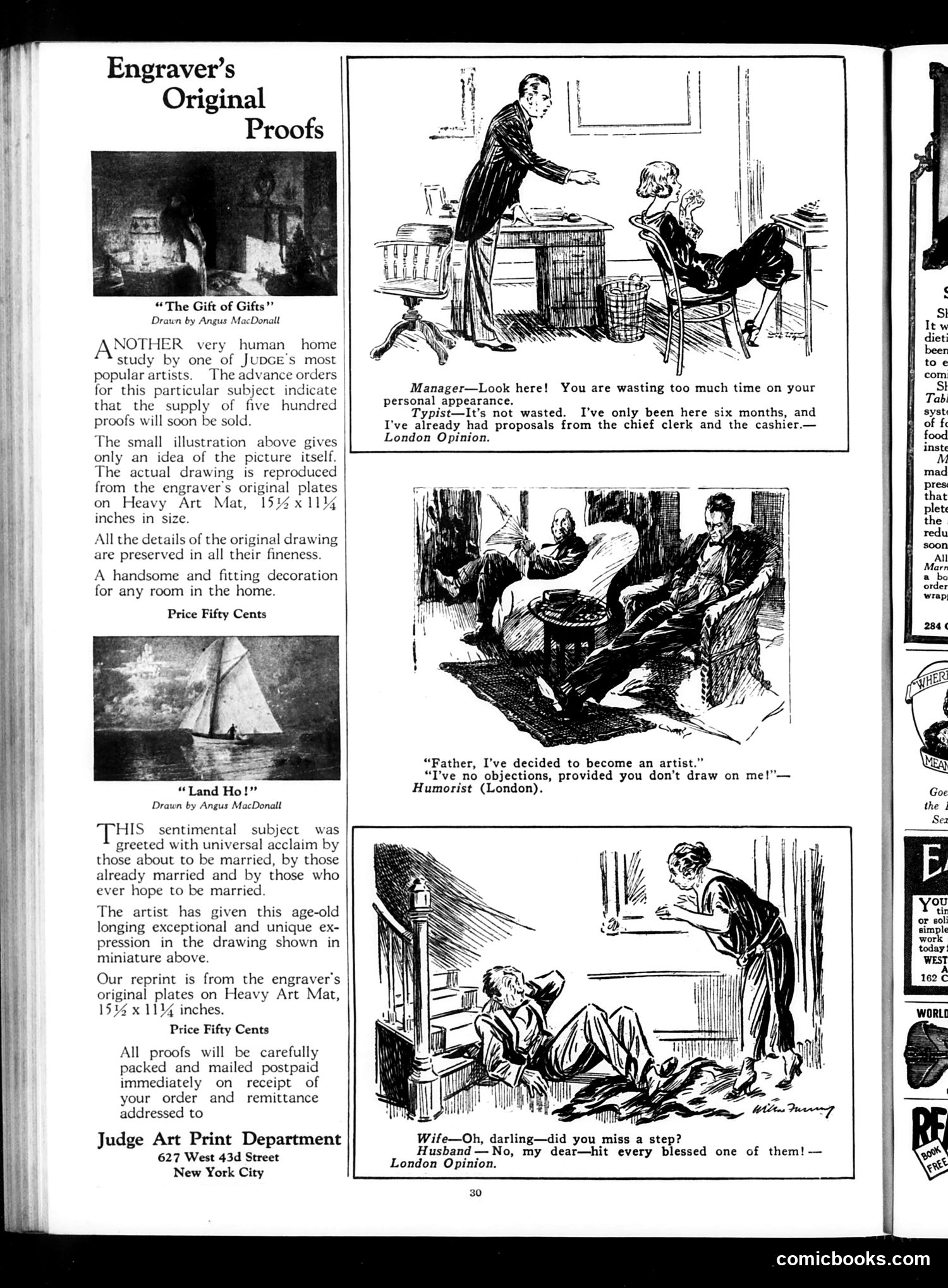
This page combines advertising with humorous cartoons reprinting engravings by artist Angus MacDonald. **The Advertisements:** The "Engraver's Original Proofs" section promotes two sentimental prints—"The Gift of Gifts" and "Land Ho!"—appealing to newlyweds and romantics. These are marketed as tasteful home decorations. **The Cartoons:** Three separate jokes appear: 1. A typist boasts to her manager that she's wasted no time—she's received marriage proposals from two male colleagues in just six months, suggesting she's attractive rather than industrious. 2. A father agrees to his son becoming an artist only if he doesn't "draw on me"—a pun on both artistic drawing and financial dependency. 3. A husband claims he didn't miss a step falling downstairs; he "hit every blessed one"—dark humor about a domestic accident. These jokes reflect early 20th-century attitudes about gender roles (female typists as decorative rather than professional), parent-child dynamics, and gallows humor about domestic mishaps. The cartoons are reprinted from British publications (*London Opinion*, *Humorist*).
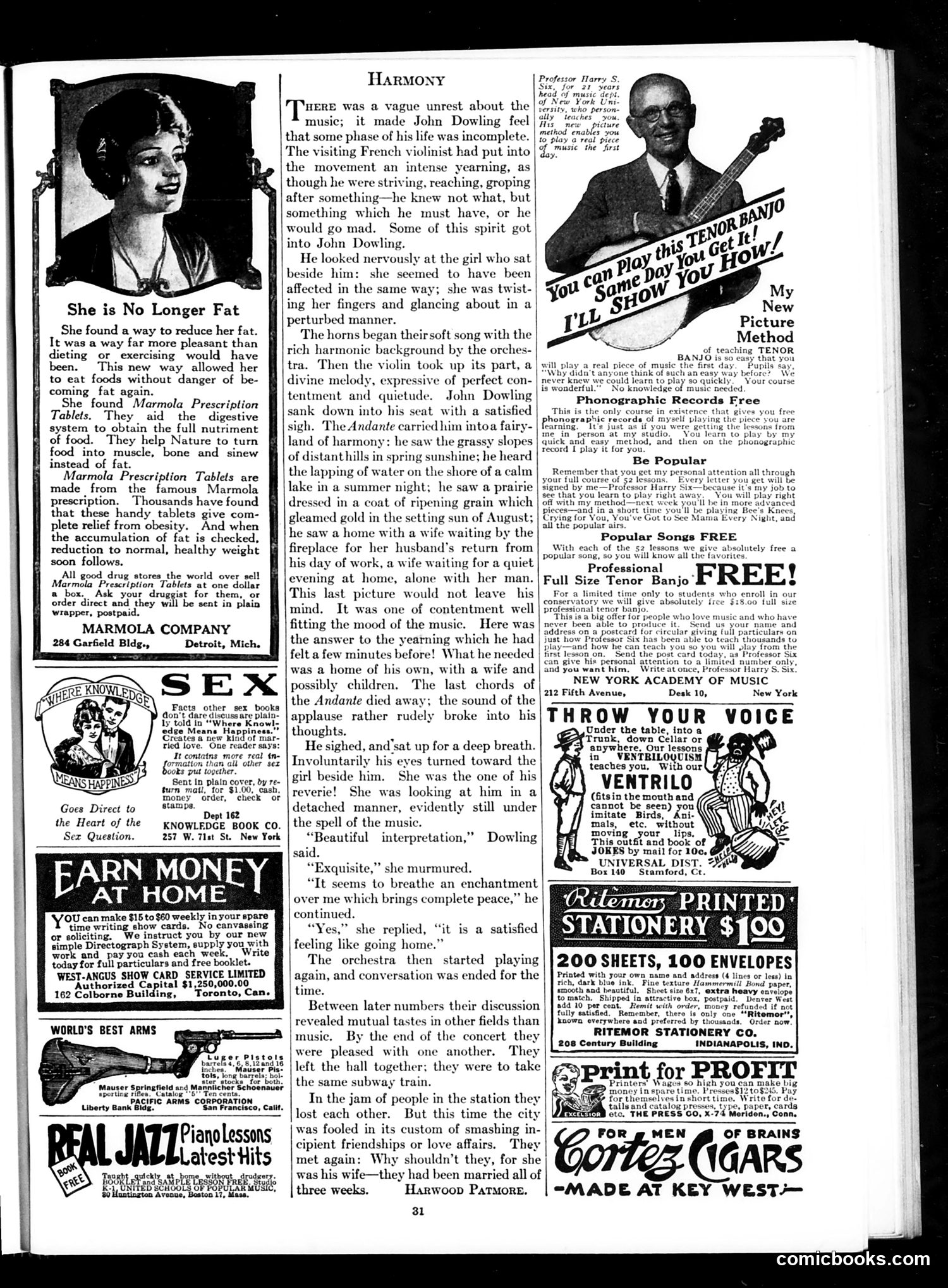
This page is primarily a **serialized short story** titled "Harmony" by Harwood Patmore, occupying most of the left and center columns. The narrative depicts a man named John Dowling attending a concert where French violinist music moves him emotionally, awakening yearnings for domestic life—a wife, home, and family. The story explores how the music's beauty stirs deep longings within him and a woman sitting nearby. The remainder of the page consists of **period advertisements** (typical for Judge magazine), including pitches for weight-loss tablets (Marmola), sex education books, piano lessons, show-card writing jobs, and various other products. These ads represent common commercial offerings of the early 20th century. The story itself contains no political satire or cartoon elements—it's sentimental fiction. The advertisements are straightforward commercial appeals without satirical intent, reflecting the magazine's revenue model.
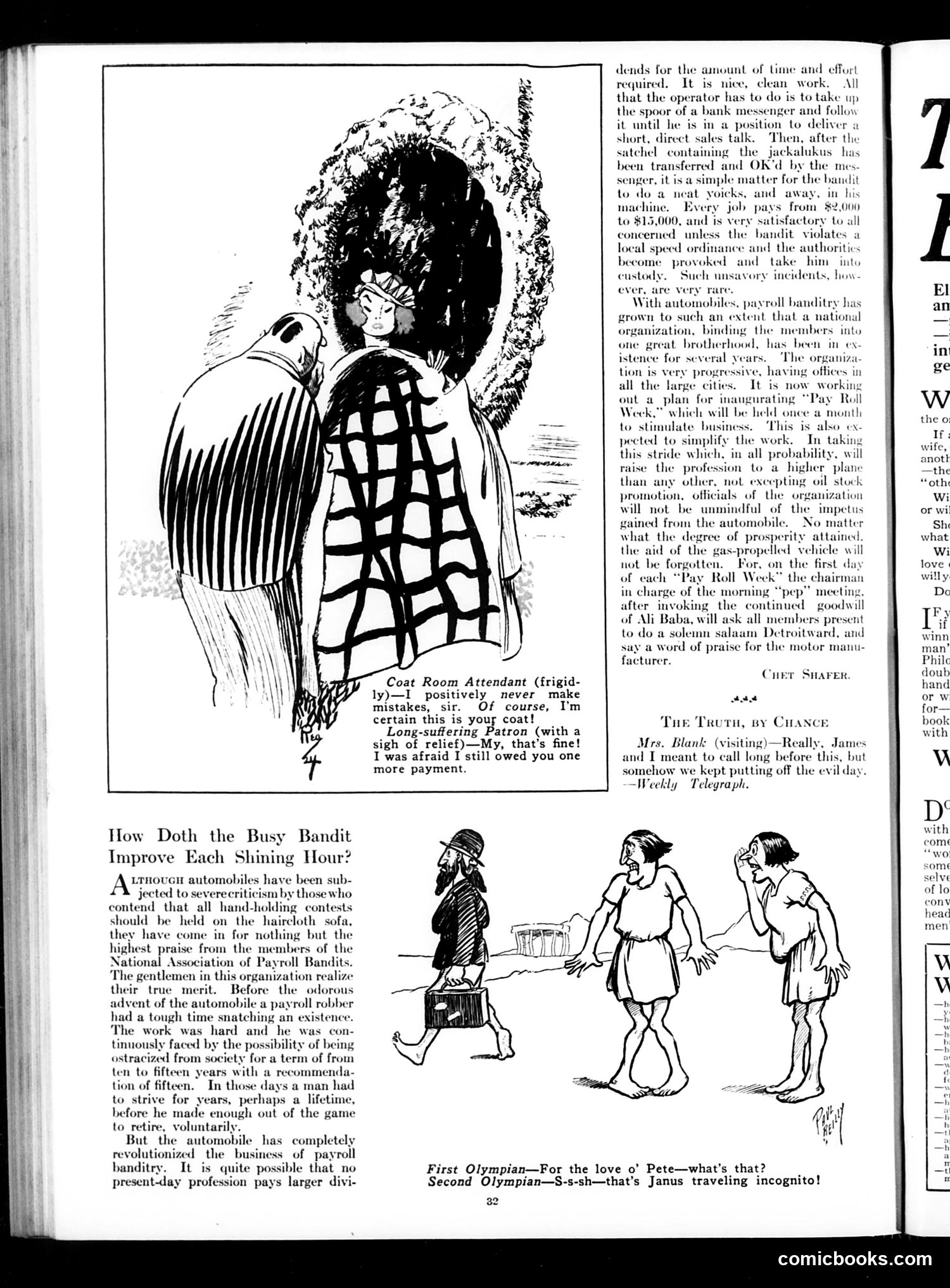
This page contains two distinct satirical pieces: **"How Doth the Busy Bandit Improve Each Shining Hour?"** is a tongue-in-cheek article praising automobile-enabled payroll robbery as a modernized profession. The satire mocks both the criminals and society's fascination with criminal enterprise by presenting banditry as a legitimate, organized business with national chapters, "Pay Roll Week" promotions, and even motor manufacturer endorsements. The joke is that automobiles have made crime so efficient and profitable that it rivals respectable industries—the author sarcastically calls it "nice, clean work" and suggests it pays better than stock promotion. The coat-room cartoon above depicts a minor class-conflict joke: an attendant insists they never make mistakes with coats, while the patron jokingly suggests he still owes a payment on his own coat—implying he's been coming so long he hasn't paid it off. The bottom cartoon references the Roman god Janus (associated with doorways and transitions) "traveling incognito"—a simple visual pun. All three pieces represent typical Judge magazine humor: witty, cynical commentary on contemporary society and human nature.
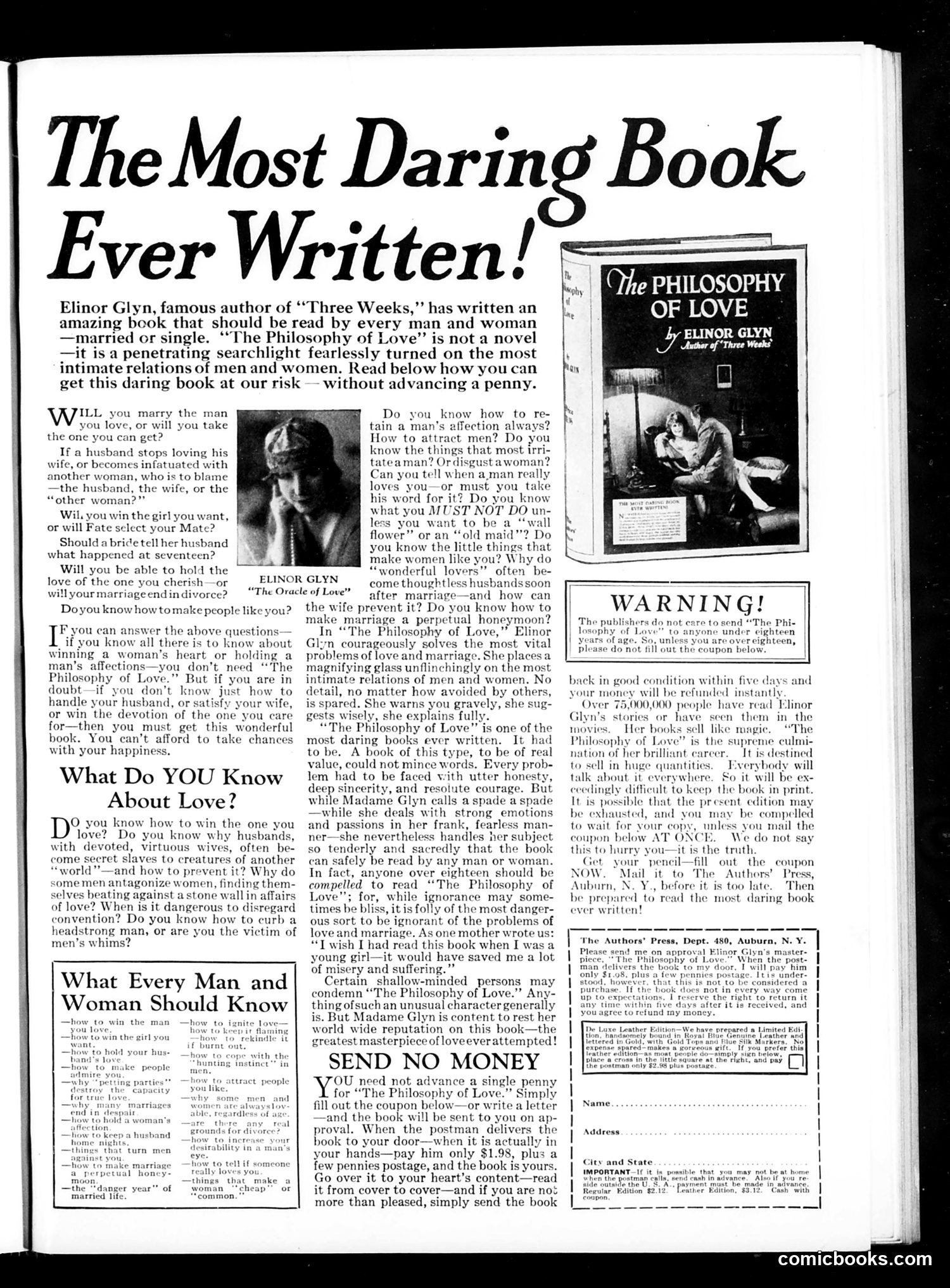
This page is primarily **advertising for "The Philosophy of Love" by Elinor Glyn**, a real author famous for her scandalous 1907 novel "Three Weeks." The ad is structured as satirical clickbait disguised as editorial content—a common Judge magazine technique. The satire works through **exaggeration and breathless hype**: the ad poses sensational questions about marriage, infidelity, and attraction ("Will your marriage end in divorce?"), then claims Glyn's book provides forbidden knowledge that will solve all romantic problems. The humor lies in the **overwrought tone and melodrama**—treating relationship advice as dangerously transgressive material requiring a stern "WARNING!" The ad mocks both Glyn's celebrity and 1920s anxieties about changing gender roles and marriage. The "$1.98 plus postage" pricing undercuts the cosmic importance implied earlier. This represents Judge's typical approach: using exaggerated advertising parody to comment on contemporary obsessions with self-help literature and sexual frankness.
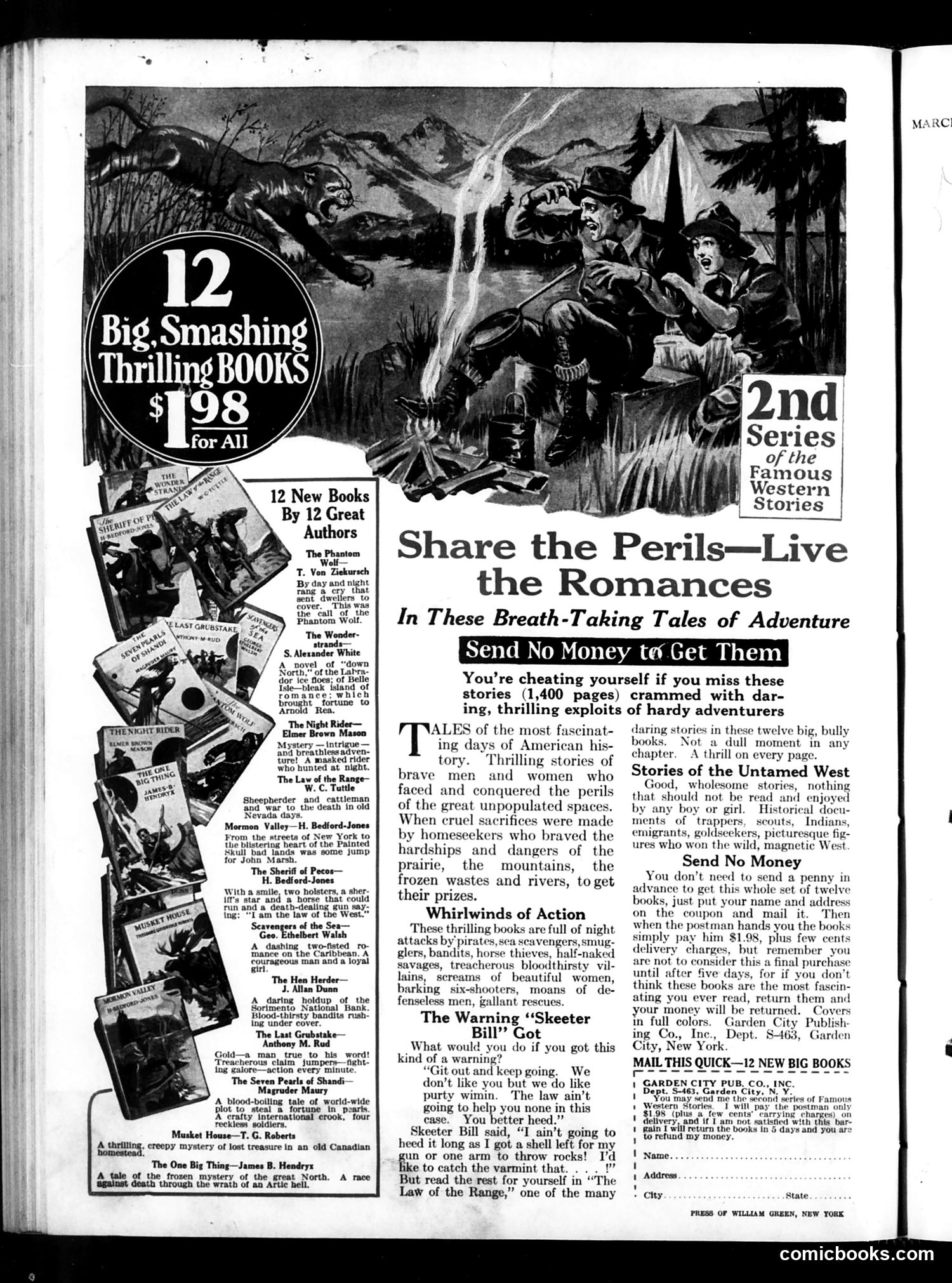
This is primarily a **book advertisement**, not a political cartoon. It promotes a 12-book collection of Western adventure stories (2nd series) priced at $1.98, using mail-order marketing tactics common in early 20th-century magazines. The imagery depicts archetypal Western scenes—frontier men in conflict with Native Americans, outlaws, and wilderness dangers—reflecting the period's romanticized view of American frontier history. Book titles like "The Phantom Wolf," "The Sheriff of Pecos," and "The Law of the Range" promise action, violence, and adventure. The "no money down" sales pitch was a prevalent advertising strategy of the era, allowing readers to examine books before committing payment. The ad emphasizes wholesome content ("nothing that should not be read...by any boy or girl"), suggesting publishers marketed these stories to families. The content reflects early 20th-century American fascination with Western mythology and frontier narratives, presenting simplified, adventurous portrayals of frontier settlement, often romanticizing violence and Native American conflicts.