
Judge, 1924-03-01 · page 14 of 36
Judge — March 1, 1924 — page 14: what you’re looking at
What you’re looking at
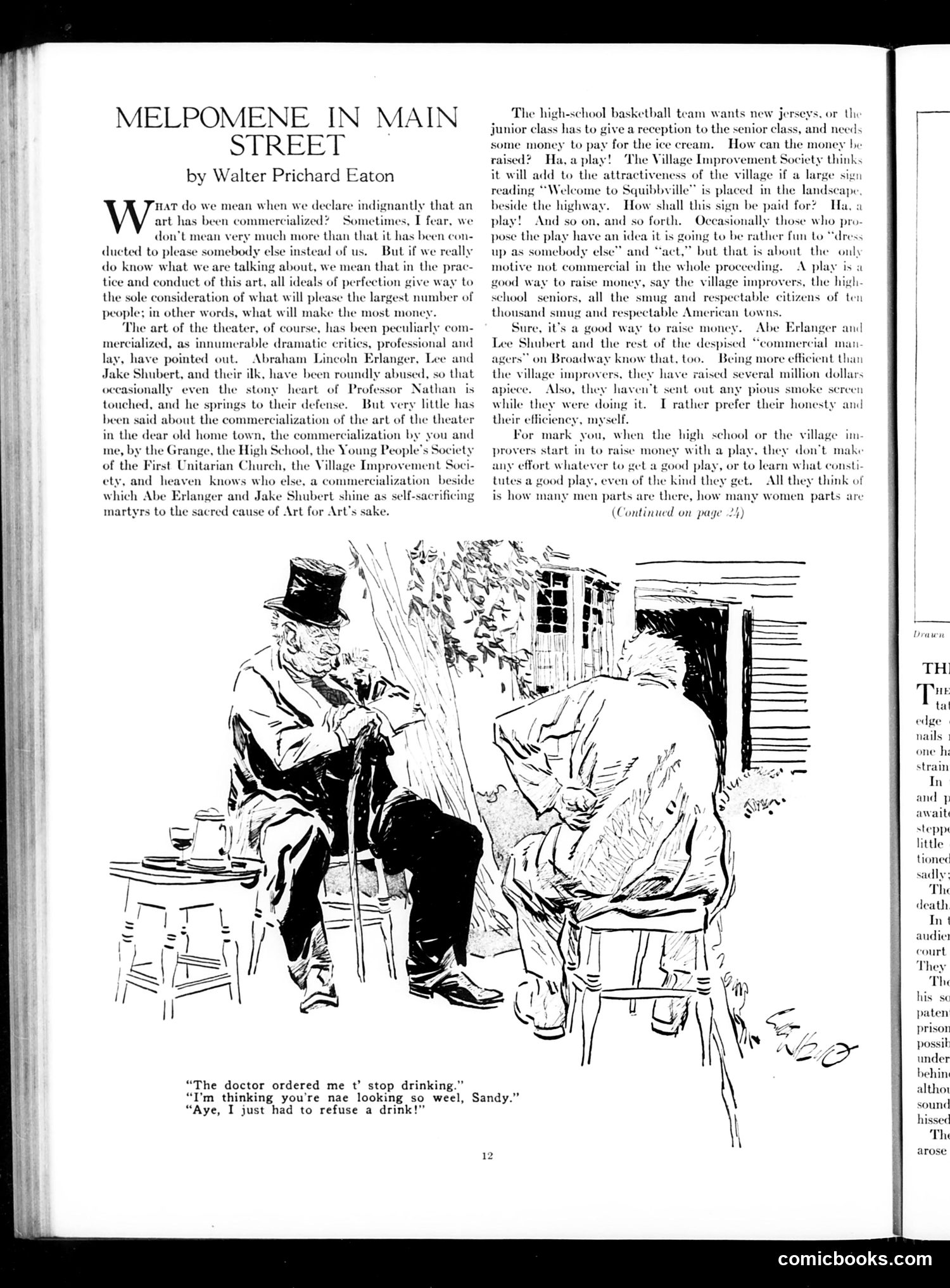
**The Essay & Cartoon:** Walter Prichard Eaton's article critiques the "commercialization" of theater in small-town America. He argues that while Broadway moguls like Erlanger and the Shubert brothers are openly profit-driven, small towns hypocritically use theatrical productions to fundraise—claiming to promote "art" while actually just seeking money for basketball jerseys, ice cream socials, and highway signs. **The Cartoon:** The sketch shows two men in conversation (one wearing a top hat) with caption dialogue: "The doctor ordered me to stop drinking" / "I'm thinking you're nae looking so weel, Sandy" / "Aye, I just had to refuse a drink!" This appears unrelated to the main article—a separate joke about health and abstinence, using Scottish dialect ("nae," "weel"). **Key Point:** Eaton's satire targets hypocrisy: rural communities claim cultural superiority over crass Broadway while themselves exploiting theater purely for profit, without caring about artistic quality or merit.
📄 Transcribed text from this page (OCR, searchable)
Machine-transcribed from the original scan — historical spelling and the odd misread are preserved.
MELPOMENE IN MAIN STREET by Walter Prichard Eaton nmAT do we mean when we declare indignantly that an art has been commercialized? Sometimes, I fear, we don’t mean very much more than that it has been con- ducted to please somebody else instead of us. But if we do know what we are talking about, we mean that in the p: tice and conduct of this art, all ideals of perfection give way to the sole consideration of what will please the largest number of people; in other words, what will make the most money. The art of the theater, of course, has been peculiarly com- mercialized, as innumerable dramatic critics, professional and lay, e pointed out. Abraham Lincoln Erlanger, Lee and Jake Shubert, and their ilk, have been roundly abused, so that occasionally even the stony heart of Professor Nathan is touched, and he springs to their defense. But very little has been said about the commercialization of the art of the theater in the dear old home town, the commercialization by you and me, by the Grange, the High School, the Young People’s Society of the First Uni n Church, the Village Improvement Soci- ‘en knows who else, a commercialization beside which Abe anger and Jake Shubert shine as self-sacrificing martyrs to the sacred cause of Art for Art’s sake. “The doctor ordered me t’ stop drinking.” The high-school basketball team wants new jerseys, or Uy junior class has to give a reception to the senior class, and needs some money to pay for the ice cream. How can the money x raised? Ha,a play! ‘The Village Improvement Society thinks it will add to the attractiveness of the village if a large reading “Welcome to Squibbville” is placed in the landse: beside the highway. How shall this sign be paid for? Ha, « play! And so on, and so forth. Occasionally those who pro- pose the play have an idea it is going to be rather fun to * “and “act,” but that is about: the ouly motive not commercial in the whole proceeding. A play is « good way to raise money, say the village improvers, the high school seniors, all the smug and respectable citizens of ten thousand smug and respectable Ame! up as somebody else” Sure, it’s a good way to raise money. flanger and Lee Shubert and the rest of the despised “commercial man agers” on Broadway know that, too. Being more efficient than the village improvers, they have raised several million dollars apie Also, they haven't sent out any pious smoke screen while they were doing it. T rather prefer their honesty and their efficiency, myse For mark you, when the high school or the village im provers start in to raise money with a play, they don’t mak: any effort whatever to get a good play, or to learn what consti- tutes a good play, even of the kind they get. All they think of is how many men parts are there, how many women parts are (Continued on page 24) “I'm thinking you're nae looking so weel, Sandy.” “Aye, I just had to refuse a drink!” THI Ts edge nails | one hi strain In and } await steppt little tionec sadly; The death Int audie court They The his se paten prison under behin althon sound hissed The arose comicbooks.com