
Judge, 1924-03-01 · page 17 of 36
Judge — March 1, 1924 — page 17: what you’re looking at
What you’re looking at
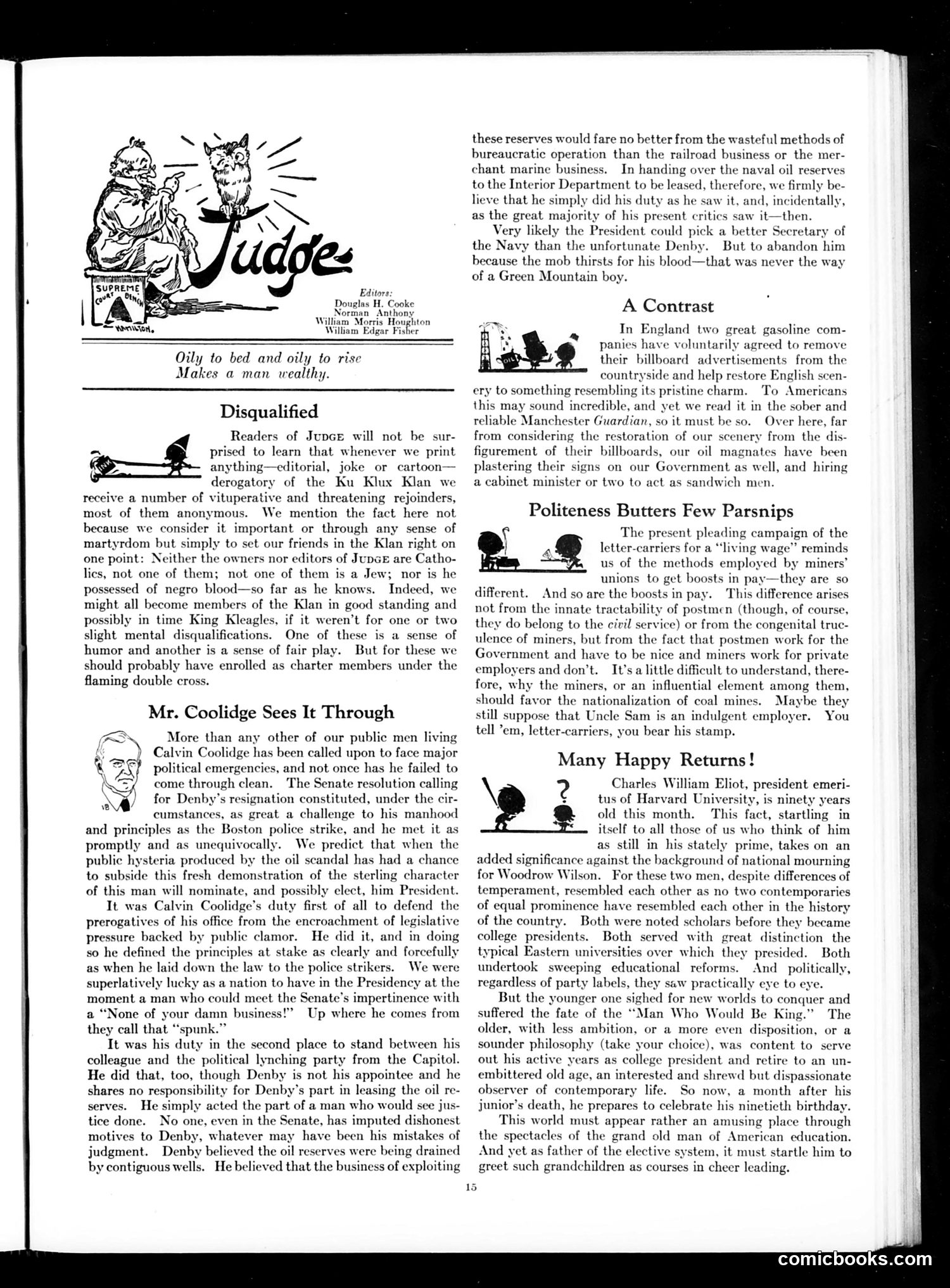
This page contains **editorial commentary defending Calvin Coolidge and his Secretary of the Navy, Edwin Denby**, during the Teapot Dome scandal (early 1920s oil reserves leasing controversy). The **"Disqualified" section** responds to Ku Klux Klan threats against Judge's anti-Klan editorial stance. The editors sarcastically claim they'd qualify for KKK membership except for two disqualifications: "a sense of humor and another is a sense of fair play"—a cutting indictment of the Klan's lack of both. The main **"Mr. Coolidge Sees It Through"** article praises Coolidge for defending Denby against Senate calls for resignation, framing it as principled leadership rather than protection of a subordinate. The piece argues Denby acted honestly, if mistakenly, in leasing naval oil reserves to private interests. The final sections discuss British companies voluntarily removing countryside billboards and note Charles William Eliot's 90th birthday, adding lighter content to balance the heavier political commentary.
📄 Transcribed text from this page (OCR, searchable)
Machine-transcribed from the original scan — historical spelling and the odd misread are preserved.
Cooke Anthony Houghton William Edgar Fisher Oily to bed and oily to rise Makes a man wealthy. Disqualified Readers of Jupce will not be sur- prised to learn that whenever we print anything—editorial, joke or cartoon— derogatory of the Ku Klux Klan we receive a number of vituperative and threatening rejoinders, most of them anonymous. We mention the fact here not because we consider it important or through any sense of martyrdom but simply to set our friends in the Klan right on one point: Neither the owners nor editors of JupGE are Catho- lics, not one of them; not one of them is a Jew; nor is he possessed of negro blood—so far as he knows. Indeed, we might all become members of the Klan in good standing and possibly in time King Kleagles, if it weren’t for one or two slight mental disqualifications. One of these is a sense of humor and another is a sense of fair play. But for these we should probably have enrolled as charter members under the flaming double cross. Mr. Coolidge Sees It Through More than any other of our public men living Calvin Coolidge has been called upon to face major political emergencies, and not once has he failed to come through clean. The Senate resolution calling for Denby’s resignation constituted, under the cir- cumstances, as great a challenge to his manhood and principles as the Boston police strike, and he met it as promptly and as unequivocally. We predict that when the public hysteria produced by the oil scandal has had a chance to subside this fresh demonstration of the sterling character of this man will nominate, and possibly elect, him President. It was Calvin Coolidge’s duty first of all to defend the prerogatives of his office from the encroachment of legislative pressure backed by public clamor. He did it, and in doing so he defined the principles at stake as clearly and forcefully as when he laid down the law to the police strikers. We were superlatively lucky as a nation to have in the Presidency at the moment a man who could meet the Senate’s impertinence with a “None of your damn business!” Up where he comes from they call that “spunk.” It was his duty in the second place to stand between his colleague and the political lynching party from the Capitol. He did that, too, though Denby is not his appointee and he shares no responsibility for Denby’s part in leasing the oil re- serves. He simply acted the part of a man who would see jus- tice done. No one, even in the Senate, has imputed dishonest motives to Denby, whatever may have been his mistakes of judgment. Denby believed the oil reserves were being drained by contiguous wells. He believed that the business of exploiting 15 these reserves would fare no better from the wasteful methods of bureaucratic operation than the railroad business or the mer- chant marine business. In handing over the naval oil reserves to the Interior Department to be leased, therefore, we firmly be- lieve that he simply did his duty as he saw it, and, incidentally, as the great majority of his present critics saw it—then. Very likely the President could pick a better Secretary of the Navy than the unfortunate Denby. But to abandon him because the mob thirsts for his blood—that was never the way of a Green Mountain boy. A Contrast In England two great gasoline com- panies have voluntarily agreed to remove their billboard advertisements from the countryside and help restore English scen- ery to something resembling its pristine charm. To Americans this may sound incredible, and yet we read it in the sober and reliable Manchester Guardian, so it must be so. Over here, far from considering the restoration of our scenery from the dis- figurement of their billboards, our oil magnates have been plastering their signs on our Government as well, and hiring a cabinet minister or two to act as sandwich men. Politeness Butters Few Parsnips The present pleading campaign of the e & us of the methods employed by miners’ unions to get boosts in pay—they are so not from the innate tractability of postmen (though, of course, they do belong to the civil service) or from the congenital truc- Government and have to be nice and miners work for private employers and don’t. It’s a little difficult to understand, there- should favor the nationalization of coal mines. Maybe they still suppose that Uncle Sam is an indulgent employer. You letter-carriers for a “living wage” reminds different. And so are the boosts in pay. This difference arises ulence of miners, but from the fact that postmen work for the fore, why the miners, or an influential element among them, tell ’em, letter-carriers, you bear his stamp. Many Happy Returns! Charles William Eliot, president emeri- tus of Harvard University, is ninety years old this month. This fact, startling in itself to all those of us who think of him as still in his stately prime, takes on an added significance against the background of national mourning for Woodrow Wilson. For these two men, despite differences of temperament, resembled each other as no two contemporaries of equal prominence have resembled each other in the history of the country. Both were noted scholars before they became college presidents. Both served with great distinction the typical Eastern universities over which they presided. Both undertook sweeping educational reforms. And _ politically, regardless of party labels, they saw practically eye to eye. But the younger one sighed for new worlds to conquer and suffered the fate of the “Man Who Would Be King.” The older, with less ambition, or a more even disposition, or a sounder philosophy (take your choice), was content to serve out his active years as college president and retire to an un- embittered old age, an interested and shrewd but dispassionate observer of contemporary life. So now, a month after his junior’s death, he prepares to celebrate his ninetieth birthday. This world must appear rather an amusing place through the spectacles of the grand old man of American education. And yet as father of the elective em, it must startle him to greet such grandchildren as courses in cheer leading. comicbooks.com