
Judge, 1924-03-01 · page 12 of 36
Judge — March 1, 1924 — page 12: what you’re looking at
What you’re looking at
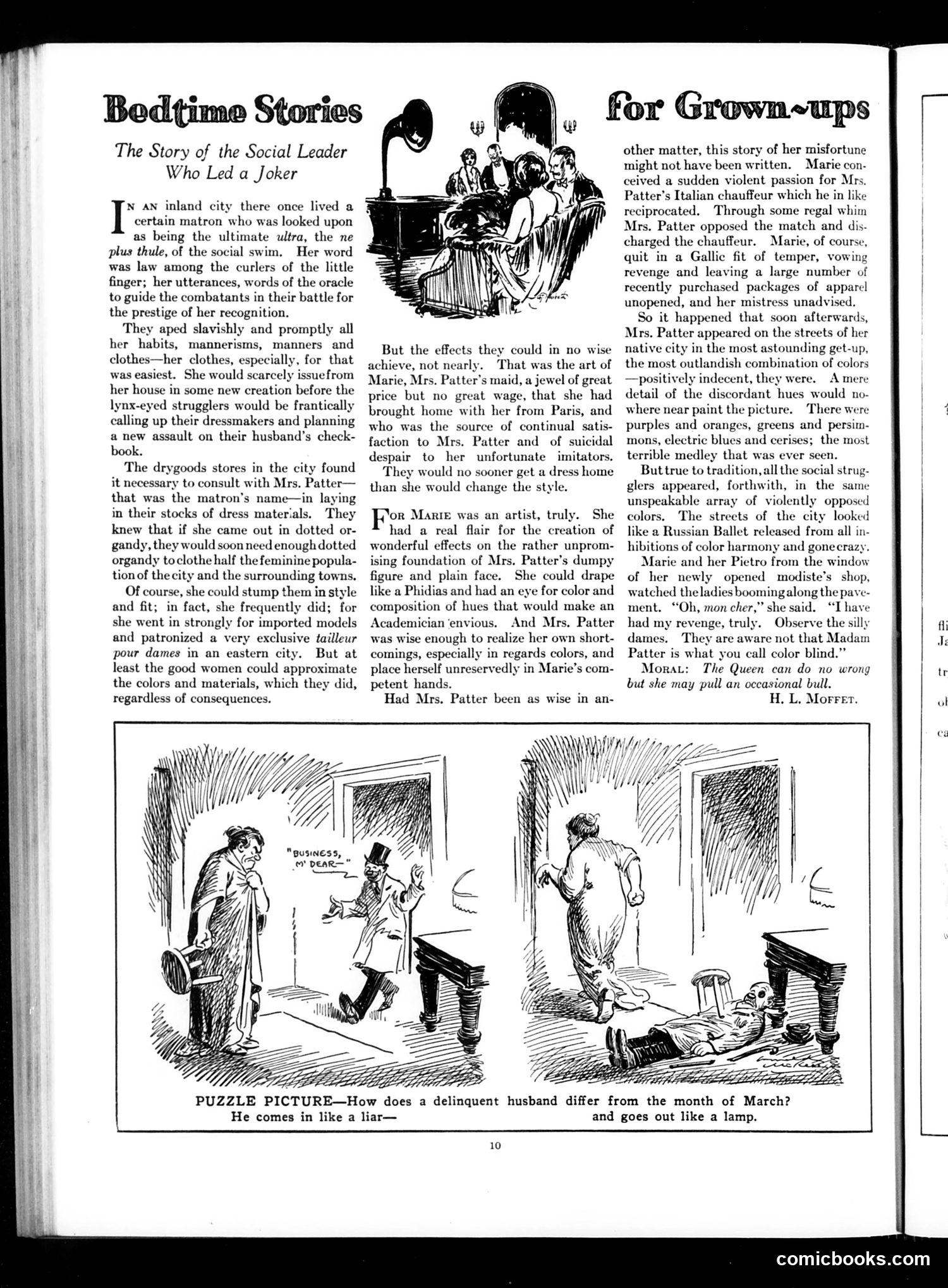
This satirical story mocks high-society fashion conformity and the power of social elites to dictate taste. Mrs. Patter is a wealthy matron whose fashion choices are slavishly copied by aspiring social climbers desperate for prestige. The twist: her French maid Marie, spurned when Mrs. Patter forbids her romance with the Italian chauffeur, takes revenge by dressing her mistress in a deliberately hideous, clashing color combination. The joke is that all the fashion-obsessed imitators immediately copy this disaster, making the entire city look ridiculous. The accompanying puzzle picture plays on the phrase "comes in like a lion, goes out like a lamb" (about March), substituting "liar" and "lamp"—depicting a deceiving husband's double life. The satire targets both wealthy women's vanity and the absurdity of blind fashion conformity.
📄 Transcribed text from this page (OCR, searchable)
Machine-transcribed from the original scan — historical spelling and the odd misread are preserved.
e oe Bedtime Stories The Story of the Social Leader Who Led a Joker N AN inland city there once lived a certain matron who was looked upon as being the ultimate ultra, the ne plus thule, of the social swim. Her word was law among the curlers of the little finger; her utterances, words of the oracle to guide the combatants in their battle for the prestige of her recognition. They aped slavishly and promptly all her habits, mannerisms, manners and clothes—her clothes, especially, for that was easiest. She would scarcely issuefrom her house in some new creation before the lynx-eyed strugglers would be frantically calling up their dressmakers and planning a new assault on their husband's check- book. The drygoods stores in the city found it necessary to consult with Mrs. Patter— that was the matron’s name—in laying in their stocks of dress materials. They knew that if she came out in dotted or- gandy, they would soon need enough dotted organdy toclothe half the feminine popula- tion of the city and the surrounding towns. Of course, she could stump them in style and fit; in fact, she frequently did; for she went in strongly for imported models and patronized a very exclusive tailleur pour dames in an eastern city. But at least the good women could approximate the colors and materials, which they did, regardless of consequences. PUZZLE PICTURE—How does a delinquent husband differ from the month of March? He comes in like a liar— , for Grown-ups But the effects they could in no wise achieve, not nearly. That was the art of Marie, Mrs. Patter’s maid, a jewel of great price but no great wage, that she had brought home with her from Paris, and who was the source of continual satis- faction to Mrs. Patter and of suicidal despair to her unfortunate imitators. They would no sooner get a dress home than she would change the style. lon Marte was an artist, truly. She had a real flair for the creation of wonderful effects on the rather unprom- ising foundation of Mrs. Patter’s dumpy figure and plain face. She could drape like a Phidias and had an eye for color and composition of hues that would make an Academician ‘envious. And Mrs, Patter was wise enough to realize her own short- comings, especially in regards colors, and place herself unreservedly in Marie’s com- petent hands. Had Mrs, Patter been as wise in an- and goes out like a lamp. other matter, this story of her misfortune might not have been written. Marie con- ceived a sudden violent passion for Mrs. Patter’s Italian chauffeur which he in like reciprocated. Through some regal whim Mrs. Patter opposed the match and dis- charged the chauffeur. Marie, of course, quit in a Gallic fit of temper, vowing revenge and leaving a large number of recently purchased packages of apparel unopened, and her mistress unadvised. So it happened that soon afterwards, Mrs. Patter appeared on the streets of her native city in the most astounding get-up, dish combination of colors nt, they were. A mere detail of the discordant hues would no- where near paint the picture. There were and oranges, greens and persim- mons, electric blues and ¢ the most terrible medley that was ever seen. Buttrue to tradition, all the social strug- glers appeared, forthwith, in the same unspeakable array of violently opposed colors. The streets of the city looked like a Russian Ballet released from all in- hibitions of color harmony and gonecrazy. Marie and her Pietro from the window of her newly opened modiste’s shop, watched theladies boomingalong the pave- ment. “Oh, mon cher,” she said. “I he had my revenge, truly. Observe the sill) dames. They are aware not that Madam Patter is what you call color blind.” Morar: The Queen can do no wrong but she may pull an occasional bull. H, L. Morrer. comicbooks.com fli Ji