
Judge, 1924-03-01 · page 22 of 36
Judge — March 1, 1924 — page 22: what you’re looking at
What you’re looking at
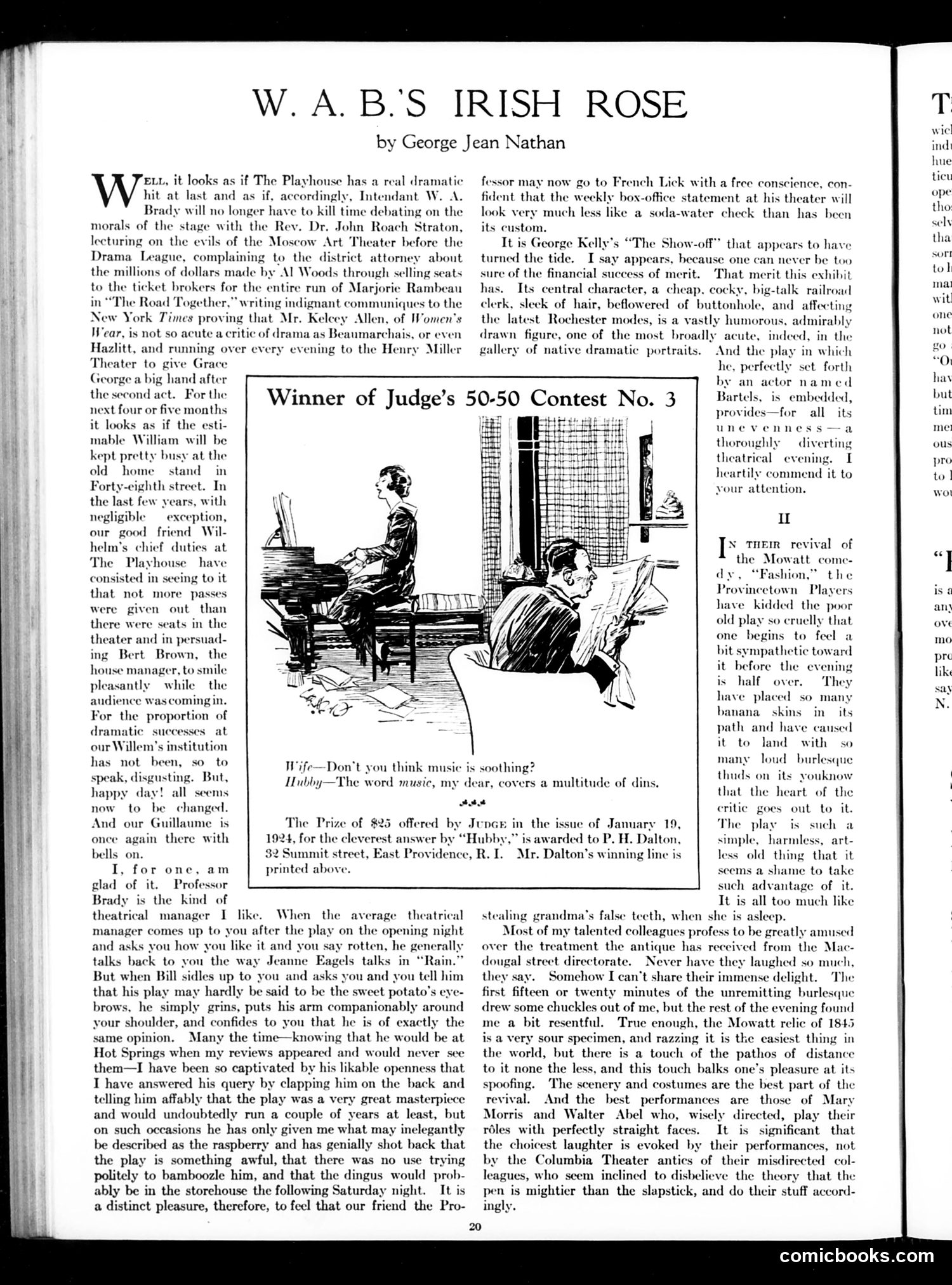
This page discusses **W.A.B.'s Irish Rose** and praises George Kelly's play **"The Show-off,"** which appears to have finally given theatrical producer W.A. Brady a financial success at his Playhouse theater. The cartoon shows a husband and wife in domestic conversation. The wife asks if he thinks music is soothing; the husband replies that "music" covers "a multitude of dims"—a play on the phrase "multitude of sins," suggesting the wife's singing is so bad it requires euphemistic language. The article describes Brady as an unusually likable theater manager who, unlike others, honestly admits when his plays are failures rather than pretending they're successes. The writer celebrates that Brady can finally leave for French Lick (a resort town) confident his box office will show actual profit, rather than the disappointing results his theater typically produced.
📄 Transcribed text from this page (OCR, searchable)
Machine-transcribed from the original scan — historical spelling and the odd misread are preserved.
Seer by George ‘ X Text, it looks as if The Playhouse has a real dramatic hit at last and as if, accordingly, Intendant W. A. Brady will no longer have to kill time debating on the morals of the stage with the Rey. Dr. John Roach Straton, lecturing on the evils of the Moscow Art Theater before the Drama League, complaining to the district attorney about the millions of dollars made by Al Woods through selling seats to the ticket brokers for the entire run of Marjorie Rambeau in “The Road Together,” writing indignant communiques to the New York Times proving that Mr. Kel Allen, of Women’s Wear, is not so acute a critic of drama as Beaumarchais, or even Hazlitt, and running over every evening to the Henry Miller Theater to give Grace George a big hand after the second act. For the next four or five months it looks as if the esti- mable William will be kept pretty busy at the old home stand in Forty-eighth street. In the last few years, with negligible exception, our good friend Wil- helm’s chief duties at The Playhouse have Winner of Judge’s consisted in seeing to it that not more passes were given out than there were seats in the theater and in persuad- ing Bert Brown, the house manager, to smile pleasantly while the audience was coming in. For the proportion of dramatic successes at our Willem’s institution has not been, so to Wife speak, disgusting. But, happy da. now to be changed. And our Guillaume is The Prize of once again there with bells on. I, for one, am glad of it. Professor Brady is the kind of theatrical manager I like. When the average theatrical manager comes up to you after the play on the opening night and asks you how you like it and you talks back to you the way Jeanne Eagels talks in “Rain.” But when Bill sidles up to you and you and you tell him that his play may hardly be said to be the sweet potato’s eye- brows, he simply grins, puts his arm companionably around your shoulder, and confides to you that he is of exactly the same opinion. Many the time—knowing that he would be at Hot Springs when my reviews appeared and would never sce them—I have been so captivated by his likable openness that I have answered his query by clapping him on the back and telling him affably that the play was a very great masterpiece and would undoubtedly run a couple of years at least, but on such occasions he has only given me what may inelegantly be described as the raspberry and has genially shot back that the play is something awful, that there was no use trying politely to bamboozle him, and that the dingus would prob- ably be in the storehouse the following Saturday night. It is a distinct pleasure, therefore, to feel that our friend the Pro- -—Don't you think music Hubby—The word music, my « all seems 25 offered by 1924, for the cleverest answer by printed above. rotten, he generally rnd “Hubby. 32 Summit street, East Providence. W.A.B.S IRISH ROSE Jean Nathan fessor may now go to French Lick with a free conscience, con- fident that the wee box-office statement at his theater will look very much less like a soda-water check than has been its custom. It is George Kelly's “The Show-off” that appears to have turned the tide. I say appears, because one can never be too sure of the financial su s of merit. That merit this exhibit has. Its central charac a cheap, cocky, big-talk railroad clerk, sleek of hair, beflowered of buttonhole, and affecting the latest Rochester modes, is a vastly humorous, admirably drawn figure, one of the most broadly acute, ind in the gallery of native dramatic portraits. And the play in which he, perfectly set forth by an actor named Bartels, is embedded, provides—for all its unevenness—a thoroughly — diverting theatrical evening. I heartily commend it to your attention. 50-50 Contest No. 3 i Is THEIR revival of the Mowatt come- Fashion,” the Provincetown Players have kidded the poor old play so cruelly that one begins to feel a bit sympathetic toward dy it before the evening is half over. ‘They have placed so many vana skins in its path and have caused it to land with so many loud burlesque thuds on its youknow that the heart of the critic goes out to it. in the issue of January 19, The play is such a is awarded to P. H. Dalton, ,R.E. Mr. Dalton’s winning line is is soothing? lear, covers a multitude of dins, Tune simple, harmless, art- less old thing that it seems a shame to take such advantage of it. It is all too much like stealing grandma's false tecth, when she is asleep. Most of my talented colleagues profess to be greatly amused over the treatment the antique ed from the Mac- al street directorate. Never have they laughed so much, Somehow I can’t share their immense delight. ‘The first fifteen or twenty minutes of the unremitting burlesque drew some chuckles out of me, but the rest of the evening found me a bit resentful. True enough, the Mowatt relic of 1845 is a very sour specimen, and razzing it is the easiest thing in the world, but there is a touch of the pathos of distance to it none the less, and this touch balks one’s pleasure at its spoofing. ‘The scenery and costumes are the best part of the revival. And the best performances are those of Mary Morris and Walter Abel who, wisely directed, play their roles with perfectly straight faces. It is significant that the choicest laughter is evoked by their performances, not by the Columbia Theater antics of their misdirected col- leagues, who seem inclined to disbelieve the theory that the pen is mightier than the slapstick, and do their stuff accord- comicbooks.com 7 wicl ind hue ticu ope tho sely tha sort tol mal wit one not go “0 hav but tim me ous pro to] wo “ ] is a any ove mo pre like say